Article Contents:
- Short answer: what needs to be decided before placing an order
- Confirmed specifications of Alcor HL-066M
- Why the entry "Alcor HL-066M — 12 pieces" is insufficient
- Facade list: the main document before the cart
- How to count handles for the entire furniture series
- Cabinet and tall cabinet doors
- External drawers
- Internal drawers
- Buffets, display cases, and freestanding furniture
- Zebrano: active linear graphics
- Wenge: a dark accent on a light facade
- Palisander: expressive warm pattern
- Walnut: calm connecting wood note
- Count furniture items, not facades
- Order execution only by verbal name
- Mixing executions without a design concept
- Forgetting internal drawers
- Assign two handles based on width only
- Do not check the 41 mm protrusion
- Start drilling based on one obtained handle
- Expect photographically identical wood
- Forget the metal palette
- Postpone FUR-033 for later
- Do not save the final version of the list
- In which wood finishes is Alcor HL-066M available?
- What size is the Alcor handle?
- Can I order Alcor for the entire kitchen in one quantity?
- How many handles are needed for a two-door cabinet?
- How many handles to install on a wide drawer?
- Do I need to consider internal drawers?
- Can I mix walnut and wenge in one set?
- Will all handles of the same finish be completely identical?
- How to check Alcor next to a furniture molding?
- What does the stainless steel color base mean?
- What is the FUR-033 plug used for?
- Is the FUR-033 automatically included in the handle set?
- Do I need to order a spare handle?
- When can I start drilling the facades?
- Can I order the kitchen now and the sideboard later?
- How to distribute handles on paired doors?
- Is Alcor suitable for a small cabinet?
- Is Alcor suitable for commercial interiors?
- Where can I see the current price of Alcor HL-066M?
- What to do if the size or shape doesn't fit?
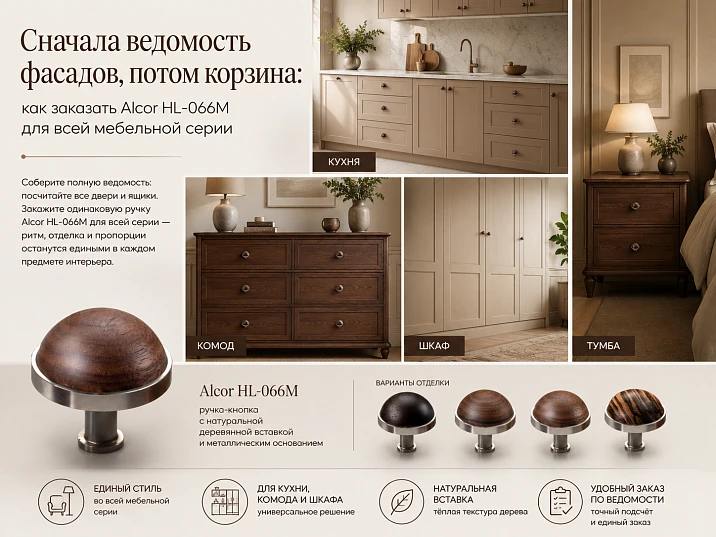
buy wooden furniture handles for a kitchen, cabinet, dresser, or an entire furniture collection, it is better not by approximate number of items, but according to a pre-compiled specification for each facade. If the project suits the Alcor HL-066M model, first choose one of four wood finishes, check the size 42 × 42 × 41 mm on a real door or drawer, consider the stainless steel color base, and only then determine the final quantity. This order helps buy the Alcor HL-066M furniture handle immediately for the entire series, not forget internal drawers, not mix zebrano with walnut, and not start drilling until the full batch is received.
Alcor HL-066M is not just a separate handle that can be added to the cart at the last moment. In a furniture project, it repeats dozens of times and becomes a visual system: it connects the kitchen with the sideboard, the cabinet with the dresser, external facades with internal drawers. One mistake in finish, quantity, or placement also repeats dozens of times. Therefore, the useful result of preparing for an order is not a note 'Alcor, 12 pieces', but a clear specification linked to each facade.
This article helps to go through the entire process: from choosing zebrano, wenge, palisander, or walnut to distributing the received handles across paired doors. It covers the facade specification, fitting the dimensions, one or two handles on a wide drawer, combining wood with a metal base, the decorative plug FUR-033, batch acceptance, and the safe moment to start drilling.
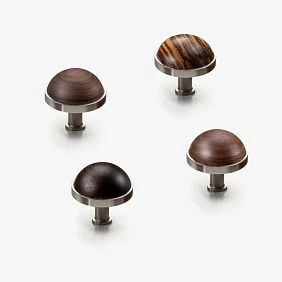
Short answer: what needs to be decided before placing the order
The Alcor HL-066M model has one confirmed dimension: 42 × 42 × 41 mm. Four wood finishes are available: zebrano, wenge, rosewood, and walnut. The base has a stainless steel color. The product card includes a drawing and a 3D model, so the shape can be assessed not only from the front photo.
Before placing an order, you need to make five related decisions:
- Choose a wood finish for all furniture or document a deliberate combination of several options in writing.
- Count not cabinets and chests, but all doors, internal and external drawers, pull-out sections, and other openable fronts.
- Determine one or two handles for each front and a uniform position relative to axes and edges.
- Check whether the 42 × 42 mm dimension and 41 mm protrusion conflict with molding, an adjacent door, a wall, a countertop, or hand movement.
- Separately resolve the issue with the FUR-033 plug, fasteners, spare parts, and distribution of the natural wood grain across paired fronts.
After this, the cart becomes a reflection of the project, not an approximate purchase. The quantity can be verified, the finish is not lost in correspondence, and the installer receives a diagram according to which identical fronts will be drilled identically.




Confirmed specifications of Alcor HL-066M
| Parameter | Confirmed data | What this changes for the order |
|---|---|---|
| Model | Alcor HL-066M | The article number must be specified in each line of the specification and on the installation diagram |
| Type | Furniture handle with a wood element and a metal base | Both the wood grain and the metal color need to be approved |
| Size | 42 × 42 × 41 mm | They check the front scale, protrusion, and free movement of adjacent parts |
| Wood finishes | Zebrano, wenge, rosewood, walnut | The selected option is fixed for each position, not just in the general comment to the order |
| Base | Stainless steel color | Checked against other visible metal elements of the project |
| Project materials | Drawing and 3D model are available in the card | They are used to check dimensions, protrusion, and visual scale |
| Texture | Natural pattern of individual products may vary | The received batch is laid out on facades before drilling |
| Related part | FUR-033, 14 × 14 × 3 mm, nickel color, for hiding M4 screw head | The need and quantity of plugs are checked separately |
| Price and availability | Variable commercial parameters | Checked in the card before placing an order |
The table shows why the model name does not replace the specification. The same article can be ordered in different wood finishes, and the same finish does not turn natural texture into a printed repeat. Additionally, the handle is not only part of the design: its protrusion and position must work together with the furniture construction.
Our factory also produces:
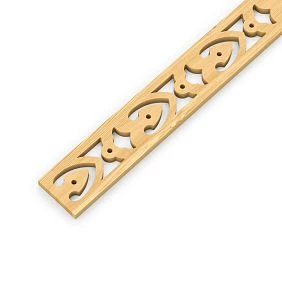
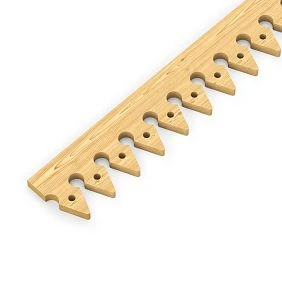
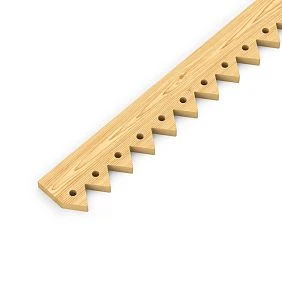

Why the entry "Alcor HL-066M — 12 pieces" is insufficient
A short entry only reports the model and quantity. It does not answer where the twelve handles will go, which wood finish is selected, how they will be oriented, whether plugs are needed, and which instances are intended for paired doors. While the furniture exists only in visualization, these gaps seem insignificant. After the facades are manufactured, each of them becomes a risk.
For example, twelve handles could refer to eight doors and two wide drawers with paired installation. But they could also refer to twelve separate facades. In the first case, the installer needs two axes on each wide drawer; in the second, a single point on each facade. The final number is the same, but the layout and operational logic differ.
A complete specification line includes the article, size, wood finish, base color, quantity, furniture item, facade number, handle position, need for an accompanying plug, and the decision on a spare unit. This format does not complicate the purchase. It eliminates repeated clarifications and allows checking the order before the error ends up in the hole on the finished facade.
Get Consultation
Facade list: the main document before the cart
The facade list is a register of all openable parts of a furniture series. It includes obvious cabinet doors and external dresser drawers, but this is where internal drawers, mezzanine sections, pull-out baskets with separate facades, hidden utility blocks, and small doors above built-in appliances are often forgotten.
The document does not have to be complex. For a private project, a table where each facade has a number and a clear description is sufficient. For serial production or a large project, it is useful to add the room code, furniture item code, opening type, facade material, installation method, and a reference to the drawing.
| № | Item | Facade | Number of handles | Execution | Position |
|---|---|---|---|---|---|
| 1 | Pencil case | Top door P-01 | 1 | Walnut | Vertically to the right, along the approved axis |
| 2 | Pencil case | Bottom door P-02 | 1 | Walnut | Vertically to the right, aligned with P-01 |
| 3 | Commode | Top drawer K-01 | 2 | Walnut | Symmetrical relative to the center |
| 4 | Commode | Middle drawer K-02 | 2 | Walnut | Along the same vertical axes |
| 5 | Cabinet | Door T-01 | 1 | Walnut | At the free edge |
| 6 | Kitchen | Inner drawer V-01 | 1 | Walnut | Centered on the facade |
After filling the table, the quantities are summed by rows and compared with the total number of facades. If some drawers receive two handles, the sum will be higher than the number of facades. If one facade opens without a handle using a different system, the sum will be lower. Therefore, the formula "one handle per facade" is not universal.
How to count handles for an entire furniture series
The calculation does not start with the final sum, but with grouping. First, the kitchen is counted separately, then the sideboard, wardrobe, chest of drawers, cabinets, and internal sections. After that, the data is combined and checked to see if the same finish is selected everywhere. This sequence allows you to quickly find a missing group: if there is a piece of furniture in the list but no line with its facades, then the count is not yet complete.
Cabinet and tall cabinet doors
For each door, the hinge side and free edge are indicated. This is especially useful for paired facades: the left and right doors should be perceived as mirror images, and the handles should be at a coordinated height. In a tall cabinet, the upper and lower doors may have different heights, but it is advisable to check the overall vertical rhythm with a single template.
External drawers
For each drawer, the width, height, and decision about one or two handles are recorded. If adjacent drawers have different sizes, the position can be subordinated to a common axis or the center of each facade. Both approaches are possible, but mixing them without a diagram is not allowed: the facade composition will look random.
Internal drawers
The inner drawer opens after the main door, so it is easy to exclude it from visualization and forget it in the order. But the handle of the wooden drawer remains a working part, and its absence will be discovered during assembly. In the specification, internal fronts are marked as a separate type so that they do not disappear when filtering the exterior.
Cabinets, display cases, and freestanding furniture
If the kitchen and cabinet form one collection, identical handles tie the items into a single ensemble. The cabinet may be in another room and ordered later. It is better to include it in the overall specification in advance or save the exact execution and batch parameters for future reordering.
Example calculation: kitchen, cabinet, and dresser of the same series
Let's imagine a project where the kitchen includes six hinged doors, eight external drawers, and three internal drawers. On the six doors, one handle is installed each. Six regular drawers get one handle each, and two wide drawers get two each. Three internal drawers get one handle each. The kitchen part requires 6 + 6 + 4 + 3 = 19 handles.
The cabinet consists of four doors and two drawers: another six handles. The dresser has three wide drawers, each with two handles as per the project: another six. The net requirement for the furniture series is 19 + 6 + 6 = 31 Alcor HL-066M handles.
| Group | Fronts | Accepted scheme | Quantity of Alcor HL-066M |
|---|---|---|---|
| Kitchen doors | 6 | One per facade | 6 |
| Standard external drawers | 6 | One per facade | 6 |
| Wide external drawers | 2 | Two per facade | 4 |
| Internal drawers | 3 | One per facade | 3 |
| Buffet | 6 | Four doors and two drawers | 6 |
| Commode | 3 | Two per wide drawer | 6 |
| Total | 26 facades | Including paired installation | 31 |
This is an example calculation, not a standard for any furniture. The decision about two handles cannot be made based solely on the drawer width: the design, weight of contents, guides, grip convenience, and pattern of adjacent fronts must be considered. The replacement reserve is also not set as a universal percentage. It is determined by the project size, service life, possibility of future reordering, and the customer's requirement to keep a spare copy of the same finish.
One or two handles on a wide drawer
The question of the number of handles on one drawer cannot be resolved by a single width figure. Two fronts of the same size may have different designs, different weights of contents, and different guide positions. On one product, a single central handle will ensure convenient movement; on another, the designer and engineer will choose two grip points for symmetry and even force application.
To make a decision, five parameters are checked. First is the actual width and height of the front. Second is the intended contents: a drawer with light textiles and a deep drawer with dishes feel different. Third is the guide design and the furniture manufacturer's recommendations. Fourth is the ability to conveniently open the drawer with one hand from a normal position. Fifth is the visual rhythm of the entire group.
If two wide drawers each receive two handles, their vertical axes must align. You cannot mark each front anew from a random edge: a slight discrepancy is especially noticeable on repeated lines of a chest of drawers. The specification should indicate not just "2 pieces" but also the distance between axes or a reference to an approved template.
A single central handle makes the composition calmer but requires checking the grip and the drawer's behavior under load. Two handles enhance symmetry but increase the total quantity and number of holes. The choice is made before ordering; otherwise, the final need for Alcor HL-066M will change after the cart is already finalized.
Four wood finishes — four different roles in the project
The name of the wood finish affects not only the shade. Each option has its own character of grain, and this grain repeats on all fronts in the series. Therefore, the choice should not be abstractly "to match dark furniture" or "to match a light kitchen," but rather next to a real sample of the front, countertop, molding, and other wooden elements.
Zebrano: active linear graphics
Zebrano attracts attention with its pronounced directional pattern. On a smooth, solid-colored front, such a handle can become an independent graphic accent. Next to active veneer, carving, or complex paneling, it can create competition, so a full-size trial is especially important.
For a furniture series, you need to decide in advance how to orient the pattern on paired doors. The natural texture will not be photographically identical, but handles can be arranged so that the most similar in character are placed next to each other. Individual, more contrasting handles are better left for single fronts where comparison does not occur closely.
Wenge: a dark spot on a light facade
Wenge suits projects where the handle should be clearly visible on light enamel or support other dark details. Contrast helps quickly locate the grip point, but makes marking inaccuracies more noticeable. If one handle is installed higher than the adjacent one, dark spots will emphasize the discrepancy.
On dark furniture, wenge can work more calmly, almost blending with the facade. Then the main visible element becomes the stainless steel-colored metal base. This combination needs to be checked under the lighting that will be used in the room.
Rosewood: expressive warm pattern
Rosewood can support the warm wood palette of the countertop, parquet, sideboard, or decorative inserts. But similar warm shades do not always match each other. An error occurs when a buyer chooses an option only by name and expects an automatic match with another wood.
Before ordering, compare the image or sample of the handle with the specific facade finish. If several wood textures are present nearby, determine which one is the main one. Alcor should either support the chosen base or deliberately become a separate accent, rather than a random third shade.
Walnut: a calm connecting wood note
Walnut is often perceived as softer and more versatile in compositions where the handle should not be the most active element. It can connect a light facade with a wooden countertop, support furniture in the living room, and be repeated on a sideboard or chest of drawers.
Even a calm option cannot be ordered "by eye." Walnut surfaces vary in tone, and the natural pattern of each handle is individual. The specification records one execution, and batch acceptance helps distribute specimens to the most suitable facades.
Comparison of four Alcor HL-066M executions
| Execution | Visual task | Where fitting is especially needed | Main risk |
|---|---|---|---|
| Zebrawood | Active linear graphics and noticeable wood accent | On veneered and carved facades | Competition of several expressive patterns |
| Wenge | Dark contrast on a light background or support for dark details | On groups of identical doors and drawers | Contrast emphasizes inaccurate marking |
| Padauk | Warm expressive wood pattern | Next to countertop, floor and other wood | Close warm shades may conflict |
| Walnut | Calm unification of a furniture series | In projects with multiple walnut finishes | Expecting a perfect match of shades |
This table describes project roles, not strict rules. The final decision is made based on the actual combination of materials. After selecting an option, its name is transferred to all rows of the statement, order specification, acceptance certificate, and installation card.
Natural texture: same finish does not mean same pattern
The Alcor wood element retains the natural character of the material. Therefore, two handles of the same finish may differ in line direction, saturation, and individual pattern areas. This is not a reason to mix different finishes, but an important reason not to drill facades immediately after unpacking the first box.
The received batch is laid out on a clean surface and grouped. First, products are separated by finish and checked to ensure there is no accidental admixture of another variant in the order. Then, pairs are selected for symmetrical doors. On four identical drawers, you can build a smooth transition from a calmer pattern to a more active one, or, conversely, choose the closest possible specimens.
For a large series, photo documentation of the layout is useful. Each handle is assigned a temporary number, and the number is recorded opposite the facade in the statement. The installer receives not an abstract box with products, but a distributed set. This approach is especially valuable when the kitchen, sideboard, and chest of drawers are in the same field of view.
Absolute identity of natural texture cannot be promised. The correct goal is not to make wood artificially identical, but to manageably distribute its natural differences.
How to check the size 42 × 42 × 41 mm before purchase
A photo of the handle does not show the actual scale on a specific facade. A 42 × 42 mm square may look compact on a tall cabinet and noticeable on a small internal drawer. The 41 mm depth affects the protrusion, grip, and interaction with adjacent objects. Therefore, the size is checked not only with a ruler but also with a simple mockup.
- Cut out a front square of 42 × 42 mm from thick paper or cardboard.
- Make a side element that shows the approximate 41 mm protrusion.
- Assemble the 3D mockup and secure it with masking tape at the intended location.
- Open the facade fully and check the adjacent door, wall, side panel, and countertop.
- Grasp the mockup from your normal body position without adjusting your hand specifically.
- Look at the group of facades from a distance of two to three meters.
- Take a photo of the option and compare several positions before finalizing the axes.
After the fitting, it is useful to study grip and dimensions of a wooden furniture handle in the context of daily use. The layout shows the overall size, but the final decision must take into account the actual shape of the product, the drawing, and the 3D model from the card.
What exactly the front template checks
The 42 × 42 mm template answers the question about the visual field of the handle. It shows whether Alcor overlaps a narrow panel strip, approaches the molding, and whether there is enough free space around it. On a small facade, the handle should not look randomly squeezed between relief elements.
On paired doors, templates are attached simultaneously. This allows you to see the distance between handles in the closed position and check if it is convenient to use them with both hands. On a group of drawers, templates are aligned along a common vertical line. If each is applied separately, the eye may not notice a slight offset before drilling.
Front fitting also helps choose between a central and edge position. For a hinged door, the handle is usually associated with the free edge, but the exact distance depends on the construction and design. For a drawer, the center may be geometric or follow the common axis of adjacent parts. A universal number cannot be assigned without a furniture drawing.
What the 41 mm protrusion checks
Depth or protrusion is no less important than width. The handle must leave room for fingers but not create a conflict when opening. In a corner kitchen, the protrusion is checked next to the adjacent facade. On a cabinet near a wall, it is checked next to a slope, trim, or switch. On a pull-out drawer under a countertop, it is checked relative to the overhang and decorative profile.
Special attention is required for narrow passages. Protruding hardware may catch on clothing or be in the path of movement. This does not mean that Alcor is unsuitable: sometimes it is enough to change the position on the facade. But the decision must be made before drilling, when the designer still has freedom.
The depth layout also shows whether the handle will interfere with the adjacent door in the open position. Not only the facade with the handle is checked, but also the entire furniture kinematics: opening angle, body protrusion, presence of limiters, and wall position.
Stainless steel base color in the overall palette
Wood attracts the main attention, but the metal base remains visible and repeats on each facade. The stainless steel color needs to be matched with appliances, profiles, legs, lighting fixtures, exposed hinges, and other hardware. If metals are distributed thoughtfully, the interior looks cohesive. Randomly mixing a cold silver base with distinctly gold, brass, and bronze details can disrupt the unified system.
Different metals can be combined, but a principle is needed. For example, the Alcor base repeats the kitchen's appliances and profiles, while warm metal remains only in the lighting fixtures. Another option is cold metal used throughout all furniture, with wood finishes connecting it to the interior. The problem arises not from the combination itself, but from the lack of repetition and logic.
For a wider range of combinations, the material on how to choose a furniture handle with a wood insertis useful. In this article, the solution is already narrowed down to Alcor: you need to check whether its base fits the specific metal palette of the project.
When it's better to choose a different shape or size
Alcor HL-066M is not suitable for every facade. If the 42 × 42 mm square takes up too much of a narrow door, the 41 mm protrusion obstructs the passage, or the chosen composition requires a long pull handle, it's worth looking at wooden furniture handles with coating of a different shape and size.
An honest rejection of a specific model is better than trying to place it despite the design. For minimalist furniture, more neutral hardware may be required. For a heavy wide door, a different grip type is needed. For a facade with rich carving, a less active wood pattern is better. The category is needed not for random switching between products, but for comparison after a full-size trial of Alcor.
Alcor HL-066M on kitchen fronts
The kitchen more often than other rooms shows the cost of approximate calculation. Here, swing doors, external and internal drawers, tall cabinets, sections above appliances, and sometimes a separate island are all present simultaneously. Each group has its own geometry but must follow a single visual rule.
Start with a front elevation layout. Number the parts from left to right and top to bottom. For each, specify the opening type and number of handles. On tall doors, check a comfortable grip height for the user, but do not assign it in isolation: adjacent fronts should form a clear line. On upper cabinets, compare the position with the lower row so that handles do not create a chaotic grid.
Internal drawers must be counted separately. They may not participate in the overall front composition but require a comfortable grip and their own marking. If the same Alcor is chosen for them, the furniture series maintains unity even in the open state. If a different decision is made, it is recorded in the specification, not left to the installer.
In the kitchen, it is especially important to check the color of the base near appliances and profiles. A stainless steel colored base can support the refrigerator, oven, or sink, but the final perception depends on the lighting and front finish.
Handles for cabinets: pairing is more important than approximate height
When wooden cabinet handles are needed, the buyer often starts with a question about installation height. For the series, it is more important to first determine the system. On two swing doors, handles should be mirror-linked to the free edges. On four doors, repeat one module. On a cabinet with a mezzanine, coordinate with the lower fronts without creating random steps.
For paired doors, use one template, flipped relative to the central joint. If the left and right doors are marked independently from the outer edges, the technological size difference can shift the handles. Control is performed along the common axis of the composition and the actual gap between the fronts.
A tall door requires checking the protrusion when fully opened. The handle should not hit the wall, adjacent module, or another handle. If the cabinet is located in a narrow passage, make a side mockup of 41 mm and walk next to it in regular clothing.
On cabinets with decorative moldings, a 42 × 42 mm square is placed in the free field. The handle should not partially overlap the relief or look squeezed between the profile and the edge. If there is not enough free field, it is better to change the model or front scheme before ordering.
Dresser: how not to lose the common axis of drawers
A dresser is perceived as a repetition of horizontal lines. Therefore, even a slight shift of a wooden drawer handle becomes noticeable. First, decide whether each front will have one central Alcor or two symmetrical ones. Then build one vertical or two paired axes across the entire group.
If the top drawer is lower than the others, the geometric center of each part can create a stepped composition. This is not necessarily a mistake, but the result needs to be seen on a paper template. An alternative is to maintain a common line by height or attach handles to the top edge. No approach is universal; consistency is important.
With two handles, the distance between them must be repeated on all identical drawers. It is recorded in the installation map as the distance between axes. The phrase "symmetrically" is insufficient because two craftsmen may choose different points.
Before drilling, lay out natural wood specimens across the drawers. On closely spaced handles, texture differences are compared directly, so pairs should be selected in advance.
Cabinets and small fronts
On a small cabinet, Alcor can become the main decorative accent. But here, the size 42 × 42 mm occupies a significant portion of the front. A mockup helps check whether the handle looks too large and whether sufficient distance remains to the edge, panel, and countertop.
If two bedside tables stand on either side of the bed, it is better to include them in one list. Handles are selected in pairs by pattern, and the position is made mirrored or identical, depending on the opening direction. Ordering at different times increases the risk of shade differences and complicates maintaining the same model in a series.
On a cabinet with a door and a drawer, it is necessary to decide whether the handle will be on one vertical line or each part will have its own center. The check is done on a front mockup of the entire piece of furniture, not on a separate front.
Identical handles for the kitchen, sideboard, and living room
Repeating the same model in different rooms helps tie a furniture series together. But sameness must be fixed with precise parameters. Names like "dark wood" or "walnut handle" are not enough: the specification must state Alcor HL-066M, size, specific wood finish, and base color.
If items are ordered simultaneously, it's better to include all handles in one list and one cart. This makes it easier to check the quantity and distribute the texture. If the sideboard is made later, keep the approved specification, batch photos, and card data. Current availability and terms for a future order will still need to be rechecked.
Unity does not require the same position on all items. A kitchen door, a dresser drawer, and a sideboard door have different geometries. The model and logic are repeated, but the specific point is determined by the design of each facade.
How to turn a list into an order specification
A list describes furniture, while a specification describes a purchase. After counting, rows are grouped by article and finish, but maintain a link to the facades. For one model, there may be one final product line and a separate appendix with distribution.
| Specification field | Example entry | Why this is needed |
|---|---|---|
| Article number | Alcor HL-066M | Eliminates substitution with a similar model |
| Size | 42 × 42 × 41 mm | Confirms verified geometry |
| Finish | Walnut | Prevents mixing of four variants |
| Base | Stainless steel color | Fixes the metal palette |
| Net quantity | 31 pieces | Obtained from the facade sheet |
| Reserve | Per project decision | Not replaced by universal percentage |
| Related part | FUR-033 — after verification of necessity | Completeness is calculated separately |
| Appendix | Facade sheet version 3 | Preserves distribution by furniture |
It is useful to specify the document version in the file name and in the order. If an internal drawer is added after approval, the new version should replace the old one for the designer, client, assembler, and installer. Multiple parallel tables are a common cause of discrepancies.
What to buy together with Alcor HL-066M
The accompanying purchase depends on the furniture design and installation method. The same kit cannot be automatically included for any facade. However, several items and documents need to be checked before placing the order.
| What to check or add | Why | What to pay attention to | Confirmed link |
|---|---|---|---|
| Decorative cap FUR-033 | Hides the M4 screw head in the provided scheme | Size 14 × 14 × 3 mm, nickel color; necessity and quantity are checked separately | Decorative metal cap FUR-033 |
| Alcor drawing | Helps check dimensions and installation geometry | Use the current file from the product card | Alcor HL-066M product card |
| 3D model | Allows checking the shape in a furniture project | Does not replace physical fitting and grip check | View 3D model of Alcor |
| Mounting template | Repeats the same point on a series of facades | Manufactured according to the approved furniture scheme | Link not required |
| Spare handle | Preserves the possibility of replacement in the future | Quantity is determined by the project, without a universal percentage | Check in the general specification |
Fasteners and compatibility with a specific facade thickness should be checked against the card, drawing, and furniture manufacturer's requirements. The article does not replace the designer's technical solution.
FUR-033: a small item that is easy to forget
The Alcor card offers a decorative metal plug FUR-033. Its size is 14 × 14 × 3 mm, the color is listed as nickel, and its purpose is to hide the head of an M4 screw. This part should not appear in the order automatically: first, check whether it is required for the selected scheme and where it will be visible.
If a plug is needed, the quantity is calculated by the number of corresponding visible attachment points, not by the approximate number of furniture items. A separate line is created in the specification. The received plugs are counted simultaneously with the handles to prevent a shortage from being discovered after installation.
The nickel color should be matched with the Alcor base in stainless steel color and other metals. Similar silver shades may look different under specific lighting, so visual compatibility is checked on actual parts.
Mounting template: how to repeat the position on dozens of facades
After approving the first point, a template is created. It can be made from a dense material and rest on one or two edges of the facade. The main thing is a stable base, clear markings, and verification on a control part. The template should not be able to flip freely so that left and right schemes get mixed up.
Different types of facades may require different templates: one for hinged doors, another for a central drawer handle, a third for paired installation. All of them receive names matching the codes in the specification. The wording "template for handles" is too general.
Before working on finished furniture, the template is checked on a material sample or a technological part, if such a procedure is provided by production. Distances, handle position, protrusion, tightening convenience, and visibility of the fastening area are checked. Only after confirmation do they proceed to the series.
Why you cannot drill the first facade before receiving the entire batch
Early drilling creates false irreversibility. If later a mix of executions, a shortage, or another nuance of configuration is discovered, the already drilled facade will be tied to the accepted model and point. Until the entire batch is received and checked, the decision cannot be considered final.
The correct sequence is: receive the order, verify the article and quantity, separate executions, check dimensions, inspect bases, distribute natural texture, match plugs and fasteners, attach several handles to control facades, and only then allow drilling.
For a large project, permission can be issued with a short note in the statement: "Batch accepted, layout approved, version 2 template allowed for work." This disciplines the process and shows on what basis the master started installation.
Acceptance of batch Alcor HL-066M
| Stage | What is checked | What is recorded | ||||||||||||||||||||||||||||||||
|---|---|---|---|---|---|---|---|---|---|---|---|---|---|---|---|---|---|---|---|---|---|---|---|---|---|---|---|---|---|---|---|---|---|---|
| Identification | Name Alcor HL-066M and selected execution | Compliance with order | ||||||||||||||||||||||||||||||||
| Quantity | Net quantity, reserve, and separate groups | Actual result | ||||||||||||||||||||||||||||||||
| Dimension | Compliance with stated 42 × 42 × 41 mm | Control check result | ||||||||||||||||||||||||||||||||
| Wood | Pattern and shade of each instance | Distribution across paired facades | ||||||||||||||||||||||||||||||||
| Metal | Bases and their appearance | Notes before installation | ||||||||||||||||||||||||||||||||
| Related items |
How not to confuse Alcor with similar solutionsFurniture fitting cards may contain similar shapes, wood inserts, and metal bases. Alcor should be distinguished by its full name HL-066M, dimensions 42 × 42 × 41 mm, four available finishes, and a stainless steel base. The single word "wooden" is not enough. Before ordering, check the card URL, name, and selected variation. Do not use abbreviations like "Alcor walnut square" in the specification unless accompanied by an article. Upon receipt, compare the product with the drawing and 3D model, not just with the thumbnail in the email. If a different size, long bracket, or other metal coating is needed, the nearest similar handle should not be considered equivalent without new approval. Changing the model affects the holes, grip, and composition of all facades. Main mistakes when ordering a furniture seriesCount furniture items, not facadesOne cabinet can have two, four, or more doors, a mezzanine, and internal drawers. The entry "one handle per cabinet" is not related to the actual design. The fix is numbering all opening parts. Order execution only by verbal nameThe words "dark" or "walnut" allow for different interpretations. Documents use one of the confirmed executions: zebrano, wenge, palisander, or walnut. Mix executions without design intentSeveral options can be used deliberately, but then the specification must show where and why. A random mix disrupts the series and complicates distribution across facades. Forget internal drawersThey are hidden in closed furniture but require working hardware. They are added to a separate group in the specification. Assign two handles based on width aloneThe solution depends on the design, filling, guides, grip, and composition. There is no universal threshold without furniture data. Do not check the 41 mm protrusionThe front photo does not show conflict with the wall, countertop, or adjacent door. A side layout and opening check are needed. Start drilling based on one obtained handleThe entire batch must be recalculated, divided by execution, and distributed across facades. Otherwise, an early hole will limit further decisions. Expect photographically identical woodNatural grain varies. The task is to properly arrange specimens, not to demand artificial identity. Forget the metal paletteThe stainless steel color base is repeated on each facade. It must be coordinated with appliances and other metals. Postpone FUR-033 for laterIf a plug is needed, its quantity and visibility are checked before installation. Otherwise, the furniture may be assembled, but the decorative trim remains unfinished. Do not save the final version of the listThe designer, specifier, and installer may work from different files. One approved version must be available to all participants. Who Alcor HL-066M is especially suitable forThis model should be considered for furniture series where a wood handle should repeat as a recognizable detail. This includes kitchens with a matching sideboard, bedrooms with a dresser and nightstands, offices with multiple cabinets, walk-in closets, and individual collections for an apartment or commercial interior. Alcor is appropriate when the client is ready to choose a specific wood finish and accept natural texture variation. It suits projects where the stainless steel base color supports the overall metal palette, and the dimensions 42 × 42 × 41 mm are confirmed by a trial fitting. A systematic order is especially useful for furniture that will be produced in batches. One list maintains the model, finish, and axes across all items. When it's better to choose another optionAnother handle should be considered if Alcor is too large for the free field of the facade, the protrusion obstructs passage, the square shape conflicts with the composition, or the project requires a different metal color. For a heavy door, a different grip type may be needed, as determined by the designer. This model is not suitable for a buyer who expects an absolutely identical pattern of natural wood. It also does not solve the problem of a missing list: even a suitable handle will be ordered incorrectly if the quantity is estimated approximately. If in doubt, first compare the shape and size in the category, then return to the facade layout. Replacement must occur before drilling and be documented with a new version of the specification. How to place an order for Alcor HL-066M on STAVROSThe commercial route does not start with the add product button, but with a ready number. Open the Alcor HL-066M card, double-check the size 42 × 42 × 41 mm, the selected wood finish, the stainless steel color base, the current price and availability. Download the available drawing, study the 3D model, and compare the data with the facade list. Then transfer the final quantity to the cart. If the project includes a reserve, it must be a separate line in the calculation, not a random rounding. Check that zebrano, wenge, palisander, and walnut options are not mixed. For a large series, it is useful to save a screenshot or export of the cart composition along with the version of the list. If FUR-033 is required, open its card and separately confirm the quantity. It is not assumed that the plug is automatically included in any handle order. Similarly, the fastener, its length, and compatibility with the thickness of the specific facade must be checked against the technical data and with the furniture manufacturer. Before completing the order, study payment and delivery terms for STAVROS. For a project with multiple rooms, it is important to determine in advance who accepts the order, where the handle layout will take place, and when the installer will receive the verified batch. What to pass to the kit assembler and installerThe kit assembler receives the final specification, a link to the card, the selected finish, quantity, information about the reserve and related parts. The installer needs a different set: a facade list with part numbers, axis diagram, templates, distribution of natural texture, and a mark of batch acceptance. A useful set of documents includes:
Such a package seems detailed only until the first mistake. On a series of several dozen facades, it saves repeated questions and protects finished furniture from irreversible marking based on verbal explanation. Control specification before payment
FAQ: Questions about Alcor HL-066M and furniture series configurationIn which wood finishes is Alcor HL-066M available?The confirmed data specifies four finishes: zebrano, wenge, rosewood, and walnut. The selected name must be carried over to each line of the specification. It cannot be replaced with a general description like "dark wood" or "walnut-style," as such wording allows ambiguity. What size is the Alcor handle?The model size is 42 × 42 × 41 mm. The first two parameters help assess the frontal scale, and 41 mm needs to be checked as a protrusion. For this, it is useful to make a cardboard mockup and open the facade next to a wall, adjacent door, molding, and countertop. Can Alcor be ordered for the entire kitchen in one quantity?Yes, but the total is first obtained from the list. It includes doors, external and internal drawers, tall cabinets, wall cabinets, and other opening elements. After that, the items are summed up and transferred to the cart in one selected finish. How many handles are needed for a double-door wardrobe?Most often, each hinged door gets a separate grip point, but the final scheme depends on the design. In the specification, the wardrobe is split into two facade lines, and the handles are placed mirror-wise at the free edges according to a single approved template. How many handles to put on a wide drawer?There is no universal width threshold. The decision for one or two handles depends on the drawer design, filling weight, guides, ease of opening, and facade composition. It is made together with the furniture manufacturer before the final count. Do internal drawers need to be considered?Yes. Internal drawers are often not visible in the main visualization but remain working facades. They are allocated as a separate group in the specification, the model and handle position are determined, and then they are included in the total count. Can walnut and wenge be mixed in one set?Only as a deliberate design decision. The specification must show which facades use each option and what task the contrast solves. A random mix due to a careless basket disrupts the unity of the furniture series. Will all handles of the same finish be completely identical?Natural wood texture may vary in pattern and shade. After receiving the handles, they are laid out and the closest specimens are selected for paired doors and adjacent drawers. Full photographic identity should not be promised. How to check Alcor near furniture molding?Cut a front template 42 × 42 mm and secure it at the planned point. A visually and technically free field should remain between the handle and the relief. Then use the side layout 41 mm and check the grip. What does the base color of stainless steel mean?This is the confirmed color of the metal part of the model. It is matched with hardware, profiles, legs, visible hinges, and lights. It should not automatically be considered identical to any silver coating without actual comparison. What is the FUR-033 plug for?FUR-033 is designed to hide the M4 screw head. Its size is 14 × 14 × 3 mm, color specified as nickel. The need for use and quantity are checked according to the specific installation diagram; the plug is listed as a separate item. Is FUR-033 automatically included in the handle set?In the provided diagram, it is confirmed that the Alcor card offers this accompanying part, but automatic inclusion cannot be confirmed. Before ordering, check the card, the selected option, and the cart contents. Do I need to order a spare handle?Reserve is useful for a large furniture series, but a universal percentage cannot be set. The decision depends on the quantity, operating conditions, possibility of future reorder, and project requirements. The stock is fixed separately from the net requirement. When can drilling of facades begin?After receiving and fully accepting the batch, you need to verify the article number, version, size, and quantity, lay out the texture, check the accompanying parts, and approve the mounting template. Drilling based on a single early sample creates an irreversible risk. Can I order the kitchen now and the sideboard later?Yes, but for a future reorder, save the article number, version, dimensions, photos, and specification. When placing a new order, the current availability, price, and appearance of the batch must be rechecked; natural wood does not guarantee a complete match. How to distribute handles on paired doors?First, select the specimens closest in pattern, then assign them left and right door codes. Set the position using a mirror template relative to the central joint, and photograph the layout before installation. Is Alcor suitable for a small cabinet?This is determined by fitting. A 42 × 42 mm square can become an expressive accent, but on a narrow front it may lack sufficient free space. Check the distances to the edge, panel, and countertop, as well as the 41 mm protrusion. Is Alcor suitable for commercial interiors?Yes, when the size, grip, wood version, and metal base match the project. For a large number of identical fronts, the list, handle marking, batch control, and a single mounting template are especially important. Where can I see the current price of Alcor HL-066M?The price is a variable commercial parameter and should be checked on the product card before ordering. There, you should also clarify the availability of the selected wood finish and the available purchase conditions. What to do if the size or shape doesn't fit?Do not start drilling. Go back to the category of handles with coating, compare a different shape, and perform a full-size fitting again. Any model replacement requires a review of axes, grip, quantity, and specification. Who is responsible for what in a project with dozens of identical handlesConfiguration errors often arise not from a lack of data, but from blurred roles. The designer selects the finish and visual axes, the engineer checks the position relative to the facade and mechanisms, the configurator compiles the final quantity, the client approves the appearance, and the installer transfers the agreed scheme to the furniture. If each participant makes decisions anew, the unified system falls apart. It is not enough for the designer to specify "Alcor walnut." They must show on which items the model is repeated, where one handle is allowed, where two are, and how the stainless steel color base relates to other metals. The engineer checks whether the hole falls into an undesirable area, whether the 41 mm protrusion interferes with opening, and whether the selected fastener can be safely used on the specific facade thickness. The configurator is responsible for the arithmetic and accuracy of variations. They compare the sum from the list with the cart, count FUR-033 separately, record the reserve, and save the current version of the order. The installer does not choose the finish or change the axes to their own taste. Their task is to check the template, match the codes of facades and handles, perform a test installation, and only after approval continue the series. The client approves not only the product photo but also the assembled logic: finish, quantity, fitting, placement, and visible accompanying details. This scheme is especially important for remote production, when furniture, handles, and installation are handled by different contractors. Versioning of the list: how not to order handles based on an outdated layoutThe furniture project changes. An additional internal drawer appears in the pencil case, two narrow facades are combined into one wide one, and instead of one handle, two are approved for the chest of drawers. Each change affects the quantity of Alcor HL-066M. If the old table remains with the configurator and the new one only with the designer, the cart will be assembled according to the previous configuration. Assign a version number and date to the specification. In the header, indicate the status: "draft", "pending approval", or "approved for order". After approval, prohibit verbal corrections without releasing a new version. Changed lines can be highlighted in the working document, but in the final specification, uniformity and absence of contradictions are more important. The file name should be clear without correspondence, for example: "Alcor_HL-066M_facade_specification_v4_approved". The same version is indicated in the order and installation card. If the quantity in the cart does not match the table total, processing is suspended and the reason is found. After receiving the batch, the specification is supplemented with actual handle codes and a photo of the layout. Then the document continues to work during installation and remains the furniture passport for future replacements. In a few years, the owner won't have to remember which finish was used on the sideboard and how many spare copies remain. Final check before pressing the order buttonThe final check takes less time than fixing one drilled facade. Compare the total quantity with the sum of all rows, ensure each item has one of four finishes specified, and check that internal drawers are not hidden by a filter. Then open the Alcor card and verify the name, size, variant, and current commercial terms. Look at the 42 × 42 × 41 mm samples again after the furniture finish is approved. The color and relief of the facade can change the visual scale of the handle. Check the metal base next to a sample of the appliance or profile. If the project includes FUR-033, match the number of plugs with the accepted installation diagram. Separately confirm the drilling moment: holes are not made until the batch is fully accepted. Record who distributes the natural texture, who approves pairs, and who stores the reserve. After these actions, the cart ceases to be a list of individual items and becomes an accurate configuration of the entire furniture series. Result: one handle becomes a system only after calculationAlcor HL-066M helps unify the kitchen, wardrobe, sideboard, chest of drawers, and cabinets with a common wood and metal detail. But buying the right quantity without a specification is not reliable: one piece of furniture may contain several doors, external and internal drawers, and wide facades sometimes get two handles. The correct order begins with choosing zebrano, wenge, palisander, or walnut, continues with fitting the 42 × 42 × 41 mm size, and ends with a specification where each facade is assigned a quantity, position, and specific unit from the accepted batch. The stainless steel base, natural variation in wood texture, and possible FUR-033 plug also become part of the project, not late clarifications. Before placing an order, open the card again and order Alcor HL-066M for the entire furniture series based on the final count from the list. This STAVROS approach turns the selection of beautiful fittings into manageable configuration: first facades and calculation, then cart, acceptance, and only after that drilling. |