
























Article Contents:
- What is a flat baluster and how is it different from a regular one
- Turned baluster
- Flat baluster
- What is the practical advantage of a flat baluster over a slat
- Where to use flat balusters: application scenarios
- Decorative partition between kitchen and living room
- Staircase railing
- Mezzanine and double-height railing
- Staircase hall of a country house
- Decorative screen in a restaurant, hotel, or banquet hall
- Hallway zoning
- Flat balusters or slats: an honest comparison without illusions
- Types of flat baluster patterns: from geometry to floral ornament
- Simple geometric silhouette
- Classic profile with turned elements
- Floral ornament and carved motifs
- Arched or vaulted contour
- Art Deco geometry
- How to calculate the number of balusters for a partition or railing
- Step 1: Measure the width of the opening
- Step 2: Determine the width of the baluster
- Step 3: Set the distance between balusters
- Step 4: Calculate the quantity
- Step 5: Account for side posts
- Step 6: Decide on a solid or open effect
- How to choose flat balusters to match your interior style
- Classic and high classic
- Neoclassicism
- Russian style
- Country house and Scandinavian style
- Restaurant and hotel
- How to combine balusters with other wooden elements
- Technical specifications of flat balusters: material, dimensions, coating
- Material
- Sizes
- Finish
- Installation of a wooden baluster partition: practice without simplifications
- Tools
- Installation Sequence
- Mistakes when creating a baluster partition: learning from others' experience
- Wooden balusters in commercial projects: hotel, restaurant, showroom
- Restaurant
- Hotel
- Showroom and boutique
- What to buy for a baluster partition: complete set
- Care for a wooden baluster structure
- FAQ: answers to the most common questions
- About the Company STAVROS
Slats have become the main trend of the last decade. They are everywhere — in partitions, on cabinet facades, in mezzanine railings, in kitchen-living room zoning. The slat is understandable, easy to install, and looks good in a modern interior. But it has one flaw: it is alone. Always the same — same profile, same rhythm. Without a face. Without a pattern. Without character.
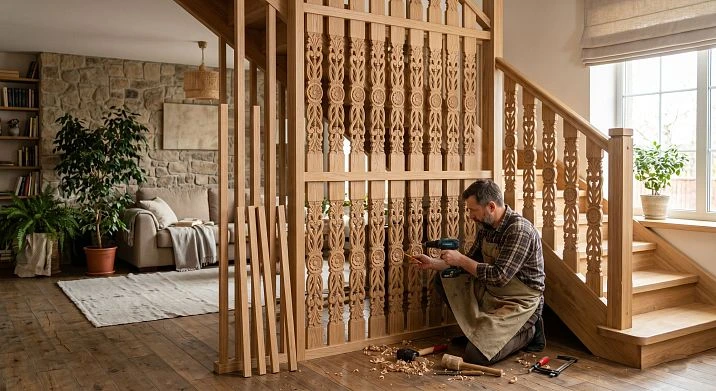
Now imagine a different solution. A vertical row flat wooden balusters — each with a silhouette, with a turned or carved pattern, with varying width, with a play of shadows along the entire height. Frontally, this reads as an ornament, not as a set of rectangles. This is what distinguishes a baluster partition from a slatted one: it is expressive, decorative, and carries a stylistic message.
Flat wooden balusters have long gone beyond stair railings. Today they are used where a wooden decorative rhythm with character is needed: partitions, halls, screens, railings of double-height openings, mezzanines, restaurant and hotel zones. And this is not just a new trend — it is a return to architectural logic, where the railing has always been part of the ornament.
What is a flat baluster and how does it differ from a regular one
Before discussing application, it's necessary to clearly distinguish between types. Because confusion here costs money and time.
Turned baluster
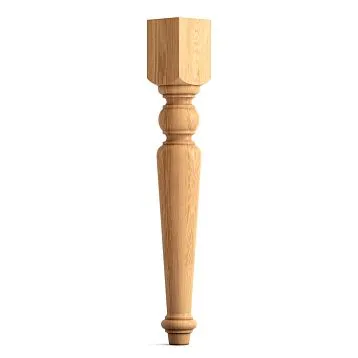
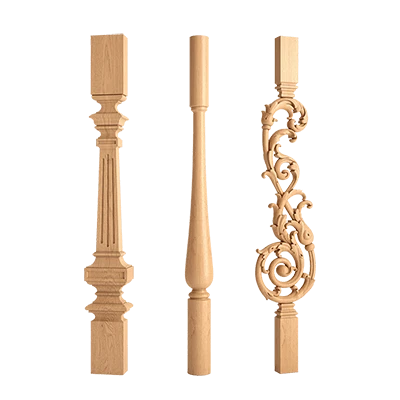
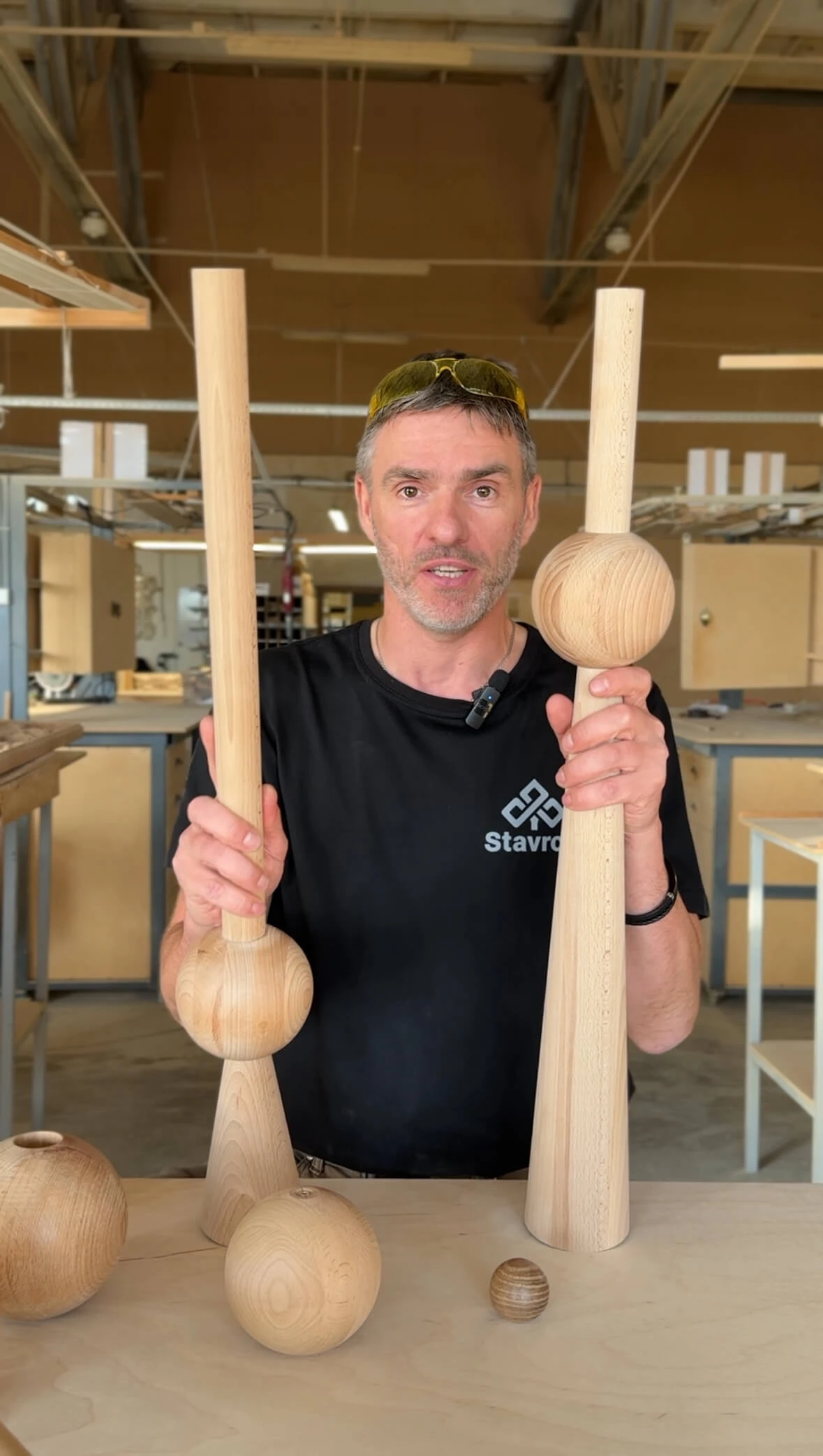
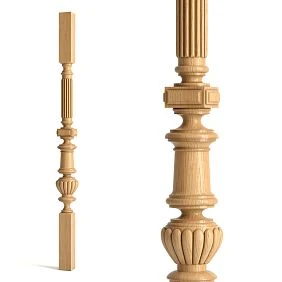
A turned (or round) baluster is a cylindrical piece obtained by turning on a lathe. It has no clear front side: it is the same from all directions. The classic image of a turned baluster is a bulbous shape, waist, neck, base. It looks great on a staircase, but in a decorative partition it loses half its potential: its volume is only visible from an angle.
Our factory also produces:
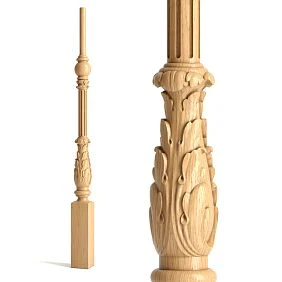
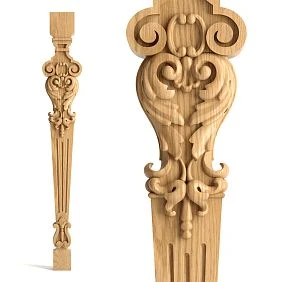
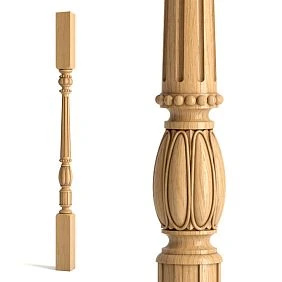
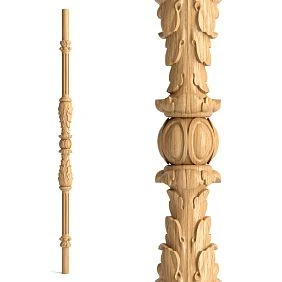
Flat baluster
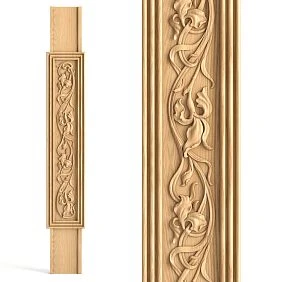
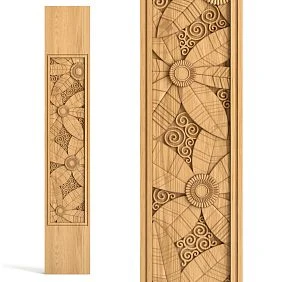
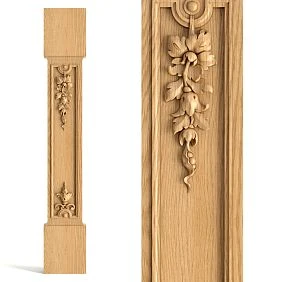
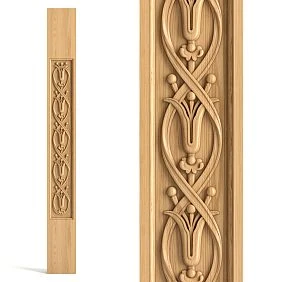
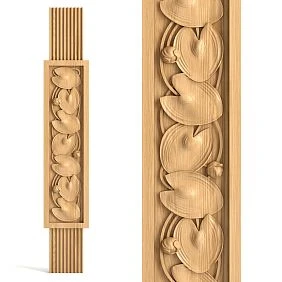
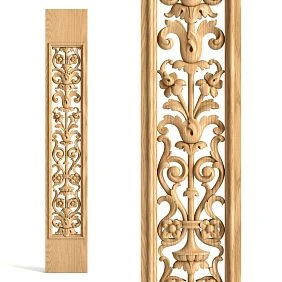
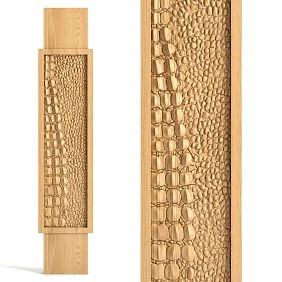
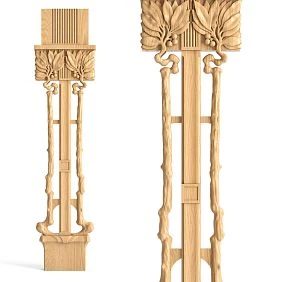
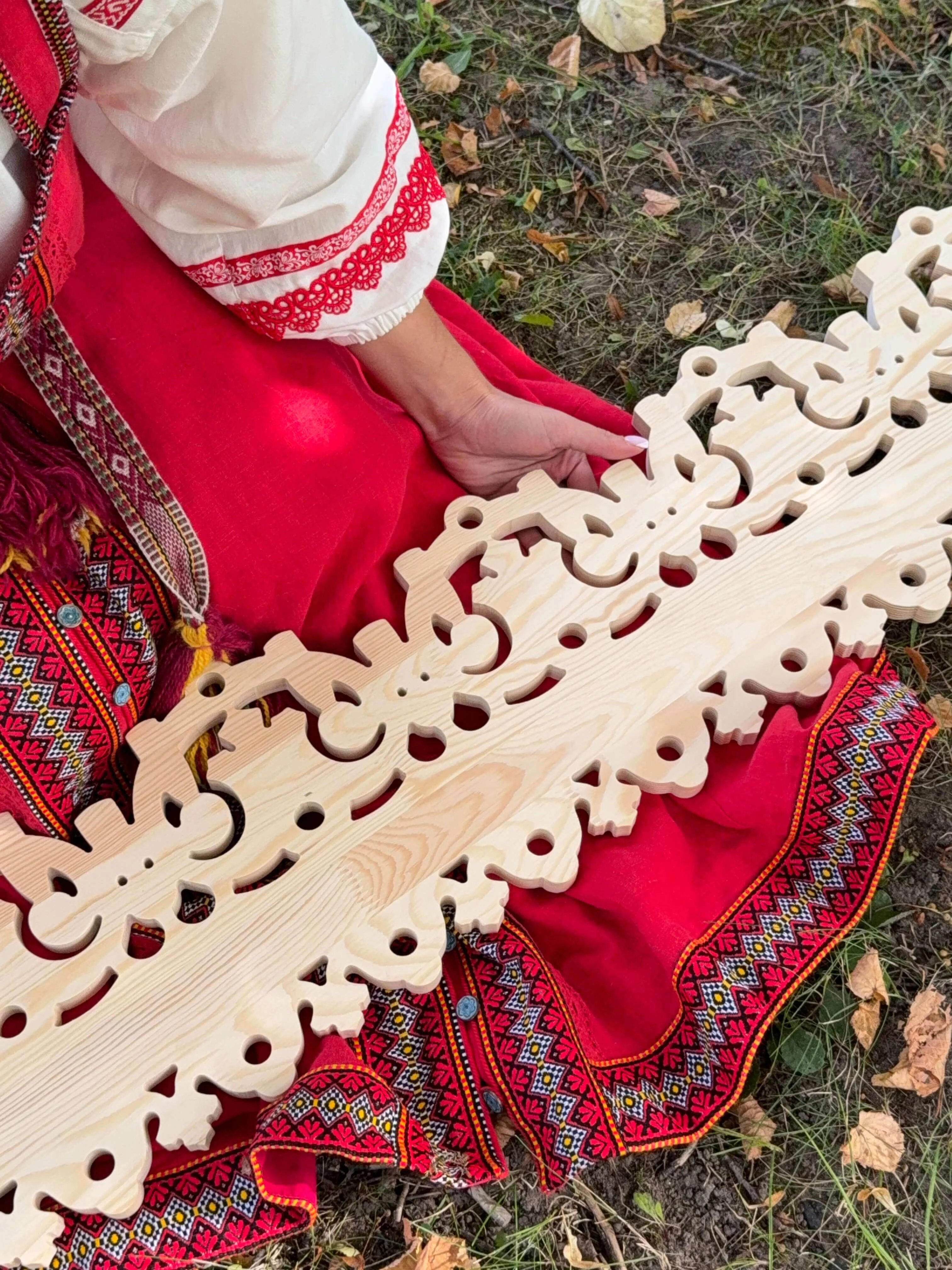
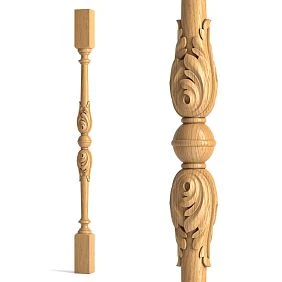
Flat baluster — is a wooden plank with a carved or milled pattern. It has a clear front side — its silhouette is fully readable from the front. The pattern of a flat baluster is perceived as a graphic image: a floral motif, geometric ornament, classic profile with transitions from wide to narrow.
Place such balusters in a row with a small step — and you get an ornamental plane with transparency: the space is visible through the gaps, but visually divided. This is exactly what is needed for decorative partitions and screens.
Get Consultation
What is the practical advantage of a flat baluster over a slat
| Parameter | Rail | Flat baluster |
|---|---|---|
| Shape | Rectangle | Silhouette with pattern |
| Visual expressiveness | Rhythm, but without decoration | Ornament + rhythm |
| Stylistic affiliation | Modern, minimalism | Classic, neoclassic, Russian style |
| Impact on space | Structures | Structures + decorates |
| Installation difficulty | Simpler | Slightly more complex, but comparable |
| Play of shadows | Flat | Voluminous, variable |
The conclusion is simple: the rail works where strictness and modernity are needed. The flat baluster works where character, history, and a decorative message are needed.
Where to use flat balusters: application scenarios
This is a key section for decision-making. Not "is it possible," but "where exactly" — because each scenario has its own requirements for size, spacing, height, and style of the baluster.
Decorative partition between kitchen and living room
An open-plan kitchen-living room is convenient but often lacks structure. You want to separate zones without losing visual connection. A baluster partition solves this elegantly: it is visible, it creates a boundary — but through it, both light, space, and the kitchen are visible.
For this area, balusters with a height of 90 to 120 cm are chosen — the level of a bar counter or console. The spacing is 5–10 cm between elements. The bottom rail is attached to the floor or the base of the bar counter, the top rail to a handrail or wooden cornice.
in combination with wooden moldings for framing the partition on both sides, the structure looks architecturally complete — not assembled, but designed.
Staircase railing
Classic application balusters for staircases — here the flat shape provides an additional advantage: a staircase railing with flat balusters looks lighter than with turned ones, but at the same time creates a richer visual pattern.
Flat balusters work especially well on straight flights — when the row of balusters is visible frontally when viewed from below or from the opposite side of the hall. It is from this angle that the silhouette pattern of each baluster reads as an ornamental strip along the staircase.
For the stair railing, all staircase components must be in the same style: balusters, posts, handrail, bottom rail. Elements of different styles ruin the integrity.
Mezzanine and double-height space railing
A mezzanine or double-height space in a country house is a space that only comes alive when its railing is beautiful. An unattractive mezzanine railing turns an expensive space into a building structure with railings.
Flat wooden balusters on the mezzanine railing create a decorative screen that is clearly visible from below — from the living room or hall. With high ceilings (3.5 m and more), this effect is especially strong: the second-floor railing is visible as an ornamental horizontal strip that decorates the space across its entire width.
For a mezzanine, the railing height is 90–110 cm (safety requirement). Balusters must be sufficiently rigid — solid oak or beech without voids.
Staircase hall of a country house
An entrance hall with a staircase is the calling card of a country house. A partition or screen made of flat balusters next to the staircase, dividing the hall and living room, is a solution with architectural logic. This is exactly how transitional spaces were designed in estates and mansions: the wooden railing did not divide — it created rhythm.
For this scenario, balusters are chosen with a height from floor to ceiling or to the handrail level — depending on the design intent. Full-height balusters (height 100–120 cm) create a screen-partition. Taller ones — from 180 to 220 cm — form almost a full wall, but transparent.
Decorative screen in a restaurant, hotel, or banquet hall
In restaurant and hotel interiors, wooden partitions made of balusters are a professional zoning tool. They divide the hall into sections without creating solid partitions. Light passes through the gaps. The space remains unified — but each zone has its own 'sky'.
For restaurants and hotels, balusters are chosen with an expressive pattern and for painting or varnishing in accordance with the design concept of the property. Often used Carved wooden decoration for decorative inserts between baluster blocks or for finishing the top and bottom rails.
Hallway Zoning
In spacious hallways, a wooden partition made of balusters separates the entrance area from the living area without losing light. This solution is better than a solid wall: the hallway seems less isolated, light from windows passes into both zones, and the structure itself is a decorative element.
Here it is important to match the balusters with the door plinth and, possibly, with the baseboard — unity of material and style makes the interior cohesive.
Flat balusters or slats: an honest comparison without illusions
This question is always asked — and the correct answer depends on the specific task. There is no universal 'better'.
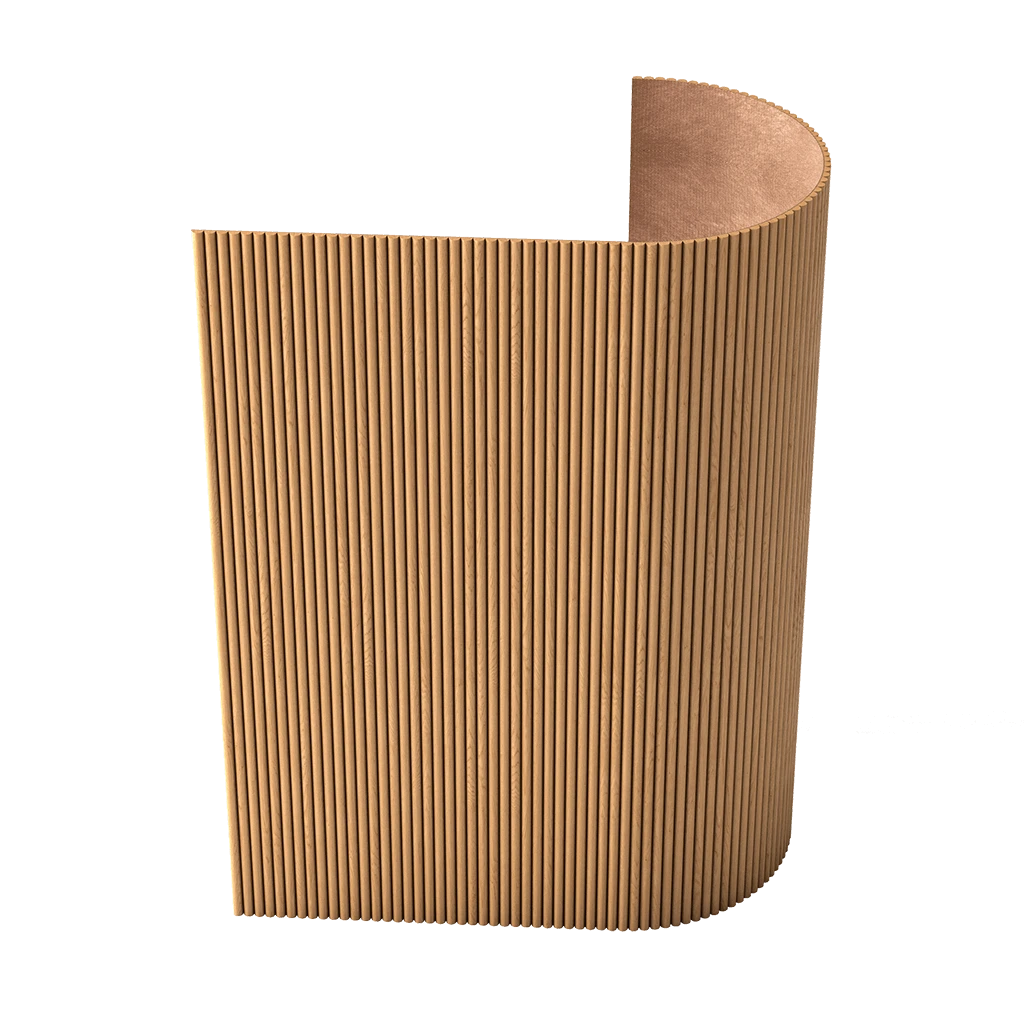
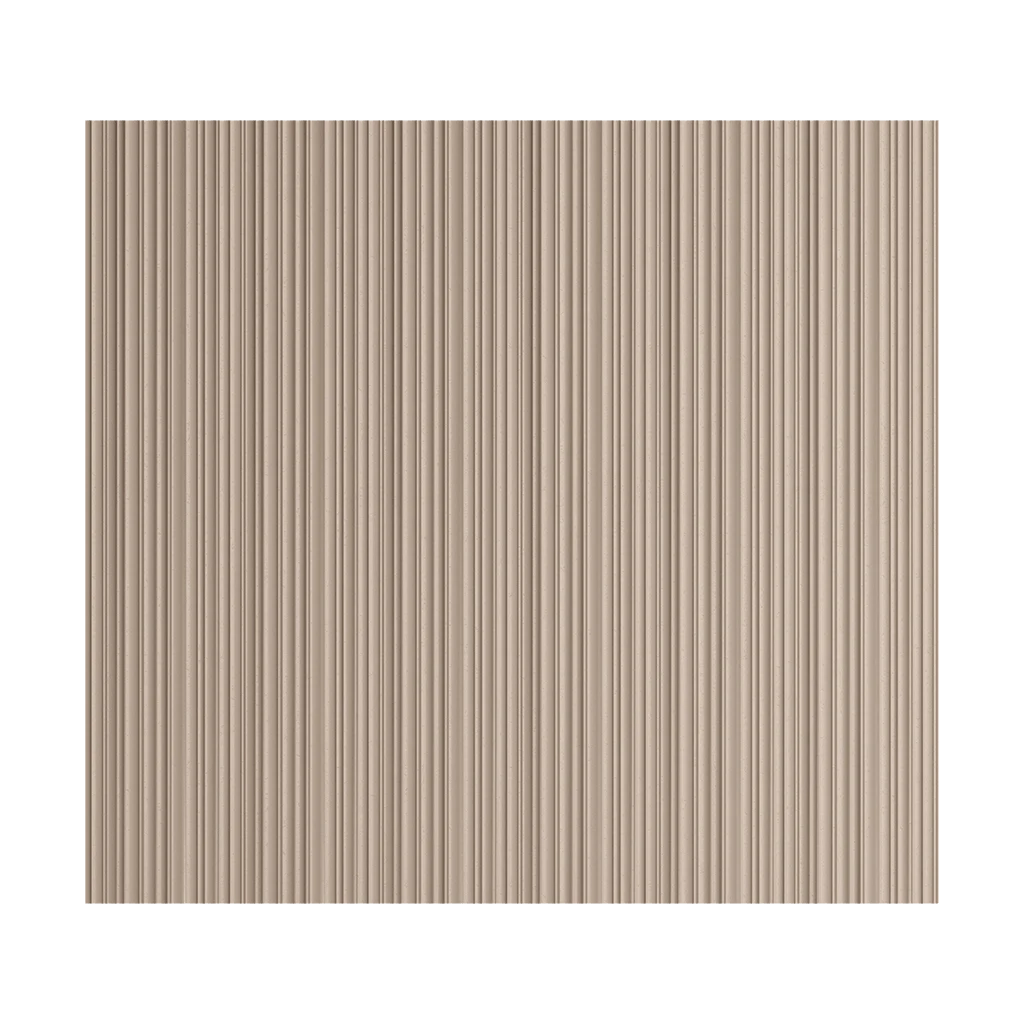
A slat is a vertical rectangle. Identical along its entire height, with a predictable rhythm, without changes in width or silhouette. That is why the slat is so good in minimalist, Scandinavian, and modern interiors: it does not claim to be decorative but creates a clean structural rhythm.
More about oak slatted partition you can read in a separate article — it details installation options and types of slatted solutions.
A flat baluster is a slat with a history. Its width changes along the height: at some points it is wider, at others narrower. It is this variable cross-section that creates a play of shadows that changes depending on the lighting angle. In the morning, a row of balusters looks one way, in the evening another. It is a living ornament.
When to choose a slat:
-
modern interior, minimalism, loft;
-
a neutral background is needed, but decor is not;
-
budget is limited;
-
quick installation is critical.
When to choose flat balusters:
-
classic, neoclassical, Russian style, country house;
-
a decorative character is needed, not just a structure;
-
the interior is thematic: estate, hotel, restaurant, office;
-
there is a desire to create an ornament, not just divide the space.
Types of flat baluster designs: from geometry to floral ornament
The baluster design is its main characteristic. It determines the style, character, and visual weight of the structure.
Simple Geometric Silhouette
Variable width without decoration: wide base, narrowing towards the center, widening to the middle, narrowing again, base at the top. This is the "classic baluster" in its simplest form. This design is stylistically neutral — it works in both neoclassicism and modern wooden interiors.
Classic profile with turned elements
A more complex silhouette with distinct transitions, shoulders, neck, and expanding zones. This is a profile that references the architectural balustrades of classic interiors: palaces, estates, manor houses. In a row, such balusters create a powerful ornamental effect.
Floral ornament and carved motifs
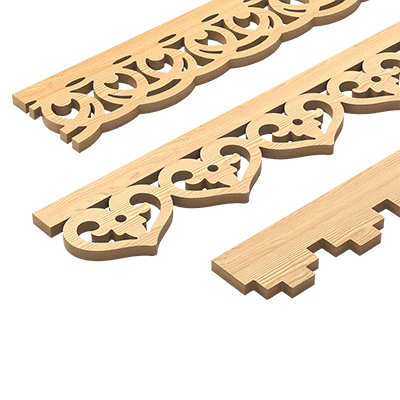
For interiors of Russian style, ethnic direction, country houses with wooden accents — flat balusters with carved floral motifs. Leaves, stems, vines, floral rosettes — carved or milled into the body of the plate. Such balusters in combination with carved wooden decor create an interior with a distinct wooden theme.
Arched or vaulted contour
Balusters with an arched top — for interiors with a Mediterranean character, with arched openings, for country houses in Italian or Spanish style. The upper semicircular part of the baluster matches the arches of doors, windows, and niches.
Art Deco geometry
Strict straight transitions, stepped expansions, geometric cutouts — a baluster in the Art Deco style. It suits interiors with metal accents, contrasting material combinations characteristic of the 1920s–1930s.
How to calculate the number of balusters for a partition or railing
Calculation is practice, not theory. It's easy to make a mistake here, and costly to fix. Let's break down the algorithm step by step.
Step 1: Measure the width of the opening
The exact width from the inner edge of one post to the inner edge of another — or from wall to wall if there are no posts. This is the working width into which the balusters need to fit.
Step 2: Determine the width of the baluster
Flat baluster has a variable width — you need to focus on the maximum width at the widest point of the silhouette. This size determines the minimum spacing between elements.
Step 3: Set the distance between balusters
The step (gap between balusters) is chosen based on several considerations:
-
aesthetics: too dense a row creates a "solid" effect, too sparse loses rhythm;
-
safety: for railings with children — no more than 10 cm between elements to prevent a child's head from passing through the gap;
-
visual transparency: the larger the gap, the lighter the structure.
The optimal gap for a decorative partition is 5–12 cm. For stair railings with children — no more than 10 cm.
Step 4: Calculate the quantity
Formula: (opening width — width of two side posts) / (baluster width + gap). Round the result down, then recalculate the final uniform spacing.
Example: opening 200 cm, side posts 5 cm each — working width 190 cm. Baluster width 6 cm, gap 8 cm. (190) / (6+8) = 13.57 → 13 pieces. Final spacing: 190 / 13 = 14.6 cm per baluster + gap.
Step 5: Account for side posts
Side posts are vertical supports of the structure. They should be wider and more massive than balusters — otherwise the structure looks flimsy. Usually, post-pillars are chosen from staircase components — there are support posts of different cross-sections and heights.
Step 6: Decide on a solid or transparent effect
Solid effect (gap up to 3 cm) — the structure is rather closed, close to slatted. Suitable for bars, restaurants where an illusion of separate space without complete isolation is needed.
Semi-transparent effect (gap 6–12 cm) — the adjacent area is visible, but the boundary is felt. Ideal for residential interiors.
Open rhythm (gap 15 cm or more) — more of a decorative accent than a partition. Works as an ornamental line in the space.
How to choose flat balusters to match interior style
Style dictates not just the pattern — it dictates everything: color, material, scale, degree of decorativeness.
Classic and High Classic
Symmetrical silhouette with pronounced transitions. Finish: white enamel, cream with gold patina, dark oak under varnish. Step — dense, rhythm — calm. In a classic interior, balusters are often combined with wooden cornices for the top trim and with a plinth — for the bottom.
Neoclassicism
Simplified silhouette without excessive decor. A baluster with geometric transitions is possible, but without carving. The coating is white or light gray matte enamel, sometimes a thin varnish on natural wood. Molding trims are thin, with a simple profile.
Russian Style
Carved motifs, ornament with floral and geometric elements, warm wood shades — stain "walnut", "dark oak", "honey". Combines with carved cornices, with applied carved decoration on posts and trims. This direction is an absolute priority for country houses in the traditional Russian spirit.
Country house and Scandinavian style
Natural texture of oak or beech under oil. Simple geometric silhouette without carving. Warm wood shades. Spacing is free, with noticeable gaps. In this option Flat wooden balusters are as close as possible to slats in perception, but still carry more architectural quality.
Restaurant and hotel
Here you can work with expressive patterns and complex coatings. Dark walnut with gold accents, black enamel with a wooden handrail, white balusters in an Italian restaurant interior — each option creates its own atmosphere. For commercial projects, the ability to replicate is important: you need N identical partitions in one hall, so the manufacturer must ensure uniformity of dimensions and coating.
How to combine balusters with other wooden elements
A wooden partition made of balusters does not exist in isolation. It only works as part of a system.
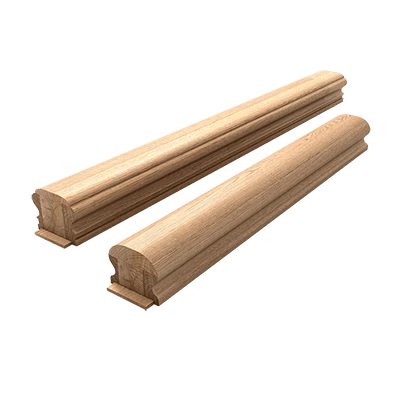
With a handrail. The top strapping of a baluster partition is either a handrail (rounded or rectangular profile), a wooden slat, or a horizontal beam. A handrail made of wooden trim is the most practical option for a partition in a living space.
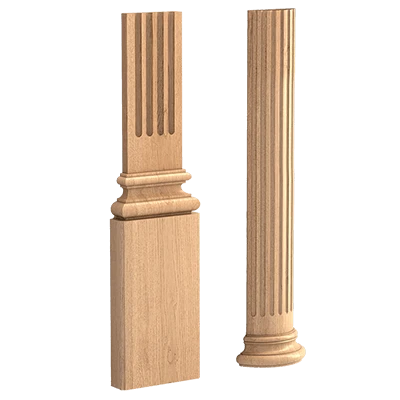
With posts-pillars. The side supports of the structure must be from the same series as the balusters. For different heights and cross-sections, different posts from the section wooden handrails and balusters.
With a cornice. If the partition goes from floor to ceiling, wooden cornice the upper part covers the gap between the structure and the ceiling. In classic interiors, the cornice adds architectural completeness.
With architraves. If the balustrade partition adjoins a doorway, wooden casing it creates a stylistic connection between the structure and the architecture of the room.
With moldings. wooden molding used for horizontal strapping of the structure — lower and upper. It gives the partition a finished look and hides fasteners.
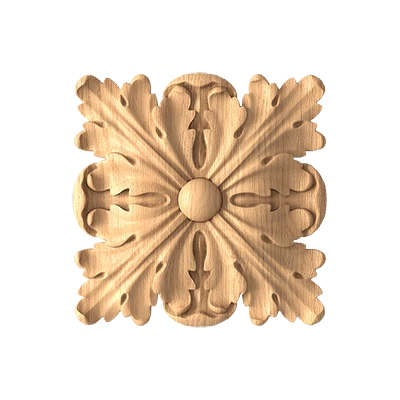
With carved overlays. Carved overlay elements can be installed on the side posts from wooden products — sockets, medallions, corner accents. This is especially appropriate in classic and study interiors.
Technical specifications of flat balusters: material, dimensions, coating
Material
Solid oak is the first choice for balusters that will be under a transparent coating: oil, varnish, stain. Oak is dense (750–900 kg/m³), strong, durable. The texture with expressive fibers looks good in both light and dark finishing options.
Solid beech is for balusters intended for painting. It has a more uniform structure, without large pores, and accepts enamel evenly. For white, gray, cream coatings, beech is the optimal material.
Dimensions
Standard heights of flat balusters: 600, 900, 1000, 1200 mm — for different railing heights. Width at the widest point: from 50 to 100 mm depending on the model. Thickness: 20–40 mm — determines strength and rigidity.
For non-standard heights (e.g., for a floor-to-ceiling partition in a room of 2.7 m) — custom manufacturing.
Finish
Balusters can be supplied without coating (for self-finishing) or with a pre-applied coating — primer, tinting, enamel. For large volumes (restaurant, hotel) — ordering with coating from the factory is more cost-effective: the color is guaranteed to be identical on all elements.
Installation of a wooden partition from balusters: practice without simplifications
Installing a baluster partition is a more complex task than installing a slatted one. But with proper preparation, it is quite doable on your own.
Tools
-
Miter saw (for precise trimming)
-
Level (construction and laser)
-
Drill and screws
-
Assembly adhesive (for additional fixation)
-
Marking batten (for uniform spacing)
-
Sander or sandpaper
Installation order
1. Marking. Mark the position of the side posts on the floor and ceiling (or on the joists, if any). Pull a string or use a laser level to check verticality.
2. Installation of side posts. The posts are attached to the floor and ceiling — through metal supports (base plates) or through anchor bolts in the floor. This is the most critical stage: if the posts are crooked, the entire row of balusters will be crooked.
3. Bottom rail. A horizontal batten or profile made of wooden trim is attached between the posts at floor level (height — according to the design). Grooves for the lower ends of the balusters are routed or cut into it.
4. Top rail. Similarly to the bottom — a horizontal profile or handrail with grooves for the upper ends of the balusters.
5. Installation of balusters. Each baluster is inserted into the grooves of the lower and upper rails. The first element is placed near the side post. A marking batten with applied marks is used to control the uniform spacing. Balusters are fixed with glue in the grooves.
6. Finish coating. After installation, if necessary, the entire structure is repainted for color uniformity. Or it is coated with a protective varnish if the wood is left in its natural state.
Mistakes when creating a baluster partition: learning from others' experience
Each of these mistakes will delay you in the renovation process by several days — or turn the finished structure into something you'll want to remove in six months.
Too frequent spacing. When the gap between balusters is less than 3 cm, the structure loses transparency and becomes "filled." This isn't always bad — but you need to make this decision before installation, not discover it afterward.
Too sparse spacing without considering safety. A 20 cm gap on a stair railing violates safety standards if there are children in the house. For stairs and mezzanines, the gap should not exceed 10–12 cm.
Incorrect height selection. A 900 mm baluster in a room with a 3.5 m ceiling is a small element that gets lost in the space. The height of the baluster should be chosen considering the scale of the room.
Too fine a pattern for a large opening. Fine detailing on a baluster with small cutouts reads well up close but gets lost at a distance of 3–4 meters. For large openings, use a larger, more readable silhouette.
Mixing different patterns. One structure should have one type of baluster. The exception is intentional alternation of two types on an "A–B–A–B" principle, but this requires careful design justification.
Lack of side posts. A row of balusters without side posts is a structure without supports. It not only looks unfinished but is also unstable: under lateral load, it will start to "wobble."
Poorly thought-out fastening of the top rail. If the top rail is simply placed on top and screwed to the balusters, it may come loose with vibration (door slam, children, furniture). The rail must be secured to the posts or to the ceiling structure.
Inconsistency with doors and trim. Light oak balusters next to dark doors create a conflict. Or classic-style balusters with modern door trim — a mismatch. The partition must be coordinated with its surroundings.
Wooden balusters in commercial projects: hotel, restaurant, showroom
For commercial properties, a wooden baluster partition is both a branding element and an atmosphere piece.
Restaurant
A wooden baluster partition between restaurant halls or zones is a classic solution. It allows for both separation and preservation of a unified space. Dark walnut, carved motifs, brass handrails — the atmosphere of a 'club', 'bistro', or 'estate'.
In a restaurant, cleanability is important: the surface must be smoothly lacquered or coated with durable enamel to remove grease stains without damaging the finish.
Hotel
In hotel lobbies, transitions between zones, near staircases — wooden baluster partitions create a sense of a lived-in, warm, high-quality space. For classic and historic hotels — an obvious choice. For modern boutique hotels — balusters in neoclassical or custom design.
Showroom and boutique
A baluster partition in a showroom makes zoning visible and decorative. In a boutique, it creates the feeling of a 'special hall' behind the partition — an exclusive space entered by invitation.
What to buy for a baluster partition: complete set
A complete set for creating a wooden partition or railing from flat balusters includes:
-
Flat balusters — the main element. Choose by pattern, height, and width.
-
balusters for staircases — if the partition adjoins a staircase or serves as its railing.
-
staircase components — posts, support columns, handrails, base shoes.
-
Wooden trim — bottom and top strapping, auxiliary profiles.
-
wooden cornice — to complete the structure from above when the height reaches the ceiling.
-
Wooden molding — for trims and connecting profiles.
-
Carved wooden decoration — overlay elements for posts and strapping.
-
Wooden items — the full range for selecting additional elements.
Caring for a wooden baluster structure
A wooden partition or baluster railing, under proper conditions, lasts for decades. A few maintenance rules.
Regular wiping. Soft damp cloth, no abrasives. The difficulty with flat balusters is that they have cutouts and relief — dust accumulates in the recesses. A soft brush or vacuum cleaner with an attachment is more effective than a cloth.
Protection from direct sunlight. Wood darkens under direct UV rays. If the partition is near a window, protective treatment with a UV filter is mandatory.
Humidity. In rooms with high humidity (kitchen, bathroom), wood must be coated with moisture-resistant varnish. Sharp humidity fluctuations cause movement in the solid wood.
Coating renewal. Varnished surfaces require renewal every 5–7 years with intensive use. Oiled surfaces — every 1–2 years.
FAQ: answers to the most common questions
Can flat balusters be used not on stairs?
Yes, and that is their legitimate application scenario. Flat wooden balusters They are used for decorative partitions, screens, mezzanine railings, and framing openings and halls. Structurally and visually, this is a complete solution — not a compromise.
What makes flat balusters better than wooden slats?
A slat creates a simple rhythm without decoration. Flat wooden baluster It creates an ornament with a play of shadows. For classic, neoclassical, country houses, restaurants — a baluster is more expressive and better suited to the style.
Can I make a partition between the kitchen and living room from balusters?
Yes. Such a partition zones the space without blocking light and visual connection. Height ranges from bar counter level (90 cm) to full height (2.4–2.7 m) depending on the task.
Which balusters to choose for a classic interior?
For classic style — a symmetrical silhouette with pronounced transitions, white or cream enamel, possible carved motifs. From the range of balusters choose models with the most expressive classic profile.
Do I need to buy only balusters or a complete set?
For a complete result, you need a set: balusters, posts, handrail or rail, bottom profile made of trim, fasteners. Isolated balusters without a system are an unfinished structure.
What gap should be left between balusters for a partition?
For a decorative partition — 5–12 cm. For a staircase railing with children — no more than 10 cm. For screens without a safety function — according to design, up to 15–20 cm.
Is it possible to order balusters of non-standard height?
Yes, STAVROS produces custom-sized elements. For rooms with non-standard ceiling heights, this is a mandatory service.
How to calculate the number of balusters?
(Opening width — width of side posts) / (baluster width + gap). Detailed instructions are in the "How to calculate the number of balusters" section above.
About the company STAVROS
A wooden partition made of balusters is not just a set of elements. It is a structure that only works when every element is precisely manufactured, correctly selected, and organically integrated into the system.
STAVROS is a manufacturer of wooden decor and of solid wood since 2002. The company's history began with restoration projects — Konstantinovsky Palace, the Hermitage, Alexander Palace — and this biography is not a declaration, but a working quality standard that is applied to every product.
In the Stavros catalog — Flat balusters, Wooden balusters of various shapes and patterns, staircase components, wooden handrails and balusters, Trim, Crown Molding, Moldings и Carved Decor — everything you need to create a full-fledged wooden partition or balustrade from balusters.
Production is in Saint Petersburg. Showrooms are in Moscow and Saint Petersburg. Delivery is throughout Russia and CIS countries. We work with private clients, designers, and commercial projects — restaurants, hotels, country houses.
If you are choosing between a slat and a baluster — STAVROS will show you the difference clearly: in the showroom, in the catalog, in the details. Because wood with character is worth seeing in person.