
























Article Contents:
- What is a flat baluster: shape, principle, image
- How flat balusters are made
- How a flat baluster differs from an overlay decorative panel
- Where flat balusters are used: eight architectural scenarios
- Staircases in a country house
- Double-height space railing
- Balustrade in a classic interior
- Indoor terrace or winter garden
- Gallery and open passage of the second floor
- Hall with Grand Staircase
- Staircase on the veranda or open porch
- Children's room and mezzanine railing
- How flat balusters differ from turned ones: comparison of two types
- By shape and manufacturing technology
- By nature of decor
- By stylistic application
- By installation and technical logic
- By visual 'transparency' of the railing
- How to choose the shape and pattern of a flat baluster: classification by styles
- Simple shaped flat baluster
- Shaped baluster with cut-out ornament
- Geometric flat baluster
- Baluster with floral ornament on the surface
- Classic "lyre-shaped" flat baluster
- How to choose a baluster shape to match the interior style
- How to choose the size of a flat baluster: height, width, thickness, spacing
- Height of a flat baluster
- Width of a flat baluster
- Thickness of a flat baluster
- Step between balusters
- Table: approximate parameters of flat balusters by application scenario
- Material: which wood to choose for flat balusters
- Beech: contour precision and versatility
- Oak: texture and status
- Ash: balance of characteristics
- Solid wood: what this term means
- Flat balusters for stairs: installation, orientation, kit composition
- Orientation of a flat baluster on a sloping flight
- Composition of a complete stair railing kit with flat balusters
- Fastening of flat balusters
- Flat balusters for double-height spaces and balustrades: safety and decor
- What a person sees from below
- Requirements for gallery railing height
- Visual lightness vs. decorativeness
- Combining flat balusters with posts on the gallery
- How to combine flat balusters with handrails and posts: rules of consistency
- Rule one: wood species and tinting
- Rule two: handrail profile matching the baluster shape
- Rule three: posts are more massive than balusters
- Rule four: steps determine the tinting of balusters
- Calculating the number of flat balusters: a foolproof algorithm
- For a flight of stairs
- For horizontal railing (gallery, balcony)
- For U-shaped or L-shaped stairs
- Mistakes when buying flat balusters: eight costly blunders
- Mistake 1. Buying balusters without calculating the spacing
- Mistake 2. Choosing balusters that are too wide for a narrow span
- Mistake 3. Not accounting for the handrail height
- Mistake 4. Mixing flat and turned balusters without a clear concept
- Mistake 5. Ignoring the thickness of the baluster
- Error 6. Buying without considering coverage
- Error 7. Not ordering spare parts
- Error 8. Not considering the style of the existing interior
- Coating of flat balusters: how to preserve shape and color
- For tinting
- For white enamel
- For oil (for a natural look)
- For outdoor use
- FAQ: answers to the main questions about flat balusters
- STAVROS: flat balusters as an element of the architectural character of the house
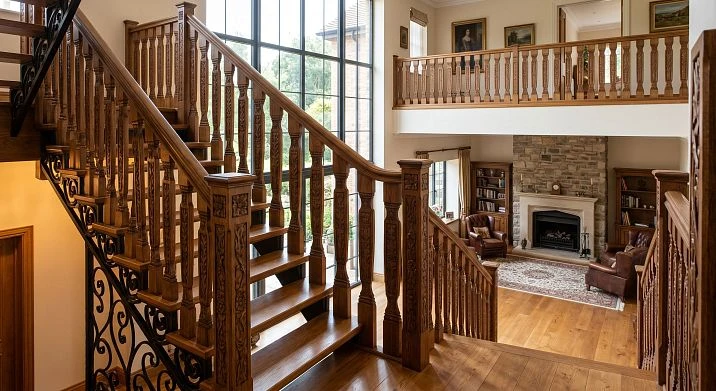
There are two ways to build a staircase railing. The first is to place round turned posts in a row and call it done. The second is to choose an element that doesn't just "fill" the space between the handrail and the step, but creates an ornamental rhythm, reads as a graphic, and works as a decorative statement.
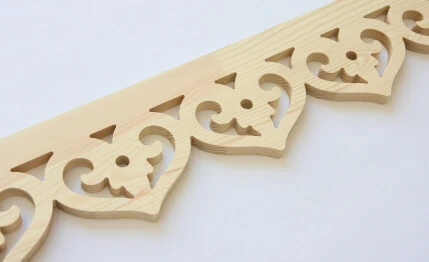
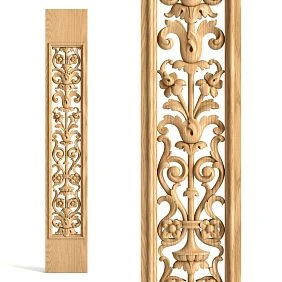
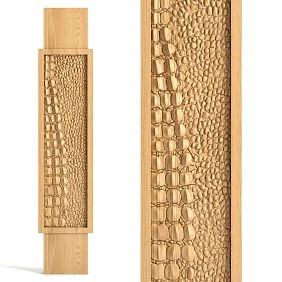
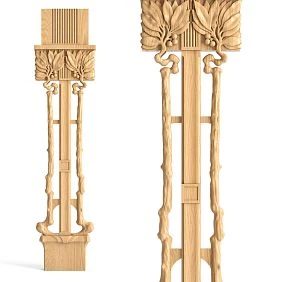
Flat balusters — this is the second way. These are flat vertical wooden boards with a figured silhouette, ornamental cutout, or decorative contour, which when viewed from the side read as an ornament, and when viewed head-on — as a straight railing post.
They are not like turned balusters. They work differently. And they are chosen by people who know what they want: not just a "railing," but a character of the space.
This article is a detailed guide to choosing wooden flat balusters: for stairs, balustrades, double-height spaces, and galleries in a country house. No repetition, no generalities — only specific and to the point.
What is a flat baluster: form, principle, image
Let's start with a definition that immediately puts everything in its place.
Flat wooden baluster — this is a vertical railing post cut from a board (not turned on a lathe). Its cross-section is rectangular: the width significantly exceeds the thickness. The outer contour is figured: curved lines, narrowings, widenings, sometimes — cut-out ornaments.
When viewed from the side of the railing, a flat baluster reads as an openwork ornament: the silhouette curves, creating a decorative rhythm similar to a carved frieze. When viewed from the front (head-on) — it is a straight vertical post with a small thickness.
It is this duality that makes the flat baluster a special choice: it creates decor where a turned post would create just a railing.
How flat balusters are made
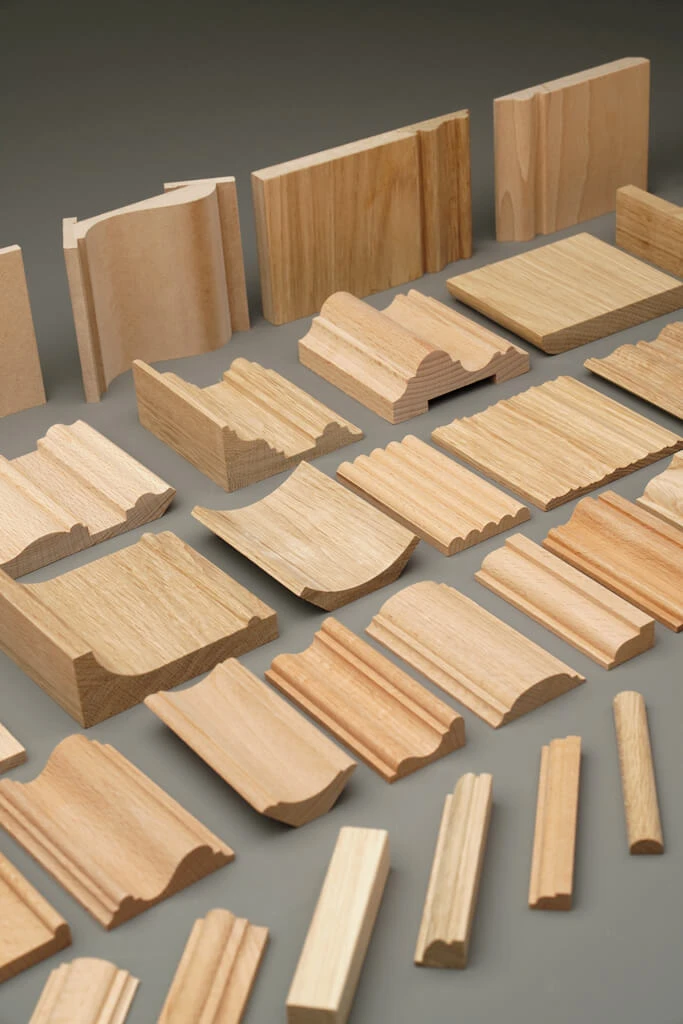
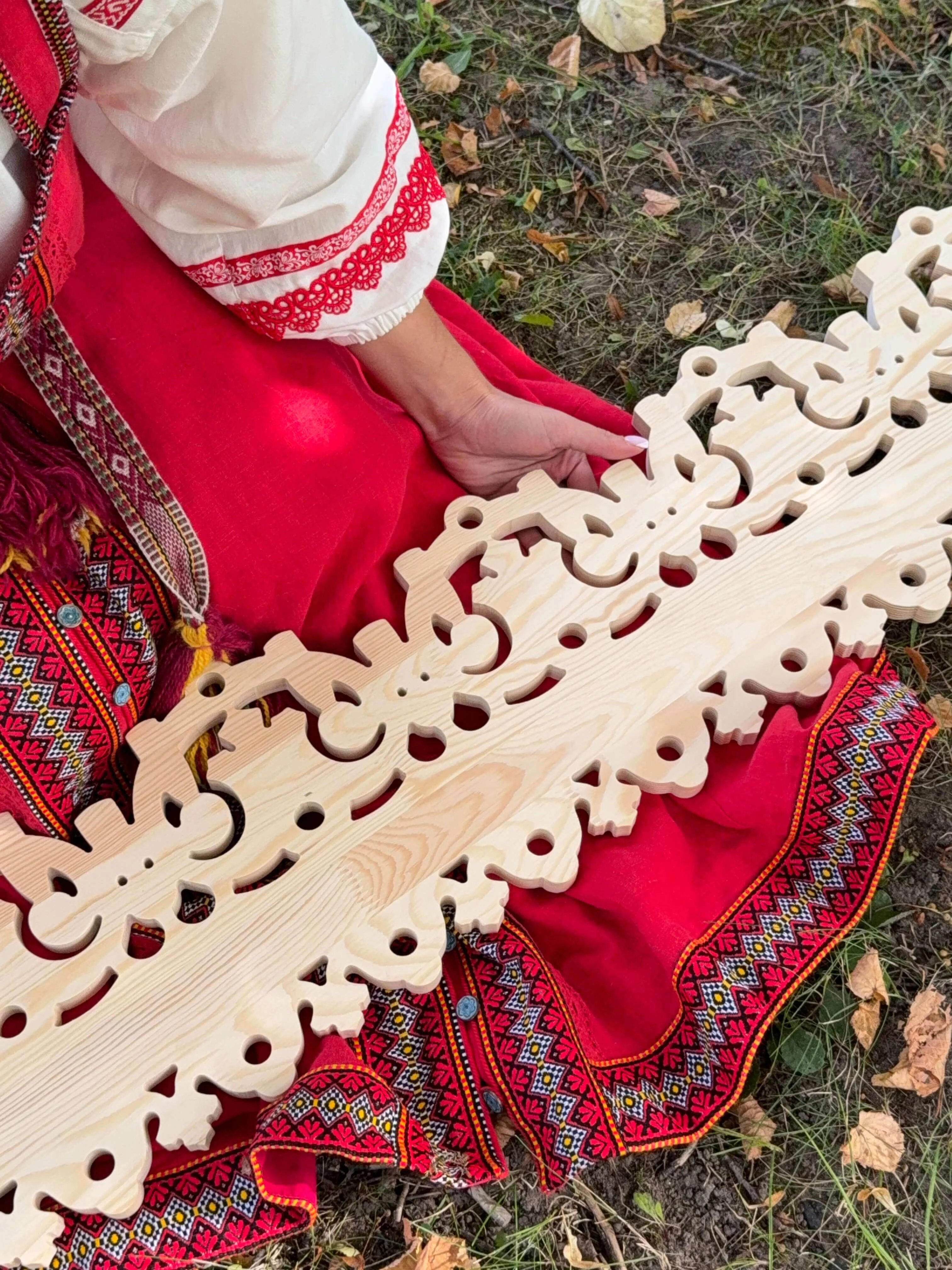
Production — cutting out from a board or panel along the contour. Tools: band saw or jigsaw using a template. After cutting — edge sanding, sometimes edge routing to remove sharp edges. If there is a cut-out ornament — additional cutting inside the contour.
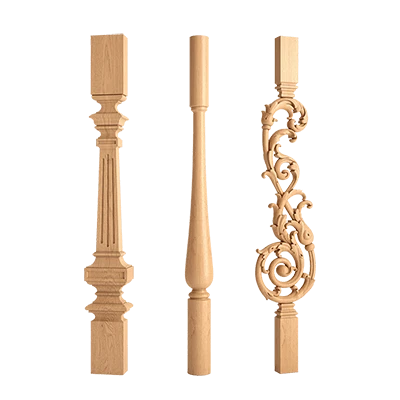
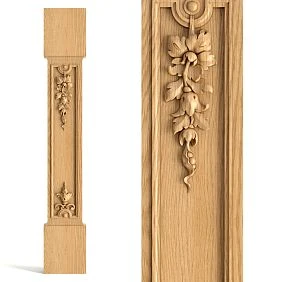
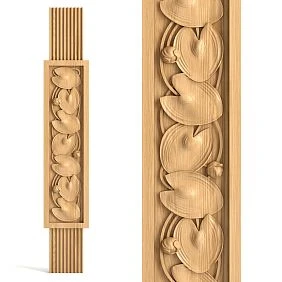
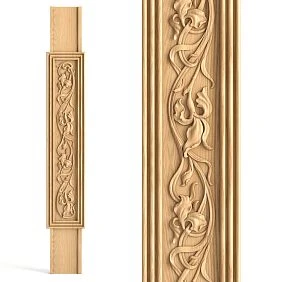
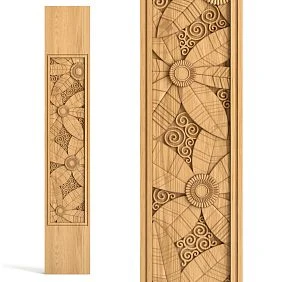
The highest level is a turned-carved flat baluster: a combination of flat cutting with hand-carved ornamentation on the surface. This product is already a decorative object, not just a structural element.
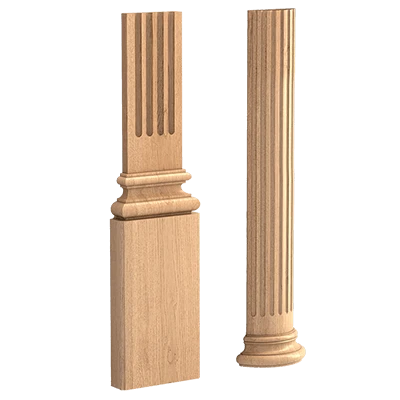
Our factory also produces:
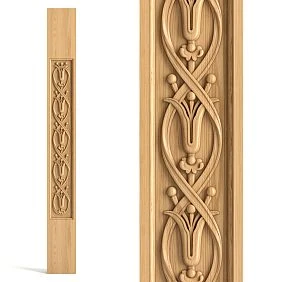
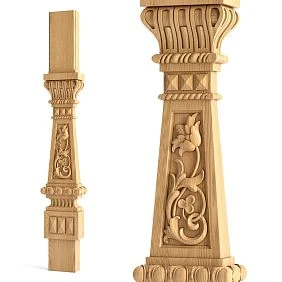
How a flat baluster differs from an overlay decorative panel
A panel is a flat board installed as a solid infill of a span. A flat baluster is a vertical post of a certain width, installed with a spacing (distance between elements). This is a fundamental difference: a baluster creates rhythm and a "breathing" railing, while a panel creates a closed infill.
Get Consultation
Where flat balusters are used: eight architectural scenarios
Wooden flat balusters — a universal element. Let's list all key application areas.
Staircases in a country house
The most obvious scenario. Balusters are installed along the staircase with a clear spacing of 100–150 mm — creating a side railing and a decorative screen visible to everyone in the hall.
Flat balusters on a staircase are especially expressive when viewed from the living room or hall at an angle: the ornamental silhouette reads as a continuous decorative frieze along the flight.
Second light railing
The second-floor gallery railing above the double-height hall — a scenario where flat balusters work most effectively. Visible from below, they create an openwork ornamental screen. Visible from above, they create a neat rhythm of vertical lines.
Balustrade in a classic interior
Included of the wooden balustrade flat balusters are often combined with massive support pillars — creating a contrast: heavy corner points and a light decorative filling row.
Indoor terrace or winter garden
Railing for an internal terrace or transition between levels in a private home. Here, flat balusters create a decorative partition that divides the space but does not completely block it visually.
Gallery and open second-floor walkway
In homes with open galleries between building wings, flat balusters form the gallery railing — creating a continuous decorative rhythm along the entire length of the walkway.
Hall with a grand staircase
In the hall, a flat baluster is a tool for creating an image: it is the silhouette of the ornament, repeated in a row, that creates the "handwriting" of the interior, its decorative leitmotif.
Staircase for a veranda or open porch
For outdoor stairs of a private house — flat balusters made of oak or ash with weather-resistant coating. They create a decorative look for the facade porch and align with the overall character of the house.
Children's room and mezzanine railing
In a house with a mezzanine or in a children's room, flat balusters with simple geometric or floral patterns create a light, decorative railing — not heavy, not overloaded, but expressive.
How flat balusters differ from turned ones: a comparison of two types
This is a fundamental question, and the answer determines the choice of product type. Let's consider the difference for each parameter.
By shape and manufacturing technology
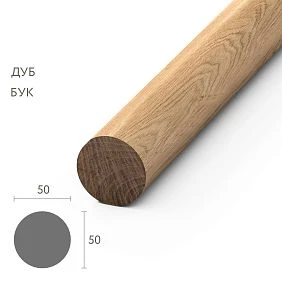
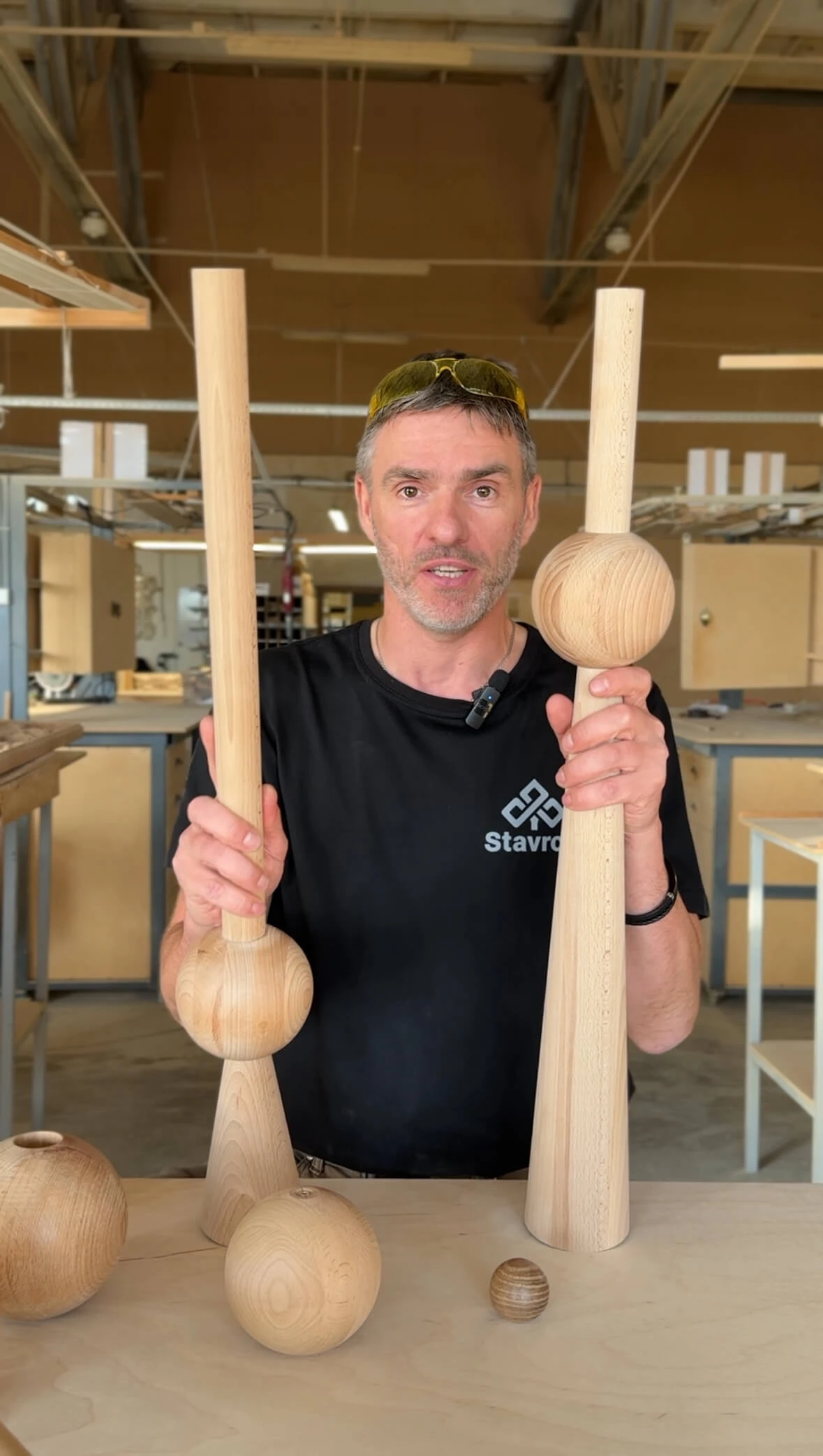
A turned baluster is made on a lathe: round in cross-section, with volumetric spheres, rollers, vases. The profile is the same from all sides.
A flat baluster is cut from a board: rectangular cross-section, shaped contour in the plane. It looks different when viewed from the side and from the front.
By the nature of decoration
Turned creates a voluminous, sculptural image. Each baluster is a small three-dimensional object. The shadow falls differently depending on the lighting angle, creating a lively plastic rhythm.
Flat creates a graphic, ornamental image. When viewed from the side — an openwork contour, linear ornament, decorative frieze. A more "flat" decor, but precisely due to this — a clearer pattern.
By style application
| Baluster type | Suitable styles |
|---|---|
| Turned | Classic, neoclassical, baroque, empire |
| Flat | Russian style, country house, classic with ornament, wooden tradition |
| Carved (voluminous) | High classic, formal interiors |
By installation and technical logic
A turned baluster is installed vertically, fastened with tenons into the step below and into the handrail above. Its position in space is strictly vertical.
Flat baluster mounted similarly, but when installing on an inclined march, it is important to orient its plane perpendicular to the handrail — so that the silhouette of the ornament reads correctly (not at an angle, but vertically).
By visual "transparency" of the railing
A turned baluster with a diameter of 45 mm at a pitch of 155 mm "covers" approximately 29% of the visual field of the railing. A flat baluster with a width of 80 mm at the same pitch — 52%. A railing made of flat balusters is visually denser, less "transparent" — this should be considered when choosing for a second light.
How to choose the shape and pattern of a flat baluster: classification by styles
Flat wooden balusters differ in the shape of the silhouette and the nature of the ornament. Let's break down the main types.
Simple shaped flat baluster
Silhouette with smooth curves: narrowing in the middle part, small expansions at the top and bottom — imitation of a "vase" in a flat version. Minimal ornament, pure form. For modern classic, neoclassical, a country house in European style.
Thickness: 18–25 mm. Width at the maximum point: 80–120 mm. Width at the narrow point: 30–50 mm.
Shaped baluster with cut-out ornament
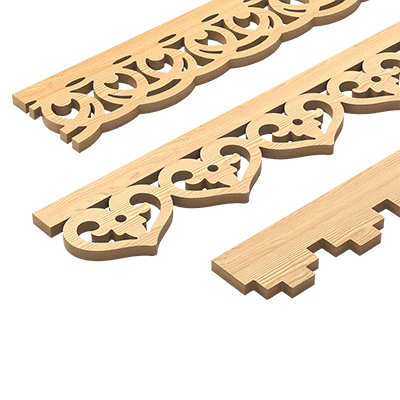
Contour shaped + inside the contour — cut-out openings: floral ornament, geometric pattern, stylized leaves. Creates an openwork, "lace" effect when viewed from the side. For Russian wooden style, for a country house with carved architraves and cornices.
Ornamental cutouts increase the "transparency" of the railing — the baluster visually appears lighter.
Geometric flat baluster
Strict geometric silhouette: stepped transitions, straight lines, minimal curves. For Art Deco, modern classical interiors, and minimalist country houses. Width is stable or changes in steps: 60–80–60 mm.
Baluster with floral ornament on the surface
Flat contour + carving on the board surface: leaves, stems, curls. This is already a turning-carving level: the ornament is crafted by hand or with a router. For classic interiors with expressive decor. The most labor-intensive and striking option — an analogue carved balusters in a flat execution.
Classic "lyre-shaped" flat baluster
Lyre-shaped silhouette: widening at the bottom and top, pronounced narrowing in the middle. Classic ornament, soft lines, no sharp corners. For classic and neoclassical styles. One of the most common forms of flat balusters in the European tradition.
How to choose a baluster shape to match the interior style
-
Russian style, wooden tradition → cut-out with floral ornament
-
Classic, neoclassic → lyre-shaped or figured without cutouts
-
Country house, Provence → simple figured with soft curves
-
Art Deco, modern classic → geometric with straight lines
-
Grand hall → with surface carving or ornament
How to choose the size of a flat baluster: height, width, thickness, spacing
Choosing the size of flat balusters is a matter of proportions. The wrong size ruins the railing as surely as the wrong style.
Height of a flat baluster
Working height (excluding mounting tenons): corresponds to the distance from the top plane of the step to the bottom point of the handrail.
Standard railing height: 900 mm (from the step surface to the top point of the handrail).
If the handrail has a cross-section of 60 mm and the sub-baluster strip is 20 mm, then the working height of the baluster is: 900 − 60 − 20 = 820 mm.
Standard working lengths of flat balusters: 800, 850, 900, 950 mm. Custom lengths available.
Width of flat baluster
Width (maximum dimension in the plane of the railing) is the main decorative parameter.
-
Width 60–80 mm — restrained, "light" rhythm of the railing
-
Width 80–110 mm — medium rhythm, clearly visible from a distance of 3–5 m
-
Width 110–140 mm — rich decorative row, for wide spans and galleries
Important: the width of the baluster should be proportional to the width of the handrail. Handrail 50 mm + baluster 140 mm — disproportion. Handrail 70 mm + baluster 100 mm — harmony.
Thickness of flat baluster
Thickness (dimension across the railing) is a structural parameter.
-
Thickness 18–20 mm — for decorative elements in lightweight structures
-
Thickness 22–28 mm — standard for residential stairs
-
Thickness 30–40 mm — for railings with increased load (wide flights, public spaces)
A flat baluster less than 18 mm thick is too fragile for a functional railing. Don't skimp on thickness: it determines the rigidity of the structure.
Spacing between balusters
Clear distance (between adjacent balusters) — a regulatory safety requirement: no more than 100–120 mm (for homes with children).
Center-to-center spacing: baluster width + clear distance.
Example: baluster width 90 mm + clear distance 110 mm = spacing 200 mm.
For a gallery railing on a second floor without constant presence of children — spacing can be increased to 150 mm clear: the railing looks visually lighter.
Table: recommended parameters for flat balusters by application scenario
| Scenario | Width (mm) | Thickness (mm) | Clear spacing (mm) |
|---|---|---|---|
| Small staircase, apartment | 60–80 | 20–22 | 100–110 |
| Residential building, standard flight | 80–100 | 22–28 | 100–120 |
| Double-height gallery | 90–110 | 25–30 | 120–150 |
| Grand staircase | 100–130 | 28–35 | 100–120 |
| Outdoor terrace, porch | 90–120 | 28–40 | 120–150 |
Material: which wood to choose for flat balusters
Wooden balusters are made from different species. For flat balusters, the choice of species is especially important — it determines the clarity of the ornament and the durability of the product.
Beech: contour precision and versatility
Beech is a dense, fine-grained species with a uniform structure. For flat balusters, this is the optimal choice: the saw and router produce a clear, sharp contour without chips or "fuzz" on the edges. The ornament reads clearly, the corners are neat.
Beech accepts any tinting from light honey to dark chocolate. Under white enamel — it is ideal: the surface is smooth, the paint lays evenly. For interior flat balusters for painting — beech is the first choice.
Oak: texture and status
Oak is a hard species with a coarse structure and expressive grain. Flat balusters made of oak in natural tinting or under oil — this is a different image: more "lively", with character, with noticeable texture.
The contour of an oak baluster is slightly less sharp than that of a beech one — the large pores of the wood give a slight "roughness" to the edge. This is not a defect — it is a feature of the material. When tinted with dark shades, oak creates an image that cannot be replicated in beech.
For grand staircases in country houses with dark natural tinting — oak is preferable.
Ash: balance of characteristics
Ash is a straight-grained wood with a slightly less pronounced texture than oak, but with good mechanical properties. For flat balusters on external structures (terrace, veranda, porch) — ash is more resistant to humidity than beech.
Solid wood: what this term means
"Made of solid wood" means that the baluster is made from a single piece of wood, not from glued panels. For flat balusters with a width of up to 110 mm — solid wood is possible. For widths of 120–150 mm, glued panels made from several planks are often used — this is standard practice and does not reduce product quality.
Flat balusters for stairs: installation, orientation, kit composition
Buy flat balusters for stairs is half the task. The other half is to correctly understand the installation logic and the composition of the complete kit.
Orientation of a flat baluster on an inclined flight
This is a key point that distinguishes the installation of flat balusters from turned ones.
A turned baluster is symmetrical — it can be placed at any angle and always looks the same.
A flat baluster has a figured ornament in one plane. To ensure the ornament's silhouette reads vertically (and not at the angle of the flight), you need to:
-
orient the plane of the baluster perpendicular to the horizon — strictly vertically
-
trim the top tenon to the angle of the flight for a tight fit to the handrail
-
trim the bottom tenon to the angle of the flight for a fit to the sub-baluster rail or step
If this is not done, the ornament appears tilted, which ruins the entire decorative effect.
Composition of a complete staircase railing set with flat balusters
Flat balusters do not work on their own. A complete staircase railing set:
-
Flat balusters — the main decorative row
-
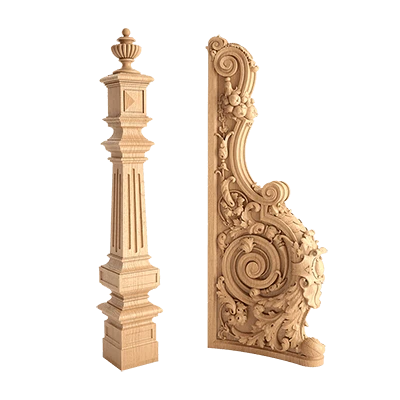
Support posts — at the beginning, end of the flight, on the landing. Square cross-section 80–120 mm. May have carved finials.
-
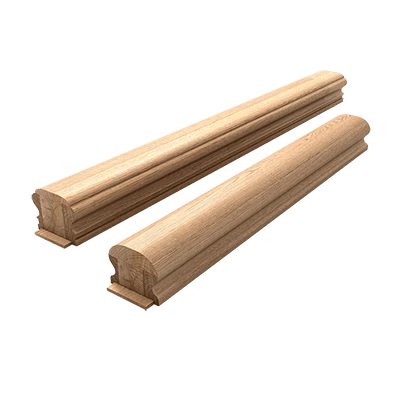
Handrail — horizontal or inclined profile on top of balusters and posts.
-
Under-baluster rail — horizontal strip under balusters on steps or stringer.
-
Post finials — decorative elements on top of posts.
-
Handrail turning elements — on the landing and when changing direction.
All elements are from the same staircase component catalog, the same series and the same wood species.
Fastening flat balusters
To the step: wooden tenon into the step hole + glue. Tenon: 10–12 mm diameter, length 30–50 mm. Hole in the step — in advance, before installation.
To the baluster rail: glue + screw from below through the rail. This is more reliable than fastening directly to the step — it allows you to align the pitch.
To the handrail: glue + concealed fastener (screw at an angle through the tenon).
Flat balusters for double-height spaces and balustrades: safety and decor
The gallery railing on the second floor is a special scenario. Here, the balusters are visible from below, from the height of the hall — and it is this perspective that determines everything.
What a person sees from below
Standing in the double-height hall and looking up at the gallery railing, a person sees:
-
the lower ends of the balusters (they must be neatly finished)
-
the baluster rail (it should be a functional part of the railing, not hidden)
-
the silhouette of the flat baluster ornament in perspective — this is the main decorative element
That is why for double-height spaces, flat balusters with openwork or floral ornament create a special effect: from below, the railing reads as an ornamental frieze.
Requirements for gallery railing height
Handrail height above gallery floor: at least 900 mm. For fall heights over 3 meters (typical double-height space), recommended height is 1,000–1,100 mm.
Clear distance between balusters: no more than 100–120 mm.
Visual lightness vs. decorative appeal
For double-height spaces, it's important to strike a balance: the railing should not be too "solid" (otherwise it blocks the view and weighs down the space), but it should be sufficiently decorative.
Optimal choice for double-height spaces:
-
Flat balusters with cut-out ornamentation (openwork effect)
-
Width 80–100 mm
-
Clear spacing 120–130 mm
-
Thickness 25–30 mm
The railing appears visually light, yet decoratively rich.
Combination of flat balusters with posts on the gallery
On the second-floor gallery, support posts are installed at corner points and every 1,200–1,800 mm on long spans. The posts are square and significantly more massive than the balusters: the contrast creates an architectural rhythm — "heavy points" and a "light row" between them.
This is the main visual principle of a good balustrade with flat balusters.
How to combine flat balusters with handrails and posts: rules of consistency
A flat baluster is just one element of the system. Buying it separately, without coordinating with the handrail and posts, means getting a set of parts, not a railing.
First rule: wood species and tinting
All railing elements should be from the same wood species (or deliberately different with justification). Tinting should be in one shade or a two-tone solution (balusters lighter/darker than posts). Accidental mismatch of shades is the most noticeable mistake.
Second rule: handrail profile matching the baluster shape
Handrail with a complex figured profile (ogee, bead) → flat balusters with a figured silhouette and ornament.
Handrail with rectangular or oval profile → flat balusters with geometric or simple figured silhouette.
Contrast between a complex handrail and simple balusters, or vice versa, is only acceptable as a deliberate design technique.
Rule three: posts are more massive than balusters
The support post should be proportionally heavier than the flat baluster. A baluster 90 mm wide + a post 80×80 mm is a disproportion (the post is thinner than the baluster). A baluster 90 mm + a post 100×100 mm is the correct proportion.
For balusters 100–120 mm wide — a post 120×120 mm.
Rule four: steps determine the tint of balusters
The tint of flat balusters should be coordinated with the tint of the steps. Three options:
-
Matching the steps — a unified wooden space
-
Contrasting white balusters + dark steps — a classic two-tone solution
-
Balusters darker than the steps — creates an accent on the railing, visually makes it heavier
Choice is before purchase, not after.
Calculating the number of flat balusters: an error-free algorithm
For a flight of stairs
Step 1. Determine the length of the flight (horizontal projection).
Step 2. Determine the installation pitch on centers = baluster width + clear spacing.
Step 3. Number of balusters = flight length / pitch on centers (round up).
Step 4. Add 2–3 pieces as spare for cutting and defects.
Example: flight 3,600 mm, baluster 90 mm, clear spacing 110 mm, pitch on centers 200 mm.
3,600 / 200 = 18 balusters + 2 spare = 20 pieces.
For horizontal railing (gallery, balcony)
Fence length / center-to-center spacing + 1 (end baluster). Add 10% margin.
Example: gallery 4,800 mm, spacing 200 mm: 4,800 / 200 = 24 + 1 = 25 balusters. With 10% margin: 28 pieces.
For U-shaped or L-shaped stairs
Each flight is calculated separately, results are summed. Landings — horizontal sections, calculated by the length of each side.
Mistakes when buying flat balusters: eight costly blunders
Mistake 1. Buying balusters without calculating spacing
"I'll take twenty pieces — that'll be enough" — and as a result, the spacing between balusters ends up either too large (unsafe) or too small (ugly). Calculate precisely using the algorithm.
Mistake 2. Choosing too wide balusters for a narrow flight
A 130 mm baluster in an 800 mm wide flight with 200 mm spacing = 4 balusters + 4 gaps of 70 mm. The railing looks overloaded. For narrow flights — balusters 60–80 mm wide.
Mistake 3. Not considering the handrail height
Baluster height 800 mm + handrail 60 mm + sub-baluster plank 20 mm = 880 mm — less than the standard 900 mm. Check the final railing height before ordering.
Mistake 4. Mixing flat and turned balusters without a clear concept
A row of turned balusters + a few flat ones in different places is not "eclectic." It's chaos. If mixing, do it only according to a clear scheme: turned on the landing, flat on the flight; or flat in the regular row, turned as accent posts.
Mistake 5. Ignoring baluster thickness
Thickness of 15 mm at a height of 900 mm — the baluster bends under lateral pressure. The minimum thickness for a residential staircase is 22 mm. Don't skimp on this parameter.
Mistake 6. Buying without considering the coating
Flat beech balusters for an open veranda without weather-resistant coating will warp after two seasons. For outdoor use — oak or ash + antiseptic + outdoor varnish or oil with UV protection.
Mistake 7. Not ordering a spare
Different batches of the same item may have slight differences in tinting. Order immediately with a 10–15% spare: better to have leftovers than to buy more from another batch.
Mistake 8. Not considering the style of the existing interior
Flat balusters with openwork floral ornament in Russian style + minimalist interior with white walls and gray concrete — a stylistic conflict. The shape of the baluster must belong to the same decorative code as the entire staircase and hall.
Coating of flat balusters: how to preserve shape and color
Under Staining
Applied in 2–3 layers with interlayer sanding. Tinting emphasizes the wood texture and the relief of the figured contour. For beech — tinting is especially even. For oak — reveals the structure.
Finish coating: water-based or alcohol-based varnish in 2 layers. Matte, semi-matte, or glossy — to taste.
For white enamel
Primer (1–2 layers, sanding after each) → enamel (2 layers). White baluster in a dark interior — a classic two-tone solution. Enamel completely hides the texture — beech is preferable to oak.
For oil (for a natural look)
Oil penetrates the wood structure without creating a film. The wood "breathes", the texture is maximally natural. Renewal — every 2–4 years. For interior balusters in a country house with natural wooden decor — oil is optimal.
For outdoor use
Antiseptic impregnation → oil with UV protection or facade varnish. Renewal — every 2–3 years (oil) or every 5–7 years (varnish). Baluster ends — coat especially carefully.
FAQ: answers to the main questions about flat balusters
What are flat balusters?
Flat balusters — vertical railing posts cut from a board with a figured silhouette or cut-out ornament. They differ from turned balusters in their flat cross-section and graphic decor.
How do flat balusters differ from turned ones?
A turned baluster is three-dimensional, round, creating a sculptural row. A flat one is graphic, with a figured contour, creating an ornamental silhouette when viewed from the side. See all types in the section Wooden balusters.
Where are flat wooden balusters used?
On stairs, second-light galleries, balustrades, open verandas, porches, and mezzanine railings. Full range in the section staircase components.
Are flat balusters suitable for stairs?
Yes. They are installed on a stair flight with a vertical orientation of the ornament. The upper and lower tenons are trimmed to the angle of the flight. They are used together with a handrail, posts, and a bottom rail.
Can flat balusters be used for a second light?
Yes. For railing a second-floor gallery, flat balusters with cut-out ornament are especially expressive. Width 80–100 mm, clear spacing 120–130 mm, handrail height 1,000–1,100 mm.
How to choose the size of a flat baluster?
Working height = railing height − handrail − sub-baluster plank. Width — proportional to handrail width and span scale. Thickness — minimum 22 mm for residential stairs.
Which flat balusters are best for a classic interior?
Lyre-shaped or figured with surface ornamentation. Made of beech for tinting or white enamel. Combined with turned posts and a figured handrail.
Can flat balusters be painted?
Yes. For white enamel: primer + 2 coats of enamel. For tinting: stain + varnish. For oil: without film coating, natural look. All options are available for beech and oak balusters.
How to calculate the number of flat balusters?
Span length / (baluster width + clear spacing) = quantity. Add 10–15% reserve. Landings and horizontal sections are calculated separately.
Where to buy wooden flat balusters?
In the STAVROS catalog: Flat balusters, full section balusters for staircases, staircase components. Contact us to confirm shipping to your destination.
STAVROS: flat balusters as an element of the architectural character of the house
A flat baluster is not a compromise between a turned post and a solid panel. It is an independent decorative tool with its own logic and aesthetics. An ornamental silhouette, readable in the perspective of a staircase. An openwork row, visible from below on the second-floor gallery. A graphic rhythm that creates the character of the hall.
STAVROS offers Wooden flat balusters made of solid wood — beech, oak — in several shapes and sizes. In the same catalog — all types of balusters for stairs, including Carved, and a complete set staircase components: posts, handrails, under-baluster strips. Everything — from one source, with Contact us to confirm shipping to your destination.
STAVROS — because the staircase in your home deserves elements with character.