




























































Article Contents:
- Buy flat balusters for stairs
- What are flat balusters and how to choose them for stairs
- Design of a flat baluster
- Material of flat balusters
- How flat balusters differ from turned and carved ones
- Flat wooden balusters: decor, pattern, and live texture
- Natural texture and coating
- Where flat wooden balusters are used
- Flat balusters for a wooden staircase in the house
- Flat balusters for porch and outdoor railings
- Flat balusters for terrace and veranda
- Flat balusters in Russian style
- How to calculate the number of flat balusters for a staircase
- Step 1. Measure the length of the railing
- Step 2. Determine the installation spacing
- Step 3. Account for posts
- Step 4. Calculate the quantity
- Step 5. Check the symmetry of the pattern
- Step 6. Add a margin
- Example of a full calculation
- Installation of flat balusters: methods and nuances
- Mounting to the stringer
- Fastening to treads
- Attachment to the handrail board
- Metal Fasteners
- What affects the price of flat wooden balusters
- Mistakes when buying flat balusters for stairs
- Flat balusters in a wooden railing system
- Where to buy flat balusters for stairs
- FAQ: answers to popular questions about flat balusters
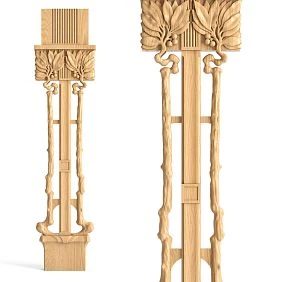
Buy flat balusters for stairs
There are things that define a home's character even before a guest crosses the threshold. The staircase is one of them. And if the staircase has a wooden railing, the first thing that catches the eye is the balusters. Their rhythm, their pattern, their silhouette. This is where the flat baluster reveals itself in full force: not a voluminous turned column, not a metal rod, but a thin, light, ornamentally rich wooden plate with cut-out or carved patterns — alive like the forest, precise like a craft.
Buying flat balusters for stairs is a task that many underestimate. It seems simple: a baluster is a baluster. But behind this choice are the railing height, installation spacing, width and thickness of each element, style of pattern, compatibility with posts and handrail, wood species, and finish. A mistake in any of these parameters — and the railing loses its integrity. The right choice — and the staircase becomes an architectural statement.
This article is written for those who want to seriously understand the topic: what a flat baluster is, how it differs from turned and carved ones, where it is used, how to calculate the quantity, what affects the price, and how to avoid mistakes when ordering.
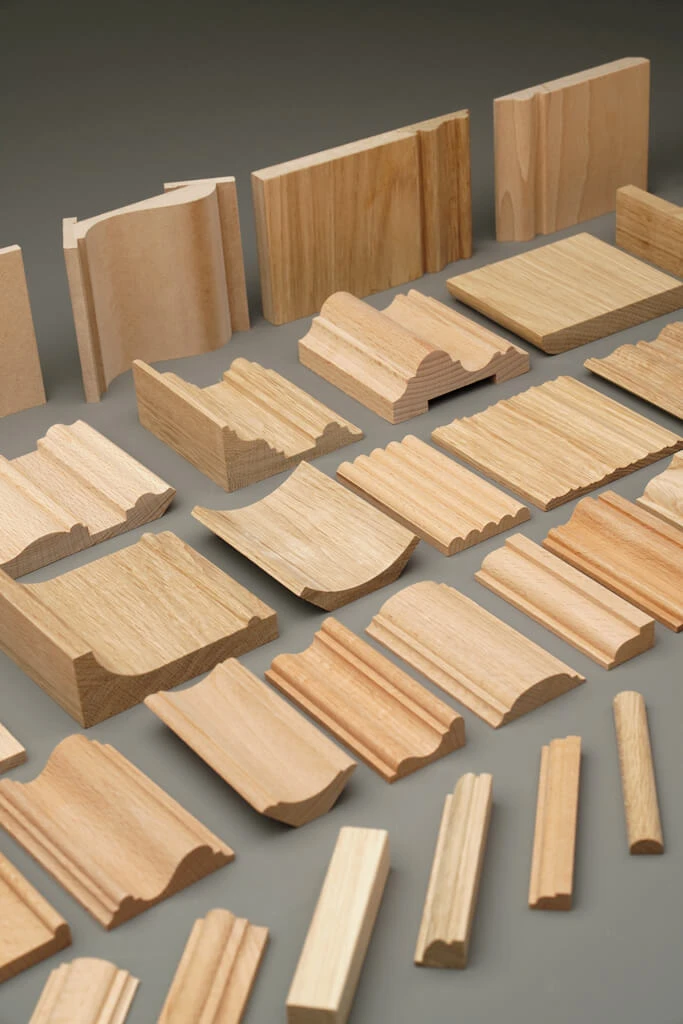
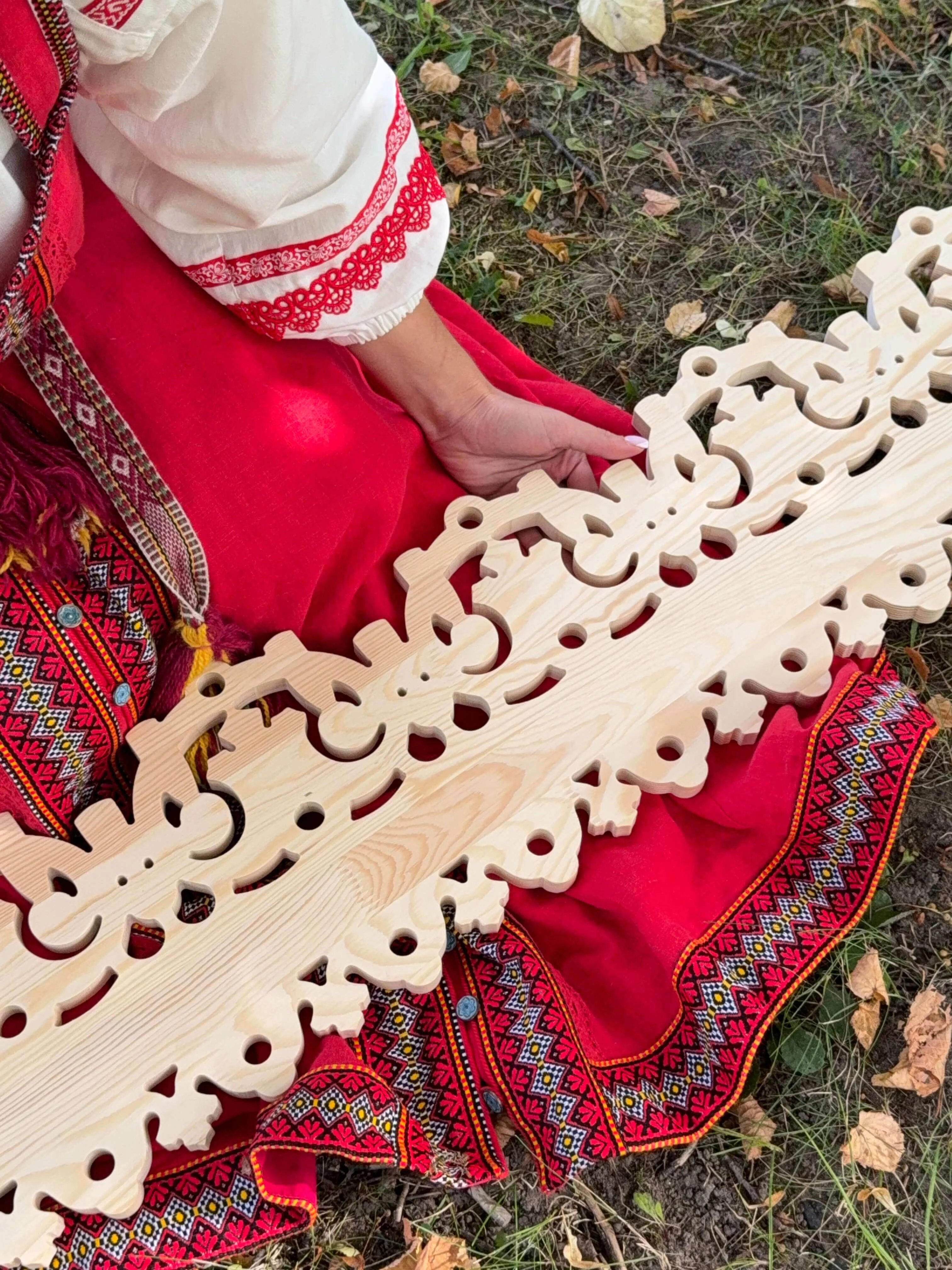
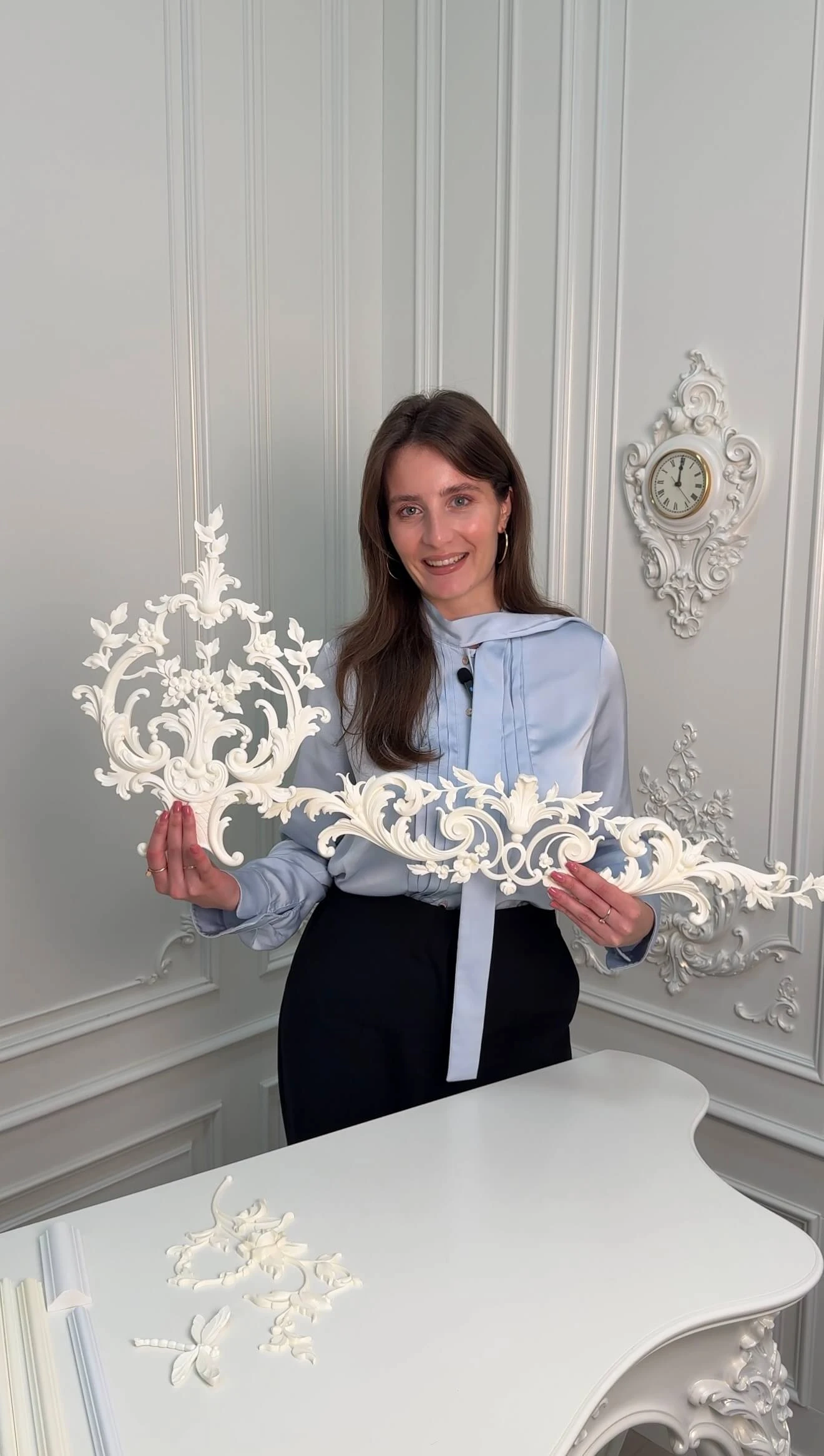
What are flat balusters and how to choose them for a staircase
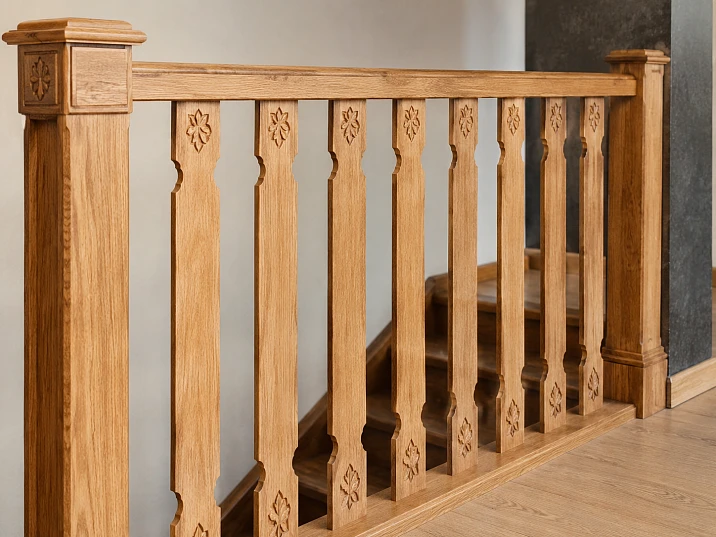
A flat baluster is a vertical load-bearing and decorative element of a staircase railing, made from a wooden board or plate with a shaped silhouette. Unlike a turned baluster with a round profile, a flat one has a constant or variable thickness, flat side faces, and a figuratively cut contour — slotted, milled, or carved.
Buying flat wooden balusters for stairs means choosing an element that:
-
creates a decorative rhythm of the railing through a repeating silhouette
-
ensures transparency of the railing (the space between balusters is "readable")
-
carries the load from the handrail and lateral pressure
-
can be painted, tinted, or varnished in any color
Buying flat balusters for a staircase means answering seven questions before ordering: height, width, thickness, pattern, wood species, mounting method, and quantity in the set.
Our factory also produces:
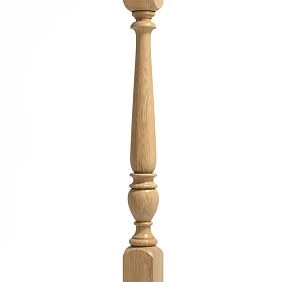
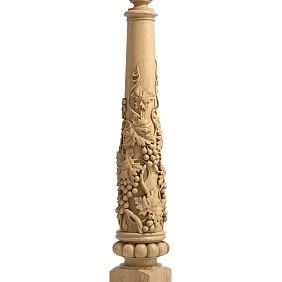
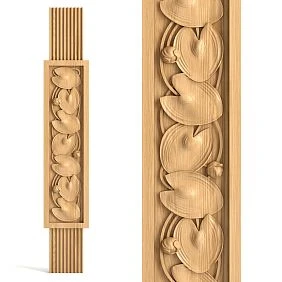
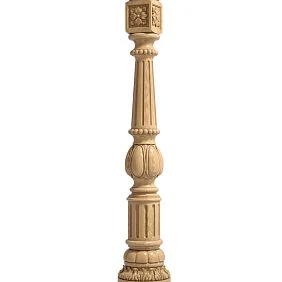
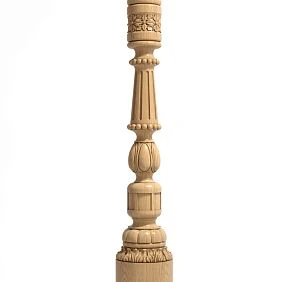
Construction of a flat baluster
A flat baluster consists of several zones:
Top tenon — a rectangular protrusion that fits into the groove of the handrail or mounting element. Tenon height: 30–60 mm. Cross-section: 20×30 — 30×40 mm.
Baluster body — the decorative part with a shaped silhouette. All ornamental patterns are concentrated here: cut-out openings, carved motifs, shaped contours.
Bottom tenon — a mirror or similar solution for the lower attachment: into the sub-rail board, stringer, or stair tread.
Total height of a flat baluster: 800–1000 mm (for a standard railing height of 900 mm including tenons and handrail). Plus mounting tenons: total blank — 900–1100 mm.
Thickness: 20–40 mm. A 20 mm thick baluster is lightweight, openwork, for interior stairs with low load. 30–40 mm — for exterior stairs, porches, terraces with real lateral loads.
Body width: 80–200 mm. Narrow (80–100 mm) — more space between balusters, lighter railing. Wide (150–200 mm) — a solid "wall" of patterns, more saturated decor.
Get Consultation
Material of flat balusters
Buy flat wooden balusters for stairs — and immediately the question of wood species. It is not decorative, but structural.
Pine — an affordable species. For interior stairs in dry rooms — it works. Easy to process, paints well. Downside: resinous knots in visible places, low resistance to mechanical impacts.
Spruce — similar to pine, but without resin. Good for staining and painting.
Oak — dense, durable, with a characteristic expressive texture. Optimal for outdoor stairs, porches, and terraces. Oak flat balusters withstand years of load and weather exposure (with proper coating). For tinting and oil — the beauty of the texture has no equal among domestic species.
Birch — dense, fine-grained. Good for painting. For wet areas — worse than oak.
In the balusters for STAVROS stairs — products made of oak and pine in various options: turned, carved, and flat. Production focuses on the quality of solid wood without hidden defects — knots in load-bearing areas, delaminations, and cracks.
How flat balusters differ from turned and carved ones
This is a fundamental question of style and technology. Three types of balusters — three different aesthetics.
| Baluster type | Profile | Style | Application |
|---|---|---|---|
| Flat balusters | Flat board with a shaped silhouette | Russian style, folk decor, terrace, porch | Wooden houses, outdoor railings, interior with house carving |
| carved balusters | Three-dimensional form with ornamental relief | Classic, baroque, formal interiors | Classic staircases, grand halls |
| Turned balusters | Symmetrical volumetric profile | Neoclassical, moderate classic | City apartments, cottages |
| Simple posts | Rectangular section without decoration | Minimalism, modern interior | Loft, high-tech |
The key difference of a flat baluster is its flatness. It sounds like a tautology, but behind it lies a fundamental aesthetic: flat balusters create a rhythm of silhouette, not volume. You look not at the shape of a vase or column, but at the cut-out pattern, the gap between elements, the outline of the design that repeats along the entire railing.
That is why flat balusters are organic where folk tradition speaks: a wooden house with window casings, a porch with a carved pediment, a terrace with an openwork parapet. Here, a turned baluster would be alien — too academic, too 'urban'.
Flat wooden balusters: decor, pattern, and living texture
Buying flat wooden balusters for stairs means choosing a material that lives with the house. Wood in the railing not only bears the load — it creates an atmosphere.
The figured silhouette of a flat baluster is the main decorative parameter. Options:
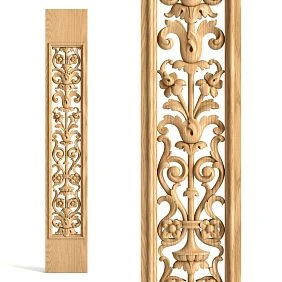
Elongated oval with cutouts — light, openwork. The center of the baluster body features one or several large cut-out elements: oval, diamond, circle. On the sides — figured bevels. Such balusters create a feeling of air and lightness.
Trapezoidal silhouette with figured carvings — more massive at the bottom, tapering upward. Resembles a vase, but flat. A traditional motif for a porch in the Russian style.
Diamond-shaped cutouts — geometric pattern, strict and symmetrical. For interior stairs with a modernist or ethnic accent.
Plant silhouette — contour of leaves, shoots, or flowers. The figuratively cut contour of the baluster itself is an ornament. For house carving — an organic solution.
Combined — cut-out elements combined with milled relief details. Cutout + relief edge along the contour — a step towards a carved baluster while maintaining a flat base.
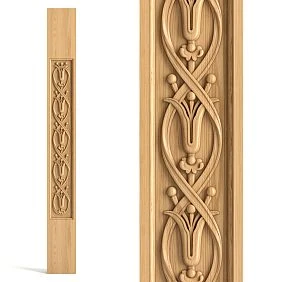
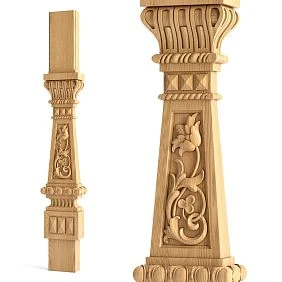
Flat balusters with carved ornament — a transitional type between flat and carved balusters: flat base with slotted and milled decorative elements on the surface.
Natural texture and coating
A flat baluster made of solid wood under tinting is a living texture. Oil-treated oak gives a deep warm tone that changes with lighting: amber and ochre in daylight, warm bronze in the evening. This cannot be achieved with imitation or paint.
Coating options:
-
Oil with wax — traditional, "breathing". For interior balusters with natural texture
-
Tinting + water-based varnish — for color matching the desired wood species (stained oak, walnut, teak)
-
Enamel (white, cream, gray) — for Provence, Scandinavian style, children's interior
-
Antiseptic + facade varnish — for outdoor balusters on the porch and terrace
-
Without coating ("white wood") — for self-finishing during installation
Flat balusters for painting are one of the most practical order formats. Blanks without coating can be finished in the exact color to match the handrail, posts, and house trim.
Where flat wooden balusters are used
Flat balusters for a wooden staircase in a house
An internal staircase in a wooden house is the most traditional scenario. Flat balusters are organic for stairs made of logs or profiled timber: they continue the planar aesthetic of wooden walls.
For an interior staircase with flat balusters, the standard railing height is 900–1000 mm. A baluster height of 800–850 mm (without tenons) plus a handrail with a cross-section of 80–100 mm — this calculation provides a safe and aesthetically correct railing.
Installation spacing of flat balusters for an internal staircase: 100–160 mm between centers. Clearance between balusters 80 mm wide: with a spacing of 150 mm — clearance 70 mm (safety standard for children — no more than 100 mm).
Flat balusters for a wooden staircase in an interior pair well with a wooden balustrade — a railing system that includes balusters, posts and a handrail. For the railing to be perceived as a single whole, all elements must be from the same wood species, in the same color scheme.
Flat balusters for a porch and outdoor railings
The porch is the calling card of the house. And it is here that the flat baluster reveals itself in full force: it creates that openwork parapet so characteristic of traditional wooden architecture.
For an external porch, the requirements for balusters are stricter:
-
thickness at least 30 mm (external load + mechanical impact)
-
oak or larch — the most weather-resistant
-
coating: wood antiseptic + facade varnish or oil for exterior use
-
metal fasteners with anti-corrosion coating
Flat balusters for a porch in the Russian style — with traditional carved motifs: leaves, scrolls, geometric diamonds, and solar symbols. This is the very House Carving, which turns the porch from a functional element into an artistic statement.
Flat balusters for a terrace and veranda
An open terrace is another traditional scenario. A terrace railing made of flat balusters creates a semi-transparent barrier that does not obstruct the view but defines the boundary of the space.
For a terrace — railing height 900–1100 mm (depending on the terrace height above ground level: the higher the terrace, the higher the railing). Baluster spacing — 100–150 mm on center. Material — oak or larch with facade oil.
Flat balusters for the terrace, complete with corner and row balusters staircase posts — a complete railing system.
Flat balusters in Russian style
Russian style in wooden architecture is not just a set of visual motifs. It is a holistic philosophy: wood as the main material, ornament as a language of meaning, handcraft as a value.
Flat balusters in Russian style — with carved patterns referencing traditional house carving: valances, architraves, bargeboards. The same motifs are in the balusters: diamonds, crosses, oak and maple leaves, birds, scrolls, geometric weaves.
It is for the Russian style that a flat baluster is the only organic choice. A turned baluster would be out of place here; a flat board with a carved pattern is native.
House Carving in the STAVROS catalog — architraves, valances, cornice boards — creates a system where flat balusters on the porch and staircase are an organic continuation of the house's overall ornamental program.
How to calculate the number of flat balusters for a staircase
Calculation is not the most exciting part, but it is the most important. An error in calculation results in either a shortage, an excess, or a mismatch in the pattern.
Step 1. Measure the length of the railing
The railing length is the horizontal projection of the flight plus the landings. For a single-flight staircase: measure the horizontal distance from the first post to the last. Add landings if any.
Step 2. Determine the installation step
The installation step is the distance between the axes of adjacent balusters. Standard values: 100, 120, 150 mm.
Safety requirement: the gap between balusters (distance between side faces) must not exceed 100 mm for rooms with children. Calculation: gap = step - baluster width.
Example: baluster width 80 mm, step 150 mm → gap 70 mm. Safe. If width is 60 mm with the same step → gap 90 mm. Also within norm.
Step 3. Account for posts
Posts for staircase Posts are installed at the beginning and end of each flight, at turns and landings. Their positions disrupt the uniform step of balusters. Draw a diagram: mark the posts, then evenly place balusters between them.
Step 4. Calculate the quantity
Formula: N = (L - d_posts) / step + 1, where L is the length of the railing section, d_posts is the total width of posts in that section, step is the distance between baluster axes.
Example: section length 2400 mm, two posts of 100 mm each = 200 mm, working length 2200 mm, step 150 mm → 2200/150 ≈ 14.7 → 15 balusters.
Step 5. Check the symmetry of the pattern
If a flat baluster has an oriented pattern (asymmetric), it is important to check: whether it reads the same when installed sequentially. Asymmetric balusters may require alternating "face" / "mirror" to achieve a rhythmic pattern.
Step 6. Add a reserve
Allowance for trimming: the lower tenons of balusters are often trimmed to the angle of the step (for staircases). Some blanks may be trimmed incorrectly during the first installation. Add 5–10% of the calculated quantity for replacement and trimming.
Example of a full calculation
Staircase: one flight, 12 steps, horizontal flight length 2400 mm, landing 1200 mm. Two corner posts, two intermediate posts on the landing.
Flight: length 2400 mm, two posts 100 mm = 2200 mm working length, spacing 120 mm → 18–19 balusters.
Landing: length 1200 mm, two posts → 1000 mm working length, spacing 120 mm → 8–9 balusters.
Total: 27–28 balusters + 10% allowance = 30–31 pieces.
A detailed algorithm for calculating a balustrade — including a spacing table and examples for different types of stairs — is provided in the article "Staircase Balustrade: Design, Types and Installation".
Installation of flat balusters: methods and nuances
Mounting to stringers
Stringer — the side load-bearing beam of the staircase. Flat balusters are attached to the stringer from the side: with glue and screws (through a groove or through an overlay). The lower tenon fits into the stringer cutout or is secured with a metal bracket.
Advantage: balusters stand strictly vertical, regardless of the flight angle.
Fastening to treads
The lower tenon of the baluster fits into a hole in the tread (socket depth 30–40 mm) and is secured with glue. The upper tenon fits into the handrail or sub-rail board.
For a straight-flight staircase — the lower tenon requires trimming to match the flight angle: the baluster stands vertically, while the tread is horizontal, so the supporting end of the tenon is cut at the required angle.
Attachment to the sub-rail board
Sub-rail board (the lower horizontal plank to which the bottom row of balusters is attached) — a solution for railings on landings and verandas. The board is mounted horizontally, and the balusters are inserted vertically into sockets.
Metal fasteners
For outdoor staircases, porches, and terraces — the tenons of flat balusters are often secured not only with glue but also with metal threaded rods M6–M8: the bolt is screwed through the lower end of the baluster into the load-bearing element. This ensures reliability under outdoor loads and humidity fluctuations.
Overview of fastening systems and principles for constructing a wooden balustrade — in the article "Wooden balustrade: how to choose balusters, posts, and handrails".
What affects the price of flat wooden balusters
Price range for flat wooden balusters: from 200–300 rubles for a pine blank without coating to 2,000–3,500 rubles for an oak one with ornament and finish coating.
Wood type. Pine is basic. Oak is 2–3 times more expensive. Larch is higher than pine but lower than oak.
Baluster height. Standard height 800 mm — one material consumption. Non-standard height for a specific staircase — sometimes requires special cutting of the blank.
Thickness. Baluster 20 mm — less material. 30–40 mm — noticeably more. For oak, the price difference with different thicknesses is significant.
Width. Narrow baluster 80 mm — less material. Wide 180 mm — more.
Complexity of the cut-out pattern. Straight silhouette with one rectangular cut — minimal processing. Complex curved silhouette with several cut-out elements — significantly more milling time.
Presence of carving. Flat baluster with carved ornament on the surface (relief) — surcharge to the base price of a cut-out baluster.
Coating or preparation for painting. White wood — cheaper. Antiseptic + oil for outdoor use — surcharge. Tinting + varnish — higher.
Number of elements. Price per piece decreases with orders of 20, 50, 100 elements. For completing an entire staircase (30–60 balusters) — serial order, more favorable price.
Individual size. Non-standard height, non-standard width, non-standard pattern — project order with surcharge.
Delivery. Long-length products (800–1000 mm) are transported in bundles. Packaging: protective film around the carved silhouette, fixing strips in the bag. Delivery within Moscow, St. Petersburg, and to regions — via transport companies.
Mistakes when buying flat balusters for stairs
Behind every mistake is lost money, rework, or operational risk. Here are seven of the most common ones.
Buying without calculating the installation step. Ordered 20 balusters, installed them — and two are missing. Or there were more than enough, but the step had to be increased, and the gap between balusters exceeded the norm. Calculate before ordering.
Not considering thickness and strength. A 20 mm baluster on an external porch under lateral load (a person leaning on the handrail) will bend or crack. For outdoor use — at least 30 mm from dense wood.
Not matching the design with the handrail and posts. Flat balusters with a geometric cut-out pattern and turned posts in a classic style — a style conflict. All railing elements should belong to the same decorative tradition.
Not checking the railing height. Safety standard — 900–1000 mm from the step to the top edge of the handrail. The baluster height must be calculated considering the handrail thickness and tenon depth. An "800 mm baluster" is not the same as an "800 mm railing height."
Mixing different baluster styles. Flat balusters in Russian folk style with cut-out leaves and turned balusters with a classic vase in one railing — incompatibility that is immediately visible.
Not planning the painting. Balusters ordered without coating, installed — and not painted for a long time. Unprotected wood on an external staircase darkens and begins to crack after one rainy season. Coating — before installation or immediately after.
Buying without a reserve for trimming. The lower tenon of a flat baluster on a flight staircase requires trimming to the step angle. Even one mistake — and the blank is ruined. A 10% reserve of the calculated quantity is mandatory.
Flat balusters in a wooden railing system
A flat baluster is one of four parts that make up a complete wooden railing. The other three are posts, handrail, and sub-rail board.
Posts are load-bearing vertical elements that take the main load from the handrail. The post at the start and end of the flight are the most heavily loaded. For flat balusters in the Russian style, posts with a four-sided cross-section and applied decorative elements are more organic than turned round ones.
The handrail is the horizontal top part of the railing that is grasped by hand. For flat balusters, a handrail of rectangular or rounded cross-section, most often made of the same wood. Optimal grip width: 45–60 mm, height 65–90 mm.
Carved wooden decoration — applied elements that enhance the decor of posts and handrails: rosettes on post ends, applied ornamental friezes under the handrail, corner overlays at section joints.
for of a wooden house with house carving — the railing of stairs and porch should be part of the overall ornamental program: architraves, valances, carved cornice boards, and flat balusters — a unified artistic language of wood.
Where to buy flat balusters for stairs
Buy flat wooden balusters for stairs in Moscow, St. Petersburg, and throughout Russia — in the STAVROS catalog.
Flat baluster — a separate catalog item with specific parameters: height, width, thickness, wood species. For standard stairs — ready-made solutions for a calculated set. For non-standard sizes — custom production.
Full section balusters for staircases also includes carved balusters and turned options — for those who want to compare and choose the optimal type for their project.
Packaging for delivery: long balusters — in bundles with bubble wrap, wooden spacers, and stretch wrap. Transportation to Moscow, Nizhny Novgorod, Yekaterinburg, Krasnodar, and any other region — via transport companies with insurance options.
FAQ: answers to popular questions about flat balusters
How to choose flat balusters for a staircase?
Determine the railing height, baluster width and thickness, installation step, pattern style, and wood species. Coordinate with stair balusters, posts, and handrail from a single catalog.
How do flat balusters differ from turned ones?
Turned balusters — voluminous, with a round profile, for classic style. Flat balusters — a flat board with a figured cut-out silhouette, for Russian style, porches, terraces, wooden houses.
Where are flat wooden balusters used?
On internal staircases of wooden houses, on the porch, open terrace, veranda, in railings in Russian folk style.
How to calculate the number of flat balusters?
Divide the working length of the railing section (without posts) by the installation step. Add 10% reserve. Check the gap between balusters — no more than 100 mm.
Can flat wooden balusters be painted?
Yes. Beech balusters are best for painting. For tinting and oil — oak. For external stairs — antiseptic + facade varnish or oil for exterior use.
What affects the price of flat balusters?
Wood species, height, thickness, width, complexity of the cut-out pattern, coating, order quantity, non-standard parameters, and delivery.