



























Article Contents:
- Carved wooden furniture legs to buy
- Which carved wooden furniture legs to buy
- Purpose and function
- Material: oak, beech, birch
- Form and style
- Carved wooden legs: how they differ from regular furniture supports
- Tinting, painting, gilding
- Which furniture are carved wooden legs suitable for
- Carved legs for sofa and armchair
- Carved legs for chest of drawers, cabinets, and wardrobes
- Carved legs for classic furniture and Baroque-style furniture
- Carved wooden legs for furniture restoration
- When legs need to be replaced
- Styling modern furniture
- Combining with other decor during restoration
- How to choose the size of carved wooden legs
- Step 1. Measure the height of the old leg
- Step 2. Assess the weight of the furniture
- Step 3. Check the support area
- Step 4. Choose the shape
- Step 5. Check the fasteners
- Step 6. Match the thread style
- Step 7. Select the set
- Step 8. Allow for spare during restoration
- What affects the price of carved wooden legs
- Mistakes when buying carved wooden legs
- Where to buy carved wooden legs for furniture
- FAQ: answers to popular questions about carved wooden legs
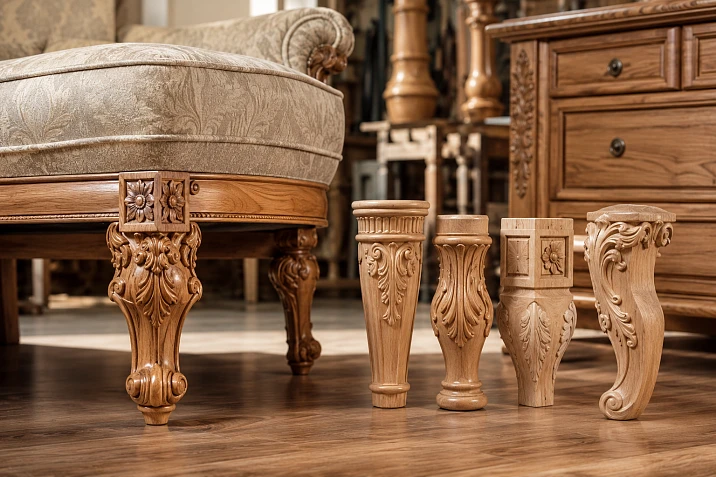
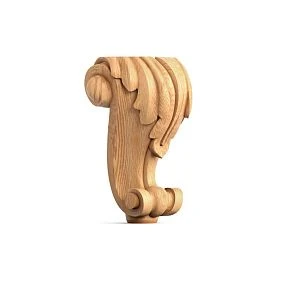
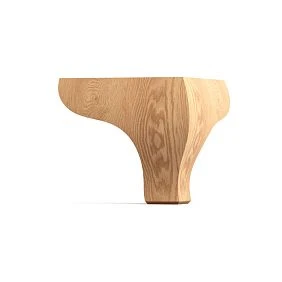
Buy carved wooden legs for furniture
Furniture starts from the bottom. This is a paradox known to anyone who has ever seen how old legs change on a good sofa or an antique chest of drawers. An item that seemed hopelessly outdated suddenly gains new life, character, and style. Sometimes four turned wooden legs do more than a complete reupholstery or a change of facade.
Buying carved wooden furniture legs is a task that, with the right approach, can be solved in one order. With the wrong approach, it ends with legs of the wrong size, wrong load capacity, and wrong style. This article is written for those who want to understand it once and choose correctly: for a sofa, armchair, chest of drawers, bedside table, cabinet, or restoration project.
Which carved wooden furniture legs to buy
Buying carved wooden furniture legs is a request behind which lies a specific task. Someone is updating an old sofa, someone is assembling classic furniture from scratch, someone is restoring antiques, someone is styling modern cabinet furniture in Baroque or Neoclassical style. The tasks are different. The selection principle is the same: the leg must be correct in size, load capacity, style, and attachment method.
Buying carved wooden furniture legs means getting a product that simultaneously carries a functional load (supports the weight of the furniture and person) and a decorative one (sets the style, character, era). Unlike metal or plastic supports, a carved wooden leg works as an architectural element: it is "read" from floor level, defines the silhouette of the item, and creates the first and last impression.
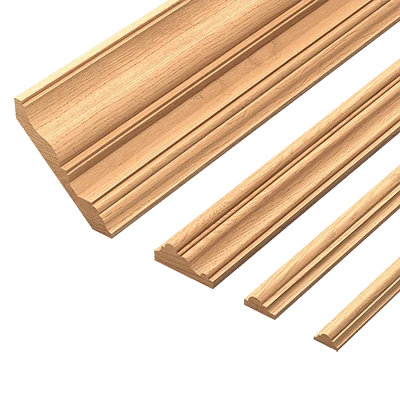
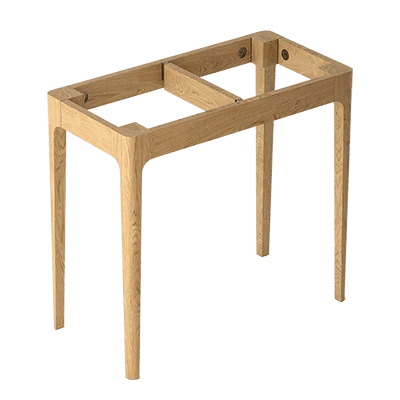
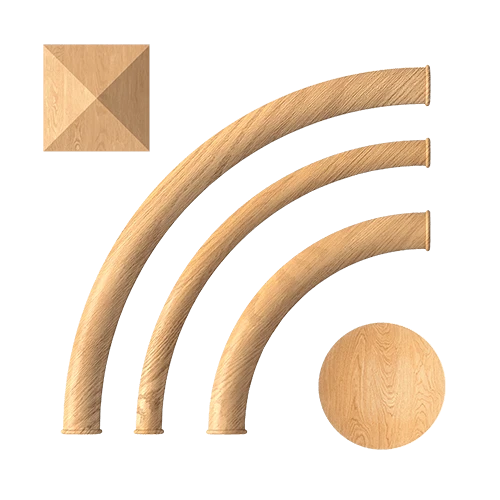
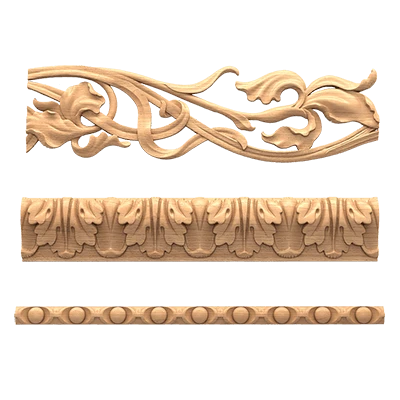
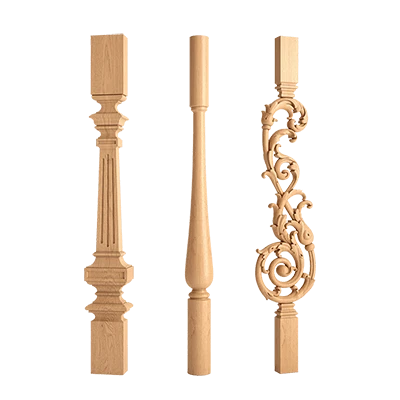
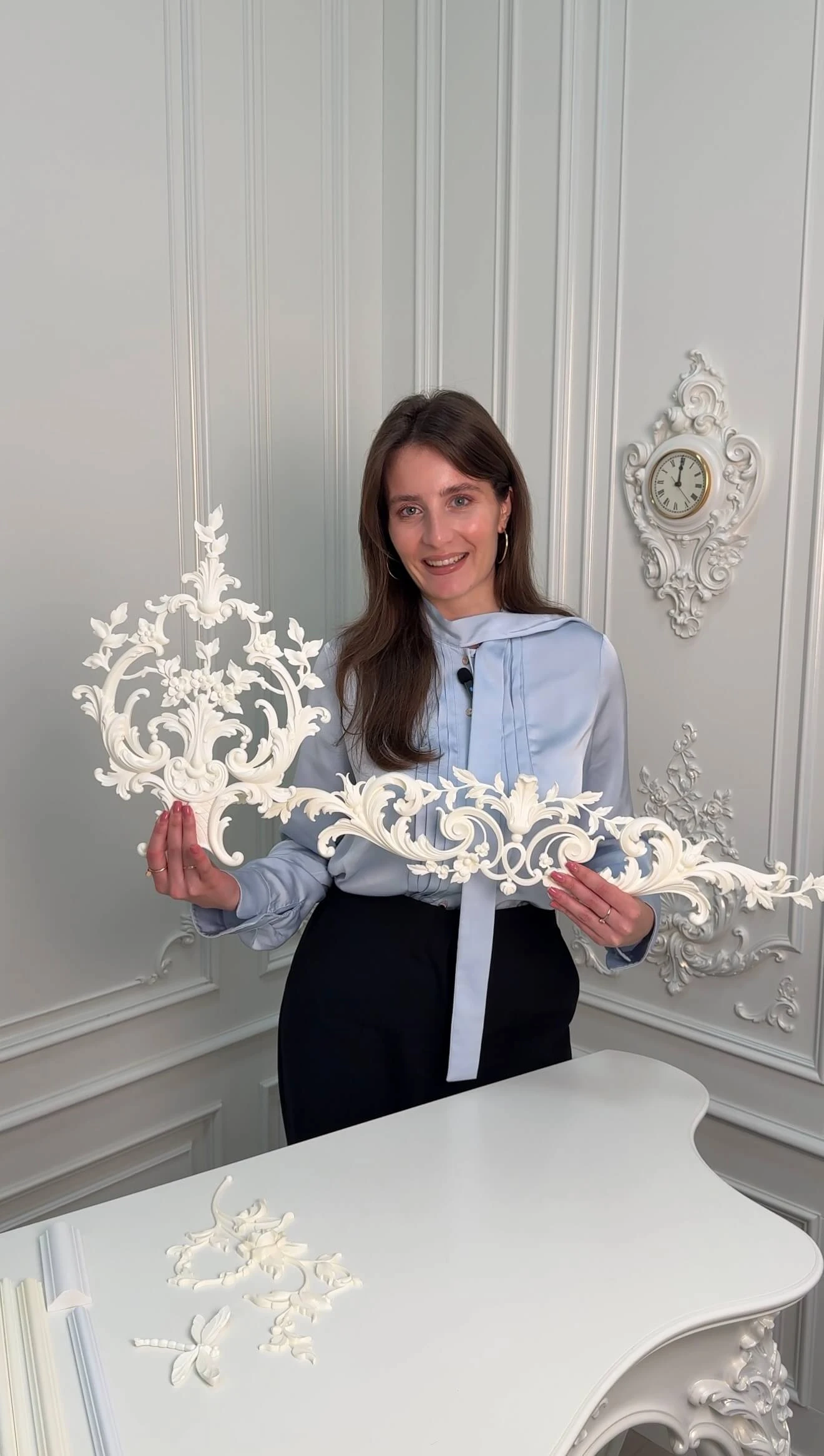
Our factory also produces:
Purpose and function
A furniture leg is a support that takes the static load from the body or frame of the furniture and distributes it to the floor. For a sofa with two people, the load is 180–250 kg on four points, i.e., 45–65 kg per leg. For a chest of drawers with contents, it is 60–120 kg total. A solid oak leg with a cross-section of 50×50 mm can withstand such a load without deformation, provided proper installation and no significant lateral loads.
It is worth buying carved wooden furniture legs with an estimate of the permissible load. It is determined by:
-
the type of wood (oak — up to 250–400 kg per leg depending on cross-section, pine — half as much)
-
the cross-section at the thinnest point (for turned legs — the neck in the center)
-
height (the higher the leg, the greater the bending moment arm)
Get Consultation
Material: oak, beech, birch
Buying carved wooden furniture legs means choosing the wood species. This is not an aesthetic, but a structural question.
Oak is the densest and hardest of the available domestic species. Specific weight 700–750 kg/m³. Resistant to abrasion, point loads, and deformation. For sofas, armchairs, chests of drawers, and cabinets with high loads — the optimal choice. For tinting and oil — expressive texture.
Beech is dense, fine-grained. It is inferior to oak in hardness but significantly surpasses birch and pine. For medium-load upholstered furniture — it is sufficient. The best material for painting with enamel: a uniform surface without large pores.
Birch is an affordable but less durable material. For light cabinets and auxiliary furniture — acceptable. For sofas and armchairs with real loads — no.
In the STAVROS furniture legs products made of oak and beech in various shapes and heights are presented. This is a production since 2002, founded by artist-restorers with experience working on state-level projects — the Hermitage, the Konstantinovsky and Alexander Palaces.
Shape and style
The shape of the leg is the main decorative parameter. It determines which furniture style the element suits.
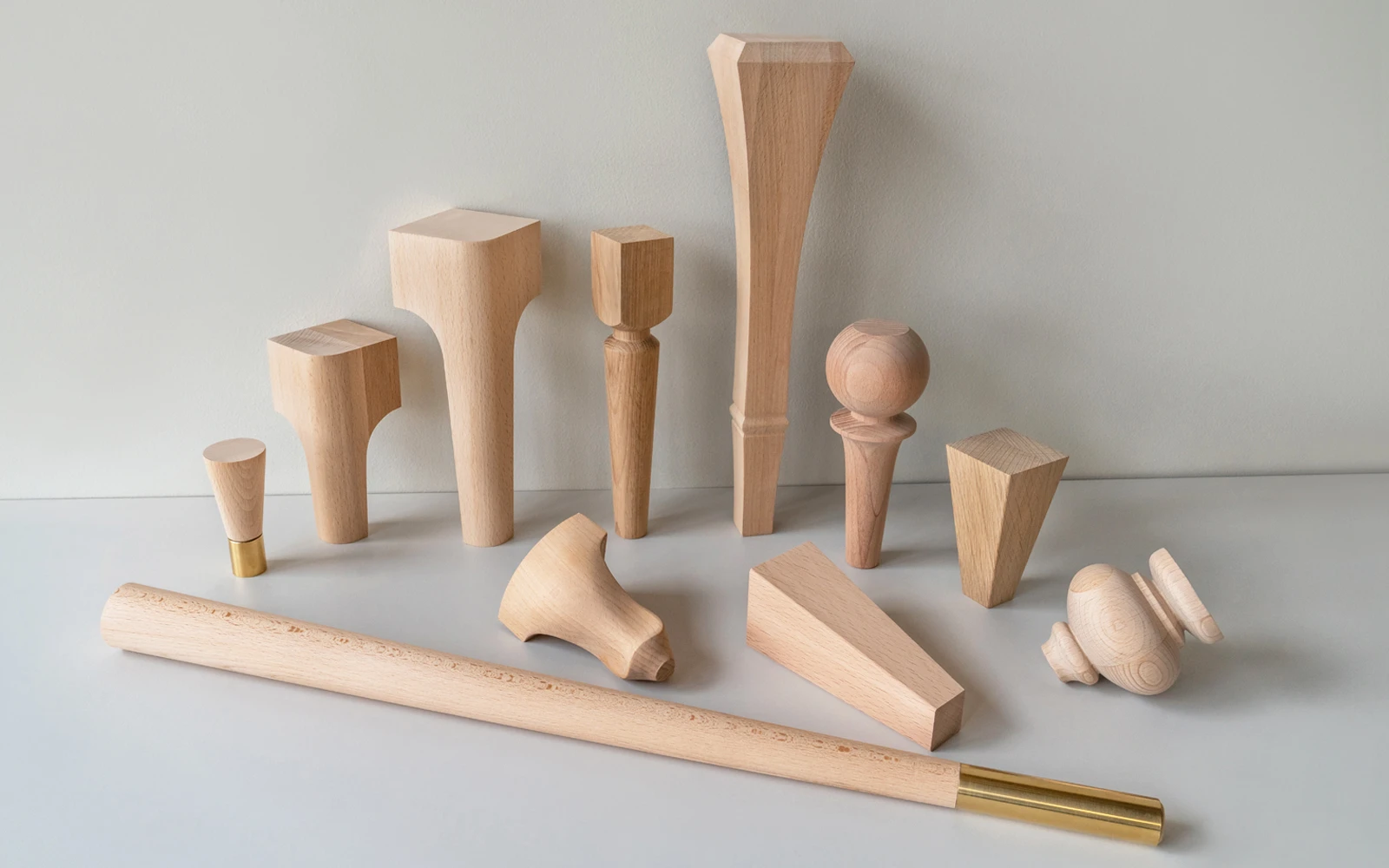
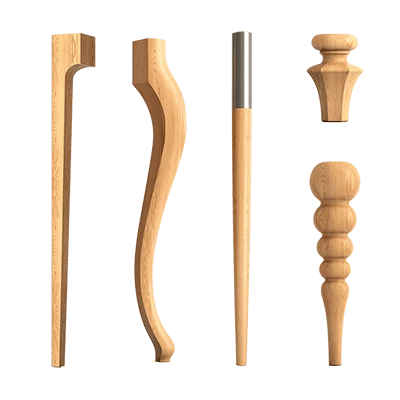
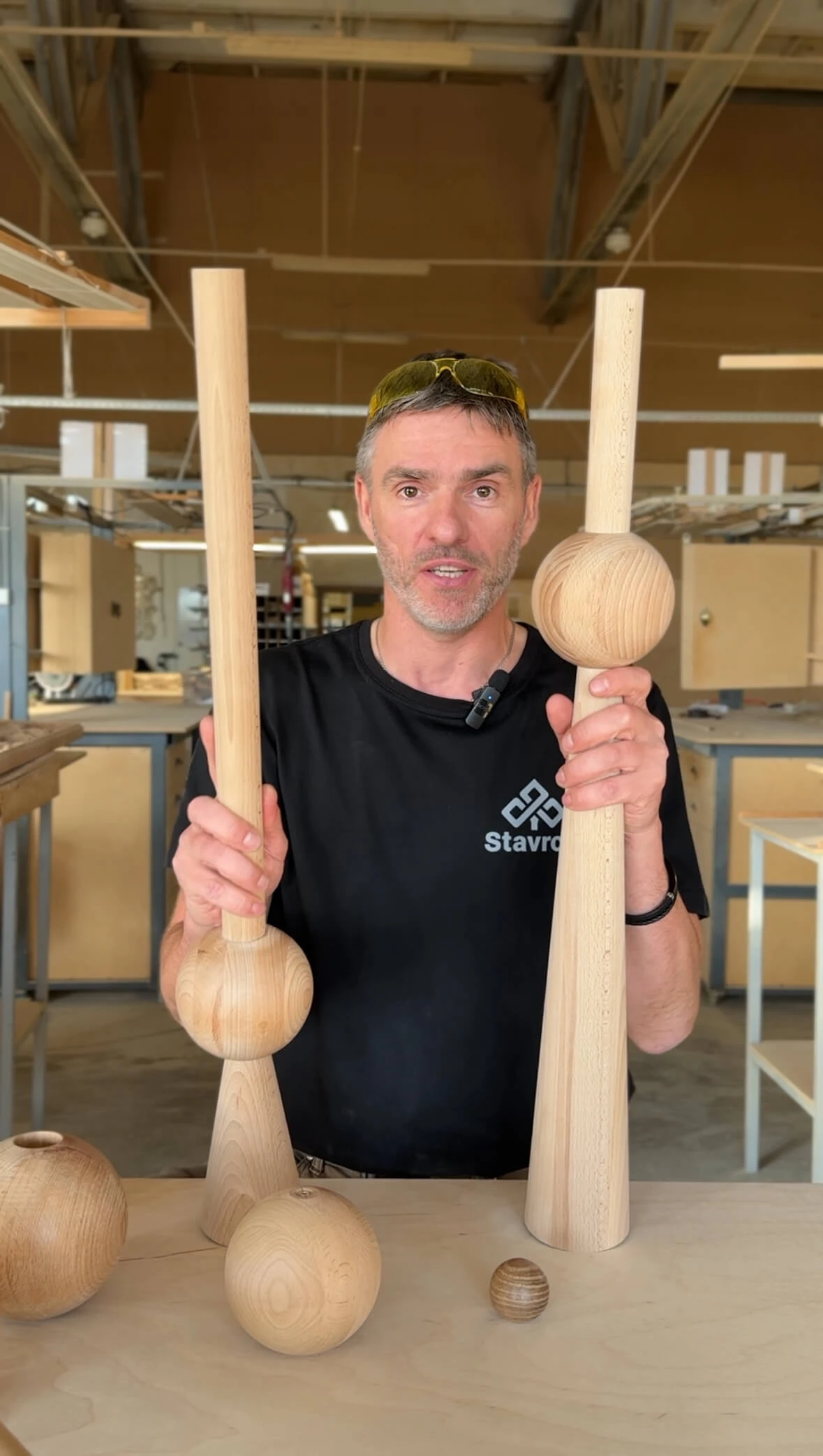
Turned conical — round cross-section, tapering towards the floor. Minimalism, Scandinavian style, neoclassicism.
Turned with a vase — expansion in the center (vase-shaped element), narrowing at the top and bottom. Classicism of the 18th–19th centuries, Empire style, Russian style.
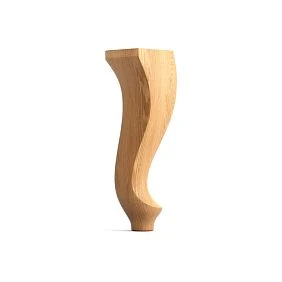
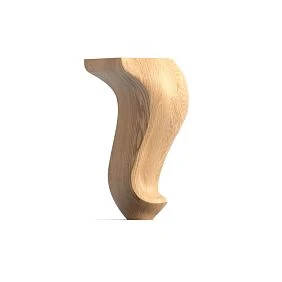
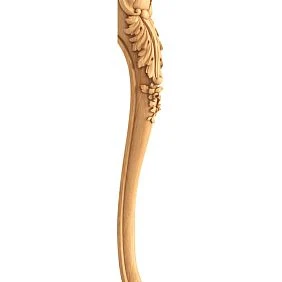
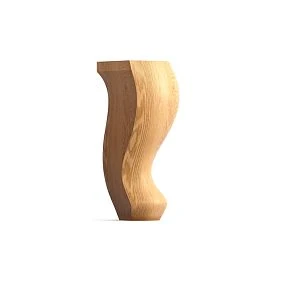
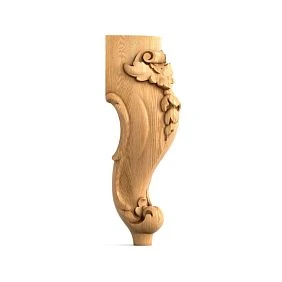
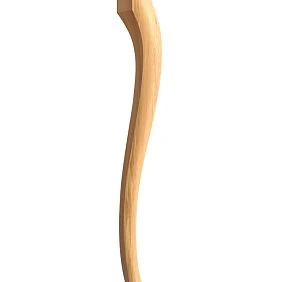
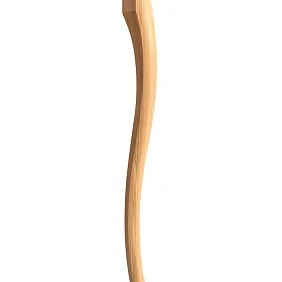
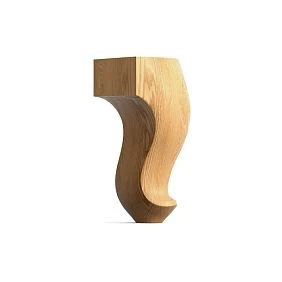
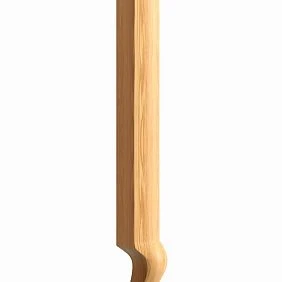
Cabriole — an S-shaped curve, widening at the top, tapering towards the middle, then widening again towards the floor (foot). Louis XV style, Rococo, Baroque. The most complex shape, requiring hand carving.
Straight square with carving — a rectangular cross-section with ornamental relief on the faces. Empire, Directoire, Classicism.
Turned with carved belts — several ornamental horizontal belts dividing the leg body. Baroque, Classic, Folk style.
Carved wooden legs: how they differ from ordinary furniture supports
Buying carved wooden legs for furniture means choosing not just a load-bearing element, but a decorative one. This is a fundamental difference from standard furniture supports — conical metal legs, plastic barrels, or simple wooden blocks.
An ordinary support solves one task: to lift the object off the floor. A carved wooden leg solves two: to lift and to decorate. Moreover, "decorate" does not mean "add an optional detail," but rather "define the style."
Place four oak cabriole legs with carved belts on a modern sofa with rectangular metal legs, and the sofa instantly transforms into furniture with the character of an era. This is precisely the key power of a carved wooden leg: it can redefine an object.
Advantages of carved wooden legs over ordinary ones:
-
Natural texture that does not age but acquires a patina
-
Possibility of painting in any color or tinting to match the desired wood species
-
Compatibility with classic furniture, baroque, Empire, neoclassicism
-
Combination with furniture handles, overlays and moldings from the same wood
-
Possibility of restoration (repainting, sanding, replacement of one leg without changing the entire set)
-
Decorative independence: the leg works even before coating is applied
Tinting, painting, gilding
A carved wooden leg is one of the few furniture elements that can undergo a radical change in appearance after manufacturing.
For tinting (stain, oil, tinting varnish) — oak legs. The texture of oak under a transparent or semi-transparent coating is one of the most expressive combinations in classic furniture.
For painting with enamel — beech legs. White, cream, gray, gold, black — any color 'sits' on beech without the grain showing through.
Under gilding (gold leaf, imitation gold leaf) — beech, pre-primed and coated with bole. A gilded leg in the Baroque style is a level at which furniture ceases to be just furniture and becomes an object of art.
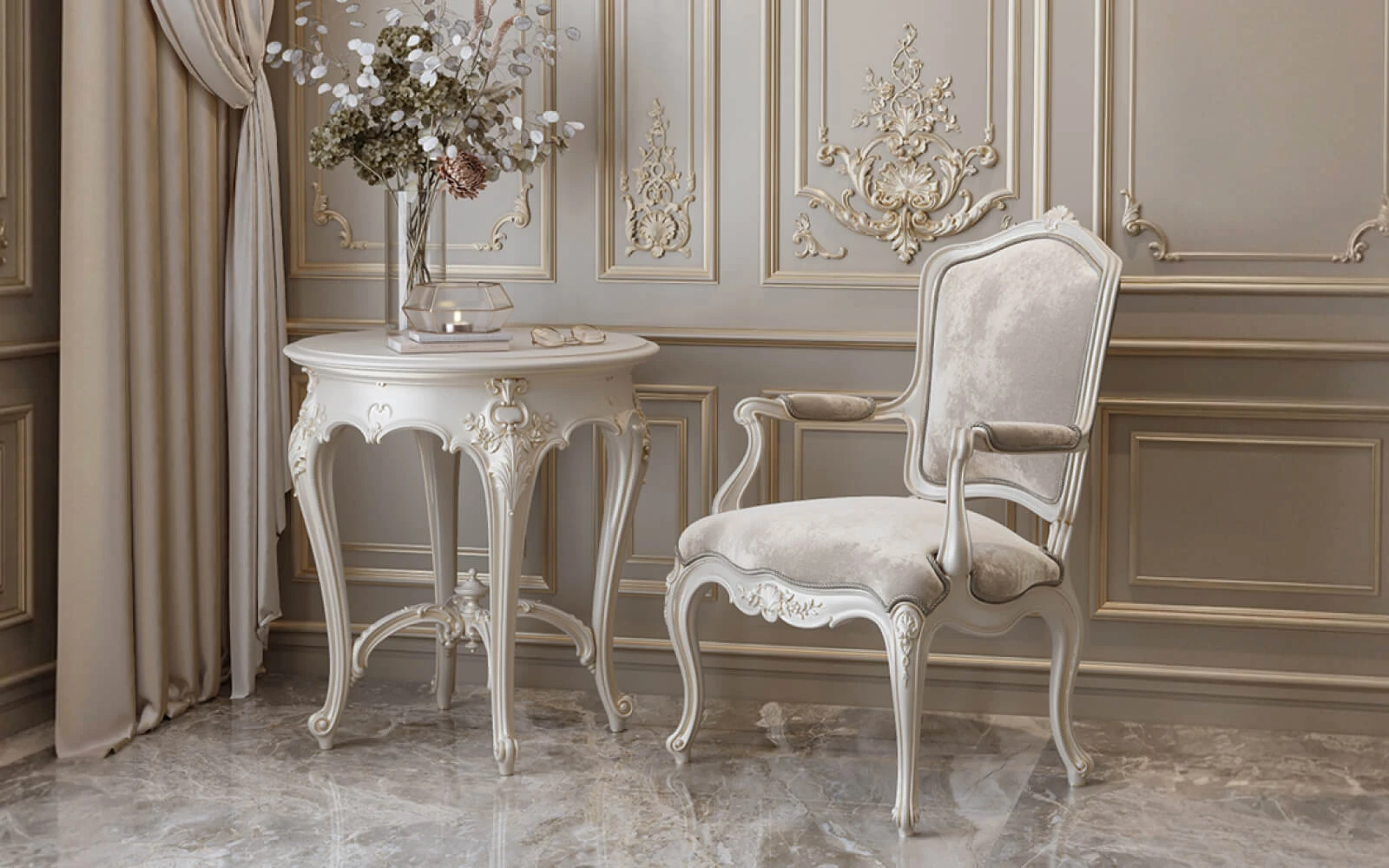
for Baroque-style furniture — the combination of gilded cabriole legs with velvet upholstery and gilded furniture handles is a decorative standard of the era.
Which furniture are carved wooden legs suitable for
Buy carved wooden furniture legs — and immediately the question: for which specific item? Requirements vary depending on the type of furniture, its weight, construction, and usage scenario.
Carved legs for sofas and armchairs
Sofas and armchairs are upholstered furniture with maximum loads. A sofa is designed for 2–3 people, an armchair for one, but often with a jolt load when sitting down.
Legs for sofas: height 100–180 mm. Height 100–120 mm — a low sofa in a modern style. 150–180 mm — a classic or Baroque sofa with a high seating position.
The cross-section of the leg at its thinnest point for a sofa is at least 40 mm. For a massive sofa frame weighing 50–80 kg plus two people — optimally 50–60 mm.
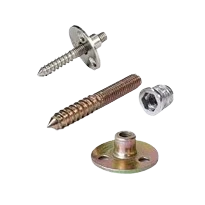
Leg attachment to the sofa: bolted through a threaded insert (the most common standard for upholstered furniture — M8 or M10 thread) or through a metal base plate with screws. Before purchasing, check which type of attachment is used on your sofa: not all legs have a standard bolt.
Carved chair legs have the same load requirements, but often a smaller base diameter (from 30 mm), because the weight of one person is distributed over four points.
for classic furniture The "sofa and armchair" category is the traditional choice: a cabriole leg 150–200 mm high made of oak or beech, with gilding or dark tinting.
Carved legs for a chest of drawers, nightstand, and wardrobe
Case furniture has different mechanics. A chest of drawers, nightstand, or wardrobe is static, loaded evenly, without jerks. Legs for case furniture bear a higher vertical load than chair legs for one person, but without dynamic impacts.
Carved legs for a chest of drawers: height 80–150 mm. Lower for squat chests in the Rococo style. Higher for tall French chests in the Louis XVI style. Base cross-section: 45–70 mm depending on the weight of the body and the number of legs.
For a standard chest of drawers with four legs: total load (body + contents) 80–130 kg, i.e., 20–33 kg per leg. This is quite feasible for a beech leg with a diameter of 40 mm.
Carved legs for a wardrobe are a special case. The wardrobe is tall and heavy: total load 150–250 kg, plus a tipping moment. The wardrobe legs must be securely fixed to the floor covering (via glides) or the wardrobe must be additionally secured to the wall. Leg height for a wardrobe: 60–120 mm, so as not to shift the center of gravity upward.
Carved legs for a nightstand are the lightest category in terms of load. A bedside table, coffee table, TV stand — loads are minimal, priority is decor. Height 150–300 mm, more elegant shapes, refined spindle legs or cabriole.
Carved legs for classic furniture and Baroque-style furniture
Furniture in Baroque style is one of the main directions where carved wooden legs work to their full potential. Baroque is excess, splendor, the triumph of form. And the leg here is not a quiet detail, but a decorative culmination.
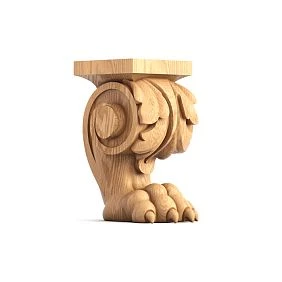
Baroque-style legs: cabriole with scroll, lyre leg, acanthus relief leg, leg with lion's paw or goat's hoof at the base. All these forms are not just decor. They are quotes from the historical language of the era, instantly recognized by a connoisseur.
Furniture legs with Baroque-style ornamentation are combined with:
-
carved decorative appliqués for furniture — overlays with acanthus, rosettes, cartouches
-
wooden decor for furniture — applied profiles and frame elements
-
furniture moldings — cornice and base profiles
-
gilded wooden handles with a curved bracket or ring
Legs for classic Empire-style furniture are a different story: straight, strict, slightly tapering downward, with relief bands of laurel leaves or imperial symbols. No curves, no Baroque excess — pure geometry and moderate ornament.
Carved wooden legs for furniture restoration
Restoration is the most interesting and most demanding scenario. When you get an old sofa with a broken leg or a 19th-century chest of drawers with missing supports, the task is not just to "find a leg," but to find the right leg: in shape, height, style, and material.
When legs need to be replaced
Replacement of furniture legs is necessary:
-
in case of mechanical damage (breakage, crack at the base)
-
when restoring an antique item with missing elements
-
when stylizing Soviet furniture to look classic
-
when updating the appearance of a sofa or armchair without changing the frame
-
when creating an 'antique' look based on a modern body
Buying carved wooden legs for furniture for restoration purposes means first taking precise measurements from the surviving leg (if available) and selecting the closest shape from the catalog. In the absence of the original, work from the style of the item: date its era, determine the order of forms, and select the leg as a historical reconstruction.
Stylization of modern furniture
A modern sofa on carved wooden cabriole legs is not a contradiction. It is a popular design technique: a concise modern body shape + historical wooden legs. The tension between eras creates visual interest.
For styling, legs with a height of 150–200 mm and moderate carving are used — not the most lavish Baroque forms, but more restrained ones that "dialogue" with the modern body without overwhelming it.
Carved wooden legs are an ideal tool for quickly changing the style of an item. Replacing the legs takes half an hour, but the result is a complete reinterpretation of the appearance.
Combination with other decor during restoration
Restoring a chest of drawers or sideboard is not just about replacing the legs. It is a systematic job. The legs must match the style of:
-
furniture handles — metal or wooden ones, with the same plasticity of form
-
furniture decor — applied rosettes, corner brackets, ornamental friezes on the facade
-
moldings — the cornice and base profile of the body
If all these elements are selected from a single decorative source, the piece gains integrity. If assembled piecemeal from different manufacturers, stylistic breaks are inevitable.
How to choose the size of carved wooden legs
The correct leg size is precision in three dimensions: height, cross-section, and fastening. An error in any of them means rework.
Step 1. Measure the height of the old leg
If you are replacing existing legs, take an exact height measurement: from the floor to the bottom plane of the body. This is the required height for the new leg. A deviation of ±5 mm is acceptable, considering the adjustable support pad.
If there are no legs and you are installing them on furniture that previously stood without legs, determine the desired height based on convenience: for a sofa, the optimal seat height is 45–50 cm from the floor. If the sofa body is 40 cm high, legs of 80–100 mm achieve the desired result.
Step 2. Assess the weight of the furniture
Sofa body — 40–80 kg. Dresser contents — 20–50 kg. Two people on the sofa — 130–180 kg. Sum the load, divide by the number of legs — and you know the load per support.
For a load up to 50 kg per leg — a beech leg with a diameter of 40 mm. Up to 80 kg — oak 45–50 mm. Up to 120 kg — oak 55–70 mm or a reinforced support pad.
Step 3. Check the support area
A leg with a wide base distributes the load over a larger area — more stable. A pin leg with a 20 mm base is more elegant but less stable. For flooring made of parquet or laminate — legs with felt or rubber support pads.
Step 4. Choose the shape
The shape of the leg should match the style of the furniture. Not "like" — but "matches." Cabriole — for Baroque and Rococo. Straight with bands — for Classicism and Empire. Tapered — for Neoclassicism and modern classic. Turned with a vase — for Russian style and Eclecticism.
Step 5. Check the fasteners
Legs for upholstered furniture (sofas, armchairs) are most often fastened with an M8 × 20 or M10 × 20 bolt, which screws into a threaded insert in the lower frame of the furniture. For case furniture (chests of drawers, cabinets) — with screws through a 80×80 mm or 100×100 mm support plate.
Before ordering furniture legs specify the type of fastening: bolted with thread (and its size) or a plate for screws.
Step 6. Coordinate the thread style
The thread style on the leg is not just decor, it is the language of an era. If the other decorative elements of the furniture — Wooden handles, overlays, moldings — are from the STAVROS catalog, then the legs should also be from there: a unified decorative program guarantees compatibility.
Step 7. Select a set
Legs are installed as a set: 4, 6, or 8 pieces depending on the furniture. Large sofas — 6 legs (4 corner + 2 center). Standard sofas and armchairs — 4. Chests of drawers — 4 or 6.
Order the entire set from one batch: identity in color, texture, and shape within one batch is guaranteed. A reorder six months later may result in a slight difference.
Step 8. Allow for spare during restoration
During restoration, it is often discovered that one of the legs is in worse condition than it seemed. Or that a damaged fastening unit is hidden under the leg, requiring complete replacement. Take "one extra": an extra leg in reserve will never be superfluous.
What affects the price of carved wooden legs
The price range is from 400 rubles for a simple beech leg to 8,000–15,000 rubles for a large carved oak support with deep ornamentation. Let's consider the price structure.
Wood species. Beech is the base price level. Oak is 30–50% more expensive. Ash, walnut — higher. The difference in the price per cubic meter is multiplied by the volume of the product.
Leg height. An 80 mm leg uses significantly less material and machine time than a 200 mm leg. Each additional centimeter of height adds both material consumption and turning time.
Diameter or cross-section. A leg with a diameter of 70 mm consumes four times more wood than a leg with a diameter of 35 mm at the same height.
Complexity of carving. A simple turned conical leg is basic complexity. A cabriole leg requires manual processing that cannot be fully replicated on a lathe. Every curve, every rounding is the work of a carver. The price of a cabriole leg is 3–5 times higher than a turned cone of the same size.
Depth of ornamentation. An ornamental band with a relief of 5–10 mm is milling work. A relief of 20–30 mm with acanthus leaves or scrolls is hand carving.
Presence of coating. "White wood" (no coating, only sanding) is cheaper. Tinting + varnish is a surcharge. Painting with enamel is more. Gilding with gold leaf is a significant surcharge.
Type of fastening. A leg with a pre-installed M8 bolt insert has one price. A leg with a platform and holes for screws is a different design. Clarify when ordering.
Quantity. furniture legs Ordered in sets. The unit price when ordering 4 or more is usually lower than when ordering one.
Purpose. Legs for upholstered furniture (sofa, armchair) are typically taller and more massive. Legs for a cabinet are lighter. Different material consumption — different price.
Delivery. Legs are packed in individual cardboard cells. Transportation to Moscow, St. Petersburg, Nizhny Novgorod, Minsk, and other cities — via transport companies. Light items up to 5 kg — via courier services.
Mistakes when buying carved wooden legs
Let's list seven mistakes — and explain why each one costs money or nerves.
They buy legs without load calculation. They take stylish, elegant legs with a diameter of 30 mm for a two-seater sofa — and after three months, one of them cracks at the neck. Strength is the first parameter, beauty is the second.
They don't check the height of the set. All four legs must be the same height. Production variation within the norm is ±1 mm. Anything more requires adjustable glides. Make sure the legs are from the same batch.
They don't consider the mounting. 'My sofa has an M8 bolt — I'll order legs.' But the legs arrived with a screw plate — and don't fit. Always clarify the type of mounting hardware before ordering.
They mix different carving styles with furniture. Baroque cabriole legs on a modern corner sofa in high-tech style — a style conflict that makes the piece look comical. The leg style is an extension of the furniture style, not an independent statement.
Legs don't match handles and moldings. Gilded. Furniture Handles With baroque plasticity and straight minimalist legs — a mismatch that is immediately visible. A systematic approach: all decorative elements are from a single decorative program.
They don't consider the wood finish. They bought beech legs and want a "dark oak" stain. Beech doesn't give the same texture depth as oak when stained. If the texture of the stain is important, choose oak.
They buy one or two legs instead of a full set. "One broke — I'll replace one." Result: three old legs and one new one, slightly different in shade and with a slightly different profile. The right solution: when replacing one, replace all four.
They don't check compatibility with restoration. For restoring an antique piece, not only the shape but also the scale of the leg is important: there is no correct shape in the wrong size. Precise measurements, precise shape, precise style — only that way.
Where to buy carved wooden furniture legs
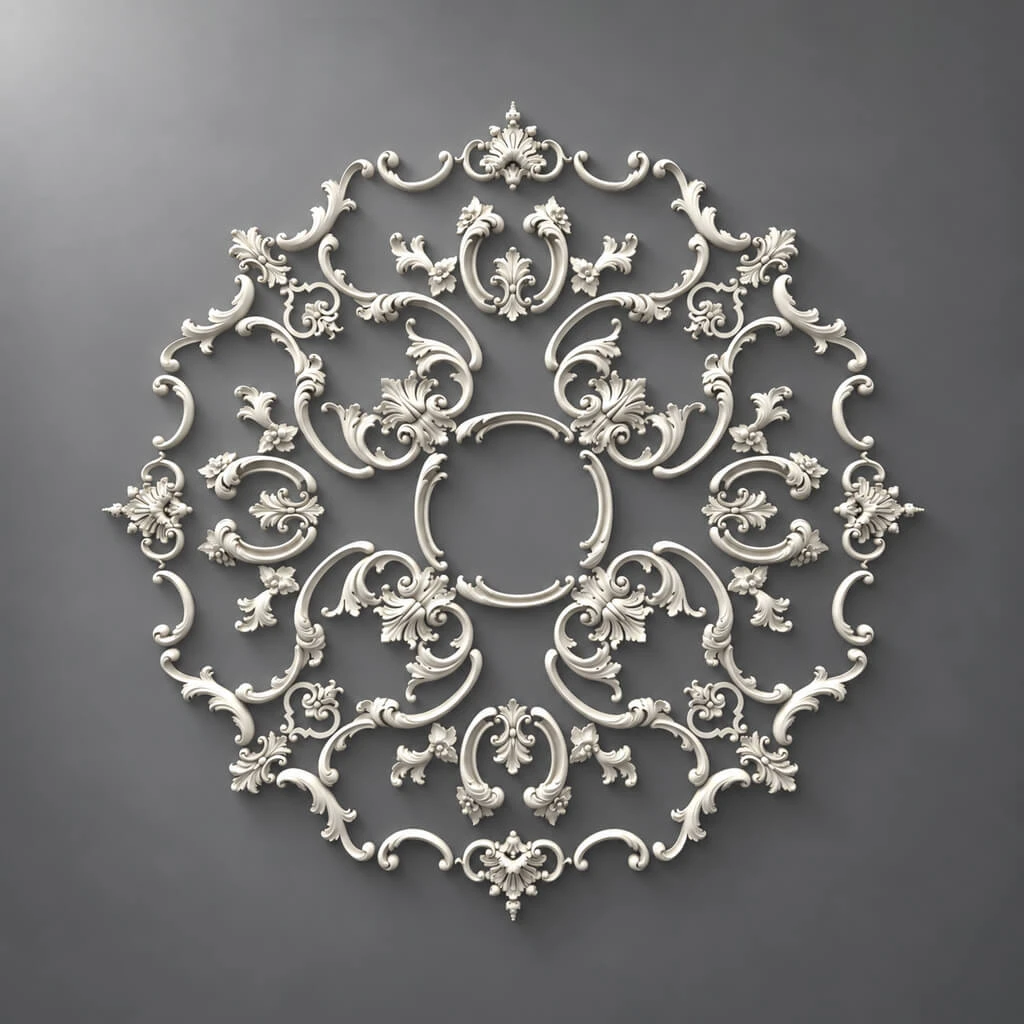
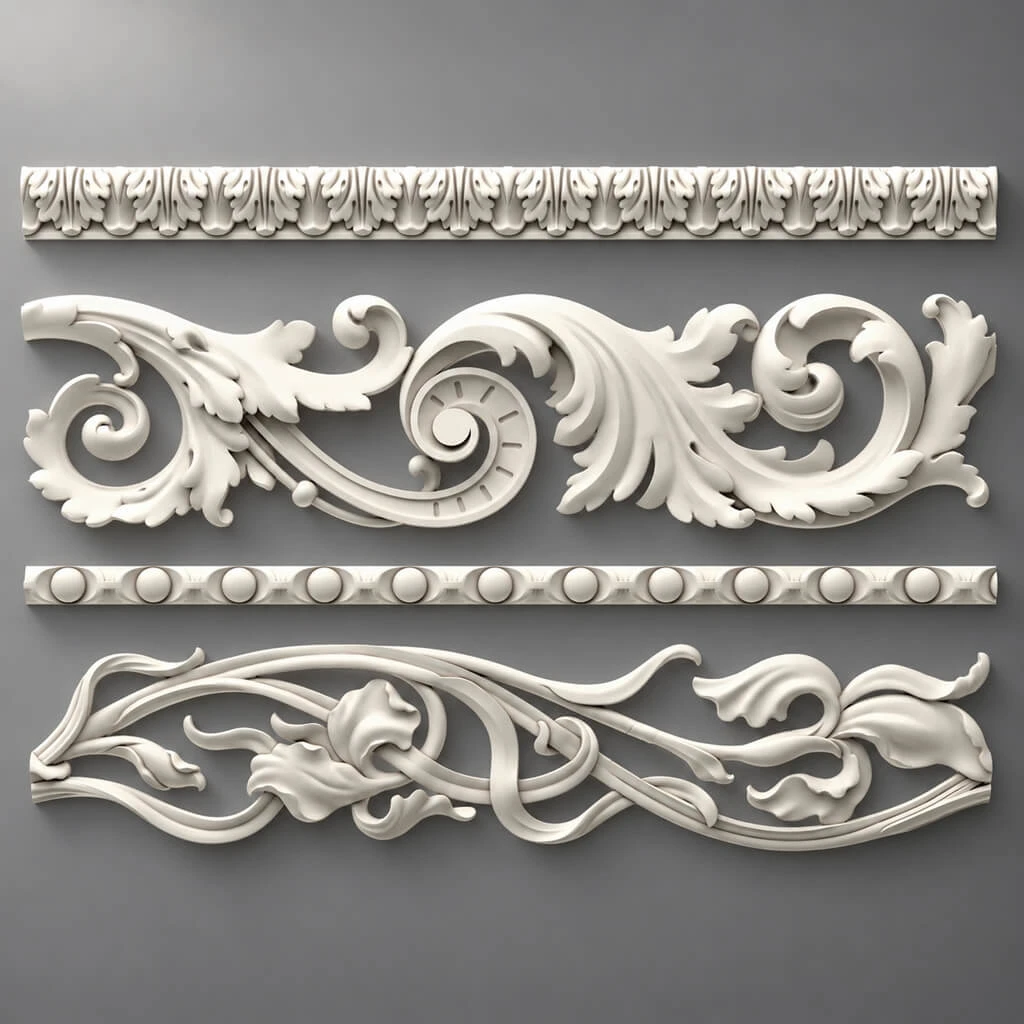
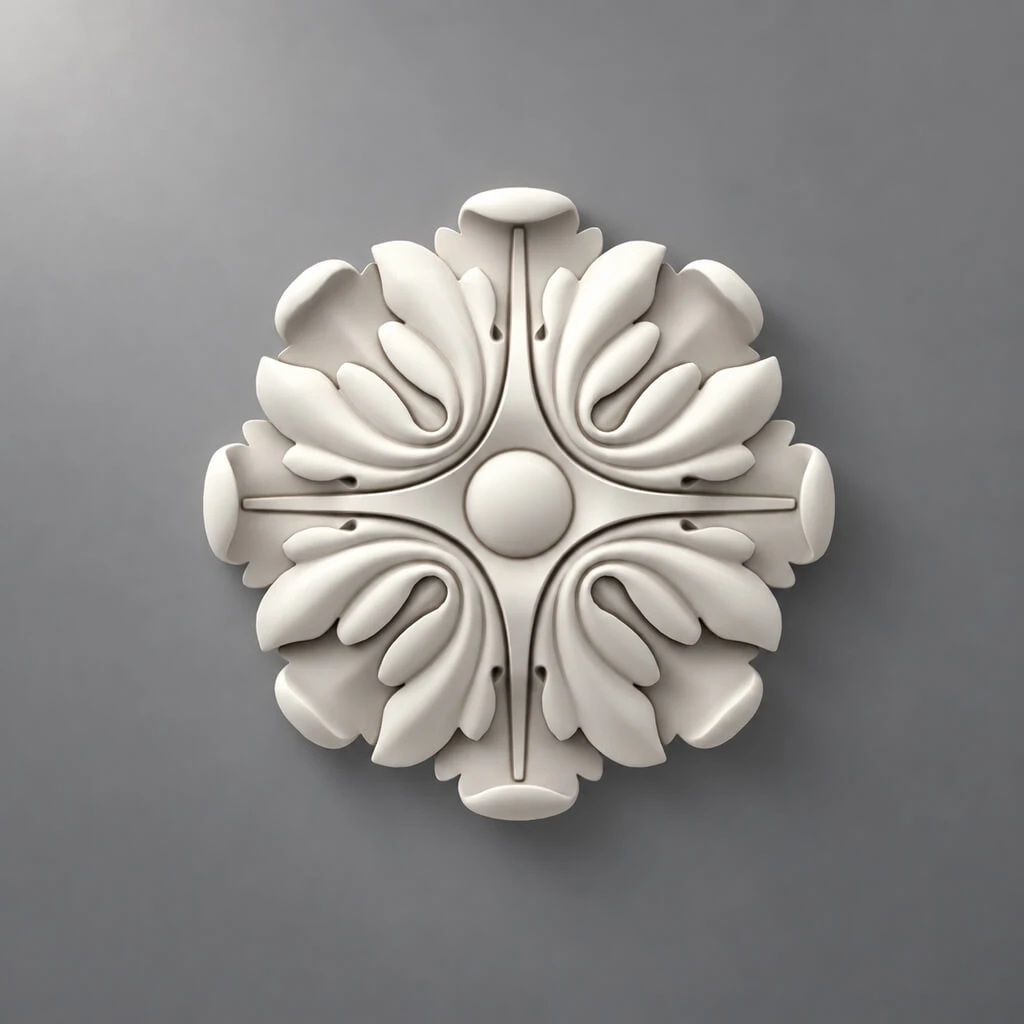
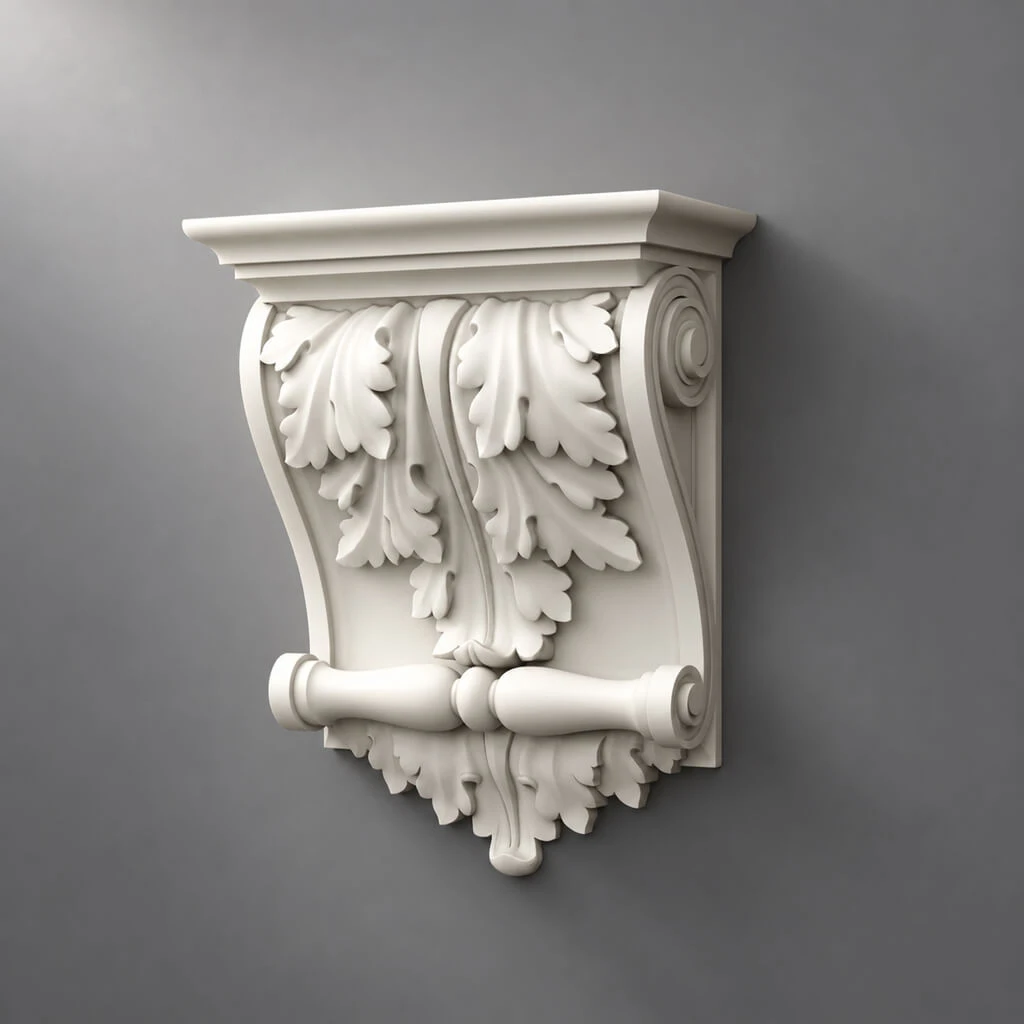
Carved wooden furniture legs for sale in Moscow, Nizhny Novgorod, Minsk, and throughout Russia — in the STAVROS catalog. In the section furniture legs — legs made of oak and beech in various styles and heights, from classic turned cones to cabriole forms with carved decor. Furniture legs in the basic version — without coating, ready for final finishing in any color and technique.
Related sections for comprehensive furniture design:
-
Furniture Handles — wooden, in the same styles and wood species
-
decor for furniture — overlays, rosettes, corner elements
-
Carved furniture decor — three-dimensional ornamental overlays
-
furniture moldings — cornice and base profiles
-
Classic Furniture — finished products in classic style
Buy wooden carved furniture legs with delivery — available throughout Russia and to Belarus. Packaging: individual cardboard cells, bubble wrap, box marked "fragile". Order for non-standard size or shape — according to technical specifications, production time from 2 to 6 weeks.
Buy carved wooden furniture legs from the manufacturer with a full decorative catalog — this is not just a purchase of legs. It is the first step towards creating furniture with the character of an era: Baroque, Classic, Empire, or Neoclassical. A step followed by handles, overlays, moldings — and ultimately an item that you want to preserve and pass on.
FAQ: answers to popular questions about carved wooden legs
Where to buy carved wooden legs for furniture?
In the STAVROS furniture legs — made of oak and beech, in various styles and heights. Contact us to confirm shipping to your destination.: Moscow, St. Petersburg, Nizhny Novgorod, Minsk and other cities.
How do carved legs differ from regular furniture supports?
A regular support is just function. A carved wooden leg is function plus decor. It defines the style of the furniture, works in ensemble with handles and overlays, and is suitable for finishing: painting, tinting, gilding.
Which carved legs to choose for a sofa?
Height 100–180 mm, neck cross-section at least 40 mm, fastening via M8 or M10 bolt. Load per leg for a two-seater sofa is 45–65 kg. Recommended material is oak.
Are carved legs suitable for furniture restoration?
Yes. Take precise measurements from the surviving leg, determine the style of the item, choose the closest shape from the catalog. For restoration, order the entire set at once — not one leg at a time.
What affects the price of carved wooden legs?
Wood species, height, cross-section, shape complexity, carving depth, coating, type of fastening unit, quantity in the set, and delivery.
Can wooden legs be painted?
Yes. Beech ones are ideal for enamel. Oak ones are ideal for tinting and oil. Any are suitable for gilding with preliminary priming. The coating is applied after installation or before it — depending on the technology.
How many legs are needed for a sofa?
Standard two-seater sofa — 4 legs. Three-seater with length 220+ mm — 6 legs (4 corner + 2 in the center of long sides). During restoration, always replace the entire set, not individual legs.