








































































Article Contents:
- Wooden knob handle buy
- What is a wooden knob handle and how to choose it
- Design and installation
- Shape: round, conical, mushroom-shaped
- Material: what to choose
- Where are wooden knob handles used: application scenarios
- Wooden knob handle for cabinet
- Knob handle for dresser and nightstand
- Wooden knob handle for kitchen
- Button handle for children's furniture
- Button handle, pull handle, and recessed handle: what to choose
- Why a button handle is more convenient than a pull on a cabinet
- How to choose the size of a wooden knob handle
- Diameter: how not to miss
- Height (projection): at what value is the grip comfortable
- Facade thickness and bolt length
- Calculate the set
- Match handles with other decor elements
- Knob handles for furniture restoration
- When handle replacement is needed
- Styling modern furniture
- Painting wooden handles during restoration
- Combination with overlays and moldings during restoration
- What affects the price of a wooden knob handle
- Mistakes when buying wooden knob handles
- Where to buy a wooden knob handle in St. Petersburg, Moscow, and across Russia
- FAQ: answers to popular questions about wooden knob handles
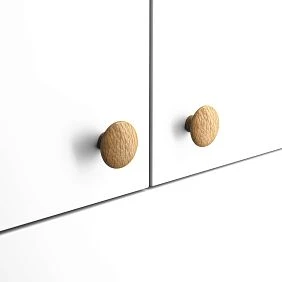
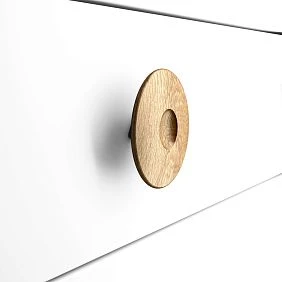
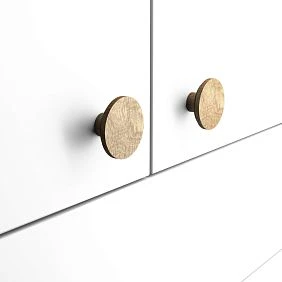
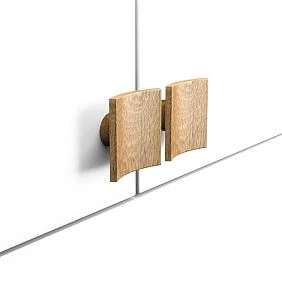
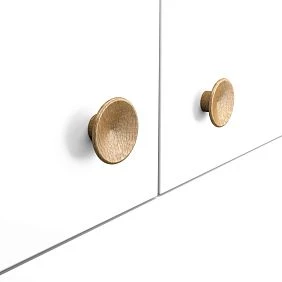
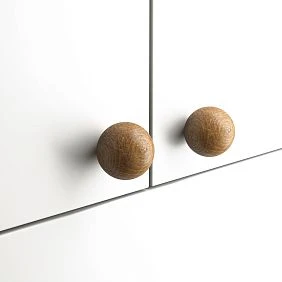
Buy a wooden knob handle
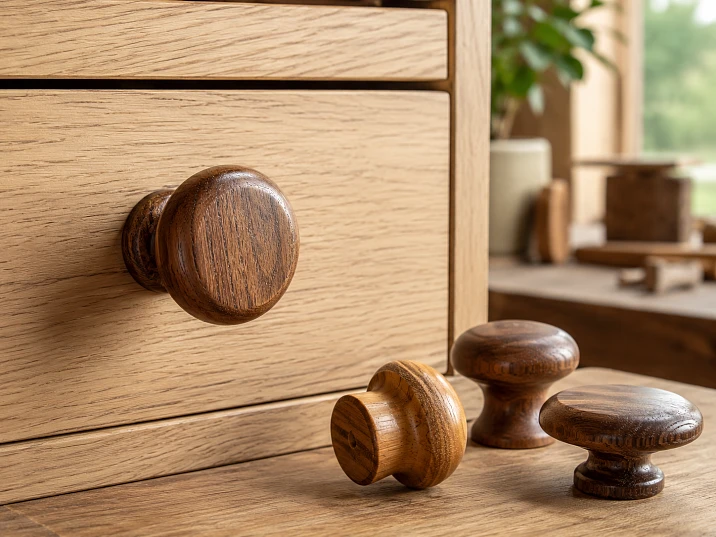
Sometimes it's the small detail that makes all the difference. A wardrobe, chest of drawers, bedside table, kitchen front — items that look neutral until the right handle appears. And a wooden knob handle made of natural wood is that very detail that can radically change the impression of furniture without repainting, remodeling, or additional investment.
Buy a wooden knob handle — the query is concise, but behind it lies a wide range of tasks: from updating a Soviet-era chest of drawers to equipping a Provence-style kitchen set, from assembling children's furniture from scratch to restoring an antique sideboard. Buying a wooden furniture knob handle means choosing a compact, warm, tactilely pleasant element that works on two levels: functional and aesthetic.
This article is for those who want to truly understand the topic. How a knob handle is constructed, how it differs from a pull handle and a recessed handle, what furniture it suits, what size to choose, how to avoid mistakes when ordering, and where to buy a wooden knob handle in Moscow, St. Petersburg, and across Russia.




What is a wooden knob handle and how to choose it
A knob handle is a furniture fitting that attaches at a single point, with a compact body: round, cylindrical, mushroom-shaped, or polyhedral. Unlike a pull handle, it has no two support posts and an arc between them — only one mounting bolt that goes through a hole in the furniture front, and the handle itself on top.
Buying a wooden knob handle means getting a product whose body is turned from solid wood: oak, beech, birch, ash, or walnut. The wood here is not an insert or veneer, but a solid material that can be sanded, painted, tinted, and repainted without losing its shape.
Buying a wooden knob handle for furniture is a task that starts with three questions. First: for what furniture? Second: what style? Third: what size? The entire subsequent selection logic answers these questions.
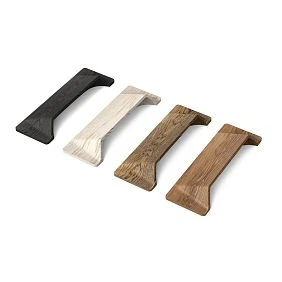
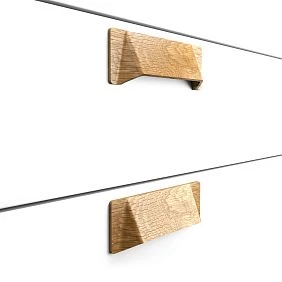
Our factory also produces:
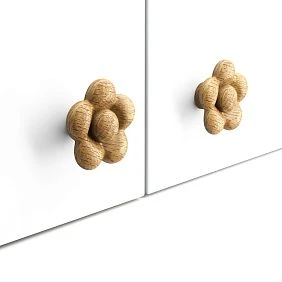
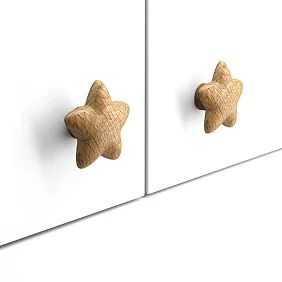
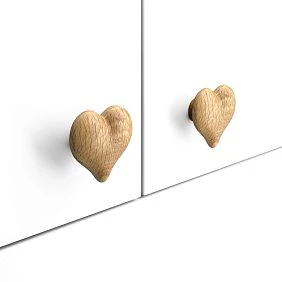
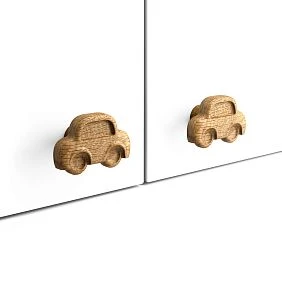
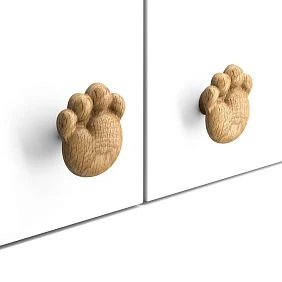
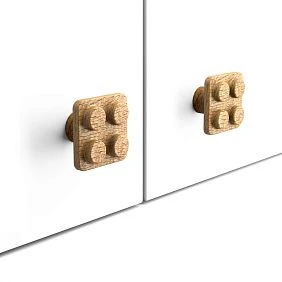
Design and installation
A knob handle consists of two elements: the handle body (a turned or milled wooden product) and a mounting bolt (most often M4 × 25–40 mm depending on the front thickness). The bolt passes through a hole in the door or drawer from the inside, screws into the thread in the handle body, and is tightened — the handle is rigidly fixed on the outside.
Mounting hole diameter: 4 mm (standard). Front thickness: 16–22 mm (standard chipboard or MDF sheet) or up to 40 mm (solid wood door). The bolt length is chosen based on the front thickness: for 16 mm — a 25–30 mm bolt, for 22 mm — 30–35 mm.
This is an extremely important parameter: the bolt must enter the handle thread to a depth of at least 8–10 mm, otherwise the handle will be held unreliably. When buying wooden knob handle, always check the thread depth and the mounting bolt length.
Get Consultation
Shape: round, conical, mushroom-shaped
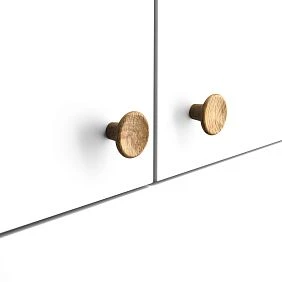
Round (ball, hemisphere) — the most versatile. Convenient for finger grip, visually neutral, organic in Scandinavian, Provence, eco-style, children's furniture. Diameter: 25–50 mm.
Cylindrical — a body in the shape of a cylinder with rounded ends. A classic, restrained shape. Suitable for cabinets and dressers in neoclassical and classic style. Diameter: 20–45 mm, height: 20–40 mm.
Mushroom-shaped (cone with flare) — widens upward, narrows toward the bolt. Fits well in the hand, convenient for frequent use. For kitchen fronts and drawers.
Multi-faceted (four-, six-, eight-sided) — for classic, Empire style, furniture with geometric ornament. Strict shape, reads as "noble" on dark fronts.
Material: what to choose
Buy a wooden furniture knob — and immediately the question of wood species arises. This is not only a matter of beauty, but also of strength and the possibility of subsequent finishing.
Oak — dense, with expressive texture. Under tinting and oil, it gives a deep, lively tone. For classic furniture, Baroque, Neoclassicism. Service life with proper use — decades.
Beech — fine-grained, without pronounced pores. Ideal for painting: white, cream, gray, black. For Provence, Scandinavian style, children's furniture. Beech knob under enamel — impeccably smooth surface.
Birch — light, uniform. For budget solutions and neutral interiors.
Walnut — warm brown tone with expressive veins. For the premium segment.
In the STAVROS furniture handles Knobs made of oak and beech are presented — in versions without coating (for self-finishing) and with coating (ready-made solution).
Where wooden knobs are used: application scenarios
A wooden knob handle is a versatile hardware element, but each scenario has its own specifics. Let's break them down by furniture type.
Wooden knob handle for a wardrobe
A wardrobe is the most common scenario. Swinging doors open by pulling: here, grip matters, not leverage. A knob handle on a wardrobe is usually one grip point per door.
Knob size for a wardrobe: diameter 30–45 mm. Too small (20–25 mm) is uncomfortable for an adult hand with frequent opening. Too large (55+ mm) visually overloads the door, especially if it has no ornament.
Installation height: center of the knob at 900–1100 mm from the floor (for standard adult height). For lower sections, lower; for upper sections, higher, but so that pulling is comfortable.
A small wooden knob handle for furniture is an optimal choice for a built-in wardrobe with minimalist facades: it does not overload the surface, creates a light accent, and easily fits any style.
for classic furniture — a wardrobe with wooden knob handles combined with furniture moldings on the fronts and furniture decor in the corners of the doors is a full-fledged classic design program.
Knob handle for a chest of drawers and bedside table
A chest of drawers is an item with many drawers. A four-drawer chest needs four handles; sometimes two are placed on each drawer for even force when pulling out. This is an important nuance: with two handles on a drawer, the pulling force is distributed evenly, and the drawer does not skew.
For dresser drawers — knob handles with a diameter of 25–35 mm: compact enough not to interfere when the drawer is closed. Shape — cylinder or hemisphere: both are comfortable for gripping with two fingers.
Knob handle for a cabinet — the most delicate scenario. A bedside table or bathroom cabinet — a small piece with one or two doors. Here, the most modest size is appropriate: diameter 20–30 mm. Shape — spherical or elegant mushroom-shaped.
For bathrooms and damp areas — choose handles made of dense wood (oak, beech) with a water-based varnish or oil-wax coating. Uncoated wood in a damp environment quickly darkens and swells.
Wooden knob handle for the kitchen
The kitchen is the most demanding scenario in terms of usage. Handles are opened and closed dozens of times a day. Grease, steam, and mechanical dirt accumulate on kitchen fronts.
A wooden knob handle for the kitchen must:
-
have a durable coating (water-based varnish, oil with wax, hard wax-oil) — or be made of moisture-resistant wood
-
be easy to clean — a smooth shape (cylinder, hemisphere) is simpler to maintain than handles with deep relief
-
have a reliable mounting bolt — in the kitchen, handles loosen faster than anywhere else; periodically tighten the bolt
Styles in which a wooden knob handle is organic for the kitchen: Provence (white knob handles on white fronts), Rustic (unfinished or stained oak texture), Country, Eco-style, Scandinavian. For minimalism and high-tech — a wooden knob handle creates a pleasant warm contrast with glossy or matte fronts.
Knob handle for kitchen front — diameter 30–40 mm. Smaller is inconvenient for frequent opening, larger visually dominates the front without additional decor.
Knob handle for children's furniture
Children's furniture is a separate world with special requirements for safety, aesthetics, and durability.
Safety. Sharp corners on the handle are excluded. For children's furniture — a round wooden knob handle or half-sphere handle: without edges, without sharp edges. Fastening is reliable, the bolt is tightened and recessed so that it cannot be accidentally unscrewed by a child's hand.
Size. For children's furniture — handles with a diameter of 20–30 mm: proportionate to a child's hand. A large 50 mm knob on a small drawer of a children's table is functionally excessive and visually heavy.
Color and finish. Knob handles for children — the most popular option for painting. White, pink, turquoise, yellow handles made of beech, painted in the color of the children's room interior — both fun and functional.
Durability. Children use furniture harshly: pull, twist, knock. A wooden handle made of solid beech with proper coating withstands years of active children's use.
Wooden handle without coating — an ideal choice for a children's room: it can be painted in the desired color yourself, repainted when the interior changes, updated without replacement.
Knob handle, pull handle, and recessed handle: what to choose
Choosing the type of furniture handle is not a matter of taste. It is a matter of function, furniture scale, and style. Let's compare all three types.
| Handle type | When it fits | Features |
|---|---|---|
| Button Handle | Cabinets, chests of drawers, bedside tables, children's furniture, small facades | One attachment point, compact, versatile |
| Wooden bracket handle | Drawers, large facades, kitchen cabinets, classic chests of drawers | Two attachment points, convenient for pulling force |
| Wooden recessed handle | Minimalist facades, sliding solutions, niches | Recessed into the facade, hidden installation |
| handles without coating | Restoration, painting, tinting to match the interior | Ready for finishing with any technique |
| Handles with Finish | Ready-made solution for a specific interior | Lacquered, tinted, with patina |
Key selection rule: the larger the facade, the sooner a bracket is needed. The more compact the item, the more organic a knob. A recessed handle — when maximum minimalism is desired or when space does not allow a protruding element.
Why a knob handle is more convenient than a bracket on a cabinet
A bracket requires precise adherence to the center distance — standards 32 mm, 64 mm, 96 mm, 128 mm, 160 mm. If the distance between holes deviates by 2–3 mm, the bracket will sit crooked. A knob — one point, one hole, minimal risk of misalignment.
For a cabinet with many identical doors, a knob handle ensures perfect repeatability during installation: one hole in the center of the door, a simple template, the same position on all facades.
How to choose the size of a wooden knob handle
The size of a knob handle is not a parameter chosen 'by eye.' It is calculated from several data points.
Diameter: how not to miss
Proportion rule: the knob handle should occupy 5–8% of the facade width to which it is attached. For a cabinet door 450 mm wide — handle diameter 22–36 mm. For a narrower one (300 mm) — 15–24 mm. For a wide one (600+ mm) — 30–48 mm.
In practice, this means:
-
small dresser drawer (200–300 mm) — handle 20–28 mm
-
standard cabinet door (350–500 mm) — handle 28–40 mm
-
tall floor-to-ceiling door (1800–2100 mm) — handle 35–50 mm
Height (projection): at what value is the grip comfortable
Knob handle height (distance from the facade to the top point of the handle) — 20–40 mm. A height less than 20 mm is uncomfortable: fingers cannot fit under the handle for gripping. A height over 45 mm is excessive; the handle starts to protrude and feels bulky.
Optimal for most scenarios: height 25–35 mm. This provides a comfortable finger grip without feeling overloaded.
Facade thickness and bolt length
Standard MDF or particleboard furniture facade — 16–22 mm. Solid wood — 20–40 mm. Each thickness requires its own bolt length.
Formula: bolt length = facade thickness + depth into handle (8–12 mm). For a 16 mm facade: bolt 25–28 mm. For a 22 mm facade: bolt 32–35 mm. For a 35 mm solid wood facade: bolt 45–48 mm.
Some Furniture Handles are supplied with a standard length bolt. Specify the length when ordering if your facade is non-standard.
Calculate the set
The number of knob handles is determined by the number of fronts. One cabinet with two hinged doors — 2 handles. A chest of drawers with five drawers — 5 handles (or 10 if two per drawer). A kitchen set with 12 fronts — 12 handles.
Take the entire set from one batch: this guarantees identical wood tone and profile accuracy. A reorder six months later will yield a different shade.
Coordinate the handles with other decorative elements
A knob handle does not work on its own — it is part of the furniture decor system. If the furniture has:
-
decor for furniture — applied rosettes, corner elements, friezes
-
furniture moldings — cornice and base profiles
-
Furniture legs — carved or turned legs
...then the knob handles should be made of the same wood, in the same style, with the same finish. A unified decorative program is not redundancy, it is professionalism.
Button handles for furniture restoration
Restoration is the most delicate and most interesting scenario for a wooden knob handle. Here it is not enough to "buy a suitable one" — you need to find the right one. One that matches the era of the piece, its proportions, style, and preserved details.
When handle replacement is needed
Replacing furniture fittings during restoration is a mandatory step if:
-
the original handles are lost or severely damaged
-
the original handles are made of metal that has oxidized or lost its coating
-
the style of the handles does not match the style of the item (typical Soviet furniture with featureless metal fittings)
-
restoring modern furniture to look 'antique'
Buying a wooden furniture knob handle for restoration means first determining the style of the item. A Biedermeier-style chest of drawers — spherical, light-colored knob handles. An Empire-style wardrobe — cylindrical or faceted handles with a 'dark walnut' tint. A Provence-style sideboard — bleached or ivory-colored hemisphere handles.
Stylization of modern furniture
Modern IKEA furniture or any inexpensive cabinet with plastic handles is the most common scenario for 'restoration of new items'. Replacing plastic knobs with wooden ones — two bolts, a screwdriver, half an hour of work — and the item takes on a completely different character.
To style a kitchen set in Provence style: replace metal pull handles with wooden knob handles made of beech, painted white or cream. The result is a completely different mood in the same kitchen. Add to buy, which will allow you to transform your furniture using carved wooden elements. You can use the C-003-3 decor set to decorate furniture, walls, doors, or any other surface. The C-003-3 decor set is made of oak or beech, known for their strength, durability, and beauty. You can buy the C-003-3 decor set at the Stavros decor store, which specializes in producing and selling decorative elements and hardware for furniture and interiors. At the Stavros decor store, you will find a wide selection of decor sets of various shapes, sizes, and styles. You can choose to the fronts — and the transformation is complete.
Painting wooden handles during restoration
An uncoated wooden handle is an ideal base for self-finishing during restoration. Sequence:
-
Light sanding with 180 grit sandpaper (removing burrs and unevenness)
-
Applying primer (for paint — acrylic primer, for tinting — not needed)
-
Painting with enamel in 2–3 layers (beech) or tinting with stain (oak)
-
Water-based varnish for protection — 2 layers
-
Final sanding with 320–400 grit sandpaper and polishing with a soft cloth
For gilding: additionally bole (red-brown pigment primer) and metal leaf. A gilded wooden knob handle on a classic chest of drawers is antique workshop level.
Combination with overlays and moldings during restoration
Knob handle — the first step. A systematic result is achieved with a set: handles + Decorative wooden overlays on the facades + Moldings along the perimeter of doors + Furniture legs in the same style.
It is precisely this approach—systemic decor—that transforms a faceless laminated cabinet into furniture with history and character. Four elements, one style, one wood species, one finish—and a result that is perceived as a single whole.
What affects the price of a wooden knob handle
The price range for wooden knob handles: from 150 rubles for a simple beech spherical one to 2,000–3,500 rubles for a large oak one with custom carving. The price structure is transparent.
Wood species. Birch is the most affordable. Beech is mid-range. Oak is more expensive. Walnut, ash are premium.
Diameter. A 25 mm handle and a 50 mm handle made from the same wood—different material consumption and turning time.
Handle height. The taller the handle body (projection), the larger the workpiece volume.
Shape and profile complexity. A simple hemisphere—minimal processing. A polyhedron with a faceted profile—milling each facet. An ornamental band—manual or milling work.
Presence of finish. A handle without finish ("raw wood")—cheaper. Tinting + varnish—a surcharge. Enamel painting—even more. Gilding—a significant surcharge.
Quantity in the order. The unit price decreases for orders of 10, 20, 50 pieces. For a kitchen set of 20 facades, this is a significant saving.
Hardware included. A handle with a bolt included—more convenient, but slightly more expensive. A handle without a bolt—if you have a non-standard facade thickness and need a non-standard bolt length.
Delivery. Knob handles — lightweight items (20–80 g each). Set of 10 pieces — 200–800 g. Courier delivery in Moscow and St. Petersburg, transport companies — throughout Russia.
Mistakes when buying wooden knob handles
Mistakes when buying furniture fittings — little things that lead to reordering, extra expenses, and ruined mood. Here are the seven most common ones.
They buy without checking the facade thickness. The handle bolt came 25 mm, but the facade is 22 mm. The bolt barely enters the thread. The handle holds unreliably. Check the facade thickness and bolt length before ordering.
They don't count the number of handles per set. "I'll buy more later" — and new handles from the next batch are a slightly different shade. Count all facades before ordering, take a spare +1–2 pieces.
They choose too small a diameter for a large facade. A 20 mm handle on a 600 mm cabinet door — visually lost, inconvenient to grip. Follow the proportion rule.
They don't consider grip comfort. A handle with low projection (10–15 mm) — beautiful, but fingers don't fit. Practically non-functional. Minimum comfortable projection — 20 mm.
They don't check the fastener. A bolt made of soft metal under regular load loosens and deforms the thread in the handle body. Choose handles with a steel bolt, not a soft aluminum one.
They don't match handles with the color and style of the furniture. Dark oak handles on white facades — that's contrast. It can be intentional, or it can be a miscalculation. Make sure the contrast is deliberate.
They mix different types of handles without design logic. Knob handles on some facades, pulls on others — only acceptable with a clear design concept (e.g., knobs on doors, pulls on drawers). Random mixing looks sloppy.
Where to buy a wooden knob handle in St. Petersburg, Moscow and throughout Russia
Wooden knob handle buy in St. Petersburg and Moscow — with delivery from the STAVROS catalog. Production is located in St. Petersburg, Contact us to confirm shipping to your destination. and Belarus.
In the section uncoated knob handles — handles made of oak and beech in several shapes and sizes, ready for self-finishing. For those who want a ready-made solution — Wooden handles with coating: tinted, lacquered, with patina.
For full furniture decor in the STAVROS catalog — a complete system: handles, legs, moldings, overlays, carved decor in a single decorative program made of solid wood. This is not a set of random parts, but a systematic approach to furniture design from a manufacturer with restoration experience.
FAQ: answers to popular questions about wooden knob handles
Which wooden knob handle to buy for furniture?
Start with the size of the facade on which the handle will be mounted. The knob diameter is 5–8% of the facade width. Next — the type of wood for coating or tinting, the shape to match the furniture style, the bolt length to match the facade thickness.
How is a knob handle different from a pull handle?
A knob is compact, with a single attachment point. Bracket Handle — an arc with two dots, convenient on large facades and drawers with heavy contents. The choice depends on the scale of the furniture and the nature of the load.
Where to use wooden knob handles?
On cabinets, chests of drawers, nightstands, kitchen fronts, children's furniture, sideboards, display cases, and during restoration. Everywhere where compact, warm, natural hardware is needed.
Can wooden knob handles be painted?
Yes. Handles without a finish — are ready for any finish: enamel, stain, tinting, gilding. Beech handles are ideal for painting. Oak handles are ideal for tinting and oil.
What affects the price of a knob handle?
Wood species, size, shape, presence of coating, profile complexity, order quantity, fasteners, and delivery.
What diameter of knob handle should I choose for children's furniture?
For children's furniture — 20–30 mm, shape without sharp corners: spherical or hemispherical. Coating — non-toxic children's enamel or water-based varnish.
How to install a wooden knob handle?
Drill a 4 mm diameter hole in the center of the facade. Insert the bolt from the inside, screw the handle on from the outside, and tighten the bolt with a screwdriver or low-speed drill. Periodically retighten the bolt during regular use.