








































































Article Contents:
- Buy house carving
- House carving: not decoration, but the language of the home
- What is included in house carving: full composition of facade decor
- Which house carving to buy for your home
- Types of house carving elements: details about each
- Carved window casings: window framing as an artistic statement
- Fascia boards: decor along the roof slope line
- Valances: wooden lace under the cornice
- Carved cornices: completing the facade vertical
- Pediment decor: the top of the facade
- Porch carving: the first impression of the house
- House carving for the facade: how to choose for the architecture of the house
- The principle of the facade program
- Facade zones and priorities
- Carved elements for the house: style compatibility
- House carving and carved architraves: what is the difference and how to choose correctly
- Styles of house carving: from geometry to plant weaving
- Geometric style
- Plant style
- Zoomorphic and anthropomorphic style
- Openwork (lacy) and blind carving
- House carving in Russian style
- How to choose house carving before purchase: a practical checklist
- Installation of house carving: basic principles
- Installation of window casings
- Installation of cornice boards
- Installation of gable boards
- Coating and protection
- What affects the price of wooden house carving
- Mistakes when buying house carving
- Where to buy wooden house carving
- FAQ: answers to popular questions about house carving
Buy house carving
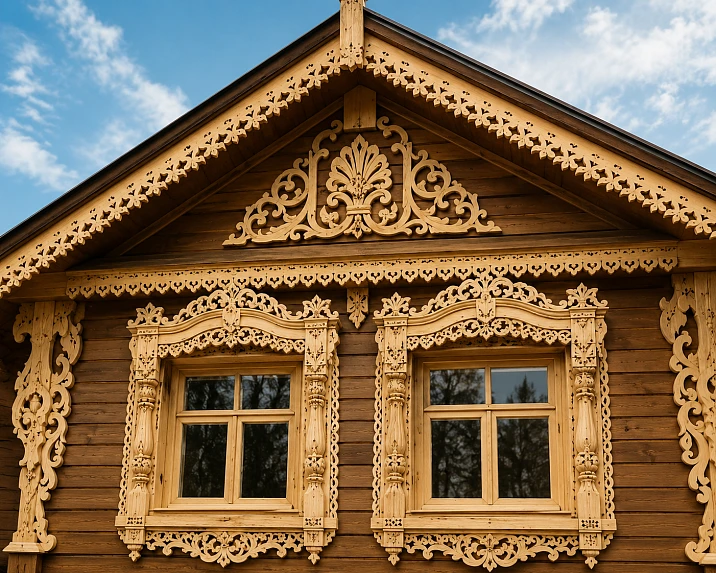
There are houses that you simply cannot walk past without stopping. Not because they are huge or built according to an avant-garde design. But because they speak. They speak through carving — that very carving that runs along the cornice as a light white strip of openwork frieze, frames the windows with casings adorned with leaves and curls, and crowns the gable with a soffit bearing a solar motif. Wooden house carving is the language with which Russian architecture conversed with the street for many centuries.
And this language is not dead. It lives on — in the wooden houses being built today, in the restoration of old ones, in people's desire to make their home not just functional, but alive, warm, and meaningful.
Buying house carving today does not mean searching for a lone craftsman with a jigsaw in a village. It is a full-fledged choice of ready-made and custom elements: carved window casings, soffits, friezes, cornices, gable decor, decorative rosettes — all of this is produced both in series and to individual specifications, and delivered across the entire country.
But to make the right choice, you need to understand what house carving is as a system, what elements it consists of, how it is installed, how it coordinates with the facade, what affects the price, and what mistakes are most common when purchasing. This article is exactly about that.




House carving: not a decoration, but the language of a home
Before talking about how to buy house carving, we need to say what it actually is.
In folk architecture, wooden house carving is not a decorative appendage nailed to the facade. It is an architectural system in which each element had its place: the soffit protected the end of the roof purlin from moisture, the frieze covered the gap between the roof overhang and the wall, and the window casing protected the window opening from drafts. Function gave rise to form, and form became overgrown with ornament — solar circles, diamonds (symbols of fertility), plant shoots (symbols of life and growth).
Today, most of these elements have lost their original protective function — or have retained it only partially. But the decorative and artistic function has only strengthened. House Carving Today, this is a way to give a house character, root it in tradition, and make the facade lively and expressive.
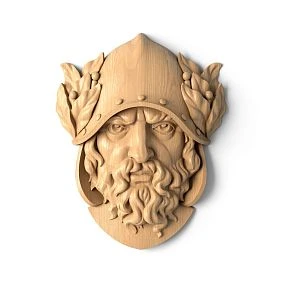
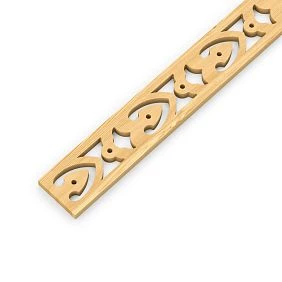
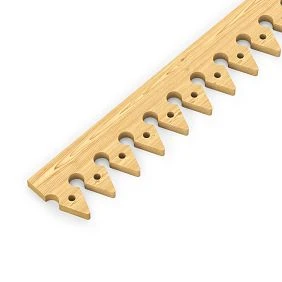
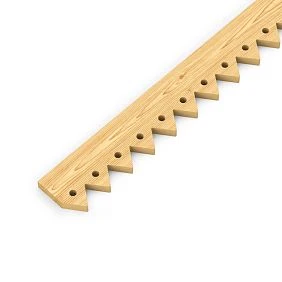
Our factory also produces:
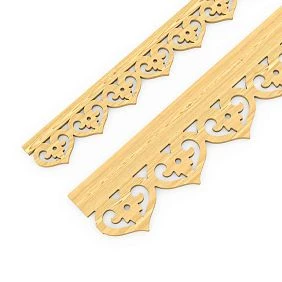
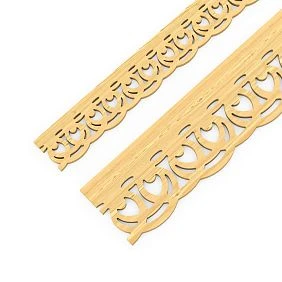
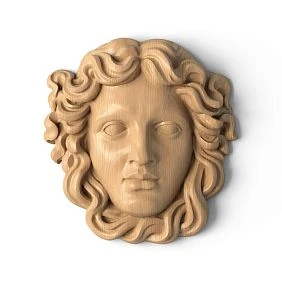
What is included in house carving: the complete composition of facade decor
| Element | Location | Function |
|---|---|---|
| Carved window surrounds | Around windows and doors | Design, framing of the opening |
| Pricheliny | Along the roof slopes along the gable | Closing the end of the roof overhang |
| Podzory | Along the lower edge of the roof overhang | Openwork decorative frieze |
| Carved cornices | Upper facade line | Wall termination, transition to roofing |
| Pediment decor | Upper triangle of the facade | Decorative pediment infill |
| Decorative rosettes | Corners, central accents | Point decor |
| Applied patterns | Walls, shutters, doors | Surface ornamental decor |
| Porch carving | Porch posts, railings, canopy | Entrance group decor |
Wooden house carving is not a single element, but a system. You can buy only window casings and already get a result. But if you add friezes along the cornice and carved gable boards on the pediment, the house becomes completely different: whole, complete, speaking a single language.
Get Consultation
Which house carving to buy for your home
Buy house carving — and immediately the question: where to start? With architecture. It determines which elements are needed, what size, in what style, and in what quantity.
A wooden house made of timber or logs — here house carving is absolutely organic. Any elements: window casings, gable boards, friezes, cornices — everything fits into the material logic of the house.
A house made of foam block or brick with wooden finishing — wooden house carving is possible as a decorative accent: window framing with casings, a frieze along the cornice. Installation — on dowels into the wall.
A frame house is an excellent base for house carving. The wooden frame allows carved elements to be mounted directly into the load-bearing structure.
A dacha, a summer house — here, window casings and eaves are often sufficient. They provide maximum visual effect with minimal work.
Buying wooden house carving also means choosing:
-
Material. Pine is affordable, easy to work with, and lightweight. Oak is dense, durable, and expensive. Larch is moisture-resistant, optimal for exterior facades.
-
Element thickness. For window casings and eaves, 18–25 mm is sufficient. For gable boards and cornices with lateral load, 25–40 mm.
-
Carving depth. Through (openwork) carving is light and airy. Relief (non-through) carving is voluminous and rich. Combined carving is both.
-
Pattern style. Geometric, floral, zoomorphic, mixed.
A detailed breakdown of how Wooden patterns on houses they relate to tradition and modernity is a separate topic worthy of careful reading before choosing a style.
Types of house carving elements: detailed about each
Carved window casings: framing a window as an artistic statement
A window casing is the most noticeable and widespread element of house carving. It consists of vertical side posts and a horizontal top board (pediment) that frame a window or door opening from the outside.
Construction of a window casing:
-
Side posts — vertical strips on both sides of the opening. Width: 80–160 mm. Length: equal to the window height plus extensions above and below the opening.
-
Top board (pediment, fronton) — horizontal or with a shaped finish (arched, triangular, "kokoshnik"). It carries the main decorative pattern.
-
Bottom board (windowsill element) — not always present, but in a full set it is mandatory.
-
Ears — corner connecting elements at the joints of side posts and the top board.
Carved Mouldings come in:
-
Cut-through — through carving along the entire length. Lacy, lace-like effect. Typical for the Moscow region and Vladimir tradition.
-
Relief — ornament in relief without cut-through elements. More voluminous, well readable from a distance.
-
Combined — cut-through + relief. The most decoratively rich type.
for the wooden skirting board For a standard size window (600×900 mm) — a standard set: 2 side panels, 1 top board, 1 bottom board. For non-standard windows — a custom set based on exact measurements.
Fascia boards: decor along the roof slope line
A fascia board (or "wind board") is a long board that runs along each roof slope, covering the ends of rafters or purlins. It is an extended horizontal element with a rhythmic carved ornament.
The fascia board is one of the most monumental facade elements: its length equals the length of the roof slope, and it is the first thing visible from the street. The pattern of the fascia board sets the overall rhythm of the house's ornamental program.
Typical fascia board width: 120–250 mm. Thickness: 25–40 mm. Length — along the slope length (from 3 to 8 meters or more). Supplied in sections of 2–3 meters with locking joints.
Traditional fascia board motifs: diamonds, triangles (teeth), curls, herringbone patterns, geometric weaves. The bottom edge is shaped: semicircular teeth, drops, leaves, flames.
At the bottom of the fascia board, an "earring" is often attached — a small decorative element in the form of a carved drop or circle, hanging on the ridge axis.
Soffits: wooden lace under the eaves
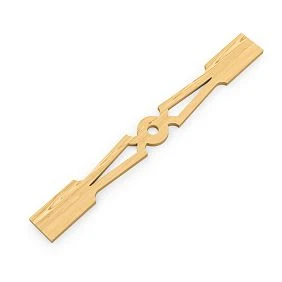
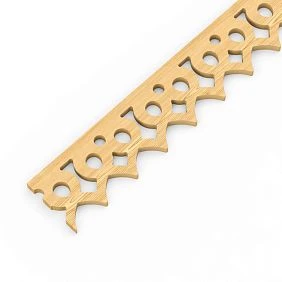
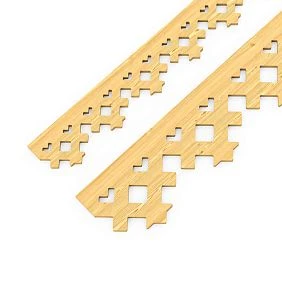
A soffit is a horizontal openwork board that runs along the bottom line of the roof overhang. This is the very "wooden lace" that is so striking in old wooden houses: fine cut-out patterns, a wavy bottom edge, rhythmic alternation of elements.
The soffit is an element with maximum decorative effect at a relatively low cost. A long strip of openwork carving along the eaves instantly transforms the facade.
Frieze width: 100–200 mm. Thickness: 18–25 mm (openwork pattern does not require large thickness). Supplied in sections.
wooden lace — friezes and openwork window casings create that very image of a "lace house" which is the hallmark of Russian wooden architecture.
Carved cornices: completion of the facade vertical
wooden cornice — a horizontal profile element along the top line of the wall, forming the transition from the vertical facade to the horizontal cornice overhang. In house carving, the cornice is often supplemented with applied ornamental elements: toothed friezes, rows of "corbels", applied rosettes.
For a wooden house in the Russian style, a wooden carved cornice is a mandatory element of the facade system. Without it, the transition from the wall to the roof looks incomplete.
Gable decor: the top of the facade
The gable is the upper triangular element of the end facade, bounded by two roof slopes. It is here that house carving achieves maximum decorative concentration.
Elements of gable decor:
-
Bargeboards — along the slopes (already described above)
-
Towels — applied vertical elements on the ridge axis and at the gable corners
-
Gable board — a horizontal board at the bottom of the gable triangle, often with carved patterns
-
Decorative "sun" rosette — in the center of the gable, often a circular ornament with rays
A fully decorated gable — bargeboards, towels, gable board, and central rosette — is the "ceremonial face" of a wooden house.
Porch carving: the first impression of the house
The porch is the meeting point between the house and the guest. Here, house carving works not only decoratively but also as a first impression.
Elements of porch carving:
-
Carved posts (porch columns) or support posts with applied ornamentation
-
Openwork canopy over the porch (often a combination of a valance and a carved frieze)
-
Carved railings and balusters (if the porch is high)
-
Carved overlays on corner posts
Door Decoration — a separate topic, but it is organically connected to the carving of the porch: the door and the porch should work as a single entrance group.
House carving for the facade: how to match it to the architecture of the house
Buying house wood carving without understanding the facade scheme means risking inconsistency. The elements will be beautiful on their own, but the facade will not come together as a cohesive picture.
The principle of the facade program
A professional approach to house carving is a facade scheme: a drawing (or at least a sketch) with marked zones for each element, their dimensions, and stylistic characteristics.
Facade program of a wooden house:
-
Horizontal zones from top to bottom: ridge — gable boards — soffits — cornice — pediment — window casings — foundation belt
-
Vertical axes: corner posts, inter-window piers
-
Accent points: central axis of the facade, corners, points of connection to the porch
Rule of integrity: all elements of house carving on one facade must belong to the same ornamental program. Not necessarily the same pattern, but the same style and the same decorative tradition.
Facade zones and priorities
If the budget is limited and it's impossible to decorate everything at once, here is the order of priorities by decorative effect:
1. Soffit boards. Maximum visual effect at minimal cost. A long openwork strip along the eaves is read from the street first.
2. Window casings. The second most important element. Windows are the "eyes" of the house, and they attract the eye.
3. Pricheliny (gable boards). They decorate the roof line and work together with the soffit boards.
4. Gable decor. For end facades — mandatory. For side ones — optional.
5. Porch carving. Accent of the entrance group.
6. Decorative rosettes and overlays. Final touches.
Carved elements for the house: style compatibility
The ornamental pattern of all elements should work together. If the window casings have plant motifs with curls, then the soffit boards should also carry a plant ornament. If the casings are geometric — the soffit boards should have a geometric series. Mixing plant ornament on the casings and strict geometry on the gable boards is a style conflict that is immediately noticeable.
A detailed analysis of ornamental motifs and their combinations — in the article about wooden patterns on houses.
House carving and carved architraves: what's the difference and how to choose correctly
This question often arises: a person looks for architraves — and sees 'house carving'. Or looks for house carving — and ends up in the architrave section. Let's distinguish the concepts.
| Concept | What it includes | Application |
|---|---|---|
| House Carving | Complete set of facade decor: architraves, gable boards, friezes, cornices, pediment, rosettes | Comprehensive design of the entire house |
| Carved Mouldings | Only framing of window and door openings | Design of openings |
| wooden ornament | Motif, pattern, design | Description of decor |
| Carved wooden decoration | Broad product cluster | General term for any carved products |
Buying house wood carving is a broader query. It includes everything: architraves, gable boards, valances, cornices, and gable decor. If you need one element, specify its name. If you need to decorate the entire house, 'house carving' is exactly what you need.
It's also important to understand: carved architraves can be part of house carving, but they are not it in the full sense. An architrave is an element. House carving is a system.
Styles of house carving: from geometry to plant weaving
The question of style is not just aesthetic. It's a matter of matching architecture, regional tradition, and personal taste.
Geometric style
The oldest layer of house carving is geometric ornament. Diamonds, squares, triangles, zigzags, crosses, and their combinations. Strict, symmetrical, rhythmic.
Geometric Wooden patterns on mouldings — characteristic of houses in the Russian North, Volga region, and Siberia. The climate of these regions required simple, technological forms that were quickly carved and held securely.
For a modern home, geometric house carving is a choice for those who value purity and rhythm, without overloading the facade with unnecessary details.
Botanical style
Leaves, shoots, flowers, grapevines, hops, ferns, lilies of the valley — the plant ornamentation in Russian house carving is endlessly diverse.
Plant motifs came into Russian carving largely through the Baroque influence of the 17th–18th centuries, but were adapted to folk tradition and acquired their own character — freer, less academic, more lively.
Carved soffit boards and valances with plant ornamentation are the hallmark of the Vladimir, Yaroslavl, and Nizhny Novgorod traditions of house carving.
Zoomorphic and anthropomorphic style
Birds, horses, fish, fantastic creatures — zoomorphic motifs in house carving carry symbolic meaning. A horse on the soffit board is a solar symbol, a talisman. A bird on the window casing is a symbol of the soul and freedom.
Zoomorphic ornament in its pure form is less common — more often as an accent in a plant or geometric program.
Openwork (lacy) and blind carving
Regardless of the motif — house carving can be openwork or blind (relief).
Slotted-through. The background "falls through," leaving only the ornament. Lightness, air, lace. Podzory and pricheliny are traditionally slotted.
Blind (relief) — the ornament protrudes from a solid background. More voluminous, more monumental. For large architraves with a pediment, for cornice boards.
Combined — a combination of slotting and relief. The most decoratively rich type.
House carving in Russian style
Russian style in architecture of the 19th — early 20th centuries is a deliberate appeal to folk tradition, often with its romanticization. Houses in the "Russian style" — with kokoshniks above windows, with rich pricheliny and podzory, with pediments decorated with "suns" and scrolls.
Wooden patterns for a house in Russian style — rich, ornamentally saturated, with alternating geometric and plant motifs. For such a house, house carving should be chosen accordingly: not minimalist, but rich, with deep relief or juicy slots.
wooden ornament in the house and outside — it's not just beauty, it's a connection to a thousand-year tradition that can be continued today.
How to choose house carving before purchase: a practical checklist
Below is a sequence of steps that will allow you to make a choice accurately and without unnecessary alterations.
Step 1. Identify the facade zones. Which elements do you need: only architraves, or a full set? Mark the zones of each element on a diagram or photo of the facade.
Step 2. Take measurements. Width and height of each window. Length of the roof overhang. Length of the roof slopes. Width of the pediment. Height and width of the front door opening.
Step 3. Choose a style. Geometric, floral, or combined? Russian style, northern tradition, modern interpretation?
Step 4. Choose the material. Pine — for a summer house and budget option. Larch — for a year-round home and outdoor conditions. Oak — for durable, premium elements.
Step 5. Determine the thickness and depth of the carving. Soffits and bargeboards: 18–25 mm. Window casings: 22–30 mm. Cornices: 25–40 mm. Relief carving: from 10 mm depth. Openwork carving: from 18 mm thickness.
Step 6. Coordinate the elements. Ensure all elements belong to the same ornamental style. Order a sample or check with the manufacturer for compatibility of selected items.
Step 7. Consider the coating. Wooden house carving on the facade is an outdoor product. It requires protection: deep-penetrating antiseptic + facade paint, or antiseptic + outdoor varnish, or outdoor oil.
Step 8. Calculate the quantity. Based on measurements, calculate the linear meters of soffits and bargeboards, the number of window casing sets, and the number of individual elements (rosettes, towels).
Step 9. Add a margin. For linear elements (soffits, bargeboards) — a margin of 10–15% for trimming and joints. For window casings — a margin of 1 set per 6–8 windows (in case of installation errors).
Step 10. Consider installation. Window casings are attached with nails or countersunk screws. Soffits — on brackets or a wooden block along the overhang. Bargeboards — on the ends of rafters. For large elements — installation with pre-cutting and rigid fixation.
Installation of house carving: basic principles
Installing wooden house carving elements is not the most difficult task if you have the tools and are attentive.
Installation of platbands
The platband is fastened around the perimeter of the opening on the outside of the wall. Order:
-
Measurement and fitting to the size of the opening
-
Applying antiseptic to the ends and back side
-
Fastening side posts: nails 80–100 mm with a pitch of 300–400 mm, heads are sunk into the wood and puttied
-
Fastening the top board: at the joint with the sides — a miter at 45° or a straight joint with a dowel
-
Fastening the bottom board (if present)
-
Finish Coating
Installation of soffits
The soffit is fastened along the lower edge of the roof overhang. Two methods:
-
On a counter batten nailed to the lower part of the rafter leg
-
Directly to the front board using nails or self-tapping screws
The joints of the soffit sections overlap or are connected with a locking element.
Installation of gable boards
The gable board is attached to the ends of the rafters with 80–120 mm nails. Important: the lower end of the gable board must extend behind the soffit or be joined with it — to close the gap. The upper ends of the gable boards of two slopes are connected with a lock at the ridge.
Coating and protection
Wooden house carving on the facade is an exterior product operating under conditions of temperature fluctuations, humidity, and UV radiation. Without a protective coating, the wood darkens within the first season and begins to crack.
Optimal scheme for exterior carving:
-
Deep penetration antiseptic (2 coats, with drying between coats)
-
Primer (for painting) or adhesion compound (for oil)
-
Top coat: facade paint, facade enamel, or oil for exterior use
Coating — before installation or immediately after (but before the first precipitation). Do not put it off: unprotected threads quickly lose their marketable appearance.
What affects the price of wooden house carving
The price range for wooden house carving is significant: from a few hundred rubles per meter of pine soffit to several thousand rubles per meter of carved architrave made of larch with deep relief.
Size of elements. Width of 100 mm and 200 mm with the same length means twice the material consumption and proportionally more processing time.
Wood species. Pine is the base price. Larch is 30–60% more expensive. Oak is 2–3 times more expensive than pine.
Pattern complexity. A simple rhythmic cut-out ornament is the minimum cost. A complex curvilinear pattern with floral motifs requires significantly more milling or hand carving time.
Depth and type of carving. Cut-out carving — main cost: milling time. Relief carving — additional: time for relief detailing. Combined carving — maximum labor intensity.
Number of parts. When ordering from 10 sets of architraves, the price per piece decreases. When ordering a complete facade set, it is a serial order, more favorable price than assembling from individual items.
Presence of coating. Without coating ("white wood") — cheaper. With antiseptic — surcharge. With finish coating (paint, oil) — higher.
Individual sizes. Standard size — one price. Non-standard opening (arched, trapezoidal) — custom order with a surcharge.
Installation. Installation cost is a separate line item. Depends on volume, building height, and complexity of fastening.
Delivery. Long-length elements (soffits, bargeboards 3–6 meters) are transported by special vehicles or in sections. Delivery within Moscow, to regions via transport companies.
Mistakes when buying house carving
Seven mistakes that occur most often — and each one costs rework or money.
1. Buying elements without a facade plan. Ordered beautiful window trims — hung them — and found they don't match the cornice soffits. Create a facade plan before ordering.
2. Not taking measurements. "Standard window" is a vague concept. Each manufacturer has their own standard. Take measurements of the specific window.
3. Mixing different styles. Baroque-style window trims + geometric soffits in the "Russian North" style — visual conflict. One style — one house.
4. Not checking thickness and material. Thin pine carved board on an open exterior facade with western exposure — under direct rain — will need replacement after two seasons. For exterior use — larch or oak, thickness at least 22–25 mm.
5. Not thinking about protective coating. "We'll paint later" means "we'll ruin it in a year." Coating — before installation or immediately after. Antiseptic is mandatory.
6. Buying without a reserve. For cutting, joints, installation errors — a 10–15% reserve for linear elements. Saving on 2 meters of soffit will result in an additional order in a month.
7. They do not coordinate house carving with other elements of the house. wooden cornice, Carved wooden decoration on the porch, platbands, valances — this is a unified system. Disparate purchases yield disparate results.
Where to buy wooden house carving
Buy house carving from wood — from a manufacturer with experience working on real wooden houses, not just decorative overlays.
In the Stavros catalog — House Carving from solid wood: platbands, valances, soffits, cornice elements, gable decor. Production since 2002, artist-restorers with experience on historically significant sites.
For standard windows and typical facades — ready-made catalog items. For non-standard sizes — custom production with a sample provided for approval.
Contact us to confirm shipping to your destination. by transport companies. For large orders (full facade set) — delivery cost calculated individually.
FAQ: answers to popular questions about house carving
What is included in house carving?
В house carving includes carved platbands, soffits, valances, Wooden cornicesgable decor, decorative rosettes, overlay patterns, porch carving and other wooden facade elements.
How does house carving differ from carved architraves?
Carved Mouldings — is one element around a window or door opening. House carving is a broad system of facade decor: architraves, under-eave boards, gable boards, cornices, gable. An architrave can be part of house carving.
Which house carving to buy for a wooden house?
Decide on the facade zones, take measurements, choose the ornament style, material (pine, larch, oak) and type of carving (through-cut, relief, combined). Start with under-eave boards and architraves — they provide the maximum visual effect.
Can wooden house carving be painted?
Yes. For facade carving — antiseptic + facade paint or antiseptic + oil for exterior work. Coating is mandatory, otherwise unprotected wood quickly darkens and cracks.
What affects the price of house carving?
Size, wood species, ornament complexity, carving depth, number of elements, coating type, individual parameters and delivery.
How to choose wooden patterns for the facade?
Base your choice on the architecture of the house and its regional style. Geometric patterns are for strict, minimalist houses. Floral patterns are for more decorative, traditional houses. The key is unity of the ornamental program across the entire facade.