Article Contents:
- Lion's power point in the interior: buy lion mascaron for furniture, portal, door and fireplace area
- Lion mascaron: not just an overlay, but an image with attitude
- Where the lion mascaron works: application scenarios
- Furniture facade: the center that holds the gaze
- Portal: architectural accent of the highest order
- Door: entrance with character
- Fireplace area: the main accent of the entire wall
- Study, library, club hall
- Restaurant, hotel, meeting room, hall
- Maskaron for furniture facade: proportion decides everything
- How to calculate the size for a furniture facade
- Adjacent elements: moldings, handles, overlays
- Maskaron above the door: how an ordinary opening becomes a portal
- Logic of placement
- Framing system
- Height above the floor and proportion
- Maskaron for the fireplace area: one accent holds the entire wall
- Where to place the maskaron in the fireplace area
- Link with adjacent elements
- Sizes and scale: how to choose a mascaron without missing the mark
- Small mascarons: up to 100 mm
- Medium mascarons: 100–180 mm
- Large mascarons: from 180 mm and above
- Selection table by scenario
- Mascaron material: why wood and why the specific type matters
- Oak: depth of relief and texture
- Beech: neatness and surface uniformity
- Solid wood vs. polyurethane: what's the difference
- What to pair with a lion mascaron: decoration system
- Mascaron + baguette: frame and center
- Mascaron + capitals: architectural vertical
- Mascaron + brackets
- Mascaron + carved overlays
- Mascaron + wall panel
- Mistakes when buying a lion mascaron
- What to buy together with a lion mascaron
- Where to buy a wooden lion mascaron
- About STAVROS
- FAQ: Answers to Popular Questions
- What is a lion mascaron?
- Where can a carved lion mascaron be used?
- How is a mascaron different from a regular wooden overlay?
- What size mascaron should I choose for furniture?
- Can a lion mascaron be used in a modern interior?
- What to buy together with a mascaron?
- Where to buy a wooden lion mascaron?
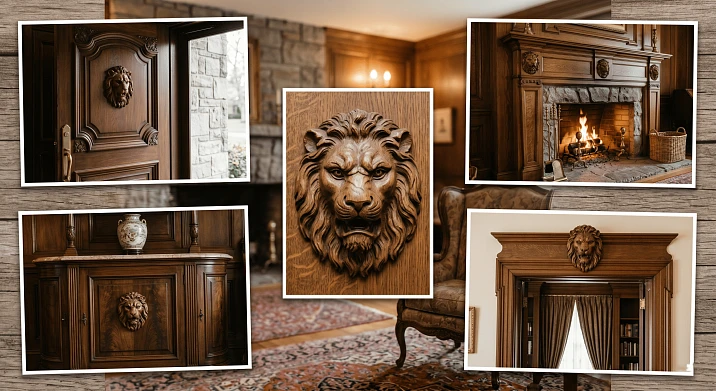

Lion power point in the interior: buy a lion mascaron for furniture, portal, door, and fireplace area
There are details in the interior that are silent — and yet speak louder than everything else. They don't shout, they don't impose, but when you look at them, it becomes clear: everything here is thought out. There is character here. There is will here.
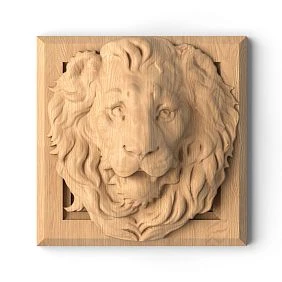
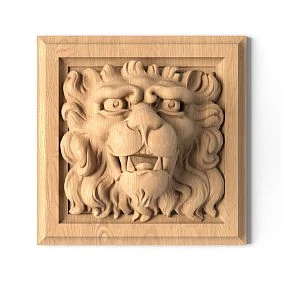
A carved lion mascaron is exactly such a detail. Small in size, but heavy in meaning. A relief head with a piercing gaze, clearly carved from wood, is not just a decoration for a furniture facade or a portal arch. It is a point of power. A geometric and semantic center around which the entire decorative program is built.
If you are looking for where to buy a lion mascaron and how to choose it correctly — this article is written especially for you. Not theory, not an excursion into architectural history, but practice: where to place it, how to select it, what to combine it with, what to avoid, and why a wooden mascaron made of solid wood is not just a beautiful overlay, but a serious investment step in the quality of the interior.
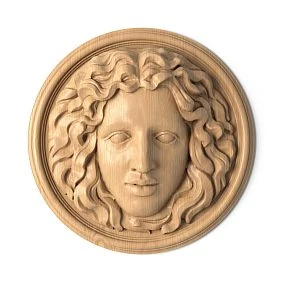
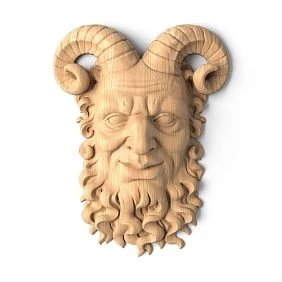
Catalog wooden decorative overlays STAVROS includes mascaron, carved central elements, and ornamental overlays for furniture, portals, doors, and fireplace areas. Let's start with the main thing.




Lion mascaron: not just an overlay, but an image with a stance
The word "mascaron" comes from an architectural tradition that spans several centuries. Facades of palaces, portals of cathedrals, fireplace areas of grand halls — everywhere that needed to mark the center, give the object character and status, a mascaron was placed. The lion's head is the most enduring of all images.
Why a lion? Because a lion is a concentration of meaning. Strength without aggression. Authority without fuss. Confidence that needs no proof. In decorative wood carving, a lion works exactly like that: it doesn't overwhelm, but holds the gaze. It doesn't shout, but the interior around it begins to sound different.
Buying a wooden lion mascaron means buying not just an interior detail, but its character.
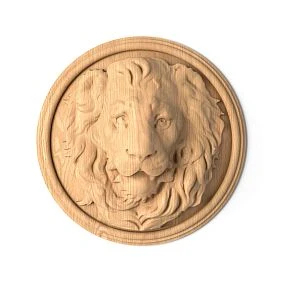
Carved Mask M-010 STAVROS — the main model with an expressive lion image. Detailed relief, intricate mane carving, clear gaze. Made from solid beech or oak, suitable for any finish. This is the starting point for those choosing a lion mascaron for a central accent.
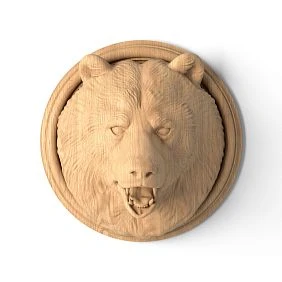
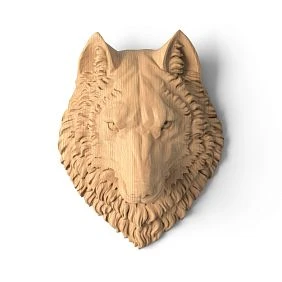
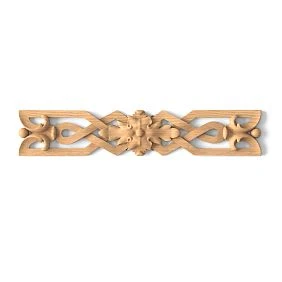
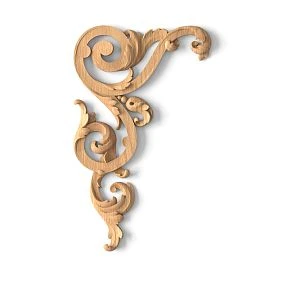
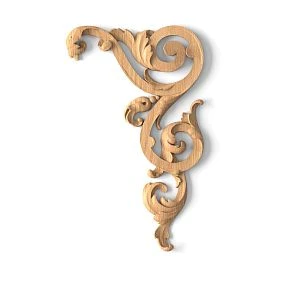
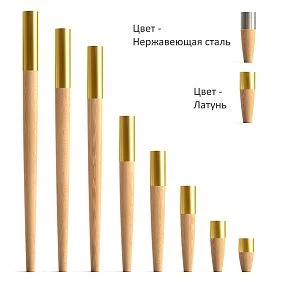
Our factory also produces:
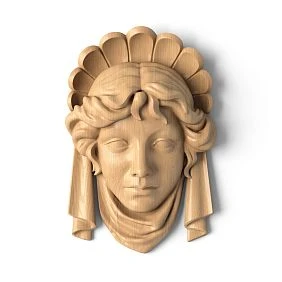
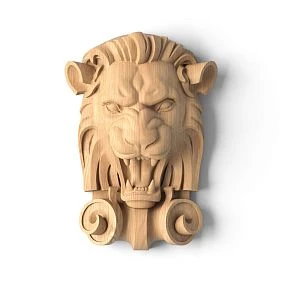
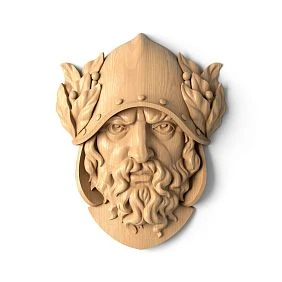
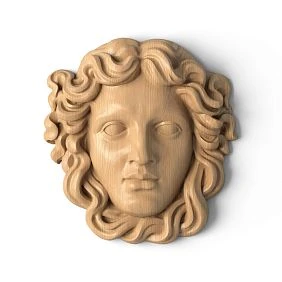
Where the lion mascaron works: application scenarios
Before buying a mascaron, you need to understand where exactly it will go and what it will do. This determines both the size, the shape of the relief, and the choice of wood species.
Get Consultation
Furniture facade: the center that holds the gaze
The most common scenario is a carved accent on the door of a chest of drawers, sideboard, cabinet, secretary, or nightstand. In classic furniture, the central motif on the facade is a style-defining element. It can be small and restrained or large and theatrical — depending on the scale of the piece and the ambitions of the interior.
For a furniture facade, the width of a mascaron is usually 80–160 mm. Smaller — it gets lost. Larger — it overloads the facade, especially if there are moldings, handles, and other applied elements nearby.
Buy carved wooden decor for furniture in the STAVROS catalog in a wide range of shapes and sizes — from compact accents to large central elements. For a chest of drawers with a door width of 400–600 mm, the optimal mascaron size is 100–140 mm.
Portal: an architectural accent of the highest order
A decorative portal above a door, in a fireplace area, or in a niche is where the lion mascaron works at full strength. There are no scale restrictions here: the portal can accommodate a large, expressive relief — 180–240 mm and above.
In a portal, the mascaron is usually placed along the central axis — in the arch keystone, in the upper part of the frieze, in the center of a horizontal element. Symmetry is the rule. A mascaron without it looks random.
Door: an entrance with character
A door in a classic interior is not just a passage. It is a boundary between spaces that must be designed with dignity. A lion mascaron above the door or in the center of the upper part of the door leaf is a tradition that never goes out of style. It works.
For a door 2.1–2.4 m high, a mascaron measuring 120–180 mm is installed in the center of the upper third of the leaf or at the point where the vertical axis intersects with the horizontal line of the upper overlay.
Fireplace area: the main accent of the entire wall
A fireplace is the natural center of a living room or study. Its decorative portal is the most noticeable place in the room. A lion mascaron installed in the center of the fireplace frieze or above the shelf transforms the fireplace area from a set of beautiful details into a single architectural composition.
Here you can use the largest and most expressive models. The high ceiling, heavy moldings, columns, brackets — all of this creates a context in which a large mascaron sounds organic.
Study, library, club hall
A lion mascaron in the study is not decoration for decoration's sake. It is a statement about the owner's character. Wall panel, bookshelf, desk with carved decor, door with a central accent — in these spaces, the lion on the facade or portal is perceived as a natural part of the interior.
Restaurant, hotel, meeting room, hall
For commercial interiors, a wooden mascaron is a way to create the atmosphere of a prestigious establishment without artificial solutions. A carved wooden furniture overlay in a restaurant reads as a mark of quality. A mascaron above the entrance to a meeting room — as a symbol of serious intentions.
Carved mask M-017 — a model with an expressive silhouette for furniture facades, doorways, and portal areas. Proportional, with a detailed relief, it reads well from a distance — exactly what is needed for public and commercial spaces.
For large central compositions on wall panels or sideboards — Wooden Decor N-045: a large-scale carved overlay that creates visual weight in the center of a large facade.
Mascaron for furniture facade: proportion is everything
The most common mistake when choosing a mascaron for furniture is incorrect proportion. The decor is chosen based on the "I like it" principle — and as a result, it either gets lost on a large facade or overloads a small door.
How to calculate the size for a furniture facade
Practical rule: the width of the mascaron should be 20–30% of the facade width. For a door 400 mm wide — mascaron 80–120 mm. For a facade 600 mm wide — 120–180 mm.
The height of the mascaron is typically 80–90% of its width (for most models, the proportion is close to a square or slightly vertical).
Central axis — strictly in the middle of the facade horizontally. Vertically — more often in the upper third (for doors with a handle at the bottom) or in the geometric center (for blind decorative panels).
Adjacent elements: moldings, handles, overlays
A mascaron on a furniture facade does not work alone. There should be a system around it:
-
A molding or baguette around the perimeter of the door creates a "frame" and highlights the mascaron as the center.
-
The handle at the bottom of the facade visually "grounds" the vertical line set by the mascaron at the top.
-
Corner overlays on the four corners of the facade support the decorative rhythm.
For ornamental motifs on a furniture facade — Wooden Decor N-006 STAVROS: an elegant overlay for creating a frame or ornamental system around a central mascaron.
Buying carved wooden overlays and a mascaron in one order means immediately receiving compatible elements from the same collection, with the same relief depth and wood species.
Mascaron above the door: how an ordinary opening becomes a portal
A door without decoration is a functional object. A door with decorative framing is an architectural element. A lion mascaron above the doorway is the transition from the first to the second.
Placement logic
The mascaron above the door is installed in one of three places:
-
In the center of the frieze — the horizontal strip above the door leaf. This is a classic scenario for doors with a horizontal casing or pediment.
-
In the keystone of the arch — if the doorway is arched. The mascaron at this point holds the entire arch and creates the feeling that it is the one "carrying" the ceiling.
-
In the upper part of the door leaf — on the door itself, in the center of the upper third. It works as a decorative accent when opening the door and as a status element when looking down the hallway.
Framing system
The mascaron above the door needs support. By itself, it is one element. Built into the system, it is part of an architectural statement.
Wooden Picture Frame STAVROS creates linear frames: architraves, horizontal bands, frame systems. Vertical architraves with a baguette profile on both sides of the opening + a horizontal frieze with a mascaron in the center = a complete door portal.
wooden capitals They are installed at the top points of the vertical pilasters on the sides of the opening. A capital + vertical + horizontal frieze with a mascaron is a three-part architectural scheme that has worked flawlessly for centuries.
Height above the floor and proportion
A door 2.1 m high — the mascaron at a height of 2.15–2.2 m from the floor (above the top edge of the door). A door 2.4 m high — the mascaron at 2.45–2.5 m. It is important that the mascaron is visible in full face when viewed from a distance of 2.5–3 m. This is the standard perception distance in a corridor or hall.
Mascaron for the fireplace area: one accent holds the entire wall
The fireplace wall is the most difficult place in the interior in terms of decor. Many elements, many levels, competition between horizontals and verticals. And at the same time — the need for a single center.
The lion mascaron in the fireplace portal solves exactly this problem: it becomes the point from which the entire decorative order of the wall is read.
Where to place the mascaron in the fireplace area
Above the fireplace mantel — in the center of the horizontal frieze. The gaze of a person entering the room naturally rises from the fireplace opening to the mantel and then to the frieze. The mascaron at this height is visible immediately.
In the center of the fireplace portal — if the portal has a decorative arch keystone or a central horizontal element.
On the wall panel above the fireplace — if there is no mirror or painting above the fireplace, and the wall is finished with wooden panels. The mascaron in the center of the panel becomes the dominant feature of the entire composition.
Connection with adjacent elements
Wooden Brackets STAVROS are installed symmetrically on both sides of the fireplace frieze. Two brackets + a central mascaron = a horizontal triad that supports the entire upper part of the portal.
Carved wooden decoration STAVROS is a system of elements that can be combined: baguette, overlays, brackets, rosettes, capitals. The mascaron here is the central element around which everything else is built.
Sizes and scale: how to choose a mascaron without missing the mark
The question of size is not a question of taste. It is a question of geometry. A mascaron chosen without considering scale either gets lost or overwhelms.
Small mascarons: up to 100 mm
For narrow furniture parts, small cabinet doors, decorative inserts in wall panels, drawer details. A delicate accent that does not claim dominance but adds completeness to the piece.
Carved Mask M-015 STAVROS — a compact model for small formats. Neat relief, readable from close range, does not overload a small facade.
Medium mascaroons: 100–180 mm
The most working range. Suitable for most furniture facades, medium-width door portals, fireplace zones in standard living spaces.
Carved Mask M-012 — an expressive medium-scale model. Artistic image with deep relief. Suitable for a chest of drawers, sideboard, door frieze, library cabinet.
Large mascaroons: from 180 mm and above
For formal areas, high studies, restaurant interiors, fireplace walls with ceilings from 3 meters. Here you need scale, relief strength, and silhouette expressiveness visible from a distance of 4–6 meters.
Carved Mascaron M-014 — a model for classic style with good detailing. Installed as a central accent in a portal, above a door, in a large decorative panel.
Selection table by scenario
| Application scenario | Recommended size | Model |
|---|---|---|
| Small cabinet, drawer | up to 100 mm | M-015 |
| Chest of drawers, secretary | 100–140 mm | M-012 |
| Buffet, large cabinet | 140–180 mm | M-017 |
| Door portal | 120–180 mm | M-010, M-017 |
| Fireplace portal | 160–240 mm | M-010, M-014 |
| Grand hall, restaurant | from 200 mm | M-014, M-010 |
Mascaron material: why wood and why the specific type matters
A wooden mascaron is not the only material on the market. There are polyurethane, plaster, and ceramic options. Each has its own purpose. But a solid wood mascaron holds a special position — and here's why.
Oak: depth of relief and texture
Oak is a species with large, open pores and an expressive pattern. Under a transparent coating — oil or varnish — the relief of the mascaron "lives": light falls differently depending on the angle, and the image gains sculptural depth.
A lion mascaron made of oak is for interiors where wood is the main decorative material: oak floors, oak parquet, oak doors, oak furniture fronts. A single species creates a unified tone.
Oak accepts stain and tinting well — you can achieve a shade from light honey to dark espresso while preserving the natural wood grain.
Beech: neatness and surface uniformity
Beech has closed pores and an even, almost smooth structure. Under enamel — white, cream, gray, anthracite — beech provides an even, neat coating without unexpected texture "breakthroughs."
Buying a carved wooden overlay from beech is the right choice for neoclassical interiors with white furniture fronts, Provencal interiors, kitchens with painted fronts, and doors under white enamel.
A carved wooden mascaron (beech) for painting is a product that visually does not differ from stucco decor but is significantly stronger, heavier, and more durable than polyurethane.
Solid wood vs. polyurethane: what's the difference
| Parameter | Wood (solid wood) | Polyurethane |
|---|---|---|
| Strength | High | Medium |
| Weight | Larger | Lightweight |
| Relief detail | High | High |
| For painting | Excellent (beech) | Excellent |
| Under varnish/oil | Excellent (oak) | Not applicable |
| Repair and restoration | Joinery | Specialized |
| Service life | Decades | Depends on conditions |
Conclusion: a wooden mascaron made of solid wood — for interiors built on natural materials and designed for a long life.
What to pair a lion mascaron with: a decor system
A mascaron is not a standalone detail. It is the central element of a decorative system. Placing it without context means losing half of its decorative power.
Mascaron + baguette: frame and center
Classic combination: Wooden Picture Frame forms linear frames — architraves, frames, horizontal strips. The mascaron takes the center of this geometry. The baguette line gives direction — the mascaron gives the focal point.
For a furniture facade: baguette around the door perimeter + mascaron in the center = classic paneled facade.
For a portal: baguette on pilasters + horizontal frieze + mascaron on the central axis = a complete door or fireplace portal.
Mascaron + capitals: architectural vertical
wooden capitals complete vertical elements — pilasters, columns, posts. Capitals on both sides of the opening + horizontal frieze + mascaron in the center = a three-part architectural scheme with full vertical and horizontal logic.
Maskaron + brackets
Wooden Brackets In decorative applications, they are installed as side accents in fireplace areas, under shelves, in cornice systems. Symmetrical brackets on both sides + a maskaron in the center — a horizontal triad that sets the rhythm for the entire area.
Maskaron + carved overlays
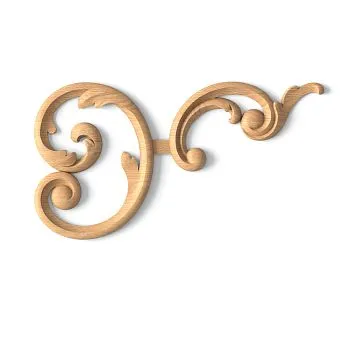
Decorative wooden inlays In the form of ornaments, leaves, flower garlands, cartouches complement the maskaron without competing with it. An important principle: the maskaron must remain the dominant element. Overlays are support, not competition.
Maskaron + wall panel
A wooden wall panel creates a background for the maskaron. The relief central accent against the background of smooth panels reads as clearly as possible. The contrast of texture is a working tool of a classic interior.
Mistakes when buying a lion maskaron
Buyers make the same mistakes. Let's record them — so you can avoid them.
Mistake 1. Buying without reference to size. A "beautiful maskaron" on the internet has no scale. Always request exact dimensions: width, height, relief depth.
Mistake 2. Choosing too small decor for a large object. A maskaron of 80 mm on a buffet facade 900 mm wide will be lost. Rule: 20–30% of the facade width.
Error 3. Placing a mascaron without a central axis. Without strict symmetry, the mascaron looks random. Measure the center precisely.
Error 4. Mixing carving styles. A Baroque mascaron with a lush mane next to laconic geometric Art Deco overlays is a conflict that no color can resolve.
Error 5. Not considering the finish. An oak mascaron under white enamel means losing the oak texture. A beech mascaron under oil means potential issues with coating uniformity. The wood species and finish must match.
Error 6. Buying one mascaron for a paired composition. If you have two symmetrical cabinets, you need two mascarons. One on a symmetrical object creates visual imbalance.
Error 7. Using a mascaron where there is no center. A mascaron is installed only where there is a clear vertical and horizontal axis. On a chaotically decorated surface, it will look lost.
Error 8. Not checking the fastening. A wooden mascaron is attached with glue (carpentry PVA, construction adhesive) and, if necessary, with a hidden screw. Make sure the surface is suitable for attachment.
What to buy together with the lion mascaron
The mascaron is the center. But the center only works within a system. Here is what you should consider when placing a comprehensive order.
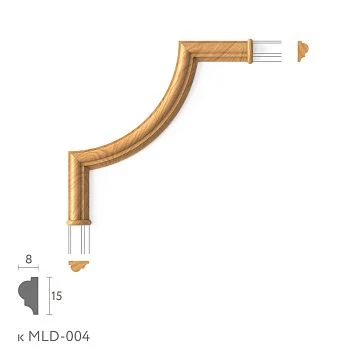
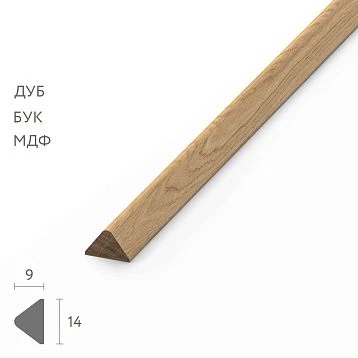
Wooden baguette — for linear framing: architraves, frames, friezes. Selected in the same wood species and with a compatible degree of ornamentation.
Decorative overlays — corner, symmetrical, ornamental. For creating a frame system around the mascaron or for accenting adjacent elements.
Capitals — if the mascaron is part of a portal scheme with vertical pilasters.
Brackets — for horizontal triads in fireplace areas and under shelves.
Assembly glue and finish coating — wood is attached with glue, treated before installation (varnish, oil, enamel).
Furniture moldings — to create a frame contour around the facade on which the mascaron is installed.
All of this is available in the catalog wooden carved decoration STAVROS — in a unified style, from compatible materials.
Where to buy a lion mascaron made of wood
When the task is defined — all that remains is to choose a specific model, verify the size, and place an order. Buying a lion mascaron in the STAVROS catalog means getting a carved product from solid oak or beech, with a detailed relief, in the required size and with any finish coating.
Main models for selection:
-
Carved Mask M-010 — the main model with an expressive lion image, for a portal, door, furniture facade.
-
Carved mask M-017 — for furniture and door areas, balanced relief.
-
Carved Mask M-015 — compact, for small formats.
-
Carved Mask M-012 — medium scale, artistic image.
-
Carved Mascaron M-014 — for classic style, formal areas.
All models are in the section wooden decorative overlays STAVROS.
About STAVROS
A carved wooden lion mascaron is a product that requires skill from the manufacturer. Not just template milling, but work with relief, proportion, and detailing of the facial image.
STAVROS has been producing carved wooden decor from solid beech and oak since 2002. The assortment includes mascarons, decorative overlays, capitals, brackets, rosettes, baguettes, moldings, finials, stair components, and furniture frames. Over 400 models of overlays and over 50 models of mascarons.
All products are made from kiln-dried solid wood (8–12% moisture), with clear carved relief, suitable for any finish. Among STAVROS's projects are the Hermitage, Konstantinovsky Palace, and Alexander Palace. Rating 5.0, over 260 verified reviews. Showrooms in St. Petersburg and Moscow. Contact us to confirm shipping to your destination. via CDEK and DPD.
FAQ: Answers to popular questions
What is a lion mascaron?
This is a relief carved decorative overlay in the shape of a lion's head. It is used as a central accent on furniture facades, in portals, above doors, in fireplace areas, and in decorative panels. Made from solid beech or oak.
Where can a carved lion mascaron be used?
On a furniture facade (chest of drawers, sideboard, secretary, cabinet), above a door opening, in a fireplace portal, in a study, library, restaurant, hotel, hall, meeting area, or on a wall panel.
How is a mascaron different from a regular wooden overlay?
A regular overlay carries an ornamental or plant form. A mascaron carries an image — a face, animal head, mythological motif. It attracts the eye more strongly and serves as the semantic center of the composition.
What size mascaron should I choose for furniture?
For a small cabinet — up to 100 mm. For a chest of drawers — 100–140 mm. For a sideboard or large wardrobe — 140–180 mm. General rule: the width of the mascaron should be 20–30% of the furniture facade width.
Can a lion mascaron be used in a modern interior?
Yes — if you make it the only strong accent and support it with restrained materials: a plain wall, strict molding, laconic overlays. A carved lion as a mono-decor in a modern interior is perceived as an author's accent, not a museum exhibit.
What should I buy together with a mascaron?
Wooden molding for linear framing, decorative overlays for corner and ornamental accents, capitals for portal verticals, brackets for fireplace areas, mounting glue, and a finish coating for the desired style.
Where can I buy a wooden lion mascaron?
In the section wooden decorative overlays STAVROS catalog — with selection of models, sizes, wood species, and finishing options.