









































Article Contents:
- Where to order wooden moldings for mirror zones in Bryansk
- Which STAVROS wooden moldings are suitable for this kind of finishing
- MLD-002 22×11 mm: the main profile for three contours
- MLD-004 15×8 mm: a lighter line with a different budget
- Other sizes: when MLD-001, MLD-003 and MLD-028 are justified
- Oak or beech: what changes when finishing the wall contour
- Decorative framing is not a mirror fastening
- Three mirror zones: actual dimensions for a purchasing list
- How to determine the visible gap between the mirror and the wood
- From drawing to twelve parts: finished length 10.9 m
- Twelve angles: why mitre cuts are not a formality
- Option A: five 2400 mm strips — a simple order composition
- Option B: four long strips and two one-metre strips
- Why saving 400 mm of material barely affects the price
- Comparison of two models with identical external dimensions
- How much the MLD-002 set costs in beech and oak
- If you need a spare strip
- What to do if the mirror is already slightly skewed
- What to include in a quote request
- Can a mirror that is already mounted on the wall be framed with moulding?
- Why are twelve pieces needed for three mirrors instead of six?
- Why buy 12 metres when the net consumption is 10.9 metres?
- Is it realistic to use four long and two short strips?
- Which is more cost-effective — MLD-002 or MLD-004?
- Why doesn't the mixed scheme reduce the price of MLD-002?
- Can I choose oak for a large mirror and beech for a small one?
- Are special corner overlays needed?
- Can the MLD-028 option be used instead of MLD-002 in the same estimate?
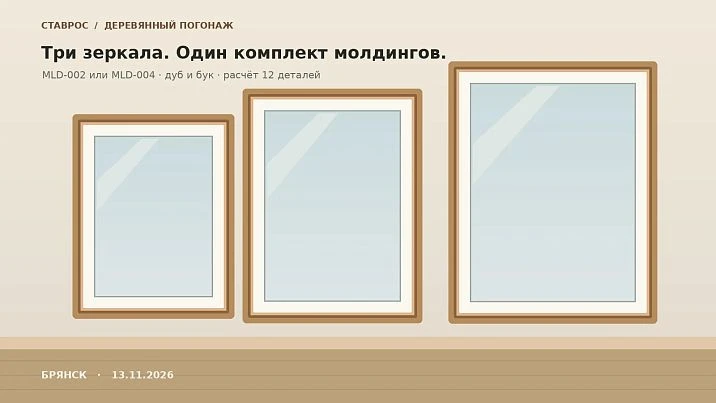
Three mirrors are already hanging on the walls, but above the console, in the hallway and near the dressing table the compositions look unfinished. Buying three ready-made frames is not necessary: a separate decorative outline made of wooden moulding can be created around each panel. However, before choosing oak or beech, it is useful to calculate not the overall "perimeter of the mirrors" but twelve separate parts and understand how they will fit into the product strips. For the three selected mirror zones you will need 10.9 metres of finished moulding length. At the same time, buying five 2400 mm strips and buying four long ones together with two one-metre ones give almost the same budget, although the amount of waste differs.
For those planning buy wooden mouldings in Bryansk, you should start by positioning the mirrors on the finished wall. The STAVROS catalog offers wooden profiles in oak and beech with various reliefs, including MLD-002 22×11 mm and the more compact MLD-004 15×8 mm. In this project, they are not needed to hold the glass: the mirror must be mounted independently, and the molding is positioned around it with a gap. This condition cannot be changed for the sake of calculation convenience or a nice photograph.
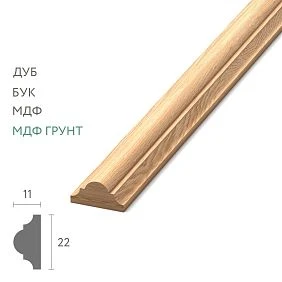
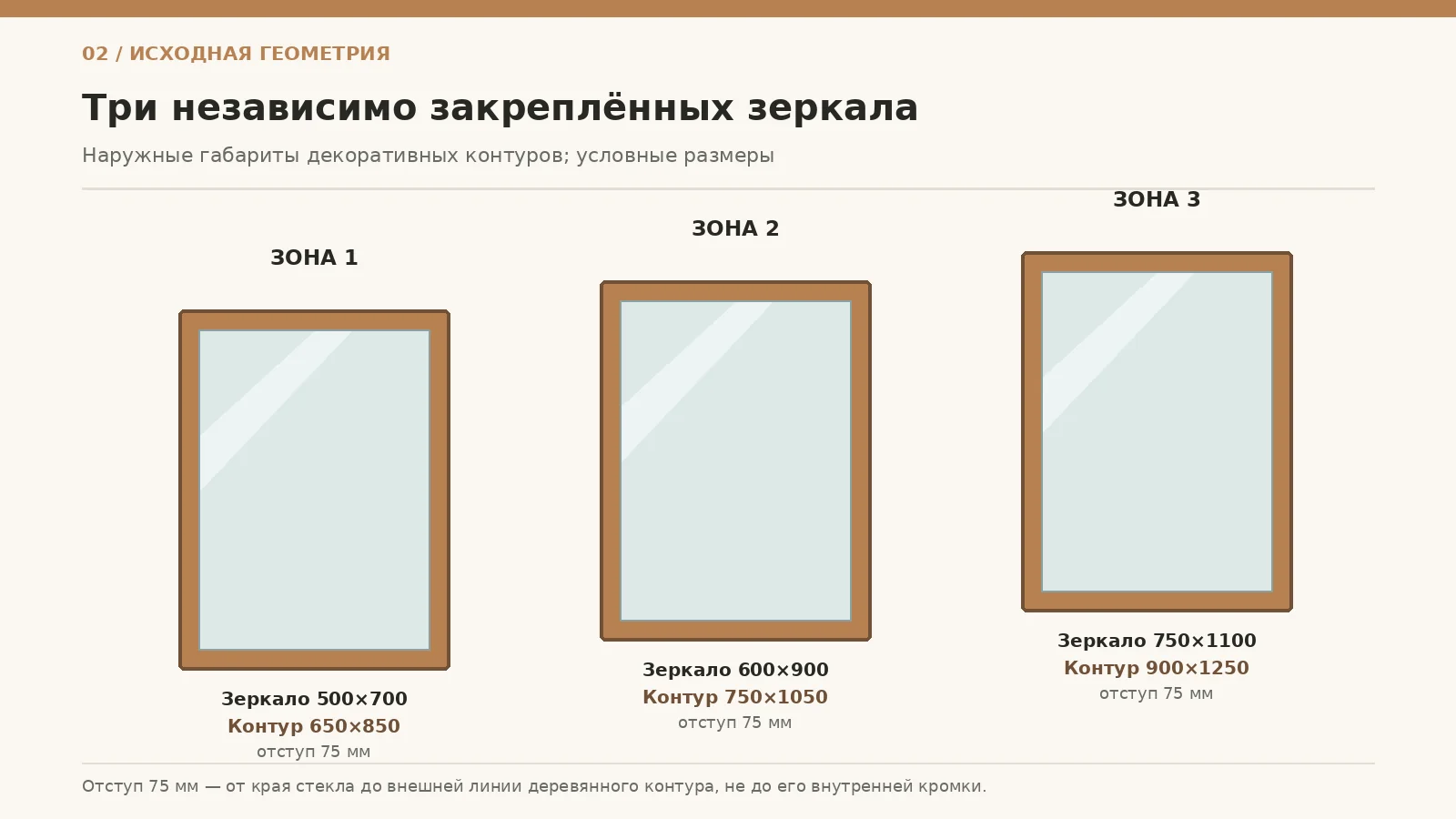
As an example, let's take mirrors of 500×700, 600×900, and 750×1100 mm. The outer dimensions of the wooden frames are 650×850, 750×1050, and 900×1250 mm, respectively. These dimensions allow for a uniform nominal offset of 75 mm from the edge of each mirror to the outer boundary of the decorative frame. How much space there will be between the mirror and the inner edge of the wood depends on the actual face width of the selected profile. The first check arises here: a 22×11 mm cross-section should not automatically be understood as a visible strip strictly 22 mm wide without consulting the drawing.
Where to order wooden moldings for mirror areas in Bryansk
A specific order requires five pieces of information: the profile article number, the wood species, the lengths of the original products, the cutting plan, and the finishing decision. Without this data, even an accurate total of linear meters is of little help. If you buy the entire length in short strips, it is harder to obtain vertical pieces of 1050 and 1250 mm without unnecessary joints. If you buy only long products, the costs and offcuts may turn out different from those of a mixed set.
A wooden molding is a linear profile of a specified cross-section. The comparison involves specifically solid oak and beech products, not their MDF versions. A single product card sometimes includes both materials, while the available lengths and price differ. Therefore, when placing a request, you must select the line with the required wood species and length, rather than relying on the first price offer shown on the page.
In this case, Bryansk is the destination address of the order. Publicly available information does not indicate that STAVROS has a local warehouse, a separate showroom, or a fixed shipping cost specifically for Bryansk. The buyer selects products in the online catalog and arranges delivery with the seller. For long wooden strips, it is especially useful to clarify the packaging, shipping conditions, and the procedure for inspecting the cargo, since damage to even one end can ruin the cutting plan if a piece is sized almost exactly.
Don't rush to add to the cart the entire range that looks suitable in the photo. For three frames, one article number and one wood species are preferable: the relief on all mirror areas will be identical, and it will be easier to distribute offcuts between the strips. The frames may differ in size but should maintain the same line thickness. If the designer needs different profiles for different rooms, they should be treated as separate orders, without hoping to use arbitrary leftovers from one model for another.




Which STAVROS wooden moldings are suitable for this kind of finishing
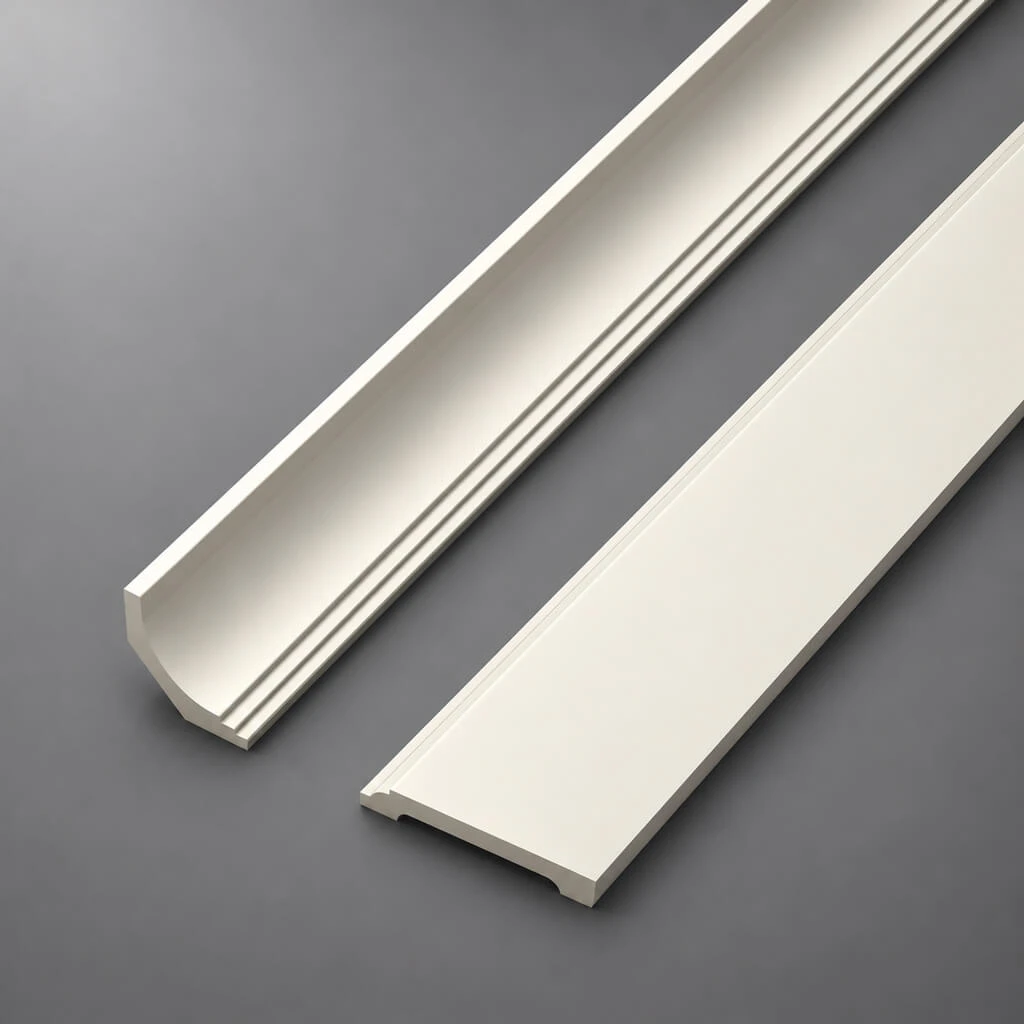
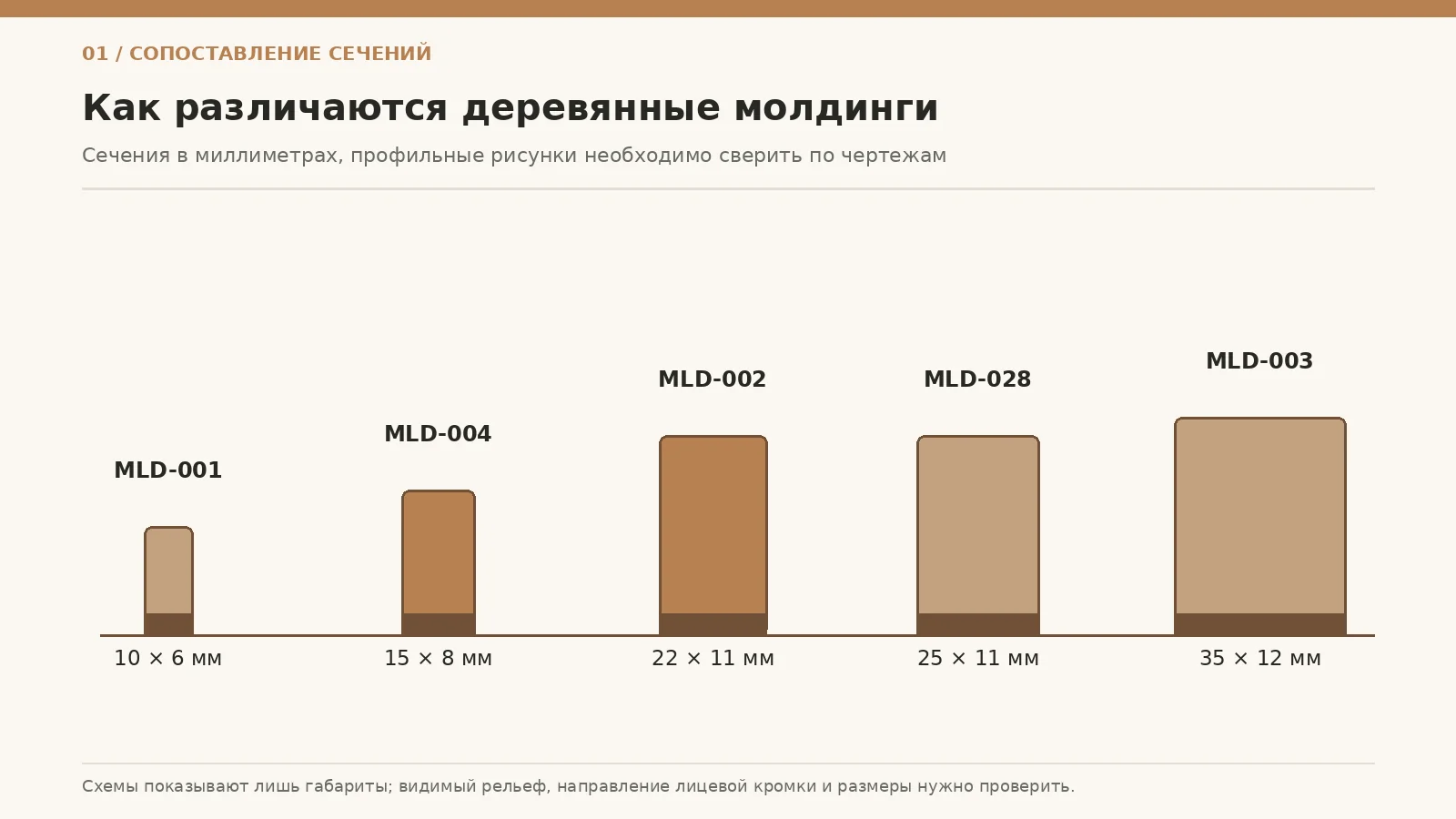
MLD models differ not only in the height or width of the section, but also in the character of the transition between its projections. A thin strip gives a light line around the mirror. A wider one makes the contour a noticeable architectural element of the wall. Choosing by price per meter alone is not enough: the profile width will change the visible distance to the glass, while the depth of the relief changes the shadow and the perception of adjacent furniture.
| Model | Wooden section size | Solid wood length | Practical purpose in comparison |
|---|---|---|---|
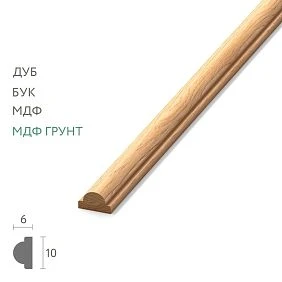
| MLD-001 | 10×6 mm | 1000 and 2400 mm | The thinnest of the profiles under consideration |
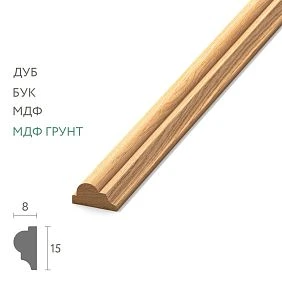
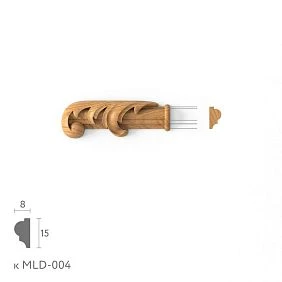
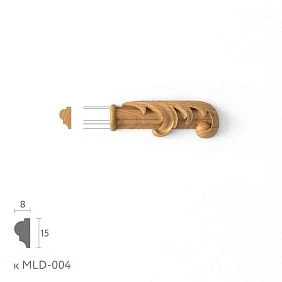
| MLD-004 | 15×8 mm | 1000 and 2400 mm | A compact alternative to the main profile |
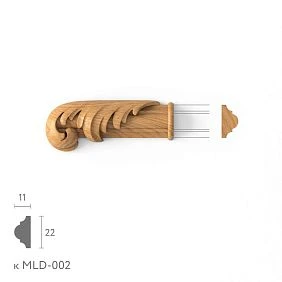
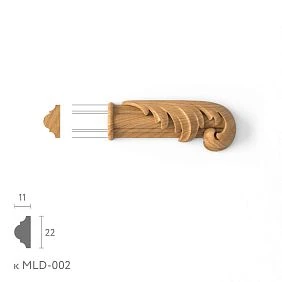
| MLD-002 | 22×11 mm | 1000 and 2400 mm | The main profile for calculating mirror zones |
| MLD-028 | 25×11 mm | 2400 мм | A different scale of relief without a one-meter version |
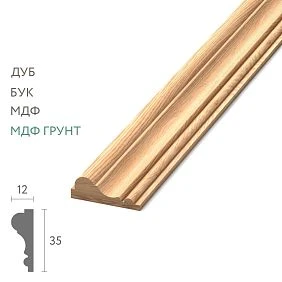
| MLD-003 | 35×12 mm | 1000 and 2400 mm | A wide, noticeable line for a large mirror |
The dimensions refer to the wooden options verified in the STAVROS product cards on November 13, 2026. For the estimate, MLD-002 and MLD-004 remain the main ones. The other models are given as real alternatives, not as interchangeable parts of the same set. You cannot get a beautiful corner if one side is made with a 22×11 profile and the adjacent one with 15×8, and you simply join them at 45° without a specially designed transition.
If the mirror is small, a thin contour may be sufficient. But on a large mirror 750 mm wide, a very narrow strip sometimes gets lost against the background of skirting boards, door casings, or large pieces of furniture. The opposite situation also occurs: a wide relief around a small mirror visually draws almost as much attention as the reflective surface itself. It is useful to place the sample not against a blank wall, but next to the mirror and look from the distance typical for that spot — from the doorway, from the console, or at the dressing table.
Our factory also produces:
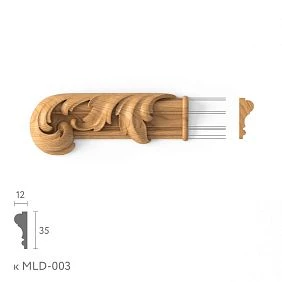
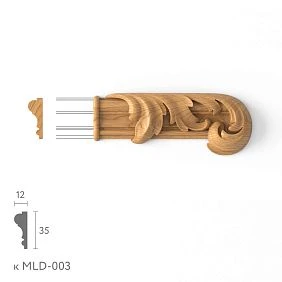
MLD-002 22×11 mm: the main profile for three contours
In the bill of materials under consideration, MLD-002 in oak or beech has been chosen as the main option. Its wooden versions, 1000 and 2400 mm long, allow two real procurement schemes to be compared without changing the item code. The tallest frame requires parts 1250 mm long, so it is impossible to switch entirely to one-metre strips: although the total requirement is 10.9 m, the long sides must remain continuous.
When required buy wooden molding MLD-002, pay especially close attention to the shape of the profile and the direction of its face. The mitre saw must hold the workpiece in a stable orientation on all four sides of the rectangle. If the piece is turned over when moving from vertical to horizontal, the relief will face different directions, and the corner will come out wrong even with a geometrically accurate cut.
For an outer size of 650×850 mm, the cut pieces must form a single closed rectangle. The 45° angle defines the joint between adjacent parts, but the length is measured along the accepted measuring edge. In this example, that is the outer dimension of the rectangle. Trying to order parts of 650 and 850 mm and then measuring them along the inner edge after cutting will produce a different actual geometry. Therefore, the specification must always state which corner vertices the dimension is based on and which side of the profile is considered the face.
MLD-002 is suitable where you want to articulate a line around a mirror without turning it into a massive standalone frame. It is not a "load-bearing frame" and not a means of attaching the mirror glass. The decorative strip must be fixed to the wall independently of the mirror fixings, and its own width and relief must not interfere with mirror maintenance or access to its edges if removal is ever needed.

Get Consultation
MLD-004 15×8 mm: a lighter line with a different budget
The cross-section of MLD-004 is smaller than that of MLD-002. On a wall, this difference is most noticeable in the shadow: the compact profile breaks up the plane less and leaves more visual space around the mirror. If the room's finish is restrained and a slim console or light furniture is nearby, this option may look more appropriate. At the same time, in a large room with tall door casings, a thin contour sometimes needs more careful colour support, otherwise it looks like a random stripe.
to buy wooden molding MLD-004 is available in oak and beech versions with the lengths we need, 1000 and 2400 mm. For calculation this is convenient: both procurement schemes drawn up for MLD-002 based on the same outer dimensions can be preliminarily compared using MLD-004 while keeping the same part lengths. But only on condition that the geometry of the outer contour really remains the same and the measurements are taken along the same accepted line. The width of the profile itself will change the inner opening of the contour and the visible gap to the glass.
A compact moulding should not be chosen merely because its set is cheaper. If the project requires a prominent architectural surround, saving money may lead to a result that is too weak. Conversely, paying extra for a wide cross-section is pointless if only a narrow field is free on the wall between the mirror, the sconce and the reveal. For such a wall, every millimetre matters in practice — first you need to determine the width of the available zone, and only then compare prices.
For a project with three mirrored zones, MLD-004 has another advantage: a reduced face width with the same outer contour will create a larger free gap between the glass and the inner edge of the wood. This can make cleaning easier and reduce the visual tightness of the composition. However, the exact gap value should be determined from the profile drawing and its installation orientation; it should not be recorded as a simple difference of "75 minus 15" without specifying the measurement axis.

Other sizes: when MLD-001, MLD-003 and MLD-028 are justified
The MLD-001 model with a 10×6 mm section is an option for very delicate edging. It may be justified if the mirror is small and there is already an active pattern of wallpaper or wall panels around it. Such a strip has less relief, which means that under sliding light the shadow is less pronounced. When choosing, it is important to assess whether the narrow line is sufficiently distinct from an accidental installation strip and whether it will get lost on a textured wall. For comparison buy solid wood moulding MLD-001 can be considered separately, but in our final estimate it does not replace MLD-002.
MLD-003 with a 35×12 mm section is noticeably wider. If there is a large chest of drawers or a wall architectural panel next to the mirror, such a contour can support the overall scale. However, fitting it is especially important with a small 500×700 mm mirror: too wide a relief will reduce the remaining free field between the contour and the reflective surface. Before deciding buy wooden molding MLD-003 a full-scale corner sample should be made and you should make sure that the chosen section really works in the specific room.
MLD-028 has a wooden section of 25×11 mm, and the product card confirms a product length of 2400 mm. For the purchase under consideration, this limitation is significant: the combined scheme with one-metre products is not used for MLD-028. A separate cutting plan using only long strips will be required. Therefore buy wooden moulding MLD-028 it is justified not by an abstract "middle" between widths, but if its actual relief suits the mirror better than others, and the need to work with 2400 mm planks does not create problems.
An intermediate choice sometimes turns out worse than the extreme options. For example, if MLD-002 is suitable in depth but there is too little free wall area, you should first check the geometry of the mirror's placement, and only then look for a difference of a few millimeters between neighboring SKUs. The decorative profile must not block access to electrical points, come right up against a sconce, or fall within the swing path of a furniture door.
Oak or beech: what changes when finishing the wall contour
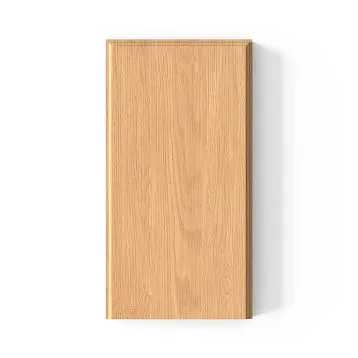
Both species are suitable for interiors, but they create a different impression with a clear finish. Oak usually has a more expressive grain: it is noticeable on long vertical elements, where light runs along the fibers and emphasizes natural irregularity. Beech grain is visually calmer, and with opaque paint this is often convenient, especially when the entire wall composition should receive a single color. At the same time, neither the species nor the primer by itself guarantees that two products will look absolutely identical: wood naturally varies in color and grain.
For three mirror zones, it is better to choose the shade as a single solution. If one frame is near a window, another is in a shaded hallway, and a third is above a console with a table lamp, the same tint will look different due to lighting. That is normal. What is undesirable is something else: when one contour is painted in a warmish white and the next in a cool white against the same wall. Before purchasing, it is useful to make two color samples on small pieces of the chosen wood and look at them in the morning and in the evening.
A product may have a finish option for enamel or for tinting. This is preparation for a specific finishing scheme, not always a fully completed paint cycle. Check what exactly is included in the selected product, whether the ends need additional priming, and how the cut areas will be treated. At the corners of the molding, end-grain sections of wood are exposed; they absorb the composition differently than the longitudinal surface. If their treatment is not provided for, the joint may stand out even with precise geometry.
It cannot be promised that any chosen composition will give the same tone on beech and oak. If the decorative contour needs to be matched with already installed wooden doors, samples of the specific coating are needed. For a light modern interior, it is sometimes more sensible to take beech under opaque enamel; for a composition where the material should be obviously wooden, consider oak under a clear finish. But the decision is determined not by the name of the species, but by how it looks in the finished interior and how it combines with the mirror, countertop, and casings.
The decorative surround is not a mirror fastening
In our project, the mirrors are already installed. Each mirror is held by its own calculated fastening, corresponding to the weight of the glass and the wall material. The molding does not go under the edge of the glass, is not used instead of a mounting profile, and does not bear the load from the mirror. This separate scheme is especially convenient if later the mirror needs to be replaced without damaging the wooden finish around it. At the same time, the distance from the glass to the molding must be sufficient for cleaning and for access to the fastening method, if such maintenance is provided for.
Confusion arises from the similar words "frame," "surround," and "baguette." A finished frame may have a rabbet for glass, a corner joint, a rigid base, and a provided hanger. A decorative wall contour made of MLD-002 or MLD-004 solves a different task: it creates a visual border on the wall around an already fixed mirror. Even if the two solutions look similar in appearance, their functions cannot be transferred from one to the other structurally. In this article, we do not calculate the weight of the glass or describe its installation — that part must be covered by the chosen mirror fastening and verification of the substrate.
The wall is checked before the wood is installed. On weak or peeling plaster, the moulding should not be fixed with paint alone, even if the profile itself looks light. If there is hidden wiring for the mirror lighting under the finish, it is important to know its route. You must not drill into the wall next to the glass without checking the utilities and the mounting plan. For joints between wooden profiles, choose compounds suited to the wood and the planned finish, and for wall mounting, choose a solution that matches the wall material and the instructions of the manufacturer of the system used.
Sometimes the customer wants to reduce the gap to the mirror so much that the moulding almost touches the glass. This option requires a separate check. The mirror may have a bevel, a protective film on the back, its own installation gap, or an uneven wall. It cannot be stated in advance that a decorative strip pressed against the glass will not create stress or interfere with removing the mirror. For the training example, we keep a noticeable gap and do not replace it with a hidden clamp.
Three mirror zones: actual dimensions for the purchasing list
When designing, it is useful to start not with the number of strips but with three ready-made rectangles. The first is, for example, above a small console: a mirror of 500×700 mm. The second is in a passage area: 600×900 mm. The third, the largest, is on an accent wall: 750×1100 mm. These are nominal dimensions of three independently mounted panels, chosen for the calculation example. They do not imply any conclusions about a specific room in Bryansk.
For all three mirrors, we set the same difference between the glass dimensions and the outer dimensions of the wooden frame: 150 mm in each dimension. With a strictly symmetrical arrangement, half of this difference, 75 mm, remains on each side of the mirror to the outer edge of the moulding. The profiles themselves occupy part of this field, so the inner opening of the frame will be closer to the mirror. However, it is the outer dimension that is easier to control by the four outer corners and then use in the parts list.
| Mirror zone | Glass size | Outer size of the wooden frame | Offset to the outer edge on one side |
|---|---|---|---|
| No. 1, compact | 500×700 mm | 650×850 mm | 75 мм |
| No. 2, medium | 600×900 mm | 750×1050 mm | 75 мм |
| No. 3, large | 750×1100 mm | 900×1250 mm | 75 мм |
Around the central mirror, the outer contour is 750 mm wide rather than 600 mm. Because of this difference, a clear area will be required on the wall. If a reveal, switch or light fixture runs nearby, its distance is checked from the outer boundary of the future wood, not only from the edge of the glass. In a photograph, the mirror surface may appear to be the main dimension, but for installing the wooden frame it is often the outer line that becomes the limiting factor.
You also need to choose the height of the centers. If the mirrors are on different walls and in different rooms, their axes do not necessarily have to be brought to the same level relative to the floor. A hallway, bedroom and living room use a mirror differently. But within each individual zone, the contour must be built from the actual position of the mirror. The simplest way to eliminate error is to measure the glass at four points, find its center by width and height, and transfer the axes to the wall without touching the reflective surface with a sharp tool.
How to determine the visible gap between the mirror and the wood
What is said about 75 mm is often misunderstood. It is not the empty space from the glass to the nearest visible edge of the finished molding. It is the distance from the edge of the mirror to the outermost boundary of the design contour farthest from it. Part of the molding itself lies within this field. The actual light gap between the glass and the wooden profile depends on the actual width of the projection of the installed product onto the wall plane, on the orientation of the section, and on which point of the profile was taken as the outer boundary.
Suppose that on the working drawing, after choosing the profile orientation, it is clear that its face band occupies a conventional 20 mm toward the mirror. Then, with an outer offset of 75 mm, about 55 mm will remain to the inner boundary of the wood. If for another installation the band occupies 14 mm, the gap will approach 61 mm. These values are given only to explain the geometric principle, and not as the nominal face widths of MLD-002 and MLD-004. Exact values are taken from the section of the specific model and a physical sample.
Why is this significant? On a large mirror, a difference of a few millimeters is barely noticeable from a distance. On a small mirror standing between two narrow wall sections, the line becomes part of a dense composition, and such a shift affects the proportions. When using moldings of different sizes in the same room but with identical outer contours, the visual gaps to the glass will turn out to be different. Therefore, the item code cannot be changed after the sketch is approved without a repeat fitting.
For control, it is useful to temporarily mark the outer contour with painter's tape. After that, place a short real sample of the required profile next to it and assess where the inner edge actually runs. The tape does not imitate the relief, but it shows the geometry. If it becomes clear that the molding comes too close to the mirror, there are two safe design paths: increase the outer size of the rectangle or choose a profile with a smaller face width. Both solutions affect the bill of materials. The first increases the lengths of the parts; the second changes the appearance and price, but may preserve the calculated outer size.
Lighting is also worth checking. A wall light to the side casts a shadow from the relief, which makes the actual width of the contour appear larger than it does by the ruler. Frontal diffused light, on the contrary, makes the profile's variations calmer. It is especially useful to look at the sample in the evening: the reflection of the light fixture in the mirror sometimes enhances the contrast on the adjacent wooden line. This is not a defect of the material but a property of the lighting. Choosing the final thickness only from a catalog image is risky.
From drawing to twelve parts: finished linear footage 10.9 m
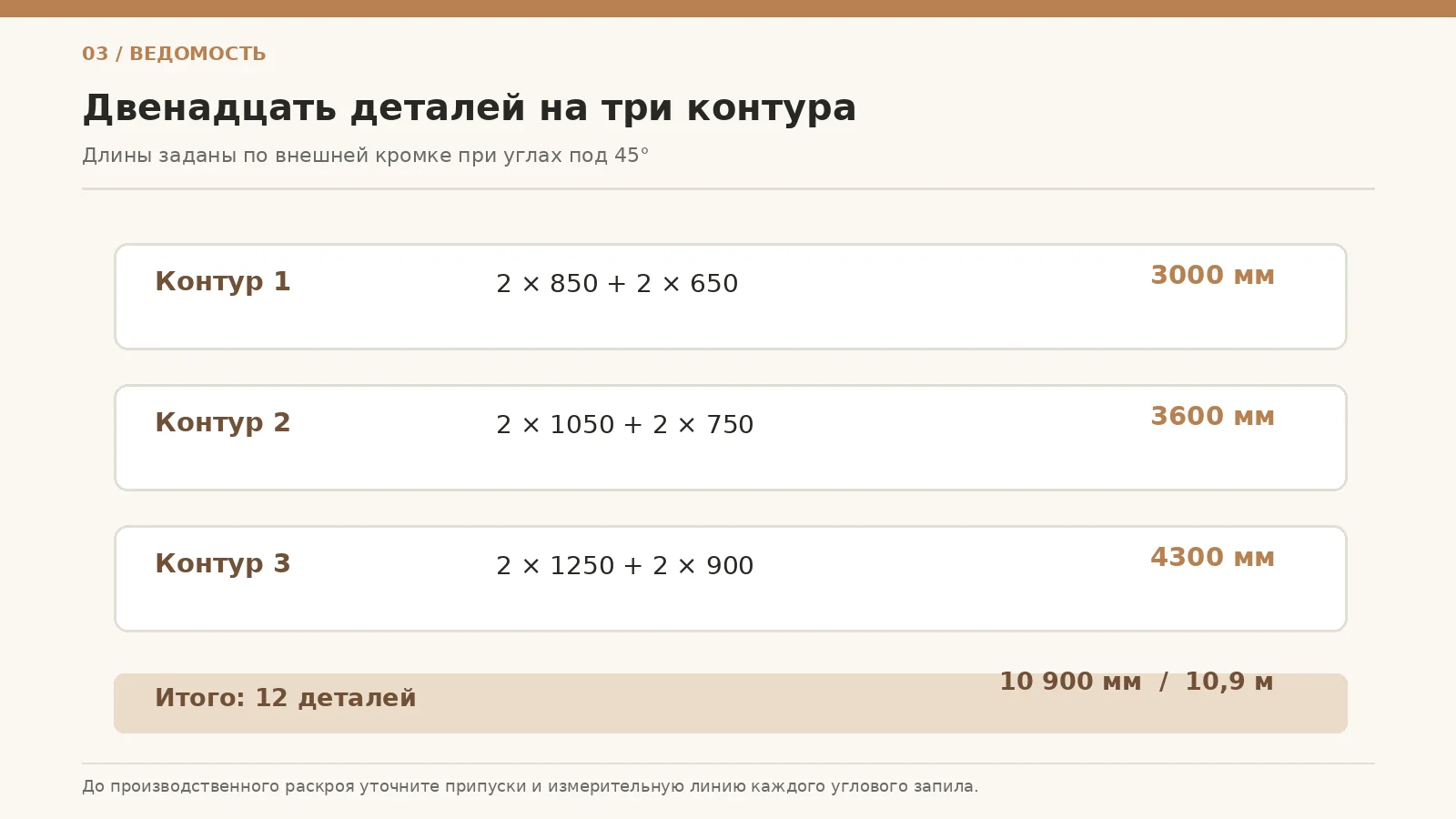
Each of the three rectangles has four sides: two vertical and two horizontal. If the corners are made with 45° joints, the dimensions of each part in our list are specified by the outer vertices of the cuts. This measurement is consistent with the outer overall dimensions of the outlines. An important detail: the length along the inner edge of the same part will be shorter; if the workshop uses a different measurement method, all dimensions must be converted before cutting.
The first outline, 650×850 mm, will require two parts of 650 mm and two of 850 mm. The finished consumption is 2×650 + 2×850 = 3000 mm. The second, 750×1050 mm, consists of two parts of 750 and two of 1050 mm, totaling 3600 mm. The third, 900×1250 mm, will yield two parts of 900 and two of 1250 mm, totaling 4300 mm. The sum of the three perimeters is 3000 + 3600 + 4300 = 10,900 mm.
| Length along the outer edge | Quantity | Where it is used | Total length |
|---|---|---|---|
| 1250 мм | 2 | Verticals of the large outline | 2500 мм |
| 1050 мм | 2 | Verticals of the medium outline | 2100 мм |
| 900 мм | 2 | Horizontals of the large outline | 1800 мм |
| 850 мм | 2 | Verticals of the small outline | 1700 мм |
| 750 мм | 2 | Horizontal lines of the medium contour | 1500 мм |
| 650 мм | 2 | Horizontal lines of the small contour | 1300 мм |
| Total | 12 | Three rectangles | 10,900 mm |
This cutting list is the main one for purchasing. It contains no random "offcuts made on site": each segment is assigned in advance to a specific side of one of the mirrored contours. This reduces the risk that short remnants will turn out to be too small for the required part. The list immediately shows why it is impossible to get by with one-metre pieces alone: two parts are 1250 mm each, and two are 1050 mm each. Both are longer than a single one-metre blank.
The finished length is not equal to the purchased linear metres. When cutting, there is the kerf width, possible end trimming to remove defects, technological allowances for precise angle fitting, and the need to preserve the wood grain pattern in paired parts. Our task is to select the strips so that the 12 elements physically fit within the commercial lengths and leave a reasonable margin for processing. That is precisely why below there are two maps rather than a single division of 10.9 by 2.4.
Twelve corners: why mitre cuts cannot be treated as a formality
The three frame contours have four corners each, twelve in total. With a standard 45° joint, each corner involves two angled ends of adjacent parts; in total, twenty-four corresponding ends are made. This arithmetic matters when planning the work: even if there are only five or six original strips, the number of precise joints remains significant. Correcting one incorrectly cut end shortens the part and can disrupt the symmetry of the entire frame.
Suppose that the first vertical, after an error, became 4 mm shorter than the required length along the outer edge. If you simply fit the adjacent horizontal to it, the rectangle will no longer match the specified outer dimension, and the paired vertical will remain longer. On a small mirror, such a discrepancy is clearly visible from the difference in the margins on the right and left. The correct solution is to check paired parts together, verify the diagonals of the entire contour, and allow for possible losses before starting the cut.
A precise 45° angle is possible only with a rectangular design contour and a properly set-up tool. The wall may have irregularities, but the wooden rectangle itself should not be systematically deformed to follow every wave of the plaster. If the base deviates significantly from the plane, it must be prepared, or a fastening must be designed taking the actual geometry into account. An angled joint on a surface with a strong unevenness may open up after installation, even though the parts fitted perfectly on the workbench.
For thin moldings, support of the workpiece during sawing is important. Complex relief does not hold well on a flat table if the profile is placed on a random side. Use suitable stops and test cuts, and do not allow the face side to shift. Before mass cutting, it makes sense to make one test corner and apply it to the mirrored area: this will confirm the direction of the relief, the size of the outer projection, and the method of measuring length. In our list, 12 parts are already calculated for external dimensions, but the specific saw settings cannot be reliably described without inspecting the selected section and tool.
The most expensive mistake here is not a ruined small offcut, but an incorrectly cut 1250 mm part. Because of it, another long strip may be needed even when mathematically the original five are sufficient. A reasonable reserve is chosen taking into account the craftsman's skill and tolerances, rather than mechanically adding the same percentage to every project. Sometimes a small technological length at each end is enough; sometimes it is better to order one whole spare strip.
Option A: five strips of 2400 mm — a simple order composition
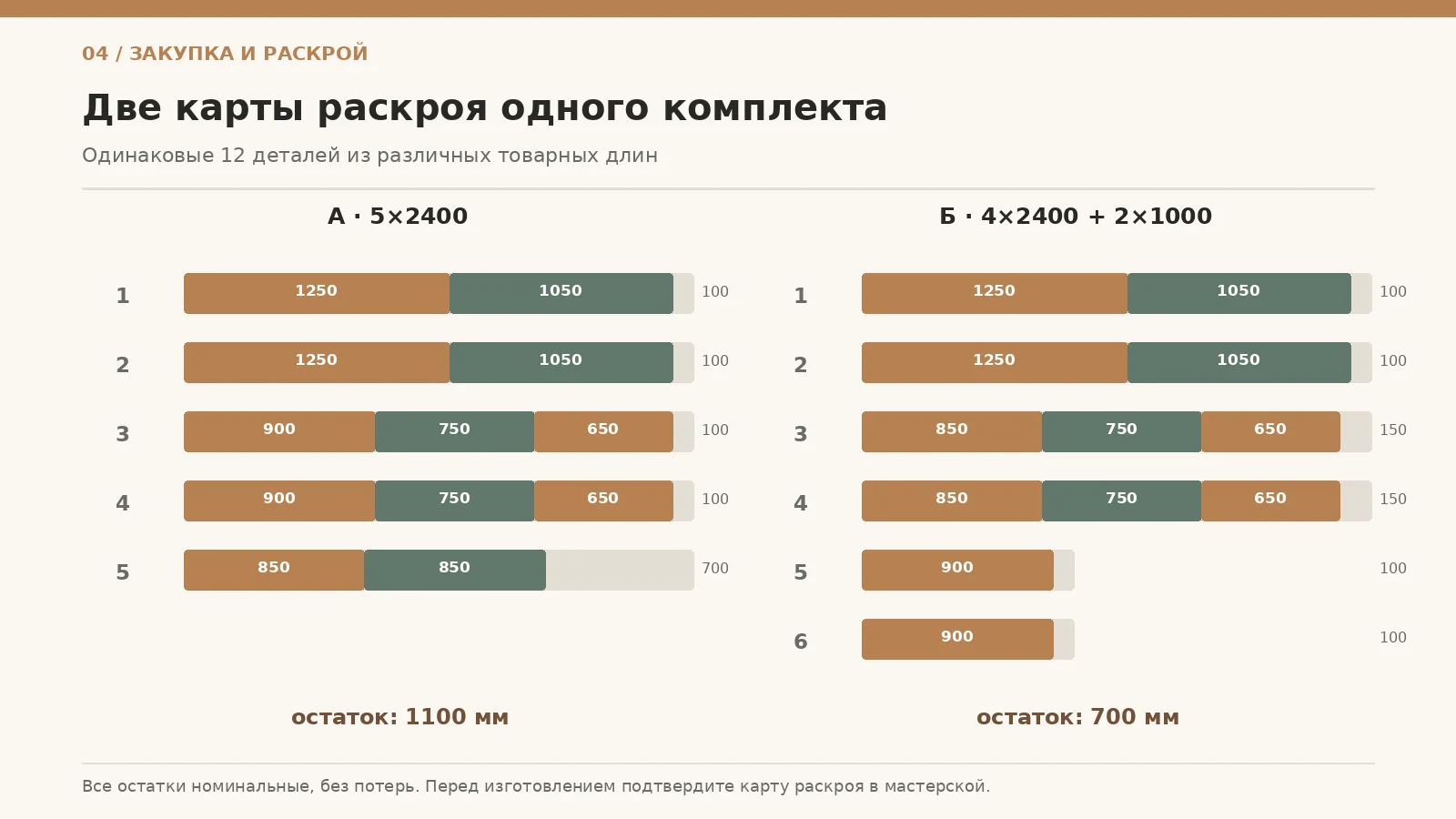
For the first purchasing scheme, we select only long wooden products of 2400 mm. There are five of them, and the total initial linear length is 12 m. This is the option that is usually easier to explain when ordering: one article, one species, one commercial length. However, one cannot assume that five products automatically provide the required cutting plan. All twelve parts must be distributed among specific strips so that no sum of lengths exceeds 2400 mm.
| Source strip | Resulting parts | Occupied length | Nominal remainder |
|---|---|---|---|
| No. 1, 2400 mm | 1250 + 1050 mm | 2300 мм | 100 мм |
| No. 2, 2400 mm | 1250 + 1050 mm | 2300 мм | 100 мм |
| No. 3, 2400 mm | 900 + 750 + 650 mm | 2300 мм | 100 мм |
| No. 4, 2400 mm | 900 + 750 + 650 mm | 2300 мм | 100 мм |
| No. 5, 2400 mm | 850 + 850 mm | 1700 мм | 700 мм |
| Total | 12 pieces | 10,900 mm | 1100 мм |
This check isn't only about the final total length: each row shows how much material is left over. The first four strips each have 100 mm free, and the last one has 700 mm. Arithmetically the map adds up: 5×2400 = 12,000 mm of source material; 12,000 − 10,900 = 1,100 mm of nominal remainder. This remainder still has to cover the kerf widths and allowances, as well as any possible end trimming. So the actual remainder usable for future products will be smaller.
One hundred millimetres may look like a sufficient margin when distributing two parts of 1250 and 1050 mm, but for a workshop that is no guarantee. If the long strip has a damaged section, one end will need extra end trimming, or the craftsman will allow a large margin for a complex profile, and the usable remainder will quickly shrink. When the short part gets two 45° cuts, you need to check the length across the outer vertices of both angles, not just measure the middle of the surface with a tape measure.
Another subtlety: strips No. 3 and No. 4 each carry three parts at once. If the production process requires cutting a common fragment first and then forming the angles, additional losses may occur on temporary process allowances. For sufficiently precise tooling, the nominal map is usually a good starting point, but it cannot be used in place of the craftsman's detailed plan. Here we confirm the geometric feasibility of the layout; we do not claim a guaranteed consumption rate for any equipment.
The five-long-strip option is convenient when the warehouse can assemble them from a single batch by colour and when the buyer does not want to separately coordinate 1000 mm lengths. Its drawback is the 1,100 mm nominal remainder, part of which may have no practical value. But it is precisely the extra free section on the fifth strip that creates some flexibility when cutting two 850 mm elements, rather than just useless waste. Sometimes such a reserve is worth more than a few dozen roubles saved on paper.
Option B: four long strips and two one-metre strips
The second scheme keeps all twelve parts and the same outer contour dimensions, but moves the two 900 mm horizontals onto separate one-metre items. The remaining ten parts are distributed across four 2400 mm strips. The result is six itemised product positions, but two size types. When choosing, remember that the one-metre and long strips must be the same model and species; a difference in length does not mean you are free to mix different batches without matching the shade.
| Source strip | Resulting parts | Occupied length | Nominal remainder |
|---|---|---|---|
| 2400 mm No. 1 | 1250 + 1050 mm | 2300 мм | 100 мм |
| 2400 mm No. 2 | 1250 + 1050 mm | 2300 мм | 100 мм |
| 2400 mm No. 3 | 850 + 750 + 650 mm | 2250 мм | 150 мм |
| 2400 mm No. 4 | 850 + 750 + 650 mm | 2250 мм | 150 мм |
| 1000 mm No. 1 | 900 мм | 900 мм | 100 мм |
| 1000 mm No. 2 | 900 мм | 900 мм | 100 мм |
| Total | 12 pieces | 10,900 mm | 700 мм |
The purchase length for this option is 4×2400 + 2×1000 = 11,600 mm. The difference from the net requirement is 700 mm. Compared with the first option, the total initial linear footage is 400 mm less, and the nominal remainder is reduced from 1,100 to 700 mm. However, six items need to be purchased instead of five. For logistics, this is separate information, although there are fewer long strips.
The process limitation remains: after cutting 900 mm parts from the two one-meter blanks, 100 mm remains on each for saw kerfs and end trimming. If the end of a one-meter strip is damaged, it is advisable to find out before purchase whether replacement or selection is possible. The long strips No. 3 and No. 4 have a 150 mm allowance, which is somewhat more than the similar rows in scheme A. But one incorrectly made cut can require a new one-meter strip or a change to the entire cutting sequence.
Which scheme is better for the craftsman? If all long parts will be cut in a workshop with precise equipment, the combined option is quite understandable. If cutting is done under non-standard conditions, separate one-meter strips do not necessarily simplify the work: each item's geometry, end, sorting, and face direction need to be checked. Sometimes working with five identical long strips is organizationally simpler. Do not turn a small difference in remainders into a universal selection rule.
Why saving 400 mm of material has almost no effect on price
Buyers often try to reduce waste because they assume costs depend directly on the number of millimeters purchased. For linear lumber, this is not always true. On the official STAVROS product pages, one-meter and long wooden items have their own per-piece prices. In our example, one MLD-002 strip 2400 mm long costs exactly the same as two one-meter strips: for beech, 920 ₽ versus 2×460 ₽; for oak, 1,260 ₽ versus 2×630 ₽. Therefore, replacing one long strip with two one-meter strips does not reduce the order cost, even though less initial material is used.
For MLD-004, a similar picture emerges: two 1-meter beech planks cost 2×350 = 700 ₽, the same as one beech plank 2400 mm long. In oak, two 1-meter planks at 440 ₽ each give 880 ₽ instead of 890 ₽ for the long plank. The saving is only 10 ₽ for the entire project. This figure should not be inflated into a decisive advantage: delivery, packaging, and labor costs can significantly exceed such a difference, and the cutting logic itself must be convenient for the craftsman.
| Parameter | Long only | Mixed lengths |
|---|---|---|
| Number of 2400 mm planks | 5 | 4 |
| Number of 1000 mm planks | 0 | 2 |
| Total source items | 5 | 6 |
| Total purchase length | 12,000 mm | 11,600 mm |
| Finished part length | 10,900 mm | 10,900 mm |
| Nominal remainder | 1100 мм | 700 мм |
Does this mean that longer items are always more economical? No. For a different set of parts, different price ratios, and a different allowance, the result may change. Here, the difference in linear meters has more of a technological than a financial meaning. A good order is chosen based on a combination of factors: the ability to obtain whole parts, convenience of angled cuts, wood from the same batch, packaging, final price, and the risk of rework. Making a decision based solely on the minimum amount of waste would be a mistake.
It is useful to compare the cost of an error separately. Suppose a craftsman damages a single 1250 mm piece. No one-metre offcut will replace it in full. You will have to either use a long usable offcut of sufficient length, if one is provided for, or buy a new 2400 mm strip. Therefore the question of additional stock should be decided with the longest elements in mind. Small short offcuts are not equivalent to a universal reserve for any damage.
Comparison of two models with identical external dimensions
MLD-002 and MLD-004 can be compared by price on the same purchasing scheme, because both models have confirmed wooden versions 1000 and 2400 mm long. But the visual result will differ. If the outer rectangle of 900×1250 mm is kept, the wider profile will occupy more of the area inside it, and the thinner one less. Perception also depends on the relief and finish. Therefore the estimate should compare not “identical finished frames” but two types of decorative contours of the same external size.
In a small area of 650×850 mm, switching to MLD-004 can make the framing lighter without reducing the mirror. In a large area of 900×1250 mm, such a reduction in width may be undesirable if there is heavy furniture or massive architraves nearby. In this case a different design is possible: keep MLD-002 on all three areas to preserve unity, or completely revise the proportions of the mirror group. Different profiles on three mirrors should not be mixed merely out of a desire to minimise the cost of individual pieces.
For evaluation it is convenient to compare trial corners rather than a single straight strip. In a corner the profile shows its height and the character of its section especially clearly. Even a small difference in depth affects the shadow along the diagonal joint. If the chosen finish emphasises the wood, the grain direction will also have to be agreed. Parallel grain on symmetrical parts gives a calmer pattern than a random combination of arbitrarily cut sections.
Do not forget to check the actual mounting surfaces. Some profiles require a sufficiently flat base so as not to rock on a textured wall. The face line may be narrow, but the supporting part of the profile has its own shape. If the wall is finished with rough plaster or textured paint, the adhesive contact will differ from that on a dense smooth surface. Choosing a product that is correct in size is only half the task; the other half is fixing it without deformation and visible gaps.
How much does an MLD-002 set in beech and oak cost
For the calculation we use the prices of the wooden versions shown in the official product pages as of 13 November 2026. These are prices per commercial strip, not per metre and not per finished frame. Delivery, packaging, surface preparation, painting and cutting work are not included in the comparative estimate. Prices must be checked again before ordering: they may change regardless of when this article was published.
| Model and length | Beech per strip | Oak per strip |
|---|---|---|
| MLD-002, 1000 mm | 460 ₽ | 630 ₽ |
| MLD-002, 2400 mm | 920 ₽ | 1260 ₽ |
| MLD-004, 1000 mm | 350 ₽ | 440 ₽ |
| MLD-004, 2400 mm | 700 ₽ | 890 ₽ |
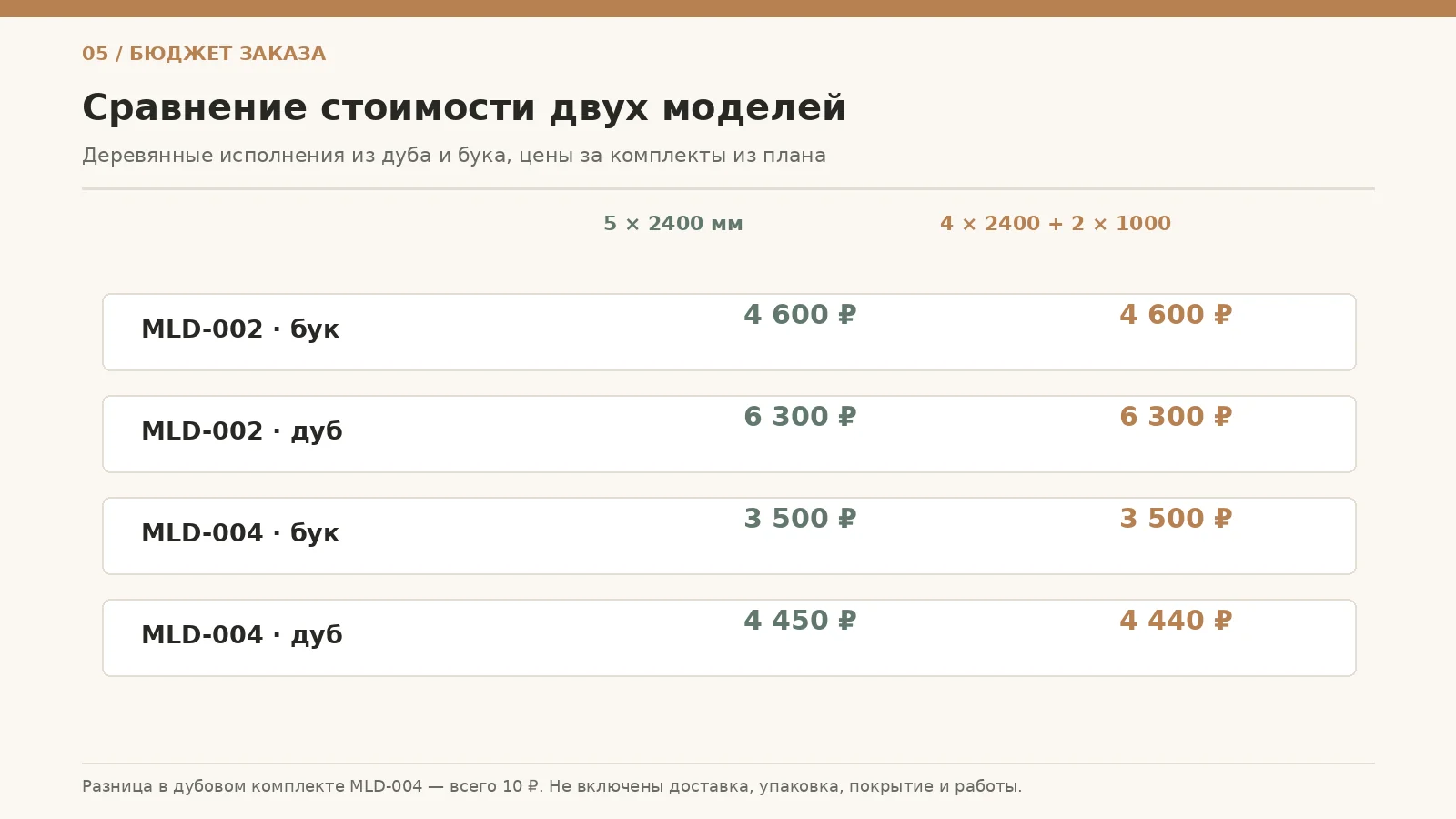
If you choose buy oak moulding MLD-002 2400 mm long, five pieces, the price of the products themselves will be 5×1260 = 6300 ₽. For beech, the same set — 5×920 = 4600 ₽. The mixed scheme costs the same: oak 4×1260 + 2×630 = 6300 ₽, beech 4×920 + 2×460 = 4600 ₽. At the same price, the choice is determined primarily by the convenience of configuration and cutting.
For MLD-004, five beech planks at 700 ₽ each will cost 3500 ₽, oak ones — 4450 ₽. The combined scheme of four long and two short planks gives 4×700 + 2×350 = 3500 ₽ for beech, and 4×890 + 2×440 = 4440 ₽ for oak. Do not confuse these four amounts with the price of one linear meter: specific products are sold, not arbitrarily measured footage.
| Set | Beech | Oak |
|---|---|---|
| MLD-002, 5×2400 mm | 4600 ₽ | 6300 ₽ |
| MLD-002, 4×2400 + 2×1000 mm | 4600 ₽ | 6300 ₽ |
| MLD-004, 5×2400 mm | 3500 ₽ | 4450 ₽ |
| MLD-004, 4×2400 + 2×1000 mm | 3500 ₽ | 4440 ₽ |
The difference between the main models for the same five long planks is 1100 ₽ in beech and 1850 ₽ in oak. But it is wrong to base a decision on a single sum. A wider contour may be necessary for the proportions of the wall, while a more compact one may be preferable when furniture and a mirror already occupy a lot of visual space. The estimate here helps compare options; it does not replace an architectural assessment.
If you need a spare plank
For the main scheme of five long products, a sixth 2400 mm product plank can be provided. Then MLD-002 in beech will cost 5520 ₽, in oak 7560 ₽. MLD-004 — 4200 ₽ in beech and 5340 ₽ in oak. The spare increases the budget, but it allows you to restore a damaged long part without a separate repeat order, provided the dimensions and finish match.
A sixth strip is not mandatory for every project. If the installation is carried out by an experienced workshop with a confirmed cutting plan, proven tools and minor technological waste, five original pieces may be sufficient. If the profile has a complex relief, the delivery is long-distance, or an exact match of wood from the same batch is required for a possible future replacement, the reserve becomes a more understandable solution. Its presence should be agreed with the actual dimensions and processing method, rather than presented as a universal norm.
Wall preparation and marking of the decorative surround
It is worth attaching wooden moldings around the mirror after the position of the glass, its separate fastening scheme and the final wall finish are known. If the surface is still to be skimmed or painted, there is a risk that the finished outline will be offset relative to the actual center of the mirror. First mark the outer rectangles by level and diagonals, then check the gap to the glass and adjacent elements. For all three zones it is useful to use a single sequence of actions, but not necessarily the same mounting height relative to the floor.
Check whether there are any voids, loose filler, weak paint or local unevenness under the future line of the wood. A 1250 mm long profile is pressed against the wall over a considerable length. If there is a bulge in the middle and the edges go inward, additional stress may occur at the corner joints. An attempt to correct unevenness by strong pressing sometimes leads to the seams opening after the adhesive dries. It is better to identify problem areas in advance and prepare the base than to compensate for surface defects with a wooden product.
Before installation, lay out on the floor or workbench the four parts of each rectangle in exactly the order in which they will go on the wall. Check whether the direction of the profile in the corners matches, whether there is a noticeable difference in shades, and whether the outer dimensions correspond to the approved drawing. Measure the diagonals of the assembled trial outline: for a rectangle they should match within the accepted installation tolerances. If the diagonals differ, do not try to "align" the frame along one vertical edge — find the cause of the skew before fastening.
It is convenient to first mark the entire outline and only then determine the fastening sequence. In one area it may be more rational to start with the top horizontal, in another — with a verified vertical line. There is no universal order for all bases; what matters more is not losing the geometry and being able to adjust the adjacent part before final fixing. Pay special attention to the evenness of the diagonal seams. After applying opaque paint, a small gap may become less noticeable, but the incorrect geometry of the outer rectangle will not disappear.
What to do if the mirror is already slightly skewed
You cannot automatically make the wooden outline parallel to a crookedly hung glass if this violates its relationship to the wall, doors and furniture. First find out whether the position of the mirror itself can be safely corrected without interfering with the fastening. If this is impossible, decide together with the customer what visual deviation is acceptable. Sometimes a small difference in the width of the empty field is less noticeable than a skewed rectangular frame next to a vertical door casing. This is a design decision, not a reason to change the dimensions of all parts without re-measuring.
Corner processing, end finishing and maintenance
The finished system looks cohesive when all elements are consistent in geometry and coating. You cannot finish only the front side, leaving open cut areas without the specified protection. It is precisely in the joints that end-grain wood absorbs the composition more strongly than the longitudinal surface. With a transparent coating, the color of such areas may differ; with enamel, a noticeable line is possible if the seam and ends are prepared unevenly. The scheme of priming, filling seams and applying the coating should be selected for the chosen material and the recommendations of the finishing composition manufacturers.
When installing next to a mirror, avoid accidental contact of glue, solvent and paint with the glass edges, the protective layer and the hardware. To remove dirt, do not use substances whose compatibility with the specific mirror has not been confirmed. If the project includes lighting, make sure the moulding does not cover the connections required for servicing and does not touch the heating parts of the fixture. The wooden edging is part of the interior finish, not a protective enclosure for electrical components.
Some time after installation, it is convenient to check the corners in side light, when small changes in the joints become clearly visible. Temperature and humidity conditions can affect solid wood, so a wooden profile should not be installed without confirming it suits the purpose of the room. For an ordinary living room, it is sufficient to maintain normal household operating conditions and use suitable care products for the chosen finish. If the mirrors are installed in an area of constant damp or direct contact with water, the standard interior version must be agreed separately and should not be considered universal.
The buyer sometimes asks for the decorative line to be removable. In that case, the fastening method must be specified before ordering: a rigidly glued and painted flush contour cannot be considered a dismountable structure merely because it is made up of four separate parts. If the hidden fastenings or lighting behind the mirror need frequent servicing, resolve this question first, and then choose the shape and dimensions of the moulding.
How to place an order for wooden moulding with delivery to Bryansk
After the scheme is approved Buy wooden moldings you can order from a single agreed list. For the main version, this is MLD-002, oak or beech, five strips of 2400 mm or four of 2400 mm together with two one-metre ones. Do not place an order with the phrase “ten metres of moulding”, since the seller needs to know the exact quantity and lengths of the factory-made items. State that both schemes are designed for twelve parts along the outer edge, and that the final cutting requires technical clarification.
In the order for beech moulding MLD-002, 1000 mm long separately record the quantity of two-metre strips if you choose the mixed scheme. This will prevent two 1000 mm items being substituted with a single strip of a different length without agreement. As an alternative, you can choose decorative molding MLD-004 in beech, but then all four or five long blanks and both short ones must belong to the selected article. Different models are not mixed within one rectangle.
If other trim is required together with the mouldings, first check whether it is included in the same project. For example, Buy wooden trim skirting boards and architraves can be coordinated separately, but these items should not be included in the calculation of the twelve mirror components. Selecting adjacent profiles is useful when discussing the overall texture and shade, not as a way to artificially inflate the product carousel.
For long strips, clarify the packaging conditions in advance. The official STAVROS product pages list additional protective measures for long-length items; the cost and specific packaging depend on the order and require up-to-date verification. Confirm the carrier, the pickup or delivery address, whether rigid packaging is required, and whether the goods can be inspected before signing for receipt. If the cargo arrives at the same time as installation work begins, the risk of damage must be taken into account and time must be allowed for inspection, but no exact delivery time to Bryansk should be invented.
What to include in a quote request
Provide the seller with the article number, wood species, selected length of each product strip, quantity, preparation option for the finish, city and delivery address. Separately attach the dimensions of the decorative frames 650×850, 750×1050 and 900×1250 mm, noting that these are the outer dimensions when joined at 45°. Such a note helps distinguish an order for raw linear stock from an order for pre-cut finished parts. If cutting by the workshop is required, both the price of the service and the manufacturing tolerances should be agreed, as well as who owns the offcuts.
Upon receipt, inspect the packaging, the items themselves along their length, the ends, and check for the absence of cracks, chips and damage to the face profile. Before installation begins, it is advisable to place the loose batch in the room in accordance with the manufacturer's recommendations so that the wood can acclimatise to the conditions of future use. Do not rely solely on the number of strips in the delivery note: a single item with a damaged end may already be unsuitable for the longest component, even if the total linear metreage of the delivery has not changed.
Frequently asked questions before buying wooden moldings
Can a mirror that is already fixed to the wall be framed with a moulding?
Yes, if we are talking specifically about a decorative frame around a mirror installed independently. The glass fixing must be designed and carried out independently of the wood. Before ordering, make sure that the profile will not cover the necessary mounting points, will not touch the glass and will not obstruct access for maintenance. In our design, a visible gap is maintained between the mirror and the inner edge of the decorative line.
Why are twelve components needed for three mirrors rather than six?
Each rectangular frame consists of four sides: two vertical and two horizontal. Three independent rectangles give 3×4 = 12. Adjacent sides of different mirrors cannot be combined into one long strip, since the areas are separate and their frames do not touch. If it is decided to make one shared panel for several mirrors, that is already a different construction and a different bill of materials.
Why buy 12 meters when the net consumption is 10.9 meters?
The product is sold in planks of a specific length, not in any measured centimeters. In option A, five pieces of 2400 mm are taken, totaling 12 m, to obtain the required twelve parts. The nominal difference of 1.1 m does not equal usable offcut: part of the material will go to saw kerfs, end trimming, and possible technological adjustment.
Is it realistic to use four long and two short planks?
In the study cutting plan, all parts fit: four 2400 mm planks and two 1000 mm planks give 11.6 m of material with a nominal offcut of 700 mm. Before actual cutting, it is necessary to check the condition of the blanks and the allowances for each angled end. If the final production scheme does not fit, the purchase composition must be changed before work begins.
Which is more advantageous — MLD-002 or MLD-004?
At prices as of November 13, 2026, MLD-004 is cheaper in both materials. A set of five 2400 mm planks in beech costs 3500 ₽ instead of 4600 ₽; in oak — 4450 ₽ instead of 6300 ₽. But these are different cross-sections, so the choice should be made after comparing their appearance on the wall. It is not worth paying for a large relief if it interferes with the composition, just as it is not worth saving on a profile that will be barely noticeable.
Why does the mixed scheme not reduce the price of MLD-002?
The price of two one-meter items equals the price of one 2400 mm item for each species: 2×460 = 920 ₽ for beech and 2×630 = 1260 ₽ for oak. Because of this, the total estimate remains the same. Reducing the purchased footage by 400 mm here has almost no effect on cost; it changes the number of individual products and the distribution of offcuts.
Can oak be chosen for the large mirror and beech for the small one?
Technically, these are two different materials that can be used in different rooms if that is the design intent. But for the overall compositional solution, it is worth looking at real samples beforehand. Different woods perceive clear finishes differently, and a color match is not guaranteed. For three coordinated outlines in one visual space, it is more reasonable to choose a single species and finish.
Are special corner overlays needed?
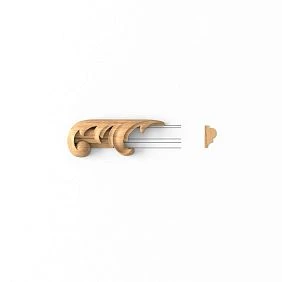
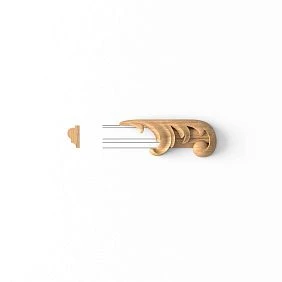
No, if the project provides for a standard 45° miter joint of the moldings and the craftsman can ensure an accurate cut. Overlays are separate decorative products with their own geometry; they cannot be declared compatible with any profile without confirming dimensions and fit. In our calculation, all twelve corners are made without such additional parts; if the layout changes, recalculate the lengths of the straight sections.
Can the MLD-028 option be used instead of MLD-002 in the same estimate?
Without recalculation — no. MLD-028 has a confirmed wood length of 2400 mm, not the 1000/2400 mm pair used in the comparison. In addition, the 25×11 mm cross-section changes the visible gap and the relief of the framing. This model requires its own cutting plan, a dimensions check, and a new estimate at the current price.
Read also
When the mirror area has already been calculated and the buyer wants to understand the adjacent solutions in more detail, the following STAVROS materials are useful: “Molding for a mirror: how to choose decorative framing”, “A mirror in a classic wall panel” и “MLD-057 molding for mirror frames”. These are related publications about other tasks. For our project, the main thing remains the separate decorative framing of the three already-mounted mirrors without a load-bearing function.
Which set to order for three mirror areas
If you choose MLD-002, the preliminary specification consists of twelve finished-length pieces totaling 10.9 m: two lengths each of 1250, 1050, 900, 850, 750, and 650 mm. For purchasing, either of two verified schemes will work — five pieces at 2400 mm or four pieces at 2400 mm and two at 1000 mm. Both give the same price for MLD-002 within the current comparison. Choosing MLD-004 reduces the cost but changes the architectural scale of the line around the mirror.
The final quantity of source strips should be confirmed after on-site measurement, verification of the profile drawing, and cutting technology. Then the purchase will contain exactly those pieces from which three independent contours can be assembled, rather than an arbitrary reserve of decorative trim. Order the selected STAVROS wooden moldings with the agreed species, lengths, and delivery to Bryansk — and keep a separate cutting list for the installation workshop.