Article Contents:
- Wooden molding MLD-057 25×12 mm: what exactly is confirmed by the product card
- MLD-057 made of MDF 25×12×2600 mm
- Beech wooden molding 25×12×2400 mm
- Oak molding MLD-057 2400 mm
- Factory rebate according to technical specifications
- Why a minimum of 100 pieces makes this option interesting specifically for a serial project
- Standard MLD-057 without rebate
- MLD-057 with factory rabbet
- Purchasing a standard profile and subsequent milling
- What is really worth comparing besides the cost of the operation
- Rabbet width
- Rabbet depth
- Which side of the profile should be processed
- Over what length should it run
- What should be at the ends
- 6 mm — width or depth?
- Mirror thickness
- Backing
- Glue or sealant
- Working gap
- Final seating depth
- Why a drawing is more important than a text description
- What to agree on separately
- Calculation example
- Map for MDF 2600 mm
- Map for beech or oak 2400 mm
- Why 120 frames do not mean 120 slats
- MDF 2600 mm and long cutting
- Beech 2400 mm
- Oak 2400 mm
- What the comparison shows
- 120 identical painted frames
- Surface repeatability
- Preparation for enamel
- Cost of the original profile
- Why MDF choice should be tied to the final finish
- Operational task
- Visible ends
- Furniture production requirements
- Why you can't choose beech just because it's 'woodier'
- Visible texture
- Batch sorting
- Tone after finish
- Why 120 frames require determining the lamella selection principle in advance
- Fixed costs of the in-house operation
- Variable costs per whip
- Conditional example #1: in-house operation with low variable costs
- What happens after accounting for defects
- Conditional example #2: automated internal line
- Surcharge is calculated on the original profile or part — to be confirmed
- Is setup included in 185 ₽
- What geometry is included in the standard service
- What tolerances are guaranteed
- Is a separate sample needed
- Check the quarter on a real mirror
- Check the seating depth
- Check the visible edge
- Check the finish
- Approve the part in writing
- When this is especially useful
- When the set is no longer needed
- Face width 25 mm
- Thickness 12 mm
- Visible part after routing
- How much the profile overlaps the mirror edge
- How the frame looks at a distance
- Reference No. 0
- Geometric Inspection
- Finish control
- Quarter control
- Sample signing
- Series starts in a tight deadline
- Geometry fully approved
- All frames are identical
- There is no specialized tooling inside
- Finishing starts immediately after receipt
- Geometry is still changing
- Several quarter options are needed
- There is an automated line
- Each part needs to be checked after cutting
- A quick reorder of several parts is required
- Approach through the number of parts
- Approach through the reserve of finished frames
- Profile input control
- Interoperational
- Final
- Error 1. Write "quarter 6 mm"
- Error 2. Multiply 120 frames by 4 parts and count 480 rods
- Error 3. Divide the total footage by 2600
- Error 4. Consider the machine free
- Error 5. Not accounting for defects
- Error 6. Run 200 rods without a sample
- Error 7. Choose oak, then decide to paint with enamel
- Error 8. Not confirming the tariff unit of 185 ₽
- Error 9. Not agreeing on tolerances
- Error 10. Mixing different versions of quarter
- Error 11. Not accounting for packaging
- Error 12. Not checking special processing deadlines
- Error 13. Assuming 2600 mm is always more profitable than 2400
- Error 14. Sorting oak after cutting without a system
- Error 15. Accepting the entire batch based on one plank
- What is the size of MLD-057?
- Is there an MLD-057 made of MDF?
- What lengths are available for MLD-057?
- Can I order MLD-057 with a quarter cut?
- From what quantity is the cut available?
- How much does quarter sampling cost?
- Can I specify my own quarter size?
- What should be in the technical specification?
- Does 6 mm mirror mean a quarter of 6×6 mm?
- Which MLD-057 to choose — MDF, beech, or oak?
- How much molding is needed for 120 frames?
- Why can't you count only the total perimeter?
- What is more profitable — factory rabbet or own milling?
- When does own milling win?
- When does factory rabbet win?
- Is a control sample needed?
- How to check the rabbet before serial production?
- What is OMLD-005 for?
- How to accept a batch after delivery?
- Where to buy wooden molding MLD-057?
- Where to buy furniture moldings?
- Can I order more than 100 slats in one batch?
- How to check the current price of MLD-057?
- How much does factory sampling cost for 120 slats?
- How much does sampling cost for 180 slats?
- How much does sampling cost for 200 slats?
- What to do if after cutting you only need 96 processed rods?
- Can I order a quarter only for part of the batch?
- Do I need to mill the quarter before cutting?
- What matters more — the price of 185 ₽ or the stability of the series?
- What reserve should I take for 120 frames?
- Do I need to keep the MLD-057 leftovers?
- What to do if I need one repair frame later?
- Can I use MLD-057 for a clear finish?
- Do I need to record the version number of the technical specification?
- Step 1. Approve MLD-057 physically
- Step 2. Approve the material
- Step 3. Assemble the mirror insert structure
- Step 4. Draw a quarter with two dimensions
- Step 5. Make a control sample
- Step 6. Assemble the reference frame
- Step 7. Build a cutting map
- Step 8. Determine the number of initial rods
- Step 9. Check the threshold of 100 pcs.
- Step 10. Calculate the factory cost
- Step 11. Calculate the own cost
- Step 12. Compare timelines and risks
- Step 13. Approve the technical specification in writing
- Step 14. Agree on packaging and delivery
- Step 15. Perform incoming inspection
- Step 16. Launch the first small part of the batch
- Step 17. Only after this continue the entire flow
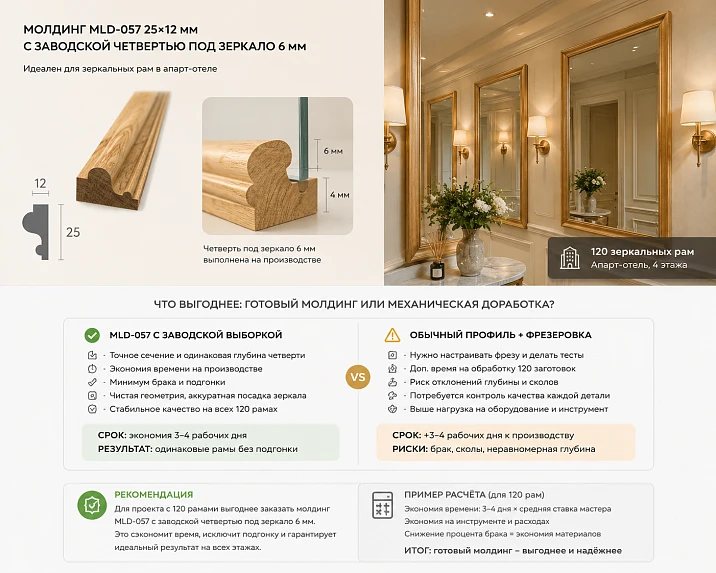
For the apart-hotel, 120 identical mirror frames need to be manufactured. The profile is already selected — MLD-057 25×12 mm. The mirror insert in the project has a thickness of 6 mm, and the frame design requires a quarter cut. A production question arises, not a decorative one: should we buy standard MLD-057 and perform the identical cut on our own equipment, or order special processing directly from the manufacturer?
MLD-057 has an option rare for a serial project that directly affects the answer. The current STAVROS card specifies a quarter cut according to the technical specification. The service is available for orders from 100 pieces, with the cost at the time of verification being 185 ₽ per item. The project for 120 mirror frames potentially falls exactly into the range where factory processing should already be considered a full-fledged alternative to own milling, rather than a non-standard service for a single part.
But the number "120 frames" does not yet mean "120 moldings." First, you need to determine the parts of one frame, build a cutting map from 2400 or 2600 mm sticks, calculate the actual number of initial strips, and only then multiply it by the cost of the profile and processing. Depending on the frame sizes, MDF 2600 mm may be cut noticeably more efficiently than beech or oak 2400 mm — or the additional 200 mm may change nothing at all. Therefore, procurement economics start not with the price per linear meter, but with the parts map.
There is also a second risk: the wording "a quarter of 6 mm is needed" is insufficient for a production order. Six millimeters could mean the thickness of the mirror, the width of the shelf quarter, or its depth — these are three different parameters. For a correct technical specification, it is necessary to fix the geometry of the rebate, the side of the profile, the length of processing, the mirror seating, the backing, the method of fixation, the working clearance, and the permissible deviations of the project. Card MLD-057 confirms the possibility of rebating according to the technical specification, but does not set the specific dimensions of the quarter on behalf of the customer.
Therefore, the main conclusion can be formulated right away. For a series of 120 identical frames, the factory rebate MLD-057 becomes rational when:
-
the geometry of the quarter is already finally approved;
-
the actual number of initial profiles exceeds the minimum threshold of the service;
-
one control part has been checked on a real mirror and finish;
-
one's own workshop does not provide an obviously lower total cost, taking into account changeover, operator, control, defects, and rework;
-
serial repeatability is more important than flexibility in changing geometry during the process.
If one's own line is already set up for such an operation, has automatic feeding, clear cost, and stable control, the factory rebate does not have to be cheaper. But the comparison should not be 185 ₽ with a conditional "we already have the machine," but the full cost of one good processed strip.
Before launching the batch, it is reasonable to buy wooden molding MLD-057 25×12 mm or agree on a reference sample in exactly the material and finish that will go into production. After geometry approval, you can decide whether to include the quarter sampling in the production order or leave this operation to your own workshop.
Wooden molding MLD-057 25×12 mm: what exactly is confirmed by the product card
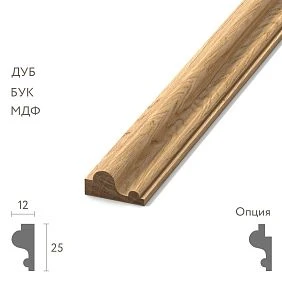
For a series calculation, you first need to separate the confirmed product characteristics from the parameters of a specific project.
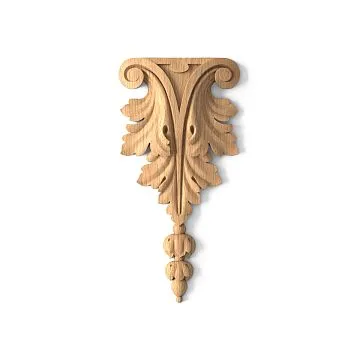
According to the current product card, MLD-057 has a profile of 25×12 mm and is offered in three materials:
| MLD-057 version | Size | Price at the time of check |
|---|---|---|
| MDF | 25×12×2600 mm | 690 ₽ |
| Beech | 25×12×2400 mm | 1 250 ₽ |
| Oak | 25×12×2400 mm | 1 770 ₽ |
For a product that is not in stock, the manufacturer indicates an average production time of 5–10 working days. For MLD-057, an additional option is separately specified: quarter sampling according to technical specifications, available for orders of 100 pieces or more, cost — 185 ₽ per item at the time of verification.
This is the central fact of the article. Not the size 25×12 mm itself, but the combination of a standard profile with a series production operation.




MLD-057 made of MDF 25×12×2600 mm
MDF has a length of 2600 mm. For a serial painted frame, this is commercially interesting for two reasons.
The first is that the initial price of the profile is lower than beech and oak.
The second is that the additional 200 mm of length compared to solid wood can reduce the number of initial strips if the part dimensions fit well within 2600 mm.
But this is not a universal advantage. If the parts of one frame have lengths, for example, that lay out equally well in 2400 and 2600 mm, the longer MDF does not provide savings in quantity. Therefore, length is compared on a map, not on the principle that "2600 is always more advantageous."
For opaque painting, MDF is especially logical when the customer needs a uniform color surface for 120 frames, and the natural texture is not part of the design. At the same time, finish repeatability still depends on a unified system of primer, enamel, application method, and batch control.
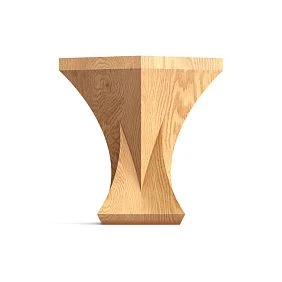
Our factory also produces:

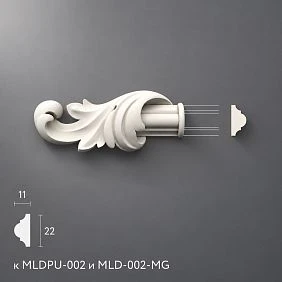
Beech wooden molding 25×12×2400 mm
Beech costs more than MDF and has a standard length of 2400 mm.
It is chosen not because it is "better by definition," but when a specific structure and operational task require solid wood, or the project specifically needs a wooden profile.
If the frames will be painted with opaque enamel, the advantage of the natural texture disappears. Then beech must be justified by other requirements: construction, edge treatment, the technology of a specific production, or customer requirements.
For a batch of 120 frames, it is especially important not to confuse the material with the finish. "Wooden frame" may mean solid wood as a mandatory condition, or it may be simply a visual description for which MDF is fully suitable. This needs to be determined before ordering hundreds of strips.
Get Consultation
Oak molding MLD-057 2400 mm
Oak is the most expensive of the three options on the current card.
It makes sense when the frames will have a transparent or semi-transparent finish and the natural grain should remain visible. In such a series, you need to determine in advance not only the dimensions of the rabbet, but also the rules for sorting the material.
For 120 frames, the question "are all the slats similar" becomes a production procedure:
-
what tone differences are acceptable;
-
how to distribute lighter and darker pieces;
-
whether to match the four sides of one frame by close shade;
-
when to sort — before cutting or after;
-
which finish is approved by the standard.
Natural wood does not become printed decor even within a single batch. Therefore, consistency must be ensured through a selection and finishing system, not by promising absolute identity.
Factory sampling of a quarter according to the technical specification
The card confirms the service itself but does not publish the universal geometry of the quarter.
This is correct: for a mirror frame, the dimensions depend on the design.
The manufacturer needs to be provided with a technical specification that defines at least the following:
-
sampling width;
-
depth;
-
profile side;
-
orientation relative to the front part;
-
processing length;
-
requirements for the ends;
-
allowable remaining wall thickness;
-
the need for a control sample.
It cannot be assumed that the query "6 mm mirror" automatically means a quarter of 6×6 mm.
Why a minimum of 100 pieces makes this option interesting specifically for a serial project
If two or ten frames need to be made, one's own workshop almost inevitably remains the natural place for such an operation: the minimum threshold for factory service has not yet been reached.
But a series of 120 frames creates a completely different economy.
The number of initial rods may be 100, 150, 180, 200 or more — depending on frame dimensions and cutting layout. At such a volume:
-
retooling is repeated once, not for each part;
-
geometry errors scale to the entire series;
-
control becomes a separate operation;
-
machine time becomes a noticeable cost item;
-
batch uniformity acquires commercial value.
Therefore, factory sampling here is not an "additional service," but one of two full-fledged production routes.
Buy furniture molding standard or immediately order special processing
If the task is — buy furniture molding for serial products, the cost of the initial profile is only the first layer of the solution.
There are three scenarios.
Standard MLD-057 without sampling
The buyer receives a regular profile 25×12 mm.
Advantages:
-
maximum flexibility;
-
the geometry can be changed in your own workshop;
-
you can first make pilot frames;
-
no dependence on the final technical specification at the time of purchase.
Disadvantages:
-
the entire batch falls on its own production;
-
a separate control operation arises;
-
the risk of defects becomes internal;
-
machine time is required.
MLD-057 with factory batch
The profile arrives with already agreed processing.
Advantages:
-
one operation is removed from internal production;
-
easier to plan the assembly flow;
-
the geometry is set by a single technical specification;
-
the number of internal changeovers is reduced.
Disadvantages:
-
The technical specification must be final before launch;
-
An error in the technical specification scales to the entire batch;
-
It is necessary to confirm in advance what exactly is included in the price of 185 ₽;
-
After receiving, changing a quarter is significantly more difficult.
Purchasing a standard profile and subsequent milling
This is not a "free" path even if a machine is available.
The cost price includes:
-
tool preparation;
-
setup;
-
a test piece;
-
operator;
-
actual machine time;
-
loading and unloading;
-
control;
-
tool;
-
defects;
-
repeated passes;
-
sorting;
-
internal logistics.
If the workshop already calculates these items in MES/ERP or production costing, the comparison is done quickly. If not, a series of 120 frames is a good reason to calculate them for the first time.
What to actually compare besides the operation price
For a B2B order, at least five parameters need to be compared:
| Parameter | Factory sample | Own milling |
|---|---|---|
| Direct operation price | Fixed per quote | Calculated internally |
| Changeover | At supplier's site | At own production |
| Geometry risk | Depends on approved spec and acceptance | Controlled internally |
| Change flexibility | below after batch start | Higher |
| Equipment loading | does not occupy its line | occupies |
| Responsibility for processing defects | contractual supply zone | internal production |
| Assembly start date | May be reduced | depends on machine queue |
The final choice is made based on the full cost of a good part and the series risk, not just on the line of 185 ₽.
What does "quarter sampling per technical specification" mean when ordering MLD-057?
A quarter is a stepped sampling of material along the profile edge. For a mirror frame, it forms a seating shelf or space in which the mirror and other layers provided by the project are placed.
But the word "quarter" itself does not describe the size.
Quarter width
This is the sampling size along one axis of the profile.
It must take into account the actual design of the mirror insert.
If the mirror must be overlapped by the front part of the molding by a certain amount, the quarter width is related to this overlap.
Quarter depth
This is the second independent size.
Depth determines how far the mirror and substrate extend relative to the rear plane of the molding.
With a 12 mm thick profile, too deep a cut reduces the residual material thickness. Therefore, depth cannot be assigned without assessing the actual geometry of MLD-057.
On which side of the profile should the processing be performed
The product has a face, a back side, and a profile direction.
The technical specification must unambiguously indicate where the quarter is located.
The phrase "from behind" may be insufficient if the drawing allows different orientations.
Over what length should it run
There are two fundamental options:
-
cutting along the entire length of the original stock;
-
processing only specific parts after cutting.
The card indicates the cost of the service per item, but before commercial calculation, it is necessary to confirm with the manufacturer which specific processing format the price of 185 ₽ applies to and how the specific technical specification will be executed.
What should be on the end faces
If the quarter is made on a full length, the end faces of the parts are formed in the workshop after cutting.
If the manufacturer processes finished parts, the requirements for the end faces become part of the order.
These schemes cannot be mixed.
Design quarter 6 mm: why one number is not enough for an order
In H1, 6 mm appears because the design case uses a mirror with a thickness of 6 mm. This is not a characteristic of the standard quarter MLD-057.
6 mm — width or depth?
If you write to the manager:
"Need a 6 mm quarter,"
He will not receive a clear-cut assignment.
At least two dimensions are needed:
width × depth.
For example, conditional 8×6 mm and 6×8 mm are completely different profiles after processing.
Mirror thickness
Mirror thickness affects the required seating depth, but is not automatically equal to it.
The design may include additional layers.
Backing
The project may include a protective backing, back panel, or other material.
Its thickness must be included in the overall package.
Adhesive or sealant
The fixing method also has its own thickness and technology.
You cannot assign a quarter as if the mirror simply lies in a dry groove without the mounting provided for by the design.
Working gap
Serial assembly requires not a nominal "to zero," but a coordinated fit.
The exact gap is determined by the product designer, taking into account the tolerances of the mirror, profile, and assembly.
Final seating depth
You need to decide in advance where the rear surface of the mirror is relative to the molding:
-
flush;
-
is recessed;
-
protrudes into the designed back panel structure.
Only after this does the real depth of the quarter appear.
Main conclusion:
In the request, you cannot simply write "make the quarter 6 mm."
Ordering a wooden molding with a quarter: what technical specification to send to the manufacturer
For a serial batch, the technical specification must exclude ambiguity.
The minimum structure can look like this:
MLD-057 / material ___ / profile 25×12 mm / length of the original product 2400 or 2600 mm / quantity ___ / quarter cutout: width ___ mm / depth ___ mm / side ___ / processing along the entire length or along the part ___ / project tolerance ___ / purpose — mirror frame / control sample — yes.
It is better to attach a cross-section drawing.
It should show:
-
front side;
-
back side;
-
width 25 mm;
-
thickness of 12 mm;
-
quarter coordinates;
-
its depth;
-
width;
-
residual material thickness;
-
mirror position 6 mm;
-
substrate, if present;
-
working gap.
Why a drawing is more important than a text description
In a serial order, one misunderstood phrase is repeated on a hundred products.
A drawing reduces the risk of interpretation.
What to agree on separately
Before launch, you need to get a written response to at least the following questions:
-
How is the price of 185 ₽ calculated — for the original whip or for another processing unit?
-
Is setup included in this price?
-
What range of quarter sizes is acceptable for MLD-057?
-
What tolerance for width and depth does production ensure?
-
Is the sampling performed along the entire length of the product?
-
Is it possible to get one control sample before the series?
-
How is the special batch marked?
-
How is the profile packaged after processing?
-
How does sampling affect production time?
-
What requirements for the technical specification are mandatory from STAVROS?
Until these answers are received, 185 ₽ cannot be considered the final cost of the operation for a specific project.
Buy wooden furniture molding for a series of 120 frames: how many strips are actually needed
If the task is — buy wooden furniture molding for 120 identical frames, the quantity is calculated by parts.
First, one frame is determined.
Each frame has:
-
two horizontal pieces;
-
two vertical parts.
But their length depends on the drawing, the corner joint, and which dimension line the part is calculated by.
Therefore, you cannot simply take the mirror size and add 25 mm twice without an approved structural drawing.
For the article, it is more useful to use a conditional production example where the part lengths are already approved after all structural calculations.
Calculation example
Let one frame require:
-
2 parts of 1020 mm;
-
2 parts of 720 mm.
This is not a characteristic of a real apartment hotel project, but a model for comparing cutting patterns.
Per frame:
2 × 10²⁰ + 2 × 720 = 3480 mm of parts.
For 120 frames:
3480 × 120 = 417,600 mm, or 417.6 linear meters of clean parts.
If you divide the total length by the length of the whip, you get an overly optimistic minimum.
For MDF 2600 mm:
417.6 / 2.6 ≈ 160.6, meaning at least 161 whips just by total meters.
For 2400 mm:
417.6 / 2.4 = 174 whips.
But real cutting requires more.
Map for MDF 2600 mm
From one whip you can get:
1020 + 720 + 720 = 2460 mm, remainder 140 mm.
This is a very useful combination: one long element and two short ones.
For 120 whips of this scheme we get:
-
120 long parts 1020 mm;
-
240 short parts 720 mm.
Short parts for all frames are already covered.
Still need to make 120 long parts of 1020 mm.
From one 2600 mm rod:
1020 + 1020 = 2040 mm.
For 120 parts, 60 rods are needed.
Total:
120 + 60 = 180 MDF rods of 2600 mm.
This is much more than the theoretical minimum of 161, but matches the actual lengths.
Map for beech or oak 2400 mm
For 2400 mm combination:
1020 + 720 + 720 = 2460 mm
no longer fits.
Therefore, convenient schemes:
1020 + 1020 = 2040 mm, remainder 360 mm.
For 240 long parts you need:
240 / 2 = 120 rods.
Short parts:
720 + 720 + 720 = 2160 mm.
For 240 short parts you need:
240 / 3 = 80 strips.
Total:
120 + 80 = 200 strips of 2400 mm.
In this specific calculation example, the additional 200 mm of MDF length saves 20 original strips.
But this is not a universal rule. With other part sizes, the advantage may disappear.
Why 120 frames do not mean 120 slats
In the given example, one frame requires 3.48 m of clean profile.
Even the longest MLD-057 2600 mm is shorter than this perimeter.
One strip physically cannot provide a complete set for one frame.
Therefore, the number of original slats is determined only by cutting.
MDF MLD-057 2600 mm vs. beech and oak 2400 mm: which format is more profitable for a series
Now you can compare materials not only by the price of one plank, but also by the number of strips in a conventional series.
For the example above:
-
MDF 2600 mm — 180 strips;
-
beech 2400 mm — 200 strips;
-
oak 2400 mm — 200 strips.
MDF 2600 mm and long cutting
Cost of the original profile:
180 × 690 = 124 200 ₽.
If the factory sampling is calculated for each original strip and is applicable to such a map:
180 × 185 = 33 300 ₽.
Total profile + operation:
157,500 ₽ before packaging, delivery, finishing, and other works.
This is a conditional calculation because the billing unit for the service needs to be confirmed with the manufacturer.
Beech 2400 mm
200 × 1,250 = 250,000 ₽ of the initial profile.
Factory sampling subject to billing per each whip:
200 × 185 = 37 000 ₽.
Total:
287,000 ₽ before further expenses.
Oak 2400 mm
200 × 1 770 = 354 000 ₽.
Sampling:
37 000 ₽.
Total:
391 000 ₽.
What the comparison shows
The difference between materials is significantly greater than the price of the quarter sampling itself.
Therefore, it is wrong to first argue about 185 ₽ and only then choose MDF, beech, or oak.
First, the final finish and construction are determined, then the material, then cutting, and only after that the economic model of processing.
When extra 200 mm of length reduces the number of initial whips
In the example with parts of 1020 and 720 mm, they allow combining the following:
1020 + 720 + 720 = 2460 mm.
It fits in 2600 mm.
In 2400 mm — it doesn't.
Hence the savings of 20 rods.
When the extra 200 mm changes nothing at all.
Let's imagine another conditional frame:
-
2 pieces of 1100 mm each;
-
2 pieces of 500 mm each.
In a 2400 mm rod, you can fit:
1100 + 500 + 500 = 2100 mm.
In a 2600 mm whip — the same combination.
The additional 200 mm does not yield another piece.
Then, by the number of initial whips, the MDF advantage may disappear.
That is why the production article should show a map, not just the total footage.
Buying MDF molding for a painted series: when it is more rational than solid wood
If the project involves 120 identical frames under an opaque enamel, buy an MDF molding it is often rational.
120 identical painted frames
The main goal is repeatable color and geometry.
The natural texture of solid wood under dense enamel does not become an advantage.
Surface repeatability
MDF provides a uniform base for painting.
But the quarter cut opens a new surface that also needs to be accounted for in the preparation process card.
Preparation for enamel
Card MLD-057 for MDF shows an option for enamel.
This corresponds to a dense painting scenario.
Cost of the initial profile
In a conditional calculation, 180 MDF strips cost 124,200 ₽, while 200 beech strips cost 250,000 ₽.
The difference is significant.
Why the choice of MDF should be linked to the final finish
If the client suddenly decides to leave natural wood under a transparent coating, MDF no longer meets the visual requirement.
Therefore, the material is approved before starting special processing.
Beech MLD-057: when solid wood is needed even under paint
Solid beech may be required by the customer's technical specification or by the furniture manufacturer's own technology.
Operational requirement
If the frame must work in a joint where edges, ends, or fastenings require solid wood, this can be a justification.
But such requirements must be clearly stated.
Visible ends
With complex geometry, some ends may remain visible.
Solid wood and MDF behave differently in the finish.
Furniture production requirements
Some company production standards may specify solid wood for a certain product line.
This is an organizational argument, not an abstract 'wood is better'.
Why you can't choose beech just because it's "woodier"
If the frame is fully painted, is in a dry room, and the MDF meets all requirements, the extra cost should have a specific reason.
Oak wooden molding MLD-057 for transparent finish
Oak is needed when visible texture is part of the product.
Visible texture
After a transparent finish, each side of the frame becomes visually readable.
Batch sorting
For 120 frames, the assembly principle needs to be determined in advance.
For example, four parts of one frame can be matched by similar tone.
Tone after finish
Raw oak and oak after oil, varnish, or tinting look different.
It is better to sort according to the approved finishing system.
Why 120 frames require determining the principle of lamella selection in advance
If sorting is started only at assembly, the flow will slow down.
It is better to define categories in advance:
-
light;
-
medium;
-
dark;
-
active texture;
-
calm texture.
This is already production logistics, not just material selection.
Factory selection versus own milling: calculating the full operation
This is the main business block of the entire article.
The error starts with the phrase:
"We already have the machine, so our own milling is almost free."
A machine that has already been purchased indeed does not require repurchase. But the production operation still has a cost.
For comparison, it is convenient to divide it into fixed and variable costs.
Fixed costs of the in-house operation
They occur once per batch:
-
preparation of the technological card;
-
machine setup;
-
installation and verification of the tool;
-
manufacturing of stops or templates;
-
first trial part;
-
size adjustment;
-
approval of the reference sample;
-
changeover after the end of the series.
Let's denote them as S.
Variable costs per rod
They grow with quantity:
-
operator labor;
-
machine time;
-
tool wear;
-
aspiration and energy costs;
-
loading/unloading;
-
measurement control;
-
marking;
-
internal movement;
-
defect rate;
-
reprocessing.
Let's denote them as V per one whip.
Then:
Own cost = S + V × N
where N is the number of processed slats.
Factory model according to the current card, if the tariff of 185 ₽ applies to each original slat:
Factory cost = 185 × N
This allows finding the break-even point.
Own operation is cheaper when:
S + V × N < 185 × N
Or:
S < (185 − V) × N
If V ≥ 185 ₽, the own operation is no longer cheaper in direct cost even without considering setup.
Conditional example #1: own operation with small variable costs
This is only a model for substituting your own rates.
For example:
-
setup and preparation S = 15,000 ₽;
-
variable cost V = 100 ₽ per whip.
Equality point:
15 000 + 100N = 185N
15 000 = 85N
N ≈ 176.5 whips.
At 120 whips:
own operation = 15,000 + 12,000 = 27,000 ₽;
factory = 120 × 185 = 22,200 ₽.
Factory is cheaper by 4,800 ₽.
At 180 whips:
own = 15,000 + 18,000 = 33,000 ₽;
factory = 33,300 ₽.
Almost equal.
At 200 whips:
own = 35,000 ₽;
factory = 37,000 ₽.
By direct calculation, the in-house operation wins 2,000 ₽.
But this is not the final step.
What happens after accounting for defects
Suppose that on 200 oak rods, the in-house operation yields a conditional 2% defect rate due to setup, chipping, feed errors, or incorrect geometry.
2% of 200 = 4 rods.
At the current price of oak:
4 × 1,770 = 7,080 ₽ just for raw materials.
The 2,000 ₽ advantage in favor of in-house processing disappears.
And we haven't yet accounted for:
-
a repeat purchase;
-
lost time;
-
re-finishing;
-
delay of the series.
That is why the comparison should be based on good output, not on an ideal operation without defects.
Conditional example #2: automated internal line
Suppose the workshop already regularly performs such a quarter.
Setup:
S = 4 000 ₽.
Variable cost:
V = 60 ₽.
For 180 rods:
4 000 + 60 × 180 = 14 800 ₽.
Factory:
33 300 ₽.
In this case, in-house processing is obviously cheaper in terms of direct cost.
And this is an important limitation of the article: the factory sample should not automatically be declared the best.
If the enterprise has a well-established process, the molding manufacturer competes not with manual improvisation, but with an efficient internal line.
Cost of factory sample MLD-057: how to correctly compare the offer
The card currently indicates 185 ₽ per 1 piece when ordering from 100 pieces.
For a commercial solution, the tariff details need to be confirmed.
The surcharge is calculated on the original profile or part — to be confirmed
The MLD-057 card sells rods of 2400/2600 mm as product units. Therefore, it is natural to assume that 185 ₽ refers to one such item.
But before estimating the series, this needs to be confirmed in writing.
If the factory processes the rod as a whole, the economics are one thing.
If we are talking about finished parts after cutting, it's another.
Is setup included in 185 ₽
This is an important question.
If a service for 100 pieces or more has a fixed price without separate setup, the factory model is especially transparent.
If a complex technical specification requires a separate preparation fee, it is added to the calculation.
What geometry is included in the standard service
The phrase "quarter sampling per technical specification" implies flexibility, but not limitlessness.
The MLD-057 profile is only 25×12 mm.
Any sampling reduces the remaining cross-section.
Therefore, the manufacturer must confirm that the specified width and depth are technologically feasible.
What tolerances are guaranteed
For the mirror series, repeatability is important.
Need to coordinate:
-
depth tolerance;
-
width tolerance;
-
straightness;
-
surface quality after milling.
You cannot make up these numbers in the article.
Is a separate sample needed?
For 100+ rods, the answer is almost obvious: a control part is useful.
But it needs to be agreed upon how it is handled commercially and whether it is included in the series.
Why one control sample MLD-057 is needed before ordering 120 frames
In serial production, the correct sequence is:
drawing → sample → inspection → written approval → series.
Not:
drawing → 200 processed whips → first trial frame.
Check the rebate on a real mirror
Use a mirror of exactly the thickness and type that will go into production.
Not a conditional 6 mm plywood and not a piece of another glass.
Check the seating depth
Need to see the actual position of the mirror relative to the back plane of the frame.
Check the visible edge
The rebate can change the visible width of the molding from the mirror side.
Profile 25 mm before processing and the visual frame after seating are not necessarily the same.
Check finish
The sample opens an additional surface.
For MDF, you need to understand its preparation for enamel.
For wood — how the new edge is processed and finished.
Approve the part in writing
On the sample, you can put:
-
project number;
-
date;
-
drawing version;
-
approver's signature;
-
"reference" mark.
This reduces the risk of disputes during acceptance.
OMLD-005 sample set: when MLD-057 is worth comparing with neighboring profiles before starting the series
Before ordering 100+ items, the physical profile matters more than the photo.
You can Buy OMLD-005 molding sample set, if the project has not yet passed the final geometry approval.
The current OMLD-005 card shows a set of 375×315×125 mm and 85 samples of molded products made of oak, beech, and MDF. It allows comparing profiles in real scale.
When this is especially useful
If MLD-057 was chosen only from the catalog.
On the mirror, a 25×12 mm profile may look:
-
thinner than expected;
-
more massive;
-
too neutral;
-
on the contrary, perfect.
Before serial special treatment, it is better to find this out physically.
When the set is no longer needed
If MLD-057 has been used by the workshop for a long time, there are real leftovers and an approved reference, there is no need to buy the set again just for this article.
Molding for a mirror frame: how to check 25×12 mm on a finished product
The profile size should be assessed not in isolation, but relative to the mirror.
Front width 25 mm
It sets the character of the frame.
But after corner joining, mirror seating, and finishing, the perception may change.
Thickness 12 mm
This is a limited resource for the quarter.
If too much is removed, the remaining part of the profile may become structurally insufficient.
The permissible dimensions are confirmed by the manufacturer and the project designer.
Visible part after sampling
Let the conditional width of the quarter on the mirror side be X.
Then the visible front strip depends on the profile and the actual geometry.
X cannot be assigned just because the mirror is 6 mm.
How much the profile overlaps the edge of the mirror
The overlap must be sufficient according to the project and identical on all four sides.
This is checked on the reference frame.
How the frame looks at a distance
An apart-hotel is not a furniture workshop.
The guest sees the mirror in the interior, often from a distance of 1–3 meters.
Therefore, before the series, place a sample on a real wall and evaluate:
-
the thickness of the visual frame;
-
color;
-
scale;
-
light reflection;
-
proximity to light fixtures and furniture.
Serial wooden frame: why first approve one standard, then launch 120 pieces
Standard No. 0 is not a formality.
It is a physical contract between design and production.
Standard No. 0
It must be fully assembled:
-
four parts;
-
real corner joints;
-
real quarter;
-
mirror;
-
substrate;
-
finish.
Geometry control
External dimensions and diagonals are checked.
Finish control
Color and gloss are compared with the project.
Quarter control
The mirror must fit as intended.
Sample signing
After approval, the series is compared specifically with it.
<What should not be included twice
If the machine-hour rate already includes:
-
electricity;
-
depreciation;
-
maintenance;
there is no need to add them a second time.
The calculation must be consistent.
Equipment downtime cost: a hidden argument
If the milling center is needed for a more profitable operation, 120–200 MLD-057 rods occupy the production window.
Even cheap internal milling can have a high opportunity cost.
Factory routing frees up equipment.
And conversely: if the machine is idle, the in-house process may be more cost-effective.
Responsibility for geometry: who pays for the mistake
This is one of the most important contractual issues.
When processing at the factory, you need to understand:
-
what is considered compliance with the technical specification;
-
how the batch is accepted;
-
what happens in case of deviation;
-
what is the claim procedure.
With your own milling, responsibility is entirely internal.
For a series of 120 frames, this factor has a monetary value, even if it is difficult to put it in one line in advance.
When the factory sample MLD-057 almost certainly wins in terms of series organization
There are projects where even a small difference in direct cost is not the main factor.
The series is launched in a tight timeframe
If your workshop urgently needs to free up equipment for furniture assembly, transferring a quarter to the supplier reduces the internal route.
The geometry is fully approved
The more stable the technical specification, the less value internal flexibility has.
All frames are identical
Serial production increases the value of external uniform processing.
There is no specialized tooling inside
If each plank has to be manually guided along an improvised stop, the risk of the series increases.
Finishing begins immediately after receipt
A profile with a ready-made rebate can move faster to sanding/finishing and cutting.
When in-house milling can be more rational
Geometry is still changing
If the first batch of frames is essentially a trial run, it is too early to start the factory series.
Several rebate options are needed
For example, different types of mirrors or different backings.
A minimum of 100 identical items may not match the actual distribution.
There is an automated line
If the operation is already standard and the cost is measured, an external service may not provide savings.
Control of every part after cutting is required.
If technologically it is more convenient to make the quarter on already finished elements, processing the full log may not be suitable.
A quick reorder of several parts is required.
For repair or defective frames, the internal process is more flexible.
When MLD-057 with factory quarter does NOT need to be ordered
The factory option looks attractive due to the threshold of 100 pieces, but the fact of a large order itself does not mean that it should be used.
Do not launch a special batch if:
-
the quarter geometry is still changing;
-
the mirror is not approved;
-
the substrate is unknown;
-
there is no final finish;
-
different frame types require different samples;
-
the cutting map is not built;
-
the actual number of source products may be less than 100;
-
the control sample is not assembled;
-
own line already gives a lower confirmed cost;
-
external processing deadlines do not fit the schedule.
This is an important anti-selling section. Special processing is beneficial only after the project's technical readiness.
When the special MLD-057 can already be included in the order
The order is ready if the following conditions are met.
-
Profile MLD-057 25×12 mm approved.
-
Material is selected.
-
Finish type approved.
-
There is a structural frame drawing.
-
Quarter dimensions are defined by two coordinates.
-
Processing side confirmed.
-
Sample length agreed upon.
-
Physical sample made.
-
Sample checked on a 6 mm mirror.
-
Cutting map built.
-
Number of source logs determined.
-
The quantity exceeds the minimum service threshold.
-
The full cost of own processing has been compared.
-
Clarified what is included in 185 ₽.
-
Tolerances and acceptance have been agreed upon.
-
The technological reserve has been determined.
-
Packaging has been agreed upon.
-
The deadline has been confirmed.
In this state, the order is no longer an experiment.
How to calculate the technological reserve for a batch of 120 frames
A universal percentage cannot be set.
The reserve depends on:
-
complexities of corner joints;
-
material;
-
stability of cutting;
-
quality of equipment;
-
availability of spare frames in the contract;
-
possibility of prompt reordering.
Approach through the number of parts
In the conditional example, you need:
-
240 parts of 1020 mm;
-
240 parts of 720 mm.
You can determine the reserve not as "5% of whips", but as a specific number of spare parts.
For example, the project decides to have:
-
8 spare long ones;
-
8 spare short ones.
Then the map is recalculated specifically for them.
This is more accurate than adding arbitrary 10%.
Approach through a reserve of ready-made frames
An apart-hotel may decide to accept 120 installation frames plus 3 fully ready repair kits.
Then production counts 123 frames.
This is a different type of reserve.
Why a defect on a long part is more expensive than a defect on a short one
If one whip produces two long pieces, a sampling error or damage can lose a large portion of the useful length.
Therefore, internal control is better carried out before final cutting.
If the factory quarter arrives as a whip, the workshop first accepts the processing, and then saws the pieces.
This reduces the risk of reworking an already cut series.
What parameters to control during incoming inspection of the quarter
For each sample plank, a map can be created:
| Check | Result |
|---|---|
| Quarter width | ___ mm |
| Depth | ___ mm |
| Side | correct / incorrect |
| Surface | clean / defect |
| Chips | no / yes |
| Straightness | matches / does not match |
| Processing length | matches / does not match |
| Material | matches |
| Article number | MLD-057 |
| Whip length | 2400 / 2600 |
The measurement tool and sample size are determined by the workshop's quality system.
What to do if the batch is split into multiple deliveries
For 120 frames, it may be convenient to receive MLD-057 in two batches.
But this creates a risk of differences:
-
material;
-
wood shade;
-
quarter adjustment;
-
finish properties.
If deliveries are split, you need to:
-
use one approved drawing;
-
keep the reference standard;
-
mark batches;
-
do not mix without control;
-
repeat input measurements.
Wood series and material moisture
STAVROS indicates kiln drying of beech and oak and a controlled production mode. But after delivery, the material must still be stored under normal conditions.
The following are especially dangerous for the frame series:
-
damp rooms;
-
storage near wet processes;
-
sharp heating;
-
storage of long whips with deformation.
If the molding warps before cutting, the precise factory quarter will not save the frame geometry.
Why long whips need to be marked before cutting
If the series has factory special treatment, it is useful to indicate on the packaging:
-
project;
-
version of the technical specification;
-
material;
-
batch;
-
date.
After opening, the marking can be transferred to whips or bundles.
This way, the regular MLD-057 will not be mixed with the special one.
What to do if some frames require a different quarter depth
This is no longer a single processing batch.
For example:
-
90 frames — geometry A;
-
30 frames — geometry B.
A threshold of 100 pieces may mean that one of the sub-series does not meet the service conditions.
You cannot combine two different technical specifications just to reach the quantity if the manufacturer has not confirmed such a scheme.
What to do if a quarter is required only on part of the rods
The cutting layout may show that some parts are used without a mirror or in a different structure.
Then there is no need to automatically order sampling on all profiles.
But if the factory service has a minimum of 100 processed items, the distribution needs to be agreed upon in advance.
How to check that the quarter does not weaken the profile too much
The profile has a thickness of 12 mm.
Any depth reduces the residual cross-section.
The article cannot specify the allowable minimum residual thickness without the manufacturer's technical data.
Therefore, in the technical specification, you need to separately request confirmation of the geometry's acceptability.
Especially if the conditional quarter is close to half the thickness or more.
Why a 6 mm mirror does not need to be "clamped" by a quarter to zero
Serial assembly must account for the actual tolerances of components.
If the design is calculated so that the mirror only fits with ideal 6.000 mm and ideal molding geometry, the process will be unstable.
The working fit is approved by the designer and verified by a reference standard.
What to do if the mirror has a protective film or a processed edge
This can affect the actual fit.
The technical specification should be based on the actual mirror specification, not just the nominal thickness.
What to do if a backing is used
It needs to be included in the layout.
If the backing goes into the same rebate, the depth is determined by the entire package.
If it has a separate mounting, the geometry is different.
What to do if the mirror is glued
The designer must account for the actual thickness of the adhesive layer in the working assembly.
The article does not specify a particular adhesive or thickness—this is part of the specific frame's technology.
How to determine the rebate side without confusion
It is better to indicate on the drawing:
-
FACE — front side;
-
BACK — back side;
-
MIRROR SIDE — mirror side.
You can add a profile orientation arrow.
For Russian-speaking production, clear labels are sufficient, but the main thing is unambiguity.
Why the technical specification version number is mandatory for a series
For example:
MLD057-QTR-R01
After adjustment:
R02.
The order and the reference sample must have the same version.
If the workshop uses an old drawing, the batch may become inconsistent.
Production card of one frame
For a stable series, it is convenient to have a route:
-
incoming MLD-057;
-
quarter control;
-
cutting;
-
marking of parts;
-
corner processing;
-
pre-assembly;
-
polishing;
-
finish;
-
mirror installation;
-
final control;
-
packaging.
If the quarter comes from the factory, the milling operation disappears from this route.
This is the time that should be evaluated when comparing.
How to accept the first ten frames
Even after the approved standard, it is useful to do an early check of the first products of the series.
Checked:
-
size;
-
diagonals;
-
mirror seating;
-
visible width;
-
finish;
-
repeatability.
If there is an error, stopping 10 products is cheaper than discovering it after 120.
How to accept 120 frames as a series
Control can be divided into levels.
Incoming profile inspection
Before cutting.
Interoperational
After processing and assembly.
Final
After mirror and finish.
This way defects are caught closer to where they occur.
Errors when ordering MLD-057 with a quarter
Error 1: Write "quarter 6 mm"
Why it occurs: mirror thickness is perceived as groove size.
Consequence: specification is ambiguous.
How to prevent: width × depth + drawing.
Error 2. Multiply 120 frames by 4 parts and count 480 whips
Why it occurs: they confuse the part and the original plank.
Consequence: the order is overestimated.
How to prevent: cutting map.
Error 3. Divide the total footage by 2600
Why it occurs: they only count the length.
Consequence: the cutting does not fit.
How to prevent: combine specific parts.
Error 4. Consider the machine free
Why it occurs: the equipment is already purchased.
Consequence: your own milling looks artificially cheap.
How to prevent: count S + VN.
Mistake 5. Not accounting for defects
Why it occurs: an ideal process is compared.
Consequence: savings disappear on the first spoiled whips.
Mistake 6. Launching 200 whips without a sample
Why it occurs: the technical specification seems simple.
Consequence: the error scales up.
How to prevent: reference sample #0.
Mistake 7. Choosing oak and then deciding to paint with enamel
Why it occurs: the material is chosen before the finish.
Consequence: the expensive texture is not used.
How to prevent: finish → material.
Error 8. Not confirming the tariff unit of 185 ₽
Why it occurs: the word "pcs." seems obvious.
Consequence: the estimate may be incorrect.
How to prevent: written commercial confirmation.
Error 9. Not agreeing on tolerances
Why it occurs: "the machine will make it identical."
Consequence: there is no criterion at acceptance.
How to prevent: tolerances in the technical specification.
Error 10. Mixing different versions of a quarter
Why it occurs: editing a drawing in correspondence.
Consequence: part of the series differs.
How to prevent: version number.
Error 11. Not accounting for packaging
Why it occurs: the price of the molding seems complete.
Consequence: the B2B estimate is underestimated.
Error 12. Not checking special processing deadlines
Why it occurs: they rely only on the standard 5–10 days.
Consequence: frame assembly shifts.
Error 13. Counting 2600 mm is always more profitable than 2400
Why it occurs: greater length.
Consequence: material is selected based on non-existent savings.
How to prevent: map for specific parts.
Error 14. Sorting oak after cutting without a system
Why it occurs: natural texture is perceived as randomness.
Consequence: frames turn out visually different.
How to prevent: assembly rules.
Error 15. Accepting the entire batch based on one plank
Why it occurs: packages look identical.
Consequence: deviation within a batch is missed.
How to prevent: random sampling from different locations.
How to order wooden molding MLD-057 for the 120-frame series
The final specification should be compact but complete.
Example:
MLD-057 / MDF / 25×12×2600 mm / 180 slats per calculation map / quarter cut per technical specification MLD057-QTR-R02 / width ___ mm / depth ___ mm / side per drawing / processing along entire length ___ / purpose — 120 mirror frames / mirror 6 mm / control sample — 1 / finish — enamel ___ / packaging ___ / deadline ___
For oak or beech, the following change:
-
material;
-
length 2400 mm;
-
quantity per map;
-
finish.
After approval, you can order MLD-057 with quarter cut.
Where to buy wooden molding after series calculation
If MLD-057 is finally approved, its card is used.
If the profile is still being selected, it makes more sense to open the category Buy wooden molding.
If you need to compare the entire run of molding — Wood and MDF moldings.
For natural solid wood, it is useful to check materials and quality of wooden products.
Before a large shipment — delivery conditions for wooden molding.
Practical scenario: 120 frames, but only 96 slats qualify for factory processing
This is an important edge case.
The service threshold is from 100 pieces.
Let's imagine that after precise cutting, it turns out: sampling is only needed on 96 original rods, and the remaining parts are assembled from profile without a quarter.
Then the project does not reach the minimum service threshold, even if there are 120 frames themselves.
This leads to an important conclusion:
the minimum of 100 refers to the service's product units, not to the number of finished frames.
Before ordering, you need to confirm that the actual quantity of processed MLD-057 matches the card's conditions.
Practical scenario: 120 frames yield 180 MDF strips, but part goes to reserve
In the conditional cutting, the series requires 180 strips.
The customer decides to add 6 strips of technological reserve.
Total quantity:
If sampling is needed for all:
186 × 185 = 34 410 ₽.
Original MDF:
186 × 690 = 128 340 ₽.
Profile + conditional factory sample:
162 750 ₽.
The reserve increased the budget relative to the base 180 slats by:
6 × (690 + 185) = 5 250 ₽.
Now the customer can compare these 5,250 ₽ with the risk of urgent reordering and assembly stoppage.
Thus, the reserve turns from a percentage into a specific management decision.
Practical scenario: oak and transparent finish
For a conditional 200 oak slats:
initial profile:
200 × 1 770 = 354 000 ₽.
Sample under per-slat billing:
200 × 185 = 37 000 ₽.
Total:
391 000 ₽.
But for oak, an additional cost item appears that is almost absent for painted MDF: sorting by texture.
If the workshop must spend, for example, several work shifts on assembling 120 frames by tone, that is also part of the production cost.
Factory quarter doesn't solve sorting. It only removes one mechanical operation.
Practical scenario: own milling is faster than factory
Suppose a workshop already has a profile in stock and can process it in two days, while a special order requires a separate production window.
Then even if the own cost is 10–15 rubles higher per rod, the time advantage may be more valuable.
For an apart-hotel, a delay in mirror installation can affect room readiness.
Therefore, B2B comparison should consider:
-
money;
-
deadline;
-
risk;
-
workload;
-
Quality.
Practical scenario: factory processing is more expensive but frees up a bottleneck
The opposite situation.
The milling center inside the workshop is overloaded with furniture parts.
MLD-057 occupies him for several shifts.
Even if direct internal costs are 150 ₽ versus factory costs of 185 ₽, the difference of 35 ₽ may be insignificant.
For 180 slats:
35 × 180 = 6 300 ₽.
If the freed equipment during this time handles a more profitable order, transferring a quarter to the factory may be economically stronger.
Practical scenario: the geometry of the quarter changed after the first five frames
This is the main argument against a premature special order.
If 180 rods have already been processed, a change in depth of 1–2 mm could make the entire batch problematic.
Therefore, first:
-
one test piece;
-
one full frame;
-
several pilot frames;
-
only then a large series.
For a stable serial product, it is sometimes reasonable to make the first five frames in your own workshop, even if the main batch is later ordered with a factory quarter.
This increases preparatory costs, but reduces risk.
Should the MLD-057 order be divided into a pilot and a series
A possible scheme is:
stage 1 — standard MLD-057 for prototype frames;
stage 2 — approval of the quarter;
stage 3 — a special batch of 100+ items.
Pros:
-
you can change the technical specification without losing the large batch.
Cons:
-
two deliveries;
-
additional logistics;
-
for oak, batch differences are possible.
The decision depends on the project stage.
How to check the economics per finished frame
It is useful for the buyer to convert the profile cost not only into sticks, but also into the finished product.
For a conditional MDF example:
profile + routing = 157,500 ₽.
For 120 frames:
157,500 / 120 = 1,312.50 ₽ per frame for MLD-057 alone with conditional factory processing.
For beech:
287 000 / 120 ≈ 2 391,67 ₽.
For oak:
391 000 / 120 ≈ 3 258,33 ₽.
These figures do not include:
-
cut;
-
assembly;
-
finish;
-
mirror;
-
fasteners;
-
back panel;
-
packaging of the finished frame;
-
Installation.
But they allow understanding the share of profile and quarter in the cost of one unit.
How to determine the acceptable defect rate through budget
Instead of the phrase "defects should be minimal," you can set an economic limit.
For example, the project budget allows raw material losses of no more than 5,000 ₽.
For MDF at 690 ₽:
5,000 / 690 ≈ 7 strips.
For oak at 1,770 ₽:
5,000 / 1,770 ≈ 2.8 strips.
The same defect rate for different materials results in different financial impact.
This is another argument to consider not only percentages.
What to do with short remnants after cutting
In the example, 2600 mm remain:
-
140 mm after the scheme 1020+720+720;
-
560 mm after 1020+1020.
Not all remnants are waste.
A piece of 560 mm may be useful:
-
for finish samples;
-
corner tests;
-
checking glue;
-
repair fragment;
-
reference part.
140 mm can also be used as a control piece.
This reduces the need to buy separate test whips.
Why a quarter on a full whip simplifies the use of leftovers
If the entire length is already processed uniformly, any suitable leftover retains the same quarter.
It can be used in a repair part of the same design.
If sampling is done after cutting only on the main elements, the leftover remains a standard profile.
Which is more profitable depends on the repair strategy.
How to store a quarter reference
It is useful to keep a short signed fragment of MLD-057:
MLD-057 / QTR R02 / material / date / batch.
On it, you can:
-
re-measure the quarter;
-
compare reorder;
-
match finish;
-
confirm disputed size.
For a series of 120 frames, such a sample is worth keeping even after the project is completed.
What to do when reordering after several months
If some frames are damaged during use, several new ones may be needed.
The factory service from 100 pcs. is no longer suitable for small repairs.
Therefore, it is useful for the workshop to be able to independently reproduce the quarter according to the approved reference.
This is a strong hybrid strategy:
-
main series — factory sampling;
-
rare repair parts — own milling based on a reference.
FAQ
What is the size of MLD-057?
The profile has a cross-section of 25×12 mm. MDF is supplied in 2600 mm lengths, beech and oak — 2400 mm.
Is there an MLD-057 made of MDF?
Yes. The current product card includes MLD-057 25×12×2600 mm in MDF.
What lengths are available for MLD-057?
2600 mm for MDF and 2400 mm for beech and oak.
Can I order MLD-057 with a quarter groove?
Yes. The card directly indicates an additional option for sampling a quarter according to the technical specification.
From what quantity is sampling available?
At the time of verification — from 100 items.
How much does a rabbet cut cost?
185 ₽ per 1 piece at the time of verification. Before estimating a large batch, you need to confirm the billing unit and the terms of the specific technical specification.
Can I specify my own quarter size?
The card mentions sampling according to the technical specification. The specific geometry needs to be agreed with the manufacturer and confirmed for its technological feasibility for the 25×12 mm profile.
What should be included in the technical specification?
Material, profile, quantity, width and depth of the quarter, processing side, processing length, drawing version, tolerances, purpose, and a reference sample.
Does a 6 mm mirror mean a 6×6 mm quarter?
No. The mirror thickness is only one parameter of the design. The width and depth of the quarter are determined separately.
Which MLD-057 to choose — MDF, beech, or oak?
If the frames are fully painted and solid wood is not required by the design, MDF is often more economical. Beech is chosen when there is a justified need for solid wood, and oak for visible natural texture and transparent finishes.
How much molding is needed for 120 frames?
This depends on the dimensions of the four parts of one frame and the cutting layout for 2400/2600 mm. The number of 120 frames by itself does not determine the quantity of strips.
Why can't you calculate only the total perimeter?
Because specific parts may not fit well into the standard length. Waste increases the actual number of strips.
What is more profitable — factory routing or your own milling?
You need to compare 185 ₽ for the factory operation with the full internal cost: setup, machine, operator, quality control, tooling, defects, and alternative equipment utilization.
When does your own milling win?
When the operation is already automated, changeover is minimal, variable cost is low, and internal equipment is not a bottleneck.
When does factory sampling win?
When the technical specification is stable, the series is large, the internal machine is overloaded, or the cost of defects and control makes your operation expensive.
Is a control sample needed?
For a series of 100+ items, it is highly desirable. It allows you to check the actual fit of the mirror and the finish before launching the entire batch.
How to check the quarter before serial launch?
Make a control part or frame, install a real 6 mm mirror with the specified layers, and check the fit, visible edge, and geometry.
What is OMLD-005 for?
The sample set helps to physically compare the geometry of moldings made of MDF, beech, and oak before a large order.
How to accept a batch after delivery?
Check the article, material, length, profile, quarter, and damage. Measure samples from different packages, not just one strip.
Where to buy wooden molding MLD-057?
In the MLD-057 card on the STAVROS website.
Where to buy furniture moldings?
If MLD-057 is still compared with other profiles, the category of wooden moldings is used.
Can I order more than 100 strips in one batch?
The card sets a minimum threshold for the service, not a maximum. A specific large volume and deadline must be agreed with the manager.
How to check the current price of MLD-057?
Open the card immediately before placing the order. At the time of checking, MDF costs 690 ₽, beech — 1,250 ₽, oak — 1,770 ₽.
How much does factory sampling cost for 120 strips?
If the tariff applies to 120 original items: 120 × 185 = 22,200 ₽. But for 120 frames, the actual number of strips may be significantly more than 120.
How much does sampling cost for 180 slats?
For the same model: 180 × 185 = 33,300 ₽.
How much does sampling cost for 200 slats?
200 × 185 = 37 000 ₽.
What to do if after cutting only 96 processed whips are needed?
The minimum service threshold of 100 is not reached. The order scheme needs to be changed, or the operation must be performed differently after approval.
Can I order quartering for only part of the batch?
Technically, this needs to be coordinated with the manufacturer. The service has a minimum volume, so the distribution of processed and standard products must be discussed before ordering.
Is it necessary to mill the quarter before cutting?
Not always necessary. It depends on the technology. The factory option likely applies to the finished product, but the specific scheme needs to be confirmed.
What is more important — the price of 185 ₽ or series stability?
For a large B2B order, both factors are important. Sometimes a more expensive operation is rational if it reduces the risk of defects and frees up critical equipment.
What allowance should be taken for 120 frames?
There is no universal percentage. It is better to specify a specific number of spare parts or finished frames and recalculate the cutting map.
Should MLD-057 leftovers be kept?
Yes. Useful leftovers with the same quarter can become a repair stock and a physical reference for the batch.
What to do if one repair frame is needed later?
A serial factory service for 100 items may be impractical. Therefore, it is necessary to keep the drawing, the reference, and the ability to repeat the processing in the workshop.
Can MLD-057 be used for a clear finish?
For solid wood, it depends on the category of the blank and the agreed finish. For a semi-transparent finish, you need to select the appropriate material quality and test it on a sample.
Is it necessary to record the version number of the technical specification?
Yes. For the series, this helps to avoid mixing the old and new quarter geometry.
Final algorithm for the buyer and production
Step 1. Approve MLD-057 physically
Not only by the card.
Step 2. Approve the material
MDF, beech, or oak.
Step 3. Assemble the mirror insert structure
Mirror 6 mm + all real layers.
Step 4. Draw the quarter with two dimensions
Width and depth.
Step 5. Make a control sample
Based on real material.
Step 6. Assemble the reference frame
Check the fit and appearance.
Step 7. Build the cutting map
2400 or 2600 mm.
Step 8. Determine the number of initial logs
Not the number of parts.
Step 9. Check the threshold of 100 pcs.
Specifically for the factory service.
Step 10. Calculate the factory cost
N × 185 RUB per confirmed billing unit.
Step 11. Calculate your own cost
S + V × N + defects + control + downtime.
Step 12. Compare timelines and risks
Not just direct rubles.
Step 13. Approve the technical specification in writing
With a version number.
Step 14. Agree on packaging and delivery
Especially for 180–200 long items.
Step 15. Perform incoming inspection
Before cutting.
Step 16. Launch the first small part of the series
And check the finished frames.
Step 17. Only after this continue the entire flow
Thus, the probability of a large-scale error becomes significantly lower.
Conclusion: the factory quarter of MLD-057 is interesting precisely because the project is serial
MLD-057 is not just a 25×12 mm molding. For a B2B project, its value lies in the fact that the manufacturer offers a quarter selection according to technical specifications for orders from 100 items at 185 ₽ per piece at the time of verification.
For a series of 120 mirror frames, this offer cannot be ignored. But it also cannot be automatically considered profitable.
First, you need to determine the actual number of source strips.
In the conditional example, the frame consists of two parts of 1020 mm and two of 720 mm. For 120 frames, 417.6 m of clean parts are required. The map shows:
-
180 MDF strips of 2600 mm each;
-
200 whips of beech or oak, 2400 mm each.
Then, provided that 185 ₽ is charged for each original whip:
-
Factory sampling of 180 MDF — 33,300 ₽;
-
Sampling of 200 wooden ones — 37,000 ₽.
But these amounts should be compared with the full internal operation, not with zero.
In-house milling includes setup, operator, machine, tooling, quality control, scrap, and alternative equipment loading. On a well-automated line, it can be significantly cheaper. With a manual or overloaded operation, factory processing may be more advantageous even at a slightly higher direct price.
The second key conclusion — the “6 mm mirror” is not a ready-made technical specification for a quarter. The manufacturer needs the width and depth of the recess, its side, processing length, tolerances, and an approved sample.
For a series of 120 identical items, the most dangerous defect is not an expensive operation, but the same error multiplied across the entire batch.
Therefore, the best order is:
reference → drawing → cutting map → economics of two routes → special order.
Once the design is approved, the map shows the required number of rods, and the manufacturer has confirmed the commercial terms, you can buy wooden molding MLD-057 25×12 mm already proceed with the configuration that actually reduces production costs and series risk.