























Article Contents:
- A staircase without beautiful balusters is like a suit without buttons
- What actually makes a baluster beautiful
- Proportions
- Quality of processing
- Batch uniformity
- Carved balusters: when the staircase is the home's decoration
- What carved balusters look like
- For which interiors carved balusters are indispensable
- Technical parameters of carved balusters
- Turned balusters: quiet classics without unnecessary words
- Range of complexity of turned balusters
- Turned balusters for different types of coatings
- Square and flat balusters for modern interiors
- Square balusters: geometry as aesthetics
- Flat balusters: wooden graphics
- Comparison of shapes by style and application
- How to choose wood species for a beautiful staircase
- Oak: the most beautiful wood for a grand staircase
- Beech: practical beauty
- Pine: know the limitations
- Ash: Nordic character
- How to choose beautiful balusters for railings and posts
- Scale: everything in one key
- Decor: style within a single image
- Breed and coating: one color, one tone
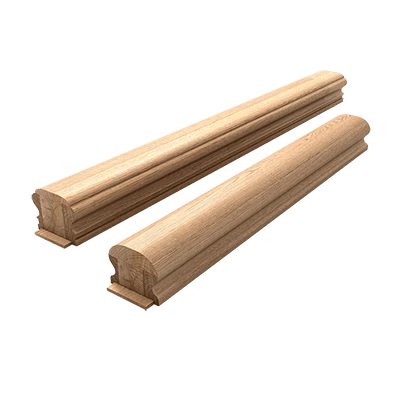
- How to choose a handrail to match the baluster style
- Interior style and baluster beauty: practical combinations
- Scenario 1: Classic country cottage
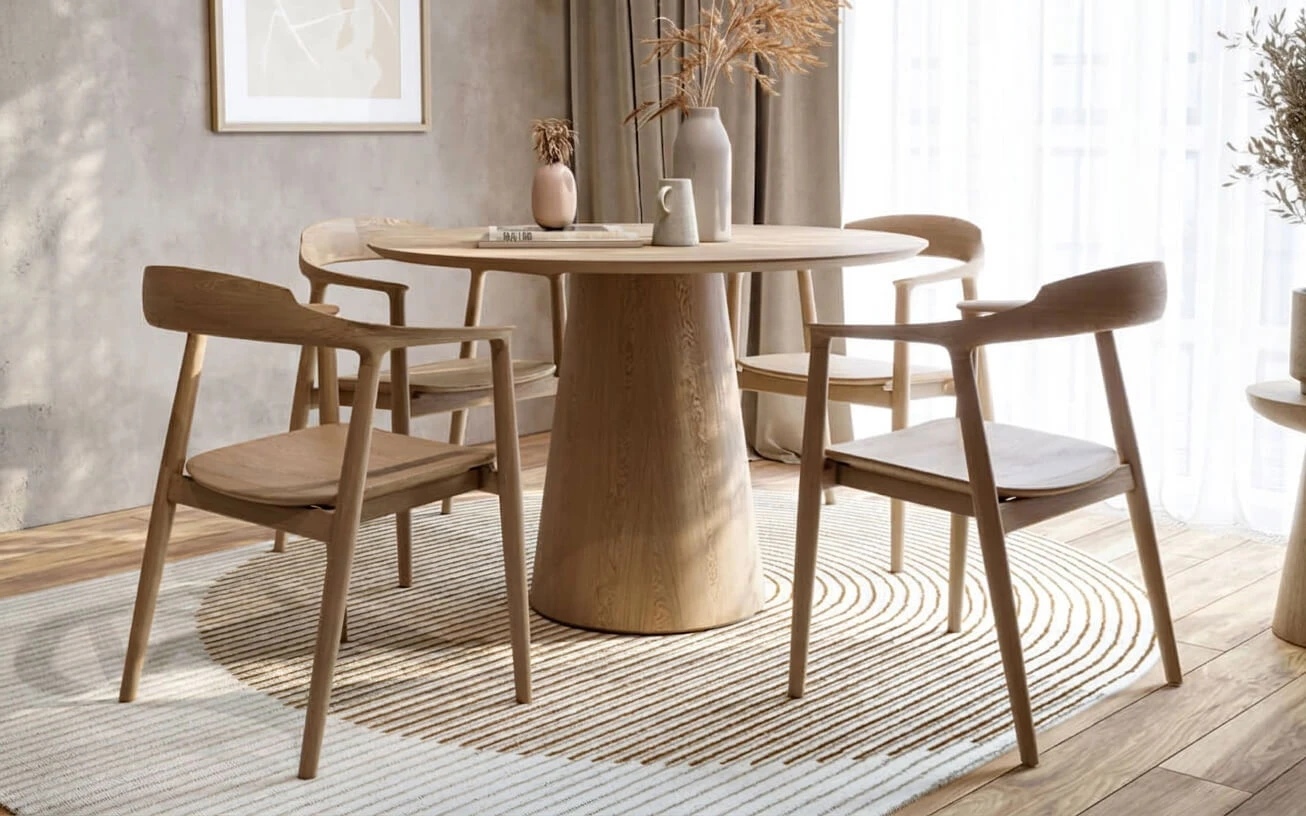
- Scenario 2: Scandinavian-style wooden house
- Scenario 3: Modern minimalist interior
- Scenario 4: Dacha and country house in rustic style
- How much do beautiful wooden balusters cost
- Pricing factors
- Estimated Prices
- How to calculate the budget for a beautiful railing
- Mistakes when buying beautiful balusters
- Mistake 1: chose only by photo, didn't consider scale
- Mistake 2: bought different batches at different times
- Mistake 3: mixed styles
- Mistake 4: didn't consider coating when choosing shape
- Error 5: forgot about the reserve
- Error 6: chose the most beautiful ones without assessing installation complexity
- Error 7: bought without posts and components
- Beautiful fencing kit: what's included
- About the Company STAVROS
- FAQ: Answers to Popular Questions
- Where can I buy beautiful balusters for stairs?
- Which balusters look the most expensive?
- What to choose: carved or flat balusters?
- Can you buy beautiful balusters and handrails as a set?
- How to choose balusters for a modern interior?
- How to choose balusters for a classic staircase?
- What determines the price of beautiful balusters?
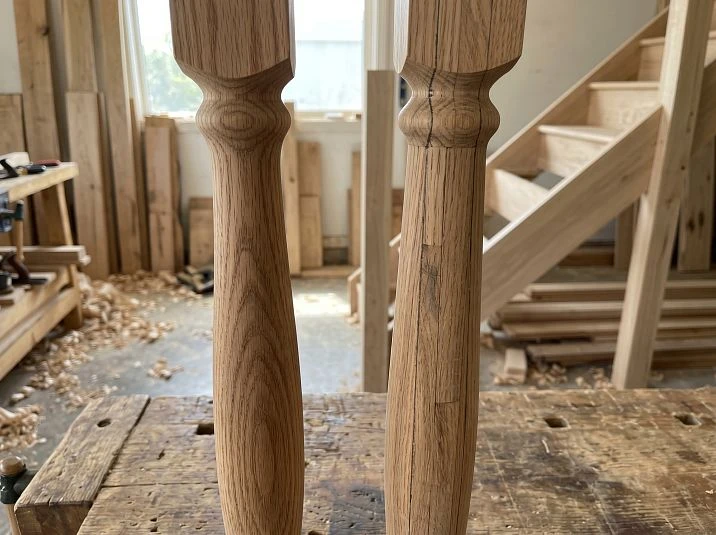
A staircase in a house is not just a route from the first floor to the second. It is the first thing a guest sees upon entering the hall. It is the axis of space around which the interior of an entire floor is built. And its appearance is determined not by the steps, not by the stringers, and not by the railings themselves—it is determined by the balusters. They create the rhythm of the railing, they catch the eye, they turn the staircase into an architectural statement or leave it as just a functional passage.
beautiful balusters for stairs — is not an abstract concept. Behind it lie specific parameters: shape, proportions, wood species, quality of processing, combination with the handrail and posts. This article is a detailed, honest discussion about how to choose wooden balusters that will make the staircase truly beautiful, not just "decent."
A staircase without beautiful balusters is like a suit without buttons
A well-designed staircase with poor railing is a disappointment. Good steps, a quality stringer, a solid structure—and cheap, ill-conceived balusters that ruin the entire effect. This is exactly the situation where details decide everything.
What do balusters do for a staircase?
They set the rhythm. A repeating element at equal intervals is a visual metric of space. The even step of good balusters creates a sense of order, quality, and thoughtfulness. An uneven step or heterogeneous elements are immediately noticeable carelessness.
They define the style. A turned baluster with three vases is classic. A square beam with a chamfer is modern or loft. A carved figure is a cottage tradition, warmth, coziness. The style of the baluster sets the style of the entire staircase, and through the staircase, the character of the whole house.
They influence the perception of price. Even in a modest-budget interior, a staircase with beautiful carved oak balusters under clear varnish gives the impression of an expensive, custom solution. Conversely, in an expensive interior, unsuccessful balusters lower the overall feel.
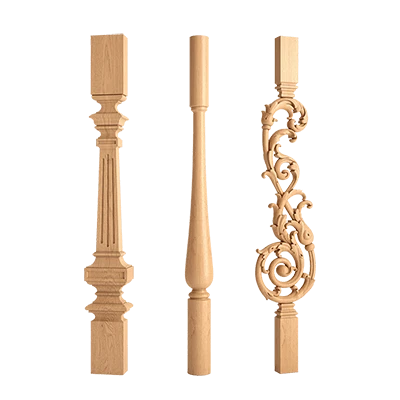
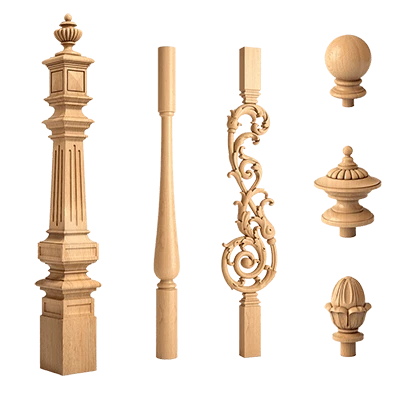
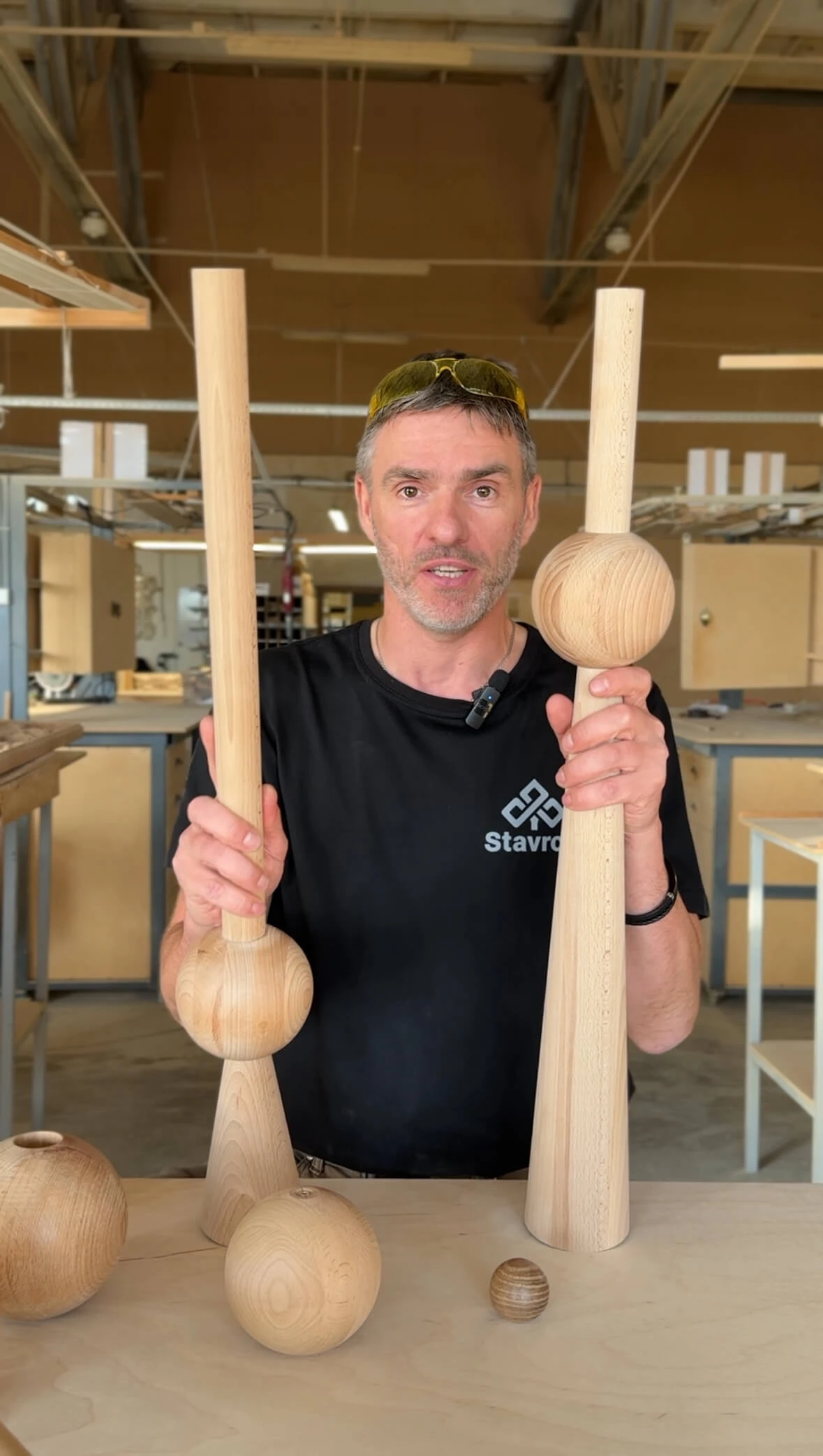
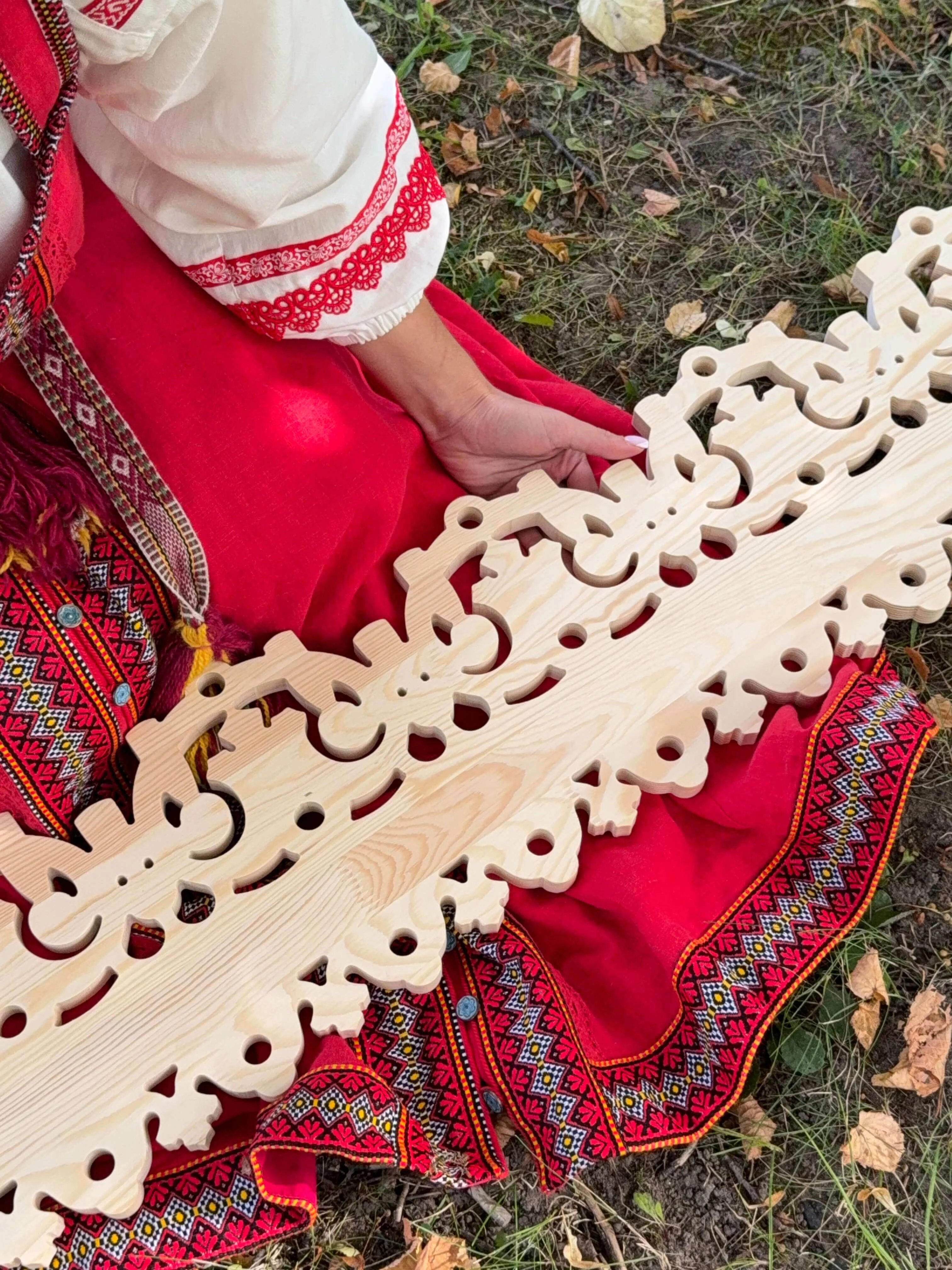
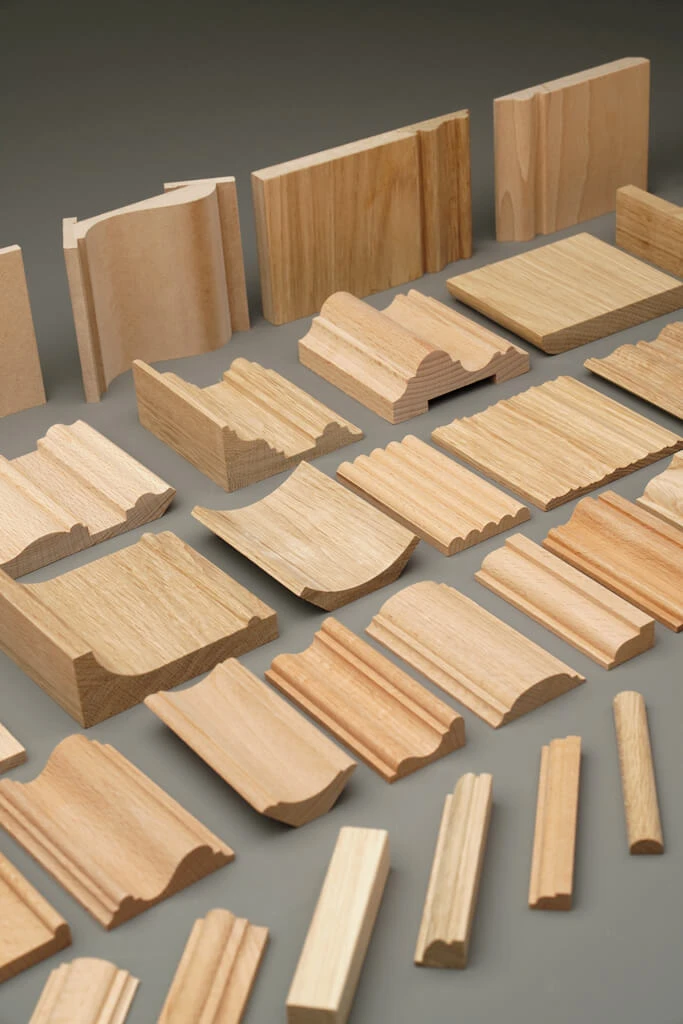
balusters for stairs photo of different shapes and wood species is the best way to start the selection. You look—and immediately understand which shape is "yours."
What actually makes a baluster beautiful
Here's a question rarely asked outright, but everyone has in mind. What does a "beautiful baluster" mean? Does it necessarily require intricate carving? Expensive wood? A non-standard shape?
No. The beauty of a baluster is not complexity, but appropriateness and quality of execution.
Our factory also produces:
Proportions
A baluster with correct proportions looks beautiful in any shape. What does this mean?
-
The ratio of height to diameter. A baluster that is too thin, 900 mm high with a neck diameter of 20 mm, will appear fragile and unreliable. One that is too thick will seem massive and heavy. The optimum for a turned baluster: vase diameter 50–65 mm, neck diameter 28–35 mm at a height of 900 mm.
-
The ratio with the handrail. The baluster should visually "support" the handrail, not "sink" under it. If the handrail is 70 mm and the baluster is ø35 mm, the handrail will dominate, and the railing will appear unstable. A balanced railing is when all elements are in the same scale.
-
Installation spacing. Too sparse — the railing looks "holey". Too frequent — it looks heavy. The correct spacing for a residential house is 130–160 mm between centers.
Get Consultation
Surface finish quality
Final sanding — what is felt by hand and seen by eye before coating application. A baluster with rough sanding P60–80 under clear varnish shows scratches, matte spots, and a sense of incompleteness. Final sanding P180–220 gives an even, smooth surface that literally glows under varnish.
Precision of tenon geometry — what is visible during installation. A tenon with a precise fit enters the groove without effort and without play. A tenon with a large tolerance wobbles, requires extra glue, and sometimes breaks during installation.
Batch Uniformity
Fifty balusters from different batches, from different blanks — that's fifty shades of the same wood. Under tinting — acceptable. Under clear varnish — every difference is visible.
A batch from a single selection, from one production cycle — guarantees a uniform tone and consistent results when coating.
Wooden balusters photo The best realized projects are not just inspiration, they are a clear demonstration of how correct proportions and quality of workmanship work.
Carved balusters: when the staircase is the decoration of the house
Buy carved wooden balusters means installing elements on the staircase that can, without exaggeration, be called a work of woodworking art. Turning and milling creates a shape that cannot be replicated by hand: smooth, perfectly identical contours from the first to the last baluster.
What carved balusters look like
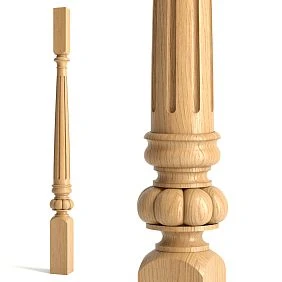
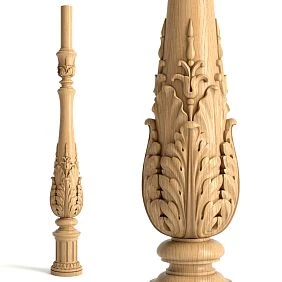
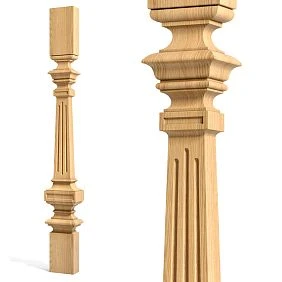
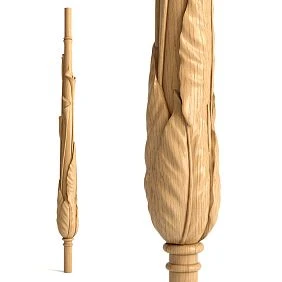
The body of a carved baluster consists of several levels of decor. The lower part is a square or round "pedestal." The body is a turned profile with vases, transitions, and tapers. Decorative elements are carved "leaves," "patterns," "waves," cut with a router over the turned profile. The upper part is again a square or round transition under the handrail.
The result is a sculpture 900–1000 mm high, which, when rhythmically repeated every 150 mm, creates a railing worthy of a staircase in a country cottage, classic house, or grand hall.
For which interiors are carved balusters indispensable
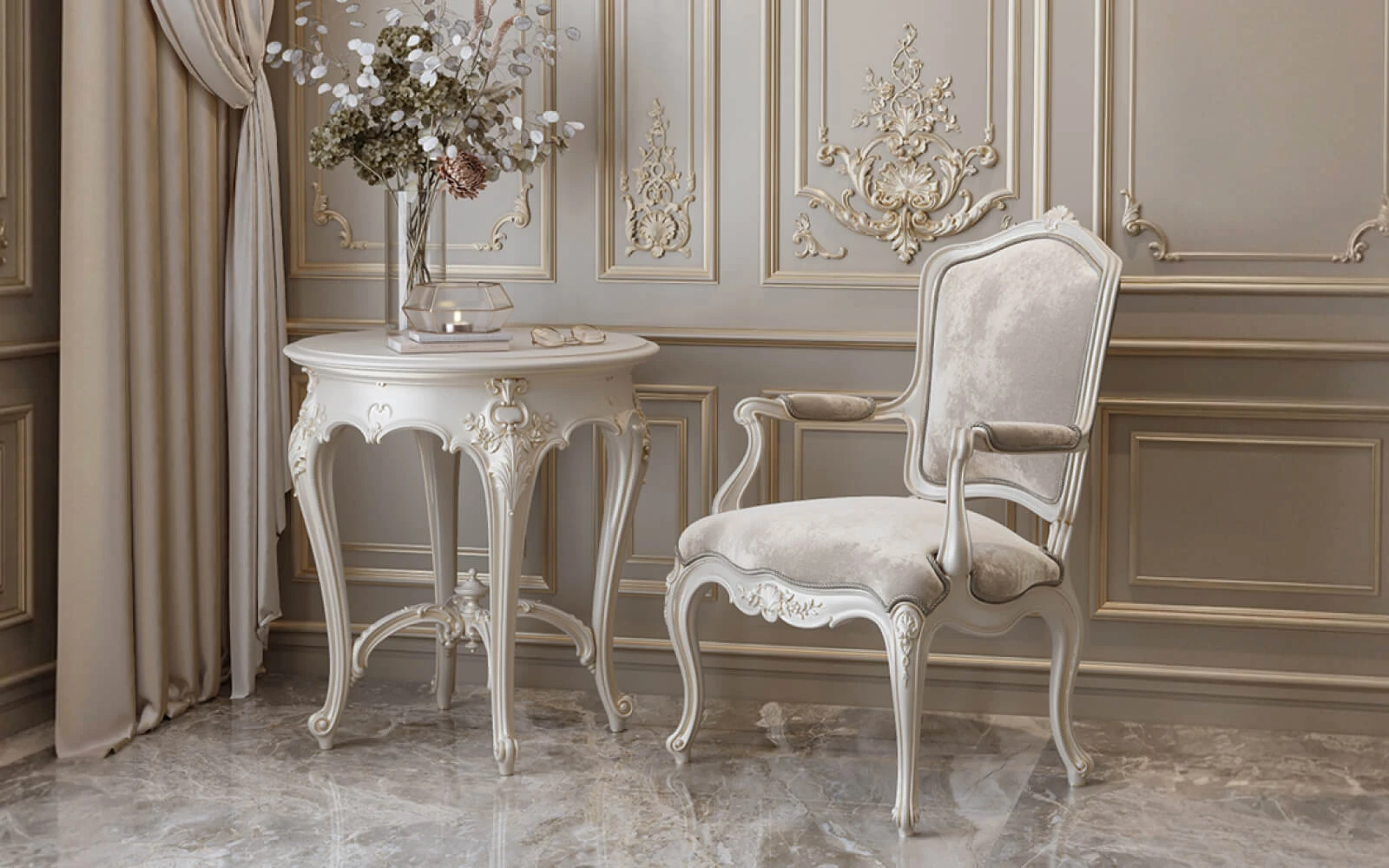
Classic and neoclassical interior. Wooden panels, stucco, dark oak, deep shades, massive furniture — here a carved baluster is as organic as no other. The staircase becomes the central element of the interior.
Cottage style. A wooden house with timber walls, open beams, a large fireplace — carved balusters made of pine or beech with a warm brown tint create the atmosphere of a real country house with history.
Country and Provence style. Here the carving works differently: the balusters are covered with white or cream opaque paint, and the railing acquires a light, airy character. The carved relief under white enamel is that very "French" image of the staircase.
A wooden house. A house built from logs or profiled timber requires decorative fencing — carved wooden balusters are the only organic choice here.
Technical parameters of carved balusters
| Parameter | Value |
|---|---|
| Working part height | 900–1000 mm |
| Vase diameter (maximum) | 55–75 mm |
| Neck diameter (minimum) | 28–38 mm |
| Square base thickness | 45×45 or 50×50 mm |
| Lower/upper tenon | ø18–25 mm, length 40–70 mm |
| Wood species | pine, beech, oak |
| Finish | varnish, stain, tint, paint |
For clear varnish — only beech or oak. For paint — pine, beech. For tinting — beech, oak.
Turned balusters: calm classics without unnecessary words
Turned balusters are the gold standard of wooden railings. Not too simple, not overloaded with decor. Recognizable, traditional, suitable for most interiors from classic to moderately modern.
Range of complexity of turned balusters
Turned balusters can be so different that "turned" is more of a technology than a style. Look:
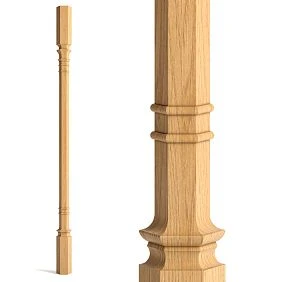
Simple turned (2 vases). Almost laconic, almost square in spirit — but with two soft thickenings on a thin rod. Suitable for a wooden house, cottage, interfloor staircase in a modest private home.
Medium complexity (3–4 vases, transitions). This is the most popular form: expressive enough for the railing to look beautiful, and not so overloaded as to require complex painting. For most private homes — the optimal choice.
Complex turned (5–7 elements, thin transitions, contrasting thickenings). This is already a decorative piece. Such a baluster in profile is almost an arabesque of curves. For a classic staircase, grand hall, cottage with rich decor.
buy balusters for the staircase of turned form — it's a choice between levels of expressiveness, not between "beautiful" and "ugly".
Turned balusters for various types of coatings
A turned beech baluster under white enamel — a neutral, modern, "IKEA-style" railing in the best sense. Works in any interior without pronounced historicity.
A turned oak baluster with walnut-brown tinting and a matte finish lacquer — this is the image of a classic English library, understandable without words.
A turned pine baluster under a light antiseptic of natural tone — this is a country or Scandinavian option: airy, warm, unpretentious.
Square and flat balusters for modern interiors
There was a time when a square baluster was perceived as a budget option "for those who don't want to spend." Now it's one of the most relevant designer choices. Why?
Square balusters: geometry as aesthetics
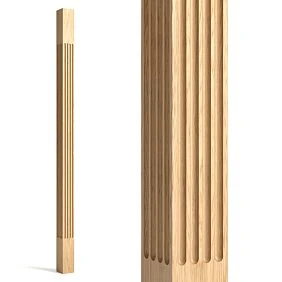
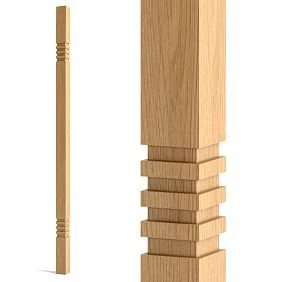
square balusters for stairs — this is a 40×40 or 45×45 mm beam, processed with precise chamfers on the edges. No turned curves, only straight lines.
In a modern minimalist interior, this is the norm. Rectangular step profile, straight stringer, straight handrails, and square balusters — this is an ensemble where every detail confirms the concept. No randomness, no "a little bit of everything."
Under which coating do square balusters look best?
-
White matte enamel — Scandinavian, light, airy. The square shape under white is almost architectural graphics.
-
Black or dark gray opaque paint — loft, industrial style. A square baluster with a black handrail and metal accents is very modern.
-
Clear oil — for species with expressive straight grain. Ash under oil gives longitudinal fibers that, combined with square geometry, look clean and precise.
Flat balusters: wooden graphics
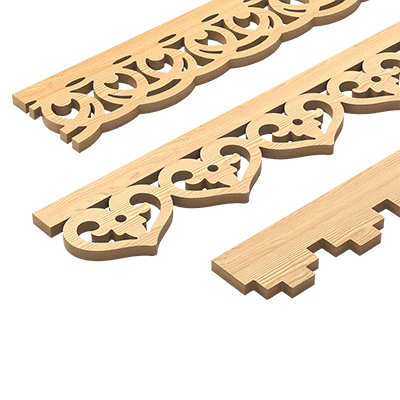
Buy flat balusters — means getting an element that looks completely different from all turned shapes. It is a solid wood plank 80–120 mm wide and 20–28 mm thick with a figured contour.
A flat baluster is two-dimensional. Front view — wide, expressive, with a decorative silhouette. In profile — almost invisible.
This creates an interesting optical effect: the railing looks different when viewed from the front and from the side. The figured silhouette of a flat baluster is a light, almost lace-like image. It works especially well on a veranda, terrace, or in a wooden house with open galleries.
Buy flat baluster made of beech under white paint for a classic veranda — this is an image that is easy to imagine and works flawlessly.
Comparison of shapes by style and application
| Shape | Interior style | Finish | Painting complexity |
|---|---|---|---|
| Carved | Classic, cottage, country | Varnish, tinting, paint | High |
| Turned complex | Classic, neoclassic | Varnish, tinting | Medium |
| Turned simple | Classic, dacha | Paint, tinting | Medium |
| Square | Modern, minimalism, loft | Paint, oil | Low |
| Flat | Dacha, wooden house, provence | Paint | Very low |
How to choose a wood species for a beautiful staircase
Shape is the outline. Species is the content. Two identical profiles made of pine and oak under clear varnish look fundamentally different. And it is the species that often determines how "expensive" a baluster looks.
Oak: the most beautiful wood for a grand staircase
Oak under clear varnish is a pattern you can observe endlessly. Large pores with a characteristic mirror-like sheen on the radial cut, a honey-brown tone with transitions from light to warm, thin dark lines of annual rings — all this makes an oak baluster a true artistic piece.
Buy oak balusters For a grand staircase under clear varnish, it is an image that requires no additional decoration. Oak speaks for itself.
Additional advantages of oak for staircase railings:
-
Hardness 3.7–3.9 units on the Brinell scale — resistance to scratches and dents
-
Natural tannins — biological stability without additional treatment
-
Durability: an oak railing with proper care lasts 50+ years
-
Accepts oil, wax, varnish, stain well — coating options are virtually unlimited
Beech: practical beauty
Buy beech balusters — a choice where beauty, practicality, and price strike the right balance.
Beech does not have as expressive a grain as oak. Its texture is fine, even, with small "sparkles" on the end cut. Under a clear coating, beech looks neat and neutral — and this is what makes it a versatile material for painted surfaces.
A beech baluster under white matte enamel is ideal. The paint surface is smooth, without spotting, without resin streaks, without tonal differences.
A beech baluster with a "white oak" stain — fresh, Scandinavian, modern. Under "walnut" — warm, classic. Under "wenge" — dark, strict, with good contrast.
Pine: Know the Limitations
Pine for a beautiful staircase in a private home is a controversial choice. Under a transparent coating, pine gives an uneven yellow tone, large knots, and resin pockets that emerge when heated. Under opaque paint, it's better, but the softness of the wood (2.5 on the Brinell scale) means balusters will scratch more easily and dents will be noticeable.
For a dacha under paint and for interiors where the staircase is not the main focus — pine is a working option. For a beautiful grand staircase with a claim to quality — no.
Ash: Nordic Character
Ash is an underestimated wood species for staircases. Long parallel fibers, an almost white base tone, an expressive transition from light sapwood to dark heartwood — under clear oil or light varnish, it is a mesmerizing surface.
For a Scandinavian interior, for modern style with natural tones, for light laminated floors — ash balusters under oil will look both organic and expensive.
How to Choose Beautiful Balusters for Handrails and Posts
A baluster never exists on its own. It is part of an ensemble: the handrail on top, posts on the sides, steps below. The beauty of the railing is the beauty of the system, not of a single element.
Scale: everything in one key
The main rule: elements must be in the same scale. If the baluster is turned ø50 mm — the handrail should be ø50–60 mm, not 90 mm. If the baluster is square 45×45 mm — the post should be 80×80 or 100×100 mm, not 150×150 mm. Mismatched scales create a feeling of randomness and incompleteness.
Buy balusters and posts for a wooden staircase From the same series — this is the only way to ensure large-scale consistency.
Decor: style within a single image
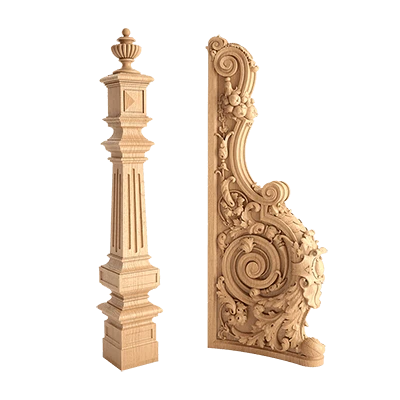
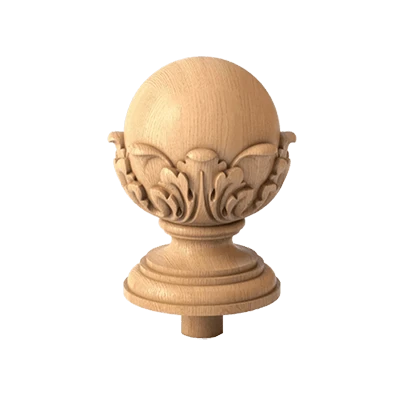
If the balusters are carved, the posts must be equally expressive in decor: profiled, with a carved capital, with a finial in the same style. A simple straight post next to a luxurious carved baluster creates dissonance.
If the balusters are square, the posts are straight, without excessive decor. The handrail has a minimalist profile. Wooden stair posts in the same style as the balusters — this is a coordinated system, not a set of random details.
Wood species and finish: one color, one tone
Balusters, handrail, posts — one wood species. With the same finish, the result is identical. This rule has no exceptions for transparent finishes. For opaque finishes, there is slightly more flexibility, but even here it is better to work with one wood species.
Wooden balusters and railings for stairs from the same batch, same grade, same wood species — the standard for a professional order.
How to choose a handrail to match the style of the balusters
| Baluster shape | Handrail profile | Handrail height |
|---|---|---|
| Carved, complex turned | Semicircular or oval ø55–70 mm | 900 mm from step |
| Simple turned | Semicircular ø45–55 mm | 900 мм |
| Square | Rectangular with chamfers 60×40 mm | 900–950 mm |
| Flat | Light semicircular ø40–50 mm | 900 мм |
Interior style and beauty of balusters: practical combinations
Theory without examples is incomplete. Let's break down a few real-world scenarios.
Scenario 1: Country cottage in classic style
Stone or brick house, interior with wooden panels, marble floor in the hall, dark furniture. The staircase is grand, with a wide flight of 1,200–1,400 mm.
Choice of balusters: carved or complex turned oak. Oak with rich brown tint and matte varnish. Handrail oak ø65 mm semicircular. Oak posts 120×120 mm with carved finial.
Effect: a grand, confident, expensive railing. Such a railing needs no explanation or addition—it speaks for itself.
Scenario 2: Wooden house in Scandinavian style
Timber walls, exposed beams, large windows, light ash or light oak flooring, white textiles.
Choice of balusters: square ash or beech with light oil or clear varnish. Handrail: ash, with a minimalist rectangular profile. Newel posts: straight, 100×100 mm.
Effect: an airy, light, honest railing. Natural wood in its natural color—this is the Scandinavian look that appears expensive without being so.
Scenario 3: Modern Minimalist Interior
Gray walls, concrete, glass, metal, dark parquet. Staircase — strict, with metal stringers.
Choice of balusters: square oak or beech painted matte black or dark gray. Handrail — rectangular oak painted. Posts straight 80×80 mm in the same finish.
Effect: graphic, modern, with character. Black wood combines warmth and strictness, working well in a minimalist space.
Scenario 4: Country house and cottage in rustic style
Log walls or imitation timber, warm tones, homespun fabrics, ceramics.
Choice of balusters: turned pine or flat beech painted white or cream. Handrail semi-circular in the same color. Posts with simple decoration.
Effect: cozy, homely, "dacha-style" railing in a good sense. Not expensive, but thoughtful and neat.
How much do beautiful wooden balusters cost
Balusters price — this is a variable that is important to understand in the system. The price of one baluster is multiplied by 30–80 pieces, posts, handrail, fasteners are added — and the budget of the entire railing is formed.
Pricing Factors
Shape: simple square → flat → simple turned → complex turned → carved turning-milling. Each step — price increase by 30–60%.
Wood species: pine < beech < ash < oak. The difference between pine and oak is 2.5–3 times.
Processing quality: basic sanding (P80) → finishing (P180–220). Price difference is 10–15%, but the difference in result is fundamental.
Order volume: batch of 50 pieces — discount of 5–15% from most manufacturers.
Estimated prices
| Shape | Pine | Beech | Oak |
|---|---|---|---|
| Square 45×45×900 | from 700 rub. | from 1,400 RUB | from 1,900 RUB |
| Flat 900 mm | from 650 rub. | from 1,600 RUB | from 2,200 rub. |
| Turned simple | from 900 rub. | from 1,900 RUB | from 2,600 rub. |
| Turned complex | from 1,500 RUB | from 2,800 RUB | from 3,500 RUB |
| Carved milling-turning | from 2,400 RUB | from 4,500 RUB | from 5,800 RUB |
Current Buy balusters price — in the catalog with filtering by shape, breed, and height.
How to calculate the budget for a beautiful fence
Let's take a front staircase: single-flight, 14 steps, width 1,200 mm, plus the railing of the second floor landing 3,000 mm.
| Element | Quantity | Price (oak, turned complex) | Total |
|---|---|---|---|
| Turned oak balusters | 48 pcs. | 3,500 RUB | 168,000 RUB |
| Posts 100×100×1200 oak | 6 pcs. | 7,500 RUB | 45,000 RUB |
| Oak handrail ø60 | 12 lin. m | 2,500 RUB/m | 30,000 RUB |
| Fasteners, finials, strips | — | — | 8,000 RUB |
| TOTAL | ~251,000 RUB |
For beech — divide by approximately 1.7–1.9. For pine — by 3–4.
Mistakes when buying beautiful balusters
Mistake 1: chose only by photo, didn't consider scale
In the photo, the baluster looked perfect. In reality — too thin next to a massive handrail. Or too large for a narrow staircase.
Solution: before ordering, check proportions on a paper mockup or request actual dimensions of all elements from the manufacturer.
Mistake 2: bought different batches at different times
The first set of balusters — one tone under varnish. The second — slightly different. It's visible on the finished staircase. Redoing it is expensive.
Solution: order the entire volume at once, in one batch.
Mistake 3: mixed styles
We took carved balusters, paired them with a modern rectangular handrail and simple straight posts. There's no ensemble, just a set of elements from different stories.
Solution: handrails and balusters made of wood select within a single style system. Carved balusters — carved or profiled posts. Square balusters — minimalist posts and handrail.
Error 4: didn't account for coating when choosing the shape
We bought carved balusters and decided to paint them ourselves with a brush. Spent three days on 40 balusters. The result is not very even. For carved balusters under paint, you need a sprayer or a painter's services.
Solution: when doing the finishing yourself, choose shapes that are easy to paint — square or flat. For carved and complex turned shapes, use a sprayer or professional finishing.
Error 5: forgot about the spare
We took exactly according to the calculation. During installation, we broke two tenons, one fell from a height — a crack. Reorder — a different batch, a slightly different shade. Noticeable.
Solution: always +10% to the calculated quantity.
Error 6: chose the most beautiful ones without assessing the installation complexity
We took balusters with a non-standard tenon that was incompatible with the existing handrail. We had to mill the handrail to a non-standard size.
Solution: before ordering, check the compatibility of the baluster tenon with the handrail groove. In systems from one manufacturer, this is resolved automatically.
Error 7: bought without posts and components
"We'll find posts elsewhere." The result: a different wood species, a different tone under the same stain, an incompatible groove size. A compromise during installation.
Solution: Buy railings and balusters for stairs together with posts and accessories from one manufacturer — a system solution without compromises.
Beautiful fencing kit: what's included
Proper fencing is always a system. Let's list the full composition.
-
Balusters — the main repeating element, selected by shape and wood species
-
Handrail — in linear meters, compatible with the baluster tenon groove
-
Pillars — 2 for each flight plus at turning points
-
Bottom baluster rails — fastening and base protection
-
Fasteners — M8 studs, nuts, washers, glue
-
Post caps — decorative and protective function
-
Handrail end caps — for a clean finish
Buy a set of balusters for stairs with a full set — one order, one delivery, guaranteed compatibility of all elements.
buy staircase components in full assortment — in the unified STAVROS catalog.
The technique for correctly installing a railing with a step-by-step description of each operation — see the material on installation of wooden railings and balusters.
About the company STAVROS
STAVROS — Russian manufacturer of solid wood products since 2002. Full production cycle: raw material selection, chamber drying to 8–10%, CNC turning and milling, multi-stage sanding.
Catalog of balusters — over 50 models: carved, turned of varying complexity, square, flat. Wood species: pine, beech, oak, ash. All elements are produced in serially compatible systems: baluster tenon → handrail groove → post series — guaranteed fit without adjustment.
Pickup from Moscow and St. Petersburg. Contact us to confirm shipping to your destination. Free calculation of the complete set based on staircase parameters. Consultation on choosing shape, wood species, and coating — no obligation.
FAQ: Answers to popular questions
Where to buy beautiful balusters for stairs?
In the STAVROS catalog — over 50 models of wooden balusters: carved, turned, square, flat. Oak, beech, pine, ash. Posts, handrails, and accessories in a unified system. Contact us to confirm shipping to your destination.
Which balusters look the most expensive?
The most expensive are carved and complex turned oak balusters with clear varnish or rich tinting, combined with massive decorative posts.
What to choose: carved or flat balusters?
Carved — for a classic staircase, cottage, grand hall. Flat — for a dacha, wooden house, veranda, light railings, and interiors in Provence or country style.
Can I buy beautiful balusters and railings as a set?
Yes — and this is the best strategy. Balusters, handrail, posts, fasteners from one system from one manufacturer = guaranteed compatibility and identical tone.
How to choose balusters for a modern interior?
For a minimalist modern interior — square or flat balusters made of beech or oak for painting or oil. A laconic handrail, straight posts. No carving.
How to choose balusters for a classic staircase?
Turned complex shapes or carved, made of oak or beech. For tinting or clear varnish. Decorative posts, rounded handrail profile. Installation step 130–150 mm.
What determines the price of beautiful balusters?
Wood species (pine, beech, oak), shape (square, turned, carved), height, sanding grade, workpiece grade, order volume. Full price catalog at stavros.ru.