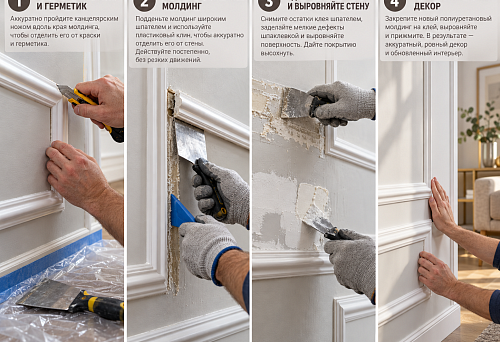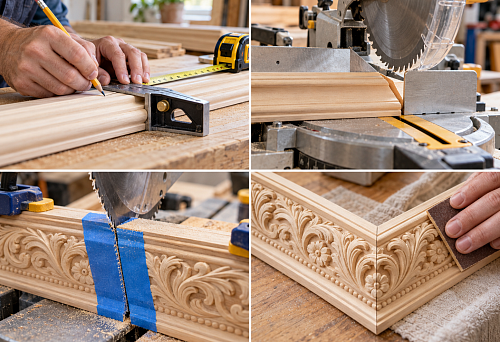































































Article Contents:
- Identical 120 × 17 × 930 mm dimensions still don't make KPU-130 and K-130 the same
- What exactly we compare: a short table without promotional conclusions
- "Under enamel" is a finish, not a material name
- What opaque enamel hides
- What enamel doesn't change
- The material must be visible
- The material is not visible, but is structurally important
- The material is not visible and is not part of the joinery logic
- Practical scenario #1: the entire wall is painted in one color
- Practical scenario #2: solid wood sideboard under white enamel
- Practical scenario #3: MDF facades painted together with the decor
- Practical scenario #4: oak furniture with a clear finish
- Practical scenario #5: decorative band on a long wall
- Practical scenario #6: a single piece above a door or furniture
- Practical scenario #7: twenty identical elements in a commercial interior
- If doubt remains after the table
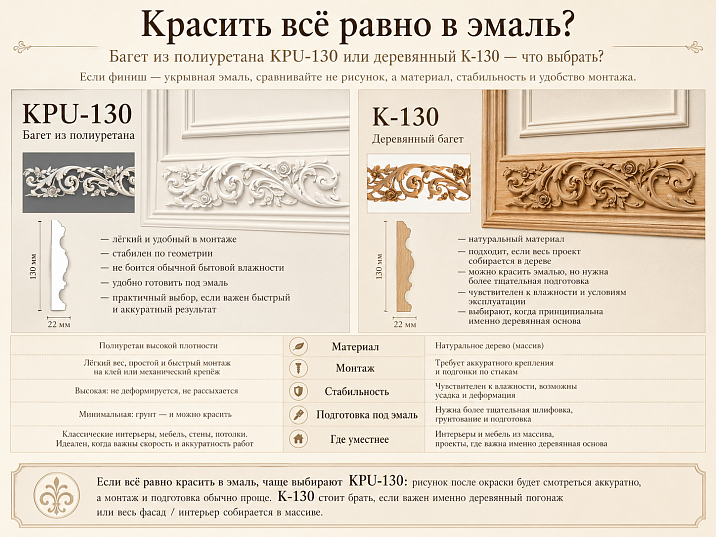
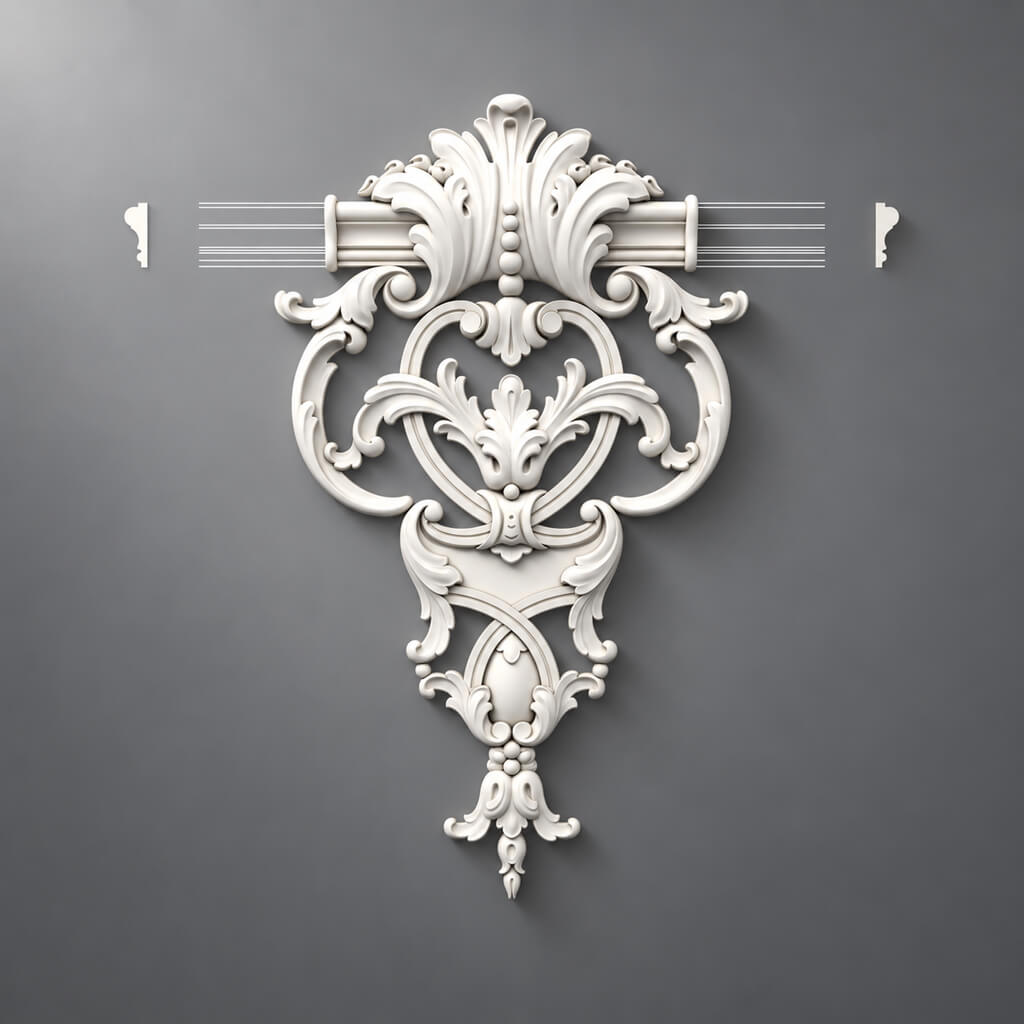
The project is almost decided. A long ornamental element measuring 120 × 17 × 930 mm is needed. The color will be opaque: white, complex gray, deep green, blue, beige — it doesn't matter. After painting, neither the owner nor the guest will see the natural wood texture. And so, two seemingly similar options end up in the cart: polyurethane KPU-130 and wooden K-130.
Their dimensions are the same. Their purpose overlaps. Both can be used in decorative finishing of walls, panels, doors, or furniture. But the material is different, so comparing these products only by photo or price per piece is incorrect.
If the task is to get a painted ornamental relief and keep the polyurethane system in the project, KPU-130 becomes the first candidate. If the decor should remain part of a wooden product, the project is based on solid wood, involves tinting, or requires subsequent joinery work, K-130 retains its own meaning even under enamel.
So the question becomes simpler and more honest: if you're going to paint with opaque enamel anyway, what exactly are you paying for — the look of the finished ornament or the material it's made from?
For a project where natural texture isn't needed and polyurethane molding is specifically required, you can buy decorative molding KPU-130 after checking the base, installation method, and number of elements. But before placing an order, it's useful to separate two things that buyers often mix up: the color of the finished surface and the material of the part itself.

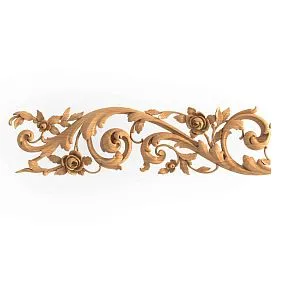
Identical 120 × 17 × 930 mm doesn't make KPU-130 and K-130 the same
It is precisely the matching dimensions that create a strong sense of interchangeability.
Both products have:
-
width — 120 mm;
-
thickness — 17 mm;
-
length — 930 mm.
If you look only at the three numbers, it seems that we are facing the same decorative task in two materials.
In practice, the identical dimensions mean only one thing: both products can be compared for the same project area. They occupy the same rectangular field, so it is convenient for a designer or furniture maker to compare which material fits better into a specific base and finish.
But the same size does not eliminate the differences in material.
KPU-130 is polyurethane.
K-130 is natural wood; the card presents options in beech and oak.
These are already two different technological routes.




What exactly are we comparing: a short table without promotional conclusions
| Parameter | KPU-130 | K-130 | What this means before ordering |
|---|---|---|---|
| Size | 120 × 17 × 930 mm | 120 × 17 × 930 mm | Can be compared in one project area |
| Material | Polyurethane | Beech or oak | Different logic of base and finishing |
| Main article scenario | Painted decorative relief | Wooden decor, including under enamel | |
| Current price of the base option | 9 990 ₽ | 10,700 ₽ for beech / standard / under enamel | The difference of one detail is small and should not decide the choice on its own |
| Possibility to preserve the wood texture | No | Yes, in the corresponding version | If a wood look is needed, the choice changes immediately |
| Wood preparation options | Not applicable | For enamel / for tinting according to the card | For wood, the finish is tied to the grade of the workpiece |
| Category | Polyurethane molding | Wooden picture frame molding | Different product systems |
The comparison becomes interesting precisely when both options will still be covered with opaque enamel.
If a natural oak look is needed, the argument ends before the table: KPU-130 should not imitate a wood material that is important in the project in itself.
Our factory also produces:


"Under enamel" is a finish, not a material name.
Perhaps this is the main thesis of the entire article.
The phrase "everything will be under enamel" often makes the buyer reason as follows:
since the wood is not visible anyway, the material does not matter.
But the material continues to matter for manufacturing, installation, processing, repair, and connection to the base.
Opaque enamel only makes two products visually closer after finishing. It does not turn polyurethane into wood, nor wood into polyurethane.
Get Consultation
What opaque enamel hides
It covers:
-
wood color;
-
natural tone;
-
the visual difference between the slats;
-
part of the differences in surface texture after appropriate preparation.
What enamel does not change
It does not change:
-
base material;
-
the processing technology;
-
the preparation method;
-
the part's relation to a wooden or mineral structure;
-
the possibility of further joinery restoration;
-
the very principle of product selection.
That is why the comparison should be made not in the spirit of "which material is generally better," but through the specific task of the project.
When KPU-130 becomes the most obvious choice
KPU-130 logically comes first on the list when the buyer needs a ready-made polyurethane ornamental element for painting.
For example:
-
the decor is installed on a wall or decorative wall panel;
-
the entire composition is already assembled from polyurethane elements;
-
the product must be painted together with the wall;
-
natural wood texture is not part of the design at all;
-
there is no requirement that the decorative detail be part of a solid wood product;
-
one material is needed in the polyurethane molding system.
In such a task, a tree may be technically possible, but it does not add additional value to the project.
And then order KPU-130 made of polyurethane is rational precisely because the material matches the logic of the entire decorative system.
When wooden K-130 remains meaningful even under opaque enamel
The opposite situation — furniture or a joinery product where the entire surroundings are already made of wood.
Solid wood cabinet.
Sideboard.
Door.
Panel assembled in a joinery workshop.
The frame, which will later be repaired using the same methods as the other wooden parts.
Here buy wooden K-130 can be not for the sake of visible texture, but for the material unity of the product.
That is, opaque enamel hides the wood grain, but does not negate the fact that the entire item is made in one joinery system.
Beech under enamel: why does such a variant even exist if the wood is not visible
The K-130 card shows important logic.
For the "under enamel" variant, wood lamellas do not have to be matched by color and texture as they would for transparent or semi-transparent finishes. Precisely because the opaque layer will cover the visual heterogeneity.
This does not make the material "worse."
This means that the workpiece is prepared for a different type of finish.
For the buyer, the conclusion is simple: if K-130 is chosen and it will be painted opaquely, you need to order the corresponding version under enamel, rather than overpaying for preparation designed to showcase the wood grain.
Oak for tinting is a completely different task
If the designer wants to preserve and emphasize the wood grain, comparing with KPU-130 loses most of its meaning.
Oak under a translucent coating exists precisely for the natural texture.
The polyurethane element should not imitate what the project requires to be made from real wood.
Therefore, before choosing, ask one short question:
Should the texture be visible after the finish or not?
If yes — first, consider the wooden route.
If no — only then does the full fork between KPU-130 and K-130 for enamel appear.
Price of one part: there is a difference, but it is too small to choose based on it alone
At the time of preparing the material:
KPU-130 — 9 990 ₽.
K-130 from beech, standard, under enamel — 10,700 ₽.
The difference is 710 ₽ per part.
This is less than seven percent of the cost of the wooden version.
Therefore, an article that would end with the phrase "polyurethane is cheaper — take it" would be useless.
What happens in the series
For 2 elements:
-
KPU-130 — 19 980 ₽;
-
K-130 — 21 400 ₽;
-
the difference is 1,420 ₽.
For 4:
-
KPU-130 — 39 960 ₽;
-
K-130 — 42 800 ₽;
-
the difference is 2,840 ₽.
For 6:
-
KPU-130 — 59 940 ₽;
-
K-130 — 64 200 ₽;
-
difference — 4,260 ₽.
For 10:
-
KPU-130 — 99 900 ₽;
-
K-130 — 107 000 ₽;
-
difference — 7,100 ₽.
In a large batch, the difference becomes more noticeable, but still you first need to choose the right material, and then calculate the economics.
Wall and furniture are different bases, so one piece of advice doesn't work for both
This is perhaps the second main criterion after the finish.
On the wall, KPU-130 exists as part of decorative finishing.
On furniture, K-130 can be part of the product itself.
The difference is not only aesthetic.
Wall composition
If the ornament is placed on a painted wall, inside a frame, or a decorative panel, the polyurethane option naturally fits into the system Decorative polyurethane moldings.
Here, the buyer more often needs:
-
relief;
-
identical repeatability;
-
painting in the color of the wall;
-
compatibility with other polyurethane parts.
Furniture composition
If K-130 is part of a wooden cabinet door, panel, sideboard, or frame, the material is already tied to the item's structure.
In that case, the wooden option may remain logical even under dense enamel.
You don't need to choose polyurethane just because the surface is a wall
That's also too rough a rule.
Wooden decor is also used on walls.
The question is different: what material supports the entire project system.
If the wall is finished with wooden panels and the baguette should continue their material, K-130 might be more accurate.
If it is a painted mineral surface with polyurethane moldings, KPU-130 looks more consistent as a product route.
You don't need to choose wood just because the surface is furniture.
Polyurethane decor is also used on furniture facades.
If the body and facade are painted, natural wood texture is not a value, and the project allows a polyurethane overlay part, KPU-130 can close the task without needing to introduce solid wood just for the ornament.
That's exactly why there is no universal rule of "furniture = wood".
The key question: should the material be visible or work inside the structure.
Conventionally, all projects can be divided into three groups.
The material must be visible
Need a wood texture.
Tinting is needed.
A transparent or semi-transparent finish is needed.
Here, K-130 has an obvious advantage due to the very nature of the material.
The material is not visible but is structurally important
Everything is painted with enamel, but the product is assembled as a joinery system from solid wood.
Then K-130 may remain preferable.
The material is not visible and is not part of the joinery logic
Only a painted decorative relief on a wall, panel, or other base is needed.
This is where KPU-130 becomes a particularly strong candidate.
Why the same pattern under enamel still cannot be considered the "same product"
The buyer sees the ornament first.
The master sees the base.
The designer sees the connection of the material with the rest of the project.
And all three are right.
When choosing, you need to combine these three views.
KPU-130 and K-130 can occupy the same field and, after painting, produce a similar decorative effect, but the route to that effect will differ.
One size simplifies project replacement, but does not make it automatic.
The match of 120 × 17 × 930 mm is very convenient.
If the drawing already includes K-130, the designer can physically check KPU-130 in the same area without recalculating the rectangular footprint.
But then you need to check:
-
mounting method;
-
base;
-
the fit with adjacent parts;
-
finish;
-
the acceptability of the material in the specific product.
That is, geometric replacement is simple, but technological replacement requires verification.
Before ordering one SKU, it is worth doing a real layout.
Even with the same size, you should not choose based on a table alone.
If the project is important, especially furniture, it is useful to order or obtain a material sample or do a test layout in an accessible way.
Enamel color can visually hide the material, but the relief, edges, and light-and-shadow still need to be assessed on a real surface.
Decorative molding under enamel: color should not decide the material question alone
In the category, you can also select and buy molding for a fully painted interior, but the commercial choice does not start with color.
It is better to do the order as follows:
-
determine the base;
-
understand whether natural wood is needed;
-
determine the finish;
-
check the size;
-
compare the price;
-
choose the mounting system;
-
place the order.
If you rearrange the items and start with the price, the likelihood of an erroneous SKU becomes higher.
What happens if you choose KPU-130 just because it is slightly cheaper
In the best case, everything will fit, and the buyer will simply get the desired result for a lower amount.
In the worst case, it will turn out that the project initially requires exactly a wooden material: for example, for joinery processing, tinting, or a unified structure.
Then saving 710 ₽ on the part makes no sense.
What happens if you choose K-130 "because wood is more prestigious"
The opposite mistake.
If the decor is mounted on a painted wall, covered with opaque enamel, and the natural wood is not revealed in any way, the buyer may pay for a material property that is not used in this project.
This does not make wood a bad choice.
This makes the choice unsubstantiated.
The right question is not "what is more expensive" but "what property am I using"
For KPU-130, the value is its function as a polyurethane decorative element.
For K-130, it's belonging to wooden decor, the ability to work with the wood species and finish.
If the project does not use the advantage of a specific material, it is worth checking an alternative.
If a project is already assembled from polyurethane, KPU-130 doesn't need to be justified only by price.
One of the most understandable scenarios is a wall where polyurethane moldings, rosettes, decorative overlays, or other trim are already present.
In such a system, KPU-130 is not a "replacement for real wood." It is part of the same material logic.
The buyer receives:
-
the same type of base within the decorative system;
-
predictable work with painting;
-
a unified approach to selecting matching polyurethane elements;
-
no need to introduce a separate wooden material just for a single ornamental belt.
In this situation Moldings made of polyurethane and KPU-130 can be considered as elements of one decorative program, rather than as products from different technological worlds.
If the project is already assembled from wood, K-130 does not become meaningless because of the enamel
Let's imagine a cabinet made of beech, a door frame, a carved panel, or another joinery construction.
All parts are made of wood.
The finish is opaque enamel.
Yes, after painting, the natural texture is not visible.
But the craftsman continues to work with the wooden product: sanding, fitting, repairing, joining elements in one joinery system.
In such a project, K-130 makes sense not as "visible wood," but as a material continuation of the structure itself.
Polyurethane and wood respond differently to the question 'what to do in a few years'
This is an important criterion that is rarely considered at the moment of purchase.
Wooden decor can be included in the usual cycle of joinery restoration: local sanding, refinishing, working with wood as a material.
Polyurethane decor lives in a different repair logic: local coating restoration, repainting, replacement in case of serious damage.
Therefore, if the project is designed for a long restoration life specifically as a wooden item, K-130 may have additional meaning.
If we are talking about a decorative wall composition, such joinery repairability is often not used at all.
Under enamel, the visual difference decreases, but the tactile and technological difference remains.
After high-quality opaque finishing, both elements can be perceived primarily as relief.
But the craftsman who works with them still deals with different materials.
This means that:
-
surface preparation may differ;
-
the trimming method may differ;
-
Glue and installation must be selected based on the base;
-
the method of correcting a defect will differ;
-
Interaction with adjacent parts must be evaluated separately.
Therefore, you cannot transfer the K-130 technology to KPU-130 or vice versa just because the final color is the same.
What to check on the drawing before placing an order
The same overall size makes comparison easier, but a drawing is still needed.
Check:
-
total length of 930 mm;
-
width of the decorative strip of 120 mm;
-
thickness 17 mm;
-
nature of end zones;
-
placement of the ornament;
-
position of the joints, if there are several elements;
-
adjacent parts.
If the project is already drawn for one of the two SKUs, matching the external dimensions should not automatically be considered full confirmation of the replacement.
One element or a series: it is the quantity that changes the economics
If one KPU-130 or one K-130 is needed, the difference of 710 ₽ should almost never be the main argument.
If you need twenty elements, there is already a difference of 14,200 ₽ at current base prices.
But even then, savings cannot be calculated without the cost of preparation, finishing, installation, and possible additional operations.
Table for the series
| Number of elements | KPU-130, 9 990 ₽ | K-130 beech / standard / under enamel, 10,700 ₽ | Difference |
| 1 | 9 990 ₽ | 10 700 ₽ | 710 ₽ |
| 2 | 19 980 ₽ | 21 400 ₽ | 1 420 ₽ |
| 4 | 39 960 ₽ | 42 800 ₽ | 2 840 ₽ |
| 6 | 59 940 ₽ | 64 200 ₽ | 4 260 ₽ |
| 10 | 99 900 ₽ | 107 000 ₽ | 7 100 ₽ |
| 20 | 199 800 ₽ | 214 000 ₽ | 14 200 ₽ |
Price is a real criterion, but not the first one.
The quantity is calculated by the length of the zone, not "by eye"
If an element 930 mm long is used serially on a wall or furniture, the quantity should be calculated according to the project.
For one finished zone, one piece may be required.
For a longer decorative belt, several pieces may be needed.
But you cannot automatically write the formula "wall length / 930" without checking the ornamental pattern and joints.
Why?
Because KPU-130 and K-130 are not smooth slats. The ornament has a rhythm, and the joint of several pieces must be meaningful.
Joining is more important than arithmetic
Let's imagine a wall panel 1860 mm long.
Mathematically, two elements of 930 mm give exactly 1860 mm.
Seems like a perfect calculation.
But the decorative pattern at the joint of two products needs to be checked against the actual design. A simple match in length does not yet guarantee a beautiful continuation of the motif.
So first — a drawing and a dry layout.
Then — the quantity.
Where KPU-130 is especially logical under enamel
There are several scenarios where the polyurethane route is especially clear.
Painted wall panel
The entire wall and decor in one color.
The relief is read through light and shadow.
Wood texture is not needed.
Here, KPU-130 solves a purely decorative task.
Decorative belt inside the molding frame
If the frame is already assembled from polyurethane, adding KPU-130 preserves the material unity of the system.
Door leaf for opaque painting
If the project allows a polyurethane overlay part and does not require joinery material, KPU-130 can be considered a full-fledged option.
Furniture facade under enamel
If the facade is not a massive joinery structure and the task is only decorative relief, polyurethane also makes sense to check first.
Where K-130 is especially logical even with opaque finishing
Solid wood furniture
If the entire item is assembled as a wooden product, K-130 supports the material of the structure.
Wooden door
When a craftsman works with a wooden panel and wants to maintain a unified approach to finishing and repair.
Panel with wooden molding
If adjacent elements are carved baguette and solid wood, a single polyurethane insert may turn out to be technologically alien, even if visually after painting the difference is hard to notice.
Project with the possibility of future finish changes
If in the future the client wants to move away from enamel to a more transparent finish, wood retains potential that polyurethane does not have.
But such a scenario needs to be planned in advance.
What if today it's enamel, and in five years you want a tint
Here, wooden K-130 gets a very specific advantage.
If the workpiece and the future coating history allow a transition to a finish where the wood texture becomes important, the wooden material provides space for a joinery solution.
With KPU-130, such a scenario is impossible by the very nature of the material.
Polyurethane can be repainted.
But you can't "reveal" natural oak under the paint, because it's not there.
Don't buy K-130 for enamel if you actually want the look of oak
This seems obvious, but in orders it is easy to make a mistake right here.
If you need a pronounced wood grain, you need to choose the appropriate species and preparation option for a translucent coating.
The "for enamel" execution is designed for an opaque finish.
Therefore, the word "wood" in the product name does not guarantee that the specific selected modification is intended for displaying texture.
KPU-130 and wall color: when polyurethane almost disappears visually
One of the strong modern techniques is painting moldings in the same color as the base.
Then the decorative stucco molding does not create a separate color band, but becomes part of the wall's architecture.
The relief is visible due to the shadow.
In this scenario, the KPU-130 material visually almost ceases to be an independent object.
The buyer sees the form, not the "polyurethane."
That is why for a wall project under solid enamel, the choice of KPU-130 is especially clear.
K-130 in the color of the furniture: a similar visual effect, but a different logic
On painted furniture, wooden K-130 can also visually blend with the facade.
But here the blending occurs within a single furniture structure.
That is, a similar result — 'relief in one color' — is achieved in two different ways:
-
polyurethane decor on a painted base;
-
wooden decor on a wooden structure.
There is no need to declare one path correct for all projects.
What to buy together with KPU-130
The decorative element itself is rarely the only line in a project.
Depending on the task, you may need:
| Position | Purpose | When needed |
| KPU-130 | Main ornamental element | If a polyurethane route is selected |
| Polyurethane moldings | Frames and adjacent profiles | If the composition is more complex than a single belt |
| Decorative elements | Additional accents | Only if they are really needed according to the sketch |
| Mounting compound | fixation | Selected based on the base |
| Primer and enamel | Finish | According to the project's painting system |
| Marking materials | Precise layout | Before installing the series |
If you need not just one item but a full set, it is worth buying polyurethane wall moldings only after approving the profile and frame dimensions.
What to buy together with K-130
For the wooden route, the accompanying set is different.
You will need materials and operations specific to a carpentry product:
-
wood preparation;
-
selected primer;
-
enamel;
-
mounting system for the specific base;
-
materials for sanding and finishing;
-
adjacent wooden trim, if the project requires it.
There is no need to assemble the same basket for KPU-130 and K-130 just because the external dimensions match.
Decorative polyurethane elements should be added only after the main material selection
If the project remains polyurethane, decorative polyurethane elements can be selected as an addition.
But first, the main question is decided:
KPU-130 or K-130?
And only then:
-
is molding needed;
-
whether an angle is needed;
-
whether an additional medallion is needed;
-
is a second type of ornament required.
Otherwise, the basket will start dictating the design instead of the project.
Materials for installation are selected after choosing the base, not before it.
The choice of adhesive cannot be made universal.
Polyurethane and wood are different materials.
Wall, MDF, solid wood, and painted panel are different substrates.
Therefore, the adhesive composition is selected after both sides of the joint are known.
You can't first buy the "strongest glue" and then decide what to attach decor to with it.
Why an article about painting shouldn't turn into a painter's manual
The buyer's task here is to choose the correct SKU.
The detailed priming technology, number of coats, intercoat drying, and specific paint system depend on the chosen material and coating manufacturer.
If a separate base on the topic is needed, it is useful to study polyurethane molding for painting already after choosing KPU-130.
But the main question of this article is different: is there any point in taking wood if the finished surface will be opaque anyway?
The answer to the main question in one paragraph
Yes, sometimes there is a point.
If the material of the structure matters in itself, the project is joinery, wooden repairability is needed, future work with wood is possible, or a single solid piece is required — K-130 remains the right choice.
If a painted relief is needed, the natural texture is not used, and the entire decorative system is built on polyurethane, KPU-130 often turns out to be a more direct product route.
How to combine wood and polyurethane if the project uses both materials
It is not necessary to choose only one material for the entire interior.
For example:
-
furniture remains wooden;
-
the wall molding is polyurethane;
-
everything is painted in close or identical colors.
Such a project can be completely logical.
The main thing is not to mix materials randomly on one small detail without a reason.
If you need to delve deeper into this approach, you can check out the material on how to combine wood and polyurethane molding.
One interior can have two materials, but each detail must have a clear role
This rule resolves most disputes.
You don't need to make absolutely everything in the room out of only polyurethane or only wood.
But each material should appear where it is really needed.
KPU-130 on the wall.
K-130 on wooden furniture.
Such a division can be much more logical than trying to unify the entire interior with a single material.
How to choose between two SKUs in five questions
Answer yourself:
-
Will the natural wood texture be visible?
-
Should the piece be part of a wooden structure?
-
Is the entire surrounding decorative system already polyurethane?
-
Will carpentry restoration or work with wood be needed in the future?
-
How important is the price difference for the entire project volume?
If the answers to the first two and the fourth questions are "no," and to the third — "yes," KPU-130 becomes a very strong choice.
If the project requires solid wood as a material, K-130 remains more consistent.
Solution for a painted wall
More often we check KPU-130 first.
Why?
Not because the tree "cannot" be placed on the wall.
But because in a painted wall composition under an opaque finish, natural wood texture is usually not used, and polyurethane molding already matches the logic of such finishing.
Solution for a solid wood cabinet
More often we check K-130 first.
Because the decor becomes part of the joinery item.
Even under enamel, this can be important for processing and further repair.
Solution for a painted MDF facade
Here there is no automatic answer.
If the furniture maker builds the entire decor as an overlay system from polyurethane — KPU-130 is quite logical.
If the project requires wooden carved elements and the craftsman works with them as part of furniture production — K-130 also has grounds.
A technological card for a specific product is needed.
Solution for a door
If the door is wooden and all finishing is joinery — K-130.
If it is a painted door or panel, where the decor works as an overlay ornament without a requirement for a wood base — KPU-130 can be considered first.
Solution for a decorative panel
A solid wood panel — we lean towards K-130.
Painted MDF wall panel or mineral base with polyurethane decor — we check KPU-130.
Again, it is not the color that decides, but the construction.
Practical scenarios: one size, different materials, and different solutions
Practical scenario No. 1: the entire wall is painted in one color
There is a wall panel.
Moldings, frames, and the ornamental belt will be covered with one opaque enamel.
Natural wood is not shown anywhere in the project.
Here, KPU-130 looks like the most consistent candidate.
Why?
Because the buyer needs exactly the relief measuring 120 × 17 × 930 mm, not the properties of wood.
If polyurethane moldings are already used in the same area, introducing wooden K-130 just for one element does not provide an obvious advantage.
In such a situation, you can buy KPU-130 120 × 17 × 930 mm as the main ornamental element and then assemble the rest of the polyurethane trim around it.
Practical scenario No. 2: solid wood sideboard under white enamel
Another project.
The body and facades are wood.
Carved parts — wood.
Finish — dense white enamel.
In the finished interior, no one will see the wood grain.
But the furniture itself remains a joinery product.
Here, K-130 does not become superfluous.
It continues the material of the structure.
The craftsman can work with the entire item in one logic — from fitting to subsequent repairs.
The price is higher by 710 ₽ per one base part, but this difference can be justified not by aesthetics, but by the technology of the product itself.
Practical scenario No. 3: MDF facades that are painted together with the decor.
This is an intermediate zone.
The facade is not solid wood.
But it is not an ordinary wall either.
If the decorative overlay is glued onto MDF and after preparation everything is painted with one enamel, KPU-130 looks like a very natural solution.
Especially if the other applied elements are also polyurethane.
But the final choice depends on furniture technology: some workshops fundamentally build decor from wood, others from polyurethane elements.
Here it is reasonable not to guess, but to agree in advance on the material with those who will produce and paint the facades.
Practical scenario No. 4: oak furniture with a transparent finish
This is where the comparison ends.
If the designer wants to see real oak, KPU-130 is no longer a competitor.
A wooden K-130 is needed in the appropriate preparation variant.
Not because polyurethane is worse.
Because the task is different.
The buyer wants material, not just shape.
Practical scenario #5: decorative belt on a long wall
If the ornament is repeated in a series, choosing KPU-130 can provide a clear system of polyurethane decor.
But before buying several pieces, you need to check not only the quantity, but the rhythm of the joints.
930 mm is a convenient fixed size for calculation, but the ornament should not break off randomly.
First, the layout.
Then the quantity.
Practical scenario #6: one piece above a door or furniture
For a single element, price almost ceases to be an important factor.
A difference of 710 ₽ should not determine the choice.
Much more important:
-
the material of adjacent pieces;
-
mounting method;
-
the coloring;
-
the prospect of restoration;
-
the overall character of the project.
A single piece is exactly the case where you can choose the right material without noticeable budget pressure.
Practical scenario #7: twenty identical elements in a commercial interior
But here, economics starts to come into play.
The difference at the current price is 14,200 ₽ for twenty pieces.
But a large batch also amplifies another factor: the repeatability of the technology.
If all other elements are polyurethane and the craftsmen work with one mounting system, KPU-130 can simplify the project logic.
If the finishing is done by a carpentry workshop using wood, K-130 may, on the contrary, fit in more naturally.
The price should be calculated together with labor and technology, not separately.
What to check with the craftsman before purchasing
The buyer often asks the designer:
"Which is more beautiful?"
But it is better to ask the craftsman other questions:
-
What base to mount on
Mistakes that cause the buyer to choose the wrong SKU
Mistake 1. Comparing only the price.
The difference in one part is small. Material matters more.
Mistake 2. Considering the same size as full interchangeability.
Dimensions match, technology does not.
Mistake 3. Taking K-130 for enamel, when visible oak texture is needed.
You need to choose the finish according to the corresponding transparent or semi-transparent finish.
Mistake 4. Taking KPU-130 for a project where solid wood is fundamentally required.
Polyurethane should not imitate a structural requirement for wood.
Mistake 5. Choosing wood only because it is more expensive and more prestigious.
If a property of wood is not used, the argument is weak.
Mistake 6. Choosing polyurethane only because it is cheaper.
Savings should not break the technology.
Mistake 7. Not checking the base.
Wall, MDF, and wood require different solutions.
Mistake 8. Choosing glue before the product.
First the material, then the mounting system.
Mistake 9. Not considering adjacent decor.
One wooden element among a polyurethane system or vice versa may be justified, but the reason must be clear.
Mistake 10. Counting only the number of elements without checking the joints.
For ornamental molding, the pattern is important.
Error 11. Assuming that 930 mm can be arbitrarily extended or shortened without checking the pattern.
Any trimming and joining must be evaluated against the actual product.
Mistake 12. Not checking the current price before ordering.
It changes.
Error 13. Ignoring the beech and oak option for K-130.
A wooden card is not one material in one configuration.
Error 14. Considering "under enamel" and "under tinting" as the same preparation.
These are different tasks.
Error 15. Painting first, and then thinking about installation.
The order of work must be approved in advance.
Error 16. Buying all the decor before the test layout.
In the series, the error multiplies.
Error 17. Assuming that future restoration doesn't matter.
For wooden furniture, it can be important.
Error 18. Trying to determine a universal winner.
KPU-130 and K-130 exist precisely because the projects are different.
Who KPU-130 suits especially well
KPU-130 should be considered first if:
-
opaque painting is required;
-
natural texture is not needed;
-
the decor is part of the polyurethane system;
-
the base is a wall, panel, or painted facade where there is no requirement for solid wood;
-
a ready-made repeatable relief is important;
-
a series of identical decorative elements is planned;
-
there is no task to reveal the wood in the future.
For such projects, polyurethane is not a compromise but an independent material.
Who KPU-130 may not suit
If the project requires:
-
natural oak;
-
of translucent tinting;
-
solid wood throughout all furniture;
-
for subsequent joinery restoration;
-
processing of the part as part of a wooden structure;
-
of historically or technologically specified wood material.
Then K-130 should be checked first.
Who K-130 suits especially well
The wooden option is logical for:
-
solid wood furniture;
-
wooden panels;
-
doors and frames;
-
projects for tinting;
-
interiors where the wood texture should remain visible;
-
items that are intended to be repaired as wooden in the future.
Under enamel, this list does not disappear completely.
Simply, some of the advantages of wood become invisible to the eye, but remain in the material.
For whom K-130 under enamel may be excessive
if:
-
the decor is placed on a simple painted wall;
-
all other molding is polyurethane;
-
no one sees the material;
-
carpentry treatment is not needed;
-
future tinting is excluded;
-
K-130 is chosen only from the conviction that "wood is always better."
In such a situation, KPU-130 should at least be compared before purchasing.
How to compile a list for a project
Do not write in the specification:
"Ornament 930 mm — 6 pcs."
Write:
KPU-130 — 120 × 17 × 930 mm — polyurethane — 6 pcs.
Or:
K-130 — 120 × 17 × 930 mm — beech — standard — for enamel — 6 pcs.
For wood, it is especially important to record not only the article number, but also the specific material, sanding quality, and preparation option.
Why the full K-130 line is longer
Because the wooden card has more options.
The buyer needs to choose:
-
beech or oak;
-
sanding quality;
-
preparation option;
-
Quantity.
For KPU-130, the product line is simpler: one confirmed size and polyurethane.
This is not a quality advantage.
This is a difference in product configuration.
What to count before the cart: not just pieces
A good specification sheet contains:
Parameter What to record Article number KPU-130 or K-130 Size 120 × 17 × 930 mm Material Polyurethane / beech / oak Finish Opaque enamel or other Base Wall / MDF / wood / panel Quantity As per project Joints Checked against the drawing Installation Agreed with the base Adjacent elements Indicated in the diagram Price Checked before payment With such a table, the chance of ordering the wrong modification sharply decreases.
How to buy KPU-130 and K-130 on STAVROS without mistakes
If after all checks polyurethane is selected, the commercial route is short:
-
open the KPU-130 card;
-
re-check the size 120 × 17 × 930 mm;
-
verify the current price;
-
determine the quantity;
-
look at related components;
-
agree on installation;
-
place the order.
No need to return to the wooden option just because of the doubt "what if it's better." If the criteria have already chosen the material, the question is closed.
If the wooden K-130 is selected
The wooden option has a slightly longer route.
Need to check:
-
wood species;
-
sanding quality;
-
preparation for enamel or tinting;
-
price of a specific combination;
-
availability or production time;
-
Quantity.
And only then add to the cart.
When a wide catalog really helps, rather than leading away from the choice
If the buyer still doubts the very type of element, you can open Relief Decoration and look at other polyurethane categories.
But a wide catalog should not replace the decision of KPU-130 versus K-130.
It is needed only when it turns out that the size 120 × 17 × 930 mm itself is not suitable or the ornament does not match the project.
Polyurethane decor for interiors is not just "white stucco molding"
The key perception mistake is to consider polyurethane a material only for white ceiling cornices.
In practice Polyurethane decor for interiors it can work on walls, furniture, doors, and decorative panels, especially when everything is painted in a single color.
KPU-130 is interesting precisely because its dimensions and ornament allow polyurethane trim to move from the role of a background molding to the role of a noticeable decorative belt.
Selection matrix: which material to use for a specific task
When there are many arguments, it is useful to consolidate them into one working table. It does not replace the project, but helps to quickly see which direction the decision is leaning.
Situation First, we check Why Painted wall, all stucco is polyurethane KPU-130 The material continues the existing decorative system Solid wood furniture under opaque enamel K-130 The decor remains part of the joinery product MDF facade with enamel finish, applied decor KPU-130 Natural wood texture is not used Oak furniture for toning K-130 Need a real wood texture Decorative wood panel K-130 The material integrity of the panel is important Wall panel MDF + polyurethane moldings KPU-130 KPU-130 logically continues the polyurethane decor One accent element, material not visible Both The base, technology, and future operation decide Large series in one color KPU-130 or K-130 after technical inspection In a series, editing, preparation, and overall technology have a stronger influence. Future tinting is possible K-130 Only wood preserves the natural wood base Only a painted relief is needed without a joinery function KPU-130 The properties of solid wood may not be used in such a project. The table shows an important thing: enamel by itself almost never gives a final answer. It only removes the visible wood texture from the comparison. Everything else—the base, technology, restoration, adjacent materials—remains.
If doubt remains after the table
Take one more step.
Describe the project in one sentence without the words "beautiful," "expensive," and "premium."
For example:
"The ornament is mounted on a painted MDF wall panel, polyurethane moldings are already installed around it, and everything is painted with one enamel."
After such a formulation, KPU-130 looks logical.
Another example:
"The ornament is part of a carved beech door; the entire door is assembled and repaired as a wooden product, and after assembly it is coated with enamel."
Here, K-130 looks more consistent.
The more precisely the function of a part is described, the less room remains for abstract debate about materials.
Three red flags before ordering
There are situations when it is too early to check out, regardless of which SKU you prefer.
First: the base is not defined
It is not yet clear where the part is attached, so it is impossible to correctly select the mounting system and evaluate the material.
Second: the finish is not defined
"Probably white enamel" is not enough if the possibility of wood tinting is being discussed in parallel. First, you need to decide whether the coating will be opaque or preserve the texture.
Third: no one confirmed the furniture manufacturing technology
If KPU-130 or K-130 are to become part of a furniture facade, approval from production must be obtained before purchase, not after delivery.
These three checks protect against a situation where the product fits in size and pattern but does not fit into the technology of a specific project.
What matching the size of 120 × 17 × 930 mm really gives
A matching dimension is a strong advantage specifically for project comparison.
The designer can make one rectangular mockup.
The furniture maker can check one zone.
The customer can compare costs without adjusting for different sizes.
But the matching of dimensions is only useful up to the point where work with the material begins.
After that, the differences become significant again.
Therefore, identical numbers should be used as a convenience for comparison, not as proof of interchangeability.
What not to write in a technical specification
Bad wording:
"KPU-130 or K-130 — either one, they are the same."
Good:
"Decorative element 120 × 17 × 930 mm. Main option KPU-130 made of polyurethane. Replacement with wooden K-130 is allowed only after approval of the base material and finish."
Or vice versa, if the project is carpentry:
"Primary option K-130 made of beech under enamel. Replacement with KPU-130 is possible only after confirmation by the furniture production."
Such a record prevents accidental replacement of the product at the procurement stage.
When it makes sense to calculate not the price of the product, but the price of the finished assembly
The most honest economics appears when not only 9,990 and 10,700 ₽ are calculated.
You need to consider the entire path:
-
preparation;
-
possible polishing;
-
installation;
-
primer;
-
enamel;
-
fitting;
-
joining;
-
defect correction;
-
the master's work.
Sometimes a cheaper part turns out to be more expensive in a specific technology.
Sometimes a more expensive one, on the contrary, provides no additional benefit.
Therefore, on a large project, the cost of one linear element is only the first line of the estimate.
If you need neither KPU-130 nor K-130
It happens that after comparison it turns out: the material is chosen correctly, but the ornament itself or the size is not suitable.
Then there is no need to try to fit the project to one article just because time has already been spent on its comparison.
If you need a different polyurethane molding, open the target catalog and select decorative stucco based on the actual area. If you need a wooden option, switch to wooden baguette and compare within that material.
The correct outcome of the article is not necessarily the purchase of one of the two products at any cost.
The correct conclusion is an accurate decision on which type of product the project needs.
Final check before payment: one question that saves the most
Before putting the selected article into the cart, formulate the reason for the choice in one phrase.
For KPU-130 it might sound like this:
"I need a painted polyurethane ornament 120 × 17 × 930 mm as part of a wall or furniture decorative system, and natural wood texture is not used in the project."
For K-130:
"I need a wooden ornament 120 × 17 × 930 mm as part of a joinery product, so the base material matters even after opaque painting."
If such a phrase cannot be formulated and the only argument is "this one is cheaper" or "wood is more solid," the choice is not yet complete.
We need to return to the base, finish, and technology.
It is this short check that is often more useful than a long list of advantages: it forces you to connect the product not with the abstract quality of the material, but with a real place in the project.
FAQ: KPU-130 or K-130 under enamel
Do KPU-130 and K-130 really have the same size?
Yes. Both have dimensions of 120 × 17 × 930 mm.
What is KPU-130 made of?
made of polyurethane.
What is K-130 made of?
The card offers wooden options in beech and oak.
Which product is cheaper right now?
At the time of checking, KPU-130 costs 9,990 ₽. K-130 in beech in standard / under enamel finish costs 10,700 ₽.
Does the lower price mean that KPU-130 is always more advantageous?
No. The material and project technology matter more than the price difference of one part.
What to choose for a painted wall?
If natural wood is not needed and the decor system is polyurethane, it makes sense to check KPU-130 first.
What to choose for solid wood furniture?
It is often more logical to check K-130, because it preserves the material unity of the wooden product.
What to choose for an MDF facade under enamel?
There is no automatic answer. KPU-130 is logical as an overlay polyurethane decor, but the technology needs to be coordinated with the furniture manufacturer.
Can KPU-130 be painted?
Yes. Polyurethane molding is designed for painting.
Can K-130 be ordered under enamel?
Yes. The product card includes the appropriate preparation of the wooden product.
How does "under enamel" differ from "under tinting" for wood?
Under enamel, a blank without matching lamellas by color and texture is allowed, because the surface will be covered with an opaque material. Under tinting, the external wood grain pattern is more important.
If I want to see oak, which option should I choose?
Wooden K-130 in the appropriate finish. KPU-130 does not provide a natural wood texture.
Can KPU-130 be repainted later?
Polyurethane decor can be considered a paintable surface, but specific preparation before repainting must be selected based on the existing coating.
Can K-130 be restored?
The wooden element allows for carpentry logic of repair and refinishing, which can be important for furniture.
Should I choose K-130 just because it is wood?
Only if this property is actually needed for the project. Under opaque enamel, the natural texture is not visible.
Should I choose KPU-130 just because it is cheaper?
No. First, you need to check whether the polyurethane material is suitable for the substrate and technology.
Are both products suitable for the same size zone?
By external dimensions — yes, because the size is the same. But full interchangeability needs to be checked against installation and the project.
What is more important: the base or the color?
In this context, the base and material of the system are often more important than the color itself. The enamel can be the same on different materials.
Do other decorative elements need to be considered?
Yes. If the entire system is polyurethane, KPU-130 is usually easier to fit into the material logic. If the entire system is wooden, K-130 may be more consistent.
What should I do if I don't know which material is used in the project?
Check with the furniture manufacturer, joinery workshop, or finisher before ordering.
Can I combine KPU-130 on the wall and K-130 on furniture in the same room?
Yes. Different materials can serve different functions while being painted in coordinated colors.
Do I need to buy all elements from one material?
No. What matters more is that the choice of each material is justified by its role.
How do I calculate the quantity for a long wall?
Based on the layout and drawing. Dividing the wall length by 930 mm without checking ornamental joints is not enough.
Can elements be trimmed?
Specific trimming must be checked against the pattern and technology. You cannot treat any ornamental molding as a plain smooth slat.
What should I check before buying KPU-130?
Size, price, quantity, base, installation, and adjacent decor.
What else should I check for K-130?
Wood species, sanding quality, preparation for enamel or tinting, and the price of the selected modification.
When is the choice of KPU-130 almost obvious?
When it is a painted polyurethane wall system, wood texture is not needed and the project does not require solid wood.
When is the choice of K-130 almost obvious?
When visible wood texture is needed or the part is part of a wooden joinery product.
What is the most important thing in the comparison?
Do not confuse the appearance after enamel with the base material. The same color does not make products identical.
The same size, the same enamel — but you should not buy "identical decor"
KPU-130 and K-130 are especially interesting for comparison because they share the same dimensions of 120 × 17 × 930 mm.
This removes the extra factor of size from the debate.
What remains is the most important thing: why the project needs this particular material.
If we are talking about a painted wall, panel, or decorative system where natural wood is not visible and does not play a structural role, KPU-130 often turns out to be a direct and clear choice. It provides the desired pattern in a polyurethane system and does not force you to introduce wood for a property that the project does not use.
If the decor becomes part of massive furniture, a door, or a joinery panel, if the wood base, repairability, or the possibility of a different finish in the future matters, K-130 retains its meaning even under a dense opaque enamel.
Before ordering, do not ask "what is generally better."
Ask:
what exactly should remain under the paint — a polyurethane decorative element or a wooden part of the product?
The answer almost always leads to the correct card.
In the STAVROS catalog, you can choose both routes: polyurethane decorative molding and wooden carved trim. A strong project does not try to declare one material the winner. It uses each where its properties are truly needed — and that is why the finished decor looks not like a random overlay, but like part of a well-thought-out structure.
-