Article Contents:
- Confirmed specifications of STL-026-7
- How the seat changes the finished stool
- Formula for the final stool height
- Why 450 mm is not the final height
- How to make a seating height mockup
- What to measure on a regular table
- How to compare a stool with chairs
- Why the exact seat size is taken from DWG
- How to measure the top platform on an assembled frame
- Seat flush with the frame
- Small even overhang
- Directed front overhang
- How to make a safe edge for a wooden seat
- Wood grain direction of the wooden seat
- Can an oak seat be placed on a beech frame
- How to choose the base of a soft seat
- How to account for the padding
- How to account for the fabric
- Removable soft block
- Removable cushion over hard seat
- Square seat
- Round seat
- Shaped seat
- Hard seat for kitchen
- Soft seat for bedroom
- Stool for hallway
- Stool for dressing room
- Stool for hotel room
- Stool for cafe
- Stool as a stand
- How to match STL-026-7 with a vanity table
- How to match with a kitchen table
- How to match with a console
- Beech for enamel
- Oak for tinting
- Why beech and oak should not be chosen only by price
- Frame and seat from the same wood species
- Frame for white enamel
- Dark enamel
- Natural oak stain
- Dark oak stain
- Matte or semi-gloss finish
- Paint before or after assembly
- How to protect joints from enamel
- Interlayer sanding
- How to get the same shade on four legs
- Test swatch
- What does "Prestige" sanding mean
- What is included in the delivery
- How to unpack the frame
- Why dry assembly is needed
- How to mark parts
- How to connect crossbars
- How to tighten fasteners
- How to check the diagonals
- Why the frame turns into a rhombus
- How to check the four legs
- What to do if there is slight wobbling
- When to install the seat
- How to secure a wooden seat
- How to secure a soft seat
- Why glue alone is not enough to recommend
- How not to damage the sanding during assembly
- Can the stool be disassembled again
- FUR-001: confirmed
- FUR-012: confirmed
- FUR-001 or FUR-012
- Complete fittings and additional fasteners
- STL-026-7 or ready-made TBR-003
- Confirmed dimensions of TBR-003
- Stool frame and chair frame
- Stool frame and bench frame
- Frame or DIY from scratch
- Why random legs are worse than a ready-made frame
- STL-026-7 for self-assembly
- STL-026-7 for furniture workshop
- STL-026-7 for interior repair
- STL-026-7 for custom new furniture
- Classic Interior
- Modern Interior
- Scandinavian scenario
- Eclectic interior
- Stool in children's room
- How to get the same height of the series
- How to get the same height of the series
- How to calculate fabric
- How to save spare fabric
- How not to confuse parts of several frames
- Specification for the workshop
- Protective glides
- Adjustable glides
- Felt glides
- How to care for the wooden frame
- How to care for the soft seat
- How to store a disassembled frame
- How to transport the finished stool
- How to check the finished stool before use
- Why you cannot promise load capacity for the frame
- Why it cannot be used as a step stool
- Mistake: considering 400 × 400 mm as the seat size
- Mistake: considering 450 mm as the finished height
- Error: buying the seat before the frame
- Error: choosing too large an overhang
- Error: making a round seat without a template
- Error: choosing a soft block only by thickness
- Error: not considering the underside of the table
- Error: mix beech and oak without intent
- Error: considering "Prestige" as a finished finish
- Error: painting the seating areas with a thick layer
- Error: tightening one corner first
- Error: correcting misalignment with the seat
- Error: installing a footrest under one leg without checking
- Error: considering FUR-001 as a seat attachment
- Error: consider FUR-012 a mandatory part
- Error: replace standard fittings with random ones
- Error: assemble on an uneven floor
- Error: mix parts from multiple kits
- Error: order a series without a reference sample
- Error: use interior finish in unsuitable conditions
- Who STL-026-7 suits
- Who the frame may not suit
- When to choose a ready-made stool
- When to choose a different stool frame
- When to open the catalog of all frames
- What not to do from scratch
- How to buy STL-026-7 on STAVROS
- What to check before payment
- When a design project is needed
- Where to study materials and quality
- Where to see assembly recommendations
- What to buy together with STL-026-7
- Comparison of frame STL-026-7 and ready-made TBR-003
- Practical check before a large order
- How to check final proportions
- How to check the storage place for the stool
- How to account for baseboard and wall
- How to check portability
- How to match a stool with a dining table
- How to match a stool with kitchen fronts
- How to check the seat before final fastening
- How to restore the finish after assembly
- How to prepare a project card
- How to check the order upon receipt
- Final check before purchase
- How to compare two seat options on the same frame
- How not to lose fabric orientation
- Why the frame should be chosen together with the seat
- How to check the stool after a week of use
- How to prepare spare parts for a commercial project
- How to check the final cost of the project
- FAQ: questions about the STL-026-7 frame
- What size is the STL-026-7?
- Is 450 mm the final height?
- Is the seat included?
- What size seat will be needed?
- Can a round seat be installed?
- Will the frame fit a soft seat?
- What type of wood is the STL-026-7 made from?
- What to choose — beech or oak?
- What does preparation for enamel mean?
- What does the tinted option mean?
- Is the frame delivered assembled?
- Is the mounting hardware included in the set?
- What are FUR-001 and FUR-012 for?
- Can the FUR-001 seat be attached?
- How to check the diagonals?
- How to fix a wobbly stool?
- Can the frame be used for a dining table?
- Will it fit a vanity table?
- How is STL-026-7 different from TBR-003?
- Can I order four identical frames?
- What is the production time?
- Can STL-026-7 be used outdoors?
- What weight can the finished stool support?
- Where to buy STL-026-7?
- Can I order a seat selection?
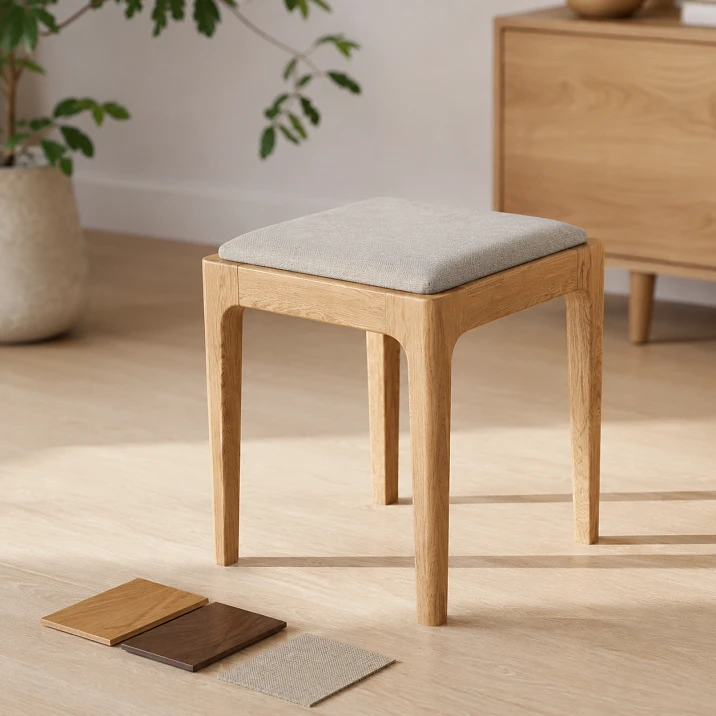
It is worth buying the STL-026-7 stool frame when you need not a ready-made standard item, but a wooden base for your own seat, color, and usage scenario. The frame size is 400 × 400 × 450 mm, but this is not the final stool size: after installing a wooden panel, soft block, or removable cushion, the height, width, depth, overhang, and position relative to the table change.
Buy STL-026-7 stool frame available in beech for enamel or oak for tinting. The frame has a square shape, four legs, aprons, and connecting elements, comes disassembled with a set of hardware, and requires assembly. The finished seat is not confirmed as part of the delivery by the card, so it is designed or ordered separately.
The main question before purchasing is not "will a 400 mm square fit," but what the stool should look like after assembly. A rigid seat 20 mm high can raise the top point to approximately 470 mm. A soft block protruding 60 mm above the frame will give approximately 510 mm before compression. These examples show the calculation principle, not a ready characteristic of STL-026-7: part of the base may fit inside the frame, and the filler changes height under load.
STL-026-7 is suitable for the kitchen, hallway, bedroom, dressing room, vanity table, hotel room, and commercial interior. The buyer receives a prepared wooden structure and can focus on choosing the seat, finishing, assembly, checking diagonals, and fastening. For those who need a completely finished item without design, it is more reasonable to compare the frame with TBR-003.
Short answer. STL-026-7 is suitable for a customer who wants to assemble a stool to match their own interior: choose a square wooden or upholstered seat, calculate the final height, paint the beech with enamel or tint the oak, and get one item or a series of identical stools.
Before ordering, download the drawing, determine the actual top platform, make a seat mockup, compare the height with the table, and clarify the purpose of the included fittings. Do not automatically assume that the seat should be 400 × 400 mm or that FUR-001 and FUR-012 are specifically used for its attachment.
Buy STL-026-7 frame View finished stool TBR-003 View all stool frames Buy finishing materials Order seat and finish selection
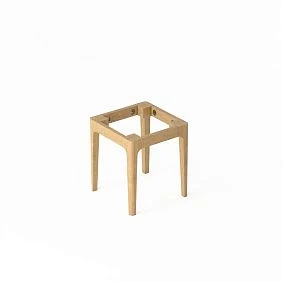
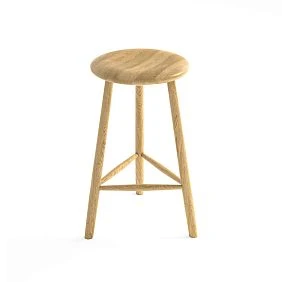
Confirmed specifications for STL-026-7
| Parameter | Confirmed data | What the buyer should check |
|---|---|---|
| Article number | STL-026-7 | Specify the full article number in the order and specification |
| Product type | Wooden stool frame | This is a base for a single seat, not a finished stool |
| Size A × B × C | 400 × 400 × 450 mm | After installing the seat, the final dimensions will change |
| Shape | Square | A square seat is most natural, a round one requires a mockup |
| Construction | Four legs, aprons, and connecting elements | During assembly, check the diagonals and evenness of tightening |
| Material | Beech or oak | Beech is chosen for enamel, oak for tinting |
| Sanding | «Prestige» | Before finishing, still inspect the joints and holes |
| Preparation of beech | For enamel | The final color and coating are not included automatically |
| Oak preparation | For tinting | A test coat and coordination with the seat are needed |
| Delivery format | Disassembled | Needs careful assembly on a flat surface |
| Hardware | The kit comes with the frame | The exact composition and purpose of the elements are checked against the configuration |
| Finished seat | Not confirmed as part of the kit | Designed and purchased separately |
| Average production time for made-to-order items | 5–10 days | Finishing, delivery, and manufacturing of the seat are accounted for separately |
| Allowable load of the finished stool | Not confirmed by a single value | Depends on assembly, seat, fastening, and usage conditions |




How the seat changes the finished stool
| Option | Advantages | What to calculate | Main risk |
|---|---|---|---|
| Hard wooden seat | Easy care, single wood species, minimalist look | Thickness, overhang, radii, wood movement | Make size by overall dimension without drawing |
| Soft seat | Comfort, fabric choice, connection to upholstered furniture | Base, filler, fabric, compression and height | Get a stool that is too tall |
| Removable cushion | Quickly changeable, the cover can be serviced separately | Rigid base, anti-slip and fixation | Consider the cushion as a structural seat |
| Square seat | Follows the frame geometry | Even or directional overhang | Sharp corners and too large protrusion |
| Round seat | Softens the silhouette, convenient in modern interiors | Diameter, corner supports and attachment points | Insufficient support area |
| Contoured seat | Design appearance | Full drawing, symmetry, fasteners and template | Accidentally loosen the edge or shift the center |
Our factory also produces:

Formula for final stool height
The preliminary calculation looks like this: final height = 450 mm plus the part of the seat that is above the top plane of the frame. The formula is simple, but it must be applied to the actual assembly.
If a 20 mm thick wooden panel lies completely on top, the approximate height will be 470 mm. If part of the panel is recessed, the addition will be smaller. A 60 mm high soft block can give about 510 mm before sitting, but under the user's weight the filler will compress.
Therefore, two values are recorded in the specification: the geometric height without load and the working seating height after compression. For verification, a mock-up is made from plywood, dense foam material or stacked samples.
Get Consultation
Why 450 mm is not the final height
The height of 450 mm refers only to the wooden base. The seat may lie on top, partially fit between the side rails, or have a separate plywood platform.
Even two soft blocks of the same geometric thickness provide different seating due to the density of the filler.
Therefore, a stool cannot be matched to a table solely by the number from the frame card.
How to make a mock-up of the seating height
Place a frame or box with a height of 450 mm and add layers of the required thickness on top.
Sit at the table, check the position of your knees, feet, and elbows. For a soft option, slightly compress the mock-up to the expected working height.
Such a test is more useful than an abstract comparison with a standard stool.
What to measure on a regular table
You need the height of the top surface of the tabletop and the distance to its underside.
A thick table apron, drawer, or metal mechanism reduces legroom.
STL-026-7 may fit the tabletop height but be uncomfortable due to lower elements.
How to compare a stool with chairs
If chairs and stools are in the same group, their working seat heights should be close.
A difference of a few centimeters is noticeable at a shared table and changes user posture.
Compare not the frames, but the finished seats after upholstery and finishing.
Why the exact seat size is taken from DWG
The overall frame size of 400 × 400 mm describes the external dimension, but not necessarily the top seating surface.
Legs, aprons, radii, and fasteners can form a different usable area.
The seat is designed according to the drawing, and before manufacturing, it is checked with a paper or plywood template.
How to measure the top platform on the assembled frame
After dry assembly, measure the distances between the outer edges, diagonals, and the position of the stretchers.
Separately mark areas where fasteners should not intersect with joints.
If dimensions differ from the project, first correct the skew, rather than adjusting the seat to the rhombus.
Seat flush with the frame
This option emphasizes the square geometry and makes the piece visually light.
The edge must exactly match the top contour, so the slightest cutting error is noticeable.
For a soft seat, full dimensional alignment requires careful fabric insertion and thickness control.
Small uniform overhang
The overhang hides the top joints and makes it easier to remove the seat for repairs.
Its size is chosen based on the layout, taking into account the leg protrusion, radii, and free space around the stool.
An excessive overhang creates leverage and requires separate verification of fastening and stability.
Directed front overhang
Sometimes the front edge is made slightly more pronounced to visually indicate the front side.
Such a technique is only possible after checking the center of gravity and leg placement.
On a square stool without a backrest, orientation may change, so asymmetry must be justified.
How to make a safe edge for a wooden seat
A sharp square corner is inconvenient when passing by and sitting down.
A chamfer or radius softens the edge but should not excessively reduce the usable area.
The profile is coordinated with the shape of the legs and the overall style of the frame.
Wood grain direction of the wooden seat
For oak or beech, the direction of the wood grain affects the appearance and structural behavior of the panel.
The seat and frame are best considered as one piece, rather than as random parts from different batches.
The fastening technology is chosen taking into account possible seasonal movement of the wooden panel.
Can an oak seat be placed on a beech frame
Such a combination is possible as a deliberate contrast, especially under a covering enamel.
Under a transparent finish, the difference in texture will be noticeable and will require a design solution.
A mixed construction cannot be described as a completely oak or completely beech stool.
How to choose the base of a soft seat
A soft block usually requires a rigid panel that takes the load and is attached to the frame.
The thickness, material, and dimensions of this panel are determined by the furniture maker.
One fabric with filler does not replace a structural seat.
How to account for filler
The thickness of foam or other filler affects the height and silhouette.
Soft material compresses unevenly at the edges and center, so the geometric size does not equal the working fit.
For a series of stools, the same density and the same molding method are used.
How to account for fabric
The fabric wraps around to the back side and takes up space near the fasteners.
Dense material, edging, or decorative nails increase the thickness of the edge.
Before manufacturing, check whether the upholstery presses against the aprons and whether the seat can be removed for repair.
Removable soft block
The removable design makes it easy to replace the fabric and repair the filling.
The fastening must prevent shifting when sitting, but remain accessible from below.
The exact mechanism is not confirmed by card STL-026-7 and is designed separately.
Removable cushion on top of a rigid seat
This is the easiest way to change the color and seasonal character of the stool.
The cushion must have a non-slip base or fixation to prevent it from sliding.
Its height is added to the height of the rigid seat and taken into account when comparing with the table.
Square seat
The square repeats the shape of the frame and facilitates an even overhang.
It suits both classic and modern finishes, as well as rigid and soft versions.
The main task is to correctly determine the actual seating area, rather than copying the external dimension of 400 mm.
Round seat
The circle softens the silhouette and can make the object visually more compact.
At the same time, the frame corners must remain hidden or look intentional.
The diameter and support points are checked on a full-size template, otherwise part of the base will remain unsupported.
Shaped seat
The shaped contour allows the stool to be linked to a vanity table, console, or other furniture.
But each curve changes the overhang and load distribution.
This option requires a separate drawing and a control sample before processing expensive wood or fabric.
Hard seat for kitchen
Wooden surface is easier for daily cleaning and does not absorb odors through fabric.
The coating must match kitchen conditions, and water should not accumulate in the joints.
STL-026-7 should not be automatically considered furniture for outdoors or wet bathrooms.
Soft seat for bedroom
In the bedroom and dressing room, comfort is often more important than the easiest cleaning.
The fabric can be coordinated with the headboard, armchair, or curtains.
The height is checked relative to the vanity table and the drawer underneath it.
Stool for hallway
In the hallway, the item is used for putting on shoes and as a temporary surface.
Size 400 × 400 mm needs to be checked in the passage and near the cabinet door.
Fabric is chosen considering frequent cleaning, and wooden edges are protected from accidental moisture.
Stool for dressing room
A compact seat without a backrest is convenient to slide under a console or place between cabinets.
It is necessary to ensure that the square dimension does not interfere with opening doors and drawers.
A soft seat makes short sitting more comfortable but increases height.
Stool for hotel room
In a hotel, repeatability, maintainability, and the ability to replace upholstery are important.
Frames are best ordered in one batch, and seats made using a single template.
The finishing recipe, fabric, and spare materials are kept for subsequent repairs.
Stool for cafe
For commercial use, separate testing of load, fastening, and wear resistance is required.
The series must have identical diagonals, height, and upholstery.
The frame card does not replace technical testing of the finished item.
Stool as a stand
A rigid seat can be used as a small surface, but the purpose and load must be determined in advance.
A soft block is inconvenient for this scenario and wears out faster.
The stool cannot be used as a stepladder without separate structural confirmation.
How to choose STL-026-7 for a vanity table
Measure the underside of the tabletop, drawer, handle, and knee clearance.
The stool should be fully or partially slid in without damaging the upholstery.
The soft block mockup shows whether the seat height will be too high.
How to match with a kitchen table
They compare the finished seat height, not the 450 mm frame.
Check the free space under the tabletop and the ability to place feet.
If four identical stools are planned, first assemble and test one control sample.
How to match with a console
The console may have a smaller depth and a lower drawer, so the space under it is limited.
The 400 mm square and soft overhang should fit without touching the furniture legs.
The mirror height and seating are also checked on the mockup.
Beech under enamel
Beech has a calm, dense surface and is offered in the STL-026-7 card for opaque finishing.
This option is convenient when the stool needs to match painted kitchen fronts, a console, or doors.
Color, primer, and gloss level are approved separately; "Prestige" sanding does not mean ready-made enamel.
Oak under tinting
Oak is chosen for its noticeable texture and translucent finish.
The frame and wooden seat are best made from the same species and stained in the same batch.
If the seat is upholstered, the oak shade is coordinated with the fabric and adjacent furniture.
Why beech and oak should not be chosen solely by price
The species produce different visual results and require different finishing routes.
Beech is rational for opaque color, oak — when the wood grain should remain visible.
First, decide what the finished stool will be like, and only then compare the current cost.
Frame and seat from the same wood species
A single wood species makes it easier to match color and texture.
For a transparent finish, it is especially important to order parts from the same batch or make a common test stain.
Even the same wood species can have natural variations, so absolute matching without a sample is not guaranteed.
Frame for white enamel
White color makes a square frame visually lighter and works well in the kitchen, bedroom, and hallway.
On legs and aprons, drips and missed spots are noticeable, so the finish is applied evenly.
The upholstered seat can be light to match or contrasting.
Dark enamel
A dark frame looks graphic and emphasizes the geometry of the legs.
On a small piece, a deep color can make the structure visually heavier.
Before full painting, evaluate the sample next to the table and flooring.
Natural oak tinting
Light tinting preserves the natural grain and suits a calm interior.
The shade is compared with the dining table, doors, and floor.
A seat made of a different material should support this color, not randomly repeat it.
Dark oak tinting
Dark oak emphasizes the silhouette and suits a classic study, hallway, or hotel room.
On rails and legs, different grain directions may perceive color unevenly.
A test coat helps see the future contrast before treating the entire set.
Matte or semi-gloss finish
A matte surface looks calmer and emphasizes small marks less.
Semi-gloss shows the leg profile more strongly and is more easily perceived as a traditional furniture finish.
The actual care properties are determined by the chosen coating system.
Paint before or after assembly
Before assembly, it's easier to treat the inner sides of aprons and legs, but the seating areas cannot be filled with paint.
After assembly, it's easier to achieve a uniform visual layer, but access to internal areas is limited.
The master chooses the sequence based on the joint design and finishing system.
How to protect joints from enamel
A thick layer in the seating area changes the size and hinders precise assembly.
Holes and contact areas are temporarily covered according to the process sheet.
After removing the protective coating, the edges of the coating should remain neat and not peel off.
Interlayer sanding
It helps level the primer and remove raised fibers.
On edges, do not remove the coating down to the wood, especially if the color should be uniform.
The tool and abrasive are selected according to the finish manufacturer's recommendation.
How to get the same shade on four legs
All parts are marked and painted in one batch.
The mixture is stirred before application, and the number of layers is recorded.
For oak, compare the legs in daylight before final assembly.
Test swatch
The sample must match the wood species, sanding, and future frame preparation.
It is considered next to the seat, table, and floor.
The photo on the screen does not replace a physical sample of color and gloss.
What does "Prestige" sanding mean?
The card indicates detailed manual surface preparation.
This reduces the amount of finishing, but the buyer still checks the parts after transport and before the final coat.
Sanding does not replace primer, enamel, tint, or protective varnish.
What is included in the delivery
The wooden frame in disassembled form and the set of fittings are confirmed.
The finished seat, fabric, padding, glides, and painting materials are not considered automatically included.
Before payment, the specification is checked line by line.
How to unpack the frame
The parts are laid out on a soft clean surface and not mixed with elements from other sets.
Check legs, stretchers, holes, sanding, and the quantity of hardware.
Before assembly, photograph any possible damage and keep the packaging.
Why a dry assembly is needed
The frame is first connected without final tightening and without the seat.
This way you can check the fit of parts, diagonals, and the position of the legs.
If you immediately tighten one corner, the square base can turn into a rhombus.
How to mark parts
For one frame, it is enough to mark the front, back, left, and right sides.
For a series, each stool is assigned a separate number.
Marking helps avoid mixing up parts after painting and maintain the same assembly scheme.
How to connect the stretchers
The stretchers connect the legs and define the geometry of the square base.
The precise connection method and fasteners are taken from the kit and drawing.
Do not replace standard fittings with random screws without checking the length and purpose.
How to tighten the fasteners
Tighten connections gradually in a diagonal pattern, not finishing one corner first.
After each round, check the dimensions and stability.
Final tightening is done only after the frame is aligned.
How to check the diagonals
Measure the distances between opposite corners of the top contour.
In a square structure, the diagonals must match within the project's allowable tolerance.
If they differ, the frame is adjusted before installing the seat.
Why the frame turns out as a rhombus
Most often, the cause is uneven tightening, joint misalignment, or assembly on an uneven surface.
The seat should not be used as a means to forcibly straighten an incorrectly assembled frame.
First, restore the geometry of the base, then design the attachment of the top panel.
How to check four legs
Place the frame on a flat, verified surface and press on the corners one by one.
If one leg does not touch the surface, check the diagonals, joints, and actual length of the parts.
The foot pad should not hide a serious assembly misalignment.
What to do if there is slight wobbling
First, rule out uneven floor and debris under the leg.
Then check the tightness and geometry.
An adjustable foot is possible as a separate solution, but its compatibility and fit need to be confirmed.
When to install the seat
The seat is attached after checking the geometry and, as a rule, after the main finishing stage.
Before this, make a hole template and check tool access from below.
It is better to install the soft block after completing dirty operations to avoid damaging the fabric.
How to secure a wooden seat
The fastening must hold the panel and account for its material.
The exact points, quantity, and type of fasteners are determined by the furniture design.
FUR-001 or FUR-012 cannot be automatically used as seat fasteners without the STL-026-7 diagram.
How to secure a soft seat
The plywood or other rigid base is connected to the frame at the designated points.
Fabric, staples, and filler must not obstruct access for installation.
Removability and repairability are considered before upholstery.
Why recommending glue alone is insufficient
The card confirms the included hardware for the frame, not a universal adhesive seat installation.
The load on a stool is dynamic, and the connection depends on the material of the top panel.
Glue may supplement the system, but it should not be designated as the sole fastening without calculation.
How not to damage the sanding during assembly
The tool should not slip and touch visible edges.
A soft, clean material is placed under the parts.
Keys and metal fittings are stored separately from painted surfaces.
Can the stool be disassembled again
This depends on the design of the joints and the condition of the fittings.
Repeated disassembly can wear out the mounting holes.
If the furniture needs to be transported regularly, this scenario is discussed before choosing the finish and seat.
FUR-001: what is confirmed
buy the FUR-001 mounting kit can be as a set of M8 × 60 stud and M8 × 13 metal insert.
It is designed for attaching furniture legs to structures.
Use specifically in STL-026-7 and especially for the seat must be confirmed by the drawing and the parts list.
FUR-012: what is confirmed
view the FUR-012 mounting kit it can be as a set consisting of a round mounting plate with a diameter of 37 mm with M8 thread and an M8 × 60 stud.
Its general function is related to attaching furniture legs.
Automatic compatibility with the stool frame is not confirmed by just being placed in the related products block.
FUR-001 or FUR-012
FUR-001 uses a threaded insert, FUR-012 uses a round mounting plate.
These are different connection schemes, and they cannot be chosen based on price or appearance.
For the project, it is better to select fasteners and furniture fittings after checking the technical documentation.
Complete fittings and additional fasteners
The frame already comes with fittings, so they study that first.
Additional kits are only needed for a confirmed task: seat, repair, different structure, or spare.
Do not duplicate fasteners without understanding the purpose.
STL-026-7 or ready-made TBR-003
STL-026-7 is purchased for a custom seat and upholstery. TBR-003 is a finished commercial model that already has a specific appearance and dimensions.
You can buy a ready-made wooden stool TBR-003, if there is no task to design a soft block or wooden panel.
The frame is more advantageous where custom fabric, exact color, or a series for a specific interior is important.
Confirmed dimensions of TBR-003
The current card for TBR-003 specifies dimensions of 445 × 445 × 460 mm.
It is wider than STL-026-7 and already represents a finished model, not a base for an arbitrary seat.
The comparison helps to understand whether the buyer needs a design path or a faster ready-made option.
Stool frame and chair frame
A stool has no backrest, so all seating and stability depend on the base and seat.
The chair frame includes additional backrest elements and solves a different task.
It's useful to learn how a stool frame differs from a base with a backrest, if the buyer is undecided between two types of furniture.
Stool frame and bench frame
A bench is usually elongated and designed for a different aspect ratio and seating position.
STL-026-7 has a 400 × 400 mm square and is designed for one compact seat.
The general material explains, how to choose a frame for a bench or stool, and this article covers a specific item.
Frame or DIY from scratch
With the ready-made STL-026-7, you don't need to separately select four legs, calculate stretchers, and create joints.
The buyer receives a coordinated wooden base and a set of hardware.
Your own efforts go into the seat, color, assembly, and inspection of the finished item.
Why random legs are worse than a ready-made frame
Four similar legs do not yet make a stable stool.
Need identical length, stretchers, precise geometry, and fasteners.
A ready-made frame reduces the risk of mismatch and cuts down on joinery design work.
STL-026-7 for self-assembly
The model is suitable for someone with basic furniture tools and the ability to work on a flat surface.
You need to be able to read a drawing, check diagonals, and not overtighten connections.
If you have no experience, it's better to outsource finishing and assembly to a workshop.
STL-026-7 for a furniture workshop
The workshop can make a rigid or soft seat, create a prototype, and assemble a series.
The frame saves time on producing legs and stretchers.
The technical specification records the article number, wood species, finish, height, and fabric.
STL-026-7 for interior repair
The frame allows adding a stool to an existing table, console, or cabinets.
The main task is to match the color and height, not just choose a beautiful wood species.
For an exact match, a physical sample of the old finish is needed.
STL-026-7 for custom new furniture
In a new project, you can immediately coordinate the frame, seat, table, and surrounding furniture.
This allows calculating the height and clearance before production.
The stool series becomes part of the overall specification, not a late addition.
Classic interior
Oak for tinting and a soft seat with piping support the traditional character.
Beech for enamel suits a light classic kitchen or vanity table.
Decorative upholstery details should not interfere with fastening and maintenance.
Modern interior
A concise square seat, matte enamel, and calm fabric make the frame visually stricter.
A round panel is possible as a contrast but requires a mockup.
The modern look is created by proportions and finish, not by random simplification of assembly.
Scandinavian scenario
Light wood, a transparent calm finish, and neutral fabric create a lightweight item.
It is important not to mask oak as beech or vice versa without a conscious choice.
A rigid seat makes maintenance easier in the kitchen and hallway.
Eclectic interior
The frame can be painted contrastingly, and the seat made of bright fabric.
Connection with the interior is supported by repeating color or texture.
With strong contrast, errors in height and proportions are especially noticeable.
Stool in a children's room
Use in a children's room requires separate checks for stability, edges, finish, and load.
Sharp corners of the seat are softened, and the fabric is chosen to be practical.
The card does not confirm specialized children's purpose, so safety is assessed by the project.
ТHow to achieve the same height for a series
All seats are made using one template and from the same material.
The soft filler is cut to the same thickness and density, the fabric is stretched using a common technique.
After assembly, each item is measured on a flat surface.
How to calculate fabric
The size depends on the base, the thickness of the filler, the allowance for wrapping, and the fabric pattern.
For checks, stripes, or large patterns, additional allowance is needed for matching.
The exact consumption is calculated by the upholsterer after the seat is approved.
How to store spare fabric
For a cafe, hotel, or large home series, it is useful to keep material for repairs.
The roll is marked with the project article and stored according to the manufacturer's rules.
When repurchasing, the shade of a new batch may differ.
How not to mix up parts of several frames
Each set receives a number, and legs and stretchers are not mixed after trial assembly.
The hardware is stored in a separate labeled bag.
Such a system is especially important after painting, when parts look identical.
Specification for the workshop
It specifies STL-026-7, quantity, beech or oak, preparation type, seat dimensions, finish, and fabric.
The final height, overhangs, and attachment method are recorded separately.
A link to the product card and drawing version prevent confusion.
Protective glides
Glides protect the floor and may slightly change the height.
Their type is chosen based on the flooring, leg diameter, and installation method.
They are not confirmed as part of the standard STL-026-7 configuration.
Adjustable glides
Adjustment helps compensate for minor floor unevenness.
Installation may require a hole and additional height.
Do not drill legs without checking the drawing and the permissible seating area.
Felt glides
Felt is suitable for smooth floors and reduces noise when moving.
It wears out and requires replacement.
The thickness of the four elements must be the same, otherwise the stool will wobble.
How to care for the wooden frame
Remove dust with a soft dry or slightly damp cloth.
Do not leave water in joints and on end grains.
General rules can be found in the section care for a wooden stool, and specific products are chosen based on the coating.
How to care for a soft seat
Care depends on the fabric, filler, and the ability to remove the cover.
Stains are removed using the method recommended by the material manufacturer.
Heavy soaking should not reach the wooden base and fasteners.
How to store a disassembled frame
Parts lie horizontally or in stable packaging in a dry room.
Legs are not used as support for heavy objects.
Hardware is kept in a labeled bag along with documents.
How to transport a finished stool
Soft seat and painted edges protect against friction.
The item is not placed on its side so that the load falls on one edge of the seat.
For the series, dividers are used and each stool is secured.
How to check a finished stool before use
Check the diagonals, four support points, tightening, and seat attachment.
The item is placed on a flat floor and a careful trial seating is performed.
If there is creaking, play, or wobbling, operation is stopped until the connections are checked.
Why you cannot promise load on the frame
Final strength depends not only on the four legs.
Connections, seat, fasteners, assembly, and load direction are important.
Without a technical calculation, the article does not specify a guaranteed user weight.
Why you cannot use it as a step stool
Standing on the stool creates a different load and a high risk of tipping over.
STL-026-7 is not declared as a step stool.
For climbing, choose a specialized product.
Error: consider 400 × 400 mm as the seat size
These numbers refer to the overall frame dimension.
The actual top surface and allowable overhang are determined per the DWG.
The seat is manufactured only after a template or measurement of the assembled base.
Error: consider 450 mm as the finished height
Any seat adds height above the frame.
For the upholstered version, both geometry and compression must be considered.
The error is especially noticeable with a low table or vanity console.
Error: buying the seat before the frame
The finished panel may not match the mounting surface and fastening.
First, study the drawing STL-026-7, then make a template.
The reverse sequence increases the risk of rework.
Error: choosing too large an overhang
A large protrusion visually hides the frame but creates leverage.
When seated on the edge, the load is transferred to the mounting and the base.
The overhang is approved based on a mockup and technical inspection.
Error: making a round seat without a template
A circle may leave frame corners exposed or insufficiently supported on the rails.
The diameter is checked with a full-size cardboard part.
Mounting points must remain inside the rigid base.
Error: selecting a soft block only by thickness
Two fillers of the same thickness compress differently.
You need to assess density, edge shape, and base.
Working height is checked with a trial fit.
Error: not accounting for the underside of the table
A thick tabletop or apron reduces legroom.
A stool may look suitable in overall height but be uncomfortable.
Measure the distance from the finished seat to the underside of the table.
Error: mixing beech and oak without intention
Under a clear finish, the difference in wood species is noticeable.
A random combination of frame and seat looks like a configuration error.
Either use one breed, or create a deliberate contrast.
Error: considering "Prestige" as finished trim
This is the quality of sanding, not enamel or tinting.
The frame arrives as a prepared wooden base.
The coating, color, and protective finish are chosen separately.
Mistake: painting the seating areas with a thick layer
The coating changes the dimensions of the joint and can interfere with assembly.
Contact zones are protected according to the technological map.
After painting, the frame is assembled without force or tapping of visible edges.
Mistake: tightening one corner first
A square frame can easily be pulled into a rhombus.
The connections are tightened gradually and the diagonals are checked.
Final tightening is done on a flat surface.
Error: correcting a skew with the seat
A rigid panel should not forcibly hold a warped frame.
Such a joint creates tension and may loosen.
First, the geometry of the base is corrected.
Error: placing a floor protector under one leg without checking
This can hide the symptom, but not the cause of the wobble.
Check the floor, diagonals, joints, and leg lengths.
Only then choose a uniform or adjustable floor protection system.
Error: consider FUR-001 as a seat fastener
FUR-001 is intended for attaching furniture legs and consists of a stud and a threaded insert.
Its role in STL-026-7 must be confirmed by the diagram.
For the seat, only project-approved fasteners are used.
Error: consider FUR-012 as a mandatory part
FUR-012 is shown among furniture fastener options, but this does not mean automatic inclusion in the frame.
The complete parts list for STL-026-7 is checked separately.
Additional hardware is purchased only for a clear purpose.
Error: replacing standard hardware with random parts
Length, diameter, and thread type affect strength and preservation of the wood.
Too long fasteners may protrude to the front side.
Any replacement requires confirmation.
Error: assembling on an uneven floor
The frame will take on a false geometry, and checking the four legs will be incorrect.
Use a flat table or a verified slab for assembly.
The finished item is then tested in the actual location.
Error: mixing parts from multiple kits
Minor differences in wood and fit may complicate assembly.
Each frame is stored under its own number.
After finishing, the marking is kept until final acceptance.
Error: ordering a series without a control sample
If the height or fabric turn out to be uncomfortable, the error will repeat in all items.
First, one stool is assembled and checked in the room.
Only after approval are the rest launched.
Error: using an interior finish in unsuitable conditions
Kitchen, cafe, and hallway require different care.
The properties of the coating are confirmed by its manufacturer, not only by the wood species.
Outdoor use of STL-026-7 without a special project is not considered.
Who STL-026-7 suits
The frame suits a buyer who wants to choose their own seat and color.
It is convenient for furniture workshops, designers, owners of kitchens, wardrobes, and hotel projects.
Especially useful when ordering a series of identical bases.
Who the frame may not suit
If you need a ready-made stool without assembly and design, STL-026-7 adds extra steps.
For a buyer without tools, a workshop, and an understanding of height, it is easier to consider TBR-003.
For a bar counter, the 450 mm frame height also does not solve the problem of a high seat.
When to choose a ready-made stool
A ready-made model is rational if its dimensions, material, and appearance suit you.
There is no need to separately search for a seat, calculate upholstery, and check the mounting.
The frame is chosen only when individual configuration is truly important.
When to choose a different stool frame
If a 400 mm square or 450 mm height does not fit, do not modify the legs and stretchers yourself.
In the category you can buy a wooden stool frame and compare other bases.
A different article number is safer than randomly reworking a finished structure.
When to open the catalog of all frames
Sometimes the task is closer to a bench, chair, cabinet, or small table.
You can buy a solid wood furniture frame and choose a base for your own project.
The category helps avoid using a stool frame for unintended purposes.
What not to do from scratch
There is no need to calculate four legs, make identical side rails, and select joints.
STL-026-7 provides a consistent base with hardware.
The buyer handles the seat, color, assembly, and inspection of the finished product.
How to buy STL-026-7 on STAVROS
Open the product page, choose beech or oak, and check the current price.
Download the drawing, determine the seat and final height.
If a series is needed, the order specifies the quantity and uniform preparation requirements.
What to check before payment
They verify the article number, 400 × 400 × 450 mm, material, "Prestige", preparation type, and delivery format.
The composition of hardware, seat, glides, finish, and assembly are specified separately.
Current payment and delivery terms for the frame are checked before ordering.
When a design project is needed
The project is useful if the stool must fit exactly under the table, replicate a complex fabric, or become part of a series.
You can Order seat and finish selection before manufacturing the top block.
This is how dimensions, color, overhang, and mounting are coordinated.
Where to study materials and quality
Beech, oak, "Prestige", under enamel, and under tinting have different meanings.
Before choosing, you need to choose beech, oak, and the quality of wood preparation according to the future finish.
This protects against ordering oak under opaque paint or beech with the expectation of pronounced texture.
Where to see assembly recommendations
General recommendations help prepare the workspace, finish, and tools.
Useful recommendations for assembly, finishing, and installation, but the specific frame diagram takes priority.
The drawing cannot be replaced with general advice.
What to buy together with STL-026-7
The frame only covers the base of the stool. For the finished item, you need a seat, confirmed fasteners, finishing materials, and sometimes floor glides. The specific configuration depends on whether the seat will be wooden, upholstered, or removable.
| What to add | Why | For which scenario | What to Check | Link |
|---|---|---|---|---|
| STL-026-7 | Get a square wooden base | Rigid or upholstered seat | 400 × 400 × 450 mm, material, configuration | wooden base 400 × 400 × 450 mm |
| Stool frame category | Compare other sizes and shapes | When STL-026-7 is not suitable | Height and top platform | View stools and solid wood bases |
| All furniture frames | Choose a different type of base | Bench, chair, cabinet, small table | Purpose and construction | Choose a base for your own project |
| TBR-003 | Buy a ready-made alternative | When you don't need to design a seat | 445 × 445 × 460 mm and finish | ready-made alternative to the frame |
| FUR-001 | Consider M8 stud and insert nut | Confirmed furniture leg mounting | Compatibility with STL-026-7 scheme | M8 stud and insert nut |
| FUR-012 | Consider plate and stud | Separate furniture mounting scheme | Not to be considered a mandatory part | view the FUR-012 mounting kit |
| hardware category | Select fasteners and leveling feet | Assembly, floor protection, repair | Leg and hole dimensions | to select fasteners and furniture fittings |
| Materials | Apply enamel, tinting, and installation | Beech or oak | Coating system compatibility | Buy materials for painting and installation |
| Design project | Calculate seat and height | Soft block or series of stools | Table, fabric, overhang, and fastening | Order seat and finish selection |
Comparison of STL-026-7 frame and finished TBR-003
| Criterion | STL-026-7 | TBR-003 |
|---|---|---|
| Format | Frame for separate seat | Finished stool model |
| Confirmed size | 400 × 400 × 450 mm | 445 × 445 × 460 mm |
| Seat | Designed separately | Included in the model's construction |
| Individuality | You can choose the shape, fabric, thickness, and height | Limited by the finished construction |
| Project speed | Requires calculation, assembly, and finishing | Fewer design stages |
| Who it suits | For the workshop and the buyer with their own concept | For the buyer of a finished item |
Practical testing before a large order
Assemble one frame, make one seat, and place the stool in a real room. Use it at a table, by a console, or in an entryway for several days. This check shows whether the height is comfortable, whether the overhang is too large, and how practical the fabric is.
After the test, record the dimensions, filler density, fastener placement, color, and assembly order. Only then order the series. This is especially important for cafes, hotels, and kitchens with four or six identical items.
How to check the final proportions
The finished stool is examined from the front, side, and top. The seat should not visually overpower the legs or look too small. A thick soft block changes the character of the item more than the color of the enamel.
A photo next to a table helps compare width, height, and free space. If the stool must slide under, the check is done with real furniture and baseboard.
How to check the storage space for the stool
A stool without a backrest is often chosen because it can be pushed under a table or console.
For the check, not only the 400 mm frame is measured, but also the actual seat overhang, fabric thickness, and glides.
The soft top may catch on the lower table apron if the free space is calculated only based on the wooden base.
How to account for the baseboard and wall
In the hallway or dressing room, a stool is often placed flush against the wall.
The baseboard reduces the usable depth and can cause the item to protrude into the walkway.
A seat mock-up is placed in the intended location along with the nearest doors and drawers.
How to check ease of carrying
The absence of a backrest makes it easier to move, but a soft seat with a large overhang is awkward to grip by the edge.
The user should not lift the stool by the fabric or decorative trim.
Before approving the design, a safe grip point on the apron or rigid seat is determined.
How to coordinate a stool with a dining table
The frame and table do not have to be from the same collection, but they should match in scale and finish.
Thin table legs next to a massive soft seat can look unbalanced.
The trial stool is examined together with the table from all main points of the room.
How to match the stool with kitchen facades
Beech under enamel allows repeating the color of the facades, while oak under tinting connects the stool with a wooden tabletop or open shelves.
A complete match of the shade is confirmed with a physical sample.
The fabric should not conflict with the backsplash, floor, and upholstery of neighboring chairs.
How to check the seat before final fastening
The seat is temporarily installed on the frame and the center, overhangs, and orientation of the fabric pattern are checked.
The user sits down carefully, evaluates the height and position relative to the table.
Only after confirming the dimensions are the final holes and fixation performed.
How to restore the finish after assembly
During installation, slight marks may appear near fasteners or joints.
They are removed using materials from the same system, preserving color and gloss.
Local repair is performed before installing the soft seat to avoid staining the fabric.
How to prepare a project card
The card records the article STL-026-7, quantity, material, color, seat size, and final height.
For the upholstered option, fabric, padding, pattern direction, and allowances are added.
This document helps reproduce the stool after several months without restoring parameters from memory.
How to check the order upon receipt
The number of boxes, legs, aprons, and hardware is checked, as well as beech or oak and the "Prestige" sanding.
Surfaces are inspected before painting and assembly.
When ordering a series, each set is labeled immediately to prevent parts from getting mixed up.
Last check before purchase
The buyer must know the place of use, table height, seat type, final seating position, and finish.
It is also necessary to decide who will assemble the frame and make the top panel.
If any of these points is not defined, a mock-up is made first, and only then the order is placed.
How to compare two seat options on the same frame
Make two temporary mock-ups: a thin wooden panel and a soft block of the intended height.
Place each option on the same frame, compare the seating position, appearance, and the ability to slide the stool under the table.
Thus, the decision is made based on real comfort, not just a photo of fabric or wood.
How not to lose the orientation of the fabric
Stripes, checks, and directional patterns must run consistently across the entire series.
Before upholstery, the front side and center are marked on the base.
Finished seats are checked before mounting, because correcting the rotation after installation is more difficult.
Why the frame should be chosen together with the seat
Choosing the base separately without understanding the top block leaves the height, overhang, and fasteners undefined.
A seat without a frame, in turn, may not match the platform and the side rails.
Joint design turns two blanks into a finished and comfortable item.
How to check a stool after a week of use
It is useful to use the control item in real mode for several days. During this time, uncomfortable height, cushion displacement, squeaking, weak seat fixation, or impractical fabric become noticeable.
After the test, the tightening, four support points, and the condition of the coating are checked again. Only then are the parameters transferred to the rest of the items in the series.
How to prepare spare elements for a commercial project
For a hotel, cafe, or showroom, a supply of fabric, finishing recipe, and hardware list are kept. This simplifies local repair without fully replacing the item.
A spare seat or upholstery material from the same batch is especially useful when multiple stools need to match in color.
How to check the final cost of the project
The price of the frame is only part of the budget. Add to it the seat, fabric or wooden panel, finishing, possible glides, assembly, and delivery.
Compare STL-026-7 with a finished stool based on the full cost of the completed item, not just the price of the wooden base.
FAQ: questions about the STL-026-7 frame
What size is the STL-026-7?
The confirmed frame size is 400 × 400 × 450 mm.
Is 450 mm the final height?
No. The seat will increase the height above the top plane of the frame.
Is the seat included in the set?
The card confirms the disassembled frame with fittings, but not the finished seat.
What seat size will be required?
It is determined by the DWG and the actual top platform. You cannot automatically take 400 × 400 mm.
Can a round seat be installed?
This option can be considered after a full-size mockup, checking the support and fastening.
Will the frame suit a soft seat?
Yes, as the basis of the design stool, but the rigid panel, padding, fabric, and fastening are calculated separately.
What wood is STL-026-7 made from?
in beech or oak.
What to choose — beech or oak?
Beech is chosen for enamel, oak for tinting with visible texture.
What does preparation for enamel mean?
Slats are not matched by color and texture because the surface is designed for an opaque coating.
What does the tinting option mean?
Slats are matched by color and texture for semi-transparent finishing.
Is the frame delivered assembled?
No, it is delivered disassembled.
Is the mounting hardware included in the kit?
The card confirms the set of hardware along with the frame. The exact composition should be verified when ordering.
What are FUR-001 and FUR-012 for?
These are separate mounting kits for furniture legs. Their compatibility and role in STL-026-7 are confirmed according to the diagram.
Can the FUR-001 seat be attached?
Without a technical diagram, such use cannot be confirmed.
How to check the diagonals?
Measure the distances between opposite corners of the top contour before final tightening.
How to eliminate stool wobbling?
Check the floor levelness, diagonals, joints, and the four legs. Glides should not hide a serious misalignment.
Can the frame be used for a dining table?
Yes, if the finished seat height and legroom fit the specific table.
Will it fit a vanity table?
It will fit after checking the drawer, handle, depth, and final height of the soft block.
How does STL-026-7 differ from TBR-003?
STL-026-7 is a frame for your own seat; TBR-003 is a ready-made model measuring 445 × 445 × 460 mm.
Can I order four identical frames?
Yes, the quantity is specified in the order. For a series, it's better to first assemble a control stool.
What is the production lead time?
The current product card indicates an average production time for custom orders of 5–10 days.
Can STL-026-7 be used outdoors?
Outdoor use is not confirmed. For outdoor use, a separate project and a special protection system are required.
What weight can the finished stool support?
The uniform load is not confirmed: it depends on the seat, fastening, assembly, and conditions of use.
Where can I buy STL-026-7?
In the frame card on the STAVROS website.
Can I order a seat selection?
Yes, project-based selection helps coordinate size, height, overhang, fabric, and finish.
Result: how to assemble a finished stool on STL-026-7
STL-026-7 — a square wooden frame measuring 400 × 400 × 450 mm made of beech or oak. It is supplied disassembled with hardware and allows you to choose your own wooden or upholstered seat.
Before ordering, you need to determine the working height, get the dimensions of the top platform from the drawing, make a template, and compare the stool with the table. Beech suits enamel, oak suits tinting. "Prestige" sanding simplifies preparation but does not replace the finish.
Assembly requires a flat surface, gradual tightening, and checking the diagonals. The seat is installed only after leveling the frame. FUR-001 and FUR-012 are considered as separate furniture fastener options, not as automatically confirmed attachment for the top panel.
On the STAVROS website, you can open the STL-026-7 card, compare stool frames, view the finished TBR-003, and select materials. The ready-made base reduces complex joinery work but leaves the main choice to the buyer — selecting a comfortable height, material, and appearance for the future stool.