








































































Article Contents:
- R-002 as a repeatable module, not a single decoration
- Confirmed characteristics of the wooden rosette R-002
- One flower — four scales
- R-002 size 50 × 50 × 10 mm
- R-002 size 60 × 60 × 12 mm
- R-002 size 80 × 80 × 16 mm
- R-002 size 150 × 150 × 28 mm
- One center on each field
- Vertical series
- Checkerboard or grid rhythm
- Rosette inside a molding frame
- Example of a cabinet specification with three groups of facades
- Count only the number of facades
- Mix sizes in one line
- Do not account for the frame and handle
- Order from a photo without scale
- Forget about depth
- Buy different batches for one grid
- Start installation before trial layout
- What is a wooden socket R-002?
- What sizes of R-002 are available?
- What size to choose for a cabinet door?
- How many R-002 are needed for four doors?
- How to calculate the grid for a wall panel?
- Do I need to add ten percent margin?
- Can I mix sizes 50 and 80 mm?
- Which is better under enamel: beech or oak?
- Can R-002 be installed on painted MDF?
- Can I use a socket instead of a furniture handle?
- How to check the proportion before purchasing?
- How to arrange three sockets vertically?
- Will R-002 fit an interior door?
- Can R-002 be used on a wall panel?
- Do I need to buy all the elements at once?
- What should I specify in the order besides the quantity?
- Can R-002 be painted together with the facade?
- How to combine R-002 with molding?
- What to do if 150 mm looks too large and 80 mm too small?
- Can R-002 be installed on children's furniture?
- How to distribute natural wood variations in a set?
- How to calculate R-002 for different facade sizes in one cabinet?
- Where to check the current price of R-002?
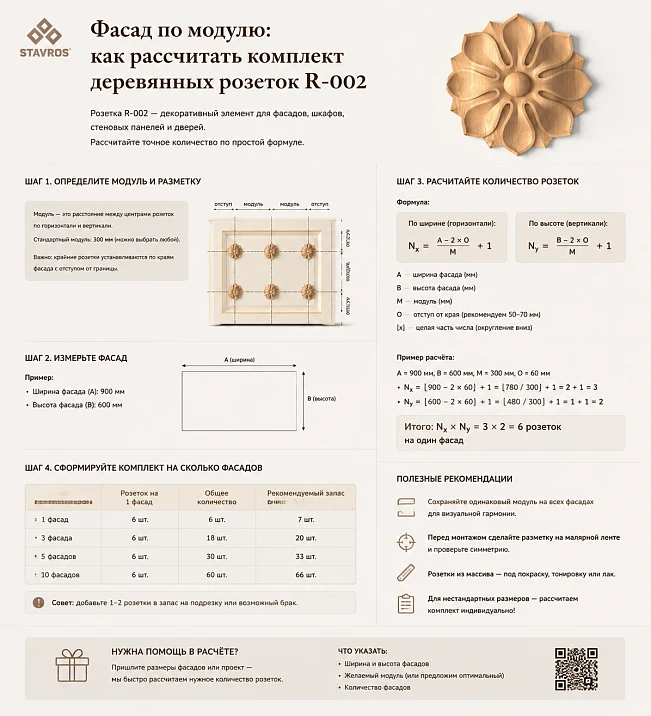
Wooden rosettes for furniture are often chosen as a single decoration: you see a suitable flower, attach it to one door, and place an order. With the R-002 model, it is more useful to act differently. Four confirmed sizes allow you to use one pattern as a repeatable module: place one rosette on identical cabinet fronts, create a vertical series on a door, create a rhythmic grid on a wall panel, or place a large element in the center of a molding frame. As a result, the customer orders not a random part, but a calculated set for a specific layout.
The main task before purchasing is to determine not only the size of one rosette, but also the number of identical fields, the number of elements on each field, the material, the future finish, and the installation method. An error in one parameter changes the entire project. A 50 × 50 × 10 mm rosette can work neatly on a small drawer, but get lost on a wide door. A 150 × 150 × 28 mm option can become a strong central accent, but on a narrow facade it will leave too little free space and may conflict with a handle, frame, or panel.
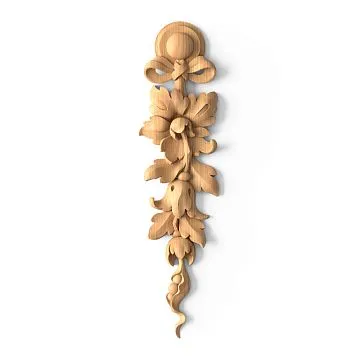
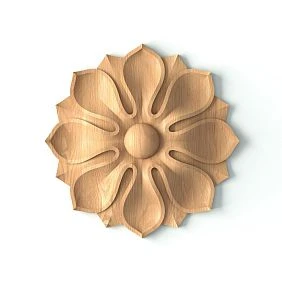
The article is based on a specific Wooden socket R-002..., and not a general overview of carved decor. The model is available in sizes 50 × 50 × 10, 60 × 60 × 12, 80 × 80 × 16, and 150 × 150 × 28 mm. Options in beech and oak are available. The relief floral pattern is suitable for furniture, doors, cabinets, wall panels, stair posts, pilasters, and other interior compositions. However, versatility of use does not mean that any size automatically fits any surface: proportions are always checked on an actual facade or on a full-size template.
After calculation, the buyer should have a clear specification: article R-002, selected size, wood species, processing quality, number of facades, layout scheme, number of elements on each field, total sum, and a reasonable reserve. Such a document helps to simultaneously check the composition, get a correct quote, and order all decor in one batch. This is especially important when identical rosettes are installed next to each other and the slightest difference in scale, shade, or surface preparation level will be noticeable.
Short answer. First, measure each surface to be decorated and make paper templates of R-002 in sizes 50, 60, 80, and 150 mm. Choose one layout scheme, count the identical fields, multiply their number by the number of rosettes per field, and only then determine the reserve. For opaque finishes, beech is usually considered, and for projects preserving wood texture, oak. Final compatibility with the facade, coating, and fastening method must be checked before ordering.
R-002 as a repeatable module, not a single decoration
The modular approach means that the same shape is repeated according to a predetermined rule. In furniture, this rule could be one rosette per door, three elements along a vertical axis, the same center on all drawers, or repetition of the flower at the nodes of a wall panel. Repetition makes even small decor a noticeable part of the project: the eye perceives not individual flowers, but a general rhythm. At the same time, ordering is simplified — the buyer works with one article, one size, and one finishing system.
The advantage of R-002 is that the pattern is preserved at four scales. You can choose a small module for drawers, a medium one for doors, or a large one for a wide surface without changing the character of the ornament. However, within one visible group, it is better not to mix sizes without a clear compositional reason. If on four identical doors you place three 80 mm rosettes and one 60 mm rosette, the difference will be perceived as an error. If the central door is wider than the side ones, an increase in the central element may be justified — provided the difference is confirmed by a mockup.
Modularity also helps when expanding a project. For example, first a cabinet is decorated, then the same element is used to complement a chest of drawers or a wall panel. However, purchasing additional items after a long time carries the risk of differences in wood and surface preparation. Therefore, all elements that will be in the same room or in the same furniture composition should be calculated in advance and ordered simultaneously.
Confirmed characteristics of the wooden rosette R-002
| Parameter | Confirmed value | What to check before ordering |
|---|---|---|
| Article number | R-002 | To prevent a similar model with a different pattern from appearing in the specification |
| Product type | Relief decorative rosette in the shape of a flower | Does the pattern match the moldings, handles, and other decor |
| Dimensions | 50 × 50 × 10; 60 × 60 × 12; 80 × 80 × 16; 150 × 150 × 28 mm | Template dimensions for a specific facade and relief depth |
| Material | Beech or oak | Future coating and material match for the entire set |
| Processing | Processing quality options are available in the card | What level of preparation is needed for the selected finish |
| Purpose | Furniture, doors, cabinets, wall panels, stair posts, pilasters, and interior compositions | Is the base suitable for the chosen mounting method |
| Main product page | buy wooden rosette R-002 | Current options, availability, lead times and cost |
The table separates confirmed data from design recommendations. Dimensions and materials can be used in calculations. However, specific adhesive, number of fastening points, suitability for installation on finished surfaces, and base preparation cannot be determined solely from a product photo. These parameters depend on the facade material, surface condition, weight of the selected size, finishing technology, and furniture production requirements.
For serial layouts, depth is especially important: for four sizes it is 10, 12, 16, and 28 mm. In the top view, all options may look similar, but from the side, their relief is perceived differently. The large R-002 protrudes more above the plane, creates a more noticeable shadow, and requires more attention to handles, opening of adjacent doors, and furniture placement near the wall.
Our factory also produces:
One flower — four scales
| Size R-002 | Initial fitting scenario | What to check specifically |
|---|---|---|
| 50 × 50 × 10 mm | Small drawers, narrow doors, children's furniture, frequent repetition | Whether the pattern is lost after painting and whether there is enough free space around |
| 60 × 60 × 12 mm | Chest of drawers, cabinet, medium furniture front, small frame | Alignment with handle and single axis on a group of drawers |
| 80 × 80 × 16 mm | Cabinet door, interior door, large furniture panel | Indentations to the frame, panel, handle, and edge of the canvas |
| 150 × 150 × 28 mm | Single center on a wide plane, large panel, noticeable accent | Scale, protrusion, method of fixation, and possibility of free opening |
This table is a starting point for fitting, not a strict manufacturer rule. It is useful for a buyer who does not suit the floral shape or available size range view all wooden carved rosettes. But if the chosen design is R-002, comparing four templates on the facade usually provides more benefit than viewing dozens of photos of different products.
Get Consultation
R-002 size 50 × 50 × 10 mm
The most compact option is convenient where decor is repeated frequently or works on small fields. This could be a series of dresser drawers, narrow doors of wall furniture, a small nightstand, a children's wardrobe, or the intersection of thin lines in a decorative panel. The 50 mm size leaves more free plane around the flower, so the facade does not look overloaded. At the same time, a small relief requires careful finishing: too thick an opaque layer can visually soften small details.
On a wide cabinet, one such rosette may get lost. The problem does not always need to be solved by switching to a larger size. Sometimes it is better to keep 50 mm but repeat the element vertically or use it inside a small frame. A paper mockup will show whether the flower is perceived as a deliberate module or as a random dot.
R-002 size 60 × 60 × 12 mm
The 60 mm option occupies an intermediate position between a miniature module and an expressive furniture accent. It is suitable for dressers, bedside tables, sideboards, small facades, and frame compositions. The difference of ten millimeters compared to the smaller size seems small only in the table. On a group of six or eight drawers, the overall pattern becomes noticeably denser.
When placing on a drawer, you need to determine the relationship with the handle in advance. The rosette can be above the handle, below it, or replace a separate decorative center, but it should not interfere with the grip. Check not only the front view but also the hand movement. If the facade already has a panel, the decorative field is measured inside it, not by the outer width of the drawer.
R-002 size 80 × 80 × 16 mm
The 80 mm size is well readable on a cabinet door, tall nightstand, door, or wall panel. It is already capable of working as an independent central decor but remains compact enough for repetition. On four identical doors, four rosettes create a clear series. On one tall door, two or three elements can emphasize the vertical if an equal interval is left between them.
A depth of 16 mm makes the side shadow more noticeable. Therefore, before ordering, they assess whether the protruding decor will conflict with the adjacent door when opening, the casing, the wall, or a pull-out element. In a tight niche, even a few millimeters can matter. A paper mockup checks the dimensions on the plane but does not show depth; for that, a cardboard or foam board sample is useful.
R-002 measuring 150 × 150 × 28 mm
The large R-002 is designed for a spacious field and works as a separate architectural center. It can be considered for a wide door, a large furniture panel, a central section of a cabinet, a decorative boiserie insert, or a pilaster. Repeating this size on every small door is risky: the relief will start competing with the furniture structure and visually reduce the free field.
A depth of 28 mm requires particularly careful attention to the installation method and operating conditions. You cannot automatically transfer the technology suitable for a 50 mm element to a large rosette. The base, coating, contact area, and surface usage mode must be coordinated with the furniture manufacturer or installer. For a heavy door, it is also important to ensure that the additional decor does not create obstacles when opening and does not fall into the zone of constant impacts.
How to make a full-size paper template for R-002
The template is needed not to imitate the relief, but to check the scale, indents, and quantity. On thick paper or thin cardboard, cut out squares of 50 × 50, 60 × 60, 80 × 80, and 150 × 150 mm. Inside, you can schematically indicate a flower, but an exact drawing is not necessary for the first stage. The main thing is to see the occupied area. Each template is labeled so that the sizes are not confused during fitting.
- Measure the width and height of the decorative field specifically, not just the outer size of the facade.
- Mark the axis of the door or drawer with painter's tape that does not damage the coating.
- Apply the four templates one by one and take photos from the same distance.
- Check the appearance of the furniture not only up close, but also from the main entry point of the room.
- Open doors and drawers to ensure the chosen location does not interfere with the handle and movement.
- Repeat the template on all identical fields if a series is planned.
- Record the selected size and center coordinates in the specification.
Do not apply regular tape to a painted or lacquered facade without testing: it can leave a mark or damage the coating. The template can be held by hand, use safe painter's tape after testing on an inconspicuous area, or attach it to a separate transparent film. The goal of the fitting is not to ruin the finished furniture for the sake of checking the decor.
For a wall panel, it is better to consider templates together with the lines of future moldings. First, mark the frames on the wall or on the layout, then place R-002 in the center or at the nodal points. Otherwise, it is easy to choose a beautiful rosette size that turns out to be too large after adding the framing.
Four basic placement schemes for R-002
One center on each field
The most straightforward scheme is one rosette per door, drawer, or panel. It is suitable for a group of identical facades and works well when the furniture already has a pronounced rhythm. The center is determined by the decorative field. If the handle is offset to the edge, the geometric center of the rosette is usually preserved, but the final composition is checked as a whole: the handle, panel, molding, and flower should be perceived as one system.
The advantage of this scheme is simple calculation. The number of items equals the number of decorated fields. The disadvantage becomes apparent on very wide or tall facades: one small element may look lost. In that case, increase the size or switch to a series, but do not do this without a mockup.
Vertical series
Two, three, or more identical elements are arranged along a single axis. This technique emphasizes the height of a door, cabinet, pilaster, or narrow wall panel. The intervals between centers must be equal. It is more convenient to start marking not from the top edge, but from the common central axis of the composition: first determine the middle element, then set equal distances up and down.
The more elements in a series, the more noticeable any error becomes. Even a difference of a few millimeters between intervals on a tall door can be perceived as a misalignment. Before installation, lay out the entire series on the floor or on a facade template, number the positions, and only then transfer the centers.
Checkerboard or grid rhythm
A grid is used on a wide wall panel, large furniture surface, reception desk, or decorative insert. The quantity is calculated by rows and columns. For example, a 3 × 4 grid requires 12 rosettes. A checkerboard pattern is more complex to construct: elements in every second row are shifted by half a step. In both cases, check the distances to the panel edges and ensure the outer margins do not appear cut off.
For a grid, smaller sizes of 50 or 60 mm are often more suitable because the repetition itself enhances the ornament. However, this is not a universal rule. On a large panel, R-002 80 mm is acceptable if enough free surface remains between elements. A large size of 150 mm in a dense grid can turn a light floral rhythm into a heavy relief wall.
Rosette inside a molding frame
The frame sets the boundaries, and R-002 forms the center. This scheme is suitable for cabinets, doors, wall panels, and boiserie. Before calculating, it is useful to study how to assemble a frame from wooden molding: the profile has its own width and relief, so the inner field after installation will be smaller than the outer dimension.
The calculation sequence is as follows: determine the outer dimensions of the frame, subtract the profile width and necessary margins, obtain the clear inner field, and then try the rosette. The central element should not touch the molding or appear cramped. If corner overlays are planned, their area is also included in the layout. In a complex composition, the number of parts is calculated not as one total number, but as separate specification lines.
Basic formula for calculating quantity
Number of identical fields × number of R-002 per field = base number of items. The formula is simple, but it only works after all fields are listed. In a cabinet, four tall doors can be identical, but the lower drawers have a different size and require a separate line. On a wall, two large panels and four narrow inserts cannot be considered one group.
| Scenario | Calculation | Base quantity |
|---|---|---|
| Four doors, one socket each | 4 × 1 | 4 |
| Four doors, three sockets vertically each | 4 × 3 | 12 |
| Six drawers and two doors, one element each | 6 × 1 + 2 × 1 | 8 |
| Wall panel, grid 3 × 4 | 3 × 4 | 12 |
| Three frames, one center and four corner pieces each | R-002: 3 × 1; corner elements are counted separately | 3 sockets R-002 |
The last example shows an important rule: specification R-002 must not include other elements as if they are interchangeable. Sockets, moldings, corner trims, and fasteners are considered separate items. This helps verify completeness and avoid getting the correct total number of parts but the wrong composition of the order.
How to calculate a set for a cabinet
Start with a list of fronts. Record each door and drawer, even if the furniture seems completely symmetrical. A built-in wardrobe may have two wide central doors, two narrow side sections, and upper mezzanines. One rule for all fields rarely gives a neat result. Create groups by the same size: for example, A — four doors 500 × 2200 mm, B — four mezzanines 500 × 450 mm, C — two drawers 1000 × 250 mm.
For each group, choose a size and layout. Tall doors may get three R-002 60 mm each or one 80 mm; mezzanines — one 50 mm each; wide drawers — two 60 mm each or one large center. These are just layout options, not a final solution. After fitting, the table becomes a calculation: group A — 4 × 3 = 12, group B — 4 × 1 = 4, group C — 2 × 2 = 4. The base total is 20 sockets if all groups use the same size and material. With different sizes, the total is split by trade offers.
For a wardrobe with paired doors, check mirror symmetry. Centers must be at the same distance from the common joint and outer edges. If hinges or handles force the decor to shift, the shift is repeated symmetrically. An error occurs when the installer marks each door separately from its edge: a slight difference in front sizes causes the pair to look uneven.
Example of a wardrobe specification with three groups of fronts
| Group | Number of fields | Scheme | Size R-002 | Calculation |
|---|---|---|---|---|
| Tall doors | 4 | Three elements vertically | 60 × 60 × 12 mm | 4 × 3 = 12 |
| Mezzanines | 4 | One center | 50 × 50 × 10 mm | 4 × 1 = 4 |
| Lower drawers | 2 | Pair center | 60 × 60 × 12 mm | 2 × 2 = 4 |
| TOTAL | 10 fields | Three schemes | Two sizes | 20 items before reserve |
This table shows why you cannot place an order with a single line "R-002 — 20 pieces". In a real specification, size 50 mm and size 60 mm are recorded separately. If materials or processing options differ, the number of lines increases. The more detailed the document, the easier the acceptance and distribution across facades.
Calculation for a chest of drawers, a nightstand, and a group of drawers
On a chest of drawers, the rhythm is set by horizontal lines. One socket in the center of each drawer emphasizes the sequence but may conflict with the handle. If a button handle already occupies the center, R-002 is placed as a separate element above or below, or the central scheme is abandoned. On a wide drawer, a pair of sockets is possible, but their coordinates must consider ease of opening and visual balance.
For a chest of drawers with four identical drawers, one R-002 per drawer gives four items. If the top row consists of two small drawers and below there are three wide drawers, two groups result: 2 × 1 + 3 × 1 = 5. With a pair scheme on wide drawers: 2 × 1 + 3 × 2 = 8. Such a calculation should be written in words next to the formula so that the manager and installer understand equally where the quantity came from.
Examples of choosing a focal element for different types of facades are discussed in the material on how to apply Rules for placing central decor on the facade. The new article does not replace this general guide: here the task is to calculate one R-002 item according to a specific modular scheme.
Calculation for an interior door
The door leaf is perceived as a tall architectural plane, so vertical proportions are especially important. One R-002 80 or 150 mm can mark the center of a panel; several small elements can support the axis. But a real door has a handle, lock, panels, glazing, and technical zones. Decor cannot be placed where it interferes with the grip, falls under the casing when opening, or overlaps the structural pattern of the leaf.
The quantity for one door is usually small, but an error is more noticeable than on furniture. Make a full-size diagram on paper or photograph the door strictly frontally and overlay templates while maintaining scale. If two or four doors in the same hallway are decorated identically, they are counted as a series. For example, four doors with one R-002 each require four items; four doors with three elements each require twelve.
Before installation on a finished painted leaf, compatibility of materials and fastening technology must be agreed upon. It cannot be guaranteed that any decorative element will reliably adhere to any paint or varnish. Sometimes the surface requires local preparation, and the fixing method is determined by the door manufacturer or installation specialist.
Calculation for wall panel and boiserie
A wall panel can include dozens of fields, so an error in one module is repeated many times. First, create a wall elevation with exact dimensions, windows, doors, electrical outlets, switches, furniture, and baseboard. Decorative R-002 is not related to electrical work, but during layout it must account for actual engineering points so that the relief does not end up near a switch or behind furniture.
Fields are grouped by size. On large panels, one 80 or 150 mm element can be placed; on narrow ones, 50 or 60 mm, or they can be left without a center. There is no need to fill every frame. An empty field can be part of the rhythm. If R-002 is used in grid nodes, the quantity equals the number of selected nodes, not the number of frames.
For the general logic of application, the material about how to combine wooden rosettes with furniture and wall panels. When calculating R-002 specifically, return to your layout: four sizes of one model give many options, but the quantity should follow the project, not the desire to use the entire size range.
How to determine the size of R-002 based on the facade width
There is no universal percentage that guarantees a successful proportion. Facades of the same width can have different heights, frames, panels, and handles. Therefore, the size is chosen based on the pure decorative field. First, measure the distance between the inner borders of the frame or the edges of the free plane, then apply templates. It is important to leave air around the relief: the flower should be readable, not fill the entire field.
For an initial check, you can compare the proportion of the rosette size to the field width. On a 300 mm field, a 50 mm element occupies about one-sixth of the width, 80 mm — a little more than a quarter, 150 mm — half. These numbers are not a standard, but they help to see the scale. Then the decision is checked visually. A tall narrow facade sometimes requires a series of small elements instead of one large one.
Do not use the external width of the cabinet instead of the door width. Do not measure the door together with the casing. Do not include areas occupied by the handle and panel in the decorative field. The more accurate the initial dimensions, the lower the chance of buying a set that physically fits but looks cramped.
How to achieve equal margins and symmetry
For a single center, find the intersection of the vertical and horizontal axes of the decorative field. For a vertical series, first mark the upper and lower boundaries of the composition, then divide the distance between centers into equal parts. For a grid, build a common coordinate system from one baseline, rather than measuring each element from the nearest edge.
On paired facades, the base is the common joint and the common horizontal line. After marking, it is useful to attach all paper templates simultaneously and step back a few meters. Avoid sequential installation without a general check: when the first rosette is already fixed, correcting the axis of the others is more difficult.
In the specification, coordinates can be recorded as the distance from the left and top edge of the decorative field to the center of R-002. For serial furniture, create one map and repeat it on identical facades. If the fields differ by a few millimeters, the decision to keep the same coordinates or individual centering is made before installation.
Beech or oak for the R-002 set
| Criterion | Beech | Oak |
|---|---|---|
| Practical scenario | Often considered for opaque finishes and enamel | Often chosen when a pronounced wood texture needs to be preserved |
| Visual task | Achieve a uniform color with the painted facade | Match the decor with oak veneer, solid wood, or tinted parts |
| What to check | Primer and enamel system, surface preparation | Test swatch, direction and character of the texture |
| Order as a set | Same material and finish level for the entire series | Simultaneous ordering is especially important due to natural wood variations |
This is a practical selection guideline, not a prohibition on other finishing solutions. Beech can be tinted, oak can be painted, but the material's essence should align with the project. If all furniture is covered with dense white enamel, the expressive texture of oak may be hidden. If the interior is based on natural wood and transparent coating, the oak relief may better support the overall character.
All outlets of one visible series should preferably be ordered from the same wood species and with the same finish option. Mixing beech and oak under transparent coating creates differences not only in shade but also in surface pattern. Even with enamel, preparation of different materials may require different techniques. To ensure a predictable result, the material is fixed in the specification before price calculation.
Why it's better to order a set as one batch
Natural wood is not a printed pattern. Shade and texture vary from blank to blank. For opaque finishes, differences are less noticeable, but uniform preparation, relief depth, and geometry remain important. When ten or twenty identical elements are installed side by side, the visual uniformity of the batch becomes part of the composition's quality.
Simultaneous ordering simplifies sorting: the manager understands that the items belong to one project, and the buyer accepts the entire set under the same lighting. Purchasing one outlet after installation is possible, but complete matching of natural wood cannot be guaranteed in advance. That is why a reserve, if needed, is better included in the initial specification.
Reserve should not automatically equal a fixed percentage. For four large elements, ten percent does not yield a whole item, while one spare R-002 means a 25% increase in the order. For a grid of forty small outlets, one or two spare items may be more reasonable. The decision depends on installation complexity, risk of damage, possibility of reordering, and project requirements.
How to determine a reasonable reserve
| Situation | Approach to reserve | Why |
|---|---|---|
| Small set of 2–4 large items | Discuss the need for one spare position separately | Percentage calculation is not informative here |
| Series of 8–16 items on furniture | Consider 1 spare socket | It will be useful in case of damage or future repairs |
| Grid of several dozen small items | Determine reserve for installation risk and project | Even a small percentage turns into several items |
| Rare size, complex finish, or long-term project | Order spare together with the main batch | Late reorder may differ in wood and preparation |
| Installation is performed by furniture production with proven technology | Coordinate the reserve with the contractor | The manufacturer may have their own standards for defects and acceptance |
The spare rosette should be stored with markings of the project, size, material, and finish. If it is simply placed in a common box with decor, it will be difficult to determine which furniture it belongs to after a few years. For a painted set, it is useful to keep the color code and a small amount of finishing material according to the coating manufacturer's rules.
How not to confuse R-002 with similar products
R-002 is a wooden relief rosette in the shape of a flower. It is not an electrical outlet, ceiling base for a chandelier, handle, structural fastener, or flat printed appliqué. In search, the word "rosette" often leads to electrical items, so when ordering always use the full article number and the phrase "wooden decorative rosette R-002".
The rosette differs from an elongated carved overlay in shape and role. It is suitable for a center, node, or repeating point. The overlay can form a long horizontal or vertical motif. If the facade needs not a compact flower but an extended ornament, it is useful to study carved wooden overlays for furniture, doors, and wallsBut you cannot replace R-002 inside an already calculated modular grid with them without a new layout.
Do not mix different R-002 cards found at old addresses without checking the current product page. Use one confirmed URL, full size, and material in the specification. This reduces the risk that the buyer and manager will view different versions of the card or different trade offers.
What to buy and approve together with R-002
| What to add to the project | Why | When needed | Confirmed route |
|---|---|---|---|
| Wooden molding | Assemble the frame and set the boundaries of the decorative field | Facade, door, wall panel, boiserie | to assemble a frame from wooden molding |
| Other wooden rosettes | Find an alternative pattern or size if R-002 is not suitable | Before final model approval | view all wooden carved rosettes |
| Central overlays | Replace the compact module with a more extended ornament | Wide facade or composition with pronounced verticality | View carved overlays for interior |
| Layout map | Record coordinates and quantity of each size | Any serial order | Prepared according to project measurements |
| Test swatch | Check enamel or tinting on the relief | Before finishing the entire set | Coordinated with the finishing contractor |
| Installation technology | Determine the base preparation and fixing method | Before purchasing glue and starting installation | Coordinate with the furniture manufacturer or installer |
The table does not turn the article into a list of random upsells. Each item is linked to a specific task: frame, alternative ornament, layout, finishing, or installation. If the project consists only of one R-002 on a ready-made cabinet, moldings and additional overlays may not be needed. If twelve facades or a wall panel are being designed, a layout map and test paintout become a mandatory part of preparation.
Installation on MDF, solid wood, veneer, and painted surface
The fixing method depends on the base and coating. MDF without finish, painted MDF, solid wood, veneer, lacquer, and factory film have different adhesion and react differently to preparation. Therefore, one universal glue cannot be recommended for all cases. Before purchasing installation materials, inform the contractor what the facade is made of, what coating has already been applied, and whether R-002 will be painted together with the furniture.
On new furniture, it is more convenient to include decor in the production process. Marking, surface preparation, fixing, priming, and finishing are performed in an agreed sequence. On a ready-made painted facade, intervention is more difficult: local sanding may leave a visible area, and an incompatible compound may damage the coating. Any action is first tested on a sample or an inconspicuous area.
The rosette is a decorative, not a structural, detail. It should not be used as a handle, stop, or element that is regularly subjected to load. The installation location is chosen so that the user does not catch the relief with clothing or hit it with an adjacent door. The larger and deeper the R-002, the more important this check is.
Finishing R-002 together with the facade
A uniform opaque finish makes the rosette part of the facade. The flower is read through light and shadow, not material contrast. For this solution, it is important not to flood the relief with an excessively thick layer and to maintain the clarity of the petals. The specific system of primer, intermediate sanding, and enamel is determined by the finishing contractor. The buyer must inform in advance that the project includes a three-dimensional carved element.
With a transparent or tinted finish, the wood grain becomes an independent part of the composition. The shade is checked not on the screen, but on a physical sample. Room lighting changes the perception of the tone: warm light enhances reddish and golden nuances, cold light makes the surface more austere. The batch is laid out together and evaluated from the side from which the furniture will be visible in the interior.
If the socket contrasts with the facade, the installation boundary must be especially neat. Any excess glue or damage to the coating will be more noticeable. A contrasting option is best first assembled on a test sample: the facade material, R-002, the selected color, and the actual method of fastening.
Application of R-002 on kitchen facades
A kitchen consists of a large number of doors and drawers, so the modular principle works naturally here. But you don't need to automatically place a socket on every facade. Upper cabinets, lower cabinets, columns, and an island can have different scales. Often it is enough to highlight display cabinets, the central section, or the ends of the island, leaving the work area calm. This choice reduces the number of details and makes the decor meaningful.
Relief near the cooking area will require maintenance. Before ordering, it is clarified whether the selected coating system is suitable for kitchen conditions and how to clean it without damage. Decor is not placed where it interferes with the handle, falls into a constant touch zone, or makes it difficult to open built-in appliances. The facade map should include the dishwasher, refrigerator, and pull-out systems, not just regular doors.
Application on children's furniture
The floral shape R-002 can support a calm classic or fairy-tale character of children's furniture. For small doors and drawers, fitting often starts with 50 or 60 mm. However, the decorative element should not become a protruding handle that a child will pull on, and should not be located at the level of constant impacts.
The finish and installation method for children's furniture are coordinated with the product manufacturer. The article does not confirm specific environmental properties of coatings and does not replace safety requirements for furniture. The buyer should separately check the finish materials, the strength of fixation, and the absence of sharp or damaged areas after installation.
If the room includes a wardrobe, bed, and chest of drawers, one article can tie the items together. But the sizes do not have to be the same: 80 mm is acceptable on a large wardrobe, 50 mm on a nightstand. Such scaling is checked with a general collage so that the pattern remains recognizable and the items do not look like a random set.
Application on pilasters and stair posts
Card R-002 is allowed for use on stair posts and pilasters. Here, the rosette acts as a central node of the vertical element. The size is chosen based on the width of the flat field, not the overall height of the post. The element must not extend beyond the boundaries of the landing or fall onto a heavily profiled surface where the back plane cannot fit flush.
The staircase is a high-traffic area. Decorative elements should be placed away from spots where they might be brushed by hands, clothing, or carried items. R-002 does not affect the load-bearing capacity of the railing and does not replace structural components. The staircase safety design is calculated independently of the decorative scheme.
For paired posts, order the same size, material, and finish. Before installation, check the direction of the pattern and ensure the centers are at the same height. If the posts are visible simultaneously, even a slight mismatch will be noticeable.
Practical choice for different tasks
| Task | Where to start | Likely first template | Main mistake |
|---|---|---|---|
| Four identical cabinet doors | One common axis and identical fields | 60 or 80 mm | Mark each door independently |
| Chest of drawers with small drawers | Check the relationship with handles | 50 or 60 mm | Place the decor in the grip zone |
| One wide door | Evaluate single center and vertical series | 80 and 150 mm | Select only by product photo |
| Wall panel | First build frames and engineering points | 50, 60 or 80 mm for repetition | Count quantity without unfolding |
| Large central panel | Check scale from main viewpoint | 150 мм | Do not consider 28 mm depth |
| Children's furniture | Check the safety of the location and finish | 50 or 60 mm | Use the socket as a handle |
| Pilaster or column | Measure the flat landing area | By field width | Place on a profiled surface without checking fit |
Errors in kit calculation
Count only the number of facades
One facade may receive one, two, or three sockets. Another facade of the same cabinet may remain without decoration. Therefore, the number of doors is the initial value, not a ready order. The table must indicate the number of elements on one field.
Mix sizes in one row
The entry "R-002, 20 pieces" is insufficient if some items are 50 mm, some 80 mm, and one socket is 150 mm. Each size needs a separate line with material and processing. Otherwise, the total is correct, but the set may be assembled incorrectly.
Do not account for the frame and handle
The size of the external facade is not equal to the free decorative field. Molding, panel, handle, and technological indents reduce the available space. The paper template is applied after marking all adjacent elements.
Order from a photo without scale
A close-up makes a small socket visually large, and an interior photo can hide the real size. Use millimeters from the card and a full-size template. This is a simple check that prevents most proportion errors.
Forget about depth
On the facade, not only width and height are important, but also the protrusion of 10, 12, 16, or 28 mm. Depth affects the shadow, opening, and risk of accidental contact. For a large model, make a 3D mockup.
Buy different batches for one grid
A later additional purchase may differ in wood or preparation level. If the entire scheme is known, it is better to order the main set and a justified reserve at the same time.
Start installation before trial layout
The pinned element becomes a fixed point from which you have to build the rest. First, place all templates, check the axes and intervals, photograph the result, and only then proceed to the fastening technique.
How to accept the set after delivery
Check the quantity for each line of the specification: size, material, and processing option. Do not limit yourself to the total number of boxes. Lay out the products in groups on a clean, soft surface. For one composition, compare the pattern, geometry, relief condition, and absence of damage. Natural differences in wood are acceptable as a property of the material, but it is important for the buyer to see them before finishing and to distribute the elements consciously.
Large rosettes are inspected from the side to assess the integrity of protruding parts. Small ones — under good side lighting, which reveals the relief. If the products are to be painted opaquely, this does not cancel the check of geometry and surface. The finish does not fix chips and does not replace preparation.
Before confirming completeness, keep the packaging and labeling. Do not mix R-002 of different sizes into one unmarked box. If the project is extended over time, create stickers with the name of the room, furniture, and position on the layout.
Storage until installation
Wooden decor is stored in a dry room under conditions agreed with the manufacturer's rules. Do not leave products near a heat source, on a damp site, or under direct exposure to water. Sudden changes in conditions may affect the wood and future finishing. Do not stack heavy objects on the relief.
The kit for one wall or cabinet is kept together. If the rosettes are distributed across different rooms, use separate boxes and a list. A spare element is labeled the same as the main batch. Before finishing, the products must undergo preparation according to the contractor's technology; the article does not establish a universal holding or acclimatization period.
What to send to the STAVROS manager
- Article R-002.
- Full size of each item: 50 × 50 × 10, 60 × 60 × 12, 80 × 80 × 16, or 150 × 150 × 28 mm.
- Material: beech or oak.
- Selected processing quality option.
- Number of fronts or panels in each group.
- Layout: one center, vertical series, grid, or frame composition.
- Number of elements per field.
- Total quantity for each size.
- Separately specified reserve, if provided.
- Type of future finish: opaque or with preserved texture.
- Photos of furniture and dimensions of decorated surfaces.
- Request to assemble elements of one visible composition in one order.
The more accurate the initial data, the less correspondence and recalculations. The phrase "about twenty flowers on the cabinet" does not indicate size, material, and distribution. A table with four doors, two drawers, and selected templates allows you to quickly check the set.
How to buy R-002 on STAVROS
The first step is to open the card and select R-002 size from 50 to 150 mm. Check available materials, processing options, current price, availability, and production time. Do not transfer prices from an old publication to the order: trade offers may change, so the current card remains the source.
The second step is to prepare a layout map. It can be a simple table, a furniture maker's drawing, or a photo with dimensions marked. The main thing is that the number of elements is derived from specific fields and the diagram. The third step is to check the material and future finishing. The fourth is to agree on the reserve and installation technology with the contractor.
After checking, you can order a set of R-002 sockets for facades in one batch. If it turns out that the floral pattern or size range does not match the project, return to the category of wooden sockets, but do not mix several models in an already calculated grid without a new layout.
Who is the R-002 modular layout suitable for
The approach is especially useful for the owner of a cabinet with several identical doors, a furniture manufacturer, a designer, a fitter, the author of a boiserie, and someone who wants to connect several items with a single pattern. It helps achieve repeatability, see the quantity in advance, and avoid spontaneous purchases of individual elements.
R-002 is suitable when a compact floral motif is needed, available in four scales, and when the surface allows for an applied relief. The model can work in a classic, neoclassical, or more restrained interior — the result depends on the quantity, frame, and finish. A single small flower looks calmer than a dense grid of the same elements.
When it's better to choose another solution
R-002 is not automatically suitable for any facade. If the surface is very narrow, heavily profiled, or occupied by a handle, even a 50 mm size may be excessive. If a long horizontal ornament is needed, it is better to consider an overlay. If only a linear structure is required, a molding is sufficient. If the decor must serve a structural function, a decorative rosette cannot replace fasteners or furniture parts.
A different option is also needed when the buyer is not ready to make a template, coordinate the finish, and check the installation. A complex grid of dozens of elements requires precise marking. For a quick update of a small cabinet, it is safer to start with one position and a test layout rather than ordering a large set at random.
FAQ: questions about calculating and ordering R-002
What is a wooden rosette R-002?
This is a relief decorative element made of wood in the shape of a flower. It is used as an applied center or a repeating module on furniture, doors, wall panels, columns, pilasters, and other interior surfaces. This is not about an electrical outlet. In the order, it is best to always specify the full article number, size, and material.
What sizes of R-002 are available?
The source data confirms four sizes: 50 × 50 × 10, 60 × 60 × 12, 80 × 80 × 16, and 150 × 150 × 28 mm. The first two values indicate the planar dimensions, the third helps estimate the relief protrusion. Before ordering, the selected option should be double-checked in the current product card.
Which size to choose for a cabinet door?
Start with 60 and 80 mm templates, but don't consider them a universal answer. The size depends on the clear field, door height, frame, handle, and number of elements. For a wide central panel, you can check 150 mm; for a narrow one, 50 mm. The final decision is made after simultaneously trying on all identical facades.
How many R-002 are needed for four doors?
With a 'one socket per door' scheme, four items are needed. With three elements on each door, twelve. If the doors have different sizes, they are counted as separate groups. The reserve is not included in the base quantity and is added as a separate line after discussion with the installer.
How to calculate the grid for a wall panel?
Multiply the number of rows by the number of columns. A 3 × 4 grid requires twelve R-002. Then separately check edge offsets, electrical points, molding lines, and the need for a reserve. If some nodes remain empty according to the design, count the actually occupied positions, not the full mathematical grid.
Is it necessary to add a ten percent reserve?
Not necessarily. The reserve is determined by the order size, installation risk, and the possibility of additional purchase. For four large items, the percentage is not very informative; for a large grid, it may provide several positions. Agree on the whole quantity with the contractor and record the reserve separately so it is not distributed across the main facades.
Can sizes 50 and 80 mm be mixed?
Yes, if different sizes serve clear roles and are verified by the overall layout. For example, 80 mm is used on tall doors, and 50 mm on mezzanines. On identical adjacent facades, random mixing looks like a mistake. In the specification, each size is recorded on a separate line.
Which is better under enamel: beech or oak?
For opaque enamel, beech is often considered, while oak is chosen when a pronounced wood texture is desired. This is a practical direction, not a mandatory rule. The final coating system is agreed upon with the finisher after checking the facade material, primer, and selected color.
Can R-002 be installed on painted MDF?
The possibility depends on the type of coating, surface condition, and fixing technology. Compatibility with any enamel, film, or varnish cannot be guaranteed. Conduct a test on a sample and coordinate preparation with the furniture manufacturer or installer. Be especially careful with an already finished facade that cannot be repainted without being noticeable.
Can a rosette be used instead of a furniture handle?
No. R-002 is considered a decorative element, not a handle or structural hardware. It is placed so that the user does not pull on the relief when opening or touch it with their hand. If a center handle is already installed, the decorative scheme is rearranged around it.
How to check the proportion before purchasing?
Cut out paper templates of four sizes, apply them to the actual facade, take a photo from the main viewpoint, and check together with handles and frames. To assess depth, make a three-dimensional mockup from cardboard. On a series of facades, place all templates simultaneously, not just on one door.
How to arrange three rosettes vertically?
Determine the upper and lower boundaries of the composition, find the central axis, and set equal distances between centers. First, secure paper templates of all three elements, check the result with a level and visually, then transfer the coordinates to the installation map.
Is R-002 suitable for an interior door?
The card allows use on doors. But you need to check the free field, handle, panels, opening, and installation method on the specific coating. The size is chosen only after a full-size fitting. For several doors in one corridor, it is better to use a single system of sizes and heights.
Can R-002 be used on a wall panel?
Yes, the model is designed for wall panels as well. It can work in the center of a frame, at grid nodes, or as a repeating module. The quantity is calculated based on the wall layout. Windows, doors, switches, furniture, and areas that will be covered by curtains or equipment are considered separately.
Do I need to buy all elements at once?
For one visible composition, this is preferable. Ordering at the same time makes it easier to match material and finish, and also allows including a reserve from the same batch. Natural wood may differ when purchased later. The difference is especially noticeable with a transparent coating or tinting.
What should be specified in the order besides quantity?
Specify the article number, full size, material, finish option, number of fields, layout scheme, quantity per field, total, reserve, and future finishing. Attach dimensions and photos of the facades. If the project includes several rooms, break down the specification by room.
Can R-002 be painted together with the facade?
Such a scenario is possible with a coordinated technology. It is important to preserve the relief and compatibility of the primer, enamel, base, and wood. The coating system is chosen by the contractor, and a sample is made before serial finishing. For a large batch, a test paint helps to see if small petals are lost under the finish.
How to combine R-002 with molding?
First, calculate the frame, get its clear inner field, and only then select the size of the central rosette. Leave sufficient visual spacing between the reliefs. Check all details on one mockup. If the molding is already installed, measure the actual field, not the dimensions from the old drawing.
What to do if 150 mm looks too large, but 80 mm is too small?
Check a series of two or three smaller elements, add a frame, or consider a different model in the category. It is not necessary to choose the nearest size without changing the layout. Sometimes the empty space around one R-002 80 mm looks more convincing than a large element almost touching the frame.
Can R-002 be installed on children's furniture?
The model is allowed for use on children's furniture, but the specific project must account for fixation reliability, placement outside impact zones, and safety of finishing materials. These parameters are checked separately. The decor is not used as a handle and is not placed at a point where a child will constantly grab it.
How to distribute natural wood variations in a set?
Before finishing, lay out all elements under the same lighting. Place visually similar rosettes on paired doors, and distribute more pronounced differences across remote fields. With opaque finishes, the base shade is less noticeable, but the geometry and relief quality are still checked before installation.
How to calculate R-002 for different facade sizes in one cabinet?
Divide the facades into groups: tall doors, mezzanines, drawers, side panels. For each group, select a separate size and layout. Then add up the results without combining different sizes into one line. This approach allows ordering the correct quantity of each trade offer.
Where to check the current price of R-002?
Check the current price, availability, and options in the wooden socket plate R-002. The price is intentionally not fixed in the article to prevent the calculation from becoming outdated. The final estimate depends on size, material, finish, quantity, and current order conditions.
Checklist before placing an order
| Check | Yes or no | What to fix if the answer is "no" |
|---|---|---|
| All decorated fields have been measured | Yes / no | Create a list of facades and panels |
| Size R-002 checked with template | Yes / no | Cut out templates 50, 60, 80, and 150 mm |
| Layout approved | Yes / no | Select center, series, grid, or frame |
| Handles and moldings applied to layout | Yes / no | Check free space and grip zones |
| Quantity counted by groups | Yes / no | Separate different facade sizes |
| Material selected | Yes / no | Coordinate beech or oak with finish |
| Reserve determined consciously | Yes / no | Discuss installation risk and future repairs |
| Mounting technology confirmed | Yes / no | Specify base, coating and contractor |
| All visible series ordered simultaneously | Yes / no | Combine items of one project |
| Current parameters verified in the card | Yes / no | Check trade offers before payment |
Result: order not individual flowers, but a verified set
R-002 becomes a powerful decorating tool when size, rhythm and quantity are interconnected. Four confirmed scales allow working with small boxes, cabinet doors, doors and large panels while maintaining one floral pattern. But freedom of choice requires discipline: measure the field, make a template, determine the scheme, count each group and record the material.
Correct calculation is no more complicated than a table. The number of identical fields is multiplied by the number of elements per field; different sizes and materials go in separate rows; reserve is added deliberately. After that, the finish, base and installation technology are checked. This order protects against major mistakes — wrong scale, insufficient quantity, mixing batches and conflict with handles or frame.
At STAVROS you can buy wooden rosette R-002 in the required size and material, and if necessary, go to catalog of carved wooden rosettes. Before placing an order, send the manager a facade map and specification. Then the cart will contain not a set of random decorative details, but a calculated set that can be sequentially distributed across a cabinet, door, or wall panel.