Article Contents:
- Why a wide facade is more difficult to design than a small one
- How N-249 differs from a regular overlay of one size
- Confirmed characteristics of N-249
- Six sizes of one ornament
- How to measure exactly the free field
- Why you cannot fill all the free space
- Full-size paper template
- How to choose a size for a compact dresser
- How to choose a size for a wardrobe
- How to choose N-249 for a wide dresser
- Furniture portal and pediment
- Bed headboard: solid center instead of a set
- Built-in furniture and wall panels
- When one solid ornament is better than several details
- When a composite composition is still more appropriate
- Horizontal shape: why it cannot be accidentally rotated
- Beech or oak
- "Standard" or "Prestige" in relation to N-249
- Why the entire batch must have the same finish
- How to order several identical N-249 without color variation
- How to Calculate Quantity
- Layout on paired facades
- Central axis as the basis for installation
- Dry fitting before glue and finishing
- Mounting compound is chosen based on the substrate
- Can N-249 be attached to MDF
- Paint before or after installation
- Why the ornament cannot be cut along the length
- How to combine N-249 with handles
- Combination with moldings and frame
- N-249 and furniture cornice
- N-249 and central rosette
- What to Buy Together
- How not to confuse N-249 with a furniture frieze
- How not to confuse N-249 with a headboard
- How not to confuse a solid overlay with a structural part
- Practical selection: nightstand
- Practical selection: sideboard or display cabinet
- Practical selection: wardrobe in the bedroom
- Practical selection: headboard
- Practical selection: furniture portal
- Practical selection: built-in wardrobe
- Practical selection: separate wall panel
- How light changes perception of size
- How color affects ornament readability
- How to coordinate N-249 with other furniture items
- How to create a placement map
- Do not create a template
- Do not account for opening
- Trim the finished ornament
- Rotate the pattern vertically
- Mix beech and oak under clear finish
- Order identical facades in parts
- Mount without axis
- How many sizes does N-249 have?
- How to know which size will fit?
- Should I consider the total width of the cabinet?
- Can N-249 be trimmed?
- Can N-249 be installed vertically?
- What to choose for enamel — beech or oak?
- Is oak suitable for tinting?
- What is the difference between "Standard" and "Prestige"?
- How many overlays are needed for two doors?
- Is a reserve needed?
- Can the overlay be installed on MDF?
- What glue to use for N-249?
- Should the overlay be painted before or after installation?
- How to align a long overlay evenly?
- Can N-249 be used as a furniture frieze?
- Is N-249 suitable for a headboard?
- How to order multiple overlays without color variation?
- Is it possible to combine different sizes of N-249?
- What to check upon receipt?
- Where can I see other options?
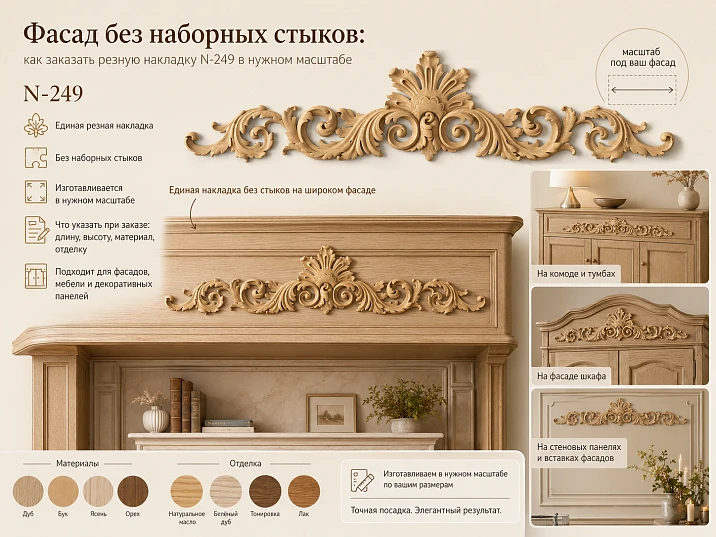
A wide furniture facade can easily be left empty and just as easily overloaded. A small overlay gets lost on a large plane, while a set of several parts requires precise marking, identical indents, and careful joining of the ornament. Even well-chosen fragments can reveal the composition through seams, differences in relief, or mismatched shades after finishing. The buyer needs not just carved furniture decor, but a solid element that matches the scale of the empty field.
The carved overlay N-249 solves this problem in an unusual way: one form is produced in six proportional sizes. The ornament can be selected for a compact drawer, a medium facade, a wide panel, a furniture portal, or a large headboard without changing the design style or assembling the central composition from separate parts. That is why, before purchasing, it is important to measure not the entire wardrobe or chest of drawers, but the actual area where the decor will be placed.
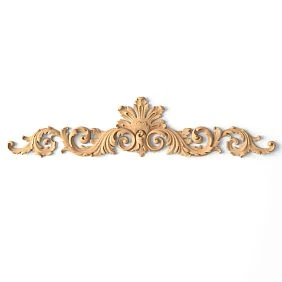
In the product card you can buy carved overlay N-249 in one of six sizes: from 397 × 90 × 10 mm to 1103 × 250 × 23 mm. Beech and oak are available, as well as sanding levels "Standard" and "Prestige." These parameters should be chosen as a single configuration: the size determines the scale, the wood species determines the nature of the future finish, and the surface preparation quality determines how thoroughly the large relief needs to be worked out before painting or tinting.
The article is structured as a practical ordering route. First, the empty field is determined, then paper templates of all suitable sizes are tried on the facade, after which the material, sanding quality, number of items, and installation scheme are selected. This order helps to obtain a solid ornament without assembly seams and avoid purchasing a part that is too small or excessively large.
Why a wide facade is more difficult to decorate than a small one
On a small door, the boundaries of the composition are clear: the decor is located near the edges, handle, and frame, so its scale is easy to assess. On a wide facade, the empty space begins to work as an independent plane. An overlay that is too small looks random, as if it was chosen from leftovers. One that is excessively large comes close to the moldings, conflicts with the handles, and leaves no empty field around the pattern.
Facades with multiple constraints are especially difficult. The central area may be located inside a panel, between pilasters, under a cornice, above drawers, or between paired handles. The overall width of the wardrobe in such a case says almost nothing about the permissible size of the overlay. The buyer needs to see the internal architecture of the furniture and determine which part of the surface truly belongs to the future ornament.
A composite composition partially solves the scale problem: several small elements can be spread across the width. But another task arises—achieving equal spacing, maintaining the axis, coordinating the relief, and hiding the boundaries between parts. On furniture with a transparent or semi-transparent finish, differences in wood become more noticeable. A solid overlay eliminates seams within the pattern and makes the central accent calmer.




How is N-249 different from a regular overlay of the same size?
Most carved elements are chosen based on the principle of 'fits or doesn't fit.' The product has a specific geometry, and the buyer is forced to adapt the facade to it. N-249 offers a different approach: the shape of the ornament is preserved, while the length, height, and thickness change proportionally. This allows one model to be repeated on objects of different scales within a single project.
For example, a compact size can be used on a cabinet or small drawer, a medium size on a wardrobe door, and a large size on a central panel or headboard. At the same time, the furniture does not look like it's assembled from unrelated catalogs: the motif remains recognizable. This solution is useful for a bedroom, dressing room, or living room, where a chest of drawers, wardrobe, and bed should support a common decorative language.
Six sizes do not mean that any of them fits any surface. Not only the length but also the height and thickness increase. The large version protrudes more above the plane, creates a deeper shadow, and requires more free space around it. Therefore, the choice is made not by a single number, but by the full set of three dimensions.
Our factory also produces:
Confirmed characteristics of N-249
| Parameter | Confirmed value | What this means for the buyer |
|---|---|---|
| Article number | N-249 | It must be specified in the specification and when ordering the entire batch |
| Type | Carved wooden overlay | The product works as an overlay decorative element, not as a structural part |
| Size range | Six proportional sizes | One ornament can be selected for furniture fields of different scales |
| Minimum size | 397 × 90 × 10 mm | Suitable for fitting on compact horizontal fields |
| Maximum size | 1103 × 250 × 23 mm | Designed for a very large plane, if sufficient free space remains around it |
| Materials | Beech or oak | The species is coordinated with the base and future finish |
| Sanding | "Standard" or "Prestige" | The preparation level is chosen considering size, finish, and viewing distance |
| Main task | Solid horizontal ornament | No need to compose a central pattern from several small overlays |
| Product card | Carved overlay N-249 | Before ordering, check the selected size, material, and processing quality |
The article does not specify the price, availability, delivery times, or specific mounting method, as these parameters depend on the selected configuration, base, and current order conditions. They must be checked in the product card or agreed upon with a STAVROS manager.
Get Consultation
Six sizes of one ornament
| Size N-249 | Thickness | Field scale reference | Where to try on |
|---|---|---|---|
| 397 × 90 × 10 mm | 10 мм | Compact horizontal zone | Dresser drawer, nightstand, small door, top rail |
| 574 × 130 × 12 mm | 12 мм | Medium facade | Wardrobe, sideboard, central part of the door, top panel |
| 705 × 160 × 15 mm | 15 мм | Wide facade | Chest of drawers, wardrobe, furniture portal, large panel |
| 838 × 190 × 18 mm | 18 мм | Large central area | Headboard, wide panel, pediment, built-in furniture |
| 948 × 215 × 20 mm | 20 мм | Large-format object | Large bed headboard, portal, long top panel |
| 1103 × 250 × 23 mm | 23 мм | Monumental field | Large headboard, wall or furniture panel, wide composition |
The last column is not a manufacturer's limitation, but a guideline for project fitting. The same facade can have different frames, handles, and free fields. A size of 705 mm on one piece of furniture will look confident, but on another it may be squeezed between pilasters. Therefore, the table helps to select two or three candidates, but the final decision is made using a full-size template.
How to measure the free field exactly
The first measurement is taken along the inner area, not the outer dimension of the item. If the facade is surrounded by molding, the tape measure is applied inside the frame. If there are furniture pilasters along the edges, the distance between them is considered. If there are handles, locks, hinges, or decorative rosettes on the surface, they reduce the available space.
It is useful to record four parameters:
- the clear width of the area between the nearest constraints;
- the clear height of the field;
- the distance from the intended axis of the overlay to handles and fittings;
- the permissible relief thickness considering door opening and adjacent parts.
Perspective is checked separately. An overlay on the top panel of a cabinet is visible from below, so its thickness and lower edge are perceived more strongly. On a headboard, the product is closer to eye level. On a wide dresser, it may be viewed at an angle from a doorway. Such conditions influence the choice of scale no less than dry dimensions.
Why you shouldn't fill all free space
Decor needs indents. If the edge of the ornament almost touches the frame, the design looks forced. If there is a free plane between the overlay and the molding, the eye sees the ornament as a whole. The exact indent value depends on the furniture, so a universal formula in millimeters cannot be assigned.
The template should show not only whether the part fits physically, but also whether there is "breathing room" around it. At least two adjacent sizes are compared. Sometimes a larger N-249 better connects a wide panel, and sometimes a medium one looks more expensive precisely because of the calm margins on the sides.
Full-size paper template
For each size under consideration, a rectangle is cut out according to the external dimensions. It is not necessary to reproduce the exact contour of the ornament at the first stage: it is enough to see the length and height. The size and thickness are labeled on the template to avoid confusing the options.
The template is secured with painter's tape that does not damage the finish, and the facade is photographed from a normal viewing angle. Then the size is changed and the photo is repeated. It is more convenient to compare options using photographs because the eye quickly gets used to the current scale and stops noticing imbalance.
After selecting the rectangular dimensions, it is useful to print or draw a more accurate silhouette. It shows how the voids inside the carving interact with the panel and handles. Before ordering, it is worth checking the open door: the overlay should not interfere with the adjacent facade, wall, or protruding hardware.
How to choose a size for a compact dresser
On a drawer or small top panel, the first candidate is usually 397 × 90 × 10 mm. But even the minimal N-249 remains a long horizontal element. It is necessary to check whether it approaches the handles or covers the useful plane of the drawer.
If the dresser consists of several identical drawers, it is not necessary to put N-249 on each one. One solid ornament can work on the top drawer or on a blind panel, while the lower facades remain calm. Repetition on all levels is only acceptable after a mockup: a large pattern can create too dense a horizontal rhythm.
How to choose a size for a wardrobe
For a cabinet, it is important to determine whether the overlay belongs to a single door or to a common top panel. On a separate door, the size is limited by the frame, handle, and adjacent facade. On the pediment or cornice area, a longer option that combines several verticals can be used.
For the middle facade, try 574 × 130 × 12 mm and 705 × 160 × 15 mm. The difference between them is felt not only in length: the larger version is taller and thicker, thus changing the door's character more significantly. If the cabinet has thin frames and narrow stiles, the medium size may be more convincing than the maximum.
How to choose N-249 for a wide dresser
A wide dresser often requires a single central accent that connects the left and right parts of the facade. A set of two symmetrical overlays emphasizes the division, while N-249 can, on the contrary, tie the composition into a single whole.
On the top panel or central wide drawer, check sizes 705, 838, and 948 mm. The choice depends on the actual field width and handle placement. If the handles form their own horizontal line, the overlay should be above or below and not conflict with it in density.
Furniture portal and pediment
The portal is perceived architecturally: it has side supports, a top lintel, and a central field. A single horizontal overlay helps assemble the top part without multiple sectional fragments. The central axis between the pilasters is especially important here.
For a large portal, consider 838 × 190 × 18 mm, 948 × 215 × 20 mm, and 1103 × 250 × 23 mm. But the maximum size is only suitable if the lintel height is sufficient. If the ornament touches the cornice above and the opening below, the composition loses clarity.
Bed headboard: solid center instead of a set
On the bed headboard, the ornament is in a constant viewing area. Joints between sectional parts are more noticeable, especially with side lighting. A solid N-249 creates a continuous central motif.
The headboard may have a soft insert, a wooden frame, or a wide top panel. The space above the soft part and inside the rigid base is measured. The overlay should not fall into the area that receives mechanical impact from pillows or textiles. For a general understanding of the design, you can study the material about decorative wooden headboard, and the exact size N-249 should be chosen based on the specific backrest.
Built-in furniture and wall panels
A built-in wardrobe often occupies an entire wall, so even a large overlay can look compact. An error occurs when the size is chosen based on the width of an individual door, although the eye perceives the entire furniture front. In such a project, N-249 can be placed on the central panel, gable, or the overall top strip.
On a wall panel, one must distinguish between furniture and interior scale. The overlay remains a decorative wooden product, and the method of attachment depends on the base, finish, and weight of the chosen size. A large version cannot be mounted according to the rules of a small overlay without verification.
When one solid ornament is better than several details
| Task | Solid N-249 | Set of several overlays |
|---|---|---|
| Get a continuous central pattern | Has no internal joints | Requires alignment and equal gaps |
| Maintain symmetry | Just align the central axis of the part and the facade | Need to mark each part separately |
| Order one type of wood and finish | One element has a single material | Differences between parts may appear after finishing |
| Change scale | You can choose one of six sizes of the same shape | You have to change distances or the number of elements |
| Create a complex composite frieze | May not be flexible enough | The set allows building a long belt of repeats |
| Go around handles and other elements | Requires a solid free field | Individual parts are easier to place on the sides |
N-249 is especially strong where the buyer needs a single central gesture. If the task is a long repeating belt, it's worth studying how it works furniture frieze. These solutions do not directly compete: the frieze builds an extended rhythm, while N-249 covers a specific wide field with one piece.
When a modular composition is still more appropriate
A solid overlay requires a continuous area. If there is a lock, handle, door joint, or structural strip in the center, a long ornament may not fit. In this case, two separate overlays on the sides will provide more freedom.
The set is also useful when the decor needs to continue over a very long length. The maximum N-249 is 1103 mm. If the belt is significantly longer, a repeatable system is designed or linear molding is used. The choice should follow the task, not the desire to apply a specific item at any cost.
Horizontal shape: why it cannot be randomly rotated
N-249 is designed as a long horizontal overlay. A vertical rotation changes the logic of the ornament, and the long length begins to compete with the door height. Even if the part physically fits, the composition may look unnatural.
For vertical fields, there are other shapes. In the overview of horizontal and vertical overlays you can understand the difference in direction. N-249 should be chosen precisely when the facade needs an extended central line.
Beech or oak
| Criterion | Beech | Oak |
|---|---|---|
| Typical design choice | Opaque enamel and uniform color | Transparent or semi-transparent finish preserving texture |
| Combination with base | Often considered for painted facades | Appropriate next to oak details and visible wood |
| Perception of the pattern | The ornament is read through shape and shadow | A pronounced wood texture is added to the shape |
| What to check | Preparation for the selected enamel and compatibility with the facade | Texture direction, tone, and sample of the future finish |
Beech and oak cannot be chosen only by price. Under a transparent finish, mixing species is noticeable even with similar colors. If the base is made of oak or veneered with oak veneer, an oak overlay usually integrates more easily into the overall material. If the facade will be completely covered with enamel, beech can be a rational base, but the painting technology should still be coordinated with the finisher.
For several identical facades, the material must be uniform. In the card, one species should be selected for the entire batch. If the project combines different items — for example, a cabinet, a chest of drawers, and a bed — it is better to order the overlays simultaneously and indicate that they belong to the same interior.
"Standard" or "Prestige" as applied to N-249
On a large overlay, the quality of surface preparation is more noticeable than on a small element. The closer the product is to eye level and the more transparent the finish, the more carefully the sanding should be evaluated. "Standard" and "Prestige" should be chosen not as abstract categories, but taking into account the size and finish.
Dense opaque enamel can partially smooth out the visual difference, but does not eliminate relief preparation. Transparent tinting leaves the wood and all processing areas visible. Large sizes 838–1103 mm have more carved surface, so batch consistency and the quality of recesses are especially important.
Why the entire batch must have the same processing
If one overlay is ordered as "Standard" and the adjacent one as "Prestige", the difference may appear after painting or under side lighting. On individual items this may not be noticeable, but on paired facades the eye directly compares the elements.
In the specification, next to each item number, the size, wood species, and sanding quality are indicated. For one room, it is better not to split the order into several stages unnecessarily. One batch simplifies the coordination of material and preparation.
How to order several identical N-249 without color variation
The first rule is to simultaneously determine the quantity and purpose of each part. You should not buy one overlay for a test facade and order the rest after installation if the project is already approved. A repeat delivery may differ in the natural wood grain, and a transparent finish will enhance the difference.
In the order, specify:
- item number N-249;
- the exact size of each part;
- beech or oak;
- "Standard" or "Prestige";
- quantity;
- common object or room;
- future finish;
- purpose: cabinet, chest of drawers, portal, headboard or panel.
If different items receive different sizes of the same ornament, this is also noted. For example, two N-249 574 mm are intended for bedside tables, one 838 mm for a chest of drawers, and one 1103 mm for a headboard. Such a list helps to avoid mixing parts during production and installation.
How to calculate the quantity
The quantity is determined by the number of fields being decorated, not the total length of the furniture. One central panel requires one overlay. Two identical doors may receive two parts if each has its own composition. A common pediment above four doors may be decorated with one large N-249.
| Scenario | Base quantity | What to Check |
|---|---|---|
| One wide drawer of a chest of drawers | 1 | Free space between handles and frame |
| Two identical doors | 2 | Same axis height and mirror symmetry |
| Common pediment of a wardrobe | 1 | Center of the entire body, not of an individual door |
| Two bedside tables | 2 | Single species, size, and finish |
| Dresser and headboard in one set | One element per field | Different sizes of the same shape can be used |
| Multiple identical objects | Number of fields × one element per field | Ordering in one batch and marking |
Reserve cannot be set as a universal percentage. It depends on the number of facades, installation method, cost of re-delivery, and possibility of subsequent purchase. For a large project, the reserve issue is coordinated with the furniture manufacturer and the STAVROS manager.
Layout scheme on paired facades
On two identical doors there are two options. The first is a separate N-249 in the center of each door. The second is one common overlay on the top panel that unites the entire cabinet. You cannot place a solid part over the working joint of the doors if it interferes with opening.
When paired, the centers of the overlays must be on the same horizontal line. Paper templates are fixed simultaneously, after which the height is checked from a distance. Marking separately often leads to a difference of several millimeters, which is noticeable on a long ornament.
Central axis as the basis for installation
A long overlay is difficult to align by the edges: a small error on the left and right may go unnoticed, but the center of the ornament will shift relative to the facade. Therefore, first find the central axis of the free field, then mark the center of the part itself and align the points.
After alignment, check the top and bottom indentation. Only when the overlay lies flat and does not conflict with the frame, its position is transferred to the base. For a large version, additional control marks are used to prevent the part from rotating during fixation.
Dry fitting before glue and finishing
Dry fitting means installation without final fastening. The overlay is applied to the facade, temporarily secured in a safe way, and evaluated from different points. Check door opening, access to handles, shadow from the relief, and interaction with the cornice.
At this stage, you can change the size without damaging the facade. If the part is already glued, correction will require dismantling and surface restoration. Therefore, dry fitting is mandatory even after a successful paper template: the actual thickness and relief are perceived differently.
Mounting compound is selected based on the base
The SEO scheme does not specify a specific mounting product, so the article does not assign a universal adhesive. The composition must be compatible with the overlay wood, facade material, primer, and future coating. Separately, check whether it leaves stains and allows painting according to the project technology.
The large N-249 weighs and behaves differently than a small overlay. Temporary fixation before setting must hold the part without shifting. The method is determined by the master based on the actual base and the chosen composition.
Can N-249 be mounted on MDF
The possibility depends not only on the word "MDF" but also on the surface condition. Untreated board, primed facade, finished enamel, and film require different solutions. The mounting method cannot be transferred from one coating to another.
Before installation, a test is performed on a technological sample. The master checks adhesion, absence of stains, and compatibility with subsequent finishing. N-249 remains a decorative overlay and should not be used as facade reinforcement.
Paint before or after installation
Both approaches are possible in different projects. Joint painting after mounting helps unify the overlay and facade with a single color. However, the relief complicates application, and the joint around the part must be carefully prepared. Pre-finishing allows thorough treatment of the product separately but requires precise color matching and careful installation.
The decision is made by the technologist responsible for the facade. The specification must indicate in advance whether N-249 will be painted together with the base or separately. You cannot first order the material and then change the finishing concept without verification.
Why can't the ornament be cut to length
The size range is created precisely to allow selection of a proportional version. Cutting a finished overlay disrupts the pattern completion, symmetry, and edge of the relief. Even if the part physically fits after shortening, the ornament may look truncated.
If two adjacent sizes are not suitable, you need to reconsider the field, choose a different model, or switch to a composite composition. Trying to turn 705 mm into arbitrary 660 mm deprives N-249 of its main advantage—a complete, finished form.
How to combine N-249 with handles
Handles and the overlay should have different roles. The hardware is responsible for interaction, N-249 for the central ornament. If the handles are located in the center of the facade, a long overlay may not fit. Then it is moved higher, a different size is chosen, or it is used on a common panel.
Before ordering, the full contour of the handles, including the base and hand movement, is marked on the template. It is not enough to leave space only for the visible hardware. The user must be able to open the furniture freely without touching the protruding carving.
Combination with moldings and frame
The molding forms a border, and N-249 works inside it. The more active the frame profile, the calmer the scale of the central decor can be. If both the frame and the overlay are very large, the facade becomes heavy.
The wooden overlay must be coordinated with the frame in material and finish. Under a transparent coating, a random combination of oak N-249 and a different species in the molding can produce a different pattern. Under enamel, compatibility of preparation and uniformity of painting are more important.
N-249 and furniture cornice
On the top panel of the cabinet, the overlay is often located directly under the cornice. A readable background area should remain between them. If the ornament comes close to the protruding profile, shadows merge and details become indistinguishable.
The paper template should be evaluated under real overhead lighting. The cornice can cast a shadow and visually reduce the height of the free field. In this case, a smaller N-249 looks clearer.
N-249 and central rosette
Two central accents in one field are rarely needed simultaneously. A long overlay already forms an independent ornament. A rosette can compete with it and fragment the composition.
If a project requires several types of decor, they are distributed across levels: N-249 on the pediment, a rosette on the door, overlays of a different format on the side sections. Approaches to carved overlays in the interior help understand the roles of different elements, but N-249 must retain its own free field.
What to buy together
| What to include in the project | Why this is needed | What to Check | Where to go |
|---|---|---|---|
| N-249 of the selected size | Creates a cohesive central ornament | Size, beech or oak, "Standard" or "Prestige" | N-249 card |
| Other wooden overlays | Adjacent fields and vertical zones are being designed | Combination of form, scale, and material | Wooden decorative inlays |
| Horizontal models | Allow comparing N-249 with other extended solutions | Dimension, direction, and purpose | Horizontal wooden overlays |
| Material for paper template | Helps choose scale without risk to the facade | Exact match to external dimensions | Manufactured according to the project |
| Compatible mounting composition | Fixes the overlay on the selected base | Compatibility with wood, facade, and finish | Selected by the master |
| Finish sample | Shows the result on beech or oak | Color, transparency, and relief behavior | Coordinated with the finisher |
The table does not encourage buying extra elements. Its purpose is to show that the central overlay is connected to the frame, adjacent fields, installation, and finish. The set is considered complete only after all these parts are coordinated.
How not to confuse N-249 with a furniture frieze
A frieze usually forms a long decorative band and may consist of repeats, moldings, or multiple elements. N-249 is a single complete overlay with defined boundaries. It does not extend indefinitely and is not intended for mechanical joining into a strip.
If you need to decorate a specific central area, N-249 is better suited. If the decor should run along the entire length of the kitchen or cabinet, consider a frieze system. Names may overlap in search queries, but the design logic differs.
How not to confuse N-249 with a headboard
The overlay can be used on the bed back, but it is not a headboard by itself. It does not replace the frame, soft part, or main panel. It is a decorative element installed on a prepared surface.
This distinction is important for configuration: the customer orders N-249 as part of the decoration, not as a finished furniture structure.
How not to confuse a solid overlay with a structural part
N-249 does not reinforce the facade, connect panels, or replace a crossbar. It cannot be used to cover a crack or working joint. The base must be sound and prepared before installation.
If there is a joint of two panels under the overlay, their movement may affect the decor. The designer must solve the structural task separately, and N-249 is installed only after that.
Practical selection: cabinet
For a cabinet, start with the size 397 × 90 × 10 mm. Try it on a drawer, door, or top rail. If the field is very wide, you can check 574 mm, but it is important to maintain free space around.
For a pair of cabinets, use two identical parts ordered in one batch. Transfer the axis and placement height using a common template so that the furniture looks like a set.
Practical selection: sideboard or display cabinet
The sideboard has many vertical divisions, glass, and handles. N-249 is usually placed on a solid top panel or a wide lower door. It is not suitable for narrow posts due to its horizontal format.
The size is chosen based on the central field of the entire item. If the overlay is above glass doors, its center is aligned with the axis of the body, not with a single door.
Practical selection: wardrobe in the bedroom
For the wardrobe, it is important to connect N-249 with the bed, nightstands, and dresser. One ornament in different sizes helps to repeat the motif without literal copying. For example, a large version is placed on the wardrobe front, a medium one on the dresser, and a compact one on the nightstands.
The material and finish should be uniform. If the wardrobe is painted with enamel and the bed has visible oak, the same shape may look different. This is only acceptable as a deliberate decision.
Practical selection: headboard
On the headboard, first measure the rigid decorative area. The soft part, pillows, and textiles should not cover the ornament or constantly touch its protrusions. For a wide backrest, compare 838, 948, and 1103 mm.
A size that is too small looks like a separate appliqué, while one that is too large is pressed against the edges. The optimal option is visible from full-size templates and a photo of the room.
Practical selection: furniture portal
At the portal, the overlay is located on the horizontal crossbar. The center is determined between the side supports. The size should take into account not only the width but also the height of the upper part.
A large relief cannot be installed close to the opening if it may interfere with the door, mirror, or lighting. All adjacent elements are marked on the drawing before ordering.
Practical selection: built-in wardrobe
Built-in furniture is perceived as part of the wall. For this reason, a separate door may look small, although the entire front remains large. N-249 can be assigned to the central blind panel or the overall pediment, but it cannot be transferred across the working joint of the doors.
On the drawing, it is useful to show both levels: the axis of the entire wardrobe and the axes of individual doors. Then the designer and installer understand which composition the overlay belongs to. The size is chosen based on the field that should actually become the center.
Practical selection: separate wall panel
On a large decorative panel, N-249 can become part of the interior composition, but the product remains a furniture overlay. The base, mounting method, and operating conditions must be checked by a craftsman. A wall surface cannot be considered automatically suitable just because it is flat.
The placement height and side lighting are evaluated especially carefully. The large ornament 1103 × 250 × 23 mm forms a noticeable relief, so shadows become part of the result.
How light changes the perception of size
With frontal uniform lighting, the carving looks calmer and flatter. Side lighting emphasizes depth, edges, and the quality of sanding. The same N-249 may appear compact during the day and more massive in the evening with directional lighting.
The template shows only the outer dimensions, so after receiving the actual part, a dry fit in real lighting is useful. If the shadow is too dense and merges with the frame, it is worth increasing the free margin or choosing a smaller size.
How color affects the readability of the ornament
Light enamel makes the contour softer and binds the overlay more strongly to the facade. Dark coloring can enhance the depth of shadows, but with insufficient light, individual areas of the pattern will merge. Transparent finish adds wood grain to the relief.
Therefore, it cannot be said that one color is always better than another. The sample must take into account the specific wood species, size, and lighting. On a large version, a finishing error is more noticeable because the surface occupies a significant part of the facade.
How to coordinate N-249 with other furniture items
Six sizes allow building a family. The largest part can be on the headboard, the medium one on the wardrobe, the compact one on the nightstands. It is important to maintain the same wood species, finish character, and ornament direction.
It is not necessary to use N-249 on every item. Sometimes two repetitions are enough: on the bed and wardrobe. The dresser can be left plain or decorated with another piece from the same stylistic group. Repetition should connect the interior, not turn it into a catalog of a single article.
How to create a placement map
| Item | Field | Size N-249 | Material | Finishing | Quantity | ||||||||||||||||||||||||||||||||||
|---|---|---|---|---|---|---|---|---|---|---|---|---|---|---|---|---|---|---|---|---|---|---|---|---|---|---|---|---|---|---|---|---|---|---|---|---|---|---|---|
| Cabinet | Common gable | Specify after template |
Beech or oak <Do not create a templateThe product photo does not show scale on specific furniture. Full-size fitting prevents mistaken purchases. Do not consider openingThe part may be placed on a closed door and interfere with the adjacent facade when opening. Trim the finished ornamentTrimming destroys the completed shape. You need to choose a different size or a different model. Rotate the pattern verticallyN-249 is a horizontal overlay. Random rotation changes its compositional role. Mix beech and oak under a clear finishDifferent wood species have different grain patterns. This difference will remain visible under the tint. Ordering identical fronts in separate batchesIndividual batches may vary in natural wood tone and preparation. Mount without an axisA long pattern immediately shows misalignment. Align the center of the part and the fields before fixing. Finishing errorsA common mistake is choosing the wood species after approving the color. Material and finish are linked: oak reveals texture, beech is often chosen for uniform enamel. The second mistake is not making a sample on the actual profile. Color on a flat board does not show how the coating will settle in the recesses. Also, do not assume that a large overlay automatically hides preparation flaws. Side lighting emphasizes the surface. The larger the N-249, the more noticeable the quality of sanding and finish application. Batch ordering errorsSometimes different sizes are mixed in one order without specifying the purpose. On site, the installer does not understand which part belongs to the cabinet and which to the headboard. Therefore, the specification is supplemented with room and front markings. Another mistake is ordering the exact quantity without discussing a reserve. A universal stock isn't necessary, but the decision should be deliberate. For a remote site, re-delivering a single part can be more difficult than having a reserve in the initial batch. Acceptance of N-249 before installation
Inspection is carried out before painting and installation. After coating, it is harder to determine at which stage the damage occurred. Each part is temporarily marked at the installation location. Storage before installationOverlays are stored in packaging, protecting the carved relief from impacts. Large sizes cannot be placed so that other parts press on the protrusions. Storage conditions are coordinated with the requirements for wooden products and future finishing. Batches for different rooms are not mixed. Marking is preserved until installation is complete. If the product requires preparation before finishing, the mode is determined by the project technologist. Technical specification for the installer
This task reduces reliance on verbal explanation. On several identical facades, the installer uses one control template and maintains the overall row height. Who is N-249 suitable for
When it is better to choose a different overlayN-249 is not suitable for a narrow vertical post, a small square panel, or a surface with a handle in the center. Another model is also chosen when none of the six sizes leaves enough free space. In the category you can view wooden decorative overlays and choose a shape of a different direction. For a long repeating belt, consider a frieze; for a vertical zone, vertical decor; for a small center, a compact overlay or rosette. How to buy N-249 on STAVROSThe customer journey does not start with the order button, but with measurement. First, the dimensions of the free field are recorded, then templates of two or three suitable versions are made. After selection, the N-249 card is opened and the available configuration is checked. Before ordering, check:
For multiple facades, it is recommended to order the entire set at once. This is especially important for transparent finishes. In the card, you can buy carved overlay N-249 of the selected scale and provide the manager with the specification for the object. How to choose between two adjacent sizesAfter the first fitting, usually two candidates remain. For example, for a cabinet, sizes 574 × 130 × 12 mm and 705 × 160 × 15 mm are suitable. Both fit, both are on the axis, but create a different impression. A mistake is to choose the larger one only because it is more noticeable at close range. The facade is perceived as a whole, not as a photograph of a single carving. The comparison is made based on four questions. Is there free background space left at the edges? Does the thickness of the overlay become excessive next to a shallow frame? Are the handles visible as independent hardware? Is the ornament readable from the usual entry point into the room? If the larger version worsens at least two parameters, it is wiser to choose the smaller one. A reverse test is also useful. On a photo of the facade, the template is mentally removed. If after this the field seems too empty, the chosen size is probably insufficient. If the gaze stops noticing the furniture itself and sees only the decor, the overlay is too large. The balance lies between these states. Viewing distance and scale N-249A chest of drawers in a narrow hallway is viewed from a short distance, while a built-in wardrobe in a large bedroom is viewed from across the room. The same overlay is perceived differently under these conditions. The farther the viewer is, the larger the ornament should be so that the shape does not dissolve. But the increase is limited by the actual free field. Therefore, the template is photographed from at least two points: next to the furniture and from the entrance to the room. For a headboard, a view from the opposite wall is added. For a portal, a view along the axis and at an angle. Such a set of photos shows whether the chosen size works in a real interior, not just during a detailed inspection. Distance also affects the choice of sanding quality. The overlay on a nightstand is close to the eyes and hands, while the pediment of a tall cabinet is visible from afar. This does not make the preparation of the upper element unimportant, but helps to set priorities when coordinating the project. How to check the relief thicknessSix sizes have varying thicknesses: from 10 to 23 mm. This is not a technical detail. It determines how much the overlay protrudes above the facade, what shadow it creates, and whether it interferes with moving parts of the furniture. On a flat modern door, even 15 mm can be perceived expressively, while on a deep classic frame, 20 mm looks natural. For verification, a side mockup is made. A strip of cardboard of the required thickness is added to the rectangular template, and the facade is viewed at an angle. This simple technique shows whether the relief is closer than the handle, whether it protrudes beyond the adjacent molding, or whether it falls into the door's trajectory. Thickness is always taken into account during packaging and storage. A large overlay cannot be placed with the relief under heavy parts. Before installation, protruding areas must be protected from pressure and accidental impact. Mockup of not just one facade, but the entire wallOn a furniture drawing, the overlay may be proportional, but after installation, the cabinet may end up next to a door portal, mirror, paintings, or other carved objects. These elements create the overall background. Therefore, the final fitting should consider the entire wall. Furniture is photographed straight on, without strong wide-angle distortion, then a paper template is added. Adjacent decorative centers are marked on the photo. If N-249 ends up on the same line as a painting or mirror, it can either enhance the composition or create unnecessary competition. The decision is made before ordering, while the size can still be changed. For a furniture set, a common sheet is prepared: cabinet, chest of drawers, nightstands, and bed at the same scale. It shows how many repeats of one ornament are actually needed. Sometimes five pieces create excessive sameness, while three form a sufficient connection. How to distribute six scales in one interior
This scheme is not a ready-made norm. It shows the logic of hierarchy: a large object gets the main scale, a smaller one gets a supporting scale. If you place the same size on the nightstand as on the headboard, the difference between objects will disappear, and compact furniture will be overloaded. The same motif is especially convincing when the size changes, but the material, color, and quality of processing are preserved. Then the interior looks custom-made. If you change the scale, wood species, and finish at the same time, the similarity of the pattern may stop working as a connection. What to tell the manager before placing an orderThe phrase "I need a large N-249" is insufficient. There are six versions in the size range, so the order must contain exact numbers. The manager is given the article number, full size, material, sanding quality, quantity, and information that the parts are used together. It is useful to attach a table of facades and briefly describe the future finish. The manager does not replace a furniture designer or technologist, but accurate information helps to check the product configuration and avoid accidentally choosing a different size. If the project requires different scales, they are listed in separate lines. For example: N-249 397 × 90 × 10 mm — two pieces for nightstands; N-249 705 × 160 × 15 mm — one piece for a chest of drawers; N-249 948 × 215 × 20 mm — one piece for a headboard. Such a record is clearer than the total quantity of "four overlays." Checklist before payment
If at least one item remains unknown, it is better not to rush the order. N-249 is a ready-made ornament, but the result depends on project preparation. A few minutes of checking is cheaper than redoing a painted facade. Post-delivery checklistAfter delivery, products are not immediately sent for painting. First, all specification lines are checked, overlays are sorted by item, and a dry fit is repeated. Real wood and relief can be perceived differently than paper. Then, photos of each approved position are taken. These images become the installation map. If the facades are sent to another workshop, the overlays are packed and labeled together with a copy of the diagram. This procedure reduces the risk that the large version ends up on the dresser and the medium one on the headboard. Why a solid overlay saves more than just installation timeThe main savings are not in the number of master's movements. A solid element reduces the number of decisions to be coordinated: there are no internal distances between fragments, no need to connect the beginning and end of the ornament, and less risk of different heights of individual parts. Additionally, it is easier to control the finish. One part has a continuous surface and a single wood grain pattern. In a composite set, each fragment may accept the tint differently. For the buyer, this means a more predictable result, although preparation of the size and axis still remains mandatory. When consultation is especially importantIt is worth consulting specialists if one of the three largest sizes is chosen, the overlay is installed on an expensive finished coating, the base has a complex shape, or the project combines several items. Consultation is also needed when the product is planned for a wall panel rather than a regular furniture facade. The STAVROS manager helps with product configuration, the furniture designer is responsible for the base and opening, the finisher for the material and coating, and the installer for the actual fixation. This division of responsibility protects the project from promises not confirmed by the product card. FAQ: questions about N-249How many sizes does the N-249 have?The model is available in six proportional sizes: 397 × 90 × 10, 574 × 130 × 12, 705 × 160 × 15, 838 × 190 × 18, 948 × 215 × 20, and 1103 × 250 × 23 mm. How do I know which size will fit?Measure the free space inside the frames and between the hardware, then make full-size paper templates of two or three closest sizes. Should I focus on the overall width of the cabinet?No. The important area is where the overlay will actually be placed: inside the panel, between pilasters, handles, or under the cornice. Can the N-249 be trimmed?Not recommended. Trimming disrupts the completeness and symmetry of the pattern. It is better to choose another proportional size or a different model. Can the N-249 be installed vertically?The model is designed for horizontal orientation. For a vertical area, it is better to select an overlay of the corresponding direction. What to choose under enamel — beech or oak?For opaque enamel, beech is often considered, while oak is chosen when a pronounced wood texture is desired. The final decision is coordinated with the base and finishing technology. Is oak suitable for tinting?Oak is usually chosen for transparent or semi-transparent finishes, but the specific tone sample should be checked on the actual material. What is the difference between "Standard" and "Prestige"?These are two quality options for sanding. When choosing, consider the size of the overlay, viewing distance, and transparency of the topcoat. How many overlays are needed for two doors?If each door has its own central decor, two pieces are needed. If a common top panel is being designed, one large N-249 may be sufficient. Is a reserve needed?The size of the reserve depends on the number of facades, installation, and the possibility of subsequent repurchase. A universal percentage should not be assigned without a project. Can the overlay be installed on MDF?The possibility depends on the coating and the chosen mounting compound. A test must be conducted and a decision obtained from the master or technologist. What glue to use for N-249?The universal composition is not specified in the original product scheme. The glue is selected based on the wood, facade material, primer, and future finish. Should the overlay be painted before or after installation?Both options are possible. Joint painting helps achieve a uniform color, while separate finishing makes it easier to process the relief. The decision is made by the project technologist. How to align a long overlay evenly?Align the central axis of the facade and the part, check the top and bottom gaps, perform a dry fit, and use additional control marks. Can N-249 be used as a furniture frieze?N-249 creates a single complete ornament. For a long repeating band, it is better to consider a special frieze composition. Is N-249 suitable for a headboard?Yes, as a decorative element on a prepared rigid panel. It does not replace the headboard structure and should not be in the area of constant contact with pillows. How to order multiple overlays without color mismatch?Choose one wood species and sanding quality, order the entire batch at once, and indicate that the elements are used on the same object. Can different sizes of N-249 be combined?Yes. This is one of the model's strengths: the same motif can be used on a cabinet, dresser, wardrobe, and headboard at different scales. What to check upon receipt?SKU, dimensions, quantity, material, sanding quality, relief integrity, and consistency of paired elements. Where can I see other options?Adjacent shapes are grouped in the category of horizontal wooden overlays and the general section of carved decor. ConclusionN-249 is valuable not only for its length and expressive relief. Its main advantage is six proportional sizes of the same shape. The buyer can select a complete ornament for a specific field and then repeat the same motif on furniture of a different scale. This helps to design a wardrobe, dresser, portal, or headboard without assembly joints and accidental mixing of decor. The right choice begins with measuring the free area. It is necessary to consider frames, handles, pilasters, cornices, facade opening, and relief thickness. After that, full-size templates are compared, beech or oak is selected, sanding quality is determined, and the specification for the entire batch is compiled. STAVROS offers N-249 as a ready-made carved element that eliminates the need to manually align multiple fragments. Before ordering, you should open the product card, select the exact size, material, and finish, and for multiple facades, place the entire set as one batch. This way, the idea of a seamless ornament becomes a manageable furniture solution, rather than an experiment on an already finished facade. |