Article Contents:
- N-040 or N-093: short answer
- What is a decorative overlay and what problem does it solve
- The overlay does not change the facade structure
- The shape sets the direction
- Thickness creates chiaroscuro
- A ready-made element helps to repeat the pattern
- N-040 170 × 86 × 13 mm
- N-040 250 × 126 × 19 mm
- N-040 350 × 176 × 27 mm
- For a wide dresser drawer
- For the central part of the cabinet
- For the frieze and top panel
- For the headboard
- When N-040 is not suitable
- N-093 80 × 185 × 9 mm
- N-093 105 × 242 × 12 mm
- N-093 133 × 300 × 15 mm
- For a tall cabinet door
- For a kitchen tall cabinet
- For a furniture pilaster
- For the wall between doors
- When N-093 does not fit
- Determine the working field
- Leave air at the edges
- Compare three sizes on the template
- Check the series of facades
- Measure the pure vertical
- Don't try to fill the entire height
- Consider the viewing point
- Thickness near the handle
- Thickness inside the frame
- Thickness on the door
- Thickness and light
- Dresser with multiple drawers
- Nightstand with one door
- TV cabinet
- Wide wardrobe
- Furniture portal
- Kitchen tall cabinet
- Tall cabinet door
- Side part of a sideboard
- Furniture pilaster
- Narrow nightstand door
- N-040 above the central panel
- N-093 along the vertical axis
- Paired doors
- Door next to the wall
- Above the mirror
- Inside the molding frame
- On the wall between doors
- Above a console or dresser
- In commercial interiors
- Beech for opaque finish
- Oak for tinting
- Light finish
- Dark finish
- Same finish as furniture
- For furniture at eye level
- For tall wall decor
- For large N-040
- For thin N-093
- One handle in the center
- Two handles on the edges
- Vertical handle on a cabinet
- Button and carved decor
- Metal and wood color
- Vertical frame and N-093
- Different relief levels
- One color or contrast
- Geometric axis
- Visual center
- Pair doors
- Multiple boxes
- Wall panel marking
- Checking the base
- Dry fitting
- Compatibility test
- Even pressure
- Large N-040
- Installation of N-093 on the door
- Overlay and molding
- N-040 and horizontal molding
- N-093 and furniture pilaster
- Overlay and rosette
- Wooden and polyurethane overlay
- Finished overlay and random blank
- Need to decorate a wide dresser drawer
- Need to design a tall cabinet door
- Need to update an old cabinet
- Need to make custom furniture
- Need to design an interior door
- Need to make a wall panel
- Need to decorate a headboard
- Need to decorate a kitchen cabinet
- Need to design a commercial counter or cabinet
- Need to select a cover plate for an already installed handle
- Select only by pattern
- Use the old number of sizes
- Do not consider thickness
- Set the maximum size on any facade
- Rotate N-040 vertically
- Place N-093 horizontally
- Do not check handles
- Mix different sizes without system
- Order beech and oak in one set without plan
- Apply glue to weak coating
- Consider glue universal
- Finish after installation without facade protection
- Buy one part for a symmetrical pair
- What is the difference between N-040 and N-093?
- Which overlay to choose for a wide drawer?
- Which model is suitable for a tall cabinet door?
- Can N-040 be rotated vertically?
- Can N-093 be used horizontally?
- How many sizes of N-040 are available in the current table?
- How many sizes of N-093 are confirmed?
- Which overlay is thinner?
- What size N-040 should I choose for a chest of drawers?
- What size N-093 should I choose for a pencil case?
- Can N-040 be installed on an interior door?
- Is N-093 suitable for a wall panel?
- What to choose for white enamel?
- How to preserve the wood texture?
- Which is better — "Standard" or "Prestige"?
- Can the handle be placed on top of the overlay?
- Do I need to buy overlays in pairs?
- What Adhesive to Use?
- Can the overlay be glued to already painted furniture?
- How to mark the overlay in the center?
- What to do if N-040 is too wide and N-093 is too narrow?
- Can N-040 and N-093 be combined in one item?
- Where to buy N-040 and N-093?
- What to check before payment?
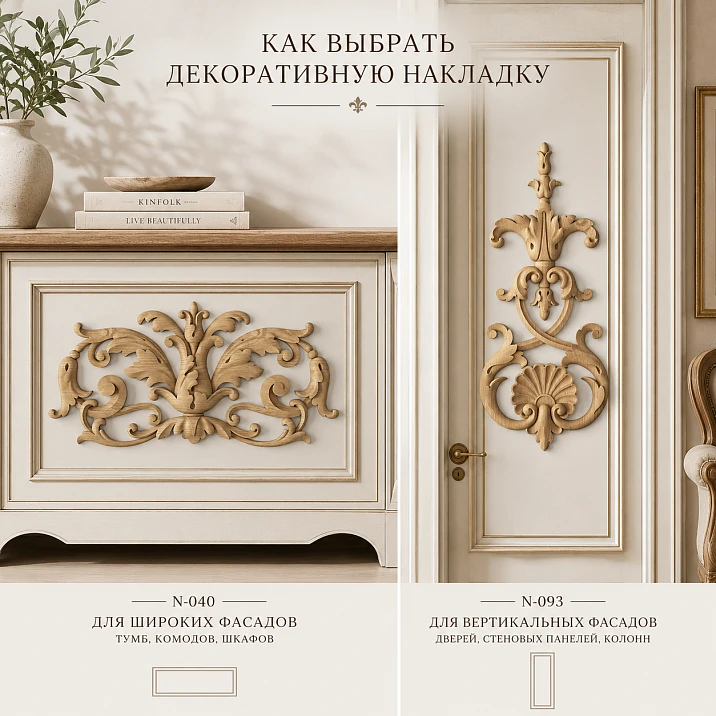
Comparison of two carved overlays made of beech or oak for a chest of drawers, wardrobe, interior door, wall panel, and furniture portal


N-040 or N-093: short answer
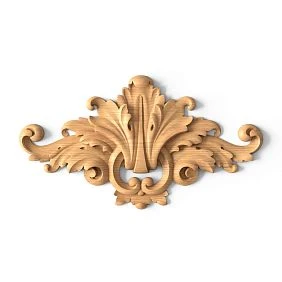
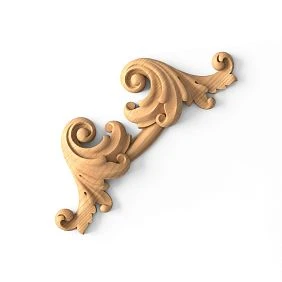
N-040 is chosen for wide furniture facades, drawers, friezes, headboards, and horizontal wall compositions. Its width is approximately twice its height, and its thickness reaches 27 mm, so the overlay not only expands the composition but also creates a noticeable relief. N-093 is suitable for tall cabinet doors, kitchen tall cabinets, furniture pilasters, partitions, and narrow vertical panels. Its height is more than twice its width, and a thickness of 9–15 mm makes the silhouette lighter.
Buy wide wooden overlay N-040 Buy vertical wooden overlay N-093 Buy decorative furniture overlays Buy mounting adhesive for wooden decor
N-040 — horizontal overlay. Current sizes: 170 × 86 × 13, 250 × 126 × 19, and 350 × 176 × 27 mm.
N-093 — vertical overlay. Current sizes: 80 × 185 × 9, 105 × 242 × 12, and 133 × 300 × 15 mm.
Both models are available in beech and oak. For opaque enamel, beech is more often chosen; for tinting while preserving texture, oak.
Grinding — "Standard" or "Prestige". The choice depends on the finish, viewing proximity, and the workshop's readiness to perform additional preparation.
You cannot rely on old text descriptions of the number of sizes. For the article and order, only three current variants of each model from the selection table are used.
The main criterion is the direction of the facade. A wide overlay should support the horizontal, a vertical one should support the height of the door, post, or partition.
A customer who wants to buy wooden decorative furniture overlays often starts with the ornament: whether they like leaves, flowers, symmetry, and depth of carving. For N-040 and N-093, this is not enough. Both models have a botanical character, are made from beech or oak, and are available in two sanding options, but they work in opposite directions. N-040 stretches the decor horizontally. N-093 gathers the gaze vertically.
This difference affects the entire piece. A wide overlay helps tie together a long drawer, frieze, or headboard and eliminates the feeling of an empty horizontal plane. An elongated overlay supports a tall cabinet door, furniture pilaster, or narrow wall section where a horizontal model either does not fit or looks too heavy. Therefore, the choice should not be "which is prettier" but "which matches the surface proportions."
Size cannot be evaluated separately from thickness. N-040 has a depth of 13 to 27 mm and creates more pronounced chiaroscuro. N-093 is thinner — from 9 to 15 mm, so it works more easily on a door, near a handle, and inside a frame molding. On a wide facade, this lightness can be an advantage or, conversely, make the vertical element too weak.
For a drawer, wide facade, and frieze, you can choose the size of the N-040 overlay. For a tall door, pencil case, and furniture stand — choose the size of the N-093 overlay. If neither model matches the proportions, it is better to open the catalog of wooden overlays and select another size by width, height, thickness, and type of ornament.




What is a decorative overlay and what problem does it solve
A carved overlay is a ready-made three-dimensional element that is attached to a furniture facade, door leaf, wall panel, or other flat surface. It does not replace the furniture structure and does not become a load-bearing part. Its task is to create relief, fill an empty surface, connect the facade with moldings and handles, and set the desired direction of the composition.
For the buyer, this is more convenient than cutting an ornament directly on the door or searching for a random carved blank. The finished model has a confirmed article number, dimensions, and a repeatable shape. You can order one overlay for the central element, a pair for a symmetrical facade, or an identical set for several doors.
Our factory also produces:
The overlay does not change the facade structure
It works on top of the existing surface. This allows you to update a chest of drawers, cabinet, or door without making a new carved facade. However, the base must be flat, durable, and compatible with the chosen fastening method. The overlay does not hide serious deformations, peeling coating, or a weak door.
Get Consultation
The shape sets the direction
N-040 visually expands the surface. It is suitable for horizontal panels, long drawers, top friezes, and wide wall frames. N-093 stretches the facade upward and works better on tall doors, pilasters, and narrow panels. This is why direction is more important than the fact that both models belong to the floral ornament category.
Thickness creates light and shadow
The deeper the relief, the more it stands out in side lighting. The large N-040 with a thickness of 27 mm becomes a noticeable volumetric center. The N-093 with a thickness of 9–15 mm looks lighter, protrudes less next to a handle, and fits more easily inside a frame. The thickness should be checked not only from the front but also from the side.
A ready-made element helps repeat the pattern
If you need to decorate two cabinet doors, four dresser drawers, or several wall panels, the article number allows you to maintain a consistent shape. When carving by hand, small differences quickly become noticeable. Purchasing one series reduces the risk of inconsistency in scale and ornament.
Confirmed characteristics of N-040 and N-093
| Parameter | N-040 | N-093 | What This Means for the Buyer |
|---|---|---|---|
| Main direction | Horizontal | Vertical | The first expands the facade, the second emphasizes its height. |
| Minimum size | 170 × 86 × 13 mm | 80 × 185 × 9 mm | Compact models are suitable for small facades but maintain different directions. |
| Medium size | 250 × 126 × 19 mm | 105 × 242 × 12 mm | Universal scale for a dresser, door, or cabinet after checking the actual field. |
| Maximum size | 350 × 176 × 27 mm | 133 × 300 × 15 mm | N-040 becomes a large relief center, N-093 becomes a tall vertical detail. |
| Thickness | 13–27 mm | 9–15 mm | N-040 protrudes more and requires more attention to handles and edges. |
| Material | Beech or oak | Beech or oak | You can choose the shape separately from the wood species. |
| Sanding | "Standard" or "Prestige" | "Standard" or "Prestige" | The preparation level is chosen based on the finish and viewing distance. |
| Ornament | Floral | Herbal, floral character | Models can be easily combined with classic and neoclassical frames, but the direction remains different. |
| Main surface | Drawer, frieze, wide panel, headboard, wall panel | Tall door, tall cabinet, pilaster, pier, vertical panel | The scenario is determined by the proportions of the field, not just the type of furniture. |
In the current order form, three sizes of each model are displayed. These must be used for calculation and specification writing. The old text description with a different number of options should not be the basis for an order until the additional size appears in the selection table.
Quick comparison: which overlay suits the task
| Situation | Preferred model | Why |
|---|---|---|
| Wide dresser drawer | N-040 | The horizontal shape supports the drawer length and fills the central empty area. |
| High cabinet door | N-093 | The vertical silhouette matches the door proportions and does not require much width. |
| Frieze above the door | N-040 | The wide form serves as the central completion of the horizontal line. |
| Furniture pilaster | N-093 | The narrow vertical overlay does not extend far beyond the edges of the post. |
| Bed headboard | N-040 | Supports the width of the bed and becomes the central decorative element. |
| Pier between doors | N-093 | The tall narrow form fits within a limited width. |
| Wide wall panel | N-040 | Extends the central ornament and connects it to the horizontal frame. |
| Narrow wall panel | N-093 | Preserves free space on the sides and emphasizes height. |
After such a comparison, you can move on to a specific card: N-040 for a wide furniture front or N-093 for a narrow furniture front.
N-040: horizontal composition for a wide front
N-040 builds decor along the width. Even the minimum version 170 × 86 mm looks like a horizontal element, while the maximum 350 × 176 mm turns into a noticeable center of a front or wall panel. This overlay is suitable for surfaces where width is more important than height: a drawer, a central panel of a chest, a frieze above a door, a headboard, a wide cabinet, or a decorative area above a mirror.
The main advantage of the model is its ability to fill an empty horizontal field without needing to assemble an ornament from several small parts. The buyer receives a solid carved element with a predictable pattern. However, it should not be assumed that the largest N-040 is automatically better. On a narrow front, a width of 350 mm will consume free space, come close to handles or frame edges, and make the composition cramped.
N-040 170 × 86 × 13 mm
The compact size is suitable for a small drawer, a narrow cabinet, the central part of a door, or a local wall frame. The width of 170 mm allows placing the overlay between handles, but the exact distance needs to be measured along the mounting axes of the hardware. The thickness of 13 mm creates a noticeable relief, so even the smallest model does not look flat.
If you need a small horizontal element, you can view the wooden overlay measuring 170 × 86 mm and apply its paper outline to the facade.
N-040 250 × 126 × 19 mm
The medium option works well on a chest of drawers, a wide cabinet door, a TV stand, a furniture panel, or above a mirror. The 250 mm size requires sufficient field width. If the facade is surrounded by a frame molding, measure the inner rectangle, not the overall door dimension. The overlay must have free space around the ornament, otherwise the carving will visually merge with the frame.
N-040 350 × 176 × 27 mm
The large version becomes an independent decorative center. It suits a wide headboard, a large drawer, the upper part of a furniture portal, and a spacious wall panel. The 27 mm thickness enhances chiaroscuro and requires checking the side view. Next to a thin handle or flat molding, such volume may appear too heavy.
For a large facade, you can view the large carved decor 350 × 176 mm and compare it with the width of the frame and handles.
For a wide dresser drawer
On a drawer, N-040 is placed along the central axis or in relation to the handles. If two handles are spaced apart at the edges, the overlay can occupy the space between them. If there is one handle, you need to decide whether it will be above, below, or within the overall design. Do not drill hardware through the carved element without a separate project.
For the central part of the cabinet
A wide cabinet often has a calm facade and a long countertop. N-040 helps connect them horizontally. On a low TV cabinet, check that the overlay does not become too high relative to the body. Sometimes the smaller size looks more convincing than the medium one.
For the frieze and top panel
A horizontal overlay naturally works in the upper part of a portal, cabinet, or door. It can become a central element of the frieze, but should not compete with the cornice in thickness and complexity. If there is already deep molding on top, choose a smaller size or paint the decor in one color.
For the headboard
On the headboard, N-040 emphasizes the width of the bed and helps create a central motif without carving over the entire surface. Before ordering, check the height of the soft part, the position of the pillows, and the visibility of the decor. The overlay should not be in the area of constant contact with the head or textiles.
When N-040 is not suitable
On a narrow door, furniture post, tall cabinet, or partition, the width of N-040 can become a problem. If the free margins on the sides are smaller than needed for normal perception, it is better to choose N-093. The horizontal model should not be turned vertically just for fitting: the ornament and shape direction are designed for the original position.
N-093: vertical decor for a tall door and narrow panel
N-093 stretches the composition upward. The smallest model measures 80 × 185 mm, the largest — 133 × 300 mm. Even the large version remains relatively narrow, so the overlay fits on a tall cabinet door, kitchen tall cabinet, furniture pilaster, partition, and vertical wall panel.
The thickness of N-093 is less than that of N-040. The range of 9–15 mm makes the relief more delicate and helps combine the overlay with handles and frame molding. This does not mean the model is always inconspicuous. The height of 300 mm creates a strong vertical and can become the main element of the door, especially in a contrasting finish.
N-093 80 × 185 × 9 mm
The most compact option fits a narrow door, a small pencil case, a side panel of a sideboard, or a vertical frame on the wall. The width of 80 mm leaves enough margin on the sides, and the height of 185 mm makes the ornament readable. The thickness of 9 mm is convenient where a handle is nearby or the door opens close to the adjacent facade.
For a compact vertical field, you can see a wooden overlay measuring 80 × 185 mm.
N-093 105 × 242 × 12 mm
The medium model fits a standard tall cabinet door, a furniture pilaster, and a wall panel. The height of 242 mm is well readable from a distance but does not require a huge surface. If the door has a frame, you need to check the internal height and leave margins at the top and bottom.
N-093 133 × 300 × 15 mm
The maximum N-093 creates a pronounced vertical. It fits a large door, a pencil case, a tall panel, or the central part of an interior door. The thickness of 15 mm remains moderate relative to the height, so the silhouette looks elongated rather than heavy. But the height of 300 mm requires precise centering.
For a large door, you can see an elongated overlay with a height of 300 mm.
For a tall cabinet door
N-093 is placed along the vertical axis of a panel or separate field. The overlay helps fill empty height without taking up much width. On paired doors, it is better to use two identical pieces and check mirror symmetry relative to the central gap.
For a kitchen tall cabinet
A tall facade often looks too empty next to lower cabinets. Vertical decor helps tie a tall cabinet to a classic or neoclassical kitchen. Consider the handle, opening direction, frequent cleaning, and proximity to heat and moisture sources.
For a furniture pilaster
On a narrow stile, N-093 supports the vertical function of the pilaster itself. The width of 80–133 mm allows selecting a model without exceeding boundaries. If the pilaster already has its own relief, an additional overlay may be redundant; first compare patterns and thickness.
For the space between doors
In a narrow area, horizontal N-040 usually does not fit. N-093 uses height and leaves free margins. On a wall, it can be placed inside a molding frame or as a standalone element, but precise adhesive and surface preparation depend on the coating.
When N-093 is not suitable
On a very wide drawer or long frieze, a vertical overlay may look random and get lost in the empty field. A single tall element is not always able to tie together a wide composition. In such cases, choose N-040, several coordinated pieces, or other decor from the category.
How to choose an overlay based on facade width
The simple calculation "the overlay should take up half the facade" does not suit all models. The ornament has its own density, it needs free margins around it, and handles and frames reduce the available space. Therefore, it is not the overall furniture dimension that is measured, but the pure decorative area.
Determine the working field
On a framed facade, the working field is the inner panel. On a smooth door, it is the area between the edges, handle, hinges, and adjacent elements. For a drawer, two handles and gaps are considered. For a wall, the inner part of the molding frame is measured.
Leave air around the edges
The carving should not press against the frame or door edge. A free field makes the ornament readable and simplifies installation. The deeper N-040 is, the more important the distance to protruding moldings. For N-093, side margins help preserve the sense of verticality.
Compare three sizes on the template
Cut out paper outlines of all relevant options. For N-040, these are 170 × 86, 250 × 126, and 350 × 176 mm. For N-093, these are 80 × 185, 105 × 242, and 133 × 300 mm. Secure them with masking tape and evaluate from the distance from which furniture is usually viewed.
Check the series of facades
If a cabinet consists of several doors of different widths, one model may look good only on some sections. Different sizes of the same article can be used, preserving the ornament, but such a decision must be deliberate. On symmetrical doors, the sizes must match.
How to choose decor based on door height
Height is especially important for N-093. A small overlay on a very tall door can get lost, while the maximum on a medium facade can take up almost the entire field and leave too little margin at the top and bottom. For N-040, height also matters: the large 176 mm model may be too tall for a low drawer.
Measure the clear vertical space
On a door, consider the frame, handle, bottom and top gaps. On a wall, consider the baseboard, switches, cornice, and furniture. On an interior door, consider the panels and eye level. Place the overlay within the actual field, not based on the overall door height.
Don't try to fill the entire height
Carved decor reads better when there is a calm surface around it. N-093 should emphasize the vertical line, not turn into a solid strip. If you want a more extended design, it can be combined with moldings, but only after checking the overall scheme.
Consider the viewing point
On a lower drawer, the decor is seen from above; on a tall door, frontally; on a frieze, from below. The higher the overlay is placed, the larger the size may need to be for the pattern to be readable. However, the physical field and installation constraints remain more important.
How to account for thickness 9–27 mm
Thickness affects light and shadow, side view, and compatibility with hardware. N-040 is deeper than N-093, especially in the maximum size. In a photo, the frontal difference may be unnoticeable, but next to a handle, molding, or door edge, it becomes obvious.
Thickness next to the handle
The handle should remain comfortable. If the overlay fits too closely, fingers may lack space. N-040 with a thickness of 27 mm requires a larger offset than N-093 with a thickness of 9–15 mm. Marking is done on the actual facade with the handle installed or using a template.
Thickness inside the frame
If the molding protrudes by 10–15 mm and the overlay by 27 mm, the central element will become dominant. This may be intentional, but should not happen by accident. Compare the side profiles of all parts.
Thickness on the door
The overlay should not interfere with opening, hit the wall, casing, or adjacent door leaf. On a hinged door, check the trajectory of movement. On a sliding door, check the gap between the panel and the tracks or the second door.
Thickness and light
Deep relief creates strong shadows, especially with side lighting. Dark tinting further enhances the volume. Light enamel softens it but does not reduce the physical protrusion. The choice of color and size should be made simultaneously.
N-040 for a chest of drawers, nightstand, and wide cabinet
A chest of drawers, nightstand, and wide cabinet provide several types of horizontal fields: a long drawer, a central panel, a top frieze, and a wide door. N-040 helps connect these zones, but placement depends on the facade design. The overlay should enhance the geometry of the piece, not conflict with the lines of drawers, moldings, and handles.
Chest of drawers with multiple drawers
On the dresser, you can place one N-040 on each wide drawer, one large overlay on the central section, or create an accent only on the top front. Full repetition makes the furniture more elegant but increases the density of carving. If the handles are already complex, it is better to choose a smaller size or limit yourself to one central element.
For a calm medium dresser, N-040 170 × 86 or 250 × 126 mm is more suitable. The 350 × 176 mm version requires a wide surface and sufficient drawer height. Before ordering, you need to check not only the external front but also the handle attachment point on the inside.
Cabinet with one door
On a low wide cabinet, N-040 can occupy the center of the door and emphasize the tabletop. If the body is compact, a large overlay will create a feeling of heaviness. A paper template helps to understand whether enough empty surface remains around the carving.
TV cabinet
The horizontal shape matches the long body, but the decor should not compete with the screen. Light N-040 in the color of the front creates relief without strong contrast. Dark oak on a light cabinet becomes an independent center and requires particularly precise symmetry.
Wide wardrobe
On wide doors, N-040 is suitable for a horizontal panel, upper part, or central frieze. If the wardrobe is tall, one horizontal overlay can visually divide the front. This is useful when you need to reduce the feeling of excessive height. To emphasize the vertical, N-093 is better.
Furniture Portal
N-040 can be used above the central section, wardrobe door, or niche. In this role, it works as a carved frieze. For a more complex system, it is useful to look at how to combine overlays and decorative moldings, and then check the dimensions of the specific front.
N-093 for a tall cabinet, high door, and pilaster
Tall narrow furniture often looks empty because horizontal decor does not match its proportions. N-093 solves this problem without excessive expansion. It can be centered on the door, repeated on a pair of facades, or support a vertical post.
Kitchen tall cabinet
On a tall cabinet, N-093 connects the upper and lower parts of the kitchen and helps integrate the tall body into a classic composition. The overlay should be placed considering the handle, facade joints, and frequently touched areas. Opaque enamel in the furniture color simplifies maintenance and makes the decor part of the door, but the specific coating system is chosen by the workshop.
Tall cabinet door
N-093 105 × 242 or 133 × 300 mm reads well on an elongated plane. If the door has a frame, the overlay is centered within the panel. On paired doors, two pieces must match in height and be at the same distance from the central gap.
Side part of a sideboard
A narrow side panel often remains unfilled, although it is visible from the side. N-093 can connect it with carved facades and a cornice. Before installation, check whether the relief interferes with the adjacent wall or passage.
Furniture pilaster
The vertical overlay is suitable for a flat post if its width and height match the working field. N-093 does not replace a full pilaster but decorates its surface. If the post already has a deep profile, additional carving may overload the composition.
Narrow cabinet door
Minimum N-093 80 × 185 × 9 mm fits a facade where N-040 does not fit in width. However, on a very low door, a height of 185 mm may be excessive. Always measure the clean panel, not the overall cabinet dimension.
How to use overlays on an interior door
A wooden door overlay can become a central ornament, fill the upper panel, or support a frame layout. But an interior door is a movable structure. The decor must not touch the casing, wall, handle, lock, or adjacent leaf.
N-040 above the central panel
A wide overlay suits the upper or middle part of the door, especially if the leaf has a horizontal division. It can work as a frieze above the panel or a central element between two vertical moldings. The large version 350 × 176 mm requires a wide leaf and sufficient field.
N-093 along the vertical axis
The vertical model suits a smooth tall door or an elongated panel. It helps emphasize height and does not take up much width. Placement in the center must consider the handle: the ornament should not interfere with grip or visually intersect with hardware.
Paired leaves
On a double door, overlays are mirrored or symmetrical. N-093 on each leaf emphasizes verticals. N-040 can be used one per leaf or as a common horizontal idea, but details must not cross the gap between leaves.
Door next to a wall
When fully opened, the deep N-040 may come too close to the wall. Check the opening angle and the 13–27 mm protrusion. The N-093 is thinner but also requires control, especially on sliding systems.
How to apply N-040 and N-093 on a wall panel
On the wall, the overlay ceases to depend on hinges and handles, but another task arises — to correlate it with furniture, moldings, lights, and the scale of the room. The horizontal N-040 suits wide frames and areas above furniture. The vertical N-093 suits narrow piers, side panels, and tall decorative fields.
Above the mirror
N-040 can become the central finish of a wide frame. The ornament is placed along the mirror's axis, checking the distance to the ceiling and lights. If the mirror is narrow and tall, N-093 on the side part or in a separate vertical frame may look more precise.
Inside the molding frame
The overlay is placed in the center of the field, leaving free space to the frame. N-040 supports a rectangle with a predominance of width. N-093 supports an elongated vertical rectangle. Before ordering, compare not only the front dimensions but also the thickness of the molding.
On the pier between doors
N-093 uses the height and does not approach the casings on the sides. It can be placed in the center of the pier or inside a narrow frame. N-040 is only suitable if there is sufficient width and can visually connect two doors if intended.
Above the console or dresser
Wide N-040 supports the horizontal of furniture and helps to assemble a wall without a picture. Vertical N-093 can work in pairs on the sides of a mirror or central panel. The distance to the countertop is chosen so that the decor is not blocked by objects.
In a commercial interior
In a showroom, restaurant, hotel, or shop, overlays can be repeated on wall panels and furniture. N-040 creates horizontal accents on posts and friezes. N-093 emphasizes tall panels and door portals. The series requires a single marking template and identical finishing.
Beech for enamel or oak for tinting
Both models are made from beech and oak. The wood species is chosen not only by price and name, but by the future finish. If the carved pattern is to become part of a painted facade, beech under enamel looks rational. If natural texture is important, oak under tinting preserves the wood grain.
Beech for opaque finish
Beech is suitable for white, gray, black, and colored enamel. The painted overlay can match the facade or contrast with it. On N-040, large planes show the quality of preparation more strongly. On N-093, the thin relief requires careful application so that the enamel does not fill the recesses.
Oak for tinting
Oak pattern makes the decor an independent material. N-040 made of oak emphasizes the wide shape and volume. N-093 adds a fine vertical texture. For a set, it is better to tint all parts simultaneously and check the shade on a test sample.
Light finish
Light enamel or tinting visually lightens the deep N-040 and helps it not to overload the facade. N-093 in the color of the door can almost blend with the plane, preserving the relief only through shadows. This is convenient for modern classics.
Dark finish
Dark color enhances the silhouette. Large N-040 becomes a noticeable center and requires a calm environment. N-093 turns into a graphic vertical. On a small facade, the contrast may be stronger than the buyer expects.
Same finish as furniture
If the overlay and facade are painted with the same compound, the joint looks calmer. With a transparent finish, the wood species and grain direction must be matched. You cannot expect an oak overlay to perfectly match veneer or solid wood from a different batch without a trial comparison.
'Standard' or 'Prestige'
The choice of sanding depends on who will prepare the product for finishing and how. "Standard" suits a project where the workshop plans additional hand processing. "Prestige" is useful for close viewing, complex tinting, and situations where the amount of finishing work needs to be reduced.
For furniture at eye level
On a cabinet, door, and cabinet, the surface is examined closely. Processing marks are more noticeable under side lighting and on translucent finishes. Here, "Prestige" is often justified.
For tall wall decor
If the overlay is under the ceiling and viewed from a distance, some fine surface details become less noticeable. But this does not eliminate preparation before enamel or tinting. The choice depends on project requirements.
For large N-040
The size 350 × 176 × 27 mm has a large area and deep relief. Any unevenness is more pronounced on wide elements. With complex finishing, more detailed sanding can save workshop time.
For thin N-093
Narrow leaves and transitions cannot be roughly re-sanded. Preparation must preserve the pattern. If the craftsman does not plan manual finishing, it is worth carefully comparing quality options.
How to combine an overlay with a furniture handle
The handle and overlay share one surface, so they cannot be chosen independently. The error usually becomes apparent after installation: fingers find it uncomfortable to grip the handle, threads intersect with mounting holes, or the two elements clash in scale. First, determine the position of the hardware, then the free space for the decor.
One handle in the center
On a small drawer, a central handle occupies the same space as the overlay. There are three solutions: place the decor higher, lower, or choose a smaller model. Drilling N-040 or N-093 for the handle without a confirmed project is not recommended: it can damage the relief and weaken the part.
Two handles on the edges
N-040 naturally fits between two handles if the distance allows. Measure not only the centers of the holes but also the length of the hardware itself and the space for fingers. A large N-040 with a thickness of 27 mm requires a particularly large gap.
Vertical handle on a cabinet
N-093 can be positioned higher, lower, or parallel to the handle. If both parts are elongated, they should work as a single vertical system, not accidentally duplicate each other. Sometimes it is better to shift the handle to the edge and leave the overlay on the central axis.
Button and carved decor
A small button competes less with the ornament. But it still needs a free zone. On N-040, the button can be located under the overlay; on N-093, to the side or below. A mockup with real hardware shows convenience more accurately than a drawing.
Metal and wood color
A dark handle on an oak overlay creates a strong contrast, the brass shade supports the classic character, and the hardware painted in the facade color makes the composition calmer. The article does not assign a specific handle because there is no confirmed URL in the schema. The buyer must agree on the shape and color separately.
How to combine an overlay with a frame molding
The molding forms the border, and the overlay fills the center. If they are equally deep and complex, the facade may look overloaded. If the frame is too massive, the thin N-093 will get lost. You need to compare
Vertical frame and N-093
The elongated frame repeats the direction of N-093. This technique is suitable for a cabinet door, wall panel, and furniture pilaster. The overlay should not occupy the entire height of the frame: free fields at the top and bottom maintain readability.
Different relief levels
N-040 with a thickness of 27 mm can protrude more than the molding and become the central volume. N-093 with a thickness of 9 mm often works as a delicate internal ornament. This is not a rule, but a reason to build a side profile of the entire composition.
One color or contrast
Painting the frame and overlay in the facade color unifies different elements. Contrasting finish separates them and requires a more precise scale. If the ornament is complex, one color usually makes the composition calmer.
Additional ideas are revealed in the material about how to combine wooden overlays with moldings.
How to mark the center of the facade
Even a correctly chosen overlay looks sloppy if it is offset relative to the door, drawer, or frame. Marking should consider not only the geometric center of the facade, but also handles, moldings, adjacent sections, and visible gaps.
Geometric axis
Measure the width and height of the working area, divide the values in half, and draw thin center lines. For N-040, horizontal symmetry is important; for N-093, vertical symmetry. Do not align with the edge of the cabinet if the door is installed with a technical gap.
Visual center
A handle, panel, or adjacent decor can shift perception. Sometimes a geometrically precise overlay appears misaligned. Before installation, secure the template with masking tape and look at the facade in the assembled furniture.
Paired doors
On two doors, the axes should be mirrored. Measurements are taken from the central gap and outer edges. Using a single template helps avoid a difference of a few millimeters.
Multiple drawers
If N-040 is repeated on each drawer, the vertical axes must align. Overlay sizes can only be changed according to a pre-approved logic. Random alternation of 170 and 250 mm creates a sense of error.
Marking the wall panel
The center on the wall is determined relative to the frame or furniture, not the entire room. If the overlay is above a dresser, its axis often coincides with the axis of the item. For asymmetrical furniture, the solution is checked in visualization.
How to glue wooden decor without unnecessary risk
The attachment method depends on the facade or wall material, coating condition, size and weight of the overlay. The SEO scheme specifies transparent TYTAN Prof. Classic Fix, intended for wood and its derivatives. However, this does not automatically guarantee compatibility with any enamel, varnish, veneer, glass, or weak paint.
Checking the base
The surface must be strong, dry, and cleaned of dust and grease. A peeling coating will hold the glue worse than the overlay itself. On old furniture, first assess the adhesion of the finish and, if necessary, prepare a test area.
Dry fitting
Before applying the compound, the overlay is placed against the marked spot, checking edges, handles, and opening. For N-040, it is important to ensure the wide edges do not extend beyond the frame. For N-093, that the vertical axis aligns with the door.
Compatibility test
The glue and coating are tested on an inconspicuous area or a separate sample. Some finishes may change gloss, color, or bond strength. The manufacturer's instructions for the compound remain mandatory.
Even pressure
The carved element should not be pressed only by the protruding leaves: thin areas can be damaged. Force is distributed over stable zones without shifting the overlay from the markings. Temporary fixation is chosen so as not to leave marks on the finish.
Large N-040
Size 350 × 176 × 27 mm requires particularly careful selection of the base and method of fixation. It cannot be assumed that glue alone is always sufficient. The master evaluates the weight of the product, the verticality of the surface, and the possibility of additional fastening.
Installation of N-093 on a door
The door leaf experiences vibration when opening and closing. The glue must be compatible with the base, and the overlay must not interfere with movement. After installation, the fixation and strength development time specified by the manufacturer must be observed.
Before work, you can select glue for installation of N-040 and N-093, and finalize the scheme with the master.
What to buy together with N-040 or N-093
The overlay may be the only decorative element, but more often it is part of a system: a frame made of moldings, handles, a painted facade, a wall panel, and an installation compound. In the SEO scheme, two articles for selecting the composition, the overlay category, and transparent glue are confirmed. Unconfirmed cards of moldings and handles are not added to the article.
| What to add to the purchase | Why this is needed | For which scenario | What to Check |
|---|---|---|---|
| Horizontal decorative overlay for furniture | Fills a wide facade, frieze, drawer, or wall panel | Chest of drawers, cabinet, headboard, door, wide portal | Size 170, 250 or 350 mm and thickness 13–27 mm |
| Vertical decor for cabinet door | Emphasizes height and fits in a narrow space | Cabinet, tall cabinet, pilaster, interior door, partition wall | Size 185, 242 or 300 mm in height and handle position |
| Decorative overlays for furniture facades | Allow you to choose a different size, shape or pattern | N-040 is too wide, and N-093 does not match the height | Width, height, thickness, wood species and sanding quality |
| How to use overlays on solid wood furniture | Helps to assemble the frame and central decor in a unified system | Chest, wardrobe, door or furniture portal | Is the surface overloaded with multiple reliefs |
| Carved decor for furniture facades | Provides ideas for combining overlays, frames and other decorations | New furniture, restoration or commercial interior | Scale, symmetry and a single material |
| Transparent glue for carved overlays | Helps secure wooden decor on a compatible base | Facade, door or wall panel after coating inspection | Instructions, base material, finish condition and need for additional fixation |
How not to confuse an overlay with similar decor
Overlay and molding
The overlay has a fixed shape and size, while the molding is a linear product cut to length. N-040 and N-093 create a central or local ornament. The molding forms a frame and a line. They complement but do not replace each other.
N-040 and horizontal linear molding
Wide N-040 resembles a frieze but remains a separate carved element. It cannot be stretched across the entire length of a cabinet. For a long continuous strip, linear molding is needed, and N-040 can serve as a central insert.
N-093 and furniture pilaster
N-093 decorates a flat vertical surface but does not form a full three-dimensional pilaster with a base and capital. If the project requires an architectural column, a single overlay element is insufficient.
Overlay and rosette
A rosette usually has a circular or radial shape and acts as a focal point. N-040 and N-093 are oriented horizontally or vertically. For a round central composition, it is better to choose another product from the category.
Wooden and polyurethane overlay
The material affects the finish, weight, texture, and installation. This article only covers products made of beech and oak. Do not apply characteristics of polyurethane decor to them or use unverified glue without testing.
Ready-made overlay and random blank
A randomly cut ornament may not have confirmed dimensions, uniform thickness, or repeatable shape. Ready-made N-040 and N-093 allow you to order a set of one article and pre-mark the facade.
Practical selection for specific situations
Need to decorate a wide dresser drawer
Start with N-040. Measure the clear width between handles or inside the frame and apply three templates. For a standard drawer, 170 × 86 or 250 × 126 mm are often suitable. The 350 × 176 mm version requires a large facade and sufficient height. If the free field is too narrow, do not try to compress the composition — choose a different size or model.
Need to decorate a tall cabinet door
N-093 aligns with the door direction. On a medium facade, check 105 × 242 mm; on a large one, 133 × 300 mm. The handle should remain comfortable, and the ornament should not intersect with the frame. On paired doors, overlays are installed mirrored and at the same height.
Need to update an old nightstand
First, assess the condition of the coating. The overlay should not be glued to peeling paint or weak veneer. N-040 helps assemble a wide door or drawer, N-093 — a narrow facade. If the furniture has complex old hardware, remove its template and check compatibility before purchasing decor.
You need to have new furniture made to order
This is the most convenient scenario: the furniture maker immediately allocates space for the overlay, handles, and molding. You can choose the exact size of N-040 or N-093, set uniform margins, and prepare the mounting surface. The finishing of the entire batch is done together with the facades.
You need to design an interior door
For the top frieze or wide panel, N-040 is suitable. For the central vertical part — N-093. Check opening, handle, lock, and distance to the wall. On a double door, the decor should maintain symmetry relative to the central gap.
Need to make a wall panel
In a wide frame, N-040 forms a central horizontal line. In a narrow tall frame, N-093 looks more natural. On the wall, the connection with the furniture under the panel is especially important. The axis of the overlay often coincides with the axis of the dresser, mirror, or console.
Need to design a headboard
N-040 emphasizes the width of the bed. Choose the size based on the visible part of the headboard, not the overall width of the mattress. The ornament should remain above the pillows and not be in the area of constant contact. For a narrow vertical insert on the sides, you can consider N-093 as a pair.
Need to decorate a kitchen tall cabinet
N-093 supports the height and does not take up the working width of the door. Consider frequent cleaning, the handle, and adjacent facades. Beech under enamel helps to combine the decor with the kitchen. The specific coating must suit the room conditions.
Need to design a commercial counter or cabinet
N-040 suits the wide front of the counter, N-093 suits vertical sections and side panels. In a commercial interior, the decor is viewed from different distances and the surface is touched more often. The mounting, finish, and number of repeating elements must be calculated in advance.
Need to select an overlay for an already installed handle
Take measurements of the hardware, the distance between mounting holes, and the free space for fingers. N-093 is often easier to bypass a vertical handle, N-040 fits well between two handles. The solution is checked on a paper template.
Mistakes when buying N-040 and N-093
Choosing only by ornament
The floral pattern unites the models, but the direction differs. N-040 will be cramped on a narrow door, N-093 will be lost on a long drawer. First, determine the field proportions, then choose the pattern and material.
Use the old quantity of sizes
Card texts may mention four or five options. The current order table shows three sizes. Only the confirmed 170, 250, and 350 mm for N-040 and 185, 242, and 300 mm in height for N-093 should be ordered.
Do not account for thickness
The buyer looks at width and height but forgets about the 27 mm of the large N-040. The overlay starts to interfere with the handle, protrudes beyond the molding, or hits the wall when the door opens. A side view is mandatory.
Set the maximum size on any facade
Large decor does not automatically make furniture more expressive. It can fill the entire field, approach the edges, and disrupt proportions. Sometimes a minimal overlay looks more convincing due to the free space around it.
Rotate N-040 vertically
The shape and ornament are designed for a horizontal position. Rotation changes the direction of the leaves and can make the pattern look unnatural. For a vertical task, N-093 is better.
Place N-093 horizontally
The same mistake in the opposite direction. An elongated model should support height. On a horizontal box, it looks random and does not fill the field.
Do not check handles
Mounting holes and grip area often overlap with the overlay. After gluing, it is difficult to change the composition. The handle and decor are marked simultaneously.
Mixing different sizes without a system
On paired doors and identical drawers, overlays must match. Different sizes are only allowed in a hierarchical composition, for example, a large N-040 on the central drawer and smaller ones on the side ones. Such a solution is shown in advance on the sketch.
Ordering beech and oak in one set without a plan
Under tinting, the species look different. Under enamel, differences can be hidden, but the preparation and surface behavior are not the same. For repeating elements, one species and one finishing system are better.
Applying glue to a weak coating
Even a suitable composition will not hold peeling paint. The base is checked and prepared before installation. On old furniture, a test is needed.
Considering glue universal
TYTAN Prof. Classic Fix is intended for wood as well, but compatibility with a specific enamel, varnish, veneer, or wall covering is checked separately. A large overlay may require additional fixation.
Finish after installation without facade protection
Enamel or tinting may get onto an adjacent surface and fill the relief. The sequence of work is agreed upon in advance: fitting, preparation, finishing, installation, or painting the entire facade as a single system.
Buy one part for a symmetrical pair
Two identical overlays are often needed on two doors or side posts. Buying later increases the risk of differences in wood and shade. The quantity is calculated before ordering.
Who is N-040 suitable for
- for a wide dresser drawer;
- for a horizontal cabinet or nightstand panel;
- for a frieze above a door or furniture portal;
- for a bed headboard;
- for a wide wall panel and the area above the mirror;
- for a composition between two handles;
- for a customer who needs a relief thickness of 13–27 mm;
- for beech under enamel or oak under tinting;
- for choosing from three current sizes;
- for a facade where the horizontal should become more noticeable.
Who is N-093 suitable for
- for a tall cabinet door;
- for a kitchen tall cabinet;
- for a furniture pilaster and a narrow stile;
- for a vertical wall panel;
- for the wall between doors;
- for the central part of an interior door;
- for a narrow cabinet front;
- for a relief with a thickness of 9–15 mm;
- for beech under enamel or oak under tinting;
- for a facade where height needs to be emphasized.
When it's better to choose a different decor
- N-040 does not fit in width, and N-093 looks too narrow;
- a round or radial rosette is needed;
- a continuous frame of molding is required;
- the facade is too small even for the smallest model;
- the handle and escutcheon cannot be placed without conflict;
- the thickness of the decor prevents the door from opening;
- a different ornament or more restrained geometry is needed;
- the base cannot be prepared for reliable installation;
- the project requires polyurethane, metal, or another material;
- the overlay must perform a load-bearing function for which it is not intended.
In that case, it is better to view other sizes of wooden decor and select a product based on the actual field.
What to Check Before Ordering
- article N-040 or N-093;
- one of three current sizes;
- width, height, and thickness;
- working area inside the frame or panel;
- position of handles and mounting holes;
- door or facade opening trajectory;
- single, paired, or repeating pattern;
- material: beech or oak;
- sanding: "Standard" or "Prestige";
- future enamel or tinting;
- compatibility of adhesive with base and coating;
- need for additional fixation;
- current price, availability, and ordering conditions in the card;
- whether another product from the category is needed instead of the selected model.
How to buy N-040 or N-093 on STAVROS
First, measure the work field and determine its direction. For a wide drawer, frieze, or panel, open card N-040 and compare 170 × 86, 250 × 126, and 350 × 176 mm. For a tall door, pencil case, or pilaster, open N-093 and compare 80 × 185, 105 × 242, and 133 × 300 mm.
If a horizontal composition is needed, you can order N-040 from oak or beech. For a vertical one, order N-093 from beech or oak. In the card, check the size, material, sanding quality, and current conditions.
If the composition includes frame molding and several carved elements, it is useful to study options for decorating furniture facades и ideas for designing a wardrobe and chest of drawers with wooden decor. Finished products with confirmed dimensions are easier to integrate into a project than to adjust a random carved blank after furniture manufacturing.
FAQ: questions about N-040 and N-093
How is N-040 different from N-093?
N-040 is oriented horizontally: its width is approximately twice its height. N-093 is elongated vertically: its height is more than twice its width. Additionally, N-040 is thicker and creates a deeper relief.
Which overlay should I choose for a wide drawer?
N-040 is usually suitable. For a small drawer, consider 170 × 86 × 13 mm; for a medium one, 250 × 126 × 19 mm; for a large one, 350 × 176 × 27 mm after checking the actual field.
Which model is suitable for a tall cabinet door?
N-093. Its current sizes are 80 × 185 × 9, 105 × 242 × 12, and 133 × 300 × 15 mm. The specific option is chosen based on the door's inner field and handle position.
Can N-040 be rotated vertically?
Not recommended. The ornament direction and proportions are designed for horizontal placement. For a vertical field, it's better to choose N-093.
Can N-093 be used horizontally?
Such a turn usually disrupts the pattern logic and does not fill a wide surface. For a drawer, frieze, and horizontal panel, N-040 is better.
How many sizes of N-040 are available in the current table?
Three: 170 × 86 × 13, 250 × 126 × 19, and 350 × 176 × 27 mm. Mentions of other quantities in old texts should not be used without confirmation in the order form.
How many sizes of N-093 are confirmed?
Three: 80 × 185 × 9, 105 × 242 × 12, and 133 × 300 × 15 mm.
Which overlay is thinner?
N-093. Its thickness is 9–15 mm, while N-040 has a thickness of 13–27 mm.
Which size of N-040 should I choose for a chest of drawers?
Measure the clear width and height of the drawer, the distance between handles, and the margins inside the frame. Then apply the templates of the three sizes. There is no universal option for all chests of drawers.
Which size of N-093 should I choose for a pencil case?
For a narrow door, 80 × 185 mm is often suitable, for a medium one — 105 × 242 mm, for a large one — 133 × 300 mm. The solution is tested on a full template together with the handle.
Can the N-040 be installed on an interior door?
Yes, on a wide panel, top frieze, or central horizontal field. You need to check the opening, distance to the wall, and handle position.
Is the N-093 suitable for a wall panel?
Yes. It works well inside a tall narrow frame, on a partition or vertical panel. The base and mounting method are checked before installation.
What to choose for white enamel?
Beech under enamel. It is suitable for opaque finishes and allows painting the overlay in the color of the facade, door, or wall.
How to preserve the wood texture?
Choose oak for tinting and make a test sample. If there are several overlays, it is better to finish the entire set in one batch.
Which is better — "Standard" or "Prestige"?
"Prestige" is useful for close viewing, complex tinting, and a project without lengthy manual finishing. "Standard" can be chosen when the workshop itself performs additional preparation.
Can the handle be placed on top of the overlay?
Only in a specially designed project. Drilling may damage the thread and weaken the part. It is safer to separate the handle and ornament into different zones.
Do I need to buy overlays in pairs?
For two identical doors, side posts, or a symmetrical wall composition — yes. For one drawer or a central facade, one may be enough.
Which glue should I use?
The SEO diagram specifies transparent TYTAN Prof. Classic Fix for wood and its derivatives. However, compatibility with a specific facade, enamel, varnish, or wall covering is checked separately. For large N-040, additional fixation may be required.
Can the overlay be glued onto already painted furniture?
Only after checking the strength of the coating and glue compatibility. Peeling paint is not a reliable base.
How to mark the overlay in the center?
Measure the clean working area, draw vertical and horizontal axes, and secure a paper template. For paired doors, use one template for mirror marking.
What to do if N-040 is too wide and N-093 is too narrow?
Go to category and choose carved wooden overlays of a different size or shape. It is not recommended to trim a ready-made ornament.
Can N-040 and N-093 be combined in one item?
Yes, if the directions are distributed consciously: N-040 on drawers or friezes, N-093 on tall doors and stands. The material, color, and relief level should unify the set.
Where to buy N-040 and N-093?
In individual STAVROS product cards or through the category where they are presented oak and beech overlays for furniture.
What should I check before payment?
Article number, size, thickness, material, sanding quality, quantity, handle position, mounting method, and current product card conditions.
Result: N-040 expands the facade, N-093 emphasizes the height
N-040 and N-093 belong to the same group of wooden decorative overlays and have a related plant-like character, but solve different tasks. N-040, sized from 170 × 86 × 13 to 350 × 176 × 27 mm, is suitable for wide drawers, friezes, headboards, furniture portals, and horizontal wall panels. It creates a deep relief and becomes a noticeable center.
N-093, sized from 80 × 185 × 9 to 133 × 300 × 15 mm, works better on tall cabinet doors, kitchen tall cabinets, furniture pilasters, partitions, and narrow panels. It uses height, leaves more space on the sides, and combines more easily with a handle and frame molding.
Both models are made from beech or oak with "Standard" or "Prestige" sanding. Before ordering, you need to check not only the width and height, but also the thickness, working area, handles, facade opening, base material, and fastening method. For the current selection, only three sizes of each model from the order table are used.
on the Stavros website you can Buy wide wooden overlay N-040 or Buy vertical wooden overlay N-093. A ready-made carved element with confirmed dimensions allows you to focus on marking, finishing, and installation, rather than cutting the ornament from scratch and fitting a random blank to an already finished facade.