Article Contents:
- STL-036 MDF table base: what people buy and what will need to be added
- The sofa is closed, unfolds and is ready for sleep: three layouts of one room
- Daytime position
- Transition to sleep
- Nighttime position
- Can I order the underframe while the sofa has not been chosen yet?
- If only guests sleep on the sofa, does the check change?
- Can I remove the tabletop every night and leave the base?
- Can the table be used as a bedside table in the night position?
- Can the tabletop be reduced so the table fits from the side?
- Should the night spot be kept free during the day?
- Can the inner cavity be used for storing bedding?
- Do I need to re-check the layout after buying a different sofa?
- Is it enough to try moving a similar table in the showroom?
- What should be kept after assembly for the next room rearrangement?

The STL-036 table base should be chosen for a room with a sofa bed if the future table does not interfere with unfolding and nighttime passage, or if another place and an acceptable way of moving it have been predetermined for it. Relying on "we'll just move it aside in the evening" is not enough: the weight of one base is 36.5 kg, and the tabletop and connections will add to it. If daily rearrangement is necessary, but there is no one to do it or nowhere to store the table, it is better to change the layout before purchasing.
Let's imagine a conditional living room where someone sleeps every night. During the day, you want to place a low table with an expressive base in front of the sofa. In the photo, the composition looks appealing, but in the evening you need to take out the bedding, free the mechanism, and unfold the sleeping area. It is this sequence that needs to be checked. A good result is not only a beautiful daytime view, but also a clear transition to sleep without constantly struggling with furniture.
STL-036 table base made of MDF: what is purchased and what will need to be added
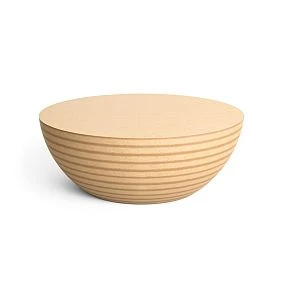
STL-036 is a coffee table base, not a fully equipped table. Its design includes an internal cavity, but it does not turn the product into a lightweight portable item. The material of this model is MDF, not solid beech or oak.
In the card where you can buy the STL-036 table base made of MDF, the following parameters are specified. The data was verified on September 6, 2026.
| Parameter | Execution of STL-036 |
|---|---|
| Size A × B × D | 800 × 300 × 452 mm |
| Material | MDF |
| Shape | Hemispherical, with internal cavity |
| Base weight | 36.5 kg |
| Sanding | «Prestige» |
| Surface preparation | One layer of primer-insulator |
| Packaging | Rigid box |
The tabletop is selected separately. The connection to the base, final coating, and necessary floor contact elements are yet to be determined. Primer-insulator is a preparatory layer, not the color of the finished item chosen by the buyer.
Dimensions are preserved in the manufacturer's notation. The D value cannot be taken as the diameter of the mounting area or a ready-made fastening scheme without a drawing. The full outline of the future table is also needed for layout: the protruding tabletop may take up more space than the base beneath it.
Comparison of this model's shape with the adjacent one is provided in a separate comparison of STL-035 and STL-036. Here we choose not between two silhouettes, but between different ways of using one room.




Sofa closed, unfolded and ready for sleep: three layouts of one room
Draw the room from above and make three copies of the plan. On each, keep the same walls, doors, cabinets, and armchairs. The position of the sofa, the place of the table, and the space needed by a person change. This will make it visible what exactly conflicts, rather than just creating a feeling of "it's cramped here in the evening."
On the original plan, label the direction of door opening and cabinet door panels. Measure the size of the free zone up to the nearest protrusion, not to the wall behind the furniture. If the countertop is not yet approved, mark its outline as preliminary. After choosing a different top, the check is repeated: the agreed base itself does not fix the dimensions of the entire item.
For the sofa, its actual model and the unfolding sequence are needed. The size of the finished sleeping area does not describe the entire path of moving parts. Between the closed and open positions, additional movements, approach from the front or side, may be required. Do not replace this check with a diagram of a similar sofa from the internet.
| Room condition | What is marked on the plan | How to check |
|---|---|---|
| Day | Closed sofa, full table outline, approaches | They sit down, stand up, use the countertop |
| Unfolding | Moving parts and the place of a person at the mechanism | Perform the standard sequence without obstacles |
| Night | Sleeping place, table, access to storage and exit | Check the making of the bed and usual nighttime movements |
Schematic diagrams without scale. The circle represents the entire table, not the recommended size or shape of the tabletop. Places, passages, and trajectory are checked against real furniture.
Our factory also produces:
Daytime position
Sit where you usually relax. Is it convenient to place a book or set down a cup without getting up every time? Can you stand up without sidestepping around the table? Check both parts of the sofa if different people use them. A position that is comfortable only for the person sitting in the center may interfere with the person at the armrest.
Cut out a full-size outline of the proposed table from paper or cardboard. Mark its orientation and center on it so you can return the mockup to the same spot. Such a template helps compare several locations without purchasing, but it only shows geometry. The ability to easily move paper says nothing about moving the finished table.
Get Consultation
Transition to sleep
Remove the mockup from the mechanism area and unfold the sofa according to the instructions. Note where the person's feet are, where they grab the intended handle, and where they step back. Then compare these areas with the daytime position of the table. Not only the absence of part collisions is checked: the person also needs a working space.
The educational example shows why the final position is insufficient. Let us take the front line of the closed sofa as the reference point and consider the strip opposite the table. The near edge of the table is conditionally at a distance of 1450 mm. The finished sleeping area ends at the 1400 mm mark, but during unfolding the moving part reaches 1600 mm. Between the finished bed and the table there remains 50 mm, but during movement the contours intersect by 150 mm. This means the stationary table interferes with the mechanism, although on the night plan the objects do not touch each other. All numbers are conditional; 50 mm is not proposed as an acceptable passage, and the trajectory is not attributed to a specific sofa model.
If you need to open the linen drawer before unfolding, include it in the sequence. An unsuccessful scheme looks like this: the table frees the mechanism, but after being moved it blocks the compartment with the bedding. Then you have to move it a second time or change the order of actions in advance.
Night position
On the third plan, show the bed, not just the frame of the unfolded sofa. Check the approach for making the bed, access to light, and the path to the door. If two people sleep, separately consider exiting from each side. Do not consider a solution convenient where one person can only get up through the other person's space.
Do not forget about where the removed sofa cushions are stored. If their usual place coincides with the night area for the table, the plan declares two purposes for the same zone. To check, lay out the bed and cushions as they will actually be in the evening. Moving them to another room is acceptable only when such an arrangement suits the owner, not as a temporary concession for a pretty sketch.
A universal gap between the sofa and the table is not assigned here. The acceptability of distances is checked against specific furniture and user actions. Supplement the plan with photos of the three states: they will help notice protrusions that were missed during measurement.
Can the coffee table be left in place
First, look for an arrangement that doesn't require daily rearrangement. Sometimes the table can be shifted relative to the center of the sofa, left closer to the armchair, or placed outside the area where the sleeping space extends. These are options to test, not a promise that any STL-036 will fit next to any sofa bed.
A permanent position has two independent conditions: the table doesn't obstruct at night and remains useful during the day. If it had to be moved so far away for unfolding that reaching the tabletop becomes inconvenient, the problem is only half solved. A beautiful object has effectively stopped functioning as a coffee table in front of the sofa.
Check not only the initial placement but also habitual changes in the environment. The armchair may be pulled closer for conversation, the cabinet door may be opened fully, and in the evening a laundry basket may appear nearby. There's no need to clear the room of all items in advance for a successful test: the test should match everyday life.
A hypothetical example: the table stands to the right of the sofa and doesn't intersect with the sleeping area. However, the passage to the exit is exactly on the right. Moving it to the left side removes this conflict, but there access to the wardrobe is required. The decision is made based on the entire room, not on a single absent collision.
When a position is found, record it relative to two fixed landmarks. The phrase "approximately near the armchair" is hard to reproduce after cleaning. A clear diagram with reference distances is sufficient; marking the floor with permanent stickers is not necessary.
After such a check, you can buy a coffee table base for a suitable arrangement. If there's no permanent spot, proceed to testing the rearrangement, without automatically considering it acceptable.
Where to place the table at night: the spot and the path to it are checked separately
The night spot must accommodate the entire item. A free circle on the floor under the central support doesn't mean the tabletop will pass by the armchair, won't hit the windowsill, or won't block the door. Check the space at different heights: the base of a floor lamp may interfere at the bottom, while an armrest or cabinet handle may interfere higher up.
Then connect the day and night points with a route. On it, note the carpet, transitions between floor coverings, thresholds, narrow spots, and turns. The area behind the armchair may be sufficient, but the path to it may be impassable for the assembled table. You can't check only the final position first and leave the way to get there for the evening after delivery.
Move the paper outline along the plan while maintaining the chosen orientation. For a round tabletop, rotation around the center does not reduce the circle it occupies. For a non-round shape, the admissibility of rotation requires a separate check of the entire outline. At the same time, the flat diagram does not show where a person's arms and body will be placed, so it remains a preliminary stage.
It is useful to make a short record of the route. For example: "from point D in front of the sofa to point H next to the armchair; over the same flooring; without crossing the doorway; the method of movement is confirmed by the manufacturer of the finished table." This is a sample wording, not a ready-made solution for any room. The words "over the edge of the carpet" or "with lifting over the threshold" mean separate conditions that need to be discussed.
Separate two sequences: preparing the table surface and moving the item itself. Cups, books, and loosely placed decor are first put away in a specific place. If a table lamp is plugged into an outlet, its cord must not be forgotten in the route. This is not a reason to add a complex organizer to the project: it is enough to understand where things will go in the evening and whether they will take up space for the bed.
Also consider the return path. In the morning, the table is returned after the sofa is folded and the passage is clear. The previous night's spot should not be occupied by a drying rack or bags by that time. If each return requires first moving two more items, the entire chain must be assessed, not just one movement of the table.
The method of movement is agreed upon for the assembled table. It must not be pulled by the edge of the tabletop, assuming the connection will withstand any force, nor should the base be tested with an unsecured top. Lifting by one person should not be assigned based only on known weight. The design, the possibility of a safe grip, and the actual route conditions matter.
A tight route cannot be compensated for by constantly tilting the finished table if such a method is not provided by the manufacturer. The plan may show passage in a horizontal position, but in real handling, a person lacks space. In this case, the project is changed, rather than offering the owner to master an awkward maneuver with expensive furniture.
Ask the contractor to describe permissible actions, grip points, and necessary conditions. Separately, state that movement is expected daily and that an assistant may be absent. A one-time delivery by installers does not confirm the suitability of the same method for the owner every evening.
With daily use over 365 days, moving at night and returning in the morning means 730 separate movements per year. This is the arithmetic of the given scenario, not a wear forecast. It helps assess everyday load: a solution acceptable before a rare visit from guests is not necessarily convenient to repeat constantly.
The mass of the underframe and the mass of the finished table are not the same number
To assess a future item, the mass of the entire assembly is needed:
Table mass = base + tabletop + mounting and additional parts.
Let's take a learning assumption: the tabletop and connections together weigh 12 kg. Then it turns out:
36.5 + 12 = 48.5 kg.
Here, 12 kg is a conditional value for explaining the calculation, not a characteristic of the STAVROS tabletop and not a permissible load on the underframe. For your order, substitute confirmed data of the selected components. If there are additional parts, their mass is also taken into account.
These numbers cannot be used to derive the force with which the table will move across the floor. Mass measures one thing, resistance to movement another. Without information about contact with the flooring, construction, and movement conditions, the promise that "very little effort will be needed" has no basis.
Also, do not choose a top just to reduce the total mass. The tabletop must match the base in geometry, mounting, and intended use. Reducing one indicator does not prove the suitability of the entire structure for daily repositioning.
You can start your selection in the section that allows choose a tabletop for a coffee table. Going to the category does not mean that any product from it is compatible with STL-036. Match the specific pair, then return to the room plan with the final outline and mass.
Will FUR-022 glides help — and what they do not confirm
FUR-022 refers to sliding glides of the SUPER GLIDE series and is present among the recommended related products for STL-036. This is a reason to consider the accessory, but not confirmation of a ready-made solution for any apartment.
The support pad changes the contact conditions between the furniture and the floor. It does not create free space near the sofa, does not remove the threshold, and does not solve the issue of holding the tabletop in place. Even after choosing it, the nighttime position and route must remain coordinated.
To buy the foot pad FUR-022 For a specific table, provide the contractor with information about the floor covering and the entire assembly. The quantity, placement, and method of attachment are determined separately. You cannot automatically order four pieces by analogy with the four legs of a regular table: the base structure here is different.
The entire route should be checked, not just the smoothest section. If the table stands on a carpet during the day and on a different covering at night, different contact conditions arise, as well as the transition between them. A successful trial on a bare floor does not confirm ease of passage over the carpet edge.
There is also the flip side of the task: the table must remain in its chosen place during normal use. Therefore, the permissibility of movement and the behavior of the item at rest are discussed simultaneously. The assessment applies to a specific assembly, not to the promotional name of the accessory.
The support pad is not a wheel. The STL-036 configuration with rollers and the ability to install them yourself in this project are not confirmed. If the mandatory requirement is to roll the table without lifting it, it is wiser to choose a structure specifically designed for this, rather than modifying the selected base based on assumptions.
Price of the base and the total budget for the coffee table
As of September 6, 2026, the price of one STL-036 is 96,170 RUB. FUR-022 is offered at 170 RUB per piece. The number of support pads has not yet been assigned, so a fixed cost for such a set cannot be calculated.
For a preliminary estimate, you can use the formula 96,170 RUB + 170 RUB × n, where n is the agreed quantity of FUR-022. It applies only to the base and these accessories, if they are included in the project. Other expenses are added separately.
| Position | What should appear in the estimate |
|---|---|
| STL-036 table base | One item of the selected configuration |
| Tabletop | Specific model or agreed manufacturing |
| Connection to the base | Parts composition and assembly work |
| Thrust bearings, if needed | Unit price and confirmed quantity |
| Finishing | Preparation, sample, materials, and labor |
| Obtaining the finished item | Packing per count, delivery, carrying in, and assembly |
Do not add packaging a second time if it is already accounted for by the supplier. Similarly, check the workshop's scope of work: attaching the tabletop may be included in assembly, but this should be recorded, not assumed.
The coating is coordinated taking into account the existing insulating substrate. General tips for finishing the under-table base help discuss the stages, but the specific material system and surface readiness are determined by the contractor. Do not automatically transfer instructions for unpainted carved decor to an already prepared MDF base.
Secure a color and gloss sample next to the sofa and flooring. The finish must not interfere with the intended connections. The final assembly date is agreed upon after the technological readiness of the coating, not just after choosing a preferred shade.
Order, change the layout, or choose a different base
Before payment, it is convenient to reduce the decision to a table. It separates a suitable project from a situation where the buyer still hopes to figure things out after delivery.
| What was found out | Solution |
|---|---|
| The table is useful during the day, does not interfere with the mechanism or nighttime passages | Continue coordinating STL-036 and the tabletop |
| Rearrangement is necessary; the location, route, and method are confirmed | Order within a proven project |
| At night the table fits, but the path to that place is not resolved | Change the arrangement before payment |
| The table has to be moved daily, there is no suitable way | Consider a different base or a different table format |
| The table only does not interfere with the sofa in an uncomfortable daytime position | Reconsider the composition rather than consider the check complete |
A request to the seller can be formulated as follows:
STL-036 / MDF / A × B × D 800 × 300 × 452 mm / "Prestige" sanding / 1 pc. Please confirm the configuration, surface preparation, packaging, current price, and delivery terms. The tabletop and final assembly are agreed upon in a separate specification.
The executor of the finished table is given another task: the selected top, connection to the base, full contour, total weight, and three room states. If rearrangement is necessary, a route and a requirement to describe an acceptable method of moving are added. The seller confirms the product item; the workshop confirms the accepted solution of its assembly.
To verify agreements, it is useful to assign a person responsible for each unresolved item. Who confirms the tabletop, who connects it to the base, who accepts the coating, and who explains how to handle the finished piece? It is not necessary to involve different companies: one workshop can cover several tasks. But the order should not leave any work that each participant considers to be another's responsibility.
Before final finishing, plan a check of the agreed connections, and after assembly, an acceptance of the finished piece. If moving is planned, its permissible procedure should be clear to the owner. A one-time demonstration is not a promise of unlimited support, but it allows identifying discrepancies with the specification before daily use begins.
Check payment and delivery terms for the table base and separately clarify the carry-in to the assembly location. After agreeing on all parts, you can order the STL-036 table base. The purchase is justified when the chosen table suits not only daytime photography but also a recurring evening scenario.
Questions before purchase
Can I order the table base while the sofa has not yet been chosen?
You can compare the appearance, but the final decision on placement is premature. Until the mechanism and dimensions of the sofa in different states are known, the required space cannot be confirmed. First, choose a specific sofa or keep the option to modify the table design without irreversible orders.
If only guests sleep on the sofa, does the check change?
The space check remains the same; the frequency of rearrangement changes. For a rare guest scenario, you can arrange help and a temporary place in advance. You cannot automatically transfer this decision to the daily sleep of a person who is usually alone at home.
Can the tabletop be removed every night and the base left in place?
Do not consider this a standard method of use without confirmation of the joint construction. You will need to safely handle the separate tabletop and store it somewhere. If it is the base that blocks the sofa from unfolding, removing the top part also does not eliminate the original obstacle.
Can the table be used as a bedside table in the night position?
Consider this as an additional feature if it is truly needed. Check the actual height of the finished tabletop, access to it from the sleeping area, and the ability to get up. Items for nighttime use should be placed after agreed movement, not used as an excuse for an inconvenient layout.
Can the tabletop be reduced so the table fits from the side?
This option is considered together with the manufacturer. Compatibility, fastening, and the usable area of the top part are checked. Reducing the tabletop does not reduce the base itself, so first determine which element actually limits the passage, and only then change the size.
Is it necessary to keep the night area free during the day?
Not necessarily, but all temporary items in that area will have to be removed before rearranging. If a chair is constantly there, it will also need another place. Check whether freeing one spot turns into a chain of moves across the entire room that no one is ready to repeat daily.
Can the internal cavity be used for storing bedding?
The cavity is described as part of the structure to reduce weight, not as an accessible compartment for items. Do not include it in the storage calculation for pillows and linens. Such use would require separate confirmation from the manufacturer; the under-table device cannot be arbitrarily modified to gain access inside.
Do I need to re-check the layout after buying a different sofa?
Yes. Even with a similar closed footprint, the movement of the mechanism, access to the linen compartment, and nighttime pathways may change. The saved plan will help perform a new check, but it does not prove compatibility of the table with any subsequent upholstered furniture.
Is it enough to try moving a similar table in the showroom?
Such a trial is useful, but compare the item's composition and the floor covering. A different tabletop, connection, or route changes the conditions. Do not automatically transfer the impression of a similar sample to your own project; the check must apply to the specific assembly and setting you will use.
What should be kept after assembly for the next room rearrangement?
Keep the table specification, information about its weight, the connection diagram, and the handling instructions provided by the installer. Add a plan with day and night positions. When changing the floor covering, tabletop, or placement of adjacent furniture, these documents will help determine which conditions require a re-check.