Article Contents:
- Confirmed dimensions, materials, and compatible profiles
- What is a decorative corner for a molding frame
- Why identical material does not make models interchangeable
- When to buy MLD-1U-1.1
- When to buy N-500
- MLD-1U-1.1 or N-500: comparison based on real tasks
- Why the difference of 97 and 208 mm changes the entire project
- How the relief of 10 and 18 mm affects
- How to calculate the conditional area of two corner pieces
- How to choose based on viewing distance
- How to choose based on free space inside the frame
- How to choose based on distance to the edge of the facade
- How to choose near a furniture handle
- How to choose near hinges and mechanisms
- How to choose for a series of identical sections
- How to choose one main accent
- MLD-001 or MLD-003: the straight profile must match the angle
- Why you cannot buy a corner piece and then pick any molding
- MLD-001 for a compact frame
- MLD-003 for large frame
- Why MLD-001 should not be automatically combined with N-500
- Why MLD-003 can overload MLD-1U-1.1
- How to check the joint on a sample
- How to calculate the straight sides of a frame
- Do I need to cut the molding at 45 degrees
- How to choose the material of a straight profile
- How to choose the length of MLD-003
- How to account for MLD-003 made of MDF
- How to order a kit in one batch
- MLD-1U-1.1 for kitchen front
- N-500 for large cabinet door
- MLD-1U-1.1 for cabinet and chest of drawers
- N-500 for sideboard
- MLD-1U-1.1 for interior door
- N-500 for front door
- MLD-1U-1.1 for display cabinet
- N-500 for large mirror
- MLD-1U-1.1 for small wall frame
- N-500 for wall panel
- MLD-1U-1.1 for the boiserie series
- N-500 for the fireplace portal
- MLD-1U-1.1 in the bedroom
- N-500 in a classic living room
- MLD-1U-1.1 in the hallway
- N-500 in a hall or hotel
- Beech under white enamel
- Beech for colored or black enamel
- Oak for tinting
- Beech or oak for furniture fronts
- Beech or oak for wall panels
- Sanding "Standard" or "Prestige"
- Why you cannot mix sanding grades in one set
- How to preserve N-500 thread under enamel
- How to paint MLD-1U-1.1 together with MLD-001
- How to tint N-500 and MLD-003
- Can patina or gilding be used
- How to store parts before painting
- How to accept an order upon receipt
- How to keep a spare element
- How to calculate the number of corner elements
- How to calculate the quantity for one facade
- How to calculate a set for a cabinet
- How to calculate a kit for a wall panel
- How to compare two patterns on one surface
- How to check the handle and opening
- How to check the view from two to three meters
- How to prepare a furniture facade
- How to prepare the wall
- How to choose an installation compound
- How to use TYTAN for the frame
- How to perform a dry layout
- How to set the first horizontal line
- How to install MLD-1U-1.1
- How to install N-500
- How to avoid damaging threads during installation
- How to treat the joint after installation
- Can I paint after installation
- How to care for the frame
- How to repair local damage
- Why the corner does not protect the wall from strong impacts
- Why you cannot use outdoors without preparation
- Mistake: choosing only by photo
- Mistake: considering N-500 an enlarged copy of MLD-1U-1.1
- Mistake: installing N-500 on a small door
- Error: using MLD-1U-1.1 on a large panel without a layout
- Error: buying a corner without a compatible molding
- Error: mixing N-500 and MLD-001 without checking
- Error: not accounting for the thickness of the relief
- Error: placing the corner too close to the handle
- Error: painting corners and moldings from different batches
- Error: considering "Prestige" as a finished finish
- Error: mixing beech and oak in the same frame
- Error: ordering quantity without a diagram
- Error: considering the corner as a load-bearing element of the mirror
- Error: promising universal glue
- Error: overloading N-500 with extra thread
- Error: leaving MLD-1U-1.1 without a scaling system
- Who is MLD-1U-1.1 suitable for
- Who is MLD-1U-1.1 not suitable for
- Who is N-500 suitable for
- Who is N-500 not suitable for
- Practical choice: small kitchen door
- Practical choice: wide cabinet front
- Practical choice: frame above the console
- Practical choice: large mirror
- Practical choice: series of identical cabinets
- Practical choice: door portal
- Practical choice: small interior door
- Practical choice: wallpaper panel
- Practical choice: fireplace area
- Practical choice: classic study
- Practical choice: Provence-style bedroom
- Practical choice: formal classic living room
- How to use both models in one project
- How to buy on STAVROS
- What to check before payment
- What to buy with corner decor
- How not to confuse an ornamental corner with a corner molding
- How not to confuse N-500 with MLD-003U
- How not to confuse a decorative kit with a support frame
- FAQ: questions about MLD-1U-1.1 and N-500
- How is MLD-1U-1.1 different from N-500?
- Which element is larger?
- Which option is suitable for a furniture door?
- Which corner to choose for a large wall panel?
- Will N-500 fit a small facade?
- Can MLD-1U-1.1 be used around a large mirror?
- Which molding fits MLD-1U-1.1?
- Which profile should I buy for N-500?
- Can I combine N-500 with MLD-001?
- How many corner pieces are needed for one frame?
- Do I need to miter the molding at 45 degrees?
- What should I choose for white enamel — birch or oak?
- How to preserve the oak texture?
- What is the difference between the "Standard" and "Prestige" finishes?
- Can I paint the corner piece after installation?
- Which glue should I use for wood?
- How do I calculate the frame size?
- How can I check the scale before purchasing?
- Can the elements be used outdoors?
- Are the corners wall protection?
- Can the N-500 be used for a mirror?
- Where to buy MLD-1U-1.1?
- Where to buy N-500?
- What should I check before ordering?
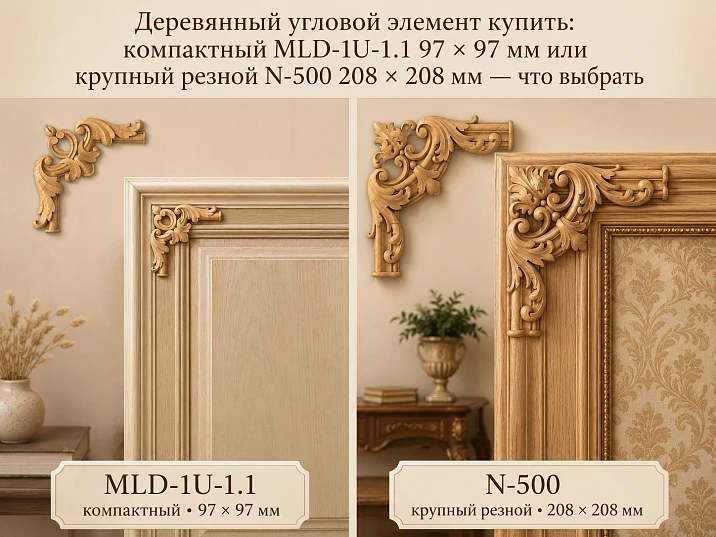
A wooden corner element can be bought for both a small furniture frame and a large wall panel, but the same purpose does not make MLD-1U-1.1 and N-500 interchangeable. MLD-1U-1.1 measures 97 × 97 × 10 mm and works as a compact symmetrical corner finish. N-500, measuring 208 × 208 × 18 mm, is designed for an expressive frame with MLD-003 molding and itself becomes a noticeable baroque accent.
The difference between models is determined not only by numbers. The side of N-500 is more than twice as long, and the conditional outer square occupies approximately 4.6 times the area. On a small door, such decor can cover a significant part of the panel and come too close to the handle. On a large wall, conversely, a 97 mm corner may get lost and fail to support the scale of a wide straight profile.
Both models are made from beech or oak. Beech is chosen for opaque enamel, oak for tinting while preserving the wood grain. For both elements, grinding options 'Standard' and 'Prestige' are available. MLD-1U-1.1 is supplied to order; current ordering conditions for N-500 also need to be checked in the product card before placing a set.
You cannot choose a corner separately from the straight molding. For the compact system, MLD-001 with a cross-section of 10 × 6 mm is provided. N-500 is designed for MLD-003 with a cross-section of 35 × 12 mm. Matching wood species or color does not yet confirm compatibility: the relief height, profile width, ornament character, and connection point are important.
Short answer. MLD-1U-1.1 is worth buying for a furniture facade, a small door panel, a display case, a compact wall frame, or a series of identical sections. N-500 is chosen for a large wall panel, a big mirror, a wide cabinet, a door, or a portal where the corner should be readable from a distance and become a standalone carved accent.
If the frame is built on thin MLD-001, a compact 97 mm corner is more logical. For wide MLD-003 and a formal composition, the N-500 with a size of 208 mm is needed.
Buy compact corner MLD-1U-1.1 Buy large carved corner N-500 Buy molding MLD-001 Buy molding MLD-003
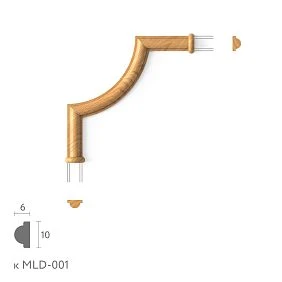
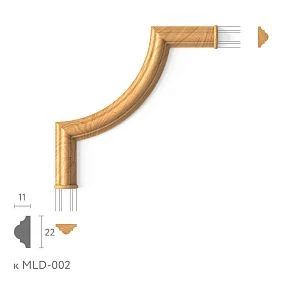
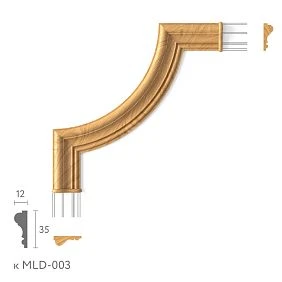
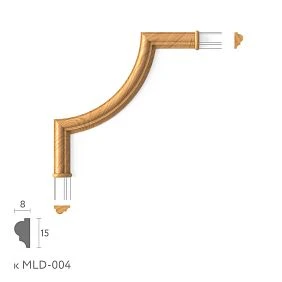
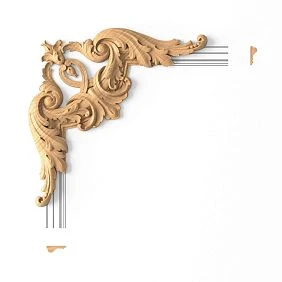
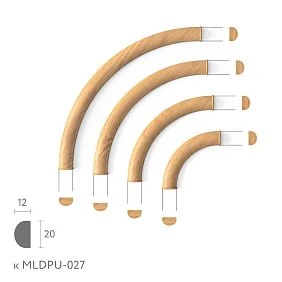
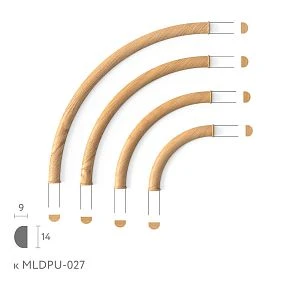

Confirmed dimensions, materials, and compatible profiles
| Parameter | MLD-1U-1.1 | N-500 |
|---|---|---|
| Type | Compact symmetrical corner element | Large carved corner accent |
| Size | 97 × 97 × 10 mm | 208 × 208 × 18 mm |
| Shape | Square, symmetrical | Large shaped corner |
| Material | Beech or oak | Beech or oak |
| Sanding | "Standard" or "Prestige" | "Standard" or "Prestige" |
| Beech | For enamel | For enamel |
| Oak | For tinting | For tinting |
| Ornamental role | Calm repetitive finish | Acanthus scrolls, volutes and plant motifs |
| Main scale | Small and medium frame | Large frame, panel or portal |
| Recommended straight profile | MLD-001, 10 × 6 mm | MLD-003, 35 × 12 mm |
| Main tasks | Furniture, doors, display cases, small panels | Walls, mirrors, large furniture, doors and portals |
| Order conditions | Custom Order | Current conditions are specified in the card |




What is a decorative corner for a molding frame
This is not a construction profile, not a mounting bracket, and not a protection for the outer edge of a wall. The wooden piece decorates the place where two sides of the frame meet at a right angle and connects straight moldings into a single decorative system.
The buyer receives a ready-made carved shape instead of manually cutting a complex ornament. The main work shifts to marking, selecting a straight profile, finishing, and careful installation.
The corner element can be repeated four times around the perimeter, used only in the top corners, or be part of a more complex composition. The quantity is determined by the drawing, not the product name.
A broad overview of the assortment is provided in the material about Decorative corners for moldings, but here the selection is limited to two specific scales.
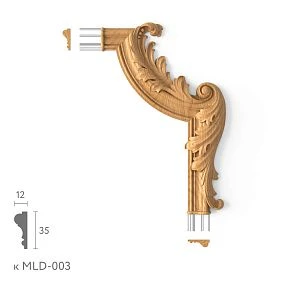
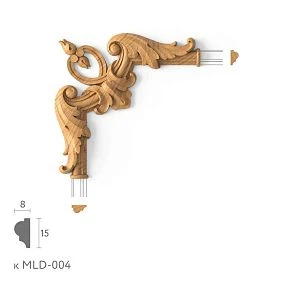
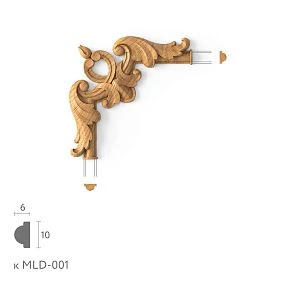
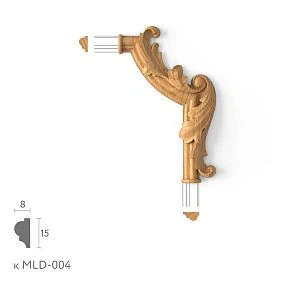
Our factory also produces:
Why the same material does not make models interchangeable
Beech and oak are available for both items, but the material only determines the base finish. The size, relief, and ornament determine how the piece will look on a facade or wall.
MLD-1U-1.1 preserves free space and allows repetition on several small sections. N-500 requires space around the acanthus curls and should not touch the handle, trim, or adjacent frame.
Even the same white enamel won't turn a large N-500 into a compact corner. Similarly, oak tinting won't help the MLD-1U-1.1 become a noticeable centerpiece of a huge panel.
First, choose the scale and compatible profile, then the wood species and finish.
Get Consultation
When to buy MLD-1U-1.1
The compact model is suitable for furniture doors, kitchen fronts, cabinets, interior doors, display cases, and small wall frames.
Square symmetry allows repeating one element in all four corners without visual inconsistency.
The 97 mm size is especially useful where there is limited space between the frame, handle, and edge of the facade.
For such a task, you can buy corner element MLD-1U-1.1 in beech or oak.
When to buy N-500
A large carved element is needed if the corner should be visible from a distance and support Baroque, Rococo, or formal classicism.
It is suitable for wall panels, large mirrors, wide cabinets, sideboards, doors, fireplace areas, and decorative portals.
There should be an empty field nearby, otherwise the acanthus scrolls will look cramped.
For an expressive composition, you can buy a carved corner element N-500 and assemble a set with MLD-003.
MLD-1U-1.1 or N-500: comparison based on real tasks
| Scenario | MLD-1U-1.1 | N-500 | What to Check |
|---|---|---|---|
| Small furniture door | Fits better | May take up too much of the facade | Empty field, handle, and hinges |
| Large wall panel | May get lost | Reads well from a distance | Wall scale and adjacent frames |
| Mirror | For a small or medium decorative frame | For a large interior composition | A separate load-bearing base of the mirror |
| Molding | MLD-001, 10 × 6 mm | MLD-003, 35 × 12 mm | Compatibility by profile and height |
| Distance to the handle | Easier to maintain a comfortable grip | A large free field is needed | Opening and finger position |
| Style | Classic, Provence, restrained neoclassicism | Baroque, Rococo, formal classic | Quantity of other carved decor |
| Repetition in a series | Convenient for multiple identical facades | Better for individual large accents | Unified layout and finishing |
| Main risk | Too weak scale on a large plane | Overload of a small facade | Full-size paper template |
Why the difference of 97 and 208 mm changes the entire project
Side N-500 is more than 2.1 times longer than side MLD-1U-1.1. On a plane, this is felt even more strongly: the outer square of the large element is approximately 4.6 times larger.
This increase changes the internal frame field, the distance to the facade edge, and the position of straight moldings.
On a door several hundred millimeters wide, the N-500 can occupy almost the entire corner. On a wall several meters high, the MLD-1U-1.1, on the contrary, may look like a point detail.
The size is chosen after fitting on a specific surface.
How the 10 mm and 18 mm relief affects
The MLD-1U-1.1 protrudes by 10 mm and blends more easily with a handle, furniture edge, and thin profile.
The N-500 has an 18 mm relief, thus creating a deeper chiaroscuro and protruding more forward.
In a narrow passage, on a door, or near the fabric of a headboard, the protrusion should be evaluated from the side.
A frontal photo does not show the actual depth.
How to calculate the conditional area of two corners
A square of 97 × 97 mm gives an external dimension of 9409 mm².
A square of 208 × 208 mm gives 43264 mm².
This is not the actual area of the wood, because the carved contour has cutouts, but the indicator honestly compares the occupied field.
This calculation helps to understand why the N-500 cannot be installed on a small door without a mockup.
How to choose based on viewing distance
A furniture facade is usually viewed from a close distance, so even a small relief is well readable.
A wall panel or portal is perceived from the center of the room, where small details lose expressiveness.
MLD-1U-1.1 is suitable for close viewing and repeating rhythm.
N-500 retains its character on a large plane and in a formal area.
How to choose based on the free field inside the frame
After installing the four corners, the central part remains, which the frame should frame, not overlap.
MLD-1U-1.1 leaves more space for a smooth panel, glass, mirror, or overlay.
N-500 requires a wide field, otherwise the floral pattern will almost meet in the center.
The internal size is calculated before purchasing the corner brackets.
How to choose based on the distance to the edge of the facade
The decor should not press against the door edge or leave an accidental narrow strip.
For a compact element, it is easier to create equal margins on all sides.
N-500 requires a wide door or panel for the pattern to look complete.
Marking is done simultaneously for four corners.
How to choose next to a furniture handle
The handle should remain comfortable to grip.
MLD-1U-1.1 is easier to place in a limited area without making fingers touch the thread.
N-500 requires noticeable spacing and is more suitable for top corners or a facade with a different handle layout.
Before installation, the door is opened with the attached paper template.
How to choose near hinges and mechanisms
The decorative element is installed on the front surface, but holes, hinges, and internal fasteners may limit attachment points.
On a small door, these areas are located close together.
MLD-1U-1.1 is easier to fit between technical areas.
For N-500, a facade is needed where the thread does not conflict with the structure.
How to choose for a series of identical sections
In a kitchen, cabinet, or wall panel, the corner may be repeated dozens of times.
MLD-1U-1.1 creates a calm rhythm and does not overload each section.
N-500 in large quantities turns the surface into a rich ornamental system.
Before serial ordering, one control facade is assembled.
How to choose one main accent
If the composition needs a large artistic center, N-500 performs this role better.
Its acanthus curls and volutes do not require many additional overlays.
MLD-1U-1.1 works more modestly and supports the central decor without competing with it.
The hierarchy must be determined before purchasing all elements.
MLD-001 or MLD-003: the straight profile must match the angle
| Profile | Section | Main role | Suitable angle | What to Check |
|---|---|---|---|---|
| MLD-001 | 10 × 6 mm | Thin furniture and interior frame | MLD-1U-1.1 | Material, length, joint, and scale of the facade |
| MLD-003 | 35 × 12 mm | Large expressive frame | N-500 | Length, material, wall placement, and ornament character |
| Wooden length | Specified in card MLD-001 | For small-scale frames | As per project | Cutting map |
| MLD-003 made of beech or oak | 1000 or 2400 mm | Long sides of the large frame | N-500 | Number of joints and transportation |
| MLD-003 from MDF | 2600 мм | Long paintable sections | Compatibility with wooden N-500 requires design verification | Material, finish, and profile height |
Why you cannot buy a corner and then pick any molding
The corner and straight strip form one contour. If the width, height, or profile character do not match, a step appears at the joint.
N-500 was developed for MLD-003, so this pair is the confirmed starting point.
MLD-1U-1.1 logically works with thin MLD-001 according to the project scheme.
Any replacement requires separate fitting, not assumptions based on a photo.
MLD-001 for compact frame
The 10 × 6 mm section keeps the lightness of a small door and does not eat up the central field.
The profile suits the repeating rectangles on a cabinet, nightstand, kitchen front, and door.
Together with the 97 mm corner, it creates a calm frame system.
For such a composition, you can buy a wooden molding MLD-001 and pre-calculate the four sides.
MLD-003 for a large frame
The 35 × 12 mm section is noticeably wider and thicker than MLD-001.
It supports the large N-500 and does not look like a random thin line next to a baroque ornament.
The profile suits a wall panel, mirror, large cabinet, and portal.
For a formal solution, you can buy wooden molding MLD-003 in the confirmed material and length.
Why MLD-001 should not be automatically combined with N-500
A thin strip 10 × 6 mm may look too weak next to a corner 208 × 208 × 18 mm.
The scale difference will create the impression that the large decor is attached to a random line.
If the designer is still considering such a combination, a full-size mockup and joint drawing are needed.
The basic commercial choice for N-500 is MLD-003.
Why MLD-003 can overload MLD-1U-1.1
A wide profile 35 × 12 mm can visually overpower a compact 97 mm corner.
On a small door, it will also reduce the internal field.
Even if the details match in color, the composition may look inconsistent.
For MLD-1U-1.1, thin MLD-001 is safer.
How to check the joint on a sample
A short piece of molding is applied to the corner element on a flat surface.
Check the matching of height, direction of the relief, and absence of a gap.
Then the sample is painted or tinted according to the chosen system.
This way, not only the geometry is visible, but also how light emphasizes the transition.
How to calculate the straight sides of the frame
First, the position of the four corners is fixed on the drawing.
Then the distance between the points where the straight profile meets is measured, not the entire outer size of the frame.
For each side, a separate length is recorded.
After that, a cutting map MLD-001 or MLD-003 is compiled.
Is it necessary to cut the molding at 45 degrees?
The meaning of a ready-made corner element is that the decorative turn is formed by a separate part.
The straight molding is brought to it according to the provided scheme, but the exact type of end must be checked against the drawing and the test assembly.
A universal connection without trimming cannot be guaranteed for any combination.
The general principle is discussed in the material about ready-made corner elements for a frame without complex cutting.
How to choose the material of a straight profile
It is better to order the corner and molding from the same wood species if tinting and visible texture are planned.
For opaque enamel, different bases can be considered only after checking the preparation and joint.
It is more logical to connect N-500 from oak with oak MLD-003.
MLD-1U-1.1 from beech is conveniently paired with beech MLD-001 for a common enamel.
How to choose the length of MLD-003
Beech and oak strips are confirmed in lengths of 1000 and 2400 mm.
The long format reduces the number of joints on the wall panel.
The short one may be more rational for small sides or complex transportation.
The cutting plan is made before ordering, not after delivery.
How to account for MLD-003 from MDF
For MDF, a length of 2600 mm is confirmed.
However, the N-500 is made of wood, so combining different materials requires matching finishes and precise geometry.
This combination cannot be automatically considered equivalent to a fully wooden set.
A test joint will show whether the height and appearance match.
How to order a set as one batch
It is better to order corners and straight strips at the same time.
This simplifies the selection of wood species, sanding, and future finishing.
For four corners of one frame, all elements must match in preparation.
Separate orders increase the risk of differences in material and lead times.
MLD-1U-1.1 for kitchen front
The compact corner is suitable for a door where the frame should support the classic style but not interfere with the handle and opening.
The 97 mm size is easier to place on a small or medium-width front.
The slim MLD-001 preserves useful central space and does not make kitchen furniture heavy.
Before serial production, one control front is assembled and the relief care is checked.
N-500 for a large cabinet door
On a wide sash, the baroque corner can become an independent decoration.
The 208 mm size requires significant indents from the edge, handle, and adjacent panels.
If the cabinet consists of several narrow doors, N-500 can fragment the surface and disrupt the overall rhythm.
The model is best revealed on one large panel or wide paired fronts.
MLD-1U-1.1 for a cabinet and dresser
On a small front, the 97 mm corner helps create a neat frame around a smooth field or central overlay.
Four identical elements can be easily repeated on several drawers.
The handle must remain in the free zone.
A frame that is too wide on a low drawer will visually reduce its height.
N-500 for a sideboard
A large sideboard can handle a rich ornament, especially on the central door or top panel.
Acanthus scrolls support formal classic style and furniture with carved legs.
There is no need to use N-500 on every small drawer.
It is better to assign one main level of decor and keep the other fronts calmer.
MLD-1U-1.1 for an interior door
The compact square shape suits a small panel and allows maintaining distance to the handle and lock.
Four corners can be repeated on the top or bottom frame.
Thin MLD-001 helps connect elements without excessive thickening of the panel.
For such a task, you can choose a compact decor for the door panel after a full-size fitting.
N-500 for the front door
A tall and wide door accepts a large corner better than a standard panel.
A 208 mm element can decorate a large panel or top frame composition.
The 18 mm relief is checked against the casing, opening, and wall.
On a narrow door, the baroque ornament will be too cramped.
MLD-1U-1.1 for a furniture display case
A compact corner is suitable for a decorative contour around the glass if the glass has a separate safe fastening system.
The corner and molding should not be considered a load-bearing frame.
The thin profile preserves the view of the display contents.
All glass mounting points are designed independently of the decor.
N-500 for a large mirror
A large corner is clearly visible around an interior mirror above a console or dresser.
The decorative kit does not replace the load-bearing base that holds the mirror and attaches to the wall.
The size of the mirror, frame, and N-500 are checked on one drawing.
For an expressive framing, you can buy a carved corner for a mirrorwithout transferring the weight of the canvas onto it.
MLD-1U-1.1 for a small wall frame
The model is suitable for a wallpaper panel, a local rectangle above a cabinet, or a series of small sections.
The 97 mm size remains noticeable up close and does not absorb the inner field.
Multiple frames must have identical margins.
The corner and straight molding template is transferred to the wall before installation.
N-500 for a wall panel
The large plane allows the volutes and plant motifs to be revealed.
A large corner can become the main accent of the upper corners or the entire frame.
Sufficient free space should remain inside the panel.
To choose a straight profile, it is worth assembling the MLD-003 and N-500 kit according to the exact dimensions of the wall.
MLD-1U-1.1 for the boiserie series
In a repeating grid, compact corners create rhythm without excessive saturation.
One template helps place all elements identically.
Beech under enamel allows painting the frames in the wall color.
Oak under tinting will make each section more noticeable and require careful pattern selection.
N-500 for the fireplace portal
Large floral decor matches the scale of the portal and the formal living room.
The corner does not perform a structural or fire-resistant function.
Location near a heat source requires separate evaluation of materials, base, and finish.
The element can only be used in the decorative zone of the project.
MLD-1U-1.1 in the bedroom
Compact decor fits frames on the wardrobe, nightstands, door, and a small panel above the bed.
Light enamel softens the classic character.
Repeating the same corner on multiple items ties the furniture together without excessive carving.
The relief should not be located where textiles constantly brush against it.
N-500 in a classic living room
The large corner is suitable for a wall panel, mirror, sideboard, and decorative portal.
It is especially convincing in a room with high ceilings and large furniture.
If there is already a lot of carving around, it is better to leave the N-500 in one main composition.
Too frequent repetition reduces the expressiveness of each element.
MLD-1U-1.1 in the hallway
A small corner suits the cabinet facade, mirror frame, and narrow wall panel.
The 97 mm size is easier to place next to the door and switches.
The 10 mm relief protrudes less into the passage.
The base and adhesive are chosen considering the intensive use of the room.
N-500 in the hall or hotel
Large decor is well readable in the waiting area, on a wall panel, or a large mirror.
For a serial commercial project, one control sample is first assembled.
The finishing, cleaning, lighting, and fastening stability are checked.
After approval, a unified specification for the entire object is fixed.
Beech under white enamel
Beech is chosen when the frame must match the painted facade, door, or wall.
The white color makes MLD-1U-1.1 calmer and helps use it in Provence or neoclassicism.
On N-500, the enamel emphasizes shadows between acanthus curls, but too thick a layer can smooth out fine transitions.
A test paint-out is mandatory for both models.
Beech under colored or black enamel
Colored finishing allows the corners to be matched to furniture or paneling according to the exact project shade.
Dark MLD-1U-1.1 creates a graphic compact frame.
Black or deep color on N-500 enhances the baroque silhouette and visually increases mass.
The gloss level is checked next to the straight molding.
Oak under tinting
Oak retains the natural wood grain and suits projects where texture is important.
On a compact corner, the fibers are read locally.
On N-500, the pattern interacts with the deep carving and makes the detail even richer.
It is better to order all four corners and straight moldings in one batch.
Beech or oak for furniture fronts
Beech is convenient for opaque enamel and precise matching with a painted door.
Oak is chosen for natural furniture and tinted frames.
Mixing breeds within a single contour without a design concept is not advisable.
Under a transparent coating, the difference will become especially noticeable.
Beech or oak for the wall panel
Painted beech allows the frame to become part of the wall, leaving only the relief as the main element.
Oak tinting turns the decor into an independent wooden line.
N-500 made of oak requires a calm background.
MLD-1U-1.1 made of beech is easier to repeat in a series in the color of the boiserie.
Sanding "Standard" or "Prestige"
Both models are available in two preparation options.
The buyer must choose the same sanding for the corners and associated wooden profiles.
Sanding is not a finished coating and does not replace primer, enamel, tinting, or protective finish.
The differences in options are clarified on the card before ordering.
Why you cannot mix finishes in one set
Different preparation may show after painting in gloss, texture, and composition absorption.
The difference is especially noticeable on four identical corners.
Corners and moldings are included in one specification.
After receipt, the marking is kept until finishing is complete.
How to preserve N-500 thread under enamel
Deep areas cannot be filled with a thick layer of primer and paint.
The composition is applied evenly, controlling the inner curls.
The sample is examined under side light.
If the pattern becomes flat, the technology is adjusted before the main batch.
How to tint MLD-1U-1.1 together with MLD-001
The corner and straight profile must have the same shade and gloss.
A test joint shows whether the composition absorption differs.
First, one set is approved, then all frames are finished.
After installation, local treatment of joints is possible using the agreed technology.
How to tint N-500 and MLD-003
Oak parts are matched by grain and shade.
The tinting must be evenly applied across the straight strip and deep carving.
On protrusions, the color may appear lighter; in recesses, darker.
The control sample helps turn this effect into part of the project, rather than a random defect.
Can patina or gilding be used?
Such options are part of the project finishing and are not confirmed as a ready-made card set.
They can only be considered after checking compatibility with the material and the base coating.
N-500 visually suits complex decorative effects, but the ornament can easily become overloaded.
MLD-1U-1.1 allows using patina more delicately.
How to store parts before painting
The corners are kept in a dry room on a flat surface.
The relief is protected from friction and point loads.
Four elements of one frame are stored together with the marking of the wood species and sanding.
Straight moldings are supported along the length to maintain geometry.
How to accept an order upon receipt
They check the article number, size, material, finish, and quantity.
MLD-1U-1.1 must correspond to 97 × 97 × 10 mm, N-500 to 208 × 208 × 18 mm.
Corners of one frame are laid out next to each other and inspected before finishing.
All issues are resolved before installation and painting.
How to keep a spare element
For a series of facades or a large panel, it is useful to have a spare corner.
It is finished simultaneously with the main set.
The spare is marked with the article number, material, and color.
This simplifies local repairs without having to re-match the shade.
How to calculate the number of corner elements
First, count the number of individual frames.
A full rectangular frame usually has four corner points, but the project may only use the top corners or an asymmetrical layout.
The quantity is multiplied by the number of identical sections.
Then, add the confirmed reserve for trial assembly or replacement, if required by the project.
How to calculate the quantity for one facade
Mark each corner insert on the drawing.
If the frame is full and symmetrical, four identical elements are usually required.
For two frames on one door, the number is doubled.
You cannot buy two corner pieces and plan to cut the rest from the molding.
How to calculate a set for a cabinet
Each door is measured separately, even if the fronts appear identical.
Count the corners of all frames, then the length of MLD-001 or MLD-003.
Handles, hinges, and gaps are marked on the general drawing.
Only after this is the order for the entire cabinet placed.
How to calculate a set for a wall panel
First, determine the number of frames and their external dimensions.
Then place N-500 or MLD-1U-1.1 and measure the straight sections between them.
For long sides, select suitable molding lengths with a minimum number of joints.
The stock is calculated using the cutting map
How to compare two templates on one surface
MLD-1U-1.1 and N-500 are applied one after the other to the same corner.
The composition is photographed from a close and a far point.
Not only the decor itself is compared, but also the remaining central field.
Thus, the choice becomes based on scale, rather than on the impression from the card.
How to check the handle and opening
The paper template is left on the facade and the door is opened several times.
The hand should not touch the relief.
The leg or adjacent facade should not touch the protruding corner.
For the N-500, such a check is mandatory due to its size and depth.
How to check the view from two to three meters away
The wall panel and large cabinet are perceived not only up close.
The MLD-1U-1.1 may disappear against a large flat surface.
The N-500 should be readable but not overwhelm the entire wall.
The main model is chosen after viewing from the actual walking path in the room.
How to prepare a furniture facade
The base must be level, sturdy, clean, and ready for the chosen finish.
Marking is done relative to the edges of the facade, the handle, and the central axis.
The glue and coating must be compatible with the wood and the door surface.
A trial fixation is performed on a separate sample or control facade.
How to prepare the wall
Crumbling plaster, weak paint, and noticeable waves prevent tight adhesion.
N-500 particularly highlights unevenness along a wide contour.
MLD-1U-1.1 is smaller, but the series of elements will emphasize frame misalignment.
The base is leveled and reinforced before installation.
How to choose a mounting compound
The adhesive must be suitable for the wood, the base, and the selected coating system.
You cannot automatically transfer one compound from an untreated wall to a painted facade.
For heavy or protruding decor, additional temporary fixation may be required as per the project.
In the card, you can buy adhesive for wooden decorafter pre-checking compatibility.
How to use TYTAN for the frame
TYTAN mounting adhesive is listed in the diagram as an accessory, but this is not a universal permission for any surface.
Before work, check the composition instructions, base material, and finish coating.
A test area shows adhesion and no damage to the finish.
Exact consumption cannot be determined without contact area and surface condition.
How to perform a dry layout
All four corners and straight planks are placed without final fixing.
Check geometry, equal gaps, and joints.
A temporary handle template is also installed on the facade.
Installation begins only after a general photo and repeated measurement.
How to set the first horizontal line
The first line determines the position of the entire frame.
It is checked against the facade, floor, door, or adjacent furniture.
An error of a few millimeters will repeat on the opposite side.
For a series of panels, a single template and control marks are used.
How to install MLD-1U-1.1
The compact element is placed according to precise markings, maintaining the same direction of all four corners.
The straight MLD-001 is brought to the junction point after dry assembly.
The glue must not come out onto the front relief.
Until drying, the part is protected from displacement.
How to install N-500
A large corner requires even contact with the base and careful temporary fixation.
Do not hold it by the thin carved protrusions.
MLD-003 is brought in after checking the profile match.
The entire frame must be marked before gluing the first element.
How to avoid damaging threads during installation
The tool and fixing materials should not press on the acanthus curls.
The part is taken by the stable areas of the base.
The front surface is covered only with material that does not leave marks.
After installation, the ornament is inspected before finishing.
How to treat the joint after installation
The main precision is achieved by accurate fitting, not by a thick layer of putty.
The local compound must be compatible with the wood and the future finish.
On oak under tinting, excess filler can change the color.
The control joint is performed on the leftover piece.
Can you paint after installation
Painting the assembled frame helps unify transitions and achieve a uniform color.
However, access to side and deep areas becomes more difficult.
Pre-finishing is more convenient for N-500, but may require local touch-up of joints.
The sequence is chosen after a test joint.
How to care for the frame
Dust is removed with a soft brush or non-abrasive cloth.
N-500 requires more careful cleaning of deep scrolls.
MLD-1U-1.1 is easier to maintain on a series of facades.
The care product is chosen based on the finish coating, not just the wood species.
How to repair local damage
Keep a spare element and a color sample.
The damaged area is assessed before attempting to repaint it with a random compound.
For oak, it is important to restore not only the shade but also the transparency of the coating.
On paired facades, the difference in repair will be noticeable, so it is better to use the original system.
Why the corner does not protect the wall from strong impacts
MLD-1U-1.1 and N-500 are decorative products.
They do not replace a construction protective profile and are not load-bearing elements.
Placement in a walkway area requires caution due to protruding threads.
To protect the external corner of the wall, a different structural solution is chosen.
Why it cannot be used outdoors without preparation
The confirmed scheme describes interior application.
The outdoor environment requires evaluation of wood, coating, moisture, temperature, and fastening.
Outdoor durability cannot be promised based solely on wood species.
For an external project, parameters are specified separately.
Error: choosing only by photo
The card does not show the real ratio of the corner and the specific door.
MLD-1U-1.1 may appear larger, and N-500 more compact, than they will be on the wall.
The paper template eliminates this error in a few minutes.
The decision is made after trying on together with the straight molding.
Error: considering N-500 an enlarged copy of MLD-1U-1.1
The models have different ornamental logic and compatible profiles.
MLD-1U-1.1 creates a calm symmetrical corner.
N-500 contains acanthus curls, volutes, and plant motifs.
Replacement changes the style of the entire frame, not just its size.
Error: placing N-500 on a small door
A 208 mm element can cover a significant part of the facade.
The handle will be too close, and the central field will become cramped.
For a small door, MLD-1U-1.1 is better.
A large corner is left for wide furniture or a wall.
Error: using MLD-1U-1.1 on a huge panel without a layout
A compact corner may get lost from a distance.
The thin MLD-001 also does not always support the scale of a large wall.
If a strong accent is required, choose N-500 and MLD-003.
The decision is confirmed by viewing from two to three meters away.
Error: buying a corner without a compatible molding
Four carved details do not create a complete frame by themselves.
Straight sides calculated at connection points are needed.
For MLD-1U-1.1, use MLD-001; for N-500, use MLD-003.
A full set is ordered from a single drawing.
Error: mixing N-500 and MLD-001 without verification
A thin profile may look accidental next to large carving.
Even the same color won't fix the scale mismatch.
The basic confirmed pair for N-500 is MLD-003.
Any other combination requires a prototype.
Error: do not account for relief thickness
The 18 mm protrusion on the N-500 is important near the handle, door, and passage.
The MLD-1U-1.1 has smaller 10 mm, but it is also not a flat application.
A separate template is made on the side.
Front marking does not replace depth checking.
Error: placing the corner too close to the handle
Fingers will touch the relief every time it is opened.
This is uncomfortable and increases finish contamination.
The handle and frame position are designed simultaneously.
The control facade is opened before final installation.
Error: painting corners and moldings with different batches
Shade, gloss, and saturation may vary.
On one frame, the transition will become noticeable.
All parts are finished simultaneously according to the approved sample.
The remaining compound is kept for repairs.
Error: considering "Prestige" as finished trim
Sanding prepares the wood but does not create the final color and protection.
After purchase, you need to choose enamel or tinting.
Without coating, the set does not achieve the planned appearance.
Finishing materials are included in the budget in advance.
Error: mixing beech and oak in one frame
The species differ in texture and behavior under transparent finish.
Under enamel, coordinated preparation is also required.
For one contour, it's better to use one material.
Contrast is only possible with a separate design project.
Error: ordering quantity without a diagram
The number of corners depends on the number of frames and their construction.
The total perimeter of the wall does not show the number of corners.
First count the points, then the length of straight profiles.
Add margin after the cutting map.
Error: consider the angle as a load-bearing element of the mirror
Carved decor adorns the frame but does not automatically hold the heavy panel.
The mirror requires a separate base and wall mounting.
Weight cannot be transferred to decorative curls.
The structure is calculated independently.
Error: promise universal glue
Bases differ in material, strength, and coating.
A composition suitable for plaster is not necessarily safe for a painted facade.
TYTAN is considered after checking the instructions and a test area.
If in doubt, installation is coordinated with a specialist.
Error: overloading N-500 with extra thread
A large corner is already a strong artistic element.
Several central overlays and tips may compete with it.
The composition needs hierarchy.
Sometimes N-500, MLD-003, and a calm inner field are enough.
Error: leaving MLD-1U-1.1 without a scaling system
On a large surface, a compact corner may look like a single point.
It is better to repeat it with a series of frames or use it on a smaller field.
A thin profile should create a readable outline.
If the system gets lost, choose the large variant.
Who is MLD-1U-1.1 suitable for
The model is suitable for the owner of small furniture, doors, display cases, and compact wall frames.
It is convenient for repeating on a series of identical facades.
Restrained classic and neoclassical styles accept it better than rich baroque.
The buyer gets neat decor without losing useful space.
Who is MLD-1U-1.1 not suitable for
The element may appear weak on a huge wall, portal, or very wide mirror.
It does not create as grand an accent as N-500.
If the straight profile needs to be large, MLD-001 may not support the scale.
Then choose a different system.
Who the N-500 suits
The model suits a spacious living room, large panel, mirror, sideboard, portal, and wide door.
It is needed by a buyer who wants a prominent baroque ornament.
Open space and viewing distance are mandatory.
The best direct partner is MLD-003.
Who the N-500 does not suit
A large corner does not suit a small door, narrow cabinet, or tight wall space.
It may conflict with the handle and adjacent frames.
In a minimalist interior, rich carving requires particularly careful use.
For a compact task, choose MLD-1U-1.1.
Practical choice: small kitchen door
First, mark the handle, hinges, and the useful central field.
MLD-1U-1.1 usually maintains convenient opening and fits the thin MLD-001.
N-500 on such an area often overloads the facade.
Before the series, one control sample is assembled.
Practical choice: wide cabinet facade
On a wide door, both options are possible.
MLD-1U-1.1 will create a calm frame, N-500 — a main baroque accent.
The solution depends on the cabinet style and the amount of free space.
The handle and adjacent doors are checked simultaneously.
Practical choice: frame above the console
For a small composition and narrow console, a compact system is suitable.
Above a wide console in the formal living room, N-500 may better support the scale.
The height of the frame is linked to the furniture and lighting fixtures.
A large corner should not come close to the sconce.
Practical choice: large mirror
The size of the mirror requires a separate load-bearing frame.
N-500 can be used as a decorative frame around a prepared base.
MLD-1U-1.1 is only suitable if there is sufficient readability and a calmer style.
The weight of the mirror is not transferred to the carved corner.
Practical choice: a series of identical cabinets
Compact MLD-1U-1.1 is easier to replicate on multiple facades.
One template maintains consistent indents.
Material and finish are ordered in one batch.
N-500 is only suitable for very wide cabinets and with free space.
Practical choice: door portal
N-500 better matches a large architectural scale.
MLD-003 forms straight sides and supports relief.
The element remains decorative and does not reinforce the portal structure.
Connection points to the architraves are calculated in advance.
Practical choice: a small interior door
MLD-1U-1.1 maintains the proportions of a standard panel.
The thin MLD-001 does not interfere with the handle and lock.
N-500 may be too wide and deep.
The size is checked on both closed and open door leaf.
Practical choice: wallpaper panel
The compact corner nicely frames a local section of wallpaper.
For a large panel in a high room, consider N-500.
The position of the wallpaper pattern and carving must be coordinated.
The adhesive is tested both on the wall and on the selected wood finish.
Practical choice: fireplace area
Large N-500 matches the front composition but is not a fire-resistant or structural element.
Distance to heat source and finishing system require design verification.
MLD-1U-1.1 is only suitable for small side frames.
Safety is more important than decorative similarity.
Practical choice: classic study
Oak N-500 for tinting supports solid furniture and panels.
Beech MLD-1U-1.1 for enamel allows for more restrained frames on cabinets.
The choice depends on the scale of the room.
Samples are viewed under working and evening lighting.
Practical choice: Provence-style bedroom
MLD-1U-1.1 under light enamel looks lighter and calmer.
The thin profile suits the cabinet, door, and small headboard.
N-500 with baroque volutes can become too formal.
The amount of carving is linked to textiles and furniture.
Practical choice: formal classic living room
N-500 unfolds on large walls, mirrors, and portals.
MLD-003 supports it in width and relief.
Compact corners can be left for secondary furniture facades.
Thus, two scales work in one room without competition.
How to use both models in one project
N-500 is assigned as the main decor of a large wall.
MLD-1U-1.1 is repeated on cabinet doors or drawers.
Material and finish can connect two systems.
They should not be mixed on one small frame without an exact drawing.
How to buy on STAVROS
First, determine the surface size and select an angle of 97 or 208 mm.
Then open the straight molding card and check the material, length, and sanding.
After calculating the quantity, add the mounting compound and finish.
If the project is not yet formed, you can select wooden corner elements in the general category.
What to check before payment
Check the article number, size, wood species, sanding, and number of corners.
Add a compatible MLD-001 or MLD-003 according to the cutting map.
Check the base, glue, finish, and the area near the handles.
For a complex frame, coordinate the drawing with the manager or master.
What to buy together with corner decor
A corner element is only one part of the frame system. For a finished result, you need straight moldings, a calculated number of corners, compatible finish, and mounting compound. Buying a separate N-500 without MLD-003 or four MLD-1U-1.1 without MLD-001 is impractical: the project will stop at the connection stage.
Additional central and connecting elements are selected only after the frame is approved. First, you need to maintain the correct hierarchy, then add new decor. A wide N-500 often does not require a complex center, while a compact system allows for a more active inner field.
| What to add | Why | For which scenario | What to Check |
|---|---|---|---|
| Buy four corners for the frame | Assemble a compact symmetrical contour | Furniture, door, display case, small panel | Number of frames, material, and sanding |
| Large wooden corner 208 × 208 mm | Create a baroque accent | Wall, mirror, cabinet, portal | Free field and relief 18 mm |
| Profile for compact frame | Connect MLD-1U-1.1 with straight sides | Small facade or door | Length, wood species, and joint point |
| Profile for corner element N-500 | Assemble a large expressive frame | Wall panel, mirror, portal | Length 1000, 2400 or 2600 mm depending on material |
| Corner, center and connecting elements | Compare full decor range | Complex or non-standard composition | Do not mix incompatible series |
| Assembly adhesive for molding corners | Secure wooden decor | Furniture, door or wall | Compatibility with base and coating |
| How to assemble a decorative frame | Check the overall logic of corners and joints | Independent project | Drawing, layout, and installation sequence |
| Molding for wall panels | Select the scale of the straight profile | Boiserie and large interior wall | Room height and number of frames |
How not to confuse an ornamental corner with a corner molding
MLD-1U-1.1 and N-500 are installed as decorative inserts within the frame composition.
They are not intended to protect the external building corner of the wall.
A corner molding of a different design can follow the profile turn or solve another decorative task.
Before purchasing, it is useful compare large corner moldings for a decorative frame and ornamental inserts.
How not to confuse N-500 with MLD-003U
N-500 is a large carved corner element with acanthus curls, designed for direct MLD-003.
MLD-003U belongs to a different product system and has its own geometry.
The matching designation MLD-003 in the name does not mean the elements are interchangeable.
Always check the exact article number and recommended set in the product card.
How not to confuse a decorative set with a load-bearing frame
Corners and moldings create visible framing.
A mirror, glass, heavy panel, or fireplace portal requires a separate structural base.
Decorative glue does not replace the fastening of the load-bearing part.
The project should separate the decorative and structural functions.
For a large order, it is useful to keep an approved paper template, a control joint, and a finish sample. These three things allow you to repeat the frame on additional facades without re-selecting the scale, profile, and shade.
FAQ: questions about MLD-1U-1.1 and N-500
How is MLD-1U-1.1 different from N-500?
MLD-1U-1.1 is a compact symmetrical corner 97 × 97 × 10 mm. N-500 is a large baroque element 208 × 208 × 18 mm with acanthus curls and volutes.
Which element is larger?
N-500. Its side is more than 2.1 times longer, and the outer square is approximately 4.6 times larger.
Which option is suitable for a cabinet door?
More often MLD-1U-1.1, as it preserves more free space and is easier to place next to a handle.
Which angle to choose for a large wall panel?
More often N-500 with wide MLD-003, if there is enough space on the wall for a large ornament.
Will N-500 fit for a small facade?
Only after a full-size check. In most cases, the 208 mm size will be too large.
Can MLD-1U-1.1 be used around a large mirror?
It can be used as a compact decor, but it may get lost. The mirror's load-bearing base is designed separately.
Which molding matches MLD-1U-1.1?
In the SEO scheme for a compact frame, MLD-001 with a cross-section of 10 × 6 mm is specified.
Which profile to buy for N-500?
N-500 is designed for MLD-003 with a cross-section of 35 × 12 mm.
Can N-500 be combined with MLD-001?
Not as a base combination. The scale difference requires a separate drawing and a control sample.
How many corner elements are needed for one frame?
Usually four, but the exact number depends on the design: the frame may have only top corners or an asymmetrical layout.
Is it necessary to miter the molding at 45 degrees?
The finished corner forms a decorative turn, but the precise end treatment should be checked against the drawing and a trial assembly.
What to choose for white enamel — beech or oak?
For opaque enamel, beech is usually chosen.
How to preserve the oak texture?
Choose an oak corner and molding, then use a coordinated stain and protective finish.
What is the difference between the "Standard" and "Prestige" sanding options?
These are two preparation options. The specific difference and availability should be checked in the product card; neither is a ready-made coating.
Can I paint the corner after installation?
Yes, if the technology is compatible with the base and joints. For complex carvings, pre-finishing with subsequent local touch-ups is often convenient.
What glue should I use for wood?
The composition is selected based on the wood, base, and coating. TYTAN from the scheme is used only after checking the instructions and a test area.
How to calculate the frame size?
First, place the corners, then measure the straight sections between the connection points and create a cutting map.
How to check the scale before purchasing?
Cut out paper squares 97 × 97 and 208 × 208 mm, add strips MLD-001 and MLD-003, and apply to the surface.
Can the elements be used outdoors?
The confirmed use is interior. An outdoor project requires separate preparation, coating, and verification.
Are corner guards wall protection?
No. These are decorative items, not a construction or impact protection profile.
Can N-500 be used for a mirror?
Yes, as a decorative frame. The weight of the mirror must be supported by a separate load-bearing system.
Where to buy MLD-1U-1.1?
In the card of the compact corner element on the STAVROS website.
Where to buy N-500?
In the card of the carved corner element for MLD-003 on the STAVROS website.
What should be checked before ordering?
Surface size, corner article, compatible molding, wood species, sanding, quantity, finish, base, and mounting compound.
Result: compact MLD-1U-1.1 or large N-500
MLD-1U-1.1 is chosen for small furniture, door, or wall frames. The size 97 × 97 × 10 mm helps maintain a free field, comfortable distance to the handle, and calm repeating decor. Paired with the thin MLD-001, it suits classic, Provence, and restrained neoclassical styles.
N-500 is chosen for large wall panels, big mirrors, wide cabinets, doors, or portals. The size 208 × 208 × 18 mm and baroque floral ornament require free space and the wide MLD-003. Such a corner becomes an independent artistic accent, not just a connector of straight sides.
Both models are available in beech or oak with "Standard" or "Prestige" sanding. Beech is suitable for enamel, oak for tinting. Before ordering, you need to make a full-size template, create a frame map, select a compatible straight profile, and check the mounting compound on the specific base.
On the STAVROS website, you can open the product pages for MLD-1U-1.1 and N-500, choose MLD-001 or MLD-003, view the full decor catalog, and select glue for wooden elements. The integrated approach helps achieve precise joints and correct scale without accidentally mixing incompatible parts.