Article Contents:
- Why the corner should be chosen together with the straight molding
- Confirmed specifications of MLD-003U and MLD-027U-1
- How MLD-003U differs from MLD-027U-1
- When to choose MLD-003U
- For a large wall frame
- For a large decorative panel
- For molding MLD-003 size 35 × 12 mm
- When the corner should be an independent accent
- For a large furniture facade
- For a furniture front
- For an interior door
- For a small wall frame
- For several frames of different sizes
- For a mirror or niche
- Angle 84 mm
- Angle 124 mm
- Angle 164 mm
- Angle 204 mm
- Reverse sampling repeats the profile
- Cross-section determines the frame scale
- Material must match
- Grinding quality affects the finish
- Plank length affects the number of joints
- Four corners for a closed frame
- Length of straight profile
- One batch for the entire wall
- Different sizes in one composition
- External and internal margins
- Beech for opaque color
- Oak for translucent finish
- Why you shouldn't mix beech and oak
- What 'Standard' and 'Prestige' mean
- Finish in wall color
- Contrasting Finishing
- Living Room
- Office and Library
- Dining Room
- Hall and staircase area
- Commercial interior
- Furniture fronts
- Interior Doors
- Bedroom
- Entry Hall
- Children's room
- Mirrors and decorative panels
- Another task
- Not protection of the external wall corner
- Compatibility is determined by the series
- Decor does not fix an uneven slope
- Check the full article number
- Check all dimensions
- Do not confuse the corner element with the tip
- Do not replace the corner with a central overlay
- MLD-027U-1 and other corners of the MLD-027 series
- Need to design one large wall
- Need to make frames on doors
- Need to update furniture without replacing facades
- Need to design a large wall panel
- Need to assemble a frame around the mirror
- Need to repeat identical frames in a hotel or salon
- Need to connect decor with existing molding
- Need an oak frame for furniture
- Need a white frame matching the wall color
- No need to manually cut threads
- No need to adjust a random overlay
- No need to cut decorative profile in a complex corner
- No need to assemble a kit from different materials
- Commercial route
- The wall must be level
- Marking starts from the outer contour
- Temporary fixation
- Joint Processing
- Finish before or after installation
- Choosing only by photo
- Purchasing a corner without a straight profile
- Mixing series
- Old sizes MLD-027
- Purchasing two corners instead of four
- Lack of straight molding allowance
- Beech for clear lacquer
- Oak under dense enamel without reason
- Different material of corners and strips
- Glue without base inspection
- Installation on a curved wall
- Too large corner on a small facade
- Too small angle on a high wall
- Painting without dry assembly
- Start with the outer contour
- Compare the width of the molding with the inner field
- Check the distance to adjacent elements
- Consider the furniture
- Take a photo of the layout
- Check the article numbers and sizes
- Compare the breed and preparation
- Arrange the elements within the frames
- Examine the carving and the back side
- Do not discard the labeling
- Painted beech
- Tinted oak
- Frame on a door or furniture
- Frame in a public space
- Baseboard and bottom frame line
- Trims and doorways
- Cornice and top of wall
- Furniture fronts and handles
- Mirror and inner field
- Wallpaper and decorative plaster
- Color hierarchy
- How is MLD-003U different from MLD-027U-1?
- What sizes are available for MLD-027U-1?
- Which angle to choose for a large wall?
- Which angle is suitable for a furniture facade?
- Can I connect MLD-003U with MLD-027?
- Which molding is needed for MLD-027U-1?
- Why do old descriptions mention 14 × 9 and 20 × 12 mm?
- How many corners are needed for one frame?
- Is a spare set of corners needed?
- How much straight molding should I buy?
- Should I choose birch or oak?
- What does 'Prestige' mean?
- Can oak be left without coating?
- Can I paint beech white?
- What Adhesive to Use?
- Can I glue the decor onto wallpaper?
- Will the corner molding work for a slope?
- Can I use the corner around the mirror?
- Is MLD-027U-1 suitable for a door?
- Is MLD-003U suitable for furniture?
- Do I need to paint before installation?
- How to check the size before purchasing?
- Can I use different sizes of MLD-027U-1 on the same wall?
- Where to buy MLD-003U?
- Where to buy MLD-027U-1?
- Where to see other angles?
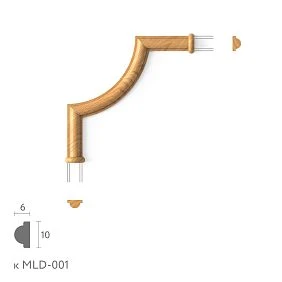
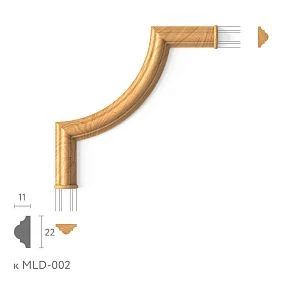
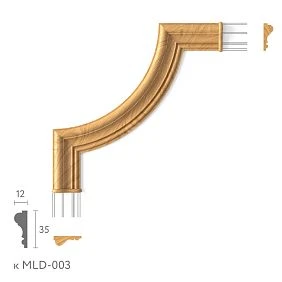
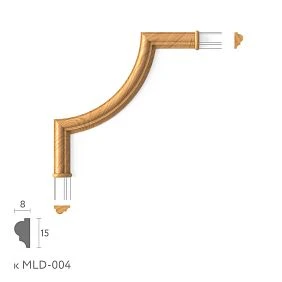
Why the corner should be chosen together with the straight molding
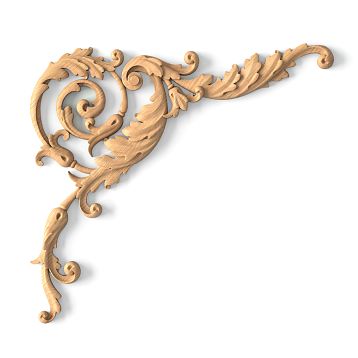
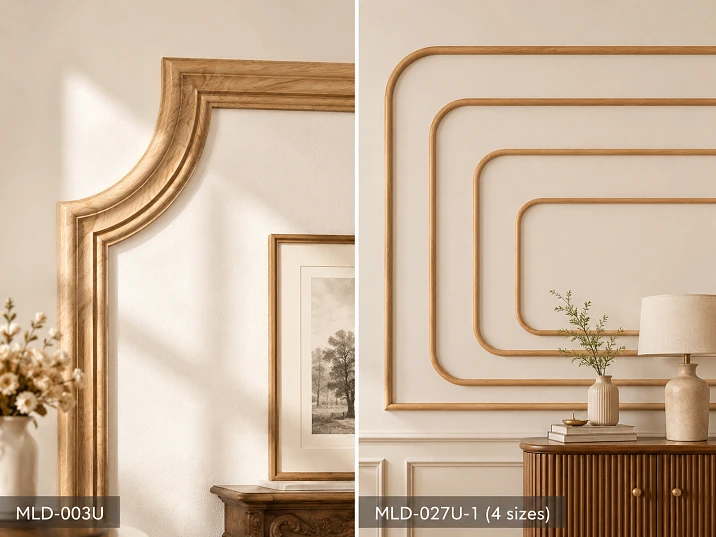
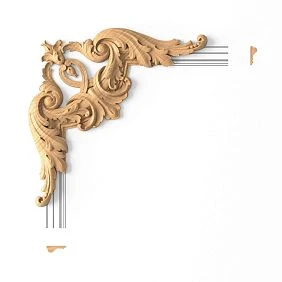
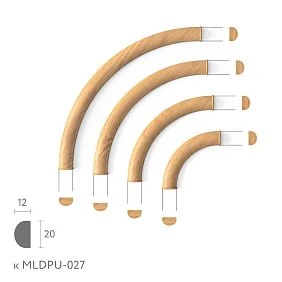
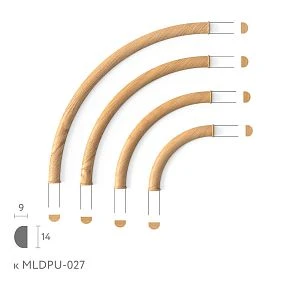
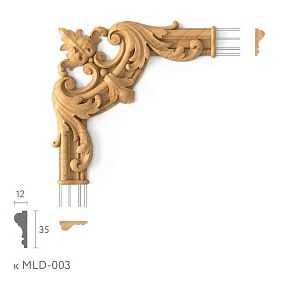
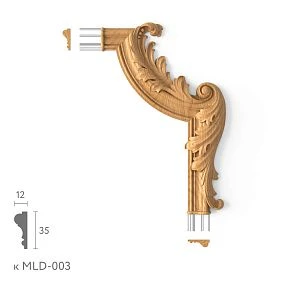
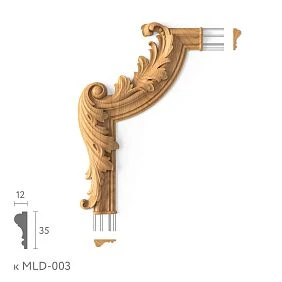
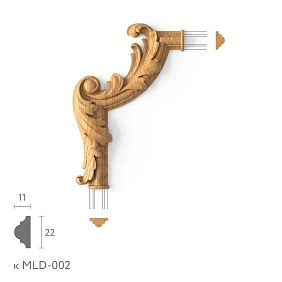
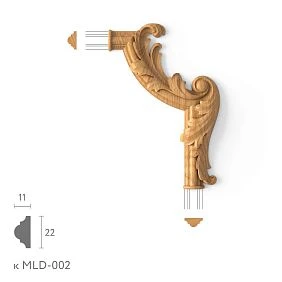
MLD-003U and MLD-027U-1 both complete the decorative frame, but give a different scale. MLD-003U is one large corner 218 × 218 × 15 mm for straight molding MLD-003 with a cross-section of 35 × 12 mm. MLD-027U-1 is a dimensional system of four corners 84, 124, 164 and 204 mm, which is selected for the more delicate MLD-027 with actual cross-sections of 14 × 8 and 20 × 11 mm.
Short answer: For a large frame with an expressive straight molding 35 × 12 mm, choose MLD-003U size 218 × 218 mm. If you need to frame a door, furniture front, or several frames of different scales, MLD-027U-1 is more convenient: the model is available in four sizes from 84 to 204 mm. Before ordering, check the straight profile series, surface size, wood species, sanding quality, and total length.
Corner molding for a decorative frame does not work as a separate overlay, but as part of a ready-made system. Its pattern, size, and back cut must match a specific straight profile. Therefore, the purchase starts not with the question 'which corner is prettier', but with understanding the frame scale, surface, and compatible series.
MLD-003U and MLD-027U-1 solve the same task differently. The first creates a large architectural corner and supports the prominent molding MLD-003. The second allows you to choose one of four sizes and is better suited for facades, doors, mirrors, panels, and wall frames where a more flexible proportion is needed.
Both models are made of beech or oak. Beech is prepared for enamel, oak for tinting. But the same material does not make the products interchangeable. MLD-003U has one dimension and compatibility with MLD-003, MLD-027U-1 has four dimensions and a link with MLD-027. Before purchasing, it is necessary to compare drawings, back cut dimensions, and the actual cross-section of the straight profile.
If none of the options match the task, it's better to select corner elements for the frame in the general category. There, decor can be filtered by compatible series, including MLD-003 and MLD-027.




Confirmed specifications for MLD-003U and MLD-027U-1
| Parameter | MLD-003U | MLD-027U-1 |
|---|---|---|
| Type | Large decorative corner element | Size corner element for frames, doors, and furniture |
| Dimensions | 218 × 218 × 15 mm | 84 × 84 × 13; 124 × 124 × 13; 164 × 164 × 13; 204 × 204 × 13 mm |
| Material | Beech or oak | Beech or oak |
| Sanding | "Standard" or "Prestige" depending on the version | «Prestige» |
| Preparation of beech | For enamel | For enamel |
| Oak preparation | For tinting | For tinting |
| Compatible profile | MLD-003, 35 × 12 mm | MLD-027, 14 × 8 or 20 × 11 mm |
| Main Scenario | Large wall frame, panel or facade | Wall, door, furniture, mirror, panel |
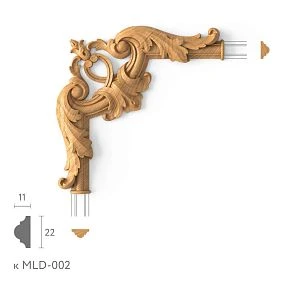
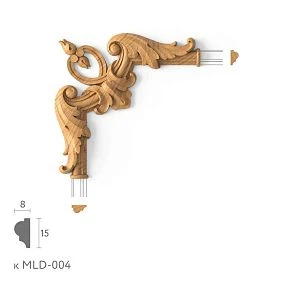
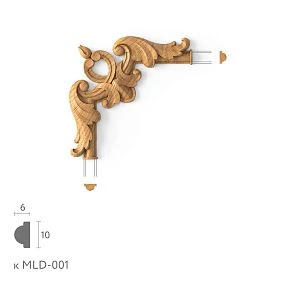
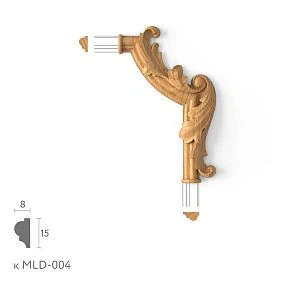
Our factory also produces:
How MLD-003U differs from MLD-027U-1
| Criterion | MLD-003U | MLD-027U-1 |
|---|---|---|
| Size logic | One large corner | Four scales |
| Straight molding | Wide MLD-003 35 × 12 mm | Semicircular MLD-027 14 × 8 or 20 × 11 mm |
| Scale | Architectural and ceremonial | From delicate to medium |
| Surface | Large wall, panel, large facade | Door, facade, mirror, niche, series of frames |
| Main risk | Overload a small surface | Choose too small an angle for a large wall |
Get Consultation
When to choose MLD-003U
For a large wall frame
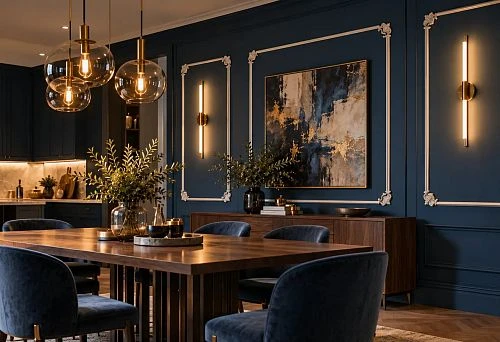
MLD-003U suits a wall where the decorative frame should be noticeable from a distance. The size 218 × 218 mm forms a full angle, and the straight MLD-003 profile with a width of 35 mm does not get lost among high baseboards, door trims, and large furniture. Such a combination is appropriate in a living room, study, dining room, hall, or commercial interior with sufficient wall area.
A large element cannot be evaluated only on screen. Print the outline or assemble a paper template 218 × 218 mm and place four corners on the intended frame. One corner may seem moderate, but four identical elements create a strong rhythm. The smaller the distance between them, the denser the decor looks.
For a large decorative panel
A panel with a large central field requires an appropriate frame. MLD-003U helps visually assemble straight strips into a unified system and covers the corner joint without the usual 45-degree miter cut. The decorative pattern becomes part of the composition, not a random overlay on the joint.
If wallpaper, fabric, painted panel, or mirror is planned inside the frame, the size of the inner field is calculated after placing the corners. You cannot first order an insert for a clean rectangle and then add large decor: MLD-003U occupies significant area and changes the usable opening.
For molding MLD-003 size 35 × 12 mm
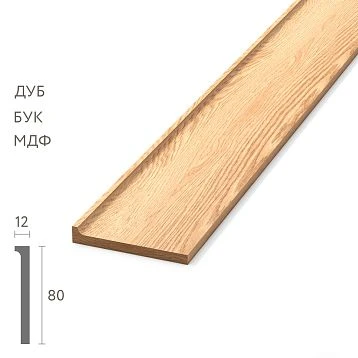
MLD-003U was created as a corner for MLD-003. The straight molding has a cross-section of 35 × 12 mm and is available in lengths that depend on the material: for solid wood, options of 1000 and 2400 mm are available, for MDF — 2600 mm. In a project with corners made of beech or oak, it is more rational to choose straight strips from the same wood species and with similar preparation for finishing.
For a large frame, you can buy wooden molding MLD-003 and immediately calculate the length of each side taking into account the corner elements. Buying only corners without the straight profile leaves the project incomplete.
When the corner should be an independent accent
MLD-003U is not hidden in the overall line of the frame. Its size and carving make the corner an independent part of the design. This technique is useful when the wall seems empty, but you don't want to add a painting or many small items. One large frame with four expressive corners creates architectural order and leaves the center free.
On a small facade, the same element can take up too much area and come close to handles, panels, or edges. Therefore, MLD-003U is chosen for a surface where free background remains around the decor.
For a large furniture facade
On a wide cabinet, sideboard, or wall panel facade, a 218 mm corner can work convincingly if the frame matches the door size. Before ordering, check the facade thickness, hinge placement, handles, and edges. The decor should not obstruct opening, cross the routing, or extend beyond the safe mounting zone.
For a heavy door or movable facade, base preparation and glue selection are especially important. A wooden corner does not reinforce the structure or replace a furniture frame. It serves a decorative function and must be securely glued to a stable surface.
If the project is designed for a large scale, you can buy a corner for a large molding frame MLD-003U and assemble a kit with MLD-003.
When to choose MLD-027U-1
For furniture facades
MLD-027U-1 is easier to adjust to the size of a door or drawer because the series includes four dimensions. Small corners 84 and 124 mm are suitable for compact facades where MLD-003U would take up a significant portion of the surface. Sizes 164 and 204 mm can be used on larger doors, panels, and cabinets.
The decor should leave room for the handle and not fall into the hinge mounting zones. On paired doors, frames are marked mirror-wise, and distances from edges are fixed with a template. Even a difference of a few millimeters becomes noticeable after painting.
For an interior door
The door leaf has a limited width and is constantly moving. MLD-027U-1 allows you to choose an angle that does not overload the door or interfere with the handle. An average size of 124 or 164 mm is often easier to fit into a paneled composition, but the final decision depends on the actual width of the leaf and the inner field of the frame.
On the door, it is important to check the thickness of the decor, the gap to the trim, and the position of the lock. The frame should not protrude in the area where the door touches the stopper or wall. Before gluing, the leaf is removed or fixed in a convenient position so that the elements do not shift.
For a small frame on the wall
A small frame can highlight a sconce, a photograph, a fragment of wallpaper, or an empty decorative field. MLD-027U-1 in size 84 or 124 mm helps maintain lightness. The straight MLD-027 has a semi-circular profile and does not create as massive a line as MLD-003.
It is better to first draw several small frames on the wall with painter's tape. The size of the angle is evaluated not separately, but in repetition. Four frames with four corners give sixteen decorative elements, so even a small size forms a noticeable pattern.
For several frames of different sizes
The main advantage of MLD-027U-1 is the ability to scale the system. On one wall, you can use large frames with 204 mm corners and smaller ones with 124 or 84 mm elements, maintaining the overall style. But mixing sizes requires a project: a random set looks like a mistake, not a well-thought-out hierarchy.
Usually, a large frame is placed in the center or in the lower tier, and smaller ones around it. The straight profile remains from the same series, so the composition maintains a connection. Before ordering, check whether the selected corner size matches the specific MLD-027 section according to the drawing.
For a mirror or niche
The corner molding can be used as part of a decorative frame around a mirror without gluing it to the glass itself. The frame is placed on the wall or panel and sets the outer contour. In a niche, MLD-027U-1 helps to design corners without complex miter cuts, but the dimensions should leave a free field around the contents.
For such a project you can buy a corner for the frame around the mirror and choose a straight MLD-027 of the same wood species.
How to choose the size of MLD-027U-1
| Size A × B × C, mm | Scale | Practical scenario | What to Check |
|---|---|---|---|
| 84 × 84 × 13 | Compact | Small furniture frame, drawer, narrow facade | Does the decor get lost on a large surface |
| 124 × 124 × 13 | Small | Door, facade, frame above furniture | Distance to handles and edges |
| 164 × 164 × 13 | Medium | Panel, large door, wall frame | Balance with inner margin width |
| 204 × 204 × 13 | Large in the series | Large wall composition or large facade | Is a more massive MLD-003U needed |
Angle 84 mm
The most compact option suits small facades and narrow frames. It preserves the series pattern but does not take up much space. On a large wall, such an angle may get lost, especially if the frame is painted the same color as the background.
Angle 124 mm
The size is convenient for standard door and furniture compositions where a noticeable but not dominant element is needed. Before purchasing, make a template and check how much space will remain between the angles after installing the straight strips.
Angle 164 mm
The medium option works well on a panel, tall door, or frame above a dresser. It is already noticeable from a distance but remains lighter than the MLD-003U. If the wall has a high baseboard and large casings, 164 mm may be the minimum convincing scale.
Angle 204 mm
The maximum MLD-027U-1 is close in sides to the MLD-003U but remains part of a different system and has a thickness of 13 mm. The choice between 204 and 218 mm is not made based on the fourteen-millimeter difference, but on the compatible straight molding and the nature of the pattern.
Why you cannot choose the angle separately from the straight molding
The reverse cut repeats the profile
Decorative moldings have a reverse part designed to mate with a specific cross-section. If you attach the MLD-003U to the MLD-027 or vice versa, the lines may not match in width, height, and shape. The joint will remain visible even after painting.
The cross-section determines the scale of the frame
The MLD-003 with a width of 35 mm creates a large line and supports a massive angle. The MLD-027 with a width of 14 or 20 mm forms a more delicate contour. You cannot choose a large angle and then install the thinnest random profile just to save space.
The material must match
A beech angle and an oak straight molding accept stain differently and have different textures. Even under enamel, it is better to use the same wood species so that shrinkage, sanding, and coating behavior are more predictable. For visible oak, matching is especially important.
Grinding quality affects the finish
MLD-027U-1 is supplied as "Prestige". For MLD-003U, "Standard" and "Prestige" are possible depending on the configuration. If the corners are prepared in detail, but the straight planks require finishing, the difference will become noticeable after priming. The kit needs to be inspected and, if necessary, brought to a uniform condition.
The length of the planks affects the number of joints
MLD-003 and MLD-027 are produced in several lengths and materials. For the long side of the frame, it is advisable to use one whole plank if possible. An additional joint in the middle requires careful fitting and may be noticeable under tinting.
For the MLD-027 system, you can buy a wooden molding MLD-027 with an actual cross-section of 14 × 8 or 20 × 11 mm, after first checking the drawing of the selected corner.
How many corners and straight molding to buy
Four corners for a closed frame
A typical rectangular frame consists of four corner elements and four straight sides. But this number is only correct for a fully closed contour. If the frame connects to a baseboard, cornice, door casing, or adjacent panel, the scheme may be different. First, draw a layout, then count the items.
Length of straight profile
For each side, measure the distance between the seating zones of the corners, not the full external size of the frame. Then sum the horizontal and vertical segments. Add a margin for control trimming, correction of a small defect, and possible joint. The margin percentage depends on the complexity of the project and the installer's experience.
One batch for the entire wall
It is better to order corners and straight moldings at the same time. Natural wood differs in shade and texture, and a repeat batch of oak may take the tint differently. For a series of identical frames in a hotel, salon, or large house, it is useful to add a few spare strips and one spare corner.
Different sizes in one composition
If MLD-027U-1 of different sizes are used, the quantity is calculated for each group separately. For example, two large frames require eight 204 mm corners, and four small frames require sixteen 84 mm corners. In the specification, the items should be separated so that elements are not mixed up during installation.
Outer and inner fields
The size of the corner affects the outer contour and the usable space inside the frame. Too large elements may almost meet on the short side. Before ordering, check the minimum length of the straight section between corners: it should remain long enough so that the composition does not look like four overlays without a frame.
Beech for enamel or oak for tinting
Beech for opaque color
Beech MLD-003U and MLD-027U-1 are prepared for enamel. The slats may differ in shade and pattern because the future covering layer will hide these differences. Beech is chosen for white, black, gray, colored, or wall-matching frames.
If the corner molding and straight strips are painted after installation, the joints can be carefully finished to obtain a single contour. However, a thick layer of primer and enamel should not fill the thread or make the transition between the corner and the profile heavy.
Oak for translucent finish
Oak elements for tinting are selected considering the color and texture of the lamellas. A translucent finish emphasizes the pores and makes the frame tangible. This set is suitable for oak furniture, doors, wall panels, and interiors where natural wood should remain visible.
Tinting is tested on a sample. The corner has threads and end sections, so it absorbs the compound unevenly. A straight molding may appear lighter or darker. The finish is applied using a single technology to the entire set.
Why you should not mix beech and oak
Under dense enamel, differences in wood species are partially hidden, but surface behavior and porosity remain different. Under tinting, a mixed set will look inconsistent. If the corners are oak, straight planks should also be chosen from oak. For a beech corner, use a beech profile.
What "Standard" and "Prestige" mean
"Standard" means machine sanding and may require additional preparation before finishing. "Prestige" includes more detailed hand sanding. These are not different patterns or different sizes. The choice depends on surface requirements, budget, and the craftsman's readiness to perform finishing.
Finish in wall color
A frame painted together with the wall creates relief without strong color contrast. In this case, shadows from the carving and joint precision are especially important. MLD-003U will provide a more noticeable architectural effect, MLD-027U-1 a lighter one.
Contrast finish
Dark oak on a light wall or colored enamel enhances each corner. With contrast, small errors in marking and joints become more noticeable. Therefore, a dry mock-up is first assembled and distances are checked.
Where to use MLD-003U
Living room
One large frame can highlight a sofa, console, fireplace area, or central panel. MLD-003U is suitable for a tall wall and large furniture. In a small living room, four 218 mm corners can take up too much space, so a full-size template is needed.
Study and library
The wide molding 35 × 12 mm and oak tint support wooden cabinets and doors. The frame can decorate the empty space between shelves or emphasize the panel behind a desk. Books and furniture already create many details, so the number of frames is limited.
Dining room
MLD-003U helps assemble a large wall panel behind the dining group. Inside, you can leave a solid color, wallpaper, or decorative coating. The corner should be at a safe distance from chair backs and areas where the wall is frequently touched.
Hall and staircase area
The large scale reads well from a distance and matches a tall room. On the stairs, the layout is coordinated with the slope of the flight and panels. A regular rectangular frame is not always suitable for a wall with complex geometry, so a project is needed before ordering.
Commercial interior
In a restaurant, hotel, salon, or showroom, MLD-003U creates a noticeable frame system. The surface must withstand cleaning and accidental touches. The finish is chosen considering intensive use, and spare elements are kept for repairs.
Where to use MLD-027U-1
Furniture facades
The size range allows you to decorate cabinet doors, dressers, sideboards, or nightstands. Small corners are suitable for compact fronts, medium ones for tall doors. The straight MLD-027 does not look heavy and preserves useful space for the handle.
Interior doors
The frame makes a smooth surface look like a paneled one, but does not change the door structure. Before installation, check that the decor does not interfere with the trim, lock, and opening. On a double door, both frames must be strictly symmetrical.
Bedroom
Delicate frames can be placed behind the headboard, above a chest of drawers, or on cabinet fronts. An angle of 84 or 124 mm creates a soft pattern, while 164 or 204 mm suits a large panel. A color matching the wall makes the decor calmer.
Hallway
MLD-027U-1 helps frame a mirror, cabinet door, or narrow wall space. Protruding parts should not be in active walkways. For a wall near an entrance, it's better to choose a size that leaves enough distance to the trim and switch.
Children's room
Frames are placed outside impact zones and a durable finish coating is chosen. Small decor on the lower part of the wall can get dirty quickly. It's more practical to raise the composition higher or use it on furniture that a child doesn't constantly touch.
Mirrors and decorative panels
Corners can frame the outer contour around a mirror, wallpaper inserts, or painted panels. Glue is applied to a stable surface, not to glass without confirmed technology. First, install and check the main object, then mark the frame.
What to buy together with corner moldings
A corner element is almost never a standalone purchase. For MLD-003U, you need MLD-003; for MLD-027U-1, you need MLD-027. You will also need mounting glue, materials for joint treatment, and a finishing system. The scheme includes a confirmed card of transparent TYTAN Prof. Classic Fix with a volume of 100 ml.
For a large composition, you can buy a set of MLD-003 and MLD-003U. For a more flexible system — buy the MLD-027 and MLD-027U-1 kit. The fastening is done using assembly adhesive for wooden decor, the compatibility of which with the base and coating is checked before work.
| What to add | Why | For which kit | What to Check |
|---|---|---|---|
| Four corner elements | Assemble a closed rectangular frame | Both series | Same size, wood species, and sanding |
| MLD-003 35 × 12 mm | Connect large corners with straight sides | MLD-003U | Length, material, and number of joints |
| MLD-027 14 × 8 or 20 × 11 mm | Assemble a delicate dimensional frame | MLD-027U-1 | Compatibility of the selected cross-section according to the drawing |
| Construction adhesive | Secure the wooden decor | Wall, door, furniture, panel | Base, consumption, setting time, and test |
| Primer and enamel | Get an opaque color | Beech elements | Compatibility and thread preservation |
| Tinting and protective finish | Preserve texture | Oak elements | Test coating and uniform shade |
How a decorative corner molding differs from a construction profile
Another task
MLD-003U and MLD-027U-1 form a flat frame on a wall, door, facade, or panel. They connect with a straight decorative molding and create a pattern. A construction corner for a slope or external corner protects the edge of plaster, tile, or panel from impacts. These products cannot be considered replacements for each other.
Not protection of an external wall corner
The phrases "molding on a wall corner" and "corner molding for slopes" often refer to profiles that cover a real protruding room corner. MLD-003U and MLD-027U-1 lie on a plane and form a turn inside a decorative frame. Installation on an external construction corner does not match their shape.
Compatibility is determined by the series
For a construction profile, look at the shelf width and base material. For a decorative corner, look at the straight molding article, pattern, and back cutout. MLD-003U is linked to MLD-003, MLD-027U-1 to MLD-027.
Decor does not fix an uneven slope
The carved corner cannot be used to mask a significant wall unevenness. The base must be leveled first. Otherwise, the element will not fit, and the joints with straight strips will open.
How not to confuse MLD-003U and MLD-027U-1 with similar products
Check the full article number
There are many items with similar designations in the category. The numbers after MLD indicate the compatible series, and the letter U indicates the corner format. Before adding to cart, compare the full article number, not just the photo and the word "corner".
Check all dimensions
MLD-027U-1 has four options that look visually similar on the card. The specification specifies the exact dimensions A × B × C and quantity. A mistake between 84 and 204 mm completely changes the frame.
Do not confuse the corner element with the end cap
The end cap finishes a straight molding on one side and does not form a ninety-degree turn. For a closed rectangular frame, corners are needed. End caps are suitable for open lines and other compositions.
Do not replace the corner with a center overlay
The center decor connects or decorates straight sections but is not designed for joining two perpendicular sides. Even a similar pattern does not guarantee the correct back cutout.
MLD-027U-1 and other angles of the MLD-027 series
The site may have other corner elements for MLD-027. They differ in pattern, size, and purpose. If MLD-027U-1 is not suitable, open the catalog of wooden corners for moldings and use the filter by series, without randomly changing the straight profile.
Practical selection for specific situations
Need to design one large wall
Start with the MLD-003U layout. If four corners of 218 mm and a molding of 35 mm look proportionate, this system will give a cohesive architectural result. If the frame seems too heavy, compare MLD-027U-1 in size 204 or 164 mm with a thinner straight profile.
Need to make frames on doors
Choose MLD-027U-1. Size 84 or 124 mm is usually easier to fit into the door leaf, but you need to check the handle, lock, and casing. Make one test template and open the door fully.
Need to update furniture without replacing facades
A frame made of MLD-027 and compact corners can transform a smooth facade after painting. The surface must be stable and suitable for glue. Film, lamination, or old coating require an adhesion test.
Need to design a large wall panel
MLD-003U is better if the panel takes up most of the wall and has a wide inner field. The corner becomes a noticeable point and connects straight slats. For multiple panels of different sizes, MLD-027U-1 is more convenient.
Need to assemble a frame around a mirror
For a small mirror and a light outline, choose MLD-027U-1. For a large mirror field on a panel, consider MLD-003U. The decor is attached to the wall or substrate; the method of contact with the glass must be agreed separately.
Need to replicate identical frames in a hotel or salon
Assemble a full-size sample, approve the corner size, slat lengths, and color. After that, order the entire set in one batch. Keep a spare for repairs and a marking template.
Need to connect decor with existing molding
First, determine the article number of the installed profile. If it is not MLD-003 or MLD-027, new corners may not fit. Measuring width and height is not enough: the cross-section shape is also important.
Need an oak frame for furniture
Order oak corners and straight slats for tinting. Make a sample next to the furniture. Do not try to match the shade only by the stain name, because different wood species and batches give different results.
Need a white frame to match the wall color
A beech set under enamel is rational. After installation, joints are refined, primed, and painted together with the wall or separately according to the project. On a sliding door, it is better to finish elements before installation and perform local final finishing.
What not to make from scratch if there are ready-made STAVROS elements
Self-making a corner requires cutting the same pattern four times, maintaining a precise right angle, and making a reverse cut for the profile. Even a small difference becomes noticeable in the frame. Ready-made MLD-003U and MLD-027U-1 allow focusing on marking, trimming straight planks, finishing, and installation.
No need to cut threads manually
Four ready-made corners have the same shape. The buyer gets repeatable geometry and can build a symmetrical frame without manually copying the ornament.
No need to adjust a random overlay
Random decor does not have a cutout for MLD-003 or MLD-027. Filing the back side can weaken the element and damage the front part. The ready-made compatible series reduces the number of risky operations.
No need to miter a decorative profile in a complex corner
A regular frame requires precise mitering at 45 degrees. The corner element covers the turn and makes it part of the pattern. Straight moldings are trimmed to length and inserted into prepared corner zones according to the drawing.
No need to assemble a set from different materials
In the cards, you can choose beech or oak. The corner and straight profile are ordered in the same wood species, then finished simultaneously. This is more predictable than combining unknown blanks.
Commercial route
First, select MLD-003U or size MLD-027U-1, then open the card of the compatible straight molding, calculate the footage, and add glue. After a test layout, the set is finished and installed. This route reduces the risk of incompatibility.
Base preparation and installation
The wall must be level
A long straight profile repeats unevenness. If the wall has a wave, gaps will appear between the molding and the base, and the corners will not align. Before work, check the plane with a straightedge and eliminate pronounced defects.
Marking starts from the outer contour
First, mark the strip
Temporary fixation
While the glue gains strength, the elements should not slide. Use safe painter's tape, supports, or a mounting template that does not damage the wood and coating. Check the specific curing time in the glue instructions.
Joint treatment
After drying, check the transition between the corner and molding. For enamel, small gaps can be prepared for painting with a suitable material. For oak under tinting, corrections are more difficult and should remain minimal.
Finish before or after installation
On a wall painted the same color as the frame, it is convenient to do the finish after assembly. On furniture and doors, it is often safer to finish the parts in advance, and then locally touch up the joints after installation. The solution depends on the base and coating technology.
Mistakes when buying corner molding
Choosing only by photo
On the card, both corners are shown separately, so the difference between 84 and 218 mm seems small. On a real wall, four large elements take up significant space. Before ordering, a full-size template is needed.
Buying a corner without a straight profile
A corner does not form a frame by itself. If a compatible molding is not ordered, the project stops. Immediately add MLD-003 to MLD-003U or MLD-027 to MLD-027U-1.
Mixing series
Similar width does not guarantee matching of the rebate and pattern. MLD-003U cannot be automatically connected to MLD-027. Check the article numbers and drawings.
Old sizes of MLD-027
In old materials, rounded values of 14 × 9 and 20 × 12 mm may be found. The current card indicates 14 × 8 and 20 × 11 mm. For ordering, refer to the current table and drawing.
Buying two corners instead of four
A closed rectangular frame requires four elements. Two corners are suitable for an open composition only by a separate project. The quantity is calculated from the drawing, not from a photo of one fragment.
Lack of spare straight molding
Exact length without spare leaves risk after a cutting error. An extra plank from another batch may differ in shade. Order a reasonable spare together with the main set.
Beech for clear lacquer
Beech in the card is prepared for enamel. A clear finish will show differences in lamellas. For visible natural texture, choose oak for tinting.
Oak under dense enamel without reason
Covering paint hides the oak pattern for which the material was chosen. If a solid color is needed, beech usually matches the task more precisely.
Different material for corners and planks
Oak corners with beech moldings will look different under tinting. Even under enamel, mixing complicates preparation. One set is better assembled from one wood species.
Glue without checking the base
Strong glue will not hold decor on peeling paint or dusty plaster. The base is cleaned and tested with a probe.
Installation on a curved wall
Long planks reveal gaps, and corners end up in different planes. First, level the surface or choose a backing.
Too large an angle on a small facade
MLD-003U can get so close to the handle and edges that the straight section disappears. For furniture, the smaller MLD-027U-1 is often more suitable.
Too small an angle on a tall wall
MLD-027U-1 84 mm can get lost in a spacious hall. In such cases, choose 164 or 204 mm, or switch to MLD-003U.
Painting without dry assembly
After finishing, it is harder to trim and adjust elements. First, assemble a mockup, mark positions, then finish.
Who is MLD-003U suitable for
A large corner is suitable for the owner of a spacious wall, large panel, or furniture facade where the decor should be readable from a distance. It is appropriate in classic, neoclassical, ceremonial, and architectural interiors. MLD-003U works particularly convincingly together with the wide MLD-003 and sufficient free space.
The model is suitable for a designer or craftsman who has prepared a layout in advance, knows the outer size of the frame, and wants one fixed scale without choosing from several options.
When it's better not to choose MLD-003U
It may be redundant on a narrow door, small facade, tight wall space, and in compositions with very thin moldings. If the element occupies most of the corner and leaves no straight section, choose MLD-027U-1.
Who MLD-027U-1 is suitable for
The size series is suitable for a project with doors, furniture, mirrors, niches, and several frames of different scales. It is useful when it's important to maintain one pattern but change the corner size depending on the surface.
MLD-027U-1 is also suitable for a small interior where the wide MLD-003 would look heavy. The semicircular MLD-027 creates a more delicate line and is easier to repeat on several facades.
When MLD-027U-1 may not be suitable
Even the maximum corner of 204 mm remains part of a thin series. On a large wall with a massive baseboard, wide architraves, and large furniture, the frame may look insufficiently weighty. In that case, choose MLD-003U and MLD-003.
How to buy MLD-003U or MLD-027U-1 at STAVROS
First, determine the surface and outer size of the frame. Then make a template of the corners and check them in the quantity of four pieces. After selecting the model, open the card of the compatible straight molding and calculate the length of each side.
In the MLD-003U card, you need to select beech or oak, as well as the available sanding quality. For MLD-027U-1, additionally select one of four sizes; the quality is indicated as "Prestige". Check the current price, availability, and lead time before ordering.
The next stage is the straight profile. For MLD-003U, you need a molding 35 × 12 mm for MLD-003U. For the second model — a semi-circular molding for MLD-027U-1. The wood species and preparation for finishing are coordinated with all corners.
If you need a different pattern, size, or compatible series, open view all corner moldings. General selection rules are additionally covered in the material about how how to select corner pieces for moldings.
What to Check Before Ordering
- outer size of each frame;
- number of closed and open contours;
- actual size of the angle;
- compatible series of straight molding;
- current section MLD-003 or MLD-027;
- length of all straight sections;
- allowance for trimming;
- beech for enamel or oak for tinting;
- the quality of sanding;
- one batch for the entire composition;
- evenness of the wall, door, or facade;
- compatibility of adhesive with the base;
- distance to handles, hinges, and trims;
- ability to open the door after installation;
- color and finishing technology;
- availability of a marking template;
- place for temporary fixation;
- current order conditions in the card.
How to check frame proportions before ordering
Start with the outer contour
Draw the frame with painter's tape at full size. Then replace simple corners with paper templates of the selected decor. This mockup shows how much wall the MLD-003U or a specific MLD-027U-1 will occupy and how long the straight sections will remain. If the corners almost touch, the frame is too small for the chosen scale.
Compare the width of the molding with the inner field
Wide MLD-003 reduces the visual opening more. On a narrow frame, it may look heavy. MLD-027 leaves more air and suits compositions where a mirror, panel, wallpaper, or a calm painted field is placed inside.
Check the distance to neighboring elements
There should be a deliberate gap between the frame and the baseboard, cornice, casing, or adjacent contour. A gap that is too small is perceived as an installation error. A gap that is too large can break the connection between elements. The layout is evaluated from several points in the room.
Consider the furniture
The frame behind a sofa, console, or dresser should relate to their width. MLD-003U suits large furniture and a high wall section. MLD-027U-1 allows for more precise adjustment to a small cabinet, closet door, or narrow panel.
Take a photo of the mockup
A photo taken from a distance helps to see misalignment and scale better than a close-up view. Compare two options: MLD-003U and the appropriate size MLD-027U-1. The decision becomes clearer when the frames are shown side by side at the same scale.
How to accept the set after delivery
Check the article numbers and sizes
Check that the corners belong to the selected series and that MLD-027U-1 have the same size. For MLD-003U, verify the dimension 218 × 218 × 15 mm. An error is detected before tinting, painting, and cutting the straight planks.
Compare the wood species and preparation
The corners and moldings must be from the same wood species and intended for the same finish. Beech parts are for enamel, oak parts are for tinting. The configuration of each item is recorded on the packaging and in the documents.
Arrange the elements by frames
If the project has multiple contours, distribute the corners and strips in advance. Oak parts are matched by tone and pattern. The closest elements are combined into one frame to make transitions look calmer.
Inspect the carving and the back side
The front part should not have damage that cannot be hidden by finishing. The back cutout should be clean and match the profile. Before installation, attach a small piece of molding to each type of corner.
Do not discard the markings
Keep the article numbers, dimensions, and order number until the work is completed. This data will be useful if you need an additional strip, a spare corner, or a manager's consultation.
Care for the finished frame
Stained beech
Enamel is cleaned with a soft cloth without abrasives. Dust from the carving is removed with a brush. Strong friction on protrusions may change the gloss, so it is better to remove dirt immediately.
Tinted oak
The care product is chosen according to the protective finish. Do not use solvent without testing. Water should not linger in recesses or at the joints of a straight profile with a corner.
Frame on a door or furniture
Moving surfaces experience vibration. Periodically check the joints and fastening. If an element starts to come off, do not press it with random glue over the old layer: relieve the load and restore the connection according to the technology.
Frame in a public space
In a hotel, salon, or restaurant, the decor is inspected more often. Impacts from carts, furniture, and luggage can damage the lower corners. A spare element from the same batch simplifies repairs and maintains a uniform color.
How to save a specification for reordering
Record the corner article, its size, material, sanding quality, straight molding article, cross-section, plank length, color, and brand of finishing materials. Add a diagram with distances between elements and a photo of the finished frame.
For a series of rooms, it is useful to save marking templates. Then new frames will match the already installed ones, and installers won't have to re-determine the offsets. An accurate specification is especially important for MLD-027U-1, where one article has four sizes.
How to choose between one large frame and a series of small ones
One frame with MLD-003U gathers attention in the central part of the wall and suits an interior that already has large furniture or a panel. It requires fewer individual contours, but each corner becomes noticeable and must be installed with particular precision.
A series of frames with MLD-027U-1 allows dividing the wall into zones: highlighting a sofa, sconce, door panels, or furniture facades. This option is more flexible but requires more corners, straight profiles, and time for marking. Before ordering, calculate not only the footage but also the number of repeating joints.
If the room is small and filled with furniture, one calm frame often looks cleaner than several. In a spacious hall or long corridor, repetition helps organize the wall. The size of the corners is chosen after placing all contours, not for the first frame separately.
It is useful to prepare two options on a photo of the wall: a large MLD-003U and several frames with MLD-027U-1. Compare the empty fields, distances to doors, and how often the pattern repeats. This method helps choose not only the product but also a reasonable number of kits.
How to coordinate a corner molding with other interior lines
Baseboard and bottom frame line
The bottom edge of the wall frame should not accidentally intersect with the baseboard. If the frame is placed low, measure not only the height of the baseboard but also its protrusion from the wall. MLD-003U has a large pattern and requires a larger offset. For a small frame above the baseboard, MLD-027U-1 usually provides more freedom.
Trim and doorways
A frame next to a door should support, not replicate, the trim with nearly the same size. If the trim is wide and carved, MLD-003U may create excessive competition. A thinner MLD-027 and corners of 124 or 164 mm allow the doorway to remain the main focus.
Cornice and top of wall
A high ceiling cornice sets the upper scale. A large MLD-003U naturally pairs better with a massive cornice and a tall room. On a wall without a cornice or with a thin line, MLD-027U-1 may look lighter. The gap from the frame to the ceiling should be checked along the entire wall, especially if the ceiling has a slope.
Furniture fronts and handles
On a facade, the decorative frame should leave room for the hand. Before gluing the corners, temporarily install the handle and open the door. The carving should not catch fingers, the adjacent facade, or the cabinet body. For drawers, evaluate the position of the handle in the center and how the frame looks in the closed unit.
Mirror and inner field
If the frame surrounds a mirror, a painted field can be left between the molding and the glass. It reduces the risk of accidental contact between the wood and the glass and helps compensate for slight size differences. The width of the field is set equal on all sides and checked with a level.
Wallpaper and decorative plaster
A different coating can be used inside the frame, but the border must be prepared before installing the molding. It is better to apply glue to a stable base rather than loose decorative plaster. If the coating has a pronounced relief, gaps may appear under the strips.
Color hierarchy
A frame in the color of the wall works through shadow and suits a saturated room. Contrasting oak or colored enamel enhances the pattern and requires more precise geometry. For a series of small frames, moderate contrast is safer, otherwise each of the many corners begins to compete with furniture and art objects.
How to calculate a frame on a door or facade
Safe margins from edges, handle, and hinges are subtracted from the width of the panel. The remaining area becomes the outer size of the frame. Then, templates MLD-027U-1 are placed in its corners, and the length of straight sections is checked. On a narrow door, a 204 mm corner may turn out to be too large, even if it looks suitable individually.
In height, the frame is positioned so that the top and bottom fields are related to the handle and the proportions of the panel. If there are two frames on the door, their sizes and the distance between them are determined simultaneously. You cannot first glue the top one and then adjust the bottom one to the remaining space.
On furniture, the thickness of the facade and the opening trajectory are additionally considered. The corner decor should not extend onto the edge or interfere with the adjacent door. For a drawer, check that the bottom corner does not hit the base or countertop when fully opened.
Before final ordering, save a photo of the layout and a table of dimensions. These materials will help the manager, finisher, and installer understand the project uniformly and reduce the risk of mixing up corners, straight profiles, or the number of elements.
Frequently asked questions
How is MLD-003U different from MLD-027U-1?
MLD-003U has one size 218 × 218 × 15 mm and connects to MLD-003 35 × 12 mm. MLD-027U-1 is available in four sizes and is matched to MLD-027.
What sizes does MLD-027U-1 have?
84 × 84 × 13, 124 × 124 × 13, 164 × 164 × 13, and 204 × 204 × 13 mm. The card also specifies parameters D and L.
Which angle should I choose for a large wall?
First check MLD-003U. If the system looks too bulky, compare MLD-027U-1 in size 204 or 164 mm.
Which angle is suitable for a furniture front?
Most often MLD-027U-1, because you can choose a size from 84 to 204 mm. MLD-003U is only suitable for a large front with sufficient free space.
Can MLD-003U be connected to MLD-027?
It should not be. The angle is designed for MLD-003. Another profile may not match in width, height, and back cut.
What molding is needed for MLD-027U-1?
The compatible product is MLD-027. The current card indicates cross-sections of 14 × 8 and 20 × 11 mm. The specific fit is checked against the drawing.
Why do old descriptions mention 14 × 9 and 20 × 12 mm?
The card dimensions may have been updated. Before ordering, refer to the current product table and the latest drawing.
How many corners are needed for one frame?
For a closed rectangular frame, usually four. For an open composition, the quantity is determined by the project.
Is a spare set of corners needed?
For a single home project, a precisely calculated set is sufficient, but for a series or commercial interior, a spare element from the same batch is useful.
How much straight molding should I buy?
Add up the lengths of sections between corners and include an allowance for cutting. Do not just calculate the outer perimeter without accounting for corner dimensions.
Should I choose beech or oak?
Beech — under opaque enamel, oak — under tinting and visible texture. It is better to take corners and planks of the same species.
What does "Prestige" mean?
This is detailed hand sanding, which reduces the amount of finishing work. Before the final finish, the product is still inspected and dusted.
Can the oak be left uncoated?
Not recommended. The wood gets dirty faster and reacts to moisture. Use a suitable protective finish.
Can beech be painted white?
Yes. Beech elements are prepared for enamel. Primer and paint are applied thinly, preserving the carved pattern.
Which glue should I use?
In the related products MLD-003U, transparent TYTAN Prof. Classic Fix is indicated. Before installation, compatibility with the base and coating is checked.
Can the decor be glued onto wallpaper?
Reliability depends on the strength of the wallpaper itself and its adhesion to the wall. For a heavy wooden set, it is safer to attach to a stable base after checking.
Is a corner molding suitable for a slope?
MLD-003U and MLD-027U-1 are designed for decorative frames on a flat surface, not for protecting the construction corner of a slope.
Can the corner be used around a mirror?
Yes, as part of a frame on a wall or panel. The method of attachment to glass is not separately confirmed and requires special technology.
Is MLD-027U-1 suitable for a door?
Yes. The card indicates doors among the scenarios. The size is chosen based on the door leaf, handle, trim, and internal field.
Is MLD-003U suitable for furniture?
Yes, for a large facade or panel. On a small door, the 218 mm element may look excessive.
Should it be painted before installation?
Depends on the base. On a wall of one color, the frame can be finished after assembly. On furniture, it is often more convenient to paint parts in advance.
How to check the size before purchase?
Make a paper template of one corner, then place four templates and connect them with masking tape along the molding line.
Can different sizes of MLD-027U-1 be used on the same wall?
Yes, if there is a project and a clear hierarchy of frames. Random mixing of sizes looks inconsistent.
Where to buy MLD-003U?
In the separate STAVROS card, you can choose beech or oak, sanding, and check current ordering conditions.
Where to buy MLD-027U-1?
In the model card, choose one of four sizes, beech or oak, and add the required number of elements.
Where to see other corners?
In the molding decor category, there are filters by compatible series, size, and collection.
Summary: MLD-003U for large scale, MLD-027U-1 for a flexible system
MLD-003U and MLD-027U-1 cannot be selected separately from the straight profile. The large corner 218 × 218 mm works with MLD-003 size 35 × 12 mm and fits a large wall frame, panel, or facade. MLD-027U-1 provides four sizes from 84 to 204 mm and connects with the more delicate MLD-027.
Before purchasing, you need to determine the surface size, number of frames, wood species, sanding quality, current cross-section of the straight molding, length, and installation method. For a closed contour, you usually need four corners, four straight sides, a profile allowance, and glue.
At STAVROS, you can assemble a compatible set without random fitting: buy corner molding MLD-003U for a large frame or buy compact corner molding MLD-027U-1 of the appropriate size. A conscious choice of series, material, and complete set provides a predictable joint and a neat result after finishing.