Article Contents:
- When you need a ready-made corner element for molding
- If you don't want to make a 45° miter cut
- If you need a symmetrical decorative frame
- If the frame is assembled on a facade, door, or wall panel
- MLD-4U-2.1L — left element
- MLD-4U-2.1R — right element
- MLD-001U — ready-made corner molding
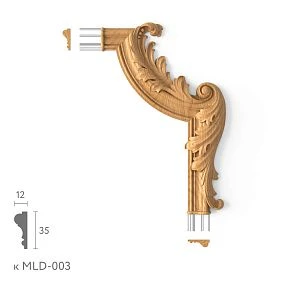
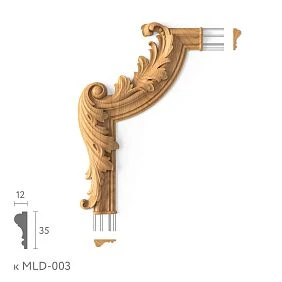
- N-500 — corner piece for MLD-003
- Check compatibility by series
- Compare height, width, and profile
- Choose material and finish
- Calculate number of corners and straight sections
- On the furniture facade
- On interior door
- On a Wall Panel
- In decorative composition with overlays
- Table of 'what to buy together'
- Need to make a frame on the dresser facade
- Need to design an interior door
- Need to assemble a wall panel
- Need to avoid a 45° cut
- Need to make a facade with a frame and overlay
- Need to choose a handle for the frame
- Mistake 1. Buying corners without straight molding
- Mistake 2. Not checking the left and right element
- Mistake 3. Choosing only by photo
- Mistake 4. Not considering profile thickness
- Mistake 5. Buying a large corner for a small facade
- Mistake 6. Not planning the finish
- Mistake 7. Assembling the frame without markings
- Mistake 8. Confusing frame and overlay
- Mistake 9. Not considering the handle
- Mistake 10. Not checking cards before ordering
- Is it possible to assemble a frame without a 45° cut?
- Why buy left and right corner pieces?
- How many corners are needed for one rectangular frame?
- Where to use corner pieces for molding?
- How to know which molding fits the corner?
- What to buy together with corner pieces?
- How is MLD-001U different from N-500?
- Can a large corner be used on a small facade?
- Do you still need to cut the molding?
- How to choose material: beech or oak?
- Can a frame be made on the wall?
- Will corner elements fit the door?
- How is a corner element different from a decorative overlay?
- What happens if you buy only straight molding?
- How to avoid frame distortion?
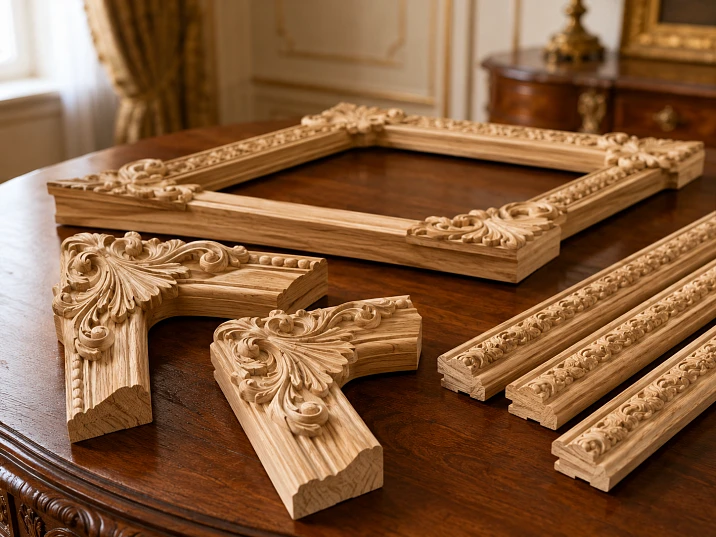
It is worth buying a corner molding element when you need to assemble a neat decorative frame on a facade, door, or wall panel, but you don't want to risk cutting at 45°, adjusting the profile, or mismatched corners. A frame made of molding seems simple only in the picture: four straight sides, four corners, a perfect rectangle. In practice, it is the corner that most often reveals installation errors — gaps, distortion, pattern mismatch, different profile heights, or rough joints.
A ready-made corner element solves this problem differently. It does not require complex joining of two straight sections at the corner. Instead of cutting the molding at 45° and hoping the profile aligns, the buyer takes a ready-made decorative corner and complements it with straight sections of compatible molding. As a result, the frame looks assembled, symmetrical, and more professional.
This topic is especially important for furniture workshops, designers, manufacturers of facades, doors, and wall panels. A private buyer can also use ready-made corners if they want to decorate a dresser facade, interior door, wall panel, decorative niche, or accent frame without complex carpentry adjustments. The main thing is not to buy corners randomly. The corner element must match the molding in series, profile, height, width, material, and future finish.
At STAVROS, there are several real solutions for such tasks: left and right decorative elements MLD-4U-2.1L/R, corner molding MLD-001U, corner element N-500 for molding MLD-003, as well as straight linear molding, overlays, and furniture handles that help assemble a finished facade or interior composition. This article will help you understand which corner is needed, when to buy left and right elements as a pair, how to calculate the frame, and what to add to the order.
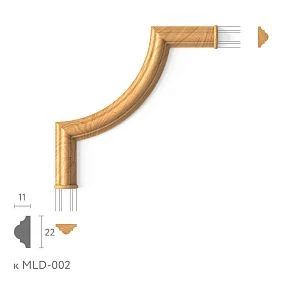
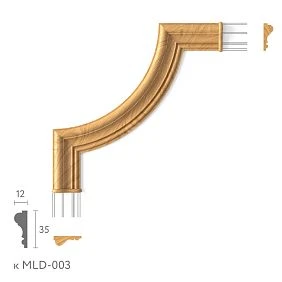
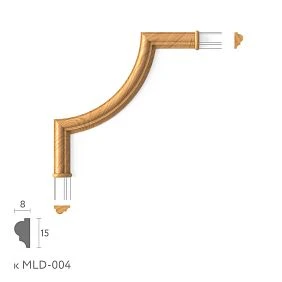
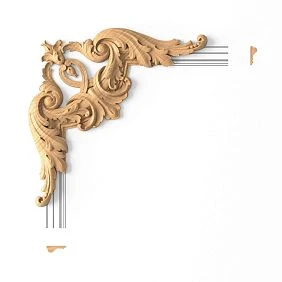
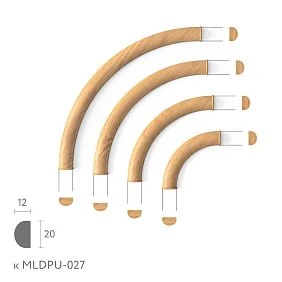
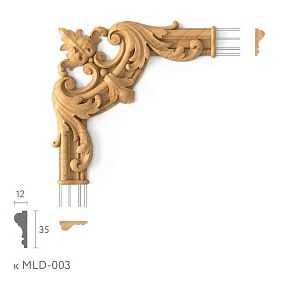
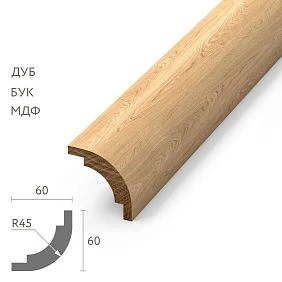
When a ready-made corner element for molding is needed
A ready-made corner is needed not only by beginners who are afraid of cutting molding. Professionals also use it when they need to speed up assembly, get a repeatable result, preserve the profile pattern, and not waste time on complex fitting. The more decorative the molding, the more noticeable the error in the corner. A simple smooth strip can still forgive an inaccuracy, but a relief profile immediately shows a gap or mismatch.
The corner element is especially useful in projects where there are many frames. For example, you need to design a series of furniture fronts, several door panels, or wall panels in one room. One unsuccessful cut can be redone. Ten unsuccessful corners turn into a loss of time, material, and nerves. Ready-made corners help make the process more predictable.




If you don't want to make a 45° cut
A 45° cut seems like a standard solution, but it requires precision. You need to correctly set the angle, account for the width of the molding, profile, pattern direction, saw thickness, material, possible chipping, and finishing. If the molding is carved, figured, or has a pronounced relief, a regular cut may result in a messy joint.
A ready-made corner element removes the main risk: the corner already exists as a separate decorative detail. Straight sections are brought to it, rather than being joined together in a complex joint. Therefore, the frame looks more assembled. The buyer gets not just a way to "close the corner," but a ready-made decorative point around which the entire frame is built.
This is especially convenient for DIY work. If a person wants to design a facade or wall with their own hands, they may not have a miter saw, templates, or experience. A ready-made corner allows them to focus on marking, symmetry, choosing molding, fastening, and finishing, rather than on complex cutting.
Our factory also produces:
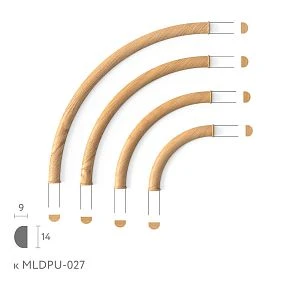
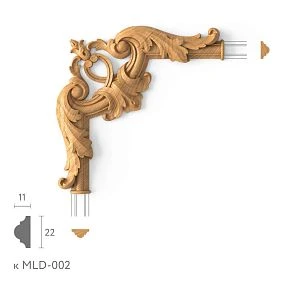
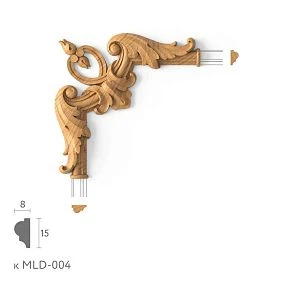
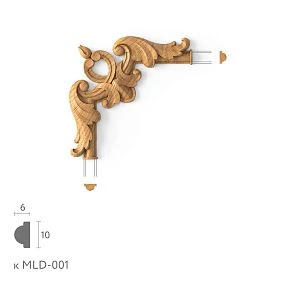
If you need a symmetrical decorative frame
The frame relies on symmetry. Even a slight misalignment becomes noticeable: one side seems longer, the corner goes down, the decorative profile faces the other way, the center of the facade shifts. Ready-made corners help give the frame clear geometry. Especially if paired left and right elements are used.
For a rectangular frame, not only the number of corners is important, but also the direction of the profile. Left and right corner elements are needed not for the beauty of the name, but for the correct rotation of the pattern. If you mix up the direction, the frame can visually "break": the profile will not continue the line, the corners will start to look different, and symmetry will disappear.
In a furniture workshop, this is critical. The client may not understand what exactly the error is, but sees that the facade looks untidy. Properly selected corners allow you to get a frame where all four corners work as a single system.
Get Consultation
If the frame is assembled on a facade, door, or wall panel
Ready-made corner elements are suitable not only for furniture. They can be used on facades of chests of drawers, cabinets, wardrobes, kitchen sections, interior doors, wall panels, decorative inserts, niches, and interior compositions. But in each scenario, the selection logic changes.
Scale is important on the facade. A corner that is too large on a small door will look heavy. On a door, you can use a more expressive frame because the panel is larger. On a wall panel, the corner element must match not only the molding but also adjacent frames, baseboard, trim, wall, lighting, and the overall room height.
Therefore, a ready-made corner cannot be chosen just by photo. You need to understand where it will be installed, which molding will be the straight section, what size the frame will be, and what finish will be used in the end.
Which STAVROS corner elements to choose
The given scheme includes four key product solutions: MLD-4U-2.1L, MLD-4U-2.1R, MLD-001U, and N-500. They are not the same. Some work as paired left/right elements, others as a standalone corner molding, and others as a corner element for a specific molding. The choice depends on the series, frame size, decorativeness, and scenario.
MLD-4U-2.1L — left element
MLD-4U-2.1L is a left decorative corner element for a molding frame. Its size is 145×90×16 mm. The card offers options in beech and oak, with sanding quality "Standard" or "Prestige", as well as with gluing for enamel or for tinting, depending on the material and execution variant.
The left element is needed where the profile must turn in the desired direction. It cannot be mechanically replaced by the right one if the frame must be symmetrical. For one full rectangular frame, you usually need to consider the pairing of corners: which elements will work on the left, which on the right, how the profile will run, and where the straight sections of the molding will begin.
If the task is to assemble a frame with a pronounced decorative corner and avoid 45° cutting, you can look at buy left corner element MLD-4U-2.1L. Before ordering, you need to check dimensions, material, sanding quality, finish, and compatibility with the selected molding.
MLD-4U-2.1R — right element
MLD-4U-2.1R is a paired right corner element of the same logic. Its size is also 145×90×16 mm. It is needed for a symmetrical frame together with the left element. If you buy only the left corner or only the right corner, the frame may not assemble into the correct decorative scheme.
The right element helps continue the profile in another direction. This is especially important on furniture facades and doors, where the eye easily reads inconsistency. If the pattern goes correctly on one corner but is incorrectly oriented on another, the entire frame appears random.
For a complete set, you need to add to the order in advance buy right corner element MLD-4U-2.1R and check it together with the left one. This paired approach is more important than it seems: it reduces the risk of error even before installation.
MLD-001U — ready-made corner molding
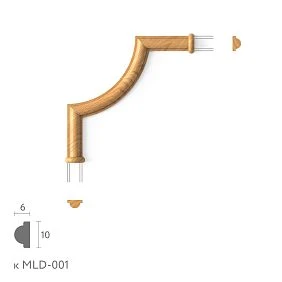
MLD-001U is a more compact corner element measuring 86×86×7 mm. It is suitable for calmer frames where a large decorative corner is not needed. The card specifies beech and oak, sanding "Standard" and "Prestige", regluing for enamel or for tinting.
This option is suitable for small facades, neat frames, and light decorative solutions where the corner should be noticeable but not the main accent. If MLD-4U-2.1L/R provide a more pronounced paired decorativeness, MLD-001U works more softly and simply.
For a frame where a small ready-made corner with a straight compatible molding is needed, you can consider buying the corner molding MLD-001U. In the related products for it, the wooden molding MLD-001 is listed, so when choosing, it is important to check the specific series and compatibility.
N-500 — corner element for MLD-003
N-500 is a large corner element for the MLD-003 molding. Its size is 208×208×18 mm. It is noticeably larger than MLD-001U and MLD-4U-2.1L/R, so it is suitable for more expressive decorative frames, wall panels, large facades, doors, or compositions where the corner should become a significant visual element.
Such an element cannot be placed in a small frame just because it is beautiful. The size must be correlated with the total area of the facade or panel. On a large wall composition, N-500 may look appropriate and prestigious. On a small cabinet door, it may overload the surface.
If the task involves classic decor and the MLD-003 molding, you should look at the corner element N-500 for the MLD-003 molding. Before purchasing, you need to check the profile, size, material, future finish, and number of corners.
Corner elements characteristics table
| Element | Size | Material | Finishing logic | When to choose |
|---|---|---|---|---|
| MLD-4U-2.1L | 145×90×16 mm | Beech, oak | For enamel or tinting depending on the option | When a left decorative corner for a steam room frame is needed |
| MLD-4U-2.1R | 145×90×16 mm | Beech, oak | For enamel or tinting depending on the option | When a right decorative corner is needed to complete the left one |
| MLD-001U | 86×86×7 mm | Beech, oak | For enamel or tinting depending on the option | For a lighter frame with a compact corner element |
| N-500 | 208×208×18 mm | Beech, oak | For enamel or tinting depending on the option | For a large decorative frame with MLD-003 molding |
| Straight molding | Size depends on the selected series | Beech, oak, MDF or other confirmed option per product card | Selected for the project | For straight sides of the frame between corner elements |
The table shows the main thing: corner elements differ not only by article number. They differ in scale, purpose, and compatibility. For a small facade, a compact corner may be better than a large one. For a wall panel, a large N-500 can open up more than a small part. For a paired frame MLD-4U-2.1L/R, it is important not to forget the left and right elements.
How to choose molding for a corner element
A corner element does not work alone. It is needed for a frame, and a frame consists of corners and straight sections. Therefore, after choosing a corner, you need to select compatible molding. You cannot buy a beautiful corner and then look for any straight profile that is 'roughly similar'. In a decorative frame, a profile mismatch is immediately noticeable.
Check compatibility by series
The most reliable way is to look at the series and recommendations in the product card. If an element is listed as a corner for a specific molding, you need to choose exactly that molding or a compatible profile from the same logic. For MLD-001U, the related products indicate wooden molding MLD-001. For N-500, the link with MLD-003 is directly indicated.
If it concerns MLD-4U-2.1L/R, you need to check compatibility via the product card, drawings, and related products. The pairing of left and right elements is important, but that is not enough: the straight section of the frame must also match the profile.
Compare height, width, and profile
Even if the molding looks similar, you need to check the dimensions. The profile height, face width, and element thickness must match. If the straight molding is lower than the corner, the joint will have a step. If higher, the corner will sink. If the profile has a different shape, the transition will look random.
Before ordering, it's useful to open product cards and compare drawings. STAVROS cards often include dimensions A×B×C and product drawings. For a decorative frame, this is not a formality but a working tool. If the frame is assembled on a facade or wall, it's better to create a simple diagram with dimensions in advance.
Choose material and finish
The corner element and straight molding must be matched in material. If the corner is beech under enamel and the straight molding is oak under stain, they may look different after finishing. Sometimes contrast is used intentionally, but more often the frame needs uniformity.
Beech is more often chosen for opaque enamel. Oak is chosen for staining and finishes that preserve wood texture. If all elements will be painted the same color, it's important to select parts prepared for this scenario. If a transparent or semi-transparent finish is planned, the material and lamella selection become especially noticeable.
Calculate the number of corners and straight sections
For one rectangular frame, you need four corners and four straight sections. But if paired left and right elements are used, you don't just buy four identical parts. You need to understand which corners will be left, which right, how the profile will run, and how the frame will be oriented on the plane.
For multiple facades, the calculation multiplies. For example, if you need to decorate two doors, each may require four corners. For a pair of facades, that's eight corners and the corresponding amount of straight molding. If the frame is double, the quantity increases. An error in calculation will cause installation to stop due to one missing part.
Where to use a molding frame
A molding frame works where the plane needs to be made more expressive but not overloaded with complex decor. It sets a boundary, emphasizes the center, helps connect the facade with the handle, makes the door deeper, and the wall panel more architectural. Ready-made corners simplify this path.
On a furniture facade
On a facade, the frame can decorate the door of a chest of drawers, cabinet, wardrobe, kitchen, sideboard, console, or built-in furniture. It helps turn a smooth plane into a more complex decorative detail. This is especially useful when furniture is made in a classic, neoclassical, soft modern interior, or custom project style.
On a facade, it's important not to overdo the size. The frame should leave margins, not interfere with the handle, and not conflict with proportions. If there is an overlay in the center of the facade, the frame should support it, not conflict. If the handle is large, the decor around it should be calmer.
For facades, it's convenient to connect the frame with decorative inlays for furniture и furniture handles for facades. This way, the buyer assembles not a separate corner, but a complete facade: frame, central decor, handle, and trim.
On an interior door
A door leaf provides more space, so the molding frame can be larger. On a door, the frame makes the plane architectural: adds depth, sets a vertical line, helps connect the door with architraves, baseboards, wall decor, and furniture.
For a door, symmetry is especially important. If the corners differ, if the frame is shifted, if the straight sections don't match, the error is immediately visible. Therefore, ready-made corner elements are useful: they reduce the risk of inaccurate cutting and help achieve a repeatable shape.
When choosing an angle for a door, you need to consider the height of the panel, the width of the frame, the number of frames on the door, the type of finish, and the location of the handle. One large frame and two elongated frames give a different impression. The angle should match the chosen pattern.
On the wall panel
A wall panel is one of the strongest scenarios for a molding frame. Here, corner elements help create decorative fields, panel compositions, symmetrical rectangles, fragments behind the bed, sofa, console, TV area, or in the hallway.
On the wall, it's important to consider not only the frame but also the room. Ceiling height, location of switches, furniture, doors, baseboards, and cornices affect the size of the frames. A large N-500 angle may be appropriate in a large composition, while MLD-001U is better suited for light frames or small fields.
If you need to select straight sections and linear moldings, you should open wooden moldings and linear elements STAVROS and compare the profile with the selected angles.
In a decorative composition with overlays
A molding frame doesn't always have to be the only decoration. An overlay, rosette, or other decorative element can be placed in the center. But here it's important not to overload the surface. If the corners are already expressive, the central decor should be calmer. If the frame is thin, the overlay can become the main accent.
For furniture, the combination is especially useful: a frame along the edge of the facade, an overlay in the center or upper part, and a handle as a functional and decorative element. Such a facade looks well-thought-out if all elements match in style, scale, material, and finish.
Commercial selection block
| Buyer's task | What to offer | Why this works |
|---|---|---|
| Assemble a rectangular frame | 2 left + 2 right corner elements | The frame gains symmetry and correct profile direction |
| Finish a furniture front | MLD-4U-2.1L/R + compatible molding | The corner becomes a finished decorative point, and the molding becomes the straight side |
| Make a frame without miter cuts | Ready-made corners instead of 45° cuts | Reduces risk of gaps, chips, and profile mismatch |
| Choose classic decor | N-500 + molding MLD-003 | Large corner suitable for an expressive frame |
| Make a simpler frame | MLD-001U + straight molding sections | A compact corner does not overload the facade or a small panel |
| Assemble the facade for finishing | Corners + molding + overlays + handles | The customer receives a ready-made decorative system |
| Design a wall panel | Corner elements + linear profiles | You can build a symmetrical wall composition |
This choice helps not to perceive the corner as a single detail. The corner element is needed for the set. It works together with the straight molding, the plane, the finish, and the adjacent decor.
What to buy together with corner elements
Buying corners without straight molding does not solve the frame problem. Buying straight molding without corners brings back the miter cut issue. Therefore, it is better to immediately assemble a kit: corners, straight sections, glue or fasteners according to the project, finishing materials, and if necessary, overlays and handles.
Table "What to buy together"
| Main product | What to buy together | What it's for |
|---|---|---|
| MLD-4U-2.1L | MLD-4U-2.1R and compatible molding | To assemble a symmetrical frame with left and right corners |
| MLD-4U-2.1R | MLD-4U-2.1L and straight frame sections | So that the profile runs in the correct direction |
| MLD-001U | Straight molding of the same series | For a lightweight frame without complex miter cuts |
| N-500 | Molding MLD-003 | For a large decorative frame |
| Frame on the facade | decorative inlays for furniture | To add a central or accent decor |
| Frame for a facade or door | furniture handles for facades | To connect the decor with a functional opening detail |
| Wall composition | wooden moldings and linear elements STAVROS | To match straight sections and adjacent molding |
It is important to decide in advance what will be the main element in the composition. If the frame itself is expressive, the handle and overlay should be more subdued. If the frame is thin, you can add a more noticeable overlay. If the door or panel is large, you can use a large corner. If the facade is small, it is better not to weigh it down.
How not to confuse corner elements with similar products
| Element | What it is for | Do not confuse with |
|---|---|---|
| Left corner element | One corner of the frame with profile direction | Right element |
| Right corner element | Paired element for symmetry | Left element |
| Straight molding | Straight sides of the frame | Corner element |
| Decorative overlay | Central or accent decor | Molding frame |
| Rosette | Point decorative element | Frame corner |
| Corner molding | Ready frame corner | Ceiling plinth |
| Molding | Long-length profile | Ready corner |
The most common mistake is buying a beautiful overlay instead of a corner. An overlay can decorate the center of a facade, but it won't assemble the frame. The second mistake is buying a straight molding and thinking the corner will form itself. It will only work with precise cutting and fitting. The third mistake is confusing the left and right elements. For a paired frame, this is critical.
Practical selection for different situations
You need to make a frame on the dresser facade
Start with the facade size. Measure the width and height, leave margins from the edge, determine the handle position. Then choose the corners. If the facade is small, MLD-001U may be neater. If the facade is large and decorative, you can consider MLD-4U-2.1L/R.
Do not place a large corner too close to the edge or handle. The frame should frame the facade, not interfere with using the furniture.
You need to design an interior door
For a door, it's better to first draw a diagram. Determine the number of frames, their height, distance from the edge of the door leaf, handle and lock positions. Then choose the corners and straight moldings. The door is large, so symmetry errors are more noticeable than on a small facade.
If the door is designed in a classic style, you can use more expressive elements. If the interior is modern, it's better to choose a calm profile and not overload the corners.
You need to assemble a wall panel
On the wall, it's important to consider the scale of the room. The same corner can look large on a small panel and calm on a large wall. It's better to do the layout not only on paper but also on the wall: mark the future frame with painter's tape, look at the distances, check switches, baseboards, furniture, and lighting.
Large elements like N-500 are best revealed on large surfaces. Compact corners are suitable for repeating small frames.
Need to avoid a 45° miter cut
Choose a ready-made corner piece and a compatible straight molding. A miter cut may still be needed for straight sections along the length, but the most complex decorative corner will already be solved by the ready-made part. This is especially useful if the molding is embossed and its profile is difficult to join.
Need to make a facade with a frame and an overlay
First select the frame, then the central decor. If you choose the overlay first, it may turn out that the frame does not fit or clashes with it in style. The overlay should live inside the frame, not accidentally intersect with it.
Need to select a handle for the frame
The handle should take into account the shape of the frame. If the frame is active, it is better not to install a too complex handle. If the frame is calm, the handle can be the main accent. For facades, it is better to look furniture handles for facades after the frame size and style are clear.
What not to make from scratch if there are ready-made STAVROS elements
If the task is to assemble a decorative frame, it is not necessary to cut complex corners manually. There is no need to adjust the embossed profile to 45° in every corner if you can use a ready-made corner piece. There is no need to try to close the gap with a random overlay. There is no need to assemble a frame from different profiles that do not match in height.
Ready-made corner pieces allow you to reduce the most risky operations. The buyer selects the corner, chooses the straight molding, calculates the quantity, marks the plane, and performs installation. Time is spent not on struggling with a bad joint, but on careful marking, material selection, and finishing.
This does not eliminate the need for accuracy. A ready-made corner will not save the frame if the dimensions are calculated incorrectly, symmetry is broken, or an incompatible molding is chosen. But it removes one of the most complex operations — the decorative joining of the profile at the corner.
Installation, preparation, and finishing
Before installation, assemble the kit on a table. Lay out the corners and straight sections, check the profile direction, and ensure the left and right elements are not mixed up. Then transfer the dimensions to the facade, door, or wall.
Marking should be done calmly and accurately. First, determine the outer rectangle, then the inner one, then check the diagonals. If the diagonals are equal, the frame will be rectangular. If not, even beautiful corners won't help.
For installing decorative elements, glue, fastening, or a combined method is usually used, depending on the base, size, and project. Before finishing, check the joints, remove dust, and prepare the surface. If the parts are for enamel, keep in mind that an opaque coating will hide the texture but not poor fit. If for tinting, the material and matching of the wood grain are especially important.
On facades and doors, it's better to plan handles in advance. If you glue the frame first and then realize the handle falls on the profile, you'll have to redo it. On a wall panel, consider switches, sockets, baseboards, trims, and furniture.
Mistakes when buying and assembling a frame
Mistake 1. Buying corners without straight molding
A corner alone does not create a frame. Straight sections of compatible molding are needed. If you buy only corners, installation will stop.
Mistake 2. Not checking the left and right elements
For paired corners, the profile direction is important. If you mix up the left and right elements, the frame may not assemble symmetrically.
Mistake 3. Choosing only by photo
It's hard to gauge the scale from a photo. The sizes 86×86 mm and 208×208 mm represent different decorative scenarios. You need to check the dimensions before ordering.
Mistake 4. Not considering the profile thickness
If a straight molding and a corner differ in height, the joint will have a step. This is especially noticeable after painting and under side lighting.
Mistake 5. Buying a large corner for a small facade
A large corner can overwhelm a small door. The facade's fields, handle, proportions, and central decor placement are important.
Mistake 6. Not planning the finish
Beech under enamel and oak under tinting yield different results. If the frame must be seamless, it's better to choose the material and finish in advance.
Mistake 7. Assembling a frame without marking
Even ready-made corners require precise geometry. If you don't check the diagonals, the frame will be crooked.
Mistake 8. Confusing a frame with an overlay
The overlay decorates the center or a specific area. The frame borders the plane. These are different elements and do not replace each other.
Error 9. Not considering the handle
On a furniture front, the handle should be positioned so as not to interfere with the frame. If the handle falls on the molding, using the furniture will be inconvenient.
Error 10. Not checking the product cards before ordering
Dimensions, material, availability, lead time, and finish must be checked in the product card. Especially if the project includes multiple fronts or panels.
Who are ready-made corner elements suitable for
Ready-made corner elements are suitable for furniture workshops, designers, manufacturers of fronts, doors and wall panels, as well as private buyers who want to assemble a neat decorative frame without complex miter cuts. They are especially useful where the frame needs to be repeatable, symmetrical, and well-prepared for finishing.
Such elements are suitable for fronts of dressers, cabinets, wardrobes, kitchen sections, interior doors, wall panels, decorative niches, and classic interior compositions. They help make the design neater if the molding, material, and scale are chosen correctly.
They are not suitable for those looking for a regular ceiling plinth, flexible molding, ready-made furniture, polyurethane stucco, or a random decorative element not tied to a frame. Also, ready-made corners will not solve the problem if the buyer is not ready to calculate dimensions, select compatible linear molding, and do the layout.
| Suitable | Not suitable |
|---|---|
| For furniture workshops | If you need a regular ceiling plinth |
| For interior designers | If you need a flexible molding |
| For facade manufacturers | If you need ready-made furniture without decor |
| For door manufacturers | If no frame is planned |
| For private customers with a clear installation scheme | If there are no dimensions or markings |
| For those who want to avoid a 45° cut | If you just need a central decor without a frame |
How to buy corner elements for STAVROS
First, determine what frame you are assembling: a furniture facade, door, wall panel, or decorative composition. Then select the corner type. For a paired decorative frame, see buy left corner element MLD-4U-2.1L и buy right corner element MLD-4U-2.1R. For a more compact frame, you can see buying the corner molding MLD-001U. For a large classic solution — the corner element N-500 for the MLD-003 molding.
After selecting the corner, proceed to the straight sections. To do this, open wooden moldings and linear elements STAVROS and check the profile, series, dimensions, and material. If the frame will be on the facade, add to the selection decorative inlays for furniture и furniture handles for facades.
Before ordering, check:
| What to Check | Why |
|---|---|
| Corner element series | So that it matches the straight molding |
| Left and right corner | To make the frame symmetrical |
| Size | So that the corner does not overload the facade or panel |
| Material | So that the finish lays evenly |
| Re-gluing for enamel or tinting | To choose the right finish |
| Number of corners | To avoid stopping installation due to a missing part |
| Length of straight sections | So that there is enough molding for all sides |
| Handles and overlays | So that the facade is assembled as a single composition |
| Base | To choose the right method of fastening and preparation |
FAQ
Is it possible to assemble a frame without a 45° cut?
Yes. For this, ready-made corner elements and straight sections of compatible molding are used. The corner is assembled as a separate piece, and the straight sides are brought up to it.
Why buy left and right corner elements?
Left and right elements are needed for the correct direction of the profile and symmetry of the frame. If they are mixed up, the decorative pattern may not align.
How many corners are needed for one rectangular frame?
Usually four corners are needed. If paired elements are used, determine in advance how many left and right pieces are needed. For one frame, a set of two left and two right elements is often required, but it is better to check the scheme against the profile.
Where to use corner elements for molding?
They can be used on furniture facades, interior doors, wall panels, decorative niches, and frames on flat surfaces.
How to know which molding fits the corner?
You need to check the series, profile, dimensions, related products, and drawings in the product card. The corner and straight molding must match in shape and height.
What to buy together with corner elements?
You need straight sections of compatible molding, installation and finishing materials. For the facade, decorative overlays and furniture handles may be needed.
How is MLD-001U different from N-500?
MLD-001U is more compact: 86×86×7 mm. N-500 is larger: 208×208×18 mm and is designed for MLD-003 molding. They are chosen for different frame scales.
Can a large corner be used on a small facade?
It is possible only if it is intended by the design, but more often a large corner overloads a small surface. For small facades, it is better to look at more compact solutions.
Do you still need to cut the molding?
Straight sections of molding are usually trimmed to length, but the most complex decorative miter cut in the corner is replaced by a ready-made corner element.
How to choose material: beech or oak?
Beech is more often chosen for enamel and opaque painting. Oak is better revealed under tinting and transparent finishing. The choice depends on the future finish.
Can a frame be made on the wall?
Yes. On wall panels, corner elements help create neat decorative fields. It's important to mark the wall in advance, taking into account switches, furniture, baseboards, and ceiling height.
Are corner elements suitable for a door?
Yes, if the size and style match the door leaf. On a door, symmetry and proper marking are especially important.
How is a corner element different from a decorative overlay?
A corner element forms the corner of a frame. An overlay works as a central or separate decorative accent. They can be used together, but they do not replace each other.
What happens if you only buy straight molding?
The frame can be assembled using a 45° miter cut, but this requires precision. If you lack experience or tools, ready-made corners reduce the risk of errors.
How to avoid frame distortion?
You need to make precise markings, check the diagonals, verify the direction of the corners, and only then attach the elements. A ready-made corner helps with the joint but does not replace marking.
Conclusion: ready-made corner elements help assemble the frame more neatly and quickly
Ready-made corner elements for molding are needed by those who want to assemble a decorative frame on a facade, door, or wall panel without complex 45° miter cuts. They help avoid gaps, profile mismatches, warping, and rough fitting. But a good result only appears when the corner is chosen together with a compatible molding, material, finish, and overall frame scheme.
For paired solutions, MLD-4U-2.1L and MLD-4U-2.1R are suitable. For a more compact frame, consider MLD-001U. For a large decorative composition with MLD-003 molding — N-500. If the frame is assembled on a facade, it's worth thinking about overlays and furniture handles right away. If on a wall — about trim, room dimensions, and symmetry.
STAVROS allows you to assemble not a random set of parts, but a clear kit: corner elements, straight moldings, decorative overlays, and handles for one interior scenario. This approach helps move from the idea of "making a frame" to an actual purchase and neat installation without extra fitting.