Article Contents:
- K-006 or K-049: short answer
- What is a carved baguette and why it is not equal to a regular strip
- The baguette is not a ready-made frame
- Ornament works stronger than size
- K-006 backing helps with installation
- Flat profile K-049 does not mean invisible
- Fractional rhythm draws attention to each repetition
- A wave connects, not divides
- The depth of relief affects side lighting
- Contrast enhances any profile
- Panel of a furniture facade
- Chest of drawers with a central overlay
- Classic door
- Door portal
- Wall panel
- Staircase and interior decor
- When K-006 looks overly classic
- Furniture frieze
- Kitchen cornice
- Bed headboard
- Modern door
- Geometric cabinet
- When K-049 looks too calm
- Width affects the free field
- Thickness affects adjacent parts
- Corners enhance the sense of depth
- Sample is more accurate than the image
- K-049 on a painted kitchen
- K-049 on an oak kitchen
- When to choose K-006 for a cornice
- Practical check
- K-006 for a classic canvas
- K-049 for a smooth door
- Vertical installation
- Frame corners
- Opening near the wall
- K-006 on a chest of drawers
- K-049 on a long cabinet
- Wardrobe with panels
- Small-sized cabinet
- Combination with furniture fittings
- Horizontal belt
- Frame around the central panel
- Oak or enamel
- One large frame
- Series of identical panels
- Belt above the dresser or console
- Combination with portal
- K-006 on furniture, K-049 on wall
- K-049 in the kitchen, K-006 on the sideboard
- One material, different finishes
- When mixing doesn't work
- Beech under white enamel
- Beech for colored enamel
- Oak for light tinting
- Oak for dark tinting
- Why oak isn't always needed under enamel
- Same batch
- K-006 and recesses between beads
- K-049 and smooth surface
- Installation height
- Trial finish
- Formula for straight frieze
- Formula for rectangular frame
- Multiple frames of different sizes
- Why the number of sticks matters more than total length
- Example for K-006
- Example for K-049
- Reserve for pattern repeat
- K-006: do not accidentally cut the bead
- K-049: preserve the wave phase
- Marking the front side
- Trial assembly
- Symmetry on paired doors
- 45-degree bevel cut
- Straight joint
- Corners on wall panel
- Corners on furniture facade
- Joint finishing
- Scale check
- Light check
- Test swatch
- Test corner and joint
- Comparison of two models
- Base made of wood or MDF
- Painted facade
- Wall and plaster
- Long element 2000 mm
- Glue doesn't fix geometry
- Painting together with the facade
- Separate finishing
- Trimming before finish
- Part marking
- Carved baguette and smooth molding
- Baguette and structural frame
- K-006 and separate wooden beads
- K-049 and smooth wavy rail
- Sample and main element
- Unpainted molding and finished color
- Need to decorate a classic dresser
- Need a calm decor for a modern kitchen
- Need to update an existing door
- Need to assemble a wall frame
- Need to decorate a headboard
- Need to select a molding for an existing carved overlay
- Need to create identical decor on multiple doors
- Need to select a profile for a commercial interior
- Need to design only a short section
- Need to replace the old smooth baguette
- Select only by width
- Do not check the current selector K-006
- Buy exactly by perimeter
- Do not account for fixed lengths
- Cut the ornament at a random place
- Start installation without a test corner
- Use K-006 on a minimalist facade without a layout
- Consider K-049 completely flat
- Mix different batches of oak
- Paint without a test swatch
- Glue on weak coating
- Consider one glue universal
- Use baguette as a load-bearing profile
- Do not account for handles and gaps
- How is K-006 different from K-049?
- Which baguette is best for classic furniture?
- What to choose for a modern kitchen?
- What lengths are available for K-006?
- What lengths are available for K-049?
- Can K-006 be used on a door?
- Is K-049 suitable for a wall panel?
- Which profile is deeper?
- Which profile is wider?
- Can K-006 and K-049 be combined?
- What to choose for white enamel?
- How to preserve the natural texture?
- Which is better — "Standard" or "Prestige"?
- How to calculate the baguette for a frame?
- What margin is needed?
- How to join K-006?
- How to join K-049?
- Can I assemble a frame with 45-degree angles?
- Do I need to order a sample?
- Can I glue the baguette onto a painted facade?
- Is TYTAN Prof. Classic Fix suitable for installation?
- Can I use K-006 or K-049 for a painting?
- Can I use baguette on a curved surface?
- Which profile is better for a furniture frieze?
- What to choose for a chest of drawers with a carved overlay?
- Where to buy K-006 and K-049?
- What to check right before payment?
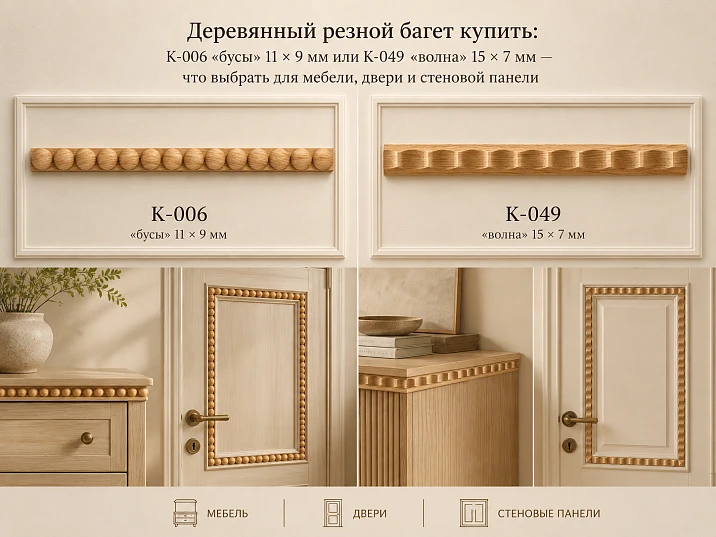
Comparison of two narrow ornamental profiles made of beech or oak for furniture facades, doors, friezes, and interior frames
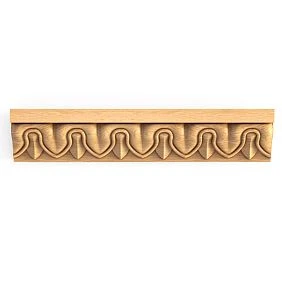
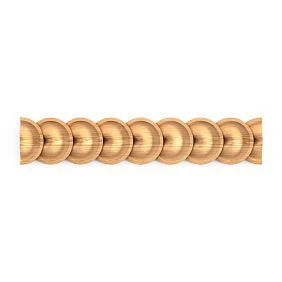
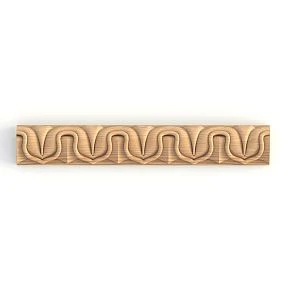
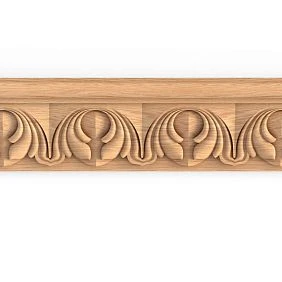
K-006 or K-049: short answer
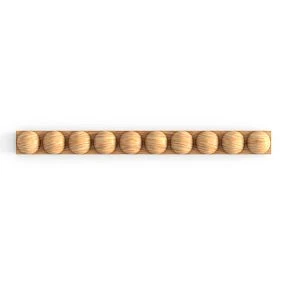
K-006 is worth buying when you need a regular classic rhythm in the form of "beads on a backing", a deeper profile of 11 × 9 mm, and a choice of lengths 300, 1000, or 2000 mm. Such a baguette works well around furniture panels, on cabinet facades, chests of drawers, doors, and in compositions with carved overlays. K-049 is better to choose for a smooth continuous line, kitchen cornice, furniture frieze, headboard, or modern wall panel. The profile 15 × 7 mm is wider but visually lighter due to its smaller thickness and wavy ornament.
Buy wooden baguette K-006 with "beads" ornament Buy wavy wooden baguette K-049 Buy wooden picture frame molding Order samples of wooden baguettes
K-006 — "beads on a backing". In the current selector, the main profile 11 × 9 mm is available in lengths of 300, 1000, and 2000 mm.
K-049 — continuous wave. The confirmed profile 15 × 7 mm is available in lengths of 300 and 2000 mm.
The four-millimeter difference in width is not the main thing. K-006 creates a fractional classic rhythm, K-049 — a smooth line without separate "beads".
Beech — for enamel. It is suitable for opaque painting in the color of the facade, door, or wall.
Oak — for tinting. It preserves the natural texture and turns the baguette into an independent wooden detail.
Do not start with the maximum length. First, check the ornament on a sample, calculate the perimeter, joints, and allowance for trimming.
A buyer who wants to purchase a wooden carved baguette for furniture, doors, or wall panels often compares only the profile width. In the case of K-006 and K-049, this is not enough. One baguette, 11 mm wide, appears more voluminous due to its 9 mm depth and repeating beads. The other is wider — 15 mm, but has a thickness of 7 mm and works as a calm wavy line. On the facade, these four millimeters in width are less noticeable than the difference in the character of the ornament.
K-006 is suitable for a project where classical repetition is needed: a frame around a panel, a belt on a chest, a carved door edge, a decorative line next to an overlay or rosette. K-049 is useful where you don't want to overload furniture with historical carving. The wave supports modern classic, Art Nouveau, Art Deco, and laconic geometric facades, remaining noticeable due to the movement of the line.
Both models are made from beech and oak, available with "Standard" or "Prestige" sanding, for enamel or tinting. Therefore, the choice is not based on the principle of "classical baguette only from oak, modern only from beech." First, determine the ornament, relief height, installation location, and length. Then choose the wood species, finish, and installation method.
For a panel and a repeating classical edge, you can choose carved molding K-006. For a furniture frieze and a smooth line — choose carved molding K-049If both forms do not match the furniture style, it is better to open catalog of carved wooden moldings and choose a different profile rather than trying to modify the finished ornament by trimming.




What is carved baguette and why it is not equal to a regular strip
Carved baguette is a molding with a repeating decorative pattern. It is used as a frame, frieze, belt, edge, or connecting line on furniture, doors, and wall panels. Unlike a smooth strip, it does not just cover the edge. The ornament creates rhythm, brings individual elements into one system, and helps connect handles, overlays, panels, and cornices.
The linear form provides freedom in length. The baguette can be used on a short drawer, a tall door leaf, a long wardrobe, or a large wall frame. However, the repeating pattern requires more precise calculation than a smooth profile. The joint should not break a bead or wave in a random place, and the corners should not look like cut fragments from different series.
Our factory also produces:
The baguette is not a ready-made frame
K-006 and K-049 are sold as decorative moldings. The confirmed data does not include a ready-made quarter for glass, a rigid frame connection, or a kit for a painting. They can be used to assemble a decorative contour, but the profile cannot automatically be considered a structural baguette for a heavy mirror or glass without a separate base.
Get Consultation
Ornament works stronger than size
Classic beads create a sequence of individual rounded elements. The eye reads each repetition, so the line appears fragmented and rich. The wave is perceived continuously: it connects the area without rigid pauses and makes an extended frieze lighter. This is why K-006 and K-049 give different results even with similar width.
K-006 backing aids installation
The "beads on a backing" ornament sits on a small flat base. It facilitates contact with the facade or wall panel and helps connect segments. However, the backing does not eliminate precise trimming: if the joint passes through the middle of a bead, the repeat will be noticeably disrupted.
Flat profile K-049 does not mean inconspicuous
The 7 mm thickness is less than the 9 mm of K-006, but the 15 mm width and wave motion maintain readability. Side lighting emphasizes the pattern, and contrasting tinting makes the profile more noticeable. On a small facade, K-049 may appear more active than the customer expects, especially if there are no other smooth lines nearby.
Confirmed characteristics of K-006 and K-049
| Parameter | K-006 | K-049 | Practical Meaning |
|---|---|---|---|
| Ornament | "Beads on a backing" | Continuous wave | The first model creates a classic fractional rhythm, the second creates a smooth line. |
| Main confirmed profile | 11 × 9 mm | 15 × 7 mm | K-006 is narrower but deeper; K-049 is wider but shallower. |
| Lengths in the current selector | 300, 1000 and 2000 mm | 300 and 2000 mm | K-006 is more convenient for the intermediate length of 1000 mm; K-049 is designed for samples and long linear footage. |
| Material | Beech or oak | Beech or oak | The ornament can be selected independently of the wood species. |
| Sanding | "Standard" or "Prestige" | "Standard" or "Prestige" | The preparation level is chosen based on tinting, enamel, and viewing distance. |
| Finishing | For enamel or tinting | For enamel or tinting | Beech is suitable for opaque painting, oak for finishes with visible texture. |
| Main Scenario | Panels, frames, classic facades, door portals | Friezes, cornices, long belts, modern facades | The choice determines the direction of the entire decorative line. |
| What to clarify before ordering | Current profile and length in the selector | Length availability and material | The product card remains the source of the current configuration. |
For K-006, the specifications may mention enlarged profiles 15 × 11 and 20 × 14 mm. The article compares the main variant 11 × 9 mm, which is displayed in the current selector with lengths of 300, 1000, and 2000 mm. If an enlarged profile is needed, its availability should be confirmed in the card before ordering, rather than transferring parameters from the old description to the current configuration.
K-006 and K-049 in one comparison
| Task | What to choose | Why |
|---|---|---|
| Classic frame around a furniture panel | K-006 | The bead rhythm supports classic decor and pairs well with rosettes and overlays. |
| Long furniture frieze | K-049 | A continuous wave connects a long plane without breaking it into separate beads. |
| Decor of a chest of drawers with carved overlays | K-006 | A deeper profile forms a pronounced frame around the central ornament. |
| Modern kitchen without heavy classicism | K-049 | A flat wave adds movement but does not turn the facade into a historical composition. |
| Door portal with a classical rhythm | K-006 | Repeating beads emphasize the perimeter and support the carved elements of the portal. |
| Decorative belt on the headboard | K-049 | A smooth line looks softer next to textiles and wide geometric planes. |
| Short fragment or test insert | Both models | Length 300 mm helps evaluate the pattern, color, and scale before purchasing the footage. |
| Intermediate length of about one meter | K-006 | The current selector includes a length of 1000 mm, which reduces the number of joints in medium sections. |
The table helps choose the direction but does not replace the sample. On a white facade, the furniture color K-006 may appear calmer than the dark K-049 from oak. With the same finish, beads almost always read more fragmented, while a wave reads more extended. It is the pattern, light, and contrast that determine the impression more strongly than the nominal width.
Why pattern matters more than a four-millimeter difference
K-006 has a width of 11 mm, K-049 — 15 mm. It seems the second profile should look larger. In practice, K-006 is often perceived as richer due to its depth of 9 mm and individual rounded elements. K-049 is wider, but the thickness of 7 mm and continuous pattern create a calmer contour.
Fragmented rhythm draws attention to each repeat
Beads form a sequence of small volumes. On a short facade, the eye quickly counts their number, while on a long one, it notices the rhythm of the entire strip. Such a pattern is useful when you need to emphasize a classic structure, separate a panel, or connect a baguette with a carved overlay.
The wave connects rather than divides
K-049 does not break the line into identical rounded elements. The wave guides the eye along the frieze, cornice, or door leaf. This helps visually unify several facades and not overload the furniture. However, a wave that is too long without a pause may seem monotonous if there are no other details around.
The depth of the relief affects the side light
The difference between 9 and 7 mm seems small, but on a narrow profile it is noticeable. K-006 gives deeper shadows between the beads and the backing. K-049 forms a soft alternating chiaroscuro. Before ordering, it is useful to apply the sample to the actual facade and look at it in the morning, afternoon, and under artificial lighting.
Contrast enhances any profile
An oak baguette with dark tinting on a light facade becomes more noticeable regardless of size. If K-006 and K-049 are painted in the color of the furniture, the main role is played by the relief. Therefore, it is impossible to choose a model only by millimeters without determining the finish.
K-006: when the rhythm of "beads" works best
K-006 creates a familiar classic motif but does not require complex carving over the entire surface. The narrow line helps to design a panel, drawer, door leaf, or wall frame. The backing makes the profile integral and facilitates installation, and the depth of 9 mm allows the ornament to remain readable even under a solid enamel.
Furniture facade panel
Beads clearly mark the boundary of the inner field. They can be placed inside a smooth frame or used as the only decorative edge. When calculating, it is important to measure the inner perimeter, not the overall size of the door. The carved profile must have the same indentation from all sides and not intersect with the handle.
For such a project you can view baguette 11 × 9 mm for furniture facade and check the length 300, 1000 or 2000 mm.
Chest of drawers with central overlay
K-006 can frame a carved overlay or repeat on several drawers. The beads connect individual ornamentation with the geometry of the facade. If both the overlay and the molding have deep relief, a flat plane is left between them, otherwise the decor will merge into a dense spot.
Classic door
On the door leaf, K-006 suits panels, vertical frames, and the central decorative belt. The pattern repeat should continue through joints and corners. Long sections are more conveniently assembled from 2000 mm elements, reducing the number of connections.
Door portal
The beads support architraves, pilasters, and carved capitals if their scales are coordinated. A narrow profile can run inside a wider frame. K-006 cannot be calculated as a load-bearing architrave: it remains a decorative molding and requires a prepared base.
Wall panel
In a classic panel, K-006 creates an inner frame, separates the central field, or repeats the furniture pattern. On a large wall, an 11 mm profile may look thin, so first check a sample from the usual viewing point. An enlarged profile version should only be ordered after confirming availability in the card.
Staircase and interior decor
The card allows use on stairs and other interior surfaces. However, the molding should not be in an area of constant mechanical impact if the fastening and finish are not designed for it. On the side plane of a stringer or decorative panel, it works better than on a handrail or step.
When K-006 looks excessively classic
On a smooth modern kitchen without frames and overlays, beads can be perceived as a random historical quote. If you only want to slightly soften the geometry, K-049 looks calmer. Another way is to paint K-006 in the color of the facade and use a small length, but the solution still needs to be evaluated on a sample.
K-049: smooth wave for frieze and long line
K-049 creates continuous movement and does not divide the linear molding into separate rounded elements. The 15 × 7 mm profile is suitable for kitchen cornices, furniture friezes, doors, cabinets, chests, tables, and beds. It can work independently or accompany more complex carvings without competing in depth.
Furniture frieze
On the top of a cabinet or chest, the wave forms an extended band. It emphasizes the length of the furniture and connects adjacent sections. For a continuous row, it is better to use 2000 mm elements and plan joints above vertical partitions or in less noticeable places.
For a long strip, you can view the 15 × 7 mm molding for furniture frieze.
Kitchen cornice
The wave-shaped profile adds a decorative line without a massive carved top. It suits painted kitchens and oak facades for tinting. Installation near a range hood, cooking area, or sink requires appropriate coating and care; specific operating conditions should be coordinated with the furniture maker.
Bed headboard
K-049 can run along the top line or form a decorative band. The smooth wave naturally combines with textiles, soft shapes, and a wide headboard. The molding should not be placed where it constantly contacts pillows or the head: the relief should remain a decorative, not a contact area.
Modern door
On a smooth surface, K-049 creates a thin frame or vertical line. The wave does not make the door fully classic, especially if the baguette is painted in the base color. Before installation, check the 7 mm protrusion and the opening trajectory near the wall and casing.
Geometric cabinet
The wave can soften straight facades and repeat on several doors. In this case, the joints and direction of the pattern must match. If the profile rotates 90 degrees at the corner of the frame, you need to decide in advance how the wave will meet and whether a visual gap will appear.
When K-049 looks too calm
In a formal classic interior with carved overlays, capitals, and complex panels, a flat wave can get lost. Then K-006 or another deeper profile from the category will create a more convincingly expressed border.
Profile 11 × 9 or 15 × 7 mm: how to see the difference on the facade
The profile drawing shows width and thickness but does not give a full sense of scale. K-006 occupies a smaller strip on the plane but protrudes more. K-049 takes four millimeters more in width but looks flatter. When designing a frame, both dimensions are considered.
Width affects the free field
If the baguette goes around the panel, its width reduces the inner decorative rectangle. On a small door, 15 mm may be more noticeable than on a wall panel. Before ordering, draw the profile at full scale and check how much plane remains between the baguette and the central overlay.
Thickness affects adjacent details
A 9 mm profile may protrude above a nearby molding or handle. A 7 mm profile integrates more easily into a calm composition. Compare the side sections of the baguette, facade, frame, and overlay, not just the front view.
Corners enhance the sense of depth
In a rectangular frame, four corners gather the relief and make it more noticeable. K-006 may appear significantly more voluminous than a separate straight segment. K-049 at corners requires particularly precise wave trimming, otherwise the smooth pattern will break.
Sample is more accurate than image
For a controversial project, it is better to compare K-006 and K-049 in person. Samples of carved molding from beech or oak, 300 or 500 mm long, allow you to evaluate the relief, texture, and test finish without purchasing the entire length.
Which baguette to choose for a kitchen cornice
The kitchen cornice is located on a long horizontal line and is often viewed from below. Here, pattern continuity, relief depth, and ease of maintenance are especially important. K-049 is usually more suitable because the wave guides the eye along the top line and does not create a dense row of individual beads. The 15 × 7 mm profile is noticeable enough but does not look heavy above modern facades.
K-049 on a painted kitchen
Beech under enamel allows painting the baguette in the color of the cornice and facades. The wave remains visible due to chiaroscuro but does not turn into a contrasting stripe. For a kitchen with straight doors, this is a way to add relief without complex carving. Before finishing, you need to check whether the enamel fills the ornament's recesses.
K-049 on an oak kitchen
Oak under tinting preserves the texture and connects the baguette with the facades or countertop. The wavy line becomes a natural wooden detail. If the kitchen is already saturated with an active wood grain pattern, it is better to check a sample: an additional wave may make the top too busy.
When to choose K-006 for the cornice
Beads suit a classic kitchen with panels, capitals, pilasters, and carved overlays. They support the existing decorative language and form a formal top. On a minimalist kitchen, K-006 may look alien if the classic motif is not repeated elsewhere.
Practical check
First, measure the length of all straight sections, then mark the joints above modules and corners. Long elements of 2000 mm reduce the number of connections. If the cornice consists of several sections, the pattern should continue through each joint, not start randomly anew.
Which baguette is suitable for a door
On a door, the baguette can form a frame, vertical inserts, a central belt, or an inner panel contour. Here, thickness, distance to the casing, handle, and wall, as well as the opening trajectory, are important. Both profiles are suitable for decorative design but create a different character.
K-006 for a classic panel
Beads work well on a paneled door, next to carved overlays and traditional casing. They emphasize the perimeter and add a repeating rhythm. For several identical doors, the baguette should be cut using a single template so that the pattern and offsets match.
K-049 for a smooth door
The wave can turn a simple panel into a more expressive one without creating a heavy frame. The 7 mm profile protrudes less, which is useful near a wall. Painting it the color of the door makes the line calm, while oak under tinting creates a contrasting decorative belt.
Vertical installation
Both profiles can be used vertically if the direction of the ornament looks natural and the pattern matches on paired sides. For K-006, the beads are perceived as a sequence along the height. For K-049, the wave can more strongly direct the gaze upward. Before installation, it is useful to secure a long paper or real sample with masking tape.
Frame corners
On a door frame, the corners are visible up close. K-006 requires careful joining of the beads, K-049 requires continuing the wave without a sharp break. Sometimes it is better to assemble the frame with a 45-degree miter cut, sometimes with straight joints and a separate pattern logic. The method depends on the project and profile.
Opening near a wall
Even a 7–9 mm profile can touch the wall if the door opens almost 180 degrees. Check the protrusion along with the handle, casing, and door stop. The decorative baguette should not take a hit with every opening.
Cabinet, dresser, and nightstand: how to distribute the profile
On cabinet furniture, the baguette can be repeated on several facades, run as a single belt, or highlight only the central section. An error occurs when the profile is chosen for one drawer without considering the entire piece. On a finished chest of drawers, four identical frames create a significantly denser decor than a single sample in hand.
K-006 on a chest of drawers
Beads suit classic drawers, especially if there is an overlay or a pair of handles in the center. You can design each facade identically or highlight only the top one. The second option looks calmer and helps avoid overload. The width of 11 mm must be considered together with the gaps between drawers.
K-049 on a long cabinet
The wave works well as a continuous belt passing through several doors. It visually connects the body and emphasizes the length. However, the profile should not cross technological gaps so that parts of the pattern shift when opening. It is better to design each facade separately with a coordinated continuation of the ornament.
Wardrobe with panels
K-006 supports a frame structure and classic handles. K-049 softens strict rectangles and suits a transitional style. If the wardrobe is tall, vertical inserts may be more important than a horizontal frieze. Make a full sketch rather than choosing a profile based on a single fragment.
Small-sized cabinet
On a small facade, both profiles can occupy a significant part of the field. K-006 looks deeper, K-049 wider. Sometimes the best choice is to use only one short horizontal line rather than assembling a full frame. This reduces the footage and preserves space around the handle.
Combination with furniture fittings
The handle, baguette, and carved overlay should have a hierarchy. If the handle is large and contrasting, it is better to make the profile in the color of the facade. If the baguette is to become the main decorative element, the fittings are chosen to be calmer. An article about how to design a furniture frieze, helps to distribute the belt relative to the doors and drawers.
Baguette on the headboard of the bed
The headboard has a large horizontal plane, so the profile easily becomes noticeable. K-049 naturally supports soft lines and a wide shape. K-006 adds a classic rhythm and is suitable for a carved or paneled back. The choice depends on whether the decor should connect the furniture with the textile or emphasize the architectural frame.
Horizontal belt
The profile runs along the upper or middle part of the headboard. K-049 makes the belt continuous and calm. K-006 creates a sequence of beads and looks more elegant. A length of 2000 mm helps to design a wide bed with a minimum number of joints.
Frame around the central panel
For the frame, K-006 is suitable for a classic center, K-049 for a more modern one. It is necessary to check the corners and indents from the soft insert. The baguette should not be located where pillows constantly rub against the relief.
Oak or enamel
An oak profile can connect the headboard with wooden nightstands and the floor. Beech under enamel helps make the relief part of a painted backrest. In the bedroom, a test paintout is especially important: the shade under warm evening lighting may differ from daylight.
Wall panel and decorative frame
On the wall, the profile is viewed from a greater distance than on furniture. Narrow 11–15 mm profiles can look delicate, so the scale needs to be checked on the actual surface. K-006 suits a classic frame and repeating panels. K-049 is for a long belt, modern wall decor, and a smooth line above furniture.
One large frame
On a wide panel, K-006 creates a rich inner border. K-049 looks lighter and does not compete with a painting, mirror, or central overlay. The perimeter is calculated based on the clean frame dimensions, adding allowance for corners and pattern matching.
Series of identical panels
Repeating rectangles require equal gaps and consistent ornament positioning. For K-006, it is important that the number of beads on symmetrical sides matches or looks logical. For K-049, the wave should start and end identically.
Belt above a dresser or console
K-049 can run horizontally and connect the wall with furniture. K-006 works better as a frame around a central decorative field. The profile axis should align with the axis of the dresser, mirror, or painting.
Combination with a portal
If the wall panel adjoins a door, the same molding can unify both zones. But the profile does not have to be repeated everywhere. Sometimes K-006 is appropriate on the portal, and K-049 on the wall panel, if they are united by wood species and finish.
Additional examples are revealed in the material about wooden decor for the portal and wall panel.
Can K-006 and K-049 be combined in one room
Yes, but the models should perform different roles. K-006 is better used as a local classic edge, K-049 as an extended frieze. If both profiles are placed next to each other on one small door, the patterns start to compete. On different items or levels of the room, the combination looks more natural.
K-006 on furniture, K-049 on the wall
A chest with beads can stand against a wall with a smooth decorative belt. A common color or oak tint will unify the profiles. The difference in pattern becomes intentional because each solves its own task.
K-049 in the kitchen, K-006 on the sideboard
A modern kitchen set gets a calm wave, while a separate classic sideboard gets beads. Such contrast works if the items differ in style and do not form one facade row.
One material, different finishes
Combining patterns and different colors at the same time is more difficult. Beech under the same enamel or oak under the same tint creates a connection. If K-006 is dark and K-049 is light, the composition requires repeating these shades in other details.
When mixing doesn't work
On one small facade, one narrow door, or one frieze, two profiles usually look like a random replacement. It's better to choose one main pattern and, if necessary, complement it with a smooth molding or an empty field.
Beech for enamel or oak for tinting
The material affects the finish, texture, and connection of the baguette to the furniture. Both models are available in beech and oak, so the wood species does not dictate the ornament. The buyer can choose K-006 or K-049 by style, and then determine whether the wood grain should remain visible.
Beech under white enamel
The white profile becomes part of the facade or wall. K-006 maintains rhythm through shadows between beads, K-049 through a smooth curve. An opaque finish helps use a classic pattern in a more modern interior.
Beech for colored enamel
Black, gray, green, or another color can turn a narrow baguette into a graphic line. On K-006, contrast emphasizes each bead. On K-049, the wave's movement. The exact shade and gloss level are checked on a sample.
Oak for light tinting
Light oak looks natural and does not overwhelm the relief. On K-006, the texture runs through repeating elements, on K-049 along a smooth line. This choice suits furniture with natural facades and wooden wall panels.
Oak for dark tinting
A dark finish enhances contrast and depth. K-006 becomes more formal, K-049 more graphic. On a small door, a dark profile can visually reduce the inner field, so the width and offsets are checked on a mockup.
Why oak is not always needed under enamel
A dense opaque coating hides the texture for which oak is chosen. For painting in the color of the facade, beech is usually more rational. Oak reveals itself under tinting, oil, or another confirmed finish with visible grain.
Same batch
For a frame or long frieze, it's better to buy all elements at once. Different batches of oak may differ in texture and shade. At the joint, this is more noticeable than on individual parts. Before tinting, elements are laid out in installation order and matched by pattern.
Sanding "Standard" or "Prestige"
Both levels are available for K-006 and K-049. The choice depends on the finish, viewing distance, and the workshop's willingness to perform additional preparation. "Prestige" is useful for close furniture fronts and transparent tinting. "Standard" can be considered if the craftsman prepares the surface before enameling.
K-006 and the recesses between the beads
Repeating elements have many transitions where processing marks and dust are more noticeable. Preparation is especially important under tinting. The ornament cannot be roughly sanded after purchase, otherwise the beads will lose their uniform shape.
K-049 and the smooth surface
The wave seems simpler, but long side lighting reveals any unevenness along the profile. On a frieze several meters long, small differences repeat and become noticeable. High-quality preparation reduces the amount of rework before finishing.
Installation height
A cornice under the ceiling is viewed from a distance, while a dresser drawer is viewed up close. For furniture, surface requirements are usually higher. But bright side lighting on the wall can also reveal defects. The decision is made based on the actual installation location.
Test finish
A short sample allows checking how primer, enamel, or tinting applies to the relief. For K-006, it is important not to fill the gaps between the beads. For K-049, it is important to maintain the smoothness of the wave without drips along the edges.
How to calculate the length of a wooden baguette
Calculation starts with the exact contour. For a straight line, its length is measured. For a frame, the lengths of all sides are added. For several identical facades, the result is multiplied by the quantity. Then, an allowance is added for corners, pattern matching, possible defects, and test trimming. A universal percentage of allowance cannot be assigned without a project: the repeat of beads and waves may require different joint offsets.
Formula for a straight frieze
Total length = length of one section × number of sections. If a cabinet has four fronts each 600 mm wide and the molding runs along one horizontal section on each, the base length is 2400 mm. But ordering exactly 2400 mm is not enough: you need to account for end cuts, pattern, and distribution of two-meter elements.
Formula for a rectangular frame
Perimeter = 2 × frame width + 2 × frame height. For a 500 × 700 mm frame, the base length is 2400 mm. If there are two such doors, 4800 mm is needed before reserve. In practice, cutting is planned using lengths of 2000, 1000, or 300 mm to reduce waste and preserve the pattern.
Multiple frames of different sizes
Do not just add up the total perimeter. Create a cutting map: which sides can be obtained from one 2000 mm element, where a useful offcut will remain, and on which sections a joint is acceptable. A long leftover from the top side of one door may fit the short side of another.
Why the number of sticks matters more than total length
Molding is sold in fixed lengths. You cannot order, say, 4.8 meters as one continuous piece. You need to determine a combination of 2000, 1000, and 300 mm for K-006 or 2000 and 300 mm for K-049. Cutting based on actual lengths shows how many elements are needed and where leftovers will occur.
Example for K-006
For two frames with a perimeter of 2400 mm each, the base requirement is 4800 mm. Three 2000 mm elements are possible with a 1200 mm surplus, or a combination of two 2000 mm and one 1000 mm element with minimal nominal surplus. However, the final choice depends on whether leftovers can be used and the bead rhythm at the corners maintained.
Example for K-049
For a frieze 3600 mm long, two 2000 mm elements are needed. The 400 mm remainder can be saved for a sample, short insert, or repair if the pattern matches. Two joints instead of one should be avoided, so the profile should not be divided into many short segments just for full material utilization.
Allowance for pattern repeat
Smooth linear molding can be cut almost anywhere. K-006 and K-049 require pattern matching. Sometimes the cut must be shifted by a few millimeters to avoid cutting a bead or to maintain a wave phase. Therefore, the allowance is calculated after studying the actual sample and repeat step, which should not be invented without measurement.
General principles are covered in the material on how to choose a wooden baguette. For a specific project, after calculation, you can choose a wooden baguette by the meter in the desired profile.
How to account for pattern repeat when trimming
A repeating pattern is the main difference between carved molding and a smooth strip. An error in trimming is not always noticeable on a single end, but after joining two elements, a double bead, an overly long gap, or a sharp wave jump appears. Therefore, first lay out the parts without glue and mark the cut points.
K-006: do not accidentally cut through the bead
The neatest joint occurs at a logical point between repeating elements or in the backing area, where the connection is easier to hide. If the cut goes through the center of a bead, the two halves must align when joined. This requires a precise tool and a test cut.
K-049: preserve the wave phase
The wave must continue up and down without a jump. If one segment ends at a peak, the next must start at the corresponding point. Joining two random fragments can create a trough next to a trough or a double peak.
Marking the front side
The cut point is marked according to the front pattern and transferred to the backing. You cannot rely only on the overall length from the back side. For several identical parts, make a template so that the pattern starts the same way.
Trial assembly
Lay out the frame or frieze on a flat surface. Align all joints, check the corners, and only then transfer the parts to the facade. If the pattern does not match, it is better to correct the cutting before finishing and installation.
Symmetry on paired doors
On two identical facades, the ornament must start and end the same way. For K-006, this means a similar arrangement of beads relative to the corners. For K-049, it means the same direction of waves. Otherwise, the doors will look different, even though the profile is the same.
How to join baguette at corners
A corner connects not only two segments but also two directions of the pattern. A 45-degree miter cut creates a classic frame, but the ornament may not meet perfectly. A straight joint is simpler in geometry but more visible. The choice depends on the facade, profile, and viewing location.
45-degree miter cut
Such a corner looks familiar and helps assemble a frame without a separate corner piece. For K-006, check that a cut bead does not form at the apex. For K-049, check that the wave is not broken. Before serial cutting, it is useful to make one test corner from samples.
Straight joint
One profile butts into another. This may be appropriate in minimalist furniture or where a horizontal line should dominate. But the end and interruption of the pattern remain noticeable. It is better to show the solution on a mockup.
Corners on a wall panel
Walls often deviate from ideal 90 degrees. Cutting at a template angle may result in a gap. First, measure the actual geometry, then adjust the parts. Glue should not be used to fill a large gap.
Corners on a furniture facade
A facade is usually more precise than a wall, but there are door gaps and handles nearby. All frames must have the same external size. Using stops and templates reduces the risk of differences.
Finishing joints
Under the enamel, a small neat joint can be prepared and painted together with the facade. Under oak tinting, any filling is more noticeable, so cutting accuracy is more important. Do not expect dark stain to hide the gap: it may, on the contrary, emphasize it.
Why order a sample first
A sample helps resolve issues that cannot be addressed through a photo: real depth, pattern frequency, beech or oak color, enamel behavior, ease of cutting, and scale on the facade. This is especially useful when choosing between K-006 and K-049 for expensive furniture or a long wall composition.
Scale check
A 300 or 500 mm segment can be applied to a cabinet, door, cornice, or wall. It shows how noticeable the profile is from a normal distance. A narrow line on the card may be too active on a small door or too thin on a large wall.
Lighting check
Place the sample vertically and horizontally, view it under daylight and artificial lighting. K-006 creates deeper shadows, K-049 creates soft wave-like ones. Light can completely change the impression.
Test paintout
On the sample, you can safely test primer, enamel, or tinting. You can compare two shades, gloss level, and number of layers. After such a test, it is easier to order the entire footage in the desired wood species and choose the sanding level.
Test corner and joint
Two short segments allow you to practice cutting and check the continuation of the pattern. This helps to understand in advance what margin is needed. A mistake on the sample will not ruin a long two-meter element.
Comparison of two models
The best way to resolve the dispute between beads and wave is to get a sample of carved molding of each model. On a real facade, you can immediately see which rhythm matches the handles, panels, and adjacent decor.
How to choose a mounting compound
The mounting adhesive card lists wood among compatible materials, but the name alone is not enough. The base can be solid wood, MDF, veneer, enamel, plaster, or wall panel. Contact area, profile length, vertical position, and finish coating affect the fastening scheme.
Base made of wood or MDF
The surface must be dry, level, and strong. Dust, grease, and weak paint reduce adhesion. On new furniture, the area under the molding should be prepared before final finishing or according to workshop technology.
Painted facade
The glue holds the molding together with the coating. If the enamel peels off from the base, the connection will be unreliable. Before installation, a test is performed on an inconspicuous area or a separate sample.
Wall and plaster
A weak decorative layer may peel off along with the profile. The base is cleaned and reinforced. For a long wall line, additional mechanical fixation may be required if the design and profile allow it.
Long element 2000 mm
It is harder to press evenly along the entire length. Unevenness of the base creates a gap. Before applying the compound, the profile is dry-fitted, the fit is checked, and temporary supports or fixation that does not damage the relief are prepared.
Adhesive does not correct geometry
A thick layer cannot be used as a universal compensation for a curved wall or facade. It may shrink and shift. First, level the base or choose a different installation method.
After checking the base, you can buy mounting adhesive for wooden baguette. Final compatibility and the need for additional fastening are agreed upon with the craftsman.
Installation before or after painting
Both approaches are possible. The choice depends on whether the baguette should look like part of the facade or a separate wooden insert. For beech under enamel, it is often convenient to first fit and cut, then install and paint together with the surface. For oak under tinting, the profile is often finished separately and installed after drying.
Painting together with the facade
Joints can be prepared as a single line, and the color matches completely. But the enamel should not fill the relief. Masking and application require care, especially between K-006 beads.
Separate finishing
Profiles are conveniently tinted on a horizontal surface, treating all visible sides. After installation, a clear boundary between the molding and the facade is maintained. The adhesive must be compatible with the finished coating.
Trimming before finishing
All corners and joints are best prepared before final finishing. After enameling or tinting, new trimming exposes an untreated end and may damage the front surface.
Marking of parts
Each segment is marked on the reverse side: top, bottom, left or right side, facade number. This is especially important for matched patterns and oak texture. After finishing, the parts return to their places.
What to buy together with K-006 or K-049
Molding rarely exists on its own. For a finished result, you need accurate footage, a sample, a suitable mounting compound, and an understanding of how the profile will work on the facade, wall, or door. The confirmed scheme includes a category of wooden molding, samples, materials for carved millwork and furniture frieze, as well as a mounting adhesive card. This is enough to build a customer journey without random links to unconfirmed products.
| What to add to the purchase | Why this is needed | For which scenario | What to Check |
|---|---|---|---|
| Wooden beads on a backing for furniture | Create a classic rhythm and a deeper frame | Panel, chest of drawers, door, portal, wall panel | Profile 11 × 9 mm, length 300, 1000 or 2000 mm and current selector |
| Wooden baguette with a smooth wave | Forms a continuous decorative belt without heavy classics | Kitchen cornice, frieze, headboard, modern door | Profile 15 × 7 mm, length 300 or 2000 mm and wave direction |
| Wooden baguette for furniture and walls | Allows you to compare other ornaments, width and relief | K-006 is too classic, and K-049 is too calm | Actual sizes, wood species, finish, and available lengths |
| Select a profile based on an actual sample | Allows you to evaluate light and shadow, scale, and a test finish | Expensive furniture, long wall line, clash between beads and wave | Sample material, length, and matching the required article |
| How to use carved moldings on a facade | Helps distribute decor on a portal, wall, and furniture | Complex composition of multiple surfaces | Whether the system is overloaded with different ornaments |
| Decorative trim for a wardrobe and dresser | Shows how to place a long line on furniture | K-049 on a cornice or K-006 on a classic frieze | The height of the belt, joints of facades and position of handles |
| Transparent glue for carved molding | Helps to secure a wooden profile on a compatible base | Furniture, door or wall panel after surface inspection | Base material, coating condition, contact area and need for additional fixation |
How not to confuse K-006 and K-049 with similar profiles
Carved baguette and smooth molding
A smooth molding forms a line without a repeating pattern. It is easier to join and trim, but it does not create a rhythm of beads or waves. K-006 and K-049 are chosen precisely for their pattern, so they cannot be replaced with a simple batten expecting the same effect.
Bagette and structural frame
Decorative molding has no confirmed function to hold glass, mirror, or heavy panel. It can visually frame such a composition, but the load-bearing base is calculated separately. The presence of the word "baguette" does not mean a ready-made quarter for glass.
K-006 and individual wooden beads
K-006 is a sequential ornament on a substrate. Individual balls or beads would have to be marked and attached one by one. Ready-made molding maintains a consistent pitch and simplifies the installation of a long line.
K-049 and smooth wavy strip
The wave-shaped profile has a repeating carved pattern, not just a bend of the entire strip. It remains straight molding and is mounted on a flat surface. It cannot be used as a flexible element around a curved wall without confirmed technology.
Sample and main element
A short segment of 300 or 500 mm helps to choose a profile, but for a long frieze, the main molding of the required length will be needed. You should not assemble a multi-meter line from many samples: the number of joints will complicate the preservation of the ornament.
Unpainted baguette and ready color
Preparation for enamel or tinting does not mean a ready-made coating. The buyer must choose a finishing system and perform a test. The current configuration and finish are checked in the product card before payment.
Practical selection for specific situations
Need to design a classic dresser
Select K-006 and attach the 11 × 9 mm profile to the actual drawer. The beads can go around the panel or as a separate line above the handles. Measure the perimeter of each front, check the corners, and order lengths so that there are as few joints as possible on the front side.
Need a calm decor for a modern kitchen
K-049 creates a smooth frieze and does not overload smooth facades. Beech under enamel will help unify the profile with the kitchen. For a long cornice, choose 2000 mm elements, and place the joints above the module boundaries, preserving the wave phase.
Need to update an existing door
First, check the flatness of the door leaf, opening, and coating. For a classic panel, K-006 is suitable; for a smooth leaf, K-049. Make a paper outline and secure the sample with painter's tape. If the profile interferes with the wall or handle, change the location before installation.
Need to assemble a wall frame
Calculate the perimeter, multiply it by the number of panels, and create a cutting map based on two-meter elements. K-006 creates a deeper classic border, K-049 a calm modern one. On a large wall, be sure to evaluate the profile from a normal viewing point.
Need to design a headboard
K-049 suits soft and smooth forms, K-006 a classic wooden back. Do not place the molding in the area of constant contact with pillows. The 2000 mm length helps maintain a continuous line on a wide bed.
Need to select a baguette for an existing carved overlay
Compare the depth and nature of the ornament. A classic floral overlay often supports K-006. A geometric or modern detail may pair better with K-049. Leave a free field between two active reliefs.
Need to create identical decor on several doors
Order the profile in one batch, make a layout template and a map of the ornament start. K-006 must have the same bead position, K-049 must have a matching wave phase. All parts are marked before finishing.
Need to select a profile for a commercial interior
In a salon, hotel, restaurant, or showroom, decor is viewed from different angles and touched more often. K-049 is suitable for long friezes and posts, K-006 for classic portals and display cases. Installation and coating are calculated considering intensive cleaning and possible contact.
Need to decorate only a short section
A length of 300 mm may be sufficient for a local insert, small drawer, or sample. But first check if the ornament will look cut off. Sometimes a short profile is better centered by repeat rather than by exact geometric length.
Need to replace an old smooth baguette
Measure the width, thickness, and traces of the old profile. K-006 or K-049 should cover the mounting area and not extend beyond the frame. Old holes and glue are removed, the base is restored. The new ornament may require a different offset from the edge.
Mistakes when buying and installing
Select only by width
11 and 15 mm do not explain the character. K-006 is deeper and more fractional, K-049 is wider and flatter. The sample shows the difference more accurately than numbers.
Do not check the actual selector K-006
Specifications may mention profiles 15 × 11 and 20 × 14 mm, but the main selector shows 11 × 9 mm. Before ordering, you need to confirm the available configuration, rather than transferring the old description to the specification.
Buy exactly along the perimeter
Allowance is required for corners, joints, and pattern matching. Ordering without leftover leads to a shortage of a few centimeters and purchasing another batch.
Do not consider fixed lengths
Total footage does not equal the number of elements. You need to distribute 2000, 1000, and 300 mm across specific sides and preserve useful leftovers.
Cut the ornament in a random place
A joint through a bead or an incorrect wave phase makes the connection noticeable. Marking is done on the front side and checked dry.
Do not start installation without a test corner
The first corner on the finished facade may be unsuccessful. It is better to practice on a sample and choose the joining method before cutting the entire batch.
Use K-006 on a minimalist facade without a mockup
Beads may look too classic. Painting in the color of the facade softens the effect but does not change the rhythm. First, apply the sample.
Consider K-049 completely flat
The 7 mm thickness remains noticeable and may interfere with opening the door near the wall. The side dimension needs to be checked.
Mix different batches of oak
Texture and shade may differ. For a long line, this is noticeable at the joint. Purchase the entire set at once.
Paint without a test swatch
Enamel can fill small recesses, while tinting can emphasize processing marks. One sample shows the result before finishing the entire footage.
Gluing onto a weak coating
The baguette will come off along with the paint or plaster. The base must be strong, dry, and clean.
Consider one glue universal
The facade material, old coating, profile length, and vertical load vary. Compatibility and additional fixation are checked separately.
Use the baguette as a load-bearing profile
K-006 and K-049 are intended for decoration. They do not replace a structural frame, trim, support, or glass fastener.
Do not account for handles and gaps
The frame may come too close to the hardware or cross the technological gap between facades. A full furniture layout is mandatory.
Who K-006 is suitable for
- for classic and neoclassical furniture facades;
- for a frame around a panel;
- for a cabinet, chest of drawers, bedside table, and door with carved details;
- for the repeating 'bead' pattern;
- for a deeper profile 11 × 9 mm;
- for lengths of 300, 1000, or 2000 mm;
- for combination with rosettes and overlays;
- for beech under enamel or oak under tinting;
- for a buyer willing to match the pattern at the joints;
- for a composition where the decorative line should be noticeable.
Who K-049 is suitable for
- for modern, transitional, and art deco interiors;
- for furniture frieze and kitchen cornice;
- for a long horizontal line on a wardrobe or chest of drawers;
- for a headboard and a smooth door;
- for a wavy ornament without heavy classicism;
- for a flatter profile 15 × 7 mm;
- for a length of 300 or 2000 mm;
- for beech under enamel or oak under tinting;
- for combining with geometric facades;
- for a composition where the molding should connect rather than fragment the surface.
When it's better to choose a different profile
- K-006 looks too classic, and K-049 too calm;
- a wider or deeper frame is needed;
- a smooth molding without repeating ornament is required;
- need a structural baguette with a quarter for glass;
- the surface is curved and not suitable for straight molding;
- the profile interferes with the handle, door, or adjacent facade;
- available lengths result in too many joints;
- no possibility to prepare a solid base;
- the finish is not compatible with beech or oak;
- the furniture style requires a different pattern.
In such a situation, it is better to look at other types of ornament and choose a profile without compromising on scale and installation.
What to check before placing an order
- exact article K-006 or K-049;
- current profile in the card selector;
- length of each element;
- total perimeter or frieze length;
- cutting map for 300, 1000 and 2000 mm;
- allowance for corners, joints and pattern matching;
- ornament direction on paired facades;
- material: beech or oak;
- sanding: "Standard" or "Prestige";
- finish: enamel or tinting;
- position of handles, overlays and frames;
- profile protrusion relative to the door and wall;
- condition of the base for installation;
- compatibility of the adhesive with the coating;
- need for a sample and test swatch;
- current price, availability and ordering conditions in the card.
For a complex composition, it is useful to create a separate specification. It lists the article, profile, length of each element, material, sanding, finish and installation location. A cutting diagram and a photo of the facade with marked lines are attached nearby. Such a document helps not to confuse K-006 with K-049, not to order different lengths for symmetrical doors, and not to lose the pattern during installation.
How to buy K-006 or K-049 at STAVROS
Start with a real sample or full-size outline. Apply the profile to the facade, door, cornice or wall panel and evaluate it under normal lighting. Then calculate the length, select fixed elements and check where the joints will be. Only after that determine the material and finish.
For a classic rhythm, you can order K-006 from beech or oak. For a smooth line — order K-049 in oak or beech. Before payment, check the current selector because the description and available configurations may differ.
If the project includes multiple rooms or types of furniture, open baguette in beech and oak and compare profiles in one category. For the first selection, it is useful Order samples of wooden baguettes, to make a test corner and check the finish.
Ready-made carved molding with confirmed dimensions allows you to focus on calculation, cutting, finishing, and installation. The buyer does not have to cut identical beads or waves by hand, adjust random slats, and correct differences between several homemade elements. On the STAVROS website, you can select a profile, length, and wood species, and then assemble a single set for furniture, doors, or walls.
FAQ: questions about K-006 and K-049
How is K-006 different from K-049?
K-006 has a "beads on a backing" pattern, a main profile of 11 × 9 mm, and a deeper relief. K-049 is a continuous wave measuring 15 × 7 mm and looks flatter and smoother.
Which baguette is best for classic furniture?
Mostly K-006. Repeating beads support panels, carved overlays, rosettes, and traditional frames.
What to choose for a modern kitchen?
K-049 usually fits better. The wave adds movement but doesn't create a dense classic ornament. Beech can be painted to match the facade color.
What lengths are available for K-006?
In the current main profile selector 11 × 9 mm, 300, 1000, and 2000 mm are listed. Other profiles from the description need to be confirmed before ordering.
What lengths are available for K-049?
300 and 2000 mm are confirmed for the 15 × 7 mm profile.
Can K-006 be used on a door?
Yes, for a panel, frame, or decorative belt. Need to check opening, thickness of 9 mm, and handle position.
Is K-049 suitable for a wall panel?
Yes. It creates a smooth inner frame or a long horizontal belt. On a large wall, it's better to first evaluate the profile on a sample.
Which profile is deeper?
K-006. Its thickness is 9 mm, while K-049 is 7 mm. Due to the beads, K-006 usually creates a more pronounced chiaroscuro.
Which profile is wider?
K-049 has a width of 15 mm. K-006 in its main confirmed version is 11 mm.
Can K-006 and K-049 be combined?
Yes, if they perform different roles. For example, K-006 frames a furniture facade, while K-049 goes along the wall or kitchen cornice. On one small door, the combination usually overloads the pattern.
What to choose for white enamel?
Beech under enamel. It allows painting the profile in the color of the furniture or wall and preserving the relief through chiaroscuro.
How to preserve the natural texture?
Select oak for tinting and make a test paint out. It is better to finish the entire set in one batch.
Which is better — "Standard" or "Prestige"?
"Prestige" is useful for close viewing and translucent finishes. "Standard" can be chosen if the workshop plans additional preparation before enamel or tinting.
How to calculate the molding for a frame?
Add the lengths of the four sides or use the formula: 2 × width + 2 × height. Then multiply by the number of frames and add a margin for corners and pattern matching.
What reserve is needed?
The exact value depends on the number of corners, joints, and pattern repeat. The margin is determined after a test layout and cutting map, not assigned as a fixed percentage for any project.
How to join K-006?
It is better to place the cut at a logical point between beads or precisely align two halves of the ornament. The joint is checked dry before finishing.
How to join K-049?
The wave phase must be preserved: the peak and trough on adjacent segments should continue the pattern, not create a double jump.
Is it possible to assemble a frame with 45-degree angles?
Yes, but first make a test angle. The pattern may not meet perfectly, so the cut point is chosen based on the face design.
Is it necessary to order a sample?
For a controversial choice — it is advisable. The sample shows depth, scale, light and shadow, and the result of a test finish more accurately than a photo.
Is it possible to glue baguette onto a painted facade?
It is possible after checking the coating strength and glue compatibility. If the enamel peels off, the profile will come off with it.
Is TYTAN Prof. Classic Fix suitable for installation?
Wood is listed among compatible materials in the card. But you need to check the base material, coating, profile length, and the need for additional fixation.
Can K-006 or K-049 be used for a painting?
They can create a decorative frame, but there is no confirmed data on a ready-made rabbet or load-bearing function for glass. The structural base of the frame is calculated separately.
Can baguette be used on a curved surface?
Profiles are direct wooden moldings. Bending requires a separate technology not confirmed in the cards. The product must not be bent without verification.
Which profile is best for a furniture frieze?
K-049 is more suitable for a long frieze due to its continuous wave. K-006 is chosen for a classic belt with a pronounced rhythm.
What to choose for a chest of drawers with a carved overlay?
K-006 usually better supports a classic overlay. If the overlay is already very complex, K-049 can provide a calmer border. The solution is verified on a full mockup.
Where to buy K-006 and K-049?
In individual model cards or through the category where you can Buy wooden picture frame molding other sizes and ornaments.
What should you check right before payment?
Article, profile, length, number of elements, material, sanding, finish, cutting map, installation method, and current card conditions.
Result: K-006 for the rhythm of beads, K-049 for a smooth wave
K-006 and K-049 belong to narrow carved moldings, but create fundamentally different decorative lines. K-006 with the "beads on a substrate" ornament and a profile of 11 × 9 mm looks deeper, more fragmented, and more classic. It suits furniture panels, door frames, chests of drawers, cabinets, portals, and wall panels, where a repeating ornament should be a noticeable part of the design.
K-049, measuring 15 × 7 mm, builds a continuous wave. It is wider but flatter, so it works naturally on furniture friezes, kitchen cornices, headboards, smooth doors, and modern cabinets. The wave connects a long surface without overloading it with individual volumetric elements.
Both models are available in beech or oak, with "Standard" or "Prestige" sanding, for enamel or tinting. Before ordering, you need to calculate not only the total length but also the number of fixed elements, joints, corners, and allowance for pattern repeat. For K-006, additionally check the current profile in the selector, not relying solely on the text description of enlarged options.
on the Stavros website you can Buy wooden baguette K-006 with "beads" ornament or Buy wavy wooden baguette K-049. Ready-made moldings with repeating carving help assemble a neat line on furniture, doors, or walls, and the buyer just needs to correctly choose the rhythm, material, length, finish, and installation scheme.