










































































Article Contents:
- K-125 or K-016: confirmed characteristics
- Why K-125 and K-016 can be directly compared
- What is wooden baguette molding in this article
- K-125 "Braid" 9 × 4 mm: thin line
- K-125 enlarged section 14 × 7 and 20 × 10 mm
- K-016 "Ionica" 23 × 17 mm: independent profile
- K-016 enlarged section 30 × 22 and 40 × 30 mm
- Difference in width 9 and 23 mm
- Depth difference of 4 and 17 mm
- How a baguette reduces the usable field of the facade
- Braid as an auxiliary ornament
- Ionic as the main classical belt
- What to choose for a small furniture door
- What to choose for a large wardrobe and dressing room
- What to choose for an interior door
- What to choose for a wall panel
- What to choose for a classic cornice
- What to choose for a bed and headboard
- What to choose for a library and study
- What to choose for a commercial interior
- How light direction changes perception
- Price of a short sample 300 mm
- Why K-125 is 1000 mm long
- Price of a two-meter strip
- Price per linear meter
- Calculation of one furniture frame 700 × 400 mm
- Calculation of a series of ten facades
- How to create a cutting map
- How much baguette stock to buy
- How to match the pattern at the corner
- How to check the distance to the handle
- How to check hinges and opening of the adjacent door
- How to check the gap to the countertop and cornice
- Beech for opaque enamel
- Oak for tinting and transparent finish
- "Standard" or "Prestige"
- When to install the baguette: before or after painting
- How to cut a baguette at 45 degrees
- How to secure a wooden baguette
- How to care for braid and ionica
- How not to confuse decorative baguette with frame profile
- When to use K-125 and K-016 together
- What to choose for a double frame
- How to choose a baguette for ready-made furniture
- How to choose a baguette for custom furniture
- How to accept a baguette after delivery
- How to store a baguette before installation
- Mistakes when buying K-125
- Mistakes when buying K-016
- Common mistakes when ordering a wooden baguette
- Who K-125 is suitable for
- Who K-016 is suitable for
- How to buy K-125 or K-016 on STAVROS
- Comparison of linear meter price
- Practical calculation of frames
- What to order together with the baguette
- Checklist before ordering
- How to make a full-size mockup of K-125 and K-016
- How to take facade measurements before ordering
- How to choose the outer offset of the frame
- How to calculate the inner field of the frame
- How to plan internal and external corners
- How to position visible joints on a long line
- When a short sample is more profitable than a new plank
- How to distribute leftovers between facades
- How to match a baguette to a casing and baseboard
- How to match a baguette to a carved overlay or rosette
- How to choose a profile for light enamel
- How to choose a profile for dark tinting
- How to use K-125 on a chest of drawers and nightstand
- How to use K-016 in a library portal
- How to use a baguette on a door with multiple panels
- How to estimate the cost of not only the profile but also the work
- How to check the order before starting the series
- When it's better to choose a different baguette
- How to match the baguette with the overall room architecture
- Final check of the estimate and configuration
- FAQ: K-125 or K-016
- 1. How is K-125 different from K-016?
- 2. How much wider is K-016 than K-125?
- 3. How much deeper is K-016 than K-125?
- 4. What to choose for a small door?
- 5. What to choose for a large cabinet?
- 6. Can both profiles be used together?
- 7. What lengths are available for K-125?
- 8. What lengths are available for K-016?
- 9. Are there other sizes for K-125?
- 10. Are there other sizes for K-016?
- 11. What materials are available?
- 12. What finish is available?
- 13. What to choose for enamel?
- 14. What to choose for staining?
- 15. How much does a meter of K-125 in beech "Standard" cost?
- 16. How much does a meter of K-016 beech "Standard" cost?
- 17. How many slats are needed for a 700 × 400 mm frame?
- 18. Do I need to buy a sample?
- 19. Can K-125 be used for a painting?
- 20. Can K-016 be used in a cornice?
- 21. How to check the distance to the handle?
- 22. How to align the pattern at the corner?
- 23. Can it be attached only with glue?
- 24. Where to buy K-125 and K-016?
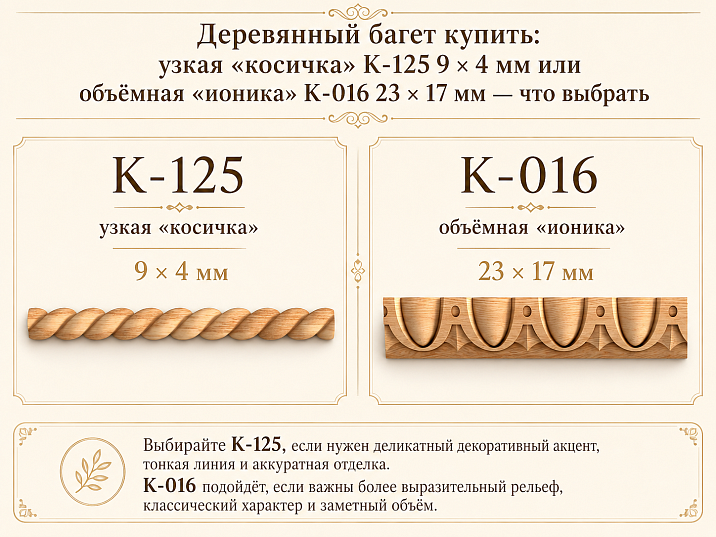
When you need to buy a wooden baguette for a furniture facade, interior door, wall panel, library portal, or classic cornice, K-125 and K-016 may end up on the same shortlist. Both products belong to the STAVROS carved wooden molding line, are made from beech and oak, have "Standard" and "Prestige" sanding options, and are available as short 300 mm samples and long 2000 mm strips. However, on the finished surface, they perform completely differently.
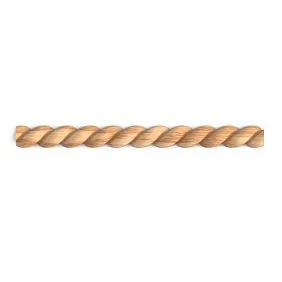
K-125 is a narrow "braid" with a base section of 9 × 4 mm. It forms a thin ornamental line, takes up almost no usable facade space, and is suitable for an inner contour, a small door, repeating frames, and delicate door design. K-016 is a "Greek Ionic" with a base section of 23 × 17 mm. This is already an independent volumetric band that is noticeable from a distance, creates a deep shadow, and requires more space near handles, hinges, panels, and adjacent parts.
Simple arithmetic shows the scale of the differences. K-016 is approximately 2.56 times wider than K-125 and 4.25 times deeper. This means the choice cannot be reduced to a preference between two classic ornaments. The 23 × 17 mm profile protrudes more from the surface, noticeably reduces the inner field of the frame, and costs more both per strip and per linear meter. For a series of several facades, the price difference becomes part of the project decision.
Below are detailed base and enlarged sections, lengths of 300, 1000, and 2000 mm, prices for beech and oak, sanding, calculation for one frame and a series of ten facades, cutting map, ornament alignment at corners, distance to handle and hinges, selection for a cabinet, door, panel, bed, and cornice, combined use of K-125 and K-016, installation limitations, and the commercial purchase route at STAVROS.
Buy K-125 "Braid"Buy K-016 "Ionic"View wooden baguettes



K-125 or K-016: confirmed specifications
| Criterion | K-125 "Braid" | K-016 "Ionic" | Practical Meaning |
|---|---|---|---|
| Base profile | 9 × 4 mm | 23 × 17 mm | K-016 takes up more space and protrudes more. |
| Ornament | Classic braid | Greek ionic | Different plasticity and decorative role. |
| Base profile lengths | 300, 1000 and 2000 mm | 300 and 2000 mm | The K-125 has an intermediate length of 1000 mm. |
| Materials | Beech or oak | Beech or oak | The rock is coordinated with the entire composition. |
| Sanding | "Standard" or "Prestige" | "Standard" or "Prestige" | The choice depends on the future finish and proximity of the view. |
| Enlarged options | 14 × 7 and 20 × 10 mm | 30 × 22 and 40 × 30 mm | The direct comparison of the article refers to the basic 9 × 4 and 23 × 17 mm. |
| Main role | Thin additional line | Main architectural belt | The profiles are not interchangeable. |
| Main risk | Get lost on a large plane | Overload a small facade | Need a full-size template. |
The commonality of materials and lengths makes the comparison fair, but the same category does not mean the same result. K-125 more often works as a line that connects the panel, molding, and handle. K-016 is perceived as an independent carved volume. Therefore, first determine the role of the decor, then the cross-section, and only after that the wood species, sanding, and number of slats.
| Material and sanding | K-125 300 mm | K-016 300 mm | K-125 2000 mm | K-016 2000 mm |
|---|---|---|---|---|
| Beech, "Standard" | 230 ₽ | 580 ₽ | 1 540 ₽ | 3 870 ₽ |
| Beech, "Prestige" | 310 ₽ | 860 ₽ | 2 040 ₽ | 5 750 ₽ |
| Oak, "Standard" | 250 ₽ | 680 ₽ | 1 650 ₽ | 4 540 ₽ |
| Oak, "Prestige" | 330 ₽ | 930 ₽ | 2 190 ₽ | 6 170 ₽ |
The table fixes the prices of basic sections at the time of topic preparation. It does not apply to enlarged versions of K-125 and K-016. Before publication, prices and availability must be rechecked in the product cards.




Why K-125 and K-016 can be compared directly
Both models are sold as carved wooden moldings, have the same primary wood species and the same levels of sanding. The buyer can order a short sample of 300 mm or a long strip of 2000 mm and use the profile on furniture, a door, or an interior panel. This allows comparing not different materials, but two scales of the same product category.
The main fork is not about quality or the purpose "for furniture or not for furniture", but about the decorative role. K-125 creates a thin auxiliary contour. K-016 forms a main classical belt. On the same facade, they change proportions differently.
Such a comparison is especially useful before a serial order. The price, depth, and consumption are multiplied by the number of facades, so an incorrect scale leads not only to a visual error but also to extra costs for the entire set.
Our factory also produces:


What is a wooden baguette molding in this article
By wooden baguette here is meant a carved profile that is sold in pieces and used as a decorative line. It can decorate a furniture door, an interior door, a panel, a portal, a cornice, or another interior element.
Such a profile cannot be automatically considered a ready-made frame for a painting or mirror. The presence of a rabbet, a mounting groove, and a sufficient support shelf are checked against the drawing of a specific product. K-125 and K-016 are primarily considered as decorative moldings.
When a broader overview of the category is needed, it is useful to study the material on how to choose a wooden baguette molding, and then return to the specific sections K-125 and K-016.
Get Consultation
K-125 "Braid" 9 × 4 mm: thin line
The basic K-125 has a width of 9 mm and a depth of 4 mm. This cross-section hardly takes away useful facade space and allows enough air to remain between the frame, handle, and panel.
The "braid" ornament creates a continuous repetition. On a small door, it reads as a neat border rather than a separate massive element. This is especially convenient for a series of identical drawers and doors.
In the card, you can buy a narrow wooden baguette K-125 "Braid" and separately check the length, wood species, sanding, and current price of the selected option.
K-125 of increased cross-section 14 × 7 and 20 × 10 mm
The K-125 card offers not only the basic 9 × 4 mm but also enlarged options 14 × 7 and 20 × 10 mm, 2000 mm long. They retain the braid ornament but become more noticeable and deeper.
These sizes cannot be discreetly substituted with the base model in price and perimeter calculations. For each section, check the separate option card, protrusion height, and distance to the hardware.
The enlarged K-125 can be an intermediate choice when 9 × 4 mm looks too thin and the ionic K-016 23 × 17 mm is already too massive.
K-016 "Ionica" 23 × 17 mm: standalone profile
The basic K-016 has a width of 23 mm and a depth of 17 mm. The Greek Ionic ornament creates a dense classical band that is readable from a distance and forms a noticeable shadow.
This profile is suitable for a large cabinet, library portal, interior door, wall panel, headboard, cornice, and compositions with columns or pilasters. On a small door, it may take up too much of the free field.
Before ordering, you can buy wooden baguette K-016 "Ionica" and compare the basic section with enlarged options to avoid confusing the project scale.
K-016 enlarged section 30 × 22 and 40 × 30 mm
The enlarged K-016 profiles 30 × 22 and 40 × 30 mm turn the Ionic into an even more pronounced architectural element. They are only suitable for large surfaces and are not included in the direct comparison of base prices in this article.
On a large cornice, library, or portal, such a size may be justified. On a regular furniture door, it requires checking the internal field, corner cuts, and adjacent hardware.
It is better to switch to enlarged ionica after trying a 300 mm sample or a full-size fragment, rather than based on a catalog photo.
Width difference of 9 and 23 mm
K-016 is 14 mm wider than K-125. Dividing 23 by 9 gives approximately 2.56: ionica is more than two and a half times wider than the basic braid.
On a frame, this difference appears on all four sides. If the outer contour size remains the same, the wide K-016 reduces the internal field more significantly. On a small panel, the difference becomes noticeable immediately.
Width also affects the corner joint. K-016 has a larger cut area, so pattern mismatch and gaps are more noticeable. K-125 fits more easily into a compact corner, but its ornament also requires precise alignment.
The depth difference is 4 and 17 mm
K-016 is 13 mm deeper than K-125 and protrudes 4.25 times more above the surface. This changes the side shadow, tactile perception, and clearance requirements.
A depth of 17 mm may conflict with a furniture handle, adjacent door, countertop, upper cornice, or passage. K-125 with a depth of 4 mm is usually easier to integrate into an existing facade.
A deeper profile is not automatically considered better. It is justified when a large classical composition truly requires volume and can be safely placed.
How a molding reduces the usable field of the facade
The usable field is the space inside the decorative frame where the panel, smooth surface, or additional decor remains. The wider the profile, the smaller this field is with the same external size.
For K-125, the reduction is minimal. K-016 takes 23 mm from each side of the contour, and with a double frame, gaps and a second profile are added to this.
Before ordering, the outer and inner boundaries of the frame are drawn on the facade at full scale. Such a layout immediately shows whether the central plane has become too small.
Braid as an auxiliary ornament
The braid works well next to a larger molding, carved overlay, rosette, or panel. It connects elements but does not need to become the main motif.
On door K-125, it can repeat the thin contour around the central panel. On a cabinet, it can separate the panel from the smooth field. On a wall panel, it can add an inner line inside the main frame.
To compare similar motifs, you can look at wooden baguettes with the "Braid" ornament and choose the scale without changing the decorative language.
Ionic as the main classical belt
Ionic has a larger rhythm and is associated with the classical architectural language. K-016 can support a cornice, capital, pilaster, or pronounced portal.
On furniture, such a profile is best used locally: on the main cabinet doors, in the central part of a bookcase, or around a large panel. Repeating it on dozens of small facades can make the composition heavy.
The expressiveness of K-016 is revealed only with sufficient space around the profile. Free space helps the relief to be readable and not blend with other details.
What to choose for a small furniture door
For a small panel K-125 is often safer. The 9 mm width preserves the central field, the 4 mm depth interferes less with the handle, and the series price remains manageable.
K-016 is used only when the door is large enough and the profile should become the main element. On a narrow panel, ionica can visually take up almost the entire space.
The paper template should show not only the outer line of the frame, but also the actual inner boundary after profile installation.
What to choose for a large cabinet and walk-in closet
A tall cabinet allows for a larger decorative scale. K-016 is readable from a distance and can assemble central facades into a single architectural composition.
K-125 on such a surface is used as an inner contour, an additional line, or a repeat on side doors. One thin braid without support can get lost.
For a series of facades, a general scheme is drawn up: where the main belt K-016 runs, where K-125 repeats, and which areas remain smooth.
What to choose for an interior door
On a door, K-125 creates a light classic edging and protrudes less into the passage. It is suitable when the leaf already has panels, a handle, and other decorative elements.
K-016 forms a more solemn belt and is appropriate on a large door or portal. The 17 mm depth is checked from the opening side and next to the casing.
Decorative baguette does not replace structural parts of the door leaf. Its role is to decorate the surface according to a pre-prepared scheme.
What to choose for a wall panel
On a large wall panel K-016 can become an external frame or a main horizontal belt. Light emphasizes the deep ionic and makes the border noticeable.
K-125 is suitable for internal layout, small sections and repeating contours. It adds detail but does not reduce each field too much.
On the wall, it is especially important to evaluate the profile from a normal viewing distance. What seems large in hand may look restrained on a large plane.
What to choose for a classic cornice
K-016 is directly related to the Ionic and Corinthian decorative language and can participate in a composite cornice as a pronounced carved belt. The exact mating with adjacent profiles is checked against the drawing and samples.
K-125 in the cornice often serves as a thin dividing line. It helps separate one profile from another and support the repetition of a braid in other interior elements.
Automatic compatibility of any size K-016 with any cornice cannot be guaranteed. The section, projection and scale of adjacent parts must be coordinated.
What to choose for a bed and headboard
On the headboard, K-125 forms a neat internal contour and is suitable for repeating panels. The 4 mm deep profile protrudes less in the contact area.
K-016 can be used on the outer frame of a large headboard or in the upper decorative belt. It is not placed where a person constantly touches the relief.
When choosing, consider soft inserts, fabric, seams, lighting, and distance to the wall.
What to choose for a library and study
In the library, K-016 supports a large classical scale, tall cabinets, and a top cornice. Oak ionica under tinting is especially noticeably linked to the wood texture.
K-125 helps to design small doors, drawers, and inner frames. It repeats the ornament without excessively increasing the cost of each element.
The combination of profiles looks convincing when the main and additional levels are pre-distributed across the facades.
What to choose for a commercial interior
In a hotel, restaurant, salon, or showroom, K-016 can be used locally in the reception area, portal, or central panel. The profile is clearly readable from a distance.
K-125 is more rational for repeated doors, cabinets, and panels where the number of elements is large. The low price per meter has a stronger impact on the total estimate.
A commercial space also requires an assessment of maintenance: deep ionic texture collects dust in the recesses more noticeably than a flat braid.
How lighting direction changes perception
Side lighting enhances the shadow of K-016 and makes the relief the main element. With frontal diffused lighting, the ionic texture looks calmer but retains volume.
K-125 creates a thin shadow line. On dark tinting, it can be read by the highlight; on light enamel, by the slight relief.
The sample is applied in place in the morning and evening or under the working lighting of the furniture. This gives a more accurate result than a product photo.
Price of a short sample 300 mm
The short element 300 mm allows you to evaluate the ornament, depth, wood species, and sanding before purchasing long planks. This is especially important for K-016, which appears more compact in photos than the actual profile.
Base prices as of July 22, 2026 start from 230 rubles for beech K-125 "Standard" and from 580 rubles for beech K-016 "Standard". Oak and "Prestige" cost more.
Before a large order, it is useful to order samples of wooden baguette and compare both profiles directly on the facade.
Why K-125 length 1000 mm
The intermediate length of 1000 mm is available for K-125 and can be convenient for a small project, repairing one door, or checking the finish on a longer section.
It is not always more cost-effective per meter, so the decision is made after comparing the cost of specific options. The length helps reduce waste but does not eliminate the calculation of angles and allowances.
For K-016, there is no confirmed data for an intermediate length of 1000 mm. For it, compare the 300 mm sample and the 2000 mm strip.
Price of a two-meter plank
For beech "Standard" K-125 9 × 4 × 2000 mm costs 1,540 rubles, K-016 23 × 17 × 2000 mm costs 3,870 rubles. The difference is 2,330 rubles per strip.
For oak "Prestige" prices are 2,190 and 6,170 rubles, the difference is 3,980 rubles. Prices are based on card data as of July 22, 2026, and should be rechecked before publication or ordering.
The cost of a plank cannot be evaluated separately from cutting. An expensive profile is sometimes used locally and requires less total footage, while an affordable braid can be repeated on dozens of frames.
Price per linear meter
Since both basic long planks have a length of 2000 mm, the cost per meter is half the price of the plank. This simplifies direct comparison.
For the "Standard" beech, meter K-125 costs 770 rubles, K-016 — 1,935 rubles. For "Prestige" oak — 1,095 and 3,085 rubles respectively.
Additional planning logic is revealed in the material about how to buy wooden baguette by the meter and reduce waste without accidentally cutting stock.
Calculation of one furniture frame 700 × 400 mm
The perimeter of a 700 × 400 mm frame is 2 × (0.7 + 0.4) = 2.2 meters. With a 15% margin, the working requirement is 2.53 meters.
One plank 2000 mm long is not enough. For one frame, two planks are preliminarily required. In "Standard" beech, this is 3,080 rubles for K-125 and 7,740 rubles for K-016.
The calculation shows the minimum purchase without optimizing leftovers. For a real order, the cutting of four sides is checked by part lengths and ornament pattern.
Calculation of a series of ten facades
Simply multiplying two planks by ten frames gives 20 planks: 30,800 rubles for K-125 and 77,400 rubles for K-016 in "Standard" beech. The difference reaches 46,600 rubles.
However, serial cutting can allow using remnants of one frame for the next. Therefore, the final estimate is built based on the list of all lengths, rather than an isolated calculation of each door.
In a series, it is especially important to approve the ornament, wood species, and sanding in advance. Replacing the profile after cutting will require recalculating the internal fields and corners.
How to create a cutting map
First, record the lengths of all top, bottom, and side sections. Then arrange them on two-meter planks, trying to use remnants where a joint is acceptable.
For an ornamental baguette, length is not the only criterion. It is necessary to preserve the direction of the pattern and avoid placing a random joint in the center of the visible side.
The cutting map helps to see when a short element of 300 or 1000 mm is more useful than a new long plank, and when it only increases the number of joints.
How much baguette stock to buy
The stock depends on the number of corners, base quality, pattern repeatability, and the ability to use remnants. In the example, 15% was used, but this is not a universal guarantee for every project.
K-016 requires particularly careful fitting of the large pattern, so saving on stock may lead to purchasing an additional plank later. K-125 is simpler in scale, but the repeat of the braid must also match.
Before ordering, the stock is agreed upon with the master who performs the cutting and installation.
How to match the ornament at the corner
The miter cut must not only close without a gap but also maintain the visual rhythm. On a braid, a shift in the repeat is noticeable as a break in the weave. On ionic, the error appears larger due to the large pattern.
Before serial cutting, a test corner is assembled. It shows how the profile behaves on real equipment and where it is best to place the start of the pattern.
For complex frames, it may be necessary to select paired sections of one plank. A universal promise of an invisible joint without a sample cannot be given.
How to check the distance to the handle
On the facade, the frame boundary and the full handle dimension are marked. It is important to consider not only the visible base but also the space for fingers.
K-125 with a depth of 4 mm usually leaves more freedom. K-016 with a depth of 17 mm can interfere with the grip even when there is a small gap between the parts frontally.
The check is performed with a full-size mockup and the actual handle, not just by the size on the drawing.
How to check hinges and opening of the adjacent door
A deep profile can fall into the trajectory of an adjacent facade, especially on a corner cabinet or with a small gap between doors. K-016 requires mandatory opening check.
The position of the hinges affects how the door moves to the side. Even if the profile does not touch the adjacent part when closed, a conflict may appear during rotation.
K-125 is safer in depth, but it also cannot be placed flush against the edge without considering the gap and cut.
How to check the gap to the countertop and cornice
On a cabinet or chest of drawers, the top frame may be located near the countertop. K-016 with a depth of 17 mm requires sufficient distance so that the profile does not rest against the overhanging edge.
On a cabinet, the top ionic should align with the cornice. Two large profiles without a free gap create a cluttered strip.
K-125 can be used as a thin border between large parts if the ornament and scale match.
Beech for opaque enamel
Beech is often chosen when the baguette is planned to be painted with opaque enamel together with the facade or door. A single coating helps to connect the profile with the base.
On K-125, the enamel must preserve the fine braid and not fill the relief. On K-016, it is especially important not to flood the deep transitions of the ionic with an excessively thick layer.
A test paint is performed on a sample of the same wood species and sanding that will be used in the order.
Oak for tinting and transparent finish
Oak is chosen when the wood texture should remain visible. Tinting emphasizes the relief and creates a difference in shade between protrusions and recesses.
On K-016, this contrast is more pronounced due to the depth of 17 mm. K-125 looks lighter and depends more on the glare on the thin pattern.
For a series, it's better to finish all parts simultaneously so that the tone and gloss do not differ between facades.
'Standard' or 'Prestige'
Both models are available in two levels of sanding. "Standard" and "Prestige" do not mean a finished paint coating: it refers to the preparation of the wooden product.
The choice depends on the viewing distance, complexity of the relief, and the finisher's requirements. On deep ionic, the quality of internal area preparation is especially noticeable after painting.
Before ordering, it's useful to agree on which operations will remain on site and what surface is needed for the chosen finishing system.
When to install the baguette: before or after painting
There is no single order for all projects. Installation before painting helps achieve a uniform surface and treat joints together with the facade. Pre-finishing is convenient when the visible texture of oak needs to be preserved.
The decision depends on the glue, fastening, base material, and coating technology. It cannot be guaranteed that any profile only needs to be glued.
First, assemble a test unit, then approve the order for the entire series.
How to cut a baguette at 45 degrees
A 45-degree cut forms a frame only with precise geometry of the base and tool. Even a small error at four corners accumulates and manifests as a gap.
K-016 has a wider cutting surface, so inaccuracy is more noticeable. K-125 is thinner, but its fine ornament can be damaged during rough cutting.
Before cutting the finishing planks, a test corner is made from a sample or leftover.
How to attach a wooden baguette
The fixing method depends on the base, profile size, installation location, and future finishing. Different solutions may be needed for furniture facades, walls, doors, and ceiling compositions.
The adhesive is chosen considering the wood and surface. Mechanical fixing is used only as per the design to avoid damaging the front relief.
The article does not replace base inspection and a master's recommendation. This is especially important for large K-016 and overhead installation.
How to care for braid and ionica
K-125 has a shallow pattern and is usually easier to clean with a soft dry cloth or a brush compatible with the finish coating.
K-016 collects dust in deep recesses more noticeably. When choosing for a kitchen, restaurant, or frequently used furniture, this should be taken into account in advance.
Care products are selected based on the enamel, varnish, or tint. Aggressive chemicals cannot be used without confirmation of compatibility.
How not to confuse decorative molding with frame profile
The query "wooden baguette" is often associated with paintings and mirrors, but decorative molding does not necessarily have a rabbet to hold the canvas or glass.
K-125 and K-016 are used as carved lines in furniture and interior compositions. The possibility of making a full frame is checked against the drawing and project design.
The general selection route is revealed in the material about how to choose a wooden baguette, but the specific fit is always checked separately.
When to use K-125 and K-016 together
The working scheme is built on hierarchy: K-016 forms the outer main belt, K-125 forms the inner thin frame. A free field is left between them.
Both profiles are chosen from the same breed and the direction of the pattern is checked in advance. The finish can be common or contrasting, if provided by the project.
Two ornaments cannot be joined automatically. 300 mm samples are applied to the actual surface and evaluated from the working distance.
What to choose for a double frame
On a large facade, a double frame can combine external volume and internal detailing. K-016 sets the architectural boundary, K-016 neatly surrounds the panel.
On a small facade, such a scheme quickly reduces the central field. It is better to use only K-125 or one simpler profile there.
Before ordering, the outer dimension, the width of both baguettes, and the distance between them are calculated. The layout shows the final area of the central part.
How to choose a baguette for ready-made furniture
When modifying ready-made furniture, first check the facade material, hardware, and finishing possibilities. The new profile should not interfere with hinges and handles.
K-125 is easier to integrate into an existing composition. K-016 requires sufficient scale and may change the character of the furniture more than expected.
Color and gloss are selected using a sample, because even the same shade name looks different on different materials.
How to choose a baguette for custom furniture
In new furniture, frame dimensions can be set before facade manufacturing. This allows using K-016 without losing the central field or distributing both profiles across levels.
The designer accounts for handles, hinges, panel thickness, and finishing sequence in advance. The cutting map is created together with the facade list.
For a complex composition, it is useful to study how to choose a baguette for furniture, mirror, and portaland provide the master with exact article numbers and cross-sections.
How to accept baguette after delivery
Before cutting, check the article number, base or increased cross-section, length, wood species, sanding, and quantity. K-125 9 × 4 mm must not be mixed with 14 × 7 and 20 × 10 mm variants.
Lay the slats side by side and check the pattern, surface, and wood grain direction. Record any issues before finishing and installation.
Label short elements and long slats by purpose to prevent a sample from accidentally ending up in the final cut.
How to store baguette before installation
Store slats on a flat surface, protecting the profile from pressure and impacts. Thin K-125 is sensitive to local bending; bulky K-016 must be protected from damage to its protrusions.
Do not mix beech and oak in the same labeled group. Separate finished and unfinished parts to avoid scratching the surface.
Coordinate the site conditions with the manufacturer and finisher, especially if wet work is ongoing.
Mistakes when buying K-125
The first mistake is choosing 9 × 4 mm for a large panel, where the thin braid gets lost. The second is considering the profile invisible and not checking the rhythm of the ornament at the corners.
The third mistake is calculating each frame separately and not using series leftovers. The fourth is buying the base section when the project actually requires the enlarged K-125.
Correction begins with a sample, full-size layout, and cutting map.
Mistakes when buying K-016
The main mistake is underestimating the depth of 17 mm. The profile may interfere with the handle, adjacent door, or countertop.
The second mistake is repeating the ionic on many small facades, where it overloads the furniture and sharply increases the estimate. The third is considering any size K-016 as a ready-made element for the cornice without checking the joints.
K-016 is chosen deliberately as the main belt, not just as a "more beautiful" option.
Common mistakes when ordering wooden baguette
You cannot choose only by photo, confuse a decorative profile with a finished frame, expect a painted delivery without confirmation, or assign installation only with glue without checking the base.
You cannot transfer the price of the base section to an enlarged version or consider a short sample proportional in price to a two-meter plank.
All key parameters — article, section, length, wood type, sanding, and quantity — are recorded separately in the order.
Who K-125 is suitable for
K-125 is suitable for owners of small facades, serial cabinets, doors with delicate decor, and projects where the baguette should be an internal contour.
The model is especially useful near a handle, with a limited central field, and when needing to control the cost of a large number of frames.
It may not be suitable for a large portal or high panel if the profile needs to be noticeable from a distance.
Who is K-016 for
K-016 is suitable for large classic furniture, libraries, walk-in closets, portals, wall panels, and cornices where a voluminous Ionic-style belt is needed.
The model is appropriate when there is enough free space around the profile, and the 17 mm depth does not interfere with hardware and operation.
It may be unnecessary on a small door, in a narrow passage, or in a project with many repeating frames.
How to buy K-125 or K-016 at STAVROS
For a thin braid, open the card and
Comparison of price per linear meter
| Material and sanding | K-125 per 1 m | K-016 per 1 m | How much more expensive is K-016 |
|---|---|---|---|
| Beech, "Standard" | 770 ₽ | 1 935 ₽ | approximately 2.51 times |
| Beech, "Prestige" | 1 020 ₽ | 2 875 ₽ | approximately 2.82 times |
| Oak, "Standard" | 825 ₽ | 2 270 ₽ | approximately 2.75 times |
| Oak, "Prestige" | 1 095 ₽ | 3 085 ₽ | approximately 2.82 times |
The calculation is based on two-meter strips of basic sections. It helps compare the scale of the estimate, but the final order depends on the cutting map and the ability to use leftovers.
Practical calculation of frames
| Scenario | Need | K-125, letter "Standard" | K-016, letter "Standard" | Comment |
|---|---|---|---|---|
| One frame 700 × 400 mm | 2.53 m with margin | 2 strips — 3,080 ₽ | 2 strips — 7,740 ₽ | Without balance optimization. |
| Ten frames by simple multiplication | 20 slats | 30 800 ₽ | 77 400 ₽ | Difference 46,600 ₽. |
| Sample 300 mm | 1 element | 230 ₽ | 580 ₽ | Prices for beech "Standard". |
| Test corner | 2 short pieces | Calculate by selected length | Calculate by selected length | Checking the ornament and equipment. |
What to order with the frame
| What to add | Why | Scenario | Link |
|---|---|---|---|
| Samples K-125 and K-016 | Compare scale and finish on site | Any large order | to order samples of wooden baguette |
| Other braid options | Find an intermediate scale | K-125 is too thin | View 'Braid' moldings |
| Carved molding category | Compare other ornaments | No model fits | View wooden baguettes |
| Frame calculation guide | Specify perimeter and margin | Multiple facades | How to calculate wooden molding for a frame |
| Guide to molding by the meter | Reduce waste | Serial cutting | How to buy molding by the meter |
| Carved decor section | Select adjacent elements | Portal, furniture, panel | View carved decor |
Pre-order checklist
| Check | K-125 | K-016 | What to fix |
|---|---|---|---|
| Cross-section | 9 × 4 mm or enlarged | 23 × 17 mm or enlarged | Exact option in the order. |
| Length | 300, 1000 or 2000 mm | 300 or 2000 mm | Cutting map. |
| Material | Beech or oak | Beech or oak | One species for the series. |
| Sanding | "Standard" or "Prestige" | "Standard" or "Prestige" | Future finish. |
| Hardware | Check the handle and hinges | Check especially thoroughly | Front and side template. |
| Ornament | Braid match | Ionic match | Test corner. |
| Price | Double-check | Double-check | Current estimate. |
How to make a full-size mockup K-125 and K-016
For front checking, cut strips 9 and 23 mm wide and assemble them into frames of the required external size. This mockup shows how much plane remains inside the contour and how the profile relates to the handle, panel, and door edge.
For side testing, add a 4 or 17 mm protrusion to the strips. This is especially important for K-016: the frontal pattern may look appropriate, but the actual depth can interfere with opening or grip on the handle.
The layout is evaluated up close and from the normal entry point of the room. After this, the decision on scale becomes much more accurate than when choosing from a product card.
How to take facade dimensions before ordering
Not only the overall width and height of the door are measured, but also the free space between the facade frame, handle, hinges, and adjacent parts. On a paneled door, the inner dimension of the smooth surface is recorded separately.
If the furniture is already installed, check the actual gaps between the doors and the opening trajectory. For K-016, it is important to measure the distance to the countertop, cornice, and protruding elements.
All values are recorded in a single diagram indicating the opening side and facade number. This prevents confusion during serial cutting.
How to choose the outer offset of the frame
The offset from the edge of the facade should leave a visible strip of the base and not intersect with the handle or panel frame. The wider the profile, the more free space is required around it.
K-125 allows a more compact offset and is suitable for small doors. K-016 needs more space, otherwise its ionica looks cramped and visually merges with the edge.
A universal number without specific facade dimensions cannot be assigned. The offset is approved based on full-size markup.
How to calculate the inner field of the frame
If the outer size of the decorative contour is set, the inner field is reduced by double the profile width. For K-125 this is 18 mm on each axis without considering cutting features, for K-016 — 46 mm.
On a frame with an outer size of 700 × 400 mm, the conditional inner field by profile width will be about 682 × 382 mm for K-125 and 654 × 354 mm for K-016. This is a geometric estimate, not an installation drawing.
The calculation helps to understand how much the ionica will reduce the central plane and whether there will be space for an overlay, socket, or smooth panel.
How to plan internal and external corners
A rectangular furniture frame usually has four internal joints relative to the field, but in a complex panel, external turns, steps, and breaks may appear. Each additional corner increases material consumption and the risk of error.
K-016 requires more material for test joints due to its large pattern. K-125 adapts more easily to small areas, but frequent corners can disrupt the continuity of the braid.
Complex geometry is broken down into separate contours, each calculated independently, after which the cutting map is combined.
How to position visible joints on a long line
A two-meter strip may not be enough for a long panel, door, or horizontal belt. The joint is placed in a less noticeable area, not automatically in the center of the composition.
For a braid pattern, it is important to continue the weave repeat. For a ionic pattern, align the large ornamental elements. Sometimes you have to sacrifice part of the length to make the pattern look cohesive.
The placement of joints is marked before cutting and agreed upon on the layout. Remnants with a suitable pattern are saved for short sides or test corners.
When a short sample is more advantageous than a new strip
A 300 mm element is primarily needed for testing, but sometimes it is suitable for a small local area. The decision depends on the price of the specific option and the number of new joints.
You cannot assume that six short elements are always equal to one strip in price or cutting quality. The short format may be more expensive per meter and create more connections.
It is used deliberately: for a sample, repair, test corner, or a short part that is inconvenient to cut from a finished long strip.
How to distribute remnants between facades
After cutting the first frame, sections remain that may be suitable for the short sides of the next one. Therefore, a series order is calculated for all facades at once, not by one template multiplied by the quantity.
Remnants are sorted by length, ornament direction, and surface quality. The most intact sections are used for the face sides, while technical trimmings are used for test corners.
This approach reduces waste but should not result in many noticeable joints on each frame.
How to choose a baguette to match the casing and baseboard
The thin K-125 sits more easily next to a wide casing and high baseboard because it remains a secondary line. It can echo a braid in another element or create a delicate transition.
K-016 requires support from large architectural details. Next to a narrow casing and low baseboard, it can appear disproportionately heavy.
Cross-sections are compared on a single sheet or stand at full scale. Matching the wood species alone does not guarantee scale consistency.
How to choose a baguette to match a carved overlay or rosette
If there is already a large overlay or rosette in the center of the facade, the baguette should frame it, not compete. K-125 more often leaves the central decor with the main role.
K-016 is suitable when the entire composition is designed for a large classical relief. A free field is left between the frame and the central detail so that the ornaments do not merge.
Before ordering, the elements are laid out together on a full-size mockup and the overall decorative weight is checked.
How to choose a profile for light enamel
On light opaque enamel, shadows become the main way to read the carving. K-016 creates a deeper and more contrasting shadow, K-125 creates a thin, neat line.
If the room is brightly lit from the front, a small braid may look calmer. With side lighting, even K-125 becomes more noticeable.
The test sample is evaluated in the actual room because the temperature and direction of light change the perception of the same white or beige shade.
How to choose a profile for dark tinting
Dark tinting enhances contrast in the recesses. On K-016, the ionica becomes especially expressive, but can visually weigh down a small facade.
K-125 on dark oak is read by the highlight and rhythm of the weave. It is suitable when a classic detail without a massive protrusion is required.
The shade and degree of gloss are chosen on the sample, taking into account the neighboring furniture and lighting.
How to use K-125 on a chest of drawers and bedside table
Chests of drawers and bedside tables often have small drawers and handles, so K-125 is more practical here. The thin frame does not interfere with the grip and allows you to repeat the ornament on each facade.
K-016 can be used on one central door or in the upper decorative belt, if furniture dimensions allow. Repeating it on every small drawer usually turns out to be too dense.
The number of frames and the price of the series are calculated before choosing the final profile.
How to use K-016 in a library portal
A tall portal or library gives the ionica the necessary scale. K-016 can pass through the central belt, upper part, or large facades and connect with the cornice and pilasters.
K-125 in such a project is used on inner frames, small doors, and drawers. It supports detailing without competing with the main profile.
The portal layout should show the hierarchy of all lines before purchasing the material.
How to use molding on a door with multiple panels
On a door with multiple fields, you cannot mechanically repeat the same large profile around each panel. K-016 can make the door leaf excessively heavy and reduce the inner surfaces.
K-125 is better suited for repeating contours. K-016 can be left for the outer main frame or the upper accent area.
The handle, lock, and opening direction are applied to the layout along with the molding.
How to estimate the cost of not only the profile but also the work
The more expensive K-016 increases not only the material cost. The large ornament requires careful corner selection, trial joints, and precise finishing of deep areas.
K-125 is cheaper per meter and usually more economical for a series, but a large number of frames still creates a significant volume of cutting and installation.
The estimate should separately account for profile, stock, samples, cutting, fitting, installation, and finishing. This allows for honest comparison of options.
How to check the order before starting the series
Before serial cutting, one control facade or large fragment is assembled. It checks frame size, angles, pattern, gap to handle, fastening method, and finishing.
After approval, the sample becomes the standard for the remaining parts. Any changes in cross-section or offset are recorded before the entire batch is launched.
The control facade is especially important when using K-125 and K-016 together, because an error scales to the entire set.
When it's better to choose a different molding
K-125 should not be taken if the thin braid gets lost on a large plane even after fitting. K-016 is not suitable if the depth interferes with the hardware or the wide belt leaves too small an inner field.
In this case, open the category and look for an intermediate cross-section, a different ornament, or a calmer profile. The task of selection is not necessarily to settle on one of the two models at any cost.
The sample and full-size layout help to reject an unsuitable option before purchasing long planks.
How to coordinate the molding with the overall architecture of the room
A baguette on furniture or a wall panel should support the scale of the room, not exist separately from it. In a room with high baseboards, wide architraves, columns, and a large cornice, K-016 looks more natural. In a calm interior with thin profiles and compact furniture, K-125 more often maintains the correct proportion.
Before ordering, it is useful to photograph the facade together with the adjacent wall, door, and top cornice. Such a shot shows how well the selected profile connects with the other lines. If the baguette appears randomly large or inconspicuous, it is better to change the section before purchasing the entire batch.
Wood species and color do not correct a scale error: oak K-125 remains a thin line, and K-016 painted in the facade color retains a volume of 23 × 17 mm.
Final check of the estimate and configuration
Before payment, the quantity of long planks, samples, intermediate K-125 elements 1000 mm long, wood species, and sanding are verified. For each facade, four lengths, a reserve, and the location of a possible joint must be known.
The estimate includes not only the baguette but also test corners, cutting, pattern fitting, installation, and finishing. This is especially important for K-016: the high material cost amplifies the cost of any mistake.
Current prices and availability must be confirmed in the STAVROS product cards immediately before ordering. The calculations in the article help compare options but do not replace the final cutting map for a specific project.
FAQ: K-125 or K-016
1. How is K-125 different from K-016?
K-125 is a thin braid 9 × 4 mm, K-016 is a voluminous ionic 23 × 17 mm. They differ in scale, depth, pattern, price, and role on the facade.
2. How many times wider is K-016 than K-125?
Approximately 2.56 times: 23 mm vs 9 mm.
3. How many times deeper is K-016 than K-125?
4.25 times: 17 mm vs 4 mm.
4. What to choose for a small door?
More often K-125, because it reduces the useful field less and interferes less with the handle.
5. What to choose for a large cabinet?
K-016 is suitable as the main belt, and K-125 as an additional internal contour.
6. Can both profiles be used together?
Yes, after testing on samples: K-016 on the outside, K-125 on the inside, with a free field left between them.
7. What lengths are available for K-125?
For the base section, 300, 1000, and 2000 mm are confirmed.
8. What lengths are available for K-016?
For the base section, 300 and 2000 mm are confirmed.
9. Are there other sizes for K-125?
Yes, 14 × 7 and 20 × 10 mm, 2000 mm long.
10. Are there other sizes for K-016?
Yes, 30 × 22 and 40 × 30 mm, 2000 mm long.
11. What materials are available?
Beech and oak for both models.
12. What sanding is available?
"Standard" and "Prestige."
13. What to choose for enamel?
Beech is often chosen for opaque enamel, but the coating system is coordinated with the finisher.
14. What to choose for tinting?
Oak, when you need to preserve the wood texture.
15. How much does a meter of K-125 from beech "Standard" cost?
As of July 22, 2026 — 770 rubles for the base section.
16. How much does a meter of K-016 from beech "Standard" cost?
As of July 22, 2026 — 1,935 rubles.
17. How many slats are needed for a 700 × 400 mm frame?
With a 15% margin, the requirement is 2.53 m, so two slats of 2000 mm are preliminarily needed.
18. Is it necessary to buy a sample?
For a large order, it is advisable: 300 mm allows checking the scale, ornament, and finish.
19. Can K-125 be used for a painting?
Only after checking the availability of a suitable rabbet and frame construction. A decorative profile does not guarantee such a function.
20. Can K-016 be used in a cornice?
It can be considered as an Ionic belt, but the connection and size are checked according to the project.
21. How to check the distance to the handle?
Make a full-size front and side template together with the actual handle.
22. How to align the ornament at the corner?
Assemble a test corner and adjust the position of the repeating pattern before final cutting.
23. Can it be attached only with glue?
There is no universal answer. The method depends on the base, size, location, and finish.
24. Where to buy K-125 and K-016?
In individual STAVROS product cards or in the category of carved wooden moldings.
Result: braid K-125 or ionic K-016
K-125 and K-016 belong to the same category and are available in the same wood species, but are not two close variants of the same profile. K-125 9 × 4 mm forms a thin inner contour. K-016 23 × 17 mm becomes the main volumetric belt and requires more free space.
K-125 is suitable for a small door, a repeating series, an area near a handle, and a project with a limited budget. K-016 is revealed on a large cabinet, door, panel, library, portal, or cornice. A combined scheme is possible when the hierarchy of profiles is predetermined.
Before ordering, select the base or enlarged cross-section, length, beech or oak, sanding, quantity, and future finish. Then you can order K-125 "Braid", order K-016 "Ionica" either go to the STAVROS wooden baguettes catalog.
How to match a baguette with a furniture handle in style
In addition to the gap, the decorative language is important. A thin braid goes well with a small classic handle and does not compete with it. Ionic requires calmer or proportionate hardware.
A handle that is too complex next to K-016 creates two competing centers. On the layout, not only the distance is evaluated, but also the overall silhouette.
The color of the metal and the wood finish are checked side by side under working lighting.
How to distribute two profiles across the cabinet facades
The central doors can be finished with K-016, and the side doors and drawers with K-125. This way, the main belt retains its significance and is not mechanically repeated on every surface.
For a symmetrical cabinet, identical doors should receive the same profile. Random alternation disrupts the order.
The scheme is applied to the facade layout before calculating the footage.
How to evaluate the molding from a distance
K-125 is evaluated not only up close, where the fine pattern is clearly visible, but also from the usual point of entry into the room. On large furniture, the braid can turn into a thin line.
K-016 is readable from a distance, but at close range its depth may be excessive.
A photo of a full-size template from the working point helps in making a decision.
How to prepare a request for the STAVROS manager
The request specifies the article, cross-section, length, wood species, sanding, and quantity. For frames, the dimensions of all sides and the number of facades are attached.
Separately, it is reported whether enamel, tinting, a sample, and the combined use of two profiles are needed.
Current prices and availability are confirmed directly before ordering.