Article Contents:
- Confirmed specifications of R-012 and R-039
- R-012 or R-039: main comparison
- What is a wooden decorative rosette and why is it needed
- Why R-012 and R-039 cannot be compared only by price
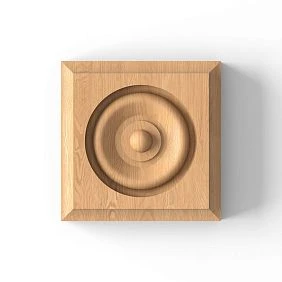
- R-012: round medallion in a square format
- R-039: gothic cross-shaped pattern
- One large element or several small ones
- Why the word "decorative" is important in the choice
- How to choose R-012 size 60 × 60 mm
- When to choose R-012 size 80 × 80 mm
- R-012 size 100 × 100 mm for large facade
- R-012 size 120 × 120 mm for wall frame
- R-012 size 150 × 150 mm as architectural center
- Why R-039 is produced in 40 mm size
- Thickness 25 or 9 mm: what changes on the facade
- How to choose a socket for a small box
- Which socket is suitable for a cabinet
- What to choose for a large wall frame
- R-039 for narrow door casing
- R-012 for the central panel
- How to use R-039 at the corners of the frame
- Can R-012 and R-039 be combined
- How to make a paper mockup
- How to check the distance to the furniture handle
- How to connect the socket to the moldings
- How to calculate the quantity of R-039
- How to calculate the quantity of R-012
- How to maintain symmetry on a two-door cabinet
- How to design a dresser
- How to style a bed
- How to style a door leaf
- How to use sockets on a stair post
- How to use R-012 in a coffered ceiling
- R-012 in the living room
- R-039 in the living room
- Sockets for the bedroom
- Sockets for the kitchen
- Sockets for the hallway
- Sockets for the study
- Sockets for dressing room
- Sockets for commercial interior
- Beech under white enamel
- Beech for colored enamel
- Oak for tinting
- Beech or oak for furniture fronts
- What does "Standard" sanding mean
- What does "Prestige" sanding mean
- Why you cannot mix "Standard" and "Prestige"
- How to make a test paintout
- When to paint before installation
- When to paint after installation
- How to protect the relief from a thick layer of paint
- How to choose glue for a wooden socket
- Why you cannot promise installation only with glue
- Installation on furniture facade
- Installation on the door
- Mounting on wall panel
- Installation on trim
- Ceiling mounting
- How to prepare the base
- How to perform a dry fit
- How to mark the center of the facade
- How to mark four R-039 at the corners
- How to mark a repeat on multiple drawers
- How to store sockets before installation
- How to accept an order
- Mistake: choosing only by photo
- Error: using one R-039 on a huge panel
- Error: repeating R-012 too often
- Error: mixing R-012 and R-039 without hierarchy
- Error: incorrectly rotating R-039
- Error: not considering the furniture handle
- Error: not considering moldings
- Error: choosing a breed only by price
- Error: mixing grinding options
- Error: considering grinding as a finished coating
- Error: mount on weak coating
- Error: use one glue for all surfaces
- Error: not doing a dry fit
- Error: not checking door opening
- Error: installing without a common axis
- Error: forgetting about the side edges R-012
- Error: expecting the socket to hide an uneven facade
- Error: buying different sizes without a common plan
- Who R-012 is suitable for
- Who R-012 may not suit
- Who R-039 is suitable for
- Who R-039 may not suit
- Practical choice: central cabinet door
- Practical choice: narrow architrave
- Practical choice: large boiserie
- Practical choice: multiple dresser drawers
- Practical choice: Gothic furniture
- Practical choice: modern minimalist facade
- Practical choice: repairing ready-made furniture
- Practical choice: custom-made new furniture
- Practical choice: one socket per door
- Practical choice: four sockets on a frame
- How not to confuse a socket with an elongated overlay
- How not to confuse R-039 with an electrical socket
- How to buy R-012 and R-039 on STAVROS
- What to check before payment
- How to save data for reordering
- How to accept the finished composition
- Why a ready-made socket is more convenient than self-threading
- What to buy together with a wooden decorative socket
- How to test a socket under real lighting
- How to prepare a control door before a serial order
- How to check identical R-039 in a long series
- How to coordinate different sizes of R-012 in one room
- How to estimate the final cost of a composition
- How to fix the final choice in the specification
- How to check the socket scale at a distance
- How to check the repeating decor after painting
- FAQ: questions about R-012 and R-039
- How is R-012 different from R-039?
- Which socket to choose for a small box?
- What to choose for a large cabinet door?
- Will R-039 fit a narrow trim?
- Which size of R-012 to choose for a wall panel?
- Can R-012 and R-039 be combined?
- Which model protrudes less?
- What to choose for white enamel?
- What to choose for tinting?
- What is the difference between "Standard" and "Prestige"?
- Do I need to paint the socket before installation?
- How to glue a socket to the facade?
- Can R-012 be mounted only with glue?
- How to check the distance to the handle?
- How many R-039 are needed for a frame?
- Can one R-039 be used on a large panel?
- How to place R-012 on a two-door cabinet?
- Can a socket be installed on ready-painted furniture?
- Will R-039 suit a Gothic interior?
- Where to use R-012 150 mm?
- Where to buy R-012?
- Where to buy R-039?
- What to buy together with the socket?
- What should I check before ordering?
- Which model is more universal?
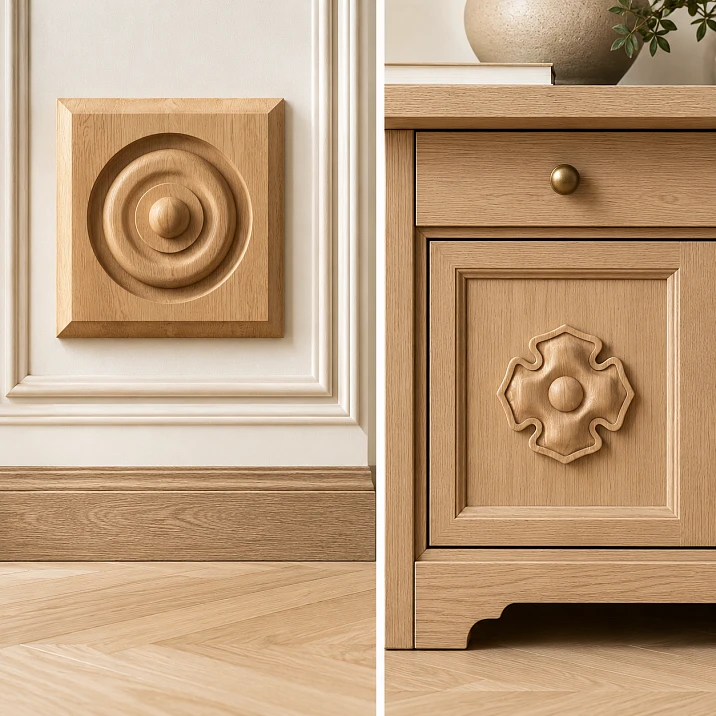
A wooden decorative rosette should be purchased after checking three parameters: the size of the facade or frame, the required protrusion, and the role of the decor in the composition. Buy geometric rosette R-012 reasonable for a noticeable central medallion ranging from 60 to 150 mm. Buy Gothic rosette R-039 better for a compact cross-shaped accent 40 × 40 × 9 mm, which repeats on drawers, doors, architraves, and frame corners.
R-012 and R-039 cannot be compared solely by price or photo. The first model comes in five sizes: 60 × 60 × 25, 80 × 80 × 25, 100 × 100 × 25, 120 × 120 × 25, and 150 × 150 × 25 mm. The second is produced in a single format: 40 × 40 × 9 mm. The 20 mm difference between R-039 and the smallest R-012 variant seems small only on paper: the thickness differs almost threefold, and the compositional role is even more significant.
R-012 works as a centerpiece: on furniture panels, wall panels, pilasters, portals, beds, stair posts, or coffered ceilings. R-039 is more convenient as a repeating module: at frame corners, on narrow architraves, on several identical drawers, or along a decorative line. One large rosette draws the eye to the center, while several small ones create rhythm without overwhelming a narrow detail.
Both models are available in beech and oak with "Standard" or "Prestige" sanding. Beech is chosen for opaque enamel, oak for tinting that preserves the wood grain. Before installation, check the distance to the furniture handle, the thickness of moldings, door openings, and the condition of the base: even a compact overlay should not interfere with the facade's operation.
Short answer. R-012 is chosen for a single prominent center or a large wall composition. Sizes 60–100 mm suit furniture and doors, 120–150 mm suit large frames, panels, and architectural decor.
R-039 is chosen for narrow architraves, small drawers, frame corners, and repeating Gothic patterns. The 9 mm thickness allows placing the decor next to a handle or molding, where the 25 mm deep R-012 would protrude too much.
Buy R-012 Buy R-039 View all wooden sockets Choose geometric decor
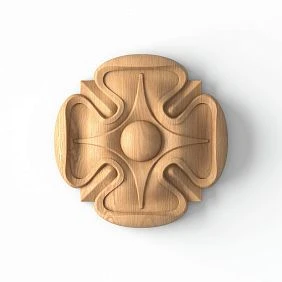
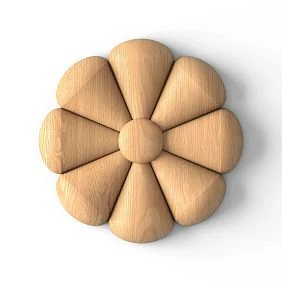
Confirmed specifications of R-012 and R-039
| Parameter | R-012 | R-039 |
|---|---|---|
| Type | Geometric wooden rosette with round medallion | Compact cross-shaped gothic rosette |
| Dimensions | 60 × 60 × 25; 80 × 80 × 25; 100 × 100 × 25; 120 × 120 × 25; 150 × 150 × 25 mm | 40 × 40 × 9 mm |
| Number of size options | 5 | 1 |
| Material | Beech or oak | Beech or oak |
| Sanding | "Standard" or "Prestige" | "Standard" or "Prestige" |
| Beech | For enamel | For enamel |
| Oak | For tinting | For tinting |
| Main role | One central accent or large architectural module | Small, corner, or repeating accent |
| Nature of the Pattern | Square format and round center | Cross-shaped gothic motif |
| Typical surfaces | Facades, doors, wall panels, portals, coffers | Boxes, narrow casings, frames, doors, small panels |
| Construction adhesive | Selected by base, mass, and coating | Selected by base, mass, and coating |




R-012 or R-039: main comparison
| Criterion | R-012 | R-039 | Practical conclusion |
|---|---|---|---|
| Minimum width | 60 мм | 40 мм | R-039 is easier to place on a narrow profile |
| Maximum width | 150 мм | 40 мм | R-012 is more readable on a large panel |
| Thickness | 25 мм | 9 мм | R-039 protrudes less near handles |
| Central element | Strong | Delicate | For the center of a large facade, R-012 is more suitable |
| Repetition in the series | Possible, but requires a large field | Especially convenient | Several R-039 are easier to distribute across the frame |
| Small drawer | May turn out to be large | Fits better | First compare with the handle and panel |
| Cabinet door | 60–100 mm for central installation | For a small center or corners | The solution depends on the door scale |
| Wall panel | 100–150 mm as center | Grouped or in corners | One large center and repetition are different compositions |
| Style | Universal geometry | Gothic, grunge, loft, industrial motifs | R-039 requires a more directed style solution |
Our factory also produces:
What is a wooden decorative rosette and why is it needed
A decorative rosette is an overlay element that creates a finished center or a repeating point within a furniture and architectural frame. It helps to close an empty panel area, connect moldings, support cabinet symmetry, and add relief without a complete facade rework.
The buyer chooses not just a beautiful pattern. The rosette must match the field width, depth of adjacent profiles, furniture material, and future coating. A too small detail will be lost, a too large one will overlap the frame or come close to the handle.
A ready-made model is more convenient than a random wooden blank: dimensions, shape, and depth are already set, and identical elements can be repeated on several facades.
Get Consultation
Why R-012 and R-039 cannot be compared only by price
One R-012 can replace a whole group of small accents and become the main center of the facade. Several R-039 solve a different task — they create a corner or linear rhythm.
The price of one card does not show the final budget of the composition. You need to consider the number of details, the area of finishing, layout, glue, and installation time.
It is more correct to compare two finished projects: one large medallion or four, eight, or more small cross-shaped rosettes.
R-012: round medallion in a square format
The square outer contour conveniently connects with a rectangular panel, furniture frame, and intersections of moldings. The round center softens the strict geometry and creates a clear focal point.
Five sizes allow repeating one pattern on different elements: a small drawer, a cabinet door, a large wall panel, and a portal.
Before ordering, it is worth choose the size of R-012 using a full-size template, not just from an image.
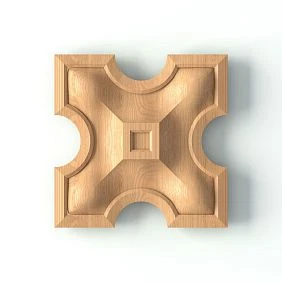
R-039: gothic cross-shaped pattern
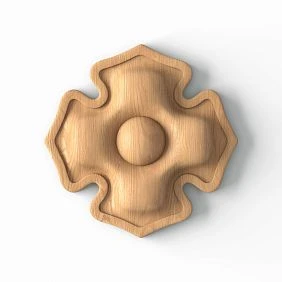
The compact rosette 40 × 40 mm is perceived not as a reduced R-012, but as an independent gothic module. The cross-shaped form gives a directional pattern and works well on narrow details.
A thickness of 9 mm reduces the protrusion above the surface. This is important on dressers, drawers, and trim where hands, clothing, and furniture fittings are nearby.
For such a scenario, you can choose a cross-shaped wooden rosette and calculate the quantity in advance.
One large element or several small ones
One large R-012 gathers the composition around the center. This technique suits a symmetrical door, wide panel, and wall frame.
Several R-039 distribute attention: in corners, along the vertical, or on identical drawers. The repetition must be regular, otherwise small details look random.
Before purchasing, it is useful to lay out paper squares of the required size and evaluate the option from a normal viewing distance.
Why the word "decorative" is important in the choice
Without specification, the buyer may end up in the search results for electrical products, furniture fittings, or technical plugs.
R-012 and R-039 specifically refer to wooden overlay decor for furniture, doors, and walls.
The card checks the article number, dimensions, wood species, and finish, not just the word "rosette."
How to choose R-012 size 60 × 60 mm
The minimum R-012 suits a small door, furniture panel, and wide casing where R-039 would look too delicate. At 60 mm, the round medallion is already readable as an independent center but does not occupy most of the facade.
The 60 × 60 mm template is applied next to the handle and inner frame. The 25 mm thickness requires a separate check of the protrusion: the small area does not make the model flat.
This option is convenient when the same pattern needs to be continued on larger elements of sizes 80, 100, 120, or 150 mm.
When to choose R-012 size 80 × 80 mm
The 80 mm format suits a cabinet door, chest of drawers, door panel, and medium furniture facade. It is more noticeable than the minimum option but does not yet require a large architectural panel.
The rosette is placed in the geometric center or linked to the intersection of moldings. If the handle is close, the distance is checked not only on the plane but also in depth.
On paired doors, two R-012 should be at the same height and rotate identically relative to the square contour.
R-012 size 100 × 100 mm for a large facade
A size of 100 mm already forms a noticeable central decor of a cabinet, bed, desk, or wide door. It is easily readable from a distance and can replace a complex composition of several small elements.
On a small chest of drawers, such a rosette can compete with a handle and a frame. A paper template helps to understand whether there is enough calm space around it.
For a central solution, you can open R-012 size 100 × 100 mm and check the thickness of 25 mm.
R-012 size 120 × 120 mm for a wall frame
The 120 mm format is designed for a larger interior scale: a wall panel, pilaster, portal, or wide furniture section.
On a narrow door, it may approach the edges of the panel and disrupt proportions. On a wall, on the contrary, the size allows the rosette not to get lost next to moldings and architectural divisions.
The mounting template must take into account not only the 120 mm square but also the side relief of 25 mm thickness.
R-012 size 150 × 150 mm as an architectural center
The largest model is suitable for a large wall panel, portal, fireplace area, stair post, or coffered ceiling after checking the base.
It requires an open field and sufficient viewing distance. On a regular furniture door, such a size often proves excessive.
When a large accent is needed, you can buy a large rosette 150 × 150 mm, after checking the full layout.
Why R-039 is produced in 40 mm size
The compact format matches the function of a small repeating module. It fits on a narrow casing, small panel, frame corner, and drawer front.
The cross-shaped pattern retains its character even at a small size, so R-039 does not have to compete with large central rosettes.
When repeating several elements, the distances between them become no less important than the 40 mm size itself.
Thickness 25 or 9 mm: what changes on the facade
R-012 protrudes 25 mm and creates a pronounced chiaroscuro. This relief is clearly visible on the wall panel, but requires checking near handles, passageways, and opening leaves.
R-039 with a thickness of 9 mm appears more compact and interferes less on narrow parts. It is convenient where the facade constantly touches the hand or is located in a passageway.
The difference in depth affects the glue, surface preparation, and edge treatment, so the choice cannot be reduced to width alone.
How to choose a rosette for a small drawer
First, measure the clear field between the frame, handle, and drawer edges. R-039 is usually more suitable due to its size of 40 mm and depth of 9 mm.
The minimum R-012 of 60 mm is possible on a wide drawer if it does not overlap the handle and does not occupy most of the panel.
On multiple drawers, it is important to maintain a single axis and the same distance from the handles.
Which rosette is suitable for a cabinet
For a large cabinet door, R-012 with a size of 80 or 100 mm creates a clear central medallion. On a small door, 60 mm can be used.
R-039 is suitable if a Gothic character, a small center, or four corner accents are needed. Multiple details require precise marking.
A general approach helps clarify the material on how to choose the central facade decor.
What to choose for a large wall frame
R-012 in sizes 120 or 150 mm reads better in the center of a large panel and connects with wide moldings.
R-039 in such an area is often used in a group: at corners, intersections, or in a repeating grid.
Before choosing, you can study how to choose a decorative wooden rosette for furniture and wall panels.
R-039 for a narrow door casing
The width of 40 mm allows the model to be placed on a profile where the minimum R-012 width of 60 mm already extends beyond the edges.
A thickness of 9 mm reduces the risk of snagging on clothing or hands. However, the actual width of the trim and the profile relief must still be checked.
On two sides of the door, the rosettes are placed symmetrically relative to the floor and the top corner.
R-012 for the central panel
A round medallion inside a square format fits well with the central geometry of a door or furniture panel.
The size is chosen so that a free field remains around it. The rosette should not touch the frame or look like it is inserted flush.
For a two-door cabinet, each door is considered as a separate panel, or one common composition is built in the center — these options cannot be mixed.
How to use R-039 at the corners of the frame
Four rosettes are placed at the same distance from the inner or outer corners. The chosen reference point must be the same for all elements.
The cross-shaped pattern is oriented identically. Even a slight rotation of one part is noticeable in a regular frame.
The corner scheme suits Gothic, Grunge, Loft, and industrial interiors well, but may be excessive for a calm classic facade.
Is it possible to combine R-012 and R-039
Combination is possible if R-012 becomes the main center and R-039 supports it in corners or on adjacent elements.
The hierarchy must be preserved: the large medallion dominates, small cross-shaped rosettes do not form a competing center.
Before ordering, both shapes are laid out on one facade at full scale and checked under real lighting.
How to make a paper mockup
Squares of 40, 60, 80, 100, 120, and 150 mm are cut from thick paper. Each is conditionally marked with a pattern and labeled with thickness.
Templates are attached to the facade with masking tape, viewed from the front and side. This method immediately shows where 25 mm creates an excessive protrusion.
For the repeating R-039, the full number of elements is cut out, not just one sample.
How to check the distance to the furniture handle
The handle is used daily, so there must be free space around it for fingers.
R-012 with a depth of 25 mm can interfere even with sufficient planar distance. R-039 protrudes less, but the cross-shaped edges must also not enter the work area.
The check is performed with the handle installed or precisely marked, not on an empty facade.
How to connect a rosette to moldings
R-012 can occupy the center of a rectangular frame or the intersection point of profiles. Its square contour simplifies alignment along axes.
R-039 is convenient to place at corners or along a narrow molding line. The thickness of the rosette and the height of the profile must be coordinated.
A broader principle is revealed in the material about combining rosettes with moldings.
How to calculate the quantity of R-039
The quantity depends on the scheme: one per drawer, four per frame, two per casing, or a regular row on a wall panel.
First, count the installation points, then add a reserve only when justified. A universal percentage without a project cannot be assigned.
It is better to order all elements of one composition at the same time so that the wood species, sanding, and finish match.
How to calculate the quantity of R-012
Usually, one model is used per central field, but on a series of identical doors or coffered ceilings, the quantity increases.
For a cabinet, count the number of panels; for a ceiling, the number of coffers; for a wall panel, the number of repeating centers.
Different sizes of R-012 can be used in one room, maintaining the overall pattern and hierarchy.
How to maintain symmetry on a two-door cabinet
First, find the overall axis of the cabinet, then the axis of each door. Choose one logic: a separate rosette on each door or a single center of the composition.
Two R-012 are placed mirror-symmetrically and at the same height. A group of R-039 also requires the same orientation of the cross-shaped pattern.
The layout is checked with the doors closed, because the gaps between the doors affect perception.
How to design a dresser
On wide R-039 boxes, they can be repeated next to handles or placed in the center of each facade. The small size does not interfere with regular use.
R-012 60 or 80 mm is suitable for one large central facade or a wide dresser door.
Do not use a large medallion, complex handle, and dense molding frame simultaneously without free space.
How to design a bed
R-012 can be used in the center of the headboard, footboard, or large frame. The size of 100–150 mm is chosen according to the scale of the furniture.
R-039 is suitable for repeating small points on posts and frame elements.
Decor should not fall into the area of constant contact with pillows, bedding, and hands.
How to design a door leaf
R-012 80–120 mm can become the center of a large panel if the 25 mm thickness does not interfere with opening and the casing.
R-039 is suitable for small panels, corners, and narrow vertical fields.
Before gluing, the door is opened to its full angle and the wall, handle, adjacent panels, and passage are checked.
How to use sockets on a stair post
R-012 creates a noticeable center on the wide plane of the post, while R-039 suits narrow sides or repeating fields.
The decor should not fall into the area of constant grip and does not replace the structural part of the staircase.
The size and protrusion are checked on a full-size template, taking into account the handrail and adjacent parts.
How to use R-012 in a coffered ceiling
The same pattern in five sizes allows you to select a center for different coffers or create a hierarchy around the main axis of the room.
Installation on the ceiling imposes increased requirements on the base, weight, glue, and additional fixation. A universal scheme using only glue cannot be guaranteed.
Size 120 or 150 mm is considered only after checking the scale from the floor.
R-012 in the living room
A large geometric rosette suits a wall panel, library, fireplace surround, and central cabinet door.
A size of 100–150 mm is clearly readable from a distance if there is a calm field around it. On small furniture, it is better to use 60–80 mm.
The trim is tied to moldings, baseboards, and facades, rather than chosen in isolation.
R-039 in the living room
Small cross-shaped elements can be repeated on the corners of a frame, several doors, or a narrow casing.
In a loft and industrial setting, dark tinting emphasizes the pattern; under enamel, the model can become part of the painted architecture.
Frequent repetition requires precise marking, otherwise small deviations are more noticeable.
Rosettes for the bedroom
R-012 suits the central part of a headboard, cabinet, or vanity table. The size is chosen based on the width of the facade and the distance to the handles.
R-039 is suitable for small drawers, corners of a mirror frame, and narrow vertical elements.
In the bed area, protruding decor should not catch on textiles or be in a place of constant contact.
Sockets for the kitchen
On kitchen fronts, opening, handles, and regular cleaning are especially important. R-039 is easier to place on a small drawer and near hardware.
R-012 60–80 mm is suitable for a wide door or decorative panel if the 25 mm depth does not interfere with movement.
The coating and adhesive are chosen based on the facade material and operating conditions, without applying a general scheme to all kitchens.
Sockets for the hallway
Narrow passages and frequent contact with clothing make depth a critical parameter. R-039 with a thickness of 9 mm is usually more practical on trims and small fronts.
R-012 is appropriate on a wide cabinet door or wall panel that is not in the work trajectory.
The layout is viewed from the side because the front photo does not show the protrusion.
Sockets for the office
R-012 with a round medallion suits a library, desk, and wall panel. The tinted oak ties the decor with natural furniture.
R-039 supports a gothic, grunge, or industrial character and can be repeated on small sections.
With multiple doors, all elements are placed on a common horizontal line.
Sockets for a dressing room
R-039 is convenient on narrow facades, drawers, and small doors where a large socket would interfere with the handle.
R-012 60–100 mm is suitable for central cabinet doors and mirror sections.
The decor should not cover hinges, pull-out mechanisms, or access to hardware adjustment.
Sockets for commercial interiors
In a salon, restaurant, hotel, or showroom, repeating R-039 can create a recognizable gothic pattern, while large R-012 can highlight main panels.
Before a serial order, one control facade is assembled and evaluated for cleaning, wear, and lighting.
The quantity, material, and orientation of elements are recorded in a list to ensure all zones match.
Beech under white enamel
Beech is chosen when the socket must match a painted facade, door, or wall panel.
White enamel softens the R-012 relief and makes the cross-shaped R-039 part of the architecture, rather than a separate dark mark.
A test coating shows whether the pattern remains after primer and finish layers.
Beech for colored enamel
Colored finish helps tie the decor to the kitchen, cabinet, door, or accent wall.
On R-012, the large area and depth enhance the saturated color. R-039 allows using a bright shade more delicately.
All elements of one composition are painted in the same batch and with the same gloss.
Oak under tinting
Oak is chosen for visible wood texture and connection to natural facades, doors, and wall panels.
On R-012, the round medallion and square contour show the pattern on different planes. On R-039, the texture emphasizes the small cross-shaped motif.
The tint is checked on a sample because the shade name does not guarantee a match with existing furniture.
Beech or oak for furniture fronts
Beech is suitable under opaque enamel, especially if the facade is made of painted MDF or solid wood.
Oak is suitable for veneered and solid wood furniture with a translucent finish.
The wood species does not determine the scale: large R-012 will remain large, and compact R-039 will remain small regardless of the material.
What does "Standard" sanding mean?
"Standard" involves machine surface preparation and may require additional inspection before demanding finishing.
On R-012, large planes and a round center are especially noticeable; on R-039, thin cross-shaped edges stand out.
Before priming, all front and side surfaces are inspected without altering the geometry through excessive sanding.
What does "Prestige" sanding mean?
"Prestige" is a more detailed manual preparation, convenient for complex finishing and visible relief.
This is not a ready-made enamel, tint, or varnish. The painting cycle is still chosen separately.
If multiple rosettes are used in one project, it is better to order them all with the same sanding quality.
Why you cannot mix "Standard" and "Prestige"
Different preparation may manifest after painting or tinting in gloss, absorption, and edge clarity.
Mismatch is especially noticeable on paired doors and repeating frames.
The sanding parameter is recorded in the specification along with the article, size, and wood species.
How to make a test paintout
A sample of the same wood species and similar sanding, or one spare part, is used.
Color, gloss, relief preservation, and compatibility with the facade, molding, and handle are checked.
The result is evaluated under daylight and artificial light because deep R-012 creates stronger shadows.
When to paint before installation
Pre-finishing is convenient for side edges and deep areas that become inaccessible after gluing.
This is especially important for R-012 with a thickness of 25 mm. R-039 is also better to fully process if the base already has a finished coating.
The mounting surface is protected according to the instructions of the selected adhesive.
When to paint after installation
Painting the assembled composition helps unify the socket, moldings, and facade with one color.
However, deep side areas are harder to paint, and glue and seams can affect the result.
A combined approach is often used: main finishing before installation, local touch-ups after.
How to protect the relief from a thick layer of paint
Excess primer and enamel smooth out the round medallion R-012 and thin edges R-039.
The composition is applied evenly, controlling recesses and avoiding drips.
After each layer, the part is inspected under side lighting.
How to choose glue for a wooden socket
The composition must be compatible with beech or oak, the facade material, existing coating, and operating conditions.
There is in the confirmed cross-linking transparent mounting adhesive for decor, but its application is still checked according to the instructions and base.
For large R-012, the weight and position may require additional fixation.
Why you cannot promise installation using only adhesive
Strength depends on the contact area, surface condition, product weight, and load direction.
On a ceiling, high portal, or weak wall panel, a single general recommendation is not enough.
The technician determines whether mechanical fastening or temporary support during curing is needed.
Installation on a furniture front
The front must be flat, sturdy, and free of contaminants. Marking is done with the handle installed or an accurate diagram of its position.
R-012 is centered on the panel or frame, R-039 is centered on the selected angular or linear grid.
On the opening door, check the weight, hinges, and absence of contact with adjacent elements.
Mounting on the door
The door leaf is opened to the full angle before fixing the decor. The socket must not hit the wall, trim, or furniture.
For R-012, the 25 mm protrusion is especially important. R-039 is easier to place in narrow fields, but its edges should not fall into the grip zone.
Both sides of a double door are marked simultaneously.
Mounting on a wall panel
The base must support the selected socket and maintain a flat surface.
R-012 with a size of 120–150 mm is placed in the center of the panel or at the intersection of moldings. R-039 is used in a group or in corners.
First, assemble the entire composition on paper, then transfer the axes to the wall.
Installation of the trim
The width of the trim is compared with the external size of the socket. R-039 40 mm is suitable for narrow profiles, R-012 starts from 60 mm.
If the part extends beyond the edges, it looks random and becomes vulnerable to impacts.
The relief of the trim itself must also provide sufficient contact area.
Mounting on the ceiling
Ceiling installation requires a separate assessment of the base, weight, and safety.
R-012 120–150 mm can become the center of a coffered ceiling, but it cannot simply be glued according to general furniture instructions.
The work is performed after checking additional fixation and coating compatibility.
How to prepare the base
The surface is cleaned, degreased using a compatible method, and the coating strength is checked.
Peeling paint or loose plaster cannot be considered a reliable mounting base.
The finishing scheme depends on the material: solid wood, MDF, veneer, painted door, and wall panel require different solutions.
How to perform a dry fit
Sockets are temporarily fixed with templates or a safe method without glue.
Check the size, protrusion, orientation, distance to handles, and symmetry of multiple elements.
After approval, take a photo and apply control marks.
How to mark the center of the facade
Measure the clear field between identical frame boundaries, not the entire door size.
The intersection of the horizontal and vertical axes becomes the center of R-012. For R-039, the center may coincide with the drawer axis or corner grid.
The marking is checked with the doors closed to account for gaps.
How to mark four R-039 at the corners
Choose the same offset from the inner frame or outer edge and stick to it at all four points.
Each socket is oriented identically relative to vertical and horizontal.
Diagonal dimensions help verify that the group is not shifted.
How to mark a repeat on several boxes
Each box uses the same baseline relative to the handle, top edge, or frame.
If the height of the boxes differs, the decision is made based on the common facade grid, rather than mechanically copying one indent.
A frontal photo is taken after installing all paper templates.
How to store sockets before installation
Parts are placed on a flat, dry surface, and the relief is protected from point loads.
R-012 is not stacked face-to-face without a soft pad, and small R-039 is stored by kits and installation locations.
Markings for size, species, and sanding are preserved until work is completed.
How to accept an order
Check the article number, size, beech or oak, and the selected sanding.
For R-012, all five possible options are checked to avoid confusing 80 and 100 mm or 120 and 150 mm.
Several R-039 are laid out next to each other and compared for orientation, relief, and preparation.
Error: choosing only by photo
A close-up makes R-039 visually larger and R-012 less deep than in reality. Without scale, it's hard to understand.
Mistake: using one R-039 on a huge panel
A single 40 mm detail can get lost on a wide wall frame.
It should be repeated, tied to corners, or a large R-012 should be chosen.
Size is evaluated from the main viewing distance, not just up close.
Mistake: repeating R-012 too often
Several 25 mm thick sockets create dense relief and can overload furniture.
Repetition is possible on large coffers or architectural panels, but distances must be significant.
On boxes and narrow doors, R-039 is usually more practical.
Error: mixing R-012 and R-039 without hierarchy
The round medallion and cross-shaped Gothic pattern belong to different compositional roles.
If both forms repeat equally often, the facade loses its center.
R-012 should become the main one, and R-039 the supporting one, or the models are used in different zones.
Error: incorrectly rotated R-039
The cross-shaped motif has a noticeable orientation relative to the frame.
On a group of four or eight elements, one rotation immediately disrupts regularity.
Before installation, keep the top mark on the back side or packaging.
Error: not considering the furniture handle
The socket may look good on an empty door, but interfere with fingers after installing the handle.
First, mark all the fittings, then select the center and size of the decor.
For a small distance, R-039 is often safer, but even 9 mm needs to be checked.
Error: not considering moldings
The socket and profile may have different depths and intersect without a clear node.
R-012 is suitable for a large center of the frame, but should not accidentally overlap the molding.
R-039 can be placed in corners if the contact area remains sufficient.
Error: choosing wood species only by price
Beech and oak imply different visual results. Beech is usually chosen for enamel, oak for tinting.
Accidental mixing of wood species on one frame is noticeable after transparent finishing.
The material is linked to furniture, doors, and adjacent wooden decor.
Error: mixing sanding options
"Standard" and "Prestige" may look different after finishing.
On repeated R-039, the difference is noticeable in one row; on large R-012, on the medallion planes.
All elements of one composition are ordered with the same preparation.
Error: considering sanding as a finished coating
Sanding prepares the wood but does not replace enamel, tinting, or protective finish.
An untreated rosette may differ in color from the facade and be vulnerable to dirt.
The painting system is included in the budget and work schedule.
Error: mounting on weak coating
The glue holds the rosette only together with the top layer of the base. If the paint peels off, the decorative element will come off with it.
The base is checked and prepared in advance.
Requirements for the ceiling, door, and large R-012 are especially strict.
Mistake: using one glue for all surfaces
Array, MDF, veneer, painted wall, and laminated facade differ in adhesion.
Even a confirmed mounting compound is used according to instructions and after checking the coating.
You cannot transfer a successful furniture installation to a ceiling or wet area without assessment.
Mistake: not doing a dry fit
After applying glue, changing the center, distance, and orientation is significantly more difficult.
Templates allow detecting a conflict with a handle, molding, and adjacent door.
For group R-039, dry layout is mandatory because the error repeats several times.
Error: not checking door opening
R-012 with a thickness of 25 mm may touch the wall, trim, or adjacent leaf.
The door is opened to the full working angle with a real depth template.
If contact occurs, change the location, size, or select R-039.
Error: install without a common axis
On paired facades, even good decor looks untidy if the centers are at different heights.
Marking is done from the common horizontal line and frame geometry.
Random measurement from an uneven floor or door edge creates misalignment.
Error: forget about the side edges of R-012
A thickness of 25 mm makes the side surface noticeable.
If it is poorly sanded or not painted, the product looks unfinished when viewed from the side.
Finishing of side edges is done before installation or access to them is provided.
Error: expecting the socket to hide an uneven facade
Overlay decor does not level the surface and does not fix a skewed frame.
Large R-012, on the contrary, emphasizes the wrong center and the wave of the base.
First, defects are eliminated, then marking is done.
Error: buying different sizes without a common plan
Five variants of R-012 allow creating a hierarchy, but a random mix of 60, 80, and 120 mm looks like a mismatch.
Each size must correspond to a specific type of facade or panel.
The scheme is fixed before ordering the entire batch.
Who is R-012 suitable for
The model is suitable for a buyer who needs a noticeable central element, one pattern in several sizes, and a pronounced depth of 25 mm.
It is suitable for cabinets, doors, wall panels, portals, and coffered ceilings.
R-012 works best where there is free space around the medallion.
Who R-012 may not suit
The model may be too deep for a narrow passage, small drawer, or area near a handle.
Even the minimum 60 mm does not fit on a narrow trim.
For frequent repetition and Gothic patterns, R-039 is more rational.
Who R-039 suits
The compact model fits narrow trims, small facades, frame corners, and series of identical drawers.
It is chosen for Gothic, grunge, loft, and industrial interiors, as well as for minimal protrusion.
The rosette is especially useful when several identical accents are needed.
Who R-039 may not suit
One detail may get lost on a large wall panel or wide door.
The cross-shaped motif does not always suit calm, universal classics.
For a strong central medallion, it is better to choose R-012.
Practical choice: central cabinet door
For a wide door, consider R-012 80 or 100 mm and check the distance to the handle.
If the door is small or the style is Gothic, use one R-039 or four corner ones.
The template is installed with the cabinet closed to see the overall facade grid.
Practical choice: narrow trim
R-039 size 40 mm is the main candidate if the profile width allows maintaining margins on the edges.
R-012 starts at 60 mm and can extend beyond the contour.
The position is repeated on both sides of the opening and checked from a distance.
Practical choice: large boiserie
R-012 120–150 mm forms the central accent inside a large frame.
R-039 can be used at intersections and corners as a supporting module.
The scale of the moldings and the width of the free field should match the depth of the rosettes.
Practical choice: several dresser drawers
Identical R-039 can be easily repeated on each drawer, maintaining a common line.
R-012 is only suitable for sufficiently wide facades and can be used on one central drawer.
Handles and decorative elements are marked in one system.
Practical choice: Gothic furniture
R-039 directly supports the cross motif and can be repeated on doors, drawers, and frames.
Additional ideas are revealed in the article about Gothic decor for furniture.
R-012 can be used as a neutral large center if the round medallion does not conflict with the rest of the pattern.
Practical choice: modern minimalist facade
R-012 with a square outline and round medallion maintains geometricity without pronounced historical styling.
Size 60–100 mm is suitable for furniture, 120–150 mm for wall panels. Neutral enamel makes the shape part of the facade.
R-039 is used only if the cross pattern is supported by handles, frame, or overall concept.
Practical choice: repairing ready-made furniture
First, measure the existing panel, handles, and damaged areas. The rosette should not be used to randomly mask a defect off-center.
R-039 is easier to add to a small facade without changing the frame. R-012 requires more free space and a precise axis.
The color is matched to a physical sample because the old coating may have changed.
Practical choice: custom-made new furniture
Rosettes are included in the drawing before the facades are manufactured. The cabinetmaker accounts for the center, margins, handles, and sufficient area for gluing.
Different sizes of R-012 can be used on cabinets and dressers while maintaining a single pattern.
For R-039, the quantity and orientation of each piece are predetermined.
Practical choice: one rosette per door
On a large door, R-012 100 or 120 mm creates a noticeable center, while 60–80 mm is more subdued.
R-039 suits a small panel or a delicate Gothic accent.
The installation height is tied to the door's frame grid, not chosen arbitrarily.
Practical choice: four sockets on a frame
For four corners, R-039 is more commonly used. Its compact size and small thickness support the frame without occupying its center.
Four R-012 units require a large architectural panel and can create an overly dense relief.
Diagonals and offsets are checked before installation.
How not to confuse a rosette with an elongated overlay
A rosette creates a focal point or a repeating compact mark. An elongated overlay covers a vertical or horizontal field.
On a tall, narrow panel, a single square rosette may look insufficient, while a long overlay is more appropriate.
The overall selection reveals material about how to choose wooden overlays, rosettes, and moldings.
How not to confuse R-039 with an electrical socket
The article name is always used together with the words "wooden", "decorative" or "carved".
R-039 has no electrical function, wiring or technical housing.
The order specifies the full URL and size 40 × 40 × 9 mm.
How to buy R-012 and R-039 on STAVROS
First, open both cards, select the size and make a paper mockup. Then determine beech or oak and the quality of sanding.
If no model fits, you can buy decorative wooden rosettes in the general category.
For models similar in character, it is useful to compare laconic socket models and check their actual sizes.
What to check before payment
Check the article number, quantity, size, wood species and sanding. For R-012, it is especially important not to confuse the five size options.
Specify the condition of the base, the selected adhesive, the painting sequence, and the distance to the handles.
For a ceiling, high wall, or large series, coordinate installation with the master.
How to save data for reordering
Record the article number, size, material, sanding, color, and exact installation coordinates.
Save the paper template, marking photo, and coating recipe.
This will help replace a damaged part or repeat the composition in another room.
How to accept the finished composition
After installation, check the axes, distances, orientation of R-039, and color uniformity.
Open doors and drawers to the full angle, use handles in normal mode.
Eliminate any contact with adjacent surfaces before final handover.
Why a ready-made rosette is more convenient than self-carving
The buyer does not need to create a precise round medallion in five scales or repeat several identical cross-shaped elements.
Ready-made cards provide dimensions, materials, and finishing options, so the project can be calculated in advance.
The main work focuses on selection, finishing, marking, and installation.
What to buy together with a wooden decorative rosette
For a complete purchase, not only R-012 or R-039 are needed. It is useful for the buyer to view the general category, compare geometric models, study the principles of central decor, and select the mounting compound. All links below lead only to confirmed STAVROS pages.
Mounting adhesive cannot be considered a universal solution for any surface and position. The compound is checked against the facade material, coating, rosette weight, and instructions. For a large R-012 on the ceiling or a high wall, additional fixation may be required.
| What to add to the purchase | Why | For which scenario | What to Check | Link |
|---|---|---|---|---|
| R-012 | Create a central medallion | Cabinet, door, panel, portal | Size 60–150 mm and projection 25 mm | central rosette for furniture facade |
| R-039 | Add a compact Gothic module | Box, casing, frame corners | Quantity and orientation | Small socket for door casing |
| Socket catalog | Compare other shapes and sizes | When R-012 and R-039 don't fit | Actual card dimensions | Catalog of carved wooden rosettes |
| Geometric sockets | View concise alternatives | Modern furniture and walls | Shape, depth, and scale | buy geometric wooden rosettes |
| General guide | Understand the application on furniture and walls | Initial category selection | Do not replace dimensional verification with it | rosettes for wall panels and boiserie |
| Central decor | Assemble the facade around the main element | Cabinet, kitchen, chest of drawers | Handles, frame, and free field | how to assemble a composition on the facade |
| Gothic style | Connect R-039 with the overall style | Gothic, grunge, loft | Do not use the motif accidentally | how to use cross-shaped ornaments |
| Construction adhesive | Secure the decor on a suitable base | Furniture, door, panel | Instructions, coating, and mass | buy glue for wooden rosette |
How to check the rosette under real lighting
The same relief looks different under frontal, side, and top light. R-012 with a depth of 25 mm creates a noticeable shadow around the medallion, while R-039 with a thickness of 9 mm appears thinner, but the cross-shaped pattern may become more contrasting with side lighting.
It is useful to supplement the paper template with a simple three-dimensional mockup. It is examined during the day and in the evening, next to switched-on sconces, cabinet lighting, or ceiling light.
If the shadow makes the composition too heavy, choose a smaller size R-012, a lighter finish, or the compact R-039.
How to prepare a control door before serial order
For a kitchen, library, cabinet, or hotel furniture, first complete one full facade. On it, check the rosette size, handle position, moldings, sanding, color, and mounting reliability.
The control door allows you to see how convenient the furniture is to use and how the decor looks from a distance. An error in one sample is much easier to fix than reworking the entire series.
After approval, the exact coordinates, article number, size, wood species, and finishing technology are fixed.
How to check identical R-039 in a long series
Small elements are especially sensitive to accumulated error. On ten or twenty boxes, a difference of a few millimeters turns into a noticeably wavy line.
For marking, a common template or jig is used, rather than individual measurements on each facade. The orientation of the cross-shaped pattern is checked against a single control photo.
After temporary layout, the entire series is viewed frontally before applying glue.
How to coordinate different sizes of R-012 in one room
Five sizes allow building a hierarchy: 60–80 mm on furniture, 100 mm on doors, 120–150 mm on wall panels. A common pattern links different scales.
For the composition to look intentional, each size is assigned a permanent role. You cannot randomly swap 80 and 100 mm on adjacent identical facades.
The wood species, sanding, and color of all rosettes must be coordinated, even if the sizes differ.
How to estimate the final cost of the composition
The cost depends not only on the price of one rosette. It includes quantity, chosen size, wood species, sanding, finish, mounting material, base preparation, and labor.
One R-012 120 mm can be more rational than a complex group of small elements if only a central accent is needed. For a series of drawers, several R-039, on the contrary, may solve the task more precisely.
Two finished projects with the same level of finishing and installation should be compared.
How to finalize the final choice in the specification
The document specifies the article, size, quantity, beech or oak, "Standard" or "Prestige", color, and installation location. For R-039, the orientation and repetition pattern are additionally noted.
A photo of the paper layout and dimensions from the control axes are attached to the specification. This way, the furniture maker, painter, and installer use one version of the solution.
If the handle, molding, or facade size changes after approval, the socket position is checked again.
How to check the scale of the socket at a distance
A furniture facade is usually viewed from one to two meters, a wall panel from a greater distance. R-039 may look great up close and get lost in a common room, while R-012 120–150 mm maintains readability on a large surface.
The template is evaluated not only near the furniture but also from the main entry point to the room. This control helps choose the size based on real perception, not on a large image in the card.
How to check repeating decor after painting
After the final coating, several R-039s are laid out in the future sequence and the shade, gloss, and pattern orientation are compared. Small differences are more noticeable in a regular row than on a single piece.
R-012 of different sizes are also considered together if they are used in the same room. A unified finish should tie 60, 80, 100, 120, and 150 mm into one system.
FAQ: questions about R-012 and R-039
How is R-012 different from R-039?
R-012 has a round medallion, five sizes 60–150 mm, and a thickness of 25 mm. R-039 is a cross-shaped Gothic rosette 40 × 40 × 9 mm.
Which rosette to choose for a small box?
R-039 is more often suitable: it is more compact and protrudes less. R-012 60 mm is only checked on a wide facade.
What to choose for a large cabinet door?
R-012 size 80 or 100 mm for a central medallion; R-039 for a small center or corner group.
Will R-039 fit a narrow trim?
Yes, if the profile width allows placing 40 mm with neat margins.
What size R-012 should I choose for a wall panel?
Usually 100, 120, or 150 mm are considered, but the final choice is made based on a full-size mockup.
Can R-012 and R-039 be combined?
Yes, when R-012 remains the main centerpiece, and R-039 supports it in corners or on adjacent elements.
Which model protrudes less?
R-039 has a thickness of 9 mm, R-012 — 25 mm.
What to choose for white enamel?
Beech in an enamel finish.
What to choose for tinting?
Oak, if you need to preserve the wood texture.
What is the difference between "Standard" and "Prestige"?
These are different surface preparation options. For one composition, it's better to choose the same sanding.
Does the socket need to be painted before installation?
Pre-finishing is convenient for side edges; the order depends on the glue, base, and overall painting scheme.
How to glue a socket to the facade?
Prepare a solid base, perform dry marking, and use a compatible compound according to the instructions.
Can R-012 be mounted only with glue?
Not always. Large size, ceiling, or weak base may require additional fixation.
How to check the distance to the handle?
Make a template of the actual thickness and try using the handle with a normal motion.
How many R-039 are needed for the frame?
Often four at the corners, but the quantity depends on the dimensions and the chosen grid.
Can one R-039 be used on a large panel?
It can, but it may get lost. For a large center, R-012 or a group of R-039 is better.
How to install R-012 on a double-door cabinet?
Either one on each door, or in a common system around the central axis; mixing schemes is not recommended.
Can I install a socket on ready-painted furniture?
Yes, after checking the strength of the coating, adhesive adhesion, and finish compatibility.
Is R-039 suitable for a Gothic interior?
Yes, the cross-shaped pattern matches Gothic style and can support grunge, loft, and industrial motifs.
Where to use R-012 150 mm?
On a large wall panel, portal, coffered ceiling, or other architectural composition after checking the base.
Where to buy R-012?
In the geometric rosette R-012 card on the STAVROS website.
Where to buy R-039?
In the card of the Gothic rosette R-039 on the STAVROS website.
What to buy together with the rosette?
Suitable mounting compound, finishing materials, and if necessary, adjacent rosettes or a molding composition.
What should be checked before ordering?
Size, thickness, quantity, wood species, sanding, base, handles, moldings, opening, and installation method.
Which model is more versatile?
R-012 is more versatile in size range and neutral geometry; R-039 is more versatile for compact repetition.
Result: R-012 or R-039
R-012 is chosen when a wooden decorative rosette should become a noticeable center. Five sizes from 60 to 150 mm allow maintaining one pattern on furniture, doors, wall panels, portals, and coffered ceilings. The thickness of 25 mm creates a pronounced relief, so the distance to handles and adjacent profiles is checked especially carefully.
R-039 is suitable for compact facades, narrow architraves, frame corners, and repeating Gothic compositions. The size 40 × 40 × 9 mm helps place decor where even the minimal R-012 is too large or deep.
Both models are available in beech and oak with "Standard" and "Prestige" finishes. Beech is chosen for enamel, oak for tinting. Before purchase, a paper mockup is made, and the quantity, finish, and installation method are approved.
On the STAVROS website, you can open both cards, compare the entire category, and select mounting materials. An informed choice between a large medallion and a small Gothic module helps design the facade without accidental scale, unnecessary protrusions, or conflicts with hardware.