










































































Article Contents:
- What is a decorative cartouche
- Where to use a cartouche in interior
- On Furniture Facades
- On wall panels
- On doors and portals
- On a fireplace
- On a mirror and frame
- Polyurethane or wooden cartouche — which to choose
- How to choose the size of a cartouche
- How to combine a cartouche with moldings
- How to choose a finish
- Mistakes when choosing a cartouche
- FAQ: Answers to Popular Questions
- About the company
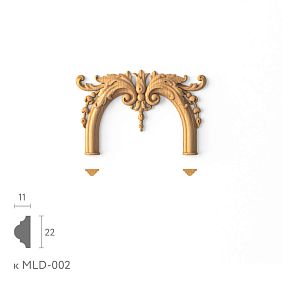
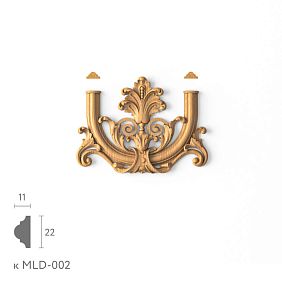
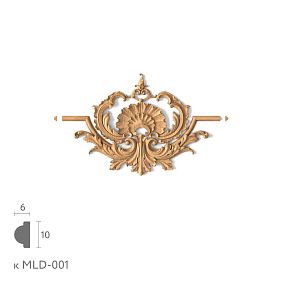
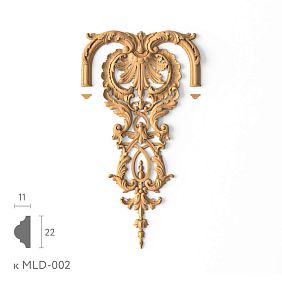
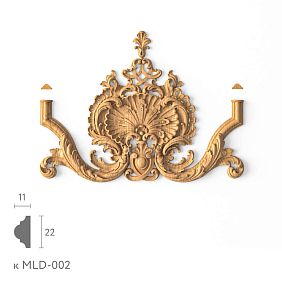
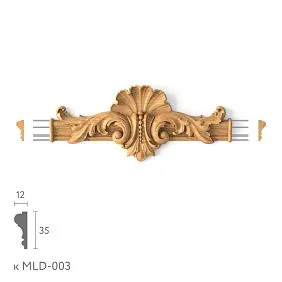
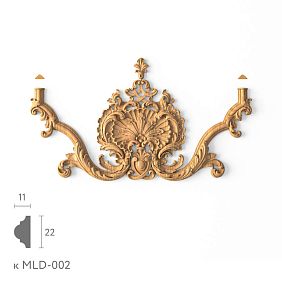
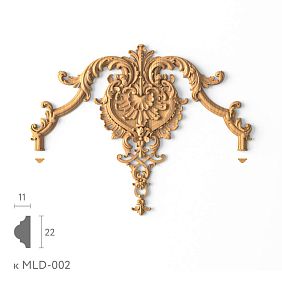
A decorative cartouche is a central ornamental overlay that transforms a furniture facade, wall frame, door portal, or fireplace area into a complete, logically assembled composition. Unlike a garland with its extended linear rhythm, a cartouche works like a medallion, as a semantic center, as the main accent around which everything else is built. For painted walls and large portals, polyurethane overlays with a cartouche ornament are optimal—they easily accept any paint and create a monolithic surface with rich relief. For furniture, doors, and natural finishes, wooden overlays with a cartouche ornament made of beech or oak provide a lively, warm, structural result that polyurethane cannot replicate.
The main thing when choosing a cartouche is to understand that it does not exist in a vacuum. Its size, relief, ornament, and material are determined by the location: the width of the facade, the scale of the frame, the height of the portal, adjacent moldings, and the nature of the finish. Choosing a cartouche "by picture" without measurements is the most common mistake, which costs both money and rework.


What is a decorative cartouche
In architectural tradition, a cartouche is an ornamental element in the form of a scroll, shield, medallion, or framed field, inside which an inscription, coat of arms, monogram, or ornamental motif could be placed. In interior decor, the meaning of this word has expanded: today, a cartouche refers to any central ornamental overlay with a complete, self-contained form—curled, floral, classical, baroque, or neutral.
The fundamental difference between a cartouche and a garland is in structure. A garland is linear, creating a horizontal or vertical rhythm. A cartouche is centric, closed in on itself, it "stands" in place and attracts the eye precisely with its completeness. It is a medallion, not a ribbon. It is a jewel-like central stone, not an ornamental chain. That is why the cartouche and garland often work together in a classical decorative system: the garland creates rhythm, the cartouche creates a focal point.
Historically, the cartouche appeared in Mannerist and Baroque architecture, from where it transitioned into Classicism and Empire style. Today, it is organic in any interior with a classical vector—from strict neoclassicism to luxurious French style. The main condition: the scale and ornament must correspond to the overall character of the space.




Where is a cartouche used in the interior
A cartouche is an element without a rigid attachment to a specific place. It is used wherever a central decorative accent is needed. Let's consider each application with an understanding of logic and practice.
Our factory also produces:



On furniture facades
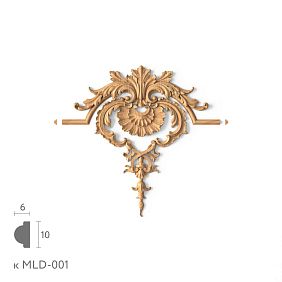
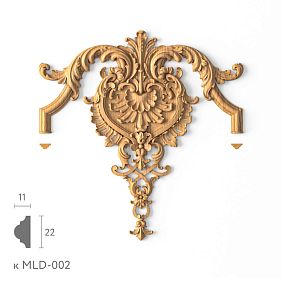
Furniture is the most common place for a decorative cartouche. A central overlay on the facade of a cabinet, chest of drawers, sideboard, nightstand, console, or kitchen facade is an element that distinguishes furniture from a series of faceless products and gives it character. On a wide facade with a double door, the cartouche is placed along the central axis between the doors—it accents the joint and turns a technical node into a decorative one. On a single-door facade, it is placed in the center of the field.
For furniture facades, it is better to choose Wooden decorative inlays Made of beech or oak. The wood naturally complements the furniture material, accepts both enamel and tinting well, and creates a natural, lively relief. Polyurethane on furniture is also possible, especially if the entire facade is prepared for painting — in that case, the material doesn't matter, only the shape of the ornament is important.
The scale of the cartouche for furniture: no more than 30–40% of the facade width. If the facade is 60 cm — the cartouche is 18–25 cm. The relief is moderate, 5–10 mm, so as not to overlap handles, hinges, and adjacent elements. Ornament: floral and botanical — for soft classic and neoclassical styles; scrollwork — for Baroque and Empire; concise geometric with botanical inserts — for strict classic and cabinet style.
Get Consultation
On wall panels
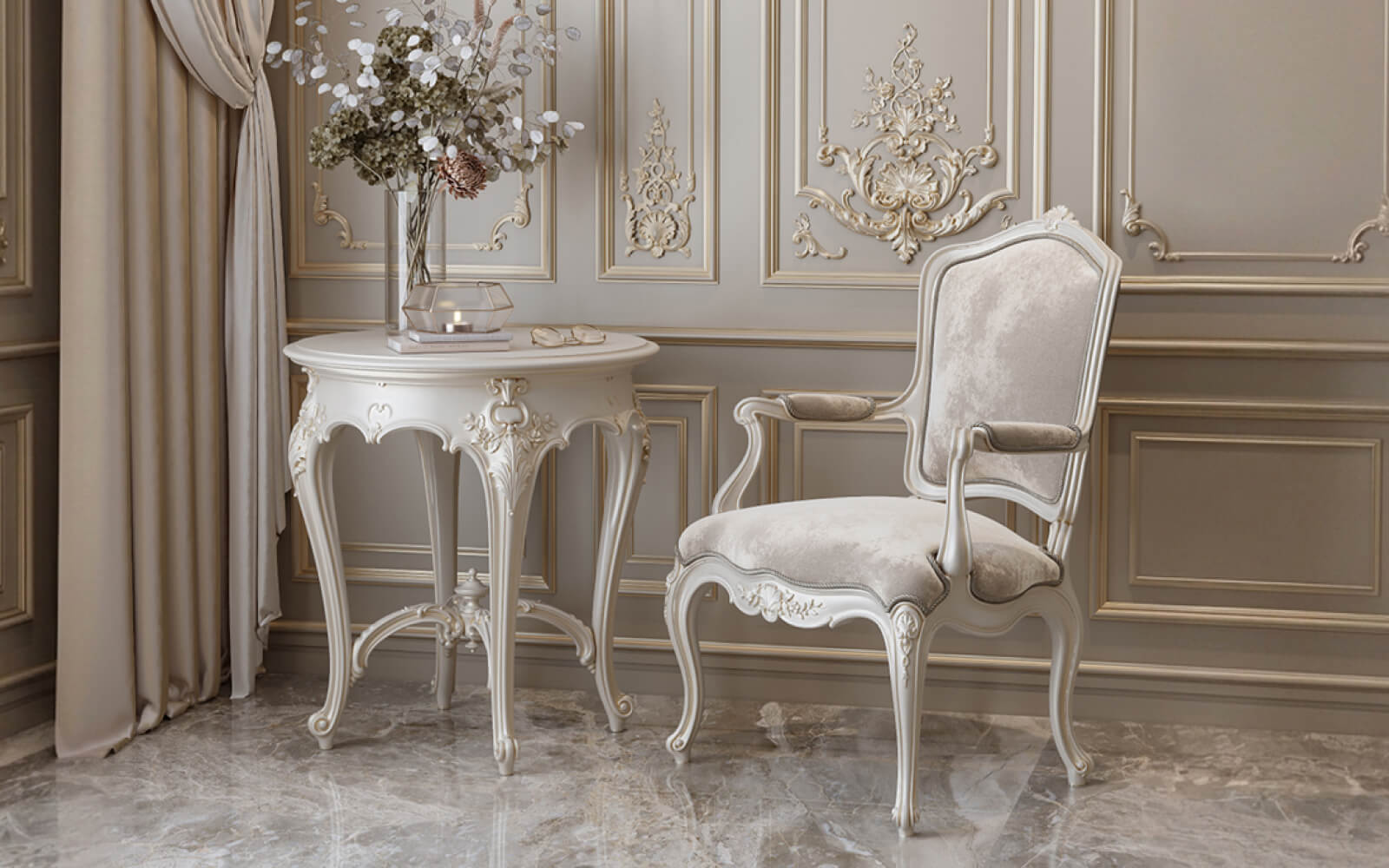
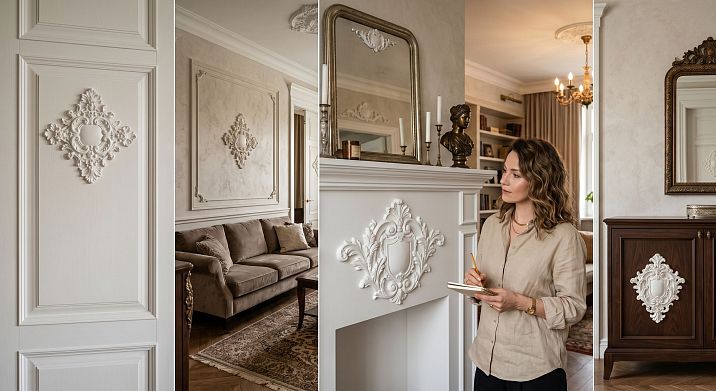
A wall with decorative molding frames is one of the most characteristic images of a classic interior. A cartouche inside such a frame turns the geometry into a complete decorative picture. It can be located in the center of the frame field, in the upper part, or along the central axis of a horizontal field — depending on proportions and the task.
For wall frames, it is better to choose molded decoration made of polyurethane. A polyurethane overlay on the wall — painted in the wall color or in a separate accent tone — creates a monolithic architectural surface. The relief here can be more developed than on furniture: 10–20 mm or more provide expressive shadow play, especially with side or spot lighting.
PU overlays from the STAVROS catalog — these are solutions specifically for such tasks: accent decorative elements with different types of ornament, including cartouche, for wall panels, portals, and complex interior compositions.
On doors and portals
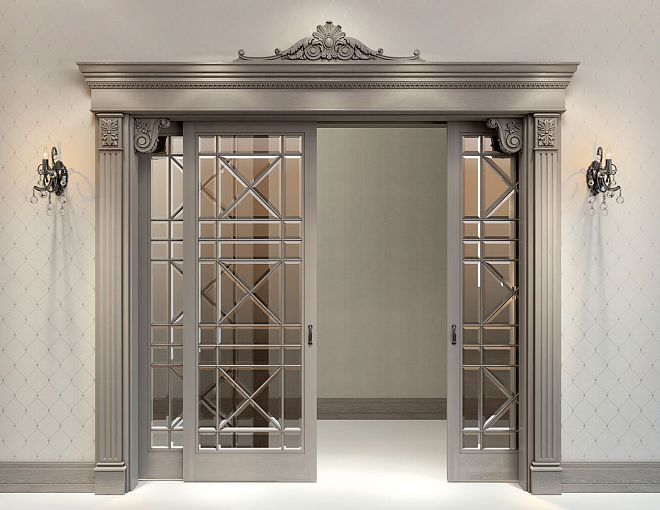
A door portal is where the cartouche plays its most ceremonial role. The central overlay above the portal lintel, in the upper framing zone, is the "keystone" of the entire architectural system. Historically, this is where the cartouche was used as an element of power and representation: above the doors of palaces, halls, and formal studies.
For a door portal, the cartouche is chosen according to the scale of the molding. If the molding is wide and relief — the cartouche can be large and expressive. If the molding is thin — the cartouche should be delicate so as not to disrupt proportionality. Decor for Molding in the STAVROS catalog includes precisely such central elements, created for portal and frame systems — they are designed to organically integrate into the molding structure, not compete with it.
On the fireplace
The fireplace area is a space that requires a majestic decorative solution. A cartouche above the fireplace mantel or in the central field of the fireplace front is a classic technique rooted in the interior culture of the 18th–19th centuries. It creates an ornamental dominant around which the entire decorative program of the area is organized: side overlays, cornice, moldings.
For a fireplace, a more expressive relief is preferred: 15–25 mm. The distance to the firebox should not be too small — polyurethane does not like direct heat exposure. The cartouche is mounted on the fireplace mantel or on the wall above the firebox opening — where there is no direct heat.
On the mirror and frame
A mirror with a cartouche in the upper part of the frame is an image known to us from interior photographs of palace halls, antique living rooms, and classic boudoirs. The central overlay above the mirror visually 'covers' it, adds architectural completeness, and turns the mirror from a functional item into an independent decorative object.
For a mirror frame, the cartouche should be compact and delicate — it should not outweigh the light construction of the frame. Carved wooden decoration STAVROS offers overlays of exactly this format: small, with fine ornament detailing, which work well on wooden frames and small-scale surfaces.
Polyurethane or wooden cartouche — which to choose
This question arises for everyone who works with decorative overlays. The answer, as always in this topic, depends on the task — but there is a clear system of criteria.
A polyurethane cartouche is the choice for wall surfaces to be painted, for portals, fireplace areas, and frames made of moldings. Its advantages: light weight, insensitivity to humidity, excellent paint adhesion, the ability to produce large and complex shapes without risk of deformation. Polyurethane can be painted any color, accepts patina, and imitates stucco well. That is why it is the material of first choice for monolithic painted wall systems.
A wooden cartouche made of beech or oak is the choice for furniture, doors, and interiors with natural wood. Wood provides a living structure, warm texture, and precise detailing of fine elements in carving. Beech under enamel creates a smooth, dense surface without visible pores — it is ideal for painted furniture. Oak under tinting retains its beautiful structure and adds a natural noble character to the overlay.
| Task | Best choice |
|---|---|
| Wall to be painted in wall color | polyurethane cartouche |
| Molding frame to be painted | Polyurethane |
| Furniture facade for tinting | Oak |
| Furniture facade for enamel | Beech or polyurethane |
| Solid wood door | Wood |
| Fireplace portal | polyurethane or wood depending on material |
| Natural classic furniture | Wood |
| Neoclassicism with laconic decor | Polyurethane |
| Baroque / Empire with lush ornament | expressive polyurethane or wood |
| Restoration of antique furniture | Wood |
There is another criterion that is rarely stated explicitly: the detailing of the ornament. Wood carving, at the same size, can be finer and more precise than its polyurethane counterpart — especially in small details. If the cartouche requires the finest detailing of leaves, petals, and curls — wood provides higher quality of the pattern. If the ornament is large and monumental — polyurethane performs just as well.
How to choose the size of a cartouche
Size is a parameter where a mistake cannot be corrected after installation. A cartouche that is too small on a large surface gets lost, creating a sense of randomness. One that is too large overwhelms, creates tension, and competes with other elements. The right size is one that is proportionate to the field and leaves space to "breathe."
For a furniture facade. Guideline: the cartouche occupies 25–40% of the facade width. For a 60 cm facade — an overlay of 15–24 cm. For a 90 cm facade — an overlay of 22–36 cm. Relief is moderate, 5–10 mm: sufficient for readability, does not interfere with functionality.
For a wall frame. The cartouche occupies 30–50% of the inner field width of the frame. For a 50×80 cm frame — an overlay of 15–25 cm. Here, the relief can be deeper: 10–20 mm create a developed play of shadows under side lighting.
For a door portal. Cartouche above the lintel: 40–60% of the opening width. For a 90 cm opening — a cartouche of 36–54 cm. It should fill the horizontal field above the lintel without extending beyond the moldings.
For a fireplace portal. Here, a larger scale is acceptable: 50–70% of the fireplace front width. A fireplace "holds" large decor better than furniture — it is monumental in itself.
For a mirror frame. Compact format: 20–35% of the mirror width. The cartouche above the mirror should not be wider than the mirror itself — this ruins the proportion.
Separately about relief thickness. For furniture with handles, the relief should be less than the distance from the facade surface to the nearest handle — otherwise the overlay will press against it. Always measure this gap before purchasing.
How to combine a cartouche with moldings
A cartouche and moldings are an inseparable pair in the classical interior system. Moldings create frame geometry: horizontals, verticals, a closed field. The cartouche fills this field with ornamental meaning. Together, they create what in design is called a complete decorative unit.
Combination principles:
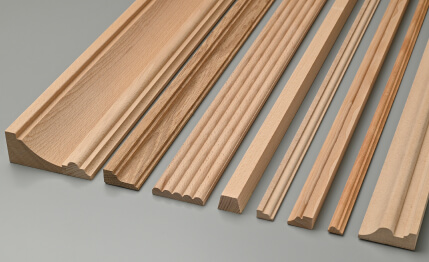
The molding should be proportionate to the cartouche. If the cartouche is large and expressive, the molding can be wider and more architectural. If the cartouche is compact and delicate, it is better to choose a thin or medium molding. The main rule: the cartouche is the dominant element, the molding is the frame. If the molding draws too much attention, the cartouche gets lost.
Corner elements. At the joints of molding strips, you need Decor for Molding — corner pieces that "seal" the corners and turn a technical joint into a decorative detail. The corner element and the cartouche must be from the same stylistic language: you cannot place a baroque curl in the corners and a laconic neoclassical cartouche in the center.
Side overlays on the molding. If the frame is tall and the vertical molding posts look empty, you can add side decorative overlays. They do not compete with the cartouche but create rhythmic support. The main thing is that the side elements should be noticeably more modest than the cartouche.
Stylistic unity. A floral cartouche goes with floral corner elements and floral side overlays. A scroll cartouche goes with corner elements featuring scrolls. A geometric cartouche goes with minimalist corners and simple molding. Mixing different ornamental languages creates chaos.
Moldings made of polyurethane STAVROS are available in various profiles — from thin contour to expressive architectural. When choosing molding for a specific cartouche, focus on scale: the larger the cartouche, the more substantial the molding can be, but it should never exceed it in visual impact.
How to choose the finish
Finishing is not a final operation but one of the first decisions to be made before purchase. Because the material of the overlay and its final finish form a unified system where each parameter affects the result.
Polyurethane for painting in the wall color. The most popular technique for wall cartouches and frame systems. The overlay is painted with the same paint as the wall — the decor "sinks" into the surface, leaving only the relief with shadow play. This is an architectural, restrained, high-quality result. This is the approach used in professional design projects.
Beech for dense enamel. Beech has no pronounced grain, so the enamel lays evenly without the structure showing through. White, cream, pearl-gray, powder-pink enamel on a beech overlay — a flawless result for a neoclassical interior with painted furniture.
Oak for tinting and varnish. Oak with its beautiful grain is a material that should not be "hidden" under an opaque coating. Tinting in any shade — from light natural to dark tobacco — reveals the grain and adds depth. Such a cartouche looks like a piece of jewelry-like decor where the material is part of the beauty.
Patina. Applying patina — dark or gold — in the recesses of the relief creates an aging effect. This is a classic technique for Baroque and Empire interiors. Polyurethane accepts patina as well as wood — only the correct application technique matters.
Gilding and silvering. These are accent solutions that require caution. A gilded cartouche on the wall is a strong statement that is only appropriate in certain contexts: a grand hall, a luxurious living room with corresponding decor. In an ordinary apartment, it can easily turn into bad taste. Rule: if you are in doubt — do not gild.
Mistakes when choosing a cartouche
Over years of working with decorative overlays, mistakes are repeated with enviable regularity. Let's name them honestly and to the point.
They call any decor a "garland" when a central cartouche is needed. These are different elements with different logic. A garland is linear. A cartouche is centric. Confusing them when ordering means buying the wrong thing.
They buy a cartouche without measuring the facade or frame. The most costly mistake. The cartouche must be selected for specific dimensions, not the other way around. First — the tape measure, then — the purchase.
They take an overly large overlay for a small door. A cartouche occupying 80% of the facade does not create an accent — it creates pressure. The decor must be proportionate to the field.
They place a small cartouche on a large wall. Small decor on a large surface is not delicacy, it is a loss. It simply does not work.
They do not account for the thickness of the relief. A relief overlay on furniture may hit a handle, interfere with opening a drawer, or overlap an adjacent part. Always check the clearance.
They do not plan adjacent moldings. A cartouche without a molding frame loses part of its potential. Moldings create the context in which the cartouche becomes the semantic center.
They mix different ornaments without a unified style. A baroque cartouche with geometric corner elements is incompatible. The ornamental language must be consistent.
They don't decide in advance: painting, enamel, varnish, or tinting. The overlay material is chosen for the finish, not the other way around. Beech for tinting is a wrong decision. Oak for dense enamel is also debatable. Decide on the finish first.
They place the cartouche not on the central axis. A shift of 5 mm will be noticeable. Marking is mandatory. Use a level, tape measure, and pencil.
They buy one overlay when a pair is needed. If the composition requires symmetry — two cartouches on either side of a doorway, for example — order left and right immediately. Ordering from another batch is risky.
FAQ: Answers to popular questions
What is a decorative cartouche?
It is an ornamental central overlay with a complete closed form — a medallion, shield, scroll, or symmetrical ornamental composition. It is used as the main decorative accent on furniture, walls, doors, portals, mirrors, and fireplaces.
How is a cartouche different from a garland and a rosette?
A garland is a linear ornament creating an extended rhythm. A rosette is a round or multi-petal overlay, usually for ceilings. A cartouche is a central, often rectangular or oval overlay with a decorative frame shape. All three are different elements with different purposes.
Where is a cartouche used in interior design?
On furniture facades (cabinets, dressers, sideboards, consoles), on walls (inside molding frames, on panels, in niches), on doors and portals (above the lintel, in the upper part), on fireplaces (above the mantel), on mirror frames (in the upper part).
Which cartouche to choose for furniture?
A carved wooden overlay made of beech (for enamel) or oak (for tinting). Size — 25–40% of the facade width. Relief — moderate, 5–10 mm. Ornament — matching the style: floral for soft classic, scrollwork for baroque, neutral for neoclassical.
Which cartouche to choose for the wall?
A polyurethane overlay for painting. For large wall frames — more expressive relief (10–20 mm). Ornament — according to the interior style. Size — 30–50% of the inner frame width.
What is better: polyurethane or wooden cartouche?
For walls to be painted — polyurethane. For furniture to be tinted — oak. For furniture under enamel — beech or polyurethane. For portals — depends on the base material. There is no universal answer — there is a task and its precise solution.
Can the cartouche be painted the color of the wall?
Yes. A polyurethane cartouche is painted with the same paint as the wall — the decor dissolves into the architecture, only the relief remains. This is a professional technique that creates a rich and restrained result.
How to choose the size of the cartouche?
Measure the width of the facade or the inner field of the frame. The cartouche should occupy 25–50% of this width (depending on the location). Check the gap to handles, moldings, and adjacent elements. The relief should be smaller than this gap.
Can you combine a cartouche with moldings?
Yes, and this is the optimal scheme. Moldings create a frame, the cartouche fills it with meaning. Decor for Molding includes corner and side elements that complete the system and create a unified decorative panel.
Where to buy a decorative cartouche for furniture, walls, and portals?
In the STAVROS catalog: polyurethane overlays with cartouche ornament, wooden overlays with cartouche ornament, PU overlays, Wooden decorative inlays, Moldings made of polyurethane — all in one place, with the ability to select elements from the same stylistic and scale family.
About the Company
STAVROS is a Russian manufacturer and supplier of decorative overlays, carved and stucco decor for furniture, walls, doors, portals, and ceilings. The catalog includes polyurethane overlays with cartouche and garland ornaments, wooden carved overlays from beech and oak, moldings of various profiles, corner and side decorative elements. If you are choosing decorative cartouche for a furniture facade, wall frame, door portal, or fireplace area — find the right element in the catalog STAVROS: here are both compact furniture overlays and large architectural accents for large-scale interior projects.