


























Article Contents:
- Buy a wooden carved cross
- The cross as an object and symbol: a brief discussion of the essence
- Which wooden carved cross to buy: key criteria
- Types of wooden carved crosses
- Wall-mounted Orthodox cross
- Carved wooden cross: material and character
- Oak carved cross
- Altar cross
- Carved cross for iconostasis
- Where are wooden carved crosses used
- Home prayer corner
- Church decoration and church interior
- Iconostasis and icon case area
- Carved decor in Orthodox style: broader than the temple
- Ornament of a carved cross: a language to be read
- How to choose a carved wooden cross: step-by-step breakdown
- What affects the price of a wooden carved cross
- Mistakes when buying a wooden carved cross
- Carved cross as part of church decor: a systemic view
- Carved Orthodox cross and the tradition of Russian carving
- Where to buy a wooden carved cross
- FAQ: Answers to Popular Questions
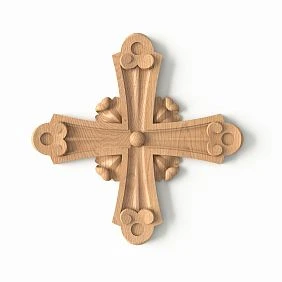
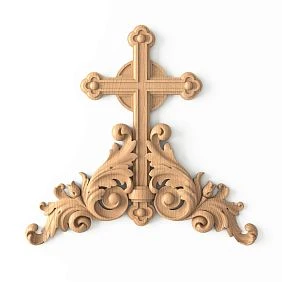
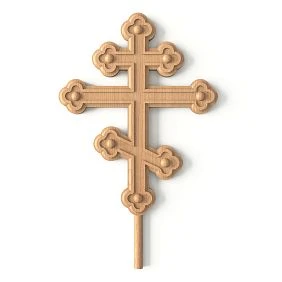
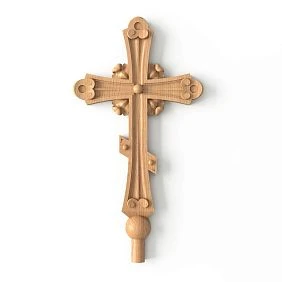
Buy a wooden carved cross
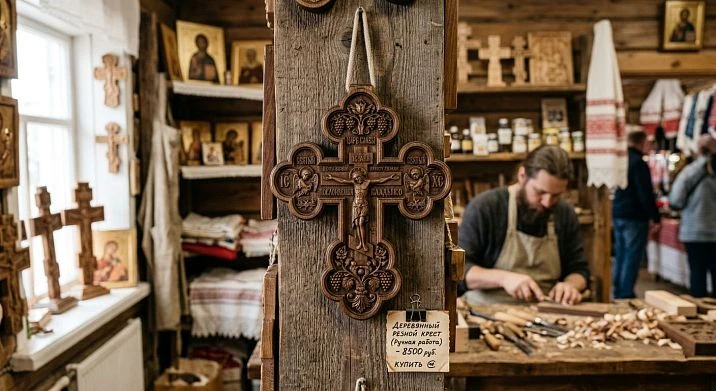
There are objects that exist outside of fashion. Outside trends, outside seasons, outside interior movements. A wooden carved cross is one of them. It does not age, does not go out of use, does not require renewal. Its value is not in relevance — it is in constancy. Generations of master carvers passed the tradition from hand to hand, and each new cross, coming from under the chisel, carried both the personal labor of the master and centuries-old ornamental memory.
Buying a wooden carved cross today means not just acquiring an object. It is a choice of symbol: its form, material, scale, relief, place in space. Whether it will be a wall-mounted Orthodox cross for a home prayer corner, an altar cross for a church, a decorative element of church interior, or a carved oak cross for memorial design — each option requires a conscious approach.
This article is for those who want to make this choice correctly. To buy a carved wooden cross, knowing exactly what you are looking for: by purpose, by material, by the nature of the carving, by size, and by how this object will exist in a specific space.
The cross as an object and symbol: a brief talk about the essence
Before talking about choice — a few words about the nature of this object. The Orthodox cross is not just a decorative form. It is a concentrated symbol, carrying theological, historical, and artistic meaning simultaneously. In the Russian tradition, the eight-pointed Orthodox cross with the upper small crossbar (tablet) and the lower slanted one (footrest) became the canonical form, reproduced in wood, stone, and metal for many centuries.
Master carvers worked with this symbol with special reverence. Each line of the cross is not just a form, but meaning. The ornament with which the cross was decorated — plant vines, grapevines, lilies, cherubs, geometric borders — all of this is not random decorative solutions, but a theological language with which the master spoke to the viewer.
wooden patterns Sacred objects in Russian architecture are a separate and very rich topic. Each motif has its own roots, its own symbolism, its own regional tradition. Understanding this means looking at a wooden carved cross differently: not as a commodity, but as a work that carries cultural memory.
Our factory also produces:
Which wooden carved cross to buy: key criteria
Buying a carved wooden cross consciously means going through several key questions. They are not complicated, but without them, the choice becomes a lottery.
Purpose. A wall cross for the home is one format. An altar cross for a church is another. church decor Overall, it is a broad field, and the cross occupies a specific place within it depending on the task.
Placement location. The wall of a home prayer corner, an iconostasis, an altar area, the central nave of a church, a shrine niche, a chapel facade — each place imposes its own requirements for size, format, ornament, and mounting method.
Material. Oak, beech, pine, linden, walnut — each wood has different properties, surface character, and color. Buying an oak carved cross means choosing maximum strength and durability. Linden is softer, better for fine carving. Beech is dense and uniform.
Size. A small wall cross 150–200 mm is a delicate accent. A cross 400–600 mm is an expressive central element of a prayer corner. A cross 800 mm and above is for large walls, church spaces, altar areas.
Type and depth of carving. Flat carving is a clean silhouette, minimal relief. Volumetric carving is relief 10–25 mm, play of shadows, rich ornament. Through (openwork) carving is a cut-through ornament, a 'lace' effect.
Coating. Toning, oil, varnish — each option changes the perception of the object. Light wood without coating is asceticism. Dark toning is solemnity. Gilding of individual elements is a festive, iconostasis tradition.
Get Consultation
Types of wooden carved crosses
Wall-mounted Orthodox cross
Buying a wall-mounted Orthodox wooden carved cross is the most common query in this category. And it's no surprise: a wall-mounted Orthodox cross is an essential element of any Orthodox home, any prayer corner, any church room.
You need to buy a wall-mounted Orthodox wooden carved cross considering where exactly it will hang. For a home prayer corner with icons and a lamp, the cross should be proportionate to the icons. It should not dominate them, but it should not get lost either. The standard size for a home corner: height 300–500 mm, width 200–350 mm.
Buying an Orthodox wooden wall-mounted carved cross for the living room, bedroom, or study is a different scenario. Here the cross can be more modest in size but rich in carving: fine ornamentation, openwork, plant motifs around the crosspiece.
Carved cross from the STAVROS catalog is a specific, ready-to-order item with set parameters: shape, relief, wood species, finish. This is important: when buying a carved cross from the manufacturer, you get a product with clear characteristics, not an anonymous item of unknown origin.
It is also worth buying a wall-mounted carved cross for decorating the entrance to the house, for placing above the door — this is an ancient Orthodox tradition preserved in Russian village houses. A cross above the entrance is a protective symbol, and its design was traditionally chosen with special care.
Carved wooden cross: material and character
Buying a carved wooden cross — in this query, 'wooden' is not just a material specification but a fundamental choice. Wood is a living material. It breathes, changes shade over time, has its own smell, its own texture, its own temperature to the touch. A wooden cross in your hands is warm. This is not a metaphor — it's physics: wood conducts heat poorly and does not cool from touch, unlike metal or stone.
You need to buy a carved wooden cross with an understanding of how the wood species affects the appearance of the finished product.
Oak. Dense structure, expressive texture, dark veins, noble color from light brown to dark walnut when tinted. Oak is the most "serious" wood for carved church items. An oak cross represents fundamentality, durability, monumentality.
Beech. Even, fine-grained structure. Holds fine relief well. After tinting, it acquires a reddish-brown hue. Slightly "warmer" in color than oak. Works well in items with fine ornamentation.
Linden. Soft wood, ideal for hand carving with high detail. Light, almost white. Traditional wood for iconostasis carving and church wood decor.
Walnut. Rich, expressive texture. Dark, saturated color. Premium material for high-end items.
Buying a carved wooden cross also means understanding which carving technique was used. In the STAVROS catalog, items are produced using CNC milling and manual finishing — this combination achieves geometric precision while preserving the lively character of the surface.
Oak carved cross
Buying an oak carved cross is a separate and very persistent query. Oak in the Orthodox tradition is a tree with symbolic meaning. Strength, longevity, indestructibility — all this was attributed to oak in folk culture. For a sacred item meant to serve generations, oak is a logical choice.
It is worth buying an oak carved cross primarily when durability is important: for a church, a chapel, a roadside chapel, for permanent placement in a public space. Oak is resistant to mechanical stress, does not deform with humidity changes, and withstands temperature fluctuations well.
Buying an Orthodox oak carved cross is a request often received from parishes and monasteries when equipping new churches or renovating existing ones. In this context, both the size (often crosses 600 mm high and above are needed) and coordination with other elements are important. church decor.
An oak cross with relief ornamentation — volumetric carving, vine on the crossbars, cherubs at the base of the vertical arm, geometric border along the outer perimeter — is a canonical image recognized at first glance. It is this cross that sets the tone for the entire church space.
Altar cross
Buying a carved wooden altar cross is a specific request that implies an understanding of the liturgical space. An altar cross is a cross placed on the altar in the sanctuary of an Orthodox church. It participates in worship, is brought out for veneration, and is one of the main sacred objects of the altar.
An altar cross made of wood was traditionally crafted from oak, walnut, or another durable species with a rich relief ornament. Its shape is the eight-pointed Orthodox cross, with proportions verified by liturgical tradition. The decor is strict and solemn: without the excessive decorative frivolity inherent in household items.
In the STAVROS catalog, the section Church decor covers a wide range of wooden products for Orthodox interiors — from individual crosses to comprehensive decorative furnishings.
Carved cross for the iconostasis
The iconostasis is a wall of icons separating the sanctuary and the nave of an Orthodox church. The central cross of the iconostasis, installed above the Royal Doors, is one of the most important decorative and symbolic elements of the entire structure.
A carved cross for the iconostasis is a large-scale item. Typically, the height of such a cross ranges from 600 to 1500 mm or more, with proportional width. The ornament must align with the carving of the iconostasis row, the column capitals, and the plant motifs adorning the iconostasis.
In the Orthodox carving tradition, the cross of the iconostasis is often surrounded by a radiance — a radiant halo made of carved wood, imitating a golden glow. This creates a powerful visual accent at the top point of the iconostasis and emphasizes the vertical axis of the entire structure.
For those planning comprehensive furnishing or renovation of the iconostasis, it is wise to consider in advance and Carved icons in the same decorative key — for consistency of the entire system.
Where are wooden carved crosses used
Home prayer corner
This is the most common scenario for a private buyer. An Orthodox prayer corner is a special area in the home where icons, a lamp, and a cross are gathered. Placement: traditionally — in the eastern part of the room, in a corner, at a level slightly above the gaze of an adult.
In this context, a wall-mounted Orthodox wooden carved cross is the central element around which the entire prayer corner is built. It should be proportionate to the icons, but at the same time read as an independent, significant object.
A handmade wooden cross (or with final hand finishing, like STAVROS products) is not just "more beautiful", it is a different surface quality, a different feeling from the object. The living trace of the tool on the wood makes the product unique, unrepeatable.
Temple decoration and church interior
Wooden church decor is a complex task in which the carved cross occupies several positions simultaneously. The central altar cross. The cross above the Royal Doors. Crosses on the domes of the iconostasis. Processional crosses. Worship crosses in the nave. Each has its own place, its own scale, its own decorative program.
For small parish churches, for village churches, for chapels and prayer houses, a wooden carved cross is often the only truly affordable option in terms of price, beauty, and durability. Plaster stucco, gilded metal products are expensive and require specialists. A wooden carved cross is the work of one master, one object, complete and expressive.
For larger projects — equipping newly built churches — STAVROS can provide the manufacture of sets of decor in a unified style: crosses, Carved iconselements of iconostasis carving, decorative overlays
Iconostasis and icon case area
A wooden carved cross for the iconostasis works as part of an ensemble. Its ornament must be coordinated with the carving of the iconostasis tiers, with the plant shoots and capitals of the iconostasis columns. A break in style is the most common mistake when equipping churches: they take a cross from one master, an iconostasis from another, and none of it 'speaks' to each other.
The icon case area is a place for storing particularly venerated icons. A small carved cross is often installed above or on top of the icon case as a completion of the entire structure. In this case, the cross must match the style of the icon case: if the icon case has a Baroque plant ornament, the cross should follow the same ornamental tradition.
Carved decor in Orthodox style: broader than the church
Not only churches and prayer corners. A wooden carved cross in Orthodox style is used today:
-
On the facades of wooden houses — above the porch or at the entrance, continuing the tradition of house carving. For those who want to understand the depth of this tradition, the material about wooden ornament comes in handy.
-
In interiors with Orthodox themes — in living rooms, studies, dining areas.
-
In Orthodox institutions — schools, almshouses, shelters, monastery hotels.
-
In the memorial design — here a wooden oak cross becomes the most important object, connecting personal memory with an eternal symbol.
Ornament of the carved cross: a language to be read
A wooden carved cross is not just a form with ornament. It is a text written in the language of carving. Each motif has meaning.
Vine. One of the most important symbols of Orthodox decor — a reference to the words about the "vine and branches," to the Eucharist, to the unity of the Church. Vine shoots with clusters, wrapping around the vertical arm or all arms of the cross — this is a canonical motif found in church decor of many eras.
Lily flower. A symbol of purity and innocence. Often adorns the crosspiece or ends of the arms of an Orthodox cross.
Cherubim. Winged angelic faces on the lower part of the vertical arm — a stable motif dating back to iconographic tradition.
Plant tendrils. Geometrically regular or freely developing shoots with leaves, flowers, and curls — a universal ornamental motif that simultaneously connects the cross with nature and with the spiritual meaning of life and growth.
Geometric borders. Meander, teeth, braiding — archaic ornamental motifs coming from pre-Mongol Rus' and Byzantium. A strict geometric border along the perimeter of the cross gives it architectural clarity.
Understanding these motifs is essential when choosing: a cross with a vine and a cross with a geometric border are two different statements, two different moods, two different contexts. One is suitable for one place, another for another.
Learn more about the language of decorative wooden ornaments in the STAVROS article on ornaments in wooden decor.
How to choose a carved wooden cross: a step-by-step guide
Buying a carved cross means going through several steps, each narrowing the choice to the right decision.
Step 1: Determine the purpose. A home wall cross, an altar cross, for an iconostasis, for the entrance to a house, for a chapel, for memorial decoration — each purpose sets its own parameters.
Step 2: Determine the placement location. Wall, altar, iconostasis, facade, icon niche, open space. Operating conditions (humidity, lighting, accessibility for touch) are also important.
Step 3: Determine the required size. Measure the place where the cross will be installed. For a prayer corner wall, correlate the size with the icons. For the altar area, with the height and scale of the space.
Step 4: Choose the wood species. Oak — strength and durability. Beech — relief and precision. Linden — delicate carving and light surface. Walnut — richness of texture and color.
Step 5: Assess the depth and type of carving. Flat carving — concise expressiveness. Volumetric — rich relief. Openwork — 'airiness', lace effect. For a large space with good side lighting, volumetric carving reveals itself to the fullest.
Step 6: Check the ornamental style. Does the ornament match the style of the space? Is it consistent with other elements of church decor in the same room?
Step 7: Choose the coating. Toning "under dark oak" — solemnity and tradition. Light oil — naturalness and warmth. Gilding of accent elements — festive, iconostasis tradition.
Step 8: Consider the mounting. The wall cross must be securely attached to the wall. Check for the presence of a mounting loop, pin, or groove for the fastener. For heavy oak crosses — the mounting must correspond to the weight of the product.
Step 9: Choose accompanying decor. A carved cross works best in an ensemble: Carved icon, decorative overlays, icon case, candlestick, lampada. To coordinate the entire decor system — work with one manufacturer or in a single style key.
Step 10: Calculate the budget for the set. One cross — one item. But if the task is to fully design a prayer corner or icon case area — consider the entire set: cross + icons + decorative overlays + lighting solution.
What affects the price of a wooden carved cross
The price of a carved wooden cross is a question asked immediately. And rightly so: the range here is wide, and it is important to understand what lies behind it.
Wood species. Buying a carved oak cross is more expensive than a linden analogue. Walnut is even more expensive. The cost of the material directly affects the final price.
Size. A 200 mm cross and an 800 mm cross are fundamentally different amounts of material and labor intensity of processing.
Complexity of carving. A simple relief profile — minimal processing. A complex multi-level ornament with a vine, cherubs, and openwork inserts — several operations, high labor intensity.
Depth of relief. A 5 mm relief — one level of processing. A 20–30 mm relief — multi-level milling, manual finishing.
Coating. Without coating — base price. Tinting, varnish, oil — add to the price. Gilding — significantly more expensive.
Manual or machine processing. CNC milling + manual final finishing (like STAVROS) — optimal balance of precision and surface liveliness. Fully manual work of a master carver — maximum uniqueness and maximum price.
Standard or custom size. Standard format — faster and cheaper. A cross of non-standard proportions or with a custom ornament — calculation and production for a specific order.
Delivery and packaging. A wooden carved cross is a fragile item requiring careful packaging. For large crosses and batch orders — separate logistics calculation.
Mistakes when buying a wooden carved cross
Over the years of working in this field, you see the same mistakes. Let's list them — so you don't repeat them.
They buy without understanding the purpose. A wall cross that doesn't fit the intended place in size or shape is a common story. First — a clear purpose, then — choosing a specific product.
They do not account for the scale of the space. A small cross on a large empty wall gets lost. A large cross in a cramped prayer corner with several icons feels oppressive and disrupts the balance.
They choose material only by price. Cheap softwood for an altar cross that dozens of people will handle daily is a poor choice. Durability here is more important than economy.
They do not check the quality of the carving. Poorly executed carving—sharp unfinished edges, uneven relief, blurred ornament—is immediately visible. Good carving means clear edges, even relief, and a readable ornament.
They do not specify the coating. A cross without coating outdoors (for facade use) will deform. A cross with varnish in a home prayer corner looks different than one with oil. The coating is not a secondary detail.
They do not check the mounting. A heavy oak cross on a single small nail in a drywall wall is a hazard. The mounting must match the weight of the product and the type of wall.
They mix different decorative styles. A lavish Baroque cross next to minimalist icons creates conflict. An ascetic geometric cross in a richly decorated iconostasis breaks the ensemble. Stylistic unity is a mandatory condition.
They do not think about accompanying decor. A cross bought separately from everything else often 'does not fit' into an existing prayer corner or church interior. It is better to plan the set right away.
The Carved Cross as Part of Church Decor: A Systemic View
A wooden carved cross never exists in space alone. It is part of the system of Orthodox decor—and only within this system does it reveal its full meaning.
In a home prayer corner: cross + icons in the same ornamental tradition + lampada + possibly a small icon case. All of this is a single ensemble where each item supports the other. In the STAVROS catalog, the section Church decor allows you to select crosses and icons in a coordinated stylistic key.
In the temple space: cross + iconostasis + Carved Decor walls and columns + choir furniture + church utensils. The logic is the same: a single style, a single material, a single ornamental language.
Those who want to study the tradition of Orthodox wooden decor more deeply — in the STAVROS catalog there is a separate section with decorative wooden overlays, which are used in Orthodox interiors for decorating altar areas, icon niche spaces, and iconostasis surfaces.
Carved Orthodox cross and the tradition of Russian carving
One cannot speak of a wooden carved cross without touching upon the tradition from which it emerged. Russian wood carving is several centuries of a continuous school, in which masters created iconostases, window frames, church utensils, and wooden crosses.
Each product in this tradition bore the imprint of time, place, and master. Yaroslavl carving differed from Novgorod, Pskov from Moscow. But with all the regional diversity, the common language of symbols and ornaments remained unified. The vine, angelic faces, geometric weaves — these motifs traveled from region to region, adapting to local tradition but not losing their common meaning.
STAVROS works within this tradition — using modern CNC technologies that allow reproducing historical ornaments with documentary precision. Final hand finishing preserves the liveliness of the surface. The result is a product that is both precise and alive.
For a more complete understanding of the ornamental tradition underlying church wood decor — STAVROS materials on wooden patterns и wooden ornament provide a rich historical and visual context.
Where to buy a wooden carved cross
STAVROS manufactures Carved wooden items occupy a special place in this regard. Wood carving not only emphasizes the aesthetics of a room but also gives it warmth, lively energy, and uniqueness. In modern interiors, carved elements are widely used due to their unique properties and adaptability to any style—from classic to minimalism. for interior, facade, and church use. The range includes Carved cross, Wooden church decor, Decorative Inserts и Carved wooden decoration for a wide range of tasks.
Manufacturing — Russia, delivery across the country and to the CIS. Showrooms in Moscow and St. Petersburg allow you to assess the relief, size, and material of products before purchase. For serial orders (multiple crosses for equipping several rooms or complete church decoration) — individual calculation and coordination of completeness.
Buying a wooden carved cross correctly means not just clicking "add to cart." It is a choice of an item with character, with history, with a place in space and in life. STAVROS makes exactly such products.
FAQ: Answers to popular questions
Which wooden carved cross should you buy?
The choice depends on the purpose: wall-mounted for a home prayer corner, altar cross for a church, decorative for the iconostasis area. Important are size, wood species, carving depth, ornament, coating, and mounting method.
How is a wall cross different from an altar cross?
A wall cross is attached to a vertical surface. An altar cross stands on the altar, has a different base format, and requires stability for regular use in worship.
How to choose a carved wooden cross?
Determine the purpose, installation location, required size, wood species, type and depth of carving, ornament, and coating. For an expressive effect, choose a cross with a readable relief and a coordinated ornament.
Which is better: an oak cross or one made from another wood species?
Oak — for durability, monumentality, and serious use (temple, chapel, public space). Beech — for precise relief in medium size. Linden — for delicate detailed carving. Walnut — for a premium solution with rich texture.
What affects the price of a carved wooden cross?
Wood species, size, complexity of ornament, depth of relief, type of processing (CNC, handwork), coating (tinting, oil, gilding), standard or custom format.
Where to use a wooden Orthodox cross?
Home prayer corner, temple, iconostasis, icon case area, house facade, memorial site. In each of these scenarios, there are specific requirements for size, material, and ornament.
Can a carved cross be used for interior decor outside a religious context?
Yes. A carved wooden cross as a decorative element with a high artistic level is used in interiors with Slavic, ethnic, historical, and artisanal accents. In this context, it functions as a piece of carved decor, not just as a religious symbol.