










































































Article Contents:
- Buy polyurethane balustrade
- What is a balustrade: structure, language, logic
- Which polyurethane balustrade to buy: where to start
- Where are balustrades used: application scenarios
- For stairs
- Turned and carved balusters: the difference
- For terrace and porch
- For interior: double-height space and stairwell
- For kitchen and furniture: furniture balustrade
- Polyurethane balustrade: when it's the right choice
- Balustrade: polyurethane, wood, or concrete — an honest comparison
- What's included in a balustrade: complete system composition
- What affects the price of a balustrade: breaking it down without hidden items
- How to calculate a balustrade before purchasing
- Mistakes when buying a balustrade
- Balustrade and interior architecture: a system, not a detail
- Furniture balustrade: a special scenario
- Where to buy polyurethane and wooden balustrades in Russia
- FAQ: Answers to Key Questions





Buy polyurethane balustrade
There are things we notice immediately — and things we only notice when they are gone. The balustrade is one of the latter. While it is there, the staircase looks like a staircase. The terrace looks like a terrace. The facade looks like a facade. But remove the railing, take away the handrail, leave the opening without balusters — and everything falls apart. The space loses its order, logic, and architectural completeness.
Buying a polyurethane balustrade today is a request from very different people: someone is building a house and designing a staircase, someone is arranging a terrace, someone wants a decorative railing for a kitchen peninsula, someone is restoring a facade. Each with their own task. And each has their own correct balustrade.
This article is written for those who want not just to buy a balustrade, but to choose it consciously: understand the structure, figure out the materials, calculate the set, and avoid mistakes. Here is a complete system from the architectural meaning of this element to a practical checklist before ordering.




What is a balustrade: structure, language, logic
Before talking about buying — let's talk about the essence. A balustrade is a railing structure consisting of vertical supports (balusters), a horizontal handrail on top, and a lower base (pedestal or base). The row is completed by corner and intermediate posts — more powerful support pillars that set the rhythm and bear the structural load.
The origin of the word is from the Italian balaustro, meaning 'pomegranate flower'. It is this flower with a swollen bud and a constriction that formed the basis of the classic baluster shape — swollen in the middle and tapering towards the top and bottom. This form has lived in architecture for millennia and remains the most recognizable to this day.
Staircase balustrade — it is not just a railing. It is a rhythmic system: balusters repeat at equal intervals, creating a visual pulse that guides the eye along the staircase. A properly made balustrade turns a staircase from a utilitarian ascent into an architectural event — into the centerpiece of the space around which the entire interior is built.
Our factory also produces:



Which polyurethane balustrade to buy: where to start
The first thing to do is answer the question: where will the balustrade be installed? The place of application determines the material, structural solution, railing height, and coating requirements. Buying a polyurethane balustrade for interior use is one story. Buying a polyurethane balustrade for an open terrace is another. Buying a polyurethane balustrade for a decorative kitchen peninsula railing is a third.
Location. Staircase, terrace, porch, balcony, facade, kitchen island, furniture shelf — each place has its own requirements.
Function. Railing with a constructive function (people lean on the handrail, safety is a mandatory requirement) or purely decorative (visual accent, space zoning, facade decor).
Material. Polyurethane, wood, plaster, concrete — selection based on operating conditions, structure weight, need for painting, and budget.
Style. Classic, Baroque, Neoclassical, Country, Rustic — no balustrade exists outside a stylistic context.
Buying a ready-made balustrade means getting a set with fixed parameters: standard baluster spacing, standard height, standard handrail profile. This is a good option for standard stairs and terraces. For non-standard openings, stairs with atypical slopes, or special architectural tasks, custom manufacturing is needed.
Get Consultation
Where balustrades are used: application scenarios
For stairs
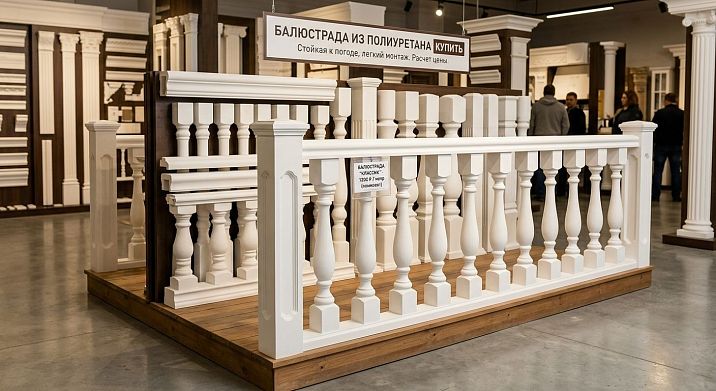
Stairs are the main place for a balustrade. Here it carries not only a decorative but also a functional load: the handrail must support the weight of an adult, the baluster spacing must not allow a child to fall through (standard — no more than 150 mm between balusters), and the railing height must be at least 900–1000 mm according to safety standards.
Buy a balustrade for stairs as a system: Balusters for staircase + handrail + support posts + bottom railing plinth. Balusters are a rhythmic element that sets the visual pulse of the stairs. The handrail is a horizontal element that bears the support load. Posts are support points that fix the structure to the steps, landings, and ceiling.
For a wooden staircase in a classic interior home — wooden balustrade with turned beech balusters and a solid wood handrail — this is a canonical choice. For a staircase in a space with polyurethane wall decor — a polyurethane balustrade logically continues the decorative system of the interior.
In the STAVROS catalog balusters for staircases presented in several types: turned, carved, flat, turned-carved. Each type has its own character and style.
Turned and carved balusters: the difference
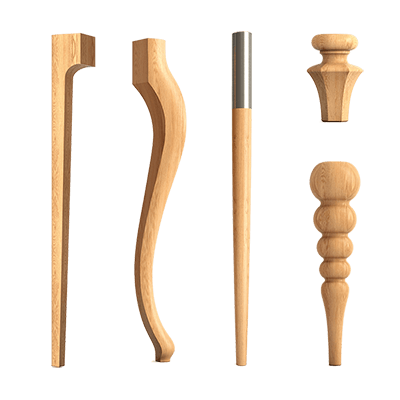
Turned balusters are a classic. The shape is created on a lathe: rotation of the workpiece + cutter = a symmetrical relief shape with alternating necks, rollers, and bulges. Clean, rhythmic, architecturally restrained. Works well in neoclassical, classical, country, and Scandinavian styles.
carved balusters — a combination of a turned base with milled or hand-carved ornamentation. Leaves, vines, rosettes, geometric motifs. More decorative, more visually rich. Works well in baroque, classical, and Russian interiors with a high level of decor.
Flat balusters — these are elements cut from a board along a profile. A flat silhouette with a figured contour. Used for decorative railings, furniture balustrades, kitchen sections, mezzanines, and shelving systems. Visually lighter than turned ones.
For the terrace and porch
Buying a balustrade for a terrace is a task that must take into account external conditions. An open terrace means rain, snow, ultraviolet radiation, and temperature fluctuations. Each of these factors destroys unprotected wood and untreated polyurethane to varying degrees.
For outdoor use, an outdoor balustrade must be:
-
made of moisture-resistant material;
-
with proper protective coating;
-
mounted with drainage in mind (water should not stagnate in the contact areas of the balusters with the base);
-
with stainless steel or coated hardware.
Polyurethane surpasses wood in this regard: it does not absorb water, does not swell, does not crack with temperature changes, and does not rot. With proper painting (facade paint or primer + topcoat), a polyurethane balustrade for a porch or terrace serves for many years without maintenance.
A wooden balustrade for a terrace is a working option provided proper treatment. Antiseptic impregnation, final paint coating, periodic maintenance — without this, wood outdoors deteriorates within 3–5 years.
In the STAVROS catalog Polyurethane Items is a wide range of elements for facade and interior decor, including brackets, moldings, linear profiles, and decorative elements used in balustrade systems.
For interiors: double-height space and stairwell
In interiors with a double-height space — a large hall 5–6 m high with an open gallery on the second floor overlooking it — the balustrade is the central decorative element. It forms the visual pattern of the gallery and sets the style of the entire space below it.
In such interiors, buying a polyurethane balustrade is a conscious choice. Polyurethane does not create additional load on the floor, accepts any coating — from white gypsum color to gilding — and accurately reproduces the classic profile of balusters.
The balustrade in the interior of a hall or living room with double-height space should be coordinated with the staircase, with the decor of the ceiling and walls, with brackets and cornices, with a common palette and ornamental program of the space. An inconsistent balustrade in an exquisite interior is a decorative conflict that catches the eye at first glance.
For kitchen and furniture: furniture balustrade
This is a separate and very interesting scenario. Buying a furniture balustrade means adding a decorative ornamental element to a kitchen set, bookcase, bed, shelving system, or partition.
Buying a balustrade for the kitchen is primarily about decorating the upper part of the kitchen set or peninsula. Often, such a balustrade is installed above wall cabinets in the space between the furniture and the ceiling, filling the empty space and giving the set a "closed" and monumental look. Or — above the bar counter of the kitchen island, creating a visual rhythm and marking the kitchen zone.
You need to buy a balustrade for the kitchen set with flat or small turned balusters: large elements look heavy in a kitchen context. Flat balusters with a figured silhouette, small turned balusters up to 200–300 mm high — the right scale for furniture use.
Buying a balustrade for furniture is also necessary when designing mezzanines and built-in shelving structures in library niches. A small balustrade 150–200 mm high along the edge of a shelf is an elegant historical technique that turns an ordinary rack into a piece of furniture with an architectural character.
Polyurethane balustrade: when it is the right choice
Polyurethane in decorative architecture is a material that appeared relatively recently but has already proven its practical value in thousands of implemented projects.
Light weight is a decisive advantage. A polyurethane baluster weighs 4–7 times less than a wooden one of the same size, and 10–15 times less than a plaster one. For decorative railings on plasterboard ceilings, for mezzanines with a light base, for furniture applications — only polyurethane.
Moisture resistance without additional treatment. Polyurethane does not swell, crack, or rot. This is important not only for open terraces, but also for bathrooms with decorative balustrades, pool areas, and open loggias.
Installation without special preparation. Polyurethane elements are mounted using acrylic glue + dowels for support points. No special tools are needed, no wet processing (as with plaster). One person can install a balustrade section in a few hours.
Ideal surface for painting. Polyurethane is a dense, non-porous material. Primer + paint lay evenly. Can be painted in any color — from classic white to dark RAL of your choice. Can be imitated to look like stone, plaster, or gilding.
Precision of relief. The polyurethane casting method allows reproducing fine ornamental details with high accuracy. A baluster with deep relief, thin necks, and expressive rollers — polyurethane conveys its shape as clearly as plaster, but weighs many times less.
Compatibility with polyurethane interior decor. If the walls are decorated molding made of polyurethane — with moldings, cornices, friezes — the polyurethane balustrade organically continues this system. One material, one surface treatment style, the same reaction to painting.
Application in classic and neoclassical styles. Corinthian, Ionic, Tuscan orders — all use balustrades with characteristic baluster profiles. Polyurethane reproduces these profiles without loss of detail.
Balustrade: polyurethane, wood, or concrete — an honest comparison
This question always arises. And there is no single correct answer — there is the right answer for each specific task.
| Material | When to choose | Comment |
|---|---|---|
| Polyurethane | Lightness, moisture resistance, painting | For interior, facade, terrace, furniture |
| Wood | Natural texture, solid wood, staircase | Works well with wooden handrails and balustrade |
| Concrete | Outdoor load, monumentality | The weight of the structure and the base are important |
| Plaster | Interior decor, classic | Fragile, requires care during installation |
| Solid wood | Premium staircase, study | Durable, but requires maintenance and precise installation |
Buying a wooden balustrade is the right choice for those building a wooden house or cottage and wanting all staircase elements to be made of the same material: steps, handrail, solid wood handlessupport pillars. This is a cohesive and logical system where wood functions both as structure and decor. In the article about wooden balustrades the logic of selecting balusters, posts, and handrails for wooden staircases is examined in detail.
It is also worth buying a wooden balustrade for a kitchen island or bar counter in a wooden interior — matching the wooden countertop, the massive cabinet fronts, and the wooden floor.
For concrete and stone open staircases on a country property, a concrete balustrade is logical: it bears significant load, is resistant to mechanical impact, and does not require painting. But it is a heavy structure requiring a strong foundation.
What is included in a balustrade: the complete system composition
One of the most common questions when purchasing: what exactly to buy? Balusters are not the entire balustrade. They are only one element of the system.
Balusters. The main rhythmic element. They are selected by shape (turned, carved, flat), height, and material. The STAVROS catalog offers a wide range balusters for staircases of different types and sizes.
Handrail. The horizontal element that the hand slides along. It must match the width of the newel posts and withstand the support load. The handrail profile is rounded, oval, or rectangular with rounded edges. Width is 60–80 mm for standard staircases.
Posts / support columns. More powerful vertical elements installed at the beginning and end of a span, at turns and landings. The post bears a structural load — the handrail and bottom profile are attached to it. The height of the post is 100–150 mm higher than a standard baluster.
Bottom base / sub-baluster rail. A horizontal plank on which the balusters rest with their lower ends. It serves as the bottom guide of the balustrade. It can be smooth or with a profiled edge.
Top profile under the handrail. An intermediate horizontal element between the balusters and the handrail. It provides a smooth surface for attaching the handrail.
decorative elements. Rosettes at the base of posts, column caps, decorative overlays at joints, corner elements. They do not bear structural load but create architectural completeness of the system.
Brackets. For wall-mounted handrails — brackets hold it on the wall. They are selected in a style and material consistent with the balustrade.
Fasteners. Dowels, anchors, screws, mounting foam, acrylic glue. The type of fastener depends on the base material and the balustrade material.
Coating. Final painting, varnishing, tinting. For polyurethane — acrylic or alkyd paints. For wood — oil or varnish.
What affects the price of a balustrade: breaking it down without hidden items
Buy a balustrade — the price range is wide. What determines it?
Material. Polyurethane is cheaper than wood of a similar profile with a simple relief. Concrete is cheaper as a product but expensive in installation and delivery. Wood — average price with high dependence on the species (beech is cheaper than oak).
Fence length. This is a key parameter. One meter of balustrade with balusters spaced 100 mm apart includes 10 balusters. With a spacing of 120 mm — 8–9. The length directly determines the number of balusters and the length of the handrail.
Number of balusters. Depends on the fence length and spacing. The spacing is determined by safety regulations (no more than 150 mm for residential stairs) and decorative requirements.
Balustrade height. Standard for stairs — 900–1000 mm. For decorative railings — from 400 mm. The height affects the length of the baluster and handrail.
Profile complexity. Simple turned baluster — minimal processing. Turned-carved with ornament — several operations. Fully carved — manual finishing.
Presence of posts and turns. Each corner section, each post with a finial — additional cost.
Outdoor or indoor use. For outdoor — additional treatment, moisture-proof coating, stainless steel fasteners. All this adds to the price.
Coating and painting. Product without coating — base price. Final painting in RAL, gilding, tinting to match specific wood — more expensive.
Delivery. Long and oversized goods. Especially if the order is large — for an entire house or complex.
How to calculate a balustrade before purchasing
Practical section. Without calculation — no confident order.
Step 1: Measure the length of the fence section. The length of the stair flight along the top edge of the steps. For a horizontal terrace — the perimeter or the length of the side being fenced. All measurements are in millimeters.
Step 2: Determine the height of the fence. For a residential staircase — at least 900 mm as per standard. For decorative balustrades — according to the designer's decision.
Step 3: Choose the baluster spacing. Spacing is the distance between the axes of adjacent balusters. Minimum for safety — the clear distance (between balusters) is no more than 150 mm. With a baluster cross-section of 40 mm — spacing no more than 190 mm. For decorative applications — spacing can be 100 or 80 mm for greater density.
Step 4: Calculate the number of balusters. Section length ÷ spacing = number of balusters + 1. For a section of 3000 mm with a spacing of 150 mm: 3000 ÷ 150 = 20 + 1 = 21 balusters.
Step 5: Account for posts. At the beginning and end of each span — 2 support posts. At each turn — a corner post. For complex staircases with a landing — an additional set of posts.
Step 6: Calculate the length of the handrail. Section length + overhangs beyond the outermost posts (usually 50–100 mm on each side).
Step 7: Add a margin. 10–15% for cutting and installation errors.
Step 8: Coordinate with the staircase, facade, and interior. The style of the balusters should match the steps, handrail, carved decor and wall finishing. An inconsistent balustrade ruins the ensemble.
Mistakes when buying a balustrade
Typical — and well known to those who have seen them in others.
They only buy balusters. And then discover there is no handrail, no newel posts, no bottom rail. The result — multiple deliveries, different suppliers, mismatched profiles.
They don't calculate the railing length. They estimate by eye — and run short for the last two sections.
They don't account for spacing. Bought 20 balusters for 3 meters with 100 mm spacing — and find out they need 30.
They mix styles. Turned balusters in Tuscan style + handrail in Art Deco style + newel posts with no stylistic logic = three different eras on one staircase.
They don't check the material for conditions. An untreated wooden balustrade on an open terrace — three years max.
They don't think about color and finish in advance. Bought balusters, installed them — and then realized pre-painting before installation was needed, not after.
They compare the price of a single element. A baluster for 300 rubles × 60 pieces + handrail + newel posts + rail + delivery + installation = a completely different number. Calculate the full set.
They don't account for the staircase slope. For a stair flight, the handrail goes at an angle — meaning the top ends of the balusters need to be cut to that angle. This is either accounted for when ordering or done on site during installation.
Balustrade and interior architecture: a system, not a detail
A balustrade is not an isolated element. It is part of an architectural system, and only within this system does it work at full capacity.
In a classic interior with a double-height hall: a staircase with a wooden balustrade → the second-floor gallery railing with the same baluster system → Polyurethane trim on the walls → Polyurethane brackets under the handrails in the corridor → Decorative Inserts on pedestals and support posts. All of this is one language, one style, one ensemble.
For those who want to understand the structural and installation details of a staircase balustrade in depth, the material on staircase balustrade provides a complete picture: from design to DIY installation.
The balustrade works in coordination with:
-
Steps and treads — color and material must be coordinated;
-
Wall-mounted handrails — if present, their profile should echo the balustrade handrail;
-
decorative elements on walls — the ornamental language of the wall and balustrade must be the same;
-
Floor — a wooden balustrade on a wooden floor of the same species — perfect coordination.
Furniture balustrade: a special scenario
Let's talk in more detail about an application that is often underestimated: buying a balustrade for furniture is not about stairs, but about furniture decor.
It is appropriate to buy a furniture balustrade in the following cases:
-
Kitchen set. Flat or small turned balusters are installed above the bodies of wall cabinets — in the space between the set and the ceiling. This removes the "emptiness" above the furniture and creates a finished look.
-
Bar counter / kitchen island. A small balustrade above the bar counter creates zoning between the kitchen and living room. It is both a visual barrier and a decorative element.
-
Bookcase / shelving. A small balustrade along the edge of a shelf or along the top tier of a cabinet is a historical library technique. In classic studies, this is the norm.
-
Mezzanine. A small mezzanine above a door or niche with a balustrade railing is an expressive architectural element.
-
Bed. A balustrade headboard or footboard is a reference to a historical type of furniture that is back in fashion today in classic and neoclassical interiors.
For furniture applications Flat balusters — this is the most appropriate type. They are thin, light, with an expressive silhouette and do not overload the furniture form.
Where to buy polyurethane and wooden balustrades in Russia
STAVROS is a Russian manufacturer with a full range of elements for balustrade systems: balusters of various types made of solid beech, decorative elements и Polyurethane trim, Brackets for wall-mounted handrails, Carved Decor for finishing and decorating balustrade systems.
Full range polyurethane products This is a ready-made decor system from which a balustrade set can be easily assembled for any application: from a grand hall to a country terrace.
Buy a balustrade with delivery across Russia and the CIS. Showrooms in Moscow and St. Petersburg — for those who want to evaluate the proportions and relief of elements in person before making a decision. Individual calculation of the number of elements — upon request.
FAQ: Answers to Key Questions
Which balustrade to buy for a staircase?
Need a system: Balusters for staircase + handrail + support posts + lower base. Material — based on operating conditions and interior style. Fence height — at least 900 mm, baluster spacing — no more than 150 mm clear.
What is better: polyurethane, wood, or concrete balustrade?
Polyurethane — for easy installation, moisture resistance, painting, and interior applications. Wood — for naturalness, matching with wooden stairs and furniture. Concrete — for outdoor loads and monumental solutions. The choice depends on the location and task.
Is a polyurethane balustrade suitable for a terrace?
Yes, with proper coating. Polyurethane is not afraid of moisture, does not rot, does not crack. It is important to use facade paint and stainless steel fasteners.
What is included in the balustrade set?
Balusters, handrail, support posts, bottom base, top profile, Decorative Inserts, fasteners and coating. The specific configuration depends on the application.
What affects the price of a balustrade?
Material, railing length, number of balusters, height, profile, decorative complexity, presence of posts and turns, coating, outdoor or indoor use, delivery.
How to calculate the number of balusters?
Section length (mm) ÷ spacing (mm) + 1 = number of balusters. Spacing is the clear distance between balusters + baluster width. Minimum clearance for safety is 150 mm.
Is furniture balustrade a separate type?
Yes. It is flat or small turned balusters for decorating kitchen cabinets, shelving systems, bar counters, mezzanines, and furniture headboards. The scale of elements is smaller than that of stair balusters.