Article Contents:
- Two ways to create carved decor on furniture
- Carving directly on the facade
- Separate applied decor
- You need to make one piece of furniture
- A small series is needed
- The workshop has no equipment for complex carving
- A deep floral ornament is needed
- The catalog already has a suitable shape
- Oak
- Oak
- Mistake 1. Cutting an expensive facade without a test piece
- Mistake 2. Buying an overlay before measuring the free field
- Mistake 3. Treating the facade size as the size for the decor
- Mistake 4. Not accounting for the handle
- Mistake 5. Assuming finished decor is always cheaper
- Mistake 6. Assuming your own carving is free
- Mistake 7. Ordering a large batch without a sample
- Mistake 8. Mixing different ornaments without a common logic
- What is decorative carving for furniture?
- Which is better — carving directly on the facade or applied carving?
- When is it wiser to buy a ready-made carved applique?
- Is applied decor suitable for mass-produced furniture?
- How to choose the size of a carved element for a facade?
- Can an overlay be painted together with the furniture?
- What to choose — oak or beech?
- How to calculate the cost of custom carving?
- Do I need to buy one overlay as a sample?
- Where to buy ready-made carved elements for furniture?
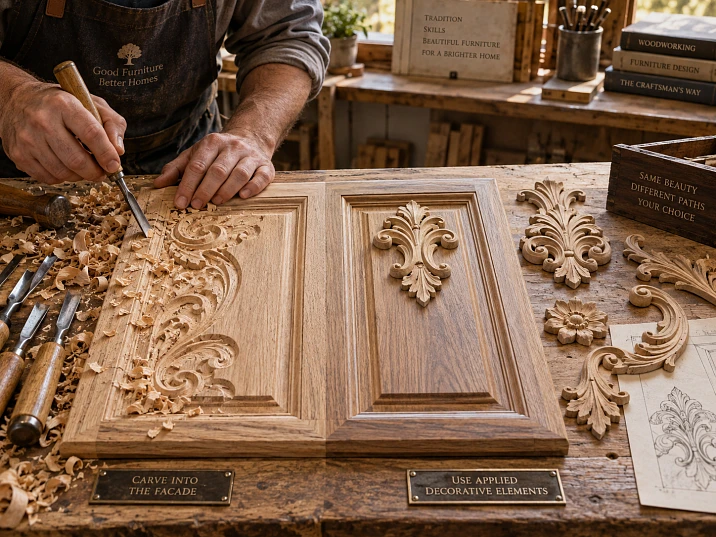
Page description: What to choose for furniture: carving directly on the facade or ready-made wooden overlays. Comparison of production, cost, repeatability, finishing, and finished carved decor STAVROS.
The most expensive mistake in decorative carving often happens not because the craftsman chose the wrong pattern. Something far more unpleasant: the facade has already been cut to size, milled, sanded, fitted to the cabinet — and it is precisely on it that the ornament is ruined. One error in depth, a shifted line, or a chip can send the entire part for rework.
With overlay decor, the risk works differently. The facade can be left relatively simple, while the carved part is made or purchased separately. If the overlay does not fit in size, is disliked after painting, or was damaged, the overlay itself is replaced, not the entire facade.
Therefore, decorative carving for furniture is not only a matter of the pattern. It is also a choice of production method.
There are two main approaches:
the first is to carve the ornament directly on the furniture piece;
the second is to make a simple facade and complement it with a separate carved overlay, rosette, capital, pilaster, or another ready-made wooden element.
Both methods are correct. But they suit different tasks.
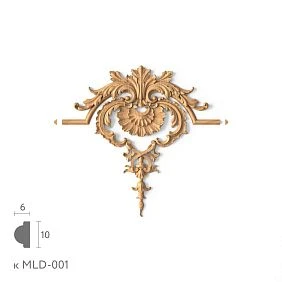
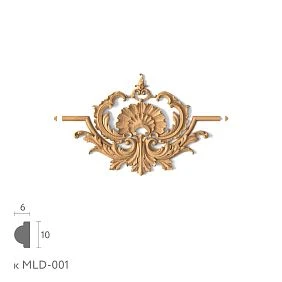
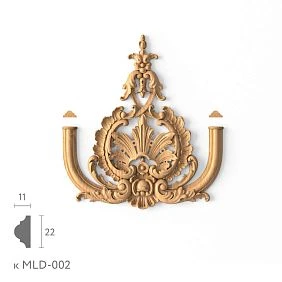
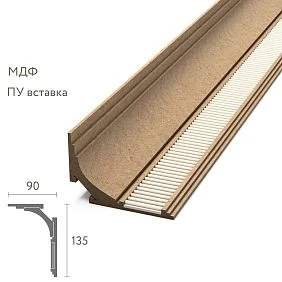
Two ways to create carved decor on furniture
Let's imagine a regular cabinet door.
The craftsman wants to achieve a floral ornament in the center.
In the first case, the design is carved directly on the door itself. Once the work is complete, the ornament and the facade become a single piece.
In the second case, the door remains smooth or has only the main frame. The carved design exists separately and is installed on the facade after fitting.
On finished furniture, both options can look very similar. But in production, the difference is significant.




Carving directly on the facade
The ornament is made directly on:
- door;
- drawer;
- tsarga;
- side panel;
- front panel;
- post;
- another furniture part.
Here the carving is inseparable from the part itself.
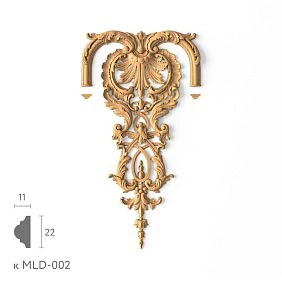
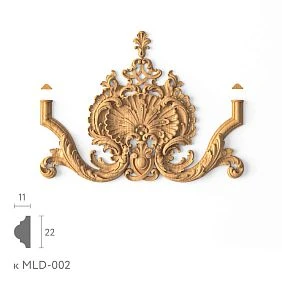
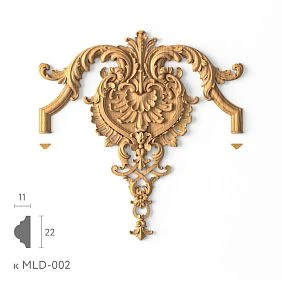
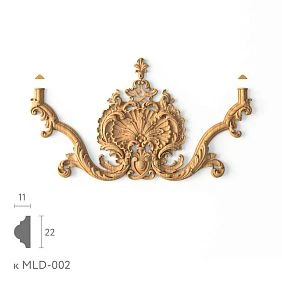
Our factory also produces:
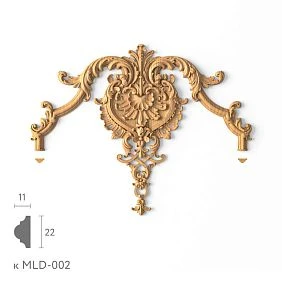
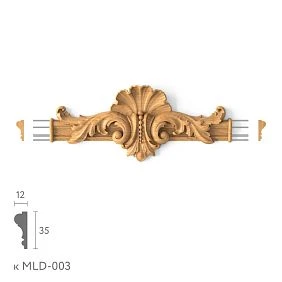
Separate applied decor
First, the furniture part is manufactured. Then a ready-made carved element is added to it:
- overlay;
- rosette;
- capital;
- pilaster;
- bracket;
- finial;
- carved moulding.
This approach is often convenient in small workshops and for one-off orders, because complex carving ceases to be part of manufacturing the facade itself.
Get Consultation
When carving directly on the facade has an advantage
Carving the pattern directly on the furniture part makes sense where the ornament should be not an addition, but part of the surface itself.
For example, on a solid door, the pattern can smoothly transition from the plane into relief. There is no visible boundary between the overlay and the base. The entire part is perceived as a single carved facade.
This method is especially useful when:
- the design is completely custom;
- there is no ready-made overlay of the required shape;
- the ornament must precisely follow the geometry of the facade;
- the workshop already performs this kind of processing;
- the same design is repeated in a large batch;
- there is a ready-made program and a proven technology.
For a large batch, the setup costs are spread across many parts.
Imagine you need to make one hundred identical facades. The program is already set up, the workpiece mounting has been worked out, and the test part has been approved. In that case, cutting the design directly on each facade can be entirely reasonable.
Another situation — one cabinet with four doors. If, for the sake of these four parts, you need to prepare the design again, set up the machine, select the tool, make test workpieces, and then spend a long time sanding the relief, a ready-made overlay already deserves consideration.
Why a mistake on a finished facade costs more
A facade is not just a piece of wood.
By the time of carving, it may already have invested:
- the material;
- Cutting;
- gluing;
- calibration;
- frame making;
- panel recessing;
- edge milling;
- sanding;
- drilling;
- hand fitting.
If after all these operations the carving is ruined, the craftsman risks losing not only the carver's time.
The entire base has to be redone.
It is especially unpleasant if the facade is made of expensive solid wood or has already been fitted to an existing cabinet.
In the overlay scheme, the main furniture component and the carved decor are separated.
The facade can be finished and checked separately.
The overlay — separately.
If the decorative component is damaged, the main facade remains intact.
This does not mean that the overlay option is always cheaper. But the risk of rework is distributed differently, and for one-off furniture this can be very important.
What is the production rationale for overlay carved decor
Overlay decor for furniture allows complex work to be divided into two independent parts.
The first part is the furniture itself.
The second is the decorative component.
For a small workshop, this separation offers several advantages.
You can first assemble the body and see the real proportions of the furniture. Then attach different overlays and choose the right one.
You can change the pattern without redoing the facade.
You can use the same carved element for several pieces in one collection.
You can replace a damaged overlay.
You can order ready-made complex carving and keep only its finishing and installation in-house.
This way the workshop retains control over the entire furniture piece, but is not obliged to carve every floral scroll itself.
That is why the query “applied decor for furniture” cannot be viewed only as a search for a beautiful ornament. For a manufacturer, it is also a way to simplify the technology.
When a ready-made overlay is more sensible than your own carving
There are several situations where a ready-made carved element is especially convenient.
You need to make a single piece of furniture
For example, a single sideboard with two carved doors.
Developing a separate complex process for just two elements may not be worth the time.
You need a small batch
Four, six, or ten fronts is already a batch, but still not the volume at which any separate setup easily pays for itself.
The workshop does not have equipment for complex carving
Cabinet furniture can be made excellently even without your own artistic carving department.
You need a deep floral ornament
The more complex the relief, the more time is spent not only on the processing itself, but also on finishing the surface.
The catalog already has a suitable shape
If a ready-made part fits perfectly in size and style, recreating it from scratch is not always worthwhile.
In such a project, it is natural to first look at Wooden carved appliqués, and then compare suitable options with custom manufacturing.
When custom carving is still better
Ready-made decor should not become the answer to every question.
Custom carving is stronger where true individuality is needed.
For example, a designer developed a special pattern for one furniture set. The ornament repeats a family emblem, a specific flower, a coat of arms, a fabric pattern, or an architectural detail of the interior.
A ready-made element of this kind may simply not exist.
Custom processing is also reasonable if:
- the workshop regularly does carving;
- the required pattern has already been worked out;
- the series is large;
- the machine constantly performs this kind of work;
- the ornament needs to be precisely fitted into a specific geometry;
- a separate overlay would add unwanted extra thickness.
Sometimes it is the carving on the facade itself that makes the piece special.
Therefore, the right question is not "what is better in general," but "which method is more sensible for this particular piece of furniture."
First, measure the free area of the facade
When choosing a ready-made overlay, it is easy to start with the catalog.
This is a mistake.
First, you need to understand how much space on the facade is actually free.
Let's imagine a door panel 500 mm wide.
Part of these 500 mm may be taken up by the frame. Another part — by the handle. Free space must be left at the edges. A molding may run nearby.
As a result, not the entire width of the door panel remains available for the decor, but significantly less.
Measure:
- the width of the free field;
- the height of the free field;
- distance to the frame;
- the position of the handle;
- the central axis;
- the distance to neighboring elements.
Only after that, open the catalog.
This way, the search immediately becomes more precise.
The size of the overlay and the size of the front are not the same thing
If the front measures 600 × 800 mm, this does not mean that it needs an overlay almost 600 mm wide.
The decor needs space around it.
If a carved element touches the edges, it starts to look heavy. The facade stops being perceived as a single surface and turns into a background for an oversized detail.
On the other hand, an overlay that is too small can get lost on a large facade.
That is why you need to look not only at millimeters, but also at proportion.
A good way to check is a paper template.
Cut out the outline of the future element at full size and place it against the door.
It will immediately become visible:
- is there enough air around it;
- whether the handle is in the way;
- is the pattern positioned too high;
- does it conflict with the frame;
- whether one element is needed or several.
Such a simple check is often more useful than staring at a product photo for a long time.
Full-size template before ordering a batch
For a single handle, a mistake is unpleasant.
For twenty identical ones, it's expensive.
So before ordering a batch, it makes sense to make a template.
The procedure is simple:
- Take the actual dimensions of the chosen part.
- Draw its overall outline.
- Print or cut out the template.
- Place it against the cabinet front.
- Mark the center.
- Check the handle.
- Check the adjacent decor.
- Look at the facade from a normal distance.
It is especially useful to make several identical paper elements if the pattern repeats on several drawers or doors.
Then the rhythm of the entire furniture becomes visible.
N-502: example of a finished openwork ornament
Wooden Decor N-502 — a good example of a complex detail that can be used instead of making a similar pattern yourself.
The overlay size is 35 × 300 × 9 mm. Options in beech and oak are available.
The shape is elongated and openwork. The pattern has through sections and many small transitions.
It is precisely on such a detail that the production advantage of ready-made decor is clearly visible.
If a craftsman wants to make a similar pattern himself, he needs to:
- prepare the contour;
- plan the processing of thin areas;
- perform the carving;
- do not break the bridges;
- process the edges;
- sand the difficult spots.
With a finished N-502, the entire geometry already exists.
The craftsman faces a different task: whether the overlay matches his facade in size, material, and pattern.
This is much easier to check with a template.
N-489: a small finished piece as a separate accent
Carved Applique N-489 measures 80 × 53 × 16 mm and is also available in beech and oak.
It is significantly more compact than the N-502.
This is a good example of how the term "ready-made carved overlay" does not mean a single type of decoration.
One element can be elongated and set a vertical line.
Another can be small and work as a separate accent.
For a furniture maker, this is convenient: instead of developing a new design for each surface, a ready-made piece can be selected for a specific composition.
But a ready-made shape does not eliminate the need for design.
The N-489 still needs to be positioned correctly on the facade, its scale checked, and a decision made as to whether it will stand alone or become part of a repeating pattern.
A central overlay and a repeating pattern are different tasks
A single carved element in the center of a large facade works as the main accent.
Several identical pieces create rhythm.
For example:
- two overlays on paired doors;
- four small elements in the corners;
- identical details on each drawer;
- repetition of the same pattern on several cabinets.
In the second case, repeatability is especially important.
If the craftsman cuts each detail by hand, small differences can be a natural part of the work.
If strict serial production is required, ready-made identical items are more convenient.
Therefore, before choosing a method, you need to decide what exactly is being built:
a single unique accent or a repeating decorative system.
Rosette as an alternative to an elongated overlay
Not every composition requires a long carved element.
If the design is built around the center, it may work better wooden rosette.
A rosette is convenient on:
- a square panel;
- the center of a door;
- the intersection of moldings;
- a corner or symmetrical composition.
An elongated overlay works differently. It sets a direction — up, down, or along the surface.
Therefore, the choice is not between “a rosette is more beautiful” and “an overlay is more beautiful.”
You need to look at the geometry of the facade.
If the surface is elongated, a vertical overlay can support the proportion.
If the field is almost square, a centered pattern may look more natural.
A capital and a pilaster are already a whole furniture architecture
On a large wardrobe, one overlay is sometimes not enough.
If furniture is built in a classical architectural logic, the decor may include:
- the lower part;
- the vertical post;
- the upper termination.
Then they appear Capitals и pilasters.
Such a system makes it possible to assemble a complex appearance from individual ready-made wooden elements.
For example, instead of carving the entire side part of a wardrobe as one huge decorative detail, you can make an ordinary carcass, install a pilaster, and finish it with a capital.
Technologically, this is easier to repair and reproduce.
If one part is damaged, you don't necessarily have to replace the entire side panel of the cabinet.
A bracket is already three-dimensional decor
Wooden Brackets differ from flat overlays in that they protrude further forward.
They create real volume.
Therefore, they cannot be chosen using the same logic as thin decor for a facade.
Need to check:
- how far the part protrudes;
- whether it interferes with opening;
- whether it conflicts with the adjacent door;
- whether there is enough space on the cabinet body;
- whether the furniture becomes too visually heavy.
Such an element can decorate the cornice part, a console, a shelf, or another furniture structure.
But this is no longer "just an overlay."
How to compare carving on the facade and ready-made applied decor
| Parameter | Carving directly on the part | Ready-made applied decor |
|---|---|---|
| Individual design | Any can be made | You need to choose from ready-made shapes |
| Preparation of processing | Need | Already done by the manufacturer |
| Risk of damaging the facade | Higher | The main facade remains separate |
| Replacing the pattern | More difficult | The overlay can be replaced |
| Small batch | Requires separate preparation | Convenient for repeating identical parts |
| Large series | May be cost-effective after setup | Batch cost needs to be compared |
| In-house painting | Possible | Possible for unpainted decor |
| Change of composition | Requires new processing | Can be repositioned or replaced before installation |
| Repair | Often affects the main part | Sometimes it is enough to replace the decor |
The main difference is clearly visible in the risk line.
With direct carving, the facade and the pattern are one piece.
With overlay, there are two.
You should count not the price of the overlay, but the full cost of the work
Comparison is often done incorrectly.
A craftsman sees the price of a finished element and says: "I'll cut it myself for less."
But the price of wood is only part of the work.
For your own carving, you need to account for:
preparing the design + setup + machine time or manual work + tools + test pieces + sanding + possible defects + finishing.
For a ready-made overlay:
cost of the part + delivery + fitting + finishing + installation.
Only after that is the comparison fair.
Let's imagine that complex carving takes two hours of machine processing and another hour of manual finishing. For one part, that's three hours plus preparation.
If you need two overlays, the cost of your own time already becomes noticeable.
If you need a hundred identical parts, the picture changes: the preparation is spread across a larger batch.
That is why quantity always influences the decision.
What is especially important for a small series
A small series is the most interesting area of choice.
A single piece of furniture can be made entirely by hand.
A large series justifies complex preparation.
But five identical chests of drawers fall somewhere in between.
Let's say each one needs two carved overlays.
In total, ten parts are required.
If you cut them yourself, you need to ensure the same pattern ten times.
If you buy ready-made ones, you need to check one model, then order ten identical elements.
Here, the winner is often not the option with the cheaper single part, but the one with fewer preparatory operations and less risk of rework.
One ready-made element can be used in different pieces
Ready-made decor has another advantage: it can be repeated.
For example, the same overlay is used:
- on a wardrobe;
- on a chest of drawers;
- on a nightstand.
Then the furniture series gains a common language.
A workshop can gradually build its own set of proven elements.
Not a huge catalog, but a small working list:
- this overlay is suitable for a 400–500 mm door;
- this socket works well on drawers;
- this bracket is used under shelves;
- this pilaster is suitable for a tall cabinet.
This way, new projects come together faster.
No need to start from scratch every time.
Oak or beech for applied decor
Once the method is chosen, the question of material comes up.
Here the rule is simple.
Beech
Often convenient if:
- the overlay will be painted with dense enamel;
- the decor should match the color of the facade;
- the wood grain should not be visible.
Oak
Often more interesting if:
- visible texture is needed;
- oil is planned;
- stain;
- Tinting;
- transparent lacquer.
But this is not a prohibition.
Both oak can be painted and beech can be tinted.
The final decision is best made based on a trial finish.
The overlay can be painted together with the facade
One of the most interesting effects of overlay carving appears after painting.
Technologically, the overlay is a separate piece.
Visually, after finishing, it can be perceived as part of the facade itself.
For example, a beech overlay is installed on a door, then everything is painted with a single white enamel.
After the work is completed, the color unifies the surfaces.
A person sees a single relief facade, even though the carving was made separately.
That is why overlay decor does not necessarily have to look like a "glued-on ornament."
If the shape, size, and finish are chosen correctly, it becomes part of the overall composition.
When is it better to finish the decorative element separately
Sometimes, on the contrary, the separateness of the overlay needs to be emphasized.
For example:
natural oak on a painted facade.
Or:
dark tinted overlay on light-colored furniture.
Or:
a patinated carved element on a calm monochrome surface.
Then it is more convenient to finish the overlay separately and then install it.
The advantage is that the craftsman can work calmly with a small part without risking staining or over-sanding the entire facade.
It is also easier to replace an unsuccessful option.
First one sample, then the whole set
There is no need to order twenty overlays just because they look suitable in a photo.
First, it's better to take one.
Next:
- attach it to a real facade;
- check the dimension;
- look at it from a distance;
- check the handle position;
- make a test finish;
- evaluate the material;
- check the installation method.
Only after that does it make sense to order a batch.
Especially if the decor is going on expensive furniture.
One physical part answers many questions faster than several pages of description.
How to record finished carved decor in the work list
Entry:
decor — 2 pieces
too vague.
Better to record:
- product number;
- size;
- the material;
- quantity;
- position;
- finishing.
For example:
N-502, beech, 35 × 300 × 9 mm, 2 pieces, centered on doors, for enamel
Or:
N-489, oak, 80 × 53 × 16 mm, 4 pieces, facade corners, for clear lacquer
Such a list helps reproduce the furniture a year later without guessing.
Common mistakes when choosing a carving method
Mistake 1. Cutting an expensive facade without a test piece
If the pattern or depth turns out unsuccessful, the entire facade will have to be redone.
Best approach: first check the thread on a test workpiece.
Mistake 2. Buying the overlay before measuring the free space
A beautiful element turns out to be too large.
Best approach: first measure the composition area.
Mistake 3. Treating the facade size as the size for the decor
The overlay needs breathing room around it.
Best approach: check with a paper template.
Mistake 4. Not accounting for the handle
After installing the decor, the handle ends up too close or right on the ornament.
Best approach: place both elements on a single drawing.
Mistake 5. Assuming ready-made decor is always cheaper
For a large series, in-house processing can be more cost-effective.
What's better: calculate the entire job in both options.
Mistake 6. Treating in-house carving as free
Machine and craftsman hours have a cost.
Mistake 7. Ordering a large batch without a sample
The scale mistake repeats across the entire furniture piece.
Mistake 8. Mixing different ornaments without a common logic
Even beautiful individual elements can clash with each other.
When you don't need to buy applied decor
A ready-made overlay is not needed if:
- the design is unique;
- it must be part of the surface itself;
- ready-made shapes are not suitable;
- the workshop is well equipped;
- the processing is already mastered;
- the series is large;
- additional overlay thickness is undesirable.
In such a situation, a custom thread may be the better choice.
Especially if the furniture is built around a custom design.
When ready-made decor is especially useful
Buying ready-made carved elements becomes more attractive if:
- the item is a one-off;
- the batch is small;
- the design is complex;
- deep relief is needed;
- there is no in-house carving area;
- the deadlines are tight;
- a suitable shape already exists;
- repeatability matters.
Then the craftsman is buying more than just a wooden part.
He buys already finished complex geometry.
Where to buy ready-made decorative carving for furniture
Main section — Carved wood decor STAVROS.
Then you can go to the desired group:
If you are just getting acquainted with the very principle of a separate carved part, you can also look at the material "Overlay wood carving".
For new furniture, the logic of choice is simple:
first decide whether carving is needed directly in the facade;
if not — measure the free field;
then select a ready-made element by size and shape;
check one sample;
only after that order the required quantity.
Short selection table
| Situation | What is more often reasonable to consider |
|---|---|
| One unique facade with a custom design | Carving directly on the part |
| Large repeating series | Consider both methods |
| Two to ten facades with complex ornamentation | Ready-made overlays |
| No equipment for carving | Ready-made decor |
| Need the ability to quickly replace the pattern | Ready-made decor |
| The ornament should be part of the surface itself | Carving on the facade |
| Need a deep production-grade relief | Compare ready-made decor with custom processing |
| High risk of damaging an expensive facade | An overlay scheme reduces risk to the base |
| No ready-made form of the required size | Custom carving |
What to choose in the end
If the furniture is one-off or low-volume, and the design is complex, applied carved decor often helps remove the most labor-intensive part from production.
The facade remains simple and clear.
The carved part exists separately.
It can be fitted, replaced, painted separately or together with the furniture.
If, however, a unique design is needed, a large series, or the ornament must be an inseparable part of the surface itself, custom carving may be the better choice.
The main thing is to decide this before manufacturing the facades.
Not after the carcass has already been assembled.
Frequently Asked Questions
What is decorative carving for furniture?
It is a carved ornament on furniture parts or individual carved elements that are installed on facades, aprons, posts, and other parts of furniture.
Which is better — carving directly on the facade or applied carving?
For a unique pattern and a large production run, carving directly on the part can be convenient. For one-off furniture and small batches, ready-made overlays often reduce the amount of complex processing and the risk to the facade itself.
When is it wiser to buy a ready-made carved overlay?
When a complex pattern is needed in small quantities, there is no in-house equipment, or a suitable shape is already available in the catalog.
Is applied decor suitable for serial furniture?
Yes. An identical ready-made part helps repeat the same pattern on several pieces of furniture.
How to choose the size of a carved element for a facade?
Measure the free field, take into account the frame, handle, and distance to the edge. Then make a full-size template of the overlay and place it against the facade.
Can the overlay be painted together with the furniture?
Yes. If the material and finishing system are compatible, the overlay can be made the same color as the facade, and visually it will be perceived as part of the overall surface.
What to choose — oak or beech?
For dense enamel, beech is often convenient to consider. For transparent finishing, where a noticeable wood texture is needed, oak is often chosen. It is better to confirm the decision with a test paint.
How to calculate the cost of your own carving?
Add up the cost of material, artwork preparation, setup, working time, tools, sanding, test pieces, possible defects, and finishing. Then compare it with the full cost of a ready-made element including delivery, finishing, and installation.
Should you buy one overlay as a sample?
For an important project, it is advisable. One piece allows you to check the scale, size, material, finish, and position on the facade before ordering the entire batch.
Where to buy ready-made carved elements for furniture?
Suitable options are collected in the STAVROS carved decor catalog. For facades, it is most convenient to start with the carved overlays section, while for other compositions, look at rosettes, capitals, pilasters, and brackets.