




























Article Contents:
- What Is Decorative Door Molding?
- Door Molding vs. Door Casing: Do Not Confuse Them
- Why the Distinction Matters for STAVROS
- Applied Molding vs. a True Paneled Door
- Why Applied Door Molding Works So Well
- The Best Doors for Applied Molding
- Can You Add Molding to Hollow-Core Doors?
- Can You Add Molding to Solid-Core Doors?
- Can You Add Molding to Existing Painted Doors?
- Four Core Door-Molding Layouts
- Layout 1: One Large Panel
- How to Proportion One Large Door Panel
- Layout 2: Two Stacked Panels
- Where the Horizontal Division Should Sit
- Layout 3: Three-Panel Classical Door
- Layout 4: Multi-Panel Grid
- Door Panel Molding: The Real Design Problem Is Scale
- Why MLDPU-001 Fits Door Work
- MLDPU-002 for Larger Doors
- MLDPU-003 for Statement Doors
- Polyurethane Molding for Doors: Where It Makes Sense
- Where Wood Is Better
- Where MDF Is Better
- Polyurethane vs. Wood vs. MDF for Door Molding
- Decorative Door Trim Molding: Keep the Hardware in the Design
- Do Not Let the Handle Cross the Molding
- Hinge-Side Clearance
- Double Doors Need Mirror Geometry
- French Doors and Glazed Doors
- Wardrobe Doors vs. Interior Passage Doors
- Decorative Appliques on Doors
- Where to Put a Door Applique
- Use Ornament Sparingly
- Decorative Corner Elements on Doors
- Example: Series 003 Corner Ornament
- Mitered Door Molding vs. Decorative Corners
- Decorative Door Molding Styles
- Neoclassical
- Traditional
- Parisian-inspired
- Art Deco
- Modern
- Transitional
- What is decorative door molding?
- Is door molding the same as door casing?
- Can I add molding to a flat interior door?
- Can I add molding to a hollow-core door?
- Can I use polyurethane molding on interior doors?
- Which STAVROS molding is best for a small door?
- Which molding works for a larger statement door?
- Can I add decorative appliques to a door?
- Can I use decorative corner elements on a door frame?
- Should door molding be painted the same color as the door?
- How many panels should a door have?
- How far should molding be from the door edge?
- Can molding cross behind a door handle?
- Can I use the same molding on walls and doors?
- Can I add molding to a fire-rated door?
- Can I cut a hollow-core door for a mirror or glass panel?
- Can I decorate an exterior door with polyurethane molding?
- How do I calculate molding for a door?
- Should I remove the door before installing molding?
- What makes applied door molding look custom?

A plain interior door is one of the largest uninterrupted surfaces in a room, yet it is often treated as if it were only hardware: a slab, a handle, a hinge, and nothing more. That makes it a powerful design opportunity. With the right molding, a simple paint-grade door can become visually closer to custom millwork without replacing the door itself.
The important word is visually. Applied molding changes the face of a door; it does not turn a hollow-core slab into a traditional frame-and-panel construction, it does not improve the structural core, and it does not replace the door casing around the opening. What it can do extremely well is create proportion, shadow, rhythm, and architectural detail.
For U.S. search behavior, this topic appears under phrases such as decorative door molding, decorative door trim molding, door molding, door trim molding, decorative moulding for doors, and door panel molding. Those phrases overlap, but they do not always describe the same product. This guide focuses primarily on applied decorative molding on the door slab itself, while clearly separating that from casing, architrave, and doorway trim.
STAVROS offers verified rigid polyurethane profiles that can be used on furniture and door panels, including compact polyurethane molding from the MLDPU family, plus polyurethane appliques and onlays and decorative polyurethane corner elements. These products are relevant to applied door decoration. They should not be described as a ready-made polyurethane door casing system unless a specific casing product is actually documented.



What Is Decorative Door Molding?
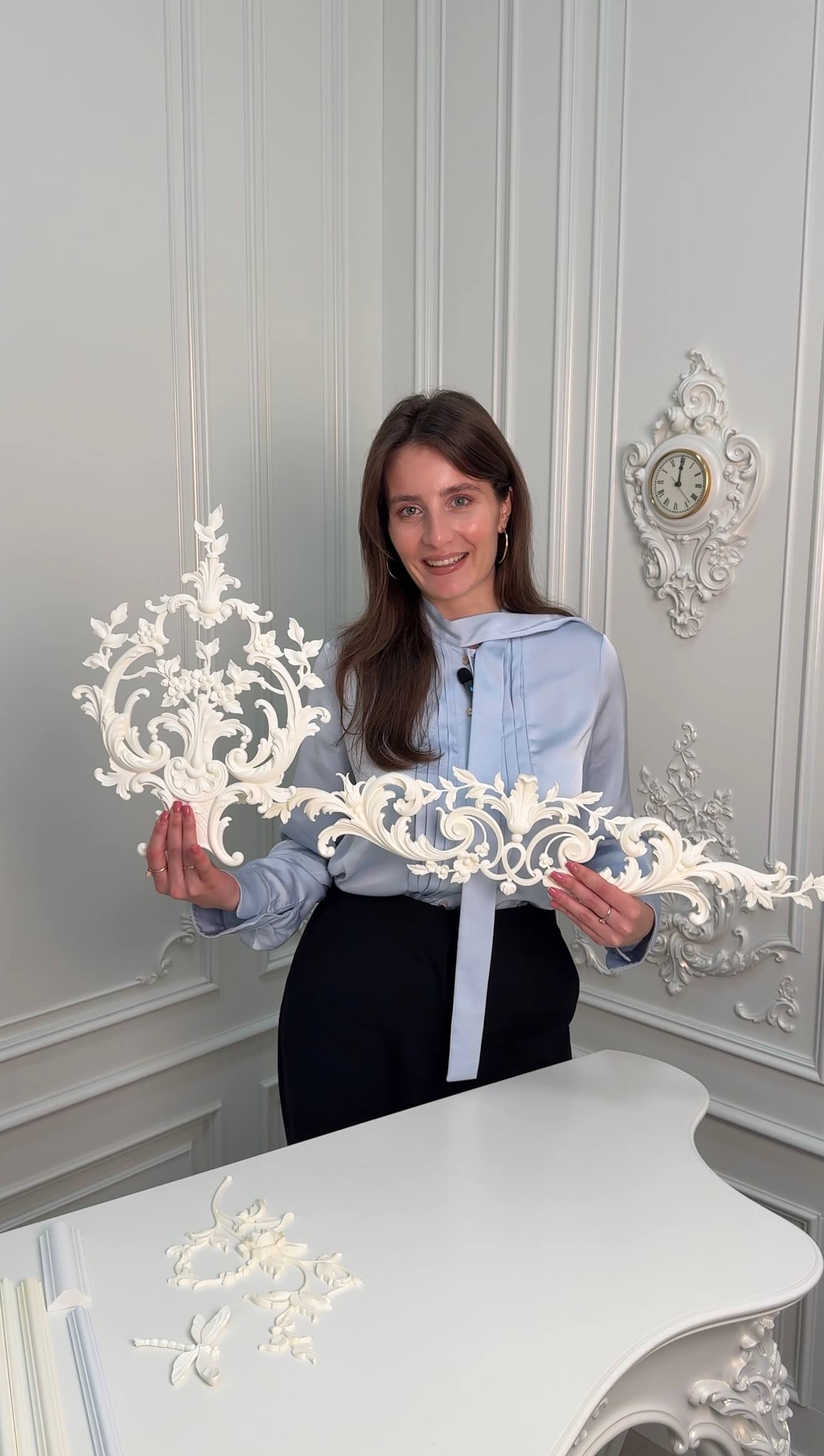
Decorative door molding is a profile applied to the face of a door to create raised lines, frames, panels, borders, or geometric compositions.
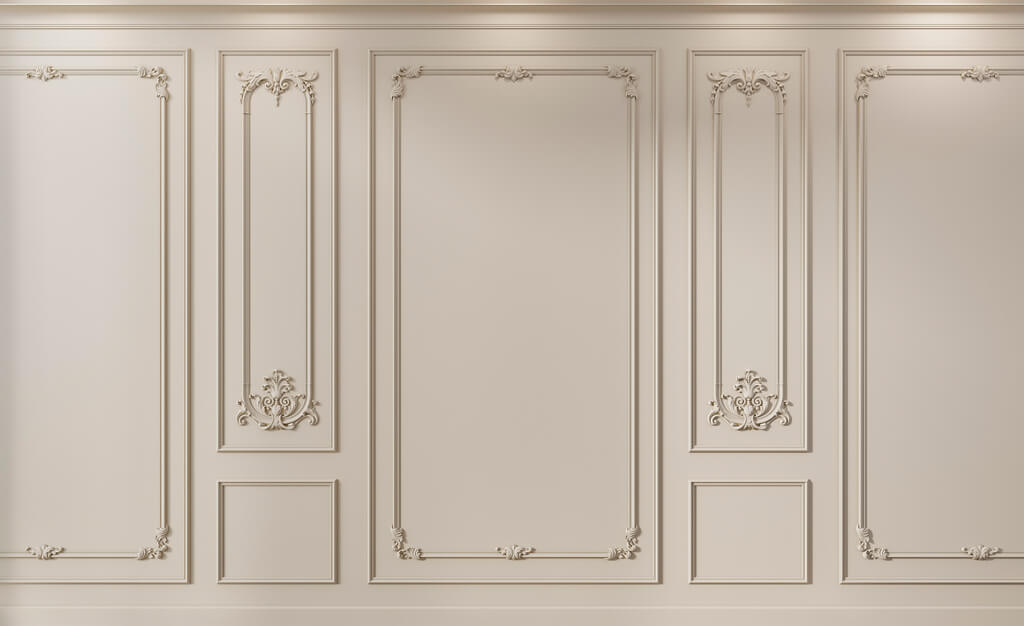
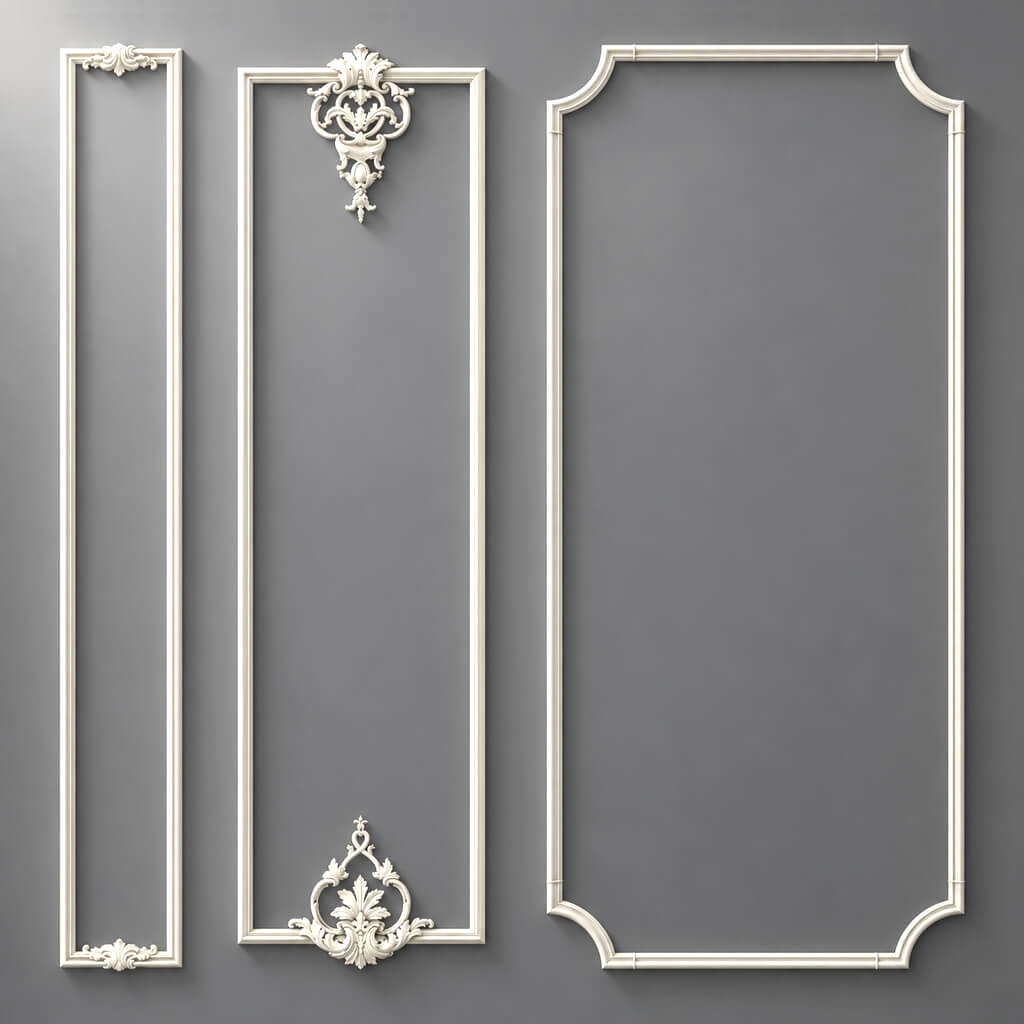
On a flat door, molding can create one large rectangular panel, two stacked panels, three or four classical panel fields, a narrow perimeter frame, Art Deco geometry, Neoclassical frames with decorative corners, or a central field for an applique or onlay.
The door remains structurally the same. The molding is an applied decorative layer.


Door Molding vs. Door Casing: Do Not Confuse Them
This distinction is essential for both design and SEO.
Door casing is the trim surrounding the opening. It covers the joint between the door jamb and the wall. Applied door molding is installed on the face of the door slab. Those components perform different jobs and should not be treated as synonyms in a specification.
Наша фабрика также производит:


Смотреть весь Каталог продукции
Why the Distinction Matters for STAVROS
STAVROS has verified linear polyurethane moldings suitable for decorating walls, furniture, and door panels. A separate ready-made polyurethane casing product is not currently confirmed as its own dedicated product family. That means a phrase such as polyurethane door trim should be used carefully: a PU molding can decorate the door, but it should not automatically be sold as casing around the opening.
Получить консультацию
Applied Molding vs. a True Paneled Door
A traditional paneled door is built from rails, stiles, and one or more center panels. Applied molding starts with an already complete slab and adds a decorative profile to the face.
From normal viewing distance, both can create a paneled appearance after painting, but they are not the same construction.
Why Applied Door Molding Works So Well
A flat slab has almost no shadow hierarchy. One narrow profile creates an outer boundary, an inner field, four corner nodes, new highlights and shadows, and a stronger vertical proportion.
Because doors are tall and narrow, even a small molding profile can have a large visual effect.
The Best Doors for Applied Molding
Applied molding is easiest on flat paint-grade interior doors, solid slab doors, MDF-faced doors, smooth wood doors that will be painted, wardrobe doors, painted closet doors, built-in furniture doors, and large pantry doors.
It is less straightforward on highly textured, deeply routed, damaged, flexible, or unstable door surfaces.
Can You Add Molding to Hollow-Core Doors?
Often, yes, for lightweight decorative trim, but the door construction matters. A hollow-core door may have a thin face skin over a lightweight internal core, so it should not be treated like thick solid wood when choosing fasteners.
A compatible adhesive is often more appropriate for lightweight applied molding. Do not assume a hollow-core door can accept deep screws or heavy overlays anywhere on its face.
Can You Add Molding to Solid-Core Doors?
Yes, but weight and hardware should still be checked. A solid-core door already has significant mass, so adding heavy ornament everywhere may not be necessary. Lightweight paint-grade molding is usually more about appearance than added mass.
Can You Add Molding to Existing Painted Doors?
Yes, if the existing finish is sound. The new molding will only be as secure as the coating it is bonded to. If old paint is peeling, chalking, oily, or poorly adhered, the trim can release with the paint film.
Four Core Door-Molding Layouts
Most successful decorative door designs can be traced to four basic layouts: one large panel, two stacked panels, a three-panel classical layout, and a multi-panel grid.
Layout 1: One Large Panel
One large applied frame is the cleanest solution. It works especially well for modern interiors, transitional rooms, tall narrow doors, bedrooms, home offices, and painted closet doors.
The single frame adds architecture without making the door visually busy.
How to Proportion One Large Door Panel
Keep the frame clearly inside the door edges. The inset should be consistent at the top and sides unless the design intentionally changes it. The bottom margin can sometimes be larger, but that should be deliberate rather than accidental.
Layout 2: Two Stacked Panels
Two panels are one of the most familiar door compositions in American interiors. The upper panel is often taller than the lower panel. This reinforces verticality and keeps the door from feeling divided exactly in half.
This layout works especially well for traditional, Neoclassical, and transitional spaces.
Where the Horizontal Division Should Sit
Do not place the dividing line without considering the lever or knob. The hardware should either sit comfortably inside one field or between the visual zones. A horizontal molding line that runs directly behind the handle looks unresolved.
Layout 3: Three-Panel Classical Door
A three-panel composition usually uses one large main field and two smaller fields or a long upper field with smaller lower divisions. This is more formal and works best on tall doors with enough width to keep the frames from becoming narrow slivers.
Layout 4: Multi-Panel Grid
A multi-panel grid creates a stronger architectural or period look. It can work for traditional interiors, library doors, dark monochromatic doors, Art Deco compositions, double doors, and statement doors in entry halls.
Every extra frame adds joints, layout risk, and visual density. Use grids when the door scale can support them.
Door Panel Molding: The Real Design Problem Is Scale
A wall molding profile may be perfectly proportioned on a 10-foot wall and completely oversized on a 30-inch door. Door decoration requires smaller visual units.
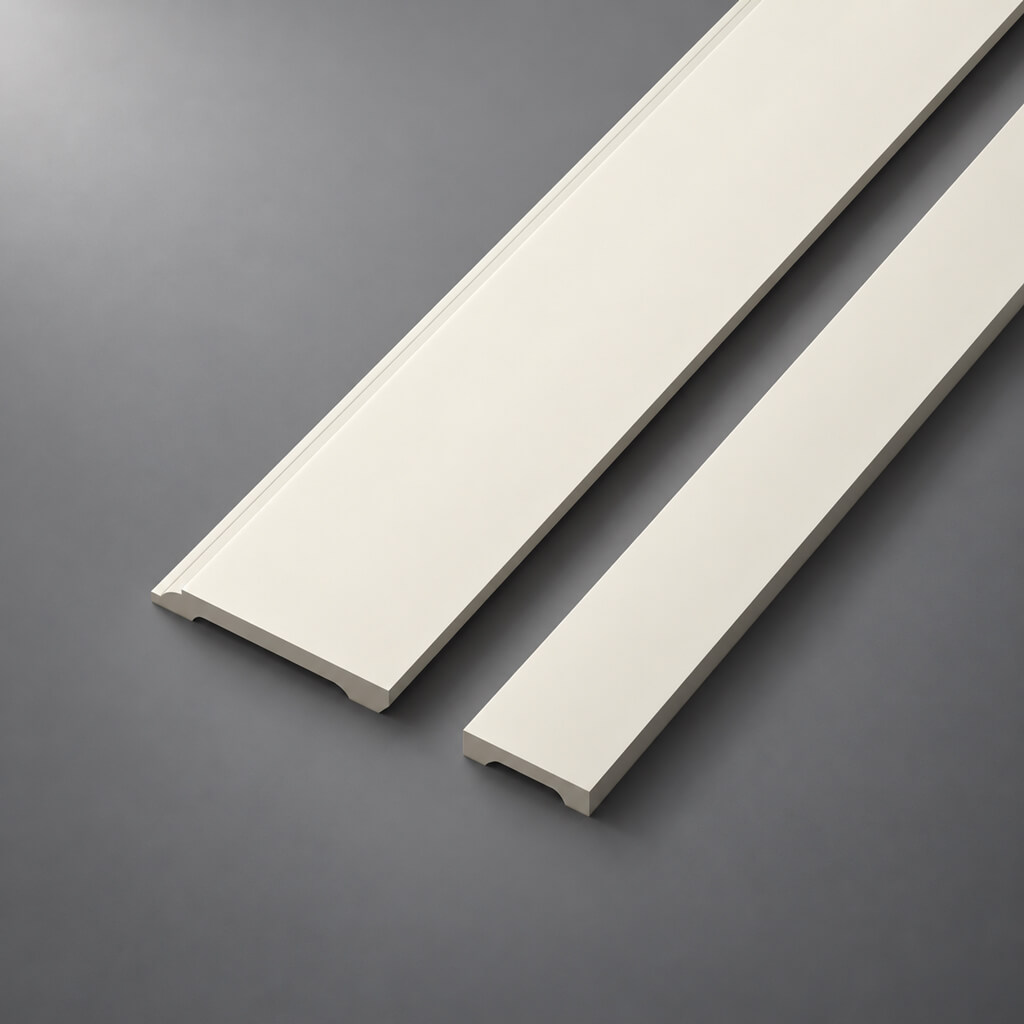
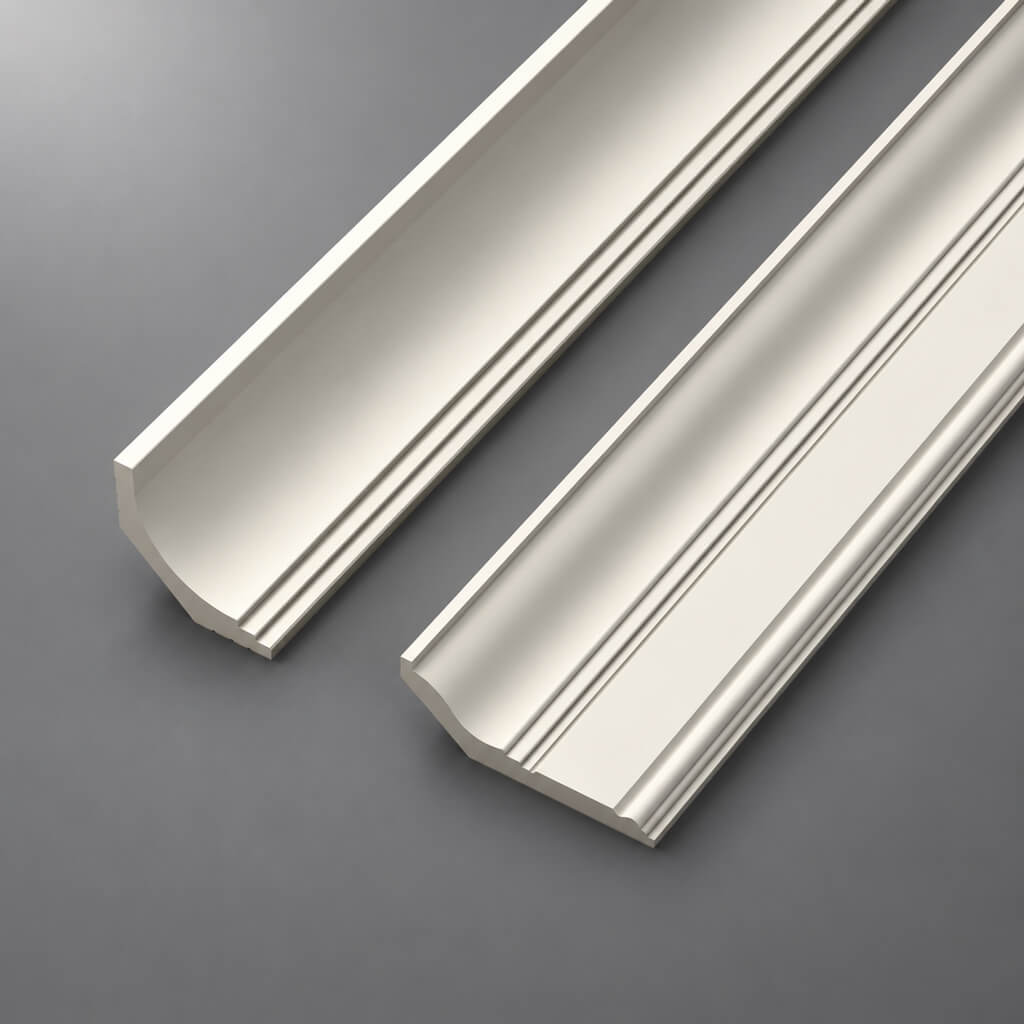
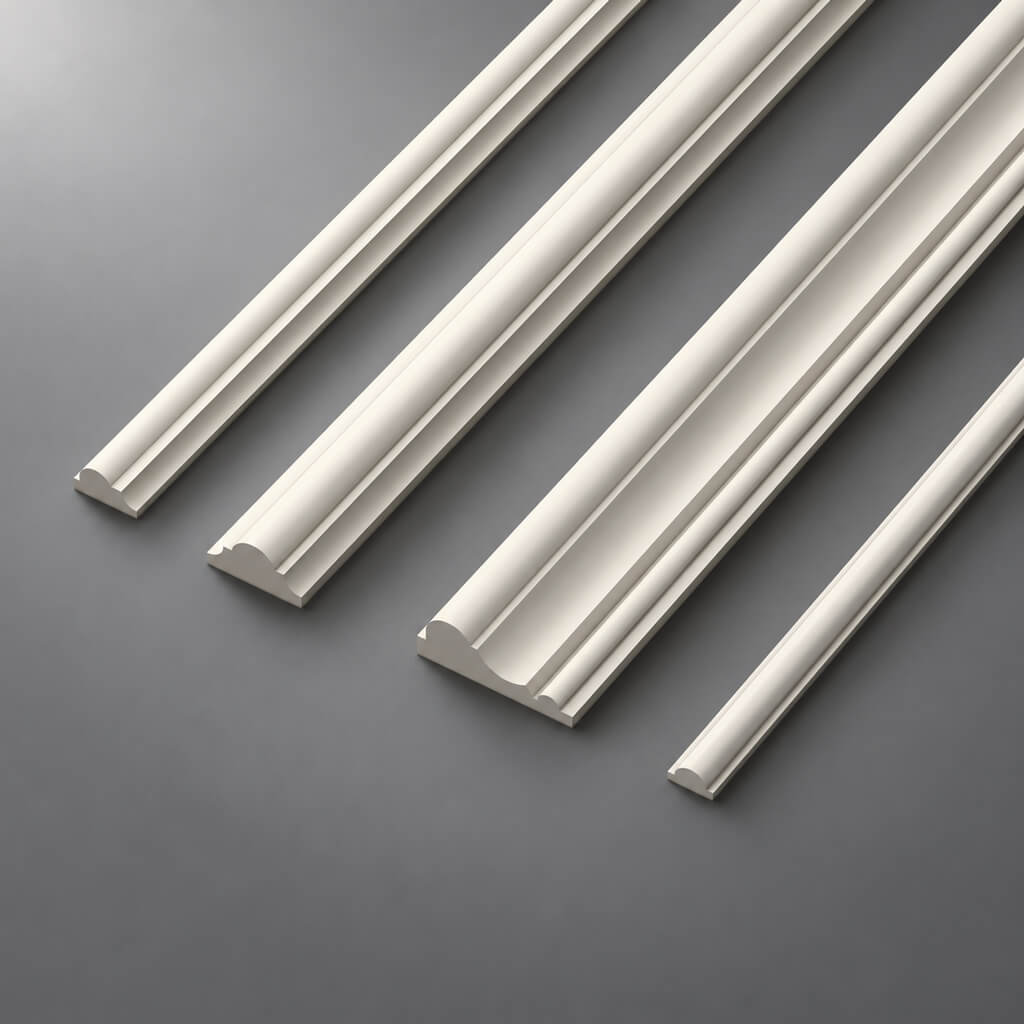
For this reason, compact profiles such as MLDPU-001 polyurethane molding can be especially useful. MLDPU-001 is a 10 × 6 mm bead profile with a 2600 mm length and is explicitly described for furniture and door-panel decoration.
Why MLDPU-001 Fits Door Work
A 10 mm face width is small enough to remain delicate on a standard interior door while still creating a visible shadow line after painting. Its 2600 mm length also exceeds the height of many common interior doors, allowing long vertical pieces to be cut without a mid-run joint.
MLDPU-002 for Larger Doors
The MLDPU-002 polyurethane molding is approximately 22 mm wide with an 11 mm projection. That gives it substantially more architectural weight and makes it more appropriate for tall doors, wide double doors, wardrobe panels, or more formal interiors.
MLDPU-003 for Statement Doors
The MLDPU-003 family is larger still. It can work on oversized door panels and substantial classical compositions, but it should not be treated as a universal door profile. On a narrow standard door, a large profile can consume too much visual space.
Polyurethane Molding for Doors: Where It Makes Sense
Polyurethane is particularly useful for door decoration when the door will be painted, the molding is purely decorative, low weight is useful, repeatable geometry is desirable, and the door substrate is already structurally complete.
Where Wood Is Better
Wood molding is more appropriate when the door will be stained or clear-finished and natural grain must remain visible. Wood is also the logical choice when the decorative profile is part of traditional joinery or must match an existing wood casing system.
Where MDF Is Better
MDF can be effective for paint-grade door decoration because it machines cleanly and can match MDF door faces. Polyurethane becomes attractive when the profile or ornament would be difficult to machine economically or when lightweight molded relief is desirable.
Polyurethane vs. Wood vs. MDF for Door Molding
| Factor | Polyurethane | Wood | MDF |
|---|---|---|---|
| Best finish | Paint-grade | Paint or stain | Paint-grade |
| Weight | Low | Moderate | Moderate |
| Natural grain | No | Yes | No |
| Ornamental relief | Excellent when molded | Excellent when carved | Good when machined |
| Repeatability | High | High with machining | High |
| Typical role | Applied decorative trim | Millwork and trim | Paint-grade millwork |
Decorative Door Trim Molding: Keep the Hardware in the Design
Handles, knobs, locks, hinges, and closers are not accessories you can ignore until the end. The molding layout should leave clear space around all hardware.
Check lever sweep, knob diameter, escutcheon size, backplate height, finger clearance, lock position, door-stop contact, and hinge-side clearance.
Do Not Let the Handle Cross the Molding
A handle base that partly overlaps the applied profile usually looks accidental and can create installation problems. Either move the frame inward, use a narrower profile, or redesign the panel layout.
Hinge-Side Clearance
The face-side molding does not usually touch the hinges, but a thick profile near the edge can interfere with neighboring trim, paired doors, or casing when the door opens.
Open the door through its full swing before finalizing the layout.
Double Doors Need Mirror Geometry
Paired doors are unforgiving because the center joint creates a strong reference line. The molding frames should mirror each other exactly. Small differences in top inset, panel height, or corner detail are immediately visible.
French Doors and Glazed Doors
Glazed doors already contain strong internal geometry. Additional applied molding should support the glass layout rather than compete with it. In many cases, the existing muntin or glazing frame provides enough architecture.
Wardrobe Doors vs. Interior Passage Doors
Wardrobe doors can use furniture-scale profiles and decorative overlays because they are part of cabinetry. Passage doors have handles, jambs, casing, swing clearances, and repeated contact. The same ornament may behave differently in these two applications.
Decorative Appliques on Doors
Linear molding creates structure; appliques create a focal point.
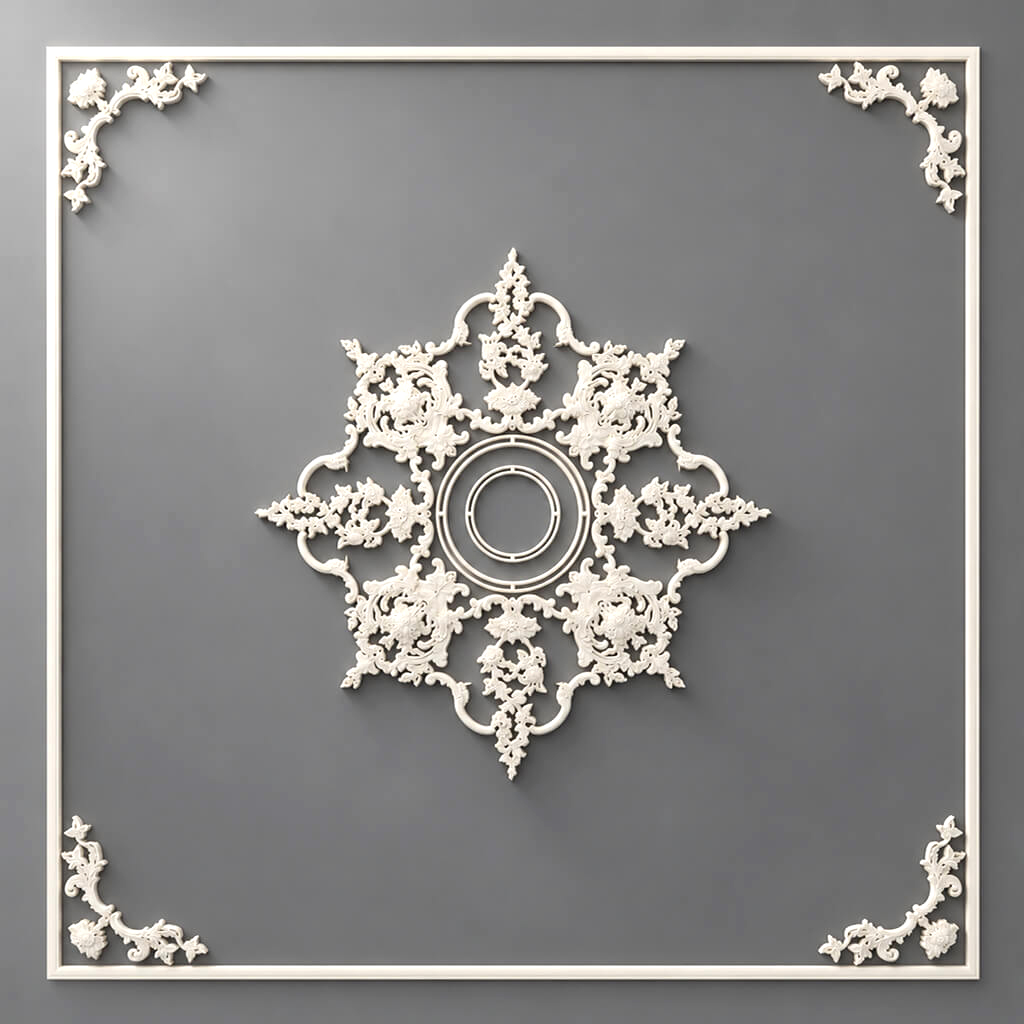
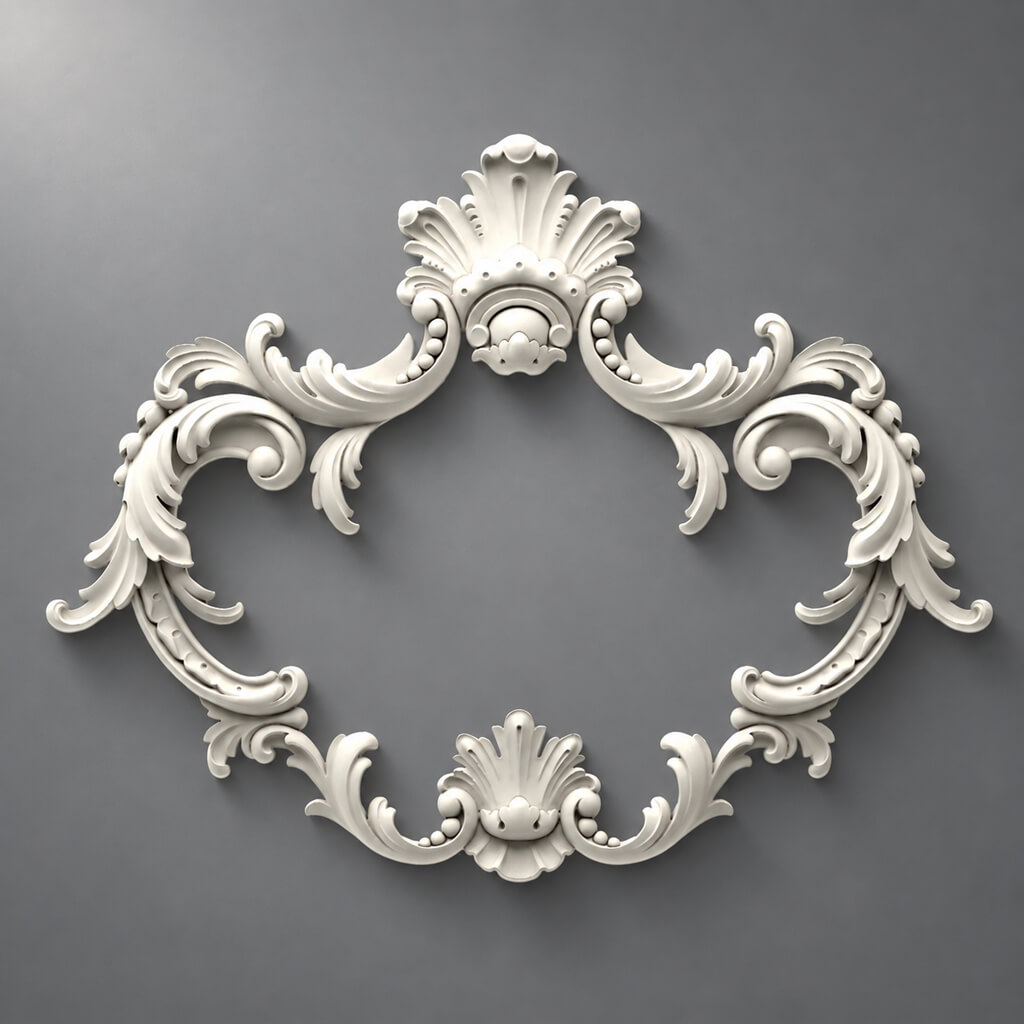
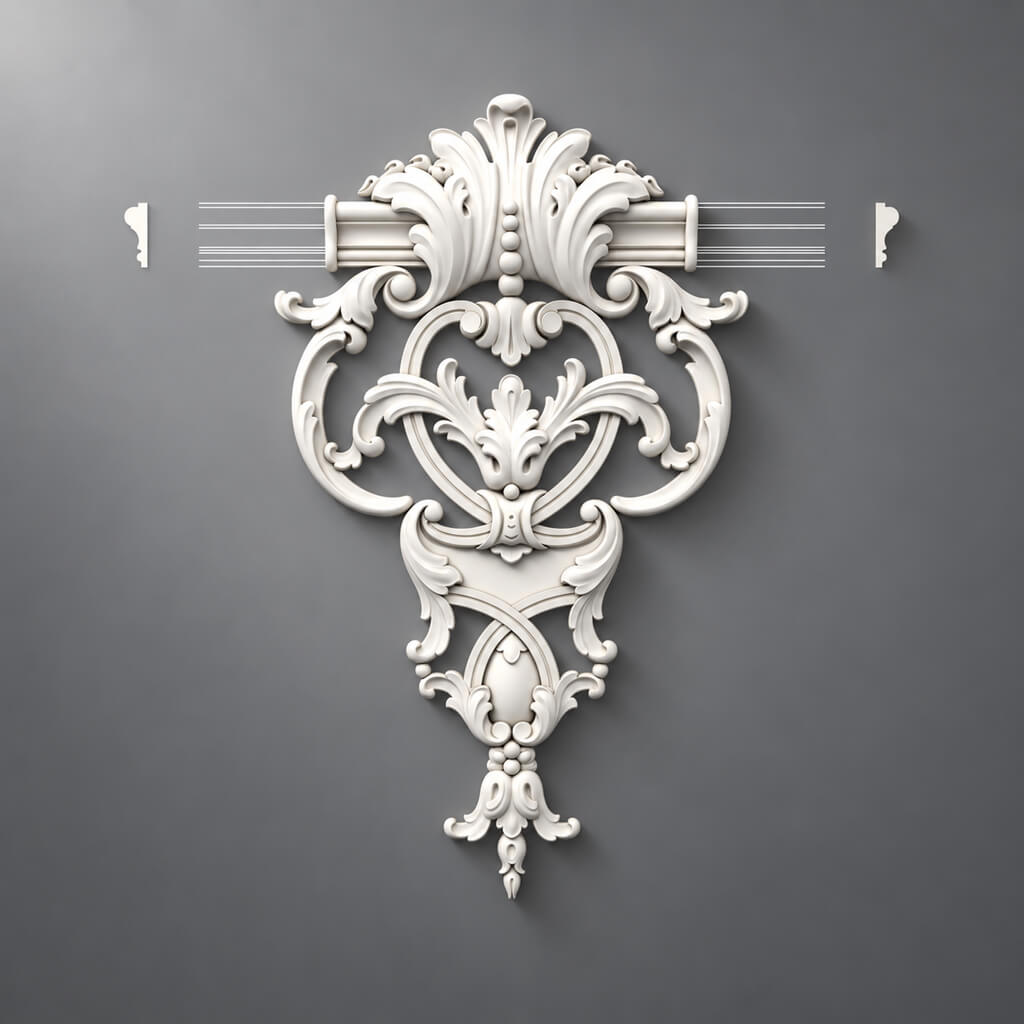
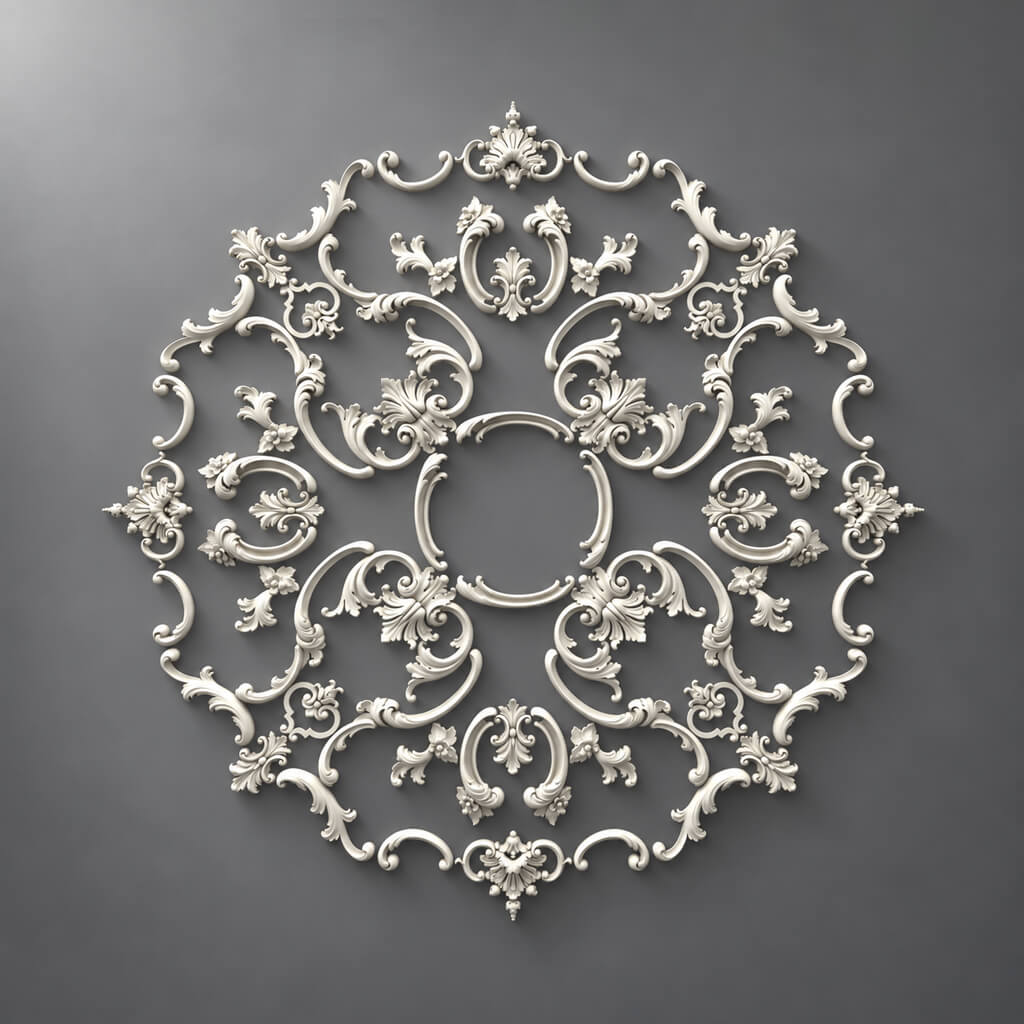
The STAVROS polyurethane decorative elements category includes central, vertical, horizontal, curved, square, round, and asymmetric forms that can be used in door-panel compositions when their scale is appropriate.
Where to Put a Door Applique
Common positions include the center of the upper panel, above the handle zone, near the top of a tall single frame, between two stacked frames, as a mirrored pair on double doors, or inside a large wardrobe-style panel.
Use Ornament Sparingly
A decorative applique should have breathing room. If it nearly touches the molding frame on all sides, the composition is too dense. Empty space is part of the design.
Decorative Corner Elements on Doors
Classical door frames can use purpose-made corner ornament instead of plain mitered corners.
STAVROS offers decorative polyurethane corner molding, including left/right pieces designed for specific molding series.
These are not universal corners. Compatibility, orientation, size, and relief depth must be checked against the linear molding.
Example: Series 003 Corner Ornament
The MLDPU-3U-2.1R corner element is a large right-oriented polyurethane decoration designed for the MLDPU-003 / MLD-003-MG system and is described for facades, doors, and wall panels.
This kind of element makes sense on a large statement door or furniture-style panel. It would be excessive on a narrow utility door.
Mitered Door Molding vs. Decorative Corners
Use miters when you want the linear profile to remain continuous and quiet. Use decorative corner pieces when the corner itself should become part of the ornament.
Neither approach is automatically more premium. The correct choice depends on style and scale.
Decorative Door Molding Styles
Neoclassical
Neoclassical doors usually use symmetrical rectangular frames, restrained profiles, same-color paint, and limited ornament. A central applique or decorative corner can be added to one focal door without turning every door in the house into a formal composition.
Traditional
Traditional doors can support deeper profiles, multiple panels, ornamental corner pieces, and stronger casing. Keep the hierarchy clear: casing frames the opening, applied molding organizes the slab, and focal ornament stays inside the panel system.
Parisian-inspired
Parisian-style doors often rely on tall proportions, narrow repeated frames, off-white or muted paint, and elegant but not oversized molding. The door should coordinate with wall molding and baseboards so the entire room reads as one millwork language.
Art Deco
Art Deco door molding is geometric rather than floral. Use stepped rectangles, long vertical lines, nested frames, and restrained metallic accents.
Modern
Modern applied molding uses fewer lines, larger fields, thinner profiles, and monochromatic paint. One oversized frame may be enough.
Transitional
Transitional doors sit between modern and traditional. A simple two-panel layout, medium profile, and same-color paint work well with contemporary furniture while retaining architectural structure.
Dark Monochromatic Doors
Black, charcoal, navy, dark olive, and deep brown can make even a shallow molding profile appear sculptural because side light creates strong shadow.
Dark paint also makes corner and joint quality more noticeable under grazing light, so surface preparation must be clean.
White and Warm-White Doors
White doors make every line crisp. They work well in classical, Neoclassical, coastal, and transitional interiors.
Warm white softens ornate details. Cooler white makes geometric profiles appear sharper and more graphic.
Contrasting Door Molding
White molding on a dark door, black molding on a light door, or metallic accents on a monochromatic door create a stronger graphic statement.
Because contrast highlights every line, use it only when the geometry is very accurate.
Should Door Molding Match Wall Molding?
Not necessarily in size, but usually in language.
A room can use a larger polyurethane wall molding on the walls and a smaller related profile on the door. Repeating the same proportion at different scales often looks more deliberate than using the exact same strip everywhere.
Should Door Molding Match Cabinet Molding?
In rooms with built-ins, wardrobes, or cabinetry, coordinating the door and cabinet trim can make the space feel custom.
Use the same molding family or closely related profiles, but adapt the size to each surface.
For a complete cabinet-focused treatment, see the STAVROS guide to cabinet molding and trim.
Door Molding and Door Casing
Applied molding should not crowd the casing. Leave enough flat door area around the applied frame so the slab and opening remain visually distinct.
On a narrow door, a wide casing plus a wide applied frame can consume almost all available negative space.
Doorway Trim: A Separate Architectural Layer
The source article also discusses casing, over-door cornices, and pilaster-like surrounds. Those are valid architectural topics, but they belong to the opening rather than the door slab.
For this U.S. article, the primary SEO intent remains decorative molding on the door itself. Door casing and doorway molding are included only to explain how the systems coordinate.
Over-Door Cornices and Pediments
A decorative element above the door can make the opening feel taller and more formal, but it requires wall space and must relate to the casing.
This treatment is more appropriate in formal halls, libraries, dining rooms, and tall-ceiling interiors than in small bedrooms or tight corridors.
Pilaster-Like Door Surrounds
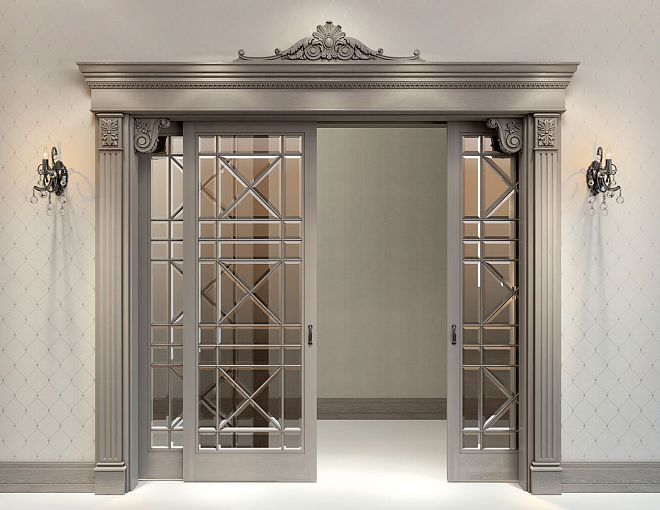
Flat vertical trim or pilaster-like components can create a formal portal around an opening. That is fundamentally different from placing molding on the slab.
Do not use door-panel molding as if it were a structural jamb extension or casing replacement.
Door Molding Ideas for Bedrooms
Bedroom doors usually benefit from restraint. One large frame or a two-panel layout is enough. Paint molding and slab the same color so the door feels tailored rather than decorative.
Door Molding Ideas for Living Rooms
Doors opening into formal living rooms can support stronger panel proportions or a coordinating applique, especially when the wall itself uses molding.
Door Molding Ideas for Home Offices
A dark paneled door can coordinate beautifully with bookshelves and built-ins. Use the same paint family and related molding proportions to create a library-like effect.
Door Molding Ideas for Dining Rooms
Dining-room doors can carry more formal detail because the room is typically static and architectural. Two- or three-panel layouts, decorative corner elements, and a central ornament can all work when scaled carefully.
Door Molding Ideas for Hallways
Hallways often contain several doors in one view. Consistency matters more than individual drama.
Use the same basic frame layout on all doors so the corridor reads as one system.
Door Molding Ideas for Closets
Closet doors can visually disappear into the wall when painted the same color and given matching linear molding. Alternatively, they can be treated as wardrobe panels with taller, furniture-like frames.
Door Molding Ideas for Double Doors
Double doors deserve a mirrored composition. One strong option is one tall frame on each leaf with a central pair of appliques positioned symmetrically away from the meeting stile.
Door Molding Ideas for Pantry Doors
A pantry door in a kitchen can borrow the cabinet trim language, especially if it sits within a tall cabinet run. This is where interior-door and cabinet-molding systems can intentionally overlap.
How to Lay Out Decorative Molding on a Door
Good door trim begins with a measured elevation, not with cutting.
Record:
- door width and height;
- handle centerline;
- lock or backplate dimensions;
- hinge side;
- distance to casing when the door is closed;
- paired-door center gap if applicable;
- any existing routed or recessed detail.
Then sketch the frame system at scale.
Use Painter's Tape Before Buying Trim
Painter's tape is the fastest way to test a door-molding layout.
Tape the exact outside dimensions of the proposed frame on the slab, reinstall the handle if it has been removed, and view the door from across the room.
A drawing can tell you that the frame fits. Tape tells you whether it feels right.
Check the Door Open and Closed
A design can look perfect when the door is closed and create interference when it opens.
Check the molding against:
- adjacent casing;
- wall stops;
- baseboards;
- neighboring doors;
- closet returns;
- cabinetry;
- hooks or wall-mounted accessories.
How Far Should Door Molding Be From the Edge?
There is no universal inset.
The correct distance depends on profile width, door size, hardware, and style. A thin profile can sit closer to the edge than a deep ornamental molding. A tall double door can support a wider border than a narrow closet door.
Consistency across related doors is more important than chasing one standard dimension.
How Much Space Should Be Between Stacked Panels?
The gap between upper and lower panels should feel related to the outer inset and molding width.
If the gap is dramatically narrower than every other margin, the panels can appear pinched together. If it is too large, the door can look visually disconnected.
How to Align Molding With Door Hardware
Use the handle as an architectural datum.
On a two-panel door, the handle may sit within the lower portion of the upper panel, beside the division, or within a clear vertical strip between frame and edge. What matters is that the relationship looks intentional.
How to Align Molding on Multiple Doors
If several doors appear in the same hallway or room, keep corresponding panel tops and horizontal divisions at the same height whenever door sizes allow.
This creates a visual datum that ties the doors together.
How to Handle Doors of Different Widths
Do not force identical frame widths onto different door sizes.
Instead, keep a consistent outer inset and profile family while allowing the center field to change. The doors will still read as related.
How to Handle Doors of Different Heights
Keep the top panel proportions related and maintain consistent horizontal alignments where possible. Taller doors can receive elongated upper panels rather than simply enlarging every margin.
Decorative Molding on Very Narrow Doors
Narrow closet or utility doors often look better with one slim frame than with multiple panels.
Use a compact profile such as MLDPU-001 and preserve enough flat surface around the frame.
Decorative Molding on Oversized Doors
Oversized doors can support larger profiles, multiple panels, corner ornament, and central appliques.
Scale up the geometry first, then decide whether additional ornament is necessary.
How to Calculate Molding for One Door
For a simple rectangular frame:
2 × frame width + 2 × frame height = linear molding required.
For two or more frames, calculate each perimeter separately and add them together.
Cut Planning Matters More Than a Simple Waste Percentage
Long vertical pieces often determine how efficiently stock lengths are used.
For example, a 2600 mm molding can often provide one full-height vertical door piece plus shorter horizontal sections from the remainder. Build a cut list before ordering rather than relying only on a generic waste allowance.
Create a Door Trim Schedule
For multiple doors, use a simple schedule:
| Door ID | Door size | Molding SKU | Layout | Corner treatment | Applique |
|---|---|---|---|---|---|
| D01 | Standard bedroom | MLDPU-001 | Two panel | Mitered | None |
| D02 | Double office door | MLDPU-002 | One tall panel per leaf | Mitered | Paired center ornaments |
| D03 | Formal dining door | MLDPU-003 | Large single frame | Series-compatible corners | Optional |
How to Install Applied Door Molding
The technical sequence is straightforward, but door work has tighter visual tolerances than wall trim because the surface is viewed close-up and moves every day.
- Remove the door when practical.
- Remove handles and other hardware.
- Clean and inspect the surface.
- Repair only defects that affect the finish or bond.
- Mark the full layout.
- Cut all frame pieces.
- Dry-fit the complete frame.
- Apply compatible adhesive.
- Temporarily support the molding as required.
- Finish small joints.
- Prime repaired areas if needed.
- Paint with a compatible finish system.
- Reinstall hardware.
- Rehang the door and check clearance.
Remove the Door When Practical
Working horizontally makes accurate layout easier. It also prevents pieces from sliding while adhesive cures and allows you to inspect every miter from directly above.
However, very heavy doors or complex hardware may make removal impractical. In that case, the door can be decorated in place with careful temporary support.
Label Doors Before Removal
When several doors are being upgraded, label each slab, hinge position, and opening.
Even similar doors may have different hinge adjustments, latch positions, or small dimensional differences.
Surface Preparation
Do not automatically strip every door to bare material.
If the existing coating is stable, preparation may involve cleaning, deglossing or sanding as required, and using a compatible adhesive and coating system.
If the finish is failing, it must be corrected before decorative trim is installed.
Do Not Use Aggressive Solvents Blindly
The source article recommends generic solvent degreasing. That is too broad.
Some door finishes, plastics, primers, and polyurethane products can be affected by aggressive solvents. Use cleaners and surface-preparation products approved for the exact coating and substrate.
Mark the Entire Composition Before Cutting
Draw all frame lines first.
This allows you to check:
- symmetry;
- hardware clearance;
- panel spacing;
- relationship to the door edge;
- alignment between double doors.
Use a Jig for Repeated Doors
If six identical doors receive the same inset, create a spacer block or marking jig.
A jig is faster and more consistent than measuring four margins from scratch on every slab.
Cutting Molding for Door Frames
A fine-tooth saw or accurately adjusted miter saw can produce clean cuts on compatible rigid polyurethane profiles. Some small current STAVROS PU profiles also permit cutting with a sharp utility knife according to product guidance.
Choose the method that produces the cleanest repeatable cut for the specific profile.
Why Miter Saw Calibration Matters
A saw set to “45” is not useful if the fence or blade is slightly out of square.
Test four pieces as a sample frame before cutting an entire project.
Dry-Fit All Four Pieces
Do not glue one side at a time without checking the complete rectangle.
A tiny length error at one corner can push the entire frame out of square by the time the fourth piece is installed.
Adhesive Selection for Polyurethane Door Molding
Use an adhesive compatible with both the polyurethane profile and the door surface.
Current STAVROS MLDPU guidance references mounting adhesive, acrylic adhesive, and certain liquid-nails-type products for decorative installation. The specific adhesive chemistry should be selected according to the substrate and manufacturer instructions.
Do Not Over-Apply Adhesive
Excess adhesive can squeeze out, contaminate the paint surface, and make a small profile slide away from the layout line.
Use enough for reliable contact, not enough to compensate for a badly uneven door.
Temporary Fixation
Low-tack tape can be useful for lightweight profiles while adhesive sets.
Do not use a tape aggressive enough to pull existing paint from the door when removed.
Should You Use Brads or Pins?
Mechanical fixation depends on the door construction and profile.
A solid wood door and a hollow-core door do not offer the same fastening substrate. Do not fire brads into a door face unless you know what is behind the skin and the fastener is appropriate.
Joint Filling
Small paint-grade gaps can be finished with a compatible filler or paintable sealant.
Large gaps are usually a geometry problem, not a filling problem. Recut the piece when necessary.
How to Make Miters Disappear
The best invisible miter starts with two accurate cuts.
After assembly, use only enough filler to close tiny imperfections. Sand carefully without flattening the profile.
Painting Decorative Door Molding
Paint is what visually turns separate molding strips into one door composition.
For the most architectural effect, door slab and molding are usually painted the same color and sheen.
Sprayed vs. Brushed Door Finishes
A sprayed finish can create a very uniform result on flat doors and small profiles. Brushed or rolled finishes can also work, especially in site-painted interiors, but they make surface preparation and brush control more visible.
Paint Compatibility
Do not state that all polyurethane can use only one paint chemistry.
Use coatings compatible with the exact molding, primer, adhesive, filler, and door substrate. Manufacturer guidance takes priority over generic rules.
Patina and Metallic Accents
Classical decorative doors can use glaze, patina, or metallic highlights to emphasize relief.
Apply these effects selectively. A small amount of contrast on a central applique or corner ornament often looks more refined than painting every molding edge gold.
Can Door Molding Hide Damage?
It can hide some superficial damage if the molding happens to cover the affected area, but decoration should not be used to conceal structural problems, delamination, severe warping, moisture damage, or failing door skins.
Mirror and Glass Inserts: Be Careful With Structural Modification
The source article suggests cutting openings into doors for mirrors or glass. That should not be treated as a simple universal DIY step.
Many interior doors are hollow-core, fire-rated, engineered, or constructed with internal blocking in specific locations. Cutting an opening can destroy structural integrity, fire performance, warranty, or hardware support.
If a door was not designed for glazing, surface-mounted mirror panels or a purpose-made glazed replacement door are often safer design routes.
Surface-Applied Mirrors
A mirror can be mounted to a suitable solid surface and framed with decorative molding, but mirror adhesive, door weight, hinge capacity, and edge safety must be considered.
Large mirrors can substantially increase door mass.
Fire-Rated Doors
Do not modify a fire-rated door casually.
Cutting, drilling, attaching combustible materials, changing glazing, or altering hardware can affect the door assembly's rating. Follow the door manufacturer, code requirements, and qualified professional guidance.
Exterior Doors
This article is primarily about interior door decoration.
Exterior doors face moisture, ultraviolet exposure, temperature change, weather seals, security hardware, and different coating requirements. Do not assume an interior polyurethane molding or adhesive is exterior-rated unless the exact product says so.
High-Humidity Rooms
Bathroom and laundry-room doors can use applied molding, but the full finish system matters. Consider door substrate, edge sealing, adhesive, primer, paint, and ventilation.
Cleaning and Maintenance
Every profile creates small ledges that collect dust.
Simple shallow molding is easier to maintain than deep floral ornament. Use cleaning products compatible with the final door paint, not simply with the raw molding material.
Repairing Damaged Door Molding
Small chips or joint cracks can often be filled and repainted.
If a molding strip is badly damaged, replacing one full side of a frame may look cleaner than attempting a visible mid-run patch.
Document Product SKUs
Keep a record of the molding and applique SKUs used on the project.
If a door is damaged years later, that documentation makes replacement much easier.
Common Mistake #1: Confusing Casing With Applied Door Molding
They are different products. Casing belongs to the opening; applied molding belongs to the slab.
Common Mistake #2: Using a Profile That Is Too Large
A profile designed for a large wall can overwhelm a standard door.
Common Mistake #3: Ignoring Hardware
Handles, locks, and backplates must fit comfortably within the molding geometry.
Common Mistake #4: Copying Dimensions From Another Door
Door widths, heights, handle positions, and casing relationships vary. Copy the proportion, not the numbers.
Common Mistake #5: Overdecorating Every Door in the House
Use stronger ornament on focal doors and simpler molding on secondary doors.
Common Mistake #6: Assuming Every Door Is Solid Wood
Hollow-core, solid-core, MDF, veneered, and engineered doors require different fastening decisions.
Common Mistake #7: Treating Filler as a Substitute for Accurate Cuts
Filler finishes a joint. It should not rebuild badly cut geometry.
Common Mistake #8: Adding Heavy Mirrors Without Checking Hinges
Door weight affects hinge loading and long-term alignment.
Common Mistake #9: Cutting Into a Rated or Engineered Door
Structural and code implications can be significant.
Common Mistake #10: Assuming All Polyurethane Trim Is Flexible
Standard rigid MLDPU profiles should not be bent around curves unless the exact SKU is designed for that use.
Common Mistake #11: Using Interior Trim Outdoors
Exterior suitability must be documented by product.
Common Mistake #12: Mixing Too Many Styles
Classical appliques, rustic wood casing, Art Deco geometry, and minimalist hardware rarely become coherent by accident.
Common Mistake #13: Using Contrasting Paint to Hide Bad Geometry
Contrast makes mistakes more visible, not less.
Common Mistake #14: Forgetting the Door Moves
A wall panel never swings into casing, furniture, or another door. A door does.
Common Mistake #15: Skipping a Full-Scale Mockup
A few strips of tape can prevent an entire set of doors from being trimmed at the wrong scale.
How to Coordinate Door Molding With Wall Molding
If the room already uses picture-frame wall molding, the door should feel related but not identical.
A good strategy is to repeat one of these attributes:
- profile shape;
- paint color;
- frame proportions;
- ornament family;
- corner treatment.
Then change the scale to suit the door. This creates continuity without making the room look like one repeated template.
How to Coordinate Door Molding With Baseboards
Baseboards and applied door molding do not need to share the same profile, but their visual weight should make sense together.
A very heavy baseboard with a hairline door bead can feel disconnected. A delicate baseboard with a massive ornate door frame can have the opposite problem.
How to Coordinate Door Molding With Cabinetry
In bedrooms, closets, studies, and kitchens, interior doors often sit next to wardrobes or built-ins.
Using related polyurethane molding families on doors and cabinetry can create a strong custom-millwork effect. Scale each application independently.
How to Coordinate Door Molding With Ceiling Details
A formal door can be visually connected to a ceiling medallion, crown, or wall panel system through style rather than exact ornament.
If the ceiling is highly decorative, keep the door simpler. If the room is otherwise restrained, the door can carry more of the ornament.
Designing a Focal Door
Not every door deserves the same treatment.
Potential focal doors include:
- double doors to a dining room;
- library doors;
- primary bedroom doors;
- doors at the end of a long hallway;
- hidden pantry doors integrated with cabinetry;
- large wardrobe-style sliding or hinged doors.
Secondary closet and utility doors can use a simplified version of the same design language.
One-Sided vs. Two-Sided Decoration
A door has two faces, and they do not always need identical decoration.
The formal side facing a living room may receive applied molding, while the side facing a utility room may remain plain. But if both sides are visible in important spaces, coordinating them may produce a more intentional result.
Door Edge and Latch Clearance
Applied molding should stay clear of the latch edge, hinges, and door stop. Even a shallow profile can catch the frame if installed too close to the edge.
Always test the door swing after a dry-fit mockup.
Lever Handles With Long Backplates
Long backplates need significantly more flat door area than small round roses.
Design the molding around the actual hardware selected for the project, not around a generic handle symbol.
Smart Locks and Electronic Hardware
Interior smart locks and keypad hardware can occupy large rectangular areas on the slab.
Keep molding well clear so hardware can be serviced or replaced without cutting into the decorative profile.
Door Closers and Specialty Hardware
Commercial and specialty doors may have surface closers, push plates, kick plates, signage, or access-control devices. Decorative applied molding should not interfere with them.
Kick Plates and Lower Panels
If a door needs a kick plate, the lower molding panel should be designed around it rather than hidden behind it.
This is another reason that a two-panel layout is more flexible than a dense multi-panel grid.
Pet Doors and Utility Cutouts
Any functional opening in the lower part of the door should be incorporated into the panel design from the beginning.
Do not create a lower molding frame only to cut through it later.
Door Stops
Wall- or hinge-mounted door stops can determine where the door surface contacts adjacent construction. A deep decorative overlay near that contact zone may be damaged repeatedly.
Children's Rooms
Use shallower, simpler profiles in high-contact rooms. Large ornate appliques at hand height are more likely to be bumped, picked at, or damaged.
Hotels and Commercial Interiors
Decorative door molding can create a premium effect in hospitality spaces, but durability, cleaning, fire documentation, and repeatability become more important.
For repeated hotel-room doors, a standardized jig and one approved profile system are more valuable than highly individualized ornament.
Historic Interiors
If an original historic door has genuine carved or molded detail, preservation should come before decorative modernization.
Applied polyurethane molding is useful for new or replacement doors that need to relate visually to a historical interior, but it should not be presented as equivalent to conserved original joinery.
Renovation Strategy: Upgrade or Replace?
Applied molding is most attractive when the existing door is fundamentally sound.
Consider replacement instead when:
- the slab is badly warped;
- the veneer is delaminating;
- the core is damaged;
- the door no longer fits the jamb correctly;
- fire or acoustic performance is inadequate;
- the hardware layout is incompatible with the desired design;
- major glazing changes are required.
Budgeting the Project
Do not compare only the price of molding with the price of a new door.
A complete applied-molding upgrade can include:
- molding profiles;
- appliques or corner elements;
- adhesive;
- surface repair;
- primer;
- paint;
- new hardware;
- labor for removing and rehanging doors;
- jigs and cutting setup;
- touch-up after installation.
For multiple doors, repeatability can make the process much more efficient.
Professional Workflow for Multiple Doors
For a contractor, cabinet shop, or finish carpenter, the most reliable workflow is:
- approve one door design;
- build one full-size sample;
- confirm hardware;
- create a marking jig;
- create a cut list;
- batch-cut matching pieces;
- label each door and frame set;
- assemble in a controlled sequence;
- finish all doors with one paint system;
- rehang and adjust as a set.
Why Batch Production Improves Quality
Repeated door sets look best when every frame is laid out from the same reference and cut with the same setup.
Changing saw settings, offsets, or profile families halfway through the project creates visible inconsistency.
Specification Checklist for Designers
A door-molding specification should identify:
- door ID and size;
- molding manufacturer and SKU;
- material;
- frame layout;
- outside inset;
- panel spacing;
- corner treatment;
- applique SKU and position;
- hardware clearance;
- adhesive or fixing method;
- primer and finish system;
- paint color and sheen;
- mockup requirement.
Specification Checklist for Installers
Before beginning, confirm:
- the door is the correct door for the opening;
- the finish is sound;
- the molding SKU matches the drawing;
- all required left/right corner pieces are present;
- handles and locks are known;
- door swing has been tested;
- adhesive is compatible;
- one sample assembly has been approved.
SEO Intent: Door Molding Is Broader Than Decorative Door Molding
The broad phrase door molding can describe casing, jamb trim, exterior trim, architectural surrounds, and applied slab decoration. That is why a page targeting the term without context can attract mixed intent.
This article is intentionally narrower. It focuses on decorative door molding and decorative door trim molding applied to interior doors, with casing explained as a separate component.
Polyurethane Door Trim: Use the Phrase Carefully
The query polyurethane door trim exists, but product intent can mean either applied decorative molding or full casing around the opening.
For STAVROS, the safe and accurate application is polyurethane molding used to decorate door panels. A dedicated complete polyurethane casing system should not be implied unless a specific product is confirmed.
How This Article Fits the STAVROS Content Cluster
This page should own the door-decoration intent: applied molding on interior doors, panel layouts, door appliques, decorative corners, hardware clearance, finishing, and renovation strategy.
The article on cabinet molding and trim should own kitchen cabinets, built-ins, wardrobes, vanities, and furniture trim.
The article on decorative corner molding should own corner blocks, left/right corner elements, and compatibility logic.
The installation guide on how to install polyurethane molding should own cutting, miter geometry, adhesive, joints, and general paint preparation.
Frequently Asked Questions
What is decorative door molding?
It is a decorative profile applied to the face of a door to create raised frames, panels, borders, or geometric designs.
Is door molding the same as door casing?
No. Casing surrounds the door opening and covers the jamb-to-wall joint. Applied door molding is attached to the door slab.
Can I add molding to a flat interior door?
Yes, if the door surface is sound and the molding, adhesive, finish, and hardware clearances are appropriate.
Can I add molding to a hollow-core door?
Lightweight applied trim can often be used, but fastening must account for the thin face skin and lightweight internal construction.
Can I use polyurethane molding on interior doors?
Yes. Rigid paint-grade polyurethane profiles such as STAVROS MLDPU products can be used for decorative door-panel frames when their size is appropriate.
Which STAVROS molding is best for a small door?
MLDPU-001 is a compact 10 × 6 mm profile and is one of the easiest options to scale to smaller doors and delicate panel layouts.
Which molding works for a larger statement door?
MLDPU-002 or MLDPU-003 can provide stronger visual weight on taller or wider doors, but the exact choice should be mocked up at full scale.
Can I add decorative appliques to a door?
Yes. Keep the applique proportionate to the panel and clear of handles, locks, and door edges.
Can I use decorative corner elements on a door frame?
Yes, if the corner pieces are designed for the selected molding series and correctly oriented.
Should door molding be painted the same color as the door?
Usually, if you want an integrated architectural look. Contrast creates a stronger decorative effect and makes every alignment more visible.
How many panels should a door have?
There is no universal number. One large panel is clean and modern; two panels are versatile; three or more create a more formal or period-specific look.
How far should molding be from the door edge?
The inset should be proportional to the door size, molding width, hardware, and style. Consistency matters more than one fixed number.
Can molding cross behind a door handle?
It can physically, but it usually should not. Keep enough flat area for the handle base, fingers, and future hardware replacement.
Can I use the same molding on walls and doors?
Sometimes, but a smaller related profile often scales better to the door while preserving the same design language.
Can I add molding to a fire-rated door?
Only with appropriate professional and manufacturer guidance. Modifying a rated door can affect its tested assembly and code compliance.
Can I cut a hollow-core door for a mirror or glass panel?
Do not assume this is safe. Internal construction, blocking, hardware support, and fire or structural performance may be affected.
Can I decorate an exterior door with polyurethane molding?
Only if the exact molding, adhesive, finish, and door system are rated for exterior exposure. This guide focuses on interior doors.
How do I calculate molding for a door?
Calculate the perimeter of each applied frame, add all frames together, then optimize those cut lengths against the actual molding stock length.
Should I remove the door before installing molding?
When practical, yes. Horizontal work makes layout, cutting, adhesive control, finishing, and painting easier.
What makes applied door molding look custom?
Correct scale, consistent panel spacing, accurate miters, integrated hardware, coordinated casing, controlled ornament, and a unified finish.
Final Design Principle: Make the Door Part of the Architecture
The strongest decorative door molding does not look like something that was added because the door felt boring. It looks as if the panel geometry always belonged to the room.
That result comes from a sequence of decisions: distinguish the door slab from the casing, choose a layout that fits the door proportions, select a profile at the correct scale, protect hardware clearances, decide whether corners should be mitered or ornamental, use appliques only where they add hierarchy, and finish the entire composition as one surface.
For broad U.S. search intent, the relevant language includes decorative door molding, decorative door trim molding, door molding, door trim molding, and decorative moulding for doors. For STAVROS product links, keep the material claim precise: use verified polyurethane molding for door panels, polyurethane appliques and onlays, and polyurethane corner elements where the exact product is compatible.
A well-designed door can do more than close an opening. It can repeat the wall geometry, echo the cabinetry, establish a room's symmetry, or become a deliberate focal point. The molding is only the tool. The real design is the relationship between the door, the opening, the hardware, and the architecture around it.
The color palette of classic style includes white, beige, cream, gray, brown. The door can be painted in a light color, moldings highlighted with gold or silver patina, overlays painted in a tone darker than the main panel. Gilding adds luxury and grandeur — it is applied to protruding parts of moldings, carved elements, creating highlights and play of light. Gilding uses special paint or leaf gold (patina).
Classic decoration requires high-quality materials and careful execution. All elements must be symmetrical, joints perfectly fitted, surfaces smoothly sanded and painted. A classic door is an investment in longevity and aesthetics; it never goes out of style and always looks dignified. Working withMDF molding productionyou can select elements for any classic project.
Modern minimalism: simplicity and graphics
Minimalism in door decoration means rejecting excess, using simple forms, clean lines, monochromatic colors. For minimalism, narrow straight moldings without ornamentation are suitable, creating graphic frames. Overlays should be simple, rectangular, without carving. The number of elements is minimal — one or two frames, symmetrically or asymmetrically placed.
The color palette of minimalism includes white, black, gray, beige. The door can be painted in one neutral color, moldings in contrasting or matching tones. High-quality painting without streaks or unevenness, smooth matte surface is essential. Minimalism does not tolerate carelessness — every detail must be perfect. Moldings can be very thin, 10-20 mm, creating a delicate relief.
Minimalist decoration suits modern apartments, offices, studios. It does not overload space, creating a sense of order and calm. A door with minimalist decoration easily fits into any interior, serving as a backdrop for other elements. Working withwooden molding productionguarantees precision and quality of elements for minimalist projects.
Loft and industrial style: roughness and contrasts
Loft is a style celebrating industrial aesthetics, rough textures, visible structures. For loft, dark colors, metallic accents, imitation of old factory doors are typical. Door decoration in loft style implies using narrow moldings creating a grid of small rectangles (cassette door). The door is painted black, graphite, or dark brown; moldings can be the same color or contrasting — metallic, rust.
The effect of an old door is created using brushing techniques (highlighting wood texture with a stiff brush), patina, and applying wear marks. You can add metallic overlays — corners, rivets, imitating industrial door hardware. Overlays are mounted on self-tapping screws, whose heads are not hidden but rather emphasized — they become part of the decoration.
Loft decoration pairs well with brick walls, concrete surfaces, exposed utilities. A loft-style door is rugged, masculine, suitable for industrial interiors, studios, creative spaces. It does not require perfect finishing — minor irregularities, scratches, wear only add authenticity. Collaboration withwooden molding productionallows selecting appropriate elements for industrial style.
Provence and country: softness and coziness
Provence and country are styles celebrating rustic simplicity, naturalness, coziness. For Provence, light pastel tones are typical — white, cream, lavender, mint, blue. The door is painted in one of these colors, then decorated with moldings and overlays featuring floral ornaments, carving, and aging effect. Patina emphasizes relief, creating a sense of time and years lived.
For country style, warmer tones are suitable — beige, brown, terracotta, olive. Moldings can be simple, without excessive decoration, but with pronounced wood texture. Overlays — rectangular or diamond-shaped, placed symmetrically. The door can be enhanced with wrought elements — hinges, handles, overlays, adding authenticity and craftsmanship.
When working with %s, you can select elements with the desired texture and profile.Wooden skirting productionWhen working with %s, you can select elements with the desired texture and profile.
Frequently Asked Questions About Door Decoration
Can you decorate an MDF door with solid wood molding?
Yes, solid wood moldings can be attached to an MDF door using quality glue or liquid nails. It is important to degrease the door surface before installation and ensure tight fitting of the moldings. For additional fixation, use thin, headless nails, driving them slightly below the surface, then fill the mounting points with putty.
How to choose molding color relative to the door?
The color of moldings depends on the desired effect. Moldings in the same tone as the door create a monochromatic volume, suitable for classic interiors. Contrasting moldings (white on dark doors or vice versa) add graphic elements, suitable for modern styles. Gold or silver moldings create luxury, suitable for art deco and glamor.
How long does it take to decorate a door yourself?
The time depends on the complexity of the composition and your experience. Simple decoration with several moldings can be completed over the weekend: preparation and marking — 2-3 hours, installing moldings — 3-4 hours, spackling and sanding — 2 hours, painting in two coats — 4-5 hours plus drying time between coats. Complex compositions with overlays, carving, patina may take a week.
Is it necessary to remove the door from hinges for decoration?
Removing the door from hinges significantly simplifies the work, especially when installing moldings on both sides of the door panel and painting. It is easier to mark and glue elements on a horizontal surface, and paint lays evenly without streaks. However, simple decoration can be done without removing the door, protecting the floor and walls with plastic sheeting.
Can you decorate a metal entrance door?
Yes, a metal door can be decorated using MDF overlays or moldings. Overlays are attached with glue and self-tapping screws, after which the door surface is cleaned and degreased. MDF elements are suitable for metal doors because they are lighter than wooden ones and hold better on glue. After installing overlays, the door is painted in the chosen color.
How to care for a decorated door?
A decorated door requires regular cleaning from dust and dirt. Wipe the surface with a soft damp cloth, avoiding abrasive cleaners that scratch the paint. Wipe moldings and overlays in recesses where dust accumulates. Every few years, renew the lacquer or paint coating to keep the door looking fresh.
What glue is best for moldings?
For attaching moldings, suitable glues include PVA wood glue, liquid nails, and polyurethane glue. Wood glue is eco-friendly, holds wood well, but requires drying time. Liquid nails provide quick fixation and are suitable for heavy elements. Polyurethane glue is water-resistant, strong, but more expensive. Choose glue depending on the molding material and usage conditions.
Can you create decoration without using special tools?
A minimal set of tools is still necessary: tape measure, pencil, hacksaw or hand saw, sandpaper, brushes. A 45-degree angle cutter is desirable but not mandatory — you can join moldings at right angles. Instead of a pneumatic stapler, use a hammer and thin nails. The key is care and patience, not professional equipment.
Conclusion: Your Door is Your Creation
Decorating doors yourself is not just a way to refresh the interior, but a true creative process that allows you to realize ideas, experiment with materials, and create unique solutions. Moldings, overlays, trim — these elements transform an ordinary door panel into a work of art, highlight the room’s style, and become your home’s signature. Don’t be afraid to experiment, try different techniques, combine materials and colors. Even simple decoration, done with love and attention to detail, can transform a space, making it warmer, cozier, and more individual.
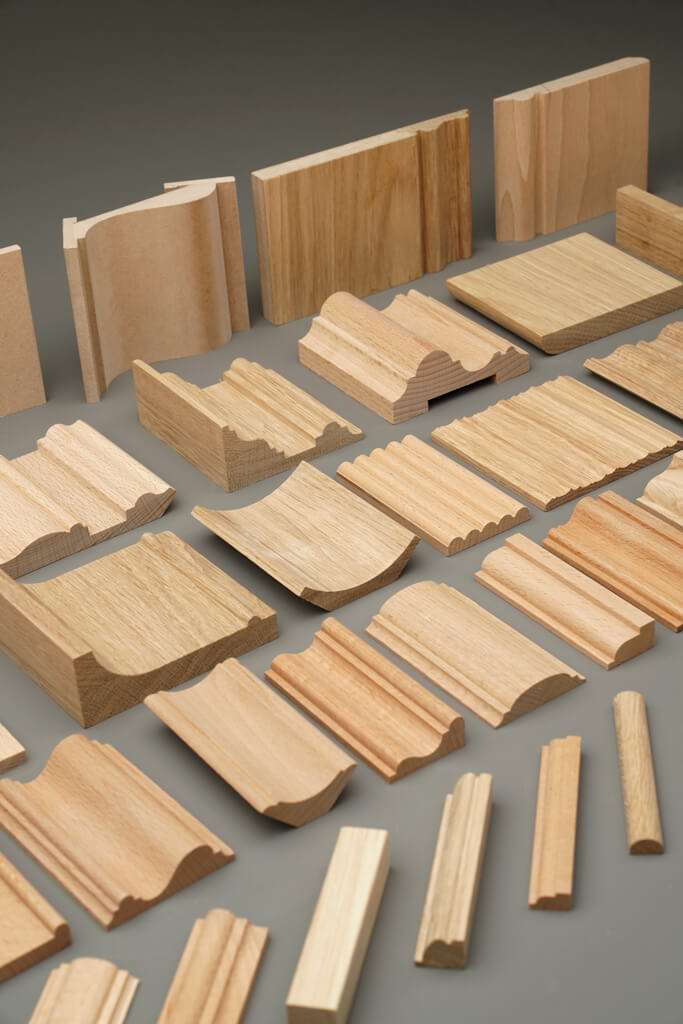
STAVROS —molding products factoryHere you can find %s and other elements needed to create a unique decoration.moldings, cornices, skirting boards, Casings, Crown MoldingSTAVROS works with the best wood species — oak, ash, beech, pine — offering products of various profiles and sizes, ready for painting or with natural texture.
STAVROS works with the finest wood species — oak, ash, beech, and pine — offering products in various profiles and sizes, ready for painting or with a natural grain finish.production of trimManufactured on modern equipment, it guarantees precise dimensions, smooth surface, and absence of defects. The company’s specialists will help select elements for your specific project, calculate the required material quantity, and advise on installation and finishing.
When contactinga manufacturer of molding productswith years of experience, you receive not just materials, but a guarantee of quality, durability, and aesthetic perfection.Moldings production, baseboards, casingsProduction of %s and other decorative elements is carried out in accordance with all technological standards, allowing you to create interiors that will delight for decades.
Decorating doors is an art accessible to anyone willing to invest time, imagination, and attention to detail. With proper materials, clear instructions, and a creative approach, you will create a door that becomes a source of pride for your home and an object of admiration for guests. Start transforming your space today — and within a few days, your interior will glow with new colors, and your doors will be reborn, filled with style, character, and individuality.