Article Contents:
- How to choose the right wall finishing method
- Substrate condition
- Purpose of the room
- Project budget
- Service life and maintainability
- Complex installation
- 1. Painting with water-dispersion paint
- 2. Washable paint
- 3. Combined painting and color blocking
- 4. Stencil painting
- 5. Decorative rollers and stamps
- 6. Paper wallpaper
- 7. Non-woven wallpaper
- 8. Vinyl wallpaper
- 9. Wallpaper for painting
- 10. Liquid wallpaper
- 11. Textured paint
- 12. Structural plaster "bark beetle"
- 13. Plaster with travertine effect
- 14. Venetian plaster
- 15. Concrete effect coating
- 16. Microcement
- 17. Cork wallpaper and panels
- 18. Bamboo sheets and panels
- 19. PVC panels
- 20. Laminated MDF panels
- 21. Laminate on the wall
- 22. Parquet or engineered board on the wall
- 23. Wooden lining
- 24. Imitation timber
- 25. Block house
- 26. Panels with natural veneer
- 27. Decorative MDF slats
- 28. Solid wood slats
- 29. Ready-made slatted panels
- 30. Acoustic panels with slats and felt
- 31. Wooden moldings
- 32. Polyurethane moldings
- 33. Frame layout on the wall
- 34. Boiserie from moldings and panels
- 35. Polyurethane decorative overlays
- 36. Carved wooden overlays
- 37. Pilasters and capitals
- 38. Decorative rosettes and medallions
- 39. Decorative cornices on the wall
- 40. Combination of moldings, slats, and painting
- 41. Gypsum 3D panels
- 42. Polyurethane 3D panels
- 43. Carved wooden panels
- 44. Artificial decorative stone
- 45. Flexible stone
- 46. Decorative brick and clinker
- 47. Large-format porcelain stoneware
- 48. Natural stone
- 49. Backlit onyx
- 50. Solid wood boiserie, marquetry and custom wall panels
- living room
- for the bedroom
- For the hallway
- For Kitchen
- For the Bathroom
- For Children's Room
- For Office
- Paint calculation
- Wallpaper calculation
- Panel calculation
- Slat calculation
- Calculation of moldings
- Choosing only by photo
- Ignoring wall preparation
- Too many textures
- Incorrect element scale
- Lack of connection with furniture
- Saving on stock
- Ill-conceived electrical wiring
- Which wall finish option is the most budget-friendly?
- Which finish best hides unevenness?
- What to choose for an accent wall behind the TV?
- Can slats and moldings be combined?
- Which finish is suitable for DIY installation?
- Is it necessary to perfectly level the wall for slats?
- Can wooden moldings and overlays be painted?
- Can MDF Be Used in Bathrooms?
- How much material stock should be purchased?
- What is more practical: paint or panels?
- How to make a small room visually taller?
- Which finish looks expensive but doesn't require covering the entire wall?
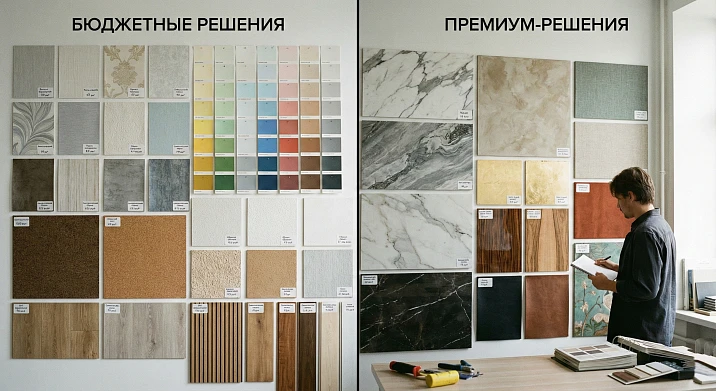
For wall finishing, you can use paint, wallpaper, plaster, panels, natural wood, slats, moldings, stone, textiles, and combined decorative systems. The choice depends on the budget, base condition, room purpose, moisture resistance requirements, and desired visual effect. To create relief compositions, you can buy wooden slats for walls, and for a classic design, choose panels, moldings, and decorative elements from STAVROS.
Modern wall finishing is not just a final coating that hides plaster or building blocks. It shapes the room's proportions, affects lighting, acoustics, perception of space, and the character of the entire interior. The same material can make a room visually taller, wider, calmer, warmer, or, conversely, more graphic and dynamic.
This guide collects 50 ways to finish walls — from affordable painting and wallpaper to natural stone, carved panels, marquetry, and boiserie made of solid wood. For each option, features, advantages, limitations, suitable rooms, and installation requirements are considered.
How to choose the right wall finishing method
There is no single material that works equally well for a bedroom, bathroom, hallway, kitchen, or formal living room. Before purchasing, it's important to evaluate not only the appearance of the coating but also its operating conditions.




Condition of the base
Paint, thin wallpaper, and smooth decorative plaster highlight wall imperfections. They require a level, durable, and properly prepared base. Panels, lining, slats, and frame systems allow hiding minor unevenness, utilities, and local damage.
Our factory also produces:
Purpose of the room
In the bedroom and living room, aesthetics, tactile feel, and eco-friendliness come first. In the hallway, resistance to dirt and impacts is important. For the kitchen, coatings that are easy to clean are necessary. In the bathroom, only materials and installation compounds designed for high humidity are used.
Get Consultation
Project budget
The cost depends not only on the price of the material itself. It is necessary to consider wall preparation, priming, leveling, fasteners, glue, finishing coating, installers' work, trimming, and waste. Sometimes an inexpensive material requires such complex preparation that the final cost ends up being comparable to a panel system.
Service life and repairability
A painted wall is relatively easy to refresh, but it is vulnerable to scratches and dirt. A damaged strip of wallpaper can be difficult to replace without a noticeable seam. An individual slat, molding, or overlay can often be removed and replaced locally.
Installation complexity
You can handle hanging simple wallpaper, painting, and installing lightweight polyurethane decor yourself. Working with natural stone, large-format porcelain stoneware, Venetian plaster, and complex wooden panels requires experience and professional tools.
Brief comparison of main material groups
|
Material group |
Price level |
Wall preparation |
Installation complexity |
Main application |
|
Paint and budget coatings |
Low |
Requires a level base |
Low or medium |
Apartments, offices, rental spaces |
|
Wallpaper |
Low or medium |
Depends on the density of the fabric |
Medium |
Bedrooms, living rooms, children's rooms, studies |
|
Decorative plasters |
Average |
Requires a solid base |
Medium or high |
Living rooms, halls, kitchens, commercial spaces |
|
MDF, PVC and composite panels |
Average |
Minor irregularities are allowed |
Medium |
Hallways, kitchens, studies, accent walls |
|
Slats and moldings |
Medium or high |
Depends on the mounting method |
Medium |
Zoning, frame compositions, TV areas |
|
50-100 years |
Medium or high |
Installation on a frame is possible |
Medium or high |
Living rooms, bedrooms, studies, country houses |
|
Stone and porcelain stoneware |
High |
Requires a solid base |
High |
Halls, kitchens, bathrooms, fireplace areas |
|
Boiserie and designer panels |
Premium |
Individual preparation |
High |
Formal living rooms, studies, halls, restaurants |
Budget wall finishing options
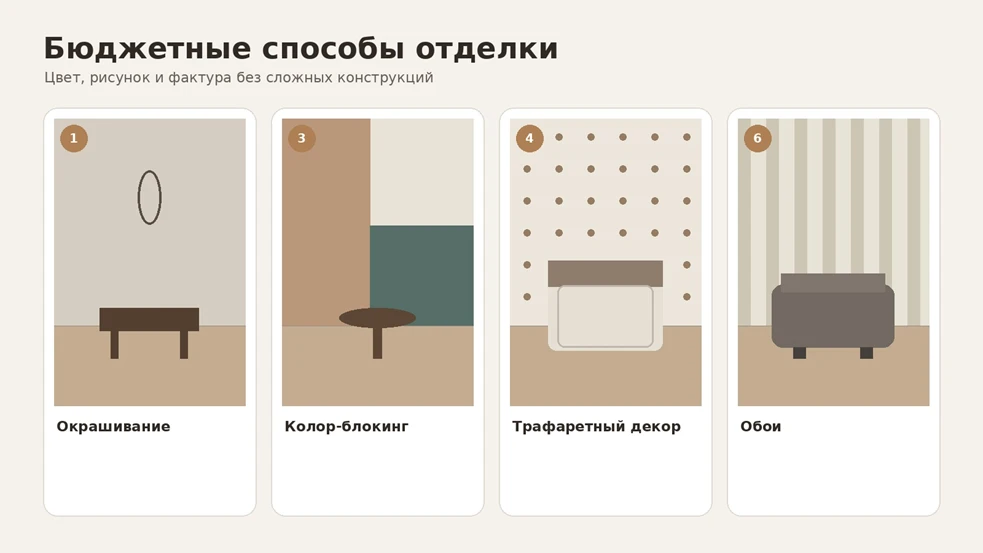
Visual example 1. Budget coatings: color, geometry, stencil and wallpaper.
1. Painting with water-dispersion paint
Painting is one of the most versatile finishing methods. It is suitable for apartments, houses, offices and commercial spaces. Modern formulations allow for a matte, semi-matte or more washable surface.
The main condition for a quality result is proper wall preparation. After painting, scratches, waves, putty marks and other base defects become noticeable. Therefore, the wall is puttied, sanded, cleaned of dust and primed.
The advantage of painting is the ability to quickly change the interior color. The surface can be locally touched up or completely renewed without removing the cladding. The disadvantage is the lack of pronounced texture and the relatively high sensitivity of matte coatings to dirt.
2. Washable paint
Washable compositions are used in hallways, kitchens, corridors, children's rooms, and other spaces where walls need regular cleaning. After drying, such a coating forms a denser surface resistant to wet cleaning.
When choosing, it is necessary to consider not only the color but also the abrasion resistance class, recommended cleaning method, and permissible room humidity. The name "washable" does not mean the coating can be cleaned with hard brushes or aggressive agents.
It is most practical to use washable paint in areas near switches, doors, the dining table, the work zone, or furniture that touches the wall.
3. Combined painting and color blocking
A wall can be decorated with two or more colors without using additional finishing materials. Horizontal division helps visually change the proportions of the room, vertical color blocks highlight functional zones, and geometric compositions create a modern graphic effect.
The boundary between shades must be precisely marked. Use a laser level, painter's tape, and paints with the same or compatible gloss level. An uneven dividing line immediately reduces the quality of the entire interior.
Combined painting is especially convenient for children's rooms, home offices, studios, and small apartments where zoning without partitions is required.
4. Stencil painting
Stencils allow applying ornaments, geometric patterns, plant motifs, and repeating designs. This is an affordable way to turn a plain wall into an accent wall without buying expensive panels or wallpaper.
The stencil is fixed on a dry base, and paint is applied with a sponge, roller, or brush with almost no pressure. Too much composition leads to drips under the template. Complex compositions require preliminary marking.
This decor is suitable for local areas: walls behind the headboard, workspace zones, niches, children's rooms, or spaces near a console.
5. Decorative rollers and stamps
A textured roller creates a repeating pattern directly on a layer of paint or a plastic decorative compound. Depending on the tool, you can achieve an imitation of fabric, natural texture, ornament, or abstract relief.
Compared to hand painting, this technique requires less time but needs careful alignment of strips. Before working on the wall, it is advisable to make a test application on a sheet of drywall or thick cardboard.
A decorative roller is suitable for small accent surfaces and interiors where an individual pattern is needed on a limited budget.
6. Paper wallpaper
Paper wallpaper remains one of the most affordable materials. It is available in a wide range of colors and patterns, does not require complex tools, and is suitable for rooms with normal humidity.
The thin sheet does not hide base defects and can become soggy if glue is applied unevenly. Paper wallpaper is less resistant to dirt, mechanical damage, and sunlight than dense multi-layer coatings.
It is advisable to use them in bedrooms, guest rooms, or interiors that are planned to be updated every few years.
7. Non-woven wallpaper
The non-woven base simplifies installation: glue is usually applied directly to the wall, after which the dry sheet is applied and leveled. The material is denser than paper and can hide minor visual defects.
Non-woven wallpaper is well suited for bedrooms, living rooms, studies, and children's rooms. Available options include smooth varieties, coatings with a pronounced relief, and sheets for subsequent painting.
When purchasing, it is important to check the batch number. Sheets from the same collection produced at different times may have slight shade differences.
8. Vinyl wallpaper
Vinyl coating is characterized by density, a variety of textures, and relatively high resistance to wet cleaning. It can imitate textiles, plaster, stone, wood, or a textured surface.
The material is suitable for hallways, kitchens, living rooms, and other areas with high operational load. However, the specific possibility of washing and use in wet areas depends on the characteristics of the chosen collection.
Dense vinyl wallpaper requires high-quality glue and precise pattern matching. With a large repeat, it is necessary to plan for additional stock in advance.
9. Paintable wallpaper
Paintable wallpaper combines the advantages of roll covering and a painted wall. It masks minor base defects, creates a uniform texture, and allows you to change the interior color several times.
Depending on the base, there are non-woven, vinyl, and fiberglass options. The number of permissible repaints depends on the depth of the relief and the material's characteristics.
This solution is convenient for apartments, offices, and commercial spaces where periodic color updates are needed without completely removing the finish.
10. Liquid wallpaper
Liquid wallpaper is a dry mixture based on fibers and decorative additives. After mixing with water, the composition is applied to the wall with a spatula, forming a seamless surface.
The material can hide minor imperfections and is convenient for walls of complex shapes, niches, protrusions, and areas with many corners. In case of local damage, the coating can be soaked and restored.
Liquid wallpaper requires protection from constant moisture. The possibility of applying a protective varnish must be checked according to the manufacturer's recommendations, as an additional layer may change the color and repairability of the coating.
Available textured and panel solutions
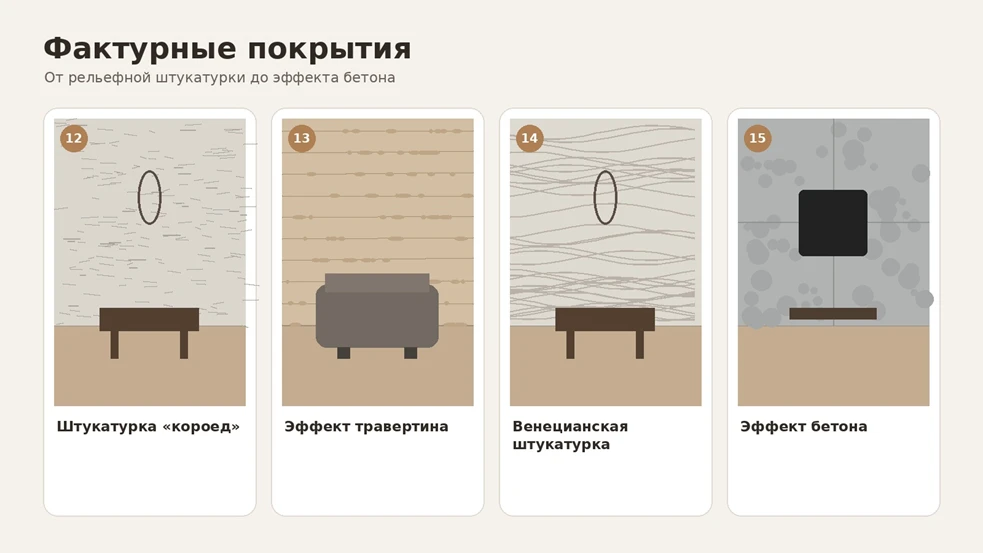
Visual example 2. Textured coatings: bark beetle, travertine, Venetian plaster, and concrete
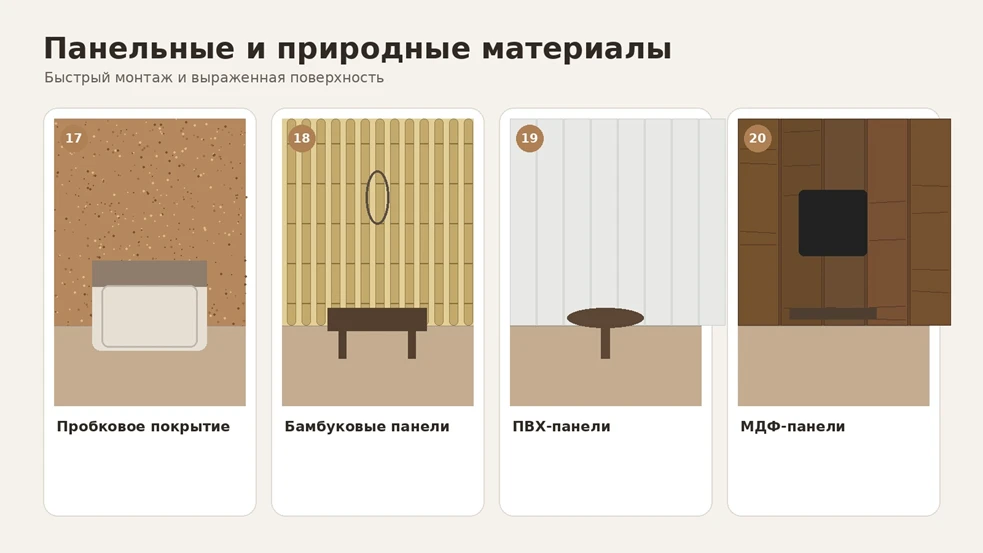
Visual example 3. Panel materials: cork, bamboo, PVC, and MDF.
11. Textured paint
Textured paint contains fillers that form a noticeable relief. The material is applied with a roller, brush, spatula, or special tool. Depending on the technique, you can achieve chaotic graininess, directional stripes, a sand effect, or soft roughness.
The coating is less demanding on the perfect smoothness of the wall than regular matte paint, but the base must remain strong and stable. Peeling areas and deep cracks must be pre-repaired.
Textured paint is suitable for hallways, living rooms, studies, and accent walls. It should be noted that the pronounced relief collects more dust and is harder to clean.
12. Structural plaster "bark beetle"
"Bark beetle" forms characteristic grooves, the direction of which depends on the movement of the trowel. The coating has a pronounced texture and masks small visual defects well.
The material is more often associated with facades, but can also be used indoors: in entryways, hallways, public spaces, and interiors with a deliberately rough texture.
For a living room, it is better to choose a fine filler fraction. Large relief visually reduces space, collects more dust, and can look too heavy.
13. Plaster with travertine effect
The decorative coating imitates the porous structure of natural travertine. Using a spatula, the craftsman forms layers, cavities, horizontal lines, or large blocks reminiscent of stone masonry.
The shade, depth of texture, and degree of contrast are regulated by the application technique, tinting, and finishing treatment. The coating is suitable for living rooms, halls, stair areas, and commercial interiors.
The quality of the result heavily depends on the skill of the performer. Before finishing the entire wall, it is advisable to approve a sample of at least 500 × 500 mm.
14. Venetian plaster
Venetian plaster creates a smooth, multi-layered surface with visual depth and a polished stone effect. The material is applied in thin, translucent layers, each contributing to the formation of the pattern.
The coating is suitable for classic, neoclassical, and modern interiors. It looks particularly expressive in halls, living rooms, formal areas, and niches with directional lighting.
Achieving uniform depth and characteristic transitions on your own is difficult. Errors in surface preparation or application become noticeable after polishing.
15. Concrete-effect coating
Decorative concrete compounds allow for an industrial surface without installing heavy panels. The pattern can be uniform, cloudy, rough, or include imitation of formwork seams.
This solution is suitable for lofts, minimalism, modern eclecticism, and interiors with metal, glass, and wooden elements. Gray is not mandatory: decorative concrete can have warm beige, graphite, sand, or complex colored shades.
To prevent the interior from looking cold, concrete texture is usually combined with wood, textiles, and warm diffused lighting.
16. Microcement
Microcement forms a thin, seamless coating with characteristic unevenness. It is used on walls, floors, stairs, countertops, and individual interior items, creating a visually cohesive space.
Performance properties depend on the entire system: the base, reinforcement, number of layers, protective varnish, and adherence to technology. The material name itself does not guarantee full moisture resistance.
Microcement is suitable for modern kitchens, living rooms, bathrooms, and commercial spaces, but the work must be performed according to a single manufacturer's system and considering the conditions of the specific area.
17. Cork wallpaper and panels
Cork features a warm surface, natural pattern, and the ability to soften sound reflection. The material is available in rolls, thin wallpaper, and denser panels.
Cork covering is convenient to use in the bedroom, study, children's room, relaxation area, or home library. It pairs well with wood, matte paint, and a calm natural palette.
The material is sensitive to the quality of the base and adhesive. Dirt is especially noticeable on light coverings, so for high-traffic areas it is better to choose denser panels with a protective layer.
18. Bamboo sheets and panels
Bamboo finishing creates a pronounced natural texture. Depending on the treatment, the surface can consist of narrow slats, wide strips, or pressed elements.
Bamboo is suitable for accent walls, niches, headboards, loggias with controlled microclimate, and interiors with natural motifs. It is not necessary to cover the entire room with it: the material is often used locally.
Before installation, it is necessary to check the stability of the base, the humidity of the room, and the compatibility of the adhesive with the specific type of covering.
19. PVC panels
PVC panels are valued for their moisture resistance, light weight, easy maintenance, and quick installation. They allow you to cover a wall without complex leveling and are available in a wide range of colors and imitations.
The material is used in utility rooms, bathrooms, balconies, storage rooms, and budget commercial interiors. PVC is less commonly chosen for formal living areas, as the repeating pattern and seams may look less natural.
When purchasing, it is important to check the thickness of the front layer, the rigidity of the ribs, the quality of the locks, and the documentation for the specific material.
20. Laminated MDF panels
MDF panels with a decorative coating imitate wood, stone, fabric, solid colors, or fantasy textures. They feature stable geometry and allow you to quickly achieve a smooth surface.
Panels can be mounted on a prepared wall or on a frame. The second method helps hide utilities and minor surface defects but reduces the usable area of the room.
Standard MDF is not intended for constant contact with water. For kitchens, hallways, or areas with variable humidity, you need to check the characteristics of the base, coating, and edges.
Wall finishing with wood and wood-based materials
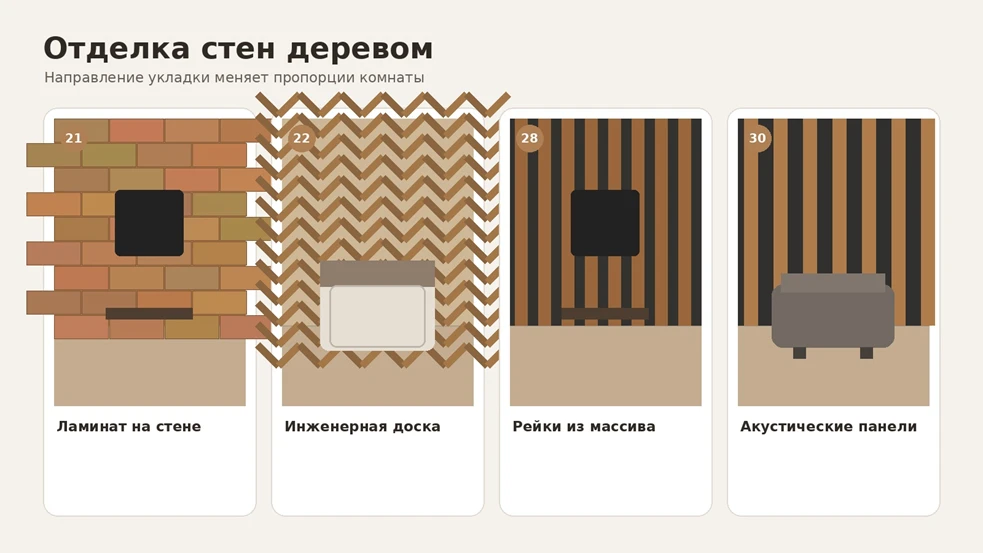
Visual example 3. Wood materials: laminate, engineered wood, slats, and acoustic panels.
21. Laminate on the wall
Floor laminate is often used to decorate the wall behind the TV, headboard, desk, or dining area. The locking connection allows you to assemble a solid plane with a repeating wood pattern.
The material is relatively affordable, but it's important to consider its weight and method of attachment. Installing it only with random universal glue without assessing the base can lead to delamination.
Laminate should not automatically be considered a moisture-resistant wall finish. Even moisture-resistant floor collections have limitations regarding exposure to water and steam.
22. Parquet or engineered wood on the wall
The natural top layer of engineered or parquet flooring creates a deeper and more natural texture than printed imitation. This design is suitable for bedrooms, living rooms, studies, and formal areas of a country house.
Boards can be placed horizontally, vertically, diagonally, or formed into geometric compositions. The more complex the pattern, the greater the material consumption and the requirements for cutting precision.
Before installation, the wood material must adapt to the temperature and humidity of the room. The fastening method is chosen considering the board's construction and the manufacturer's recommendations.
23. Wooden paneling
Paneling is a profiled board with a tongue-and-groove joint. It is suitable for walls and ceilings in country houses, bedrooms, studies, loggias, and rooms with a natural style.
Vertical placement visually increases height, while horizontal placement emphasizes the length of the wall. For a more modern interior, calm wood sorting, hidden fasteners, and a matte finish are used.
The wood must be protected with a compound suitable for the operating conditions. Special attention is paid to the ends, cut areas, and ventilation gaps.
24. Imitation timber
Imitation timber differs from regular lining by its wider profile and creates the feel of a massive wooden wall. The material is especially organic in country houses, attics, studies, and spacious living rooms.
A wide board creates a calm rhythm and showcases the wood grain well. However, in a small room, a too-large profile can visually reduce the space.
Installation is usually done on a lathing system, accounting for expansion gaps. Before installation, the material is sorted by shade and pattern to avoid random contrasting areas.
25. Block house
Block house has a convex front surface and imitates a wall made of rounded logs. This is an expressive solution for interiors of country houses, bathhouse relaxation rooms, themed restaurants, and chalet-style spaces.
The relief profile significantly affects the perception of space, so it is used sparingly in small city apartments. More often, block house is used to finish one wall or a separate architectural zone.
The material requires proper drying, acclimatization, protective coating, and reliable fastening.
26. Natural veneer panels
Veneered panels combine a stable base with a thin layer of natural wood. They provide a solid wood surface with a lower risk of warping compared to wide solid wood elements.
Production uses veneer of oak, walnut, ash, and other species. The pattern can be arranged sequentially, mirrored, or freely. The layout method determines the character of the entire wall.
Veneered panels are well suited for studies, living rooms, bedrooms, meeting rooms, and hotel interiors. Special attention must be paid to joints, edges, and grain direction.
27. Decorative MDF slats
MDF slats create a uniform repeating rhythm and are suitable for walls, ceilings, niches, and separate zones. The base has stable geometry, and the surface can be painted, laminated, or veneered.
Slats are used behind the TV, near the desk, in the hallway, bedroom, and living room. Vertical placement visually raises the ceiling, horizontal placement expands the wall, and a partial slatted composition helps highlight a functional area.
When calculating, you need to consider the slat width, gap between elements, wall length, and allowance for trimming.
28. Solid wood slats
Solid wood slats feature expressive grain patterns and tactile depth. They are suitable for modern, Scandinavian, Japanese, minimalist, and eclectic interiors.
In the STAVROS catalog you can Select wooden slats for interior wall decorationDepending on the project, they are left in their natural shade, tinted, painted, or coated with a protective compound.
Before installation, the slats are laid out on the floor and sorted by shade. Natural wood has a variable pattern, so random installation without pre-sorting can create unwanted contrasting stripes.
29. Ready-made slatted panels
A finished panel combines several slats on a common base. It is installed faster than individual slats and ensures a consistent gap between elements.
Panels can have a base made of MDF, plywood, composite, or acoustic material. When purchasing, it is important to evaluate not only the front part but also the quality of the backing, the stability of the slat attachment, and the method of edge treatment.
Slatted panels are convenient for TV zones, headboards, walls in hallways, and commercial spaces. It is necessary to plan the location of sockets, switches, and lighting in advance.
30. Acoustic panels with slats and felt
In such systems, decorative slats are placed on a sound-absorbing base. The surface helps reduce sound reflections while creating an expressive slatted rhythm.
Panels are used in home theaters, offices, studios, meeting rooms, bedrooms, and living rooms with a TV area. However, a decorative acoustic panel does not replace a full engineering acoustic project.
Efficiency depends on the density of the base, the depth of the structure, the coverage area, and the characteristics of the room.
Architectural wall finishing with moldings and decor
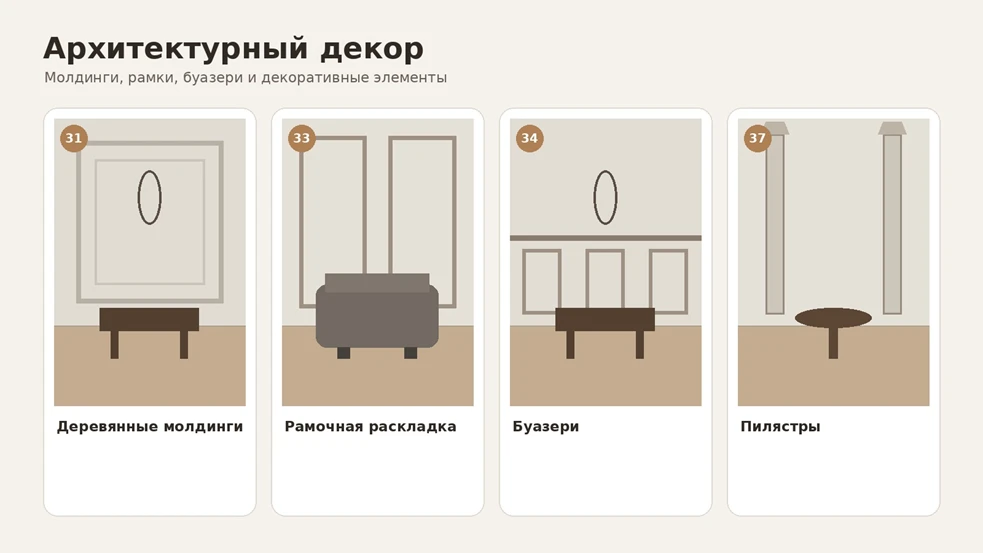
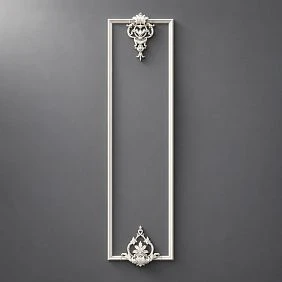
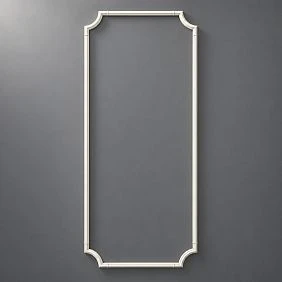
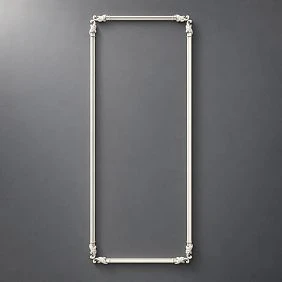
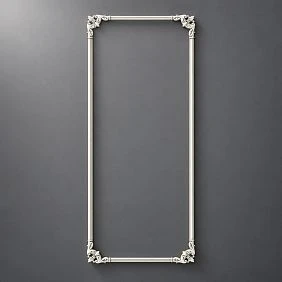
Visual example 4. Architectural design: moldings, frames, boiserie, and pilasters
31. Wooden moldings
Wooden moldings allow creating frames, panels, vertical divisions, and complex wall compositions. They add architectural depth to the wall and are suitable for both classic and modern interiors.
Narrow profiles create a delicate pattern, while wide and embossed ones create a noticeable decorative accent. Moldings can be painted in the wall color, highlighted with a contrasting shade, or left with the natural wood texture.
Before installation, it is necessary to develop an accurate layout with frame dimensions, indents from the floor, ceiling, doors, and furniture.
32. Polyurethane moldings
Polyurethane profiles have low weight, stable geometry, and reproduce fine relief details well. They are attached with suitable construction adhesive and, after preparation, are painted with interior paint.
Polyurethane is convenient for frame compositions, cornice lines, door framing, niches, and transitions between different types of finishes. The products should not be confused with soft foamed profiles of low density.
For a neat result, it is necessary to correctly execute corner joints, seal seams, and use compatible adhesives and putty compounds.
33. Frame layout on the wall
Frames made of moldings are one of the most versatile ways of architectural design. The composition can be symmetrical, asymmetrical, classic, or minimalist.
The size of the frames is chosen not separately from the interior, but taking into account the location of the sofa, bed, console, lamps, doorways, and sockets. A random grid not tied to furniture looks less convincing.
Painting moldings in the color of the wall creates a calm relief. A contrasting shade makes the geometry more graphic and requires particularly precise installation.
34. Boiserie from moldings and panels
Boiserie is a wall decoration system consisting of frames, panels, base elements, cornices, and decorative details. A simplified version can be assembled from moldings and painted inserts.
The composition can occupy the lower third of the wall, half the height, or the entire surface from floor to ceiling. The lower panel part protects the wall from accidental damage and simultaneously forms an architectural rhythm.
For designing a complex interior, you can consider STAVROS wall panels and boiserie.
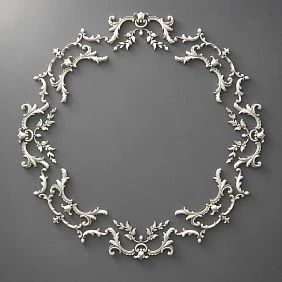
35. Polyurethane decorative overlays
Overlays allow you to add local relief without cladding the entire wall. They are placed inside frames, above doors, in the corners of a composition, above a console, near a mirror, or in the center of a decorative panel.
In the catalog you can choose polyurethane overlays for walls and furniture. After installation, the elements are painted in the base color, highlighted with a different shade, patinated, or used in combination with moldings.
The overlay should match the scale of the wall. A too small element gets lost on a large surface, while an excessively large one overloads a small room.
36. Carved wooden overlays
Wooden overlays create a deeper and more natural relief. They are suitable for classic, neoclassical, oriental, ethnic, and eclectic interiors.
The elements are used inside wall frames, as part of door portals, above furniture, or as independent decorative accents. Paired overlays allow for the formation of symmetrical compositions.
The wood finish is chosen considering the background: the overlay can be painted together with the wall, emphasized with stain, coated with oil, or decorated with a decorative patina.
37. Pilasters and capitals
Pilasters imitate flat architectural supports and help visually divide a long wall into separate sections. They consist of a base, shaft, and capital, or are assembled from several compatible elements.
This design is suitable for door portals, fireplace areas, niches, TV walls, and formal rooms. In small rooms, it is better to use shallow and minimalist profiles.
The position of pilasters is linked to the actual architecture of the room: openings, furniture, cornices, and ceiling lines.
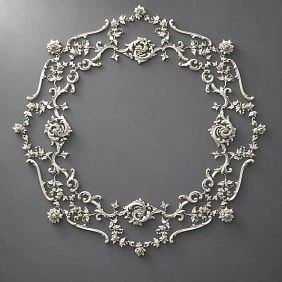
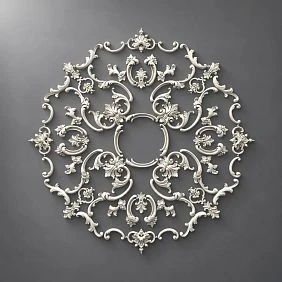
38. Decorative rosettes and medallions
A wall rosette can become the center of a frame composition, the basis for a decorative panel, or an element of niche design. The round shape softens a large number of straight lines and adds completeness to the interior.
Rosettes are used singly, in groups, or in combination with moldings and overlays. Compositions where the relief is painted in the wall color and revealed by side lighting look especially expressive.
When choosing, consider the diameter, depth of the ornament, and the distance from which the element will be perceived.
39. Decorative cornices on the wall
A cornice does not have to be used only at the junction of the wall and ceiling. The profile can finish the paneled part of the wall, separate one material from another, form the top line of boiserie, or frame a niche.
A horizontal cornice creates a visual boundary and helps to assemble disparate elements into a unified system. It is important to maintain scale: a heavy profile requires sufficient ceiling height and support from other architectural details.
For a modern interior, choose minimalist profiles; for a classic one, choose a deeper relief.
40. Combination of moldings, slats, and painting
Combining several materials allows creating a custom composition without fully cladding the wall. For example, a slatted TV area can be framed with molding, while the remaining sections are painted in a calm color.
In the bedroom, slats can be placed behind the headboard, while frame layouts go on adjacent walls. In the hallway, the lower part is protected with a panel composition, and the upper part is painted.
To prevent the interior from looking random, it is advisable to limit the number of active textures and determine the main material in advance.
Volumetric, stone, and premium solutions
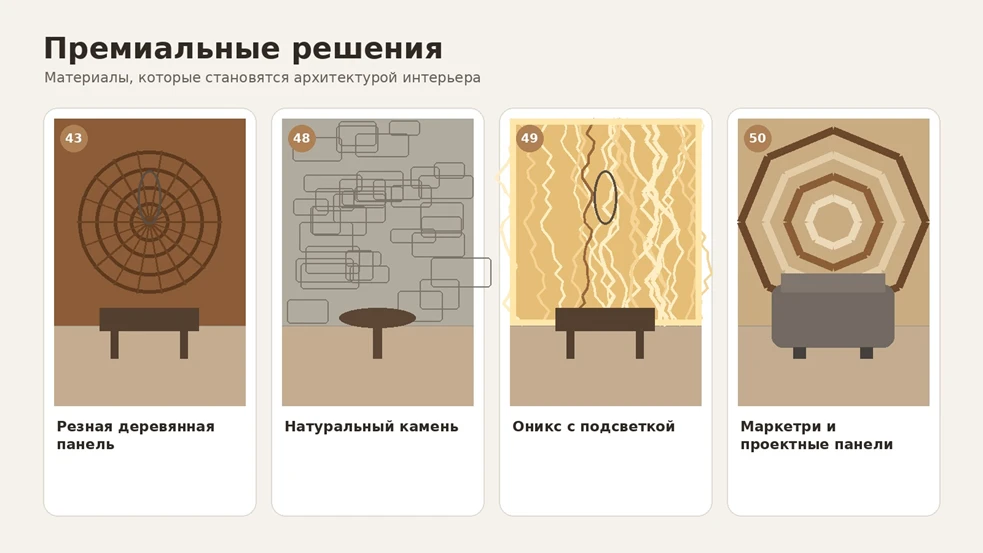
Visual example 5. Premium solutions: carving, stone, onyx, and marquetry.
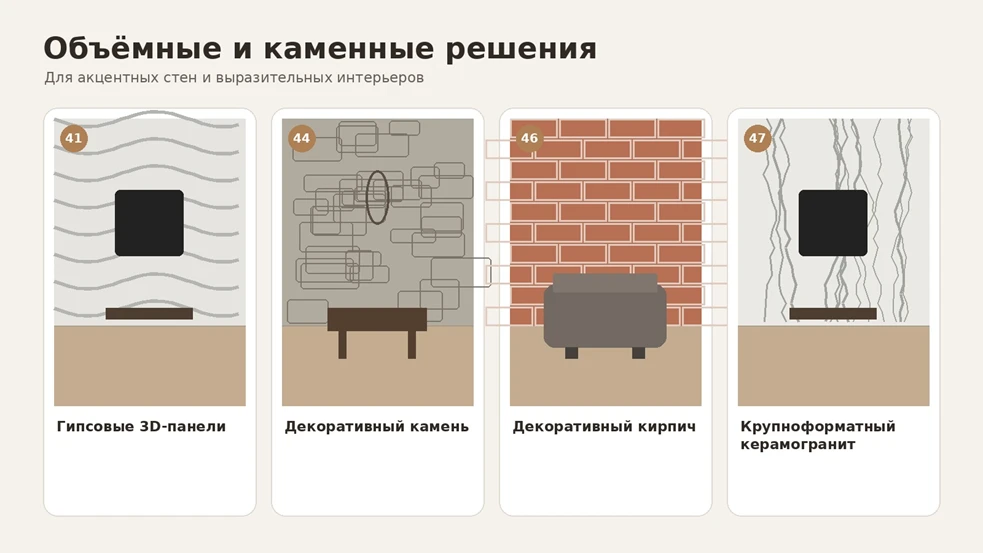
Visual example 6. Volumetric and stone surfaces: 3D panels, stone, brick, and porcelain stoneware.
41. Gypsum 3D panels
Gypsum panels create a deep repeating relief. After installation, the joints are filled, the surface is primed and painted, which visually unifies the individual elements into a solid wall.
The geometric pattern is especially expressive under side lighting. Light highlights the protrusions and recesses, and the wall's appearance changes throughout the day.
Gypsum has noticeable weight and requires a solid base. Panels need to be precisely trimmed around sockets, corners, and junctions.
42. Polyurethane 3D panels
Polyurethane panels are lighter than gypsum and can have complex, detailed relief. They are convenient for accent walls, niches, headboards, and decorative inserts.
After installation, panels can be painted, blending them with the interior color. When choosing, consider material density, geometry quality, pattern depth, and installation recommendations.
Pronounced relief is best used locally. If used on all walls of a small room, the interior may become visually overloaded.
43. Carved wooden panels
A carved panel turns a wall into an independent artistic element. The ornament can be floral, geometric, classical, oriental, or abstract.
Panels are used in living rooms, studies, bedrooms, restaurants, hotels, and grand halls. Depending on the project, the carving is left open, placed on a contrasting background, or supplemented with hidden lighting.
Large relief requires free space in front of the wall. Furniture should not cover the main parts of the composition.
44. Artificial decorative stone
Artificial stone imitates brick, slate, sandstone, limestone, and other natural materials. It is lighter than many natural counterparts and is produced in convenient format elements.
The material is suitable for fireplace areas, hallways, living rooms, walls near stairs, and specific sections of the kitchen. In small spaces, it is better to choose a shallow texture and a calm color.
Unnatural repetition of identical elements worsens the result. Before installation, the stone is laid out on the floor and pieces are alternated by shade and shape.
45. Flexible stone
Flexible stone is a thin decorative material with a mineral surface. It can follow smooth curves and is suitable for columns, arches, niches, and walls of complex shapes.
The coating visually resembles sandstone or other layered rock, but is significantly thinner. Specific performance properties depend on the base and protective layer.
Special attention is paid to base preparation and joints. Under directional light, any surface irregularities become more noticeable.
46. Decorative brick and clinker
Brickwork is suitable not only for lofts. White or light clinker can be used in Scandinavian interiors, thin aged brick in classic eclecticism, and dark brick in a modern study or kitchen.
For interior finishing, full-format elements or thin tiles are used. The second option creates less load on the wall and takes up less space.
The color of the grout significantly affects the result. A contrasting seam emphasizes the geometry, while a tone close to the surface makes it calmer.
47. Large-format porcelain stoneware
Large slabs allow for an almost seamless surface with imitation of marble, concrete, metal, or stone. The material is suitable for kitchens, bathrooms, fireplace areas, hallways, and modern living rooms.
The large format reduces the number of joints but complicates transportation, lifting, cutting, and installation. The base must be strong and level, and the adhesive must match the type and size of the slab.
It is better to entrust work with large-format material to specialists who have equipment for carrying and precise trimming.
48. Natural stone
Natural stone is distinguished by its unique pattern, depth of color, and long service life. Marble, granite, travertine, limestone, slate, and other rocks are used for walls.
The choice depends not only on appearance. Stones differ in porosity, weight, sensitivity to acids, processing method, and care requirements.
Natural material must be selected based on actual slabs or samples. A photo in the catalog does not convey the exact location of veins and color transitions of a specific batch.
49. Onyx with backlighting
Some types of onyx have a translucent structure and can be used with backlighting. The light reveals the stone's pattern and turns the wall panel into a large decorative lamp.
This solution is used in grand halls, living rooms, bars, restaurants, hotels, and premium bathrooms. The project requires precise calculation of the frame, placement of light sources, ventilation, and access for maintenance.
The slab pattern is selected in advance, especially if the surface is assembled from several pieces.
50. Boiserie from solid wood, marquetry, and custom wall panels
The most complex finishing option is a custom system of wall panels made of solid wood or veneered base with carved elements, panels, cornices, pilasters, and decorative inserts.
Marquetry allows assembling images and ornaments from veneer of different wood species. The direction of the fibers, shade, and layout method become part of the pattern. Such panels are developed to the dimensions of a specific room.
Premium finishing requires a project with precise alignment to doors, windows, outlets, furniture, and lighting. For classic and custom interiors, you can order wall decoration with STAVROS boiserie panels.
Which finish to choose for different rooms
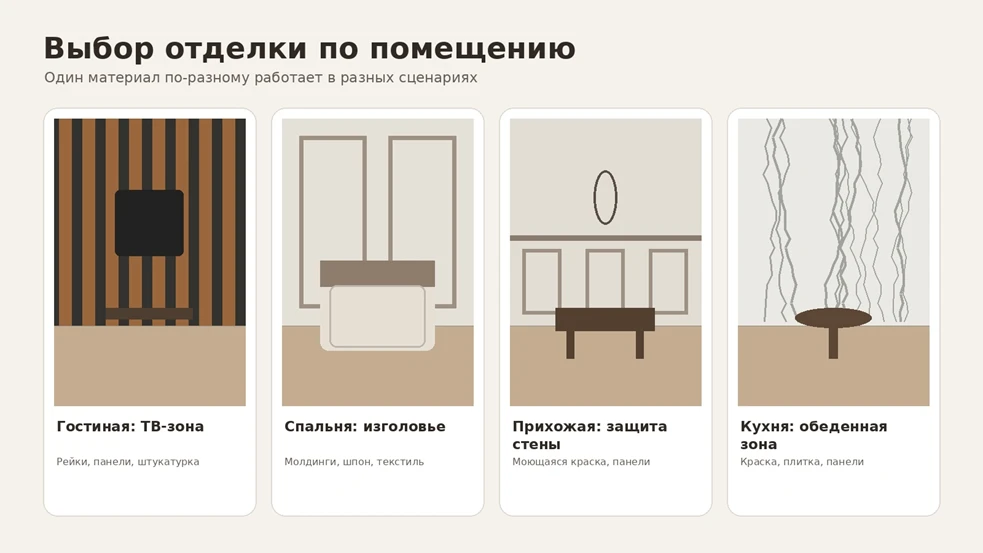
Visual example 7. Selection of finishes for living room, bedroom, hallway, and kitchen.
For the living room
In the living room, most decorative materials can be used since the room is usually not exposed to constant moisture. For the wall behind the TV, slats, veneered panels, decorative plaster, porcelain stoneware, or moldings are suitable.
Behind the sofa, frame compositions, large decorative panels, relief plaster, or a combination of paint with wooden elements look good. In a spacious classic living room, boiserie and pilasters are appropriate.
For the bedroom
In the bedroom, calm texture, tactility, and the absence of visual overload are important. The wall behind the headboard can be decorated with wooden slats, soft panels, veneer, wallpaper, moldings, or decorative plaster.
It is better to concentrate active relief on one surface. The other walls are made more neutral so that the interior does not interfere with rest.
For the hallway
The lower part of the wall in the hallway is subject to dirt and accidental impacts. Here, washable paint, paneling, durable wallpaper, porcelain stoneware, or a combined system with a protective lower part are practical.
Vertical slats and pilasters help visually increase the height of a narrow corridor. However, too deep a relief can reduce the usable width of the passage.
For the kitchen
Away from the sink and cooking surface, you can use paint, wallpaper, slats, moldings, and MDF panels. In the work area, coatings designed for moisture, heat, and regular cleaning are required.
Untreated wood or complex porous relief should not be placed directly where water, grease, and steam hit the wall.
For the bathroom
In the bathroom, porcelain stoneware, specially designed decorative coatings, glass, stone, and other materials intended for a specific humidity zone are used.
Even moisture-resistant material does not compensate for waterproofing failures. The entire system must be considered: the base, protective layer, adhesive, grout, joint sealing, and ventilation.
For a children's room
For a children's room, safety, cleanability, and repairability are important. Washable paints, paintable wallpaper, cork coverings, and local decorative panels with secure fastening are practical.
Deep protruding elements should not be installed in active play areas. Material and coating characteristics must be verified according to the specific manufacturer's documents.
For a study
A study pairs well with wood, veneer, slats, boiserie, cork, and calm decorative plasters. These materials create a visually composed and solid atmosphere.
To improve acoustic comfort, slatted panels with a sound-absorbing base, textile inserts, and dense wall coverings can be used.
How to calculate the amount of material
Paint calculation
First, determine the wall area by subtracting large window and door openings. Multiply the resulting value by the number of coats and divide by the consumption rate specified by the manufacturer. Add a margin for the base's absorbency, repainting, and local repairs.
Wallpaper calculation
You need to know the width and length of the roll, the room height, the number of full panels, and the pattern repeat size. Wallpaper with a large pattern requires a larger allowance due to pattern matching.
Panel calculation
The wall area is divided by the usable area of one panel. If the material has a distinct pattern, direction, or complex trimming, the allowance is increased.
Slat calculation
For the calculation, the slat width and gap size are used. For example, with an element width of 30 mm and a gap of 20 mm, one composition repeat takes 50 mm. The wall width is divided by the repeat size, after which the edge offsets are refined.
If the slats are installed vertically, the length of each element depends on the wall height. If there is a baseboard, cornice, hanging cabinet, or ceiling gap, the actual length of the decorative zone is taken into account.
Molding calculation
For each frame, the length of two vertical and two horizontal sides is added. Then the perimeters of all frames are summed, and an allowance for corner cutting is added. The more complex the profile and the greater the number of corners, the higher the allowance should be.
Wall preparation before finishing
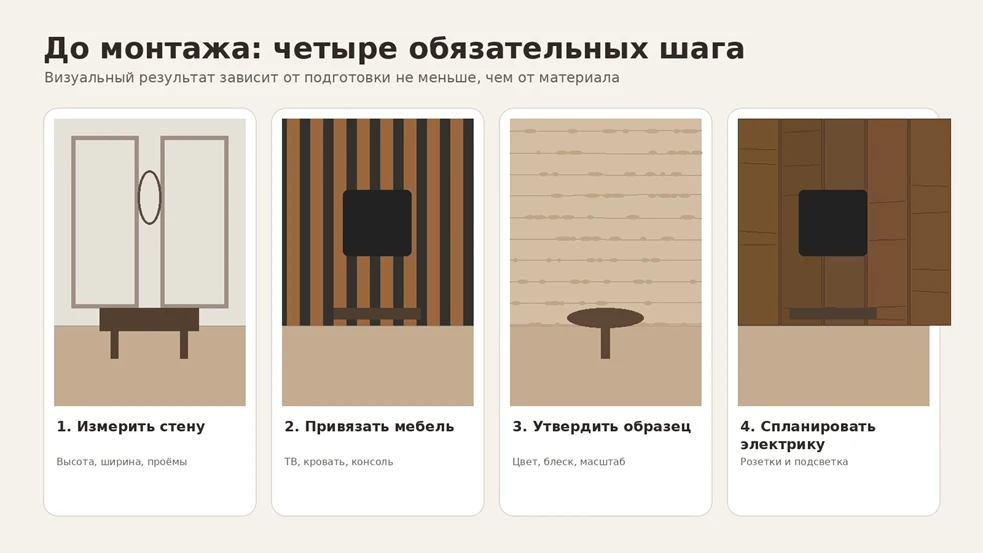
Visual example 8. Four steps before installation: measurement, furniture alignment, sample, and electrical work.
The base must be strong, dry, and cleaned of dust, peeling paint, loose plaster, and other contaminants. Heavy panels or stone cannot be attached to a layer that does not adhere well to the wall.
For painting, thin wallpaper, and smooth plaster, particularly high-quality leveling is required. For panels and slats, minor unevenness is less critical, but it can interfere with the precise geometry of the composition.
Before installation, it is necessary to check:
· strength of the base;
· verticality and flatness of the wall;
· surface moisture;
· location of concealed wiring;
· locations for installing sockets and switches;
· compatibility of primer, adhesive, and finishing material;
· need for expansion gaps;
· possibility of access to utilities after installation.
Common mistakes when choosing finishes
Choosing only by photo
Color, pattern scale, gloss, and relief depth depend on lighting and room size. Before purchasing, it is advisable to obtain a physical sample or make a test swatch.
Ignoring wall preparation
Expensive material does not fix a weak substrate. Peeling, cracks, and moisture must be eliminated before starting decorative finishing.
Too many textures
Using brick, wood, marble, bold wallpaper, and relief panels simultaneously creates visual noise. In most rooms, one main material and one or two supporting ones are enough.
Incorrect scale of elements
Small moldings get lost on a tall spacious wall, while deep panels overwhelm a small room. The size of the decor should match the area and height of the room.
Lack of connection with furniture
Frames, slats, and panels must be tied to the sofa, bed, nightstand, doors, lights, and other interior elements. Otherwise, the composition looks random.
Saving on stock
Material may vary between batches. If a few elements are missing, finding a perfectly matching shade or pattern can be difficult.
Poorly planned electrical wiring
After installing panels or slats, moving sockets becomes more complicated. All outlets, lighting, and cable routes must be planned in advance.
Who different types of finishes suit
Paint and wallpaper suit those who want to relatively quickly update the interior and retain the ability to easily change colors. Panels are convenient when you need to cover a large surface, hide minor defects, or achieve a pronounced texture.
Slats are chosen for modern interiors, visual zoning, and creating vertical rhythm. Moldings and overlays suit rooms where architectural detail is needed without full wall cladding.
Natural wood is chosen for its texture, tactile feel, and durability. Stone and large-format porcelain stoneware suit solid foundations and interiors where monumentality and surface stability are important.
Boiserie, carved panels, and marquetry are justified in designer interiors where the finish must be coordinated with the architecture, doors, furniture, and lighting.
How to order STAVROS decorative wall finishes
STAVROS offers wall decoration elements made of natural wood, MDF, and polyurethane. The project can use slats, moldings, carved overlays, cornices, pilasters, panels, and other architectural details.
Before ordering, it is recommended to prepare:
· wall dimensions;
· photos of the room;
· furniture layout plan;
· ceiling height;
· desired style;
· preferred material;
· finishing or painting option;
· location of sockets, doors, and lights.
For a modern interior, you can look at STAVROS wooden slats. For a classic wall, door portal, or frame composition, polyurethane decorative overlays. A design project for the entire wall can be done using boiser panels.
Frequently asked questions
What is the most budget-friendly wall finishing option?
The most affordable options are usually painting, paper wallpaper, and simple wallpaper for painting. The final cost depends on the condition of the base: complex leveling can make up a significant part of the budget.
Which finish best hides unevenness?
Small defects can be hidden by dense textured wallpaper, structural plaster, liquid wallpaper, and panel systems. Serious differences must be corrected or compensated for with a frame structure.
What to choose for an accent wall behind the TV?
For the TV area, wooden slats, veneered panels, porcelain stoneware, decorative plaster, moldings, slatted acoustic panels, and combined compositions are suitable. The material should not interfere with equipment ventilation or access to wiring.
Can you combine slats and moldings?
Yes. Slats can form the central part of the wall, while moldings can frame the composition or decorate adjacent surfaces. It is important to coordinate the width of the profiles, color, and distance between elements.
What finishes are suitable for DIY installation?
With basic skills, you can do painting, hanging simple wallpaper, installing lightweight moldings, and some types of slats. Complex plaster, natural stone, and large-format panels are best left to professionals.
Do I need to perfectly level the wall for slats?
The requirements depend on the mounting method. When installing directly on the wall, noticeable differences can disrupt the overall plane. A frame can compensate for some unevenness but reduces usable space.
Can wooden moldings and overlays be painted?
Yes. Wooden elements can be painted, tinted, coated with oil, varnish, or other compatible finishes. Before finishing, the surface is prepared according to the chosen coating system.
Can MDF be used in a bathroom?
Standard MDF is not designed for constant contact with water. The possibility of use depends on the type of base, protective coating, edge treatment, and location relative to the wet area.
What stock of material should be purchased?
The stock depends on the material and layout complexity. For simple trimming, a small reserve is usually provided, while for diagonal laying, large pattern repeats, natural stone, or complex frames, the stock is increased.
What is more practical: paint or panels?
Paint is easier to completely refresh and repaint. Panels allow for a pronounced texture, sometimes hide small defects, and protect the base from damage. The choice depends on the room's purpose and desired appearance.
How to make a small room visually taller?
Use vertical slats, elongated frames, pilasters, vertical wallpaper patterns, or color blocks. Avoid overloading the upper part of the wall with heavy decor.
What finish looks expensive but does not require covering the entire wall?
Local frames made of moldings, wooden slats, decorative overlays, a panel behind the headboard, or a TV area with veneer give an expressive result. A small accent surface often looks more convincing than a large amount of heterogeneous decor.
Conclusion
There are many ways to finish walls, but you cannot choose a material based only on appearance. It is necessary to consider the condition of the base, humidity, operational load, lighting, room area, installation complexity, and the possibility of subsequent repairs.
For budget updates, paint, wallpaper, and simple textured coatings are suitable. In the mid-price segment, decorative plasters, MDF panels, slats, moldings, and combined compositions are available. Natural wood, carved panels, stone, boiserie, and marquetry allow for creating durable project interiors with individual architecture.
The finish should not exist separately from the furniture, doors, ceiling, and lighting. The most harmonious walls are achieved when the frame sizes, slat direction, relief depth, and panel layout are pre-coordinated with the overall room composition.
STAVROS helps create decorative wall finishes using natural wood, MDF, and polyurethane. The range includes slats, moldings, overlays, panels, and architectural elements that can be used for both a small accent and a comprehensive interior design.
|
Final selection principle |