

























Article Contents:
- Why the number of balusters should be calculated before purchase, not after
- What parameters are needed for calculation: flight length, spacing, height, landing
- 1. Flight length along the horizontal projection
- 2. Installation spacing
- 3. Baluster height
- 4. Installation type: one or two balusters per step
- 5. Presence of a landing
- 6. Number of flights
- 7. Stock
- Optimal spacing between balusters: standards and common sense
- Normative requirements
- Spacing depending on baluster diameter
- How spacing affects appearance
- How to account for turns, landings, and the second floor
- L-shaped staircase with a landing
- U-shaped staircase with an intermediate landing
- Railing at the second floor
- How many posts are needed for a staircase
- How to calculate handrails and railings
- How stock affects the budget
- Impact of order volume on cost
- Calculation example for a straight staircase
- Calculation example for a staircase with a landing
- How to calculate the budget for balusters before purchasing
- Balusters
- Posts
- Handrails
- Fasteners and consumables
- Final budget for the example (oak):
- Additional nuances often overlooked
- Winder steps
- Helical Staircase
- Stair width
- Step material and mounting method
- When to calculate yourself and when to ask the manufacturer
- Checklist before ordering balusters
- About the Company STAVROS
- FAQ: Answers to Popular Questions
- How many balusters are needed for one flight of stairs?
- What is the optimal spacing between balusters on a staircase?
- How to calculate balusters for a wooden staircase with a landing?
- How much does a set of balusters for a staircase cost?
- Do I need to buy posts together with balusters?
- How to calculate the length of the handrail?
- Are standard balusters suitable for non-standard height?
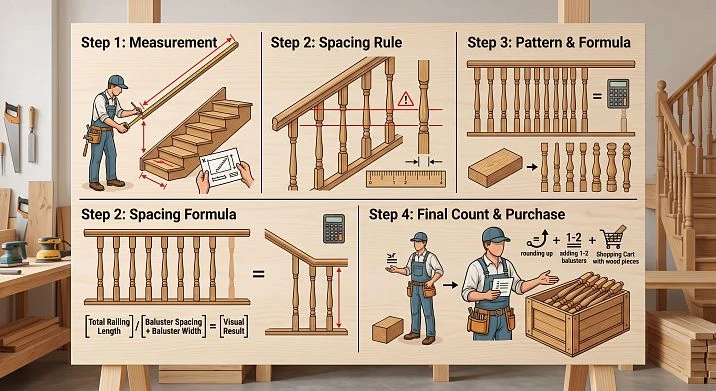
A mistake in calculating balusters is expensive. Not figuratively — literally. Being short by five pieces means a reorder, waiting for a new batch, and the risk that the wood shade will slightly differ from the first delivery. Having twenty extra pieces is money simply sitting in storage. And there is also an intermediate option, which is the most common: a person bought "by eye", installed them, and the spacing turned out either too frequent (the railing looks like a solid fence) or too sparse (safety standards are violated, and a child can easily slip between the posts).
Correctly calculating the number of balusters is not rocket science. But it is a task that needs to be done carefully, consistently, taking into account all parameters: the length of the flight, the installation spacing, baluster height for staircases, the presence of landings, turns, and horizontal sections of the railing. This article is dedicated to that — a detailed, honest, and practically applicable guide to calculating before purchasing.
Why the number of balusters should be calculated before purchase, not after
It would seem like an obvious thought. But in practice, many order balusters "by feel" or rely on advice from a marketplace seller who has never seen the actual staircase. The result is predictable.
Here is why calculation is critically important before purchase.
Matching batch color and texture. Wood is a living material. Two batches of the same species with the same article number, made at different times, may slightly differ in shade. This difference is almost imperceptible to the eye when the items are lying side by side. But when installed in a row on a staircase, it stands out. If you order the entire volume at once, the problem disappears: all balusters are from the same batch.
Logistics and timelines. A reorder takes time. If the builder is waiting for material, and you are waiting for the builder, the losses are measured not in rubles, but in weeks.
Budget under control. Knowing the exact quantity, you see the real cost before payment. Price of wooden balusters depends on the species, shape, and order volume — for large purchases, wholesale terms often apply. Without knowing the exact quantity, you cannot take advantage of this benefit.
Compatibility with other elements. Balusters do not exist in a vacuum — they are part of a system. Their quantity affects the length of the handrail, the number of posts, and the volume of fasteners. All of this is calculated as a single package, not piece by piece.
What parameters are needed for calculation: march length, step, height, landing
Before picking up a calculator, you need to take seven measurements. Without any one of them, the calculation will be approximate. With them, it will be accurate.
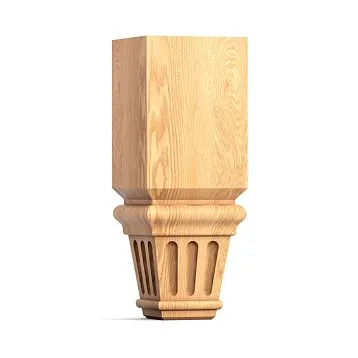
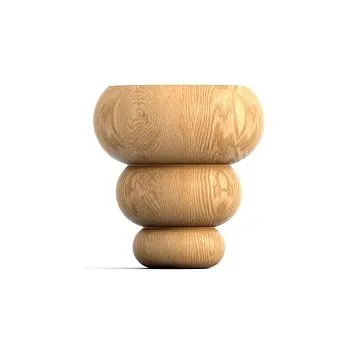
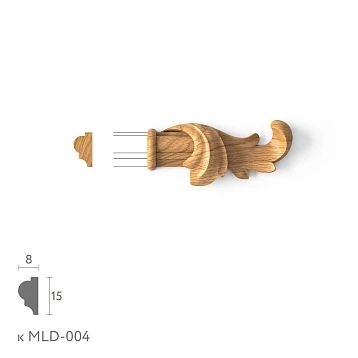
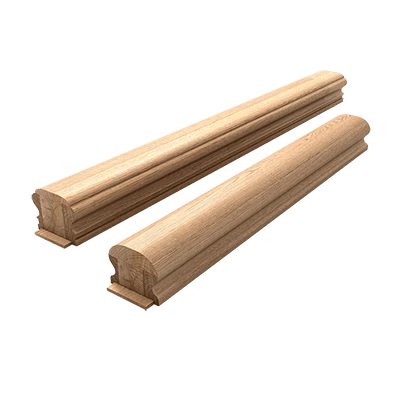
Our factory also produces:

1. March length along the horizontal projection
This is not the length of the stair stringer (inclined beam), but its horizontal projection — the distance along the floor from the first to the last step. This parameter determines how many balusters will fit in a row at a given step.
Measured with a tape measure along the floor level or along the projection of the lower edge of the stringer onto the horizontal. If the staircase is already installed, measure along the extreme points of the lower ends of the steps.
Get Consultation
2. Installation step
The step is the distance between the axes of adjacent balusters. Not between their side edges, but specifically between the central axes. With a baluster diameter of 50 mm and a step of 150 mm, the gap between the products will be 100 mm — this is acceptable according to standards. With a diameter of 45 mm and a step of 150 mm, the gap is 105 mm, also within the norm.
The optimal step for a residential house with children is 130–150 mm along the axes. For an adult house without small children, the step can be 150–180 mm — the railing looks lighter and airier.
3. Baluster height
railing baluster sizes for staircases include the total length of the product and the working length — minus the tenons that go into the step below and the handrail above. The standard total length of a baluster is 900–1000 mm. The bottom tenon is about 30–50 mm, the top tenon is 20–30 mm. The working height, therefore, is 820–950 mm depending on the model.
The standard railing height is at least 900 mm from the step surface to the top edge of the handrail. This requirement is automatically met when the baluster is correctly selected by height.
4. Installation type: one or two balusters per step
This is a fundamental question that either doubles or leaves the final quantity unchanged. In most modern staircases, one baluster per step is used — this is the standard for classic railings. Two balusters per step is an option for dense railings, decoratively rich interiors, or safety requirements (families with children under 3 years old).
5. Presence of a landing
An interfloor landing is a horizontal section between flights. Here, the railing runs parallel to the floor, not at an angle. The installation spacing on the landing may match that of the flight, but the calculation is done separately — based on the length of the landing railing, not the number of steps.
6. Number of flights
A straight staircase has one flight. An L-shaped staircase has two flights with a turning landing. A U-shaped staircase has two flights with an intermediate landing. Each flight is calculated separately, and the results are summed.
7. Reserve
A 10% reserve is always added to the calculated quantity. This is insurance against errors during cutting, accidental chipping during installation, and the need to replace a baluster after several years — when products from the same batch may no longer be available.
Optimal spacing between balusters: standards and common sense
The installation spacing of balusters is one of the parameters where safety and aesthetics work in opposite directions. Standards say one thing, design says another. Let's figure out how to find a balance.
Normative Requirements
The main guideline for residential buildings is that the gap between balusters should not exceed 150 mm. This requirement stems from the need to prevent a child's head from getting stuck: a 3-year-old child's head has a circumference of about 50 cm, which with a diameter of about 15–16 cm will not fit through a 150 mm gap.
In practice, most private houses are built without strict government supervision, but a sensible owner still follows this parameter — at least out of common sense.
Spacing depending on the diameter of the baluster
Gap = Spacing (center-to-center) − Baluster diameter
| Baluster diameter | Center-to-center spacing | Gap |
|---|---|---|
| 45 мм | 150 мм | 105 мм |
| 50 мм | 150 мм | 100 мм |
| 50 мм | 170 мм | 120 мм |
| 60 мм | 180 мм | 120 мм |
| 45 мм | 130 мм | 85 мм |
For homes with children, a gap of no more than 100–110 mm is recommended — this ensures reliable safety. For adult families, it is acceptable to increase the center-to-center spacing to 170–180 mm — the railing looks lighter and allows reducing the number of balusters by about 15–20%.
How step spacing affects appearance
Frequent step spacing (130–140 mm on centers) — a dense, "closed" railing. It looks more massive, solemn, and rich. Well suited for classic and baroque interiors where detail saturation is an advantage.
Rare step spacing (170–180 mm) — a light, "airy" railing. It opens up the space under the stairs, making the structure less monumental. An ideal choice for Scandinavian style, modern minimalism, spacious halls with high ceilings.
How to account for turns, landings, and the second floor
A straight staircase is the simplest case. In real projects, L-shaped and U-shaped structures with turning and intermediate landings are more common. Their calculation requires several additional steps.
L-shaped staircase with a turning landing
Consists of two flights arranged at a 90° angle. The calculation is done separately for each flight, and the results are summed. Additionally, the railing for the turning landing is calculated.
On the landing, the railing runs along two perpendicular sides. The number of balusters on the landing depends on its dimensions and the chosen step spacing. A support post is installed in the corner of the landing — it simultaneously completes the railing of the first flight and begins the railing of the second.
The typical number of balusters on a turning landing is from 4 to 10 pieces, depending on its dimensions. This is a small number, but do not forget about it: it supplements the calculation of the flights.
U-shaped staircase with an intermediate landing
Two flights arranged in parallel with a 180° turn. An intermediate landing connects them. Here, the railing can run along three sides of the landing — two end sides and one side, if the landing opens into the hall space.
An important nuance: on the intermediate landing of a U-shaped staircase, two support posts are often installed — one at each turn. The posts are calculated separately.
Railing at the second floor
If the staircase ends at an open balcony or mezzanine level, the railing continues horizontally along the edge of the floor slab. This section is calculated separately: the length of the horizontal railing is divided by the selected spacing. Balusters here are installed vertically, without slope, which simplifies installation.
How many posts are needed for a staircase
Support posts are load-bearing vertical elements that take on the load from the entire railing. Their number depends on the staircase configuration.
Basic rule: a post at the beginning of each flight + a post at the end of each flight. If there is one flight — two posts. If there are two flights — three or four, depending on whether they are separated by a landing with a post or not.
| Staircase type | Minimum number of posts |
|---|---|
| Straight, one flight | 2 |
| L-shaped, turn | 3–4 |
| U-shaped, with a platform | 4–5 |
| With a horizontal railing on top | +1–2 for the horizontal section |
Posts are included components for stair steps and must be purchased together with the balusters — from the same series. A mismatch in the style of the post and balusters is one of the most noticeable visual errors during installation.
The typical cross-section of a support post is 100×100 mm, 120×120 mm, or 150×150 mm. The height of the post must match the height of the handrail above the floor level — taking into account the mounting tenon at the bottom.
How to calculate railings and handrails
The length of the handrail is not the horizontal projection of the flight, but its actual length along the slope. The handrail runs along this: from the top point of the first post to the bottom point of the last one.
The following formula is used to calculate the length of the handrail:
Handrail length = √(L² + H²)
Where L is the horizontal projection of the flight, H is the vertical height of the flight (from the floor of the lower floor to the floor of the upper floor).
Example: L = 4 m, H = 3 m → √(16 + 9) = √25 = 5 m
10–15% is added to the resulting value for reserve and for bends at the posts.
For horizontal sections of the railing (on the landing or near the second floor), the handrail length equals the length of that section plus overhangs at the posts.
The handrail and balusters must be compatible in profile: the lower edge of the handrail has a groove or recess that accommodates the upper tenon of the baluster. Check this parameter when ordering in the catalog. wooden balusters for staircases.
How reserve affects the budget
A 10% reserve is a standard that is not up for debate. But let's honestly look at how it affects the budget in different scenarios.
When ordering 30 balusters at 2,500 rubles each, the base cost is 75,000 rubles. A 10% reserve means 3 additional balusters, i.e., 7,500 rubles. The total amount with reserve is 82,500 rubles.
This is money that goes 'into reserve'. Extra balusters after installation are stored for replacement. In 10 years, one baluster may crack from an accidental impact — and you will have a ready replacement from the same batch. This is not excess, but insurance.
If you refuse to keep a spare and break one baluster during installation, a problem arises: you need to find a product of the same shape, same wood species, and a close shade. For small manufacturers, this can take 2–4 weeks. For large ones, it's a bit faster. But construction is at a standstill.
The conclusion is simple: a 10% reserve always pays off.
Impact of order volume on cost
When ordering a large batch — from 40–50 pieces and above — many manufacturers offer wholesale terms. This could be a fixed discount of 5–10%, priority in terms of delivery time, or free shipping. If your calculation showed 35 pieces, it makes sense to ask: wouldn't an order of 40 pieces yield better terms? Often, the difference in unit price covers the cost of the "extra" items.
Example calculation for a straight staircase
Let's break down a specific example from start to finish. This is a straight single-flight staircase in a private house.
Initial Data:
-
Length of the flight along the horizontal projection: 3.6 m
-
Rise height: 2.8 m
-
Step width: 28 cm, number of steps: 14
-
Installation scheme: one baluster per step
-
Spacing: 150 mm on centers
-
Baluster diameter: 50 mm
-
Posts: one at the beginning and end of the flight
Calculation of the number of balusters:
Method 1 — by steps: 14 steps × 1 baluster = 14 balusters
Method 2 — by spacing: 3,600 mm ÷ 150 mm = 24 balusters
Why such a difference? Because “one baluster per step” and “150 mm spacing” are two different approaches, and only one of them is correct for each staircase.
With a step width of 28 cm and a spacing of 150 mm, each step accommodates approximately 1.87 balusters. This means that the “one per step” approach would create a spacing of about 280 mm — which is too sparse. Therefore, for this staircase, you should use the “by spacing” approach and install 2 balusters per step or maintain a strict 150 mm spacing regardless of step boundaries.
Total by spacing method: 24 balusters + 10% reserve = 26–27 pieces
Calculation of handrail length:
√(3.6² + 2.8²) = √(12.96 + 7.84) = √20.8 = 4.56 m
With a 15% margin — 5.25 m of handrail.
Number of posts: 2 pieces (start and end of the flight).
Complete set for this staircase:
-
27 balusters
-
2 support posts
-
5.3 m of handrail (with margin)
-
Fasteners: M8 studs × 27 pieces, nuts, glue
Example calculation for a staircase with a landing
Now let's break down a more complex case — an L-shaped staircase with a turning landing.
Initial Data:
-
First flight: length 2.4 m horizontally, 9 steps
-
Landing: 1.0 × 1.0 m, railing on two sides (1.0 + 0.8 m = 1.8 m)
-
Second flight: length 2.1 m horizontally, 8 steps
-
Layout: 150 mm spacing on centers
-
Railing at the second floor: horizontal section 2.0 m
Calculation of the first flight:
2,400 ÷ 150 = 16 balusters
Calculation of the landing:
1,800 ÷ 150 = 12 balusters
Calculation of the second flight:
2 100 ÷ 150 = 14 balusters
Railing on the second floor:
2 000 ÷ 150 = 13 balusters
Total balusters: 16 + 12 + 14 + 13 = 55 balusters
With 10% spare: 60–62 balusters
Posts:
-
At the beginning of the first flight: 1
-
At the turn of the platform: 2 (at each corner)
-
At the end of the second flight: 1
-
On the horizontal railing: 2
Total posts: 6
Handrails:
-
First flight: √(2.4² + 1.4²) ≈ 2.78 m → with margin 3.2 m
-
Second flight: √(2.1² + 1.4²) ≈ 2.52 m → with margin 2.9 m
-
Platform (horizontal section): 1.8 m → with margin 2.1 m
-
Horizontal railing: 2.0 m → with margin 2.3 m
Total handrail: approximately 10.5 m
This is already a full volume for a wholesale order. With this quantity, it is definitely worth checking the terms with the manufacturer — the wholesale price for 60 balusters can be significantly lower than the retail price.
How to calculate the budget for balusters before purchasing
Budget calculation is not just multiplying the quantity by the price. The full budget includes several items, and each requires a separate line.
Balusters
The cost depends on the wood species and shape. Approximate prices:
-
Pine, turned: from 1,990 RUB/piece
-
Oak, turned: from 3,500–4,500 RUB/piece
-
Beech, turned: from 3,000–4,000 RUB/piece
-
Oak, carved: from 5,000–7,000+ RUB/piece
For our example with 60 pine balusters: 60 × 2,200 = 132,000 rubles. For oak: 60 × 4,000 = 240,000 rubles.
Columns
A post is significantly more expensive than a baluster because it is more massive and its shape is more complex. Approximate cost:
-
Pine, 100×100 mm: from 3,500–5,000 RUB/piece.
-
Oak, 100×100 mm: from 7,000–12,000 RUB/piece.
6 oak posts: 6 × 9,000 = 54,000 RUB.
Handrails
Handrail is sold per linear meter. Cost:
-
Pine: from 800–1,200 RUB/m
-
Oak: from 2,000–3,500 RUB/m
10.5 m of oak handrail: 10.5 × 2,500 = 26,250 RUB.
Fasteners and consumables
Studs, nuts, dowels, PVA or epoxy glue — that's 3,000–8,000 RUB for an average project. Not much, but not zero.
Final budget for example (oak):
| Position | Quantity | Price per unit | Total |
|---|---|---|---|
| Oak balusters | 60 pcs. | 4,000 RUB | 240,000 RUB |
| Oak posts | 6 pcs. | 9,000 RUB | 54,000 RUB |
| Oak handrail | 10.5 m | 2,500 RUB | 26,250 RUB |
| Fastening | — | — | 5,000 RUB |
| TOTAL | 325,250 RUB |
For pine, the same set will cost approximately 130,000–160,000 rubles.
Additional nuances that are often forgotten
There are several points rarely mentioned in standard guides — but they affect the final quantity and budget.
Winder steps
If the staircase has winder steps in the turning area (instead of an intermediate landing), the railing geometry here is non-standard. Balusters on winder steps may have different working heights due to the variable slope. This requires either trimming the balusters on site or ordering items of different heights.
Before calculating the winder section, it is recommended to consult with the manufacturer — sometimes it is easier to order a small batch of balusters with increased length and trim them on site.
Helical staircase
For spiral structures, the standard calculation "length ÷ step" does not work. Here, they count by the number of steps: as a rule, one baluster per step with spacing aligned along the arc. The specifics depend on the staircase diameter and rotation angle.
Stair width
Wide stairs (from 120 cm and wider) may require railing on both sides — this doubles the number of balusters and handrails. Do not forget to consider this parameter when calculating.
Step material and fastening method
If the steps are made of solid wood, the baluster is attached directly into the step body via a stud with glue. If the steps are made of chipboard with cladding, a special fastening unit or a metal shoe is needed. The type of fastening affects the list of components.
The complete installation algorithm with a description of all types of fasteners is in the guide on installing balusters and railings. We recommend studying it before signing a contract with the installer.
When to calculate yourself and when to ask the manufacturer
Self-calculation gives you control and understanding. However, most manufacturers have a staff specialist who will calculate for free based on your measurements. This is especially important for non-standard structures: stairs with winder steps, curved flights, U-shaped structures with multiple landings.
What you need to provide for a professional calculation:
-
Horizontal projection of each flight
-
Height of each flight
-
Number of steps
-
Width of the staircase
-
Length of horizontal railing sections
-
Selected installation spacing or railing type preference
-
Preference for wood species and baluster shape
With this data, a specialist will provide you with a full specification: number of balusters, posts, linear meters of handrail, and a list of fasteners. All you need to do is check it against your budget and make a decision.
Checklist before ordering balusters
Use this list as a final check before submitting your request.
Geometry:
-
Measured horizontal projection of each flight
-
Measured height of each flight
-
Counted number of steps
-
Landings and horizontal sections of railing accounted for
-
Determined staircase width (one or two railing spans)
Baluster parameters:
-
Selected baluster height (standard baluster height for stairs — 900–1000 mm total length)
-
Selected wood type
-
Profile shape selected (turned, carved, square)
-
Compatibility with handrail checked
Calculation:
-
Number of balusters calculated for each section
-
10% spare added
-
Number of posts calculated
-
Handrail length calculated with spare
Set:
-
Posts from the same series as balusters
-
Handrail compatible with balusters by profile
-
Fasteners selected (studs, nuts, glue)
-
All items ordered from one manufacturer
Budget:
-
The cost of the complete set has been calculated
-
Terms have been clarified for orders from a certain volume
-
Delivery and installation costs accounted for
About the company STAVROS
STAVROS is a Russian manufacturer of wooden products for stairs and interiors. The company has been operating since 2002 and specializes in the production of balusters, posts, handrails, and risers, staircase components made from solid oak, beech, and pine.
The production is equipped with CNC lathes and milling machines, ensuring geometric accuracy of each product and complete size consistency within a batch. The catalog features more than 50 models balusters for staircases, including turned, carved, and square series. All elements within a series are fully compatible in profiles and sizes.
STAVROS works with private clients, architects, and construction companies. Calculation of the number of balusters and selection of the set is free. Contact us to confirm shipping to your destination. and CIS countries. Pickup from warehouses in Moscow and St. Petersburg.
FAQ: Answers to popular questions
How many balusters are needed for one flight of stairs?
Depends on the length of the flight and the selected spacing. With a spacing of 150 mm on centers and a flight of 3.6 m — about 24 balusters. With the "one per step" scheme — equal to the number of steps in the flight. Add 10% spare.
What is the optimal spacing between balusters on a staircase?
For homes with children — 130–150 mm on centers (clearance 85–105 mm). For adult families — 150–180 mm on centers. Clearance must not exceed 150 mm for safety reasons.
How to calculate balusters for a wooden staircase with a landing?
Calculate each flight and landing separately. For a flight: horizontal projection length ÷ spacing. For a landing: landing railing length ÷ spacing. Sum the results, add 10% spare.
How much does a set of balusters for a staircase cost?
Depends on the wood species, shape, and volume. For pine: from 130,000–160,000 rubles for a full set for a medium staircase. For oak: from 300,000 rubles. Current prices are in the catalog of wooden balusters STAVROS.
Do I need to buy posts together with balusters?
Absolutely — and from the same series. A mismatch between the post and baluster in style or wood species spoils the entire railing's appearance.
How to calculate the length of a handrail?
Using the formula: √(L² + H²), where L is the horizontal projection of the flight, H is the height of the flight. Add 10–15% to the resulting value for margin and bends at the posts.
Are standard balusters suitable for non-standard heights?
If your railing height differs from 900–1000 mm, you need balusters of non-standard length. This is handled by custom order. More about acceptable deviations in the article about baluster sizes for stairs.