Article Contents:
- What are balusters and why you shouldn't choose them just by photo
- Types of balusters: turned, carved, flat, square
- Turned balusters
- Carved and turned-carved balusters
- Flat and cut-out balusters
- Square and rectangular balusters
- How to choose material: oak, beech, pine, ash
- Oak balusters
- Beech balusters
- Pine balusters
- Ash balusters
- How to choose height, thickness, and installation spacing
- Baluster height
- Baluster thickness and cross-section
- Installation spacing
- What to buy together with balusters: handrails, posts, railings, fasteners
- Posts (support)
- Handrails and balustrades
- Fastening Elements
- How not to make a mistake with the number of balusters
- Price of balusters: what determines the cost
- What is better: buy ready-made balusters or order custom ones
- Common mistakes when buying balusters
- Flat balusters vs turned: what to choose for a specific style
- Balusters for a terrace: how they differ from interior ones
- Where to buy wooden balusters for stairs
- About the Company STAVROS
- FAQ: Answers to Popular Questions
- Which balusters to buy for a wooden staircase?
- How to choose the height of a baluster?
- How much do wooden balusters for stairs cost?
- Can I buy balusters and handrails from the same manufacturer?
- Where can I buy beautiful balusters for stairs?
- Do I need a reserve when ordering balusters?
- Are wooden balusters suitable for a terrace?
- How to install wooden balusters?
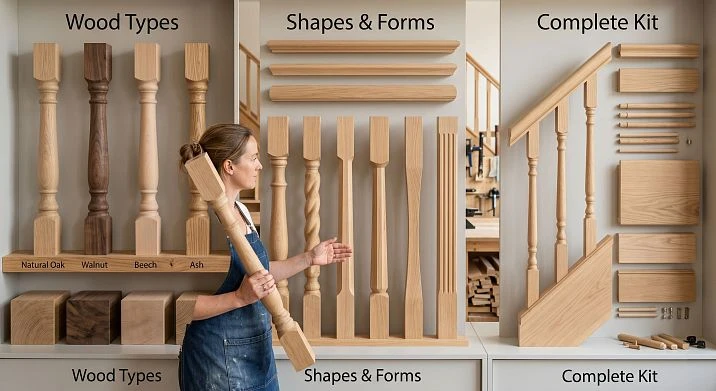
A staircase in a house is not an engineering structure hidden behind a wall. It is the first thing a guest sees, and the last thing the owner notices when they get used to their own interior. But it is the balusters — those vertical posts that support the handrail — that set the entire character of the stair railing. They determine whether the staircase will look like a piece of joinery art or like a faceless set of wooden parts bought at the nearest home improvement store.
The question "how to buy balusters for a wooden staircase" sounds simple. But behind it lies a whole layer of decisions: wood species, profile shape, height and installation spacing, compatibility with handrails and posts, quantity per flight, price, and delivery times. Making a mistake at any of these stages means either overpaying or getting a result that disappoints.
This article is not about pretty pictures. It is about concrete steps: from choosing the shape of the baluster to calculating the complete set. Read carefully — one right choice here will save you time, money, and nerves.
What are balusters and why you shouldn't choose them just by photo
A baluster is a vertical support element of a stair railing. It stands between the handrail above and the stringer or step below, securing the railing and forming a barrier that simultaneously ensures safety and creates a visual rhythm for the staircase.
It is precisely "visual rhythm" that is the key concept. Look at any beautiful staircase: its beauty is composed of the repetition of one element—the baluster—at equal intervals. It is like an arcade in architecture: one span means nothing, but twenty repetitions give birth to a musical order.
Why can't you choose based only on a photo? Because a photograph hides details. In the picture, a baluster may look turned and elegant, but upon close inspection, it might turn out to be roughly sanded, with visible marks from the lathe. Or—on the contrary: a simple shape in the right wood species with flawless finishing looks significantly more expensive than in a catalog screenshot.
wooden balusters for staircases It needs to be evaluated based on a set of parameters: wood species, shape, sanding quality, processing category, geometric precision. And, of course, compatibility with other elements—posts, handrails, fastening components.




What types of balusters exist: turned, carved, flat, square
Shape is the first thing that catches the eye, and the first thing people ask about when choosing. Let's break down the main types found in real projects.
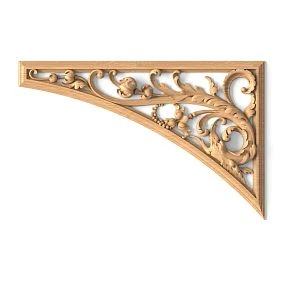
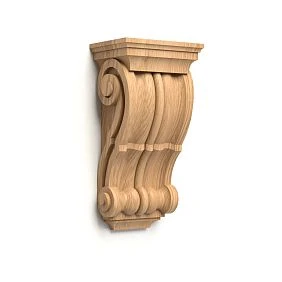
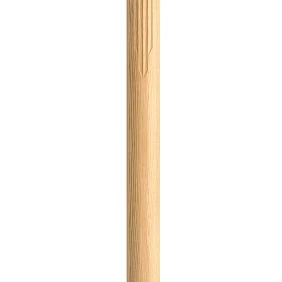
Our factory also produces:
Turned balusters
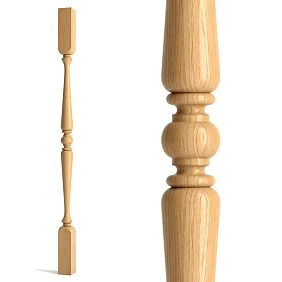
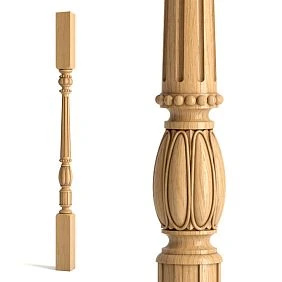
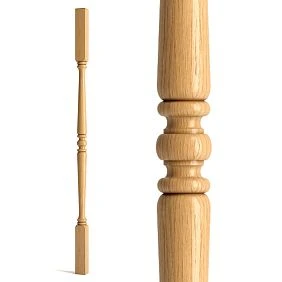
The most common type. A turned baluster is created on a lathe: a solid wood blank rotates, and a cutter sequentially removes excess material, forming the profile. The result is a strictly symmetrical shape with repeating elements: necks, vases, cones, discs.
Turned balusters are versatile. They fit equally well into classic, country, Provence, and neoclassical styles. They are valued for their visual lightness: the vertical rhythm of turned forms does not overload the space. Most models in the catalog wooden balusters for staircases are precisely turned.
The price of a turned baluster starts from 1,990 rubles—this makes them the most affordable option while maintaining high quality.
Get Consultation
Carved and turned-carved balusters
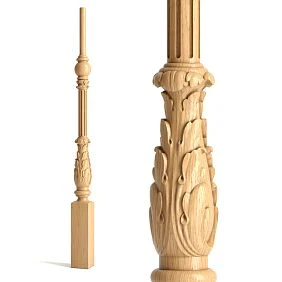
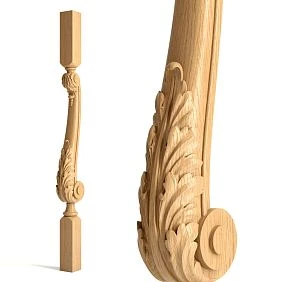
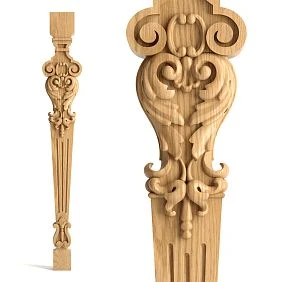
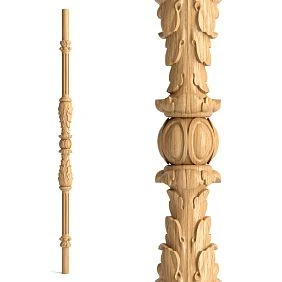
For those building interiors above the average level. Carved wooden balusters — is a combination of turning and 3D milling. Flutes, acanthus leaves, geometric ornaments, and scrolls are applied to the surface. Each such baluster is a small sculpture.
Carved balusters are used in upscale interiors: country houses in Baroque, Empire, Classicism, and Renaissance styles. They require a higher budget, but the payoff is corresponding: a staircase with carved oak balusters becomes the main architectural element of the house.
Flat and cut-out balusters
Flat balusters are not round posts, but flat vertical panels with a shaped contour. They are cut on a milling machine from a board or wide blank. They are most often used in Scandinavian style, modern minimalism, and rustic and country styles.
Flat balusters provide a more "closed" railing: fewer through gaps, which is convenient for families with small children. In terms of installation, they are also less demanding on step accuracy.
Square and rectangular balusters
Square profile is strictness and geometric purity. Such balusters are appropriate in modern interiors, loft style, and minimalism. They easily combine with straight steps, metal details, and glass inserts.
Square balusters are easier to install because they do not require alignment along the axis: there is no difference in how the product is rotated around its axis. This speeds up installation and reduces the likelihood of installation errors.
How to choose material: oak, beech, pine, ash
Wood species is not just about aesthetics. It's about service life, stability, price, and the labor intensity of the finish. Let's break down the four main options found in real production.
Oak balusters
Oak is the king of hardwoods in wooden construction. The density of oak makes it resistant to mechanical loads, abrasion, and deformation. An oak baluster will not sag or crack after five years, and will not need replacement after ten. The expressive texture with large rays and pores makes each piece unique.
Oak balusters are the choice for those building for decades. They are especially good in classic and neoclassical interiors, in combination with oak steps and posts. The only compromise is the price: oak is on average 2–3 times more expensive than pine, which is noticeable with large orders.
Beech balusters
Beech is the closest competitor to oak in hardness. Its dense, uniform structure, with almost no pronounced annual rings, allows for a perfectly smooth finish. Beech balusters look 'cleaner,' more academic, without a pronounced texture.
Beech takes staining and painting well — it's easy to achieve the desired shade. If you want the balusters to be painted white, gray, or another neutral color, beech is one of the best options.
Pine balusters
Pine is the most affordable material and at the same time one of the most popular. A soft wood, easy to work with, it allows for both simple turned shapes and complex carved profiles at reasonable costs. The resinous nature of pine provides natural protection against moisture and biological decay.
The downside of pine is its softness: dents from mechanical impacts can appear on the surface. Therefore, pine balusters are recommended to be coated with varnish or oil for hard surface protection. With proper finishing, pine balusters last a long time and look decent.
Ash balusters
Ash is a species with an expressive fibrous texture, light, strong, and flexible. Ash balusters have a characteristic wood grain that is especially beautiful under a clear lacquer finish. Ash is slightly lighter in tone than oak and looks more 'lively.'
Ash is well-suited for modern and Scandinavian interiors where lightness and naturalness are important. If your steps are made of ash or engineered wood with an ash veneer, balusters from the same species will create perfect visual coherence.
How to choose the height, thickness, and installation spacing
The geometric parameters of a baluster are not just numbers from a table. They are proportions that determine how the railing will look in the space.
Baluster height
The standard height of a baluster for indoor staircases is 90 cm (from the stair tread plane to the bottom of the handrail). This is a safety requirement adopted in most building codes. In practice, the net height of the baluster (excluding the tenon that goes into the tread) is usually 80–85 cm.
For staircases on open terraces and outdoor porches, the recommended railing height is 110 cm. This is due to the different risk level when used outdoors.
If the staircase leads to a children's area or if small children live in the house permanently, it is reasonable to increase the railing height to 100–110 cm even for indoor structures.
Baluster thickness and cross-section
The diameter or cross-section of the baluster is selected depending on the installation spacing and the visual density of the railing:
-
Diameter 45–55 mm — a light, openwork railing, good for classic and neoclassical styles
-
Diameter 60–70 mm — a universal option, works in most styles
-
Diameter 80–100 mm — a massive railing, appropriate in monumental interiors and with high posts
Square balusters typically have a cross-section of 40×40, 50×50, or 60×60 mm. A wider cross-section gives a sense of solidity and heaviness — this is good for grand staircases and bad for small spaces where visual lightness is important.
Installation spacing
Spacing is the distance between the axes of adjacent balusters. According to safety standards, the gap between balusters must not exceed 15 cm (to prevent a child from sticking their head through). In practice, the accepted spacing is 15–17 cm between axes with a baluster diameter of about 50 mm.
A closer spacing (10–12 cm) creates a dense, "closed" railing — a good choice for homes with children. A wider spacing (18–20 cm) is for decorative staircases in interiors without small children.
What you need to buy along with balusters: handrails, posts, railings, fasteners
The most common mistake when purchasing is to order only balusters, and then find that the handrails do not match their profile, the posts are of a different diameter, and the mounting studs are not in stock. staircase components should be purchased as a system, from the same collection or from the same manufacturer.
Posts (support)
Posts are load-bearing vertical supports that are installed at the beginning and end of each flight, as well as on landing platforms. The handrail is attached to them, and the outer balusters adjoin them. The post must be significantly more powerful than the baluster — both architecturally and structurally.
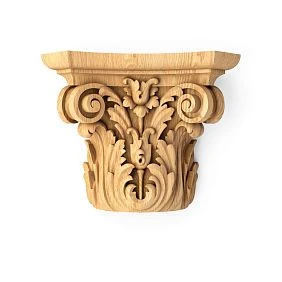
The typical cross-section of a support post is 100×100 mm, 120×120 mm, or 150×150 mm. The shape can be smooth, turned, with carved elements, or with a capital on top. It is important that the post and baluster belong to the same stylistic line: mixing a baroque carved post and a minimalist square baluster is a bad idea.
Handrails and balustrades
The handrail is a horizontal element that you hold onto while moving along the stairs. It should be comfortable to grip (diameter or width — 45–55 mm), smooth, and free of burrs. The handrail sits on top of the balusters and is attached either with dowels or special metal brackets.
Buying a handrail separately from the balusters is risky. The profile of the lower part of the handrail must exactly match the diameter of the cup or tenon on the upper end of the baluster. Clarify this parameter when ordering.
Fastening Elements
The standard method of attaching a wooden baluster is with an M8 or M10 stud, which is screwed into the end of the baluster from the bottom and top. From below, the baluster is attached to the step or stringer, from above — to the handrail using a reverse nut or glue.
In some designs, attachment with a dowel (a wooden pin with glue) is used — a more traditional method that requires precise marking. Whichever type of fastener you choose, buy it at the same time as the balusters — then the geometry will be precisely coordinated.
A detailed installation algorithm and a complete list of tools are described in the guide on installing wooden railings and balusters.
How to avoid mistakes with the number of balusters
Calculating the quantity is arithmetic, but with nuances that are easy to miss.
Basic formula:
Span length ÷ installation step = number of balusters
For example: a flight 4 m long, step 15 cm → 4,000 ÷ 150 = 26–27 pieces. Plus one baluster for the first and last step of the landing (if the railing continues horizontally).
What else to consider:
-
If you install two balusters on each step, the quantity doubles — but the railing looks more ornate and safer
-
Landings require separate calculation — the step may differ here
-
Add 5–10% reserve for defects or cutting errors
-
Posts are counted separately — one per flight plus one for each intermediate landing
Order the full set based on calculation first, not 'bit by bit': balusters from the same batch are guaranteed to match in shade and texture. Additional pieces from another batch may differ slightly in tone — this is especially noticeable on light wood species.
Price of balusters: what determines the cost
An honest talk about prices — this is usually put off until later. But with balusters, it's better to figure it out in advance to plan your budget correctly.
on price of wooden balusters several factors influence it.
Wood species. Pine is the most affordable option. Oak, beech, and ash are 2–3 times more expensive due to raw material costs and processing complexity. If the budget is limited, pine with a quality lacquer finish looks decent and lasts a long time.
Shape and profile complexity. A simple turned baluster with two or three elements is inexpensive. A baluster with deep flutes, acanthus leaves, or combined carved decoration requires significantly more milling time—and this is reflected in the price.
Processing category. Manufacturers divide products into "Standard" and "Prestige." "Standard" means quality sanding, ready for final finishing. "Prestige" means additional processing, elimination of the smallest defects, ready for painting without preliminary priming.
Order volume. When ordering 50 pieces or more, most manufacturers offer a discount. If you are building a large staircase or several staircases in one house, always check the wholesale purchase terms.
Price guidelines. In the STAVROS catalog, baluster prices start from 1,990 rubles for simple turned pine models and go up to 7,000+ rubles for complex carved balusters made of oak or beech. The average budget for a set for one flight of 20–25 balusters is from 50,000 to 150,000 rubles, depending on the choice.
What is better: buying ready-made balusters or ordering custom ones
This question arises every time the project is slightly more complex than standard. Let's honestly examine both paths.
Ready-made balusters from the catalog are fast, predictable, and reliable. You see the actual product in photos and 3D visualizations, know the exact dimensions, and can immediately calculate the cost. The production is already refined, the machines are set up for this shape, and the geometry quality is consistent from batch to batch. For a standard project—a straight or L-shaped staircase in a house—the ready-made catalog is more than sufficient.
Custom ordering is justified in several cases:
-
Non-standard staircase height or atypical step requiring balusters of a special length
-
Custom design project where the shape of the baluster is created by the architect for a specific interior
-
Need for an exact match with already installed elements — for example, if you are replacing part of the balusters in an existing staircase
-
Large-scale project: a country house, hotel, restaurant, where a unique collection is needed
Custom production typically requires a minimum batch (from 20–50 pieces), approval of the drawing, and takes from 2 to 6 weeks. But the result is a product that no one else has.
For most private projects, the right approach is to choose the most suitable model from the catalog wooden balusters for staircases and, if necessary, adjust only the length.
Common mistakes when buying balusters
Mistakes when buying balusters are not scary if others make them. Here are the most common ones.
Choosing a baluster separately from the post. The post and baluster are a pair. If they belong to different stylistic series or different manufacturers, the railing will look 'composite,' as if assembled from leftovers. Buy staircase components from the same system.
Do not check compatibility with the handrail. The handrail has a specific groove or bottom edge shape for which the diameter of the upper baluster tenon is designed. A mismatch of even a millimeter means rework or on-site adjustment.
Rely only on the color in the catalog. The wood color on the monitor screen depends on display settings, lighting during photography, and photo tinting. Always request samples or clarify the actual shade with the manager. This is especially critical for oak — the difference between "light oak" and "dark oak" can be very subjective.
Do not account for extra material. Buying exactly the calculated amount means risking a shortage at the first cutting error. Always add 10% extra. The remainder will be used or serve as insurance for replacing a damaged baluster in a few years.
Forget about fasteners and glue. Pins, nuts, PVA or epoxy glue — all this seems trivial, but it is the lack of fasteners that delays installation by an extra day.
Mix wood species without a well-thought-out plan. Pine balusters and oak posts are acceptable if painting hides the texture difference. But if you plan a clear lacquer finish, different species will be very noticeable.
Do not think about the final finish in advance. The baluster from the catalog comes unlacquered — ready for final treatment. If you do not know what you will coat it with, you risk an unexpected result: oil gives one effect, lacquer another, staining a third.
Flat balusters vs. turned ones: what to choose for a specific style
This question is most often put off until last — and in vain. The shape of the baluster defines the staircase style more strongly than the wood species or step height.
Classic and neoclassical. A turned baluster with vases, necks, and discs is the language of the classical order. It reads in the same row as columns, arches, and moldings. If the interior is built on symmetry and ornament, a turned baluster is a must.
Rustic, country, Provence. Both turned balusters with a simple profile and slightly "deliberate" shapes with irregularities and live texture are appropriate here. Pine with matte oil is an ideal solution.
Modern minimalism. Square or rectangular baluster. No vases or necks. Only a clear contour, smooth surface, matte paint or light varnish.
Scandinavian style. Flat or thin rectangular balusters made of light wood with minimal processing. Emphasis on the naturalness of the material, not the shape.
Baroque and Empire style. Carved wooden balusters with fluting, capitals, floral motifs. Only oak or beech. Only "Prestige" finish.
Balusters for a terrace: how they differ from interior ones
If the staircase leads not only inside the house but also to the terrace, porch, or open balcony — a separate discussion about the material and finish for outdoor conditions is needed.
Outdoors, wood works in fundamentally different conditions: temperature changes, moisture, direct sunlight, biological threats. Pine for outdoor use must be impregnated with a bioprotective compound before the final finish. Oak and ash are more resistant to moisture but also require outdoor varnish or oil with UV protection.
An important parameter for outdoor balusters is the moisture content of the source material. Raw wood will dry out and deform during installation. Make sure the balusters are made from kiln-dried wood with a moisture content no higher than 10–12%.
Fasteners for outdoor balusters — only stainless steel or galvanized. Regular steel pins rust within two or three seasons, leaving brown stains on the wood.
Where to buy wooden balusters for stairs
The question "where to buy" seems obvious until you start searching. Marketplaces offer a wide selection, but the problem is that it's difficult to verify the actual quality of processing, clarify exact dimensions, or confirm compatibility with handrails and posts from the same series.
Buying directly from the manufacturer offers several important advantages:
-
You see the full catalog and can select a system kit
-
The manager can calculate the exact number of balusters for your specific flight
-
Custom manufacturing is possible
-
Guaranteed matching of batches by wood species and shade
buy balusters for the staircase with Contact us to confirm shipping to your destination. and the CIS — this is exactly the task for which the STAVROS catalog was created. Over 50 models, oak, beech, and pine species, two processing classes, compatible handrails, posts, and fasteners — all in one place.
Pickup is available from warehouses in Moscow and St. Petersburg. Long-distance transportation is done in reliable packaging: corrugated cardboard, bubble wrap, and hard inserts for fragile elements. The product arrives undamaged — this has been proven by thousands of orders.
About the company STAVROS
STAVROS is a Russian manufacturer of wooden interior products with a production history since 2002. The company specializes in the production of balusters, posts, handrails, railings, moldings, baseboards, architraves, and other millwork products from solid oak, beech, and pine.
The production is equipped with CNC lathes and milling machines — this ensures geometric precision of each product and the possibility of repeat manufacturing with identical parameters. The STAVROS catalog features over 50 models of balusters, including turned and carved series, and a full line staircase components from coordinated collections.
STAVROS works with both private clients and architects, designers, and construction companies. Delivery is carried out throughout Russia and CIS countries. Consultation, quantity calculation, and kit selection are free.
FAQ: Answers to popular questions
Which balusters to buy for a wooden staircase?
The choice depends on the interior style and budget. For classic style — turned balusters made of oak or beech. For minimalism — square balusters from any wood species. For a budget project — pine with a good varnish finish.
How to choose the height of a baluster?
The standard railing height is 90 cm from the step plane. The net height of the baluster (excluding tenons) is usually 80–85 cm. For terraces and outdoors — 110 cm.
How much do wooden balusters for stairs cost?
In the balusters for STAVROS stairs the price starts from 1,990 rubles per piece (pine, simple turned shape) and goes up to 7,000+ rubles for carved oak balusters.
Can I buy balusters and handrails from the same manufacturer?
Yes, and that is the right decision. STAVROS offers a complete set: balusters, posts, handrails, and fasteners from coordinated series.
Where to buy beautiful balusters for stairs?
Directly from the manufacturer — in the catalog wooden balusters for staircases. This guarantees batch consistency, precise dimensions, and a systematic selection of the entire set.
Do I need a reserve when ordering balusters?
Absolutely — add 10% to the calculated quantity. This is insurance against cutting errors and a guarantee that you will have a product from the same batch if replacement is needed.
Are wooden balusters suitable for a terrace?
Yes, provided proper treatment: bio-protective impregnation, exterior varnish or oil with UV filter. Material — kiln-dried wood with moisture content no higher than 12%.
How to install wooden balusters?
Step-by-step instructions with step calculation, marking, and fastening methods — in the guide on installation of wooden railings and balusters.