Article Contents:
- What is a carved overlay and why does a buyer need it
- What carved overlays are presented in the STAVROS category
- How to update furniture with carved overlays
- How to decorate a furniture facade: central, corner, and horizontal solutions
- Carved overlays for doors: how to decorate a door leaf with wooden decor
- Wooden decor for facades: when overlays are needed not only for furniture
- How to make furniture in a classic style using overlays
- Wall composition: how to use overlays not only on furniture
- Carved rosettes: when they are better than a regular overlay
- Capitals and pilasters in classic decor
- What to buy together with carved overlays
- How to choose carved overlays by shape
- How to choose an ornament: acanthus, cartouche, laurel, flowers, geometry
- How to choose the size and thickness of the overlay
- Material and finish: what to check before ordering
- What not to do from scratch if you have ready-made STAVROS elements
- How not to confuse carved overlays with similar products
- Practical selection for specific situations
- Need to update an old cabinet
- Need to decorate the dresser
- Need to decorate a door leaf
- Need to cover the empty central part of the facade
- Need to make furniture in a classic style
- Need to decorate a wall panel
- Need to select decor for painting
- Need to decorate the facade of a built-in wardrobe
- Choosing only by ornament
- Ignoring size A, B, and C
- Too much decor on one surface
- Style Mismatch
- Buying without considering handles
- Expecting the overlay to fix a bad surface
- Random selection of accompanying elements
- Buying without checking the product card
- How to update furniture with carved overlays?
- What to decorate a furniture facade with?
- Are carved overlays suitable for doors?
- How to choose carved overlays by shape?
- What to cover the empty central part of the facade with?
- Can I make furniture in a classic style using overlays?
- What to buy for decorating an old cabinet?
- How is a carved overlay different from a rosette?
- Do I need to buy overlays as a set?
- Can carved overlays be used for painting?
- How to avoid mistakes with the overlay size?
- Which ornaments to choose for a classic interior?
- Where to buy carved wooden overlays?
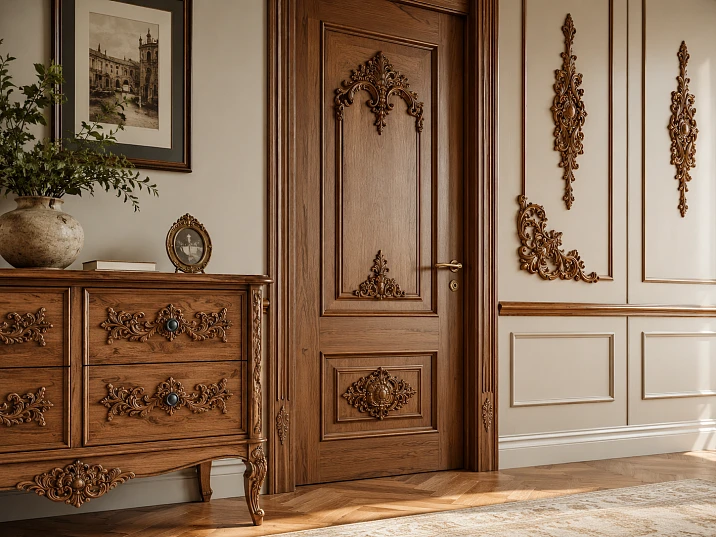
Carved wooden overlays help refresh furniture facades, door panels, or decorative wall compositions without completely replacing the item. Sometimes a cabinet, nightstand, chest of drawers, or door is still sturdy, convenient, and fits in size, but looks too plain: a large empty surface, a flat facade without character, a boring central area, inexpressive corners. In such a situation, a wooden overlay works not as a random decoration, but as a ready-made carved element that adds relief, supports the style, and helps create a cohesive interior look.
The main mistake when choosing such decor is to look only at the beautiful pattern. The overlay must fit in shape, size, ornament, installation location, and future finish. A central piece on a furniture facade solves one task, a corner piece another, a vertical piece a third. Decor for a door does not always work as well on a chest of drawers, and a large element that looks impressive on a wall panel can overwhelm a small cabinet. Therefore, before buying, you need to understand where exactly the overlay will be placed, what empty space it should cover, and which neighboring details it will combine with.
In the STAVROS catalog you can buy carved wooden overlays for furniture, doors, wall panels, and interior compositions. The category includes overlays, decor sets, and mascaron pieces, and selection can be made by shape, collection, ornament, and size. This format is convenient for the buyer: you don't have to search for a random blank, but can choose ready-made wooden decor for a specific task — update a facade, design the central part of a door, enhance the classic style of furniture, or assemble a decorative wall scheme.
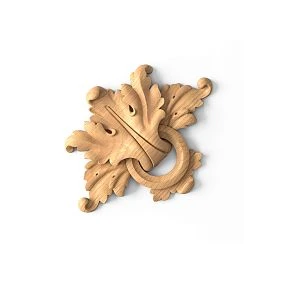
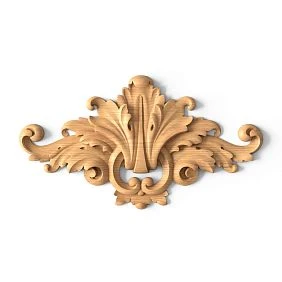
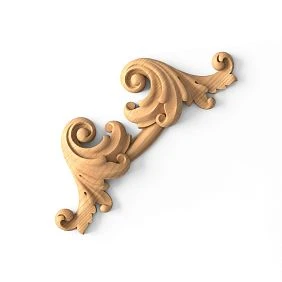

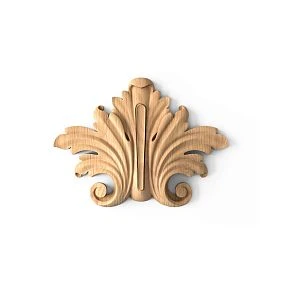
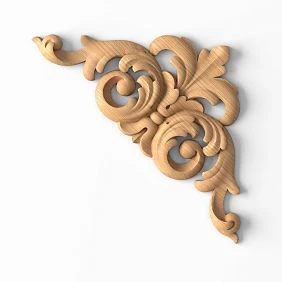
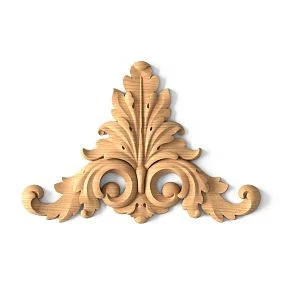
What is a carved overlay and why does a customer need it
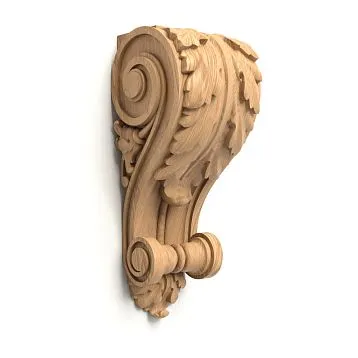
A carved overlay is a decorative element installed on the surface of furniture, doors, walls, ceilings, or other interior planes. Unlike linear molding profiles that often run along edges or joints, an overlay acts as an independent accent. It can be central, corner, vertical, horizontal, oval, round, square, rectangular, asymmetrical, or more complex in shape.
For the customer, this is a simple way to change the character of an item. A plain smooth facade can become classic, neoclassical, more formal, or decorative after installing an overlay. A door without expressive paneling can be enhanced with a central carved element. A wall panel can be turned into a composition with a clear top, bottom, center, corners, and logical decoration. Meanwhile, the furniture or door itself can remain unchanged: it's not the frame that changes, but the perception.
Carved overlays are especially useful when you need to solve one of three tasks. The first is to decorate an empty plane. For example, the front of a dresser looks too flat and lacks a central accent. The second is to connect several details together. For example, the furniture already has handles, legs, or a cornice, but the front looks poor. The third is to support the interior style. If the room has classic doors, baseboards, moldings, or carved elements, the overlay helps the furniture not fall out of the overall look.
Such decor is often chosen not only for new furniture but also for updating old furniture. If the cabinet is sturdy but visually outdated, it can be repainted, the handles replaced, and overlays added. If the door is too simple, it can be decorated with wooden decor and tied to the trim or wall finish. If the wall composition looks empty, overlays help add relief without complex joinery from scratch.




What carved overlays are presented in the STAVROS category
The STAVROS carved overlays category is structured so that the buyer can choose not just a "beautiful piece" but an element for a specific scenario. Inside the section, there are filters by price, dimensions A, B, C, product type, collections, shapes, ornaments, and availability. This is important because a decorative overlay must fit the installation location not approximately but precisely: in width, height, thickness, pattern, and role in the composition.
| Parameter | What to consider when choosing |
|---|---|
| Product group | Decorative carved wooden overlays |
| Main section | buy carved wooden overlays |
| Number of products in the category | The catalog shows 544 products |
| Product types | Decorative set, mascaron, overlay |
| Sizes in filters | A — width, B — height, C — thickness |
| Product shapes | Square, round, oval, rectangular, asymmetrical, angular, straight, curved, C-shaped, S-shaped, crown, diamond, central, vertical, horizontal, triangular |
| Ornaments | Geometric, floral, shells, acanthus, plant, branch, cartouche, laurel, garlands, animals, woven |
| Collections | Empire, Versailles, Grape, Gothic, Classic, Summer Garden, Art Nouveau, Russian Style, Eclecticism |
| Material | The category page shows models made of beech and oak wood; the exact material should be checked in the specific product card |
| Product examples | Wooden decor N-106, N-154.1, N-421, N-420, N-276, N-095, N-422, N-464, decor set C-020 and other items |
| Where to use | Furniture fronts, interior doors, wall compositions, panels, ceiling and decorative interior solutions |
| What to check before ordering | Size, shape, thickness, ornament, material, purpose, surface compatibility, future finishing |
This catalog structure helps you not get lost in a large assortment. If you need to decorate the central part of the facade, you can look at central and oval shapes. If you need to finish the corners, it's more convenient to select corner elements. If the task is to elongate the facade vertically, you should look at vertical overlays. If you need to support a classic style, ornaments with acanthus, cartouche, laurel, garlands, or floral motifs are useful.
At the same time, you don't need to assume in advance that every overlay will suit any surface. Some elements look good on a dresser facade, others require a larger plane. Some work better in pairs, others are designed for central placement. Some can be used as part of a wall composition, others look more convincing on furniture or a door. Therefore, the product card remains a checkpoint: dimensions, material, price, availability, and other parameters should be checked before ordering.
Our factory also produces:
How to update furniture with carved overlays
The question 'how to update furniture with carved overlays' most often arises when the item is not yet ready to be thrown away, but it no longer fits the style. This could be an old nightstand, dresser, wardrobe, kitchen cabinet, console, bedside furniture, or built-in wardrobe facade. In such a case, the overlay helps change the character of the surface: add relief, cover an empty central part, support a classic line, or connect the furniture with other decor in the room.
It is best to start by evaluating the facade. If it is flat and wide, a central overlay can become the main accent. If the facade is narrow and elongated, a vertical element will look more natural. If the corners are empty or the facade seems unfinished, corner overlays will help create a frame composition. If the furniture consists of several doors, it is important not to decorate one door separately from the others, otherwise the item will look random.
For a dresser, the "center + corners" scheme often works well. The central carved element emphasizes the main plane, while the corner details help complete the facade. For a nightstand, it's better to choose decor more carefully: an overly large overlay can take over the entire scale and make the item look heavy. For a wardrobe, you can use more elongated elements, especially if the facades are tall and need vertical division.
If the furniture is planned to be painted, it is better to select overlays before the final finish. This way, you can understand in advance how the relief will look under enamel, varnish, or other coating. You should not paint the furniture first, then look for decor, and then adjust the finish again. A solution where the facade, overlay, handles, and adjacent elements are thought out in advance as a single set looks much neater.
When the task is to choose decorative overlays for furnitureYou need to look not only at the ornament, but also at the size. A small overlay on a large cabinet will get lost. A large overlay on a small nightstand will look heavy. Carving with an active plant motif supports classic furniture well, but can conflict with a minimalist facade. Geometric decor is calmer and fits more easily into modern compositions.
Get Consultation
How to decorate a furniture facade: central, corner, and horizontal solutions
A furniture facade can be decorated in different ways. It all depends on which part of the plane looks empty and what role the decor should play. The overlay can become the center of the facade, emphasize corners, stretch the surface vertically, create a horizontal line, or combine several details into an ornamental pattern.
| Facade task | Which overlay is suitable | Where it works best | What to Check |
|---|---|---|---|
| Cover an empty central part | Central, oval, round, rectangular | Chests of drawers, bedside tables, cabinet doors, decorative panels | Size relative to the facade, thickness, symmetry |
| Finish the corners | Corner, triangular, asymmetrical | Framed facades, doors, panel compositions | Corner alignment, pattern direction, pairing |
| Emphasize height | Vertical, rectangular, elongated | Cabinets, door leaves, tall panels | Height proportions, distance to edge |
| Add line by width | Horizontal, curved, S-shaped, C-shaped | Chests of drawers, consoles, upper parts of facades | Combination with handles and cornice |
| Create a classic accent | Cartouche, acanthus, laurel, garlands, floral ornament | Classic furniture, sideboards, doors, wall panels | Do not overload the facade, tie in with the rest of the decor |
| Make a restrained design | Geometric or concise floral decor | Modern classics, neoclassicism, calm interiors | Scale, purity of form, future finishing |
The central overlay is especially good at solving the question of 'what to cover the empty central part of the facade with.' An empty facade is not always bad in itself, but in a classic interior it can look poor. The overlay creates a focal point and helps make the furniture look complete. If the facade is wide, it's better not to leave the center too small. If the facade is narrow, a large oval or round detail can look unnatural.
Corner elements help create a sense of a frame. They don't have to be large. Sometimes small carved details in the corners are enough to make the facade look more cohesive. This technique works well on cabinet doors, nightstands, decorative panels, and wall compositions.
Horizontal elements are useful where you need to emphasize width. For example, on a chest of drawers with a long top line or on a facade where handles already create a horizontal rhythm. But horizontal decor must be carefully combined with hardware. If the handle is prominent, the overlay should not compete with it.
Carved overlays for doors: how to decorate a door leaf with wooden decor
Carved door overlays help change the perception of the leaf without completely replacing the door. This is especially relevant if the door is smooth but the interior requires a more classic or decorative presentation. The overlay can emphasize the central part, create the feel of a panel, add a vertical accent, or connect the door with architraves, baseboards, and wall finishes.
A door leaf differs from a furniture facade in scale. On a door, a decorative element looks different: a person sees it at eye level, and the surface itself is taller and larger. A small furniture overlay on a door can get lost. Too large an overlay can disrupt the proportions of the leaf. Therefore, when choosing, it is important to consider the door height, leaf width, handle placement, presence of panels, glass, or other details.
If the door already has a frame or panel, the overlay can be used inside the central area. If the door is completely smooth, you first need to imagine the future composition: where the top and bottom parts will be, whether one element or several are needed, and whether the decor will conflict with the handle. Special care should be taken with vertical overlays: they can beautifully elongate the leaf, but if positioned incorrectly, they create the feeling of a random stripe.
Carved door overlays are well-suited for classic, neoclassical, vintage, and eclectic interiors. They can complement a carved architrave, wooden baseboard, decorative wall panel, or furniture in the same room. If the interior is modern and very strict, it is better to choose more restrained forms: geometry, a laconic plant motif, rectangular or vertical elements without excessive relief.
If the goal is not just to decorate the door but to connect it with furniture, it is worth using repeated motifs. For example, the door may have a central overlay with a plant ornament, and the dresser may have a smaller detail in a similar style. This does not mean all elements must be identical. A general logic is sufficient: similar ornament, close shape, unified finish.
Wooden decor for facades: when overlays are needed not only for furniture
A facade can be not only a furniture door. In interior decor, a facade often refers to any visible plane: a kitchen facade, cabinet, wall panel, decorative portal, built-in furniture body, or door leaf. Therefore, the query "what to decorate a furniture facade with" easily expands to a broader task: how to design a plane so that it becomes part of the interior, not just a flat surface.
When you need to buy wooden decor for facades, it is useful to understand in advance what role this plane plays. If the facade is in the center of the room, the decor can be more noticeable. If it is a side part of furniture or a small cabinet in the hallway, it is better not to overload it. If the facade is repeated many times, as in a kitchen or a large wardrobe, one active overlay on each door can create too dense a pattern. In such a case, you can highlight only the central facades or use more restrained elements.
For kitchen facades, practicality is especially important. A carved overlay creates relief, and relief requires more careful maintenance. Therefore, in the kitchen, it's better to think in advance where the decor won't interfere with daily use. On upper facades, it can work more calmly; on lower ones, it will have more contact with hands, cleaning, and household loads. It's best to check specific application conditions with the material, finish, and recommendations for the chosen product.
For cabinets and built-in furniture, overlays help move away from the feeling of a flat wall. A large cabinet without decor can look massive. If you add vertical or central elements, the facades gain division, and the furniture looks lighter and more expressive. But a large cabinet requires discipline: the decor must repeat in a clear pattern, not appear chaotically on individual doors.
How to make furniture in a classic style using overlays
Classic style is not created by a single carved detail. It is built on proportions, symmetry, relief, correct lines, and a combination of elements. Carved overlays help add a classic character to furniture, but the result will be convincing only when the decor is supported by the shape of the facade, handles, legs, color, cornice, or adjacent trim.
The simplest way is to work with symmetry. Classic furniture loves a central axis. If the facade has one door, the central overlay should be placed neatly in the center. If there are two doors, the decor can be mirrored. If there are several facades, you need to decide in advance whether all of them will be decorated identically or only the central ones will get the accent.
The second principle is scale. A classic overlay should not be too small. Otherwise, it looks like a random appliqué. But it should not completely 'take over' the facade either. There should be air between the edges of the overlay and the boundaries of the facade. Then the decor is perceived as part of the furniture, not as an extra detail glued on top.
The third principle is connection with other elements. If the furniture is in an interior with pilasters, capitals, rosettes, moldings, carved doors, the overlay should support this language. For example, acanthus or cartouche work well in classic style, plant motifs add softness, geometric ornament is suitable for more restrained neoclassicism. If there are no other classic details in the room, one carved overlay may not be enough: it's worth adding handles, legs, a cornice, or wall decor in a similar character.
Wall composition: how to use overlays not only on furniture
Carved overlays can also work on the wall. In this case, they become part of a decorative composition: a panel, frame, central medallion, vertical axis, corner design, or ornamental node. This approach is especially interesting for living rooms, studies, hallways, dining rooms, salons, restaurants, and showrooms.
On the wall, an overlay is visible differently than on furniture. It is not tied to handles, drawers, or doors, but must match the scale of the room. A small element on a large wall will get lost. Too large an element will look heavy. Therefore, it is better to build a wall composition from the overall scheme: where the center is, where the edges are, what height the panel is, how much free space is around, and whether there are moldings, pilasters, or rosettes nearby.
For the central part of the wall, a more expressive overlay can be used. For corners, corner elements. For vertical sections, elongated details. For a classic panel, a combination of overlays with rosettes, capitals, and pilasters. If the wall is decorated in a formal style, the decorative set should be consistent: do not mix Gothic, Art Nouveau, Russian style, and Empire without a clear idea.
In a wall composition, the overlay often solves the problem of emptiness. For example, a large flat area has formed between two moldings, which looks unfinished. A central carved element can become a focal point. Or vice versa: a wall frame is too strict and needs a soft plant detail. In both cases, the overlay helps not just to "add beauty" but to complete the architectural plane.
Carved rosettes: when they are better than a regular overlay
Rosettes are a separate group of decorative elements. They often have a round, oval, square, or symmetrical shape and work well as the center of a composition. In furniture, a rosette can emphasize the middle of a facade, door, panel, backrest, panel, or decorative insert. On a wall, it can become a central medallion or part of a repeating pattern.
If a regular overlay can be elongated, corner, asymmetrical, or horizontal, a rosette is more often perceived as a point. It gathers the gaze in the center. Therefore, it is good to use where you need not to stretch the surface but to place a decorative focus. For example, on a dresser door, in the center of a panel, on a wall panel, or in a decorative frame.
When you need to enhance a facade with a small but expressive element, you can buy carved rosettes for furniture and use them as an independent accent or as part of a composition with other overlays. Rosettes are especially useful if the furniture already has a frame, but the inside of the frame lacks relief.
The main thing is not to confuse a rosette with any overlay. If the plane is elongated, a rosette may look too point-like. If the facade is tall and narrow, it is better to consider vertical decor. If you need to decorate corners, a rosette will not replace a corner overlay. But where a center is needed, it works very convincingly.
Capitals and pilasters in classic decor
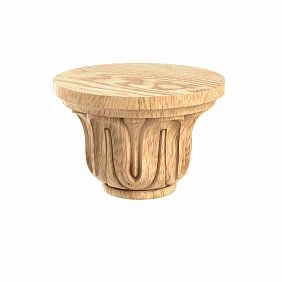
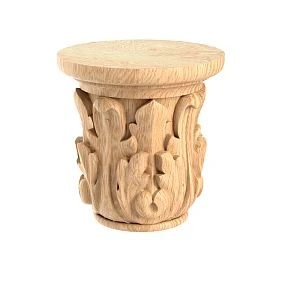
Capitals and pilasters are needed when the task goes beyond a single overlay. If you need to design not just a facade, but a whole classical composition — a cabinet, portal, wall panel, doorway, library, display case, sideboard, interior niche — one central detail may not be enough. You need verticals, support elements, finishes, architectural logic.
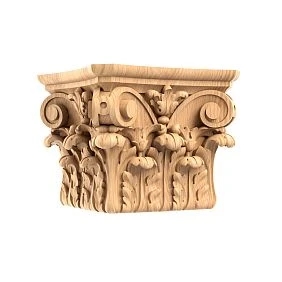
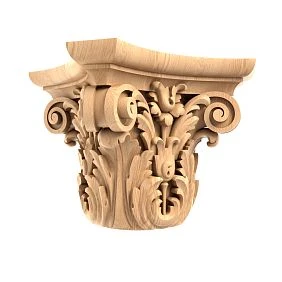
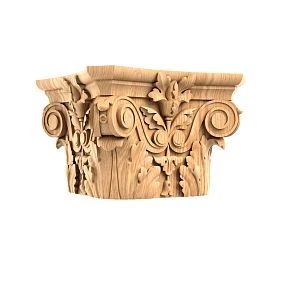
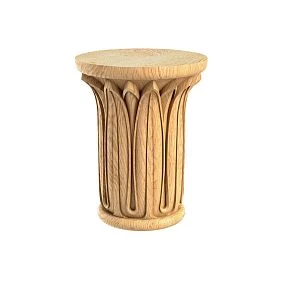
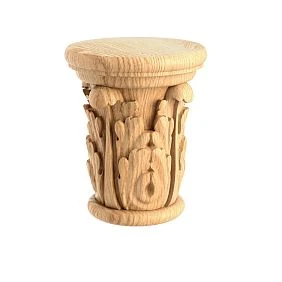
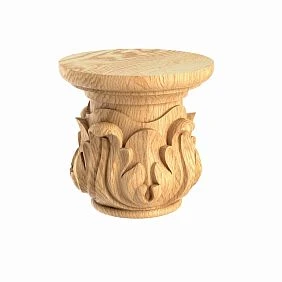
A pilaster helps create vertical division. It can visually divide a plane, emphasize edges, and frame the side parts of a cabinet or wall panel. A capital completes the top of a pilaster or column element, adds classic expressiveness, and makes the composition more architectural.
For large classical projects, it's better to plan ahead select capitals и pilasters for classical decor together with overlays. Then the furniture or wall composition will not look like a flat plane with a glued decoration. It will get structure: verticals, center, top, bottom, corners and finishes.
This combination works especially well in interiors with a historical character: classic, Empire, eclectic, Russian style, Gothic, Art Nouveau. But it can also be adapted to modern neoclassicism if you choose calmer forms and do not overload the surface.
What to buy together with carved overlays
A carved overlay often becomes the first item in a selection, but rarely remains the only one. If a buyer is updating furniture, they may need a central overlay, corner elements, rosettes, pilasters, capitals or other wooden decor. If a door is being decorated, elements for the center and corners may be needed. If a wall composition is being assembled, it is better to think through several levels of decor in advance.
| What to add to the purchase | Why this is needed | Which scenario it suits | What to pay attention to | Link |
|---|---|---|---|---|
| Carved overlays | Main decor for a facade, door, or wall | Furniture update, door decoration, creating an accent | Size A/B/C, shape, ornament, thickness, material | buy carved wooden overlays |
| Decorative overlays for furniture | Help cover empty surfaces and add relief to the facade | Chests of drawers, nightstands, cabinets, sideboards, facades for painting | Scale relative to the facade, symmetry, combination with handles | to choose decorative overlays for furniture |
| Wooden decor for facades | Needed for a broader facade composition | Cabinets, doors, wall panels, decorative portals | Avoid overloading repetitive facades, tie details by style | to buy wooden decor for facades |
| Carved rosettes | Work as a central medallion or point accent | Panels, facades, wall frames, decorative panels | Shape, diameter or dimension, position in the center | buy carved rosettes for furniture |
| Capitals and pilasters | Create an architectural structure around overlays | Classic cabinets, portals, wall compositions, niches | Scale, height, style, combination with central decor | select capitals и pilasters for classical decor |
This set helps the buyer not to be limited to a single detail. If the furniture is small, one overlay may be enough. If the facade is large, a more complex scheme will be needed. If a door is being decorated, it is worth considering central and vertical decor. If a wall composition is being created, it is better to immediately connect the overlays with rosettes, pilasters, and capitals.
How to choose carved overlays by shape
Shape is the first filter that helps not to drown in the assortment. But you need to choose the shape not based on the principle of "liking it," but based on the task of the surface.
Round and oval overlays work well as a soft central accent. They are suitable for facades where you need to add a decorative point but not create rigid geometry. Oval looks especially good on vertical facades and door panels. The round shape is suitable for a rosette effect, central medallions, and symmetrical compositions.
Square and rectangular elements are easier to fit into furniture geometry. They combine well with straight frames, panels, cabinet doors, chests of drawers, and wall panels. A rectangular overlay can be horizontal or vertical, and this completely changes the impression. A horizontal one expands the facade, a vertical one elongates it.
Corner overlays are needed where a facade or panel already has a frame or requires corner finishing. They help avoid empty spaces at the edges and make the decor more cohesive. However, corner elements require precision: you need to monitor the direction of the pattern and pairing so that the left and right corners look coordinated.
Asymmetrical and curved shapes are suitable for freer compositions. They can be interesting in Art Nouveau, eclecticism, decorative panels, and non-standard furniture solutions. But such shapes are more difficult to use without a project. If there is no confidence, it is better to start with more understandable symmetry.
C-shaped and S-shaped elements are good for decorative connections when you need to draw a line, frame part of a plane, or add movement. They can support plant ornaments, scrolls, cartouches, and classical motifs. But they cannot be placed randomly: the direction of the line must be related to the shape of the facade.
How to choose an ornament: acanthus, cartouche, laurel, flowers, geometry
The ornament determines the mood more than the size. Two overlays of the same shape can be perceived completely differently if one is decorated with geometry and the other with acanthus and garlands.
Acanthus is a classic motif that works well for furniture with a historical character, portals, doors, wall panels. It adds relief and status, but requires support in the adjacent decor. If acanthus appears only in one small overlay on very simple furniture, it can look lonely.
A cartouche helps create a central decorative point. It works well on facades, doors, panels where an expressive center is needed. The cartouche can be used as the main element of the composition, especially if there is a frame or symmetrical details around it.
Laurel and garlands give a more formal, solemn feel. They are suitable for classic interiors, dining rooms, living rooms, studies, sideboards, display cabinets, doors to formal areas. But with them, you need to dose the amount of decor: if garlands are repeated too often, the surface can become overloaded.
Floral and plant ornament is softer. It works well for bedrooms, living rooms, feminine interiors, furniture with smooth shapes, and decor in the style of classic, Art Nouveau, or eclectic. Such a motif helps make furniture warmer and more decorative.
Geometric ornament is calmer and more versatile. It is suitable for neoclassical, modern interiors, strict facades, cabinets, doors, and wall panels. If you want a wooden relief without strong historical stylization, geometry is often the safest option.
How to choose the size and thickness of the appliqué
The size of the appliqué should match the surface. This seems obvious, but this is where buyers often make mistakes. They choose an element based on a photo without imagining it on the actual facade. As a result, the decor turns out too small, too large, too thick, or poorly placed in the free area.
Width is important for horizontal placement. If the overlay almost touches the edges of the facade, it looks cramped. If it is too narrow for a large plane, a lot of empty space remains around it. Height is important for vertical proportion. This is especially noticeable on doors and tall cabinets: short decor can get lost, while excessively elongated decor can make the panel look heavy.
Thickness affects relief and practicality. A more prominent relief works well in formal areas but requires careful finishing and maintenance. A thin appliqué is calmer, fits more easily into furniture, and protrudes less above the surface. Before ordering, you need to check dimension C — the thickness, especially if the appliqué will be placed next to handles, frames, moldings, or other details.
For a furniture facade, it is useful to make a simple calculation in advance: measure the free central area, leave margins from edges, handles, and frames, then select an overlay by its dimensions. For a door, consider the height of the handle and any possible paneling. For a wall, look not only at the size of the overlay itself but also at the entire composition: distance to the floor, ceiling, adjacent moldings, pilasters, and rosettes.
Material and finish: what to check before ordering
The category page states that the catalog features wooden carved overlays made from beech and oak wood. For the buyer, this is an important texture: wood can be integrated into furniture and interior solutions, finished, and combined with other wooden details. However, the specific material, availability, and parameters need to be checked in the card of the selected model.
Beech and oak are perceived differently. Oak is often associated with a more expressive texture and a solid interior character. Beech can look calmer and smoother. But in a finished project, much depends on the specific model, processing, finish, and adjacent materials. Therefore, you should not choose solely based on the wood species name. You need to look at the task: will the overlay be painted, tinted, varnished, combined with existing furniture, or used under a uniform final coating.
If the furniture is to be repainted, it is better to select the overlay before starting the finishing. Then you can prepare the surface, try on the decor, check the fit, coordinate the relief, and only then proceed to the final coating. If the overlay is purchased for already finished furniture, you need to pay special attention to the color, texture, and thickness. Even a beautiful wooden decor can look foreign if its finish does not match the facade.
For doors and wall compositions, the finish plays an even greater role. On a door, the overlay is in an area of constant visual and tactile contact, so the surface must look neat. On a wall, the relief will catch light and shadow, meaning any unevenness in the finish will become more noticeable. Before ordering, it is better to decide in advance whether the decor will stand out in color or blend with the base.
What not to make from scratch if there are ready-made STAVROS elements
Many buyers start with the idea of 'making furniture in a classic style with their own hands.' This is a normal desire: you want to update a cabinet, design a facade, add carving, decorate a door, or make a wall panel. But complex carving requires tools, experience, time, and precision. If you cut an ornament by hand without skill, the result may be rough, and the furniture surface may be damaged.
Ready-made carved overlays take the most difficult part of the work off the buyer. There is no need to carve an acanthus, cartouche, garland, or complex plant motif from scratch. There is no need to look for a random blank and try to turn it into a decorative element. There is no need to adjust the pattern by hand when you can choose a ready-made shape, size, and ornament from a catalog.
This does not eliminate preparation and careful installation. The surface still needs to be measured, cleaned, marked, the location chosen, and the finish thought out. But the buyer focuses on assembling the composition, not on making the carving. This path is especially convenient when updating furniture: an old facade can be turned into a more expressive one without creating decor from scratch.
For independent work, it's important not to overcomplicate things. If you have little experience, it's better to start with one central overlay or a pair of simple corner elements. Complex schemes with pilasters, capitals, rosettes, and several types of overlays are best laid out on paper or in a project first. Ready-made decor helps, but the composition still needs to be built consciously.
How not to confuse carved overlays with similar products
Carved overlays can easily be confused with rosettes, capitals, pilasters, moldings, furniture appliqués, and other decorative details. They may look similar on the outside, but each item has its own role.
An overlay is a universal decorative element for a surface. It can be central, corner, horizontal, vertical, or asymmetrical. Its task is to add relief, cover an empty area, create an accent, or support a composition.
A rosette often works as a symmetrical center. It doesn't always replace an overlay, especially if you need to elongate a facade or decorate corners. If you need a point in the center of a panel, a rosette works well. If you need framing, it's better to look for other shapes.
A pilaster is a vertical architectural element. It does not replace an overlay on a facade, but sets the structure: it divides the plane, decorates the side parts, and supports the classical order. A capital completes a pilaster or column element from above. It cannot be used as a regular overlay without understanding the scale.
A molding is a long profile that creates a line, frame, or joint. An overlay does not replace a molding if you need to create an extended frame. However, it can work inside a frame as a center or corner accent.
The main mistake is buying an item based on a similar picture without understanding its role. If you need to decorate the center of a facade, look for a central overlay or rosette. If you need to decorate the verticals of a cabinet, look at pilasters. If you need an upper architectural element, capitals will come in handy. If you need to draw a line along the edge, a different group of decor is needed.
Practical selection for specific situations
Need to update an old nightstand
First, evaluate the facades. If the cabinet is small, do not take overly large decor. One central overlay on the door or a pair of small corner elements works well. If the cabinet will be repainted, select the overlays before painting. Then the decor and facade can be finished together.
Need to decorate the dresser
A chest of drawers offers more possibilities. On each drawer, you can use small horizontal elements, and on the central part, more expressive decor. But do not overload all drawers at once. If the handles are active, the overlays should be calmer. If the handles are simple, the decor can take on more attention.
Need to design a door leaf
Check the handle height, leaf width, and presence of panels. The overlay should not interfere with the use of the door and should not be placed too close to the handle. For a smooth door, you can use a central or vertical scheme. For a door with panels, it is better to select decor for existing zones.
You need to cover the empty central part of the facade
Look for central, oval, round, or rectangular overlays. First, measure the free area, then leave margins. Do not choose an element that occupies the entire plane without breathing room. A good overlay should look built into the facade, not randomly placed on top.
Need to make furniture in a classic style
One overlay can help, but it's better to think as a set. Central decor, corners, rosettes, pilasters, capitals, handles, and trim should work together. For classic style, symmetry and repetition are especially important. If there are multiple facades, decide in advance how the decor will be distributed.
Need to design a wall panel
Start with the overall wall scheme. Where will the center be? Are verticals needed? Will there be moldings? What is the size of the free fields? Overlays can be used as a center, corners, or decorative inserts. If the composition is large, consider rosettes, pilasters, and capitals.
Need to select decor for painting
Look not only at the pattern, but also at the depth of the relief. Under dense coloring, fine carving may read softer, while large relief will produce more noticeable shadows. Before finishing, you need to try on the overlay, check the surface, and ensure it matches in thickness.
Need to decorate the facade of a built-in wardrobe
A built-in wardrobe often occupies a large area. Here, the decor should work systematically. Do not decorate one door separately. It is better to think about repetition: central elements on the main facades, vertical details along the edges, a calm pattern on the secondary doors.
Mistakes when choosing carved overlays
Choosing only by ornament
A beautiful ornament does not guarantee a good result. The overlay may not fit in size, shape, thickness, or style. Before purchasing, you need to see where it will be placed and how it will combine with the facade, handles, edges, and adjacent parts.
Ignoring dimensions A, B, and C
Width, height, and thickness are as important as the pattern. If the overlay is too thick, it may interfere with the handle or look rough. If too small, it will get lost. If too tall, it won't fit into the free area of the facade or door.
Too much decor on one surface
A carved overlay should enhance the surface, not turn it into an overloaded panel. You need to be especially careful when working with small furniture. If the cabinet is small, one expressive element is enough. If the wardrobe is large, repetition can be used, but it should be calm.
Style mismatch
Acanthus, Gothic, Art Nouveau, Russian style, geometry, and garlands carry different moods. If you mix them without an idea, the furniture will become visually noisy. It is better to choose one stylistic line and maintain it in all details.
Purchase without considering handles
On a furniture facade, the handle is often already an accent. If the overlay conflicts with the handle in placement or pattern, the facade looks overloaded. Before ordering, you need to visualize the overlay, handle, frame, and free margins together.
Expecting the overlay to fix a poor surface
If the facade is damaged, warped, or poorly prepared, the overlay will not always solve the problem. It can cover a small gap or add texture, but it will not replace proper surface preparation. The surface must be clean, level, and suitable for installation.
Random selection of accompanying elements
The overlay, rosette, pilaster, and capital must work together. If you buy them from different stylistic directions, the composition will look disjointed. It is better to assemble a set in advance and check how the elements combine in shape and scale.
Buying without checking the product card
The category helps you choose a direction, but the final decision is made based on the specific product card. Before ordering, you need to check the material, dimensions, price, availability, and other parameters. If something is unclear, it's better to clarify with a STAVROS manager.
Who carved overlays are suitable for, and who should choose a different decor
Carved overlays are suitable for those who want to update furniture without a full replacement. This is a good option for dressers, nightstands, cabinets, sideboards, doors, decorative panels, and wall compositions. They are especially useful if the surface is sturdy but visually empty or too simple.
They are suitable for buyers who love wood, relief, classic and decorative details. With overlays, you can make furniture closer to classic, neoclassical, Empire, Art Nouveau, Russian style, or eclectic. At the same time, you can choose more subdued forms if the interior does not require rich ornamentation.
Overlays are good for those who want to assemble a set. If rosettes, pilasters, capitals, or other elements are needed nearby, wooden decor allows you to build a more complex composition. This is convenient for designers, furniture makers, restorers, and homeowners who want to tie furniture, doors, and walls together in one style.
But carved overlays are not always necessary. If the interior is very minimalist and any relief details will conflict with the architecture, it is better to choose a more laconic solution. If the facade is too small, large carvings can look heavy. If the furniture has a complex shape and is already overloaded with handles, panels, and color, additional decor may be unnecessary.
Also, the overlay does not replace base repair. If the door is damaged, the facade is swollen, the surface is unstable, or requires serious restoration, you first need to solve the technical problem. Decor should be placed on a prepared base.
How to buy carved overlays on STAVROS and what to check before ordering
Start with the section where you can buy carved wooden overlays. First, choose the task: furniture facade, door, wall composition, central accent, corners, vertical, horizontal. Then use filters by shape, ornament, collection, and sizes.
After that, open the cards of the products you like and check dimensions A, B, C. Compare them with the actual facade, door, or wall area. Do not buy an overlay without measuring the surface. Even if you like the shape, it must fit into the free space with normal margins.
If the decor is selected for furniture, check the placement of handles, frames, drawers, and doors. If for a door, check the handle height, panel width, and existing panels. If for a wall, check the distance to the floor, ceiling, moldings, pilasters, and adjacent elements.
For a more complex composition, immediately look at related categories: buy carved rosettes for furniture, select capitals и pilasters for classical decorThis makes it easier to assemble not a separate overlay, but a complete decorative set.
If the project is non-standard, it is better to contact a STAVROS manager in advance. This is especially useful when you need to select decor for existing furniture, match the room style, combine several types of products, or clarify the material and parameters of a specific model.
FAQ: frequent questions about carved wooden overlays
How to update furniture with carved overlays?
First, measure the facade and determine which area looks empty: the center, corners, vertical, or horizontal. Then select an overlay by shape, size, and pattern. If the furniture will be repainted, it is better to install the decor before the final finish so that the facade and overlay look like a single whole.
What to use to decorate a furniture facade?
For the facade, you can use central, corner, vertical, horizontal, oval, rectangular, or round overlays. The choice depends on the size of the facade and the task. For an empty center, a central overlay or rosette is suitable; for corners, corner elements; for tall facades, vertical decor.
Are carved overlays suitable for doors?
Yes, carved overlays can be used for door panels if they match in size, thickness, and style. You need to consider the door width, handle height, presence of panels, and the overall interior. The decor is especially visible on doors, so the scale must be chosen carefully.
How to choose carved overlays by shape?
Focus on the installation location. Round and oval shapes are suitable for central accents, rectangular and vertical ones for elongated facades and doors, corner ones for completing frames, and horizontal ones for wide surfaces. Asymmetrical shapes are best used in more free decorative schemes.
What to cover the empty central part of the facade with?
For an empty central part, central overlays, rosettes, oval or rectangular elements are suitable. The main thing is to choose the size so that neat indents remain around the decor. The overlay should not be too small or occupy the entire facade without breathing room.
Can furniture be made in a classic style using overlays?
Yes, carved overlays help add a classic character to furniture. But for a convincing result, you need to consider symmetry, scale, handles, legs, cornice, color, and adjacent decor. Sometimes one overlay is enough, and sometimes it is better to assemble a set with rosettes, pilasters, or capitals.
What to buy for decorating an old cabinet?
For a small cabinet, a central overlay or a pair of neat corner elements is usually enough. If the cabinet is to be repainted, it is better to install the decor before painting. Do not choose too large a relief: small furniture quickly becomes heavy if the facade is overloaded.
How does a carved overlay differ from a rosette?
An overlay can be of different shapes and perform different tasks: center, corner, vertical, horizontal, decorative insert. A rosette more often works as a symmetrical central accent. If you need to decorate the center of a panel, a rosette is well suited. If you need to elongate or frame a surface, it is better to look at overlays of a different shape.
Do I need to buy overlays as a set?
Not always. For a small facade, one piece may be enough. But for a large cabinet, door, wall panel, or classic composition, a complete set approach is often better. It helps avoid mismatches and pre-links the center, corners, verticals, and additional elements.
Can carved overlays be used for painting?
Yes, but the specific material and preparation need to be checked for the selected product. If painting is planned, it is better to select overlays before the final finishing of the furniture or door. Then the decor and the base will look like a unified solution.
How to avoid mistakes with the size of the overlay?
Measure the free surface area, leaving margins from edges, handles, frames, and panels. Then compare these dimensions with parameters A, B, and C in the product card. Do not rely solely on the photo: the scale in the image may be perceived differently.
Which ornaments should I choose for a classic interior?
For classic style, acanthus, cartouche, laurel, garlands, plant and floral motifs work well. For a calmer neoclassical style, you can look at geometry and concise forms. The main thing is not to mix too different styles without a common idea.
Where to buy carved wooden overlays?
Carved overlays can be selected in the STAVROS catalog, in the wooden carved decor section. Filters by shape, size, collections, ornaments, and product type are available there. Before ordering, you need to open the card of the selected model and check the parameters.
Conclusion: a carved overlay should solve a problem, not just decorate the surface
Wooden carved overlays help refresh furniture, design a door, create a wall composition, and add relief to an interior without crafting complex carvings from scratch. But a good result comes not from random decor, but from precise selection. You need to understand where the overlay will be placed, what empty area it covers, what style it supports, what size is needed, and what elements it will combine with.
For furniture, the scale of the facade, handles, symmetry, and future finishing are important. For a door — the height of the panel, handle placement, and connection with architraves. For a wall — the overall composition, center, corners, verticals, and adjacent architectural decor. If the task is larger than a single detail, it's worth immediately looking at rosettes, capitals, and pilasters to create a cohesive design.
STAVROS allows you to select wooden carved decor not blindly, but by categories, shapes, patterns, and sizes. You can start with the section where it's convenient buy carved wooden overlays, and then complement the composition with rosettes, capitals, and pilasters if the project requires a more expressive classical design.