Article Contents:
- Wooden cornice KZ-016 54×54 mm: what is preserved and what changes when changing the material
- KZ‑016 made of MDF 54×54×2600 mm
- Beech KZ‑016 54×54×2400 mm
- Oak KZ‑016 54×54×2400 mm
- Why “in stock” does not yet mean “will make it to the site on time”
- Why “made to order in 5–10 days” cannot automatically be considered suitable for completion in 10 days
- KZ-016 made of MDF under enamel: when it is wiser to wait for the original specification
- Beech KZ-016 54×54×2400 mm: when solid wood can be considered as an urgent alternative
- Oak KZ-016 54×54×2400 mm: when an urgent replacement of MDF with oak is economically pointless
- Original MDF 2600 mm
- After urgent switch to beech or oak 2400 mm
- Why you cannot copy the quantity from the old estimate
- Order KZ-016 urgently: first check whether the new joint will become the main problem
- Section 2500 mm
- Section 5200 mm
- Section 4800 mm
- Corner cuts and urgent cutting: the mathematical minimum may be too tight
- The term "5–10 days" and delivery in 10 days: why the upper production limit is not equal to the ready date
- Why you cannot take this "2+2+1" as a universal formula
- Installation date and delivery date are different dates
- KZ-016 made to order: what cannot be done before confirming the real date
- What answer is needed instead of "we should make it in time"
- Example of a rational urgent replacement
- When it is better to keep the original KZ-016 and shift the installation
- KZ-015 or KZ-016: we don't compare the geometry of the models again
- How to choose a wooden cornice when the term becomes more important than the original specification
- Original MDF under enamel
- Beech under an opaque finish
- Oak with visible texture
- Wooden molding products of one room: you cannot change only KZ-016 and forget the adjacent profiles
- Why a more expensive material is sometimes still more profitable
- Why a cheap material can turn out to be an expensive solution
- Why you cannot schedule delivery for the morning of installation
- Acceptance of urgent batch KZ-016: what to check before the installers are already waiting
- If instead of MDF, solid wood of the correct cross-section arrived
- If one plank is damaged
- Is a spare plank needed under a tight ten-day schedule
- If the material is changed two or three days before installation: the project must receive a new revision
- Scenario A. The original KZ-016 arrives with a margin
- Scenario B. The original material does not arrive in time, the alternative is ready and compatible
- Scenario C. Alternative material arrives on time but breaks the project
- Urgent replacement matrix: what must be green before changing material
- When current status 'in stock' cannot be considered sufficient basis for urgent order
- If required quantity is unavailable, partial purchase of KZ-016 may be worse than waiting for full batch
- When partial delivery is acceptable
- When it is better to wait for the entire batch
- Urgent replacement of MDF with oak: how not to lose a day on repeated color approval
- Room 1 is ready, rooms 2–4 are still in progress
- Materials cannot be mixed randomly within a continuous perimeter
- Individual rooms may have different timelines
- Partial installation before receiving the full batch: when it helps, and when it creates a second downtime
- When partial installation is useful
- When it is useless
- Finishing can be more critical than production: not only the readiness date of KZ-016 needs to be checked
- Why an extra 100 mm can add a bar
- What to do if the completion date suddenly becomes even earlier after ordering
- Urgent delivery and agreements with the client: not only the product but also the consequences of replacement need to be documented
- How to check the critical path in five minutes
- When painter downtime is really real
- When downtime can be removed by rearranging tasks
- Mistake 1. Reading "made to order" as a promise to make it by the deadline
- Mistake 2. Changing the material only because the cross-section is the same
- Mistake 3. Copying the quantity of 2600 mm to 2400 mm
- Mistake 4. Scheduling delivery on the installation day
- Mistake 5. Not reserving the entire volume
- Mistake 6. Choosing oak for white enamel only for the sake of the deadline
- Error 7. Not recalculating direct joints
- Error 8. Ignoring corner allowances
- Error 9. Not updating the design revision
- Error 10. Considering old stock as current
- Error 11. Comparing only the price of one plank
- Error 12. Not approving the new finish
- Error 13. Changing KZ-016 to another model without checking geometry
- Error 14. Ordering additional reserve without a map
- Error 15. Promising the customer a date before confirming shipment
- Transferring an urgent order to production and installation: one sheet instead of correspondence
- Last test before payment: the alternative must win exactly the date of finished installation
- Checklist 10 days before delivery
- What is the size of KZ-016?
- What is the length of KZ-016 made of MDF?
- What is the length of beech KZ-016?
- What is the length of oak KZ-016?
- Can MDF be replaced with beech without changing the cross-section?
- Can MDF be replaced with oak without changing the drawing?
- What does "made to order" mean?
- Can we rely on leftovers from an old article?
- If the website says "in stock," can we schedule installation?
- Which is faster — MDF, beech, or oak?
- Do we need to recalculate the quantity when switching from 2600 to 2400 mm?
- Why is it important to check a 2500 mm wall separately?
- Can we order part of the oak batch now and part later?
- When is it more reasonable to wait for the original material?
- When is it reasonable to urgently change the material?
- Do I need to change KZ‑016 to another model if the required material is unavailable?
- Where can I check the current price of KZ‑016?
- Should a fixed buffer time, such as three days, be included?
- Should an additional strip be ordered for urgent requests?
- How can I check the corners if time is limited?
- What information should be provided to the manager for a quick response?

KZ‑016 has already been approved by the designer, the ceiling line of 54×54 mm is marked on the layouts, installers are waiting for the linear material, and the facility must be delivered in ten days. The buyer opens the product page and sees that different versions of KZ‑016 have different current availability statuses. At this moment, it is easy to make an emotional decision: "the required MDF is unavailable — let's take beech or oak, since the profile is the same." This cannot be done without recalculation.
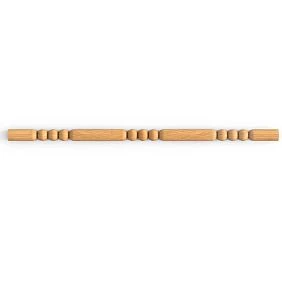
KZ‑016 indeed maintains the same square cross-section of 54×54 mm in MDF, beech, and oak, but the purchase length and finishing logic differ. MDF is produced in 2600 mm lengths and is designed for covering enamel; beech and oak are 2400 mm in solid wood. Therefore, changing the material for the sake of the deadline may preserve the facade geometry, but it can change the number of strips, straight joints, leftovers, packaging, finish, cost, and the actual readiness date.
The main question of the article is not "which material is more beautiful." It is this: will the original KZ-016 version make it into the real installation slot in time, and if not, is it cheaper to shift the installation or reassemble the specification for a different material? The answer is accepted only after a confirmed lead time, not based on the label "in catalog" or an old article.
If the profile and cross-section are already selected, the correct starting point is buy a wooden cornice KZ-016 after checking the specific version on the day of the order. Next, you need to break down the ten days into real stages: production or reservation, shipment, delivery, acceptance, finishing, and installation.
Wooden cornice KZ-016 54×54 mm: what is preserved and what changes when changing the material
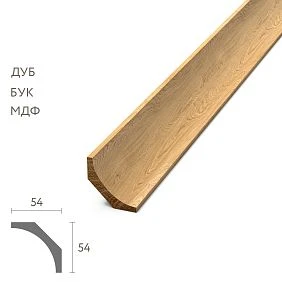
A strong feature of KZ-016 is the stable cross-section. In all three base materials, the profile remains 54×54 mm. Therefore, the ceiling line and occupied space can be preserved without reworking the architectural section.
| Execution | Size | Main finishing logic | What changes when replacing |
|---|---|---|---|
| MDF | 54×54×2600 mm | For enamel | length, base, joint map |
| Beech | 54×54×2400 mm | array, finish to coordinate | length, wood, finish, price |
| Oak | 54×54×2400 mm | array, finish to coordinate | length, wood, finish, price |
That is, the design cross-section is preserved, but the trade item is not. This is why replacing the execution can be architecturally faster than choosing a different KZ profile, but it still requires a full procurement check.




KZ‑016 from MDF 54×54×2600 mm
This is a natural option for white or colored opaque enamel. The 2600 mm length is useful in areas of 2401–2600 mm: there MDF can cover the wall in one piece, while 2400 mm solid wood will require a direct joint.
Our factory also produces:

Beech KZ‑016 54×54×2400 mm
Beech allows preserving solid wood with the same cross-section. But if the original project was designed for enamel on MDF, switching to beech should be evaluated not only by lead time. The base, length, finish, and budget change.
Get Consultation
Oak KZ‑016 54×54×2400 mm
Oak is especially justified when visible texture is needed for the project. If the entire line will be covered with dense white enamel, buying oak solely for a more convenient delivery date may be an expensive way to solve a logistics problem.
KZ-016 delivery time: what to check specifically on the day the order is placed
Availability status cannot be carried over from yesterday's screenshot, an old article, or a manager's memory. For a strict ten-day schedule, a specific answer must be obtained for a specific configuration.
We check sequentially:
- SKU KZ-016;
- the material;
- length 2600 or 2400 mm;
- required quantity;
- current status "in stock / made to order";
- if made to order — confirmed production lead time;
- possible shipping date;
- delivery date and method;
- time for receiving and finishing;
- actual installation date.
Why "in stock" does not yet mean "will make it to the site"
The product may be in another warehouse, require packaging, moving, or delivery. Additionally, the cornice may need finishing before installation. Therefore, the calendar needs not the purchase date, but the date when the installer can actually work with the received and prepared batch.
Why "made to order 5–10 days" cannot automatically be considered suitable for delivery in 10 days
If production takes up the entire available interval, there is no time left for delivery, acceptance, painting, and installation. Any production range is compared with the installation date, not with the final delivery date.
Ten days until delivery: we build the calendar backward from installation, not forward from the order
Suppose the object needs to be delivered on the tenth day. The cornice must be installed, touched up, and accepted earlier. First, we determine the last safe installation date, then count backward.
| Stage | What should happen | Risk when shifting |
|---|---|---|
| delivery day | interior ready | rework is no longer acceptable |
| before delivery | installation KZ-016 completed and accepted | no time to fix the joints |
| earlier | finish/paint dried according to technology | cannot be installed while wet |
| even earlier | batch accepted, recounted and checked | defect will be detected too late |
| before this | delivery to site/workshop | logistics delay eats into buffer |
| start of chain | order reserved or confirmed for production | no guarantee of date |
The article does not assign a universal "need plus three days." In one project, the cornice is painted on site, in another—in the workshop; one delivery takes hours, another—several days. The point of the calendar is to fill in the real stages of your order.
KZ-016 from MDF under enamel: when it is more reasonable to wait for the original specification
Urgency itself does not make an alternative material correct. If the original KZ-016 from MDF still fits within the working window with a reasonable buffer, keeping the specification is often safer.
Waiting for MDF is logical if:
- all ceiling molding is calculated for covering enamel;
- length 2600 mm is already used in the cutting map;
- on view walls, the specific position of joints is important;
- natural wood is not needed;
- adjacent moldings and cornices are also MDF;
- the confirmed lead time leaves time for delivery, acceptance, painting, and installation.
If these conditions are met, switching to solid wood just because it "can arrive faster" creates more changes than real benefit.
For related painted trim, you can separately buy MDF moldings and check whether the entire upper trim depends on a single material system.
Beech KZ-016 54×54×2400 mm: when solid wood can be considered as an urgent alternative
Beech does indeed allow maintaining the 54×54 mm cross-section, so the architectural geometry of the room does not require a new cornice model. But this is not "the same KZ‑016, only faster": the base, standard length, and finishing technology change.
Switching to beech can be considered if the following conditions are met simultaneously:
- the current beech production timeline is actually shorter and confirmed by the manager;
- the project allows for an array instead of MDF;
- the 2400 mm length has been recalculated for all walls;
- new straight joints do not fall on main view axes;
- the beech finish has been approved;
- the total cost is acceptable;
- the switch truly wins the schedule after accounting for finishing and delivery.
If beech still needs to be tinted, dried, and approved for a long time, its warehouse availability may not provide a real advantage for the installation date.
Oak KZ-016 54×54×2400 mm: when urgent replacement of MDF with oak is economically pointless
If the design requires visible oak texture, oak is an independent material, and its delivery time is indeed important. But when the original project is white dense enamel, oak does not provide the visual advantage for which this species is usually chosen.
The transition from MDF to oak solely for the sake of the schedule should be stopped and recalculated if:
- the oak will be completely covered with opaque enamel;
- its finishing requires a new technological cycle;
- the length of 2400 mm adds extra joints;
- the overall budget increases noticeably;
- part of the already ordered trim remains MDF;
- the time is saved only on paper, not until readiness for installation.
If the interior is built on natural oak, oak KZ-016 54×54×2400 mm may be correct even with more complex logistics. In such a case, it is better to shift the installation than to replace the material and destroy the material concept.
KZ-016 2600 mm vs 2400 mm: lead time triggers mandatory re-calculation of cutting layout
The transition between materials changes the standard length by 200 mm. On one short wall, this seems like a trifle, but across the full perimeter, it can add an entire plank and several straight joints.
Let's take a hypothetical project with four sections:
| Section | Length |
|---|---|
| A | 5200 мм |
| B | 2600 мм |
| C | 2500 мм |
| D | 1800 мм |
total net length:
5200 + 2600 + 2500 + 1800 = 12,100 mm.
Original MDF 2600 mm
One simple cutting layout:
- A = 2600 + 2600;
- B = 2600;
- C = 2500;
- D = 1800.
Five full planks of 2600 mm are needed. Wall A has one straight joint; the other three sections are solid. Purchase length:
5 × 2600 = 13,000 mm.
Nominal remainder is 900 mm.
After an urgent switch to oak or walnut 2400 mm
The same walls can be assembled, for example, like this:
- A = 2400 + 2400 + 400;
- B = 2200 + 400;
- C = 2100 + 400;
- D = 1800.
Six purchase strips are enough. Three extensions of 400 mm can be obtained from leftovers, but the installation picture changes: on A there are already two straight joints, on B — one, on C — one. Four in total instead of one for MDF.
This results in a very telling trade-off: the material may arrive faster, but the order increases from five to six whole strips, and the number of straight joints — from one to four. If such joints fall on feature walls, a few saved calendar days may cost a worse outcome.
Why you cannot copy quantities from the old estimate
If the original list stated "5 pcs.", this is not a characteristic of article KZ‑016. It is the result of a specific length of 2600 mm and a specific cutting layout. After switching to 2400 mm, five strips give only 12,000 mm, which is already less than the net requirement of 12,100 mm — even before corner allowances.
Order KZ-016 urgently: first, check whether the new joint will become the main problem
In a time conflict, it is convenient to view each wall not only as millimeters, but also as a feature surface.
For each straight wall, three questions are asked:
- Will it become composite after the transition from 2600→2400 mm?
- Where will the straight joint be located?
- Can it be shifted without buying another plank?
Section 2500 mm
MDF 2600 covers it with one piece. Solid wood 2400 — no longer. So, switching to beech/oak for the sake of the warranty guarantee creates a direct joint exactly on this wall, if the section's layout doesn't change.
Section 5200 mm
MDF gives a nice multiple of 2600+2600. Solid wood requires 2400+2400+400 or another three-part cut. In the central living room, this may be sufficient reason not to change the material.
Section 4800 mm
Here it's the opposite:
2400 + 2400 = 4800 mm.
Solid wood doesn't lose in the number of joints. So, the consequences of changing the material are determined not by the general phrase "2400 is shorter," but by the specific geometry of the object.
Corner cuts and urgent cutting: the mathematical minimum may turn out to be too tight
Even if the total length fits exactly into N planks, the cornice still needs to be end-cut and mitered at corners. Time pressure often leads to ordering "exactly by the math" without a technological allowance.
Need to check:
- internal and external corners;
- actual room geometry;
- test cut;
- finished ends;
- visible straight joints;
- suitability of remnants for the next section.
If when transitioning to 2400 mm the new layout is already tight, the sixth or seventh reserve plank may be needed not because of a "reserve percentage," but because of a specific complex corner. Such a reserve is much more justified than automatic 10–15%.
The term "5–10 days" and delivery in 10 days: why the upper production limit does not equal the readiness date
If the manufacturer gives a production range for a missing item, the buyer needs to add all stages after production. It is useful to calculate not "ordered today — hand over the site in ten days," but "on which day the material must be physically received and ready for finishing."
Let's consider a conditional calendar example. This is not a STAVROS standard, but a way to check your own schedule:
- 10 days before site handover;
- The cornice must be fully installed 2 days before the handover;
- The workshop allocates another 2 days for acceptance, preparation, and finishing;
- Delivery takes 1 day along the confirmed route.
Then the batch must be ready for shipment no later than:
10 − 2 − 2 − 1 = the 5th day from the current moment.
If the confirmed production of the selected configuration takes up to 10 days, the schedule no longer works. If the manager confirms a ready batch or an earlier date, the source material may still make it in time.
Why you cannot take these "2+2+1" as a universal formula
On your site, delivery may be same-day, painting may take longer, and the cornice may be installed before other work. The table should be filled with actual data. The main principle is to count backward from the last safe installation day.
Installation deadline and handover deadline are different dates
If the object is handed over to the client on Friday, do not plan delivery of KZ‑016 for Friday morning. After delivery, risks remain:
- quantity error;
- transport damage;
- material mismatch;
- unsuccessful trial angle;
- need for additional sanding or finishing;
- correction of a direct joint;
- need for an additional strip.
Therefore, the time reserve is not "extra days for peace of mind," but time for specific control operations.
KZ-016 to order: what not to do before confirming the actual date
Until receiving a confirmed production and shipping date, it is dangerous to:
- assign installers exclusively for KZ-016;
- promise the customer an exact readiness date for the ceiling molding;
- cancel the original material and order another one based only on a phone assumption;
- launch a new 2400 mm cutting plan before confirming the alternative material;
- call a painter for a specific day;
- block access to areas where the cornice still needs to be installed;
- reschedule other work if the delivery is not yet confirmed.
What answer is needed instead of "should make it in time"
Specific control points are needed: selected configuration, quantity, confirmed status, estimated/guaranteed readiness date per seller's terms, shipping date, and delivery. If the seller can only provide a range, the schedule uses a conservative scenario, not the best possible day.
When it is reasonable to urgently change the KZ-016 specification
The material can be replaced without changing the profile if the same 54×54 mm cross-section truly allows preserving the architectural line and the new delivery saves time after all recalculations.
The transition is justified when simultaneously:
- the new version is confirmed in terms of timeline and quantity;
- 54×54 mm preserves the required geometry;
- 2400/2600 mm have been recalculated;
- joint locations have been approved by the designer;
- the new material matches the finishing concept;
- the finish can be executed within the available time;
- price and packaging have been accepted;
- the transition does not disrupt adjacent trim pieces;
- The calendar win is greater than the time needed for the project change.
Example of a rational urgent replacement
The original white cornice was supposed to be MDF, but the project allows for enameled beech; the new 2400-millimeter board does not add joints on visible walls, the required quantity of beech is confirmed for immediate shipment, and the painting system for solid wood is already approved. In this scenario, changing the material can be a real way to keep the date.
When it is better to keep the original KZ-016 and postpone the installation
Sometimes a few days of delay are cheaper and safer than changing the entire material system.
Keeping the original position is reasonable if:
- oak with a clear/tinted finish is specifically required;
- the rest of the ceiling trim has already been purchased from the same wood species;
- switching to 2400 or 2600 mm significantly worsens the joints;
- the new material will require re-approval of the color;
- alternative execution is significantly more expensive;
- shifting the installation does not affect the critical path of other works;
- the client prefers to keep the project rather than the date at any cost.
This scenario is important: a commercial article should not push the buyer toward a more expensive material just because of urgency.
Buying a wooden cornice: when it is better to change the model rather than the material KZ-016
If the required KZ‑016 does not fit the schedule, and the alternative material is unacceptable, a plan B is possible — another cornice model. But this is already an architectural change, so it is applied only if the project still allows it.
For such a choice, it is better to open the category and buy a wooden cornice after comparing available profiles, rather than picking a replacement from the first "in stock" item.
When changing the model, the following are re-checked:
- cross-section;
- the occupied strip of wall and ceiling;
- built-in furniture;
- door portals;
- backlighting;
- corners;
- length;
- Cutting;
- finishing.
That is, changing the model usually requires more design work than changing the material within KZ‑016.
KZ-015 or KZ-016: we do not re-compare model geometry
If the deadline forces consideration of another model, the full choice between the deep KZ‑015 and the square KZ‑016 has already been analyzed separately. Use the material KZ-015 or KZ-016, and then return to the deadline specification of the selected product.
This article intentionally does not repeat the dimensions of KZ‑015, the scale comparison, and the general profile selection. Here, KZ‑016 has already passed the designer's selection.
How to choose a wooden cornice if the deadline has become more important than the original specification
If the project still allows a model change, it is useful to first restore the criteria by which KZ‑016 was chosen: compact square cross-section, room scale, adjacent trims, furniture, and light. The general article how to choose a wooden cornice helps not to replace KZ-016 with a random profile just based on availability.
Materials and quality of KZ-016: identical 54×54 mm do not make MDF, beech, and oak interchangeable in terms of finish
A deadline conflict often looks technical: "the cross-section is the same — we'll replace the base." But after installation, the user sees not the cross-section, but the finished surface. Therefore, before an urgent replacement, the finish technology needs to be checked.
Section STAVROS materials and quality useful for coordinating sanding, preparation for enamel or transparent/translucent finish. This is especially important if the new batch should visually continue the already installed trim.
Original MDF for enamel
A project designed for an opaque color is usually easier to keep in MDF if time allows. When switching to solid wood, you need to ensure that the painting system works on the new base and has time to dry before installation.
Beech for opaque finish
May be an acceptable replacement, but the base remains natural wood. The same color after painting does not negate the differences in material and preparation.
Oak with visible texture
This is no longer a "replacement for the sake of time," but a noticeable design change if the original was white MDF. It needs to be approved on a sample and in the overall interior.
Wooden trim products of one room: you cannot replace only KZ-016 and forget about neighboring profiles
If in room KZ-016 it is connected with platbands, wall moldings, and baseboards, an urgent change of material of one element can disrupt the unified system. It is useful to check the entire section wooden trim items and understand which items are already ordered, which can still be changed, and which must match in finish.
For example, if KZ-016 becomes oak, and adjacent moldings remain MDF under enamel, this is not an error in itself. The error is if the designer learns about such a mix after installation.
KZ-016 price: we compare not the cost of one strip, but the price of the solution deadline
The public STAVROS catalog at the time of checking shows KZ-016 "from 1,620 RUB", but the actual price depends on the selected configuration. The current KZ-016 price must be checked immediately before issuing the invoice.
For urgent procurement, they compare not only the price of the product:
| Line | Wait for the original configuration | Urgently change the material |
|---|---|---|
| KZ‑016 | original price | new price |
| Quantity | by old length | after recalculation 2400/2600 |
| Joints | original map | new map |
| Finishing | Approved system | new technology possible |
| Packaging | by original batch | recalculate |
| Delivery | by confirmed deadline | by alternative |
| simple installation | possible in case of delay | May be reduced |
| project rework | Not needed | Possible |
Why a more expensive material is sometimes still more profitable
If a confirmed delay of the original batch stops several crews, and the alternative material is already approved and does not change visible joints, the economic effect of an urgent replacement can be positive. But the cost of downtime must be calculated for the actual site, not by inventing a universal figure.
Why cheap material can turn out to be an expensive solution
If for the sake of a cheaper KZ-016 you have to add a strip, change the finish, postpone installation, and redo the joints, the final budget may exceed the original one.
Payment and delivery of a wooden cornice: the deadline must be calculated until the actual acceptance of the batch
After confirming the material and quantity, you need to check separately payment and delivery of a wooden corniceFor the ten-day schedule, the following are especially important:
- shipping city;
- delivery method;
- readiness of the batch for delivery;
- packaging of long-length material;
- time for lifting and carrying in;
- who receives the goods;
- where it is stored until finishing.
Why delivery cannot be scheduled for the morning of installation
The batch must be unpacked, checked, and matched against the list. If one plank is damaged, a solution must be found before the installers arrive.
Receiving urgent batch KZ-016: what to check before the installers are already waiting
Urgency does not cancel incoming inspection. On the contrary, when the material is changed, the probability of error is higher because the project and order were changed at the last moment.
Checked:
- SKU KZ-016;
- section 54×54 mm;
- the material;
- length of each strip;
- quantity;
- compliance with the finishing task;
- straightness and integrity;
- transport damage;
- batch marking;
- match with the new cutting list.
If instead of MDF, solid wood of the correct section arrived
An order cannot be considered correct just because 54×54 matches. Material and length are part of the specification.
If one strip is damaged
First, check the cutting plan: can the defect go into the planned offcut. If the strip is needed entirely at 2400/2600 mm, the damage is more critical.
Is a reserve plank needed on a strict ten-day schedule?
Reserve is especially tempting under time pressure: "let's take one more so we don't have to wait." Sometimes it's reasonable, sometimes it's an unnecessary purchase.
An additional plank is justified if:
- there is no suitable long leftover;
- there are complex external corners;
- repeat delivery definitely doesn't fit the schedule;
- The long species-specific part is used almost entirely;
- it's important to keep natural material from the same batch;
- losing one plank will halt the entire installation.
If the layout already leaves a large leftover that can replace a critical part, a separate strip may not be needed. Reserve is calculated based on risk, not on a "just in case" percentage.
If the material is changed two to three days before installation: the project must receive a new revision
The most dangerous situation is when a supplier has already ordered the alternative KZ‑016, but the installer continues working with the old 2600 mm list. Therefore, any material change must create a new version of the document.
It records:
- new material;
- new length;
- new quantity;
- new joint locations;
- remainders;
- finish;
- the date and status of the order.
It is better to keep the old version in the archive, but clearly mark it as outdated. This is easier than figuring out on site why the installer is trying to get two parts of 2600 mm from oak rods of 2400 mm.
Three real scenarios with a deadline of 10 days
Scenario A. The original KZ-016 is ready with a margin
The manager confirms the required version and quantity, and the readiness date leaves time for delivery, acceptance, finishing, and installation. In this case, there is no reason to change the material. The original map, finish, and agreements with the designer are preserved.
If the original version is KZ-016 made of MDF 54×54×2600 mmUrgency itself does not make beech or oak preferable.
Scenario B. The original material does not arrive in time, the alternative is ready and compatible
Then the new specification is built the same day. No later. The 2400/2600 mm dimensions, cost, finish, and joints are checked. If everything is accepted, the order is fixed as a new revision, and the installers receive an updated map.
Scenario C. The alternative material arrives in time but breaks the project
For example, oak is available faster, but the original interior is white MDF, a new joint will appear on the 2500 mm wall, the cost increases, and the painter must re-approve the system. Here, the right solution may be to shift the installation, not to 'save the date' at any cost.
Urgent replacement matrix: what must be green before changing the material
| Check | Original specification | Alternative | Solution |
|---|---|---|---|
| cross-section 54×54 | Yes | Yes | geometry is preserved |
| readiness date | Confirm | Confirm | compare before installation |
| Length | 2600/2400 | another | recalculate |
| Joints | approved | new | Approve |
| Finish | Approved | may change | Approve |
| Price | current | current | compare full budget |
| Delivery | Confirmed | Confirmed | compare acceptance date |
| installation reserve | yes/no | yes/no | do not choose an option without reserve |
If at least one critical line in the alternative still says "clarify later", it is too early to change the material.
When the current status "in stock" cannot be considered a sufficient basis for an urgent order
Even if the product card shows the item as available, you need to verify that:
- the required configuration is actually available;
- the quantity is sufficient for the entire project;
- the batch can be reserved;
- the actual shipping date is suitable;
- delivery to the required city is feasible;
- there is time left for finishing after delivery;
- the material substitution has been formally approved.
The word "in stock" answers only one question. The project needs an answer for the entire chain up to installation.
If the required quantity is unavailable, partial procurement of KZ-016 may be worse than waiting for the full batch
Suppose an object needs six oak planks, but only four are confirmed for fast shipment. There is a temptation to take four now and order the remaining two later.
This option requires verification:
- whether the second delivery will come from a comparable batch of wood;
- whether the two late planks will end up on the same feature wall;
- whether separate delivery will take more time;
- whether the first part can be installed without blocking the joints;
- whether the overall finish will become more complicated.
When partial delivery is acceptable
If the rooms are independent, the first batch fully covers one room, and the second covers another. Then the delivery boundary aligns with the architectural boundary.
When is it better to wait for the entire batch
If six slats are to be assembled in one open space, and especially if it's natural oak with visible texture.
Urgent replacement of MDF with beech: how not to lose a day on re-approving the color
If the project is a covering one, the potential gain in delivery may be eaten up by a new paint sample. To avoid this, even before the critical day, it's useful to have a pre-approved Plan B: a beech sample under the same or compatible enamel system, if such an alternative is at all allowed by the project.
This doesn't mean you need to buy spare material in advance. It's enough to know in advance which finishes the designer is willing to accept and what check needs to be performed if the main option is delayed.
Plan B before the problem arises: how to prepare an urgent project in advance
For projects with a strict completion date, it's reasonable to fix the following before ordering:
- main finish KZ-016;
- acceptable alternative within the same article;
- unacceptable alternative;
- the deadline after which plan B is activated;
- who makes the decision — the designer, the client, the foreman;
- what the estimator recalculates;
- what document the installer receives.
Then, in case of a delay, no two days are wasted arguing over "can we use birch instead of MDF."
If the installation of KZ-016 blocks only one room: it is not necessary to change the material of the entire object
In a multi-room project, the deadline may be critical only for the living room, hallway, or the room that is handed over to the client first. Then the question "wait or change the material" is better resolved by zones rather than for the entire object.
Room 1 is ready, rooms 2–4 are still in progress
If the confirmed batch fully covers the first room, it can be closed without splitting the material within a single space. The remaining volume later receives the original finish according to the general specification.
Materials must not be mixed randomly within a continuous perimeter
Making one wall from MDF, a second from beech, and a third from oak just because these planks were available on different days is a poor way to speed up installation. Even under a single enamel, the substrates and cuts differ. It is better to align material boundaries with the architectural boundaries of the room.
Individual rooms may have different timelines
If doors block visual connection, it is acceptable to finish the first room with an alternative material and the second with the original one, if approved by the designer. Then the urgent decision does not multiply across the entire project.
Partial installation before receiving the full batch: when it helps and when it creates a second downtime
Sometimes the contractor suggests starting with the walls for which material is already available and waiting for the rest. This only works if the unfinished area does not interfere with subsequent operations.
Before partial installation, check:
- whether corners can be finished without the missing plank;
- whether an already installed part will have to be removed for the next joint;
- whether the painter can finish the surface in stages without visible difference;
- whether scaffolding or furniture blocks the unfinished cornice;
- Is it possible to accept part of the work separately.
When partial installation is useful
For example, two rooms are fully supplied with material, the third is waiting for a separate delivery. The crew closes two completed areas and frees them for subsequent work.
When it is useless
If one long room requires six planks, but only five are available, installing five may leave an uncovered corner and prevent finishing paint joints. Then the crew will still return a second time, and the site incurs double organizational costs.
Finishing may be more critical than production: not only the readiness date of KZ-016 needs to be checked
Let's imagine that an alternative beech KZ-016 54×54×2400 mm is ready for quick shipment. If the original MDF was supposed to receive white enamel, and for beech the workshop requires an additional technological test and a different preparation cycle, the calendar gain from the warehouse is reduced.
Before changing the material, the painter must answer:
- Can the approved system be used;
- Is new primer needed;
- Is a separate test coat needed;
- When will the coating be ready for installation;
- How will corner and straight cuts be processed;
- Will the new material visually match already finished parts.
If there is no answer to these questions, the "quick" beech batch is not yet a quick finished cornice.
Control measurement before an urgent order: you cannot save a day on geometry
Under time pressure, you want to take the footage from the old estimate. But if plaster, built-in furniture, or door portals have already changed the finished dimensions, an urgent order based on rough geometry creates a deficit that cannot be quickly fixed.
Before invoicing, you need to re-confirm:
- each straight section;
- niches and protrusions;
- places where the cornice breaks;
- internal and external corners;
- built-in wardrobes up to the ceiling;
- areas where the cornice is completely omitted.
Why an extra 100 mm can raise the bar
If the layout is calculated with almost no leftover, a slight increase in one wall can make a previously usable remainder too short. At 2600 mm, it's one package of parts; when switching to 2400, it's another. Therefore, control measurements and material selection must happen before the final quantity.
What to do if, after ordering, the completion date suddenly becomes even earlier
Don't automatically change the material a second time. First, find out the status of the already placed order:
- is the item reserved;
- has production started;
- can the execution be changed or cancelled under the order terms;
- what is the current shipping date;
- can logistics be expedited without changing the material;
- can part of the installation work be postponed.
Repeatedly switching from MDF to beech to oak within a few days creates more project risk than the benefit from each individual decision.
Urgent delivery and agreements with the customer: not only the product but also the consequences of replacement need to be documented
If the material is changed for the sake of a date, the customer or designer
How to check the critical path in five minutes
Take the work schedule and for each operation after the planned date of KZ-016 ask the question: "can it physically not start without the cornice, or was it just placed in the calendar that way?" If the task can be done in parallel, it does not need to be automatically postponed.
When a simple painter's downtime is truly real
If KZ-016 is installed before final painting and the painter must close joints/transitions with one system, the absence of the cornice blocks the finish. Then the cost of waiting can be compared with the price of an alternative material.
When downtime can be eliminated by rearranging work
If doors, furniture, or electrical work are not yet finished in another room, the crew can sometimes be temporarily moved there, preserving the original KZ-016. Such a rearrangement may be cheaper than an urgent material change and re-approval of cutting.
That is why the decision "wait or change the execution" should be based not only on the product card, but also on the actual sequence of work at the site.
Typical mistakes when ordering KZ-016 for a fixed renovation date
Mistake 1. Reading "made to order" as a promise to make it in time for handover
Production time is only part of the calendar. After it, delivery, acceptance, finishing, and installation remain.
Mistake 2. Changing the material only because the cross-section is the same
54×54 mm is preserved, but length, finish, cost, and joints change.
Error 3. Copying the quantity 2600 mm by 2400 mm
In our example, five MDF panels are not physically replaced by five solid wood slats: the total length is already insufficient.
Error 4. Scheduling delivery on installation day
There is no time for inspection and replacement of a damaged part.
Error 5. Not reserving the entire volume
A single missing slat can halt a feature wall.
Error 6. Choosing oak under white enamel only for durability
The buyer pays for an expensive base without using its texture.
Error 7. Not recalculating straight joints
On a 2500 mm wall, MDF was solid, but solid wood becomes segmented.
Error 8. Ignore corner allowances
The mathematical minimum may not withstand real trimming.
Error 9. Do not update the project revision
The installer receives an old map of 2600 mm.
Error 10. Consider old stock as current
Warehouse status changes. Verification is needed on the day of the quote.
Error 11. Compare only the price of one plank
Need to account for quantity, finish, delivery, joints, and downtime.
Error 12. Do not approve the new finish
The material arrived in time, but the color and surface were not accepted by the designer.
Error 13. Replacing KZ-016 with another model without checking geometry
The deadline is saved, but the ceiling architecture becomes different.
Error 14. Ordering additional reserve without a map
You can buy an extra long plank when there is already a suitable leftover.
Error 15. Promising the client a date before shipment confirmation
The external deadline turns into a promise that production has not yet confirmed.
When KZ-016 does not need to be ordered urgently at all
Sometimes the best way not to miss the handover is to abandon the urgent purchase altogether and move the ceiling cornice to a separate stage. This is not always possible, but the scenario should be considered before an expensive material replacement.
It is reasonable not to rush the KZ-016 order if:
- the cornice does not block the start of engineering systems and furniture;
- it can be installed later without damaging the finished finish;
- the customer agrees to accept the premises with a separate act for the subsequent decorative stage;
- changing the material worsens the interior more than the temporary absence of a cornice;
- the needed natural batch is more important than the current date.
But if the walls and ceiling must be finally painted after the installation of KZ-016, postponing it may mean calling painters again and restoring the junctions. Then such an option should be evaluated according to the actual technology of the facility.
Transferring an urgent order to production and installation: one sheet instead of correspondence
After choosing the configuration, it is useful to make a short "urgent order passport". It does not replace the contract or invoice, but collects data that is most often lost between supply and installation.
| Field | Example of filling |
|---|---|
| revision | REV‑02 |
| Article number | KZ‑016 |
| Material | selected configuration |
| Size | 54×54×2600 or 54×54×2400 mm |
| Quantity | N pcs. |
| map | A1/A2/B1… |
| Joints | applied to facades |
| Finish | Approved system |
| Ready date | upon seller's confirmation |
| Delivery | date/route |
| Acceptance | Responsible person |
| Installation | date after acceptance |
If the material changes, the old sheet is kept in the archive, and the new one gets a different revision number. The installer should not have to go through a long chain of messages and guess which length of KZ-016 is current today.
The last test before payment: the alternative must win exactly the date of the completed installation
Before the final "we change the material," it is useful to finish one phrase:
"If we take the alternative execution, the fully installation-ready KZ-016 will be at our site ___ days earlier."
If there is no exact or at least confirmed range, the decision is still based on a sense of urgency. This date must include not only warehouse and production, but also delivery, acceptance, and necessary finishing.
Such a test filters out false replacements: the material seems to be "available now," but repainting and recalculation take as long as waiting for the original item.
Decision tree: wait for the original KZ-016, change the material, or change the profile
| Control question | If yes | If no |
|---|---|---|
| Is the original execution confirmed by a date that leaves time for delivery, acceptance, finishing, and installation? | keep the original specification | check plan B |
| Does another KZ-016 material preserve the design? | recalculate 2400/2600 mm | do not change the material |
| Is the new joint map accepted? | check cost and time | stop replacement |
| Is the finish of the alternative material already approved? | check logistics | allocate time for a sample or decline |
| Is the required quantity of the alternative confirmed? | reserve the entire batch | do not promise a date |
| Does the alternative KZ-016 really win the schedule? | process a new revision | shift the assembly of the source material |
| Does no KZ‑016 material fit the deadline? | consider another profile as plan B | stay in KZ‑016 |
What to send to the manager for an urgent KZ-016 calculation
An urgent request must be specific. The fewer clarifications the manager has to gather after the first message, the sooner a real date appears.
| Field | What to specify |
|---|---|
| Article number | KZ‑016 |
| Cross-section | 54×54 mm |
| Source material | MDF / beech / oak |
| acceptable alternative | if approved |
| Length | 2600 / 2400 mm |
| Quantity | according to the current map |
| Finish | enamel / approved finish |
| delivery city | exact city/object |
| latest acceptance date | earlier than installation day |
| installation date | actual |
| Question | confirm availability/production, shipping date and delivery |
After confirmation, you can order KZ-016 54×54 mm already per the fixed version, not per verbal agreement "if MDF is not available, put beech"
Checklist 10 days before delivery
- KZ-016 remains the finally selected model;
- source material is fixed;
- acceptable alternative is predefined or prohibited;
- 54×54 mm are applied to the working drawings;
- length 2600/2400 mm corresponds to the material;
- quantity is calculated after material selection;
- straight joints are applied to the facades;
- complex corners are marked;
- finish is confirmed;
- current product status is checked on the order day;
- production time confirmed;
- shipping date confirmed;
- delivery calculated up to actual acceptance;
- time available for incoming inspection;
- time available for finishing;
- installation scheduled after these stages, not before them;
- reserve strip added only when there is a specific risk;
- all participants work to the same revision of the specification.
FAQ about KZ-016, availability, and urgent order
What is the size of KZ-016?
The 54×54 mm cross-section is maintained for MDF, beech, and oak.
What is the length of KZ-016 made of MDF?
2600 mm.
What is the length of the beech KZ-016?
2400 mm.
What is the length of the oak KZ-016?
2400 mm.
Can MDF be replaced with beech without changing the cross-section?
In terms of geometry, 54×54 mm — yes, but for the order, the length, quantity, joints, finishing, price, and lead time need to be recalculated.
Can MDF be replaced with oak without changing the drawing?
The architectural cross-section is preserved, but the cutting and finish change. Therefore, at minimum, the procurement and finishing documentation is updated.
What does "made to order" mean?
This means that the specific configuration needs to be produced or prepared for delivery by a confirmed deadline. This is not synonymous with "it will arrive by your completion date."
Can we rely on leftovers from the old article?
No. The stock status is checked in the product card and with the manager on the day of the order.
If the website says "in stock," can we schedule installation?
Only after confirming the required quantity, reservation, shipping date, and actual delivery.
Which is faster — MDF, beech, or oak?
There is no universal answer: the current status of different versions changes. The specific item and quantity are checked at the time of order.
Do we need to recalculate the quantity when switching from 2600 to 2400 mm?
Yes. Even with the same total linear footage, the number of planks and straight joints may change.
Why is it important to check a 2500 mm wall separately?
MDF 2600 mm covers it with a single piece, while solid wood 2400 mm requires at least two installation fragments.
Can we order part of the oak batch now and part later?
Only after assessing batch composition, wall distribution, and timelines. For a single model room, a full joint delivery is usually simpler.
When is it wiser to wait for the original material?
When an alternative material changes the finish, adds noticeable seams, significantly increases the budget, or disrupts the overall material concept.
When is it reasonable to urgently switch materials?
When the alternative option is confirmed for availability/lead time, fits the design, has been recalculated by length, and truly provides a benefit before the installation date.
Do we need to change KZ-016 to another model if the required material is unavailable?
Not necessarily. First, another version of the same KZ-016 is checked. A different profile is plan B because it changes the architectural geometry.
Where can I see the current price of KZ-016?
In the product card, right before the invoice. The public catalog currently shows the model from 1,620 RUB, but the specific price depends on the version.
Do we need to allocate a fixed time buffer, for example, three days?
There is no universal number. The buffer depends on production, city, delivery, finishing, acceptance, and installation technology.
Should an additional strip be taken for urgent orders?
Only if the map shows that the loss of one critical part is not covered by existing stock and a repeat delivery won't arrive in time.
How to check angles when time is short?
Actual angles are still measured before final cutting. Urgency doesn't make all angles exactly 90° and doesn't cancel a test cut.
What information should be given to the manager for a quick response?
Item number, material, size, quantity, delivery city, latest acceptance deadline, and an acceptable alternative if it's already agreed upon.
Before the final invoice, it's useful to compare the new specification with the original line by line. If the material has changed, but the list still shows old lengths of 2600 mm, old quantities, or previous joint points, the project is formally not updated. The same applies to the deadline: the date "needed on site by Friday" must be separated from the confirmed readiness date, shipment date, and actual acceptance date. Only when these four points are agreed upon between procurement, the designer, and the site supervisor can the order be considered manageable by deadline, not just urgent.
Final specification KZ-016 under a tight schedule
| Parameter | What is recorded |
|---|---|
| Article number | KZ‑016 |
| Cross-section | 54×54 mm |
| Material | MDF / beech / oak |
| Length | 2600 / 2400 mm |
| Quantity | After the cutting map |
| joint locations | approved |
| Finish | Approved |
| current status | verified on the day of order |
| Production | confirmed deadline |
| Shipping | confirmed date/range |
| Delivery | before the acceptance date |
| Incoming inspection | before finishing and installation |
| Reserve | for a specific risk |
| Installation | after acceptance and preparation |
For an urgent order, it's better to spend time once on a full specification check than to send installers back twice due to incorrect length or material.
Bottom line: identical 54×54 mm simplifies replacement of KZ-016, but does not eliminate the need to recalculate the order
The strong point of KZ‑016 in an urgent project is the stable square cross-section of 54×54 mm. If one version doesn't fit the schedule, another can be considered without changing the cornice scale. But this is only the beginning of the solution.
MDF has a length of 2600 mm, beech and oak — 2400 mm. Therefore, an urgent material change can increase the number of slats and the number of butt joints. In our example, 12,100 mm of MDF is covered by five slats and one butt joint on the long wall, while switching to 2400 mm requires six slats and four butt joints. That is, "getting it faster" does not equal "finishing the object faster and better".
With a ten-day deadline, you need to count backward from the installation date: when the batch must be accepted, how much time is needed for finishing, when delivery is possible, and on which day the material must be ready for shipment. Only after this are the original and alternative versions compared.
If the original KZ-016 fits with a reserve, keep the project. If the alternative material genuinely wins on the schedule and does not worsen the design, recalculate and lock in a new revision. If an urgent replacement ruins the finish, joints, or budget, it is wiser to shift the installation than to save the date at the cost of a weaker result.
Working sequence: KZ-016 selected → material and length fixed → current status checked → schedule built backward from installation → if the deadline does not align, an acceptable alternative is checked → 2400/2600 mm, joints, finish, and price are recalculated → shipment and delivery are confirmed → batch is accepted → only then is installation scheduled.