


































































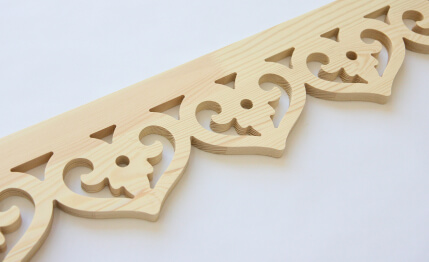
Article Contents:
- Kaliningrad and humidity: what it means for finishing
- Slatted panels: tasks they solve in interior design
- Creating architectural wall texture
- Zoning of open space
- Accentuation without excessive decor
- Functional acoustic improvement
- Which material to choose: an honest breakdown of options
- Solid oak: maximum status, maximum requirements
- Solid ash: lighter and more expressive
- Thermowood: choice for humid areas
- MDF with film coating: stability and price affordability
- MDF for painting: color freedom and modern classic
- WPC: facade, street, terraces
- Polyurethane decor: what exactly is worth considering
- Cornices and skirting boards: essential element of a finished interior
- Moldings: frames that turn a wall into architecture
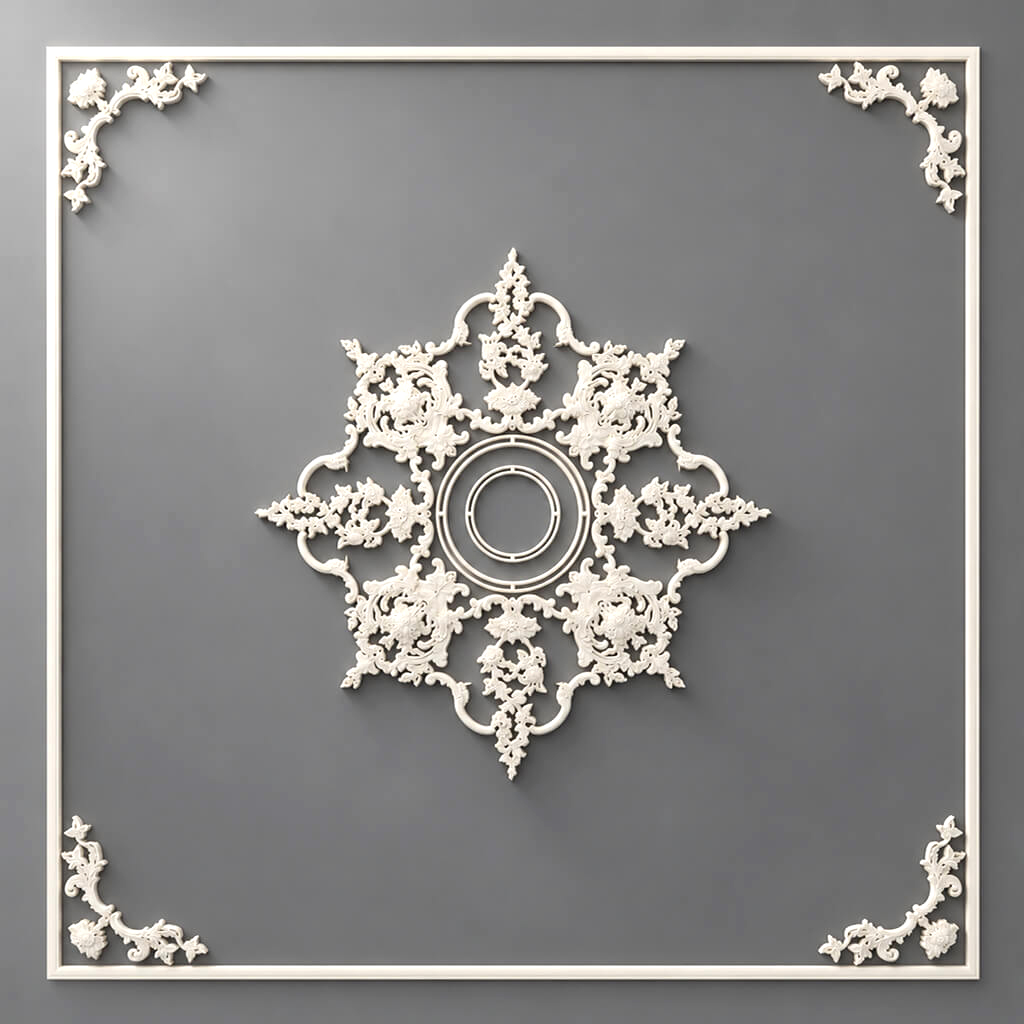
- Rosettes: appropriate accent or unnecessary detail?
- Overlay decorative elements: accent without overload
- How to combine panels, moldings and stucco decor: a system, not a random set
- Rule one: one accent per room
- Rule two: tonal unity
- Rule three: scale correspondence
- Rule four: stylistic consistency
- Room-by-room breakdown: what goes where and why
- Living room: an accent that works
- Bedroom: silence through material
- Entryway and hallway: solving the spatial task
- Kitchen: pragmatism as a priority
- Ceiling: spatial scale
- How to check material before purchase: a practical protocol
- Geometry
- Finish
- Tone
- Smell
- Moisture Content
- Where quality most often suffers: an honest conversation about the market
- First problem: untreated MDF edges
- Second problem: film with poor adhesion
- Third problem: non-standard geometry 'for painting'
- Fourth problem: low-density polyurethane
- Fifth problem: mismatch between declared and actual color
- Slat panel for wall: formats and size range
- Installation of slat panels: key principles without unnecessary words
- Slat panels for the facade of a Kaliningrad house
- STAVROS: A Systematic Approach to Choosing Finishes
- FAQ: Answers to Popular Questions

Kaliningrad is a special city. Not just geographically isolated from the rest of Russia, but also climatically completely different: sea air, high humidity year-round, mild winters without severe frosts but with constant dampness, frequent temperature swings in autumn and spring. This is not an abstract 'Russian climate'—this is the Baltic. And it dictates its own requirements for finishing materials, which behave differently here than in Moscow, Yekaterinburg, or Novosibirsk.
That's precisely why the question of how to buy slatted panels in Kaliningrad and simultaneously wisely choose polyurethane molding for them is not just a question of aesthetics. It's a question of durability. Here, a material that is 'just beautiful' will begin to deform, peel, or lose its shape within three years. But a material chosen wisely will last for decades and look just as convincing as on the day of installation.
This article is for those who undertake renovation or construction in Kaliningrad consciously. For those who want to make an interior visually strong, technically competent, and durable. Here you'll find specific selection criteria, an analysis of typical mistakes, the logic of combining linear and relief decor. And most importantly—an understanding of why Kaliningrad's climate changes everything.


Kaliningrad and Humidity: What It Means for Finishing
The average annual relative humidity in Kaliningrad is about 80%. For comparison: in Moscow this figure is about 70–75%, in Samara—65–70%. The difference seems small, but for finishing materials it is critical.
What happens to wood under constantly high humidity? It absorbs moisture and expands. When humidity drops (when heating is on in winter)—it dries out. This expansion-drying cycle on a poorly protected surface leads to deformations, cracks, and coating delamination. Solid natural wood without proper treatment in a Kaliningrad apartment is a risk that will inevitably materialize.
What does this mean in practice?
-
Panel coating is paramount. Oil with wax or high-quality varnish, completely covering the ends and the back side.
-
Acclimatization before installation is mandatory.Wooden slat panelsThey need to be kept indoors for at least 5–7 days before installation so they can absorb ambient moisture and stabilize.
-
The ventilation gap behind panels when mounted on battens is not just a technical trick, but a necessity for condensate drainage.
-
For bathrooms, kitchens, hallways — only specialized moisture-resistant options: WPC, thermally modified wood, or moisture-resistant MDF with sealed edges.
Polyurethane decor in this regard is a more predictable material. Polyurethane is not afraid of moisture, does not swell, does not dry out.Buy polyurethane moldingFor a Kaliningrad interior — means choosing a material that will perform better in the local climate than plaster, and incomparably better than wood under the same conditions without protective coating.




Slat panels: tasks they solve in interior design
Before moving on to specific selection recommendations, it's important to understand: why do you need a slat panel at all? What problem does it solve? This is not a rhetorical question — the answer determines exactly which material, format, and finish you need.
Our factory also produces:


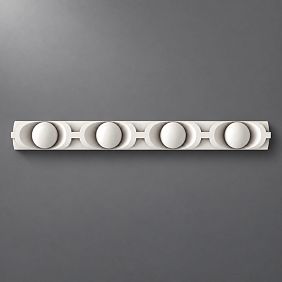


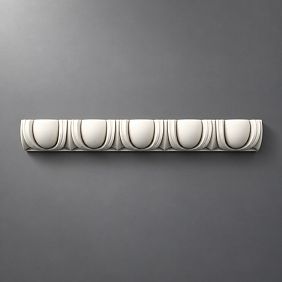

Creating architectural wall texture
A smooth wall is a neutral background. It's good when there are few such walls and they serve as a pause between active elements. But if all surfaces are equally smooth — the interior becomes boring and faceless.Slatted wall panelsThey introduce rhythm and texture into the space — two things that the brain perceives as a 'living' surface. This is architectural texture: not a pattern, not an ornament, but a structured repetition of verticals or horizontals.
The rhythm of slats calms and organizes. That's whySlatted panels in interior designthey work simultaneously as an aesthetic and psychological tool.
Get Consultation
Zoning of open space
Open floor plans in Kaliningrad new builds are not uncommon. A combined kitchen-living room requires visual zoning without physical partitions. A slatted panel on one of the living room walls is immediately 'read' as a separate space—even if there isn't a single wall between the kitchen and living room.
Accentuation without excessive decor
slatted panels for wallscreates an accent through material and texture—a subtler and more durable technique than color highlighting. An accent wall with wooden slats doesn't go out of style after a season, like a painted wall in a trendy shade.
Functional acoustic improvement
Slats with gaps between them and the backing absorb some sound—primarily mid and high frequencies. In a living room with hard surfaces (tile, plaster, glass), a slatted panel noticeably reduces reverberation. For Kaliningrad apartments in monolithic buildings with high ceilings—a tangible bonus.
Which material to choose: an honest breakdown of options
This question is asked most often—and most often answered evasively. Let's try a different approach: specific and without embellishments.
Solid oak: maximum status, maximum requirements
Solid oak is the most noble and durable option. Oak has a dense structure, holds its shape well, and with proper treatment, lasts for decades.Solid oak slat panelsIt features a living texture, warm tone, and unique pattern on each plank. Suitable for the Kaliningrad climate but requires proper coating.
For Kaliningrad: only oil with wax or high-quality varnish with treatment of ends and the back side. Installation on battens with a 10–15 mm ventilation gap. Mandatory acclimatization for 7 days indoors before installation.
Solid ash: lighter and more expressive
Ash is lighter than oak and has a more pronounced 'grainy' texture. In warm tones: amber, honey, light walnut. In modern interiors, especially Scandinavian or eco-style, it's an impeccable solution. Same treatment requirements as for oak.
Thermowood: choice for wet areas
Thermowood is natural wood treated with high temperature (180–230°C) without chemicals. During thermal treatment, wood cells lose their ability to absorb moisture. Result: a material that hardly reacts to humidity changes. For Kaliningrad, it's an ideal choice for wet areas: bathroom, kitchen, balcony, sauna. The characteristic dark chocolate tone adds contrast to a light interior.
MDF with film coating: stability and affordability
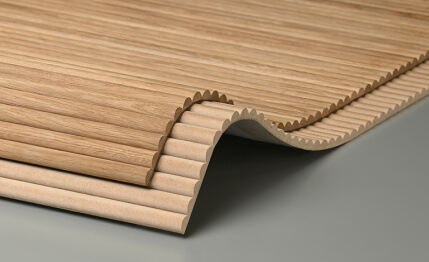
MDF Slatted Wall PanelIt's the optimal choice for most living spaces in Kaliningrad. MDF is significantly more stable than natural wood under humidity fluctuations—the film coating seals the surface, preventing moisture absorption. Wide range of decors: oak, ash, walnut, concrete, solid colors. Affordable price, quick installation.
Limitation: not for areas with direct water contact. In bathrooms—only if it's a special moisture-resistant board with sealed ends.
MDF for painting: color freedom and modern classic
paintable slatted wall panels— these are profiles without decorative coating, ready for painting with any paint. Absolute freedom of color choice: precise match to the interior palette. Great paired withpolyurethane moldings for painting— when battens and cornices are painted in the same tone, a monochrome architectural effect is achieved, very relevant in 2025–2026.
WPC: facade, street, terraces
Wood-polymer composite is a material for outdoor use and wet areas. In interiors, WPC is used where natural wood wouldn't survive: open terraces, unglazed loggias, poolside areas.Slatted Façade Panelsmade of WPC are the optimal choice for a Kaliningrad house facade: they don't rot, don't lose color under the influence of sea air.
Polyurethane decor: what exactly is worth considering
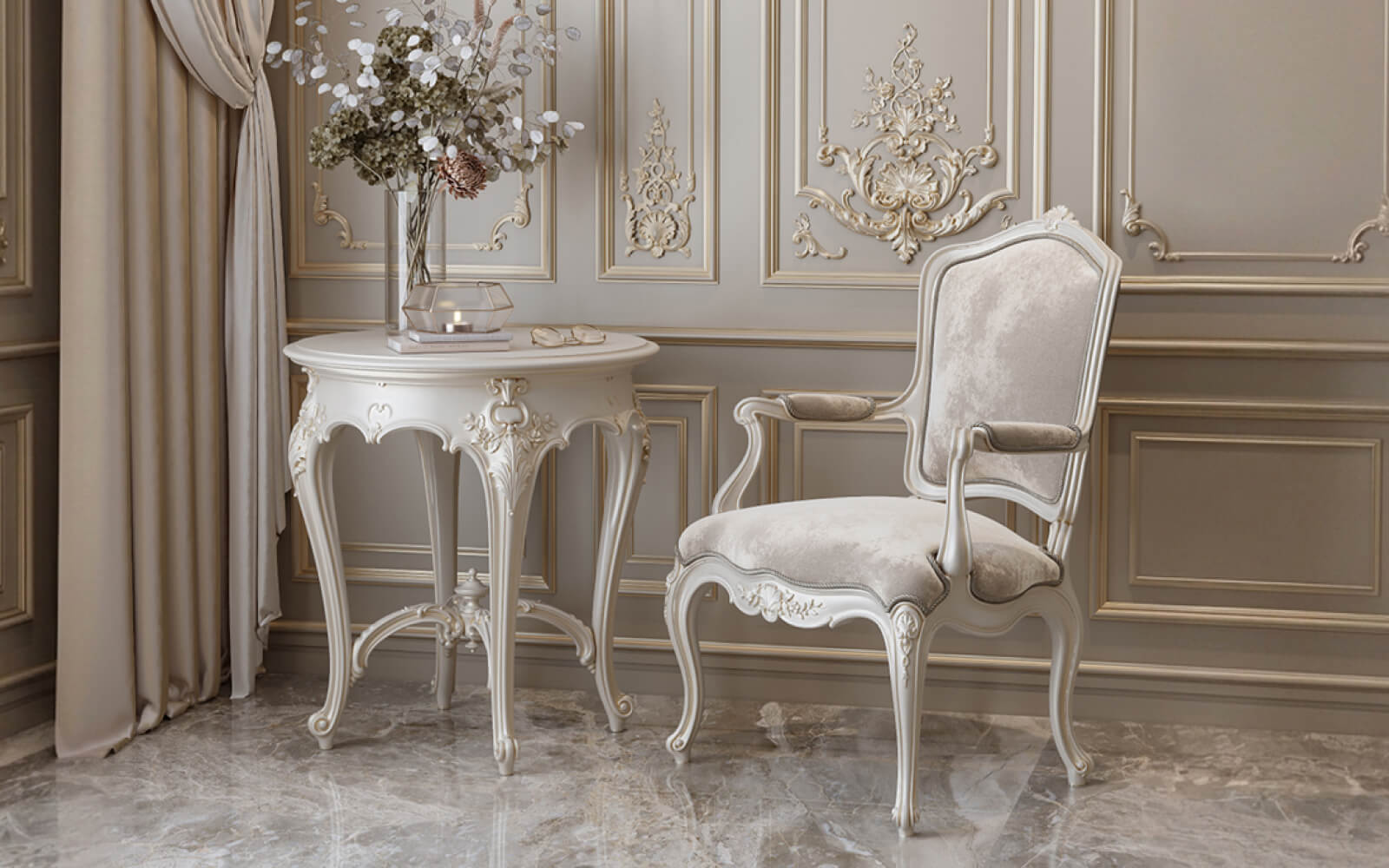
The topic of polyurethane moldings is often perceived narrowly: 'this is classic style, we don't need it.' This is an outdated view. The modern assortment ofonline store of polyurethane moldingsincludes profiles for any stylistic direction—from strict minimalism to elaborate neoclassicism. Let's break down specific categories.
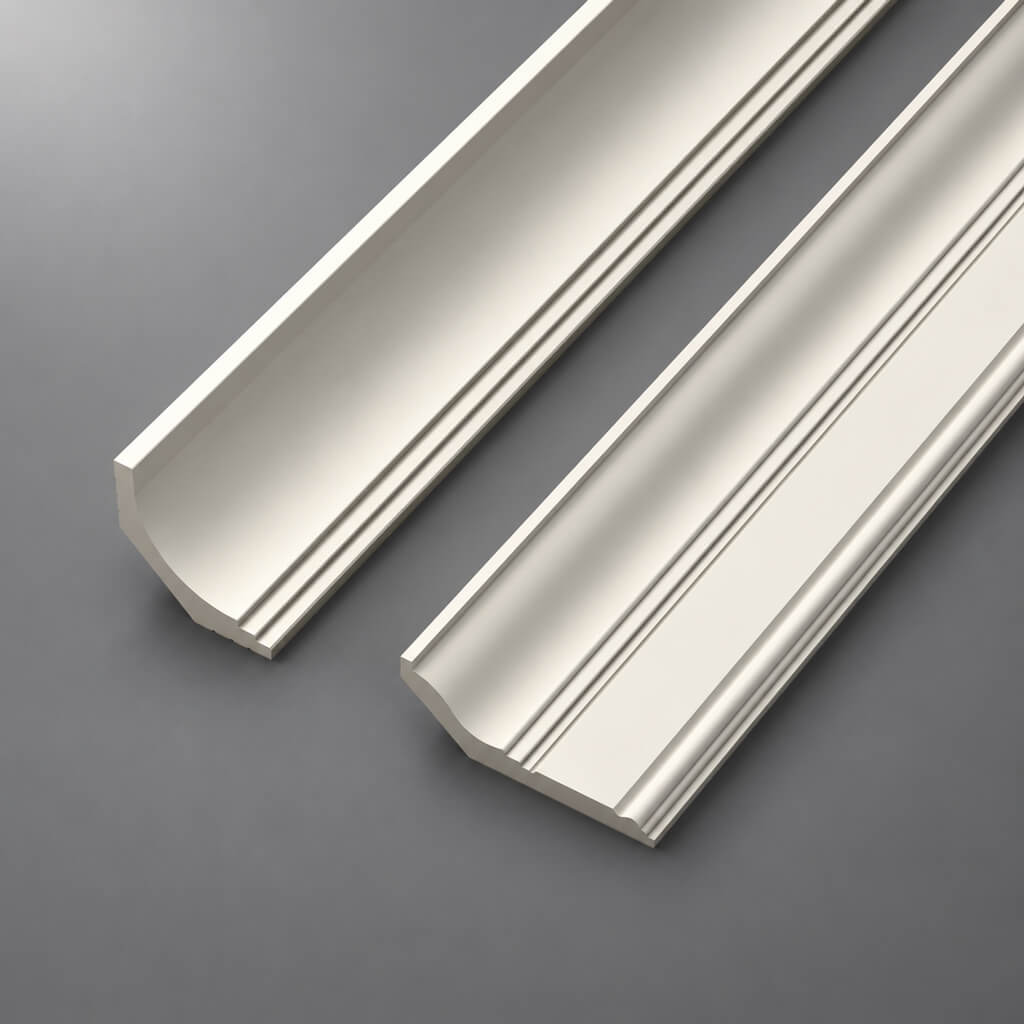
Cornices and baseboards: an essential element of a finished interior.
A ceiling cornice is not just decoration. It is an architectural element that solves several tasks simultaneously:
-
Conceals the technological joint between the wall and ceiling.
-
Masks cracks from building settlement.
-
Visually raises the ceiling by creating a horizontal line.
-
Adds completeness to the entire perimeter of the room.
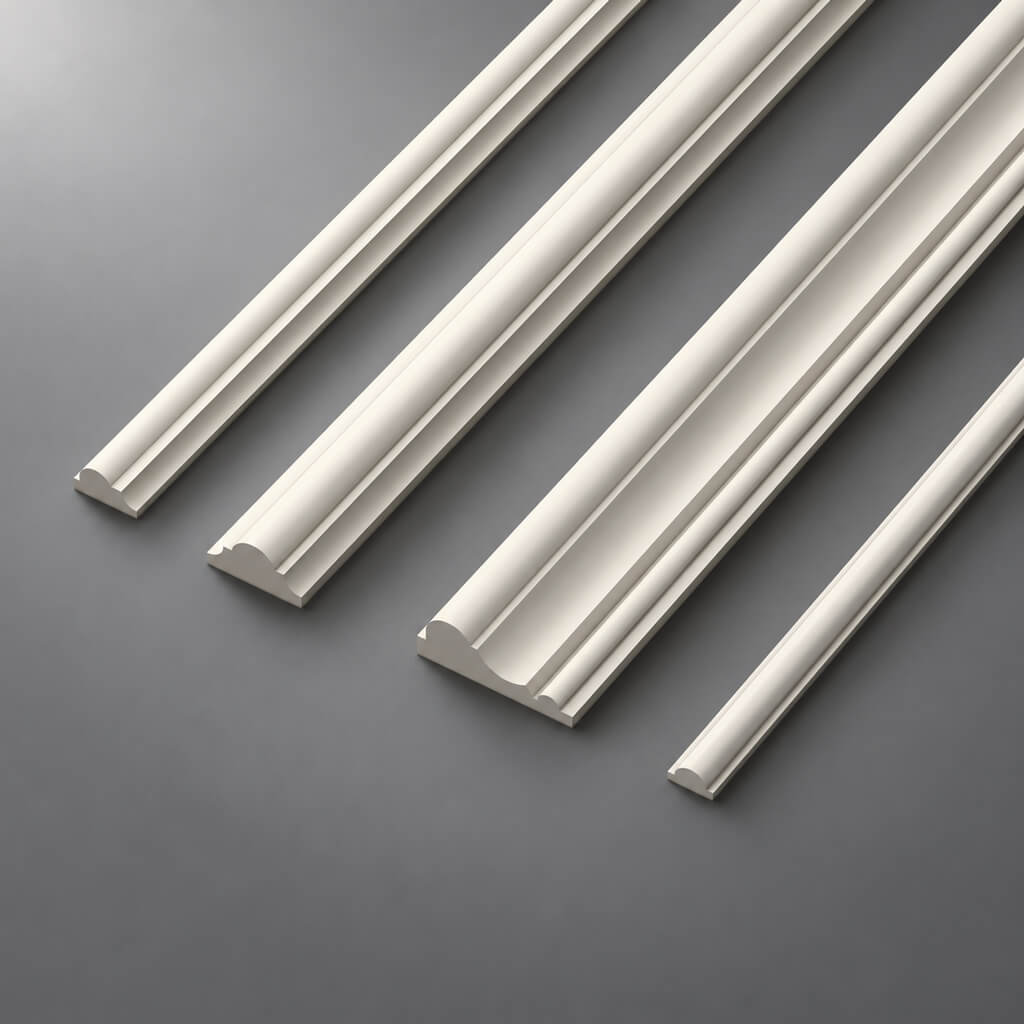
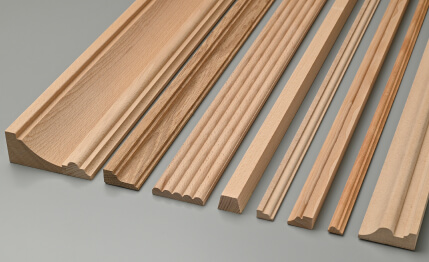
You can buy ready-made stucco matching the Baroque style. Calculate the quantity: linear meters of cornices and moldings, number of rosettes, pilasters, consoles, corner elements. Add a ten to fifteen percent allowance for trimming.Cornices are available in a range from a thin geometric molding of 35–40 mm to a multi-level profile of 200+ mm. The choice is determined by ceiling height: the rule is that the cornice height should not exceed 1/25 of the room height. For a Kaliningrad apartment with a standard 2.6 m ceiling—an 80–100 mm cornice.
Polyurethane floor baseboards follow the same logic. The baseboard height should match the scale of the room. For a room with a 2.5–2.7 m ceiling—a 60–80 mm baseboard. For a high space of 3 m—up to 120 mm.
Moldings: frames that transform a wall into architecture.
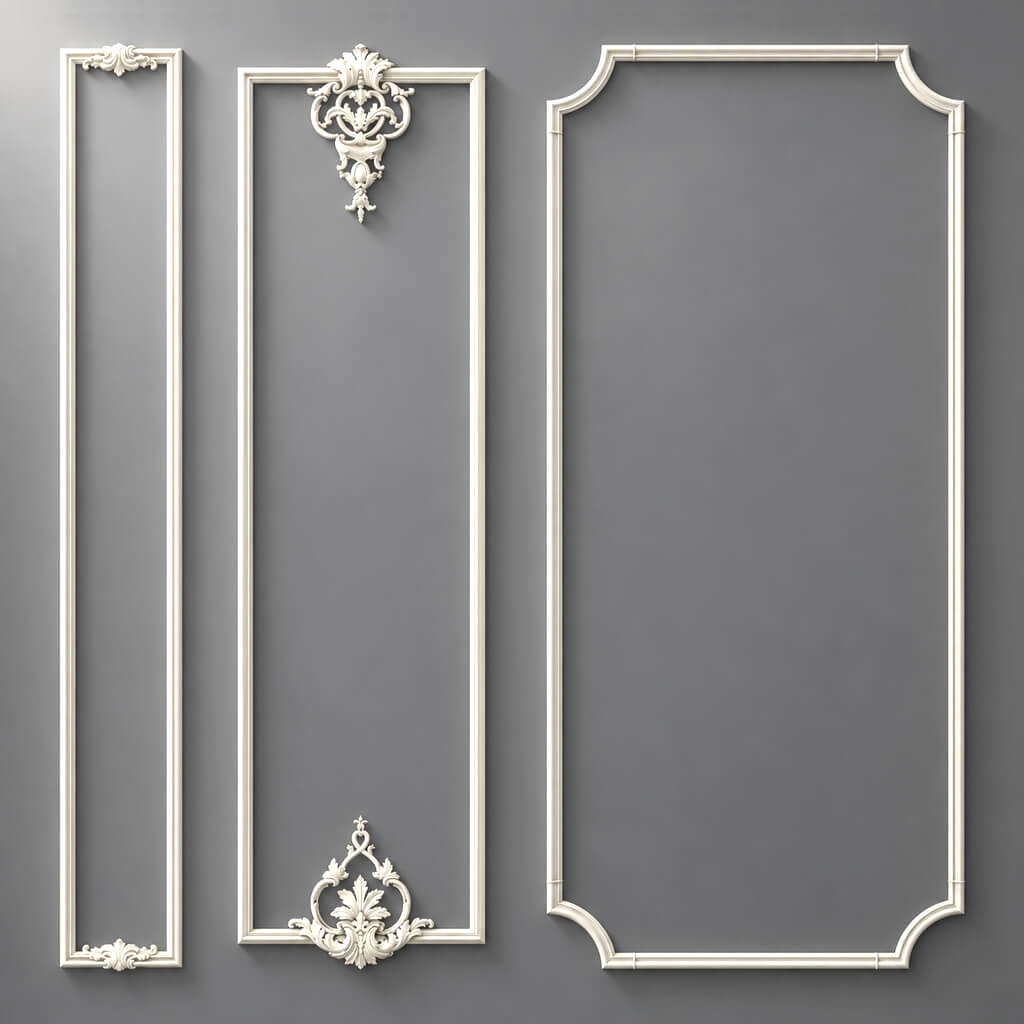
Wall moldings create a 'panel' pattern on the wall—a system of rectangular frames that give the surface depth and geometric order. In classic interiors, moldings imitated expensive wood paneling. In modern interiors, it's strict geometry as an independent technique.
Polyurethane moldings paired with slatted panels work as follows: the lower part of the wall is a slatted panel up to the horizontal restraint line; above it—the wall with molding frames. This is a two-level wall structure that looks significantly richer than just slats or just frames separately.
Rosettes: an appropriate accent or an unnecessary detail?
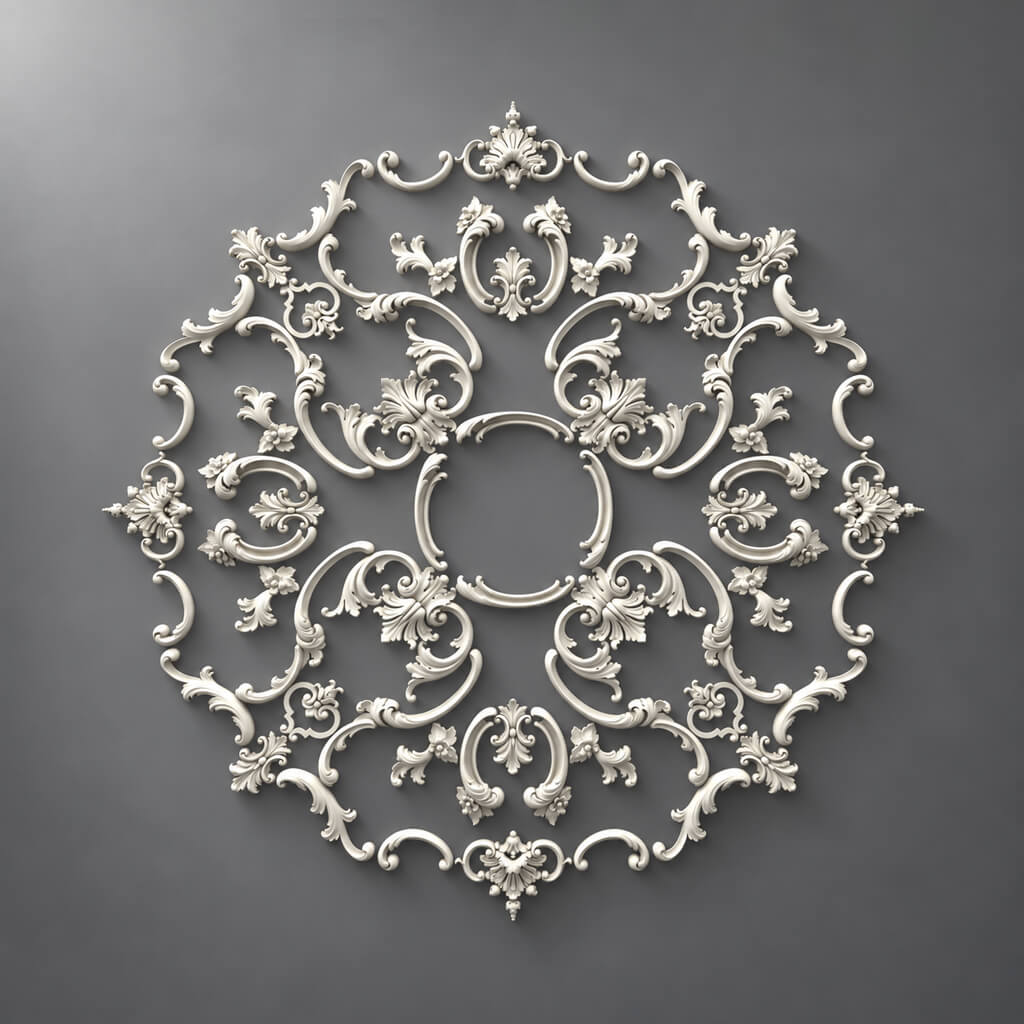
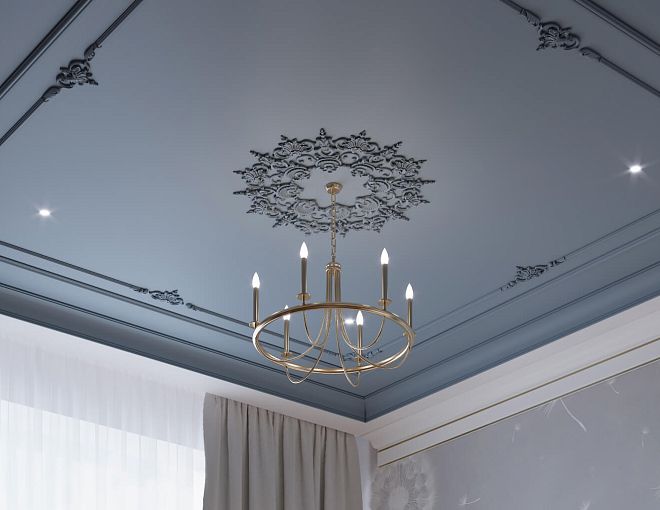
A ceiling rosette is a decorative element around the chandelier mounting point. It is appropriate under the following conditions:
-
The ceiling is not lower than 2.7 m.
-
There is a classic chandelier (not spotlights) in the center of the ceiling.
-
The interior style includes at least some classical or neoclassical touch.
It is inappropriate with: spot lighting, slatted ceiling, ceiling of 2.4–2.5 m, minimalist interior without architectural details.
Overlay decorative elements: accent without overload
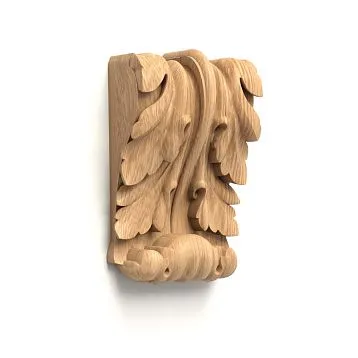
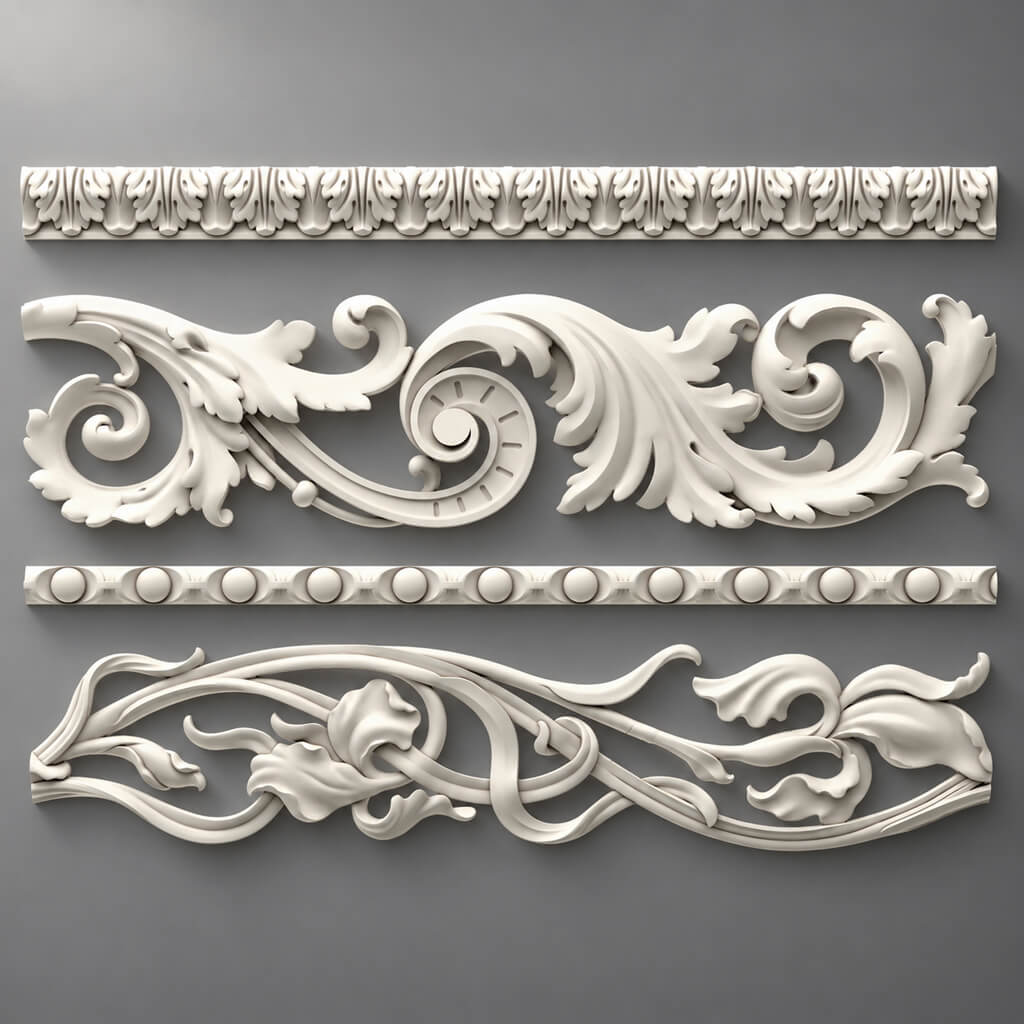
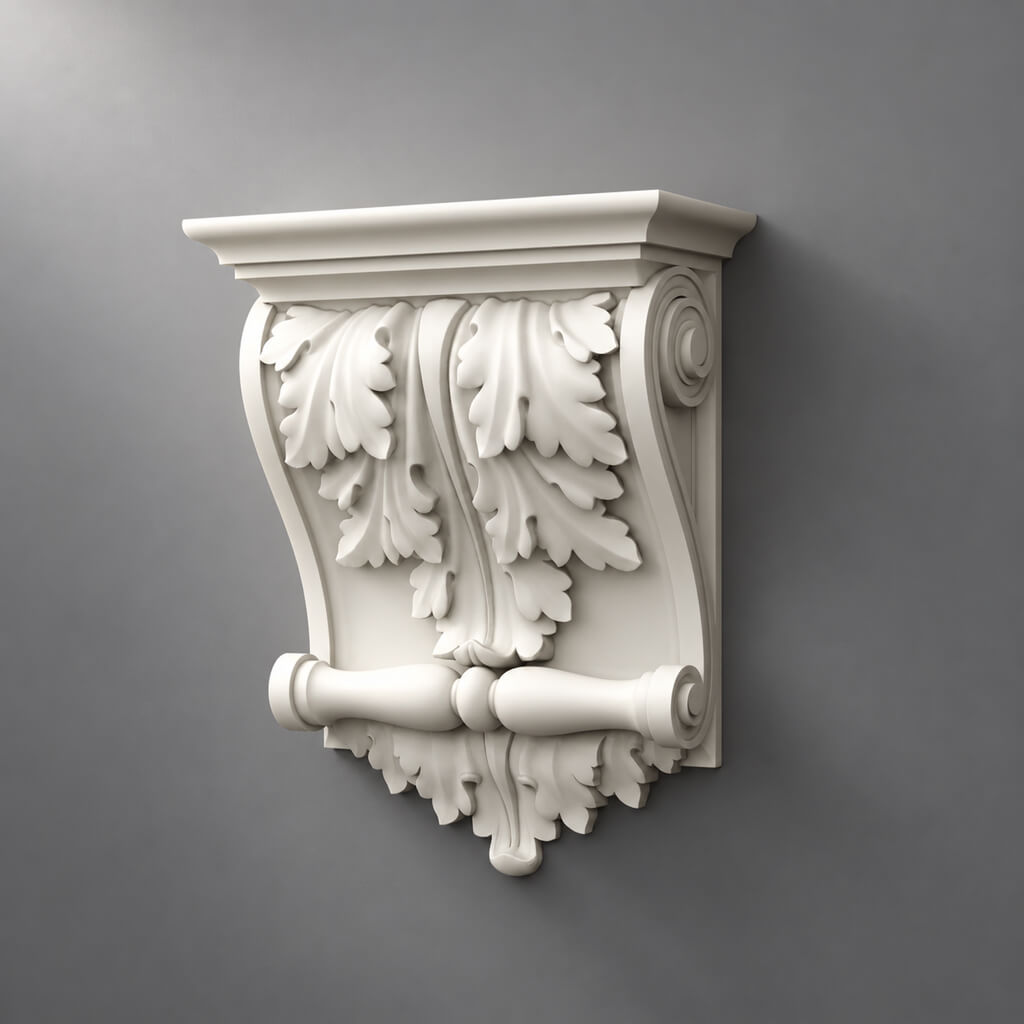
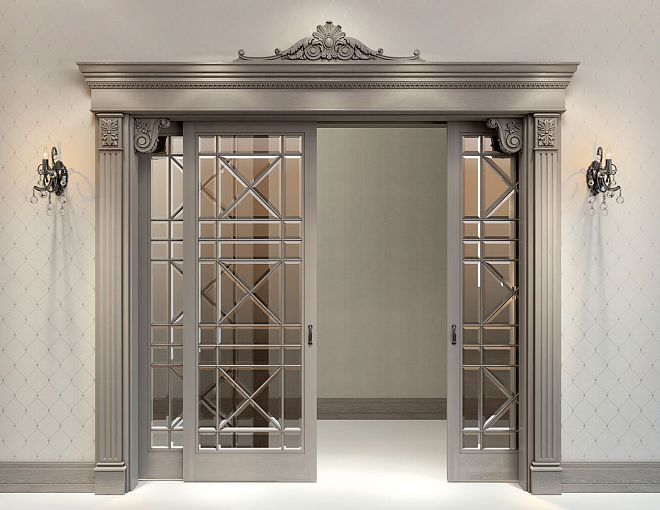
to buy polyurethane molding in an online storein the form of overlay elements—these are capitals for columns and pilasters, corner blocks for moldings, keystones for door arches, decorative consoles. These elements add a pinpoint architectural accent without total decoration of the entire space.
In a modern interior, such details work as 'quotations' of classicism—delicate, singular, understandable. Not the entire ceiling in stucco, but one rosette above the dining table. Not all cornices with ornament, but one corner block at the intersection of moldings.
How to combine panels, moldings, and stucco decor: a system, not a random assortment.
This is the key section of the article. Because buying slatted panels in Kaliningrad separatelyYou can buy ready-made stucco matching the Baroque style. Calculate the quantity: linear meters of cornices and moldings, number of rosettes, pilasters, consoles, corner elements. Add a ten to fifteen percent allowance for trimming.—that's not yet an interior. An interior is how they work together.
Rule one: one accent per room
Each room should have one main decorative element. If it's a slatted wall—everything else is delicate. The cornice is simple, without ornament. Moldings are thin, geometric. No rosette. If the main element is an elaborate ceiling cornice with a profile—the slatted panel should be restrained: light-colored, narrow, covering a small area.
Violating this rule creates visual overload. It's not a 'rich' interior—it's an anxious one.
Rule two: tonal unity
Wooden slats and polyurethane decor should exist in the same tonal register. 'Tonality' refers to color temperature: warm (amber, golden, ochre) and cool (gray, bluish, steely).
-
Warm wood (oak, ash in warm shades) + warm white cornice = harmony.
-
Cold gray wood + neutral or cool white cornice = harmony.
-
Warm wood + cool white cornice = a conflict that is always visible but rarely realized.
Check the tone of samples in person under your lighting. The difference between 'warm white' and 'pure white' on a monitor screen is almost imperceptible—in a real room, it's striking.
Rule three: scale correspondence
The width of the slat and the height of the cornice should correspond to the scale of the room and to each other.
| Batten width | Recommended cornice height |
|---|---|
| 40–60 mm (narrow) | 50–75 mm |
| 70–100 mm (medium) | 80–100 mm |
| 110–140 mm (wide) | 100–130 mm |
| 150+ mm (large) | 130–180 mm |
Mismatch creates a feeling that 'something is off'. A small cornice with wide slats looks random. A monumental cornice with thin slats looks aggressive.
Rule four: stylistic consistency
Wooden slat panelshave a stylistic 'affiliation': Scandinavian, eco, contemporary, minimalist loft. Ornamental stucco in Baroque style is a different stylistic pole. Intersection points exist: contemporary classic and neoclassical easily accept both slats and delicate relief cornices. But a 'pure' loft with a 'pure' classical rosette is not eclecticism, but design inconsistency.
Safe style combinations:
-
Contemporary classic: warm oak slats 80–100 mm + cornice with soft profile 90–110 mm + thin rectangular wall moldings.
-
Scandinavian: white or light gray MDF slats + minimalist straight cornice 50–65 mm + no moldings.
-
Neoclassical: light wood slats with dense rhythm + cornice with ornamental band + corner blocks at molding points.
-
Eco-style: dark thermowood + neutral matte cornice + live plants as decor instead of stucco.
Room-by-room breakdown: what goes where and why
Living room: an accent that works
Slatted panels in the living room interior— one accent wall. That's an axiom. One—behind the sofa or behind the TV. Not three, not two. One slatted wall with neutral other surfaces creates an accent. Three slatted walls in one living room—a forest dugout, not a modern interior.
What works in a Kaliningrad living room:
-
Solid oak or thermowood slats, width 80–120 mm, floor to ceiling—behind the relaxation area.
-
Cornice around the ceiling perimeter 90–110 mm warm profile.
-
Slatted panels with lighting— hidden LED strip in the gaps behind the sofa: warm light 2700–3000K.
-
TV area:slatted panel for the television— slats from floor to ceiling, TV mounted directly to the wooden surface.
Bedroom: silence through material
slatted panels in the bedroomshould create a feeling of enveloping warmth. One wall behind the headboard—the ideal zone. Warm tone, dense rhythm of slats, no cold lighting above the panel.
Polyurethane decor in the bedroom—delicate. Cornice 60–75 mm simple profile around the perimeter. Molding as a frame for the headboard niche—a beautiful pinpoint accent. No ornamental rosettes—in the bedroom they create excessive formality, inappropriate for a rest space.
Hallway and corridor: solving a spatial task
The hallway in most Kaliningrad apartments—a narrow, often dark corridor.Slatted panels in the hallway interiorThey solve a spatial task here: vertical battens along the long wall of the corridor create a perspective effect, visually elongating the space.
The color of the batten in the hallway is critical: dark battens in a dark corridor will turn it into a tunnel. Choose light tones: milky, cream, light gray, bleached ash. A polyurethane cornice along the top perimeter is mandatory — it 'raises' the ceiling and adds a sense of volume.
Kitchen: Pragmatism as a Priority
Slatted panels in the kitchenIn Kaliningrad — a high-attention zone. Steam, grease, moisture — an aggressive environment for any wood. For the kitchen area — only moisture-resistant materials: WPC or MDF with film coating. Natural solid wood without special treatment in the stove and sink area is a direct path to problems within 1–2 years.
If the kitchen is combined with the living room — batten panels are appropriate in the living area, the kitchen area is better left neutral.slatted panels in kitchen interiorsThey work on a decorative backsplash (instead of tiles) or as zoning in an open layout — but the material in both cases must be technically suitable.
Ceiling: Spatial Scale
Batten panels for ceilings— one of the most expressive and underrated techniques. The ceiling occupies a huge area, which most people simply paint white and forget. A batten ceiling turns this 'forgotten' space into an architectural element.
Batten ceiling in Kaliningrad: light battens for low ceilings (create a sense of height), dark — for high ceilings (add drama). Batten width 60–100 mm, gap between battens 15–25 mm. Behind the battens — acoustic underlay and, if desired, hidden lighting.
How to check the material before purchase: a practical protocol
When you decide to buy slatted panels online in Kaliningrad with delivery, a mandatory inspection is required before installation. Here is the specific protocol:
Geometry
Place the slat on a flat surface horizontally. It should lie without gaps — not twisted, not sagging along its length. Check several slats. A twisted slat will cause waves on the finished surface.
Check the cross-section: the slat should have a consistent cross-section along its entire length — width and thickness should not vary. For MDF, tolerance is ±0.2 mm; for solid wood — ±0.5 mm.
Finish
Run your finger along the front surface — there should be no bubbles, roughness, drips of varnish, or uneven texture of the film. Inspect the ends: they should be evenly processed, without MDF delamination, without chips.
For oil coating: the surface should be matte or semi-matte, without glossy spots. Gloss in individual areas indicates uneven oil application.
Tone
Lay out several slats side by side in daylight. The tone should be uniform within the batch. For solid wood, slight natural variations are acceptable and even desirable — they create a lively texture. But there should be no sharp jumps in saturation or hue.
For film-coated MDF, tone uniformity should be perfect — this is machine production, and deviations here indicate defects.
Smell
Natural solid wood with oil coating has a slight scent of flax or wood — neutral, pleasant. A sharp chemical odor indicates poor-quality varnish or substandard glue in the MDF composition. This is harmful and unpleasant.
Foamed polystyrene is hygroscopic - it absorbs moisture from the air, albeit in small amounts. Long-term storage in a humid environment (basement, unheated warehouse in winter) may result in dark spots appearing on the surface.
Professional tip: check wood moisture with a moisture meter. Optimal moisture content before installation in Kaliningrad is 10–14% (higher than for drier regions). Dry wood with 6–8% moisture in a Kaliningrad home will inevitably absorb moisture and expand — resulting in 'bumps' between the slats.
Where quality most often falls short: an honest conversation about the market
First problem: untreated MDF edges
The most common defect in the budget segment is unsealed MDF edges. The edge is the most vulnerable spot: here the board absorbs moisture instantly. In Kaliningrad's high humidity, an unsealed edge can cause swelling, film peeling, and edge deformation of the slat within six months. Always check the edges.
Second problem: film with poor adhesion
On some MDF panels, the decorative film is held only by production pressure and begins to peel at the edges during the very first installation. It's easy to check: try gently lifting the film with your fingernail on the edge of the slat. If the film starts to come off without effort, the material won't last even one season in Kaliningrad conditions.
Third problem: non-standard geometry for painting
paintable slatted wall panelsmust have a perfectly smooth surface — any geometry defect will become even more apparent after painting. Inspect such slats under side lighting (a flashlight at an angle to the surface) — all irregularities become immediately visible.
Fourth problem: low-density polyurethane
Cheap polyurethane decor has low density — it's lightweight, produces a hollow sound when tapped, and deforms easily under light pressure. The relief on such material is unclear: blurred contours, smudged ornament. After installation and painting, it looks like 'plastic imitating stucco' — exactly what one wanted to avoid.
Quality polyurethane: dense, resilient, relief is clear with smooth edges. When tapped — not hollow, but a soft, dull sound. The shape holds without deformation under hand pressure.
Problem five: discrepancy between stated and actual color
Monitor screens display color approximately. The 'warm white' of a cornice on the website and the actual 'warm white' under your apartment lighting can be completely different things. Always order samples. It's a small investment that saves you from redoing the work.
Slat panel for the wall: formats and size range
Before buying slat panels for walls, it's important to understand the available formats and their applications:
By slat width:
-
40–60 mm — narrow slat: tight rhythm, dynamic, suitable for small rooms and ceilings.
-
70–100 mm — medium: universal format, works in most residential interiors.
-
110–150 mm — wide: monumental effect, for high rooms and facades.
-
160–200 mm — large: facades, high halls, public spaces.
By length:
-
Standard length — 2400, 2700, 3000 mm.
-
Custom length available — up to 6000 mm and more for high ceilings.
By thickness:
-
MDF — typically 12–18 mm.
-
Solid wood — 15–22 mm.
-
WPC — 18–25 mm.
slatted modular wall panel— is a ready-made module with slats mounted on a backing. A convenient format for quick installation: the entire panel is installed as a single unit, with precise row geometry guaranteed by the manufacturing process.
Installation of slatted panels: key principles without unnecessary words
installation of slatted panels on the wallin Kaliningrad requires consideration of local specifics:
Acclimatization — mandatory. At least 5–7 days in a room with heating on in winter. In summer in Kaliningrad — 3–5 days is sufficient.
Battens with ventilation gap — standard for solid wood. Wooden battens made from 20–30 mm timber with spacing of 400–600 mm, ventilation gap between wall and panel — 10–15 mm. Under the battens — vapor barrier when installing on external walls.
Hidden or exposed fastening. Hidden (via groove) — for interior solid wood slats, provides a clean surface without visible fasteners. Exposed (via hole with putty) — for MDF, where a groove is technically difficult.
Temperature gaps. Leave a 1–2 mm gap between slats when installing solid wood — this compensates for possible expansion. For MDF, the gap is smaller or not needed.
Additional elements.How to install slatted panelsso that the corners and perimeter look finished — a starter profile at the bottom, a finishing profile at the top, corner strips for external and internal corners. Without them, even a perfect installation looks incomplete.
Slatted panels for the facade of a Kaliningrad house
The facade in Kaliningrad's climate — constant moisture, sea air, ultraviolet, wind from the Baltic.Slatted panel on the facadehere — only specialized materials:
-
Thermowood larch or pine — natural moisture resistance plus heat treatment. Durability with proper care — 20–30 years.
-
WPC (wood-polymer composite) — absolutely moisture-resistant, does not rot, withstands sea air. Downside — limited color palette.
-
Thermowood oak — maximally durable, but expensive. For representative facades — the best option.
Slatted Façade Panelsare mounted on a ventilated facade with a mandatory ventilation gap of 40–60 mm. This is not just a technological requirement — it is a necessity for the climate of Kaliningrad, where moisture condenses on surfaces year-round.
STAVROS: a systematic approach to choosing finishes
When it comes to where to buy slatted panels in Kaliningrad and simultaneously select high-quality polyurethane decor for them as a unified system — STAVROS is precisely the manufacturer that operates according to this logic.
STAVROS offers a complete rangeof slatted panelsmade from solid wood of various species, MDF with film coating and for painting — plus a full line ofpolyurethane decor: cornices, baseboards, moldings, rosettes, overlay elements, trim. All in one catalog, with a guarantee of stylistic and tonal consistency within the assortment.
Delivery to Kaliningrad — a working service for any project scale. Order samples in advance and compare them under your lighting, in your space.Pogonazh iz massivaSTAVROS — baseboards, casings, auxiliary elements — covers all transitions and joints, ensuring a completeness that is immediately visible.
STAVROS is not just a catalog of materials. It is a production system where each element is created with an understanding of how it will function in the interior as a whole. In the climate of Kaliningrad, where materials are tested by moisture every day, this is not just convenience — it is a guarantee that your interior will remain strong in a year, in five, and in ten years.
FAQ: Answers to popular questions
Is it possible to buy slatted panels in Kaliningrad with delivery from the manufacturer?
Yes. Most quality slat panel manufacturers offer delivery across all of Russia, including Kaliningrad. Be sure to order samples before placing your main order.
What panel material is best for the Kaliningrad climate?
For living spaces — MDF with film coating or solid oak/ash with oil coating and processed edges. For wet areas — thermowood or WPC. For facades — thermowood or WPC.
Is polyurethane molding afraid of humidity?
No. Polyurethane is a water-resistant material; it does not swell or deform with changes in humidity. This is one of the key advantages over gypsum molding, especially for Kaliningrad.
Is acclimatization needed for MDF slats before installation?
For MDF with film coating, acclimatization is less critical than for solid wood. Nevertheless, 2–3 days are recommended to stabilize the geometry in the room conditions.
How to choose the height of a cornice for a 2.5 m ceiling?
For a 2.5 m ceiling — a cornice of 70–90 mm with a simple profile. A taller cornice on a standard ceiling will make the space feel oppressive.
Can slat panels be installed independently?
Yes, if you understand the basic principles: acclimatization, lathing, ventilation gap, working with additional elements. A detailed step-by-step guide is in the article How to install slatted panels.
How many slatted panels should be taken with a margin?
The standard margin is 10–15% of the calculated volume. In Kaliningrad, considering delivery and potential reorders, it's better to take 15%.
Where can I see photos of slatted panels in interiors?
Currentphoto gallery of slatted panelswith analysis of styles and applications — is available in the STAVROS catalog.