Article Contents:
- What is polyurethane molding: an honest answer without jargon
- What polyurethane molding consists of: the complete system composition
- First group: profiles for walls and ceilings
- Second group: special-shaped moldings
- Third group: decorative elements for moldings
- Fourth group: decorative stucco
- Polyurethane trims: for walls, frames and architectural zones
- What is Molding and Why Is It Needed
- Trim parameters when choosing
- How much molding is needed for a room
- Cornices and ceiling profiles: how to design the top line of a room
- What the cornice does
- Types of polyurethane ceiling cornices
- How to choose the height of the cornice
- Decorative stucco: when linear footage alone is not enough
- Overlays and medallions
- Decor for moldings: system fittings
- When to add stucco and when not to
- Complete renovation kit: how to place an order
- Scenario one: "Apartment with clean walls"
- Scenario two: "Apartment in neoclassical style"
- Scenario three: "Classic-style office or grand hall"
- Polyurethane molding installation technology: from marking to painting
- Tools and Materials
- Sequence of work
- What to buy for different tasks: summary table
- Frequently Asked Questions
- STAVROS: complete line of moldings for any task
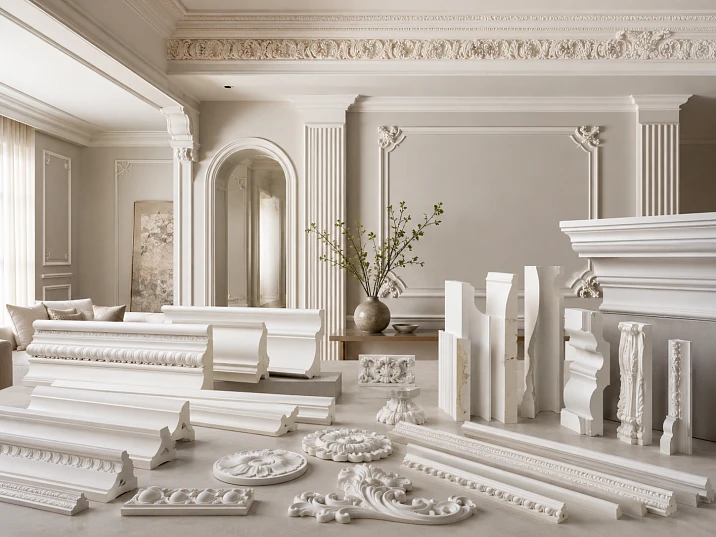
Most people renovating hear the word "molding" and think it's something about long baseboards. Or that it is a baseboard. Or that it's not their thing at all — it's "for designers with a project."
In reality, it's simpler and at the same time richer. Polyurethane trim — it's a whole system of profile and decorative elements from which an interior is literally assembled. From bottom to top: baseboard, wall moldings, cornice at the ceiling. Horizontally: frames, belts, joints. Vertically: pilasters, corners, door trims. And on top of this entire framework — decorative overlays, medallions, corner accents.
Polyurethane molding helps assemble the finish as a system: Moldings they decorate walls, cornices cover the top line, decorative profiles connect joints, and Moldings and overlays add an accent where a regular line is no longer enough.
Let's break it down in order: what exactly is included in this system, why each element is needed, and how not to buy too much.




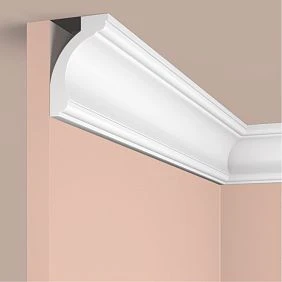
What is polyurethane molding: an honest answer without jargon
In construction terms, "molding" refers to products sold by linear meters or fixed-length planks and installed in continuous lines. Baseboard is molding. Cornice is molding. Molding is molding. Casing is molding.
Polyurethane molding is the same products, but made of rigid two-component polyurethane, not wood, MDF, or plaster.
Why polyurethane? Because it has a rare combination of characteristics:
-
Lightweight: 100–250 g per linear meter — 3–5 times lighter than a plaster counterpart.
-
Moisture-resistant: does not swell, deform, or mold.
-
Precise: the profile is reproduced with an accuracy of 0.1 mm — each product is identical to the next.
-
Paintable: acrylic, alkyd, wax, paint on any base — polyurethane accepts everything.
-
Cuts: with a miter saw at any angle — 45°, 30°, 22.5°.
It is these properties that make polyurethane molding a universal material for renovations of any level: from budget to luxury.




What polyurethane molding consists of: the complete system composition
Before moving on to each element individually, it is useful to see the entire system as a whole. Polyurethane molding is divided into several functional groups.
Our factory also produces:
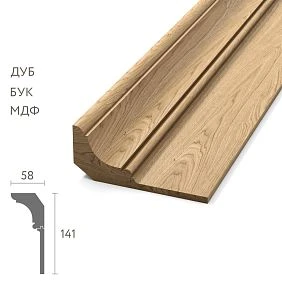
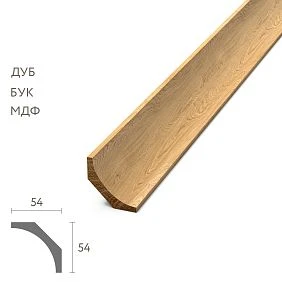




First group: profiles for walls and ceiling
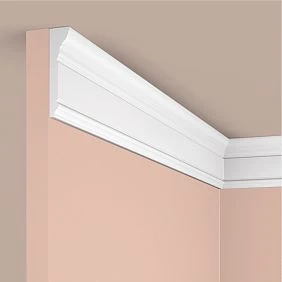
This includes moldings (wall profiles for frames, belts, divisions), cornices (ceiling profiles for the wall-ceiling joint), ceiling coves (simplified cornices without complex profiles), and polyurethane baseboards (an alternative to wooden ones if a non-standard profile is required).
Get Consultation
Second group: special-shaped molding
Corner profiles, pilasters, niche and door frame trims, arch profiles — everything that decorates not flat surfaces, but transitions and three-dimensional elements.
Third group: decorative elements for molding
Decor for Molding — corner caps, finials, connectors, inserts — items that are installed together with the molding but are not profiles. These are the system's "hardware."
Fourth group: decorative stucco
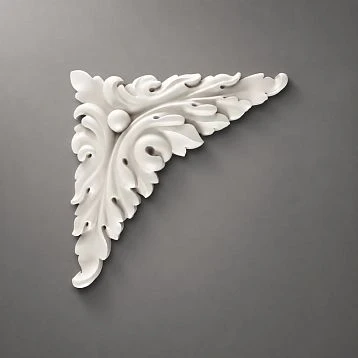
Overlays, medallions, rosettes, ornamental elements are independent decorative products that are mounted separately or in combination with linear moldings, but are not profile elements.
Understanding this classification is the key to ordering correctly: not buying too much and not forgetting what's important.
Polyurethane moldings: for walls, frames, and architectural zones
If linear moldings are the entire orchestra, then Moldings made of polyurethane — are its first violins. They are encountered most often, work in most interior tasks, and most orders start with them.
What is molding and why is it needed
A molding is a profile strip with a cross-section of a specific shape. The cross-section can be:
-
Rectangular (flat) — for minimalist modern frames.
-
Rounded (scotia, ovolo) — for a soft transition without sharp edges.
-
Stepped (band) — to create several levels of relief.
-
Ornamental (with a relief pattern) — for classic and neoclassical interiors.
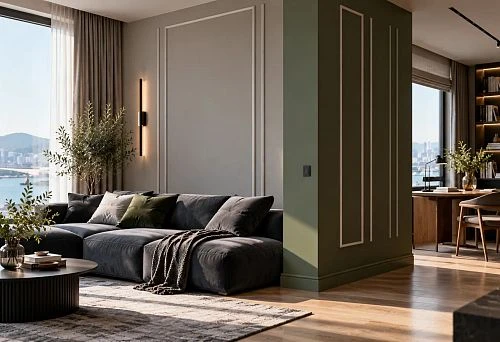
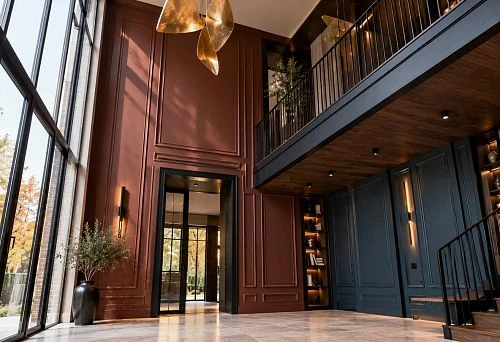
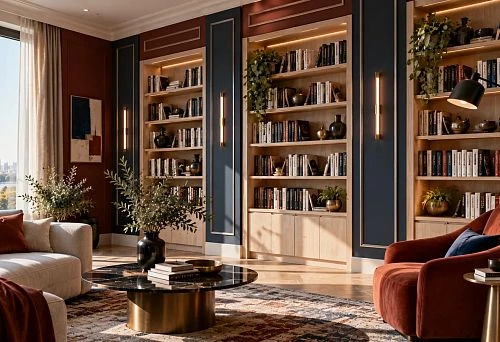
Moldings are used to create frames on walls, horizontal and vertical bands, dividing the wall into decorative zones ("panels"), framing doorways, niches and arches, designing art zones (walls behind the sofa, behind the bed, above the fireplace), and creating home galleries with identical frames.
Molding parameters when choosing
Profile width: from 10 to 80+ mm. For thin modern frames — 15–25 mm. For neoclassical decorative bands — 30–50 mm. For monumental classic — 50–80 mm.
Profile height: how much the element "protrudes" from the wall. The higher the relief, the more active the shadow and the more expressive the molding in side light.
Plank length: standard length of polyurethane moldings is 2.0 or 2.4 meters. When ordering, account for a 15% allowance for trimming.
Profile style: in the STAVROS catalog — moldings from several collections: "Neoclassic" (concise rectangular profiles), "Versailles" (ornamental, with relief details), "Japandi" (flat ribbed profiles for Japanese minimalism), "Botanical Garden" (with floral inserts).
How much molding is needed for a room
Calculation for wall frames: measure the total perimeter of all planned frames and add a 15% allowance. For a frame 200 × 100 cm, perimeter = (200 + 100) × 2 = 600 cm = 6 linear meters. Plus 15% = 6.9 m. Total — 7 m of molding for one frame.
For horizontal bands: wall length + 15%. For two walls 4 m long each = 8 m + 15% = 9.2 m.
Cornices and ceiling profiles: how to design the top line of a room
If moldings are about walls, then cornices are about the ceiling. More precisely, about the transition from wall to ceiling. This is a boundary that in most living spaces is resolved in the simplest way: with nothing. And this is exactly what makes the ceiling look "cheap" even with an expensive renovation.
What the cornice does
Ceiling molding in the form of cornices solves three tasks simultaneously.
Aesthetic task: the transition from wall to ceiling is the longest and most noticeable line in any room. If it is clean and profiled, the room looks finished. If it is simple or absent altogether, the interior feels "raw."
Architectural task: the cornice visually "raises" the ceiling. This is an optical illusion known since antiquity: a horizontal profile with an overhanging edge creates a sense of shadow under the ceiling, which visually adds height.
Technological task: the cornice covers the seam between the wall and ceiling, which in most cases is not perfectly even. This is the most economical way to eliminate the "unevenness" of the top line without redoing the plaster.
Types of polyurethane ceiling cornices
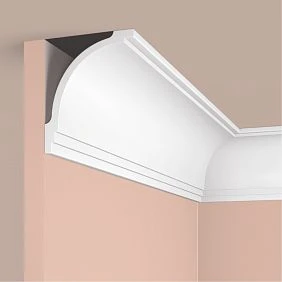
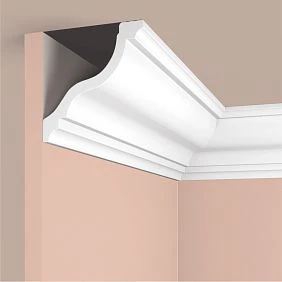
Galtel is the simplest ceiling profile. Triangular or semicircular cross-section. Height 40–60 mm. Installed in the wall-ceiling corner. This is a budget option for modern interiors or small spaces.
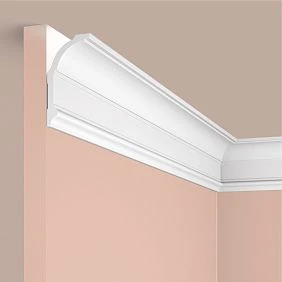
Ceiling cornice with profile is a more expressive option with a multi-step or ornamental cross-section. Height 60–130 mm. For neoclassical and classical styles. In the STAVROS assortment — models A130V1 (100 × 83 mm), A090V1 (80 × 70 mm), and several others for rooms with different ceiling heights.
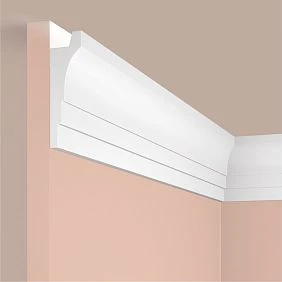
Wide cornice with shelf — a cornice where the lower part is a horizontal shelf. An LED strip for hidden lighting can be placed inside this shelf. This is a modern solution combining decorative and lighting functions.
How to choose the cornice height
The rule is simple: the height of the cornice is proportional to the height of the ceiling.
-
Ceiling 2.4–2.6 m → cornice 40–60 mm.
-
Ceiling 2.7–2.9 m → cornice 60–80 mm.
-
Ceiling 3.0–3.5 m → cornice 80–100 mm.
-
Ceiling above 3.5 m → cornice 100–130 mm or more.
A cornice that is too wide with a low ceiling "lowers" the ceiling. One that is too narrow with a high ceiling looks insignificant.
Decorative stucco molding: when linear moldings alone are not enough
Linear moldings are profile lines. But an interior lives not only by lines. It lives by points. Accents. Focal points. And this is where Decorative stucco — appliqués, rosettes, medallions, corner elements.
Appliqués and medallions
Decorative appliqués are independent elements that are mounted on a wall or ceiling at specific points. Their task is to create a visual accent at a particular spot. Popular options: ceiling rosettes for a light fixture or chandelier, central medallions in wall frames, ornamental panels above a fireplace or console, cartouches — rectangular or oval frames with ornamentation.
The STAVROS assortment includes over 100 models of overlays priced from 470 RUB (MLDPU-027U-2) to 15,990 RUB (MLDPU-3-2.1) and higher. This is a wide range both in size and in the level of ornament detail.
Decor for moldings: system fittings
This is a special category that is often overlooked when ordering — and later regretted. Decor for Molding — these are elements that are installed in places where molding profiles meet or end:
Corner elements: overlays in the corners of wall frames. Where the horizontal molding meets the vertical one at a right angle. Without corner overlays, the joint looks like a construction cut — technical but not decorative. With an overlay, it is a finished detail.
Tips and plugs: elements for the ends of the molding — where the profile abuts another element (door frame, room corner, niche). Without a plug, the end of the molding looks "cut off."
Inserts and blocks: elements that are built into gaps in the molding line — for example, to create a "window" in a horizontal belt for a decorative overlay.
In the STAVROS assortment, the category of decor for moldings is represented by models of the NPU and MLDPU series — from 470 to 15,990 rubles, in styles from "Versailles" (ornamental, with acanthus) to "Neoclassic Light" (geometric, flat).
When to add stucco molding, and when not to
This is the question most often asked. The simple answer: add decorative stucco molding when the expressive possibilities of the linear elements run out.
Lines and profiles create structure. Molding creates character. If the structure is already there (baseboard, molding frames, cornice), but the interior feels "cold" or "unfinished" — add one overlay at an accent point. It works like the final brushstroke.
If there is no structure, but the molding has already been purchased — you will get "decoration for decoration's sake." Individual elements without a system.
Complete renovation kit: how to place an order
Let's break down three typical renovation scenarios and what you need to buy for each.
Scenario one: "Apartment with bare walls"
Goal: a calm, modern interior without excessive decoration. You need to give the walls structure without overloading the space.
Order composition:
-
Ceiling cove or cornice 40–60 mm — along the perimeter of the room.
-
Moldings 15–20 mm — frames on one accent wall (above the sofa or behind the bed).
-
Acrylic construction adhesive.
-
Reserve 15%.
-
Paint: matte acrylic — wall, cornice and moldings in one tone.
Without stucco — monochrome purity.
Second scenario: "Neoclassical apartment"
Goal: an expensive interior with architectural character. Molding frames, profiled cornice, decorative details.
Order composition:
-
Cornice 60–80 mm with profile (A090V1 or equivalent) — along the perimeter.
-
Moldings made of polyurethane 25–40 mm — wall frames in all rooms or in the living room and bedroom.
-
Corner overlays — in every corner of the frame.
-
Central overlays — in one or two accent frames.
-
Glue, reserve 15%.
-
Paint: two-tone — dark wall + cream moldings and cornice.
Scenario three: "Study or grand hall in classical style"
Task: full architectural program. All three levels of decor: bottom line, wall, top line.
Order composition:
-
Wooden baseboard 100–120 mm.
-
Moldings 35–50 mm — two-tier frame system.
-
Decor for Molding — corner overlays, horizontal bands.
-
Buy decorative stucco — central medallions inside frames.
-
Cornice 80–100 mm.
-
Ceiling stucco — rosette for chandelier.
-
Construction adhesive, acrylic putty, primer, paint.
-
Stock: baseboard — 10%, moldings and cornice — 15%.
Installation technology for polyurethane moldings: from marking to painting
Tools and materials
-
Miter saw (minimum) or miter box with hacksaw (for simple cuts).
-
Laser level.
-
Acrylic mounting adhesive.
-
Painter's tape for temporary fixing.
-
Acrylic putty for filling joints.
-
240 grit sandpaper.
-
Brush and roller for painting.
Work sequence
First step: priming the surface. The wall or ceiling is primed with acrylic primer — this improves adhesive adhesion.
Second step: marking. Laser level — all horizontals are strictly parallel to the floor, all verticals are strictly perpendicular.
Third step: cutting. Polyurethane moldings are cut on a miter saw at the required angle. For internal corners of the frame — 45° on each side. For external corners — reverse 45°.
Fourth step: installing the cornice. Start with the cornice — it sets the top line of the entire system.
Fifth step: moldings. Apply glue to the back side of the molding in a zigzag pattern. Press against the wall, secure with painter's tape. Wait 20–30 minutes for it to set.
Sixth step: overlays. Installed last. Centered strictly along the axes of symmetry.
Seventh step: puttying joints. Acrylic putty in the joints of moldings and areas adjacent to the wall. Sand with 240 grit after drying.
Eighth step: painting. Primer + two coats of matte acrylic paint. All moldings, overlays, and the wall are painted in the final scheme simultaneously.
What to buy for different tasks: summary table
| Task | What to buy |
|---|---|
| Create frames on the wall | Moldings made of polyurethane |
| Finish the joint between wall and ceiling | Ceiling molding — cornice |
| Assemble a decorative wall | Moldings + Buy Moldings |
| Complete frames at corners | Decor for Molding — corner pads |
| Add accent | Buy decorative stucco — medallion or overlay |
| Don't make a mistake with the order | Trim + glue + paint + 15% spare |
Frequently asked questions
What is included in polyurethane molding?
Polyurethane molding includes moldings, cornices, fillets, baseboards and other profile elements made of rigid polyurethane, which are sold by linear meters or planks of fixed length. These are the "frame" elements of the decorative finishing system. Polyurethane trim — the basic category from which any decorated renovation begins.
How is molding different from stucco?
Molding is long linear profiles. Moldings — a broader concept: it includes linear molding, but also overlays, rosettes, medallions, cartouches, and other piece decorative items. Simply put: all linear molding is stucco, but not all stucco is linear molding.
What to buy for renovation: moldings or a cornice?
It depends on the task. If you need to decorate walls — buy polyurethane moldings. If you need to decorate the wall-ceiling transition — a cornice. For a full interior, they are bought together: the cornice sets the top line, moldings — the wall system.
What else to buy with polyurethane linear molding?
Acrylic mounting adhesive, acrylic putty for joints, primer, finish paint, and a 15% reserve of the calculated linear molding quantity. Optionally — Decor for Molding (corner overlays) and decorative molding for accents.
Do I need to putty the walls before installing polyurethane linear molding?
The walls should be clean and primed. Serious unevenness (a difference of more than 5 mm) is better corrected before installation — linear molding does not hide significant wall irregularities. Final leveling for painting is done after installing the linear molding: puttying joints and seams is part of the finishing work.
How to calculate the amount of polyurethane molding?
For cornices: room perimeter + 15%. For molding frames: sum of perimeters of all frames + 15%. The reserve is needed for cutting corner joints — each corner of the frame "consumes" the width of one profile on each side.
STAVROS: a complete line of moldings for any task
A correctly assembled order is when all system elements belong to the same production standard: same material density, same profile accuracy, same reaction to painting.
STAVROS manufactures Polyurethane Items in a full range for any interior task: moldings of all profiles and widths, cornices from 40 to 130+ mm, ceiling stucco for rosettes and coves, decorative molding in 100+ models and Decor for Molding — corner covers, finials, inserts.
Buy molding and polyurethane moldings for renovation can be purchased at the STAVROS online store. Delivery across all of Russia. Pickup in Moscow and St. Petersburg.
Because a good renovation is a system. And the system starts with the right molding.