Article Contents:
- PAN-001 or PAN-005: short answer
- What is a flexible slatted panel and what problem does it solve
- Creates relief without complex base milling
- Helps to shape a radius
- Covers a large surface with a repeating pattern
- Works as a background or accent
- Connects the wall and furniture
- Suitable for painting or wood finishing
- The semicircle gathers a wide highlight
- The triangle divides the surface into facets
- On a large wall, the difference intensifies
- On the radius, the profile changes perception
- Color enhances or softens the geometry
- A calm background for the bedroom
- Delicate hallway
- Radius island
- Furniture front
- Neighborhood with active decor
- Purchase of a specific model
- Expressive TV zone
- Large accent wall
- Reception desk
- Wardrobe, dresser or cabinet
- Directional lighting
- Purchase of a specific model
- Diffuse daylight
- Side daylight
- Top lighting
- Hidden side lighting
- Dark finish
- Light enamel
- Local insert instead of the entire wall
- Light PAN-001
- PAN-005 as a point accent
- Vertical or horizontal layout
- Sockets and Switches
- PAN-005 as the main relief
- PAN-001 as a background for furniture
- Dividing the wall into zones
- Check from a distance
- PAN-001 behind the screen
- PAN-005 as a graphic background
- Dark wood finish
- Panel around the equipment
- PAN-001 for a soft island
- PAN-005 for an expressive island
- Straight front
- Radius front
- Knee space
- Column
- Rounded external corner
- Inner radius
- Joint around the circumference
- Column height
- Cabinet
- Commode
- TV cabinet
- Radius front
- Custom furniture
- Desk front
- Logo and navigation
- Visitor contact
- Lighting
- MDF "Prestige"
- MDF "Prestige primed"
- Oak
- Oak
- Why the material should be viewed on the relief
- One batch for the entire surface
- Light enamel
- Dark enamel
- Wall and panel color
- Preparation of unprimed M<Length 950 mm
- Length 950 mm
- MDF 2670 mm
- Beech and oak 2400 mm
- Vertical Layout
- Horizontal Layout
- Lengthwise joint
- Measure each plane separately
- Determine the direction of the relief
- Preliminary calculation by width
- Do not mechanically subtract openings
- Column and circumference
- Waste depends on the project
- Count in modules and dimensions, not just in square meters
- Module width is fixed
- Material lengths vary
- Radius uses the actual circumference
- The pattern must continue
- Engineering elements create local cuts
- Dry layout
- Centering
- Wood grain pattern
- Painting
- Light
- Inside corner
- External right angle
- Rounded external corner
- Furniture corner
- Joints at ceiling and floor
- Wall preparation
- Dry fitting
- Contact adhesive
- Micro pins
- Radius installation
- Trimming
- Installation after painting or before it
- Sockets and Switches
- OPAN-001
- OPAN-005
- Comparison under the same lighting
- Radius check
- Trial installation
- Commercial route
- With PAN-003
- With PAN-007
- With individual wooden slats
- With a rigid wall panel
- With an acoustic panel
- With a moisture-resistant panel
- With a pre-painted panel
- Need to decorate the wall behind the bed
- Need an expressive TV area
- Need to decorate a narrow hallway
- Need a panel for a large living room
- Need to clad a curved island
- Need to design a column
- Need to update the cabinet without making new facades
- Need to design a reception desk
- Need to paint the panel to match the wall color
- Need to preserve the natural texture
- Need to cover a wall about 2.6 meters high
- Need to design only the lower part of the wall
- Choosing a profile only by photo
- Consider the difference of 8 and 9 mm insignificant
- Compare only under frontal light
- Buying a large batch without samples
- Mixing PAN-001 and PAN-005 on the same continuous plane
- Not accounting for lengths of different materials
- Counting quantity only by square meters
- Not checking layout relative to corners
- Ordering regular MDF without a budget for priming
- Applying enamel to unprepared MDF
- Not coordinating the shade of oak panels
- Considering flexible base as a guarantee of any radius
- Promising acoustic properties
- Use in wet area without inspection
- Mount on weak finishing layer
- Do not account for sockets, switches, and furniture
- How is PAN-001 different from PAN-005?
- Which panel looks calmer?
- Which panel looks more graphic?
- How important is the difference between 8 and 9 mm?
- Which panel to choose for a small room?
- What to choose for a large accent wall?
- Which model is suitable for a TV area?
- Can panels be used on a column?
- Which panel is best for a curved kitchen island?
- What materials are the panels made from?
- What length is available?
- What is the width of PAN-001 and PAN-005?
- What should I choose for painting?
- What to choose for visible wood texture?
- Can I paint regular MDF without primer?
- Can I use the panels in a wet area?
- Do PAN-001 and PAN-005 have acoustic properties?
- How to calculate the number of panels?
- How to attach the panels?
- What are OPAN samples for?
- Can I mix PAN-001 and PAN-005?
- Which profile works best with side lighting?
- Where to buy PAN-001?
- Where to buy PAN-005?
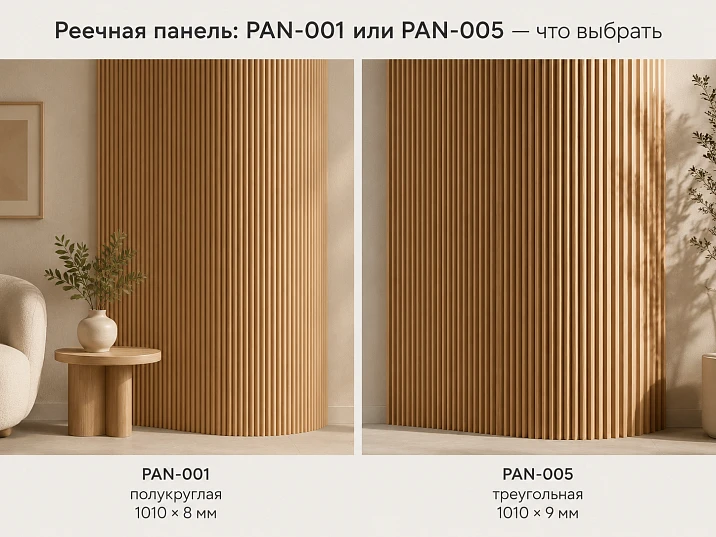
Comparison of two flexible slatted panels of the same width with different profile geometries
PAN-001 or PAN-005: short answer
PAN-001 is worth buying if you need a calm semicircular relief with a smooth transition of light and shadow for a small wall, bedroom, hallway, radius island, column, or furniture facade. PAN-005 is better to choose when a graphic surface with triangular elements, clear edges, and more contrasting chiaroscuro is required for a TV area, large accent wall, reception desk, or expressive furniture. The nominal width of both models is 1010 mm, materials and lengths match, and the depth difference is only 1 mm. Therefore, the final choice should be made not by the number 8 or 9 mm, but by the actual profile shape and lighting.
Buy semicircular slatted panel PAN-001 Buy triangular slatted panel PAN-005 buy slatted panels How to choose PAN using the OPAN sample
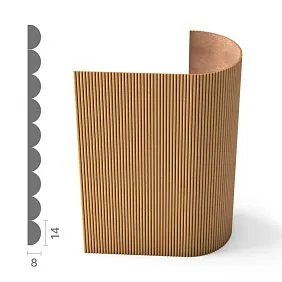
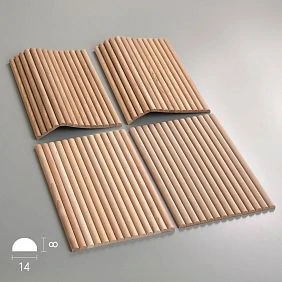
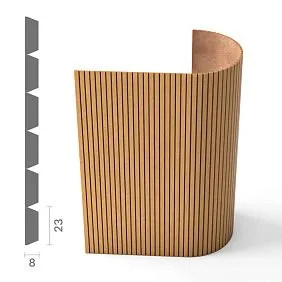
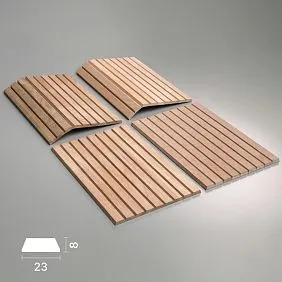
PAN-001 — semi-circular elements on a flexible fabric base. Confirmed profile depth — 8 mm.
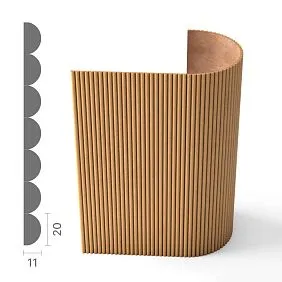
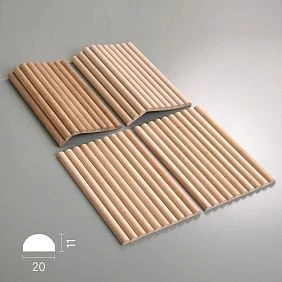
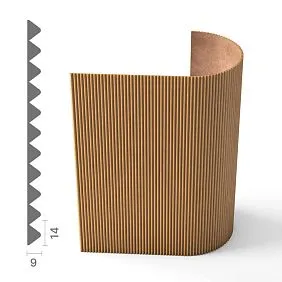
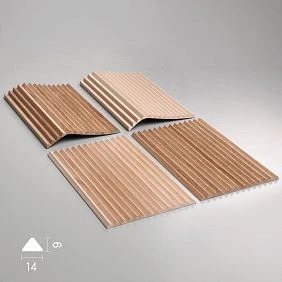
PAN-005 — triangular elements on a flexible fabric base. Confirmed profile depth — 9 mm.
Both panels have a nominal width of 1010 mm. Short length — 950 mm, long MDF — 2670 mm, beech and oak — 2400 mm.
Materials match. Available in MDF "Prestige", primed MDF "Prestige primed", beech, and oak.
The flexible base allows working with straight and curved surfaces. The minimum allowable radius is not specified in the source data, so it is checked against the sample and specific design.
Before purchasing a large batch, it is better to order OPAN-001 and OPAN-005. Physical samples show relief, material, and chiaroscuro more accurately than photographs.
Buying a slatted panel is more difficult than it seems from the catalog. PAN-001 and PAN-005 have the same width, the same length options, the same set of materials, and the same flexible fabric base technology. On screen, the difference may appear small: a semicircular element 8 mm deep or a triangular element 9 mm deep. In a real interior, it is the geometry that changes the character of the entire surface.
The semicircular profile PAN-001 softly transitions light into shadow. It creates a calm texture that can serve as a backdrop for a bed, console, island, or cabinet. The triangular profile PAN-005 separates the illuminated and shadow sides more sharply. This panel reacts more strongly to side light and is more noticeable on a large wall, TV area, or reception desk.
The buyer does not have to choose between different installation technologies or incompatible materials. Both models can be ordered in MDF, primed MDF, beech, or oak, and used on a flat plane, column, rounded corner, or radius facade. This makes the comparison pure: the question comes down to whether a soft semicircular relief or a more graphic triangular surface is needed.
For a delicate texture, you can choose PAN-001 size 1010 × 8 mm. For active chiaroscuro — choose PAN-005 size 1010 × 9 mmIf no geometry fits, it's worth opening catalog of flexible slatted panels and compare other profiles from the PAN series.




What is a flexible slatted panel and what problem does it solve
A flexible slatted panel is a ready-made module of repeating profiled elements attached to a fabric base. Unlike a set of individual slats, the buyer receives an already arranged pattern and can transfer it to a wall, column, furniture facade, or rounded surface without manually marking each batten.
Our factory also produces:
Creates relief without complex base milling
The panel adds volume to a finished wall or furniture piece. There is no need to cut dozens of identical semicircular or triangular elements and manually maintain the spacing. The main work shifts to laying out, trimming, finishing, and installing the ready-made module.
Get Consultation
Helps shape a radius
The fabric base allows the panel to wrap around curved surfaces. This is convenient for a column, rounded corner, radius kitchen island, and bent facade. However, flexibility does not mean compatibility with any radius: the actual bend is tested with a physical sample.
Covers a large surface with a repeating pattern
The nominal width of 1010 mm allows you to quickly assemble a wall or furniture surface with modules. The result depends on joints, orientation, and light. You cannot simply multiply the area by the number of panels and consider the project complete.
Works as a background or accent
PAN-001 is often perceived as calmer due to its semicircular elements. PAN-005 can become an active center because of its triangular facets. The choice affects not only the style but also how many other decorative elements can be placed nearby.
Connects the wall and furniture
One profile can be repeated on a wall panel, cabinet facade, and island. This connection helps avoid a random set of materials. However, the same model and finish must be coordinated from the same batch.
Suitable for painting or wood finish
MDF and primed MDF are chosen for opaque painting. Beech and oak allow preserving the wood character. The precise finishing system must match the material and operating conditions.
Confirmed options PAN-001 and PAN-005
| Model | Execution | Size | Profile shape | Base | Practical Meaning |
|---|---|---|---|---|---|
| PAN-001 | MDF, "Prestige" | 1010 × 8 × 950 mm | Semicircular elements | Flexible fabric | Short module for preparation and covering finish. |
| PAN-001 | MDF, "Primed Prestige" | 1010 × 8 × 950 mm | Semicircular elements | Flexible fabric | Prepared base for further painting according to project technology. |
| PAN-001 | Beech | 1010 × 8 × 950 mm | Semicircular elements | Flexible fabric | Short wood panel for furniture, column, or local accent. |
| PAN-001 | Oak | 1010 × 8 × 950 mm | Semicircular elements | Flexible fabric | Natural texture and soft chiaroscuro on a compact surface. |
| PAN-001 | MDF, "Prestige" | 1010 × 8 × 2670 mm | Semicircular elements | Flexible fabric | Long panel for painting for wall or tall furniture. |
| PAN-001 | MDF, "Primed Prestige" | 1010 × 8 × 2670 mm | Semicircular elements | Flexible fabric | Long primed module for covering finish. |
| PAN-001 | Beech | 1010 × 8 × 2400 mm | Semicircular elements | Flexible fabric | Long wood panel for wall, island, or facade. |
| PAN-001 | Oak | 1010 × 8 × 2400 mm | Semicircular elements | Flexible fabric | Long panel with pronounced oak texture and smooth light-and-shadow effect. |
| PAN-005 | MDF, "Prestige" | 1010 × 9 × 950 mm | Triangular elements | Flexible fabric | Short graphic panel for covering finish. |
| PAN-005 | MDF, "Primed Prestige" | 1010 × 9 × 950 mm | Triangular elements | Flexible fabric | Prepared panel for color accent and contrasting light-and-shadow effect. |
| PAN-005 | Beech | 1010 × 9 × 950 mm | Triangular elements | Flexible fabric | Short module for expressive furniture facade or stand. |
| PAN-005 | Oak | 1010 × 9 × 950 mm | Triangular elements | Flexible fabric | Compact oak panel with active geometry. |
| PAN-005 | MDF, "Prestige" | 1010 × 9 × 2670 mm | Triangular elements | Flexible fabric | Long module for a large wall or tall furniture for painting. |
| PAN-005 | MDF, "Primed Prestige" | 1010 × 9 × 2670 mm | Triangular elements | Flexible fabric | Long prepared panel for a graphic painted surface. |
| PAN-005 | Beech | 1010 × 9 × 2400 mm | Triangular elements | Flexible fabric | Long wood module for an accent wall and furniture. |
| PAN-005 | Oak | 1010 × 9 × 2400 mm | Triangular elements | Flexible fabric | Long oak panel for contrasting relief and directional light. |
PAN-001 and PAN-005: comparison by key criteria
| Criterion | PAN-001 | PAN-005 | What this changes in the interior |
|---|---|---|---|
| Shape of elements | Semicircular | Triangular | PAN-001 gives smooth chiaroscuro, PAN-005 gives sharper edges. |
| Nominal width | 1010 мм | 1010 мм | Width module calculations are performed identically. |
| Profile depth | 8 мм | 9 мм | The difference is only 1 mm, but geometry affects more than the number itself. |
| Short length | 950 мм | 950 мм | Both models fit a local facade, column, and a small wall section. |
| Long MDF | 2670 мм | 2670 мм | You can cover a tall wall or furniture with one long module. |
| Long beech and oak | 2400 мм | 2400 мм | For a higher plane, a joint or different layout will be required. |
| MDF | Yes | Yes | Both panels can be designed for covering paint. |
| Primed MDF | Yes | Yes | You can choose a prepared base and reduce the amount of pre-treatment. |
| Beech | Yes | Yes | Suitable for enamel or light finishes as per the project. |
| Oak | Yes | Yes | Allows preserving the expressive natural texture. |
| Flexible base | Fabric | Fabric | Both panels are suitable for straight and curved surfaces after checking the bend. |
| Chiaroscuro | Smooth | Contrasting | PAN-001 is calmer, PAN-005 is more active under side light. |
| Small room | Usually easier to fit in | Requires scale check | Graphic relief can dominate on a small plane. |
| Accent wall | Calm volume | Pronounced accent | The choice depends on whether the wall should be a background or the main element. |
| Main criterion | Softness of the profile | Geometric nature of the profile | Don't choose based solely on the 8 and 9 mm difference. |
Why the difference isn't limited to one millimeter
The depth of PAN-001 is 8 mm, PAN-005 is 9 mm. If you only look at the numbers, the models seem almost identical. In reality, the semicircle and triangle reflect light differently. One millimeter doesn't explain why the PAN-005 panel looks more graphic, while PAN-001 appears softer. The main factor is the surface shape of each repeating element.
The semicircle gathers a broad highlight
Light glides over the rounded surface gradually. There is no sharp boundary between the light and dark sides. This makes PAN-001 appear calmer under diffused lighting and less conflicting with furniture, textiles, and moldings.
The triangle divides the surface into facets
In PAN-005, one side of the element can be illuminated while the adjacent side remains in shadow. The contrast changes as a person moves and the direction of light shifts. The panel emphasizes geometry more strongly, especially in a dark finish.
On a large wall, the difference intensifies
A single sample about the size of a palm shows the shape but not the repetition scale. On a wall with multiple modules, the smoothness of PAN-001 forms a background, while the rhythm of PAN-005 turns into a noticeable graphic grid.
On a radius, the profile changes perception
When bent, the elements rotate relative to the light source. Semicircular slats maintain a smooth transition, while triangular ones begin to show different facets along the arc. That's why the sample needs to be applied to a surface with approximately the same radius.
Color enhances or softens the geometry
Light enamel makes both models calmer, but PAN-005 still retains a sharper edge. Dark oak tinting emphasizes shadows and makes the triangular profile more noticeable. The semicircular PAN-001 in a dark color remains softer, although the relief also intensifies.
What the semicircular profile PAN-001 looks like
PAN-001 consists of semicircular slats on a flexible fabric base. This profile does not cut the plane into rigid light zones. It suits an interior where a slatted surface should add depth but not become the main decorative event.
A calm background for a bedroom
Behind the headboard, semicircular elements add volume without sharp geometry. They support soft textiles and diffused light. Before purchasing, check that the panels do not cover sockets, sconces, or bed fastenings.
Delicate hallway
In a narrow space, an active relief can visually bring the wall closer. PAN-001 allows adding texture more calmly. The short 950 mm module is suitable for a local insert, the long one for a vertical wall or cabinet.
Radius island
The rounded profile logically supports the smooth shape of the furniture. The panel wraps around the base thanks to the fabric backing, but the permissible bend is checked with a sample. For such a project, you can choose a slatted panel for a rounded kitchen island.
Furniture facade
On a cabinet or dresser, PAN-001 creates a tactile relief that does not look too sharp. Check the operation of doors, gaps, handles, and the direction of the pattern. The panel should not interfere with opening.
Adjacency to active decor
If there is already molding, trim, carved overlays, or expressive furniture nearby, the semicircular surface works as a unifying background. It adds depth without competing with each element for attention.
Purchasing a specific model
When a project requires a soft texture, you can buy the PAN-001 panel made of oak, choose beech or MDF for painting and check the length in the product card.
How the triangular profile PAN-005 works
PAN-005 is built from triangular elements on the same flexible base. The faces create a clearer separation of light and shadow. The panel is suitable for projects where the relief should be readable from a distance and support a geometric interior.
Expressive TV area
The triangular profile is noticeable even with limited decor. Side lighting enhances the edges, and a dark finish creates deep chiaroscuro. It is important not to position the screen and backlight so that the surface produces unwanted glare.
Large accent wall
On a large plane, PAN-005 creates a graphic rhythm. It can replace additional decor because the surface itself becomes the main element. Before ordering, you need to check the sample from the distance from which the wall will be seen most often.
Reception desk
The counter facade receives an active vertical or horizontal texture depending on the layout. The panel must withstand the selected finishing and cleaning scenario. For such a task, you can choose PAN-005 for furniture and reception counter.
Cabinet, dresser, or nightstand
The triangular profile helps make a simple shape more expressive. On a small facade, the pattern may be too active, so the sample is applied to the entire piece of furniture, not evaluated separately.
Directional light
If the project includes side lighting, PAN-005 shows sharper shadows. The direction of the light fixture must be aligned with the orientation of the relief. Otherwise, some edges will be lost, while others will become overly contrasting.
Purchasing a specific model
For a graphic surface, you can buy an oak panel PAN-005, choose beech or prepared MDF and check the light and shadow on the sample.
Smooth or contrasting light and shadow
Diffuse daylight
PAN-001 shows a soft relief and suits a calm background. PAN-005 preserves edges, but the contrast becomes more moderate. In a room with windows opposite the wall, the difference may be less noticeable than with side lighting.
Side daylight
When the window is on the side, the geometry is more pronounced. PAN-001 gives a smooth sequence of highlights and shadows. PAN-005 creates clearer light bands and may change appearance throughout the day.
Top lighting
Light from above emphasizes the top edges and recesses. On a tall module, it is important to see how the shadow is distributed along the entire length. The panel near the ceiling and at eye level may look different.
Hidden side lighting
This light is especially expressive on PAN-005. But an overly close source can create harsh shadows and emphasize installation irregularities. PAN-001 is more tolerant of soft side light.
Dark coloring
On a dark surface, the chiaroscuro becomes deeper. PAN-005 looks more active and graphic, PAN-001 looks more voluminous but calmer. The choice should be made based on a sample with the real color, not on a white blank.
Light enamel
Light finish reduces contrast but does not erase form. On PAN-001 it creates a soft wave, on PAN-005 a readable edge remains. A thick layer of enamel should not fill gaps or smooth the profile.
The material on which profile shape works best with backlighting.
Which panel to choose for a small room
In a small bedroom, hallway, or study, the slatted pattern is close to the viewer. Here, scale, shadows, and repetition frequency are especially noticeable. PAN-001 usually fits in more easily due to its semicircular shape, but the final decision depends on color, area, and light.
Local insert instead of the entire wall
It is not necessary to cover the entire surface with panels. A short 950 mm module can be used behind a console, near a bed, on part of a wardrobe, or around a mirror. This approach allows you to add texture without overloading.
Light PAN-001
The semicircular profile in a light finish supports a calm interior. Shadows remain soft, and the wall does not look too fragmented. However, the actual sample should be viewed next to furniture and textiles.
PAN-005 as a point accent
The triangular model can be used in a narrow area where graphics are needed intentionally. A large area in a small room requires verification: an active relief can visually bring the wall closer.
Vertical or horizontal layout
Orientation changes perception. A vertical direction can emphasize height, a horizontal one — width. Specific installation and cutting must be coordinated before ordering, especially if the module length does not match the surface size.
Sockets and switches
On a small wall, engineering elements occupy a noticeable share of the area. Their position is marked in advance. You cannot accidentally cut the relief so that the switch frame ends up on a protrusion or overlaps a joint.
Which model is suitable for a large accent wall
On a large plane, the pattern is viewed from different distances. PAN-005 works more strongly as an independent accent, PAN-001 creates a calm architectural background. The choice depends on the amount of furniture, color, and the role of the wall.
PAN-005 as the main relief
Triangular elements are readable from a distance and support directional light. If the wall should become the center of a living room, reception, or showroom, a graphic surface helps to avoid unnecessary overlays and frames.
PAN-001 as a background for furniture
The semi-circular profile suits the wall behind a sofa, bed, console, or display case. It adds volume but keeps the furniture as the main focus. On a large area, it is especially important to maintain even joints between modules.
Dividing the wall into zones
The panel can only be used in the central part or inside an architectural frame. The boundaries must align with furniture, light fixtures, and the room's axes. An arbitrary stop in the middle of the wall looks like a shortage of material.
Checking from a distance
The sample should be viewed not only up close. Step back three, five, or more meters depending on the room. PAN-001 can become an almost uniform texture, while PAN-005 retains a more active rhythm.
PAN-001 or PAN-005 for the TV zone
PAN-001 behind the screen
The soft profile competes less with the image. It is suitable if the TV, cabinet, and light fixtures already create an active composition. Wiring, mounts, and ventilation gaps are designed before panel installation.
PAN-005 as a graphic background
The triangular relief makes the TV zone more expressive. Side lighting enhances the edges. It is necessary to check whether glare appears and whether the rhythm distracts from the screen.
Dark wood finish
Tinted oak helps visually conceal the black screen. On PAN-005, the dark color creates deep shadows; on PAN-001, a softer surface. The shade is matched to a sample.
Panel around appliances
Outlets, cables, brackets, and service access must not be blocked without a project. The panel should not obstruct removing the TV or replacing wiring.
Choosing a panel for a kitchen island
The slatted surface helps design the island's blind facade and connect the kitchen with the living room. Radius, leg clearance, cleaning, and finish are important here. PAN-001 and PAN-005 are suitable with a flexible base but offer different characters.
PAN-001 for a soft island
Semicircular elements support rounded countertops and calm facades. They break up a small kitchen less. For the project, you can choose a semicircular panel for a curved wall and test it on a sample.
PAN-005 for an expressive island
The triangular profile turns the base into a noticeable object. It suits a large island, a kitchen-living room, and directional lighting. In a walk-through area, edges and finish must be protected from constant impacts.
Straight facade
Both models are easy to compare on a flat surface. PAN-001 is calmer, PAN-005 is more graphic. The solution needs to be linked to the kitchen facades, countertop, and lighting.
Radius facade
The flexible fabric base allows wrapping around the shape, but the minimum radius is not confirmed. Before ordering a full-size panel, it is useful to apply an OPAN sample to the actual or mock-up radius.
Kick zone
If the island has seating, shoes may touch the panel. The material and coating must account for such contact. Resistance to any impacts and wet cleaning cannot be promised without a confirmed finishing system.
Additional scenarios are revealed in the article about how to choose material, rhythm, and finish for a kitchen island.
PAN-001 and PAN-005 for column and rounded corner
Column
The panel wraps around the surface thanks to its flexible base. Before ordering, measure the circumference, height, and radius. It is better to place the joint in a less visible area or align it with an architectural axis.
Rounded external corner
PAN-001 supports smooth shapes, PAN-005 creates a more complex play of facets. On a small radius, triangular elements change direction relative to light more strongly, so a sample is especially important.
Inner radius
The panel must fit without lifting the fabric base and without excessive tension. The feasibility of a specific bend is checked on site. Flexibility cannot be considered a guarantee for any internal corner.
Joint around the circumference
Calculation based solely on area does not work. You need to know the circumference, the actual coverage width, and the connection point. Sometimes module trimming is required, which must preserve the uniformity of the pattern.
Column height
MDF 2670 mm is suitable for higher surfaces, beech and oak 2400 mm for lower heights or compositions with a joint. The short version 950 mm can be used in the lower belt or local finishing.
For radius tasks, it is useful to study the material about a semicircular or triangular profile for the radius.
What to choose for a wardrobe, chest of drawers, and bedside table
Wardrobe
PAN-001 makes tall facades calmer. PAN-005 emphasizes verticality and geometry. Before installation, check hinges, gaps, handles, and additional thickness of 8 or 9 mm.
Chest of drawers
On small facades, the PAN-005 relief can become very active. PAN-001 often leaves room for handles and countertops. The short length of 950 mm is convenient for local furniture, but cutting is still planned in advance.
TV cabinet
Graphic PAN-005 connects furniture with an accent wall if a single profile is used. PAN-001 is suitable for a calmer bedside table. The relief should not interfere with opening drawers and accessing appliances.
Radius facade
Both panels allow for designing curved furniture without independently milling each element. It is necessary to check the radius, opening direction, and panel edge. A detailed approach is revealed in the article about how to choose a panel for curved furniture.
Custom furniture
It is better to embed the panel before manufacturing the body. This allows calculating the thickness of the facade, hinges, handles, and joints. Attempting to glue a relief onto a finished door without checking may disrupt the gaps.
PAN-005 for reception desk and commercial interior
Reception desks, bar areas, salons, or showrooms require surfaces that are readable from a distance. PAN-005 is often suitable due to its triangular profile. PAN-001 is chosen when the desk should be calmer and not compete with the logo, lighting, or product display.
Desk facade
The relief must align with the furniture axes and not be randomly interrupted at corners. On a long desk, modules are calculated based on actual width, not just square meters.
Logo and navigation
Active PAN-005 may compete with letters and signs. Before ordering, create a visual mockup. PAN-001 more often works as a background for a large logo.
Visitor contact
The lower part of the desk receives impacts from shoes and cleaning equipment. The finish must match the load. The specific durability of the coating depends on the chosen system and should not be promised without confirmation.
Lighting
Directional light reveals the triangular profile but also highlights joints and unevenness. The mounting surface must be prepared especially carefully.
MDF, primed MDF, beech or oak
The materials for PAN-001 and PAN-005 are the same, so profile selection can be separated from finish selection. First, decide whether soft or graphic geometry is needed, then choose MDF, prepared MDF, beech, or oak. This allows you not to sacrifice the right shape for the material.
MDF "Prestige"
Regular MDF is suitable for a project with opaque painting if the workshop is ready to perform preparation. Before applying the finish, the surface must be primed according to the chosen technology. Enamel cannot be applied to unprepared material and expect a uniform, consistent result on all elements.
MDF "Prestige primed"
The primed version reduces some of the preparatory work. It is especially convenient for long panels of 2670 mm and large areas under enamel. However, the primer is not a ready decorative coating: color, intermediate processing, and finish depend on the project.
Beech
Beech has a calm wood texture and is suitable for opaque enamel or light finishing if such technology is agreed upon. On PAN-001, it supports a soft pattern; on PAN-005, it emphasizes geometry without a pronounced oak pattern.
Oak
Oak is chosen when the texture should remain visible. Tinting changes the shade but preserves the natural pattern. On the semicircular profile, the texture reads smoothly; on the triangular one, it interacts with edges and light and shadow.
Why the material needs to be viewed on the relief
A flat oak sample does not show how the fibers and tinting will look on a semicircle or triangle. It is useful for solving compare MDF, beech and oak on OPAN-001 and to compare oak, beech, and MDF in person on OPAN-005.
One batch for the entire surface
Wood panels may differ in shade and pattern. Before installation, they are laid out side by side, distributed across the wall, and finished with one system. An additional order over time needs to be compared with the saved sample.
MDF slatted panels for painting
Both models cover the request for slatted wall panels for painting. PAN-001 is chosen for a soft relief, PAN-005 for graphic edges. Color does not cancel geometry, but only enhances or softens it.
Light enamel
On PAN-001, a calm wave is obtained, on PAN-005 — a clear but less contrasting geometry. A light color is suitable for a small room and furniture where the relief should not dominate.
Dark enamel
Shadows become deeper. PAN-005 looks particularly active, PAN-001 retains a softer character. Before ordering, you need to see the paint sample under real lighting.
Wall and panel color
The same color unifies the relief with the wall. A contrasting color highlights a separate area. The solution must take into account joints, boundaries, and adjacent furniture, not just the selected shade.
Preparation of unprimed M<Length 950 mm
Suitable for a local insert, furniture facade, part of a column, low stand, or lower belt of the wall. A short module is easier to try on and transport. For a tall surface, several sections or a different orientation will be needed.
MDF 2670 mm
A long module allows covering a tall wall, cabinet, or stand with fewer transverse joints. Before ordering, you need to check delivery access, elevator, stairs, and storage space. Cutting the panel in advance is only possible with a ready cutting map.
Beech and oak 2400 mm
Wood options are suitable for the standard height of many walls and furniture, but for greater height, a joint, baseboard, top insert, or different layout will be needed. You cannot pass off a length of 2400 mm as 2670 mm by analogy with MDF.
Vertical layout
The length runs along the height of the surface, and the width of 1010 mm builds the wall horizontally. This option emphasizes height and is more often used on walls and facades. The specific direction must be confirmed by the project.
Horizontal layout
The panel can be oriented differently if the mounting scheme and appearance allow it. Then the length affects the width of the covered area. Joints and edges need to be drawn in advance because the horizontal relief shows mismatches more strongly.
Lengthwise joint
The connection must match in rhythm, material, and shade. On PAN-005, side light emphasizes the difference more strongly. On PAN-001, the joint may look calmer but does not disappear automatically.
How to calculate the number of panels
The calculation starts with the surface layout, not the total room area. The nominal width of one module is 1010 mm. You need to know the length or height of the selected version, the layout direction, openings, corners, and trimming points.
Measure each plane separately
A wall, column, island, and facade are calculated as different zones. Even if the material is the same, the cutting will differ. Each surface is assigned a number and a specific model PAN-001 or PAN-005.
Determine the direction of the relief
Before counting, you need to decide whether the elements go vertically or horizontally. This determines which side of the size works for height and which for the width of the coverage.
Preliminary width calculation
If modules are installed vertically and the nominal width of 1010 mm covers the wall horizontally, the quantity can be preliminarily determined by dividing the section width by 1010 mm, rounding up. Then the calculation is adjusted for corners, joints, and cuts.
Do not mechanically subtract openings
A window, door, niche, or TV may yield remnants that cannot be used elsewhere due to pattern direction. Specific pieces need to be allocated on the cutting map.
Column and circle
For a round surface, calculate the circumference and compare it with the nominal width of the modules. The final joint location is chosen in advance. The minimum radius is checked with a sample.
Waste depends on the project
You cannot assign a single percentage for a wall, island, and furniture. The more corners, outlets, niches, and complex facades, the more cuts. The allowance is discussed after layout.
Count in modules and dimensions, not just in square meters
Area helps estimate the overall scale but does not show how many whole panels need to be purchased. The final list should include the model, material, length, quantity, and purpose of each panel.
Why you cannot count only by area
Module width is fixed
A few centimeters of wall remainder may require separate trimming or an additional panel. The area does not show this.
Material lengths differ
MDF 2670 mm, beech and oak 2400 mm produce different joints at the same height. Comparing square meters without considering length leads to errors.
The radius uses the actual circumference
The column projection on the plan does not equal the surface length around it. The calculation requires the circumference or an exact template.
The pattern must continue
The remainder can technically cover a section but disrupt orientation or sequence. On PAN-005, mismatched faces are especially noticeable under light.
Engineering elements create local cutouts
Sockets, switches, brackets, and furniture hinges require precise holes. These cutouts may render the remainder unusable for another area.
How to join modules by width
Dry layout
Before gluing, panels are laid on the floor or temporarily applied to the wall. The rhythm, shade, and seam location are checked. Installation must not start from a random edge without calculating the last module.
Centering
On an accent wall, it is useful to decide whether the pattern will start from the center or from the corner. A narrow cut at one edge may look worse than two symmetrical cuts.
Wood grain pattern
Beech and oak are sorted by shade. Adjacent panels should look consistent. On oak, a sharp tone change is noticeable even with a precise geometric joint.
Painting
MDF panels are easier to unify with a covering color, but the seam must still be even. A thick layer of enamel should not be used as a way to hide improper fitting.
Light
Side lighting reveals the difference between modules. PAN-005 is particularly demanding. Before final fixation, turn on the working light and check the flatness.
Internal and external corners
Inner corner
Inside a corner, two planes meet at a real, not conditional, right angle. The panel can be brought to the junction line or unfolded through a flexible transition, if the radius and project allow. The solution is tested on a sample before cutting the entire batch.
External right angle
A sharp edge requires careful finishing. A flexible base does not turn the panel into a ready-made corner profile. It is necessary to decide whether the relief will wrap around the rounding, meet at a miter, or end on one plane.
Rounded external corner
PAN-001 usually supports a smoother transition. PAN-005 creates a change of edges along an arc and looks more active. The minimum radius is not specified, so the actual sample must replicate the intended curve.
Furniture corner
On a cabinet, island, or counter, the edge receives more contact. The panel end must be protected and not interfere with doors. The fabric base cannot be left exposed in a walkway area.
Joints at ceiling and floor
A tall panel must finish evenly. If the length of 2400 or 2670 mm is insufficient, the joint, baseboard, or top insert is designed in advance. An accidental narrow strip near the ceiling spoils the impression of an expensive surface.
Installation of PAN-001 and PAN-005
The cards for both models specify contact adhesive and recommend additional mechanical fastening with micro-pins. This does not mean that any adhesive is suitable for any wall. The substrate, finish, humidity, and area weight must be checked according to the instructions and project.
Wall preparation
The surface must be strong, level, dry, and free of dust. Weak paint, peeling putty, or loose plaster will not hold the panel even with good adhesive. First, strengthen the base, then perform an adhesion test.
Dry fitting
All modules are applied without glue, marking joints, corners, sockets, and cuts. For PAN-005, it is especially important to turn on side lighting: it reveals even a slight plane difference.
Contact adhesive
The composition is chosen based on the panel material, fabric, wall, and future conditions. It is useful to study how to glue PAN-001 and PAN-005, but the final decision is made according to the instructions of the specific adhesive.
Micro pins
Additional mechanical fixation helps hold the panel until it gains strength and secures complex areas. Points are placed so as not to split the element or leave a noticeable mark. The method depends on the base and tool.
Installation on a radius
The panel is gradually pressed to the shape without bending the fabric base or creating excessive tension. If the sample does not comfortably follow the radius, the full-size panel cannot be forced to bend.
Trimming
The tool must provide a clean edge on MDF, beech, or oak and not tear the fabric. The cut line is checked twice. After trimming, the end is processed according to the chosen finishing system.
Installation after painting or before it
The sequence depends on the project. Separate painting makes it easier to access the relief, but requires careful installation without damage. Painting on the wall helps to unify the seams, but makes it more difficult to apply evenly in recesses. The solution is tested on a sample.
Sockets and switches
Holes are made according to precise markings. The frame must rest on a flat base, not on the top of a separate batten. Electrical work is performed safely and separately from decorative installation.
Why order OPAN-001 and OPAN-005
A sample is needed not only for color selection. It shows the shape, depth, material, curve, quality of the future painting, and behavior under light. Since PAN-001 and PAN-005 differ mainly in geometry, a physical comparison is especially useful.
OPAN-001
The sample allows you to evaluate the semi-circular relief of 8 mm, check the softness of the chiaroscuro and apply the material to the wall, furniture, or radius.
OPAN-005
The sample measuring 197 × 9 × 310 mm is made from MDF, beech, and oak. With it, you can evaluate the triangular profile of 9 mm and see the facets under real light.
Comparison under one lighting
Place both samples side by side, paint or tint them using the same system, and change the direction of light. Only then can you separate the influence of shape from the influence of material and color.
Radius check
Apply the samples to a mock-up of a column or island. If one profile looks strained or too active on the curve, the choice becomes more obvious.
Trial installation
On a separate section of the wall, you can test the glue, micro-pins, and edge treatment. Such a test is safer than experimenting on the entire wall.
Commercial route
The detailed path from sample to panel is revealed in the article about why to compare panels before the main order.
What to buy together with PAN-001 or PAN-005
The project kit consists not only of full-size panels. Samples are useful before the main order, and for installation, a confirmed scheme of adhesive and mechanical fixation is needed. Adjacent profiles should only be considered when PAN-001 or PAN-005 do not fit the geometry.
| What to add to the purchase | Why this is needed | For which scenario | What to Check |
|---|---|---|---|
| Flexible slatted panel with soft relief | Creates a semicircular texture with a depth of 8 mm | Bedroom, hallway, radius island, column, furniture | Material, length, radius, light, and layout |
| Flexible panel with triangular relief | Creates a graphic surface with a depth of 9 mm | TV area, large wall, reception desk, accent furniture | Side lighting, scale, and surface quality |
| Buy slatted panels for walls | Allows comparison of PAN-001, PAN-003, PAN-005, and PAN-007 | Need a different depth or pattern frequency | Profile, materials, lengths and samples of OPAN |
| Order sample PAN-001 | Shows a semi-circular profile, material and light-shadow | Choice for radius, coloring and small room | Curve, color, relief and compatibility with interior |
| Order sample PAN-005 | Shows triangular facets under real lighting | TV zone, reception, dark finish, backlighting | Shadow contrast, material and test finish |
| Compare relief 8 and 11 mm | Helps understand choice by depth, not by shape | PAN-001 is too soft, PAN-005 does not solve the depth issue | Do not mix two different comparative intents |
| Order OPAN-001 and OPAN-005 | Explains the path from sample to full-size order | Large batch, complex color, curved surface | Compare samples in the same material and light |
| Choose glue for slatted panel | Helps prepare the installation diagram | Wall, column, island, furniture facade | Base, contact adhesive, and additional micro-pin fastening |
How not to confuse PAN-001 and PAN-005 with similar products
With PAN-003
PAN-003 is involved in another comparison: there the buyer chooses the relief depth of 8 or 11 mm. In the pair PAN-001 and PAN-005, the main question is semicircle or triangle with almost the same depth. If a deeper panel is needed, it is useful to know how PAN-001 differs from deep PAN-003.
With PAN-007
PAN-007 belongs to a neighboring profile and should be compared with PAN-005 in terms of scale and pattern frequency. Its characteristics cannot be transferred to PAN-005 without a card.
With individual wooden slats
The PAN module already contains repeating elements on a fabric base. Individual slats require independent marking, maintaining spacing, and individual fastening. These solutions are not equal in technology.
With rigid wall panel
The flexible base allows working with radius. A rigid panel may be easier on a straight wall, but will not follow a column without additional structure. Not every slatted panel should be considered flexible.
With acoustic panel
The source data does not include confirmed acoustic tests for PAN-001 and PAN-005. Do not promise sound absorption or noise insulation solely based on texture and fabric backing.
With moisture-resistant panel
Materials and finishes must be evaluated for the specific area. Panels cannot be automatically used in bathrooms, showers, or outdoors without a confirmed protection and installation system.
With pre-painted panel
MDF and primed MDF are bases for further finishing. Primer should not be considered a final decorative coating. Color and protective layers remain part of the project.
Practical choice for specific situations
Need to design the wall behind the bed
PAN-001 is often suitable for a calm bedroom: the semicircular profile creates soft light and shadow and does not conflict with textiles. PAN-005 is appropriate if the interior is built on geometry and the wall should become the main accent. Before ordering, mark the dimensions of the future panel on the wall, note sconces, outlets, and headboard edges.
Need an expressive TV area
PAN-005 works stronger under side lighting and is readable from a distance. PAN-001 is chosen if the screen and furniture are already active enough. Both models require pre-planned wiring and access to the TV mount.
Need to design a narrow hallway
Semicircular PAN-001 is usually safer in scale. Light coloring and a local insert help avoid overloading the space. Triangular PAN-005 can be used on a small end wall where a graphic landmark is needed.
Need a panel for a large living room
On a wide wall, PAN-005 creates strong relief and supports directional light. PAN-001 forms a calmer background for a sofa, art, or furniture. The decision is made based on the wall's role, not the room size as such.
Need to clad a radius island
Both models have a flexible base. PAN-001 visually supports roundness more softly, PAN-005 turns the arc into a sequence of facets. Samples are applied to the radius mockup to check the joint and the leg contact area.
Need to design a column
Measure the height and circumference, determine the seam location. PAN-001 gives a calm cylindrical volume, PAN-005 creates dynamic light variation. The minimum radius cannot be assigned without physical verification.
Need to update the cabinet without making new fronts
First, check if the hinges can handle the extra thickness and whether the gaps will change. PAN-001 is suitable for calmer furniture, PAN-005 for an accent front. Handles and edges must be included in the design before gluing.
Need to design the reception desk
PAN-005 helps make the surface noticeable from a distance. PAN-001 is suitable if the logo and lighting are already active. For a commercial interior, be sure to check the finish, cleaning, shoe impacts, and repairability.
Need to paint the panel to match the wall color
Choose MDF or primed MDF. PAN-001 will give a soft texture in the same color as the wall, PAN-005 will preserve sharper edges. A test coat is needed on the same profile, not on a flat plate.
Need to preserve the natural texture
Beech or oak allow the wood to remain visible. Oak shows the texture more strongly, especially under tinting. PAN-005 connects the wood grain with the edge, PAN-001 with a smooth shape.
Need to cover a wall about 2.6 meters high
Long MDF 2670 mm may allow avoiding a horizontal joint after precise measurement and trimming. Beech and oak have a length of 2400 mm, so a well-thought-out joint will be required for greater height.
Only the lower part of the wall needs to be finished
Short panels 950 mm are suitable for the base, the area behind the console, or the lower belt. The border must align with furniture, molding, or another architectural line. The panel cannot end at a random mark.
Main mistakes when buying PAN-001 and PAN-005
Choosing a profile only by photo
The screen does not convey depth, material, and light-shadow. The same photo under frontal light can hide the difference between a semicircle and a triangle. Order OPAN samples and apply them to the real surface.
Considering the difference of 8 and 9 mm insignificant
The difference itself is indeed small, but the geometry differs fundamentally. The mistake is not in ignoring one millimeter, but in ignoring the profile shape.
Comparing only under frontal light
Frontal lighting smooths out shadows. PAN-005 must be viewed from the side, otherwise the graphic nature will appear after installation and may be unexpectedly strong.
Buying a large batch without samples
Color, curvature, and relief are best checked before ordering full-size panels. The mistake will repeat across the entire wall, not just on one small element.
Mixing PAN-001 and PAN-005 on the same continuous plane
Different profiles create different shadows and rhythm. Mixing can only be intentional with clear zone separation. Random switching in the middle of a wall looks like a configuration error.
Not accounting for the lengths of different materials
MDF is produced in 2670 mm lengths, beech and oak in 2400 mm. You cannot calculate a wood wall based on MDF length and then find a missing section on site.
Calculating quantity only by square meters
Module width, direction, openings, and joints affect the number of whole panels. A cutting map is mandatory.
Not checking the layout relative to corners
The last narrow section near an external corner can ruin the composition. The installation start point is chosen after calculating both edges.
Ordering regular MDF without a budget for priming
MDF "Prestige" requires preparation. If the finishing budget is limited, a primed version may be more rational. You cannot compare only the price of the panels themselves.
Applying enamel to unprepared MDF
This approach leads to uneven absorption, rough edges, and unpredictable finish. Preparation must follow the technology.
Not coordinating the shade of oak panels
Natural material varies. Panels are laid out and tinted in one batch, and a control sample is kept.
Assuming a flexible base guarantees any radius
Each profile and material has physical limitations. The minimum radius is not confirmed, so bending is tested with a sample.
Promising acoustic properties
Relief and fabric base alone do not confirm sound insulation or sound absorption. Such promises without testing are incorrect.
Using in a wet area without verification
Bathroom, shower, exterior wall, and constant contact with water require a special system of material, finish, and adhesive. The initial data does not confirm universal moisture resistance.
Attach to a weak finishing layer
The adhesive will hold the panel no stronger than the paint or plaster holds on the wall. The base must be reinforced before installation.
Do not account for sockets, switches, and furniture
Engineering elements and facade openings must be marked on the layout. Random cutouts disrupt the rhythm and increase waste.
Who PAN-001 is suitable for
- a small bedroom, hallway, or study;
- a wall that should become a calm background;
- a radius kitchen island and a rounded furniture facade;
- a column or a rounded corner;
- an interior with active moldings, frames, or furniture;
- project with soft diffused lighting;
- MDF under light or colored enamel;
- beech or oak with delicate wood texture;
- local insert 950 mm long;
- high MDF wall 2670 mm long;
- customer who values smooth chiaroscuro;
- furniture facade where relief should not dominate.
When it's better not to choose PAN-001
- need a maximally graphic faceted surface;
- the panel should be the main accent of a large wall;
- the project is built on sharp side chiaroscuro;
- the triangular relief is better connected with furniture and architecture;
- a different depth is needed, for example comparing PAN-001 and PAN-003;
- the surface has an unconfirmedly small radius;
- humidity and outdoor application conditions are not coordinated;
- confirmed acoustic characteristics are expected;
- the mounting wall is weak and unprepared;
- dimensions and cutting layout are not calculated.
Who is PAN-005 suitable for
- TV zone with directional or side light;
- large accent wall;
- reception desk, showroom, salon, or commercial furniture;
- large kitchen island;
- cabinet, dresser, or chest with a graphic facade;
- interior with clear geometry;
- dark finish or oak tint;
- project where the relief should be readable from a distance;
- long MDF module 2670 mm;
- radius surface after checking with a sample;
- customer who needs contrasting edges;
- accent area that replaces additional decor.
When it's better not to choose PAN-005
- a small room is already overloaded with furniture and decor;
- a neutral calm background is needed;
- side lighting makes shadows excessively harsh;
- the wall has unevenness that lighting will emphasize;
- the relief will constantly be subject to impacts without a suitable finish;
- a soft rounded connection with the interior is needed;
- the purchase is made without an OPAN sample;
- the panel is planned in an unconfirmed wet area;
- calculation is based on area only;
- compatibility with any radius is expected.
What to Check Before Ordering
- article PAN-001 or PAN-005;
- profile shape — semicircle or triangle;
- depth 8 or 9 mm;
- nominal width 1010 mm;
- length 950, 2400 or 2670 mm;
- material: MDF, primed MDF, beech or oak;
- laying direction;
- total development of wall, column, island or facade;
- number of whole modules and cutting map;
- joint locations along width and length;
- internal and external corners;
- actual surface radius;
- sockets, switches, brackets, and furniture gaps;
- daylight, side light, and artificial light;
- test patch or tinting;
- compatibility of adhesive with the base;
- need for additional micro-pin fastening;
- operating and cleaning conditions;
- delivery and storage of long panels;
- current parameters and ordering conditions in the product card.
How to buy PAN-001 or PAN-005 on STAVROS
Start with the form. For a soft semicircular pattern, open the card and buy the semicircular slatted panel PAN-001. For triangular facets and active chiaroscuro, you can Buy triangular slatted panel PAN-005.
Before a full-size order, it is worth buying a sample OPAN-001 и buying a sample OPAN-005. Compare them in the same material, in daylight and side light, on a flat plane and the intended radius.
After selecting the profile, determine the material and length. MDF and primed MDF are suitable for covering paint, beech and oak for a wood solution. Short panels have a length of 950 mm, long MDF — 2670 mm, beech and oak — 2400 mm.
If you need a different pattern, go to the section and select panels from MDF, beech, or oak. Before placing a large order, it is helpful to provide the STAVROS manager with the surface dimensions, layout direction, radius, material, number of modules, and selected finish.
FAQ: questions about PAN-001 and PAN-005
How is PAN-001 different from PAN-005?
PAN-001 has semicircular elements with a depth of 8 mm, PAN-005 has triangular elements with a depth of 9 mm. The width, materials, lengths, and flexible base are the same.
Which panel looks calmer?
Usually PAN-001. The semicircular shape creates a smoother transition of light and shadow.
Which panel looks more graphic?
PAN-005. The triangular edges more strongly separate the light and shadow sides.
How important is the difference between 8 and 9 mm?
One millimeter is less important than shape. A semicircle and a triangle interact with light differently even at similar depths.
Which panel should I choose for a small room?
PAN-001 usually fits in more easily. PAN-005 can be used locally if a deliberate accent is needed.
What should I choose for a large accent wall?
PAN-005 suits more pronounced geometry. PAN-001 is better if the wall should remain a backdrop for furniture or art.
Which model is suitable for a TV area?
Both. PAN-001 is calmer, PAN-005 is more active under side lighting. Need to check glare, wiring, and scale.
Can panels be used on a column?
Yes, the flexible fabric base works with curved surfaces. The minimum radius needs to be checked with a sample.
Which panel is best for a curved kitchen island?
PAN-001 softens the rounded shape, PAN-005 creates a more graphic arc. The decision is made after trying OPAN samples.
What materials are the panels made from?
From MDF "Prestige", primed MDF "Prestige primed", beech, and oak.
What lengths are available?
Short — 950 mm. Long MDF — 2670 mm. Beech and oak — 2400 mm.
What is the width of PAN-001 and PAN-005?
The nominal width of both models is 1010 mm.
What should I choose for painting?
MDF or primed MDF. The primed version reduces the amount of initial preparation but still requires final painting.
What to choose for visible wood texture?
Beech or oak. Oak usually gives a more expressive pattern, especially under tinting.
Can regular MDF be painted without primer?
No. MDF needs to be prepared according to the technology. The primed version already has a preparatory layer but is not a finished finish.
Can panels be used in wet areas?
Only after checking the material, coating, glue, and conditions. Universal moisture resistance is not confirmed in the initial data.
Do PAN-001 and PAN-005 have acoustic properties?
There are no confirmed tests, so sound insulation or sound absorption cannot be promised.
How to calculate the number of panels?
You need to determine the direction, dimensions of each plane, width of 1010 mm, length of the selected material, openings, corners, and cuts. Counting only square meters is not enough.
What to use to attach panels?
The cards include contact adhesive and recommend additional mechanical fixation with micro-pins. The composition and scheme depend on the base.
Why are OPAN samples needed?
They allow you to check the profile, material, color, bend, and light-shadow before ordering full-size panels.
Can PAN-001 and PAN-005 be mixed?
In different zones — yes, if the difference is intentional. On one continuous plane, mixing usually disrupts the pattern.
Which profile works best with side lighting?
PAN-005 creates more contrasting edges. PAN-001 gives a smooth light-shadow transition.
Where to buy PAN-001?
In the card, you can check PAN-001 under real lighting through a sample and choose a full-size panel.
Where to buy PAN-005?
In the card, you can choose PAN-005 in beech, oak or MDF.
Result: semicircle for softness, triangle for graphics
PAN-001 and PAN-005 have the same nominal width of 1010 mm, the same lengths by material, the same choice of MDF, primed MDF, beech and oak, and one flexible fabric base. The buyer primarily chooses the relief shape.
PAN-001 with semicircular elements 8 mm deep suits a calm wall, small room, bedroom, hallway, column, radius island, and furniture facade. PAN-005 with triangular elements 9 mm deep is appropriate for a TV zone, large accent wall, reception desk, and graphic furniture.
Before ordering, you need to compare OPAN-001 and OPAN-005 under real lighting, check the material, color, and radius, choose a length of 950, 2400, or 2670 mm, and create a cutting map. Installation is carried out on a solid base with suitable contact adhesive and additional fixation according to a confirmed scheme.
STAVROS allows you to go through the entire process sequentially: view the category, order two samples, select the desired profile, and proceed to the full-size panel. This approach helps you buy not just a trendy slatted decor, but a surface that truly suits the light, scale, and task of the interior.