




























































Article Contents:
- Why slatted panels are particularly suitable for a kitchen island
- The island is the most noticeable area of the kitchen
- Slatted texture makes the lower part of the island look visually more expensive
- Where panels work best
- Which material to choose for a kitchen island: MDF, oak, or beech
- MDF — when you need a smooth modern rhythm and painting
- Solid oak — when you need a natural premium look
- Beech — a compromise between natural material and budget
- When is the best time to take primed MDF for painting
- How to choose the rhythm of slats for an island
- Frequent rhythm — for a neat and expensive visual pattern
- More pronounced rhythm — when noticeable volume is needed
- What to consider when choosing a rhythm
- How to match the finish of a slatted panel to the kitchen style
- Enamel in the color of the fronts
- Contrast island as an accent
- Toning and varnish for oak
- Matte, satin, or semi-gloss surface
- What is more practical for the kitchen and wet cleaning
- Slatted panel on straight and radius islands
- For straight islands
- For islands with rounding
- When a flexible base is important
- Which STAVROS models to consider for a kitchen island
- PAN-001 — for delicate rhythm and furniture with complex shapes
- PAN-003 — for more pronounced relief
- PAN-002 / PAN-004 — if you need an island for painting in the exact color of the kitchen
- RK-002 — when you need not a module, but a separate decorative slat
- How to combine a slatted island with facades, walls, and countertops
- Island + smooth fronts
- Island + slatted inserts on fronts
- Island + wall panel
- Island + bar counter in the same rhythm
- What to consider before ordering
- Island size
- Where the panel joints will be
- Is painting needed before installation
- What cleaning is planned
- What light will fall on the relief
- Is a material reserve needed?
- Mistakes when choosing slatted panels for a kitchen island
- Slatted island in different kitchen styles
- Kitchen in Japandi style
- Kitchen in Neoclassical style
- Kitchen in Minimalist style
- Kitchen in Loft style
- Installation of slatted panels on a kitchen island: practical aspects
- Preparing the island surface
- Adhesive Selection
- Working with edges and junctions
- Painting and finishing after installation
- Checklist for final decision
- FAQ: answers to common questions
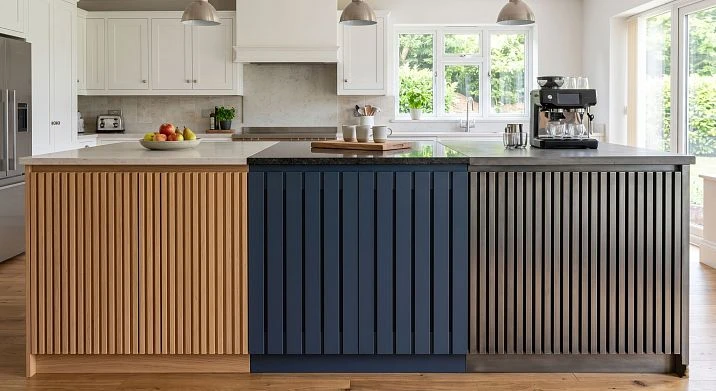
A kitchen island is not just an additional work surface. It is an architectural object within the kitchen, visible from all sides, which 'holds' the center of the space and sets the tone for the entire interior. That is why the question of its finishing is not a secondary detail, but a key design decision. And one of the most convincing answers to this question today isSlatted panels for the kitchen island.
Slatted decor does not just decorate the island. It makes the lower part of the island visually more expensive and architecturally more complex. A vertical row of slats creates depth of surface, play of light and shadow, a sense of handcrafted work—even if you are looking at a serial panel installed in one day. Moreover, slatted cladding for the kitchen island provides an opportunity to tie it into a unified theme with the fronts, bar counter, wall inserts—and to achieve a kitchen with an internal system, rather than a set of unrelated elements.
SelectSlatted panels for the kitchen islandin the STAVROS catalog—solutions made of MDF, oak, and beech, as well as models for painting in an exact color according to RAL/NCS.
Why slatted panels are suitable specifically for a kitchen island
The island is the most noticeable zone of the kitchen
The wall-mounted unit is hidden by the background. The island is not. It stands in the space like a sculpture: it is visible upon entering the kitchen, from the living room, from the dining area. Every centimeter of its surface is in the field of view, and that is precisely why the appearance of the lower part of the island determines the entire image of the kitchen.
A smooth carcass with laminated fronts on the lower part of the island is neutral and banal. Slatted cladding for the kitchen island is already a statement. Vertical texture adds volume where there was none: a massive rectangular block transforms into a light architectural structure with a lively surface. An island with wooden slats is perceived as a designer furniture piece, not as a functional box.
Our factory also produces:
Slatted relief makes the lower part of the island visually more expensive
The mechanism is simple: relief creates shadow. Shadow creates depth. Depth creates a sense of complexity and quality. The eye perceives a surface with a slatted rhythm as more expensive—even when comparing it to a natural wood veneer facade. This is a proven visual effect that architects and designers have been using for decades.
The relief works especially strongly with side or directional lighting. If pendant lights hang over the island or there are track spots with an angle of incidence, the slats become a true lighting tool: each plank casts a soft shadow on the adjacent one, the surface 'breathes,' changing depending on the time of day and lighting angle. This is unattainable with any other furniture finish.
Get Consultation
Where panels work best
Slatted finishing for a kitchen island has several priority application zones, and each provides its own effect:
-
The island's front facade—the main zone: this is what is seen upon entering the kitchen. A slatted facade here creates the image of the island as an independent design object.
-
The island's sides—work especially effectively in open kitchens, where the island is visible from the living room; slatted sides give the island a 'finished' look from all sides.
-
The island's end—an accent zone for bar use: a slatted end with lighting from below or above creates the effect of a glowing surface.
-
Island-bar counter—when the island is combined with a bar counter, slats clad the entire front part from floor to countertop, creating a unified vertical accent.
-
Transition from island to bar counter—flexible slatted panels on a fabric base wrap around a radius transition without seams or deformations.
-
Furniture inserts near the island—slatted decorative inserts on the nearest floor cabinets of the set create a unified theme with the island.
This is exactly howslatted panels for furniture frontsin real kitchen projects: not as a separate decorative element, but as a systematic tool for forming the kitchen's visual language.
Which material to choose for a kitchen island: MDF, oak, or beech
Material selection is the first and most fundamental question. It determines the final result, budget, finishing application technology, and durability. Let's examine each option honestly and without unnecessary words.
MDF — when a smooth modern rhythm and painting are needed
MDF with a density of 750–850 kg/m³ is a material with a perfectly uniform structure. No knots, resin pockets, or variations in hardness. Every slat comes out of the milling machine identical in geometry, weight, and surface. This is precisely what makes MDF the priority choice for modern kitchens, where precision of lines, predictable results, and the ability to paint in any color are important.
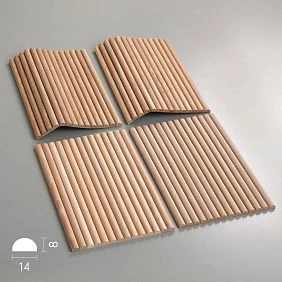
Slat panel PAN-001and PAN-003 are available in MDF. This means you get a slatted rhythm with a living surface and complete freedom in choosing the finish: matte, satin, or semi-gloss enamel, any shade from RAL or NCS, perfect matching with the color of the main cabinet fronts.
MDF panels for a kitchen island are more budget-friendly than solid wood, yet do not fall short in visual result — especially if the surface is coated with high-quality matte enamel. In modern minimalism, Scandinavian style, neoclassicism with monochrome kitchens — MDF fully meets the requirement.
Solid oak — when a natural premium look is needed
The living texture of wood is something that cannot be imitated by any film or powder coating. Oak is hard, stable, and holds its shape excellently under fluctuations in humidity and temperature — which is especially important for a kitchen. Each oak slat carries an individual grain pattern: straight threads, moiré sheen, medullary rays. None of these patterns repeat.
Oak slat panel PAN-001andPAN-003— a choice for kitchens where the material must speak for itself. A wooden slatted panel for a kitchen island made of oak, tinted to golden honey, cold quartz, or dark graphite, creates that very 'expensive naturalness' sought in Japandi, modern classic, and organic modern interiors.
Islands with natural texture work especially well in kitchens where other natural materials are present nearby: a stone countertop, brass hardware, veneered upper cabinet fronts. Solid oak slatted panels on the island in such an environment are not just decor; they are part of the overall material philosophy of the interior.
Beech is a compromise between natural material and budget.
Beech deserves a separate discussion because it is talked about less than it deserves. Beech slats differ from oak ones with a more uniform, fine texture with small fibers and practically without pronounced medullary rays. This makes beech an ideal material for those who want natural wood but without a bright 'forest' pattern—a calmer, more neutral option.
PAN-001is available in beech—this is good news for projects where the budget is limited, but natural texture is essential. Beech takes stains as well as oak, accepting oil, varnish, and stains without problems. In light kitchens in Scandinavian style, beech slats in a natural tone or light gray stain look soft and expensive.
When it's better to choose primed MDF for painting
There are cases where the choice between wood and MDF is not even a question: a specific color is needed. If the kitchen is made in an exact shade like RAL 9010, Dulux Classic Cream, or Benjamin Moore White Dove—the slatted panel for the kitchen island should also be in that color. Perfectly even. Without texture showing through the enamel. Without the slightest variation in tone.
For such tasks, there areSlatted panel PAN-002 primedandslatted panel PAN-004 primed—painting-ready panels with factory primer. The factory primer evens out the surface porosity of the MDF and ensures perfect adhesion for any enamel. The finish coating applies in one or two layers without puttying, without stains, without unevenness. PAN-004 is specifically positioned as a solution with complete freedom to choose shades from RAL and NCS—exactly what is needed for a monochrome island under enamel.
Panels for a kitchen island for painting are also the choice when you want to update the slatted island after a few years: simply repaint it in a new shade without dismantling.
How to choose the rhythm of slats for an island
Rhythm is the distance between slats and their width. It is the rhythm that determines how pronounced the slatted texture is, how deep the shadows will be, and how 'heavy' or 'light' the island will appear. This is one of the most subtle, yet most important selection parameters.
Frequent rhythm — for a neat and expensive visual pattern
A frequent rhythm of slats creates a delicate texture: the surface of the island looks textured but not overloaded. The shadows between the slats are soft, and the distance between the planks is small. The result is an exquisite, 'jewelry-like' finish that is clearly visible up close and does not feel overwhelming when viewed from a distance.
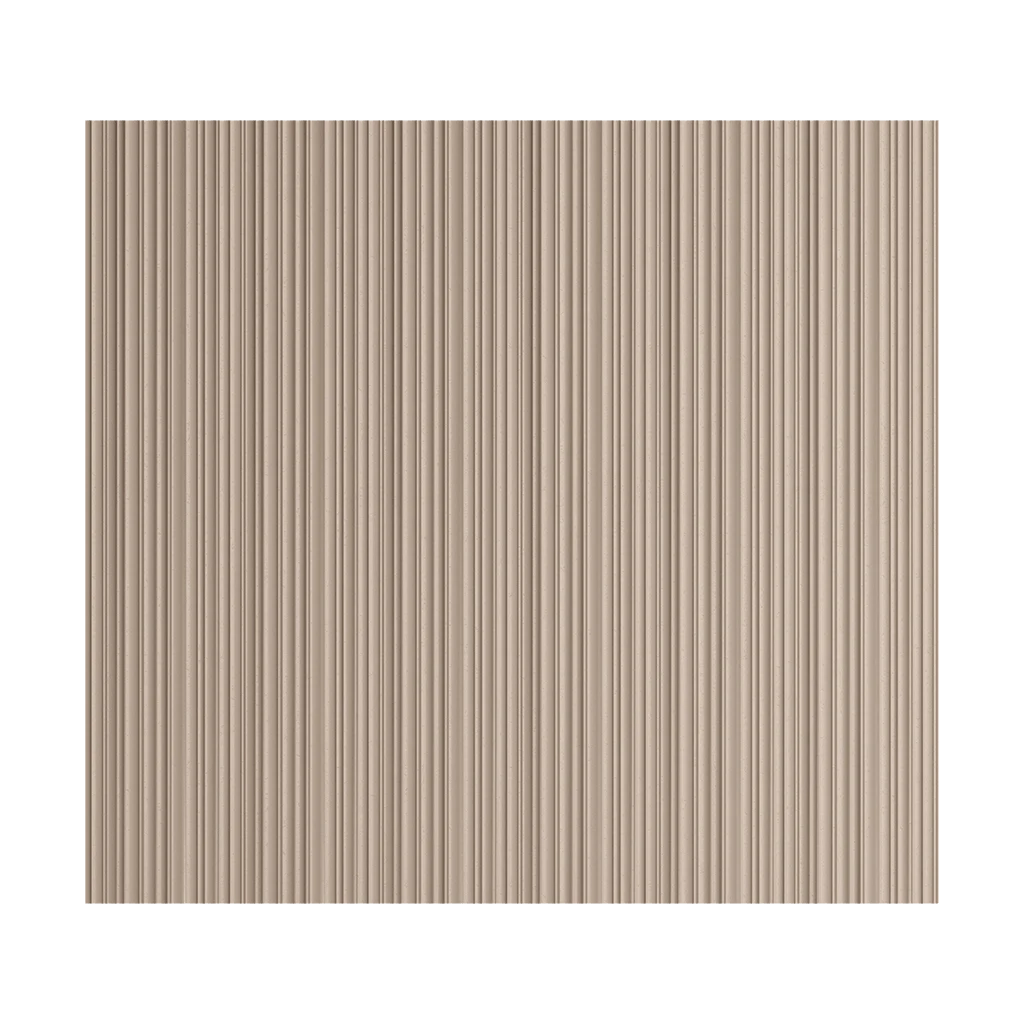
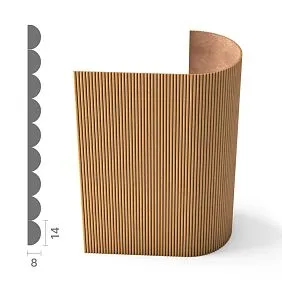
This is exactly the effect given bySlat panel PAN-001with a profile of 1010 × 8 mm. The delicate rhythm of this panel is especially suitable for small kitchens, where an overly pronounced relief would visually 'compress' the space, as well as in kitchens with many active materials nearby — stone, glass, metal. In such an environment, the restrained slatted rhythm of the island does not compete with other textures but complements them.
A more pronounced rhythm — when noticeable volume is needed
A pronounced rhythm provides deeper and more contrasting shadows. An island with such slats is perceived as a three-dimensional architectural form even under neutral lighting. This is a choice for large kitchens, open spaces, kitchen-living rooms, where the island should be clearly visible from a distance of 4–6 meters.
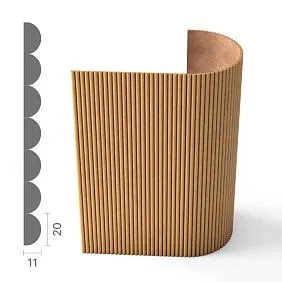
Slatted panel PAN-003with a profile of 1000 × 11 mm provides exactly such relief: wider slats, more pronounced shadows, a clearer vertical rhythm. On an island 180–200 cm long, this panel creates a monumental, architectural effect. PAN-004 primed is a similar solution for those who need a pronounced rhythm plus precise painting.
What to consider when choosing a rhythm
Choosing a rhythm is not a matter of taste in a vacuum. It is a practical decision that depends on several specific parameters:
Kitchen size. In a kitchen up to 12 sq. m, a pronounced relief can overload the space. The delicate PAN-001 rhythm is preferable here.
Island length. On an island up to 120 cm, the moderate PAN-003 rhythm provides the necessary volume without monumentality. On an island from 180 cm, pronounced relief is perceived organically.
Viewing distance. If the island is visible from a distance of more than 3 meters, a more pronounced rhythm is needed; otherwise, the texture will be 'lost'. A delicate rhythm works better when viewed up close.
Adjacent textures. If there is a stone wall panel, brickwork, or large veneer near the island, a delicate slatted rhythm for the island will provide balance. If the walls are neutral and smooth, you can choose a more pronounced rhythm without the risk of overload.
Light. Directed side light enhances shadows: a delicate rhythm under such lighting looks like a pronounced one. Diffused general light 'softens' the relief. This must be considered when viewing samples — view them under conditions close to the actual lighting of your kitchen.
| Panel | Profile | Rhythm | Best scenario |
|---|---|---|---|
| PAN-001 | 1010 × 8 mm | Delicate | Small kitchens, complex adjacent textures, japandi, minimalism |
| PAN-003 | 1000 × 11 mm | Pronounced | Large kitchens, open spaces, neoclassicism, loft |
| PAN-002 / PAN-004 | Primed MDF | For painting | Monochromatic islands, precise color by RAL/NCS |
How to choose slatted panel finishing to match the kitchen style
The material is chosen, the rhythm is set. Now — the finishing. It is the final coating that turns a 'blank' into a finished design solution. And it is here that mistakes are most often made, which reduce the quality of the final result.
Enamel in the color of the cabinet fronts
A monochrome island is one of the strongest contemporary techniques in kitchen design. An island in the exact color of the lower cabinets of the set, with slatted decor on the sides and front, looks like a unified kitchen system assembled by one designer. At the same time, the slatted texture of the island creates the necessary contrast with the smooth fronts of the set — and the kitchen does not turn into a boring monolith.
To implement this technique, you needpaint-ready panels for the kitchen island— PAN-002 or PAN-004. They are already primed, the surface is ready for the final application of enamel. A master painter or professional paint shop applies the enamel after installation or before — both options yield good results with the correct technique.
Contrast island as an accent
The opposite technique is a contrast island. White cabinet fronts and a dark island with oak slats in a graphite tint. Or gray fronts and an island in the color of natural beech. This technique works in open kitchen-living rooms, where the island becomes the 'highlight' of the entire public space.
Solid oak or beech slatted panels are the perfect choice for such a solution: it is the natural texture that creates the necessary contrast with uniform laminated or enameled fronts. An island with wooden slats against a white kitchen background is a classic of contemporary design that never goes out of style.
Staining and varnish for oak
Oak and beech slats accept stain evenly and predictably — if the material is properly prepared. Before applying stain oil or varnish, the surface is sanded to a grit of 180–220, dust is removed, and the wood is degreased. The stain is applied in two to three passes with intermediate sanding using fine sandpaper between layers.
For a kitchen island, the recommended finish is stain oil with wax or polyurethane varnish. Oil with wax gives a more natural, matte look with a pleasant-to-touch surface. Varnish creates a denser film with increased resistance to moisture and grease — which is more practical in the kitchen. The choice between them depends on how intensively the island is used and whether you are willing to periodically renew the oil finish.
Popular staining directions for islands:
-
Scandinavian bleached gray — for japandi and Scandinavian style
-
Golden honey — for modern classic and warm minimalism
-
Dark tobacco / wenge — for loft and industrial style
-
Graphite / black — for brutal minimalism and art deco
Matte, satin, or semi-gloss surface
The degree of gloss of the final finish is a subtle but very important parameter. In modern residential interiors, matte and satin finishes dominate: they do not glare, do not collect fingerprints, and look expensive and restrained.
Semi-gloss and gloss finishes are a choice for interiors with distinct classical or art deco motifs, where surface shine is part of the design code. In a kitchen with many metal details, a glossy slatted island creates an interesting dialogue with chrome or brass.
PAN-004 supports all three finish options: matte, satin, semi-gloss — depending on the chosen coating.
What is more practical for the kitchen and wet cleaning?
The kitchen means humidity, grease, temperature fluctuations. Any panel coating on a kitchen island must handle this. Practical recommendations:
MDF under enamel with a hardener additive — resistant to regular wet cleaning with a soft cloth. Aggressive cleaning agents, abrasives, and hard sponges are prohibited.
Solid oak under polyurethane varnish — more resistant to moisture than oil. The varnish coating withstands regular cleaning without wood swelling or darkening.
Solid oak under oil with wax — requires more careful maintenance: water and grease stains must be removed immediately, before they soak in. Renew the oil layer every 1–2 years. This keeps the island always looking fresh and 'alive'.
Slatted panel on a straight and radius island
One of the most frequent and yet most important questions before purchase — what to do if the island is not rectangular. This is precisely where the choice between a rigid and flexible panel construction becomes crucial.
For a straight island
A straight island with smooth sides and straight ends is the most common option. Here, a rigid slatted panel on an MDF backing works: it ensures perfect plane geometry, uniform slat spacing, and clear vertical lines.
PAN-001, PAN-002, PAN-003, PAN-004— all these positions are excellent for flat surfaces. Installation with adhesive and finishing nails takes a few hours and does not require special tools.
For an island with a rounded edge
A rounded end, a radius side, a smooth transition from the island to the bar counter — these are complex tasks for a standard rigid panel. Attempting to bend a rigid MDF substrate without prior treatment will lead to cracks. Attempting to 'assemble' a radius from separate straight sections will create visible seams. Neither yields a professional result.
The correct solution is a flexible slatted panel for the island on a fabric base. The fabric base allows the panel to wrap around any radius without deforming the slats and without visible seams. The slats maintain uniform spacing and vertical rhythm even on curved sections. The radius can be any — from a soft rounding of 15–20 cm to an almost semicircular end.
When a flexible base is important
A flexible base is chosen not only for radius forms. There is another situation where it is critically important: when the surface of the island is not perfectly flat. Small waves, unevenness of the base, minor plane variations — a flexible panel on a fabric base follows these irregularities without creating voids under the substrate. A rigid panel on an uneven base will produce a 'drumming' effect — a void that will be audible when pressed.
PAN-001 is described as a solution that works on curved and flat surfaces. This makes it the most versatile option in the lineup — especially for projects where the island's shape is non-standard or not known in advance.
Which STAVROS models to consider for a kitchen island
This is the most specific section of the article: not theory, but practical recommendations for selecting items from a real catalog.
PAN-001 — for a delicate rhythm and furniture with complex shapes
Slat panel PAN-001— flexible, fabric-based, available in MDF, oak, and beech. Profile 1010 × 8 mm, delicate rhythm. Works on flat and curved surfaces without adaptation. Perfect for radius islands, counters with rounded ends, and any non-standard furniture shapes.
Why choose PAN-001:
-
Island with rounded ends or sides
-
Bar counter with a smooth transition into the island
-
Small kitchen where a delicate relief is needed
-
Japandi, Scandinavian minimalist interiors
-
Natural oak or beech without opaque painting
PAN-003 — for a more pronounced relief
Slatted panel PAN-003— more pronounced relief with a profile of 1000 × 11 mm. Available in MDF and oak. The flexible fabric base allows for installation on curved surfaces.
Why choose PAN-003:
-
Large island in an open kitchen-living room
-
Kitchen where the island is the main visual accent
-
Interiors with large forms: neoclassical, modern classic, loft
-
Natural oak for tinting
PAN-002 / PAN-004 — if you need an island for painting to match the exact color of the kitchen
Slatted Panel PAN-002andPAN-004— primed MDF panels for painting. The factory primer ensures perfect adhesion of the final enamel without additional surface preparation. PAN-004 supports color selection by RAL and NCS — that is, by any professional color system used in furniture manufacturing.
Why choose PAN-002 / PAN-004:
-
Monochromatic kitchen where the island must be in the exact color of the fronts
-
Modern minimalism with uniform surfaces
-
Project where repainting to a new shade is planned in a few years
-
Any kitchen style with opaque enamel
RK-002 — when you need not a module, but a separate decorative slat
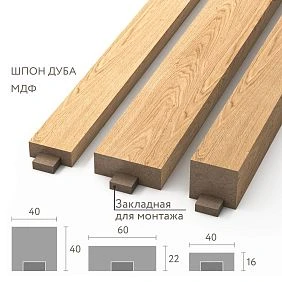
Interior Rail RK-002— is not a ready-made panel, but a separate decorative MDF slat in oak veneer. Allows forming patterns with arbitrary spacing, mounting slats directly on any surface, creating non-standard rhythms and corner transitions.
RK-002 is chosen when the project requires a completely individual solution: non-standard island height, asymmetrical rhythm, mixing horizontal and vertical slats. Built-in mounting insert simplifies installation: the slat is fixed without glue, allowing position adjustments during laying.
View the full catalog of solutions forkitchen island with slatted decorin the "Slatted Panels" section on the STAVROS website.
How to combine a slatted island with fronts, walls, and counter
A slatted kitchen island works most effectively not in isolation, but as part of a system with the other kitchen elements. Here's how to build this system correctly.
Island + Smooth Fronts
The most common and foolproof technique: smooth fronts for the main set of cabinets — slatted decor on the island. The contrast of textures works even with the same color: smooth matte enamel next to slatted enamel of the same tone creates a 'quiet' dialogue of surfaces, which looks very subtle and expensive.
If the kitchen is small — this exact technique allows you to add texture without overloading: the cabinets remain a calm background, and only the island carries the visual accent.
Island + Slatted Inserts on Fronts
A more complex technique: slatted inserts on part of the main cabinet fronts duplicate the rhythm of the island. For example, two or three lower cabinets next to the island get slatted fronts — and the entire lower tier of the kitchen is united into a single textural zone. The upper cabinets remain smooth, creating a visual 'lightening' of the upper part of the kitchen.
Forfurniture facadesThe same catalog items — PAN-001, PAN-003, PAN-002, PAN-004 — are used for the slatted decor as for the island. This guarantees an exact match of the slat spacing and unity of rhythm.
Island + Wall Panel
The wall area behind the island is an additional point for applying slatted decor.Wall slatted panelsOn the section of wall behind the island or above the work area, they create a 'frame' for the island — a background that enhances its visual significance.
Important: with this solution, the rhythm of the slats on the island and on the wall must match or deliberately contrast (different spacing, different material). Random mismatch looks like a mistake.
Island + bar counter in the same rhythm
If the island smoothly transitions into a bar counter, the slat cladding should wrap around this transition without a break. This is exactly where the flexible PAN-001 panel on a fabric base is indispensable: it runs continuously along the side of the island, wraps around the radius transition to the counter, and continues on the front part without a single joint.
The result is that the bar counter and island are perceived as a single architectural object, not as two joined elements.
For kitchen solutions in theKitchens sectionon the STAVROS website, you can find additional ideas for using slat panels in various kitchen scenarios.
What to consider before ordering
Island size
Standard panel formats in the STAVROS catalog are 950 mm in height (for standard-height fronts) and 2700 mm (for tall spaces). Module width is about 1000–1010 mm. Measure the front part and sides of the island, calculate the number of modules considering trimming. Standard allowance is 10–15%.
Where will the panel joints be
When joining two or more panels horizontally, the slat spacing must match on both panels. All panels should be from the same production batch—this guarantees precise geometry and shade matching. When ordering, always clarify whether a single batch can be provided for the entire volume.
Is painting required before installation
For PAN-002 and PAN-004 panels, two scenarios are possible: painting before installation (in a workshop or at the factory) or after installation (on-site). Painting before installation yields a more uniform result across all surfaces, including edges. Painting after installation is more convenient when precise shade matching on-site is needed—under the actual kitchen lighting conditions.
What type of cleaning is planned
For a heavily used kitchen with frequent wet cleaning—enamel with hardener or polyurethane varnish. For less intensive use—oil with wax for oak, matte acrylic enamel for MDF. This choice must be made before applying the finish coating, not after.
What light will fall on the texture
As mentioned above—light drastically changes the perception of the slat rhythm. It is recommended to view samples under conditions as close as possible to your kitchen's lighting before final selection: with the same type of fixtures, approximately the same direction of light fall.
Is a material reserve needed
Always needed. 10–15% of the calculated quantity is a standard reserve to account for cutting, possible installation errors, and the need to replace a damaged panel after several years without searching for a matching batch.
Mistakes when choosing slatted panels for a kitchen island
Years of experience working with wooden decorative materials reveal a consistent set of mistakes that repeatedly lead to disappointment with the result. Here are the main ones — and how to avoid them.
Too active a rhythm for a small kitchen. A pronounced relief like PAN-003 or PAN-004 on an island in a kitchen of 8–10 sq. m is a visual overload. For small kitchens, the delicate rhythm of PAN-001 creates the desired texture without pressure.
Natural texture where a solid-color front is needed. They order an oak slatted panel, planning to paint it white to match the cabinet fronts. The wood grain will show through any opaque enamel. For a monochrome island — only MDF for painting.
Ignoring radii and end cuts. They buy a rigid panel for an island with rounded ends. On straight sections, everything is fine, but the ends remain uncovered or are covered with 'pieces' — unattractive and unprofessional. Solution: find out the island's shape in advance and order a flexible PAN-001 panel for curved sections.
Not considering the combination with the countertop. Slatted panels made of dark oak under a black granite countertop — not the best combination: two dark, heavy materials side by side create a gloomy effect. There needs to be contrast in tone, texture, or both between the slats and the countertop.
Slats on all kitchen surfaces at once. Island, all cabinet fronts, walls, bar counter — solid slats everywhere. The interior loses rhythm and accents, turning into a 'wooden cave'. Slatted decor is an accent, not a universal finishing material.
A finish not designed for kitchen conditions. Water-based oil paint without a hardener on an island in a heavily used kitchen — the result after a year is yellow stains and wear. For kitchens — only professional finishes with moisture-resistant characteristics.
Lack of well-thought-out end cuts and joints. A cut, open end of a slatted panel on an island without an end profile or cap looks unfinished. End cuts are planned in advance — either hidden under a corner profile or covered with the same slatted panel at a 45° angle.
Slatted island in different kitchen styles
Kitchen in Japandi style
The philosophy of Japandi is built on minimalism, natural materials, and a sense of tranquility. A Japandi-style island is a compact, clearly defined form without unnecessary details. Slatted panels of oak or beech in light gray or natural tint on the island's sides, a countertop of light stone or concrete, matte brass hardware—this is the precise formula for a designer kitchen in the spirit of Japanese-Scandinavian synthesis.
Slat panel PAN-001in oak or beech execution is the perfect choice for this style: delicate rhythm, lively texture, no pomp.
Kitchen in Neoclassical style
Neoclassicism demands elegance, proportion, and 'expensive' materials. Smooth fronts with milling and a slatted island in the same shade is a strong move: the island becomes a 'sculptural' object against the backdrop of a classic set. Matte enamel in deep gray, dusty blue, or classic white on primed PAN-002 or PAN-004 panels provides the required level of sophistication.
Kitchen in Minimalist style
In a minimalist kitchen, every element carries meaning or is removed. A slatted island in the color of the walls or cabinetry with a delicate PAN-001 rhythm is a 'dissolving with an accent' technique: essentially, the island almost merges with the environment but lives in it thanks to the fine slatted structure. This is the highest level of minimalist thinking in kitchen design.
Kitchen in Loft style
Loft is about brutality, honesty of materials, contrasts. Dark oak slats in graphite tint on an island next to a concrete countertop and exposed metal pipes—this is a scene from the cover of an architectural magazine.PAN-003in oak with dark tint is precisely for this scenario.
Installation of slatted panels on a kitchen island: practical aspects
Preparing the island surface
The surface of the island cabinet must be clean, dry, level, and degreased. If the existing island facade is coated with polyurethane varnish or PVC film, mechanical adhesion must be created: sand the surface with 120–150 grit sandpaper. Clean MDF or particleboard without coating can be glued without additional preparation.
Adhesive selection
Mounting acrylic or polyurethane adhesive is the standard choice for fixing slatted panels on furniture surfaces. For flexible panels on a fabric base, polyurethane adhesive is preferable: it holds the flexible base better during bending.
Adhesive is applied in a "snake" pattern with a spacing of 15–20 cm. On curved surfaces, apply a continuous layer to avoid voids when wrapping around the bend.
Working with edges and joints
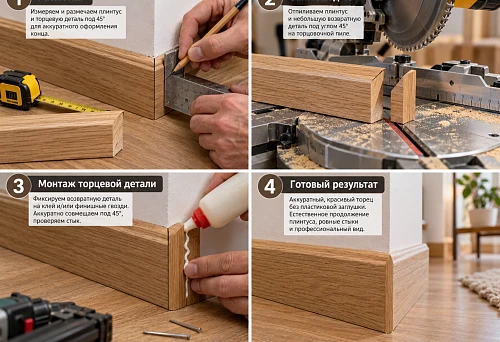
Exposed panel edges are covered with edge trims matching the material and color. For MDF intended for painting, the edge can be filled with putty and painted along with the front surface. Corner transitions are resolved using corner aluminum or wooden profiles.
When joining panels side by side, it is important to align the slat spacing: if the spacing does not match, the horizontal joint will be clearly visible. To avoid this error, all panels are cut based on a whole number of slat intervals from one edge.
Painting and finishing after installation
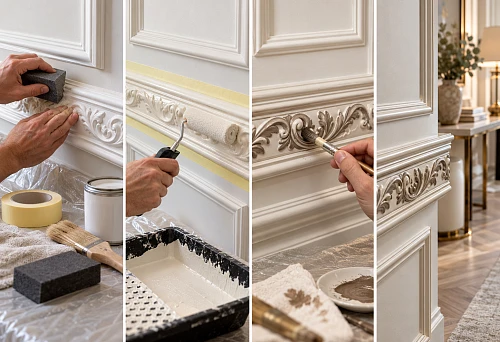
When painting after installation, it is necessary to protect adjacent surfaces: the countertop, walls, floor. Painting is done with a brush along the slats, followed by painting the gaps between the slats, or with an airbrush, which gives a more uniform result. The number of finish enamel coats is two to three with intermediate sanding.
Checklist for final decision
Before clicking 'buy slatted panels for the kitchen island', go through this short list:
-
Is the island shape determined: straight or radius?
-
Material selected: MDF, primed MDF for painting, oak, beech?
-
Rhythm chosen: delicate PAN-001 or pronounced PAN-003 / PAN-004?
-
Final finish determined: enamel, tinting, varnish, oil?
-
Are all surfaces measured, module quantity calculated with 15% reserve?
-
Are ends and junctions thought through?
-
Sequence determined: painting before or after installation?
-
Is the slat pitch alignment considered when joining modules?
If you have answers to all points — you are ready to order. If not — return to the corresponding section above or contact STAVROS managers for consultation.
FAQ: answers to frequently asked questions
Which slatted panels are better for a kitchen island?
The choice depends on the island's shape, desired effect, and type of finish. For a straight island for painting — primed PAN-002 or PAN-004. For a natural look with wood texture — PAN-001 or PAN-003 in oak. For a radius island of any shape — flexible panel PAN-001 on a fabric base. Full selection — in catalogue of slatted panels.
Can slatted panels be used on a radius island?
Yes — panels on a flexible fabric base are created specifically for this. PAN-001 works on curved surfaces of any radius without deformation of the slats and without visible seams. More details — in the section on flexible slatted panels.
What is better for an island: MDF for enamel or oak?
MDF for painting — when you need an exact color by RAL/NCS, a monochrome island, a match with the cabinetry. Oak — when you need a lively natural texture, tactile value, a contrasting accent. Both materials deliver a professional result if chosen for their specific purpose.
Can a slatted panel for a kitchen island be painted?
Yes. Primed panels PAN-002 and PAN-004 are specifically created for painting: factory primer ensures perfect adhesion of any enamel, including coatings with a hardener for kitchen conditions. PAN-004 supports color selection by RAL and NCS.
Are slatted panels suitable for a bar counter?
Perfectly suitable. The flexible PAN-001 panel allows cladding the transition from the island to the bar counter seamlessly — with a single continuous slatted rhythm. For bar counters without radius transitions, rigid panels PAN-002 or PAN-003 are suitable.
Which panels to choose for a modern kitchen island?
For a modern minimalist island — PAN-001 in MDF with a delicate rhythm or PAN-004 primed for enamel. For a modern kitchen with natural materials — PAN-001 or PAN-003 in oak.
How to care for the slatted decor of an island?
Regular cleaning — use a soft, damp cloth, without abrasives or aggressive agents. Enamel coating with a hardener withstands intensive cleaning. Oak with oil and wax requires renewing the protective layer every 1–2 years. Oak with polyurethane varnish is a more durable and moisture-resistant option for active kitchens.
How much do slatted panels for a kitchen island cost?
Current prices are on theslatted panels catalog pageof STAVROS. The cost depends on the material (MDF, oak, beech) and model.
Where to buy slatted panels for a kitchen island in St. Petersburg and Moscow?
STAVROS — production in St. Petersburg, Contact us to confirm shipping to your destination. Orders are placed on the website stavros.ru, delivery — by transport companies or pickup from the warehouse in St. Petersburg.
STAVROS is a Russian manufacturer of wooden decor and furniture components with production in St. Petersburg. The range includes slatted panels, moldings, furniture legs, decorative overlays, and components for furniture and interiors — over 4000 items of own production. All products are made from high-quality MDF and properly dried solid oak and beech in a controlled microclimate, ensuring geometric stability, durability, and predictable results in finishing. Warehouse in St. Petersburg, shipping from a single unit. SelectSlatted panels for the kitchen islandin the STAVROS catalog — solutions made of MDF, oak, and beech for straight and curved islands, counters, furniture inserts, and fronts.