




























Article Contents:
- Why radius facades are complex in conventional execution
- Why curved facades are more expensive than straight ones
- What is the problem with classical milling on a radius
- Why standard rigid panels are only suitable for flat surfaces
- What is a flexible slatted panel for furniture
- Construction on a fabric base
- How the panel follows the radius without pattern deformation
- Why this is convenient for furniture facades, cabinets, and islands
- What tasks are slatted panels suitable for on radius facades?
- Radius facades for cabinets
- Curved facades for dressers and nightstands
- Rounded ends of kitchen islands
- Bar counters, furniture inserts, and radius partitions
- Why is a flexible slatted panel better than complex milling?
- Faster project implementation
- Lower production complexity
- Can work with straight and curved surfaces in one project
- Slatted pattern is achieved immediately, without assembling slats on-site
- Which materials to choose for a radius facade
- MDF — for modern painted facades
- Oak — for natural premium furniture
- Beech — as an alternative to solid wood
- Primed MDF — if you need a facade for enamel
- How to choose the rhythm and depth of slats for curved furniture
- A more delicate rhythm for calm facades
- A more active rhythm for accent furniture
- How not to overload a small product
- When it's better to make the entire facade slatted, and when only an insert
- Which finish to choose for radius facades
- Enamel for painted furniture facades
- Toning and transparent coatings for oak and beech
- Matte surface for modern furniture
- What is more practical in daily use
- Installation of slatted panel on a radius facade
- Foundation Preparation
- Mounting with adhesive
- How module joining is performed
- What to consider on a small radius
- When a material reserve is needed
- Which STAVROS solutions to consider for radius facades
- PAN-001 — flexible slatted panel for straight and curved surfaces
- PAN-002 — primed flexible panel for painting
- When to choose MDF and when to choose solid oak or beech
- Which option is better for a wardrobe, cabinet, island, and counter
- Slatted panels for radius facades in different interior styles
- Japandi and Scandinavian minimalism
- Neoclassicism and Modern Classicism
- Loft and Industrial Style
- Tips for furniture manufacturers and B2B customers
- Advantages for serial furniture production
- For design studios and planners
- Integration with other finishing elements from the catalog
- Errors in selecting panels for curved facades
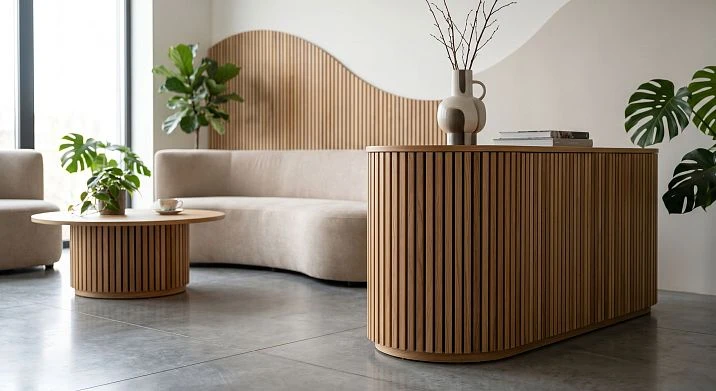
Curved facades are a long-standing story of how a design idea collides with production reality. An architect draws a beautiful rounded cabinet end, a radiused cabinet, a kitchen island with smooth side panels—and at some point hears: 'It's complicated, time-consuming, and expensive.' Radius milling on an MDF facade requires special tooling, precise calculations, and considerable production experience. This is exactly where the game-changing solution appears: slatted panels for radius facades on a flexible fabric base.
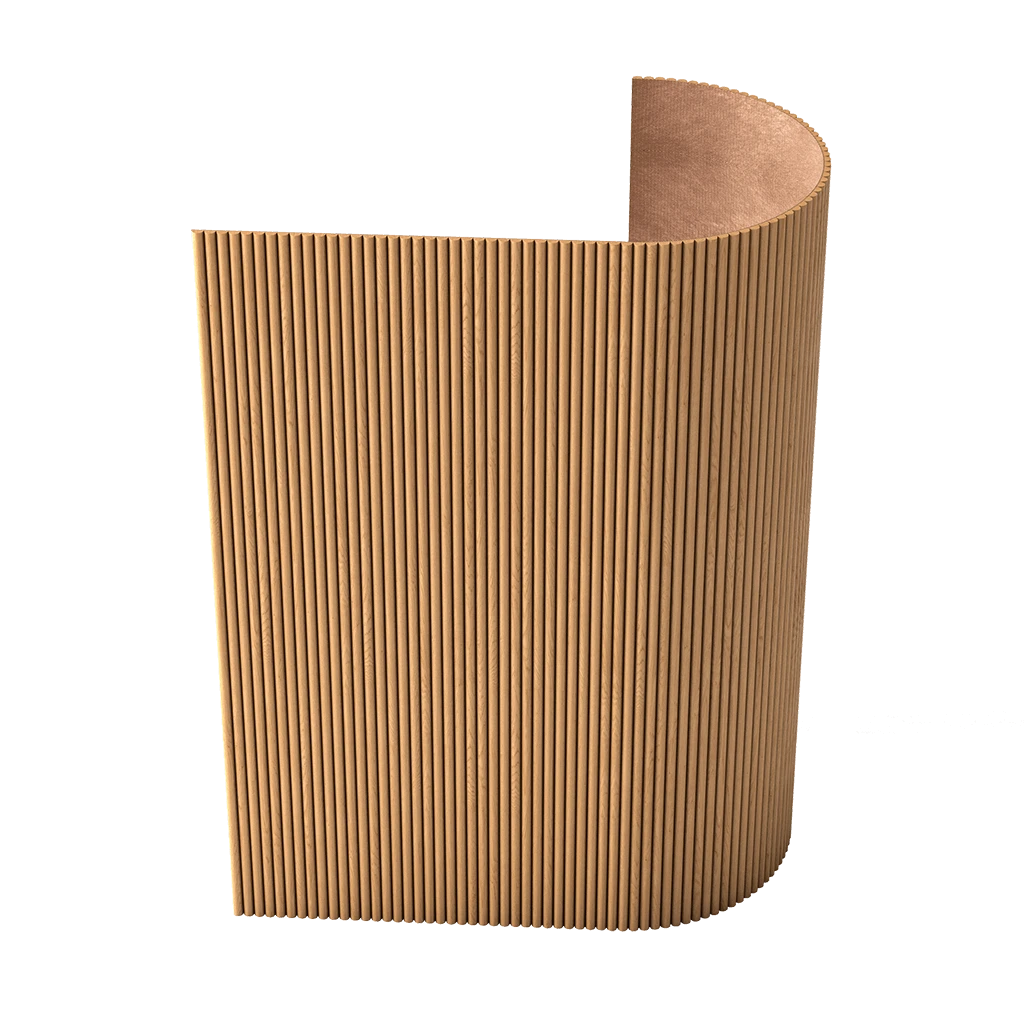
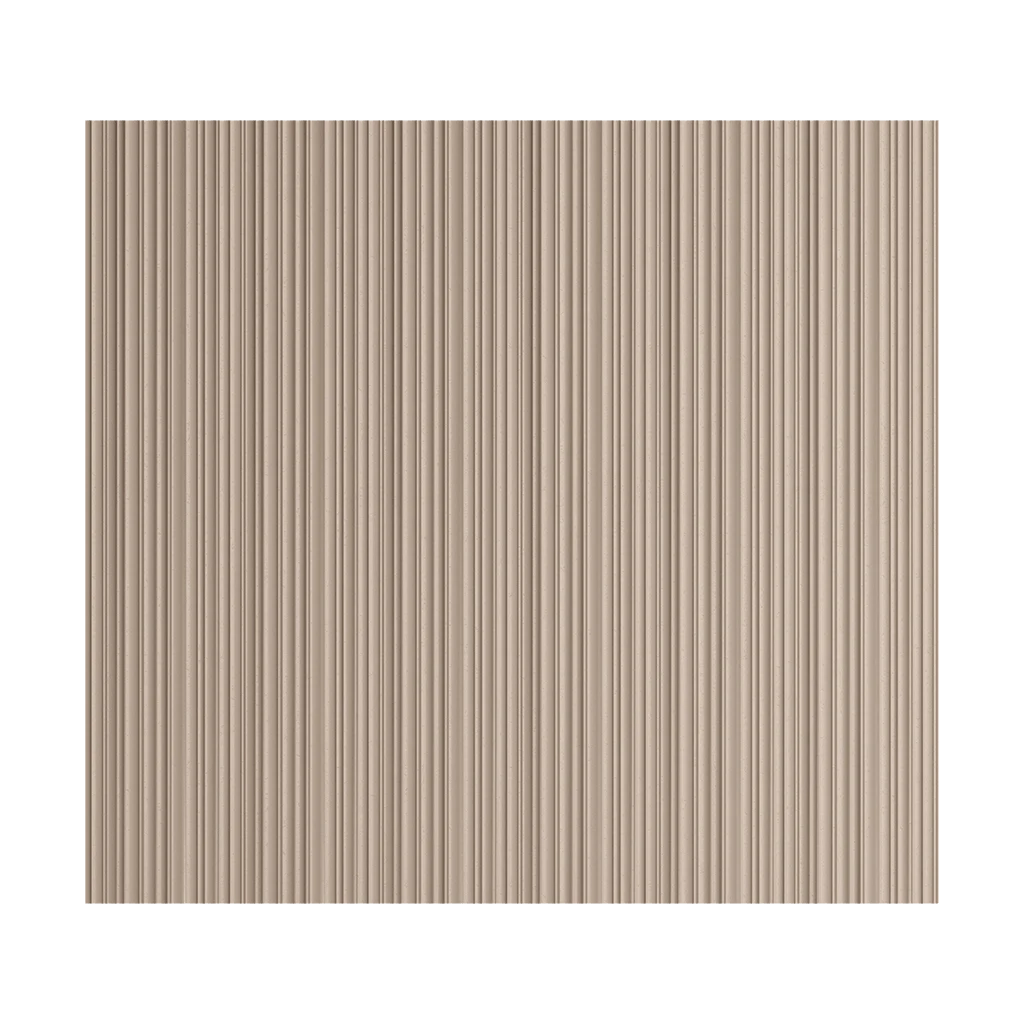
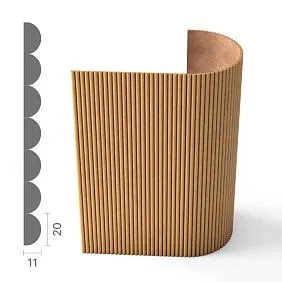
STAVROS offers such a solution today—in the form of ready-made flexible slatted panels that wrap around any curved surface without fitting, milling, or complex calculations. Slats with uniform spacing are fixed on a fabric base, allowing the panel to bend with the surface while maintaining an even rhythm of slats on both straight and curved sections simultaneously. This is not a compromise—it's a technologically sound response to a demand that previously required labor-intensive custom production.
Why radius facades are complex in conventional execution
Before discussing the solution, it's worth having an honest conversation about the problem. A radius facade in furniture is not just 'beautiful.' It's a structural task with several layers of complexity, each affecting price, timelines, and the final result.
Why curved facades are more expensive than straight ones
A straight furniture facade is produced from sheet board or an MDF blank on standard equipment. A radius facade requires either steam-press bending under pressure, milling on the reverse side followed by bending, or laminating multiple thin layers with adhesive. Each of these methods is a separate technology, requiring additional equipment and manual labor. Hence the price: a radius facade without slatted decoration is already one and a half to two times more expensive than a straight one at the cabinet production stage.
Add slatted decoration in the classic execution to this—and the complexity multiplies further. Assembling a slatted pattern on a curved surface from individual slats on-site is precision work: you need to accurately calculate the spacing, ensure uniform gaps across the entire radius, and prevent the slats from fanning out on the curve. This is quality work only in the hands of a very experienced craftsman.
Our factory also produces:
What's the problem with classic milling on a radius
Classic milling for a slatted pattern on a flat MDF sheet is a routine operation on a CNC machine. But for a curved surface, you either need special tooling to secure the bent facade under the cutter at the correct angle, or milling on a flat blank followed by bending—with all the risks of rib breakage during bending.
Grooves cut into a still-straight sheet create stress concentration zones during bending—the sheet breaks precisely along them. Therefore, radiused facades with grooved milling often use MDF HydroFlex or laminated bent blanks—these are specialized materials with different costs and availability. All this makes the task expensive and technically challenging for most furniture manufacturers.
Get Consultation
Why standard rigid panels are only suitable for flat surfaces
A rigid grooved panel on an MDF substrate is an excellent solution for flat surfaces. But attempting to bend it onto a radiused facade results in cracks in the substrate. MDF with a thickness of 8–12 mm lacks the plasticity reserve for bending without special preparation (scoring the back side), and even with scoring, it loses load-bearing properties. A rigid panel is a tool for flat planes, and using it on a curve means fighting the physics of the material.
It is precisely this boundary of applicability for standard panels that creates the demand forflexible grooved panel for furniturewith a fabric base—a solution originally designed to work where a rigid substrate is no longer applicable.
What is a flexible grooved panel for furniture
This is not a standard decorative slat or a conventional facing sheet. A flexible grooved panel is a structurally different product, developed with an understanding of the limitations of classic solutions.
Construction with a fabric base
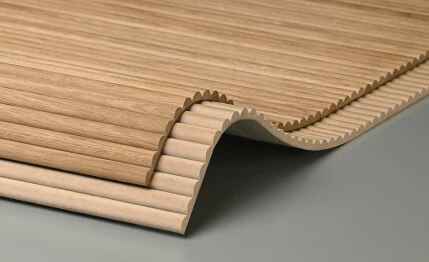
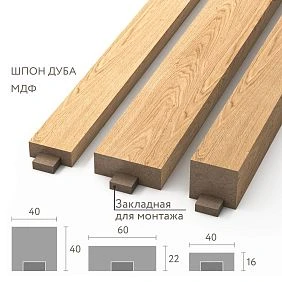
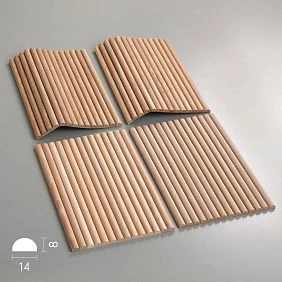
The base is a textile substrate with high tensile strength and sufficient plasticity for bending. Wooden or MDF slats—strips of equal width and height, oriented vertically—are glued onto it at equal intervals. The slat spacing is fixed during production: uniform gaps along the entire panel length are guaranteed without any on-site marking.
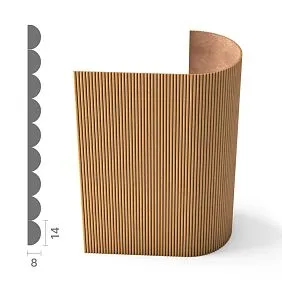
The fabric backing keeps the slats rigid in the transverse direction—the spacing does not 'drift' when bent, and the slats do not splay apart. At the same time, along the length of the panel, it allows bending: the panel wraps around a curved surface just like a sheet of dense fabric wraps around a rounded object—tightly, without folds or gaps.
PAN-001 Slatted Panel on Fabric Backing—precisely this construction. It works on flat and curved surfaces, is mounted with adhesive, and the modules butt-join—slat to slat—with no visible seam.
How the panel follows a radius without distorting the pattern
The key property that distinguishes a flexible panel from a set of individual slats is the preservation of rhythm on a curve. When you create a slatted pattern from individual planks on a radiused facade, the gaps between the planks on the outer radius widen: the geometry of the arc requires the outer arc to be longer than the inner one. If the slats are parallel to the axis of the bend, their ends splay apart like a fan at the edges. This is a classic problem of cutting to a curve, and it cannot be solved without precise joinery work.
The flexible backing solves this problem structurally: the fabric backing stretches and compresses evenly along the arc, compensating for the difference between the inner and outer radii. The slats remain parallel, the spacing stays uniform, and the rhythm is not disrupted. The panel literally 'memorizes' the surface shape during installation—and holds it.
Why this is convenient for furniture fronts, cabinets, and islands
For furniture makers and designers, this means one thing: a radiused slatted facade now requires neither specialized machinery nor meticulous manual fitting. The panel arrives ready-made. It is cut to the required dimensions, applied to the form, and fixed with adhesive. The entire process in terms of time is comparable to installing a standard rigid panel on a flat plane—and this is a fundamental advantage for productivity.
For the B2B audience—furniture manufacturers, design studios, construction and finishing companies—panels for radiused facadesfrom STAVROS — is an opportunity to expand the range of projects implemented without investing in new equipment. Rounded cabinet ends, radius cabinets, curved islands — all this becomes feasible in a standard production cycle.
What tasks are suitable for slatted panels on radius fronts
Flexible slatted panel — is a universal tool precisely for those scenarios where previously one had to compromise or significantly increase the budget. Let's consider each of them.
Radius fronts of cabinets
A cabinet with radius side panels or rounded corners — furniture that is increasingly found in modern interiors. This could be a built-in wardrobe in a bedroom with smooth rounded corners instead of straight 90-degree joints, or a freestanding wardrobe with an arched side panel profile.
Slattedpanel for cabinet frontswith a flexible fabric base wraps around these roundings without adaptation or sawing. The rhythm of the slats on the straight section of the side panel smoothly transitions onto the curve and continues onto the next straight section without interruption. The cabinet receives a unified slatted 'casing' that looks like the result of complex custom production — although in fact it is the installation of a standard panel.
For cabinets in hallways and dressing rooms, the practicality of such a solution is especially important:slatted panels for radius frontsThey close the sides and ends in a unified concept with the main straight fronts, and if repainting is necessary, the entire surface is refreshed in one painting cycle.
Curved fronts for dressers and cabinets
A cabinet with radiused ends or a dresser with an arched front are pieces valued in interiors where 'softness' of forms and the absence of sharp corners are important. Scandinavian style and Japandi actively use rounded furniture forms precisely to create tactile and visual comfort.
A flexible slatted panel for a curved cabinet front allows for a slatted relief on an arched surface without complex lathe or milling work. Oak or beech slats on the curved front of a bedside table create the feeling of a unique handmade piece—exactly that 'expensive' aesthetic which in the budget segment is imitated with films and veneers, but here is achieved from natural material on a proper structural basis.
Rounded ends of kitchen islands
A kitchen island with rounded ends is one of the most common requests in modern kitchen design. A straight rectangular island is often perceived as a 'hard' element, especially in kitchen-living rooms where one wants to maintain a sense of open space. Rounded ends visually lighten the island, making it more organic.
A slatted panel for a kitchen island with a radius on a fabric base is the perfect tool for finishing such ends. The flexible base adheres tightly to the arc of the end, the slats maintain a vertical rhythm, and the joints with the straight sides are executed seamlessly. Forkitchen solutionswith radiused islands, this is the technically and aesthetically only correct option for slatted cladding.
Bar counters, furniture inserts, and radiused partitions
A bar counter that smoothly transitions from a straight to a curved section is a beautiful structural challenge with an equally precise solution. The flexible PAN-001 panel runs continuously along the entire length of the counter: straight sections are clad without changing the method, curved sections use the same adhesive and the same tool, simply applying the panel to follow the bend's shape.
Furniture inserts with slatted decor in radius niches, decorative partitions with smooth transitions, built-in display cases with rounded sides—all are tasks that the fabric-based flexible panel solves where a rigid module would require fully custom production.
Why a Flexible Slatted Panel is Better than Complex Milling
This question deserves a separate and detailed answer—especially for those still unsure whether to switch from a familiar technology to a ready-made panel solution.
Faster project implementation
Milling a slatted pattern on a radius facade is a task that takes several steps: designing tooling, setting up the machine, a test run, adjustments, and main production. Just aligning the technology for a non-standard radius takes time, which is often unavailable in commercial projects.
Ready-madeflexible slatted panel for furniturereduces this path to one step: order — receive — install. No technological design, no test runs. The panel arrives ready for installation, and the only thing needed in production is to cut it to the required sizes.
Lower production complexity
To implement a slatted pattern on a curved facade via milling, you need a CNC center with 4-axis or 5-axis kinematics, a special vacuum table to hold the curved workpiece, and an experienced operator. This equipment is not available at every furniture factory, let alone design studios that order products from contractors.
Panels for curved furniture frontsFabric-backed panels are installed without special equipment: mounting adhesive, pressure roller, utility knife, and measuring tape — a complete set of tools. This is accessible to any assembly shop and any experienced installer.
Can work with both flat and curved surfaces in a single project
In a real furniture project, an island or cabinet is rarely 'fully radiused'. Usually, it's a combination: flat fronts, side panels — and only one or two sections with a radius. This is precisely where the flexible panel demonstrates its main advantage over milling: the same product is used for both flat and curved sections. There's no need to order different technical solutions for different zones — the panel covers both scenarios.
This is fundamentally important for project logic: all slatted decor is made from the same material from the same batch. Slat spacing, shade, texture — everything matches from the flat front to the radiused edge.
The slatted pattern is achieved immediately, without assembling individual slats on-site
Assembling a slatted pattern from individual slats on-site is work requiring the precision of a master cabinetmaker. Each slat must be measured, consistent gaps maintained, and nailed or glued considering the surface curvature. For one flat cabinet, this takes several hours. For a radiused front — significantly longer.
The finished panel transfers all this work to production, where it is performed more precisely, faster, and without the risk of on-site error. The installer on-site mounts a ready-made module — and the result will be geometrically accurate in any case.
Which materials to choose for a radiused front
Choosing the material for a flexible slatted panel is choosing the final look of the product. It determines how the surface will appear, what finish can be applied, and how durable the coating will be under real furniture use.
MDF — for modern painted facades
MDF in flexible slat panels is the choice when precise slat geometry, a uniform surface for painting, and predictable results when applying enamel are required. MDF slats on a fabric base have consistent density throughout their cross-section: no knots, no resin pockets, no uneven absorption of primer or paint.
PAN-001 in MDF version— a slat panel on a flexible fabric base that works on both straight and curved surfaces. For furniture with opaque enamel in any RAL or NCS color — this is the essential working tool. The panel accepts any furniture enamel: acrylic, polyurethane, water-based with hardener added.
Oak — for natural premium furniture
Oak is a choice that requires no explanation for anyone who has ever held a well-finished oak surface. Hardness, density, unique grain pattern — an oak slat carries everything that makes a wooden object 'expensive' in the broadest sense of the word.
Oak slat panel PAN-001on a fabric base — this is natural oak finishing on radius facades without the need for complex bent solid wood. Each slat carries a living texture with a moiré pattern, straight grain, or characteristic medullary rays. Under transparent tinting oils and varnishes, this texture is revealed in full force — the result is perceived as a custom solid wood piece, although it is a technological ready-made panel.
For radius cabinets, dressers, wardrobes, and bar counters in japandi, neoclassical, modern loft, and organic modern interiors — oak slats on a flexible base deliver precisely that tactile-visual result that cannot be imitated by any other means.
Beech — as an alternative to solid wood
Beech is mentioned less often than oak in the context of high-end furniture—and undeservedly so. Beech slats have a more uniform and fine texture: the fibers are small, the pattern is calm, without a pronounced moiré effect. For interiors that require a natural wood texture but without a 'loud' pattern, beech turns out to be preferable.
PAN-001 is available in a beech version. Beech slats with a light tint or in a natural tone provide a delicate, 'Scandinavian' surface that fits organically into white, beige, and light gray interiors. In terms of cost, beech is a compromise between MDF and oak: more expensive than 'faceless' MDF but more affordable than oak, with a similar aesthetic result for certain tasks.
Primed MDF — if you need a front for enamel paint
There are situations where the surface must not just be painted, but painted perfectly. A monochrome cabinet in an exact Farrow & Ball shade, a kitchen island in a specific NCS code, a cabinet matching the exact wall color—in such cases, the material of the slats is not important, but the quality of the finish is.
Primed batten panel PAN-002on a fabric base is MDF with a factory primer, ready for the application of finish enamel without additional puttying. The surface is primed evenly, porosity is sealed, adhesion is ensured. Two coats of finish enamel—and the front is ready. The slat spacing is preserved, the flexible base works on curved sections, the result is a perfectly painted slatted front on any surface shape.
For furniture manufacturers who work with strict color assignments from designers or architects,panel for painting for furniture frontsis a standard working tool that eliminates variables and guarantees reproducible results from batch to batch.
How to choose the rhythm and depth of slats for curved furniture
Rhythm is not just about aesthetics. On curved surfaces, the rhythm of the slats also has a structural significance: too wide a spacing can create a 'ragged' effect on a small radius, where the slats will noticeably diverge. Choosing the rhythm for curved furniture is a joint decision between the designer and the manufacturer.
A more delicate rhythm for calm facades
Narrow slat spacing with low profile height creates a delicate, 'jewelry-like' texture. On curved surfaces, this delicate rhythm has another important quality: when panels bend, the difference in visual spacing between the inner and outer sides of the arc is less than with wide slats. The visual result is an even, calm slat pattern that behaves consistently on both straight and curved sections.
PAN-001 with a 1010 × 8 mm profile is exactly this delicate rhythm. For small cabinets, bedside tables, rounded dresser fronts in the bedroom, or japandi cabinets in the hallway, this rhythm works perfectly: the surface is textured but not overloaded.
A more active rhythm for accent furniture
A wider slat with deep relief creates pronounced shadows between the planks—the surface reads as volumetric and architectural even in neutral lighting. For large pieces—curved kitchen islands, large bar counters, built-in living room cabinets—an active rhythm is justified: the piece must 'hold' the space, and the slat relief with deep shadows serves precisely this purpose.
PAN-003 with a 1000 × 11 mm profile is a pronounced rhythm for large pieces. On the curved side panel of an island 60–80 cm wide, it creates a monumental architectural effect that reads well from a distance of 3–5 meters in an open kitchen-living room.
How to avoid overloading a small piece
A bedside table 50 cm high and 40 cm wide is a small volume. A slat rhythm with tall, wide planks on such a piece would be an overload: the texture would 'overwhelm' the form. The rule here is simple—the smaller the piece, the more delicate the rhythm should be.
For small cabinets, dressers with narrow drawers, decorative furniture inserts—the PAN-001 rhythm is preferable. For large cabinets, islands, and bar counters—a more pronounced relief like PAN-003 or PAN-004 can be used.
When is it better to make the entire facade slatted, and when only an insert?
Slatted finishing across the entire facade is a bold technique for accent pieces. A cabinet with fully slatted side panels and back panel, an island with slatted ends and facade — such elements make a strong impression in the right interior.
A slatted insert in the central part of the facade is a more restrained option. It breaks the monotony of a smooth facade, adds detail without turning the piece into a 'slatted box'. For furniture in neutral interiors where a balance between texture and surface purity is required, a slatted insert is often a more appropriate choice than full slatted cladding.
What finish to choose for radius facades
The final finish is the concluding chord that determines how a piece will look and how long it will retain that appearance. For radius furniture facades with slatted panels, the choice of coating also has a practical dimension: furniture is used, touched by hands, wiped down, and sometimes stores items with odors and moisture. The coating must handle this.
Enamel for painted furniture facades
Polyurethane enamel with a hardener additive is the standard for professional furniture painting. It provides a film of high hardness, resistant to mechanical impact, wet cleaning, and household stains. On MDF slatted panels, polyurethane enamel applies evenly: on the flat surfaces of the slats and in the recesses between them — without spots or uneven gloss.
For primed panelsPAN-002and PAN-004, the painting cycle is shortened: the factory primer evens out the porosity of the MDF, and the finish enamel is applied directly onto it. Two coats of enamel with intermediate sanding yield a smooth, matte or satin surface of professional quality.
Acrylic enamel on a water basis is an alternative to polyurethane for less intensively used furniture: it is more eco-friendly, dries faster, but is inferior to polyurethane in coating hardness. For bedrooms, living rooms, and hallways — it is quite sufficient. For a kitchen island or work furniture with active wet cleaning — polyurethane is better.
Toning and transparent coatings for oak and beech
For natural oak and beech slats — tinting oil or clear varnish. Tinting oil with wax creates a soft semi-matte surface with the feel of 'living' wood under your hand. The oil penetrates the wood structure without forming a film on top — so the surface remains warm to the touch.
Polyurethane varnish provides a harder and more moisture-resistant film on top of the wood. For furniture that is actively used and often wiped with a damp cloth, varnish is preferable to oil — it does not require regular renewal and withstands household cleaning more easily.
Tints for oak and beech slats — an unlimited palette: from bleached Scandinavian to deep black, from golden honey to cool smoky gray. The tone is selected to match the overall color concept of the interior.
Matte surface for modern furniture
Matte finish is the absolute standard in modern furniture design for residential interiors. A matte surface does not glare, does not 'collect' dust in highlights, does not emphasize minor scratches — and looks expensive and restrained in any lighting.
For slatted panels, a matte finish has another effect: it enhances the readability of the slatted rhythm. The matte surface of the slats creates a more pronounced contrast between the plank and the shadow between them — the depth of the relief is perceived as greater. Gloss, on the contrary, 'softens' the shadows, and the slatted rhythm appears less pronounced.
What is more practical for daily use
For furniture in living rooms — wardrobes, cabinets, chests of drawers — priority is given to aesthetics and durability under moderate load. Matte oil on oak or matte acrylic enamel on MDF provides a sufficient level of protection.
For furniture in active zones — kitchen islands, bar counters, furniture in children's rooms — a hard polyurethane film is needed, resistant to mechanical impacts and regular wet cleaning. Here, it is not worth saving on the finish: a quality enamel with a hardener will last 10–15 years without repainting.
Installing a slatted panel on a radiused facade
Installing flexible slatted panels is a simpler process than it seems. It doesn't require special equipment, doesn't involve complex technological operations, and is accessible to a craftsman with basic carpentry and installation skills.
Foundation Preparation
The surface onto which the panel is mounted must be clean, dry, and degreased. On radiused facades, it's especially important to ensure the arc is even: an uneven radius creates areas where the panel doesn't adhere to the base. Such areas are filled with glue that has an extended open time and are pressed using tape or temporary supports.
If the base is coated with polyurethane varnish or enamel, mechanical adhesion needs to be created: sand the surface with 120–150 grit sandpaper. Fresh, uncoated MDF and particleboard can be glued without additional preparation.
Mounting with adhesive
Mounting adhesive — acrylic or polyurethane — is applied to the back of the panel in a 'snake' pattern or in dots spaced 10–15 cm apart. On radiused sections, the adhesive is applied more densely: a continuous layer or a 'snake' pattern with 8–10 cm spacing ensures even pressure of the panel against the curved surface.
The panel is applied according to the shape of the facade and pressed with uniform pressure. On radiused sections, it's convenient to press the panel against the surface using painter's tape, wound over it in several layers under tension — it mimics a bandage clamp and holds the panel in the bent shape until the adhesive cures.
The open time for acrylic mounting adhesive is 5–10 minutes. Full curing time is 24 hours. During this period, the panel is secured and should not be loaded.
How module joining is performed
Joining several modules into one continuous slatted pattern is a key moment for large surfaces. The joint is made butt-to-butt, slat to slat: the last slat of one module and the first slat of the next must be positioned with the same spacing as the slats within the module.
For this, before installation, the spacing of the module's slats is measured and the starting point of the next module is calculated. If necessary, the first slat of the next module is trimmed to the required width so the spacing matches. All modules should be from the same production batch: this guarantees matching geometry and shade without the need for selection.
What to consider on a small radius
When working with a small radius (less than 150 mm), the flexible panel may require more precise clamping: the fabric base experiences significant stress on a small radius. In such cases, it is recommended:
-
Use polyurethane adhesive with a longer open time — it allows for longer adjustment of the panel position
-
Clamp the panel to the surface using a bandage method — painter's tape or elastic tape across the entire width
-
Allow full adhesive curing time before removing the fixators
When material reserve is needed
The standard calculated reserve for slatted panels is 10–15% of the calculated surface area. On radius sections, the reserve should be increased to 15–20%: during installation on a bend, additional trimmings arise for proper step layout, and a poorly executed joint may require section replacement. Panels from the same batch should be ordered taking this reserve into account — it is more difficult to purchase an exactly matching batch later.
Which STAVROS solutions to consider for radius facades
The STAVROS slatted panel line covers the main scenarios for radius and curved furniture facades. There are no unnecessary items here — only what really works for the task.
PAN-001 — flexible slatted panel for straight and curved surfaces
Slat panel PAN-001— the main item for all tasks related to radius facades. Flexible fabric base, delicate rhythm 1010 × 8 mm, available in MDF, oak, and beech. Works on straight and curved surfaces without adaptation. Modules join seamlessly. Installed with adhesive.
Application: radius cabinet sides and ends, curved fronts of cabinets and dressers, rounded ends of kitchen islands, bar counters with smooth transitions, furniture inserts and decorative partitions.
This is the only item in the catalog that simultaneously covers all the listed scenarios without product replacement. For designers and furniture manufacturers working with non-standard shapes, it is a basic working item.
PAN-002 — primed flexible panel for painting
Slatted panel PAN-002 primedon a fabric base — the choice for projects where the facade must be painted in an exact color. Factory primer ensures the surface is ready for applying finishing enamel without additional puttying. The flexible fabric base allows the panel to be used on radius surfaces.
Application: monochrome furniture facades for exact RAL/NCS color, cabinets and dressers with radius elements in design projects with color specifications, kitchen islands in the color of the set.
When to choose MDF and when to choose solid oak or beech
A simple decision-making scheme:
| Task | Material | Position |
|---|---|---|
| Exact opaque color according to RAL/NCS | Primed MDF | PAN-002 |
| Any color, without primer | MDF | PAN-001 (MDF) |
| Natural texture, tinting | Oak | PAN-001 (oak) |
| Delicate natural texture, budget | Beech | PAN-001 (beech) |
| Pronounced relief on large items | MDF or oak | PAN-003 |
Which option is better for a wardrobe, cabinet, island, and counter
For a wardrobe in the hallway or bedroom with radius side panels — PAN-001 in MDF for painting or PAN-001 in oak for tinting. The choice depends on the interior style: if a solid matte surface is needed — MDF; if natural texture is important — oak.
For a bedside table or dresser — PAN-001 in beech or oak: small items in areas of close tactile contact benefit from natural texture.
For a kitchen island with radiused ends — PAN-001 in MDF for painting (if the kitchen is monochrome) or PAN-001 in oak (if the kitchen uses natural materials). For large islands with pronounced relief — PAN-003.
For a bar counter with a smooth transition — PAN-001 on a flexible base: only this product ensures a continuous rhythm from the straight section to the curved one.
See the full range at STAVROS slatted panels catalog and choose a solution for your specific task.
Slatted panels for radiused facades in different interior styles
Flexible slatted panel — a stylistically neutral material in the sense that it works organically in a wide variety of design codes. Form — radius, material — wood or MDF, rhythm — vertical: these are the basic parameters that are well 'read' in several stylistic contexts.
Japandi and Scandinavian minimalism
In these styles, radius furniture forms are almost a mandatory element. Rounded cabinets, soft corners of wardrobes, islands without sharp edges — all this is part of the 'round and calm' philosophy shared by both styles. A slatted panel made of beech or oak in a light finish on curved facades is a precise hit of this design code.
Forfurniture facades in a Japandi interior PAN-001 in beech under transparent oil or in oak with a cool grey-smoky finish — the perfect choice.
Neoclassicism and modern classicism
In neoclassicism, radius furniture forms are traditional: rounded legs, arched sides, rounded cabinet ends — this is part of the classical furniture language. Slatted decor on such forms creates an interesting synthesis of classical geometry and a modern decorative technique: the form is historical, the finish is contemporary.
For neoclassical style — PAN-001 in MDF under white or cream enamel, or in oak with warm golden tone staining.
Loft and industrial style
In loft style, radius forms are used less frequently — the brutal style gravitates towards right angles and honest materials. But it is precisely the contrast: the smooth radius edge of an island or counter surrounded by rectilinear structures — that creates that unexpected accent which makes a loft interior interesting.
PAN-001 or PAN-003 in oak with dark graphite-tone staining on a radius island in a loft kitchen — a strong design solution with clear material logic.
Tips for furniture manufacturers and B2B customers
A separate section — for those who use flexible slatted panels not in a private project, but in commercial production or a design studio.
Advantages for serial furniture production
The flexible fabric-based slatted panel is fully compatible with serial furniture production. Cutting — with a standard utility knife along a metal ruler, no special tools required. Installation — adhesive, pressure, curing time. No machining operations at the installation stage.
For manufacturers who periodically receive orders for non-standard radius products, the ready-made flexible panel allows them to take on these orders without investing in special equipment. This expands the commercial niche without increasing operational costs.
For design studios and planners
Working withslatted panels for radius facadesIn the project, the designer gains several important advantages. First — predictability of the result: a standardized product provides the same slat rhythm and the same surface quality from item to item. Second — the ability to order a sample and approve it with the client before production starts. Third — the choice of material for different price segments of the project: MDF, beech, or oak — three different price points with fundamentally different aesthetics.
For designers, the compatibility of panels with standard furniture constructions is especially important: PAN-001 and PAN-002 are mounted onto standard MDF and chipboard carcasses without any structural modifications. This allows adding slat decor even to already designed items.
Connection with other finishing elements from the catalog
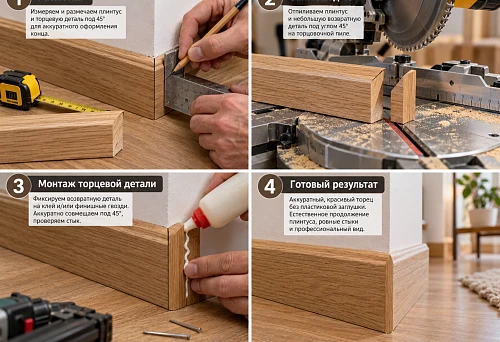
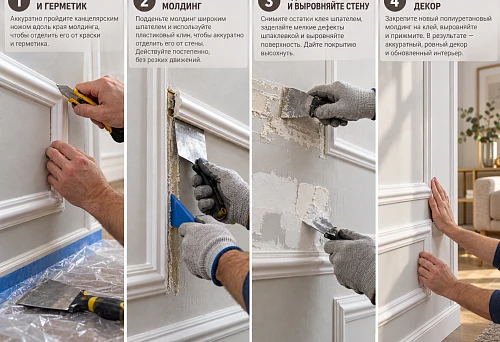
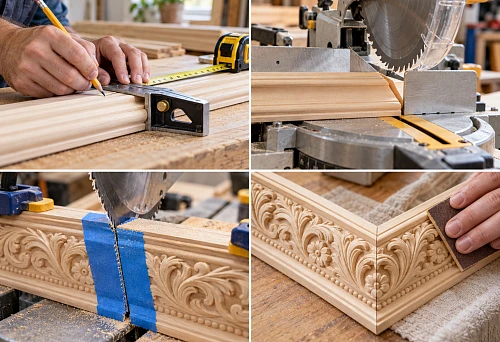
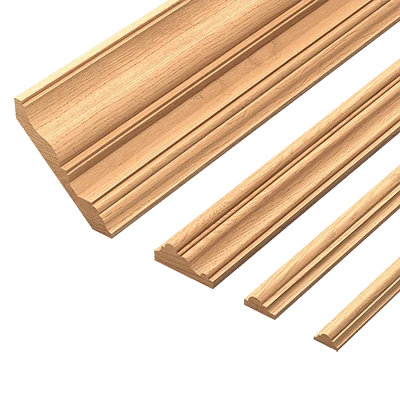
For complex projects where slat panels are combined with other decorative elements, STAVROS offers a wide range of additional products made from solid wood and MDF.Decorative slats RK-002allow forming a non-standard rhythm and creating transitions between slat panels and other surfaces. Moldings, cornices, and skirting boards from the same section ensure the connection of the slat facade with the floor and ceiling into a single system without visible breaks.
Mistakes when choosing panels for curved facades
Purchasingslat panels for curved furniture, it is important to avoid typical mistakes that lead to rework and unnecessary costs.
Rigid panel on a radius