Article Contents:
- The external width of the console and the usable opening are different dimensions
- What is confirmed about the MN-187 furniture leg
- Opening formula for four MN-187 legs
- Example with a 1000 mm tabletop
- Example with a 900 mm tabletop
- Example with a 1200 mm tabletop
- Apron
- Pull-out drawer
- Bottom decorative trim
- Beech for enamel
- Oak for tinting
- Step 1. Central axis
- Step 2. Outer margins
- Step 3. Full-size outlines
- Step 4. Opening check
- Step 5. Diagonal check
- Step 6. Aprons and drawer
- Step 7. Fastening centers
- The furniture axis aligns with the opening axis
- Drawers force the opening to be shifted
- Counting the tabletop width as usable opening
- Measuring only the soft seat
- Setting the offset by eye
- Drilling first, then trying on
- Forgetting about the apron
- Not accounting for the drawer
- Not accounting for the baseboard
- Counting four legs as a ready-made underframe
- Buy all fasteners from the card
- Don't specify the configuration
- Choose material only by color on screen
- Don't check the glides
- Make the opening exactly the width of the pouf
- Ignore the depth
- Place front legs without a back plan
- Three dimensions that cannot be combined into one
- Separate mark for the drawer rail
- What to write in the technical specification
- What is the width of MN-187?
- What is the height of MN-187?
- Is MN-187 suitable for a console?
- How to calculate the opening between two front legs?
- How to calculate the opening based on the distance between axes?
- How much space will four MN-187s take up?
- Will a pouf 600 mm wide fit under a 1000 mm console?
- What clearance should be left on the sides of the pouf?
- Why can't the opening be made exactly the width of the pouf?
- Do I need to take the apron into account?
- Can a box interfere with a pouf?
- Can MN-187 be used for a vanity table?
- Can only two MN-187 be installed?
- Do four legs guarantee stability?
- Which material should I choose — beech or oak?
- What is the difference between "Standard" and "Prestige"?
- Is MN-187 supplied painted?
- Which fasteners are suitable for MN-187?
- Is the fastener included in the order?
- Is a separate fastener kit needed for each leg?
- Are FUR-027 floor glides needed?
- How to mark four legs symmetrically?
- Can I first attach one leg, and then align the others based on it?
- Why do I need to take the baseboard into account?
- When is it better to choose a ready-made underframe?
- Can MN-187 be used as universal legs for any table?
- Where can I buy MN-187?
- Do I need to order four legs at the same time?
- What should I keep after assembly?
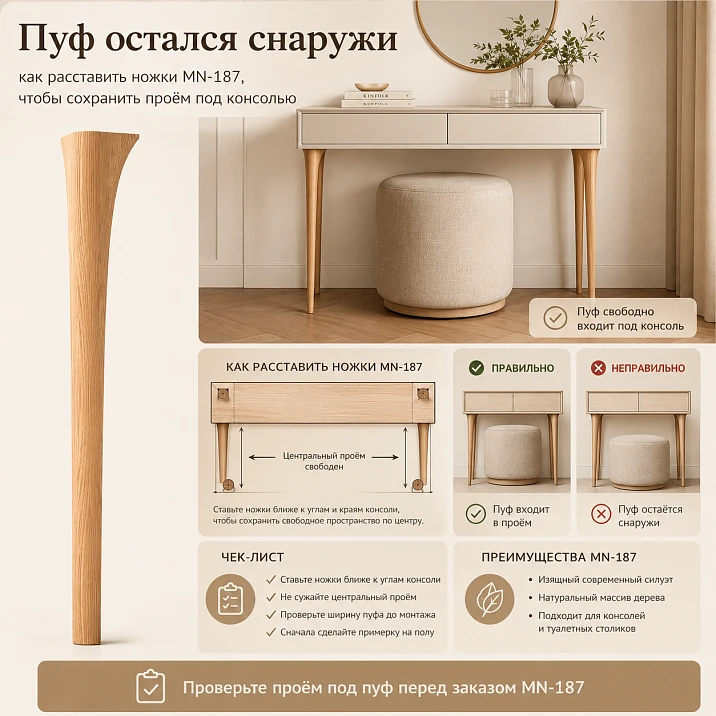
The console already fits into the niche, the tabletop does not touch the doors, the height seems comfortable, and the four wooden supports look proportional. It remains to push in the pouf — and it turns out that it does not fit between the front legs. From the outside, the furniture seems wide enough. Inside, the useful opening turned out to be much smaller: part of the space was taken up by indents from the edges, two legs 80 mm wide, the apron, the drawer, and fastening units.
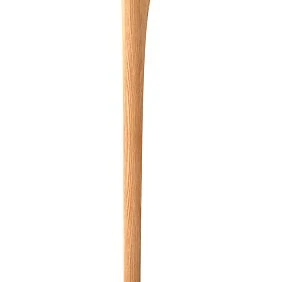
That is why buy geometric furniture legs MN-187 for the console It is better after a planning check, rather than after choosing a countertop by external dimensions. MN-187 has a height of 740 mm and a cross-section of 80 mm, is made of beech or oak, and is offered with a sanding quality of "Standard" or "Prestige". The card primarily associates the model with a console, but one style-matching leg does not yet answer the main household question: whether there will be room between the four supports for a pouf, bench, basket, or chair.
For a preliminary check, a simple formula is needed. If W — the width of the countertop or the front part of the body, E — the indentation from each edge to the outer side of the leg, and the width of MN-187 is 80 mm, then the clear opening between the inner sides of the front supports can be estimated as follows:
P = W − 2E − 160 mm
With a countertop width of 1000 mm and indentations of 60 mm each, the result will be:
P = 1000 − 120 − 160 = 720 mm
But even 720 mm is not yet the final answer. The apron can narrow the space in height, a pull-out drawer can interfere with knees, and the wide legs of a pouf can turn out to be larger than the soft seat. Therefore, before drilling, it is necessary to check not just one number, but the entire assembly: the countertop, MN-187, the pouf, aprons, the drawer, the fastening, the wall, and the baseboard.
The external width of the console and the useful opening are different dimensions
The buyer looks at a console 1000 mm wide and mentally compares it with a pouf 600 mm wide. It seems that 400 mm of free space remains. In practice, these 400 mm are distributed not around the pouf, but among all the structural elements.
Indents appear on the left and right from the edge of the tabletop. Then come two front MN-187 legs, each 80 mm wide. There is clear space left between them. If the legs are not installed along the outermost contour, the usable opening decreases even further.
| Size | What it means | Why it cannot be replaced with another |
|---|---|---|
| Total tabletop width | External furniture dimension | Includes edges, indents, and legs |
| Distance between the outer sides of the legs | Width from one support to another | Both legs are inside this dimension |
| Distance between axes | Distance between centers of front supports | For MN-187, the clear opening is 80 mm smaller |
| Clear opening | Distance between inner sides of legs | This is exactly where the ottoman should fit |
| Maximum ottoman width | Widest point of the product | May be larger than the seat due to legs or edging |
| Working clearance | Free space for daily movement | Does not have a single universal size |
The main mistake occurs when only the width of the countertop is specified in the project. The cabinetmaker sees the overall dimension, the designer sees a beautiful composition, the buyer sees a pouf in the visualization. But no one records the clear opening. After assembly, it turns out that each project participant meant a different size.




What is confirmed for furniture leg MN-187
| Parameter | Confirmed data | Practical meaning |
| Article number | MN-187 | Must be specified precisely in the request and drawing |
| Type | Geometric wooden furniture leg | Suitable for a straight rhythmic composition |
| Main purpose of the card | Leg for a console | Other applications require structural verification |
| Height | 740 мм | Affects the overall height of the furniture and seating |
| Width | 80 мм | Two front legs take up 160 mm of the opening |
| Material | Beech or oak | The choice is related to furniture finishing |
| Sanding quality | "Standard" or "Prestige" | Determines the scope of further preparation |
| Condition | Unpainted wooden support | Final finishing is agreed separately |
| The mentioned hardware | FUR-001-1, FUR-001, FUR-012, FUR-027 | The composition and quantity need to be confirmed for the selected unit |
| Thrust bearing | FUR-027, felt, diameter 24 mm | Considered for floor protection, but compatibility is checked |
The card contains a contradiction: fasteners are mentioned as special elements that may come with the leg, but at the same time they are shown as separate items in the required hardware block. Therefore, the article does not state that FUR-001-1, FUR-001, FUR-012, or FUR-027 are automatically included in the order. Before payment, it is necessary to clarify what the buyer receives with one MN-187, which set is purchased separately, and how many fastening elements are required for four legs.
Our factory also produces:
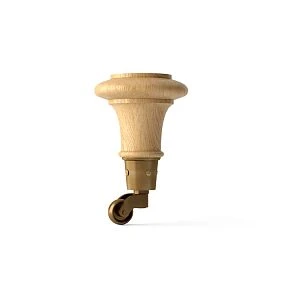
Opening formula for four MN-187
For symmetrical placement of front supports, four values are used:
-
W— width of the tabletop or cabinet; -
E— distance from the edge to the outer side of each leg; -
B— width of one leg, for MN-187 it is 80 mm; -
P— clear opening.
General formula:
P = W − 2E − 2B
For MN-187:
P = W − 2E − 160 mm
Get Consultation
Example with a 1000 mm tabletop
Offsets of 60 mm each:
P = 1000 − 2 × 60 − 160 = 720 mm
A pouf with a maximum width of 600 mm fits geometrically. 120 mm remains, that is, 60 mm on each side with a central position. Whether this is convenient for daily movement depends on the shape of the pouf, protruding legs, and how a person grabs it by hand.
Example with a 900 mm tabletop
With the same indents:
P = 900 − 120 − 160 = 620 mm
A 600 mm wide pouf fits with only 20 mm to spare. Formally — yes. In everyday use — most likely too tight: any slight shift leads to a hit against the wooden support. Here you need to either reduce the pouf, reconsider the indents, or choose a different structural scenario.
Example with a 1200 mm tabletop
Indents of 80 mm each:
P = 1200 − 160 − 160 = 880 mm
Such an opening is suitable not only for a pouf, but can also provide space for a compact chair. However, the width of the furniture does not guarantee stability. The designer must check the depth, aprons, connections, and load.
If the drawing indicates the axes of the legs
A furniture drawing often shows not the outer edges, but the center lines of the supports. Let D — the distance between the axes of the two front MN-187. Since each leg has a width of 80 mm, from the center axis to the inner side is half the width — 40 mm. On both sides, a total of 80 mm is subtracted.
Formula:
P = D − 80 mm
If the distance between the axes is 800 mm:
P = 800 − 80 = 720 mm
This notation is convenient for the designer, but the buyer needs to check that the axes refer specifically to the inner pair of front legs. The distance between diagonal supports or outer edges will give a different result.
The pouf is measured at its widest point, not by the seat
The soft seat may have a width of 560 mm, while the legs spread outward are 610 mm. Decorative piping adds a few more millimeters. A handle, a hinge of a folding structure, or a side protrusion also changes the actual dimension.
Before calculating, measure:
-
the maximum width of the body;
-
outer size of the legs;
-
decorative protrusions;
-
depth;
-
height;
-
position of the hands when pulling out;
-
direction of movement;
-
possibility to slightly turn the pouf;
-
space for the legs of a seated person;
-
space up to the frame and drawer.
There is no need to assign a single "correct" clearance on the sides. For a light pouf without protruding parts, one scenario is enough; for a heavy bench with wide supports, another. A full-scale mockup will give a more honest answer than an abstract number.
Trial fitting on the floor before drilling
The most visual test is done with masking tape and four 80 × 80 mm templates.
On the floor, the outer contour of the tabletop is marked. Then four squares corresponding to the cross-sectional dimensions of MN-187 are cut out and placed with the intended gaps. A real pouf is placed between the front templates.
They check not only the static position:
-
the pouf is pushed in and pulled out several times;
-
they pick it up with the hand they will use daily;
-
they shift it slightly left and right;
-
they simulate the presence of a drawer rail;
-
they add the contour of the drawer;
-
they account for the baseboard behind the rear legs;
-
they check the depth of pushing in;
-
they assess whether the pouf protrudes beyond the edge of the tabletop.
Such a test looks almost too simple, but it is precisely this that detects the problem before ordering and drilling.
The edge offset cannot be assigned with a single number for any countertop.
The desire to enlarge the opening pushes the legs closer to the edges. Mathematically this works: it decreases E, it grows P. But the offset is determined not only by the puff.
It is influenced by:
-
tabletop material;
-
thickness;
-
cabinet construction;
-
mounting method;
-
presence of crossbars;
-
drawer placement;
-
risk of edge damage;
-
visual proportion;
-
furniture depth;
-
rear plinth;
-
stability requirements.
A universal value without a drawing would be a fabrication. Too small an indentation can weaken the edge or leave insufficient space for the mounting plate. Too large an indentation can narrow the opening and make the supports visually clustered toward the center.
Four legs do not equal a finished underframe
The buyer sees four tall supports and assumes that after screwing them to the tabletop, a finished console will result. But stability depends on the entire system. Individual MN-187 legs do not replace aprons, cross braces, the carcass, mounting plates, or wall attachment.
Four legs can be part of the structure, but they do not guarantee its rigidity on their own. A tall support of 740 mm creates a noticeable lever. Any play in the top connection is felt more strongly than with a low furniture leg.
Before ordering, you need to decide:
-
whether there will be a carcass;
-
whether aprons are needed;
-
is rear communication provided;
-
is the console attached to the wall;
-
where are the drawers;
-
How is the load distributed?
-
how are the legs fixed;
-
is there a ready-made underframe.
Material about when is a ready-made underframe better than four legs, helps to choose the overall structure. The current article solves a narrower task — to preserve the useful opening specifically between MN-187.
The apron can get in the way before the legs do
The ottoman fits in width, but does not slide in deeply. The reason is often on top: the lower line of the apron, decorative trim, or drawer is lower than expected.
Three dimensions are checked:
-
width between the front legs;
-
height from the floor to the lower part of the body;
-
depth of the free space.
If the pouf is 460 mm high and the lower edge of the drawer rail is at 450 mm, it won't fit, even with a wide opening. If the seat passes through but the decorative hinge protrudes upward, the problem remains.
Tsarga
The drawer rail increases rigidity but reduces vertical space. Its height cannot be chosen solely based on appearance.
Pull-out drawer
The drawer takes up height, and the guides and handle may reduce knee space. This is especially important for a vanity table.
Lower decorative trim
It may be thin on the front, but have significant depth. The mockup should show not only the front line but also the internal volume.
Console with a pouf in the hallway
In the hallway, furniture is often placed in a narrow wall niche. On the left is a door, on the right a cabinet, and behind is a baseboard. The countertop fits with minimal margins, so it seems that the internal space is sufficient.
For this scenario, check:
-
the width of the niche;
-
the door opening;
-
the depth of the console;
-
baseboard protrusion;
-
the position of the rear legs;
-
the maximum width of the pouf;
-
the passage in front of the furniture;
-
baskets and bags that will be stored underneath;
-
access to the power outlet;
-
Wall mounting.
MN-187 with a height of 740 mm creates the usual base height for tall console furniture, but the final dimension depends on the tabletop and the body. You should not state a finished height in advance without a drawing.
Vanity table: the ottoman must not only fit but also provide seating.
At a vanity table, the user sits between the supports. Checking the width of the ottoman is not enough here. Space for knees, drawer height, seating depth, and mirror position are needed.
The clear opening must account for:
-
the width of the seated person's hips;
-
the maximum width of the pouf;
-
knees when sitting;
-
the edge of the drawer;
-
handle;
-
the ability to approach the tabletop;
-
drawer extension while the person is seated;
-
storage of the ottoman after use.
If the legs are placed close together, the ottoman may fit, but the person will hit the supports with their knees. Therefore, the furniture mockup is checked not only with the ottoman, but also with the user.
Small workspace
MN-187 can be considered for a narrow tabletop, but work furniture has stricter requirements. Proper seating, legroom, stability, load testing, and cable management are needed.
The phrase "legs for a tabletop" does not make any MN-187 a universal table or work support. For comparison, you can buy wooden legs for a tabletop in the specialized category, and then choose a model according to the drawing.
A workspace requires checking:
-
opening width;
-
knee zone depth;
-
tabletop height;
-
equipment loads;
-
stability when typing;
-
placement of sockets;
-
rear connection;
-
wall mounting;
-
position of the front legs relative to the chair.
Two MN-187 or four: the design decides
Sometimes the customer wants to keep the opening as wide as possible and place two legs only at the front, securing the rear part of the console to the wall. This option can exist, but two supports work only together with other load-bearing elements: the body, wall mounting, ready-made under-table, or frame.
Four legs also do not provide automatic stability. The number is determined by:
-
width and depth of the tabletop;
-
body material;
-
furniture weight;
-
expected load;
-
presence of drawers;
-
aprons;
-
cross braces;
-
wall mounting;
-
connection method.
It is not possible to recommend two or four MN-187 based only on a photo. The opening for the ottoman is an important condition, but the safety and rigidity of the structure are more important than a few extra centimeters.
Beech or oak: the material must be matched with the finish of the entire console
The card offers MN-187 in beech and oak. Both species are suitable for making a wooden support, but give a different visual result after finishing.
Beech for enamel
Beech is reasonably chosen for opaque painting. The legs can be made in the color of the tabletop, body, or wall panel. The geometric shape is read through silhouette and chiaroscuro, while the natural pattern takes a back seat.
For a batch of four supports, identical preparation and one test coat are important. Even white enamel can differ in shade and gloss level.
Oak for tinting
Oak is chosen when visible texture is required. A long straight leg emphasizes the direction of the grain, and a transparent or tinting finish ties the console to doors, floor, or other furniture.
You need to compare not only the color name, but also the actual sample. Oak parts from one batch may have natural differences, so it is advisable to finish four legs together.
| Criterion | Beech | Oak |
| Most understandable scenario | Covering enamel | Tinting with visible texture |
| Visual accent | Geometry and color | Geometry and wood grain |
| Combination with the body | Good for painted furniture | Good for natural furniture |
| Control before batch | Test enamel coating | Test tone on oak |
| What to check | Surface preparation | Toning uniformity |
In the section wooden legs for enamel or toning you can compare other unpainted models. The material is chosen before ordering fasteners and foot pads so that the entire structure is coordinated.
'Standard' or 'Prestige'
The quality of sanding affects the amount of further preparation. "Standard" may suit a workshop that plans its own finishing before painting. "Prestige" is chosen when more thorough factory preparation is important and manual work needs to be reduced.
No option eliminates the need for inspection before finishing. For a long geometric leg, check:
-
planes;
-
edges;
-
end faces;
-
transitions;
-
mounting points;
-
absence of damage after transportation;
-
identicalness of four parts;
-
readiness for the selected coating.
The actual quality content should be verified in the card and informational sections of STAVROS. It cannot be automatically assumed that the selected sanding is already a finished decorative coating.
Geometric shape MN-187 and visual rhythm of the console
A width of 80 mm makes the leg noticeable. Four verticals form the furniture's architecture. If the front supports are shifted toward the center, the console appears heavy in the middle, with the tabletop edges overhanging. If the legs are too close to the edges, the structure may look tense and require particularly precise fastening.
In the category geometric wooden legs It is convenient to compare MN-187 with other straight supports. The comparison should be made not only by height, but also by width, shape, material, and installation location.
For MN-187, it is useful to create a frontal mockup. On a wall or large sheet, mark:
-
the width of the tabletop;
-
the outer contour of the legs;
-
clean opening;
-
ottoman;
-
drawer handle;
-
mirror;
-
sockets;
-
adjacent doors.
This way you can evaluate not only the calculation, but also the proportion.
Template for marking four legs
Marking starts with the furniture axes, not with the first random drilling point.
Step 1. Central axis
On the underside of the tabletop, mark the center. From it, set equal distances to the left and right.
Step 2. Outer margins
Fix the agreed indentation EIt must account for the mounting, material edge, and visual proportion.
Step 3. Full-size outlines
Place four templates 80 × 80 mm. Even if the actual cross-section has features, the external transverse dimension must be fully accounted for.
Step 4. Opening check
Measure the distance between the inner sides of the front templates. Compare with the maximum width of the pouf.
Step 5. Diagonal check
Distances between opposite points must match. Different diagonals mean the supports are not positioned as a rectangle.
Step 6. Aprons and drawer
All body parts are marked on the template. Without this, a beautiful opening on the plane may turn out useless in height.
Step 7. Mounting centers
Mounting points are transferred only after the overall scheme is approved. Drilling independently along the presumed leg center is not allowed without a drawing of the specific joint.
Symmetry on the left and right
Even a difference of 5–10 mm becomes noticeable on a narrow console. One leg closer to the edge, another closer to the center — and the whole piece of furniture looks skewed, even though the tabletop is level.
For control, record:
-
left offset;
-
right offset;
-
distance between outer sides;
-
clean opening;
-
distance between axes;
-
diagonals;
-
depth of the front pair;
-
depth of the rear pair.
After installing the first leg, do not use it as the only reference point. All four positions should be marked in advance.
The depth of the console also affects the comfort of the ottoman.
The ottoman can fit between the legs but remain half outside. The reason is insufficient depth or a rear crossbar. Another option: the ottoman is fully pushed in, but it is difficult to pull out because it hits the wall.
Check:
-
full depth of the tabletop;
-
position of the front legs;
-
the position of the rear legs;
-
depth of the ottoman;
-
back wall;
-
baseboard;
-
cables and outlets;
-
handle protrusion;
-
ability to grab the ottoman from the side.
A narrow console against a wall often has enough depth for decor, but not enough for a full seat. Therefore, the storage function of the pouf must be incorporated into the design from the very beginning.
The baseboard shifts the rear legs forward
On the drawing, the furniture is placed flush against the wall. On site, a baseboard several centimeters thick prevents the tabletop from being pushed close. If the rear MN-187 are placed at the very edge, they may end up on the baseboard or require a shift.
Shifting the rear pair changes:
-
the depth of the support;
-
position of the stretchers;
-
stability;
-
the sliding in of the pouf;
-
the side appearance;
-
the distance to the wall.
You cannot simply move the rear legs forward after drilling the front ones. The layout must be checked against the room plan.
Mounting MN-187: first the assembly, then the hardware
The card mentions FUR-001-1, FUR-001, and FUR-012. However, without confirmation, it cannot be stated which set suits each structure and what is included in the kit for one leg.
Before purchasing fasteners, determine:
-
the material of the tabletop or body;
-
the thickness of the part;
-
the presence of a crossbar;
-
the disassembly method;
-
access to the mounting;
-
the load;
-
the direction of forces;
-
the need for a hidden joint;
-
the number of elements per leg;
-
adjustment capability.
Material on how to choose a mounting for wooden legs without play, helps to understand the differences in mounting solutions. The final assembly is approved by the furniture designer.
Why you shouldn't buy the entire list of fasteners "just in case"
If several compatible items are shown in the card, it doesn't always mean they are used simultaneously. One project may require a stud, another a mounting plate, a third a ready-made frame.
Buying without a diagram leads to three problems:
-
some of the hardware remains unused;
-
the installer chooses the assembly right on site;
-
the mounting does not match the thickness or material of the cabinet body.
In the order, it is better to write: "We ask you to confirm the recommended fasteners for four MN-187 in the structure with the specified tabletop and aprons, as well as to clarify which elements are included in the selected configuration."
FUR-027: floor protection and a small detail that is often forgotten
The card links MN-187 with the felt floor protector FUR-027 with a diameter of 24 mm. Such an element can protect the floor from direct contact with the wooden end and facilitate slight movement of furniture.
Felt floor protector FUR-027 with a diameter of 24 mm are considered after checking the lower end of the leg and the floor conditions.
Need to clarify:
-
diameter compatibility;
-
installation method;
-
number of floor protectors;
-
thickness after installation;
-
influence on the final height;
-
type of floor covering;
-
need for adjustment;
-
behavior during movement.
The general guide helps choose a floor protector for MN-187. The felt model does not replace an adjustable support if the floor has noticeable unevenness.
Floor protector and final height
Even a thin part slightly changes the height. For a console without seating, the difference may be unnoticeable. For a vanity table, a few millimeters add up with the thickness of the tabletop, drawer, and the height of the ottoman.
The drawing records:
-
height of MN-187 — 740 mm;
-
thickness of the upper part of the furniture;
-
height of the floor protector after installation;
-
floor level;
-
final height of the work surface.
You should not promise an exact finished height until all layers are defined.
What to buy together with MN-187
| Position or section | Why it's needed | What to check before purchase | Link |
| MN-187 | Four geometric supports for the designed console | Quantity, beech or oak, sanding | View dimensions of MN-187 |
| Leg catalog | Compare shape and cross-sectional size | Is a narrower option needed | Buy wooden furniture legs |
| Geometric supports | Find a close straight model | Height, width, and style | Compare MN-187 with other straight supports |
| Unpainted legs | Select a base for your own finish | Wood species and preparation | Buy unpainted furniture legs |
| Fastening | Connect legs to the body | Real mounting assembly | to choose a mounting for wooden legs without play |
| FUR-027 | Protect the floor | Compatibility and quantity | Felt floor protector FUR-027 with a diameter of 24 mm |
| Underframe | Replace individual legs with a ready-made base | Opening, wall mounting, stability | Choose a base for a narrow console against the wall |
This table does not mean that all items should be automatically added to the four legs. The set is assembled according to the drawing, not according to the maximum product list.
How not to confuse MN-187 with a ready-made console frame
MN-187 is a separate wooden support. It is responsible for the vertical, material, and visual rhythm, but does not automatically include the entire furniture structure. A ready-made frame or underframe combines supports with ties and predefines the geometry.
| Criterion | Four MN-187 | Ready-made table base |
| Freedom of arrangement | High, determined by the project | Limited by the frame structure |
| Useful opening | Can be adjusted with offsets | Set by internal geometry |
| Rigidity | Depends on the frame, body, and mounting | Partially provided by the system |
| Installation | Requires precise marking of four points | Requires installation of a ready-made base |
| Appearance | Four separate wooden verticals | Single frame |
| Risk of error | Different offset, misalignment, narrow opening | Unsuitable ready-made size |
| When it fits | Requires a custom design and specific opening | A pre-attached base is needed |
The choice cannot be reduced to the price of four legs and the price of one frame. You need to compare the entire set: connections, fasteners, assembly labor, stability, and usable space.
How not to confuse the leg width with its mounting area
The width of MN-187 is 80 mm, but this does not prove that the mounting zone on top is exactly 80 × 80 mm and allows fastening at any point. The external dimension is needed for calculating the opening. The fastening scheme is taken from the drawing and the selected hardware.
Bad: mark a square of 80 × 80 mm, place a point in the center, and drill.
Correct: use the square as a planning outline, then overlay the actual scheme of the top end, mounting plate, or pin.
This separates two questions:
-
whether the pouf will fit;
-
whether the leg can be securely attached in the chosen location.
The front and rear pairs may stand at different offsets only according to the design
On a narrow console, the rear legs are sometimes shifted away from the baseboard, while the front legs are left closer to the edges. From the side, the furniture gets a trapezoidal support scheme. Such a solution may be justified, but it cannot be accepted on site without verification.
It is necessary to assess:
-
diagonals of the support contour;
-
rigidity of the stretchers;
-
load on the fastening;
-
position of the center of gravity;
-
visual side view;
-
depth of the ottoman;
-
the ability to push it up against the wall.
For the buyer, the main conclusion is simple: calculating the front opening does not replace a full plan of the four legs.
Console between two doors
In a narrow wall space, the external width of the furniture is limited by the trim and the opening of the doors. The ottoman should fit inside, and the console itself should not obstruct the passage.
Checking procedure:
-
measure the distance between protruding parts of the platbands;
-
check the door trajectory;
-
set the maximum countertop width;
-
select preliminary leg offsets;
-
calculate the clear opening;
-
check the ottoman;
-
apply furniture depth to the plan;
-
account for the baseboard;
-
determine the wall mounting;
-
only then choose the quantity and hardware.
If after all deductions the opening turns out to be too narrow, more careful installation will not solve the problem. You need to change the width of the pouf, the tabletop, the leg model, or the base construction.
Basket under the console
A basket seems simpler than a pouf: no one sits on it, so seating dimensions are not needed. But it has handles, a widening top, and contents that protrude outward.
Measure:
-
maximum width across the handles;
-
top edge;
-
depth;
-
height with contents;
-
grip method;
-
direction of pulling out;
-
clearance to the apron.
If the basket is soft, don't expect it to always compress. Daily friction against the finished wooden legs will quickly leave marks on both surfaces.
Bench under a long console
The bench can be wider than a regular ottoman and have spread legs. Its actual maximum dimension is especially important.
A long tabletop does not necessarily provide a wide opening. If MN-187 are shifted toward the center for construction or drawers, the bench will remain outside.
Two values are used for checking:
-
the clear width between the front legs;
-
the depth of the free zone to the back crossbar.
If the bench is intended for regular sitting, leg comfort is also assessed, not just storage.
Console under a mirror
The mirror sets the central axis. If the ottoman and the opening are offset relative to it, the composition looks random. First, align the axis of the mirror, tabletop, and inner space, then distribute the legs.
Two scenarios are possible:
The furniture axis coincides with the opening axis
The front MN-187 are positioned symmetrically, the ottoman stands in the center. This is the most straightforward option.
The drawers force the opening to be shifted
The internal structure can divide the space. Then the designer must show the asymmetry on the facade and explain it. You cannot hide a structural offset with just beautiful visualization.
Narrow console and large legs 80 mm
With a tabletop width of 700 mm, two front MN-187 already take up 160 mm. If you leave 50 mm from the edges:
P = 700 − 100 − 160 = 440 mm
Most wide poufs will not fit. Even a compact stool may be cramped.
In this situation, there are four options:
-
give up storing the seat under the console;
-
choose narrower legs;
-
increase the tabletop;
-
switch to a different base structure.
You cannot promise a console with ottoman feature until the opening is confirmed with numbers.
Wide console and too large empty center
The opposite problem occurs with a 1600 mm tabletop. With legs close to the edges, the opening may look excessively empty, and a long apron may require additional checks.
Increasing the distance between legs just for the ottoman cannot be done without a structural calculation. A long tabletop may sag, and drawers may need intermediate ties.
MN-187 helps form a beautiful vertical line, but does not determine the allowable span. That is a task for a furniture designer.
Comparison of three planning scenarios
Suppose the tabletop has a width of 1000 mm.
| Indent on each side | Clear opening | What it may be suitable for | What to check | ||||||||||||||||||||||||||||||||||||||||||||||||||||||
| 40 мм | 760 мм | Wide ottoman or compact bench | Edge of the tabletop and mounting | ||||||||||||||||||||||||||||||||||||||||||||||||||||||
| 60 мм | 720 мм | Most medium ottomans | Side clearance and apron | ||||||||||||||||||||||||||||||||||||||||||||||||||||||
| 100 мм | 640 мм | Compact ottoman | Convenience of daily movement | ||||||||||||||||||||||||||||||||||||||||||||||||||||||
| 140 мм | 560 мм | Narrow seat or basket |
What to check before finishing MN-187
Painting or tinting is done after a test fitting. Before finishing, check:
If the legs are painted separately, the labels "front left", "front right", "back left", "back right" are transferred to the packaging. After finishing, positions cannot be randomly selected again. Four identical legs may look different after installationCauses:
Before installation, the parts are laid out side by side and arranged so that the front pair looks consistent. This is especially important for oak under a transparent finish. Mistakes that leave the ottoman outsideCounting the tabletop width as the usable openingThe offsets and two legs of 80 mm each were not subtracted from the total size. Measuring only the soft seatThe ottoman legs or decorative trim turn out to be wider. Assigning the offset by eyeThe left and right legs stand differently, and the opening is shifted. Drill first, then try fitting.Any adjustment turns into a repair of the body. Forget about the drawer rail.The ottoman fits in width, but hits the top. Not accounting for the drawer.Sitting is uncomfortable, the handle gets in the way of the knees. Not accounting for the baseboard.The back legs have to be moved forward after marking. Counting four legs as a finished underframe.Furniture gets play without ties and proper fastening. Buy all fasteners from the cardSome items may relate to alternative assemblies. Not specifying the package contentsThe buyer expects fastening in the box, but it is ordered separately, or vice versa. Choosing material only by color on screenBeech and oak finishes give different results. Not checking the glidesThe final height changes, and the floor remains unprotected. Making the opening exactly the width of the poufDaily movement causes impacts on the legs. Ignore depthThe pouf fits between the supports but does not slide in completely. Arrange the front legs without a back planThe support contour ends up skewed. Who MN-187 is suitable forConsider this model when:
When it's better to choose another solutionMN-187 may not fit if:
In such a situation, it is more reasonable to open the STAVROS furniture support catalog and compare models by width and purpose. Project checklist before placing an orderBefore purchasing four MN-187 units, fill out the working table. It should be placed next to the furniture drawing, not exist only in correspondence.
The table is not needed for formality's sake. It shows where the project is not yet ready. An empty line "fastening unit" means that the kit cannot be assembled definitively. An unknown width of the pouf means that the useful opening is still chosen blindly. Request template to STAVROS managerGeometric furniture legs MN-187 are required for the console. Quantity — ___ pcs. Material — beech/oak. Sanding quality — "Standard"/"Prestige". Tabletop width — ___ mm, depth — ___ mm. Planned indentation from each edge to the outer side of the leg — ___ mm. Calculated clear opening between front supports — ___ mm. Maximum width of the pouf — ___ mm. The design includes a crossbar ___ mm and a drawer ___. Please confirm the current dimensions of MN-187, available options, price, lead time, delivery contents, recommended fastening unit, and the need for separate ordering of FUR-001-1, FUR-001, FUR-012 and support pads FUR-027. Drawing is attached. Such a request immediately shifts the conversation from a general "we need four legs" to real furniture. The manager sees the purpose, quantity, material, and contentious configuration points. How to order MN-187 from STAVROS
Don't search for "where to buy furniture legs" after the cabinet has already been drilled. First, choose a compatible system, then fix the mounting points. Test assembly before final finishingBefore painting or staining, assemble the structure temporarily or perform a full fitting of the components. The check should answer seven questions:
If a problem is detected at this stage, the wooden surfaces can still be re-prepared without damaging the finished coating. After enamel or tinting, any change in attachment points becomes more noticeable. Acceptance of four MN-187After delivery, do not randomly distribute the legs among positions. First, inspect the entire batch. Check:
For oak, lay out the four legs side by side and assess the texture. It is better to select the front pair so that it looks consistent after staining. Care for the finished consoleThe care method depends on the finish coating. Unpainted MN-187 cannot be considered ready for normal use immediately after assembly. The finish must protect the surface and match the furniture. In everyday use:
If the opening is designed with sufficient working space, the ottoman will not constantly hit the legs, and the finish will maintain a neat appearance longer. How to convey the calculation to the cabinetmaker without ambiguityThe phrase "leave space for the ottoman" is too vague. One craftsman will understand it as the width between axes, another as the distance between outer edges, and a third will compare the ottoman to the total width of the cabinet. The working drawing must show specific lines. Tell the cabinetmaker:
On the drawing, it is better to highlight the useful opening with a separate dimension line and label it: "clear distance between the inner sides of the front MN-187". Such wording leaves no room for different interpretations. Three sizes that cannot be combined into oneSuppose the distance between the axes of the front legs is specified as 800 mm. This does not mean an opening of 800 mm. The clear distance will be 720 mm. The overall width of the pair, with each leg being 80 mm wide, will, on the contrary, be 80 mm greater than the distance between the axes — 880 mm. This results in three different sizes:
If only the number 800 mm appears in correspondence without clarification, the risk of error is very high. Specify between which points the dimension is taken. A separate mark for the apronThe front view shows the width, while the side section shows the height and depth. It indicates the lower edge of the apron, the bottom of the drawer, and the maximum height of the ottoman. If these lines are absent, the wide internal space may turn out to be too low. What to write in the technical specificationShort working formulation: The clear opening between the inner sides of the front legs MN-187 must be at least ___ mm. The dimension refers to the finished structure after installation of the supports. The lower edge of the apron must be no lower than ___ mm from the finished floor. The pouf has maximum dimensions ___ × ___ × ___ mm. The position of the fasteners and extreme offsets should be determined according to the drawing, taking into account the tabletop material and furniture stability. Such a record does not dictate a dangerous offset to the designer, but fixes the required user result. Checking the project at 1:1 scaleComputer visualization shows proportions, but does not give a physical feel. For a narrow hallway or vanity table, it is useful to assemble a simple mockup. You will need:
The mockup does not bear load and does not replace a structural sample. Its task is to test the space. The user sits down several times, stands up, pushes in the pouf, opens an imaginary drawer, and walks past the console. Such a fitting reveals details that are not in the formula:
After the mockup, the dimensions are transferred to the drawing. Not the other way around: there is no need to adjust real human movement to already drilled points. Such a check is especially useful for narrow furniture in the hallway. Questions and answers about MN-187What is the width of MN-187?The confirmed leg width is 80 mm. The two front supports together take up 160 mm of the console width, not including offsets. What is the height of MN-187?The height is 740 mm. The final height of the furniture will be greater due to the tabletop, body, fasteners, and possible leveling feet. Is MN-187 suitable for a console?Yes, the product card positions the model primarily as a leg for a console. Stability and assembly method depend on the entire structure. How to calculate the opening between the two front legs?
Subtract the two edge offsets and 160 mm from the tabletop width: How to calculate the opening by the distance between axes?
Subtract 80 mm from the distance between the central axes of the front MN-187: How much space will four MN-187 take up?For the front opening, two front legs are important — 160 mm. Four supports also take up depth and require a full furniture plan. Will a pouf 600 mm wide fit under a 1000 mm console?With 60 mm offsets on each side, the clear opening will be 720 mm. The pouf fits geometrically, but you need to check its protruding parts, the apron, and the depth. What clearance should be left on the sides of the pouf?There is no universal number. The clearance depends on weight, shape, legs, handles, and the method of daily pulling out. Why can't the opening be made exactly the width of the pouf?Without free space, the pouf will hit the supports at the slightest shift. This is inconvenient and damages the finish. Should the apron be taken into account?Yes. The apron may not reduce the width between the front legs, but it can limit the height and depth of sliding in. Can the drawer interfere with the pouf?Yes. The lower part of the drawer, the guides, and the handle reduce the space for knees and the height of the free zone. Can MN-187 be used for a vanity table?It can be considered if the height, opening, fit, drawer, and stability are confirmed by the furniture design. Can only two MN-187 be installed?Only in a structure with other load-bearing elements, such as a body, frame, or wall mounting. Universally recommending two supports is not possible. Do four legs guarantee stability?No. Rigidity depends on the aprons, ties, body, fasteners, and the material of the tabletop. Which material to choose — beech or oak?Beech is convenient under covering enamel, oak — under tinting with visible texture. The choice is linked to the body and interior. What is the difference between "Standard" and "Prestige"?These are sanding quality options. The exact amount of preparation needs to be verified in the card; both options are inspected before finishing. Is MN-187 supplied painted?The model is in the section of unpainted legs. The final finish is selected separately. Which fasteners are suitable for MN-187?The type of fastener depends on the design. The card mentions FUR-001-1, FUR-001, and FUR-012, but the specific joint and completeness need to be confirmed. Is the fastener included in the order?The description has a contradiction between mentioning the set and a separate hardware block. Before payment, ask for written confirmation of the delivery contents. Is a separate fastener set needed for each leg?This depends on the selected joint and configuration. The quantity cannot be determined without confirmation. Are FUR-027 floor protectors needed?They can be considered for floor protection. Compatibility, installation method, and impact on height need to be checked. How to mark four legs symmetrically?Mark the central axis, symmetrical edge offsets, full-size 80 × 80 mm outlines, and compare the diagonals. Can one leg be attached first, and the others aligned based on it?This increases the risk of accumulating error. All four positions must be marked before drilling. Why should the baseboard be taken into account?It may prevent the rear legs from being placed close to the wall. The shift will change the depth and support scheme. When is it better to choose a ready-made underframe?When a pre-connected structure is needed, and individual legs require overly complex aprons, fasteners, or wall assemblies. Can MN-187 be used as universal legs for any table?No. The card links the model to the console, and other furniture requires checking height, load, depth, and construction. Where to buy MN-187?The model is presented in the STAVROS card, where before ordering you need to check current options, price, timelines, and delivery contents. Do I need to order four legs at the same time?For one console, this is rational: the material, sanding, and subsequent finishing will be coordinated in one batch. What to keep after assembly?The drawing, opening dimensions, mounting diagram, hardware data, coating code, and information about floor glides. Summary: first the opening and construction, then drilling and purchaseMN-187, 740 mm high and 80 mm wide, can become an expressive base for a narrow console, vanity table, or other custom furniture. But four beautiful supports do not guarantee that a pouf will fit under the tabletop. The usable space needs to be calculated separately. Take the width of the tabletop, subtract the two edge offsets and 160 mm, which are occupied by the two front legs. Compare the resulting opening with the maximum size of the pouf, then add the apron, drawer, plinth, and depth to the layout. If the axes are known on the drawing, the clear opening between MN-187 equals the distance between the axes minus 80 mm. A critical constraint is the lack of a universal edge offset. It is determined by the cabinet material, fastening, aprons, and overall stability. Do not move the legs outward just for the pouf, and do not buy all hardware items without an approved joint. Separately clarify the configuration: the card simultaneously mentions special fasteners and shows them as standalone products. STAVROS offers MN-187 in beech or oak, sanding options, categories of geometric and unpainted legs, and materials on fastening and glides. Such a choice is useful not by itself, but as part of a precise furniture project. When the opening, pouf, aprons, and mounting scheme are checked before drilling, the console remains beautiful on the outside and truly convenient on the inside. |