Article Contents:
- The problem is not the leg — it's the mounting system
- What furniture leg fittings consist of
- Mounting Plates
- Furniture leg studs
- Screws for mounting plates
- Glides
- Attaching legs to the tabletop: how to do it right
- Step one: check the tabletop thickness
- Step two: mark the leg positions
- Step three: install the plates
- Step four: screw the stud into the leg
- Step five: screw on the leg and install the foot
- Mounting plate: breakdown of scenarios by leg type
- Straight leg to tabletop without underframe
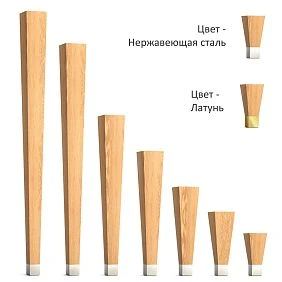
- Tapered conical leg
- Round leg
- Repairing old mounting
- Studs and screws: technical details that matter
- M8 stud: standard for wooden legs
- Screw length and grip depth
- Number of mounting points
- Glides: felt, plastic, or adjustable ball joint
- Felt glide
- Plastic glide
- Adjustable ball joint glide FUR-019
- How to choose hardware based on furniture type
- Dining table
- Kitchen table
- Chest of drawers and cabinet
- Cabinet
- Console table
- Chair and stool
- How to choose fastener size: a practical algorithm
- Typical mistakes when installing furniture legs
- What to buy together with wooden furniture legs
- FAQ: answers to popular questions about furniture leg fittings
- About the Company STAVROS
Play does not appear immediately. At first, it is a barely perceptible wobble that you notice only at a certain angle of pressure. Then — a slight creak. Then — a noticeable skew and the feeling that the table is about to collapse. And all this is not because the wooden leg is bad. The reason is almost always something else: the fittings are chosen incorrectly, the fastening is selected without considering the load, and the installation is done "by eye."
Beautiful wooden furniture leg — is only half the task. The other half is how it holds in the structure. And this is where Furniture leg hardware plays the main role. A properly selected set — mounting plate, stud, foot cap, and screws — turns a separate wooden part into a stable load-bearing support with zero play and long-term durability.
This article is a practical guide to choosing fasteners and fittings for wooden furniture legs. No abstract advice, only specific solutions understandable to anyone — from a professional furniture maker to a person assembling a dining table at home for the first time.
The problem is not the leg — it's the fastening system
Before diving into specific details, it is important to understand one thing. A wooden furniture leg is not an independent structural element. It is part of a system: leg plus plate plus stud plus foot cap plus the base to which it all attaches. If any link in this chain is weaker than the others, the system works unreliably.
That's why buying legs separately and then "dealing with the fasteners" is a path to problems. A professional approach looks different: first, understand the expected load, the thickness of the tabletop, whether vertical or angled leg placement is needed — and only then choose the specific type of mounting.
Wobbling of a table or cabinet after installation almost never means the legs are bad. Most often, it means one of the following: the plate is weaker than the load, the screw is shorter than needed, the stud is the wrong diameter, the leg is placed at an angle on a straight plate — or there simply wasn't proper marking.




What furniture leg hardware consists of
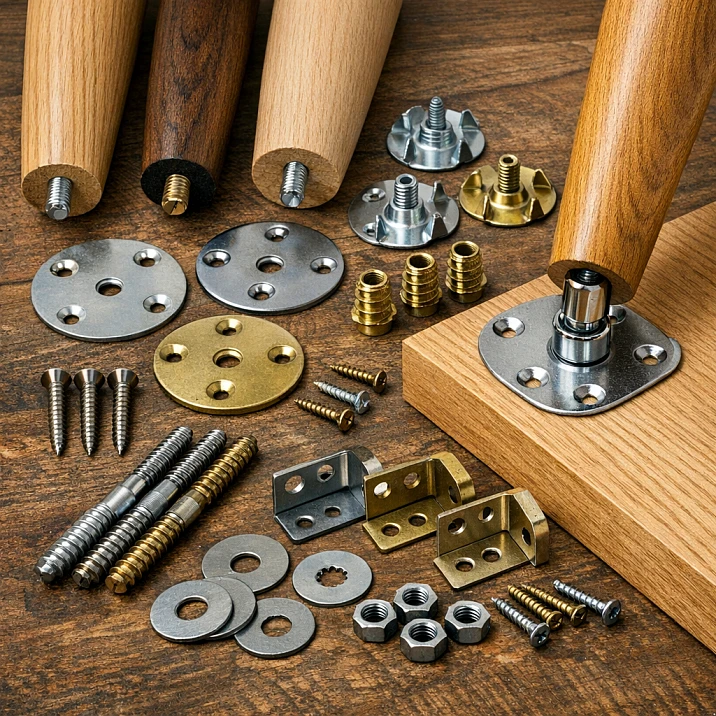
В in the STAVROS hardware section a full set of fastening and mounting elements is presented. Let's break down each category separately — what it is, when it is used, and why the right choice is important.
Our factory also produces:
Mounting plates
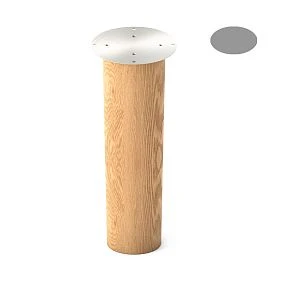
A mounting plate is a transitional element between the tabletop or furniture body and the leg. Its task is to distribute the load, ensure straight or angled placement, and secure the leg without the possibility of shifting.
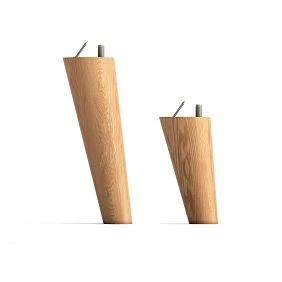
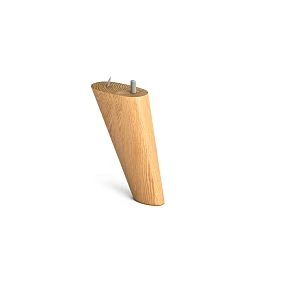
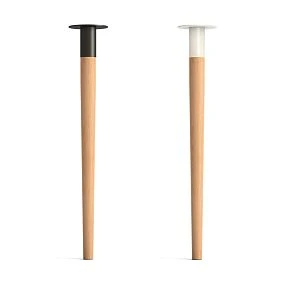
The STAVROS range includes several types of mounting plates. The straight plate FUR-020 is designed for vertical leg mounting — when the leg stands perpendicular to the base. The wooden mounting plate FUR-017 allows installation at a 10° angle — this is the so-called "Scandinavian tilt," where the legs are slightly spread apart for greater structural stability.
The choice between a straight and angled plate is not a design whim but a structural decision. A straight leg on a dining table looks one way; slightly spread conical legs on a coffee table look completely different. And the mounting plate makes a difference not only visually but also mechanically: with angled placement, the load is distributed across the plane differently.
Get Consultation
Furniture leg studs
A stud is a threaded rod that screws into the end of a wooden leg on one side and into the plate on the other. A standard M8×60 stud (item FUR-001-1) screws into the leg end to a depth of 25–30 mm. This means the leg body must have enough mass to hold the thread.
The stud diameter and thread pitch must match the leg type. For thin legs with a small end, smaller diameter studs are used; for massive supports under heavy tables, larger ones. A stud installed in too thin an end will eventually start to pull out under load — and that is exactly the play from which wobbling begins.
Important nuance: the thread pitch of the stud must match the thread pitch in the plate. If they don't match, the connection either won't screw in completely or will have play.
Screws for attaching plates
The plate is attached to the base — the tabletop, the bottom of a cabinet or dresser — using screws. And there is a nuance here that many ignore: the screw length must provide sufficient grip depth in the solid wood. Structural screws FUR-037 (5×70) and FUR-038 (5×90) from the STAVROS range are designed specifically for connections under constant load. These are not ordinary "from the kit" screws — they are fasteners with the correct thread pitch and diameter for working with wood under load.
The number of screws matters. A plate secured with two screws instead of four works under bending — and under sufficient load, it starts to pull the leg to the side. Always use all the provided mounting holes of the plate.
Glides
The glide is the last element of the system that works "from below," between the leg and the floor. It is a small part, but its role is hard to overestimate.
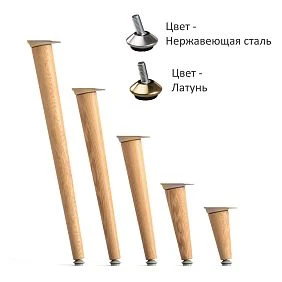
Firstly, a felt glide protects the floor covering from scratches. Parquet, laminate, tile — any finished floor covering suffers from direct contact with the wood or metal of the leg when moving furniture. The felt pad eliminates this contact and does not slip.
Secondly, the adjustable glide FUR-019 with a ball joint allows compensating for minor floor irregularities. If the floor is not perfectly level — which is normal for most living spaces — a leg without an adjustable glide will inevitably stand crooked. One of the support corners will be slightly raised, and this is where the "diagonal" wobble comes from, which many mistakenly attribute to a fastening problem.
Thirdly, the glide reduces noise when moving furniture. This is especially relevant for kitchen chairs, bar stools, and dining tables.
Attaching legs to the tabletop: how to do it right
Attaching table legs to the tabletop is the most common scenario, and it's where mistakes are most often made. Let's break down the process step by step.
Step one: check the thickness of the tabletop
The thickness of the base determines the length of the screw. The screw must penetrate the solid wood to at least half its length — only then does the thread hold the fastener, rather than just "sitting" in the material. A tabletop 20 mm thick requires screws not exceeding this depth: a through exit of the screw will ruin the front surface. A tabletop 40 mm thick gives significantly more freedom in choosing fasteners.
If the tabletop is made of laminated chipboard or MDF, it's important to consider that these materials hold screws worse than solid wood. For large legs under heavy dining tables, it's better to use massive wooden underframes or furniture frames, which provide sufficient mass for fastening.
Step two: mark the positions of the legs
The positions of the legs are not marked "by eye" or "by feel." For a square or rectangular table, the distance from the corner of the tabletop is determined based on ensuring the legs do not extend beyond the tabletop's footprint on the front side while providing a sufficient stability base. Too close to the center — the table will wobble under lateral loads. Too close to the edges — the legs will interfere when sitting and increase the risk of bumping.
Marking is done with a pencil based on precise measurements, symmetrically on both sides. Before drilling pilot holes, check with a level that all four points are in the same horizontal plane.
Step three: install the plates
The plate is attached to the underside of the tabletop or to the end of the underframe. Screws are driven into all holes, without exception, with equal force. After installing all four plates, check that they lie in the same plane: a small level on the plane of the plates will show if there is any misalignment.
For legs with an angled mount, the wooden mounting plate FUR-017 is used — it already has a built-in 10° angle, and no additional shims are needed. Using a straight plate for tapered angled legs is a common mistake: in this case, the leg will stand at an angle, but the load on the plate will be distributed unevenly, creating a risk of loosening.
Step four: screw the stud into the leg
The stud is screwed into the end of the leg using two nuts tightened as a "lock nut." The screwing depth is 25–30 mm into the solid wood. The leg is held in hands, end up; the stud is screwed strictly along the axis of the leg, without misalignment. If the stud goes in at an angle — when screwing the leg onto the plate, a misalignment will occur, creating uneven load on the connection.
Step five: screw on the leg and install the foot pad
After installing all plates, the legs are screwed on via the stud. The tightening torque is moderate, without excessive force: the thread is in the solid wood of the leg, and it can be stripped. Final check — verifying the levelness of the structure with the foot pad installed.
Mounting plate: scenario breakdown by leg type
The mounting plate is the most variable element in the fastening system. To understand which one is needed, answer three questions: what leg (shape, cross-section, design), what installation angle (straight or angled), and what is the expected load.
Straight leg to tabletop without underframe
Here, a straight metal or wooden plate with a right-angle mount is suitable. The FUR-020 plate is a standard solution for most cases: a square or rectangular table with four legs, load within normal household use.
Angled tapered leg
For Scandinavian-style legs that are slightly spread apart during installation, a wooden mounting plate FUR-017 with a 10° angle is used. It ensures correct support geometry and allows the foot cap to fully contact the floor rather than touching it only with one edge.
Round leg
For round legs, it is important that the stud is installed strictly along the axis of the end circle. Shifting the stud toward the edge of the end — even slightly — creates eccentricity during screwing and leads to uneven load on the joint. The plate for a round leg is selected as standard; only precise centering of the stud during insertion matters.
Repair of old mounting
If the table is already wobbling due to worn-out mounting — the plate is deformed, screws have lost grip in the material — the correct solution is not to "add more screws" but to completely replace the system. Worn holes in the tabletop can be reinforced with wooden plugs on glue, followed by drilling new pilot holes. After that — a new plate, new screws, and level checking.
Studs and screws: technical details that matter
Fasteners are not a category where savings are appropriate. One weak screw in a system of four is not "25% risk": it is the failure point of the entire structure.
M8 stud: standard for wooden legs
Standard M8 stud — diameter 8 mm, thread pitch 1.25 mm — is compatible with most STAVROS furniture legs. It provides sufficient holding force under standard loads: dining table, desk, console, chest of drawers. For very heavy structures — a massive oak table over 2 meters long — it makes sense to consider a reinforced connection through an underframe rather than direct leg attachment to the tabletop.
Screw length and grip depth
A 30 mm self-tapping screw enters a 20 mm thick array — the remaining depth provides grip. For an 18 mm thick tabletop, a 30 mm screw is the limit; a longer one will go through. For solid wood underframes and furniture frames with material thickness of 30–40 mm, 5×70 (FUR-037) or 5×90 (FUR-038) self-tapping screws are used — these are structural fasteners designed for long-term operation under load.
Number of mounting points
Four screws per plate is not a recommendation, but a minimum. Six holes in the plate — use all six. This is not redundancy: under dynamic loads — and a table is constantly loaded and unloaded — each fastener takes part of the force. Reducing the number of attachment points multiplies the load on the remaining ones.
Glides: felt, plastic, or adjustable ball joint
Three types of glides — three application scenarios. Knowing when to use which means avoiding both scratches on the floor and annoying furniture instability.
Felt glide
A classic for parquet, laminate, and any finished flooring. The felt glide is glued to the end of the leg or inserted into a special groove. It is soft, non-slip, absorbs vibration when moving furniture, and leaves no marks. This is the default choice for all furniture in a living space.
Limitation: felt compacts and gets dirty over time. In high-use areas — under kitchen chairs, under bar stools — glides need to be replaced periodically. This is not a design flaw, but normal wear of a consumable item.
Plastic glide
Suitable for technical areas, workshops, commercial spaces where furniture is moved less frequently, but mechanical strength of the glide is needed. Plastic does not slip on rough surfaces — concrete, ceramic tiles — and is moisture resistant. For a living space with parquet, a plastic glide is less preferable: under lateral load, it may leave a mark.
Adjustable glide with ball joint FUR-019
This is the most functional solution for conditions where the floor is not perfectly level. The ball joint allows the end of the leg to adapt to the slope of the surface: the foot always sits fully, without skewing. When used with angled legs on the FUR-017 plate, this is an ideal pair: the mounting angle is compensated by the plate, and floor unevenness by the foot. The structure stands stable regardless of the floor covering condition.
How to choose hardware based on furniture type
A table, chest of drawers, wardrobe, and kitchen chair present fundamentally different tasks for the same set of fastening hardware. Let's break down each scenario.
Dining table
A dining table bears static load from the weight of items and dynamic load from people leaning on the tabletop. Here, system rigidity in the horizontal plane is important. Four legs on mounting plates with six screws each is the minimum standard. For long tables with six or more legs, it is recommended wooden table base: it significantly increases structural rigidity and relieves part of the load from individual leg attachment points.
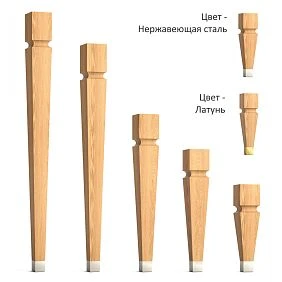
When choosing of wooden furniture legs for a dining table, it is important to decide in advance: straight or angled. This will determine the type of mounting plate and, accordingly, the type of foot.
Kitchen table
A kitchen table is used more intensively than a dining table: it is wiped more often, people lean on it while working with food, and it experiences more horizontal impact loads. Here, moisture resistance of all fastening elements is important. Metal plates made of stainless steel with a thickness of 3 mm are the preferred option. Wooden FUR-017 plates, despite their convenience for corner installation, require additional moisture protection in kitchen conditions with regular floor washing.
Chest of drawers and cabinet
A chest of drawers and cabinet are loaded vertically — by the weight of the body and the contents of the drawers. Horizontal dynamic loads are minimal: this furniture is not constantly moved. The main requirements are stability on uneven floors and no scratches on parquet. For most chests of drawers, straight plates with four screws each and felt feet are sufficient. Adjustable FUR-019 feet make sense if the floor in the room is noticeably uneven.
Wardrobe
A cabinet is the heaviest piece of furniture among all considered scenarios. With a body height of 2 meters or more and the load from its contents, significant force is placed on the load-bearing capacity of the leg fasteners. Here, not only the plate and screws matter, but also the leg itself: it must be designed for the corresponding load. For a cabinet, it is important to check the calculated load per leg (the weight of the cabinet with contents divided by four with a 30% margin) and ensure that the selected leg model and plate meet this value. A mounting plate with increased load-bearing capacity is not a luxury but a necessity.
Console table
A console is furniture with pronounced horizontal load: items are placed on it, people lean on it, and it is used as a barrier against a wall. Play in a console is especially noticeable because it is used in motion, not just statically. Fastening the legs of a console table requires special attention to geometry: the legs must stand strictly vertically or with the same calculated tilt, without the slightest misalignment. Checking the level after installation is mandatory.
Chair and stool
A chair is the most dynamically loaded piece of furniture. People sit on it, push off when standing up, lean back while talking, and rock. The load on the chair leg fasteners is cyclical and unpredictable in direction. That is why chair legs are most often attached not through mounting plates, but directly via a tenon joint with the seat frame or through stretchers. Nevertheless, for additional reinforcement, glides on chairs—especially adjustable ones—are fundamentally important: they absorb part of the dynamic load from impacts on the floor.
How to choose fastener size: a practical algorithm
There are no universal sizes. But there is an algorithm that works for any project.
First parameter: leg diameter or cross-section. The stud is selected based on the diameter of the leg end. The end must accommodate the stud with a sufficient layer of solid wood around the thread—at least 5–7 mm from the edge of the end to the stud shaft. For a leg with a diameter of 40 mm, a standard M8 stud is used. For a leg with a diameter of 25 mm, a smaller diameter stud is needed.
Second parameter: base thickness. Determines the screw length for the plate. The screw should penetrate the solid wood by 60–70% of its length without going through.
Third parameter: installation angle. Straight or angled leg placement determines the type of plate (straight or FUR-017 for 10°).
Fourth parameter: load. The calculated load on one leg must not exceed the declared load-bearing capacity of the plate. If precise data is unavailable, choose with a 30–50% margin.
Fifth parameter: floor type. Felt glides for parquet and laminate; plastic glides for tile and concrete; adjustable ball glides for uneven surfaces or angled legs.
Typical mistakes when installing furniture legs
Over years of practice, an understanding accumulates: the same mistakes are repeated with enviable regularity. Here are the most common ones — with an explanation of why exactly this is wrong.
One screw instead of four. It seems the plate holds. And it does hold — until the load exceeds static. At the first dynamic load, the plate starts to rotate around the single attachment point. The result is loosening within a few weeks.
Screw into the end of laminated chipboard. Laminated chipboard holds a screw poorly in the end direction. For this, you need either to glue wooden reinforcing strips in the attachment areas or use furniture frames and under-table structures solid wood.
Flat plate for an angled leg. It looks like this: the leg is installed at an angle, but the plate is flat. As a result, the bottom plane of the plate does not fit evenly against the base, two screws work in shear, two in pull-out. The joint stiffness decreases significantly.
Lack of pilot holes. Driving a screw without pre-drilling into hard wood — oak, beech — often leads to cracking of the solid material. A pilot hole with a diameter 1–1.5 mm smaller than the screw diameter eliminates this risk.
Asymmetric marking. Leg positions are marked "by eye" or with an error of a few millimeters. The result is a visually skewed table, one leg slightly farther from the edge, another closer. Fixing this after installation without reattachment is impossible.
Forgotten glides. A wooden leg without a glide on parquet means scratches with every movement of the furniture. A glide costs pennies; repairing parquet flooring is incomparably more expensive.
Stud at an angle to the leg axis. If the stud is screwed in crooked, when screwing the leg onto the plate, mechanical stress occurs in the thread area of the plate. Over time, the thread wears out, and the connection weakens. The stud is screwed in strictly along the axis.
Legs too close to the edge. If the leg is installed less than 50–60 mm from the edge of the tabletop, there is a risk of material chipping around the attachment points under lateral load. The optimal offset is 80–120 mm from the edge, depending on the material and base thickness.
Buying legs without hardware included. A furniture leg without a plate and stud is just a wooden part. The complete mounting system must be selected together. At STAVROS Furniture for legs and handles it is separated into a separate section specifically to consciously assemble the mounting system.
Mismatch of stud and plate threads. Parts from different sets or from different manufacturers may have incompatible thread pitches. Always check compatibility before installation.
What to buy together with wooden furniture legs
A complete mounting system is not just legs. Here is what makes sense to order together to avoid returning to the attachment issue after receiving.
-
Furniture leg hardware — mounting plates, studs, glides, screws
-
Unpainted furniture legs — for tinting, painting, or varnishing
-
furniture legs with finish — ready for installation without additional finishing
-
furniture frames and under-table structures — for tables requiring reinforced construction
-
wooden bases — ready-made systems with built-in leg attachment points
-
Mounting and finishing materials — glue, primer, edge treatment products
-
Wooden furniture handles — for comprehensive furniture design in a unified style
-
Wood and MDF Products — full range of wooden components for furniture
FAQ: answers to popular questions about furniture leg hardware
What is included in furniture leg hardware?
Mounting plates (straight and angled), threaded studs, screws for attaching plates to the base, glides (felt, plastic, and adjustable with ball joint). At STAVROS, all of this is collected in one hardware section for legs.
When is a mounting plate needed for furniture legs?
Always when the leg is attached to the tabletop or body via a stud. The plate distributes the load over the area, eliminates point cutting of the material, and ensures even seating of the leg. For angled legs — plate FUR-017 for a 10° angle; for straight legs — standard straight plate.
Why does the table wobble after installing the legs?
The most common reasons: insufficient number of screws in the plate, too short a screw, incorrect plate type (straight for an angled leg), the stud is installed crookedly, the adjustable foot pad did not compensate for floor unevenness, or the legs are marked asymmetrically.
Why are felt foot pads needed?
They protect the floor covering from scratches, reduce noise when moving furniture, and create a cushioning layer under the leg. Especially important for parquet and laminate. Adjustable foot pads with a ball joint additionally compensate for floor unevenness.
Can I buy hardware without legs?
Yes. At STAVROS, hardware for furniture legs is presented as a separate product category and does not require joint purchase with legs.
Which screw should I choose for attaching the plate to the tabletop?
The screw length should ensure a grip in the solid wood of at least 15–20 mm. Structural screws FUR-037 (5×70) and FUR-038 (5×90) are the optimal choice for fastening to solid wood under constant load.
How to choose a foot pad for a wooden leg?
Felt — for parquet and laminate; plastic — for tiles and concrete; adjustable FUR-019 — for uneven surfaces and for legs installed at an angle on plate FUR-017.
What to choose for a kitchen table?
Stainless steel metal plates, structural screws, adjustable or felt glides. For a kitchen table, resistance to frequent wet cleaning is important.
Can I replace the attachment of a leg that has become loose?
Yes. Worn holes in the tabletop are reinforced with wooden dowels on glue; after drying, new pilot holes are drilled, and a new plate and screws are installed. Complete replacement of the attachment system takes about an hour.
Is marking necessary before installing legs?
Absolutely. Symmetrical marking based on precise measurements prevents leg misalignment, uneven overhang beyond the tabletop edge, and related stability issues. Marking with a pencil and checking with a level is 10 minutes of work that saves hours of rework.
About the company STAVROS
STAVROS is a Russian manufacturer of wooden decor and furniture components with over twenty years of experience. The company's range includes solid wood furniture legs (oak, beech), frames and underframes, decorative elements, as well as a complete set of hardware for mounting legs: straight and angle mounting plates, studs, screws, felt, plastic, and adjustable glides with ball joints. STAVROS products are supplied throughout Russia and are available for online ordering with delivery. For craftsmen, furniture makers, and private buyers, the entire necessary range is provided — from a wooden leg to the last screw.