Article Contents:
- Delivery of construction materials begins with checking the site's readiness
- Why long-length trim cannot be received like ordinary boxes
- Before dispatch, the route from the vehicle to the room must be checked
- Wooden skirting: how to prepare a batch for delivery
- Wooden moldings: why similar profiles are especially dangerous to mix
- Wooden cornices: large profiles require special attention when carrying
- Delivery of construction materials: every item must remain identifiable
- The specification and labeling must speak the same language
- Delivery of building materials by phases: when you don't need all the trim at once
- One delivery or several: you need to count more than just transport
- One large delivery
- Several phases
- What to check before sending trim to the site?
- Should factory markings be kept?
- Can long packages be leaned against a wall?
- Should all planks be opened at the vehicle?
- What to do with damaged packaging?
- When is it better to split a delivery into several stages?
- How to avoid mixing up similar moldings?
- Where can I view STAVROS wooden trim?

The order has already been finalized: skirting boards, moldings, and cornices have been calculated, item codes approved, and the material selected. The next mistake usually happens not in the estimate, but between the warehouse and installation. Long-length wooden trim can be ordered correctly and still cause problems on site: part of the packaging was damaged during handling, similar moldings were mixed up, several packs were taken to another floor, and the reserve was used earlier than planned.
Therefore supply of construction materials for such a project should begin with a logistics plan. Before shipment, you need to know whether the site is ready to receive long-length items, who will meet the vehicle, where unloading will take place, how the packages are labeled, where each group is stored, and who signs off on acceptance.
For wooden decor, the working sequence looks like this:
site readiness → labeling → packaging → transport → delivery window → unloading → acceptance → distribution → storage → handover to installers.
If you need to view the assortment before final assembly, you can open the general section wooden trim. But in this article, the main issue is no longer choosing a profile, but how to deliver it and hand it over on site without damage or confusion.

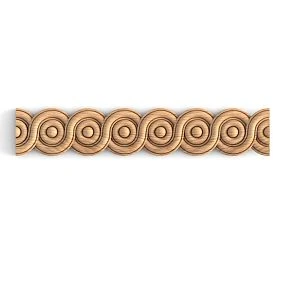


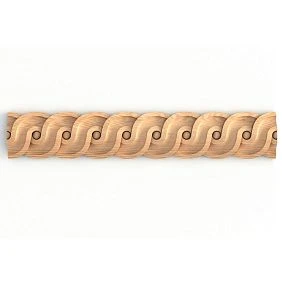
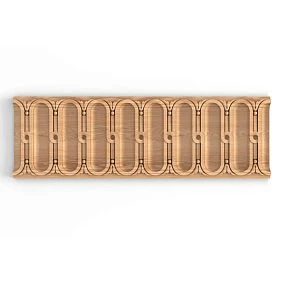


Delivery of construction materials begins with checking the site's readiness
The most expensive logistics mistake is sending finished goods to a site that is not yet ready to receive them.
Phrase:
the order has been placed, it can be delivered
is not equal to:
the site is ready for delivery.
Before confirming the date, you need to check:
- whether wet and dusty work in the storage area has been completed;
- whether there is a dry, clean room;
- whether a truck can access the site;
- whether there are time restrictions for unloading;
- who receives the cargo;
- are there enough people to carry long-length packages;
- does the packaging pass through gates, doors, the elevator, and corridors;
- where the skirting boards, moldings, and cornices will be placed;
- is there a current copy of the specification with the receiving person.
If even one item is not covered, early delivery may turn out worse than delivery a few days later.
This is especially true for sites where plasterers, tilers, painters, and furniture installers are working in the room at the same time.




Why long-length trim cannot be received like ordinary boxes
Skirting boards, moldings, and cornices differ from most boxed building products in that their length is much greater than their cross-sectional size.
For typical wooden trim, strips around 2–2.5 m are often found. With this geometry, the risk is associated not only with impact on the packaging, but also with incorrect carrying.
Damage can be caused by:
- end face;
- edge;
- relief;
- surface;
- a long plank during an unsuccessful bend;
- packaging when dragged along the floor.
STAVROS, in materials about the production of mouldings, describes protective packaging with film and end-face protection. But even good factory packaging does not make long-length items invulnerable after unloading.
Therefore, the rule on site is simple:
do not throw, do not drag, do not use packaging as temporary supports, and do not place random heavy materials on top.
Our factory also produces:


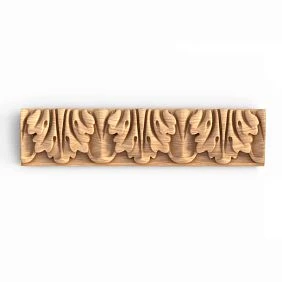

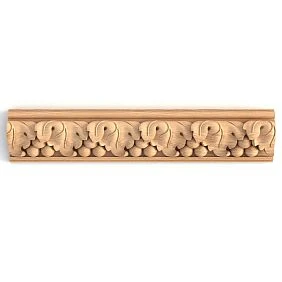

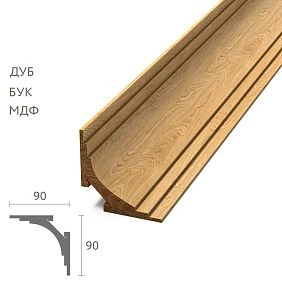
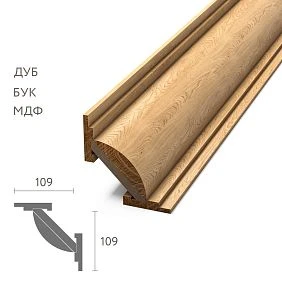
Before dispatch, it is necessary to check the route from the vehicle to the room
Logistics does not end at the gate.
For each large batch, it is necessary to go through the path:
vehicle → unloading point → entrance → vestibule → stairs/elevator → floor → corridor → storage room.
It is especially important to check:
- length of doorways;
- turning ability;
- space in front of the elevator;
- diagonal of the elevator cabin;
- stair landings;
- narrow turns;
- ceiling height along the route;
- presence of already installed furniture.
If a 2400 mm plank fits on its own, that does not yet mean that the transport item in its packaging will fit as well.
For a complex site, it is useful to check the route using the actual packaging dimensions confirmed by the seller or carrier.
Get Consultation
Wooden skirting board: how to prepare a batch for delivery
A large skirting board order is best divided not only by product codes, but also by zones.
Poor labeling:
PLT — 400 m.
Working:
Building A / floor 2 / rooms 201–208 / PLT-___ / oak / 2400 mm / 36 pcs.
If the same skirting board is used on three floors, the warehouse may see the overall total, but it is more convenient for the site to receive the distribution in advance.
For example:
| Zone | Product code | Material | Length | Quantity | | --- | --- | --- | ---: | ---: | | Floor 1 | PLT-___ | oak | 2400 | 24 | | Floor 2 | PLT-___ | oak | 2400 | 36 | | Floor 3 | PLT-___ | oak | 2400 | 20 |
Then, after unloading, there is no need to divide 80 identical planks in the corridor.
Wooden mouldings: why similar profiles are especially dangerous to mix up
With skirting boards, a mistake is sometimes noticeable immediately: the height or shape is clearly different.
Mouldings can differ much more subtly.
At a nearby site there may be:
- two profiles of similar width;
- the same SKU in different materials;
- a similar pattern;
- different lengths;
- different batches for different rooms.
If the outer packaging has been opened and the planks have been separated without labeling, it becomes harder to determine their origin after a day.
For each location, a line is useful:
site / zone / SKU / material / length / quantity / batch.
For example:
OBJECT-17 / FLOOR-03 / MLD-___ / DUB / 2400 / 24 PCS / BATCH ___
If you need to compare the product groups themselves, you can use the wooden mouldings catalog. But within a delivery, the SKU should be the main identifier.
Wooden cornices: a large profile requires special attention when carrying
The cornice can have a more pronounced profile and relief than a thin molding.
Therefore, during unloading it is important to avoid:
- impact of the end against the floor;
- pressure from heavy packages on top;
- carrying a long bundle by one end;
- resting the relief on a random corner;
- storage in the path of carts and construction tools.
For a long package, it is better to determine in advance how many people will take part in carrying it and where it will be unrolled.
It is impossible to assign a universal number of loaders for any cornice: the weight, length of the package, and number of items vary.
Delivery of building materials: every item must remain identifiable
For the site supply of building materials requires labeling not for the warehouse as such. It is needed for the site after unloading.
Minimum transport unit code:
order / site / zone / SKU / material / length / quantity.
If there is a batch number, it is also useful to save it.
Official STAVROS materials indicate that the packaging label for mouldings may contain the SKU, wood species, profile, length, quantity, and production batch number.
The larger the site, the more valuable this data is.
The specification and labeling must speak the same language
If the specification contains:
MLD-047 / oak / 2400 / 18 pcs.
and on site they labeled the box:
beautiful molding / bedroom
acceptance turns into guesswork.
Ideally, the same code runs through the entire process:
order → packaging → delivery note → acceptance report → storage zone → installation.
Then a person who has never seen the design project can check whether the bundle ended up in the right place.
Phased delivery of building materials: when not all trim is needed at once
On a large project deliveries of construction materials it is not always convenient to tie to a single date.
Imagine a hotel across three floors.
You can bring everything at once, but then dozens of long packages will have to be:
- stored somewhere;
- moved several times;
- protected from other crews;
- constantly recounted.
Alternatively, you can split the delivery:
stage 1 — floor 1;
stage 2 — floor 2;
stage 3 — floor 3 and common areas.
The second scheme may cost more in pure logistics, but it reduces the load on the site.
One delivery or several: you need to count more than just transport
The comparison should include more than just the cost of the truck.
One large delivery
Advantages:
- one unloading;
- one acceptance;
- fewer separate trips.
Disadvantages:
- more storage space;
- higher risk of repeated handling;
- harder to distribute;
- more material is in the repair zone at the same time.
Multiple queues
Advantages:
- fewer long-bed trucks on site;
- easier to distribute across rooms;
- easier to track remaining stock.
Disadvantages:
- additional deliveries;
- additional receptions;
- the schedule needs to be maintained more precisely.
Therefore, the cheapest transport solution is not always the cheapest for the project as a whole.
What to prepare before the vehicle arrives
The pre-delivery checklist should be short and specific.
Receiving contact: name and phone number.
Unloading window: exact time or agreed interval.
Address and access: gate number, barrier, pass.
Vehicle location: where the transport will actually stop.
People: who carries the long items.
Route: has the turn been checked.
Storage area: cleared and marked.
Documents: specification and acceptance sheet available.
Tools: tape measure, marker, phone for photo documentation.
If this is missing, the truck arrives and the site starts making decisions during unloading.
Wholesale supplies of building materials: scale changes the operation
With ten meters of molding, unloading is a small task.
With 500–1000 m of long-length decor wholesale supplies of building materials they become a separate operation.
You need to decide in advance:
- how many transport units;
- in what sequence to unload them;
- what belongs to which floor;
- how many storage zones;
- who checks the delivery note;
- who photographs the damage;
- who signs off on the acceptance;
- when the vehicle can leave.
If all of this is decided after the truck body is opened, some of the packages will almost inevitably end up not where they were planned to be.
Why wooden trim should not be stored next to wet processes
Wooden decorative trim belongs to the finishing part of the interior.
It should not be stored where:
- tools are washed;
- mixes are prepared;
- tiles are cut;
- cement is stored;
- abrasive dust is constantly flying;
- leaks are possible;
- heavy machinery moves around.
A dry and clean area is required for storage.
In its production materials, STAVROS specifies dry, ventilated storage and horizontal placement of packages on pallets or racks, without tilting or bending under their own weight.
How to place long-length items after unloading
Bad option:
lean ten packs vertically against the wall, because “they'll be installed tomorrow anyway.”
It is better to prepare a horizontal platform or rack in advance, on which long packages do not sag.
However, a universal support spacing cannot be assigned automatically. It depends on the actual packaging, length, weight, and manufacturer's requirements.
Practical rule:
the packaging must sit stably, not bend, and not bear the load from other materials.
It is best not to remove the marking before installation.
Acceptance of wooden moulding: packaging first, then quantity
Unloading and acceptance are not the same action.
A convenient sequence:
- inspect the external condition of the packaging;
- verify the marking;
- count the transport units;
- check the item codes;
- check the material;
- verify the quantity;
- record visible damage;
- separate disputed areas;
- only after that, distribute the cargo.
It is not necessary to open hundreds of planks right at the vehicle if this contradicts the acceptance conditions. But damaged packaging must be recorded before the cargo is mixed with the rest.
What to do if the packaging is damaged during transportation
The first action is not to look for the culprit, but to record the fact.
You need to:
- photograph the damaged side;
- keep the marking in the frame;
- note the place number;
- check the available part of the item;
- do not mix the disputed packaging with the accepted one;
- record the discrepancy in the facility documents.
If the damage relates only to the packaging, that is one scenario.
If there is a chip, dent, crack, or damage to the item's surface — that is another.
The decision on further actions is made based on the facts, not on the appearance of the box from a distance.
Wholesale building material supplies: acceptance table vs. misdelivery
Such wholesale building material supplies it is convenient to accept using a simple table:
| Zone | SKU | Material | Per documents | Received | Condition | | --- | --- | --- | ---: | ---: | --- | | Floor 1 | PLT-___ | oak | 40 | 40 | accepted | | Floor 1 | MLD-___ | oak | 72 | 72 | accepted | | Floor 2 | KZ-___ | beech | 18 | 18 | check | | Hall | MLD-___ | beech | 24 | 23 | discrepancy |
Such a list can be used directly during unloading.
It is better than a general entry:
154 units arrived.
The total quantity does not show which specific item is missing.
Delivery of building materials and installation: first accounting, then distribution
A typical mistake:
the truck arrived → the workers opened the body → each took materials for their own floor.
After that, no one can quickly answer:
- how much actually arrived;
- which pack is damaged;
- where the reserve is;
- who took the extra planks;
- which batch remained in the warehouse.
Therefore construction material deliveries it is better to proceed in a different order:
received → counted → recorded → marked → distributed.
Even an extra twenty minutes on inventory can save hours of searching during installation.
How to organize a kit for a room
For repeating rooms, it is convenient to assemble a ROOM KIT.
For example:
ROOM KIT 01 — number 201
It includes:
- plinth;
- Moldings;
- cornice;
- Baseboards;
- the designated installation reserve.
For a hotel with 30 identical rooms, 30 set lists can be prepared.
Physically, materials do not have to be packed into separate boxes if this is inconvenient. The main thing is that the distribution exists in the accounting and labeling.
Example of a set for one room
Suppose a standard room requires:
- PLT-___ — 8 planks;
- MLD-___ — 6 planks;
- KZ-___ — 4 planks;
- 1 spare skirting plank per group of rooms according to the approved scheme.
For 10 rooms, the base requirement is:
80 skirting boards + 60 moldings + 40 cornices.
But during unloading, you don't need to pile all 180 items in one heap.
Logically, it's better to separate them by numbered sets or at least by floors.
This way the quantity doesn't change, but the likelihood of internal mix-ups decreases.
Why the repair reserve shouldn't be given to installers along with the entire volume
The reserve exists because it must remain available at the moment when a real need arises.
If it's immediately stacked next to the main volume without labeling, the crew may use the reserve simply because the nearest plank turned out to be more convenient to cut.
Therefore, it's useful to separate:
the main installation volume;
the cutting reserve;
the operational or repair reserve, if provided for by the project.
Each group must have its own labeling.
What to do with long leftovers after installation
After the first stage, usable offcuts may remain.
They should not be automatically thrown away or mixed with new material.
It is useful to label:
item code / material / leftover length / floor / date.
Then, at the next stage, the installer can check whether the leftover is suitable for a specific joint.
If there is no labeling, a long offcut becomes “some kind of molding” after a few days, and it is either not used or used incorrectly.
How to accept different materials of the same item code
If the same profile is available in beech and oak, the external geometry may be similar.
Therefore, the material must be present both in the specification and on the labeling.
Must not be recorded as:
MLD-___ — 50 pcs.
if these 50 mix different variants.
You need to:
MLD-___ / oak — 30 pcs.
MLD-___ / beech — 20 pcs.
This is especially important before painting, when the visual difference may not be obvious to a worker who was not involved in the procurement.
How to hand over material to installers without losing accountability
After acceptance, a second act is needed — internal issue.
Minimum entry:
| Date | Zone | SKU | Issued | Received | | --- | --- | --- | ---: | --- | | ___ | Floor 1 | PLT-___ | 20 | ___ | | ___ | Floor 1 | MLD-___ | 36 | ___ | | ___ | Floor 2 | KZ-___ | 10 | ___ |
This is how the site warehouse understands the remaining stock not "approximately," but by specific items.
For a large project, this is no longer bureaucracy but control over expensive long-length materials.
How to check the route for long-length materials with a mock-up before delivery day
If the linear trim must pass through a narrow elevator, stairway, or corridor with a turn, it is useful to check the route in advance, not just with a tape measure.
You can make a simple mock-up of the transport space: take a lightweight batten, a cardboard strip, or another safe blank with a length close to the actual packaging, and carry it from the entrance to the storage area.
They check not just one door, but the entire path:
- the area in front of the entrance;
- the vestibule;
- the turn toward the elevator;
- the elevator itself;
- exit on the floor;
- internal corridor;
- room door;
- turning space before laying.
This test is especially useful for strips 2400–2600 mm and longer custom items. If the mock-up only passes with strong bending, this is not considered a normal route for wooden moulding.
At the same time, the mock-up only checks the geometry. The weight of the package, the actual number of people, and the carrying method still need to be agreed separately.
Photo documentation of acceptance: which shots are actually useful
A hundred random photos after unloading are of little help in a dispute.
It is much more useful to take a few systematic shots:
- general view of the transport place before opening;
- close-up of the marking;
- damaged section of packaging;
- exposed section of the item, if inspection has been performed;
- temporary storage location after unloading.
If there is a discrepancy in quantity, the line number of the acceptance report is recorded next to the photo.
For example:
Floor 2 / KZ-___ / location 7 / right end of packaging damaged / item inspection required.
Such a record allows the photograph to be linked to a specific order line.
In what order to unload multiple zones of one site
If the vehicle is carrying mouldings for several floors at once, the loading and unloading order also affects the risk of mixing up items.
It is undesirable to first unload everything onto one area and then sort through dozens of identical bundles.
It is more logical to agree on the sequence in advance:
zone A → zone B → zone C
and form transport units so that the required queue is accessible without constantly rearranging the remaining packages.
Even if the actual placement is determined by the carrier, the site must provide a clear breakdown by zones in advance.
This reduces the number of repeated relocations, and each pack reaches the correct storage location faster.
Who should make the decision about disputed packaging
If the packaging is damaged during unloading and the condition of the item is unclear, it is better not to leave the decision to a random worker. A responsible person must be assigned in the report who records the discrepancy, separates the disputed item and decides whether it can be handed over to the installers after inspection.
When a delivery can be considered closed
Not when the truck has left.
A delivery is closed when:
- the quantity has been verified;
- the item codes match;
- the materials match;
- damage has been recorded;
- disputed areas have been separated;
- batches have been distributed;
- Storage place prepared;
- the responsible person has signed off on the acceptance.
If part of the goods is simply somewhere on the site, but no one knows where, the delivery is effectively not yet complete.
When it is better to postpone the delivery
There is no need to bring the moulding just because it is already ready if:
- the storage area is wet or dusty;
- the carrying route has not been checked;
- the freight elevator is unavailable;
- no receiving party;
- there is nowhere on site to lay out long-length items horizontally;
- the rooms are still being used for heavy work;
- the specification has changed;
- the floors are not ready to receive their sets.
Postponing to an agreed date may be cheaper than storing in unsuitable conditions with repeated handling.
Errors in the delivery of wooden moulding
Error: delivering material immediately after production is ready.
The reason is that the shipment date is not tied to the readiness of the site. The consequence is that the moulding is stored among dirty works. The solution is a pre-delivery checklist.
Error: checking only the number of packages.
Cause — the desire to release the machine faster. Consequence — mis-sorting is discovered later. Solution — verify the item code and material.
Error: distributing goods across floors before acceptance.
Cause — workers want to speed up unloading. Consequence — overall accounting is lost. Solution — accept first, then distribute.
Error: removing labeling immediately after opening.
Cause — packaging seems unnecessary. Consequence — similar profiles get mixed up. Solution — keep the identifier until handover to installation.
Error: storing long-length items vertically “for a day.”
Cause — no prepared area. Consequence — risk of bending and damage. Solution — prepare horizontal stable storage in advance.
Error: mixing the reserve with the installation volume.
Cause — everything belongs to one item code. Consequence — the stock disappears in the first work phase. Solution — separate labeling for the reserve.
Questions before delivery
What should be checked before sending the moulding to the site?
Room readiness, the carrying route, the unloading area, personnel, storage, documents, and the person responsible for acceptance.
Should the factory markings be kept?
Yes, until the goods are accepted and distributed. The markings help verify the SKU, material, length, quantity, and batch.
Can long packages be leaned against a wall?
For storage, STAVROS recommends horizontal placement in a dry room without bending.
Do all the planks need to be opened at the vehicle?
Not necessarily. But the condition of the outer packaging and any visible damage must be recorded before the cargo is distributed.
What should be done with damaged packaging?
Take photos, keep the markings in the frame, set aside the disputed item, and inspect the products before installation begins.
When is it better to split a delivery into several phases?
When there is nowhere to safely store a large volume, or different floors are ready for installation at different times.
How to avoid mixing up similar moldings?
Use identical codes in the specification, labeling, acceptance report, and internal issue documents.
Where can I view STAVROS wooden trim?
In the catalog of wooden and MDF trim products; the specific profile is selected before forming the logistics batch.