Article Contents:
- Interior slat RK-002 2750 mm: first, determine the exact modification of the damaged element
- RK-002 16×40 mm made of MDF
- RK-002 22×60 mm made of MDF
- RK-002 40×40 mm made of MDF
- RK-002 with oak veneer
- What length is RK-002?
- What cross-sections are available for RK-002?
- What materials are RK-002 made from?
- Is RK-002 a solid oak slat?
- Can I replace only one damaged RK-002?
- Do I need to buy several slats to match the color?
- How do I match a new slat to oak veneer?
- How do I match RK-002 to old enamel?
- What is a 20×8 mm embedded strip?
- Do I need to replace the embedded strip along with the slat?
- Can I move an outlet between slats?
- Where can I buy RK-002?
- Where can I see the price of RK-002?
- When is it better to replace not one rail, but a group?
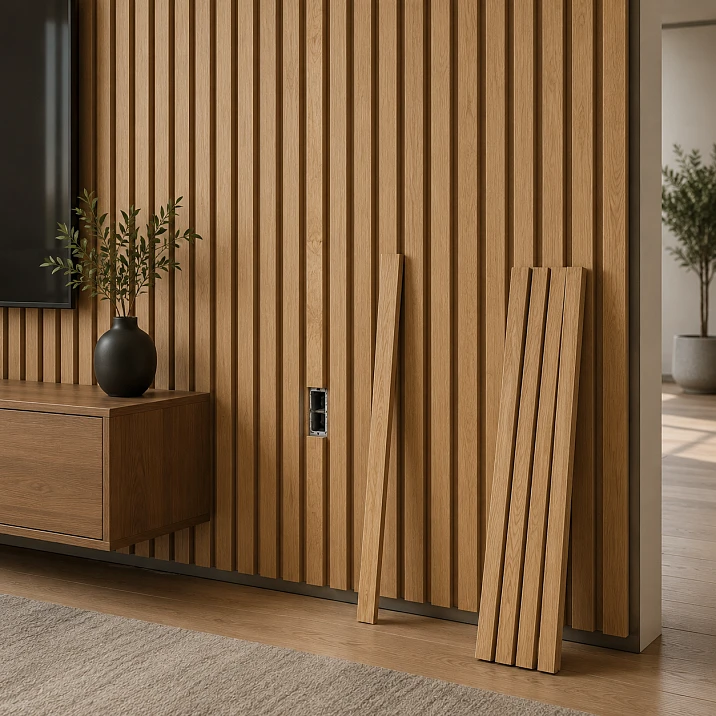
The finished slat wall has already been assembled, painted or tinted, the electrician moved the socket — and one RK‑002 vertical got an extra cut, chip, or damage. If the other rails are intact, replacing the entire wall usually makes no sense. But buying "one same oak rail" from a photo is risky: RK‑002 has three different geometries, two materials, a length of 2750 mm, and a mounting system with a 20×8 mm insert.
The correct renovation order is as follows:
precisely identify the old RK‑002 → record the actual finish and rhythm → check the condition of the insert and base → finally determine the position of the new socket → accept the new rail next to the existing wall → only then dismantle the damaged vertical.
If the old wall is made of MDF under a covering enamel, the cross-section is exactly known, the paint recipe is saved, and repeat delivery is simple, it is reasonable to first consider one new rail. If the installed version is MDF with oak veneer, the pattern and shade of the new batch may differ. Then ordering 2–3 rails is sometimes justified: you can choose the closest match in pattern, use one for the repair, and keep another as a spare. But there is no universal rule of "always buy three" — an additional group only makes sense with a real risk of matching, complex cutting, expensive delivery, or the need for future repairs.
The first step is — buy interior batten RK-002 only after the cross-section, material, and length are specified in the request, not just the name RK‑002.
The main conclusion of the article:
if one vertical is damaged — then first we check the possibility of local replacement of one vertical; the quantity of 2–3 appears only as a managed reserve, not as an automatic norm.
Interior rail RK-002 2750 mm: first, determine the exact modification of the damaged element
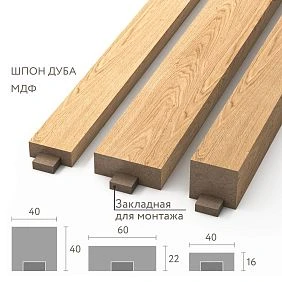
The current RK-002 card shows six product items. All have a length of 2750 mm, but the profile and material differ:
| RK‑002 | Material | Dimension A×C×D×E×L, mm |
|---|---|---|
| Narrow | MDF | 16×40×20×8×2750 |
| Medium | MDF | 22×60×20×8×2750 |
| Wide | MDF | 40×40×20×8×2750 |
| Narrow | MDF / oak veneer | 16×40×20×8×2750 |
| Medium | MDF / oak veneer | 22×60×20×8×2750 |
| Wide | MDF / oak veneer | 40×40×20×8×2750 |
Price, availability, and lead times change. They must be checked in the product card before payment.




RK-002 16×40 mm made of MDF
This is a variant with a face width of A=16 mm and a depth of C=40 mm. The construction also specifies D=20 and E=8 mm.
For local repair, not only the external size 16×40 matters. If you order 22×60 or 40×40, the new vertical will immediately change the rhythm of the entire wall.
Our factory also produces:







RK-002 22×60 mm made of MDF
The face part is wider, and the depth is noticeably greater. Such a slat creates a different shadow and a different scale.
If the damaged part was 16×40, you cannot replace it with 22×60 'because it looks similar.'
Get Consultation
RK-002 40×40 mm made of MDF
The widest face version of the three. Even one mistakenly ordered 40-mm slat among 16- or 22-mm verticals will visually destroy the repetition.
RK-002 with oak veneer
The wood finish card describes it as MDF / oak veneer. It is not solid oak throughout the cross-section.
That is why the repeated request should sound like:
RK‑002 22×60×20×8×2750 mm, MDF/oak veneer, Prestige
And not:
"oak slat 60 mm".
Product anchor RK-002 made of MDF with oak veneer leads to the same card.
Why the entry "RK‑002" without cross-section is insufficient
Three profiles give different:
-
face strips;
-
depth;
-
chiaroscuro;
-
visual rhythm step;
-
junction to the socket;
-
cost.
Therefore, before repurchasing, they first look for the old specification, invoice, marking, or measure the actual slat.
Damaged RK-002: what to remove from the existing wall before reordering
Before buying a new vertical, you need to fix the existing wall so that after a week it can be restored without guesswork.
Minimum package:
-
photo of the entire slat wall strictly from the front;
-
photo of the damaged vertical;
-
close-up of two or three adjacent slats;
-
width of the front part;
-
depth;
-
distance between adjacent battens;
-
actual finished length;
-
surface material;
-
color;
-
old order number, if preserved;
-
enamel or tinting recipe;
-
photo of the mounting assembly where accessible.
Why you need to photograph the entire wall
One batten is assessed not separately, but within the rhythm. After dismantling a damaged element, it is easy to forget:
-
what the gap on the left was;
-
what it was on the right;
-
was the outermost element shifted;
-
where exactly the socket was located.
The frontal photograph becomes an assembly reference.
Measure the pitch, not just the width of the batten
Let the damaged version have A=22 mm.
If the distance from the left edge of one batten to the left edge of the next is, for example, 62 mm, then the clear gap is approximately:
62 − 22 = 40 mm.
This is not the STAVROS rule or a ready-made size for a specific wall—just an example of how to restore the rhythm.
If the new batten is shifted by 5–7 mm, the geometry of the entire composition will become noticeably asymmetric around the socket.
Take the final length measurement anew
The product is 2750 mm, but the installed vertical could be shorter due to:
-
floor baseboard;
-
ceiling cornice;
-
shadow gap;
-
uneven floor;
-
trimming during initial installation.
Therefore, the entry:
"ceiling 2700 — we'll cut to 2700"
insufficient.
Need the actual length of the old part and check the current floor/ceiling joint.
Record the old finish
For MDF:
-
enamel code;
-
manufacturer;
-
gloss level;
-
date of painting;
-
application method, if known.
For veneer:
-
stain/tinting;
-
varnish/oil;
-
gloss level;
-
the direction of the fibers.
The more initial data, the lower the risk that a technically correct new batten will look foreign.
RK-002 made of MDF: when one new batten is usually enough to check first
If the existing wall is made of MDF and painted with opaque enamel, local replacement of one vertical is the most straightforward scenario.
Terms:
-
profile precisely identified;
-
adjacent battens are intact;
-
mounting anchor is not damaged;
-
color is known;
-
the base around the socket has been restored;
-
repeat delivery is available.
Then there is no reason to automatically buy three identical items.
Why enamel simplifies selection
MDF has no visible natural wood grain. After proper preparation, the appearance is mainly determined by:
-
geometry;
-
the color;
-
gloss;
-
surface quality.
This reduces one variable — the grain pattern.
But the paint code match does not guarantee a perfect visual match after several years.
The old wall could:
-
fade;
-
get dirty;
-
acquire a different sheen after use;
-
have been painted with a different batch of material.
Therefore, the new slat is first compared next to the wall under real lighting.
When one slat is especially rational
For example, damaged RK‑002 16×40 made of MDF.
if:
-
Delivery is simple;
-
enamel is available;
-
The cutout for the socket is simple;
-
The contractor can make a duplicate part,
Buying three elements for 3,030 rubles just "in case" may be unnecessary.
Even for MDF, it's better to take two
If the new cutout is complex and there is a risk of error on the first cut, the second strip becomes a concrete installation reserve.
Or if repeat delivery costs more than the product itself.
Correct logic:
The price of the reserve strip is compared with the cost of the risk of reordering, not with an abstract percentage rule.
RK-002 with oak veneer: why one new strip may look different
The veneered RK-002 has a natural surface. Even with the same article number, natural differences are possible:
-
shade;
-
direction of fibers;
-
density of the pattern;
-
contrast;
-
reaction to tinting.
Therefore, a new strip from a different batch may match technically perfectly, but stand out visually.
Why a card photo does not solve the matching issue
A catalog photo shows the type of material, but not the specific veneer sheet that will arrive in the order.
If the old wall has a calm radial pattern, and the new slat has a more contrasting tangential one, a single vertical can become a noticeable accent.
When two or three slats are justified
if:
-
the wall is natural/tinted;
-
the vertical is in the center of the composition;
-
lighting is side;
-
repeat delivery is expensive;
-
the client is demanding about pattern matching.
Then you can order 2–3 identical RK‑002, hold them against the wall, and choose the one closest in tone and pattern.
The remaining best slat becomes a repair reserve.
How to calculate the cost of scenario 1/2/3 without an outdated price list
Let's denote the current price of the selected SKU as P.
Then:
-
one slat =
P; -
two =
2P; -
three =
3P.
Delivery, finish, and labor are added separately to this amount. Before payment P is taken from the current RK-002 card.
Why you can't promise a perfect match even from three
Three items increase the chance of selecting a closer pattern but do not guarantee identity with the old batch.
If near-absolute visual sameness is needed, it's sometimes better to replace a symmetrical group rather than a single vertical.
Buy one RK-002 or order two or three: when a reserve is truly justified
It is better to frame the decision not as a dispute between 'saving' and 'over-insuring', but as a risk matrix.
| Condition | 1 rail | 2 rails | 3 rails |
|---|---|---|---|
| MDF under a known enamel | usually enough to check first | reasonable for complex cutting | rarely needed |
| oak veneer, side inconspicuous area | Possible | often reasonable | according to matching requirements |
| oak veneer, center of wall | risk of difference is higher | good minimum for comparison | maximum choice from a small group |
| expensive redelivery | riskier | more reasonable | depends on logistics cost |
| contractors fear inaccurate cutting | risk of reorder | one worker + one reserve | only for a truly complex node |
| need a reserve after delivery | no reserve | One reserve | two reserves, often redundant |
One rail is not a "cheap option"
It is rational if the probability of error and difference is low.
Two is often the most logical backup scenario
One working.
Second:
-
in case of error;
-
for selection;
-
for future repairs.
Three are needed for a specific reason
For example:
-
natural veneer;
-
center of composition;
-
complex finish;
-
expensive delivery;
-
the customer wants to choose the best pattern.
Without such a reason, the third batten becomes extra stock.
How to calculate the economics
Formula:
Cost_1 = batten + delivery + labor.
Cost_2 = 2×slat + one delivery + labor.
If one unsuccessful cut leads to a repeat delivery, the comparison is already:
1×slat + delivery + repeat slat + repeat delivery
с
2×slat + one delivery.
With expensive logistics, the second scenario may be cheaper.
Buy slat wall panels for interior finishing: when local repair no longer makes sense
Local RK‑002 is not a universal answer. Sometimes after moving electrical wiring, not just one vertical is damaged, but the entire area around the outlet.
If damaged:
-
several adjacent slats;
-
mounting base;
-
the background between the slats;
-
electrical outlets;
-
the rhythm of the entire insert,
you need to compare a local replacement with a larger rework.
For a general selection, you can buy slat panels for walls for interior finishing and compare the finished panel system with the piece-by-piece RK-002.
When one rail no longer solves the problem
For example, the socket was moved by 120 mm, and the new junction box landed in the adjacent gap. As a result:
-
one rail is cut out;
-
the next one is cracked;
-
the wall background is exposed;
-
the pitch around the socket is lost.
Purchasing one RK-002 will restore only one element.
You need to restore an entire composition.
When a module/panel may be more rational
If the original finish was even built on a ready-made panel, rather than on individual RK-002 elements.
Then attempting to fix it with a separate slat can result in a different pitch and depth.
The second categorical route — Buy slatted panels for wall finishing — is needed only for such cases, not as a default replacement for a specific RK-002.
Interior slat RK-002 and mounting insert 20×8 mm: what to check before dismantling
RK-002 is not just a decorative strip that was necessarily glued directly to the wall. The comparative article by STAVROS and the product card confirm the mounting insert of 20×8 mm.
This is important for repairs.
What exactly does 20×8 mm mean
In the profile card, parameters D/E are specified as 20×8 mm, and the mounting system uses an embedded plate of the corresponding size.
Before dismantling, you need to understand how exactly your object is implemented:
-
the embedded plate is preserved;
-
damaged;
-
glued;
-
mechanically fastened;
-
the rail is fixed to it with adhesive/fasteners.
Why you can't just pull the rail toward you
Force dismantling can:
-
break out the embedded plate;
-
damage the background;
-
tear off adjacent trim;
-
break the adjacent vertical.
The article intentionally does not provide a universal instruction "pry here and pull." Specific dismantling depends on the actual fastening.
What to check before removal
-
Inspect the top and bottom ends.
-
Find traces of fastening.
-
Check the old installation documents.
-
Understand whether the embedded part is accessible.
-
Determine whether only the decorative part can be replaced.
-
Fix the position of the rail relative to its neighbors.
Why installing a new rail should not be the first operation
First, you need to understand what exactly is being replaced:
only the decorative profile
or
profile + embedded part + section of the base.
The scope of repair depends on this.
If the embedded part RK-002 is damaged along with the rail
After moving the socket, the hole may have been widened, chiseled, or drilled directly in the installation area. Then not only the face part is damaged.
Signs
-
the rail is loose;
-
the adjacent section has shifted;
-
the fastening is torn out;
-
the base around the socket box is destroyed;
-
the new rail does not have stable support.
Correct sequence
electrical → base restoration → restoration/replacement of the mounting plate → new RK‑002 → finish.
Not the other way around.
Why the decorative rail should not “hold” a weak wall
It is designed for a decorative function. If the base is damaged, the structural support is restored first.
When it is better to involve the same installer
If contact with the original contractor is preserved, they know:
-
the type of adhesive/fastener;
-
scheme of embedded parts;
-
installation sequence;
-
finishing.
This reduces the risk of damage to adjacent verticals.
Slat wall and new outlet: where the cutout should go after renovation
If the cause of damage is a new electrical point, you cannot first buy and trim RK-002, and then clarify the position of the socket box.
First, the electrical unit is fixed.
Three possible scenarios
Outlet between slats.
The calmest option for the rhythm, if the design and electrical layout allow it.
Outlet crosses one slat.
A precise cutout in the new vertical is needed.
The socket crosses two slats or a wide area.
Locally replacing one part no longer solves the problem.
Why the new point should be final
If the socket box shifts another 10–15 mm after the finished cutout, the second purchased slat can be ruined.
Full-size template before cutting
Before processing the new RK‑002, you can make a cardboard template only in the socket area:
-
slat width according to actual A;
-
position of the socket;
-
height;
-
side margins.
It does not replace the technical wiring diagram, but allows checking the visual cutout.
Check symmetry relative to the rhythm
If the socket is in the center of the composition, even a slight shift relative to the verticals becomes noticeable.
Therefore, the working layout should include:
-
the socket axis;
-
axes of adjacent slats;
-
clean gaps.
Purchased RK-002 2750 mm and actual wall height: why the old size cannot be taken "from memory"
The product length of all RK‑002 is 2750 mm. The installed vertical is almost always shorter.
For example:
-
finished wall height — 2720 mm;
-
floor plinth at the bottom 100 mm;
-
cornice/gap at the top — 40 mm.
The working vertical may be around:
2720 − 100 − 40 = 2580 mm.
This is just an example.
If you simply cut a new rail "to the wall height of 2720", it will not fit into the old assembly.
The old rail can be used as a dimensional reference — with a caveat
If the damage is local and the part itself is not deformed, the old rail can be measured after careful removal.
But before copying the length, you need to check whether the following have changed:
-
floor;
-
baseboard;
-
ceiling cornice;
-
background;
-
new socket.
The new part does not have to be exactly like the 2750 mm item
2750 — original SKU.
The finished length is recorded separately:
RK-002 22×60×20×8×2750 / finished part 2582 mm.
This way the craftsman doesn't confuse the product length with the installation length.
RK-002 16×40, 22×60 or 40×40 mm: an error in the cross-section will ruin the entire rhythm
The three cross-sections differ not "by a few millimeters," but in the nature of light and shadow.
Let's take a wall where the pitch along the axes of adjacent slats is a conventional 60 mm.
If RK-002 16 mm is installed
Clear gap:
60 − 16 = 44 mm.
If 22 mm is mistakenly installed
The interval will be:
60 − 22 = 38 mm.
On the left/right, the new vertical will visually compact the pattern.
If you set 40 mm
60 − 40 = 20 mm.
This is already a completely different rhythm.
Why the error is noticeable even with the same color
The eye reads the repetition:
slat → gap → slat → gap.
If one vertical is wider, it stands out as an accent.
The depth also differs
16×40 and 40×40 have the same C=40, but different face widths.
22×60 is deeper and creates a stronger side shadow.
Therefore, reorders are always checked against the full A×C×D×E×L line.
Buy wooden slats: when RK-002 is needed instead of RK-001
Local repair starts with checking the original product. If the old wall is indeed assembled from RK‑002, the new part must be RK‑002 of the same cross-section and material. But on site, documents are often lost, and the customer only remembers:
“the slats were oak.”
this is not enough.
If after inspection it turns out that the old vertical is made of solid wood, not MDF with veneer, repurchasing RK‑002 may already be a mistake.
To check, you can open the category buy wooden slats and compare the original system with RK‑001.
How to distinguish the task without repeating the entire comparative article
RK‑001 — a separate solid beech/oak slat, 2400 mm long.
RK‑002 — an interior slat made of MDF or MDF with oak veneer, 2750 mm long, with a mounting insert system.
If the old wall is made of solid wood, you cannot choose RK‑002 just because visually 'there is oak both here and there.'
For a complete distinction, there is already a separate material. RK-001 or RK-002.
When an identification error is especially likely
-
the old order was done by another contractor;
-
documents were not preserved;
-
the surface is tinted;
-
the end is hidden;
-
The customer only saw the front wood strip.
What to check physically
If the end of the damaged part is accessible:
-
Is the MDF base visible;
-
Is the veneer layer visible;
-
Is there a mounting insert;
-
Does the length of the original product match 2750 mm;
-
Does the geometry match one of the three RK‑002.
Why you cannot change the article number in one row
Even if the new strip is visually similar, differences:
-
thicknesses;
-
overhang;
-
mounting systems;
-
shadows
can disrupt the entire rhythm.
Local repair is strongest when the new element is truly a repeat of the original system, not a similar alternative.
Buy slat panels for wall finishing: when a damaged area is better replaced with a module
If the original wall is built not from individual RK‑002 slats, but from a ready-made slat panel, buying a single interior slat may be the wrong level of repair.
In such a case, it is useful to buy slat panels for wall finishing only after checking the structure itself.
How a piecemeal slat differs from a ready-made module in repair
In a piecemeal system:
-
each vertical is independent;
-
the step is set by editing;
-
a separate element can be locally replaced.
For the finished panel:
-
the rhythm is already built into the module;
-
the background and slats are connected;
-
damage may affect part of the panel entirely.
When modular replacement becomes stronger
If after moving the socket:
-
a wide area is cut out at once;
-
the background is disrupted;
-
several slats are damaged;
-
the module has lost rigidity;
-
local repair creates too many visible seams.
Why you don't need to replace the entire wall automatically
Even a panel system can be assessed section by section.
First, determine:
-
size of the damage;
-
number of modules;
-
possibility of neat replacement.
Then they compare local restoration and module replacement.
RK-002 rail price: why the cost of one piece is not the entire budget for local repair
Anchor RK-002 rail price It is needed exactly before payment, because the current price and availability change.
But even the current price of one slat does not answer the question of how much the entire repair costs.
Formula:
Repair total = Rails + Finish + Base repair + Cutting + Installation + Delivery.
Where:
-
Rails— one, two, or three RK‑002; -
Finish— enamel/tinting/varnish; -
Base repair— wall or anchor restoration; -
Cutting— new cutout for an outlet; -
Installation— dismantling/installation; -
Delivery— current logistics.
Why one cheap slat can lead to an expensive repair
if:
-
the anchor is damaged;
-
The electrical work requires rework;
-
The adjacent area needs to be repainted,
-
The repeated cutout is complex,
The product becomes a smaller part of the estimate.
Why three slats are not necessarily three times more expensive than repairs
The work on dismantling and restoring the wall can be the same.
The difference is only in Rails and, possibly, in the finish of additional products.
How to compare one and two slats
Let:
-
P— the current price of one RK‑002; -
D— cost of re-delivery; -
F— finishing of one part.
Then:
Scenario 1: P + D + F.
If the first batten is damaged:
**2P + 2D + 2F`.
Scenario 2: two at once:
**2P + D + 2F`.
If D high, the second batten as a reserve may be economically justified.
For veneer, the value of choice is added
The second/third batten is not just a reserve against mistakes.
This is an opportunity to select:
-
shade;
-
drawing;
-
the direction of the fibers.
Therefore, the economics of natural veneer cannot be reduced to the probability of incorrect cutting.
How to accept a new RK-002 before the old one is completely dismantled
This is one of the most important steps of the entire article.
Wrong order:
remove the old one → open the wall → wait for the new one → find out it doesn't match.
Stronger:
get the new one → check it nearby → only then dismantle the old one.
Check by article number
On the packaging/documents it should be:
-
RK‑002;
-
exact cross-section;
-
material;
-
length 2750 mm;
-
Quality.
Geometry check
Measure:
-
A;
-
C;
-
D;
-
E.
Do not rely only on the signature.
Surface check
For MDF:
-
smoothness;
-
absence of damage;
-
Ready for finishing.
For veneer:
-
drawing;
-
shade;
-
direction.
Place a new batten next to the existing wall
Do not mount.
Just position vertically in the same plane and look:
-
in daylight;
-
in the evening;
-
from the front;
-
from the side.
Why the light should be the same as after renovation
Under a storefront, veneer looks different than by a home window.
Side light especially emphasizes:
-
texture;
-
shade;
-
depth.
What to do if the match is good
Mark the selected rail as working.
If multiple are ordered, assign:
-
WORK;
-
RESERVE;
-
SAMPLE.
What to do if the match is poor
Do not dismantle the old rail.
First decide:
-
finish;
-
selecting another from the group;
-
exchange/re-order per seller's rules;
-
replacement of a small symmetrical group.
This keeps the wall in the most stable state until the final decision.
What to do if the new RK-002 noticeably differs in shade
A difference can also occur in MDF under enamel and in veneer, but the reasons are different.
MDF
Check:
-
is the paint code the same;
-
is the gloss the same;
-
has the surface aged;
-
does the primer match;
-
is the application method the same.
If the old wall has faded, a new part painted according to the original recipe may look visually fresher.
Veneer
The reason is more often the natural variability of wood.
Options:
-
choose another slat from the ordered group;
-
change the tint on the new part;
-
replace not one, but a small symmetrical block;
-
move the most different slat to a less noticeable position, if the design allows.
Why a symmetrical block is sometimes stronger than one perfect attempt
Let's imagine a central group of five slats:
L2 / L1 / C / R1 / R2.
C is damaged.
If the new C is sharply different, the eye sees a single accent.
You can replace, for example:
L1 / C / R1
with three slats close in tone from the new batch.
Then the center becomes a homogeneous group, and the transition boundaries shift symmetrically.
This is not a universal recommendation or mandatory repair. It is one of the options for a demanding veneered interior.
When renovation doesn't need to be extended
If the differences are minor and only visible from 20 cm away, and the wall looks fine from a normal viewing point, replacing three verticals may be unnecessary.
Why it's better to keep the spare RK-002 after renovation
After a successful renovation, the question remains: what to do with the second/third purchased slat.
If it matches in:
-
SKU;
-
by material;
-
batch/tone;
-
finish,
it's a very valuable repair reserve.
What it preserves
Not just "one spare stick".
She records:
-
exact cross-section;
-
source material;
-
visual sample;
-
variant of the future finish;
-
ready stock for the next local repair.
How to store
Marking:
RK002 / 22×60×20×8×2750 / MDF-OAK-VENEER / finish ___ / room ___ / date ___
Store dry, protecting:
-
edges;
-
veneer;
-
the face surface.
Why you can't cut the reserve into samples right away
Until the repair is completed and accepted, a whole slat is more valuable than several small samples.
After handover, you can keep a small fragment for color, but the main spare vertical is better left as long as possible.
Finishing walls with wooden slats: why local replacement should repeat the old rhythm, not improve it
General material finishing walls with wooden slats useful for a new project.
But renovation is not the moment to suddenly "improve" one vertical line.
Common mistake
Old RK-002 16×40.
The contractor suggests:
"Let's use the new 22×60, it's prettier and deeper."
In a new wall, such a choice can be discussed.
In a finished composition — no.
Renovation principle
The new batten repeats the existing system.
Not:
-
changes the rhythm;
-
adds an accent;
-
increases depth;
-
changes the material.
If the client wants to change the design, this is already a partial wall reconstruction project, not a local replacement.
RK-002 for a narrow pier: why the existing article does not need to be repeated in renovation
Separate material RK-002 for a narrow pier details:
-
number of battens;
-
step;
-
the width of the niche;
-
selection of cross-section;
-
MDF/veneer.
In our situation, all these design decisions have already been made by the old wall.
What is carried over from the old project
-
step;
-
cross-section;
-
material;
-
orientation.
What is calculated anew
-
finished length of one piece;
-
cutout for the new socket;
-
condition of the embedded part;
-
number of spare slats.
This is the unique boundary of the new article.
STAVROS materials and quality: what to compare in a new rail before finishing
It is useful to open before repair STAVROS materials and quality and agree on the level of preparation with the master.
For MDF
Check:
-
surface;
-
primer;
-
enamel;
-
sanding between layers.
For veneer
Check:
-
surface quality;
-
tinting;
-
transparent finish;
-
Preservation of texture.
Why the same SKU may look different after finishing
Finish can change:
-
color;
-
grain contrast;
-
shine;
-
visual depth.
Therefore, a "new batten arrived slightly lighter" does not always mean the product is wrong. Sometimes the difference disappears after an agreed tinting system.
But the reverse is also true: finish cannot fix a completely different veneer pattern.
Payment and delivery of STAVROS battens: when a second batten saves not the product, but repeat logistics
Before making the final choice of quantity, you need to check payment and delivery of STAVROS battens.
For local repairs, delivery is often disproportionately important.
One batten
The product basket is minimal.
But if it:
-
did not match;
-
damaged during cutting;
-
got a defect during installation,
a re-order is needed.
Two
They increase the product part, but provide:
-
reserve;
-
selection;
-
one delivery.
Three
Rational only with an additional task:
-
veneer selection;
-
complex central block;
-
long-term reserve.
To order and availability
If the desired option is made to order, a repeated error means not only a second delivery, but also a new production lead time.
This is an argument for a reserve, but only after checking the current status of the specific SKU.
Order RK-002 2750 mm: what finished length to specify to the installer separately
Anchor order interior slat RK-002 without changing the article number and with a clear quantity.
Final decision tree: one RK-002 or several for local repair
Step 1. Is it precisely established that the wall is made of RK-002?
-
no → identify;
-
Yes → continue.
Step 2. Is the cross-section known?
-
no → measure A/C/D/E;
-
Yes → continue.
Step 3. Material MDF or MDF/oak veneer?
-
MDF → painting branch;
-
veneer → pattern selection branch.
Step 4. Is the mounting plate 20×8 mm intact?
-
no → first restore the mounting system;
-
Yes → continue.
Step 5. Is the new socket finally secured?
-
no → do not cut a new rail;
-
Yes → continue.
Step 6. Is the finish known for MDF?
-
yes → first consider 1 rail;
-
no → make a test paint/refine the recipe.
Step 7. Is the pattern match critical for the veneer?
-
yes → consider 2–3;
-
no → possibly 1.
Step 8. Is repeat delivery expensive/slow?
-
yes → reserve becomes more rational;
-
no → minimal purchase is stronger.
Step 9. Is the new batten accepted near the wall before removing the old one?
-
no → compare first;
-
Yes → continue.
Step 10. Only after this, remove the damaged vertical.
FAQ about replacing a damaged interior batten RK-002
What is the length of RK-002?
All current versions of the card have a length of 2750 mm.
What cross-sections are available for RK-002?
16×40×20×8, 22×60×20×8, and 40×40×20×8 mm.
What materials are RK-002 made from?
MDF or MDF with oak veneer.
Is RK-002 a solid oak slat?
No. The wood version has an MDF base and oak veneer.
Can only one damaged RK-002 be replaced?
Yes, if the damage is local, the exact SKU is found, the base/embedded part is intact, and the finish match is confirmed.
Do I need to buy several slats to match the color?
Not always. For MDF under a known enamel, one is often enough to check first. For veneer, 2–3 may be more reasonable when there are high requirements for the pattern.
How to match a new slat to oak veneer?
Compare several pieces next to the existing wall under real lighting, and only then tint/install.
How to match RK-002 to old enamel?
Find the code, manufacturer, gloss, and if possible, do a test patch next to the wall.
What is a mounting block 20×8 mm?
This is part of the RK‑002 mounting system on which the decorative slat is fixed.
Do I need to replace the mounting block together with the slat?
Only if it is damaged or does not provide a secure attachment.
Can I move an outlet between the slats?
This depends on the electrical project and the wall design. First, the technical position is fixed, then a new slat is cut/installed.
Where can I buy RK-002?
In the RK‑002 interior slat product card, after identifying the cross-section and material.
Where can I see the price of RK-002?
In the current product card, before payment.
When is it better to replace not one slat, but a group?
When the new veneered vertical differs significantly, several elements are damaged, or the central rhythm needs to be kept symmetrical.
Can I buy a ready-made slat panel instead of RK-002?
If the original system is panel-based or the damage is extensive, a panel may be more rational. For a piece-by-piece RK‑002 wall, local repair is considered first.
Do I need to keep a spare batten after repair?
If it matches by SKU, material, and finish, yes: it is a valuable repair reserve.
Short conclusion
Damage to one RK-002 after moving an outlet does not mean replacing the entire wall and does not mean automatically buying three new battens.
First, you need to confirm:
exact profile → material → length → mounting block → finished height → new outlet → finish.
For MDF under a known enamel, it is logical to start with a single-batten scenario, especially if repeat delivery is simple.
For MDF with oak veneer, two or three battens may be justified when you need to choose the closest grain pattern and keep a reserve. But even three do not guarantee the identity of natural veneer from different batches.
The safest order:
new RK-002 arrives → is compared next to the finished wall → is accepted by size and finish → only then is the damaged vertical removed.
After such a check, local repair preserves the original rhythm of the wall and does not turn into a new rework of the entire composition.