Article Contents:
- When oak becomes part of the furniture concept
- The profile type is chosen based on its place in the project
- Cross-section dimensions are checked before the shade
- How moulding width changes the space for texture
- Oak grain is assessed on the future visible side
- Oak for tinting requires a suitable blank
- A clear finish also changes the perception of oak
- What sample is needed before buying a batch
- The test finish coat is brought to a finished surface
- How to match molding to an oak facade or veneer
- The strips are sorted into sets before cutting
- Where oak texture works in a furniture project
- Facade frames
- Cabinets and bookcases
- Door portals and decorative panels
- Can oak be coated with opaque enamel?
- When to consider beech instead of oak
- Can I order based only on a photo of finished furniture?
- Will a repeat order be exactly the same?
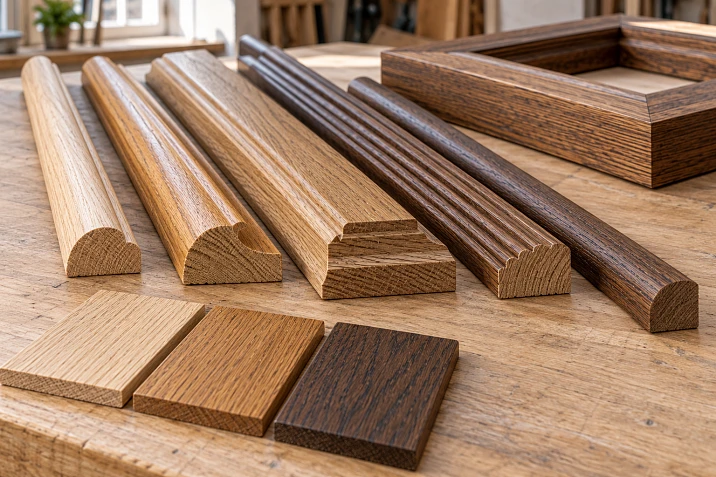
Two oak strips of the same article can look different under the same stain. One shows long streaks, the other a larger pattern, and after the finish is applied the difference becomes more pronounced. If these parts meet in the corner of a furniture frame, the eye will catch the transition between them even with a precise cut.
Oak moulding for a visible grain is chosen by both cross-section and future surface. First, check whether the profile fits the project, then verify the quality of the blank, test the finish on an oak sample, and match adjacent parts by pattern. It is best to complete the purchase of the entire batch after such a check: a small sample helps choose the profile and coating, while the compatibility of long strips is assessed when assembling the product.
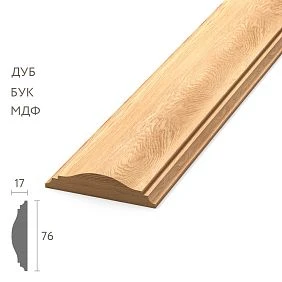
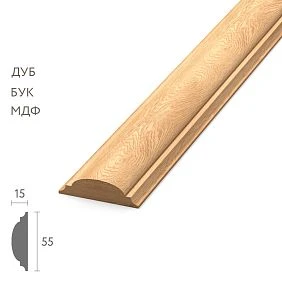
When oak becomes part of the furniture design
It makes sense to choose oak moulding for the visible wood, if the profile must match oak fronts, frame a veneered panel, or stand as an independent accent under a clear finish. In these cases, the buyer sees not only the line of the moulding but also the grain within it.
On the wide flat part of the profile, the texture reads differently than on a narrow bead. A complex cross-section breaks the surface into lit and shaded areas. Therefore, the same oak shade on a flat front and on a shaped frame may be perceived differently, even if the parts are finished with the same system.
Before searching for an article number, decide what result you need: a calm frame in the color of the main furniture, a darker frame, or an expressive strip with a noticeable grain. This will determine the permissible differences between the parts. For a contrasting frame, you do not need to literally repeat the shade of the front, but its four sides must look consistent.
The phrase “natural oak” does not yet describe the finished surface. In the order, it is more useful to specify how visible the texture should be, what sheen is needed, and with which furniture sample the profile will be combined.




The profile type is chosen according to its place in the project
Moulding combines linear parts for various purposes. A moulding forms a frame or divides surfaces; a batten gives a simpler line; a cornice completes the top; a baguette and an ornamental profile create a pronounced decorative frame. When purchasing, it is important to check that the specific cross-section is suitable for the chosen junction.
For example, a wooden furniture moulding may sit well on a flat front but may not have the required step for a frame assembly. The name “baguette” also does not confirm the presence of a seat for glass or a panel. This is visible on the drawing of the reverse side and in the cross-section.
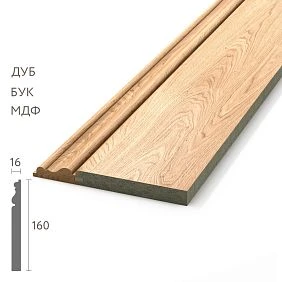
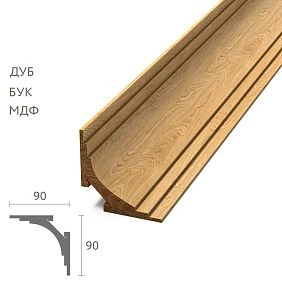
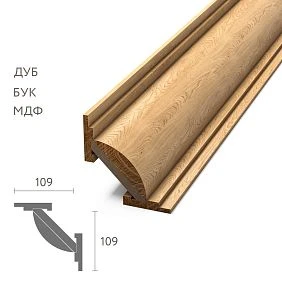
In the of STAVROS millwork products first choose the purpose and shape, then check the material of the specific version. One article number may be available in oak, beech, and MDF. The photo and model name do not replace selecting the material in the order.
For a furniture front, the bonding surface, the width of the visible part, and the projection above the plane are especially important. For a top cornice, the lower perspective is added: the installed part will be seen differently than a sample lying on a table.
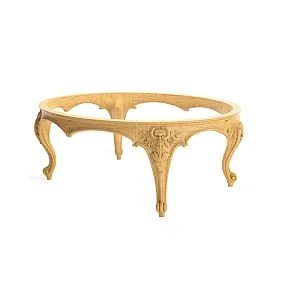
Our factory also produces:
Cross-section dimensions are checked before the shade
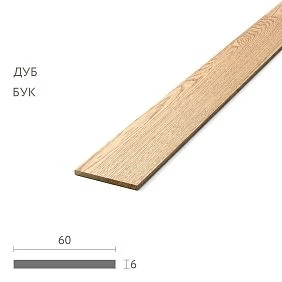
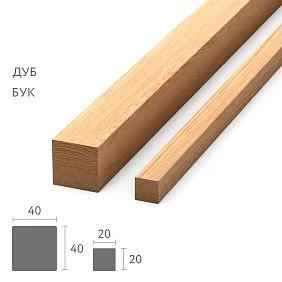
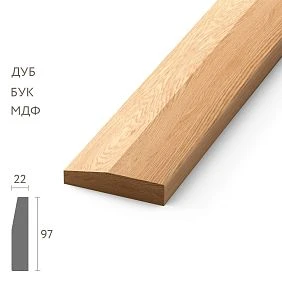
The product cards for the mouldings in question use three dimensions: A — width, C — section height, L — length. For surface-mounted profiles, the section height helps estimate the projection above the facade, but the final position depends on the fit. If part of the piece sits in a groove, the projection will be different.
At STAVROS, three specific profiles can be matched with oak finishes:
| Model | Section A × C | Oak finish lengths | What to compare on the project |
|---|---|---|---|
| MLD-019.1 | 17 × 12 mm | 2400 мм | Scale of the narrow framing and its projection |
| MLD-002 | 22 × 11 mm | 1000 and 2400 mm | A wider face strip with a lower section height |
| MLD-006.1 | 35 × 21 mm | 2400 мм | A wider frame and a larger projection above the surface |
These are three different profiles, not one profile in three sizes. The wider option is not necessarily taller: MLD-002 is 22 mm wide and 11 mm high, whereas the narrower MLD-019.1 is 17 and 12 mm respectively.
Also check the length of the oak item specifically. The 2600 mm length that can be found in these MDF product cards does not mean that the same version is offered in oak. When placing an order, the entire line is verified: item code, material, profile and length.
Get Consultation
How molding width changes the space for texture
Suppose that on a 480 mm wide front, the outer contour of the frame is inset 45 mm from the side edges. The outer width of the frame will be 390 mm. If the profile is located entirely within this contour, the free field in width will be as follows:
- with a 17 mm wide molding — 356 mm;
- with a 22 mm wide molding — 346 mm;
- with a 35 mm wide molding — 320 mm.
When moving from the first option to the third, the central field narrows by 36 mm. At the same time, the area of the oak frame itself increases. On a small door, this can change the relationship between the front pattern and the framing more than a change in coating shade.
These dimensions are a calculation example, not a rule of proportions. In a specific product, the handle, central overlay and adjacent fronts are taken into account. If the molding runs next to the handle, finger clearance is additionally checked. If the frame protrudes near the hinge side, door opening is assessed.
The profile should be placed against a full-size image of the front. A short sample will show the profile, while a marked frame contour will show how much surface it will occupy on the entire piece of furniture.
The oak grain is assessed on the future visible side
Oak can have a more straight-grained and larger, more open pattern. Its character depends on the wood and on how the blank is sawn. After profiling, different fragments of this structure are visible in different areas of the cross-section. The name of the species does not promise a uniform pattern along the entire length.
When choosing, look at the face surface, the side areas and the places that will remain visible after installation. On a wide moulding, an expressive stripe on one edge can become a separate line next to the relief. On a narrow profile, the same area will be perceived as a local colour variation.
Do not try to achieve a continuous wood pattern around a rectangular frame. On horizontal and vertical parts, the direction changes with the position of the strip. The practical task is to harmonise the character of the texture and the shade so that one side does not look like a random insert.
It is better to discuss natural variations using several samples. One small successful fragment does not show the range of pattern in a batch. This is especially important for a light transparent finish, in which the wood itself remains clearly visible.
Oak for tinting requires a suitable blank
A solid wooden part can be made from glued lamellas. For visible finishing, their selection matters: adjacent areas may differ in colour and pattern. Therefore, the material "oak" and the quality of the lamination are separate order parameters.
In the description quality of STAVROS products the options "for enamel" and "for tinting" are separated. In the first case, the lamellas are not matched by colour and texture; in the second, matching is provided, although minor differences remain. The tinting version is intended for semi-transparent finishing and does not mean that all strips are absolutely identical.
Check which quality is available for the selected profile and how to specify it when placing an order. The option automatically selected in the product card may have a different purpose. Also, do not confuse the quality of the lamination with the quality of sanding: a smooth surface by itself does not confirm that the wood has been matched by pattern.
If you need an almost colourless result, please let us know in advance. Preparation for tinting does not guarantee that, without colour correction, adjacent parts will match the facade. The decision is made after a test finish on the actual blank.
A clear finish also changes how oak is perceived
A finish without colored pigment does not necessarily preserve the look of untreated wood. For example, an oil finish can make the shade richer and warmer. That is why "keeping the natural color" should be shown on a sample rather than described only in words.
Stain, tinting composition, and protective finish serve different purposes; their combination depends on the chosen system. Some materials combine functions. To buy oak profile, it is enough to understand in advance which result is being verified: a slight change of tone, pronounced darkening, or a light surface that preserves the grain.
Look at how the finish appears on raised areas and in recesses. Darkening in the depth of the profile can emphasize its shape, or it can create unwanted striping. This is especially noticeable when a wide, calm facade plane is next to it.
Gloss is also agreed upon on a finished sample. A glossier frame and a matte door can appear different in color because of reflections. In that case, evaluating only the name of the shade is not enough.
What sample is needed before buying a batch
To start, it is convenient to order Samples of linear products. STAVROS offers 100 mm cut pieces from materials available in stock. When requesting oak trim, confirm the material separately: a sample of the same profile in beech or MDF will show the geometry but not the result of tinting oak.
A 100 mm cut piece lets you see the cross-section, feel the scale, and make a small coating test. It is not enough to evaluate texture transitions along a long strip, the appearance of the entire frame, or the behavior of a corner joint. For these tasks, you will need a longer part or several cut pieces corresponding to the future assembly.
Before ordering, determine what exactly needs to be approved:
| Task | What material is needed for testing |
|---|---|
| Compare the width and protrusion of the profiles | Short samples of the required cross-sections |
| Choose a shade on oak | Oak samples with consistent preparation |
| Check the angle and the joint | Pieces for assembling a test joint |
| Evaluate the pattern of the long frame | A strip of sufficient length and a layout diagram for it |
If several finish options are planned, prepare separate labeled samples. Applying different compositions sequentially to the same area will not give an honest comparison: the previous treatment has already changed the surface.
A test finish is carried through to the finished surface
You need to finish the material and the profile that will actually be installed in the furniture. An oak board helps you choose the color in advance, but it does not show how the composition will distribute across a complex molding cross-section.
Prepare the surface according to the requirements of the chosen finishing system. Sanding affects color perception, so the sample and the batch must undergo consistent treatment. An area that was accidentally sanded more heavily may look different after tinting. On a shaped profile, it is important to preserve the edges and fine transitions of the form.
Then carry out the full cycle specified by the composition, including the protective coating if required. The result should be assessed after the drying time set by the manufacturer. A wet finish and a completed finish are different surface states.
On the back of the sample, record the item code, material, preparation method, compositions used, and sequence of operations. Note the approved gloss separately. These records allow the result to be reproduced without guessing from a photograph.
For the final choice, place the facade and the profile side by side in the position they will occupy on the furniture. Look at them in diffused daylight and under the lighting of the future room. If an option works only under one lamp, it is better to discover this before finishing the whole set.
Keep the approved sample. It will serve as a reference when accepting the finished surface, but it will not replace checking the geometry and material of a new delivery.
How to match molding to an oak facade or veneer
Matching the species makes selection easier, but it does not guarantee an identical appearance. The facade and the profile may differ in base tone, grain pattern, preparation, and existing coating. Veneer on a large flat surface also shows the wood differently than a narrow shaped cross-section.
If the furniture is already finished, compare it with a fully finished molding sample. You cannot choose an untreated strip just because it currently looks close in color: the coating will change the result. For a new project, it is more convenient to approve the facade and the profile at the same time.
For a calm composition, first look for a close common tone and comparable prominence of the grain pattern. If an exact match cannot be achieved, you can try a deliberately darker surround. Such an option should be repeated on related fronts so that the difference looks like part of the design.
You should not intensify the tinting until the texture is completely hidden just to match one corner. First assess whether the planks can be distributed differently or a different version of the blank can be chosen. The goal when buying oak moulding for visible wood is to preserve a consistent pattern across the entire product.
The planks are laid out by set before cutting
The received batch is first checked against the order: article number, cross-section, length, oak version and agreed quality. Then the face surfaces are inspected and the planks are laid out under uniform lighting. This makes it easier to notice a piece that differs from the others before it becomes a side of the finished frame.
At this stage, you decide which sections will be adjacent. For two cabinet doors, it is useful to select both frames at the same time. Otherwise, the first may end up made from the calmest planks in terms of pattern, while only contrasting ones remain for the second.
Unfinished wood allows for preliminary sorting. Final compatibility is checked using a trial finish on representative offcuts: a lighter original plank will not necessarily produce the exact transition expected after coating. If the batch contains noticeably different pattern groups, samples from each group are needed for the check.
The selected parts are marked on the reverse side and linked to their place on the product. The marks must not show through, fall on the face surface or interfere with gluing. After cutting, the set is kept together until finishing and installation.
A single order does not make wood uniform. Its advantage for the workshop is that all the material can be inspected and distributed before work begins. For a repeat order, this check is repeated, comparing the new parts with the saved sample and the already finished furniture.
Where oak texture works in a furniture project
Front frames
On doors and drawers, the moulding is close to the eyes and hands. This is where the difference between the four sides, the quality of the corners and the transition to the main field are especially noticeable. Wooden furniture mouldings are first checked on one representative facade, then the agreed solution is carried over to the series. For a significantly smaller door, the scale of the frame is assessed separately.
Cabinets and bookcases
On tall verticals, the pattern is visible in long sections. It is worth laying out the solid wood furniture profile next to a pilaster, side panel and top cornice. If the joint of the strips falls within an open area, not only the precision of the joint but also the tone transition on either side of it is assessed.
Door portals and decorative panels
In large framing, the overall rhythm and lighting are important. A profile near a window may look different from the same element deep inside the room. The sample is placed against the future installation site, and the texture is selected taking into account neighbouring areas. For interior furniture and joinery products, this is a separate task from choosing a material for exterior use: the purpose of the coating and the operating conditions must be agreed for the specific project.
Carved moulding adds ornament to the wood grain
With a smooth shaped profile, attention is divided between the section line and the oak texture. With a carved one, another pattern appears — a repeating ornament. If both the wood and the carving are very expressive, their combination should be assessed on a painted fragment of sufficient length.
An example of such an element is Wooden Molding K-004. The product page offers oak options with sections of 14 × 7, 22 × 14 and 30 × 19 mm, in lengths of 300 or 2000 mm. Therefore, a single SKU entry defines neither the scale of the part nor the length of the blank.
When choosing, compare how the recesses read after tinting and whether fine transitions are lost. For extended framing, the alignment of the ornament is additionally checked. A short fragment helps to agree on the coating, but by itself it does not show the placement of the motif across the entire portal or furniture cornice.
What to preserve during preparation and installation
Glue marks on the face surface are especially undesirable under visible wood: a contaminated area may take stain differently and show up as a spot. The method for removing excess is chosen according to the adhesive used, without smearing it across pores and recesses in the profile.
Surface finishing must not change the cross-section. If the edges are rounded too much before assembly, a noticeable depression may appear at the corner joint. Therefore, it is useful to bring a test joint to its finished state using the same operations planned for the remaining frames.
Decide in advance whether finishing will be done before or after installation. When finishing separately, preserve the contact surfaces suitable for the chosen joint. When finishing assembled, check access to internal corners and the ability to treat the profile evenly near the facade. This affects order preparation and workshop technology, even when the parts themselves already fit in size.
Specification before purchasing oak moulding
The specification must allow the order to be repeated without explaining “I need the same moulding.” The model name is not enough: one profile may differ in material, length, preparation, and finish option.
| What to fix | What to specify in the order or work schedule |
|---|---|
| Article number | Exact designation of the selected model |
| Part type | Moulding, batten, cornice, baguette, or carved moulding |
| Cross-section | Width A and height C in millimeters |
| Length | Length L of each blank |
| Material | Oak, with confirmation of the selected finish |
| Blank quality | Agreed preparation for the future finish |
| Surface as supplied | Presence or absence of primer and coating |
| Sample | Which item code and material were checked |
| Finishing | Approved color sample and process record |
| Quantity | Number of blanks of each length, total linear meters |
| Purpose | The product, front or set for which the parts are intended |
Record the reserve and material for additional trials separately. For visible wood, it is important to be able to match adjacent sections; however, the reserve should not be set as an arbitrary percentage without understanding the cutting plan and appearance requirements.
For repeat orders, use the same specification sheet and the saved color sample. If the coating material or preparation method has changed, the previous sample no longer fully describes the new result: it must be re-checked.
The quantity is determined after selecting the profile and finish
Once the oak version is approved, compile a list of parts with finished lengths and distribute them across blanks. Total linear footage is not enough: the longest sections, end cuts, kerf width, and the ability to assemble a set from segments compatible in texture all matter.
For example, an offcut of suitable length may not match the adjacent side of the frame in grain pattern. This does not make it useless: it may be suitable for another product or used for a coating test. The decision is made before the final cutting plan, while the material can still be redistributed.
The detailed calculation procedure is covered in the article on linear footage and the cutting plan. For an oak batch, visual matching is added to this work: first, compatible groups of strips are identified, then it is determined how to obtain the required parts from them.
Questions before making the final choice
Can oak be coated with opaque enamel?
Yes, with suitable preparation and a coating system. But an opaque color does not necessarily hide the pore texture. If a completely smooth surface is required, this condition is checked on a sample and taken into account in the process. Choosing oak for its visible grain is no longer the main argument for such a task.
When to consider beech instead of oak
When a wood surface with a different character is needed, or the project involves solid painting, it is useful to compare ready-made samples of both species. These are not interchangeable blanks for one guaranteed result. The specifics of the other material are covered in the article about Beech skirting boards.
Can I order based only on a photo of finished furniture
A photo helps set the direction for selection. The exact shade is not approved from it: lighting, photography and the screen all have an effect. For approval, a physical sample or access to the furniture itself is required.
Will a repeat order be exactly the same
Matching the item code and dimensions allows the geometry of the selected finish to be repeated. The pattern and tone of natural wood may differ. A new batch is compared with the previous one before finishing, and if necessary a test stain is made and the distribution of parts is clarified.
Where to buy oak moulding for furniture
To buy oak moulding at STAVROS, start with the purpose of the profile and its cross-section. In the selected product card, check the oak version, length, preparation quality and surface condition on delivery. For tinting, agree the requirements for the blank separately: a material note does not replace this condition.
Then order a suitable oak sample, make a test stain and compare it with the facade or panel. After approval, enter the specific finish in the specification and confirm the quantity. When buying wooden mouldings for furniture in Moscow, Saint Petersburg or with delivery, focus on the availability of the specific selected item and the agreed delivery terms.
This procedure links the purchase to a verifiable result: the profile fits in size, the finish shows the desired character of oak, and the strips are distributed across future products. A specific set goes into the order, and the workshop already understands how to work with it.