Article Contents:
- What the user is actually searching for with the query "console legs"
- How it looks in the STAVROS catalog
- About names and heights
- Leg height and finished console height: different dimensions
- Formulas for different cases
- How to check in practice
- First determine the purpose of the console
- Console in hallway
- Toilet console
- Console as a desk
- Tall decorative console
- About the sofa and TV
- Why the query “console table legs 70 high” needs clarification
- Tolerance
- Two or four legs for a console
- What the manufacturer says
- Key takeaway
- Leg MN-116: an example for a standard-height console
- Set price
- MN-143: A tall base changes the furniture's purpose
- Four tall legs
- About the product card description
- MN-029: A turned leg for a console
- How to evaluate an unfinished version
- Turned legs for a console
- How to choose a profile
- About the conical shape
- Carved legs for a classic console
- Examples by plan
- How to combine carving
- About light
- Geometric legs for a modern console
- What to check
- A narrow console requires attention to stability
- Simple tip-over assessment
- What increases the safety margin
- The taller the leg, the more important the structural joint
- What the catalog recommends
- About the stated load
- Stretcher or stretcherless console
- How to choose
- Example
- Beech or oak for the console
- Gluing grade and sanding
- About the section text
- Unpainted legs are more convenient for a custom console
- Finishing sequence
- Uniform tone
- About painting at the manufacturer
- How to match legs to an existing tabletop
- Example
- Trial layout
- Mounting plates
- How many legs to buy for a small series of consoles
- Reserve
- Availability and lead times
- Specification
- One sample before ordering the whole batch
- Conditions
- When a sample is not needed
- Where to buy wooden legs for a console table
- Order terms
- What to clarify with the manager
- Craftsmen's questions
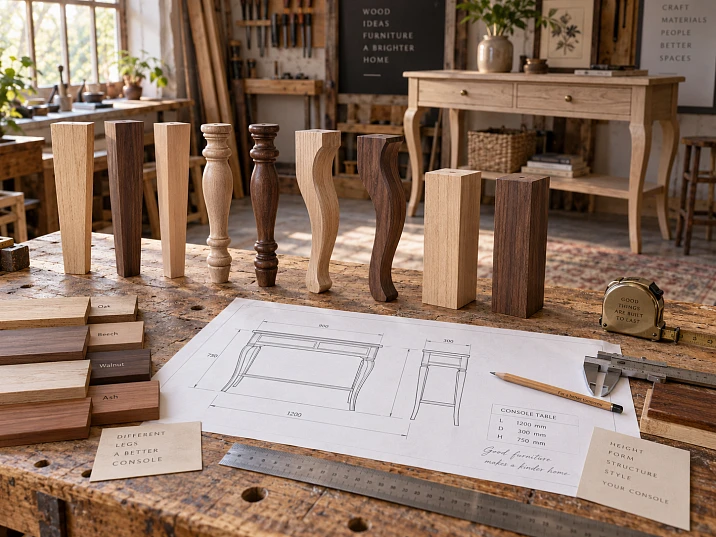
The console tabletop is lying on the workbench: 30 mm solid wood, length 1200, depth 300. All that's left is to buy the legs, and the first question sounds simple: "What height?" The answer "seventy centimeters" is almost always imprecise. A leg 700 mm high plus a 30 mm tabletop gives a console table 730 mm high, not 700. That three-centimeter difference decides whether the table sits flush with a windowsill, a sofa, or adjacent furniture.
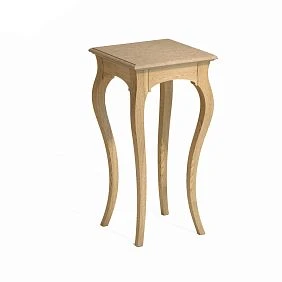
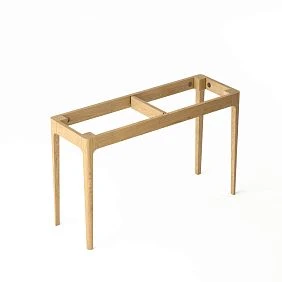
Console table legs are chosen based on the final height of the furniture, not from a catalog picture. Leg height plus tabletop thickness plus mounting hardware thickness give the height of the finished piece. So the order is: purpose of the console table, required height, tabletop thickness, construction (with or without an apron), support height, number of legs, shape, wood species, item code, mounting, purchase. Below, this chain is broken down using real STAVROS models: MN-116 at 720 mm high, the tall MN-143 at 1100 mm, and others. The general selection of supports for a chest of drawers and a nightstand is covered in a separate article about wooden furniture legs for a chest of drawers, nightstand, and console, while here we're talking only about a console table.
What the user is actually looking for with the query "console table legs"
The task isn't about defining a console table or the history of furniture. There's a tabletop or a console table project, and you need to select ready-made wooden supports of the required height. To do this, you need to know seven values:
-
the desired final height of the console table;
-
The thickness of the tabletop;
-
whether there's an apron or another frame;
-
number of supports;
-
mounting method;
-
wood species and finish;
-
the shape of the leg.
All seven are interconnected. The height depends on the tabletop and the mounting unit, the number of supports on the design and length, and the mounting method on the shape and the presence of a stretcher. If you change one parameter, you will have to revise the others, so it is better to write them down together on one sheet before opening the catalog.




How this looks in the STAVROS catalog
There is a separate selection for console tables: section console legs. At the time of checking, the list contains 56 items. The filters allow you to select products by application (console table, coffee table, table, bar counter, and others), dimensions A, B, C, collections ("Art Deco", "Classic", "Modern"), type (turned, carved, geometric), and availability in Moscow and Saint Petersburg. Prices in the list start from 540 rubles (turned MN-145) and go up to 143,160 rubles (carved support MN-244). Data as of the time of checking; before ordering, check the current price in the product card.
A spread of more than two hundred times means that "console legs" are not a single product, but an entire range: from a simple cone to an individually carved support. Therefore, you should start with the design and height, not the budget.
Our factory also produces:
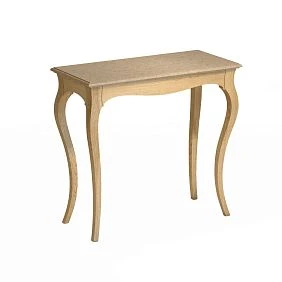
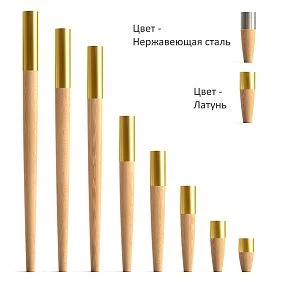
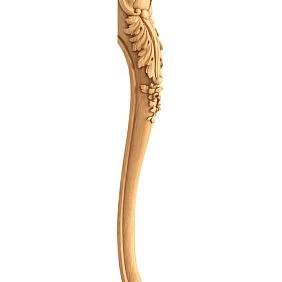
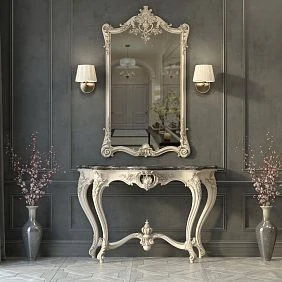
About names and heights
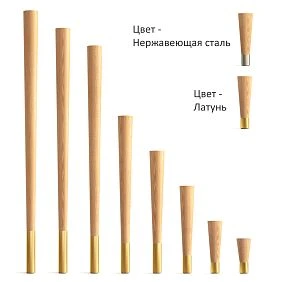
The section text names 700–750 mm as the usual height for console table legs, which corresponds to the height of work surfaces. This is the manufacturer's guideline, not a standard. The actual height of your console is determined by its purpose: for a hallway, sofa, toilet area, or workplace, it is different.
Get Consultation
Leg height and finished console height: different dimensions
Key section of the article. For a simple design, the formula is: leg height plus tabletop thickness plus mounting unit equal the final height. If there is a mounting plate or support block between the leg and the tabletop, their thickness is also included in the sum.
Example on a real model. The turned leg MN-116 has a height of 720 mm (as stated in the product card description). A 30 mm tabletop gives about 750 mm to the top surface, even before accounting for mounting elements. The square mounting plate FUR-044 recommended for MN-116 costs 490 rubles; check its thickness in the plate's product card and add it to the sum if the plate is placed between the leg and the tabletop.
Important: don't mistake the leg height for the height of the finished furniture. A 720 mm leg is not a 720 mm console. It's a support that the tabletop will rest on, and the final result depends on it.
Formulas for different cases
| Construction | Final height |
|---|---|
| Tabletop directly on legs (stud into the tabletop) | leg + tabletop |
| Tabletop on a mounting plate | leg + plate + tabletop |
| Apron scheme, apron at the level of the top of the leg | leg + tabletop (the apron does not add height) |
| The leg fits into the frame or underframe | depends on the design of the joint |
The last line means there is no universal formula: check against the drawing of your specific unit, not a generic diagram.
How to check in practice
Take a ruler and mark off the leg height from the floor, then add the countertop and the plate. Draw the top line on the wall with a pencil or tape. Assess how this line relates to adjacent furniture and the windowsill. Only after that, lock in the dimensions in the project.
First determine the purpose of the console
The purpose determines the height, depth, and stability requirements, so it must be determined before anything else.
Console in the Hallway
It is used for keys, decor, a mirror, and small items. Here, depth, stability, and clearance are key: the console stands where people pass right up close, and any side element that catches on them gets in the way. A narrow depth of 25–35 cm preserves the passage but requires a well-thought-out base.
Vanity console
Here, a comfortable height relative to a seated user is important. A vanity table is often used while sitting, so the height is closer to a standard table height, and the space under the countertop should allow the knees to fit.
Console as a desk
Here, the ergonomics of a standard desk come into play: height, free space for the legs, and stability under the load of elbows. The legs must be strong enough for work use, and the structure must be rigid.
Tall decorative console
This is a different scenario and different legs. A tall console works as a display surface, a bar accent, or a reception area. Its legs are noticeably taller, and the requirements for the mounting joint are stricter.
In the section text, the manufacturer lists typical applications: entryway, console behind the sofa, TV console, vanity console, and work console. For each scenario, define the required final height in millimeters and record it before selecting an article number.
About the sofa and the TV
A console behind the sofa should not get in the way of the legs of those sitting, and its height is usually close to the height of the backrest. A TV console carries heavy equipment, so the requirements for the supports are higher. In each case, you need to assess the load weight and compare it with the stated load per leg.
Why the query “legs for a console table 70 high” requires clarification
Users are searching for fairly specific geometry, and that is good. But “70 cm legs” and “a console 70 cm high” are not the same thing. If you need a finished piece of furniture 700 mm high, the leg must be lower by the thickness of the tabletop, the mounting joint, and the base.
Example. You need a console 700 mm, the tabletop is 30 mm, and there is no mounting plate. Then the leg must be 670 mm. If you take a 700 mm leg, the result will be 730 mm. If you take MN-116 at 720 mm, the result will be 750 mm. The options differ from the target by two and five centimeters.
This leads to a practical rule. Determine the desired final height, subtract the tabletop and the joint, get the required leg height, then look in the catalog for models that fall within the tolerance. If there is no exact model, there are three paths: choose a tabletop of a different thickness, change the final height in the project by a few centimeters, or discuss a non-standard size with the manager. The latter is possible only for batch orders, as the manufacturer states in the questions section, so for a single console it is better to adjust the project to the catalog.
Tolerance
Set a tolerance for the final height, say, ±10 mm. For a freestanding console, a difference of a centimeter is not noticeable. For a console that must match the height of a windowsill or adjacent furniture, the tolerance should be tighter.
Two or four legs for a console
There is no universal number. The number of legs is determined by the design of the console, not just by its appearance.
Four legs create a freestanding structure. Advantages: clear load transfer, a classic scheme, and less dependence on the wall. Such a console stands even without being attached to the wall.
Two front supports and wall mounting are possible for a wall-mounted console. In this case, the wall becomes part of the structural system, and the rear part of the tabletop is attached to it. This scheme saves material and makes the console more airy, but it requires a reliable wall and fasteners.
A central base or table base is already a different type of construction, where several legs are replaced by a single support or frame. In the catalog, such items are listed as table bases, for example STL-041 from 46,700 rubles in the related products block.
What the manufacturer says
The section text states that wooden supports for a console are most often installed in quantities of two or four, depending on the length of the tabletop; for short consoles up to 80 cm long, two legs at the edges are sufficient, while long ones need four. This is the manufacturer's guideline. The final decision depends on the rigidity of the tabletop, the load, and the mounting method, so for a specific item it is made by the designer.
Key idea
The number of supports is chosen based on the design. The appearance can be adjusted by the shape of the leg, while the number of legs is determined by how the tabletop performs under load.
Leg MN-116: example for a standard-height console
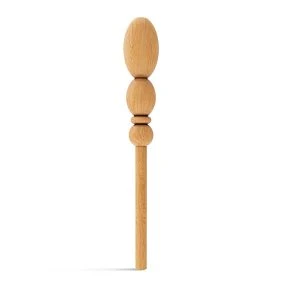
Turned leg MN-116 is positioned directly in the product card for the console. According to the description, the shape is round, cone-shaped, tapering toward the bottom, height 720 mm, material beech or oak, supplied unfinished. The card lists applications for a console, table, dresser, and cabinet. The price, according to the related products block on the neighboring card, is from 14,760 rubles per piece. Recommended hardware: metric threaded rod or M8x60 screw (FUR-001-1, 72 rubles), square mounting plate (FUR-044, 490 rubles), FUR-012 set (152 rubles), felt glide d=24 mm (FUR-027, 55 rubles).
How to use this example. Design a console within the standard dining or work height range, look at the actual 720 mm leg, add the tabletop, and check the final dimension. With a 30 mm tabletop you get about 750 mm, with 40 mm about 760 mm.
Cost of the set
Four MN-116 legs will cost at least 4 × 14,760 = 59,040 rubles. Two legs for a wall-mounted scheme cost 29,520 rubles. Add hardware to this: a threaded rod and a glide at approximately 127 rubles per leg if rod mounting is chosen. For a series of five consoles on four supports, 20 legs are needed, that is, at least 295,200 rubles. All calculations are based on "from" prices at the time of checking; the actual price depends on the wood species and the level of sanding.
Similar models by purpose are offered nearby: MN-117 from 4,240 rubles, MN-093 from 1,660 rubles. Compare their dimensions with MN-116, because price does not indicate height.
MN-143: a tall support changes the purpose of the furniture
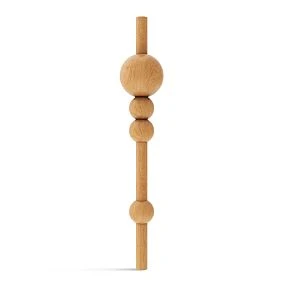
Leg MN-143 noticeably taller. In the description it is called a modern leg for creating tall consoles and is intended for frame-less constructions. The height according to the description is 110 cm (that is, 1100 mm), the shape is round, cone-shaped, with decorative rings. The diameter in the text is stated as 14 cm; when ordering, verify it against the size chart, as inaccuracies occur in the description. Material beech or oak, unfinished. Price according to the related products block from 19,690 rubles per piece. Mounting: M8x60 threaded rod, FUR-001 or FUR-012, FUR-044 mounting plate. Recommended glides: felt FUR-027 or FUR-021 from the SUPER GLIDE series, which allows heavy constructions to be moved easily without damaging the floor.
The contrast with MN-116 is telling. Both models are turned, made of beech or oak, but 720 mm and 1100 mm create furniture of completely different purposes. A 720 mm leg forms a console or table. A 1100 mm leg forms a tall console, bar counter, display surface, or reception desk. With a 30 mm tabletop, the final height will be about 1130 mm.
Four tall legs
A set of four MN-143 costs at least 78,760 rubles. This is an expensive solution, and it is justified only when the height is truly needed. For a high tsarga-free construction, the mounting joint and rigidity are especially critical, so such a project should be coordinated with a structural engineer.
About the product card description
The MN-143 card text is partly written about a bar counter and bar stools, while the first sentence of the description is about consoles. Focus on the line "for creating tall consoles" and on the size table, and do not include general phrases about advantages in the project without confirmation.
MN-029: turned leg for a console
Another example from the console section. Turned leg MN-029 in the list for a console table it starts at 3,510 rubles. The card was not opened during article preparation, so check the dimensions, height, and mounting features in it. According to the project plan, it belongs to turned legs intended for a console from the unfinished line, meaning it is suitable for your own finishing.
The price shows the model's position: it is more expensive than simple cones like MN-145 (from 540 rubles) and noticeably cheaper than MN-116 (from 14,760 rubles). For a console where a turned silhouette is needed without a high price, such models are considered first. The main condition: the height must fall within your tolerance.
A set of four MN-029 will cost at least 14,040 rubles, and a set of two will cost 7,020 rubles. A conditional calculation based on "from" prices.
How to evaluate the unfinished version
An unpainted leg allows the entire console to be finished with one system: the tabletop, apron, and supports. This is convenient if you need a single tone or RAL color. Finishing details are covered below.
Turned legs for a console
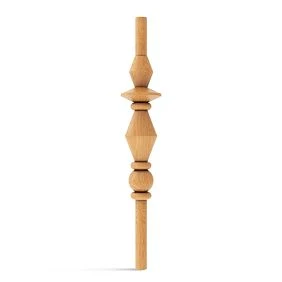
Turned legs are suitable for classic, modern classic, neoclassic, decorative console, and vanity table styles. Lathe turning produces a round cross-section, beads, necks, and transitions that create rhythm. In the section Turned Legs such supports are collected.
For a console, the turned shape benefits from the height: on a long support all the transitions are visible, and a well-chosen profile makes the console elegant. A poorly chosen profile (too many small details) looks fragmented on a tall leg.
How to choose a profile
Assess the leg height and the size of the profile details. On a 720 mm leg, 20–30 mm transitions get lost, while large beads read well. For a tall console, choose a profile with several large elements and smooth transitions. For a leg with polyurethane decor (such as MN-152, from 2,160 rubles) or metal decor (such as MN-203.1, from 4,370 rubles), match the decor material with the rest of the console's hardware.
About the conical shape
A shape that tapers toward the bottom visually lightens the structure. In the text, the manufacturer calls such supports dynamic and notes their popularity in Scandinavian and modern styles. Legs MN-116 and MN-143 are cone-shaped, which explains their light appearance despite their considerable height.
Carved legs for a classic console
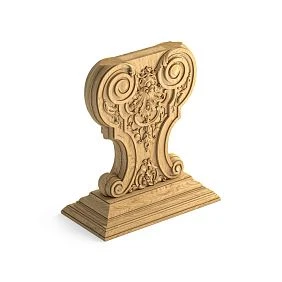
A carved leg is needed not because it is "richer." It must work together with the facade, apron, tabletop, pilasters, and overlays. If the console is classical, with a carved apron, then the leg must also repeat the motif.
The catalog shows the price range of carving: for example, the carved furniture leg MN-076 costs from 3,480 rubles, while the carved support MN-244 costs from 143,160 rubles. The second figure indicates one-off work, which is essentially a standalone piece rather than a purchased component for a series.
Examples according to the plan
Carved leg MN-114 and geometric MN-120 are marked in the plan as related to use for a table or console. During preparation of the article, their product cards were not opened, so check the dimensions and application yourself. It is only known that MN-120 costs from 7,240 rubles according to the related products block.
How to combine carving
A carved leg requires coordination with the rest of the decor. If the console has carved overlays and rosettes, the motif of the leg must work with them. If the console is smooth, the carved leg will become the only accent, and the pattern should be calm. Do not mix several competing ornaments.
About lighting
A relief several millimeters deep almost disappears in diffused light. A console in a hallway often stands in partial shade, so the carving must be sufficiently deep or the finish contrasting. Thick enamel clogs fine relief.
Geometric legs for a modern console
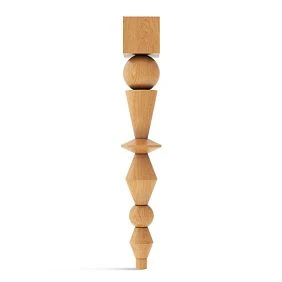
If the front is smooth, laconic, without classic carving, move on to geometric supports. In the section geometric legs straight, conical and faceted shapes are collected.
In the console list, geometric models are represented by a wide price range: MN-146 from 590 rubles, MN-193 from 680, MN-186 from 1,280, MN-206 from 2,870, MN-188 from 4,130, MN-031 from 4,260, MN-205 from 4,670, MN-187 from 6,210, MN-139 from 9,630 rubles. It is important not to list the entire catalog, but to explain the principle: the shape of the leg should support the geometry of the tabletop and the body. A straight edge of the tabletop requires a straight leg, while soft rounded corners of the tabletop require a soft support.
What to check
The ratio of the leg cross-section to the tabletop thickness: a thin leg under a massive slab looks weak, while a thick leg under a thin tabletop looks heavy. The orientation of the facets relative to the tabletop: a slight rotation is noticeable immediately. The quality of edge sanding: sharp edges reveal any defect, so for geometric shapes the "Prestige" level is justified.
A narrow console requires attention to stability
A console table often has a shallow depth, a long tabletop and a tall leg. This means that stability cannot be assessed from a photo of the product. It is necessary to take into account the depth of the base, the distance between the supports, the height, the fastening, the load center and possible wall fixation.
The manufacturer in the section text notes that a narrow tabletop creates specific loads requiring precise calculation of the location and dimensions of the legs, and for narrow tabletops with a depth of 25–35 cm, elegant thin legs are suitable. This confirms that depth is a key parameter.
A simple tipping assessment
A simplified example to understand the order of magnitude. A console 750 mm high and 300 mm deep along the supports, with a mass together with objects of 40 kg. To tip it forward, a lateral force at tabletop level H must create a moment greater than the moment of weight relative to the front supports: H × 0.75 m greater than 40 kg × 0.15 m. Hence H is greater than approximately 8 kgf. This force can be created by a child leaning on the edge. The example is conditional and does not take into account the rigidity of the joints, but it shows: a narrow tall console is tipped over by a relatively small force, and wall fixation removes the problem.
The engineering check of the structure is performed by the product designer. Here it is important to understand that the taller and narrower the console, the smaller the margin, and therefore the more important the base and fastening.
What increases stability
Large base depth. Wide spacing of front and rear supports. Additional lower shelf or crossbar between the legs. Wall fixing. Mass of the lower part. Each factor solves its own task, and the choice depends on what the design allows.
The taller the leg, the more important the structural joint
A 100–150 mm leg under a cabinet and a 700 mm or taller leg under a console work completely differently. A tall support is more sensitive to lateral load, play, joint geometry, apron stiffness and the fastening method.
The reason is leverage. A lateral force applied to the tabletop is transferred to the leg fastening joint with an arm equal to the leg height. The taller the leg, the greater the moment on the joint. For a 100 mm leg the arm is small, and the joint is lightly loaded. For a 720 mm or 1100 mm leg the arm is large, and the same lateral force creates a several times greater moment.
Therefore the article cannot be reduced to the advice “choose the leg you like at a suitable height.” For tall legs you need to check the fasteners, the thickness of the mounting plate, the presence of a plate and the stiffness of the entire structure.
What the catalogue recommends
For MN-116 and MN-143, the recommended hardware includes a square mounting plate FUR-044 (490 rubles), which distributes the load over a larger tabletop area. An M8x60 stud tightens the joint. These are standard solutions, but their sufficiency for your structure is determined by the designer.
About the declared load
The manufacturer declares a vertical load of at least 100 kg for all furniture legs. This is vertical. For tall legs, lateral load is significant, and nothing is said about it in the general claims, so for lateral stability check with the manager or verify with a sample.
Stretcher or stretcherless console
A stretcher is a horizontal rail under the tabletop that connects the legs. It can connect the legs, increase rigidity, and form a decorative band.
The stretcher design provides a more rigid frame: the legs are connected to each other, and lateral load is distributed across the frame. For tall consoles and heavy tabletops, this is a significant advantage. The stretcher also hides the fasteners and creates a visual line under the tabletop.
The stretcherless design provides a cleaner appearance and a lighter silhouette, but places different demands on the mounting assembly. Each leg is supported only by its own assembly, so rigidity depends on the plate, the stud, and the tabletop. The MN-143 leg is explicitly intended in its description for stretcherless constructions, and in that case the assembly is selected with a margin.
How to choose
Focus on the construction of the specific item and your project. If the product page indicates stretcherless constructions, design the assembly accordingly. If the leg is intended for a stretcher design, take into account its fit onto the stretcher. For a non-standard assembly, contact the manager before ordering.
Example
A hallway console 1200 × 300 mm with 720 mm legs. With a stretcher, it is more rigid and will withstand accidental pressure on the edge. Without a stretcher, it looks lighter but requires a reliable plate and possibly wall fixing. The choice depends on what matters more: rigidity or lightness.
Beech or oak for the console
Briefly, since the comparison of species is covered separately. Beech is a dense, non-porous wood that the manufacturer recommends for products under enamel. It is good under enamel, for painted furniture, and with a calm opaque finish. Oak is a dense, porous wood with a pronounced texture, often used under a semi-transparent coating that emphasizes the pattern. It is chosen when the texture is preserved and oil, clear lacquer, stain, or tinting are used.
There is a special feature for the console: the legs are often fully visible, along their entire height, and the species reads better than on a low support. A long oak leg under oil shows the grain pattern along its entire length, and this is a strong visual factor. A long beech leg under enamel looks like a clean form.
Glue-up grade and sanding
Choose the "under enamel" grade for opaque finishing and "under tinting" for semi-transparent. On long parts, contrasting lamellas are more noticeable than on short ones. The "Prestige" level (hand sanding without additional processing) is justified for long turned legs: on a large surface, processing marks are more visible.
About the section text
The general text of the section mentions ash and walnut, as well as the production of supports in any size. The cards of verified models list oak and beech, and the FAQ section states that other species and required sizes are made to order only for batch orders. Rely on the cards and the FAQ section, not on the general promotional text.
Unpainted legs are more convenient for a custom console
If a craftsman makes the tabletop, apron, facade, and legs, he needs a unified finishing system. An unpainted support allows painting in a single RAL color, tinting to match the tabletop, coating with a single oil, or creating a patina. This is the main option for a workshop.
Section Unpainted legs contains the main part of the catalog. All verified models for the console (MN-116, MN-143) are supplied unpainted.
Finishing sequence
The manufacturer provides four steps for products under lacquer or enamel: dust removal after sanding, uniform priming, matting after the primer has fully dried, and a final coat of lacquer or enamel in two layers with interlayer drying. For a tall leg, finishing is more difficult than for a short one: it is convenient to hang a long part by the end on a wire and paint it entirely so as not to leave marks from supports.
Uniform tone
If the tabletop and legs are painted or tinted together, the tone comes out the same. But remember: the same finish on the solid wood of the tabletop and on a turned leg looks different due to the different structure of the end grain and the direction of the fibers. Check on a sample.
About painting at the manufacturer
The manufacturer paints products when ordering goods worth 150,000 rubles or more. A set of four legs MN-116 costs less than this amount, so for the console, plan for your own finishing. Finished legs with a coating are available in the section Legs with Finish.
How to choose legs for a ready-made tabletop
The algorithm consists of eight steps.
-
Measure the tabletop: length, depth, thickness.
-
Determine the final height of the furniture.
-
Subtract the thickness of the tabletop.
-
Take into account the frame, stretcher, and mounting plates.
-
Get a reference for the leg height.
-
Choose suitable item numbers from the catalog.
-
Check the mounting plates.
-
Do a trial layout.
This is one of the most useful parts of the project, because it turns the wish "a console about this height" into a specific number to search for.
Example
Tabletop 1200 × 300 × 30 mm. Required height is 750 mm. Subtract 30 mm: we get 720 mm. There is no mounting plate. So MN-116 with a height of 720 mm is suitable. If the FUR-044 plate is needed, subtract its thickness from 720 mm, and the leg ends up slightly lower; then either change the target by a few millimeters or look for another model.
Trial layout
Place the tabletop on two stools or trestles of the required height. Place mockups of the legs made of timber or cardboard at the mounting points. Assess the proportions, height, and distance from the edge. Place the neighboring furniture next to it and compare the lines.
Mounting plates
Check the size of the top of the leg against the table in the product card and compare it with the thickness and width of the tabletop at the mounting point. The offset from the edge of the tabletop must be sufficient so that the stud does not go beyond the edge. If the tabletop is thin, use a plate.
How many legs to buy for a small series of consoles
For a workshop, the formula is simple: the number of supports per item is multiplied by the number of items. Five consoles with four legs each give 20 legs. If the design has two supports, five consoles require 10 supports. After that, the production reserve is decided separately.
| Scheme | Legs for console | Consoles | Base batch |
|---|---|---|---|
| Four legs | 4 | 5 | 20 |
| Two supports plus wall | 2 | 5 | 10 |
At "from" prices, a series of five consoles on four MN-116 requires at least 295,200 rubles for the legs, and 147,600 rubles on two supports. Hardware: FUR-001-1 stud (72 rubles) and FUR-027 foot pad (55 rubles) per leg, totaling 127 rubles per leg, i.e. 2,540 rubles for 20 legs. If FUR-044 plates are needed (490 rubles), that is another 9,800 rubles for 20 pieces. All of these are approximate calculations; check prices and availability in the product pages.
Reserve
Determine by risk. For long legs, the risk of damage during finishing and transportation is higher than for short ones. Record the reserve as a separate line in the bill of materials.
Availability and lead times
Some items are "in stock", while some require 5–10 days. For a series, plan so that all legs arrive in one batch: parts from different batches may differ in wood color, which is noticeable with a clear finish.
Specification
Record the product code, wood species, glue grade, sanding level, height, finish system, hardware, quantity, and status (SAMPLE or APPROVED). That way, a repeat order six months later won't require searching.
One sample before ordering the entire batch
The correct sequence: product code, one sample, assembly check, trial finish, approval, batch. For long, expensive legs, the cost of a sample is significant: a single MN-116 starts at 14,760 rubles. But a mistake in a batch of twenty legs would cost almost 300,000 rubles.
Seven things need to be checked on the sample: the actual height, the top cross-section, the shape, stability, the color after finishing, the proportions relative to the tabletop, and how the joint behaves under lateral pressure.
About stability in particular. Place the console mock-up on the sample and assess the play: press on the edge of the tabletop and see how the joint behaves. For tall legs, this is the most important check.
Conditions
The catalog ships items from a single piece, so a sample can be ordered without any commitment to a production run. Items in stock are dispatched within three business days; the rest are prepared in 5–10 business days. Most items are stored in the warehouse unsanded.
When a sample is not needed
For a product code you have already used in a console of the same design, a repeat sample is unnecessary. For a single console, the order itself serves as the sample.
Where to buy wooden legs for a console
The main product page for this task: the section wooden legs for a console, which features models for use with a console table.
Additional Items:
-
Wooden furniture legs: general catalog of supports.
-
Unpainted legs: for your own finishing.
-
Turned Legs и geometric legs by shape type.
Order conditions
Items are shipped from a single unit. Delivery is available across Russia and to CIS countries via the transport companies CDEK and DPD, or by pickup. Showrooms are located in St. Petersburg and Moscow, with production in St. Petersburg. Cutting items to size is not performed. Non-standard items and custom sizes are made only for bulk orders. Before ordering, the manufacturer recommends preparing a design project: drawings can be downloaded from the website.
What to clarify with the manager
Availability of the complete set in a single delivery, exact top dimensions and height, mounting method and hardware set, permissible lateral load for tall models. Before ordering, check the current price and availability in the product card.
Craftsmen's questions
Which legs are suitable for a console?
Those whose height, together with the tabletop and mounting unit, gives the required size, and whose top plate fits your tabletop. In the STAVROS catalog, for example, MN-116 with a height of 720 mm and the tall MN-143 at 1100 mm are marked for the console.
Where to buy wooden legs for a console?
In the section console legs of the STAVROS catalog. Ordering is possible from a single unit.
What height should the legs of a console table be?
Such that the leg plus tabletop plus mounting unit give your final height. The manufacturer cites 700–750 mm as the usual height for console legs. For a console 750 mm high and a 30 mm tabletop, a leg of about 720 mm is needed.
How to calculate the final height of a console?
Add the leg height, the tabletop thickness, and the thickness of the plate or other assembly. Example: 720 + 30 = 750 mm. In the standard scheme, the apron does not add height, but check the assembly design against the drawing.
Are two or four legs needed for a console?
It depends on the design and length. According to the manufacturer's guideline, consoles up to 80 cm long need only two legs at the edges, while long ones need four. A wall-mounted scheme with two supports requires reliable attachment to the wall.
Should the console be attached to the wall?
For narrow, tall consoles this is often reasonable: a simple estimate shows that a console 300 mm deep and 750 mm high can tip over from a lateral force of about 8 kgf. The final decision is made by the designer.
Which is better: turned or geometric legs?
Turned ones suit classic, neoclassic, and vanity consoles; geometric ones suit clean modern styles. First check the height and the assembly, then choose the shape.
Which legs should be chosen for a 30–40 mm thick tabletop?
For a final height of 750 mm with a 30 mm tabletop, you need a leg of about 720 mm; with 40 mm, about 710 mm. A thin tabletop requires a mounting plate to distribute the load.
What to choose: beech or oak?
Beech for enamel and painted furniture, oak for oil, lacquer, stain, and tinting with visible texture. Choose the glue-up grade to match the finish.
Do I need to buy a sample leg before producing a series?
Yes, for a new SKU. A sample verifies the height, joint, stability, and finish. For tall and expensive legs, an error in a series costs significantly more than a sample.
The specifications and prices of MN-116 and MN-143, the composition of the console legs section, recommended hardware, ordering conditions, and finishing sequence have been verified against the STAVROS catalog at the time of preparation. Calculations are conditional.