Article Contents:
- Wave HL-006 or Plane HL-011: the main difference in one solution
- What is an overlay profile handle and why it changes the facade
- What Wave and Plane have in common
- Technical specifications of two models
- When to buy the wavy handle Wave HL-006
- For facades with soft geometry
- For a custom wardrobe or dressing room
- For a kitchen with rounded details
- For chests and cabinets
- For a minimalist kitchen
- For a tall wardrobe
- For facades with slats and straight milling
- For office, salon, and commercial interior
- When to choose beech
- When to choose oak
- Why you should not mix species randomly
- Modern minimalism
- Japandi and calm natural interiors
- Modern classicism
- Eclecticism and designer furniture
- Children's and teen's room
- Hallway and dressing room
- Need to design a smooth tall cabinet
- Need to update an existing dresser
- Need to assemble a set for the entire kitchen
- Need a natural wood texture
- Need to visually elongate the facade
- Need to soften strict furniture
- Choosing Only by Photo
- Assuming the same length guarantees compatibility
- Not considering the cross-section
- Buying a handle without coating as fully finished
- Mixing beech and oak in one set
- Not checking the direction of Wave
- Placing a long handle too close to the edge
- Not considering adjacent doors
- Drilling the facade before obtaining the exact layout
- Forgetting about decorative plugs
- Which handle is better for a tall cabinet — Wave or Plane?
- Do Wave and Plane have the same sizes?
- Why does the 900 mm size require separate verification?
- Can Wave be installed vertically?
- Can Plane be installed horizontally?
- Which model looks more massive?
- What material are Wave and Plane made of?
- Are the handles supplied painted?
- Is the mounting hardware included in the kit?
- Are decorative caps needed?
- Which handle is suitable for a minimalist kitchen?
- What to choose for a slatted facade?
- Can the handle be painted to match the facade color?
- Can the natural wood texture be preserved?
- How to determine which length will suit the facade?
- Can the old handle be replaced without redrilling?
- What to choose if you don't want to do painting?
- Where to compare other long wooden handles?
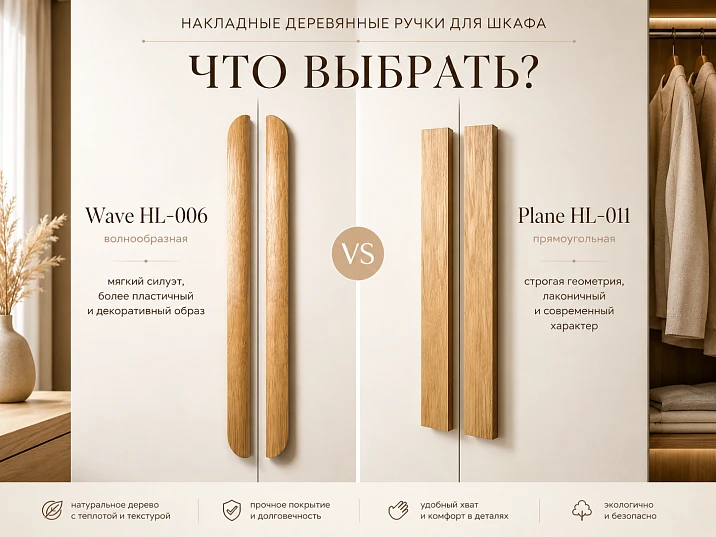
Overlay wooden handles for a cabinet are often chosen after the facades have been manufactured, painted, or prepared for finishing. At this stage, it seems enough to determine the appropriate length and order a model that looks best in the photo. In practice, a long profile handle noticeably affects the proportions of the door, ease of grip, placement of mounting holes, and the overall character of the furniture. This is especially evident in two STAVROS models: Wave HL-006 with a smooth wave-like line and Plane HL-011 with straight rectangular geometry.
Both handles are available in ten lengths from 180 to 1800 mm, made from beech or oak, supplied without a finish coating, and come with fasteners. Therefore, in terms of basic parameters, they seem almost interchangeable. But the same size range does not mean the same result. Wave makes the facade more plastic and noticeable, supports rounding, soft lines, and custom furniture shapes. Plane, on the contrary, emphasizes the rectangular grid, elongates a tall facade, and does not conflict with the minimalist architecture of a kitchen, cabinet, or wardrobe.
The difference is not only in appearance. The cross-section of Wave is 35 × 23 mm, Plane is 40 × 25 mm. For most of the same sizes, the center distances match, but the 900 mm length becomes an important exception: for Wave, the center distance is 832 mm, for Plane, it is 768 mm. This means that replacing one model with another on an already drilled facade without checking is not possible. Even with the same overall length, the holes will be in different places.
Below is an analysis of which overlay handle to choose for a tall cabinet, kitchen pantry, chest of drawers, nightstand, wardrobe, or custom furniture. The article includes a comparison of sizes, shape, installation, material, finish, and ready-made series with coating. This approach allows you to understand in advance which specific model suits the project, what to check before ordering, and what additional elements will be needed for a neat installation.
Short answer.
Wave HL-006 and Plane HL-011 are available in ten lengths from 180 to 1800 mm. Choose Wave if you need a wave-shaped surface-mounted handle profile that will become a prominent part of the facade design. Plane is suitable for a strict kitchen, cabinet, or tall unit with straight geometry. Before replacing, be sure to check not only the overall length but also the center distance: for models 900 mm long, it differs — 832 mm for Wave and 768 mm for Plane.
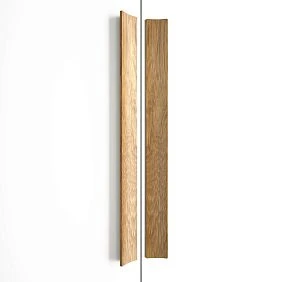
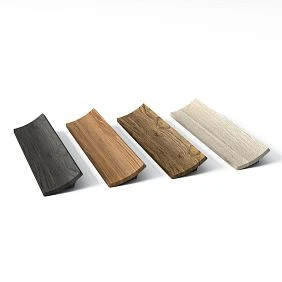
Wave HL-006 or Plane HL-011: the main difference in one solution
The main choice here can be stated very simply: does the facade need a soft, flowing line or strict geometry. Surface-mounted wooden handle Wave has a smooth curve that resembles a wave crest. Even in a short size, it is perceived as an independent decorative detail. In long versions from 900 to 1800 mm, the shape becomes part of the facade architecture: it guides the eye along the door, softens a large surface, and makes the furniture less static.
Surface-mounted furniture handle Plane is built on a straight line and rectangular profile. It does not strive to become a separate ornament but emphasizes the furniture's construction. On a tall cabinet, such a handle visually elongates the facade; on a wide drawer, it supports the horizontal line; and in a modular kitchen, it helps maintain order among straight lines. Plane is especially appropriate where the facade already has a noticeable texture, slats, panels, or complex layout, and an additional wave could create unnecessary competition.
Therefore, Wave cannot be considered a decorative version of Plane, nor Plane a simplified version of Wave. These are two different models for different visual tasks. Both are surface-mounted profile handles: they are installed on the facade surface and remain visible after installation. Unlike a concealed opening system, the handle here is not hidden but becomes part of the furniture's front side.
| Criterion | Wave HL-006 | Plane HL-011 |
|---|---|---|
| Shape | Smooth wave | Rectangular profile |
| Type | Surface-mounted profile handle | Surface-mounted profile handle |
| Lengths | 180–1800 mm, 10 sizes | 180–1800 mm, 10 sizes |
| Cross-section | 35 × 23 mm | 40 × 25 mm |
| Center distance | 128–1728 mm | 128–1728 mm |
| Size 900 mm | Center distance 832 mm | Center distance 768 mm |
| Material | Beech or oak | Beech or oak |
| Delivery condition | Uncoated, Prestige sanding | Uncoated, Prestige sanding |
| Fasteners | Included in the set | Included in the set |
| Main character | Flexible, expressive, decorative | Strict, straight, architectural |




What is a profile handle and why it changes the facade
An overlay handle-profile is an elongated furniture handle that attaches directly to the front of a door or drawer. It differs from a small knob not only in length. Due to its extended shape, such a part forms a noticeable vertical or horizontal line, helps visually change the proportions of furniture, and creates a convenient grip area over a large surface. The longer the handle, the more it participates in the design of the facade.
On a tall cabinet, a short handle can look like a random dot, especially if the door is floor-to-ceiling height. A long profile connects the upper and lower parts of the facade, makes the opening line clearer, and adds architectural coherence to the furniture. On a wide drawer, the situation is reversed: a handle positioned horizontally helps distribute force across the center and visually supports the width of the module. That is why overlay handles for facades are chosen not separately from the furniture, but together with its proportions.
Wood enhances this effect. Unlike a neutral metal profile, a wooden handle can be painted in the color of the facade, highlighted with contrasting tinting, or matched in shade to the countertop, slats, baseboard, and other decor. Beech is suitable for opaque enamel, while oak allows preserving the expressive natural texture under tinting. The buyer receives not just ready-made hardware, but part of a finishing solution.
At the same time, the overlay construction requires careful marking. The holes remain tied to a specific center-to-center distance, so changing the handle after drilling is only possible after verification. This is especially important for long sizes: an error of even a few millimeters is no longer masked by the body of a small knob. For Wave and Plane with a length of 900 mm, the difference is 64 mm, and this completely excludes direct replacement without new drilling or reworking the facade.
Our factory also produces:
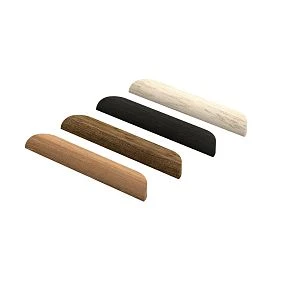
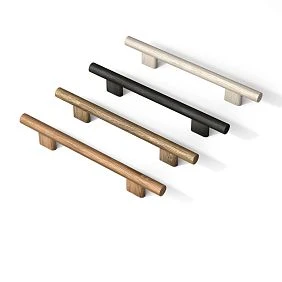
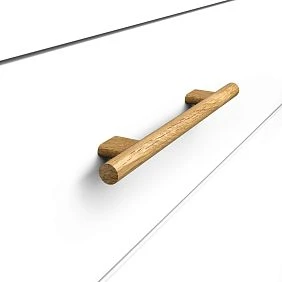
What do Wave and Plane have in common
The two models share the same ordering logic. Both are available in lengths of 180, 260, 400, 500, 600, 700, 900, 1200, 1500, and 1800 mm. This range allows you to assemble a set for furniture of different scales: use short options on small drawers and cabinets, medium ones on chests of drawers and hinged doors, and long ones on wardrobes, dressing rooms, and kitchen tall cabinets.
Both handles are made from beech or oak. The choice of wood species is primarily related to the future finish. Beech is usually chosen when the handle is planned to be painted with opaque enamel and unified with the facade in one color. Oak is appropriate if you need to emphasize the natural wood grain, perform tinting, and preserve a distinguishable texture. It is better not to mix species in one set without a well-thought-out design reason: after a transparent or semi-transparent finish, they will look different.
Wave HL-006 and Plane HL-011 are supplied without a final coating, with a "Prestige" sanding quality. This is convenient for a furniture workshop, designer, and buyer who wants to match the color to a specific sample. The handles can be finished together with the facades, achieving a more precise shade match. At the same time, this format means that after purchase, painting or tinting will need to be arranged. If no additional work is desired, it is more reasonable to immediately look at ready-made series with the M index.
Fasteners are included in the package of both models. However, for a finished appearance, decorative metal caps may be required, listed on the product cards as necessary hardware. Their choice depends on the desired metal shade and the overall furniture finish. The mere presence of fasteners does not negate the need to check the facade thickness, installation diagram, and accessibility of the reverse side for tightening.
Get Consultation
Technical specifications of the two models
| Parameter | Wave HL-006 | Plane HL-011 | What This Means for the Buyer |
|---|---|---|---|
| Article | HL-006 | HL-011 | The article number must be checked when ordering, especially if versions with coating are purchased simultaneously. |
| Available lengths | 180, 260, 400, 500, 600, 700, 900, 1200, 1500, 1800 mm | 180, 260, 400, 500, 600, 700, 900, 1200, 1500, 1800 mm | You can assemble a single set for drawers, doors, and tall cabinets. |
| Section B × C | 35 × 23 mm | 40 × 25 mm | Plane looks slightly more massive, Wave looks lighter and more plastic. |
| Tree Species | Beech or oak | Beech or oak | Beech is chosen for enamel, oak for tinting while preserving the grain. |
| Finish | No | No | After receiving, finishing is required or choose the ready-made M series. |
| Sanding | «Prestige» | «Prestige» | The surface is prepared for further finishing, but the coating technology must be selected separately. |
| Mounting kit | Enters | Enters | Before installation, you still need to check the thickness of the facade and the mounting scheme. |
When to buy the Wave HL-006 wave-shaped handle
For facades with soft geometry
Wave looks especially convincing on furniture that already has rounded corners, radius side panels, oval mirrors, smoothly rounded countertops, or a soft panel line. The wave does not introduce a random motif but continues the existing plasticity. As a result, the handle is perceived as part of the overall project, not as hardware added after the body was manufactured.
On a smooth, monochrome facade, Wave can become the main decorative element. This is useful when furniture is deliberately devoid of overlays, frames, and active milling, but a completely neutral surface seems too empty. A long wave-shaped handle creates an expressive line without additional decor and simultaneously performs the practical function of opening.
If this effect matches the task, you can buy the Wave HL-006 handle in a length that supports the scale of the facade. Short options are suitable for drawers, medium ones for swing doors and chests of drawers, and long ones for tall cabinets and pencil cases. It is better to choose the color after the role of the handle is determined: blend with the facade, softly differ by half a tone, or work as a noticeable wood contrast.
For a custom cabinet or dressing room
In custom furniture, the handle often becomes one of the few details that cannot be changed without redoing the facade. Therefore, it is important for the designer to choose not only the length but also the character of the line. Wave suits projects where the cabinet should look lighter and more plastic, especially with a tall door. The wave breaks the monotony of a long vertical line but does not fragment the facade into small elements.
In a dressing room, the same model can be used in several sizes: long handles on tall doors, medium ones on internal sections, and short ones on drawers. Such a set creates a relationship between modules, even if they differ in height and purpose. It is important to decide in advance whether all handles will be placed vertically or some of them will be placed horizontally. Mixing directions is acceptable when it follows the furniture's construction, not when it happens randomly.
For a kitchen with rounded details
In the kitchen, Wave pairs well with radius ends, rounded countertops, soft island lines, and facades without rigid frames. On a tall pantry cabinet, a long handle creates a convenient grip zone and supports the vertical line. On lower drawers, short and medium options can be placed horizontally while maintaining a unified pattern.
However, the wave shape is more noticeable than a straight one. If the kitchen already has an active stone pattern, frequent slats, contrasting milling, or many open shelves, Wave may add unnecessary complexity. In this case, Plane will be calmer. Wave should be chosen when the handle itself is meant to be the main plastic element, while other surfaces remain restrained.
For a chest of drawers and a nightstand
On a chest of drawers, Wave helps connect several drawers into one composition. When installed horizontally, the handles form repeating wave-like lines. This is especially noticeable on wide facades without frames. To avoid a cluttered look, the handle length should be matched to the drawer width, leaving sufficient margins on the edges.
On a small cabinet, an overly long Wave can take up almost the entire facade and visually weigh it down. Here, it is wiser to choose a short model or switch to another shape. First, make a full-size layout on paper or painter's tape, apply it to the facade, and evaluate the proportion from a normal distance, not up close.
When to choose the rectangular Plane HL-011
For a minimalist kitchen
Plane suits a kitchen where facades are built on straight lines, identical modules, and a strict grid. The rectangular profile supports the geometry of the cabinets and does not create a separate decorative theme. This is especially useful when combining several materials: wood, stone, solid enamel, glass. The handle does not compete with textures but helps connect them with a common line.
On a tall cabinet Handle for kitchen cabinet 1800 mm can take up a significant part of the facade height and make it visually slimmer. Before ordering, you need to check where the working grip zone ends, whether the handle interferes with the adjacent door, and whether sufficient distance remains to the floor, countertop, and top edge.
For a tall cabinet
A rectangular handle for a cabinet creates a clear vertical line. It is appropriate on smooth doors, facades with straight paneling, built-in cabinets, and walk-in closets where the furniture should be perceived as part of the wall. If Plane is painted in the color of the facade, the profile becomes almost an architectural shadow. If it is made of oak with a tint, a calm wood contrast appears.
For paired doors, it is important to maintain symmetry. The handles should be at the same distance from the inner edge and at the same height. The longer the profile, the more noticeable even a slight discrepancy. It is better to mark using a single template rather than measuring each door separately from different points.
For facades with slats and straight routing
Wave next to frequent vertical slats can create an intersection of two different patterns. Plane works more calmly in such a situation: it repeats the direction of the slats or becomes a contrasting horizontal line. The same applies to facades with a rectangular frame. A straight profile supports the shape of the paneling and does not introduce additional curvature.
If the furniture already has a pronounced decorative pattern, the handle should help open the door and maintain order, rather than becoming a second focal point. Therefore, Surface-mounted cabinet handle it often turns out to be a more rational choice for complex facades.
For office, salon, and commercial interiors
In commercial furniture, repeatability is important. Plane is easier to combine with straight posts, display cases, wall panels, and modular systems. It creates a clear opening line and does not tie the interior to an overly decorative look. This is convenient for a showroom, office, reception, salon, or hotel room where furniture must remain visually relevant for a long time.
When there are many fronts, it is especially important to order handles of the same model, same wood species, and in a coordinated finish. Minor differences between batches or mixing oak and beech on your own become more noticeable when handles are placed side by side. It is better to prepare a size list in advance and check each module.
How to choose the handle length for a cabinet front
The handle length should not automatically equal the maximum possible. The longest model is suitable only when it supports the door's proportion and remains comfortable to use. On a tall front, a handle of 1200, 1500, or 1800 mm may look natural, but for a medium cabinet, the same size will be excessive. First, measure the door's height and width, determine the indents from the edges, and understand where a person will grab the handle.
For vertical installation, three zones are usually important: the lower edge of the handle, the main grip area, and the upper edge. If the handle starts too low, it may interfere with cleaning, catch on clothing, or visually "sink" toward the floor. If raised too high, part of the profile becomes non-functional. This should be checked especially carefully on children's furniture and tall tall cabinets.
On wide drawers, the handle can occupy a noticeable part of the width, but calm margins should remain at the edges. A very short handle on a wide front looks random, while one almost equal to the drawer's width can create a feeling that the profile does not fit. There is no universal percentage: the Wave shape is perceived as more active, so it sometimes requires more free space, whereas Plane works more easily as a long line.
A useful technique is a temporary mockup. Mark the length with painter's tape or cut a strip of cardboard with the real profile width. For Wave, additionally mark the wavy contour because a simple straight strip will not convey its visual activity. Look at the front from the distance at which the furniture is usually seen in the room. Such a test helps avoid an error that is hard to notice from a catalog photo.
How to choose a handle for a kitchen tall cabinet
A kitchen tall cabinet is one of the most demanding fronts. It is tall, often located next to a refrigerator, oven, appliance column, or passage. The long handle should be expressive but not interfere with adjacent doors or human movement. Before ordering, check the opening direction, the door's swing angle, and the distance to the wall, countertop, and protruding elements.
Wave is suitable for a tall cabinet that should become a noticeable part of the kitchen. Its wave works well next to a softly rounded island, a radius end, or calm monochrome facades. Plane better continues the straight line of appliances, modular grid, and vertical seams. With the same length, Plane looks slightly more massive due to its 40 × 25 mm cross-section, while Wave is a bit lighter thanks to its 35 × 23 mm cross-section and smooth shape.
For a tall cabinet, a length of 1800 mm looks impressive but is not always necessary. If the door has inserts, horizontal divisions, or built-in appliances, a long handle may cross important lines. In such a case, it is better to choose 1200 or 1500 mm and position the profile in the convenient grip zone. The decision should be based on the actual design, not on the desire to install the maximum size.
If the kitchen has lower drawers and upper cabinets, plan a unified set of lengths in advance. You can use Plane or Wave on all facades, only changing the size and direction. This way, the furniture will maintain consistency. Mixing both models in one set is only acceptable with a clear logic, for example, Wave on the island and Plane on the main straight line. Without such a separation, the set will look random.
Handle length and center-to-center distance are not the same thing
The overall length shows how much space the handle occupies on the facade. The center-to-center distance shows the distance between the centers of the mounting holes. For a new facade, the craftsman can mark the holes for the selected model. When replacing an old handle, the situation is reversed: existing holes limit the choice, and the center-to-center distance becomes the main parameter.
Buyers often see the same length of 900 mm and assume that Wave and Plane can be swapped. This is incorrect. For Wave HL-006 with a length of 900 mm, the mounting centers are located at a distance of 832 mm, while for Plane HL-011 of the same external size, it is 768 mm. The difference is 64 mm. The old holes will not match, and the new handle body is not guaranteed to completely cover the traces of the previous installation.
For other sizes, you also need to check the table in the product card. The range of center-to-center distances for both models is 128–1728 mm, but compatibility cannot be determined by the range or appearance. Before purchasing, measure the distance between the centers of the holes with a caliper or precise ruler, and then compare it with the specific option.
If the facade has not yet been drilled, first order or finally select the handle, and only then make a template. This protects against a situation where the furniture is made for conditional sizes, but the actual product has a different mounting pattern. For expensive painted facades, this sequence is especially important.
Main check before replacement: the same external length does not guarantee the same center-to-center distance. For size 900 mm, Wave and Plane are incompatible without new drilling: 832 mm vs. 768 mm.
Why 900 mm models cannot be swapped without checking
The 900 mm size is often chosen for medium and tall doors, so this is where the risk of error is especially practical. In the photo, the two handles look comparable in scale, and the description "length 900 mm" creates a sense of interchangeability. But the mounting pattern differs. If the facade is already painted, trying to install a different model will lead to new holes and the need to decide how to cover the old ones.
Sometimes old holes can be covered by the handle body, but you cannot rely on this without an accurate drawing. For Wave and Plane, not only the mounting position differs, but also the cross-section. Plane is wider and deeper, but this does not mean it will automatically hide all traces. Additionally, new holes may end up too close to old ones, weakening the material area.
For new furniture, the problem is solved simply: a specific article number and center distance are entered into the working documentation. For repairing or updating a cabinet, you need to remove the old handle, measure the holes, and assess the condition of the facade. If the dimensions do not match, it is better to either choose a suitable option or arrange professional surface restoration in advance.
This example shows why a long handle cannot be bought based solely on shape. Technical compatibility always precedes decorative choice. First, determine the installation feasibility, then the material and finish, and only then compare Wave and Plane by visual character.
Horizontal or vertical installation
Both models can be used horizontally and vertically. The direction depends on the type of facade. On drawers, the handle is usually placed horizontally because it follows the width of the module and allows pulling the facade toward you. On tall hinged doors, the profile is more often installed vertically, emphasizing the cabinet's height and creating a long grip zone.
Wave, when placed horizontally, particularly shows its wavy pattern. Several drawers form a repeating motif, so it is important to maintain the same orientation and installation height. If one handle is accidentally turned differently, the difference will be noticeable. On a vertical door, Wave creates a soft line that can visually lighten a large surface.
Plane is easier to perceive in both directions. Horizontally, it supports the lines of drawers; vertically, the seams between facades. Due to its straight shape, it is easier to combine with rectangular milling and a modular grid. However, the simplicity of the shape does not eliminate precision: a long straight handle instantly shows even a slight misalignment.
When choosing the direction, check whether neighboring handles collide when opening. In a corner kitchen, a long profile may hit a perpendicular facade. On paired doors, too small a gap between handles makes gripping uncomfortable. On drawers, the handle should not interfere with the countertop or protrude beyond the safe walkway zone.
Beech for enamel or oak for tinting
When to choose beech
Beech is suitable for projects where the handle needs an opaque enamel. It is chosen for white, gray, black, colored, and complex interior shades. When Wave or Plane is painted in the facade color, the handle retains volume and shadow but does not create additional wood contrast. This technique helps make the long profile noticeable in shape and calm in color.
For a high-quality match between the handle and facade, it is better to finish them in the same system: identical primer, enamel, gloss level, and application technology. Even the same color code can look different on different materials and with different preparation. Therefore, a sample or joint painting is more useful than choosing only by the shade name.
When to choose oak
Oak is chosen when the natural grain should remain visible. Tinting can tie the handle to the countertop, wood panels, furniture legs, floor, or individual decorative details. On a smooth painted facade, the oak Plane creates a strict contrasting line. The oak Wave adds not only a wave but also a lively texture.
When ordering a set of several handles, natural differences in wood grain must be considered. Complete matching, as with printed film, should not be expected. The goal of finishing is to bring elements together in a close shade and general character, preserving the naturalness of the material. If a completely uniform surface is needed, beech under enamel is usually more predictable.
Why you should not mix wood species randomly
In one cabinet, beech and oak after clear finishing will differ in grain. If some handles are made of beech and some of oak, the set may look inconsistent. Mixing is justified only as a deliberate technique, for example, different furniture zones receive different colors and textures. In all other cases, it is better to order one species for the entire group of facades.
Before ordering, you need to make a list of sizes and immediately select the material for each. This is especially important when ten available lengths are used. Ordering in stages without a single specification increases the risk of receiving different materials or finishes.
Handle without coating or ready-made M series
Wave HL-006 and Plane HL-011 are supplied without a final coating. This option is suitable for a furniture workshop, design project, and a customer who needs to precisely match the handles to the facades. The buyer independently chooses enamel or tinting, controls the degree of gloss, and can include the handles in a common painting batch.
The advantage of custom finishing is flexibility. A beech handle can be painted in the color of the facade or highlighted with a contrasting shade. Oak can be tinted to match existing wood. The disadvantage is additional operations. You need to select materials, prepare a workspace or workshop, adhere to the technology, and protect the surface before installation.
If the handle should be ready for installation, you can buy the Wave HL-006M with coating either buy Plane HL-011M with coating. The M series reduces the amount of work after purchase and is convenient for repairs, ready-made furniture, or a project without a separate painting stage.
The choice between versions without coating and with a ready finish must be made before the final specification. You cannot focus only on the difference in product price: an unpainted handle will incur costs for materials, labor, and logistics. The finished version may be more rational if an individual color is not needed. The unpainted model is beneficial primarily when custom finishing is an important part of the design.
How not to confuse a surface-mounted handle with the Gola system
The surface-mounted profile handle and the Gola system solve a similar task — they help open the facade — but are arranged differently. Wave and Plane remain visible on the front side of the furniture and are attached as independent handles. Gola forms a hidden grip zone built into the kitchen or cabinet structure. Therefore, they cannot be chosen only by the general word "profile."
A surface-mounted handle is convenient when the facade is already designed as a regular door or drawer and noticeable hardware is required. It gives the designer freedom of length, material, and finish. The Gola system requires considering the profile even when designing the cabinet, gaps, and facade structure. This is a different route for furniture manufacturing.
To understand in detail how a surface-mounted profile handle differs from Gola, it is useful before ordering a kitchen. If a hidden opening line is needed, Wave and Plane will not replace Gola. If a wooden element on the facade that can be painted or tinted is needed, surface-mounted models are more suitable.
Another mistake is calling any decorative profile a long handle. A handle must have a confirmed attachment scheme and purpose. It should not be replaced with a random wooden strip: such a blank has no calculated grip shape, ready-made attachment points, or a coordinated size range.
Wave and Plane in different interiors
Modern minimalism
For strict minimalism, Plane is often chosen. Its straight form supports even seams, laconic facades, and an architectural grid. Painted in the color of the furniture, the handle looks restrained, while one made of tinted oak becomes a neat contrasting line. Wave can also work in minimalism, but in a softer, organic version where there are rounded objects and natural forms.
Japandi and calm natural interiors
In interiors with natural materials, both models are appropriate in oak. Plane emphasizes simplicity and order, Wave adds softness. The choice depends on the furniture: straight cabinets and slats will be supported by Plane, a rounded nightstand or dresser by Wave. The tint is best coordinated with other wooden details, without trying to mechanically repeat every shade.
Modern Classic
On facades with frame milling, Plane usually looks calmer because it repeats the rectangle of the panel. Wave can become an expressive contrast on simpler doors, but next to rich classic decor, its shape may be superfluous. Here it is important to determine the main accent: the milling or the handle.
Eclecticism and designer furniture
Wave offers more possibilities for an item that should be memorable. It suits a designer dresser, a freestanding cabinet, a bar unit, or showroom furniture. Plane is convenient when the designer character is created by materials, color, and proportions, and the handle should maintain a strict foundation.
Children's and teenager's room
In a children's room, a long handle should be not only beautiful but also conveniently positioned. It is necessary to check the grip height, the absence of conflicts with the passage, and the quality of the finish. Wave can support the soft plasticity of the furniture, Plane a more mature and calm interior. Precise requirements for the coating and operation should be agreed upon before ordering.
Hallway and dressing room
In the hallway, long handles are clearly visible on tall cabinets. Plane helps built-in furniture look like part of the wall, while Wave makes a freestanding cabinet more expressive. The handle protrusion is especially important here: in a narrow passage, you need to check that it doesn't catch on clothing or obstruct movement.
Practical choice for specific tasks
You need to design a smooth tall cabinet
If the cabinet should be as calm and built-in as possible, choose Plane and paint it in the facade color. If a large smooth door looks too empty and the furniture needs a noticeable pattern, Wave will add a plastic vertical line. In both cases, the length should be checked with a full-size mockup.
You need to update an existing dresser
First, remove the old handles and measure the center-to-center distance. Then compare it with the specific size of Wave or Plane. If the holes don't match, assess the possibility of professional facade repair. The decorative choice begins only after technical verification.
You need to assemble a set for the entire kitchen
Create a list of all doors and drawers. For each facade, specify the width, height, installation direction, and selected length. Then order the entire set of one model, wood species, and finish. This approach prevents mismatches and helps to see in advance where a long profile interferes with an adjacent module.
You need a natural wood texture
Choose oak for tinting. Plane will create a straight wood line, Wave will create a lively wavy accent. It's better to evaluate the tint sample next to the facade, countertop, and other wooden details under real lighting.
You need to visually elongate the facade
A vertical Plane is more suitable for this task. Its straight line emphasizes height and makes the door look slimmer. Wave can also be positioned vertically, but it creates more active movement. If the facade is already tall and narrow, an excessively long handle can overly accentuate the elongation.
Need to soften strict furniture
Wave helps eliminate the feeling of a rigid box. It is especially useful on a smooth dresser, a cabinet with large surfaces, and furniture with rounded ends. However, the shape should be supported by at least one interior detail: a lamp, mirror, countertop, or the contour of a neighboring object.
What to buy together with Wave or Plane
The basic set starts with the handle itself, but for a complete result, you need to decide on the finish and visible fasteners in advance. Wave and Plane cards list decorative metal caps as necessary hardware. Decorative cap antique bronze suitable for projects with a warm metallic shade, and cap for screw in nickel color — for colder modern hardware.
If the handles are to be painted or tinted independently, you need to select a coating system in advance and check material compatibility. Do not start installation until the finish is complete: it is harder to apply coating evenly around an already installed handle, and the fasteners may interfere with processing the ends and back areas.
For a buyer who is still comparing shapes and sizes, it is useful to open the section where overlay profile handlesare displayed. There you can compare Wave and Plane with other profiles without mixing them with buttons and short brackets. For a wider selection, a category is available where you can Buy wooden furniture handles from oak and beech without a ready-made coating.
| What to add to the purchase | Why this is needed | Which scenario it suits | What to Check |
|---|---|---|---|
| Buy caps for furniture handles FUR-032 | Cover visible fastening elements with a warm "antique bronze" shade. | Tinted oak, classic and eclectic furniture. | Compatibility and quantity according to the number of attachment points. |
| Caps in nickel color FUR-033 | Neatly finish the fastening in a cold metallic shade. | Modern kitchen, cabinet, wardrobe, light facades. | Compatibility, shade of other hardware and quantity. |
| Ready-made wavy handle Wave HL-006M | Avoid self-painting or tinting. | Renovation and ready-made furniture without a separate painting stage. | Length, finish and center distance. |
| Ready-made rectangular handle Plane HL-011M | Get a straight profile with a factory finish. | A cabinet, kitchen or pencil case that needs to be quickly equipped. | Exact size, color and location of fasteners. |
| STAVROS profile handle catalog | Compare Wave, Plane and other long profiles. | Project where the handle shape is not yet approved. | Type, length, material and delivery condition. |
Installation: what to check before drilling the facade
Installation of a long handle starts not with a drill, but with checking the specific article and size. You need to verify the total length, center-to-center distance, installation direction and position relative to the edges. For Wave, it is additionally important to correctly orient the wave. If handles on several facades are turned differently, this should be part of the project, not a random mistake.
Marking is done using a rigid template. A paper diagram can stretch or shift, so for a series of identical facades it is better to use a stable material. The control line should be common for the entire group of doors or drawers. On paired doors, first check symmetry relative to the central gap, then the distance to the top and bottom edges.
Before drilling, you need to make sure there are no hinges, internal drawers, ribs, shelves or other elements on the reverse side that would interfere with tightening. The facade thickness and fastener length must be compatible. The included fasteners simplify selection but do not replace checking the specific furniture construction.
A handle without coating is best finished before final installation. All surfaces should receive an even layer, including the ends and areas around the holes. After drying, the coating needs to be protected during assembly so that tools and metal elements do not leave marks. Decorative caps are installed after the fasteners are tightened and the handle position is checked.
How to calculate the number of handles
For a cabinet or kitchen, you need to count not only the external facades. The list includes hinged doors, pull-out drawers, internal drawers behind a common door, tall cabinets, base units and individual modules. Then, for each element, the length and direction are assigned. Such a list helps to see whether a set can be assembled only from Wave or Plane, or whether another model will be required for the smallest facades.
Not all drawers require the same length. For a narrow front, 180 or 260 mm is sufficient; for a medium one, 400–700 mm may work; and for a tall cabinet, consider 900–1800 mm. This is not a strict rule but a logic of selection: the handle should match the scale and leave free margins.
Ordering the entire set in one batch is more convenient for several reasons. It is easier to maintain the wood species, coordinate the finish, and check the quantity of fasteners. With phased purchases, the risk of confusing the article number, length, or coating version increases. For a large project, you can plan for one spare copy of the most commonly used size, if agreed upon with the budget and order conditions.
After compiling the list, it is useful to go through the furniture again and check the opening direction. Sometimes in the drawing, two identical doors look symmetrical, but near a wall or corner, one handle may require a different offset. These nuances are easier to correct before ordering and drilling.
Mistakes when choosing a surface-mounted handle
Choosing only by photo
A photograph does not convey the real scale. A handle 1800 mm long on a separate white background may seem only slightly longer than an average model, but on the facade it will become a large architectural detail. Before ordering, you need to look at the dimensions and make a mockup.
Assuming the same length guarantees compatibility
The example of 900 mm shows the opposite: Wave has a center-to-center distance of 832 mm, Plane — 768 mm. When replacing, you need to check the hole centers. Otherwise, the new handle will not fit in the old place.
Not considering the cross-section
Plane has a cross-section of 40 × 25 mm, Wave — 35 × 23 mm. The difference affects the feeling of massiveness, the protrusion above the facade, and the grip. In a narrow passage or on a small cabinet, a larger profile may be excessive.
Buying a handle without coating as completely finished
HL-006 and HL-011 require finishing. If painting or tinting is not possible after receipt, it's better to look at the HL-006M and HL-011M series right away. You need to compare the final route, not just the product in the box.
Mixing beech and oak in one set
Under a transparent finish, the wood species look different. For enamel, birch is rational; to preserve the texture, choose oak. Mixing must be deliberate, otherwise the furniture will lose its integrity.
Do not check the Wave direction
The orientation of a wave-shaped handle is noticeable. On several facades, all elements must be aligned consistently. An error will be visible even with precise installation height.
Placing a long handle too close to the edge
Insufficient offset visually presses the profile to the facade border and may complicate installation. Dimensions should be evaluated together with margins, not separately.
Not considering adjacent doors
In a corner kitchen or narrow hallway, handles may collide. Check the full opening angle, not just the closed position.
Drilling the facade before receiving the exact diagram
The working drawing must be tied to a specific model and size. A universal designation like "handle 900 mm" is insufficient. The specification should include the article number and center distance.
Forgetting about decorative plugs
Fasteners are included in the kit, but visible points may require finishing. It is better to include FUR-032 or FUR-033 plugs in the order in advance and check their quantity.
Who Wave suits and who is better off choosing Plane
| Situation | What to choose | Why |
|---|---|---|
| A smooth facade needs noticeable decor | Wave | The wavy line becomes an independent pattern. |
| A strict kitchen with a straight modular grid | Plane | The rectangular profile supports the geometry of the facades. |
| The furniture has radius corners and rounded details | Wave | The smooth shape continues the existing plasticity. |
| The facade is already decorated with slats or frame milling | Plane | The handle does not create a second competing line. |
| A designer chest of drawers or a freestanding wardrobe | Wave | The handle enhances the individual character of the piece. |
| A built-in wardrobe should blend with the wall | Plane in the color of the facade | A straight line looks architectural and restrained. |
Wave is not suitable for a project where any decorative curves disrupt the strict system of straight lines. Plane may be too neutral if a smooth facade requires a noticeable plastic detail. An honest choice begins not with the question of which model is more beautiful in general, but with the question of what role the handle should play on this particular piece of furniture.
Both models are not suitable for replacing existing hardware without measurements. They will also require additional finishing if a series without the M index is ordered. A buyer who does not plan painting work should immediately choose ready-made versions.
How to buy Wave or Plane on STAVROS
First, open the cards of both models and choose the shape. For a plastic line and an accent facade, it is suitable Wave profile handle 1800 mm long or another available size. For strict geometry, you can buy the Plane HL-011 handle.
Then check four parameters: overall length, center-to-center distance, wood species, and delivery condition. For size 900 mm, separately compare the mounting pattern. If the facade is already drilled, the main parameter becomes the center-to-center distance. If there are no holes yet, enter the specific article number in the working documentation before making the template.
After choosing the size, decide if an individual finish is needed. Uncoated beech is suitable for enamel, oak for tinting. If painting is not part of the project, proceed to the ready-made M series. Don't forget to check the decorative caps and the number of attachment points.
For a large project, it is convenient to first open profile handles for the cabinet, compare available shapes and compile a list of all facades. If there are remaining questions about compatibility, finish, or a specific size, it is better to clarify them with a STAVROS manager before drilling and painting the furniture.
FAQ: Questions about Wave HL-006 and Plane HL-011
Which handle is better for a tall cabinet — Wave or Plane?
For a strict built-in wardrobe, Plane is often chosen: its straight line visually elongates the facade and supports architectural geometry. Wave is suitable if the wardrobe should look more plastic and the handle itself becomes a noticeable decorative element.
Do Wave and Plane have the same sizes?
Yes, both models are produced in ten lengths: 180, 260, 400, 500, 600, 700, 900, 1200, 1500, and 1800 mm. However, the same length does not always mean the same center distance.
Why does the 900 mm size require separate verification?
For Wave with a length of 900 mm, the center distance is 832 mm, for Plane — 768 mm. Therefore, one handle cannot be replaced with another on already prepared holes without checking and possible rework of the facade.
Can Wave be installed vertically?
Yes. Wave is suitable for vertical installation on tall cabinet doors and tall cabinets, as well as for horizontal mounting on drawers. It is important to orient the wave identically on all adjacent facades.
Can Plane be installed horizontally?
Yes. Horizontal Plane well emphasizes the width of a drawer or swing facade. On a tall cabinet, it is more often placed vertically to support the proportions of the door.
Which model looks more massive?
Plane has a cross-section of 40 × 25 mm, Wave — 35 × 23 mm. Therefore, Plane is perceived as slightly more massive and strict, while Wave is lighter and more plastic. The final impression also depends on the length and color.
What material are Wave and Plane made of?
Both models are available in beech and oak. Beech is chosen mainly for opaque enamel, oak — for tinting while preserving the wood grain.
Are the handles supplied painted?
Wave HL-006 and Plane HL-011 are supplied without a finish coating. For the finished version, you need to look at Wave HL-006M and Plane HL-011M with coating.
Is the mounting hardware included in the kit?
Yes, the mounting kit is included in the price of both models. Before installation, you still need to check the thickness of the facade, access to the reverse side, and the specific installation scheme.
Are decorative caps needed?
On the cards of both handles, decorative metal caps are indicated as necessary fittings. You can choose FUR-032 in "antique bronze" color or FUR-033 in "nickel" color, after checking compatibility and quantity.
Which handle is suitable for a minimalist kitchen?
For a strict straight-line kitchen, Plane is often chosen. Wave suits organic minimalism and interiors with rounded shapes, where the smooth line is supported by other details.
What to choose for a slatted facade?
Plane usually pairs more calmly with slats because it repeats the straight direction. Wave next to a frequent linear pattern can create a competing wave.
Can the handle be painted in the facade color?
Yes, an unfinished beech option is suitable for this. It is better to finish handles and facades in the same material system so that the shade and gloss level match.
Can the natural wood texture be preserved?
Yes. For this, oak is chosen and a transparent or semi-transparent tint is applied. The exact coating composition and shade must be coordinated with other wooden elements of the project.
How to determine what length suits the facade?
Measure the height and width of the facade, determine the offsets, and make a full-size mockup of the handle from paper, cardboard, or painter's tape. Evaluate the proportion from a normal distance and be sure to consider adjacent doors.
Can an old handle be replaced without redrilling?
Only if the center distance matches exactly. The overall length is not sufficient for this. First, remove the old handle, measure the hole centers, and compare them with the specific size card.
What to choose if you don't want to do painting?
Choose ready-made models Wave HL-006M or Plane HL-011M with coating. They reduce the number of operations after receipt and are suitable for projects without a separate painting workshop.
Where to compare other long wooden handles?
Open STAVROS profile handle catalog. In it, you can compare Wave, Plane, and other models by shape, length, and material.
How color and finish change the perception of a long handle
The same shape can look completely different depending on the color. Wave, painted to match the facade, retains its wavy relief but becomes calmer: the curve is read through light and shadow, not sharp contrast. In a contrasting finish, the same model immediately becomes the main graphic element. Therefore, when choosing Wave, it is important to decide whether the wave should be noticeable from afar or only appear when approaching the furniture.
Plane in the color of the facade works almost like an architectural layout. The straight handle continues the door lines and can visually unite several modules. Contrasting Plane, especially made of tinted oak on a solid enamel, emphasizes the length and makes the structure more graphic. This technique works well for tall cabinets and pencil cases, but requires precise marking: a contrasting straight line immediately shows any misalignment.
The degree of gloss also affects the result. A matte handle looks calmer and closer to the facade surface. More pronounced gloss enhances reflections and makes the profile more noticeable. The exact coating option in the article should not be chosen instead of a technologist or painting workshop: it is important that the finish matches the purpose of the furniture and is coordinated with the facade. Before painting, it is useful to prepare a sample on the same wood species.
For oak, the tint shade is evaluated not separately, but next to other materials. The color of the floor, countertop, or slat may seem suitable according to the catalog, but under real lighting, the wood reveals warm or cold undertones. If the handles are on several facades in the same plane, the discrepancy will be more noticeable than with a single item. Therefore, it is better to finish the set at the same time.
Care after installation and maintaining a neat appearance
The long handle comes into contact with hands over a large area, especially in the kitchen and hallway. Care depends on the chosen finish, so cleaning product recommendations should be coordinated with its manufacturer. A universal safe principle is not to use hard abrasives, metal sponges, or aggressive compounds without testing on an inconspicuous area.
When cleaning, do not pull the handle sideways or use it as a support. Wave and Plane are designed for opening furniture fronts, not for additional load. If the door starts moving with more difficulty, check the hinges, guides, or adjustment, rather than increasing the pull force. Properly functioning furniture reduces stress on the fasteners and helps preserve the facade holes longer.
Periodically check the tightness of the fasteners. If the handle starts to move, prolonged use with play can damage the surface around the hole. Tighten the fasteners carefully, without excessive force, to avoid denting the wood, facade, or decorative cap. Before working, remove the cap in a way that does not damage its finish.
On long models, inspect the entire surface, not just the main grip area. Marks may appear near the ends if the handle touches a wall, adjacent door, or clothing in a narrow passage. Such contacts are best eliminated by adjusting the facade or limiting the opening angle, rather than waiting for noticeable damage.
How to coordinate handles with a furniture workshop
For custom furniture, words like 'long Wave handle' or 'straight Plane' are not enough. The specification should include the full article number, wood species, total length, center distance, quantity, installation direction, and delivery condition. For the version with a coating, additionally record the selected finish option. Such a record eliminates the situation where the designer, supplier, and craftsman mean different products.
It is useful to attach a facade diagram to the specification. On it, mark the axis of each handle, distances to edges, and the orientation of Wave. For Plane, the overall line on adjacent modules is especially important. If handles on drawers should be at the same height, tie the dimension to a single base, not to random edges of individual parts.
Finish is agreed upon before installation. Beech under enamel and oak under tinting require different visual results. The workshop needs to be provided with a facade sample, color code, desired gloss level, and requirements for matching other parts. If the finish is done elsewhere than where the furniture is made, plan safe transportation of long profiles in advance to avoid damaging the ends and surface.
After receiving the order, check the quantity and dimensions before drilling. Sort the handles into groups, compare with the list, and only then transfer them to specific facades. Pay special attention to items 900 mm. Such a check takes less time than correcting holes on an already painted door.
Result: Wave or Plane
Wave HL-006 and Plane HL-011 solve the same functional task but create a different facade. Wave suits furniture that needs a soft wavy line, a noticeable decorative accent, and a connection to rounded shapes. Plane is chosen for a strict kitchen, built-in wardrobe, pencil case, dressing room, and facades with a straight architectural grid.
In terms of size range, the models are similar: both are available from 180 to 1800 mm, made of beech or oak, without coating and with complete fasteners. But differences in cross-section and center distance cannot be ignored. Pay special attention to the 900 mm option: 832 mm for Wave and 768 mm for Plane.
Before ordering, determine the role of the handle, installation direction, required length, wood species, and finishing method. For custom enamel or tinting, choose series without coating. For ready-to-install, look at M versions. Additionally, check decorative plugs, facade thickness, and the location of adjacent elements.
On the STAVROS website, you can compare both product cards, select a specific size, and assemble a single set for a wardrobe, kitchen, chest of drawers, or custom furniture. A conscious choice between Wave and Plane helps to get not random hardware, but a handle that matches the proportions of the facade, is convenient to use, and supports the entire interior project.