Article Contents:
- What exactly is being purchased: RPU-046 is a carved rosette, not an overlay or a molding
- Why there is even a choice here between one rosette and a frame
- First, measure not the RPU-046, but the smooth field itself
- A paper template 200 × 200 mm is the best way to understand whether one RPU-046 is enough
- What matters more: the center of the smooth field or the axis of the console
- At the center of the smooth field
- At the center of the console
- Along the overall visual axis of the composition
- The field is too wide for a single rosette
- The field is very tall
- The interior is clearly classical
- Need to separate the inner panel from the slatted edges
- Need to connect the rosette with other stucco elements
- Option 1. Only RPU-046
- Option 2. RPU-046 + frame
- How the distance to the console changes the composition
- What to do if a mirror is planned above the console
- How to account for sconces and directional lighting
- Layout A — only RPU-046
- Layout B — RPU-046 + frame
- The height of a smooth insert is sometimes more important than its width
- What to buy if a frame is needed: geometry first, then the specific molding
- Do you need to make the frame square because of the identical dimensions of RPU-046 200 × 200 mm
- When the frame starts to argue with slat panels
- When a molding frame, on the contrary, reconciles slats and classic decor
- RPU-046 in the color of the smooth insert
- Rosette a shade lighter or darker
- Contrasting frame and contrasting rosette
- How the console itself influences the choice between a single element and a frame
- Simple modern console
- Classic console with carved legs
- Console with active stone or bright texture
- Narrow wall-mounted console
- What happens if you leave the smooth field completely empty
- Matte and semi-gloss finishes: how the finish changes the need for a frame
- Step 1. Measure the smooth field
- Step 2. Fix the console axis
- Step 3. Make a template 200 × 200 mm
- Step 4. Check the 25 mm bleed
- Step 5. Take a photo of the version without a frame
- Step 6. Mark the frame with painter's tape
- Step 7. Take a photo of the version with a frame
- Step 8. Compare both photos from the entry point
- Step 9. Calculate the basket
- Scenario 1. Field 600–700 mm wide, narrow console, active rails on the sides
- Scenario 2. Field about 1000–1200 mm and a high free zone
- Scenario 3. Narrow hallway with a mirror, wall sconce, and decorative console
- Mistake 1. Thinking that an outlet necessarily needs a frame
- Mistake 2. Placing the outlet in the center of the wall, ignoring the console
- Mistake 3. Ignoring the 25 mm depth dimension
- Mistake 4. Calculating the frame without cutting the molding
- Mistake 5. Making the frame too close to the slats
- How to tie the choice to slatted panels without turning the topic into an article about panels
- What to do if the smooth field between rails is asymmetric
- Base and finish: why a frame requires higher surface precision
- Maintainability and repainting: which option is easier to maintain after several years
- Monetary benefit
- Compositional benefit
- When to order only one RPU-046
- When to order RPU-046 together with moldings
- When not to buy RPU-046 at all
- Can RPU-046 be placed above a small bench instead of a console?
- What to do if there is a switch or intercom inside the smooth insert?
- Can the frame be open, for example U-shaped, rather than closed?
- Is a second RPU-046 needed on the opposite wall of the hallway for symmetry?
- Can RPU-046 be used if the smooth field is covered with wallpaper rather than painted?
- What to do if the console is later planned to be replaced with a wider one?
- Is it necessary to repeat the RPU-046 ornament on the doors or facades of the cabinet in the same hallway?
- How to send a clear layout to the designer or client before purchasing?
- Does it make sense to buy RPU-046 in advance if the console has not been chosen yet?
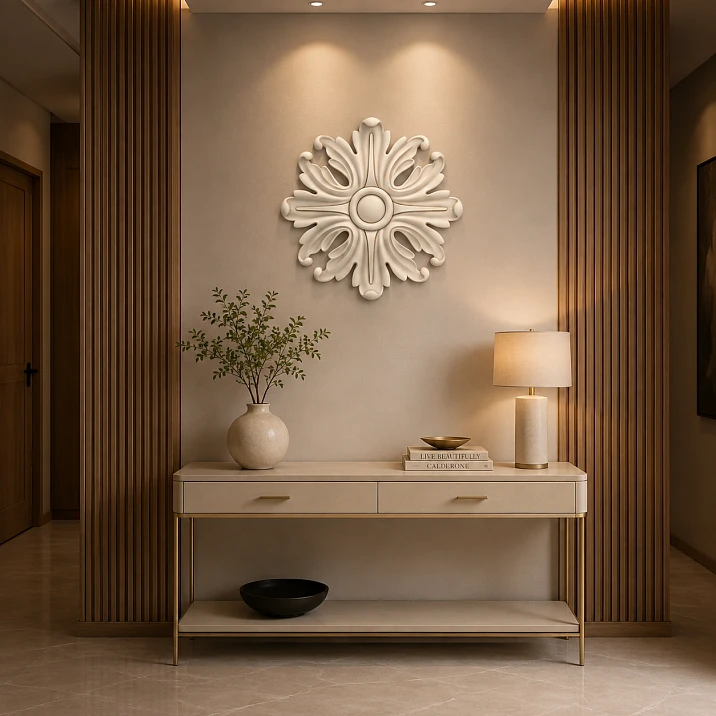
Between two sections of slatted panels in the hallway, there is a smooth painted field left, and a console stands beneath it. The wall is already assembled, the vertical rhythm of the slats is set, and the furniture is in place. Only one decision is missing: leave the smooth insert calm, place a single carved rosette RPU-046 on it, or turn the area into a classic panel with a molding frame.
This is not a question of "what is more beautiful in general." The buyer has two scenarios that differ in budget and visual impact. In the first, he buys one carved rosette RPU-046 made of polyurethane, sized 200 × 200 × 25 mm, for 8,110 ₽, and leaves the surrounding plane free. In the second, moldings, corner cuts, additional joints, and a larger frame geometry are added to the same rosette. A third option should also remain acceptable: if the slatted wall and console already create a rich composition, RPU-046 is not needed at all.
The main conclusion of the article can be stated right away. One RPU-046 works better than a frame where the smooth field itself is already a separate architectural insert between the slats and only needs a central accent. A molding frame is justified when the smooth field is too large for a single rosette, its boundaries visually blur, or the interior requires a more classic hierarchy.
But this decision cannot be made based only on a product photo. You need to measure the smooth insert, the position of the console, the free space on the sides of the rosette, and the height to nearby objects. Only after such a fitting does it make sense to buy the carved rosette RPU-046 made of polyurethane.
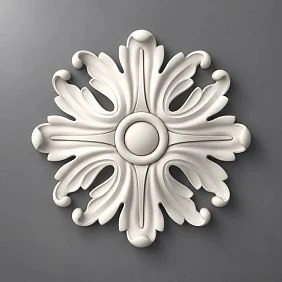
What exactly is being purchased: RPU-046 is a carved rosette, not an overlay or a molding
For this topic, terminology is crucial. RPU-046 is a carved round polyurethane rosette. It belongs to a separate category of STAVROS rosettes and has an overall area of 200 × 200 mm with the rosette itself being round, with a projection of 25 mm. There is no need to call it an "overlay RPU-046" just for the sake of text variety: it is a different type of product.
The current product card confirms the following data:
| Parameter | RPU-046 |
|---|---|
| Product type | Carved rosette |
| Material | Polyurethane |
| Size | 200 × 200 × 25 mm |
| Price | 8,110 ₽/pc. |
| Quantity in the base scenario | 1 pc. |
| Main task | central accent on the smooth field between slatted panels |
The 200 × 200 mm dimension is large enough to be perceived as an independent center, but this figure says nothing about how large the smooth insert itself should be. On a 350 × 400 mm field, the rosette will dominate. On a 1200 × 1800 mm field, it may look lonely. Therefore, the next task is not to discuss the material, but to compare the size of the rosette with the actual field above the console.




Why there is even a choice between a single rosette and a frame here
The smooth insert between the slats already has natural side boundaries. On the left and right, it is "held" by the slatted panels. That is why a molding frame is not automatically necessary here.
On a regular large smooth wall, molding helps create its own field: it outlines a rectangle, sets the scale, and gathers the center. In our case, part of this work has already been done by the slats. They have formed the side edges and highlighted the smooth area as an independent insert.
Hence the first important question:
Do we need to outline again what is already visually outlined by the slats?
If the answer is "no," one RPU-046 gets strong logic: the slats form the boundaries, the console provides the lower support of the composition, and the socket becomes the point in the center.
If the smooth area is too wide or too tall, the side slats are not enough. Then a single socket can get lost in the emptiness, and a molding frame will create additional internal scale and connect the center with the size of the wall.
That is, the frame is needed not because "sockets are customarily framed," but because a specific smooth field may lack architectural structure.
Our factory also produces:
First, measure not the RPU-046, but the smooth field itself
The buyer often starts with the product: 200 × 200 mm — meaning, they need to figure out where to place it. It is more useful to start from the opposite: measure the field and understand what role it can play at all.
Record four dimensions:
-
the width of the smooth insert between the inner edges of the slat panels;
-
the height of the available area above the console;
-
the width of the console itself;
-
distance from the console countertop to the top edge of the decorative zone.
Additionally, note:
-
mirror, if present;
-
wall sconce;
-
switches;
-
sockets;
-
intercom;
-
painting or lamp;
-
the top line of the console;
-
baseboard and floor geometry, if the composition is fully visible.
After this, the field transforms from an abstract 'empty wall' into a specific rectangle with constraints.
Get Consultation
A paper template 200 × 200 mm is the best way to understand if one RPU-046 is enough.
Before purchasing, cut out a 200 × 200 mm square from cardboard or thick paper. To check the overhang, you can additionally make a backing that simulates approximately 25 mm of depth.
The template should be secured with masking tape at the intended center of the smooth field and viewed from at least three points:
-
from the entrance to the hallway;
-
directly opposite the console;
-
at an angle from the adjacent room or hallway.
After that, do a second test: use the same tape to mark the intended frame around the outlet. It will immediately become clear whether the wall needs additional geometry.
This technique is more valuable than any words about style. On one wall, the frame will indeed "gather" the small central element. On another, it will add an extra rectangle between already active vertical slats and visually weigh down the entryway.
How to evaluate the free field around a large zone of 200 × 200 mm
It is impossible to derive a universal norm like "be sure to leave 150 mm on each side." Such a number does not exist for all interiors. But you can assess the relationship of the outlet to the field.
If the smooth insert has a width of W, then when centering the round RPU-046, the lateral free field will be:
(W − 200) / 2.
This is not a construction tolerance, but a compositional calculation.
For example:
| Width of the smooth field | Free on the left and right when centering RPU-046 |
| 400 мм | 100 мм |
| 500 мм | 150 мм |
| 600 мм | 200 мм |
| 800 мм | 300 мм |
| 1000 мм | 400 мм |
| 1200 мм | 500 мм |
This table does not automatically say that 600 mm is "correct" and 400 mm is "incorrect." It shows scale.
On a 400 mm field, the socket takes up half the width and becomes very active. At 600–800 mm, good air appears around it. At 1200 mm and more, the opposite question arises: is one 200 × 200 mm mounting zone too little for such a wide insert?
It is precisely in the latter case that the frame begins to make practical sense.
What matters more: the center of the smooth field or the axis of the console
This is one of the most useful questions in the article, because the two axes often do not coincide.
Let's imagine a smooth insert between rails 900 mm wide, and the console is 1000 mm and slightly offset due to a doorway. Where to place the RPU-046?
There are three possible anchor points:
By the center of the smooth field
This is the most architectural option. The socket supports the insert, and the console works as furniture in front of it. Suitable if the insert itself reads as the main field.
By the center of the console
Suitable when the console clearly dominates and the person perceives the wall as a composition of "furniture + decor above it." Then the outlet supports the furniture axis.
Along the overall visual axis of the composition
Sometimes the correct point is between the geometric center of the field and the center of the console. For example, a sconce or mirror is located on the right, visually weighing down one side. Here, the decision is made only on the full layout.
It is critically important not to mix these principles. If the outlet is installed "approximately in the center" without clear alignment, it looks random much faster than a molding frame.
When one RPU-046 truly looks complete without a frame
A standalone outlet is not a simplified version of a full classical composition. Under the right conditions, it is a separate, complete technique.
It works especially well when:
-
the smooth insert already has clear side boundaries thanks to slatted panels;
-
the console sets a clear lower axis;
-
the field is of moderate size;
-
there is no mirror or painting nearby that requires its own frames;
-
the socket is located in a calm center;
-
the interior combines a modern slatted texture with measured classical decor;
-
we want to preserve a large amount of free painted surface.
In this scenario, RPU-046 works almost like a medallion. It draws the eye but does not force the entire insert to become a classic paneled wall. This technique is especially convincing if a few objects are left on the console and no tall decor is placed directly under the socket: the center of the wall remains independent, and the furniture does not duplicate it in height. It is also useful to check the option with a completely empty countertop — if RPU-046 still looks complete, then its compositional role is truly independent.
It is here that a single socket can look more expensive than a frame: fewer details, fewer joints, more air, and a clearer hierarchy.
When a molding frame is truly needed
A frame makes sense if it solves a separate problem of the field, not just adds more decor.
The field is too wide for a single socket
On a smooth insert 1200–1600 mm wide, a 200 mm socket may be perceived as too small a point. The frame creates an intermediate scale between the socket and the entire wall.
The field is very high
If there is a large height left above the console to the ceiling, a single medallion sometimes "hangs" without support. A vertically elongated frame connects the center with the proportions of the wall.
The interior is clearly classic
If the hallway already has cornices, high baseboards, paneled doors, classic sconces, and other architectural lines, a single medallion without a frame may seem too modern in presentation. Then the molding supports the overall system.
Need to separate the inner panel from the slatted edges
Sometimes the slats are quite far away and do not give the smooth field a clear internal structure. The frame creates a "panel within the insert" and removes the feeling of an empty wall.
Need to connect the rosette with other stucco elements
If frames already run on adjacent walls, continuing the system in this area supports the unified language of the interior.
In all these cases, you can Buy polyurethane wall moldings after the size of the frame has been checked with a paper mock-up.
What to add to the cart: only RPU-046 or RPU-046 together with moldings
This is the main commercial H2 of the article.
Option 1. Only RPU-046
Purchase contents:
-
1 × RPU-046 200 × 200 × 25 mm;
-
necessary mounting and finishing materials according to the chosen technology.
The cost of the socket itself: 8,110 ₽.
This option makes sense if the smooth field is already architecturally formed by slats and a console.
Option 2. RPU-046 + frame
Here the cost depends on the chosen molding and frame dimensions. It is impossible to write one universal price in advance.
To understand the difference, let's take just an example, not a mandatory configuration: molding MLDPU-004 with dimensions 15 × 8 × 2600 mm at the current price of 3,190 ₽ per strip.
If a conditional frame has an external size of 900 × 1200 mm, its perimeter is:
2 × (900 + 1200) = 4200 mm.
With a strip length of 2600 mm, geometrically at least 2 strips will be required, giving a total of 5200 mm. The cost of two MLDPU-004:
2 × 3 190 = 6 380 ₽.
Together with one RPU-046:
8 110 + 6 380 = 14 490 ₽.
This is still without a separate calculation of mounting materials, trimming, and possible allowance. If a different molding or a different frame size is chosen, the budget will be different.
The point of the example is not that the frame necessarily costs 14,490 ₽. It shows a commercial fork: one rosette is one product item for 8,110 ₽; a frame composition already turns into a set where you need to separately calculate linear meters and cutting of the molding.
When one carved rosette between slatted panels looks more expensive than a complex stucco frame
The amount of decor and visual cost are different things.
One RPU-046 often looks stronger than a frame when the smooth insert is small and already highlighted by two slatted fields. In such a case, the slatted panels play the role of architectural side "wings," the console sets the horizontal, and the round rosette forms the single center.
If you add another frame, you get three levels of borders at once:
-
the outer edges of the slat panels;
-
the inner frame made of molding;
-
the RPU-046 itself.
In a small hallway, this multi-layering can look not richer, but finer. Especially if there are doorways, a mirror, a sconce, switches, and other details nearby.
One large carved center keeps the air. Light and shadow at a 25 mm projection give the rosette enough volume that it doesn't require additional framing just for visibility. This is especially important on a smooth insert, where the empty plane itself becomes part of the design. The more quality free space remains around the relief, the stronger the ornament itself is perceived, and the fewer reasons there are to add another contour just to fill the space.
25 mm projection: why RPU-046 should be checked not only from the front
Size C = 25 mm is an important part of the product. This is noticeable volume, especially on a smooth painted wall.
When viewed from the front, you see the overall template of 200 × 200 mm. At an angle, the depth starts to work. The rosette creates its own shadow and becomes more sculptural than a flat paper template.
Therefore, after checking the overall area of 200 × 200 mm, it is useful to make a second mockup with a conditional projection of 25 mm. There is no need to accurately reproduce the relief. It is enough to understand how far the element will protrude from the wall.
This is important in three cases:
-
the field is narrow and the viewer approaches it from the side;
-
there is a mirror, sconce, or shelf nearby;
-
the console is high, and the outlet ends up quite close to the countertop.
If the relief protrudes too noticeably in a cramped hallway, the frame won't solve the problem. It will add another layer. Then it's better to either leave just one RPU-046 or skip it altogether.
How the distance to the console changes the composition
The outlet shouldn't visually "sit" on the console. There needs to be air between the furniture and the decor.
If the console is high and the smooth field is small, the RPU-046 may end up squeezed between the countertop and the upper part of the wall. In that case, the frame usually only makes things worse because it requires even more free space.
If the console is low and there's a significant empty area above it, the frame, on the contrary, can help tie the medallion to the furniture.
The practical test is simple: mark the top line of the console on the wall with painter's tape if the furniture isn't in place yet, and attach the outlet template. See whether a separate free zone is readable between them.
If the outlet is perceived as a continuation of the items on the console, it is placed too low. If it seems detached from the furniture and hangs almost under the ceiling, it is too high.
What to do if a mirror is planned above the console
A mirror radically changes the conclusion.
If the mirror is large and occupies the center of a smooth field, RPU-046 can no longer be the sole central accent in the same place. Then there are several options:
-
abandon the outlet;
-
move it above the mirror, if space allows;
-
use it as part of a frame composition, but only if the mirror and molding are coordinated;
-
choose a different section of the wall.
The weakest option is to try to place the round RPU-046 in a random free corner next to the mirror. The outlet loses its central status and turns into a decorative addition.
If the mirror already exists, it usually sets the center of the composition. In that case, a frame made of moldings may be a more appropriate way to support the mirror, and RPU-046 may be redundant.
How to account for sconces and directional light
RPU-046 has a 25 mm overhang and relief, so light can significantly change its perception.
Side sconces create an asymmetric shadow. Two symmetrical sconces on the sides of the field can, on the contrary, emphasize the central rosette. Top directional light forms a shadow from below and enhances the sense of volume.
If two sconces are already nearby, a molding frame can become a third strong geometry. Then one rosette often looks cleaner.
If the lighting is weak and the smooth field is large, the frame helps to "read" the composition even without pronounced chiaroscuro.
That is, light affects not the possibility of installation, but the amount of necessary architectural graphics.
How to compare one rosette and a frame without buying moldings
You don't need to buy moldings for the test. Masking tape is enough.
Make two wall states.
Mockup A — only RPU-046
Attach the 200 × 200 mm dimensional template at the chosen point. Look at the composition during the day and in the evening.
Layout B — RPU-046 + frame
Around the square, apply thin masking tape along the intended frame contour. Don't try to pick the profile right away. It's important to first check the very fact that an inner rectangle appears.
After that, photograph both options from the same point. Comparing them in person one by one is harder: memory adapts quickly. Two photos side by side give a more honest answer.
If the frame immediately makes the field more cohesive, moldings make sense. If it only fragments the wall, a single RPU-046 is enough. It's useful to repeat the comparison the next day: after a few hours, the eye stops being attached to the first option you liked. If, upon re-evaluation, the single rosette still looks complete, there's no commercial reason to complicate the cart with moldings.
How the width of the smooth field affects the choice: an approximate table
The following table is not a standard. It's a design guideline for the first test of a round rosette 200 × 200 mm.
| Smooth insert width | What is most often worth checking first |
| up to 400 mm | usually too tight for a large center and frame |
| 450–600 mm | a single RPU-046 often works better than a frame |
| 650–900 mm | strong zone for comparison "one socket / light frame" |
| 900–1200 mm | the frame can help gather the field, but is not mandatory |
| over 1200 mm | one RPU-046 can get lost, a full layout is needed |
Why is there no hard answer? Because the field height and console width can completely change the conclusion. An insert 1200 mm wide and 600 mm high is one thing. The same width at a height of 2000 mm is quite another.
Therefore, the table is only needed to select the first layout.
The height of a smooth insert is sometimes more important than the width
If the field between the rails is narrow in width but very tall, a round socket may look small even with good side clearance.
Here, the molding frame gets a particularly clear function: it forms a vertical rectangle and connects a small socket to the wall height.
But there is an alternative path — place the RPU-046 closer to eye level and deliberately leave the top of the wall empty. This is a more modern technique that pairs well with rails.
To choose between the two approaches, mark not only the outline of the socket, but also a conditional horizontal line at its center level. See where this center is located relative to:
-
console;
-
door trims;
-
wall sconce;
-
the height of slatted panels;
-
the top line of the mirror, if there is one.
If the socket already falls on a clear architectural height, the frame may be unnecessary.
How to choose the frame size if it still feels empty without it
The frame cannot be built flush against the RPU-046. Otherwise, it looks like a random square framing of the product, rather than an independent panel.
First, determine the overall size of the future panel with painter's tape. Then check how much air remains between the socket and the frame.
It is more convenient to think not in universal millimeters, but in proportions:
-
The RPU-046 should read as the center;
-
frame — as the border of the field;
-
between them there should remain an independent painted plane.
If the gap disappears, the frame is too small. If the rosette gets lost inside a huge rectangle, the frame is too large.
Particularly careful work is needed on a narrow insert between the slats: the inner frame should not almost touch the slat boundaries themselves. Otherwise, you get a 'frame within a frame' effect without air between them.
What to buy if a frame is needed: first geometry, then a specific molding
You cannot start with the question 'which molding do I like.' First, set the frame size, and only then choose the profile.
For a small hallway, thin and medium moldings are usually more logical. A wide profile can visually approach the strength of the RPU-046 itself and create competition within the composition.
In the STAVROS catalog, there is a separate section where you can choose a polyurethane molding for the frame and compare profiles after the frame is approved.
If a very delicate line is needed, MLDPU-004 15 × 8 × 2600 mm can be considered as one of the possible options. But the article should not turn it into a mandatory pair for RPU-046: the specific profile depends on the style, the scale of the field, and the existing molding in the hallway.
Do I need to make the frame square because of the identical dimensions of RPU-046 200 × 200 mm?
No. This is another typical trap.
A round rosette does not require a square frame. On the contrary, above a console, a vertically elongated rectangle often works better because it connects the furniture with the wall height.
A square frame is appropriate if the smooth field itself is close to square and the console is quite wide. A vertical rectangle — if the field is tall. A horizontal one — if the console is long and the decorative zone is low.
The shape of the frame should follow the architecture of the insert, and RPU-046 remains the center inside it.
When the frame starts to argue with slat panels
Slats set vertical repeating lines. A molding frame adds four rigid edges, and RPU-046 adds a complex floral or carved center. That's already three different graphic languages.
A conflict arises when:
-
the frame is too close to the slats;
-
profile is too wide;
-
there is not enough air inside the frame;
-
there are still sconces on the sides;
-
the console has a complex facade;
-
the hallway is small and all elements are visible at once.
In this case, one socket often turns out to be a more mature solution: it does not compete with the slat rhythm, but contrasts with it as a single point.
When the molding frame, on the contrary, reconciles the slats and classic decor
There is also the opposite scenario. If the interior is clearly neoclassical, a single carved rosette between modern slats can look too lonely and "glued on."
In this case, the frame acts as an adapter between two languages:
-
the straight lines of the molding support the architecture of the slats;
-
central RPU-046 introduces a classic ornament;
-
the smooth plane between them creates a pause.
This option works especially well if the hallway already has classic doors, baseboards, ceiling cornices, or other molding elements.
That is, the frame is needed not for "richness," but for stylistic connection.
How color, console, and field fullness change the choice
The amount of decor is directly related to contrast.
RPU-046 in the color of the smooth insert
This is the most versatile option. The rosette is read through relief and shadow. In this execution, one detail is more often able to work without a frame.
Rosette a shade lighter or darker
Contrast increases, the center becomes stronger. The more noticeable the RPU-046, the less need for additional molding framing.
Contrast frame and contrast socket
For a narrow hallway, this is the riskiest scenario. Two levels of contrast plus slats quickly overload the wall.
Practical takeaway: if you want to keep only one RPU-046, painting it in the wall tone with expressive light-and-shadow is one of the safest ways to make it stand on its own.
How the console itself influences the choice between a single element and a frame
The console can be minimalist or decorative, and this changes the decision more than it seems.
Simple modern console
One RPU-046 provides a neat classic counterpoint. A frame may be redundant, especially next to slats.
Classic console with carved legs
The frame gains more justification: it supports the architectural language of the furniture.
Console with an active stone or bright texture
An additional molding can create too many competing materials. A single outlet works cleaner.
Narrow hanging console
If the furniture is visually light, a massive frame above it can outweigh the composition. A standalone RPU-046 is usually safer.
Therefore, the decision should not be based only on the wall. The console is part of the same visual cluster.
What happens if you leave the smooth field completely empty
An empty wall should not be considered a losing option.
If the slats on the sides already create a strong composition, and the console has a mirror, lights, or items on top, the smooth field can serve as a pause. An additional RPU-046 in this case does not enhance the interior but deprives it of air.
Avoiding the outlet is especially justified if:
-
the field is narrow;
-
a mirror already hangs above the console;
-
there are sconces on the sides;
-
the slats are very contrasting;
-
the console itself is decorative;
-
the hallway is small and full of doors.
Then the correct basket is 0 × RPU-046, rather than an attempt to necessarily use a product you like.
Matte and semi-gloss paint: how the finish changes the need for a frame
Even with the same geometry, the same RPU-046 is perceived differently depending on the finish. On a matte wall, the relief is read mainly through natural shadow, so a standalone rosette looks calmer and more often withstands proximity to active slats without an additional frame. On a semi-gloss or more reflective surface, highlights enhance the edges of the relief and make the central element more noticeable.
If the frame itself is also painted in the same semi-gloss tone, the amount of graphics will increase even more. For a small hallway, this is an argument to first check the option with only RPU-046. In a very large field, on the contrary, a matte monochrome surface can visually "absorb" a small rosette — then a light molding contour helps organize the space.
The finish does not provide a universal answer, but it changes the strength of each element. Therefore, the final layout should be viewed under the lighting and approximately the degree of gloss that will be present after renovation, not just on a white paper template.
Practical algorithm before purchasing RPU-046
Step 1. Measure the smooth field
Record the width and height of the available area between the rails.
Step 2. Fix the console axis
Mark it with painter's tape or a laser.
Step 3. Make a 200 × 200 mm template
Attach it at the intended center.
Step 4. Check the 25 mm overhang
Make a conditional volumetric pad and look from the side.
Step 5. Take a photo of the version without a frame
This will be the control version A.
Start not with the profile, but with the external geometry.
Start not with the profile, but with the external geometry.
Step 7. Photograph the version with the frame
This is option B.
Step 8. Compare both photos from the entry point
Do not evaluate only close to the wall.
Step 9. Count the basket
If one socket wins — you buy 1 × RPU-046. If the frame — you calculate moldings around the perimeter separately. If both options overload the wall — you do not buy decor.
Three scenarios that give different commercial decisions
Scenario 1. Field 600–700 mm wide, narrow console, active slats on the sides
The 200 × 200 mm footprint gets enough air, and the side boundaries are already formed by panels.
Solution: most often, buy only 1 × RPU-046 for 8,110 ₽. The frame here easily becomes redundant.
Scenario 2. A field of about 1000–1200 mm and a tall free zone
A single outlet starts to look small relative to the entire insert. A painter's frame makes the composition more cohesive.
Solution: consider RPU-046 with moldings, but only after calculating the specific perimeter and profile.
Scenario 3. A narrow hallway with a mirror, sconce, and decorative console
Even a single RPU-046 becomes another focal point among several existing ones.
Solution: 0 × RPU-046; keep the smooth field or use another, calmer approach.
These scenarios differ not in size for the sake of size, but in the final purchase. That's why they don't need to be expanded with ten similar examples with fields of 650, 700, and 750 mm: such a series wouldn't add new knowledge. For a real decision, it's more important to understand which variable changes—the scale of the field, the saturation of the surroundings, or the need for an architectural boundary.
What mistakes are most often made in such a composition
Mistake 1. Thinking that a socket necessarily needs a frame
Why it happens: classic interiors often show a medallion inside a molding panel.
Consequence: the small field between the rails becomes overloaded.
How to check: compare two full-size mockups.
How to avoid: perceive RPU-046 as an independent center, and the frame only as an additional tool.
Mistake 2. Placing the socket in the center of the wall, ignoring the console
Why it happens: the geometric center is easy to measure.
Consequence: the decor and furniture live on different axes.
How to check: draw a vertical axis of the console.
How to avoid: choose in advance which object is the main one — the field or the furniture.
Error 3. Ignoring the 25 mm depth size
Why it occurs: on the card, attention is focused on 200 × 200 mm.
Consequence: the relief turns out to be too active on the side or near the sconce.
How to check: make a three-dimensional mockup.
How to avoid: evaluate RPU-046 not only from the front.
Error 4. Counting the frame without cutting the molding
Why it occurs: the user sees only the perimeter of the rectangle.
Consequence: the actual cart differs from the expected one due to the length of the strips and trims.
How to check: divide the perimeter by the length of the specific selected molding and round the quantity up.
How to avoid: calculate after selecting the profile.
Error 5. Making the frame too close to the rails
Why it happens: you want to use the full width of the smooth insert.
Consequence: the molding and rails form several almost parallel borders and start to conflict.
How to check: photograph the composition from a distance.
How to avoid: leave an independent smooth field between the frame and the rails.
Alternatives and next step in the catalog if RPU-046 is not suitable
If after the template it becomes clear that the overall template 200 × 200 mm is too large, too small, or does not fit the ornament, you don't need to force this SKU to work at any cost. There is a separate section on the website where you can buy polyurethane rosettes and compare other options.
This is the logical user path:
-
first, the specific RPU-046;
-
then the socket category, if the scale did not fit;
-
then the general catalog, if you need to change the type of decor.
If you want to expand the search beyond sockets, you can You can buy ready-made stucco matching the Baroque style. Calculate the quantity: linear meters of cornices and moldings, number of rosettes, pilasters, consoles, corner elements. Add a ten to fifteen percent allowance for trimming. in the general catalog. It also makes sense there ordering polyurethane molding decor after it has become clear whether the wall needs a medallion, a molding system, or another type of product.
How to connect the choice with slat panels without turning the topic into an article about panels
Slats here are an important context, but not the main product. The article should not retell the types of wall panels, their installation, or materials. For this, STAVROS already has a separate catalog and general articles.
But the user journey should remain coherent. If a person is still finishing the wall or planning a neighboring area, it is appropriate to provide a transition buy slat panels for walls for interior finishing.
For a more general understanding of combining the two systems, the STAVROS informational article is also useful “Slat panels and moldings on the wall: how to create a beautiful accent composition”. If the project is not yet completed and you need to continue the lamella finishing in a neighboring area, this same section allows Buy slatted panels for wall finishing without mixing commercial and informational intent.
It solves a broad problem. Our article remains narrow: a specific RPU-046 and a specific fork "one center or a framed panel".
Should the frame be tied to the width of the console
Yes, but not mechanically.
The frame can be:
-
already the console;
-
approximately equal to its visual width;
-
slightly wider than the console.
Each option gives a different impression.
If the frame is much narrower than the console, the top composition looks small relative to the furniture. If noticeably wider, the field begins to dominate the console. If the sizes are close, a more traditional "furniture + panel" pairing results.
But slat panels add an additional boundary. Therefore, the frame should not expand just to match a wide console if it almost touches the slats in doing so.
For RPU-046 without a frame, connection with the console is simpler: a convincing common axis and a normal vertical distance are enough. If the console is noticeably wider than the smooth insert, it is especially important not to mechanically stretch the frame to the width of the furniture: it should remain part of the wall, not an imitation of a wall-mounted continuation of the countertop. In this case, a single center often handles the difference in widths more easily.
Additional space checks: distance and asymmetry
The size of 200 × 200 mm cannot be assessed only by the wall itself. The hallway is a space where a person rarely stands strictly opposite the decorative field for a long time. More often, they enter, walk past, turn toward the door, take off outerwear, or look at the composition from an adjacent corridor. Therefore, distance and viewing angle significantly influence the decision between a single outlet
What to do if the smooth field between the slats is asymmetrical
The ideal scheme of "slats on the left — smooth center — slats on the right" is not always found. On one side there may be a doorway, on the other — a wider section of slatted finish; the console may be shifted due to a switch, radiator, or passage. In such a case, the molding frame and a single outlet behave differently.
The frame enhances geometry. If the insert itself is asymmetrical, the rectangle of molding makes the viewer compare distances to the slats and neighboring boundaries even more carefully. A small difference that was almost unnoticeable without a frame may become noticeable after a clear outline appears.
A single RPU-046 is less demanding on external edges. It still needs a clear axis, but this axis can be related to the console, not to the geometric center of the entire wall. Therefore, in a complex asymmetrical hallway, a single medallion often works more calmly.
Before purchasing, it is useful to mark three vertical lines with painter's tape:
-
geometric center of the smooth field;
-
center of the console;
-
the intended axis of RPU-046.
If all three nearly coincide, the frame gets more freedom. If they noticeably diverge, first check the single socket. It happens that a slight shift of RPU-046 relative to the center of the wall looks natural due to furniture, whereas a rectangular frame immediately makes this asymmetry rigid and "designed."
If none of the axes looks convincing, there is no need to save the situation with the amount of molding. Probably, the smooth field is better left without central decor, or the entire composition should be reassembled relative to the furniture.
Installation complexity: one socket and a frame are solutions with different labor intensity
The difference between the two options does not end with the price of the product. They have different installation logic.
For a DIY RPU-046, the main thing is to accurately find the center, prepare the base, correctly glue the product, and perform the finishing. A positioning error is noticeable, but the operation itself is local: one element, one installation zone, minimal joints.
The molding frame adds a whole set of operations:
-
marking out the four sides;
-
checking horizontals and verticals;
-
corner cuts;
-
joining the profiles;
-
checking identical indents;
-
seam treatment;
-
painting of long linear elements;
-
additional check of how the frame relates to the slats and the console.
On a smooth field between the slats, even a small angle error becomes noticeable because there is already a perfect vertical rhythm of panels nearby. The slatted surface actually works as a "ruler" against which the eye compares the molding.
Therefore, a frame makes sense only when its compositional benefit justifies the increased complexity. If two photos — with and without the frame — give almost the same impression, it is simpler and more rational to leave one RPU-046.
This criterion is especially important when the renovation is already finished. On a finished painted wall, one socket requires less intervention, whereas a frame forces marking and installing several long elements on the finish surface.
Base and finish coating: why a frame requires greater surface precision
On a finished wall between slatted panels, the base is usually already painted, so decorative installation starts not from bare plaster but from a finished plane. Before installation, you need to check for any local waviness, peeling paint, noticeable orange peel, or a transition at the boundary of the smooth field. For a single RPU-046, small defects are easier to detect and locally fix within a 200 × 200 mm area. A frame requires even geometry over a significantly larger area.
Long verticals are especially sensitive. If the wall has even a slight visual wave, the molding can emphasize it. The slatted panels on the sides make this effect more noticeable: their rhythm already gives the eye a very precise vertical grid. Therefore, before purchasing moldings, it is worth applying a long straightedge or laser-checking the lines of the future frame.
The finishing paint also differs in labor intensity. One rosette can be painted together with the wall or separately accent the relief. In a frame system, four sides, corners, joints, and the central RPU-046 need to be treated equally. If a single color is planned, all transitions should look like one architectural system. If contrasting, errors in joints and geometry become even more noticeable.
This criterion rarely decides the choice alone, but is useful in a borderline situation. If the frame provides only a weak visual improvement, and the base requires additional preparation over a large area, a single RPU-046 may be not only cleaner in composition, but also more rational in terms of work volume.
Maintainability and repainting: which option is easier to maintain after several years
The hallway is an area of active use. Traces from clothing, bags, dust, accidental touches appear here more often, and walls are periodically touched up. Therefore, the decorative solution should be evaluated not only at the moment of installation.
A single RPU-046 creates a local relief object. If the wall needs to be refreshed, it is easier to work with a brush around one element or carefully repaint the entire insert. The decor itself can be left in the tone of the wall or highlighted separately.
The frame increases the number of internal and external corners. When repainting, you need to carefully go along the long profile, watch the shadow lines, and with local damage to one section, a more noticeable restoration may be required.
This does not mean that moldings are impractical. If the frame is an important part of the architecture, additional care is justified. But if it is added only because "one rosette seems too simple," the operational complexity becomes another argument in favor of the minimal option.
For the hallway, it is useful to ask the question:
If in three years I want to repaint the smooth insert, which option will be easier to refresh without feeling like I have to restore an entire panel?
If the answer is a single RPU-046, this is a real practical plus, not just an aesthetic preference.
How to connect RPU-046 with door trims, baseboards, and other hallway lines
A hallway rarely consists only of slats, a console, and one smooth insert. Doors, trims, baseboards, ceiling cornices, mirrors, or wardrobes almost always come into view. All these elements already create architectural lines.
If there is a developed classical system around — wide trims, profiled baseboards, ceiling cornices, paneled doors — the frame around RPU-046 gains additional logic. It becomes part of the overall interior language, not a separate rectangle for the sake of one medallion.
If the other lines are maximally minimalist, and the main texture is modern slats, a single rosette often works better. It provides a classical accent without trying to turn the entire hallway into a system of wall panels.
It is useful to do a simple visual audit. Stand at the entry point and count how many rectangular frames are already visible simultaneously:
-
door leaves;
-
trim;
-
mirror;
-
wardrobe facades;
-
console contours;
-
slat boundaries.
If there are already many rectangles, another molding frame may become a repetition of obvious geometry. Then the circular or round carved center of RPU-046 without a frame will create a more useful contrast.
If, on the contrary, the interior lacks a unifying classical line, the frame can combine the RPU-046 with the trim and baseboard into one architectural system.
How to choose between "one socket" and "panel" in one evening without buying materials
To avoid making a decision from memory or from individual references, you can set up a full home test.
First, completely clear the console. Remove vases, key holders, candles, and other small decor. The wall should be evaluated without visual noise.
Then:
-
attach the RPU-046 template 200 × 200 mm;
-
photograph the wall during the day;
-
turn on the usual evening light and take a second photo;
-
add a frame with painter's tape;
-
repeat both photographs;
-
return the items to the console and compare the options again.
Why is it important to first remove items and then put them back? Because a frame can look good on a "sterile" wall and turn out to be unnecessary after a lamp, tray, vase, or mirror appears on the console.
In the end, you will have not an abstract feeling, but four states:
-
RPU-046 without a frame, empty console;
-
RPU-046 with a frame, empty console;
-
RPU-046 without a frame, real contents;
-
RPU-046 with a frame, real contents.
The option that remains cohesive in all working states of the hallway wins, not just in a pretty shot without household items.
Decision tree: one RPU-046, RPU-046 + moldings, or nothing
| Check | Result | Next step |
| The field is moderate, the slats already set boundaries | one outlet looks complete | buy 1 × RPU-046 |
| The field is large and empty | the socket is lost | make a frame mockup |
| The frame collects the field | the needed architecture appears | calculate a specific molding |
| The frame divides the wall | the composition becomes heavier | leave only RPU-046 |
| Even a single socket overloads the node | too many centers | give up the decor |
| RPU-046 is not suitable in scale | the problem is not in the frame | go to the socket category |
Such a tree allows making a decision without the universal formula "molding is always needed."
What is more profitable — one RPU-046 or a frame: you need to count not only rubles
Obviously, one socket requires fewer product items. But the word "more profitable" has two meanings here.
Monetary benefit
1 × RPU-046 = 8 110 ₽.
The frame adds the cost of molding and related operations. In the example above with two MLDPU-004 strips, the total cost of just the socket and molding was 14,490 ₽.
Compositional benefit
If the frame truly solves the problem of a large field, the extra expense is justified. If it doesn't produce a new result, the buyer pays more for a more cluttered wall.
Therefore, the right question is not "what's cheaper," but:
What does the frame add to the already formed field between the strips?
If the answer is specific — scale, boundaries, connection to a classic interior — purchasing moldings makes sense. If the answer is just "it will look richer," it's better to leave a single socket.
When to order only one RPU-046
The final positive scenario for a standalone socket can be formulated very clearly.
Buy 1 × RPU-046 if:
-
the smooth field between the strips already reads as an independent insert;
-
The 200 × 200 mm dimensional template has enough air around it;
-
The socket axis is aligned with the console or field;
-
The 25 mm protrusion does not conflict with neighboring objects;
-
There is no large mirror that has already become the center;
-
The frame according to the layout looks redundant;
-
The slat wall is quite active and requires a restrained classical accent.
After this check, you can Order carved rosette RPU-046 Without mandatory purchase of moldings.
When to order RPU-046 together with moldings
A frame composition is justified if:
-
the field is too large for a single socket with a 200 × 200 mm footprint;
-
the walls are high and a socket without a frame is visually lost;
-
the interior already has a molding system;
-
the frame connects the RPU-046 with a console or other elements;
-
a sufficient smooth pause remains between the frame and the slats;
-
the budget is calculated based on a specific profile and plank lengths;
-
the painted mockup objectively looks stronger than the version without a frame.
Then moldings are not an additional product for the sake of the average check, but a real architectural tool.
When not to buy the RPU-046 at all
It is better to refuse the purchase if:
-
the field is already occupied by a mirror;
-
sconce, console, and slats create enough accents;
-
the smooth insert is too narrow for a socket with dimensions 200 × 200 mm;
-
the socket looks small and lost, but the frame only complicates the wall;
-
a depth of 25 mm is too active for a cramped hallway;
-
the interior is deliberately minimalist;
-
neither the axis of the field nor the axis of the console provides a convincing place for the center.
In such a situation, an empty smooth surface can be more valuable than another decorative object.
Conclusion: the frame is needed not for the socket, but only for the wall that lacks a frame
RPU-046 200 × 200 × 25 mm — a standalone carved socket made of polyurethane costing 8,110 ₽. On the smooth field between the slatted panels, it can work perfectly without moldings, because the side boundaries of the composition are already set by the slats, and the console provides the lower support.
Therefore, the base scenario should start with a single RPU-046. Make a full-size template 200 × 200 mm, check the axis relative to the console, evaluate the 25 mm overhang, and photograph the wall from the usual entry point.
Only if on such a mockup the socket looks too small and the smooth insert seems unfinished and blurry, does it make sense to add a second test: a frame made of painter's tape. If the frame really gathers the field, proceed to choosing a specific molding and calculate it based on the actual perimeter.
If the frame merely adds another rectangle between already active battens, there is no need to buy it. In that case, a single RPU-046 looks cleaner, calmer, and often more expensive in perception.
And if even one socket turns out to be superfluous, the correct basket is zero. A commercially strong article should be able to lead to such a decision as well.
FAQ
Can RPU-046 be placed above a small bench instead of a console?
Yes, if the bench sets a clear lower axis and a separate smooth field remains on the wall. But the composition will be lighter than with a console, so the frame should be checked especially carefully: it may turn out to be visually heavier than the furniture.
What to do if there is a switch or an intercom inside the smooth insert?
First, include the device in the full-size wall mockup. If it falls within the intended panel, the rectangular frame may emphasize the asymmetry more strongly. Sometimes a single RPU-046, offset along a clear console axis, works more calmly; sometimes it is better to exclude the decor entirely.
Can the frame be open, for example U-shaped, rather than closed?
Such a technique is possible as a separate design scheme, but it is no longer an ordinary frame around RPU-046. It needs to be mocked up separately and checked where the moldings logically end relative to the console, battens, and other lines of the hallway.
Is a second RPU-046 needed on the opposite hallway wall for symmetry?
Not necessarily. Symmetry between different walls is only needed if the walls themselves form a paired composition. Buying a second outlet just for the sake of quantity is not worth it: first check whether the opposite surface has its own center and a similar role.
Can RPU-046 be used if the smooth field is covered with wallpaper rather than painted?
Compositionally, yes, but the wallpaper pattern should be evaluated together with the relief. An active pattern can compete with the carved rosette more strongly than a plain painted surface. The mounting compatibility of the specific covering and adhesive system should be checked separately.
What to do if the console is later planned to be replaced with a wider one?
Do not tie the center only to the current piece of furniture. If the replacement is already planned, mock up the future console width and check the RPU-046 against it. This is especially important for the frame: its dimensions visually "survive" a significant furniture change with more difficulty.
Should the RPU-046 ornament be repeated on doors or cabinet fronts in the same hallway?
No. One medallion can be the only carved accent. Repetition on furniture makes sense only as part of a general decorative system; mechanical duplication of the same motif easily makes a small hallway feel overloaded.
How to send a clear mockup to a designer or client before purchasing?
Take a frontal photo of the wall with a tape measure or control dimension, then two versions with painter's tape: only the overall template 200 × 200 mm and the rosette within the 200 × 200 mm footprint inside the frame. Add dimensions of the smooth field and the console. This set allows discussing specific geometry rather than abstract "like / dislike".
Does it make sense to buy RPU-046 in advance if the console hasn't been chosen yet?
Only if the smooth insert itself has a clear center and the socket is tied specifically to the wall architecture. If the whole composition is built around the furniture, it's better to first determine the console or at least its future dimensions, and then confirm the position of RPU-046.