Article Contents:
- L-032 turned out to be longer: what to do before the first cut
- What mounting height is actually needed
- How deep does the baluster go in at the top and bottom
- Where does the carved basket begin
- On which side is adjustment even allowed
- Do all balusters require the same reduction
- The basket should be on one line
- A large pattern cannot be hidden by editing
- The visible height of the basket is more important than the total figure
- Distance between clean support planes
- Upper seating depth
- Lower seating depth
- Handrail angle
- Thickness of the under-rail strip
- Finish coatings
- Example only for understanding the method
- On a flight, the height changes according to geometry
- Edge elements work differently
- Landing and flight cannot be mixed
- Steps may have slight differences
- The carved basket must match
- What limits the bottom part
- What limits the top part
- Combined processing is possible
- Sometimes the right answer is to choose a different model
- What dimensions are needed
- What information might be missing
- The drawing is shared with all participants
- Rectangular batten
- Full-size contour
- Number of each item
- Control of the first L-032
- Bottom line of acanthus baskets
- Top line of baskets
- Start of flutes
- End of flutes
- Visible length of straight sections
- Flight balusters
- Landing balusters
- You cannot swap groups
- Example of calculation structure
- Do I need a spare baluster
- Beech L-032 under enamel
- Oak L-032 under transparent or tinting finish
- One wood species for the entire fence
- When surface preparation is especially important
- Trimming creates a new surface
- The cart requires special attention
- One batch — one finishing cycle
- What to request regarding the handrail
- Replacing the handrail changes the calculation
- Stringer board
- Post L-069
- Why the post affects baluster trimming
- One material and one finish
- Simple turned model
- L-032
- What to look at in the product card
- A photo without an article number is not enough
- Size does not replace the pattern
- Mistake 1. Treating all 1000 mm as free length
- Mistake 2. Measuring the distance to the top surface of the handrail
- Mistake 3. Not accounting for the top seating
- Mistake 4. Not accounting for the bottom seating
- Mistake 5. Cutting based on a photo
- Mistake 6. Assigning trimming only from the top
- Mistake 7. Assigning trimming only from the bottom
- Mistake 8. Automatically splitting the trimming in half
- Mistake 9. Removing 50 mm from the entire batch before fitting
- Error 10. Using the first step as a reference for the entire flight
- Error 11. Mixing flight and landing parts
- Error 12. Not accounting for the handrail angle
- Error 13. Cutting first, then choosing the handrail
- Error 14. Forgetting the handrail support strip
- Error 15. Assuming L-032 fits any handrail
- Error 16. Cutting the acanthus basket and hiding it with the fit
- Error 17. Installing baskets at different heights
- Error 18. Not controlling the start of the flutes
- Error 19. Adjusting each baluster only by eye
- Error 20. Do not mark positions
- Error 21. Trim already painted L-032 without protection
- Error 22. Leave the new end without coating
- Error 23. Try to hide the defect with a thick layer of enamel
- Error 24. Fill the acanthus recesses
- Error 25. Order half of the batch from beech, half from oak
- Error 26. Order different sanding options in one row
- Error 27. Do not order a control part
- Error 28. Do not account for reserve at the remote site
- Error 29. Buy posts later
- Error 30. Select a column only by photo
- Error 31. Order the finial before selecting the column
- Error 32. Not verifying the production time
- Error 33. Not checking the condition of parts upon receipt
- Error 34. Considering a trimmed baluster as returnable
- Error 35. Buying L-032 when the mounting height is too small
- Error 36. Not showing the carved basket in the visualization
- Error 37. Reducing only the end balusters
- Error 38. Using different measurement bases
- Error 39. Not checking the finished level of the steps
- Error 40. Start installation without final acceptance of templates
- SKU
- Size
- Wood species
- Sanding
- Preparation for enamel
- Carving
- Quantity
- Marking
- Final length
- Processing side
- Cart
- Reeding
- End face
- Angle
- Position in row
- Labeling
- Open the product card
- Compare other models
- Choose a style
- Assemble the set
- Get the drawing
- Create a control template
- Approve the finish
- Arrange delivery
- Can L-032 be shortened?
- Can 20 mm be removed?
- Can 50 mm be removed?
- Can L-032 be shortened by 100 mm?
- Which side should L-032 be cut from?
- Why can't it simply be cut from the top?
- Why can't it simply be cut from the bottom?
- Can part be removed from both the top and bottom?
- Where is the carved basket?
- What does the ornament consist of?
- Does L-032 have flutes?
- What is the full size of the baluster?
- Is there a shorter L-032?
- What wood is L-032 made from?
- Can I order a beech L-032 for enamel?
- Can the oak L-032 be tinted?
- What is the difference between "Standard" and "Prestige"?
- Do I need to choose the sanding quality before ordering?
- Can the quality be changed after production?
- How do I find out the allowable trimming?
- What dimensions are needed from the staircase?
- Do I need to account for the handrail support strip?
- Does the handrail affect the length of L-032?
- Can I choose the handrail after trimming the balusters?
- Can I use one template for both the flight and the landing?
- Do I need to trim each baluster individually?
- Why do all baskets need to be at the same height?
- Can I trim an already painted L-032?
- What happens to the enamel when cutting?
- Do I need to paint the new cut end?
- Can I hide an uneven cut in the groove?
- How do I prepare a control piece?
- Do I need a spare baluster?
- How many L-032 should I order?
- Can balusters be ordered in stages?
- Is it necessary to mark L-032?
- How to mark the parts?
- Can trimmed balusters be swapped?
- What to check upon receipt?
- Is the mounting hardware included in the set?
- What fasteners should be used?
- Is L-032 suitable for an inclined flight?
- Is L-032 suitable for a horizontal balustrade?
- Can L-032 be used in two different sections?
- How to choose a post for L-032?
- Is L-069 suitable?
- Is a finial needed?
- Is L-007 suitable?
- Where can I see other finials?
- How to keep the same shade?
- Can beech and oak be mixed under enamel?
- Can beech and oak be mixed under a transparent coating?
- How to avoid filling flutes with enamel?
- How to process the acanthus basket?
- What is the production time for L-032?
- Can I order one L-032 as a sample?
- Where can I see the current price?
- How to place an order in one line?
- What should I write to the manager?
- What should I ask the designer?
- What should I ask the installer?
- What should I ask the painter?
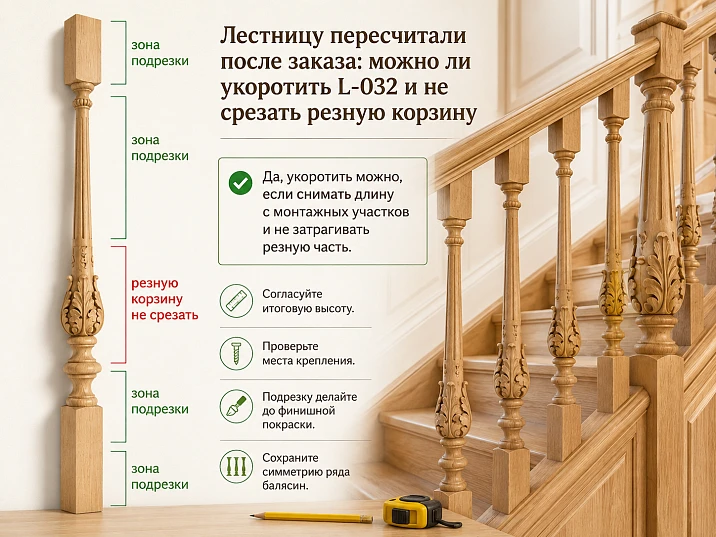
The project is already approved, the balusters are selected, the handrail is ordered. Then, on site, the step height was clarified, the position of the under-rail strip was changed, or the upper railing assembly was recalculated. Instead of the planned 1000 mm between support surfaces, less remains. The installer looks at L-032 and offers a simple solution: "We'll cut off the excess on site."
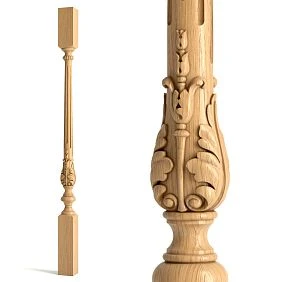
On a regular straight post, such a phrase would sound like a routine operation. For L-032, it turns into a serious issue. The baluster has a fixed size of 1000 × 60 mm, vertical flutes, and a large carved basket of acanthus leaves near the base. If you cut without a drawing, you can not only damage the ornament but also disrupt the proportions of the entire part: the basket will rise relative to the step, the flutes will become shorter, and the decorative pattern of adjacent balusters will no longer match.
Therefore, the answer to whether L-032 can be shortened is not simply "yes" or "no." Trimming is possible only after checking the actual mounting height, upper and lower sections, seating depth, handrail profile, under-rail strip, and the current drawing. Without this data, it cannot be stated in advance that removing 20, 50, or 100 mm is acceptable. Nor can a single universal cutting side be assigned.
If you plan to buy wooden baluster L-032, first measure not the baluster itself, but the space in which it will work. You need to measure the distance between the actual support surfaces, taking into account the seating, the slope of the flight, and the upper railing structure.
The main rule for the entire article:
1000 mm is the full size of the product, not a confirmed allowance for free trimming.
L-032 turned out to be longer: what to do before the first cut
Let's imagine a typical situation. The project specified a baluster height of 1000 mm. After the final installation of the steps and handrail, it turned out that the actual distance is smaller. The difference seems small, so they want to make a decision right on site.
Before turning on the saw, you need to stop and get answers to five questions.




What mounting height is actually needed
It is not the conditional height of the railing that is measured, but the distance between the surfaces into which the specific L-032 fits.
The lower base can be:
-
step;
-
string;
-
stringer plank;
-
balustrade board;
-
other support surface specified by the project.
The upper base may be:
-
lower side of the handrail;
-
handrail support plank;
-
groove;
-
intermediate element;
-
another part of a specific system.
If you measure the distance to the top plane of the handrail, but the baluster rests against its lower part, the calculation will be erroneous.
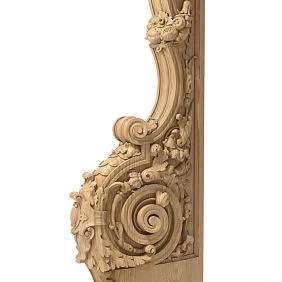
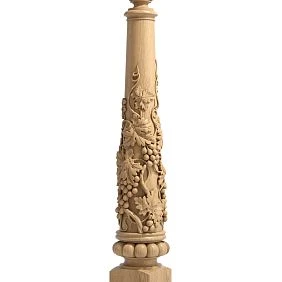
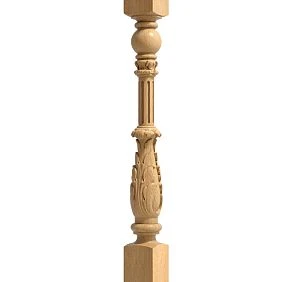
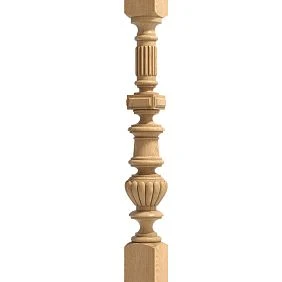
Our factory also produces:
How deeply the baluster goes in from the top and bottom
The visible height and the full size of the part are different values. Part L-032 may fit into a mounting node. The depth depends on the staircase design and should not be assigned based on a photograph.
A conditional calculation looks like this:
Required baluster length = distance between support planes + upper seating depth + lower seating depth.
The formula shows the principle but does not assign the depth. Values are taken from the project.
Get Consultation
Where the carved basket begins
For L-032, the decorative acanthus is located near the base. The external photograph helps understand the nature of the pattern but does not provide the exact coordinate of the carving boundary.
To solve this, a dimensional drawing is needed. It should show:
-
lower straight section;
-
start of acanthus leaves;
-
full height of the basket;
-
transition to flutes;
-
upper straight section;
-
mounting zones.
Which side is generally acceptable for fitting
You cannot write in advance: "cut only from the top" or "cut only from the bottom." Each side has its own role.
The lower part is connected to the acanthus basket and seating into the base. The upper part is connected to the flutes, handrail, and mounting method. Trimming either side can disrupt either the decorative or mounting logic.
Do all balusters require the same reduction
On a straight platform, the distance can be the same. On an inclined flight, the upper ends work at an angle, and the actual fitting depends on the position of each post.
If you cut the entire batch to one size before marking the flight, some parts may end up shorter than required.
Confirmed characteristics L-032
| Parameter | Confirmed information | What this means before trimming |
|---|---|---|
| Article number | L-032 | The exact model must be specified in the order and drawings |
| Product type | Wooden carved baluster | The part is part of the stair railing |
| Full size | 1000 × 60 mm | 1000 mm cannot be considered free installation allowance |
| Material | Beech or oak | The wood species affects the finish and matching of other elements |
| Sanding | "Standard" or "Prestige" | The option is chosen before finishing the entire batch |
| Primer for enamel | Available for beech execution | Conditions and type of training are checked in the card |
| Ornament | Carved basket of acanthus leaves at the base | Bottom trimming requires special checking |
| Vertical decor | Flutes | Top trimming can change their length |
| Size range | One size confirmed | For lower mounting height, approval is required |
| Made to order | Average time is specified as 5–10 days | Current batch time is checked when placing an order |
| Allowable trim value | Not published in the card | Cannot be assigned without a drawing |
| Upper mounting zone length | Not published separately | Technical diagram required |
| Lower mounting zone length | Not published separately | Technical diagram required |
| Mounting method | Depends on the stair assembly | It is approved by the stair manufacturer |
| Handrail | Selected separately | The profile affects the height and top adjustment |
The table provides source data but does not answer the main question with a number. This is fundamental: if the permissible trimming is not published, it cannot be invented for the convenience of installation.
Why the carved basket changes the entire calculation
L-032 is not a cylindrical blank with uniform geometry along its entire height. Its pattern develops from bottom to top.
Near the base there is a voluminous basket of acanthus leaves. Above it begins a more elongated section with flutes. The upper zone connects the baluster to the handrail or the sub-rail strip.
If material is removed from the bottom, the basket may:
-
move closer to the step;
-
partially enter the seating zone;
-
lose its lower framing;
-
appear visually pressed against the base;
-
differ in height from adjacent parts;
-
lose part of the carved contour.
If material is removed from the top, other consequences are possible:
-
the flutes will become shorter;
-
the upper straight section will decrease;
-
the mounting will move closer to the decorative zone;
-
the distance between the carving and the handrail will change;
-
the overall vertical rhythm will be disrupted.
In both cases, the drawing is analyzed first.
The basket should be on the same line
On a stair flight, balusters follow the inclined handrail, but acanthus baskets are usually meant to be perceived as an orderly decorative band. If each post is cut from an arbitrary side, the baskets will end up at different heights.
The eye notices this faster than the difference in total length. The ornament forms a repeating line, and any offset looks like an assembly error.
A large ornament cannot be hidden by assembly.
Sometimes a damaged straight section can be partially covered with a groove or a strip. A carved basket is harder to hide. It is the central feature of L-032.
The buyer chooses this model specifically for the acanthus decor. Cutting it off and then trying to mask the change means depriving the product of its main advantage.
The visible height of the basket is more important than the total figure
Two balusters may have the same final length of 950 mm, but look different:
-
the first has 50 mm removed from the top;
-
the second — from the bottom.
The total height matches, but the position of the ornament does not. Therefore, the specification records not only the length after processing, but also the base from which the trimming was performed.
First, measure the staircase, not apply a tape measure to the baluster
The main mistake starts with an incorrect base. The installer sees L-032 with a length of 1000 mm, measures the free opening as 950 mm, and concludes that 50 mm needs to be removed.
But these 950 mm may not account for the seating.
The distance between clean support surfaces
Measure the space from the surface on which the baluster actually stands to the underside of the upper assembly.
If a sub-rail plate is used, the measurement is taken to it, not to the outer surface of the handrail.
Upper seating depth
The baluster may fit into a groove or another mounting assembly. This section is hidden after assembly.
Lower seating depth
The lower end may also have seating. It cannot be subtracted or added by eye.
Handrail angle
On a march, the top end of a baluster may require an angled cut. Its highest and lowest points will have different coordinates.
Thickness of the under-rail strip
If the strip is between the balusters and the handrail, it reduces the available height. Replacing the PR-003 profile or changing the design of the top joint can alter the required length of all posts.
Finish coatings
After laying the finish material on the step, the mark changes. Balusters cannot be finally cut to size on a rough staircase if the project does not account for the thickness of the future layer.
Calculation of installation length without invented tolerances
For a straight balustrade, a general principle can be used:
L = H + V₁ + V₂
Where:
-
L — required full length of the prepared baluster;
-
H — clear distance between visible support planes;
-
V₁ — top seating depth;
-
V₂ — lower seating depth.
If L is less than 1000 mm, an estimated adjustment value arises:
P = 1000 − L
where P is an unallowed trim, and the difference that needs to be checked against the drawing.
This is where they stop. The obtained number cannot be immediately transferred to the saw. First, they determine:
-
where processing is permissible;
-
whether the basket is preserved;
-
whether the flutes are preserved;
-
whether a sufficient mounting zone remains;
-
whether the fastening method changes;
-
whether L-032 is suitable at all.
Example only for understanding the method
Suppose the clear distance is 920 mm, the top seating is 15 mm, and the bottom seating is 15 mm.
Then:
L = 920 + 15 + 15 = 950 mm.
Difference from the original length:
P = 1000 − 950 = 50 mm.
This does not mean that L-032 can be automatically shortened by 50 mm. The example only shows how to obtain the mismatch value. The permissibility and the cutting side are confirmed according to the technical drawing.
Why you cannot shorten the entire batch based on one control baluster
At first glance, the method seems reasonable: fit one L-032, use it as a template, and cut the rest.
This can only be done when all installation positions are truly identical and this is confirmed by the layout.
On a flight, the height changes according to the geometry
The steps are located at different levels, and the handrail runs at an angle. With the correct layout, balusters can have the same total length, but the top cuts and seating points differ.
The end elements work differently
A baluster near a post may have a different joint than a regular one. Its distance to the handrail or connection method may differ.
The landing and the flight must not be mixed
On a horizontal landing, the top end is straight, while on a flight it is angled. Even with the same visible height, the blanks are prepared using different templates.
Steps may have slight differences
Actual levels after finishing sometimes differ. Fitting each position should rely on a single baseline, not on a random measurement of one step.
The carved basket must align
Even when the total length differs, the position of the baskets relative to the steps and adjacent elements must follow the design.
Top or bottom trimming: why there is no universal answer
The customer expects simple advice. It seems logical to keep the lower basket and remove the excess from the top. But this approach may also prove to be incorrect.
What limits the lower part
Near the base are:
-
acanthus basket;
-
straight mounting section;
-
thread transition;
-
possible seating zone;
-
Attachment point.
If the lower straight zone is short, trimming will quickly approach the ornament.
What limits the upper part
In the upper zone are:
-
finishing of flutes;
-
transition to handrail;
-
installation section;
-
inclined cut on the flight;
-
attachment zone;
-
possible seating into the under-rail strip.
Removing too much length from the top can reduce the installation section to an unusable size.
Combined processing is possible
In some projects, the amount of change is distributed between the top and bottom. But for L-032, such a scheme must be confirmed by a drawing. You cannot independently divide the difference in half.
Sometimes the right answer is to choose a different model
If the actual mounting height is significantly less than 1000 mm, and there are not enough free straight sections, attempting to preserve L-032 may result in an unsuccessful proportion.
In this case, it is more reasonable to choose a baluster of a different size, than to buy an expensive carved post and remove a significant part of its pattern.
Drawing L-032 is the main document before trimming
The photo shows the style. The card confirms the overall size. Only the drawing helps to understand the geometry of individual zones.
Before ordering a batch, you need to download the current drawing L-032 and check whether it contains enough data.
What dimensions are needed
-
full size 1000 × 60 mm;
-
height of the lower straight part;
-
boundaries of the acanthus basket;
-
basket height;
-
start of flutes;
-
end of flutes;
-
upper straight section;
-
possible mounting zones;
-
end dimensions;
-
recommended marking bases.
What information might be missing
Even a detailed product drawing does not always specify the allowable trim for a particular staircase. Then you need to request separately:
-
can the length be reduced to the required value;
-
from which side;
-
which part is allowed to be removed;
-
how will the fastening change;
-
is a different product variant needed;
-
how to process the new end.
The drawing is shared with all participants
One document should be seen by:
-
designer;
-
staircase manufacturer;
-
installer;
-
painter;
-
customer;
-
manager accepting the specification.
If everyone works from their own photo or verbal description, the risk of errors increases.
Fitting template: first material without threads, then L-032
Cutting the first production baluster as a trial is expensive. It is more convenient to make a control template.
Rectangular batten
A 1000 mm long batten helps to check:
-
actual height;
-
upper corner;
-
lower fit;
-
position of the under-rail strip;
-
repeatability of steps.
It does not show the basket, but allows you to build the geometry.
Full-size contour
Zones L-032 are applied to the rail or sheet:
-
lower section;
-
basket;
-
flutes;
-
upper section.
This makes it visible which part of the ornament will be after fitting at each height.
Number of each position
Templates can be marked:
-
M-01;
-
M-02;
-
M-03 — for the flight;
-
P-01;
-
P-02 — for the landing.
After checking, the data is transferred to the actual parts.
Control of the first L-032
Even after the template, the first baluster is processed as a control one. It is installed without final fixation and checked:
-
basket position;
-
flutes;
-
gaps;
-
top end;
-
lower fit;
-
handrail line.
Only then is the batch marked out.
Uniform ornament height is more important than uniform cut size.
Suppose two steps differ slightly in actual elevation. If both L-032 are shortened by the same 40 mm, their baskets may end up at different levels relative to the steps or handrail.
For carved railings, the system of visual lines is important.
Bottom line of acanthus baskets
It should look orderly. On a flight, movement following the steps is allowed, but each element must repeat the general pattern.
Top line of baskets
If one basket is trimmed or raised higher than its neighbor, the rhythm is disrupted.
Start of flutes
Vertical grooves should begin at a consistent height relative to the baskets.
End of flutes
The top part of the pattern should also be perceived as consistent.
Visible length of straight sections
Identical or regularly varying gaps make the railing look cohesive. Random differences turn expensive carving into a set of mismatched pieces.
Flight and landing: two separate groups L-032
Ordering all balusters as a single line item is convenient for accounting, but insufficient for production and installation.
Flight balusters
For them, the following are checked:
-
handrail angle;
-
slanted top cut;
-
position on each step;
-
seating depth;
-
visible height;
-
baluster line;
-
extreme positions.
Landing balusters
They are characterized by:
-
horizontal handrail;
-
straight top end;
-
uniform mounting height;
-
another marking method;
-
possible connection with a separate column.
Groups cannot be swapped
After individual marking, the flight and landing parts cease to be interchangeable.
In the specification, it is better to write:
-
L-032 for the flight — ___ pcs.;
-
L-032 for the landing — ___ pcs.;
-
control L-032 — ___ pcs.;
-
reserve — according to agreed demand.
How to calculate the quantity of L-032 before ordering a batch
The number of balusters is determined by the railing design, not by the approximate length of the flight.
Need to know:
-
number of steps;
-
number of posts per step;
-
length of the landing;
-
baluster spacing;
-
post placement;
-
end nodes;
-
turns;
-
sections without filling;
-
reserve for control processing.
Example of calculation structure
| Section | Number of positions | L-032 per position | Total quantity |
|---|---|---|---|
| First flight | 12 | 1 | 12 |
| Landing platform | 5 | 1 | 5 |
| Second flight | 11 | 1 | 11 |
| Upper balustrade | 8 | 1 | 8 |
| Control part | — | — | 1 |
| Total | — | — | 37 |
The table illustrates the accounting method, not a ready-made standard.
Is a spare baluster needed?
Reserve is useful when:
-
the batch is large;
-
complex trimming is required;
-
individual tinting is performed;
-
the site is remote;
-
future replacement may be needed;
-
re-order lead times are critical.
Reserve is assigned in whole pieces. Mechanically adding ten percent is not always justified.
Beech for enamel or oak for tinting
The material does not resolve the issue of permissible trimming, but it affects the appearance of the new end, the finish, and the selection of other parts.
Beech L-032 under enamel
The card includes preparation of the beech version under enamel. This option is suitable when the stair railing needs to receive an opaque color.
Trimming should be completed before final finishing. The new end requires preparation as part of the overall system. If you saw an already painted baluster, risks arise:
-
coating chipping;
-
scratch;
-
difference in local restoration;
-
contamination of flutes;
-
damage to carving;
-
visible boundary of the repeated layer.
Before ordering, you can buy L-032 from beech under enamel after confirmation of the mounting height.
Oak L-032 for transparent or tinting finish
Oak retains a pronounced wood grain pattern. Cutting errors are more noticeable on such a surface: putty or local restoration does not replicate natural fibers.
Customers who plan to order oak L-032 for tinting, it is especially important to perform a test fitting before finishing.
One wood species for the entire railing
Handrail, posts, balusters, and finials should be matched by wood species. Mixing beech and oak under a transparent finish creates noticeable inconsistency.
If the railing is painted with opaque enamel, the difference in wood species may be less visually obvious, but structural and finishing compatibility should still be determined in advance.
"Standard" or "Prestige": what to choose before trimming
For L-032, the grinding quality options "Standard" and "Prestige" are confirmed. Exact differences should be checked in the current description of processing quality.
You cannot independently assign specific grit, number of operations, or readiness for a certain coating to these options if such parameters are not published.
When surface preparation is especially important
-
with opaque enamel;
-
with light tinting;
-
with a glossy finish;
-
with complex finishing of acanthus leaves;
-
with side lighting;
-
when viewed from a close distance.
Trimming creates a new surface
Even if the entire baluster has the selected sanding quality, the new end after sawing must be processed separately. It does not automatically become equal to the factory surface.
Before ordering, it is useful compare sanding "Standard" and "Prestige" and agree on how the end will be prepared after fitting.
Flutes cannot be "leveled" with a thick layer of enamel.
Vertical flutes make L-032 slimmer and connect the acanthus basket with the upper part. After trimming, the installer sometimes tries to hide small defects with an additional layer of finishing material.
This is incorrect logic.
Excessive coating can:
-
reduce the depth of the grooves;
-
make the edges softer;
-
create runs;
-
change the chiaroscuro;
-
visually weigh down the rack;
-
distinguish one baluster from the neighboring ones.
To preserve the pattern, it is useful to study tips for painting carved elements and make a test sample.
The basket requires special attention
Acanthus leaves have recesses, protrusions, and undercuts. The coating must keep them readable. After trimming, dust must not be left in the carving: it will show in the finish.
One batch — one finishing cycle
If part of L-032 is painted now and the rest later, the shade and gloss may require re-approval. It is easier to order a set of L-032 balusters in one batch and prepare them according to a single map.
The handrail defines the upper boundary of L-032
The cut cannot be calculated before selecting the handrail profile. Different profiles have different lower geometry and connection method to balusters.
In the category you can Buy a wooden handrail for stairs after checking the cross-section and the top node.
What to request regarding the handrail
-
article number;
-
cross-section;
-
lower profile;
-
presence of a groove;
-
method of use with PR-003;
-
angle on the flight;
-
bottom plane line;
-
position relative to the baluster;
-
mounting method;
-
finishing.
Replacing the handrail changes the calculation
If a different profile is selected after marking L-032, the mounting height may change. All templates need to be checked again.
Underhandrail strip
If PR-003 or another approved strip is used, it adds a separate layer between the balusters and the handrail.
You cannot first calculate the length up to the handrail and then place a strip under it: the posts will end up longer.
Posts define the start and end of the railing line
A baluster does not work in isolation. At the edges of the railing there are entry or support posts.
You can buy a wooden post for the stairs after selecting L-032 and the handrail.
Pillar L-069
In the card L-032, among related products, L-069 is listed. To buy pillar L-069, first check its height, material, installation, and connection with the handrail.
The indication in related products confirms a commercial connection but does not replace design.
Why the pillar affects the trimming of balusters
The handrail must reach the pillars at a certain level. If the pillar is already installed, its node sets the line of the entire structure. An error in the height of L-032 will lead to a wave or break in the handrail.
One material and one finish
For oak L-032, it is logical to consider an oak pillar; for beech under enamel, the corresponding beech system. The final choice is made according to the cards and the project.
The finial completes the pillar but affects the overall scale
L-007 is also listed as an accompanying item. You can buy a wooden finial L-007 after checking the fit on the selected post.
The finial does not directly participate in the length of L-032, but it affects the visual vertical of the railing. If the balusters are excessively shortened, posts with large finials will start to look disproportionately tall.
Other options can be compared in the section that presents wooden finials for stair posts.
What to buy together with L-032
Purchasing a single baluster makes sense as a control sample. For a full railing, a coordinated set is required.
| Position | What it's for | What to check before ordering |
|---|---|---|
| L-032 | Fills the railing and creates an acanthus decorative rhythm | Mounting height, wood species, sanding, and trimming |
| Handrail | Forms the top line and grip point | Profile, angle, bottom geometry |
| Handrail support strip | Connects the handrail to a row of balusters in the corresponding system | Thickness and impact on height |
| Starting or support post | Finishes and supports railing sections | Height, mounting, and wood species |
| L-069 | Possible accompanying post | Geometric compatibility per project |
| L-007 | Finishes the stair post | Landing and scale |
| Installation materials | Required for the intended installation method | Base, fasteners, and instructions |
| Finishing materials | Create a uniform color and protect the wood | Beech or oak, test stain |
| Drawing L-032 | Shows pattern and installation zones | Version relevance |
| Templates | Help verify fit before cutting | Flight and landing separately |
| Control baluster | Used for the first fitting | Do not include it automatically in the series |
| Spare baluster | Needed for a complex object or future replacement | The quantity is determined by the project |
For a complete order, you can buy components for a wooden staircase and assemble posts, balusters, handrail, and finials as one system.
L-032 or another baluster: comparison of scenarios
| Situation | L-032 | Another model of lower height or with a different pattern |
|---|---|---|
| Mounting height is close to 1000 mm | Suitable for checking | May not be needed |
| Requires minor adjustment | Possible after drawing | Compared against the project |
| Requires significant reduction | Risk of damaging the basket and flutes | May prove more rational |
| Acanthus ornament needed | Strong point of L-032 | The drawing will be different |
| Need a simple free trim | Not confirmed | Should look for a model with suitable geometry |
| Fence under enamel | Beech finish can be considered | Compare other beech models |
| Need a pronounced wood texture | Oak L-032 fits the approved finish | Compare oak options |
| The landing and the flight have different heights | A separate scheme is required | Combination of models is possible only per project |
| The project has not been measured yet | It's too early to order a batch | Measure first |
| Balusters have already been produced | An analysis of allowable trimming is needed | Replacement is compared by cost and result |
In the catalog you can compare L-032 with other carved models, if the required height jeopardizes the acanthus basket.
How not to confuse L-032 with a simple turned baluster
Both cards may specify a height of 1000 mm and a width of 60 mm. But the same dimensions do not mean the same allowance for processing.
Simple turned model
May have long straight sections and a different character of transitions. However, even for it, the allowable trimming needs to be checked.
L-032
Has a large carved basket near the base and flutes. Decorative zones limit the freedom to change proportions.
What to look at in the card
-
article number;
-
full size;
-
material;
-
type of decor;
-
location of carving;
-
sanding;
-
available preparation;
-
a drawing;
-
related products.
A photo without an article number is not enough
A supplier or installer may confuse similar classic models. The order always specifies L-032.
Size does not replace the drawing
Another baluster 1000 × 60 mm may look lighter, denser, have a different lower zone or a different start of the flutes.
For a project with classic decor, you can choose balusters with flutes and compare proportions before ordering.
Practical scenario: need to remove 20–30 mm
A small difference seems safe. But even 20 mm may be in the area needed for seating or fastening.
Correct order:
-
Determine the required length based on the mounting assembly.
-
Get a drawing.
-
Apply the basket, flutes, and mounting zones to the template.
-
Select the processing side.
-
Check one control L-032.
-
Install it without final fixation.
-
Compare with neighboring positions.
-
Only after confirmation, prepare the batch.
It is not allowed to write that 20 or 30 mm are guaranteed acceptable. A small number reduces risk but does not eliminate the check.
Practical scenario: need to remove about 50 mm
Such a difference can already noticeably change proportions.
Should check:
-
does the upper mounting zone remain;
-
does the cut not approach the flutes;
-
can the change be distributed;
-
whether the basket is preserved;
-
is the selected handrail suitable;
-
would another model not be more rational.
Even with technical feasibility, the visual result may be weak. The baluster will become shorter, and the acanthus basket will retain its original scale, so the decor will occupy a larger share of the visible height.
Practical scenario: need to remove 100 mm or more
Such adjustment cannot be considered a routine operation. The feasibility of L-032 must be reassessed.
With significant reduction, the following are likely:
-
disruption of the upper zone;
-
drawing the pattern closer to the railing;
-
loss of the lower straight section;
-
change in fastening;
-
heavy proportion;
-
difference from the posts;
-
inconsistency with the visualization.
Instead of attempting any
What not to make from scratch if there are ready-made STAVROS elements
Making an acanthus baluster yourself requires carving, turning, fluting construction, and repeatability of the entire batch. Even an experienced carpenter finds it difficult to manually produce several dozen identical baskets.
The ready-made L-032 allows you to focus on other work:
- precise calculation of the mounting height;
- creating templates;
- selecting a handrail;
- installing posts;
- choosing finishing;
- fitting confirmed zones;
- assembling the fence.
Do not:
- carving an acanthus basket from scratch;
- manually marking each fluting;
- assembling a post from random elements;
- copying an ornament from a photo;
- selecting mismatched blanks.
The commercial route looks like this:
finished L-032 → drawing → test fitting → compatible posts and handrail → finishing → installation.
The overall composition of the railing can be checked in the material about how to assemble balusters, handrails, and posts.
Mistakes that require replacing a carved baluster
Mistake 1. Treating all 1000 mm as free length
The full size includes decorative and mounting zones.
How to avoid: get a drawing.
Mistake 2. Measuring the distance to the top surface of the handrail
The baluster adjoins another point.
How to avoid: determine the actual reference plane.
Error 3. Not accounting for the top fit
The part is cut shorter than required.
How to avoid: add the fit depth to the calculation.
Error 4. Not accounting for the bottom fit
After installation, a gap remains or the length is insufficient.
How to avoid: secure both nodes.
Error 5. Cutting based on a photo
The exact boundaries of the basket are not visible in the image.
How to avoid: use a dimensional diagram.
Error 6. Assign trim only from the top
The upper mounting zone is reduced.
How to avoid: check both sides.
Error 7. Assign trim only from the bottom
The cut approaches the acanthus leaves.
How to avoid: do not make a decision without a drawing.
Error 8. Split the trim in half automatically
Both sides may have different constraints.
How to avoid: get an agreed scheme.
Error 9. Remove 50 mm from the entire batch before fitting
Actual positions differ.
How to avoid: one control baluster.
Error 10. Use the first step as a reference for the entire flight
Marks on other steps may differ.
How to avoid: create a common layout.
Error 11. Mix flight and landing parts
Top ends do not match.
How to avoid: separate groups and label them.
Error 12. Do not account for the handrail angle
The top cut turns out wrong.
How to avoid: use the angle template.
Error 13. Cut first, then choose the handrail
The new profile changes the height.
How to avoid: approve the handrail in advance.
Error 14. Forget about the under-rail strip
All balusters turn out longer.
How to avoid: include the strip in the section.
Error 15. Consider L-032 suitable for any handrail
Profiles and fasteners differ.
How to avoid: check compatibility.
Error 16. Trim the acanthus basket and hide it with planting
The ornament loses proportion.
How to avoid: keep the carving intact.
Error 17. Place baskets at different heights
The row looks uneven.
How to avoid: mark from one base.
Error 18. Do not control the start of flutes
The vertical pattern jumps.
How to avoid: draw a control line.
Error 19. Fitting each post only by eye
The accumulated error becomes noticeable.
How to avoid: use templates.
Error 20. Not marking positions
After trimming, parts get swapped.
How to avoid: number the step on each baluster.
Error 21. Trimming already painted L-032 without protection
Chips appear.
How to avoid: perform processing before finishing.
Error 22. Leaving a new end without coating
The part is not fully finished.
How to avoid: include the end face in the finishing cycle.
Mistake 23. Trying to hide a defect with a thick layer of enamel
The flutes lose their sharpness.
How to avoid: mechanically prepare the surface correctly.
Mistake 24. Flooding the acanthus recesses
The basket becomes heavy and flat.
How to avoid: control the application.
Mistake 25. Ordering half of the batch from beech, half from oak
Under a transparent finish, a mismatch appears.
How to avoid: one breed.
Error 26. Order different grinding options in one row
The surface may require different preparation.
How to avoid: unified specification.
Error 27. Not ordering a control part
The first error occurs on the main batch.
How to avoid: provide a sample.
Error 28. Not accounting for reserve at a remote site
Replacement delays installation.
How to avoid: assess the risk before ordering.
Error 29. Buying posts later
The wood species or finish do not match.
How to avoid: assemble the system from one batch.
Error 30. Choosing a post only by photo
The handrail height is not agreed upon.
How to avoid: a common drawing.
Error 31. Ordering a finial before choosing the post
The fit may not match.
How to avoid: check the set.
Error 32. Not checking the production time
The installation schedule is based on an unconfirmed date.
How to avoid: clarify the actual batch deadline.
Error 33. Not checking the condition of parts upon receipt
Damage is discovered after trimming.
How to avoid: accept the goods before processing.
Error 34. Considering a trimmed baluster as returnable
After individual processing, the terms change.
How to avoid: agree on everything before cutting.
Error 35. Buying L-032 when the mounting height is too small
It is impossible to keep the ornament proportional.
How to avoid: compare another model.
Error 36. Do not show the carved basket in the visualization
The designer evaluates only the silhouette.
How to avoid: use an exact product outline.
Error 37. Reduce only the outermost balusters
The row pattern breaks.
How to avoid: check the entire layout.
Error 38. Use different measurement bases
Some posts are measured from the step, others from the stringer.
How to avoid: a unified coordinate system.
Error 39. Not checking the finished level of the steps
After finishing, the height decreases.
How to avoid: take into account the finished surface.
Error 40. Starting installation without final approval of templates
Errors are repeated across the entire batch.
How to avoid: approve the control node.
Who L-032 is suitable for
This model should be chosen when:
- a baluster with a height of 1000 mm is needed;
- a width of 60 mm is suitable;
- The acanthus basket matches the style of the staircase;
- Classical flutes are used;
- The project allows preserving the carving;
- The handrail and the under-rail strip are known in advance;
- There is an up-to-date drawing;
- Trimming is checked before production of the batch;
- beech or oak was chosen;
- Sanding is agreed upon;
- Posts and finials are selected as a set;
- Finishing is done in one batch.
When L-032 is better to replace with another model
Another baluster is more rational if:
- the mounting height is significantly less than 1000 mm;
- the required cut passes through the basket;
- the upper zone leaves no room for fastening;
- the handrail is already installed at an incompatible level;
- the project requires a free large trim;
- the acanthus ornament does not match the style;
- a modern minimalist post is needed;
- a drawing cannot be obtained;
- installation is performed without templates;
- the baluster has to be significantly reworked;
- another model fits in size without disrupting the pattern.
In such a situation, you can buy carved balusters for the staircase and compare the placement of the ornament on different items.
Acceptance of the batch before trimming
SKU
The packaging and documents must indicate L-032.
Size
The control piece is compared against the confirmed size of 1000 × 60 mm.
Wood species
Check that the entire batch is made from the selected beech or oak.
Sanding
Verify the "Standard" or "Prestige" against the order.
Preparation for enamel
For the beech version, check whether the corresponding option was enabled.
Carving
Inspect:
- edges of acanthus leaves;
- the depth;
- fine transitions;
- flutes;
- upper and lower sections.
Quantity
Recalculate the main batch, control batch, and reserve positions.
Marking
Before processing, assign a number to each baluster.
Acceptance after trimming
Final length
Checked against the map of the specific position.
Processing side
Must match the approved drawing.
Cart
No acanthus leaf should be accidentally cut off.
Flutes
Their start and finish are checked in the row.
End face
It must be smooth, prepared, and suitable for installation and finishing.
Angle
On the flight, the top end is checked against the template.
Position in the row
The test installation shows the height of the basket and the handrail line.
Marking
The number is kept until final assembly.
How to place order L-032
The working specification should contain more data than the article number and quantity.
Baluster L-032 — ___ pcs.
- Full product size: 1000 × 60 mm.
- Material: beech / oak.
- Sanding quality: "Standard" / "Prestige".
- Preparation for enamel: specify for beech execution.
- Usage area: flight / landing.
- Actual mounting height: ___ mm.
- Upper seating depth: per project.
- Lower seating depth: per project.
- Handrail: article number and profile.
- Under-sill strip: specify.
- Flight angle: ___°.
- Confirm the allowable trimming zone.
- Keep the height of the acanthus basket according to the overall layout.
- Manufacture all parts in one batch.
- Control part: ___ pcs.
- Reserve: ___ pcs.
- Drawing attached.
- Perform trimming after template approval.
How to buy L-032 at STAVROS without the risk of rework.
Open the card
First, you can check the price of baluster L-032 and choose the material, sanding, and available preparation.
Compare other models
If the actual height differs significantly from 1000 mm, open catalog of wooden balusters STAVROS.
Choose a style
For a formal classic railing, you can buy classic wooden balusters.
Assemble the kit
Do not leave the handrail and posts for later. Their dimensions determine the fitting of L-032.
Get the drawing
Check the mounting areas and the position of the basket.
Create a control template
Divide the flight and the landing.
Approve the finish
In the catalog you can buy materials for finishing balusters after selecting the wood species and coating system.
Coordinate the delivery
After approval of the full specification, you can order L-032 with Contact us to confirm shipping to your destination. and clarify the current production lead time for the batch.
Frequently asked questions about trimming L-032
Can L-032 be shortened?
The possibility depends on the required length, installation zones, and the drawing. A universal trimming value has not been published.
Can 20 mm be removed?
Without the drawing, even a small amount cannot be confirmed. The fit and fastening need to be checked.
Can 50 mm be removed?
Only after analyzing the upper and lower zones. The number alone does not prove feasibility.
Can L-032 be shortened by 100 mm?
Automatically, no. Such a change could seriously disrupt the proportions.
From which side should L-032 be cut?
The side is determined by the drawing and the installation unit. There is no universal answer.
Why can't you just trim from the top?
You can reduce the length of the flutes and the upper mounting zone.
Why can't you just trim from the bottom?
You might damage the acanthus basket or the lower seating.
Can you remove part from both the top and the bottom?
Only according to the approved scheme. You cannot mechanically split the trimming in half.
Where is the carved basket?
Near the base L-032.
What does the ornament consist of?
Of carved acanthus leaves.
Does L-032 have flutes?
Yes, vertical flutes are part of the decorative pattern.
What is the full size of the baluster?
1000 × 60 mm.
Is there a shorter L-032?
The provided product scheme confirms one size.
What wood is L-032 made from?
in beech or oak.
Can I order a beech L-032 for enamel coating?
Yes, such preparation is specified in the card.
Can the oak L-032 be tinted?
Oak can be considered for a coordinated transparent or tinted finish.
What is the difference between "Standard" and "Prestige"?
Exact details should be checked in the current information about processing quality.
Do you need to choose the sanding quality before ordering?
Yes, it is specified for the entire batch.
Can the quality be changed after production?
Additional processing is possible only according to the agreed technology and does not replace a properly placed order.
How to find out the allowable trimming?
Request a drawing and confirmation from the manufacturer or designer.
What dimensions are needed from the staircase?
Distance between support surfaces, seating depths, flight angle, and parameters of the top node.
Should the sub-rail strip be taken into account?
Yes, it reduces the available mounting height.
Does the handrail affect the length of L-032?
Yes, its profile defines the upper geometry.
Can the handrail be selected after cutting the balusters?
It is not advisable. Changing the profile may alter all calculations.
Can one template be used for both the flight and the landing?
No, if the upper nodes and angles differ.
Does each baluster need to be cut individually?
Marking depends on the project. Even with serial processing, positions need to be checked.
Why should all baskets be at the same height?
A repeating pattern creates a decorative line. The variation is noticeable in the finished row.
Can an already painted L-032 be trimmed?
Only according to the approved technology with subsequent restoration of the end face.
What will happen to the enamel when cutting?
Chips and damage to the coating boundary are possible.
Do I need to paint the new end face?
Yes, it must receive the intended protection and finish.
Can an uneven cut be hidden in the groove?
The groove does not cancel the requirements for precision and fastening.
How to prepare a control part?
First check the template, then process one L-032 and perform a temporary assembly.
Is a spare baluster needed?
It is useful for complex fitting, large batches, or remote objects.
How many L-032 should be ordered?
Based on the number of design positions plus the agreed control and reserve volume.
Can balusters be ordered in stages?
Yes, but a single batch simplifies coordination of wood and finish.
Is it necessary to mark L-032?
Yes, especially after individual trimming.
How to mark the parts?
By the number of the flight, step, or position on the plan.
Can trimmed balusters be swapped?
Not without re-checking.
What to check upon receipt?
Article number, size, material, sanding, quantity, and thread condition.
Is the mounting hardware included in the kit?
The mounting kit composition needs to be clarified separately per the staircase project.
What fasteners should be used?
It is chosen by the staircase manufacturer based on the base and the joint.
Is L-032 suitable for an inclined flight?
The possibility and method of adjustment must be confirmed with a drawing.
Is L-032 suitable for a horizontal balustrade?
It can be used per the project with the appropriate mounting height.
Can L-032 be used on two different sections?
Yes, if a separate diagram is prepared for each section.
How to choose a post for L-032?
Compare style, height, wood type, installation, and handrail line.
Is L-069 suitable?
It is listed as a related product, but full compatibility is checked according to the project.
Is a finial needed?
It belongs to the post, not to the baluster itself. The choice depends on the composition.
Is L-007 suitable?
It is listed among related products and requires checking the fit on the post.
Where can I see other finials?
In the category of wooden finials.
How to maintain the same shade?
Order parts in the same wood species, the same batch, and finish according to a common sample.
Can beech and oak be mixed under enamel?
Technical feasibility does not eliminate differences in materials. The decision is coordinated with the finisher.
Can beech and oak be mixed under a transparent coating?
This will create a noticeable difference in texture and should be a deliberate design decision.
How to avoid flooding flutes with enamel?
Use an agreed technology and a control sample.
How to process an acanthus basket?
According to the technology of the selected coating while preserving thread depth.
What is the production time for L-032?
The card shows an average lead time of 5–10 days. The current value is confirmed for the batch.
Can I order one L-032 as a sample?
Yes, that is reasonable for checking scale, finish, and trimming.
Where can I see the current price?
In the main L-032 card.
How to place an order in one line?
Specify the article number, size, material, grinding, quantity, and division into flight and landing.
What to write to the manager?
"Need L-032 for mounting height ___ mm. Please confirm the allowable trimming zone according to the attached staircase drawing."
What should I ask the designer?
"From which side and by how much is fitting allowed without damaging the acanthus basket and the top mounting?"
What to ask the installer?
"What base will be used for marking all L-032 and how will the uniform height of the baskets be maintained?"
What to ask the painter?
"Which ends need to be prepared after trimming and how to preserve the flutes and acanthus relief?"
First preserve the pattern, and only then reduce the millimeters
L-032 cannot be assessed as a meter-long wooden lath. Its 1000 mm consist of functional and decorative sections. Near the base there is a basket of acanthus leaves, above it are flutes, and the upper and lower zones participate in mounting.
If the staircase has been recalculated, start not with trimming, but with four actions:
- determine the actual mounting height;
- obtain the current drawing;
- align the side and amount of processing;
- check one control baluster on a real node.
When the required reduction affects the basket, flutes, or fasteners, a different model may be the right solution. Trying to keep L-032 at any cost should not turn into destroying its main pattern.
STAVROS allows you to go through the entire process sequentially: choose L-032 in beech or oak, determine the quality of sanding, compare carved and classic balusters, select handrails, posts, and finials, get a drawing, and assemble the set in one delivery. This approach preserves not only millimeters but also what the buyer chose L-032 for — the expressive acanthus basket and the even repeating rhythm of the carving.