








































Article Contents:
- Buy wall moldings in Moscow: which solutions are suitable for interiors
- What Wall Molding Can You Buy in Moscow
- Wooden Wall Molding
- MDF Molding
- Polyurethane wall moldings
- For which interiors are wall moldings purchased
- Moldings for classic interior
- Moldings for neoclassicism
- Moldings for modern interior
- Moldings for accent walls and TV zones
- How to choose wall moldings by material
- When is it better to buy wooden moldings
- When is MDF for painting more convenient
- When is it better to choose polyurethane
- How to choose the size and profile of wall molding
- Narrow moldings
- Medium universal profiles
- Wide moldings for expressive panels
- Smooth and relief profiles
- Where to use wall moldings in apartments and houses
- Living Room
- Bedroom
- Hallway and corridor
- Office
- Commercial interiors
- What to Buy Together with Wall Moldings
- Corner Elements
- Decor for moldings
- Related trim
- Ready-made compositions and compatible series
- Where to buy wall moldings in Moscow
- Availability and delivery
- Project Profile Selection
- Component Compatibility — The Main Argument for a System Purchase
- Common mistakes when choosing wall moldings
- Too small a profile on a large wall
- Overly complex relief in a small space
- Choosing Based Solely on Catalog Photos
- Mixing Different Series Without a Concept
- Purchasing Moulding Without Corner and Decorative Elements
- Ignoring operating conditions
- Lack of Systematic Thinking
- Frequently Asked Questions About Buying Wall Mouldings
- Conclusion
Buying wall mouldings in Moscow is not a difficult task if you know what to look for. But precisely 'what to look for' is the main question. Wooden or polyurethane? Wide profile or narrow? For painting or preserving the texture? For classic, neoclassical, or contemporary space? This page is a direct answer to all these questions with practical guidelines, clear selection logic, and links to the catalog.
No extra theory. Only what you need to buy the right wall moldings for a specific interior.

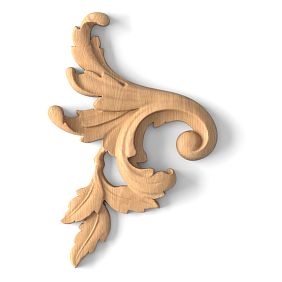
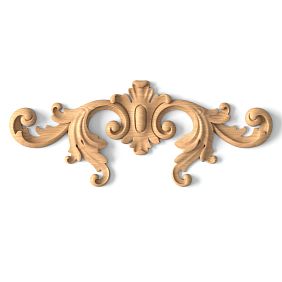


Buy wall moldings in Moscow: which solutions are suitable for the interior
The Moscow wall decor market is diverse: it includes mass-market, professional lines, and direct manufacturer products. The key difference is not always in price—it's in systematicity. Moldings that work as decor, not just 'glued to the wall,' are a well-thought-out system of profiles, corner elements, compatible cornices, and baseboards.
Buying wall moldings in Moscow today means making several conscious choices at once:
-
choose the material—it determines durability, tinting possibilities, and feel
-
choose the profile—width, relief height, cross-section shape
-
choose the application scenario—framed panels, horizontal belt, TV zone, accent wall
-
choose complementary decor—corner elements, overlays, connectors
It is precisely this approach that turns a set of planks into a complete interior project. Below—each point in detail.




What wall moldings can be bought in Moscow
Three main materials, three fundamentally different products. Understanding their difference means solving 80% of the selection task.
Our factory also produces:


Wooden wall moldings
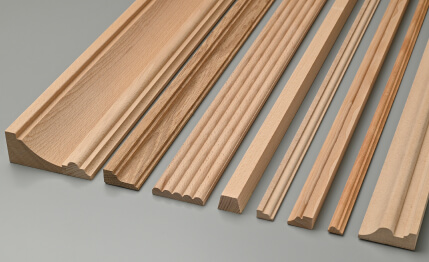
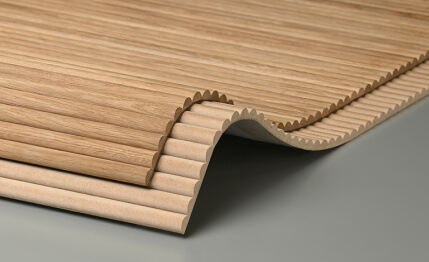
Solid wood is a material without compromises.Wooden wall moldingsmade of oak, beech, ash, pine, or birch carry a living texture, organic scent, and tactile quality that are irreproducible by any other material.
What makes wooden profiles great:
-
Texture — each board is unique: grain pattern, shade, density — everything is individual
-
Durability — with proper treatment, service life of 20–30 years without loss of appearance
-
Staining — wood accepts stain, oil, wax in any shade while preserving the natural pattern
-
Repairability — a scratch on wood can be sanded and refreshed without replacing the entire profile
Wooden moldings made of wood are the choice for interiors where material honesty is fundamental. Classic, neoclassical, a study with expensive furniture, a living room with parquet flooring — anywhere a wooden profile integrates into the natural environment of the space.
Buy moldings in Moscowmade from solid wood — with delivery in Moscow and project selection consultation
Get Consultation
MDF Moldings
MDF — pressed wood with a homogeneous structure, without knots or pores. It is this homogeneity that makes MDF profiles mathematically precise: edges are sharp, planes are perfectly smooth, joints are gap-free.
Buying MDF wall moldings means getting a product perfectly suited for finish painting. The primed MDF surface accepts acrylic paint flawlessly: no absorption in random areas, no tonal variations. The profile blends with the wall, creating a monolithic relief pattern without visible material boundaries.
MDF is the right tool for:
-
apartments with paint-ready finishes
-
Scandinavian and modern interiors
-
large areas where cost per linear meter matters
-
projects with thin profiles without complex relief
MDF wall moldings for painting are one of the fastest-growing requests among Moscow buyers of new housing. The logic is clear: an apartment with finished interior, two-tone painting, molding color-matched to the wall — and the space gains architectural character.
Limitation: MDF is not suitable for rooms with unstable humidity. Swelling is a real risk with regular moisture exposure.
Polyurethane wall moldings
Polyurethane wall moldings— is an independent category with its own advantages that are not covered by either wood or MDF.
What fundamentally distinguishes polyurethane:
-
Moisture resistance — polyurethane is not afraid of moisture at all. The hallway, where outdoor dampness enters, a country house with seasonal heating, the kitchen — this is polyurethane territory.
-
Lightness — 5–8 times lighter than a wooden counterpart. Installation alone, without an assistant, even at a three-meter height.
-
Complex profiles — curls, reverse curves, multi-step cornices are reproduced accurately in polyurethane and cost significantly less than in wood.
-
Perfect joints — polyurethane cuts well at any angle: corner joints come out without gaps and without puttying.
-
Wide selection of profiles — catalog of polyurethane moldings includes both thin smooth profiles and rich classic cornices.
Decorative polyurethane moldings are a sensible choice for classic with rich decor, for neoclassical with cornices, for hallways and country houses. This is not a 'cheap substitute for wood' — it is a professional tool with a different set of properties.
For which interiors are wall moldings purchased
A molding is a linguistic sign. It instantly 'names' the interior style: classic, neoclassical, modernity, minimalism. The correct profile speaks the right language — the wrong one creates dissonance.
Moldings for classic interior
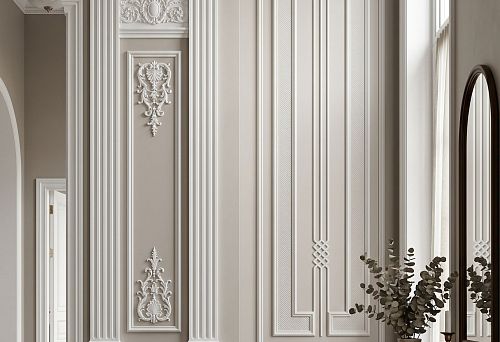
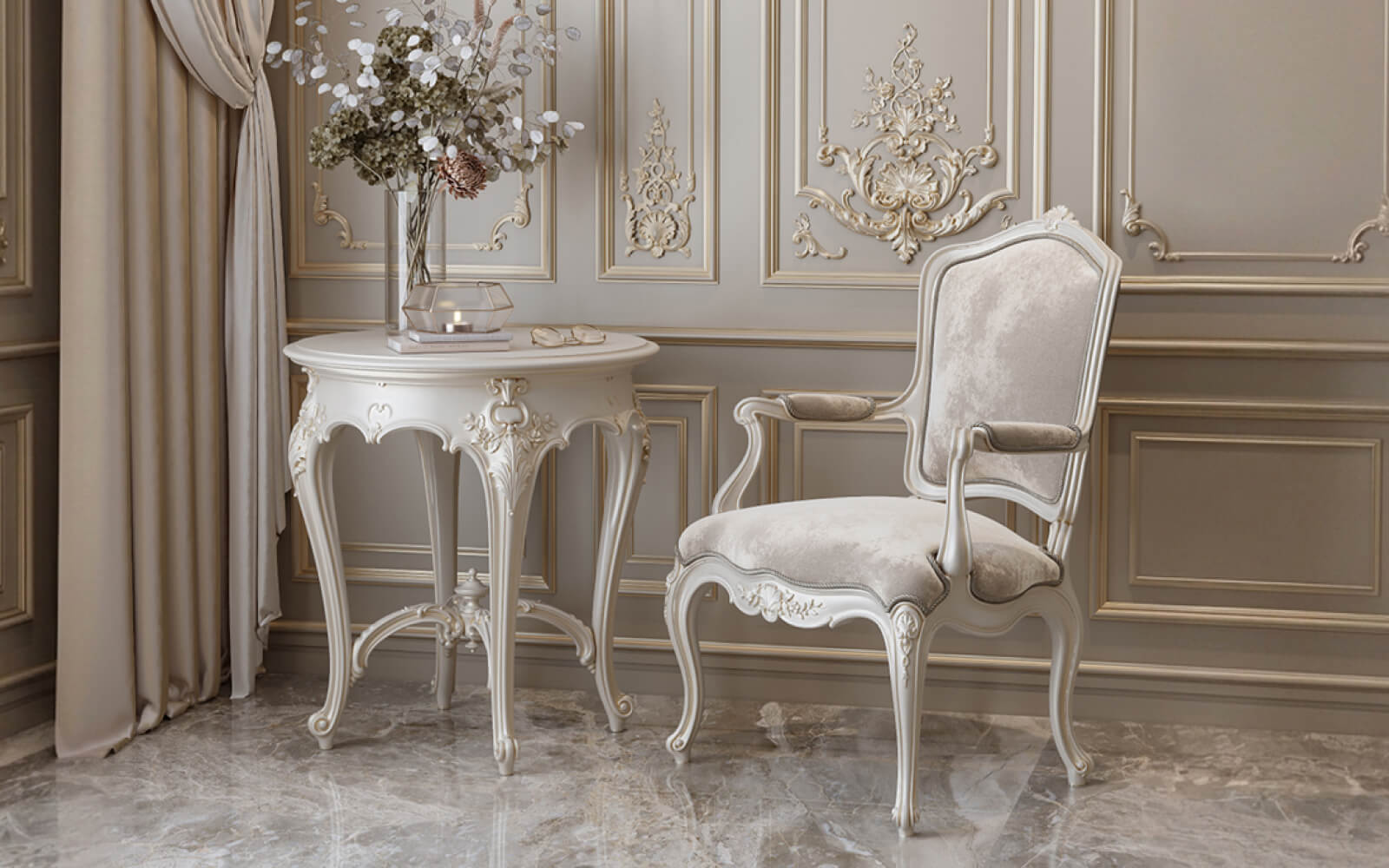
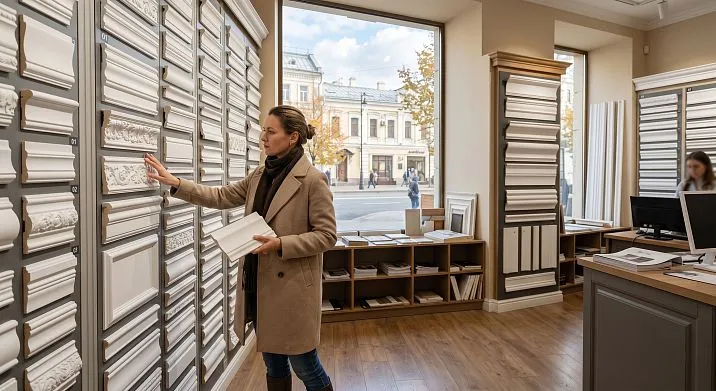
Classic is about hierarchy, scale, richness of detail. Moldings for a classic interior should be wide (from 5 to 10 cm), with a pronounced multi-step profile, combining straight and curved lines in cross-section. The system: a wide baseboard at the bottom of the wall, a waist molding in the middle, framed panels, a rich cornice in the ceiling area.
Purchased for classic style: wooden moldings made of dark oak or beech, or polyurethane profiles with detailed relief for painting white — to create contrast with a dark or saturated wall.
Details without which classic is incomplete:Decor for Molding— corner blocks, central overlays, ornamental inserts. It is they that turn a 'molding frame' into an architectural panel.
Moldings for neoclassicism
Neoclassicism is classicism freed from baroque. Clean lines, moderate relief, noble restraint. Moldings for neoclassicism: an expressive but not overloaded profile. Width — from 3 to 6 cm. Cross-section — with one or two steps without curls.
Material: wooden moldings in light 'champagne' or 'linen' tones, or MDF for painting to match the wall color with a slight contrast. It is neoclassicism that is the most actively growing style in Moscow apartments, and it is for it that people most often search for wall moldings to buy in Moscow.
Moldings for modern interior
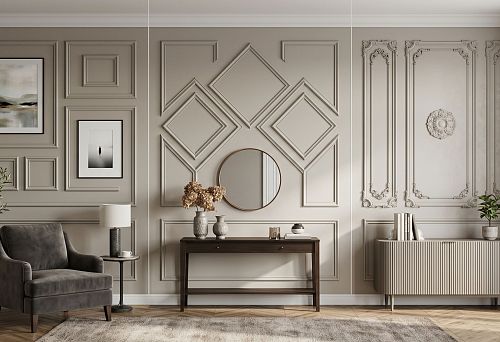
Modernity in interiors is about precision, not richness. A thin, smooth profile, mathematically precise spacing of frames, monochrome with the wall surface — and no extra details.
MDF wall moldings are the perfect tool for a modern interior. Smooth surface, sharp edges, color-matched paint. The decorative effect is created solely by relief, without material difference. This requires high installation precision—but the result justifies the effort.
Decorative wall moldings in a modern interior function as architectural drawing: they are seen not as 'decoration,' but as part of the wall's very structure.
Moldings for accent walls and TV zones
Accent walls and TV zones are the two most popular scenarios for using wall moldings in Moscow apartments today.
Accent wall with molding frames: one wall in the living room, bedroom, or hallway is decorated with a system of rectangular or vertical molding frames. The frames can be the same size or different—depending on the rhythm the space requires.
TV zone with molding framing: a TV on a wall without decor looks like a 'screen in a void.' A molding frame around the TV panel—and the zone gains architectural completeness. Additionally: wall moldings for the TV zone can be purchased with integrated niches for media systems or with lighting behind the slats.
Learn more about the application scenarios for wall moldings in the article how to choose wall moldings.
How to choose wall moldings by material
This question is second in importance after 'for which interior.' And there is no universal answer here: each material has its own conditions of application.
When is the best time to buy wooden moldings
Choose wooden moldings made of wood if:
-
the interior already has wooden elements — parquet, doors, furniture, slats — and a unified material environment is needed
-
tinting is needed while preserving the natural texture — oil, stain, wax
-
durability with proper care is important
-
the interior suggests classic, neoclassical, or a 'warm' Scandinavian style with natural materials
-
the room is dry, with constant temperature and humidity
Wooden moldings are an investment in a long-term interior. They age beautifully: they acquire a patina, darken slightly over time, and only become richer.
When MDF for painting is more convenient
It is advisable to buy MDF moldings if:
-
final finish — painting in white or any other color
-
clean geometry without visible texture is needed
-
large volume — many linear meters, and cost matters
-
interior — modern, Scandinavian, minimalist
-
dry room — bedroom, living room, study
MDF for painting is a technological material. With proper preparation and high-quality paint, it is almost impossible to distinguish from a profile made of another material.
When it is better to choose polyurethane
Buy polyurethane moldingsis advisable if:
-
room with variable humidity: hallway, country house, cottage
-
Need a complex profile at a reasonable price: curls, twists, multi-tiered cornices
-
Installation alone — material lightness is fundamentally important
-
Quick project — polyurethane does not require special tools or long preparation
-
Need a unified system: moldings, cornices, corner elements, rosettes — all from one product line
Decorative polyurethane profile — a choice for those who want rich decor without compromises on installation and moisture resistance.
How to choose the size and profile of wall molding
The rule is simple: the size of the molding should correspond to the scale of the room. But within this rule — there are many nuances.
Narrow moldings
Width up to 3 cm. This is a delicate profile that creates a contour, not a pronounced relief. Narrow moldings are a tool for modern and minimalist interiors: they define geometry without extra weight.
They work well: in apartments with ceilings up to 2.7 m, in small rooms, in interiors where a light, unobtrusive accent is needed. Narrow MDF molding for painting color-to-color with the wall — it is this technique that makes an ordinary apartment look like a designer project.
Medium universal profiles
Width 3–6 cm. The most in-demand range. They are well perceived in space, do not overwhelm, and suit most styles — from neoclassical to modern classic.
For wall panel frames — medium profile works best. It is expressive enough for the frame to 'hold' the wall, and restrained enough not to overload it.
Wide moldings for expressive panels
Width from 6 to 12 cm. This is a statement molding. A wide profile carries scale and status — it is appropriate in spacious living rooms, country houses with high ceilings, classic studies with expensive furniture.
To buy wide wall molding means to create a pronounced architectural framework. A wide baseboard at the bottom, a wide molding belt in the middle, a wide cornice at the top — this is the classic 'trinity' that has worked in European interiors for centuries and has not lost its relevance.
Smooth and relief profiles
A smooth profile is a clean section without ornament. Straight edges, smooth transitions, no additional elements. Ideal for modern interiors and neoclassicism with clean lines.
A relief profile — with ornament, ribbing, classic 'egg and dart', 'meander', or floral pattern. This is the territory of rich classicism and baroque. Relief molding creates a complex shadow pattern that works especially beautifully with directed side lighting.
The choice between smooth and relief is a choice between modernity and historicity. Neither solution is better than the other: they simply speak different languages.
| Parameter | Smooth | Relief |
|---|---|---|
| Style | Modern, neoclassical | Classic, baroque, empire |
| Installation | Simpler | Requires precise pattern alignment |
| Shadow and volume | Soft | Expressive |
| Material | All three | Most often polyurethane, less often wood |
Where to use wall moldings in an apartment and house
Living Room
The living room is the main space for molding experiments. It is here that wall decor works with maximum efficiency: large planes, high ceilings (in good apartments), the need to create a 'feature wall'.
Buying wall moldings for the living room is primarily a system of framed panels. The wall behind the sofa, decorated with vertical molding frames, is a complete designer accent without additional investment in decor. No paintings, shelves, or installations are needed: the molding system itself is sufficient.
For the TV zone in the living room: a horizontal molding frame around the screen creates a 'frame within a frame' — and the TV ceases to be an 'alien object' on the wall.
Bedroom
The bedroom requires intimacy. Not monumentality — coziness. Moldings for the bedroom on the accent wall behind the bed headboard are one of the most effective designer techniques available without renovation.
Scheme for the bedroom: one vertical frame behind the bed or a system of two or three frames of different heights, oriented vertically. This creates a 'wooden frame' behind the headboard — soft, lively, warm. Material: wooden molding in a light tint or MDF in the color of the wall.
Important: in the bedroom, molding decor should only be on one wall. All four walls is overkill, creating a claustrophobic feeling.
Hallway and corridor
The hallway is the place of first impression. And the place where the wall receives maximum mechanical loads. Wall moldings in the hallway are both decor and protection for the lower third of the wall.
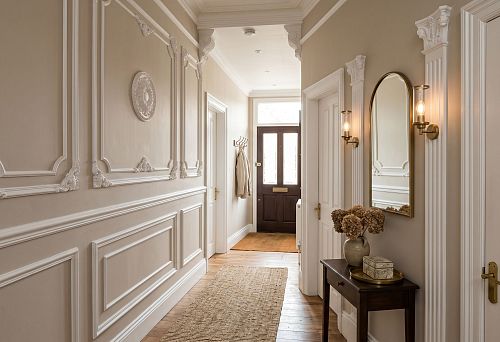
Scheme for the hallway: a horizontal molding belt at a height of 1.1–1.2 m divides the wall into two zones. The lower one is in a dark, dense color (practical and durable). The upper one is in a light color (expands). For the hallway, polyurethane wall moldings are optimal: moisture resistance is critical, lightness is convenient for installation.
A long corridor without decor is a tunnel. Molding frames on the side wall of the corridor create rhythm, making the route interesting. Vertical frames visually raise the ceiling, horizontal ones widen the walls.
Office
The study is an interior with the highest requirements for the 'status' of the finish. Solid wood moldings in the study are an environment that works for productivity: a warm, rich space with natural materials.
A system for the study: dark oak paneling (boiserie) around the perimeter of the lower half of the wall, a horizontal molding belt in the middle, a wide cornice near the ceiling. This architectural solution was the standard for gentlemen's workspaces as far back as the 18th century—and it has not lost its relevance.
Commercial interiors
Wall moldings are not only for residential spaces. Restaurants, hotels, office meeting rooms, medical clinics with 'premium' positioning — all these spaces actively use wall molding decor to create the desired impression.
In commercial interiors, polyurethane moldings (quick installation, lightness, moisture resistance) and MDF for painting (precise geometry, large areas, color control) are especially valued.
What to buy together with wall moldings
Molding is a link in the system. Buying a profile without corner elements and accompanying decor means getting an unfinished solution.
Corner elements
Corner elements for molding frames are a mandatory part of the system. They frame the corners of the frame without the need to cut the molding at a 45° angle — this is both installation convenience and a decorative accent.
In classic and neoclassical interiors, corner blocks with relief ornamentation are the central decorative element of the frame. In modern interiors, smooth corner inserts ensure a clean transition without a visible seam.
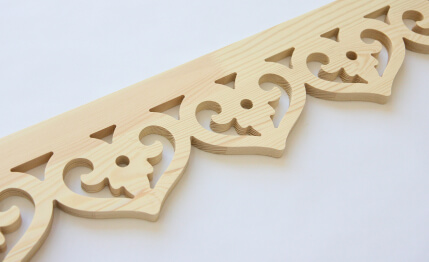
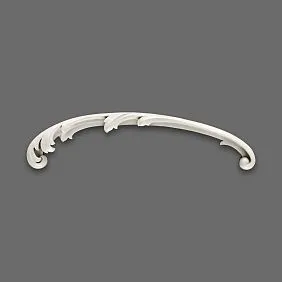
Decor for Molding— corner blocks, central overlays, ornamental inserts, and connecting elements. It is these details that elevate a molding frame from the 'DIY installation' category to the category of 'professional decor'.
Decor for moldings
A central overlay on a horizontal molding is a small decorative accent in the middle of the run. Visually, it 'holds' the long molding, preventing it from looking monotonous. In the classic version, it's a rosette with a floral motif. In the modern version, it's a geometric block.
Overlays and decorative inserts work as the 'finishing touches' of an interior: they are noticed upon close inspection, and it is they that create the feeling that the interior was done by a master, not an amateur.
Related millwork
Moldings and cornices made of solid wood and MDF— in a single catalog. This means that along with a wall molding, you can select a cornice of the same profile, a baseboard from the same series, a threshold made of the same wood species.
Unified millwork from a single manufacturer is a guarantee of compatibility in proportions, profiles, and shades. A molding, cornice, and baseboard from a unified line create an interior where 'everything is in its place' — and this sense of integrity is impossible to achieve by assembling a system from different sources.
Ready-made compositions and compatible series
Some profiles are developed as ready-made systems: molding for frames, cornice for ceiling transition, baseboard for the base — in coordinated proportions. This is especially convenient for those working with molding decor for the first time and wanting to be sure everything will come together correctly.
For more on use cases and compatible systems, see the articlepolyurethane wall moldings: how to choose and buy.
Where to buy wall moldings in Moscow
Practical block — the most important for those who have already made a decision and are looking for a specific address.
Availability and delivery
When purchasing wall moldings in Moscow, two parameters are crucial: availability of the required item in stock and the possibility of delivering long-length trim without damage.
Wooden moldings in Moscow— with fast delivery in Moscow and consultation on selection for a specific project. Check availability before ordering: for unique or non-standard profiles, the production time may be extended.
Profile selection for the project
A professional approach to buying wall moldings is not 'taking the first suitable one,' but selecting a profile considering:
-
specific room proportions
-
existing furniture and finishes
-
planned wall color
-
compatibility with cornices and baseboards
Consultation on selection is a service that distinguishes a professional supplier from an anonymous marketplace. Prepare: photos of the room, wall dimensions, samples or photos of existing wooden elements.
Element compatibility is the main argument for a system purchase
Buying wall moldings in Moscow from a manufacturer with a unified line means getting a guarantee of compatibility for all elements. Molding and corner block from the same series, cornice from the same line, baseboard with a coordinated profile — this is a system, not a set of separate parts.
Wall moldings with delivery in Moscow from the manufacturer — go to catalog:
Common mistakes when choosing wall moldings
Observations of how people buy moldings lead to one consistent conclusion: most mistakes are predictable and avoidable. Here is a specific list—without lecturing, but with practical benefit.
Too small a profile on a large wall
A 2 cm wide molding on a 3 m high wall with a five-meter wall—visually disappears. It's there, but it's 'not seen'. Rule: the minimum width of molding for a noticeable decorative effect is 1/50 of the room height. With a 2.5 m ceiling—from 5 cm.
Overly complex relief in a small room
A molding with a Baroque ornament in a 12 sq. m bedroom creates a feeling of clutter. A small room requires a light, clean profile: either smooth or with minimal relief.
Choosing only from a catalog photo
A photo is always a specific room with specific lighting. The same molding looks different in another space. This is especially true for wooden profiles: the shade of wood under screen light and in the natural lighting of your apartment are different things. Request samples before finalizing the order.
Mixing different series without a concept
A molding from a classic series on one wall, a modern smooth profile—on another, a polyurethane cornice with an ornament—near the ceiling. Without a concept, this is not a design technique, but chaos. If there are several materials or series in the interior—a clear logic for their application is needed.
Buying molding without corner and decorative elements
A corner joint of molding without corner blocks is a technical joint at a 45° angle. Making it precisely is difficult. Making it so that it is unnoticeable—is even more difficult. Corner elements for moldings solve both problems with one action: installation is faster, the result is more professional.
Ignoring usage conditions
MDF in an entryway with outdoor humidity is a poor choice. Polyurethane in an interior where material naturalness is essential is a disappointment. Wood in a room with unstable humidity without proper treatment is a risk of warping. Operating conditions are the first question to resolve even before choosing a profile.
Lack of systems thinking
Buying wall molding without considering the cornice, baseboard, and corner inserts means getting an unfinished interior. Decorative wall moldings work as a system: plan it entirely before your first order.
Frequently asked questions about buying wall moldings
Which moldings are better for walls: wood, MDF, or polyurethane?
It depends on the task. Wood is for a natural interior with texture. MDF is for painting and modern geometry. Polyurethane is for damp rooms, complex profiles, and quick installation.
How to calculate the amount of molding for a wall?
Measure the perimeter of each frame, sum it up, add 15% for trimming. For horizontal bands — wall length + 10%. Count corner elements separately: one for each internal corner of the frame.
Can moldings be installed by oneself?
Yes. MDF and polyurethane are glued with acrylic adhesive or liquid nails, attached to the wall. Wood is installed with adhesive and fasteners. The main thing is proper marking and precise miter cutting for corner joints.
Wall moldings made of MDF — can they be repainted?
Yes. MDF accepts repainting well: sand with sandpaper, apply new primer and paint. The profile can be repainted multiple times.
Are polyurethane moldings long-lasting?
With proper installation and use — yes. Polyurethane does not rot, does not warp from moisture, does not crack from temperature changes. Service life is comparable to wooden counterparts.
Are corner elements needed, or can joints be made at 45°?
Joints at 45° are technically possible but require precise tools and skill. Corner blocks eliminate this issue and simultaneously add a decorative accent. For most projects — corner elements are preferable.
Which molding to choose for neoclassicism in Moscow?
Clean profile without baroque curls, width 4–6 cm, one or two steps in cross-section. Material — wooden moldings from light wood or MDF for painting in a contrasting or nuanced shade.
How to choose molding for an already finished renovation?
Focus on the color and style of existing elements: floor, doors, furniture. Request samples. Select a profile that either matches the dominant wood tone or intentionally contrasts.
Wall moldings for the hallway — wooden or polyurethane?
Polyurethane is preferable: moisture resistance, easy installation, washable surface. In an entryway with constant humidity changes, untreated wood may warp.
MDF moldings for painting — what color to paint them?
Three most effective options: white molding on a colored wall (maximum contrast), molding color-matched to the wall (architectural, delicate effect), molding 1–2 tones lighter than the wall (nuanced, expensive look).
Can I buy wall moldings with fast delivery to Moscow?
Yes — if in stock. Moldings are delivered in special packaging to prevent damage. Check delivery times when placing your order.
Conclusion
Buying wall moldings in Moscow means making a specific, thoughtful choice: material for operating conditions, profile for room proportions, system for interior style. Decorative wall moldings only work when there's logic behind them — not just 'I want something pretty on the wall.'
Three materials, three tasks:
-
Wood — for natural interiors with long-term perspective
-
MDF — for modern geometry under paint
-
Polyurethane — for complex decor, wet rooms, quick installation
And one principle: molding is a link in the system. Together with cornices, baseboards, and corner elements from a unified line, it creates a cohesive interior. Individually — it's just a strip on the wall.
Go to the catalog and select:
STAVROS is a Russian manufacturer of decorative interior products made from natural wood, MDF, and polyurethane. The STAVROS catalog includes wall moldings, cornices, baseboards, paneling, decorative elements, and related trim: a complete finishing system for any style and any room.
STAVROS works with private customers, interior designers, construction, and development companies. Delivery to Moscow, St. Petersburg, and throughout Russia. Free consultations on selecting moldings for specific projects. Material samples available upon request.
Order moldings in Moscow with quality guarantee, a unified profile system, and professional support at every stage — STAVROS.
Get Consultation

● Universality. The wooden trim K-017 is suitable for any style and room, whether it's a living room, bedroom, office, kitchen, bathroom, or hallway. The wooden trim K-017 can be used for various purposes and tasks, such as framing, cladding, decorating, or zoning. The wooden trim K-017 easily complements other decorative elements, creating a harmonious and cohesive look.
from 23.70 $

Furniture handle Pebble HL-065-2M
from 29 $

Decor Set N.VRS-003
from 155.84 $

Wooden Capital KL-027
from 33.37 $