Article Contents:
- Why people buy furniture molding: essence and purpose
- Where furniture moldings are used: scenarios and applications
- Molding for furniture facades: basic scenario
- Molding for cabinets: verticality and scale
- Molding for kitchen furniture: practicality + aesthetics
- Molding for dressers: rhythm of drawers
- Molding for sideboards: lightness in details
- Moldings for classic furniture: a system, not just decor
- Molding for furniture restoration: a new life
- What types of furniture moldings can you buy: a complete typology
- Solid wood moldings
- Carved moldings: ornament as a statement
- Smooth moldings: geometry without ornament
- Polyurethane moldings
- Profiles for painting: surface purity
- How to choose furniture molding by material
- Wood: when it is beyond competition
- Polyurethane: scope of application
- Comparison table: wood vs polyurethane
- What is better for classic furniture
- How to choose molding according to furniture style
- Molding for classic furniture
- Molding for neoclassical style
- Molding for baroque-style furniture
- Molding for light and white facades
- Molding for dark furniture
- Molding for furniture with patina, enamel, veneer
- How to select molding based on profile size and shape
- Narrow molding (up to 2 cm)
- Medium profile (2–5 cm)
- Wide molding (from 5 cm)
- Molding for thin facade frame
- Molding for accent furniture decoration
- How to combine furniture moldings: building a decoration system
- Furniture decor and overlays
- Furniture handles
- Furniture legs and supports
- Pilasters and capitals for furniture
- What to consider before buying furniture molding in St. Petersburg
- Material: the first and main question
- Profile length: calculate with a margin
- Style: consistency is mandatory
- Compatibility with other hardware
- Paintability
- Selecting decor in a unified style
- Where to buy furniture molding in St. Petersburg: why choosing the right supplier matters
- How to choose molding for a specific task
- Why it's convenient to buy moldings, overlays, handles, and legs in one place
- How to assemble a furniture decor set
- FAQ: Answers to common questions about buying furniture molding in St. Petersburg
- Which molding is best to buy for furniture?
- What to choose: wooden molding or polyurethane?
- Is molding suitable for kitchen fronts?
- Can you buy molding for restoring old furniture?
- How to correctly calculate the required amount of molding?
- Where to buy furniture molding in St. Petersburg with delivery?
- How to buy molding and handles in the same style?
- Conclusion: molding is a decision made once and never regretted

There are questions whose answers lie on the surface, you just need to look more carefully. Here's one of them: why does one piece of furniture seem expensive—even if it's not made of rare wood or hand-painted? And another looks cheap—even if it costs a lot of money? The answer is almost always the same: details. Molding around the perimeter of the facade. A thin frame around the panel. A corner overlay that you don't notice immediately but feel—constantly.
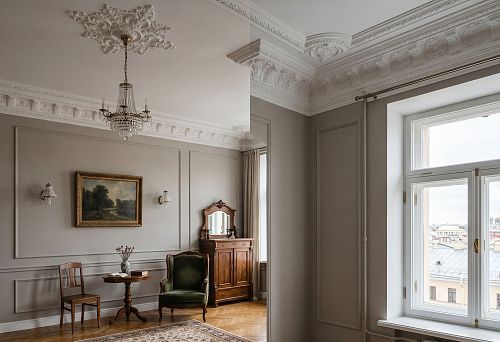
Buying furniture molding in St. Petersburg means making a decision in favor of an interior with character. It is here, in the city with Baroque facades and Classical palaces, that furniture decor is perceived not as an excess, but as an organic part of the environment. The STAVROS catalog featuresSolid wood furniture moldings, applied decoration for furniture, molding decorative elements, Furniture Handles, furniture legsandClassic Furniture—everything for creating a unified decorative system with delivery in St. Petersburg.


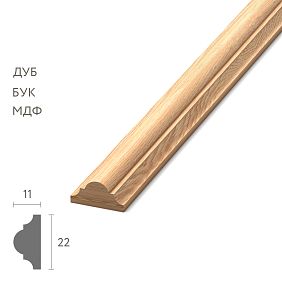

Why buy furniture molding: essence and purpose
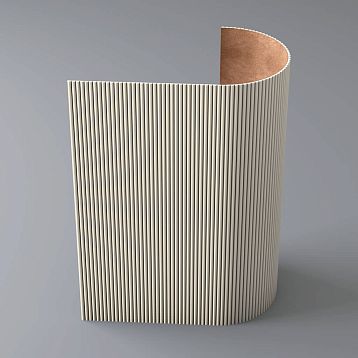
Furniture molding is a linear decorative profile made of wood or polyurethane that is mounted on the surface of a cabinet furniture facade. Its task is to create a frame geometry, give volume to the plane, and form a visual hierarchy of the surface. It is molding that turns a smooth MDF facade into a framed panel that looks like the work of a cabinetmaker.
Why buy it? There are several reasons—and each of them is specific:
-
Aesthetics. Molding makes furniture look more expensive. Relief, frame, profile—all this adds tactile and visual depth to the surface, which a smooth facade lacks.
-
Style. Decorative moldings for furniture are the main tool for styling in classic, neoclassical, and Baroque styles. Without molding, the classic style doesn't work.
-
Restoration. Old furniture with flat fronts is updated with applied profiles, turning a Soviet sideboard into a classic buffet.
-
Coordination. When making custom furniture, moldings are selected together with handles, legs, and overlays — for a unified decorative program.
Where are furniture moldings used? Anywhere there is a front:
-
cabinets — hinged, built-in, wardrobe;
-
kitchen sets — upper and lower modules, doors and drawers;
-
chests of drawers, cabinets, bedside tables;
-
buffets and display cabinets;
-
classic furniture pieces — secretaries, bureaus, library cabinets;
-
fireplace fronts and decorative portals.




Where to use furniture moldings: scenarios and applications
Our factory also produces:
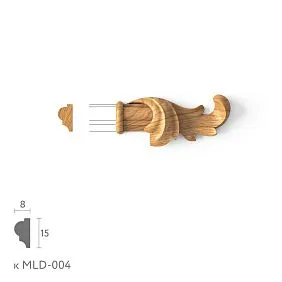
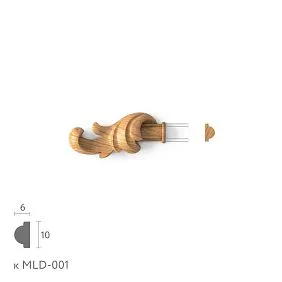
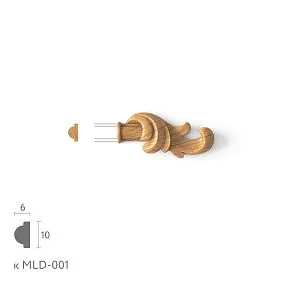
Molding for furniture facades: basic scenario
The facade is the face of a piece of furniture. It's what a person sees upon entering a room. A framed facade with perimeter molding is immediately perceived as 'expensive and well-thought-out': an outer frame made of profile, inside—a panel field that can be decorated or left neutral. This is a scheme that carpenters have used for several centuries. It worked then, works now, and will always work—because it's based on proportion, not fashion.
Buying moldings for furniture facades means getting a ready-made tool to turn any flat facade into an architecturally expressive object.
Get Consultation
Molding for a wardrobe: verticality and scale
A wardrobe is the largest piece of furniture. Molding works especially expressively on it because it takes on the task of scaling: it breaks down a large plane into readable rectangles, creates rhythm, and reduces the monotony of a large surface. For a built-in wardrobe covering an entire wall, moldings are almost a mandatory element: without them, the front looks like a partition, not like furniture.
Scheme for a sliding wardrobe with high facades from 180 cm:
-
Outer molding frame around the perimeter of the door.
-
Horizontal profile at 1/3 of the height—divides the facade into two unequal parts.
-
Corner decorative overlays on the corners of the frame.
-
Central decorative element—in the upper or lower field.
Molding for kitchen furniture: practicality + aesthetics
A kitchen in a classic style always features framed fronts. Molding for kitchen fronts must meet two requirements simultaneously: look like a classic profile and withstand kitchen conditions. That's why polyurethane profiles are often chosen for kitchens: they are moisture-resistant, do not swell from steam, are easy to clean, and take any paint well.
Wooden molding for the kitchen is also possible, but only with a high-quality lacquer or enamel coating without gaps. Profile width: for standard kitchen fronts 70–80 cm high — optimally 2–4 cm. For fronts 90–100 cm — up to 5 cm.
Molding for a chest of drawers: the rhythm of drawers
A chest of drawers with moldings is a small architectural object in the interior. Each drawer gets its own frame, and the entire front acquires a vertical and horizontal rhythm. For a chest of drawers, it's important to maintain proportions: a drawer 12–15 cm high requires a narrow profile of 1.5–2 cm, otherwise the frame will take up the entire height of the drawer, leaving no space for the panel.
Buy molding for a chest of drawers in St. Petersburg conveniently together withwooden handlesfor painting — then both the molding and the handle receive a unified finish and look like one whole.
Molding for a cabinet: lightness in details
TV stand, bedside table, vanity cabinet — small items that often remain 'bare' in terms of decor. Molding for a cabinet is the simplest way to give these items a stylistic identity. A narrow, smooth profile turns a nightstand into neoclassicism. Carved molding with an overlay turns a small cabinet into a Baroque-style object.
Moldings for classic furniture: a system, not a decor
For classical furniture, molding is not a decoration applied to the structure. It is part of the structure itself.Classic FurnitureIt is built according to the logic of the order: base, body, crown. Moldings participate in all three parts—as baseboard profiles, as frames on facades, and as a crowning cornice. Without moldings, classical furniture loses its architectural language.
Molding for furniture restoration: a new life
Buying wooden molding for restoration is a solution that allows you to completely change the appearance of an item without replacing it. Overlay profiles are glued onto the existing smooth facade, after which the entire surface is sanded, primed, and painted. The result is a piece of furniture that looks new and carries the history of the original.
What types of furniture moldings can you buy: a complete typology
Solid wood moldings
Wooden moldings— is the standard. Natural wood carries something that cannot be faked: a living texture, the warmth of the material, the uniqueness of every linear meter. Wooden moldings are made from various species: oak—for heavy classic and empire styles, beech—for furniture intended for painting and patina, pine—for light solutions and Provence style.
Wooden molding accepts well:
-
tints and stains—for imitating valuable wood species;
-
clear varnish—for preserving the natural texture;
-
enamel of any color—for monochrome interiors;
-
patination technique — for an aged appearance.
Buy wooden molding in St. Petersburg for solid wood and veneer furniture, as well as for all restoration projects where polyurethane next to natural wood will look like a foreign element.
Carved moldings: ornament as a statement
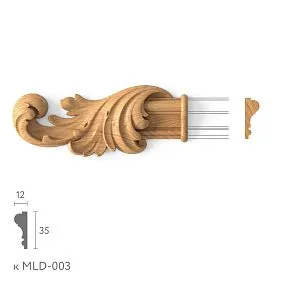
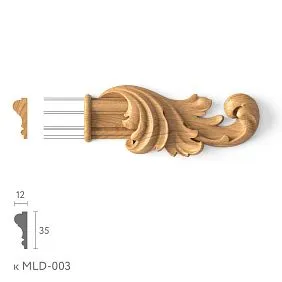
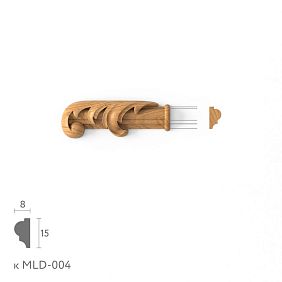
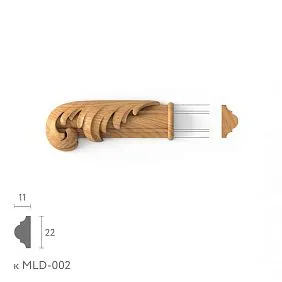
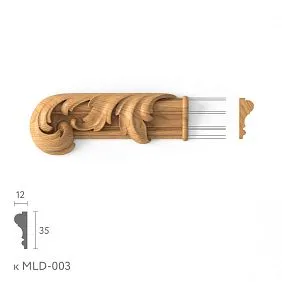
Carved molding is a profile with a decorative pattern. The ornament can be geometric (meander, weaving, checkerboard border), floral (acanthus, laurel branches, grapes) or mixed. Buy carved decor for furniture where the interior style allows for rich relief: Baroque, Rococo, Classicism, Empire. In a minimalist interior, carved molding looks appropriate only as an intentional contrasting accent.
Smooth moldings: geometry without ornament
A smooth profile is architecture without decoration. Clear rectangular, trapezoidal, or stepped cross-sections. No carving — only form. Smooth furniture molding works in neoclassical, modern classic, and Scandinavian interiors. After painting to match the facade, it creates a monochrome volume: the relief is revealed through the play of shadows, especially with directional lighting.
Polyurethane moldings
Polyurethane Items— this is a different logic of furniture decor. Polyurethane furniture molding is lightweight, moisture-resistant, not afraid of household chemicals, cuts well with a sharp knife, and adheres to most surfaces. The relief of a polyurethane profile can be significantly more complex and deeper than that of wood — since it is produced by casting in a mold, not by milling.
Polyurethane appliquésfor furniture — rosettes, medallions, plaques — complement linear molding with three-dimensional elements and create the feeling of hand carving without its cost.
Profiles for painting: surface purity
A separate category — moldings with a primed, even surface, specially prepared for final painting. They do not require additional puttying or sanding. Ideal for furniture in total white style, for classic kitchen sets with a uniform coating, and for cabinets that are painted in the same shade as the facades.
How to choose furniture molding by material
This is the most common question — and the most important one. A mistake in material choice cannot be fixed by repainting.
Wood: when it has no competition
Wooden furniture molding is chosen in three situations:
First: furniture made of natural wood. Solid wood, veneer, wood — only wooden molding provides material unity. Polyurethane next to natural wood is noticeable — even after painting: texture, reaction to light, tactile sensations — everything speaks of the difference.
Second: restoration. Authentic furniture requires authentic material. Wooden molding integrates organically into the historical construction — especially if a similar wood species is selected.
Third: premium custom interior. Where quality in every detail is important — wood is irreplaceable.
Polyurethane: scope of application
Polyurethane molding excels in the following scenarios:
-
Kitchen: moisture resistance, resistance to grease and cleaning agents, ease of maintenance.
-
Furniture made of chipboard and laminated MDF: polyurethane or MDF profile — an organic pair for these materials.
-
Complex ornament: casting allows reproducing relief of any complexity — something that milling cannot achieve.
-
Large volume on a limited budget: polyurethane is cheaper than carved wood with comparable visual results.
Comparison table: wood vs polyurethane
| Parameter | Wood (solid wood) | Polyurethane |
|---|---|---|
| Texture | Live, natural | Imitation of stucco |
| Moisture resistance | Requires coating | High |
| Complexity of relief | Limited by milling cutter | Any |
| Installation | Acclimatization + glue/nail | Glue, fast |
| Finish | Varnish, tinting, enamel | Any paint |
| Weight | Medium | Lightweight |
| Optimal application | Solid wood, veneer, restoration | Chipboard, MDF, kitchen |
| Cost | Higher | Below with relief |
What is best for classic furniture
For classic solid wood furniture — wooden molding. For a classic MDF kitchen for painting — polyurethane or MDF profile. For a classic veneered MDF wardrobe — wooden molding will give an organic result. The key principle: the molding material must match the material of the main structure.
How to choose molding according to furniture style
Molding for classic furniture
Classic is hierarchy and proportionality. Molding for classic furniture should be: voluminous (several cross-section levels), with clear geometry, with corner overlays on frame joints. For furniture in a classic style, buy molding should be paired withdecorative pilastersandcapitals— this creates a full-fledged order decor.
Molding for neoclassicism
Neoclassicism is classic without opulence. The molding here is restrained: medium width, moderate or zero relief, clear geometric lines. Smooth wooden molding with a lacquer finish in the tone of the wood is a textbook choice for neoclassical furniture.
Molding for furniture in the Baroque style
Baroque does not recognize restraint. Buying carved molding for furniture in this style means choosing a profile with rich floral ornamentation, possibly with gilding or bronze patina. Polyurethane moldings andRelief Decoration— the optimal tool for Baroque facades: they provide rich relief at a reasonable cost.
Molding for light and white facades
On light furniture, molding works through shadows. A white profile on a white facade is a monochrome volume: the frame reveals itself through the difference in illumination of the planes. This effect is especially expressive with directional spot lighting. For a white kitchen or a sliding wardrobe with white facades, this is exactly the result that creates the feeling of expensive furniture without additional investment.
Molding for dark furniture
Dark molding on a dark facade is academic classicism. Wenge with wenge, dark walnut with walnut — here, the unity of material and tone works. For dark furniture, it is important that the molding has clear edges of the cross-section: it is they that create a readable relief on the dark surface.
Molding for furniture with patina, enamel, veneer
Furniture with patina requires molding in the same technique: the profile is painted in the base tone, then patina is applied, then the edges are lightly cleaned. Enamel: molding under the same enamel without exceptions — any discrepancy in shade is noticeable. Veneer: wooden molding from the same species, preferably with matching grain direction.
How to choose molding by size and profile shape
Size is not a matter of taste, it's mathematics. An error in proportion ruins the entire concept.
Narrow molding (up to 2 cm)
For small facades: dresser drawers, nightstands, cabinets. Creates a light, thin frame that outlines the geometry without overloading the surface. Works well in neoclassical, Scandinavian, and modern classic styles. Optimal for furniture with small-format facades.
Medium profile (2–5 cm)
Universal working range. Standard cabinet doors, kitchen facades 70–90 cm, dressers with medium-height drawers. The frame width from a medium profile is about 10–15% of the facade width. Creates an expressive frame without absorbing the inner field.
Wide molding (from 5 cm)
For large furniture: tall cabinets, library shelves, portals, sideboards with large facades. A wide profile creates architectural framing that is noticeable from a distance. In small rooms and on compact items — it overloads the form.
Molding for a thin facade frame
If an elegant, almost immaterial frame is needed — choose a profile 8–12 mm wide. Such molding leaves maximum field and creates a delicate accent. Good for furniture in modern classic style, where the frame is a hint, not a statement.
Molding for accent furniture decor
When the molding should be not a background, but the main decorative element — choose a wide profile with developed relief. Such molding can be used not as a perimeter frame, but as a single horizontal or vertical accent on the facade — one line that crosses or divides the facade with a strong visual effect.
What to combine furniture moldings with: building a decor system
Molding is just the beginning. The true decorative result is born in the system.
Decor and overlays for furniture
applied decoration for furniture— corner elements, center overlays, ornamental plaques — work together with molding. Scheme: molding creates a frame, corner overlays secure and decorate joints, the center overlay provides a focal point within the frame. Three elements — one complete decorative composition.
Carved decor for wooden furniture — these are decorative patterns, applied ornaments, and carved inserts that are mounted on the facade surface. Paired with wooden molding, they create the feel of handcrafted joinery work.
Decor for moldings — specialized corner and transition elements that solve the task of beautiful profile joining at frame corners. Without them, frame corners look like a technical joint. With them — like a complete decorative unit.
Furniture handles
Furniture Handles— the final accent of the system. The handle should not compete with the molding — it should continue it. The rule is simple: if the molding is wooden with a natural texture — the handle is wooden or forged. If it's polyurethane with gilding — a handle with gold. If it's smooth white molding — a laconic handle in the same tone.
uncoated wooden handles— a strategically correct choice for projects with furniture painting: both the molding and the handle are painted in a unified tone, creating a monolithic decorative surface.
Legs and supports for furniture
furniture legs— the bottom point of the system. A carved turned solid wood leg for classic style. A straight rectangular one — for neoclassical. A curved cabriole — for Baroque and Empire. When the leg shape and the molding pattern belong to the same style — the furniture gains an internal logic that is instantly perceived.
decorative legs with coating— a ready-made solution for projects where installation time is important. The finish is already applied, the style is defined, just choose the right option from the catalog.
Pilasters and capitals for furniture
Decorative pilasterstransform an ordinary cabinet into an architectural object. They work on the corner posts of the body as vertical accents, setting the rhythm and creating the illusion of load-bearing columns. Paired withcapitals— crowning decorative elements at the top point of the pilaster — they create a full-fledged order scheme: base — body — capital.
For large classic furniture — shelving cabinets, buffets, libraries — pilasters and capitals together with moldings on the facades constitute a complete decorative program.
What to consider before buying molding for furniture in St. Petersburg
Before placing an order, answer a few questions — they will save you from mistakes.
Material: the first and main question
Furniture made of solid wood or veneer — wood. Kitchen, furniture made of chipboard/MDF, an object with rich relief — polyurethane. Mixing both materials is possible: wooden linear profile + polyurethane overlays — this is a working combination for many projects.
Profile length: calculate with a margin
Measure the perimeter of all facades on which the molding will be mounted. Add 20% for cutting, fitting, and inevitable waste when sawing at 45°. Molding is a long-length product, and a shortage of material in the middle of the project is an unpleasant situation, especially if the required profile is custom-made.
Style: consistency is mandatory
You cannot buy a carved Baroque molding and pair it with a minimalist Scandinavian handle. The style must be consistent. Before purchasing molding, define the stylistic concept of the entire furniture piece and select all elements within the same logic.
Compatibility with other hardware
The depth of the molding relief, the width of the overlays, the size of the handle, the shape of the leg—all must be proportionate. If the molding is thin, a corner overlay cannot be a massive Baroque rosette. If the molding is wide and relief-rich, the handle should not be a thin, inconspicuous bracket.
Paintability
If painting is planned, clarify: does the selected profile accept primer without additional treatment? Wooden molding is usually sanded and primed before painting. Polyurethane is primed faster. MDF profile is the most prepared for painting.
Selecting decor in a unified style
Ideal scenario: molding, overlays, handles, legs—all from the same catalog. This guarantees stylistic consistency, correct scale ratios, and unity of finish coatings.
Where to buy furniture molding in St. Petersburg: why the right choice of supplier is important
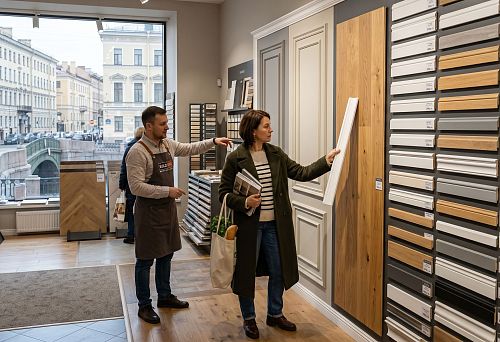
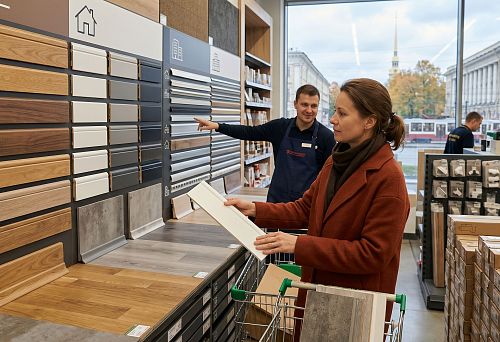
You can buy furniture molding in St. Petersburg in several formats: a construction market, a specialized furniture store, an online catalog. But only in the latter case—with a full range of related categories—do you get the opportunity to assemble a set in a unified style.
How to choose molding for a specific task
Start with the goal: restoration, new custom furniture, updating existing furniture. Determine the material: wood or polyurethane. Choose the style: classic, neoclassical, Baroque. Calculate the proportions: profile width—8–15% of the facade width. Check the availability of corner overlays for the selected profile.
Why it's convenient to buy moldings, overlays, handles, and feet in one place
Three arguments:
First. Stylistic consistency. When all elements are from one catalog, they are created in a unified proportional series and look equally good together.
Second. Time savings. One supplier, one delivery, one invoice. No need to compare, coordinate, or wait for multiple separate shipments.
Third. Competent consultation. A specialized furniture decor supplier knows what goes with what. Choosing a molding is not just about 'like or dislike,' it's also about size, relief, compatibility. The right advice here is invaluable.
How to assemble a furniture decor kit
Optimal kit for classic furniture:
-
furniture moldings— main profile for front frames.
-
applied decoration for furniture— corner and center overlays.
-
molding decorative elements— inserts for profile joints.
-
Furniture Handles— in the style of molding.
-
furniture legs— following the same stylistic logic.
-
Polyurethane Items— for when voluminous decorative elements are needed.
This entire line is available in the STAVROS catalog with delivery in St. Petersburg.
FAQ: Answers to popular questions about buying furniture moldings in St. Petersburg
Which molding is best to buy for furniture?
It depends on the furniture and the task. For solid wood and veneer — wooden molding made of wood. For kitchen fronts — polyurethane. For classic styles with rich decor — relief polyurethane or carved wooden profile. For neoclassical — smooth wooden molding of medium width.
What to choose: wooden molding or polyurethane?
If the furniture is made of natural wood or veneer — choose wood: unity of material creates an organic result. If the furniture is made of MDF, chipboard, a kitchen set, or the project requires complex relief — polyurethane is more effective. Both materials paint well; wood stains and tints better.
Is molding suitable for kitchen fronts?
Yes, this is one of the most in-demand scenarios. Polyurethane molding is the optimal choice for kitchens: moisture-resistant, resistant to grease and cleaning agents, easy to paint. Wooden molding for kitchens is used with high-quality coating. Frame fronts with molding are standard for classic kitchen sets.
Can I buy molding for restoring old furniture?
Exactly. Overlay moldings are one of the best tools for furniture renewal. Flat, smooth facades gain a framed geometry, and after painting, the result looks like new classic furniture. Buying wooden molding for restoration is especially important when the original furniture is made of wood—then the profile fits into the construction organically.
How to correctly calculate the required amount of molding?
Measure the perimeter of all facades (width + height × 2 for each door). Add up all the values. Add 20% for waste during cutting. If the facade has additional horizontal or vertical accents—add them separately. Order with a small margin: extra linear footage is better than a shortage.
Where to buy furniture molding in St. Petersburg with delivery?
In the STAVROS catalog —Wooden moldings for furniture, overlay and carved decor, Elements for moldings, Furniture Handles, furniture legsandPolyurethane moldings— all with delivery in St. Petersburg. You can buy molding for a specific task or assemble a full set of decor in a unified style.
How to buy molding and handles in the same style?
Determine the style and material of the molding. In the same catalog, select handles with matching style and proportions. Check: the handle should not be wider than the molding. The handle material should be the same as the molding or coordinated in texture (wood + wood, gilding + gilding). When painting the furniture in a unified color—take handles without coating and paint them together with the molding.
Conclusion: molding is a decision made once and never regretted
A well-chosen furniture molding is an investment in interior beauty for years to come. It doesn't need to be replaced with fashion trends—classic is beyond trends. It doesn't lose its appearance over time—on the contrary, furniture with decor only looks more noble with age. And it works on any scale: from a small bedside table to a built-in wardrobe covering an entire wall.
To buy furniture molding in Saint Petersburg means choosing a tool that carpenters, designers, and interior connoisseurs have used for centuries. And this tool still works flawlessly.
STAVROS is a catalog where this task is solved comprehensively.Moldings for furniture, buy furniture decor, Furniture Handles, Decorative legs, Classic Furnitureandpolyurethane decor— everything in one place, everything in stock, with delivery in Saint Petersburg. Here you can not just buy molding—here you can assemble the entire decorative ensemble of furniture, from the first profile to the last leg.