Article Contents:
- What needs to be decided before ordering
- How MN-046 differs from a regular furniture leg
- How to determine the main side of furniture
- How to determine the main facade
- Left and right sides relative to the facade
- Do I need to consider the back side
- Can MN-046 be rotated 90 degrees
- Do left and right MN-046 exist?
- When should you order one leg for a sample
- When can two front MN-046 be considered
- When four MN-046 are needed
- What to check for an armchair
- When two MN-046 for an armchair look more convincing than four
- Freestanding table
- Console against the wall
- Height 430 mm
- Size 32 mm
- Size 93 mm
- Why a 1:1 template is needed
- Beech for enamel
- Oak for tinting
- Comparison of beech and oak
- When the surface needs to be evaluated especially strictly
- Empire and ceremonial classicism
- Neoclassicism
- Eclecticism
- Commercial interior
- Support foot FUR-022
- Kit table
- Signs used to verify the desired product
- Need to update an old chair
- Need to make a console against the wall
- Need to assemble a table visible from all sides
- Need to decorate a bed
- Need to order a series of furniture for a hotel or restaurant
- Dry assembly before finishing
- Protecting threads during installation
- Ordering four legs without a plan
- Choosing only from a front photo
- Assuming the model is symmetrical around the vertical axis
- Inventing left and right versions
- Mixing up the concepts of "front" and "left"
- Use MN-046 on the front and back of the chair without checking
- Do not account for the 93 mm offset
- Consider the foot plate as automatically included
- Consider the fasteners as known
- Order a batch without a test sample
- Paint before marking
- Mix beech and oak in one set
- Example of a detailed request
- Which direction should the lion's head face on MN-046?
- Can I simply point all four heads forward?
- How many MN-046 should I order for one chair?
- Will MN-046 work for a table?
- Can I install two MN-046 on the console and put other legs at the back?
- Is there a left and right version of MN-046?
- What does the size 430 × 32 × 93 mm mean?
- What should I choose: MN-046 in beech or oak?
- Is MN-046 sold already painted?
- How is "Standard" different from "Prestige"?
- Do I need to order one leg first?
- Is the mounting hardware included in the set?
- Is a FUR-022 glider needed for each leg?
- Can the direction be determined from a product photo?
- How to avoid mixing up the legs after painting?
- Will MN-046 suit a modern interior?
- What to do if the required leg rotation does not fit the apron?
- Where can I check the current price and availability of MN-046?
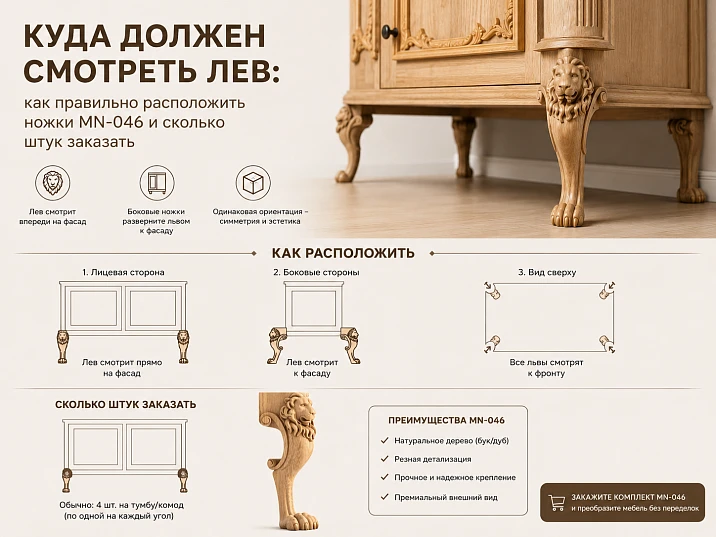
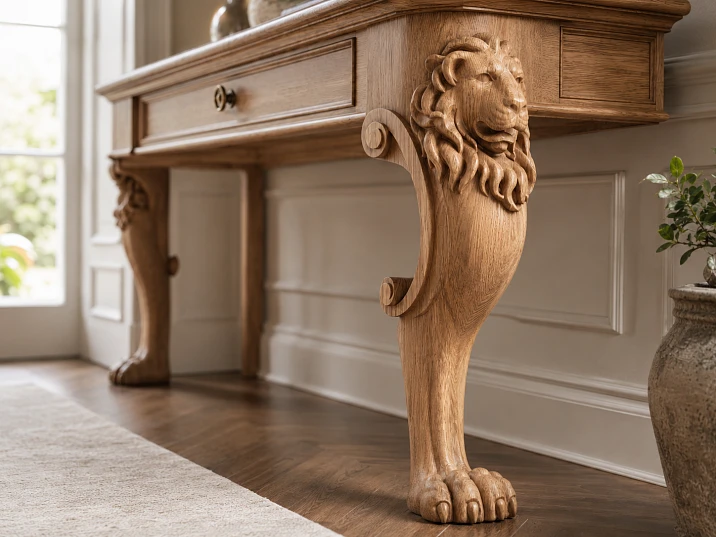
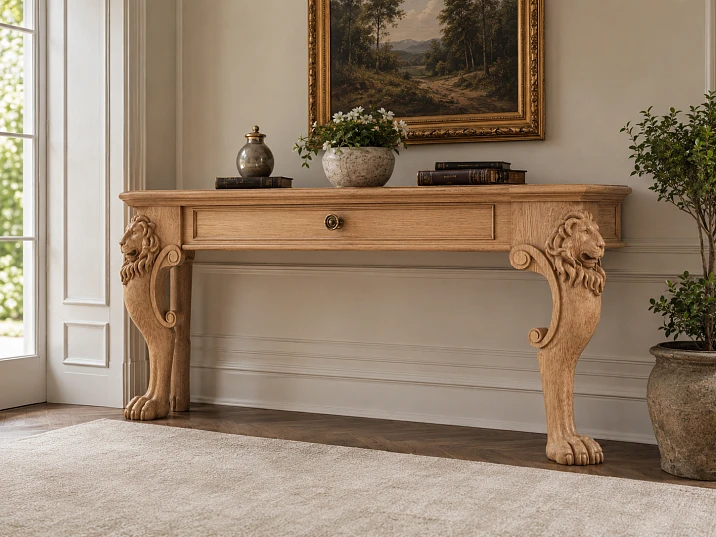
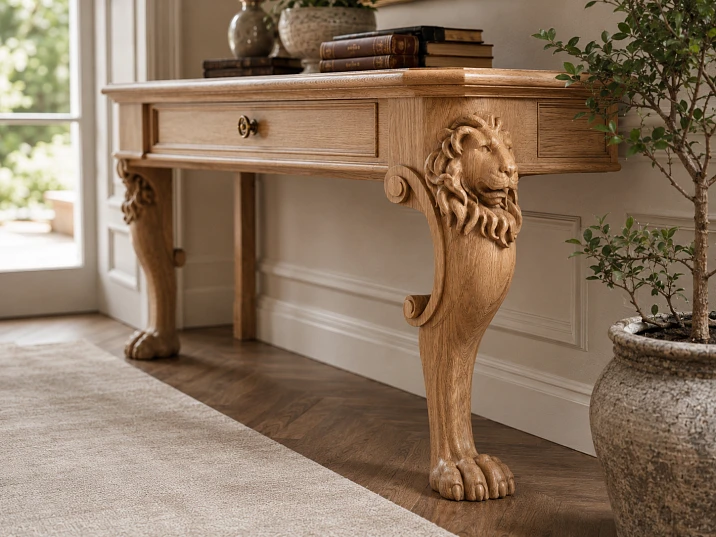
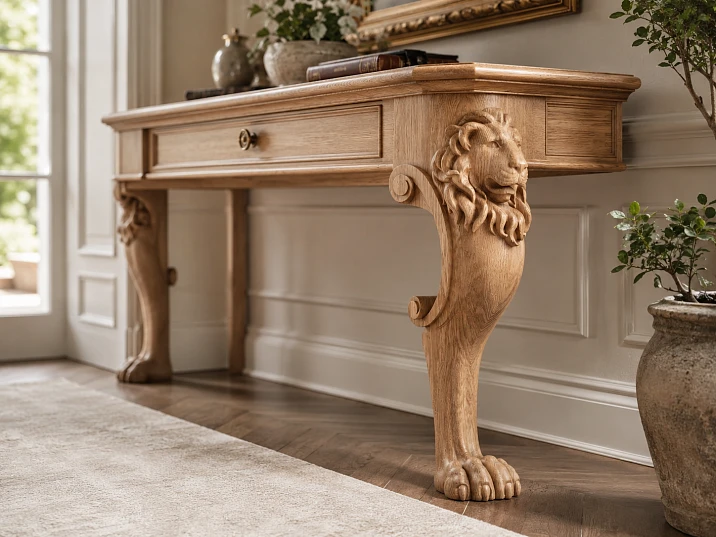
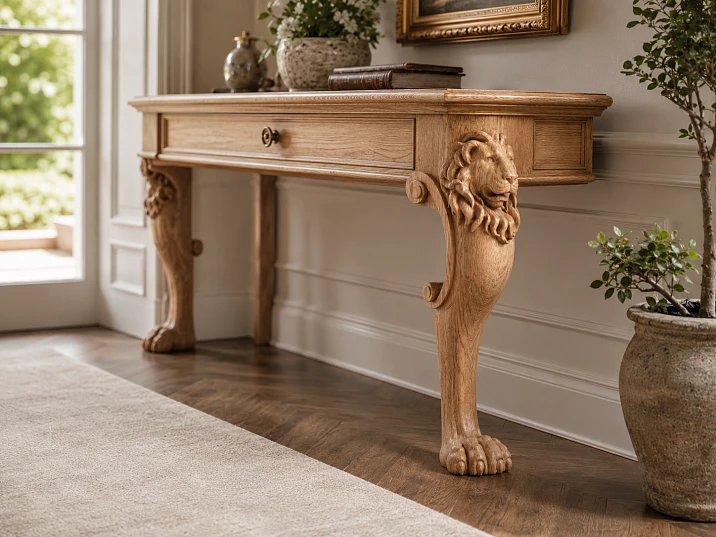
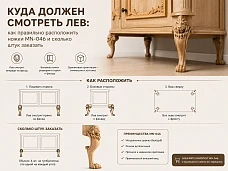
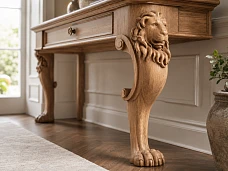
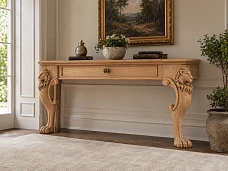
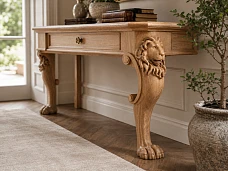
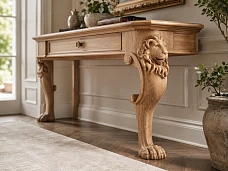
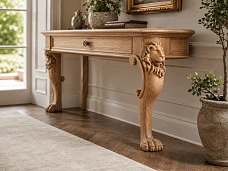
The carved furniture leg MN-046 with a lion's head immediately catches the eye. But precisely because of its expressive decor, it cannot be ordered using a simple scheme: "furniture has four corners — so we take four identical legs." The model has a noticeable front side, and the position of the head, mane, and relief changes when rotated. If you do not determine the place of each support in advance, after assembly some lions may end up facing the wall, inside the cabinet, or in different directions. The furniture will remain stable, but the decorative intent will be lost.
Therefore, before purchasing, you have to resolve several related questions at once. Which side of the furniture will be the main one? From where will the item most often be seen? Can MN-046 be rotated relative to the aprons? Do you need two decorative legs at the front or a full set of four? Which supports should be placed at the back? How to mark the parts before painting, and how many gliders should be added to the order?
MN-046 is suitable for armchairs, chairs, consoles, tables, beds, benches, and other furniture where the support should be a noticeable part of the appearance. However, the same pattern cannot be transferred from one piece to another without verification. In an armchair, the front and back legs often differ in design. A console stands close to the wall. A freestanding table is viewed from all sides. In a bed, the footboard and headboard are perceived differently.
Let's go through in order how to determine the main facade of the furniture and the front side of MN-046, when it is reasonable to order one piece for testing, in which cases two legs are enough, when a set of four is needed, what the dimensions 430 × 32 × 93 mm mean, how to choose beech or oak, how the "Standard" and "Prestige" sanding options differ, why the FUR-022 floor protector is needed, and what must be clarified before payment.
What needs to be decided before ordering
MN-046 has a pronounced lion's head, so it cannot be treated as a neutral symmetrical support. First, on the furniture plan, mark the main facade, left and right sides, back side, and main viewing points. Then, for each position, determine the desired direction of the carved head. Only after that, check against the current DWG, 3D model, or physical sample whether the leg design allows the required rotation and whether it correctly connects with the aprons or the body.
The quantity is chosen not by the beauty of the photo, but by the structure of the specific item:
- one MN-046 is needed when a sample, test finish, or fit check is required;
- two legs can be considered for visible front positions if the back supports have a different design and this solution is confirmed by the furniture project;
- four MN-046 are ordered only after checking all corners, the direction of the carving, and the connection of each support with the frame;
- floor protectors are calculated based on the number of legs actually installed;
- the composition of the fasteners is clarified separately, because from the general description it cannot be confidently assumed that they are included in the set.
If the project has not yet been broken down into positions, it is safer not to rush with the batch. To begin with, you can buy a carved leg MN-046 with a lion's head in the quantity of one piece to check the scale, direction of decor, mounting area, and future finishing. The sample is especially useful when furniture is designed for a specific room, and the sculptural support should look consistent with the facade, aprons, and adjacent decor.




How MN-046 differs from a regular furniture leg
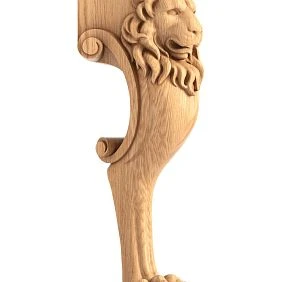
MN-046 is a wooden carved support with a lion's head. Its decorative part is not glued onto a finished leg as a separate flat piece, but rather forms the very appearance of the support. Due to this, the furniture receives not only a reliable support, but also a noticeable decorative detail: the head, mane, transition to the main part of the leg, and the lower support are perceived as a single form.
It is this integrity that distinguishes the model from a regular turned leg. A round or geometrically calm support can often be rotated without a noticeable change in perception. With MN-046, any rotation changes the direction of the gaze, the position of the mane, the visibility of the relief, and the relationship of the decor to the corner of the furniture. Turning the leg ninety degrees does not mean simply rotating the pattern. Along with the pattern, the mounting plane, the orientation of the cross-section, and the place where the aprons meet change.
The confirmed characteristics of the model are collected in the table.
| Parameter | Confirmed value | What this means for the buyer |
|---|---|---|
| Article number | MN-046 | By the article number, you need to verify the card, drawing, and request |
| Product type | Carved furniture leg | The support performs a structural and decorative function |
| Decor | Lion's head | The part has a pronounced direction and a front side |
| Size A × E × F | 430 × 32 × 93 mm | Need to check the height, joint thickness, and relief protrusion |
| Material | Beech or oak | Beech is suitable for painting with enamel, oak — for finishing that preserves the texture |
| Sanding quality | "Standard" or "Prestige" | The choice depends on the future coating and surface preparation requirements |
| Preparation of beech | For enamel | Suitable for opaque painting after proper preparation |
| Oak preparation | For tinting | Allows highlighting the natural wood grain |
| Condition | Without ready-made coating | Color and finish need to be planned separately |
| Drawing | DWG available | The turn and joint should be checked not only from the photo |
| Floor protection | Recommended foot cap FUR-022, D30 | The foot cap is counted as a separate item based on the number of supports |
The table provides a basis but does not replace design verification. For example, the numbers 32 and 93 mm do not by themselves indicate which side should face forward. You cannot assign a "face" to a leg just because one side is wider than the other. To do this, you need to compare the drawing, photo, head direction, mounting part, and placement of the crossbars.
It is also important to separate one leg from the set. A card for a separate item does not mean that two or four supports are automatically included in the price. Foot caps, fasteners, crossbars, or a finished furniture frame should not be considered included until the configuration is confirmed immediately before ordering.
Our factory also produces:
How to determine the main side of furniture
Most furniture items have a side that meets a person first. For a console, this is the facade facing the room. For a bed, it is the footboard and side sides visible from the entrance. For a table, it is the side perceived from a passage or seating area. For a chair, it is the front with the seat and armrests. Even if the item is formally symmetrical, the room makes it asymmetrical: one side stands against the wall, another faces the passage, a third is hidden by a sofa, and a fourth opens from the doorway.
With neutral legs, the direction attracts almost no attention. On a model with a lion's head, it immediately becomes noticeable. The carving can be turned toward the entering person, toward the main facade, outward from the corner, or arranged in pairs. Any of these options should first be checked against the appearance and construction of the furniture.
Get Consultation
How to determine the main facade
The main facade is not necessarily the longest side. It is the side that a person sees most often and from the most important point. For a console in a hallway, the main facade will be the plane facing the entrance. For a dressing table, it is the side with drawers and a place for a seated person. For a bed, the decision may depend on whether it is visible from the door in full or mainly from the side.
Before ordering MN-046, it is useful to draw a simple rectangle of the furniture and place an arrow labeled "main facade." Then mark the main observation points: door, sofa, passage, window, staircase, workspace. Such a diagram quickly shows which legs are truly visible and where the decor should be directed.
Left and right sides relative to the facade
Left and right sides are determined not by where a person stands during assembly, but relative to the chosen main facade. This seems obvious until the parts end up in the workshop separately from the furniture. After painting, four identical carved legs are easy to mix up. Therefore, positions should be marked in advance, rather than relying on the assembler's memory.
Do you need to consider the back side
The back side can also be visible. A console is sometimes moved, a chair is turned around, a table is pulled to the center of the room, a bed is separated from the wall. If an item is potentially visible from three or four sides, saving on detailing the back positions is risky. But this does not mean that MN-046 must be installed at the back. It means that the decision about the back supports should be deliberate and constructively confirmed.
How to determine the front side of MN-046
It is impossible to determine the face of the leg from a single photo. The image shows the product from a chosen angle, but does not fully reveal the shape of the top joint, the cross-section geometry, and the permissible installation directions. Additionally, a product photo may be taken to better show the carving, rather than how the part should be positioned in a specific piece of furniture.
A reliable check is based on a combination of several features:
- the direction of the lion's head;
- the position of the mane and the depth of the relief;
- wide and narrow sides of the leg;
- shape of the upper mounting zone;
- junction point of the front and side apron;
- extension of the decorative part beyond the body;
- position of the lower part and the foot block;
- ability to machine and assemble the part without damaging the thread.
For the project work, it is worth downloading the drawing MN-046 and comparing it with the frame plan. The section with drawings is useful not only for the designer. From the DWG, you can see in advance how the support fits into the corner of the furniture, which plane the apron occupies, whether the mane protrudes into the passage, and whether the desired head direction is maintained after rotation.
Can MN-046 be rotated 90 degrees
There is no universal answer without checking the drawing. The sculptural form may visually allow rotation, but the furniture joint does not. If the upper part is designed for a specific position of the stretchers, turning will change the structural scheme. It may turn out that the front stretcher lands on a narrow plane, the side one on a relief, and the mounting area no longer matches the project.
Therefore, the question should be formulated not as "can the leg be turned at all," but as "can MN-046 be installed in a specific position FL, FR, RL, or RR with this arrangement of stretchers." The more precise the request, the lower the risk of getting a part that is formally suitable but inconvenient to assemble.
Do left and right MN-046 exist?
There is no confirmation of separate L and R part numbers. One cannot promise a mirrored pair in advance or place an order as if left and right versions exist by default. If the project requires a mirrored thread direction, this issue should be agreed upon separately. Until confirmation, it is reasonable to assume that we are talking about a single model MN-046, and the possibility of forming a symmetrical pair needs to be checked based on geometry and available execution options.
How many MN-046 legs to order: one, two, or four
The quantity is not arithmetic by angles, but the result of a design decision. The same model can be purchased as a sample, used only on the facade, or form a complete set. Comparison helps to see the difference.
| Scenario | When considering | What to check | Main risk |
|---|---|---|---|
| One MN-046 | Sample, test finish, checking scale and fit | Material, sanding, decor direction, drawing | Order a batch before confirming all parameters |
| Two MN-046 | Two front visible positions, rear supports of a different model | Same height, load, mating, and style of rear legs | Accept a decorative pair as a ready-made structural solution |
| Four MN-046 | All sides are visible or the project requires a unified set | Rotation of each position, stretchers, stability, direction of heads | Get mismatched thread directions |
| MN-046 plus spare | Serial furniture, complex finishing, risk of damage during work | Matching of material, batch, sanding, and dimensions | Buying spare without understanding where and how it will be used |
When it is worth ordering one leg for a sample
One piece is useful not only for large-scale production. A private customer also benefits from a sample if the furniture is built around an expressive carved support. The physical MN-046 allows you to place it against the apron mock-up, put it by the wall, look at it from the doorway, assess the height, and check how large the lion's head looks in a real room.
A sample is especially justified in five cases:
- the furniture color is not yet approved;
- complex enamel, patina, or tinting is planned;
- the item will be placed in a narrow passage;
- the position of the aprons differs from the standard;
- a series of identical items is required, where the error will be multiplied by the quantity.
A test coat on one leg provides more information than a small wood swatch. Deep relief accepts primer, enamel, stain, and patina differently. On raised areas, the color looks lighter; in recesses, it appears deeper. It is on the full piece that you can see whether the mane pattern is lost or whether the contrast becomes excessive.
When you can consider two front MN-046
Two decorative legs make sense for furniture that constantly stands against a wall and is perceived primarily from the front. This could be the case for a console, a vanity table, a bed with a closed headboard, or a piece of case furniture where the rear supports are hidden.
But the phrase "it's not visible from the back anyway" does not replace calculation. The rear legs continue to bear the load, determine stability, height, and behavior of the furniture on the floor. If they differ from the front ones, the designer must coordinate them with MN-046 in terms of height, support area, material, attachment method, and frame operation.
You also need to check the side view of the furniture. A simple rear leg should not unexpectedly appear in a side angle and ruin the image. For a console, it is enough to step two steps to the side for the rear support to become visible. Therefore, before ordering, it is useful to make not only a front sketch but also two side views.
When four MN-046 are needed
A full set is justified for freestanding furniture viewed from all sides, as well as for a project where the lion motif should encompass the entire piece. This could be a table in the center of a dining room, an armchair in an open living room, a bench near a walk-in closet island, or a bed pulled away from the wall.
However, four identical parts do not yet form a coordinated set. You need to determine where each head is looking. Different artistic schemes are possible:
- all heads are directed toward the main facade;
- the front ones face forward, the side ones — outward;
- each head is turned away from the center of the furniture;
- the front and rear legs form separate pairs;
- the carving is oriented diagonally to the corner.
There is no universally correct scheme here. The suitable option is one that matches the shape of the specific furniture and actually assembles according to the drawing. First the artistic layout, then the structural check, and only after that — the order of four supports.
MN-046 for armchair and chair: why front and rear legs are checked separately
An armchair is one of the most complex scenarios for a carved support. Outwardly, it seems that the front pair sets the image, and the rear pair merely repeats it. In the actual structure, the rear legs often have a different inclination, participate in forming the backrest, or bear the load differently. Therefore, automatically placing four MN-046 on any armchair is not allowed.
The front legs are in the direct line of sight. Here, the lion's head can emphasize the line of the armrests, the width of the seat, and the connection of the carved apron with the lower part of the furniture. But even for the front pair, it is necessary to check whether the decor reads the same on the left and right. If both parts have the same carving direction, the symmetry may turn out to be not mirror but repeated. Sometimes this looks intentional, sometimes — like a mistake.
The rear positions require a separate answer to three questions. First: do the legs continue the backrest posts. Second: do they have a structural inclination. Third: are they visible from the side. If at least one answer indicates a difference from the front pair, designing four identical supports is risky.
For the initial selection, you can select supports for the chair and compare MN-046 with other models by height, shape, and purpose. To understand the structural difference itself, it is useful to study the material about how front and rear legs differ. Such a route does not replace the chair drawing, but helps avoid a typical mistake: not taking the decorative appeal of the front leg as proof of its universality for all four corners.
What to check for the chair
Create front, side, and top views. On the top view, mark the head direction of each proposed MN-046. On the side view, check whether the thread protrudes beyond the armrest line and does not fall into the leg area. On the front view, assess the distance between the lion heads and their size relative to the seat width.
Next, match the leg with the apron. A narrow connection zone may require a different position of the part than what looks nice in the facade sketch. If aesthetics and construction conflict, the issue cannot be resolved only by rotating the image. You need to change the frame, choose another support, or agree on an individual solution.
When two MN-046 for a chair look more convincing than four
Two front sculptural legs can be stronger than a full repeat if the rear part of the chair is structurally calmer. This approach creates a hierarchy: the front part gets expressive decor, the sides remain assembled, the back is not overloaded. But the rear supports must be selected not randomly. Their shape, material, and finish must support the front pair, and the height and attachment must match the calculation.
MN-046 for a table and console: how to coordinate decor with aprons
A table seems simpler than a chair: a rectangular top, four corners, four legs. It is this simplicity that is misleading. In a table, each support is connected to at least two aprons, and a person views it from different sides and approaches closely. The sculptural relief may end up near knees, protrude into a walkway, or be hidden under the tabletop.
To begin with, it is worth choosing wooden table legs and matching the artistic task with the proportions of the tabletop. MN-046, with a height of 430 mm, should not be perceived as a universal dining table leg just because tables are mentioned in its purpose. The total height of the furniture consists of the leg, the apron belt, the underframe, and the tabletop. The project should provide the final ergonomics, not just beautifully place a carved element.
Freestanding table
A table in the center of a room has no true "back" side. People walk around it, sit in different places, and see the ends and diagonal angles. Here it is especially important to decide whether the heads should face outward from the center, along the long sides, or toward one main facade. It is useful to make four images of the table from each side. If in one angle the composition looks convincing, but in the opposite one two heads end up turned inward, the layout must be changed before ordering.
One must not forget about everyday use either. A protruding relief should not interfere with knees, catch clothing, or fall into the zone where a chair constantly hits the leg. The sculptural support is designed for expressiveness, but it should be protected from repeated mechanical impacts by the furniture layout.
Console against a wall
A console most often has an obvious main facade. The front legs are open, the rear ones are close to the wall, and the view is from the front and diagonally. Here, a pair of MN-046 can be a logical solution if the rear part of the frame rests on other legs that are consistent in design or is attached to the wall according to the project.
But a narrow console is sensitive to stability. One cannot rely only on the fact that the rear supports are barely visible. Their position, footprint area, and connection to the frame determine how confidently the piece stands on the floor. The decision about two decorative legs should be made not only by the designer but also by the structural engineer.
For a console, a full-size template is especially useful. Cut out the contour of MN-046 from cardboard in the front view according to the drawing, attach it to the installation site, and look from the entrance area. This makes it clear whether the lion's head is too large for a narrow body and whether it conflicts with the floor plinth.
MN-046 for a bed, bench, and dressing table
A bed has two noticeable parts: the headboard and the footboard. The headboard is often pushed against the wall, while the footboard faces the room. Therefore, four identical sculptural supports are not always needed and are not always perceived the same way. The front pair at the footboard can become an expressive finish, while the rear positions are hidden by textiles, the body, or bedside tables.
At the same time, the bed experiences dynamic loads, it is moved during cleaning, and sometimes disassembled during a move. A leg with deep relief must be integrated into the structure so that the decorative part does not take random impacts. It is necessary to check whether the lion's head protrudes into the passage, whether it catches on the bedspread, and whether assembled elements can be safely carried through the doorway.
A bench is often viewed from four sides, especially if it stands in the center of a dressing room, at the foot of a bed, or in a spacious hallway. Here, a full set of MN-046 can look expressive, but only with careful arrangement. On a small bench, four lion heads can overload a small piece. Sometimes two front carved supports and two calmer rear ones create better balance.
A dressing table combines the properties of a console and a workspace. It is necessary to preserve legroom, check the position of the drawers, and not direct protruding decor into the seating area. If the table stands against a wall, the front pair is more important than the rear. If it is part of an island dressing room, a circular view will be required.
Size MN-046 430 × 32 × 93 mm: what the parameters mean in finished furniture
The parameters A × E × F — 430 × 32 × 93 mm — are useful only when translated into the language of a specific structure. The mistake begins where the buyer sees the height of 430 mm and decides that this is enough for a choice.
Height 430 mm
The height of the leg affects the overall height of the furniture, but is not equal to it. For a chair, elements of the seat, aprons, filling, and upholstery are added on top. For a table — the underframe and tabletop. For a bed — the frame, base, and mattress. Therefore, first determine the desired final height, then subtract the other structural layers and check whether MN-046 is suitable.
Height also affects the perception of proportions. A sculpted leg 430 mm long requires sufficient space so that the carving does not look cramped between the floor and the massive body. If the apron is too high or the facade overhangs above the lion's head, the effect is lost. If the body is too light, the support may seem disproportionately monumental.
Size 32 mm
The smaller cross-sectional dimension is related to the thickness of one of the sides, but it cannot automatically be considered the front or side plane. It is important for mating with the apron, placement of fasteners, and assessing the strength of the joint. The designer must check whether there is enough area for the chosen connection and whether the fastener falls into the relief part.
Size 93 mm
The larger cross-sectional dimension shows a noticeable protrusion of the shape. For the buyer, this means that the leg occupies not only a point at the corner of the furniture but also real volume. It is necessary to check the distance to the wall, baseboard, neighboring furniture, the legs of a seated person, and passage. Especially careful attention is paid to the corners of consoles and beds: protruding decor easily ends up where it will be bumped.
Why a 1:1 template is needed
A drawing on screen does not always convey scale. A printed outline at full size helps to see how MN-046 relates to the furniture. The template can be applied to the front, transferred to the side view, checked for height relative to the seat, and the protrusion of the carving can be marked on the floor with painter's tape.
For a professional project, it is useful to check the layout of furniture legs together with the entire appearance of the furniture. Such a check is especially important if MN-046 is combined with carved aprons, overlays, or cornices. An expressive leg must be coordinated with the other details, not coexist with a random set of decor.
Beech or oak: how the material affects finishing and appearance
MN-046 is available in beech or oak. The choice of wood species affects the future finish, the perception of carving, and the combination with other furniture details. The material cannot be chosen solely by name or the master's habit.
Beech for enamel
Beech is logical for a project with opaque painting. Enamel unifies the leg, aprons, and body into one color, so the carving is read through light and shadow, not through the wood grain. This suits white, milky, gray, deep colored, or complex patinated furniture.
When choosing enamel, it is important not to flood the fine relief with a thick layer of primer and coating. The sculptural lion's head relies on depth transitions: mane, forehead, muzzle, side planes. If preparation is excessive, the edges become soft and the character of the image is lost. Therefore, a test paint on one part is more useful than a theoretical color choice from a fan deck.
Beech MN-046 can support a classic interior without showing natural texture. It works well where furniture should be uniform in color: in a light bedroom, formal living room, study with painted panels, hotel room, or salon.
Oak for tinting
Oak is chosen when it is important to preserve the visible wood texture. Staining, oil, or varnish allow the carved image to be linked with oak aprons, tabletop, facades, or wall panels. The relief gains additional depth: wood fibers interact with shadows and make the surface lively.
But oak requires careful selection of adjacent parts. If the legs are made of oak and the body is made of a material with a different texture and shade, the difference may look random. The solution must be either unified or intentionally contrasting. Simply a "similar brown color" does not guarantee consistency.
The stain should be evaluated on the actual wood species and preferably on the full relief. In recesses, the compound may accumulate more strongly than on flat surfaces. This emphasizes the mane, but with excessive contrast, the lion's face becomes harsh and blotchy.
Comparison of beech and oak
| Criterion | Beech | Oak |
|---|---|---|
| Suitable finish | Opaque enamel | Tinting while preserving texture |
| Visual accent | Shape, light and shadow, coating color | Shape plus pronounced wood texture |
| Combination with the body | Convenient to combine with a common opaque finish | Better to coordinate with oak or similar character details |
| Risk during finishing | Losing fine relief under a thick layer | Getting uneven or overly contrasting tone in recesses |
| When it is especially appropriate | Light and colored classic furniture | Natural, dark, cabinet, and historical interiors |
"Standard" or "Prestige": how to choose the quality of sanding
The "Standard" and "Prestige" options refer to the quality of surface preparation. These are not two different designs or two types of wood. The choice depends on what coating is planned, how carefully the relief should be read, and how much manual preparation the craftsman is ready to do before the finish.
Before ordering, it is useful choose "Standard" or "Prestige" taking into account the future finish. For simple opaque painting and subsequent preparation in your own workshop, one option may be suitable. If the surface needs to be better prepared for fine decorative finishing, the sanding requirements will be higher.
A sculpted leg is more complex than a smooth part. It has recesses, protrusions, transitions, areas where fibers intersect, and sections that are difficult to reach with ordinary sanding tools. Therefore, saving time on preparation should be done deliberately. If the workshop is not ready to manually finish deep carving, more thorough initial sanding may be more important than the difference in cost.
When the surface needs to be evaluated especially strictly
Increased attention is required for glossy enamel, thin light-colored paint, contrasting patina, and transparent oak finishes. Such coatings reveal defects rather than hide them. Matte enamel is more tolerant of minor differences, but even it will not fix damaged edges or carving clogged with primer.
Before launching a series, it is worth agreeing on a technological map: sanding, dust removal, primer, interlayer treatment, finish. It is useful to study in advance recommendations for finishing carved wood, and then adapt them to the chosen coating and workshop conditions.
How to use the lion motif without overloaded decor
The lion's head carries a strong historical image. It is associated with power, protection, dignity, and grandeur. But a modern interior does not require literal reproduction of palace furniture. MN-046 can sound different depending on the material, color, body shape, and number of repetitions.
Empire style and formal classicism
Here the lion motif reads naturally. Symmetrical facade design, dark oak, deep tinting, patina, or rich enamel will work. The legs need to be coordinated with the proportions of the aprons and the body. A too-thin tabletop or an extremely minimalist facade may look too light next to a sculptural support.
Neoclassicism
In a neoclassical project, it is better to give MN-046 the role of the main decoration and reduce the amount of neighboring decor. Smooth facades, a calm cornice, clean upholstery, and restrained color allow the lion's head to look expressive without overload. Here, two front legs are often more convincing than four equally active positions.
Eclecticism
An eclectic interior allows contrast: a carved support can hold a minimalist body, an unusual tabletop, or modern fabric. But the contrast must be cohesive. Repeat the material or color of the leg in at least one detail: handle, frame, baseboard, tabletop, or upholstery trim. Then the lion motif will look like part of the design, not a random quote.
Commercial interior
In a hotel, restaurant, salon, or showroom, MN-046 can become a memorable signature. Here, visibility, wear, and safety are especially important. The sculptural part cannot be placed in a narrow passage. The finish must match the load, and spare parts and the marking scheme should be stored with the project documentation. For a furniture series, it makes sense to first approve one fully assembled and painted sample.
What to order together with MN-046
An expressive leg rarely exists on its own. It needs a frame, clear mounting, floor protection, and coordinated finishing. The mistake in many orders is not in choosing the MN-046 itself, but in remembering the accompanying elements after receiving the goods. Then it turns out that the glides are not counted, the fasteners are not confirmed, the rear supports differ in height, and
Glide FUR-022
For MN-046, a round glide D30 FUR-022 is recommended. It protects the lower part of the leg and the floor surface, but should be considered as a separate item. If two MN-046 are installed, the basic calculation is two glides; if four, then four. Final compatibility and installation scheme must be confirmed according to the project.
You can buy round glide FUR-022 D30 at the same time as the legs, so as not to look for floor protection after assembly. If the project requires other fastening or protective parts, you should view fasteners and glides for furniture legs and verify each item by purpose and size.
Kit table
| What to add to the purchase | Why this is needed | For which scenario | What to Check |
|---|---|---|---|
| Foot pad FUR-022 D30 | Floor and lower part of the support protection | For each installed MN-046 | Compatibility, quantity, and installation method |
| Fasteners for legs | Connection of the support to the stretcher or body | Any assembly | Type, length, quantity, seating depth, and disassembly possibility |
| Rear supports of a different model | Formation of a mixed set of two carved and two plain legs | Chair, console, bed against the wall | Height, load, material, side visibility |
| Materials for a test sample | Checking color and preservation of relief | Enamel, tinting, patina | Compatibility of the coating system and layer sequence |
| Drawing or 1:1 template | Checking scale, rotation, and alignment | Custom furniture and series | File relevance and correct print scale |
| Marking labels | Preserving positions after finishing | Set of two or four legs | Designation of the facade and each position |
An accompanying purchase should not turn into an automatic upsell. Each part is justified only when it solves a specific project task. There is no need to order random fasteners "just in case" or choose a floor glide only by outer diameter without checking the fit.
How to distinguish MN-046 from a mascaron, overlay, and other parts
The phrase "lion's head" appears in various types of decor, but the products serve different functions. A mascaron is attached to the surface of a facade or wall. An overlay decorates an existing part. A baluster is part of a railing. A stair post forms a stair node. MN-046 is a furniture support that must fit into the frame and bear the load according to the project.
A similar decorative motif does not make products interchangeable. You cannot take a flat lion mascaron and consider it an alternative to a carved leg. You also cannot choose any "lion's paw" made of metal or polymer just by image without comparing height, material, fit, and mounting method.
MN-046 should also not be confused with low sofa legs. The height of 430 mm sets a different scale and scope of tasks. It is suitable for furniture where the support noticeably affects the overall silhouette, not just lifts the body off the floor.
Signs by which the required product is checked
- exact article number MN-046;
- full name of the carved furniture leg;
- size 430 × 32 × 93 mm;
- material — beech or oak;
- condition without finished coating;
- sanding options "Standard" and "Prestige";
- availability of DWG for project verification;
- recommended foot cap FUR-022 D30.
If at least one key parameter differs, you may be looking at a different model or a different type of product. The article number is more important than the colloquial name "lion's foot," because similar motifs can repeat across different collections and sizes.
How to choose a configuration for specific furniture
Need to update an old chair
First, remove the old supports and measure not only their height, but also the mounting area, tilt, fastener position, and the connection of the rear legs to the backrest. If the rear posts continue the backrest frame, replacing them with MN-046 without reworking the design is most likely impossible. The front pair may work as a decorative update, but only after checking the final seat height and joint strength.
Don't start with painting. First, assemble the chair dry or do a trial fit of one leg. Make sure the lion faces the right direction, the relief isn't covered by the apron, and the seated person's knees don't touch the protruding part.
Need to make a console against the wall
Determine the cabinet depth and the distance from the rear apron to the baseboard. Draw a side view: sometimes the wide part of MN-046 requires more space than it seems from a front photo. If only two carved front legs are planned, the rear supports should be selected by height and load, not by visual similarity.
On the floor, mark the console outline and leg overhang with painter's tape. Walk past it, open the door, check cleaning. This simple test shows whether the lion's head will end up in a high-impact zone.
Need to assemble a table that is visible from all sides
Make four elevations and a top view. For each position, draw an arrow for the head direction. Check space for legs and chairs. If all four MN-046 look good only from one side, look for a different rotation scheme or change the model. Separately, check how the aprons fit the wide and narrow planes.
Need to style a bed
Decide where the main decorative accent will be: at the foot, on the sides, or in all four corners. Consider the bedspread, nightstands, and walkway. The protruding relief at the foot should not be where a person walks at night. If the bed is disassembled, the fasteners and markings should allow repeated assembly without mixing up parts.
Need to order a series of furniture for a hotel or restaurant
Do not launch a batch based on one beautiful render. Produce and approve a full sample: frame, four sides, coating, glides, real load, and daily cleaning conditions. Document photos of each position, markings FL, FR, RL, RR, finishing technology, and component list. Then a repeat order will rely on documentation, not memory.
How to mark a set and not mix up the legs
Even if all MN-046 are physically identical, they get different roles in the project. Convenient internal marking:
- FL — front left;
- FR — front right;
- RL — rear left;
- RR — rear right.
These markings are not manufacturer part numbers. They are needed by the workshop, finisher, and assembler. On each package, additionally place an arrow pointing toward the main facade. On the plan, the same arrow should be shown next to the furniture.
Marking must be done before painting. After enamel or tinting, temporary inscriptions on the part itself are unacceptable, and visually similar legs are easy to mix up. Attach the label to the packaging or to a safe area without damaging the wood. If legs are shipped between workshops, include a printed plan with the set.
For the two front MN-046, markings FL and FR are sufficient, but the rear supports should also be marked. Otherwise, during assembly, the left and right sides of the frame can be swapped, especially if mounting holes are pre-drilled.
Mounting and assembly: what to clarify before starting work
The composition of the fastening kit cannot be considered definitively confirmed. Before payment, you need to request the type of fastener, its quantity, the connection diagram, requirements for the side rail, seating depth, and the possibility of disassembly. These questions are especially important for a bed, table, and furniture that is transported in parts.
The leg should not be attached through decorative relief. The load-bearing joint is placed in the designated mounting zone. Independently moving holes without a drawing can weaken the wood, bring the fastener close to the edge, or damage the threads.
Dry assembly before finishing
Pre-assembly allows you to see errors that become expensive after painting:
- the leg is turned the wrong way;
- the side rail covers part of the mane;
- the distance between supports is different;
- one lion looks inward, the other outward;
- the foot pad changes the height or position of the leg;
- It is impossible to tighten the fastener without risking damage to the decor.
After inspection, the parts are removed, marked, and only then sent for finishing. If holes and joints are fitted by hand, each leg must return to its place.
Thread protection during installation
The lion's head cannot be used as a handle when carrying. The part is supported by structurally strong areas. The work surface is covered with a soft, clean material, and the tool is positioned so that it does not slip onto the protruding relief. Protective packaging is removed only in the connection area, if possible.
Mistakes when choosing and ordering MN-046
Ordering four legs without a plan
The number of corners does not prove that four identical supports will rotate correctly. First, you need a top view with head directions and aprons.
Choosing only from a front photo
The photo shows the appearance, but not the full geometry. Without DWG, it is impossible to confidently assess the rotation, mounting plane, and relief offset.
Assuming the model is symmetrical around the vertical axis
The lion's head sets the direction. Even if the dimensions allow turning the leg, the overall appearance of the furniture changes.
Come up with left and right versions
Separate L and R options are not confirmed. Mirroring needs to be coordinated, not built into the project as an existing fact.
Mix the concepts of "front" and "left"
The front position is determined by the facade, the left — by the position relative to it. Without a unified marking system, assemblers understand these words differently.
Use MN-046 on the front and back of the chair without checking
The rear legs may have a different tilt and continue the backrest. Decorative sameness does not negate the structural difference.
Not taking into account the 93 mm overhang
The sculptural part takes up space. It can hit the baseboard, narrow the passage, or be hit by the chair.
Assuming the foot cap is included automatically
FUR-022 is a separate item. Its quantity and compatibility need to be checked in advance.
Consider the fasteners as known
The general field about hardware does not replace an exact list. The type and quantity of fasteners are confirmed before ordering.
Order a batch without a test sample
On deep relief, the coating looks different than on a flat sample. A color or layer thickness error will repeat across the entire batch.
Paint before marking
After finishing, identical parts can easily be swapped. Positions and the direction of the facade are fixed in advance.
Mix beech and oak in one set
Different wood species look and accept coating differently. A mixed set is possible only as a deliberate project, not as a random replacement.
Who MN-046 suits, and who should choose a different model
MN-046 is suitable for those who create furniture with a clearly defined facade and view the support as part of the structure and appearance. It fits well in classic, Empire, neoclassical, eclectic styles, executive offices, hotel, or restaurant interiors. The model is especially strong when the lion's head is supported by the proportions of the body, the material, and restrained neighboring decor.
It suits workshops and designers who work with drawings, do dry assembly, test finishes, and marking. For a serial project, such discipline is especially valuable: an expressive detail becomes reproducible rather than dependent on the assembler's random decision.
It's better to choose another model if a neutral support is needed that can be turned in any corner without hesitation; if the furniture is minimalist and should not have a historical motif; if the passage is too narrow for the protruding relief; if the design requires rear legs with a tilt; if the project does not allow checking the fit and direction before finishing.
MN-046 should also not be chosen just for the word "lion." An expressive motif requires appropriate scale and free space. On a small body, four heads may look cramped, and on a too massive one, they may get lost. An honest choice sometimes means giving up a liked detail in favor of another carved or turned support that better matches the frame.
How to place an order for MN-046 at STAVROS
A good request saves time and protects the project from incorrect assumptions. It's not enough to write: "Need four lion legs for a table." The manager will see the product, but not your furniture, the direction of the facade, the position of the aprons, and the future finish.
Before placing an order, gather a short package:
- name of the furniture item;
- dimensions of the body or frame;
- top view with the main facade;
- number of expected MN-046;
- head direction for each position;
- material — beech or oak;
- grinding quality — "Standard" or "Prestige";
- expected coating;
- furniture disassembly requirements;
- list of glides and fasteners that need to be confirmed.
If you are just starting to understand supports, it is useful to first read how to choose wooden furniture supports, and then return to the specifics of MN-046. The general material will help check the height, purpose, and structural logic, but the final decision on the lion head direction is made separately for a specific article.
Example of a detailed request
Need a carved furniture leg MN-046 measuring 430 × 32 × 93 mm for a console against the wall. The main facade is marked with an arrow on the attached plan. Two MN-046 are assumed in the front positions FL and FR; the rear supports are designed separately. Material — beech, finish — opaque enamel, sanding quality — “Prestige”. We ask to confirm the possibility of the shown head direction, current DWG, acceptable connection with aprons, fastener composition, and compatibility with the FUR-022 D30 glide. First, one leg is required for a dry fit and test finish, after approval — the main quantity.
Such a request does not guarantee automatic approval of the scheme, but it allows getting a substantive response. It contains no invented conditions, but has all the parameters on which the purchase depends.
What to check before payment
Check the project item by item. If there is no answer to at least one question, it is better to stop the order and clarify the data.
- Is the article MN-046 specified without errors?
- Does the size 430 × 32 × 93 mm fit the frame?
- Is the main facade of the furniture determined?
- Is the direction of the lion's head set for each leg?
- Are the front, side, and top views checked?
- Is the current DWG opened?
- Is the allowable rotation confirmed structurally?
- Is it decided whether one, two, or four MN-046 are needed?
- Are the back legs and backrest checked separately for the chair?
- Are the aprons and legroom checked for the table?
- Are the wall and baseboard taken into account for the console?
- For the bed, are the footboard, passage, and disassembly taken into account?
- Is one material selected for the agreed set?
- Is the sanding quality determined?
- Has a test paint-out been done or planned?
- Is the fastener composition specified?
- Is the quantity of FUR-022 calculated?
- Is the marking FL, FR, RL, RR prepared?
- Is the completeness of each item checked?
- Are the current price, availability, and lead times reviewed immediately before placing the order?
The last point is crucial. Price and stock status change, so they should not be carried over from an old note or saved image. You should rely on the current product card and order confirmation.
Frequently asked questions about MN-046
Which direction should the lion's head face on MN-046?
There is no single direction for any furniture. First, determine the main facade and key viewing points, then set the direction of each leg on the plan. After that, check in DWG whether the design allows the required rotation and whether the support connects correctly to the aprons.
Can I simply place all four heads facing forward?
Only if such a layout suits the appearance and construction in all positions. The position of the aprons differs at the side and rear corners, so the same head direction may require different leg rotation. The solution needs to be checked against the top view and the drawing.
How many MN-046 should I order for one chair?
The number depends on the construction. For a chair, different front and rear supports are often used, because the rear legs may have a tilt or continue the backrest. Two MN-046 can be considered as a front decorative pair, while four should only be used after checking the entire frame.
Will MN-046 work for a table?
The model can be used for tables, but the size and connection need to be checked in the project. The leg height is 430 mm, and the final table height also depends on the underframe and tabletop. It is important to preserve legroom and position the aprons correctly.
Can I install two MN-046 on a console and use other legs at the back?
Such a scenario is possible after a constructive check. The rear supports must match in design height, maintain stability, correspond to the fastening, and not look random when viewed from the side. Simply hiding random legs against the wall is not enough.
Is there a left and right version of MN-046?
Separate L and R part numbers are not confirmed. You should not order a "left" and "right" version as existing standard items. For a symmetrical project, you need to check the possibility of rotating one model and, if necessary, agree on the solution separately.
What does the size 430 × 32 × 93 mm mean?
These are confirmed parameters A × E × F. The height of 430 mm affects the overall height of the furniture. The cross-sectional dimensions of 32 and 93 mm are important for the seating area, the connection with the aprons, and the relief offset. They do not by themselves allow determining the front side of the leg.
What to choose: MN-046 in beech or oak?
Beech is prepared for enamel and is suitable for opaque painting. Oak is prepared for tinting and is appropriate when you need to preserve the visible wood texture. The choice should be coordinated with the material of the body, aprons, and other wooden parts.
Is MN-046 sold already painted?
The confirmed condition is without a ready-made coating. Future enamel, tinting, or another finishing system is planned separately. Current service options and conditions should be clarified before ordering.
How does 'Standard' differ from 'Prestige'?
These are surface sanding quality options. For a carved leg, the difference is important due to the deep relief and hard-to-reach areas. You should choose taking into account the future coating and how much manual preparation will be done in your workshop.
Do I need to order one leg first?
For a complex individual project, this is a reasonable approach. One MN-046 allows you to check the scale, fit, direction of the decor, offset relative to the body, and the result of a test finish. After approval, you can order the main quantity.
Is the mounting hardware included in the kit?
The exact composition of the fasteners cannot be considered confirmed based on the general description. Before payment, request the type, quantity, connection diagram, requirements for the apron, and the possibility of disassembling the furniture.
Is a FUR-022 floor glider needed for each leg?
The card recommends a round floor glider D30 FUR-022. Basically, its quantity corresponds to the number of installed MN-046: two gliders for two legs, four for four. Compatibility and installation method need to be confirmed according to the project.
Can the direction be determined from a product photo?
A photo helps assess the appearance but does not replace a DWG. It does not fully show the mounting surface, the connection with the aprons, and the behavior of the leg after rotation. For ordering a batch, one angle is not enough.
How not to mix up the legs after painting?
Before finishing, assign designations FL, FR, RL, and RR to the positions, mark the main facade with an arrow, and keep the diagram in the packaging. After a dry assembly, each leg should return to its place.
Will MN-046 suit a modern interior?
Yes, if you use it as one strong historical motif and don't overload the furniture with other decor. A laconic body, restrained finishing, and repeating the material in several details help integrate the sculptural support into modern eclecticism or neoclassicism.
What to do if the required leg rotation doesn't fit the apron?
Do not relocate fasteners or trim the relief without a design solution. Possible paths are to change the frame construction, choose a different direction scheme, use MN-046 only in front positions, or select another support model.
Where can I check the current price and availability of MN-046?
In the product card, right before placing the order. Don't rely on saved screenshots, old publications, or the price of a similar leg. Also, separately check the cost of the selected material, sanding, and related items.
Summary: first determine the direction, then the quantity
MN-046 attracts attention with the lion's head, but a successful project starts not with a symbol or a striking photo. It starts with a plan. Where is the main facade? From where will a person see the furniture first? Which leg will be front left, which rear right? Can each support be rotated without conflict with the aprons? Are four sculptural positions needed, or are two enough, with the rest having a different construction?
Once these questions are resolved, the model reveals its strength. The 430 mm height makes the support noticeable, the relief ties it to the overall furniture image, beech allows painting the leg in one color with the body, and oak preserves the live wood grain. Sanding options help align the initial preparation with future finishing, and the FUR-022 floor protector helps protect the floor and the lower part of the support.
The most expensive mistake here is not choosing the "wrong style." It's much more dangerous to order four identical legs without a layout, paint them, and then discover that two heads face inward, the apron overlaps the mane, the rear chair position requires a tilt, and the floor protectors are forgotten. Such problems are prevented by one sequence: drawing, facade plan, dry assembly, marking, test paint, confirmation of the configuration, and only then the batch.
STAVROS allows you to select MN-046 together with categories of wooden supports, drawings, surface preparation options, and furniture hardware. The buyer's main task remains—not to turn an expressive carved leg into a random decoration. Define the face of the furniture, assign a direction to each lion, calculate the real quantity, and place the order as a complete system, not as a set of beautiful parts.